UNIVERSITY OF HOHENHEIM GERMANY
Department of Agricultural Economics and Social Sciences in the Tropics and Subtropics Rural Development Theory and Policy
Prof. Dr. Manfred Zeller
Impact evaluation of improved rice varieties and farmer training on food security and technical efficiency in The Gambia
Dissertation submitted in fulfilment of the requirements for the degree “Doktor der Agrarwissenschaften” (Dr.sc.agr. / Ph.D. in Agricultural Sciences) to the Faculty of
Agricultural Sciences
Presented By
Lamin Dibba
Place of birth: Brimaka, The Gambia
This thesis was accepted as a doctoral dissertation in fulfilment of the requirements for the degree “Doktor der Agrarwissenschaften” by the Faculty of Agricultural Sciences at University of Hohenheim in August 2015.
Date of oral examination: 17 December 2015.
Examination Committee
Supervisor and Reviewer Prof. Dr. M. Zeller Co-Reviewer Prof. Dr. S. Abele Additional examiner Prof. Dr. C. Lippert Head of the Committee Prof. Dr. T. Streck
ii Table of contents List of tables ... v List of figures ... vi Acknowledgements ... vii Executive summary ... ix Zusammenfassung... xiv Chapter 1 ... .1 1. Introduction ... 1 1.1 Background ... ...1
1.2. NERICA and food security... 3
1.3 Agricultural training and technical efficiency ... 5
1.4 Study objectives, research questions and hypotheses ... 6
1.4.1 Specific objectives ... 6
1.4.2 Research questions and hypotheses ... 7
1.5 Organization of dissertation ... 8
Chapter 2 ... 11
2. Methodological framework ... 11
2.1 Research area, sampling and data collection ... 11
2.1.1 Research area ... 11
2.1.2 Sampling and data collection ... 12
2.2 Food security indicators ... 13
2.3 Estimating technical efficiency ... 15
2.4 Overview of impact evaluation methods ... 18
2.4.1 Impact evaluation problem and the potential outcome framework ... 18
2.4.2 Randomized impact evaluation ... 19
2.4.3 Impact evaluation using matching approach ... 21
2.4.4 Impact evaluation using instrumental variable approach ... 24
2.4.4.1 Two-Stage Least Square (2SLS) Approach ... 25
2.4.4.2 The LATE approach ... 26
2.4.5 Impact evaluation using double difference approach ... 27
2.4.6 Impact evaluation using regression discontinuity designs ... 29
2.4.7 Conclusions ... 30
iii
3. How accessibility to seeds affects the potential adoption of an improved rice
variety: The Case of New Rice for Africa (NERICA) in The Gambia ... 33
3.1 Introduction ... 34
3.2 Conceptual framework ... 36
3.2.1 Technology awareness and access ... 36
3.2.2 Actual and potential adoption ... 37
3.2.3 Hypothesized determinants of adoption... 37
3.3. Sampling procedure and data ... 39
3.4. Empirical framework ... 40
3.4.1 Sample adoption rate... 40
3.4.2 Potential outcome framework and evaluation problem ... 41
3.4.3 Population adoption gaps and selection bias ... 43
3.4.4 ATE estimation of the population adoption rate and its underlying assumptions ... 45
3.4.4.1 Assumptions of ATE estimation ... 45
3.4.4.2 Parametric estimation of ATE ... 46
3.5. Results and discussions ... 47
3.5.1 Socio-demographic characteristics of farmers ... 47
3.5.2 Actual and potential adoption rates... 49
3.5.3 Determinants of access, exposure, and adoption of NERICA ... 51
3.6 Conclusions ... 56
Chapter 4 ... 63
4. Impact of NERICA adoption on household food security and health in The Gambia ... 63
4.1 Introduction ... 64
4.2 Sampling procedure and data ... 66
4.2.1 Food security and health outcome indicators... 67
4.2.1.1 Calculation and analysis of the Food Consumption Score ... 67
4.2.1.2 Calculation and analysis of sick days per capita ... 69
4.3. Theoretical framework ... 70
4.3.1 The problem with impact evaluation ... 70
4.3.2 Identifying causal effects ... 71
4.3.3 The Instrumental Variable approach ... 73
4.3.4 Estimators and estimates ... 74
iv
4.4.1 Descriptive analysis ... 76
4.4.1.1 Socio-demographic characteristics of households ... 76
4.4.1.2 Identifying impact based on observed differences ... 78
4.4.2 Econometric analysis ... 80
4.4.2.1 Impact of NERICA adoption on household food security and its determinants ... 80
4.4.2.2 Impact of NERICA adoption on household health status and its determinants ... 84
4.5 Conclusions ... 88
Chapter 5 ... 94
5. Impact of agricultural training on technical efficiency of smallholder rice farmers in The Gambia... 94
5.1. Introduction ... 95
5.2. Agricultural rice-farmer training programs in The Gambia ... 97
5.3. Sampling and data ... 98
5.4. Empirical framework ... 99
5.4.1 Estimating technical efficiency ... 99
5.4.2 Estimating the impact of agricultural training ... 103
5.4.2.1 A balancing test for matched covariates ... 106
5.4.2.2 Sensitivity analysis to test the Conditional Independence Assumption ... 106
5.5. Results and discussions ... 107
5.5.1 Socio-demographic characteristics of households ... 107
5.2 Determinants of technical efficiency ... 108
5.5.3 Descriptive analysis of the impact of agricultural training on technical efficiency... 112
5.5.4 Propensity score matching ... 113
5.5.4.1 Estimating the propensity score ... 113
5.5.4.2 Choosing a matching algorithm ... 115
5.5.4.3 Balancing test ... 116
5.5.4.4 Sensitivity analysis ... 117
5.6. Conclusions ... 124
Chapter 6 ... 131
6. Summary, conclusions and policy implications... 131
6.1 Summary of main findings and interpretations ... 131
v
6.3 Conclusions and policy implications ... 134
List of tables
Table 2.1: Compliance type by treatment and instrument ... 27 Table 3.1: Comparing 2006 and 2010 survey results on NERICA adoption and
farming in The Gambia ... 48 Table 3.2: Actual adoption of NERICA ... 49 Table 3.3: ATE parametric estimation of potential adoption rate ... 50 Table 3.4: Definition and summary statistics of the explanatory variables used in the probit model ... 53 Table 3.5: Probit model marginal effects of the factors affecting exposure, access to seeds, and adoption ... 54 Table 4.1: Weights given to food groups with their justification ... 68 Table 4.2: Descriptive statistics of households by adoption status ... 77 Table 4.3: Identifying impacts using mean differences in outcome by adoption status80 Table 4.4: Impact of NERICA adoption on food security ... 82 Table 4.5: Exponential LARF coefficient estimates for determinants of food security with and without interaction ... 83 Table 4.6: Impact of NERICA adoption on household health ... 86 Table 4.7: Exponential LARF coefficient estimates for the determinants of health with and without interaction ... 87 Table 5.1: Descriptive statistics of the variables in the DEA model ... 102 Table 5.2: Socio-demographic characteristics of households by agricultural training status ... 108 Table 5.3: Tobit marginal effects of factors influencing technical efficiency ... 111 Table 5.4: Descriptive analysis of the impact of agricultural training on technical efficiency... 113 Table 5.5: Probit regression of determinants of participation in agricultural training programs ... 114 Table 5.6: PSM quality indicators before and after matching ... 116 Table 5.7: Sensitivity analysis for selected algorithms ... 117 Table 5.8: PSM estimates of the impact of agricultural training on technical efficiency ... 118 Table 5.9: Social cost-benefit analysis ... 119 Table 5.10: Private cost-benefit analysis ... 120 Table 5.11: Investment analysis of agricultural training with a 13.9% discount rate . 122 Table 5.12: Sensitivity analysis with a 100% increase in expected cost ... 123
vi List of figures
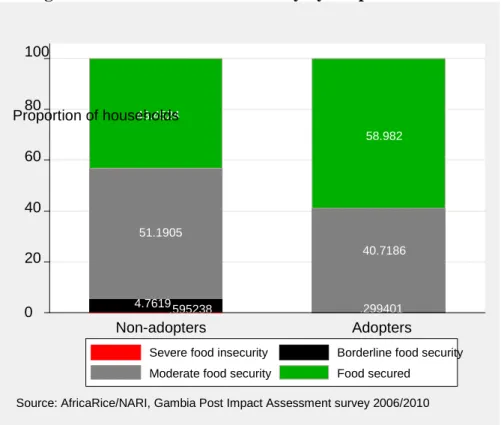
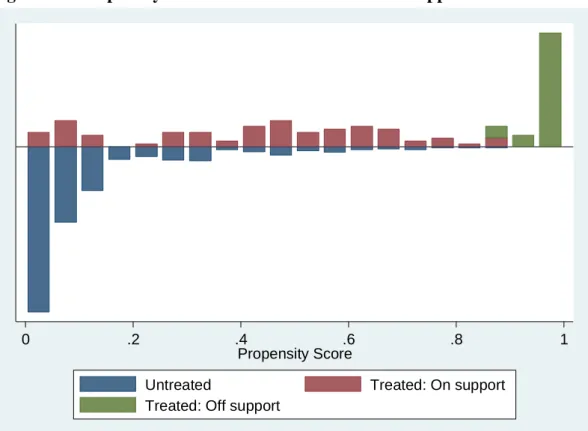
Figure 2.1: Map of The Gambia and its agricultural regions ... 12 Figure 4.1: Household food security by adoption status... 79 Figure 5.1: Propensity score distribution and common support ... 115
vii Acknowledgements
I would like to express my sincere gratitude to the Africa Rice Center (AfricaRice) for awarding me the 2011 Global Rice Science Scholarship (GRISS) to pursue my doctoral program at the University of Hohenheim, Stuttgart, Germany and for proving all the necessary funding on a timely manner to ensure I successfully complete my program against all odds. I am also very grateful to AfricaRice for the field supervision and technical support rendered for the successful completion of this research work. The conducive environment and technical support rendered by the University of Hohenheim is also highly appreciated and acknowledged. I am also very grateful to the Food Security Center of University of Hohenheim for giving me the opportunity to participate in their programs and activities.
I am sincerely grateful to my academic supervisor Prof. Dr. Manfred Zeller for his helpful comments and suggestions, which helped to improve the quality of this research work significantly. The guidance and advice he provided during the implementation of this study has immensely increased my confidence to do meaningful research. I am thankful to Prof. Dr. Steffen Abele and Prof. Dr. Christian Lippert for accepting to examine this dissertation. I am highly indebted to my first field supervisor Dr. Aliou Diagne for having introduced me to impact evaluation methodologies in 2005 and guided me all the way through my MSc and PhD programs. I am extremely grateful for the confidence he has in me. I cannot think of a greater compliment to pay him than he is more a mentor than supervisor. I am also very grateful to my second field supervisor Dr. Aminou Arouna for facilitating my field visit to AfricaRice and for providing all technical and logistical support to ensure that I successfully complete my program.
I am grateful to Dr. Khalid Siddig, Dr. Tim Loos, Dr. Ling Yee Khor and Dr. Alexander Nimo Wiredu for always willing to share their ideas and experience with me. I am also thankful to Katharina Mayer and Coni Schumacher for always providing administrative support. The time taken by Katharina Mayer to translate the executive summary of this doctoral thesis into German is also highly acknowledged. The active role played by Dr. Brigitte Kranz in making sure I participate in all programs and activities of the Food Security Center of the University of Hohenheim is also highly acknowledged. My special gratitude goes to Dr. Thea Nielsen for serving
viii
as co-author for the first paper of this dissertation for which she provided very useful comments and suggestions. The time she spared to language edit this dissertation is also highly acknowledged.
I would also like to express my sincere gratitude to all the rice farmers who provided data for this research and all the research technicians who actively collected and entered all the data used for the analysis of this dissertation. The important role played by the late Dr. Babou Jobe, Dr. Mustapha Ceesay, Mr. Lamin Jobe, and Mr. Ansumana Jurju to ensure that the pursuit of this doctoral program becomes a reality is also highly acknowledged.
Finally, I would like to take this opportunity to express my profound gratitude to my beloved parents, Makieu Lamin and Sambou Dibba, and to all my siblings for their continuous love, support and prayers. My special gratitude goes to my beloved wife, Maimuna Keita, for her patience, love, encouragement and prayers. I am also very grateful to my three year old son, Muhammed Dibba, for his love and patience. I am always moved when I hear his sweet voice on the telephone asking me to come back home because he misses me dearly. The birth of my baby girl, Fatima Dibba, has also given me much joy and encouragement to complete my doctoral program on time in order to unite with my family.
ix Executive summary
This dissertation aims to evaluate the impact of improved rice varieties and farmer training programs that have been introduced to boost local rice production in The Gambia. Rice is the main staple crop of The Gambia. The per capita consumption level of rice is estimated at 117 kg per annum, which is one of the highest in sub-Saharan Africa. The annual consumption of rice is estimated at 195, 811 metric tons, out of which only 51,137 metric tons are produced nationally. This huge deficit is met through imports, at an estimated cost of about US$ 50 million annually. As a result, the government is committed to attaining rice self-sufficiency. To achieve this objective, currents efforts have concentrated on the introduction of yield increasing improved rice varieties and farmer training programs. To evaluate how such improved rice varieties and farmer training programs are contributing towards the achievement of rice self-sufficiency in The Gambia is the main focus of this dissertation.
To evaluate the impact of improved rice varieties and farmer training programs, this study has obtained a country-wide data from rice growing communities and households that were selected through a multi-stage stratified random sampling procedure. Data were obtained during 2006 and 2010 rice cropping seasons. The data collected were used to address three research topics: (1) How accessibility to seeds affects the potential adoption of an improved rice variety: The case of The New Rice for Africa (NERICA) in The Gambia, (2) The impact of New Rice for Africa (NERICA) adoption on household food security and health in The Gambia, and (3) The impact of agricultural training on technical efficiency of smallholder rice producers in The Gambia. These research topics are the main pillars of this dissertation.
The aim of the first research topic was to assess the population adoption rate of NERICA and its determinants. The NERICA is a high yielding rice variety that was officially introduced in The Gambia in 2003. The introduction of NERICA was an attempt taken by the government to increase rice production and productivity in the country. This study focuses on two main constraints that limit the adoption of NERICA: awareness and access to its seeds. We used the treatment evaluation technique to address these constraints and estimate the true population adoption rate of NERICA in The Gambia. The results of our analysis show that the NERICA
x
population adoption rate could have been 76% instead of the observed 66% sample estimate in 2010 provided that every rice farmer had been aware of NERICA’s existence before the 2010 rice growing season. However, further investigation finds that if all the rice farmers had been aware of and had access to NERICA seeds, adoption would have been 92%. The results further show that if awareness had not been a constraint, 16% of farmers would have failed to adopt NERICA due to lack of access to NERICA seeds.
We found farmer contact with extension services and access to in-kind credit as significant determinants of access to and adoption of NERICA varieties. The policy implication of these findings is to increase farmer contact with extension and facilitate access to in-kind credit services like improved seeds to all the rice farming communities. This is likely to increase awareness and access to NERICA seeds, which can help to significantly close the population adoption gap of NERICA in The Gambia. Moreover, when efforts are made to make the entire rice farming population aware of the existence of NERICA varieties and also make the seeds of NERICA accessible to all rice farmers, then it will not be meaningful for future research to attempt to further estimate population adoption rate of NERICA in The Gambia. Under such circumstance, a more meaningful estimate of adoption is given by assessing the intensity of technology use among adopters. For the case of NERICA varieties, it will be more interesting to know the share of total rice area famers are allocating to NERICA varieties. This will give a better picture regarding the desirability of the NERICA technology by the target rice farming population.
The second research topic attempts to identify improvements in household food security and health outcome indicators that can be attributed to NERICA adoption. We used food consumption scores (FCS) and sick days per capita among farm households’ members as outcome indicators of food security and health, respectively. Since NERICA adoption is a decision made by rice farmers, we assume that this selection decision is partly based on unobservable factors, for example, farmers’ attitude towards work. Therefore, we used the instrumental variable approach to identify causal effects of NERICA adoption on food security and health. The results of our analysis show significant differences in some key socio-economic and demographic characteristics between NERICA adopters and non-adopters. These
xi
includes practice of upland rice farming, non-agricultural income, contact with extension and access to credit. Such variables can mask the impact of NERICA adoption if they are not balanced between treatment and control groups. For instance, if one group has higher non-agricultural income, differences in food security and health outcome indicators between the two groups may be due to that difference and not necessarily to NERICA adoption. To control for such differences and allow a causal interpretation of the impact of NERICA adoption, we estimate the Local Average Treatment Effect (LATE). Our findings indicate that NERICA adoption significantly increases household food consumption by 14 percent. This helps severely food insure households to achieve acceptable food security status by enabling them to acquire cereals, tubers, vegetables, and fruits on daily basis. We also found that the impact of NERICA adoption on food security, among NERICA adopting households, is greater for households that have access to in-kind credit services. Our findings also indicate that NERICA adoption impact at household level is only significant for households headed by men. This may be due to the fact that NERICA is upland rice and resources for upland rice production are mainly owned and controlled by men in The Gambia. However, we found no significant impact of NERICA adoption on health.
The finding that the impact of NERICA adoption on food security is greater for households that have access to in-kind credit services, like improved rice seeds, necessitate policy makers to take efforts to redistribute NERICA seeds from high production areas to rice farming communities with low accessibility. However, the finding that the impact of NERICA adoption on food security is greater for households headed by men does not necessarily indicate that NERICA adoption does not have any significant impact on food security for women at the individual level. The data we used to assess the impact of NERICA adoption on food security were collected at the household level so we are unable to assess individual food security status. As a result, we recommend that future studies that intend to assess the impact of NERICA adoption on household food security should collect data at the individual level to enable better gender based comparison of food security outcomes between men and women. Moreover, there is some evidence that NERICA varieties have higher protein content and more well-balanced amino acids compared to traditional and imported rice varieties. This may result in better health outcomes for NERICA
xii
adopting households. However, the results of our analysis have shown no significant impact of NERICA adoption on health. This could be attributed to the fact that we used information on all household members to create number of sick days per capita. Given the limited scope of the survey data regarding health, more precise indicators of health, such as detailed individual recall data on specific diseases, anthropometric data, or other health indicators were not available. Number of sick days per capita is a highly noisy indicator which tend to be negatively correlated with household size. When one individual respondent reports on the health status of all households members, it can lead to under estimation if the household is large. For this reason, we recommend that future studies that intend to identify the impact of NERICA adoption on health should focus on individual recall data, which may be a better outcome indicator.
Finally, the third research topic aims to identify improvements in technical efficiency of smallholder rice farmers that can be attributed to agricultural rice farmer training programs introduced in The Gambia to increase rice production and productivity. Technical efficiency is a measure of how the use of best rice farming practices affects the total yield of rice farmers. Technical efficiency is achieved when it is not possible to increase output without increasing inputs. Due to technical inefficiencies, there is a huge gap between actual and potential yields of rice farmers in sub-Saharan Africa. For instance, the rice yield of upland farmers, in sub-Saharan Africa, is estimated at 1 t/ha whereas the yields at research stations ranges between 2.5 to 5 t/ha. This yield gap is mainly attributed to inappropriate farming practices and lack of farmers’ access to modern inputs that influence efficiency in farmers’ fields. As a result, this study assesses how the introduction of best agricultural rice farming practices, through agricultural training programs, affects the technical efficiency of smallholder farmers in The Gambia. In the first stage, we use Data Envelopment Analysis (DEA) technique to estimate technical efficiency scores for each sampled household and used Tobit regression to identify factors influencing technical efficiency. In the second stage, we employ propensity score matching to assess program impact on participants using technical efficiency scores as our outcome indicator. The results of the analysis indicate that agricultural training significantly increases technical efficiency of smallholder rice farmers by 10 percent. This translates to rice yield increase of 260 kg/ha, which results in net social and private benefits per annum of US$ 43700 for
xiii
900 rice farming households and 30 extension agents, and US$ 53 per household, respectively. Our analysis of investment on agricultural training yields a Net Present Value (NPV) of US$ 195816, a Benefit Cost Ratio (BCR) of 5.3 and an Internal Rate of Return (IRR) of 99%. These results justify increased investment on agricultural training programs to boost rice production and productivity. Further analysis to identify determinants of technical efficiency show farmer’s contact with extension workers and a farmer’s association membership as significant factors influencing technical efficiency.
The significance of farmer’s contact with extension and association membership in determining technical efficiency indicates that extension contact and association membership could be important impact pathways to improve technical efficiency among smallholder farmers. The policy implication of these findings is to encourage rice farmers, through agricultural extension services, to be members of rice farmers associations and motivate them to meet regularly to exchange ideas and information about new developments within and outside their rice farming communities. Moreover, we define agricultural training as participation in at least one rice farmer training program. Since some training programs are likely to be more effective than others, defining participation as receipt of at least one training on rice cultivation practices is likely to underestimate the impact of highly effective training programs. Consequently, we recommend that future studies that intend to assess the impact of agricultural training on technical efficiency should identify specific training programs and assess their impact on technical efficiency separately.
xiv Zusammenfassung
Die vorliegende Arbeit hat zum Ziel, den Einfluss von verbesserten Technologien und Programmen, die im Rahmen des Reisanbaus in Gambia eingeführt wurden um die lokale Reisproduktion zu steigern, zu evaluieren. Reis ist Hauptnahrungsmittel in Gambia. Der Reiskonsum pro Kopf wird auf 117kg pro Jahr geschätzt, und ist damit einer der höchsten in Subsahara-Afrika. Der landesweite jährliche Reiskonsum wird auf 195.811 Tonnen geschätzt, wovon 51.137 Tonnen im Inland produziert werden. Das gewaltige Defizit wird durch Importe zu geschätzten Kosten von jährlich 50 Millionen US$ ausgeglichen. Die Regierung ist daher bestrebt, im Bezug auf Reisproduktion wirtschaftliche Unabhängigkeit zu erlangen. Um dieses Ziel zu erreichen, haben sich die aktuellen Bemühungen darauf konzentriert, ertragssteigernde landwirtschaftliche Technologien und Programme einzuführen. Schwerpunkt der vorliegenden Arbeit ist es, auszuwerten, wie solche Technologien und Programme dazu beitragen, wirtschaftliche Unabhängigkeit in der Reisproduktion in Gambia zu erreichen.
Um die Auswirkungen der Technologien und Programme in der Reisproduktion zu evaluieren, liegt der Studie ein landesweiter Datensatz von reisproduzierenden Gemeinschaften und Haushalten vor, die über ein mehrstufiges Stichprobenverfahren ausgewählt wurden. Die Daten wurden in den Erntejahren 2006-2010 gesammelt, und wurden verwendet um drei verschiedene Forschungsfragen aufzustellen: (1) Wie beeinflusst der Zugang zu Saatgut die potentielle Einführung einer verbesserten Reisvariante? Der Fall „New Rice for Africa“ (NERICA) in Gambia, (2) Die Auswirkungen der Einführung von „New Rice for Africa“ (NERICA) auf Ernährungssicherheit und Gesundheit in gambischen Haushalten, und (3) Die
Auswirkungen landwirtschaftlicher Weiterbildungen kleinbäuerlicher
Reisproduzenten zu technischer Effizienz in Gambia. Diese drei Forschungsfragen stellen die drei Hauptsäulen der vorliegenden Dissertation dar.
Ziel der ersten Forschungsfrage war, den Bevölkerungsanteil festzustellen, der NERICA Saatgut einsetzt, sowie die Faktoren die zu dessen Einsatz beitragen. NERICA ist eine ertragreiche Reissorte, welche offiziell im Jahr 2003 in Gambia eingeführt wurde. Die Einführung von NERICA war ein Versuch der Regierung, die
xv
Reisproduktion und die Produktivität des Landes zu erhöhen. Die vorliegende Studie konzentriert sich auf zwei primäre Einschränkungen welche den Einsatz von NERICA Saatgut limitieren: Das Wissen der Produzenten über das Vorhandensein von NERICA Saatgut, sowie den Zugang dazu. Um diese Einschränkungen anzugehen, und die unverzerrte Anwendung von NERICA Saatgut durch die gambische Bevölkerung abzuschätzen, wurde eine Wirkungsanalyse durchgeführt. Die Ergebnisse der Analyse zeigen, dass die Anwendungsquote statt der in der Stichprobe vom Jahr 2010 tatsächlich beobachteten Quote von 66% bei 76% hätte liegen können, wenn sichergestellt gewesen wäre, dass jeder Reisproduzent vor der Anbausaison 2010 von der Existenz des NERICA Saatguts gewusst hätte.
Weitere Untersuchungen zeigen, dass der Einsatz von NERICA Saatgut bei 92% hätte liegen können, wenn neben dem Wissen um die Existenz des Saatguts auch der Zugang auf das Saatgut sichergestellt gewesen wäre. Weiterhin zeigen die Ergebnisse, dass, wenn das Wissen um die Existenz des Saatguts keine Einschränkung gewesen wäre, 16% der Reisproduzenten NERICA nicht hätten einsetzen können, weil sie keinen Zugang zu NERICA Saatgut gehabt hätten.
Der Kontakt der Reisproduzenten zu landwirtschaftlichen Beratungsdiensten und ein erleichterter Zugang zu nichtmonetären Krediten wurden als bedeutende Faktoren für den Zugang zu und den Einsatz von NERICA Saatgutsorten herausgestellt. Die Politikempfehlung zu den Ergebnissen lautet, den Kontakt der Reisproduzenten zu landwirtschaftlichen Beratungen zu verbessern, und den Zugang zu nichtmonetären Krediten, wie z.B. verbessertem Saatgut, für alle Reisproduzenten zu erleichtern. Dies würde höchstwahrscheinlich das Wissen um die Existenz von NERICA Saatgut und den Zugang dazu verbessern, was wiederum dazu beitragen würde, die Anwendungslücke bei NERICA Saatgut in der gambischen Bevölkerung beträchtlich zu verkleinern. Wenn es Bemühungen dahingehend gibt, die alle Reisproduzenten über das Vorhandensein von NERICA Saatgutsorten in Kenntnis zu setzen, und überdies das Saatgut für alle zugänglich gemacht wird, wird es außerdem für künftige Forschungsvorhaben nicht mehr bedeutsam sein, weiterhin die Anwendungsquote von NERICA Saatgut in der gambischen Reisproduzentenschaft zu erheben. Unter solchen Umständen wäre es sinnvoller, den Einsatz von NERICA zu bewerten, indem die Intensität in der Technologienutzung unter den Anwendern erhoben wird. Letzteres
xvi
würde ein detaillierteres Bild bezüglich der Attraktivität der NERICA Technologie für die Zielgruppe der Reisproduzentenschaft ergeben.
Die zweite Forschungsfrage zielt darauf ab, Verbesserungen hinsichtlich der
Ernährungssicherheit in den Haushalten, sowie Ergebnisindikatoren zu
gesundheitlichen Auswirkungen zu identifizieren, die der Anwendung von NERICA Saatgut zugeschrieben werden können. Hierfür wurden Food Consumption Scores (FCS) und Krankheitstage pro Kopf der reisproduzierenden Haushaltsmitglieder als Ergebnisindikatoren für Ernährungssicherheit und Gesundheit herangezogen.
Da die Entscheidung zum Einsatz von NERICA Saatgut von den Reisproduzenten getroffen wird, wird angenommen, dass diese Auswahlentscheidung teilweise auf nicht beobachtbaren Faktoren basiert, wie beispielsweise die Einstellung der Reisproduzenten zu ihrer Arbeit. Daher wurde eine Instrumentvariable angewendet, um kausale Effekte des Einsatzes von NERICA Saatgut auf Ernährungssicherheit und Gesundheit zu ermitteln. Die Ergebnisse dieser Analyse zeigen signifikante
Unterschiede bei einigen sozioökonomischen und demografischen
Schlüsselmerkmalen zwischen NERICA Anwendern und Nicht-Anwendern. Diese beinhalten die Erfahrung beim Reisanbau in Hochlagen, das außerlandwirtschaftliche Einkommen, den Kontakt zu landwirtschaftlichen Beratungen und Zugang zu Krediten. Solche Variablen können die Auswirkungen des Einsatzes von NERICA Saatgut verzerren, wenn sie nicht in ausgeglichenem Umfang bei den Behandlungs- und Kontrollgruppen vorkommen. Wenn eine Gruppe beispielsweise ein höheres außerlandwirtschaftliches Einkommen hat, könnten Unterschiede innerhalb der beiden Gruppen in Ernährungssicherheit und Gesundheitsversorgung ursächlich von dieser Variablen stammen und sind nicht notwendigerweise dem Einsatz von NERICA Saatgut zuzuschreiben. Um solche Differenzen zu regulieren, und eine kausale Interpretation der Auswirkungen des Einsatzes von NERICA Saatgut zu ermöglichen, wird der Local Average Treatment Effect (LATE) kalkuliert. Die Ergebnisse deuten darauf hin, dass der Einsatz von NERICA Saatgut den Lebensmittelkonsum innerhalb eines Haushalts signifikant um durchschnittlich 14% steigert. Weiterhin wurde festgestellt, dass die positiven Auswirkungen des Einsatzes von NERICA Saatgut auf die Ernährungssicherheit unter allen Haushalten die NERICA Saatgut einsetzen, für solche Haushalte größer sind, die Zugang zu nicht-monetären Krediten haben. Unsere
xvii
Ergebnisse weisen auch darauf hin, dass die positiven Auswirkungen des Einsatzes von NERICA Saatgut auf Haushaltsebene nur für diejenigen Haushalte signifikant ist, die von Männern geführt werden. Dies mag darauf zurückzuführen sein, dass NERICA eine Bergreissorte ist, und die Flächen für Reisanbau in den Hochlagen Gambias hauptsächlich im Eigentum von Männern sind bzw. von Männern bearbeitet werden. Es wurden weiterhin keine signifikanten Auswirkungen des Einsatzes von NERICA auf die Gesundheit festgestellt.
Die Tatsache, dass die positiven Auswirkungen des Einsatzes von NERICA Saatgut auf die Ernährungssicherheit für Haushalte mit Zugang zu Naturalkrediten wie beispielsweise in Form von verbessertem Saatgut, größer sind, macht es für die Politik erforderlich, die notwendigen Bemühungen zu unternehmen, um NERICA Saatgut von Gebieten mit hoher Produktionsleistung zu reisproduzierenden Dörfern mit niedrigem Zugang auf nicht-monetäre Kredite umzuverteilen. Dass die Auswirkungen des Einsatzes von NERICA Saatgut auf Ernährungssicherheit bei Haushalten mit männlichem Haushaltsvorstand größer sind, weist nicht notwendigerweise darauf hin dass der Einsatz von NERICA Saatgut keine signifikanten Auswirkungen auf die Ernährungssicherheit von Frauen auf individueller Ebene hat. Die verwendeten Daten wurden auf Haushaltsebene gesammelt, so dass es nicht möglich war, die Ernährungssicherheit bei einzelnen Personen zu erfassen. Daher empfehlen wir, dass sich künftige Studien, welche die Auswirkungen des Einsatzes von NERICA auf die Ernährungssicherheit erfassen wollen, Daten auf individueller Ebene sammeln sollten, um einen geschlechtsspezifischen Vergleich zur Ernährungssicherheit bei Männern und Frauen zu ermöglichen.Weiterhin gibt es Behauptungen, dass NERICA Saatgutsorten im Vergleich zu traditionellen und importierten Reisvarianten einen höheren Proteingehalt und eine ausgeglichenere Komposition von Aminosäuren hätten. Dies könnte bei Haushalten die NERICA einsetzen zu positiven Auswirkungen im Gesundheitsbereich führen. Allerdings haben die Ergebnisse unserer Studie keine signifikanten Auswirkungen des Einsatzes von NERICA auf die Gesundheit ergeben. Letzteres könnte der Tatsache geschuldet sein, dass die Informationen aller Haushaltsmitglieder verwendet wurden um die Krankheitstage pro Kopf zu ermitteln. Derzeit gibt es in Gambia einen kostenlosen Gesundheitsdienst für die meisten Kurzzeit-Erkrankungen bei Kindern, woraus sich die insignifikanten Ergebnisse der vorliegenden Studie ergeben haben könnten. Daher empfehlen wir, dass künftige
xviii
Studien die sich mit den Auswirkungen des NERICA Einsatzes auf die Gesundheit befassen, sich auf erwachsene, arbeitsfähige Haushaltsmitglieder konzentrieren sollten, da diese ein besserer Ergebisindikator sein könnten.
Die dritte Forschungsfrage zielt schließlich darauf ab, Verbesserungen in der technischen Effizienz bei Kleinbauern im Reisanbau zu ermitteln, die den landwirtschaftlichen Weiterbildungsprogrammen für Reisproduzenten zuzuschreiben sind, welche in Gambia eingeführt wurden um die Reisproduktion und Produktivität zu steigern. In der vorliegenden Studie wird gemessen, wie die Anwendung der besten Reisanbaumethoden den Gesamtertrag der Reisproduzenten erhöht. Aufgrund technischer Ineffizienzen klafft eine große Lücke zwischen dem tatsächlichen und dem potentiell möglichen Ertrag der Reisproduzenten in Subsahara Afrika. Der Reisertrag der Produzenten im Hochland liegt etwa bei einer Tonne pro Hektar, während die Erträge an Forschungsstandpunkten 2,5 bis 5 Tonnen pro Hektar betragen. Diese Ertragslücke wird hauptsächlich unangemessenen Anbaumethoden zugeschrieben, die auf den Reisfeldern weit verbreitet sind. Infolgedessen soll die vorliegende Studie erfassen, wie eine Einführung der besten Reisanbaumethoden durch landwirtschaftliche Weiterbildungsprogramme die technische Effizienz der gambischen Kleinbauern beeinflusst.
Der kausale Wirkungszusammenhang der landwirtschaftlichen Weiterbildung mit technischer Effizienz wird in zwei Phasen bemessen. In der ersten Phase wird die Data Envelopment Analysis (DEA) verwendet, um technische Effizienz-Werte für jeden befragten Haushalt zu ermitteln, sowie eine Tobit-Regressionsanalyse durchgeführt, um die Faktoren zu ermitteln, die einen Einfluss auf die technische Effizienz haben. In der zweiten Phase wird die Propensity Score Matching Methode angewendet, um die Auswirkungen von Weiterbildungsprogrammen auf deren Teilnehmer zu erfassen, wobei technische Effizienz-Werte als Ergebnisindikator dienen. Die Ergebnisse der Analyse zeigen, dass landwirtschaftliche Weiterbildungen die Fähigkeit der reisproduzierenden Kleinbauern, die besten Anbaumethoden anzuwenden, signifikant um 10% erhöhen. Auf Haushaltsebene bedeutet dies eine Ertragssteigerung von 260kg/ha; anders ausgedrückt ist das ein Nettogewinn auf sozialer und privater Ebene von 43.700 US$ für 900 reisproduzierende Haushalte und 30 Berater, bzw. 53 US$ pro Haushalt. Eine Analyse der Investitionen die in
xix
landwirtschaftliche Beratung getätigt werden ergibt einen Kapitalwert (NPV) von 195.815,8 US$, ein Kosten-Nutzen-Verhältnis von 5,3 und einen internen Zinssatz (IRR) von 99%. Diese Ergebnisse rechtfertigen höhere Investitionen in
landwirtschaftliche Weiterbildungsprogramme um die Reisproduktion und
Produktivität zu erhöhen. Weitere Untersuchungen zur Identifikation von Schlüsselfaktoren technischer Effizienz zeigen, dass der Kontakt der Reisproduzenten zu Beratern, sowie Mitgliedschaften in Landwirtschaftsverbänden die technische Effizienz signifikant beeinflussen.
Die politischen Implikationen zu den Ergebnissen wären, dass Reisproduzenten durch landwirtschaftliche Beratungsstellen ermutigt werden sollten, sich zu Verbänden zusammenzuschließen, und motiviert werden sollten sich regelmäßig zu treffen um Ideen und Informationen zu neuen Entwicklungen innerhalb und außerhalb ihrer Dorfgemeinden auszutauschen. Überdies wird landwirtschaftliche Weiterbildung definiert als Teilnahme an wenigstens einem Weiterbildungsprogramm für Reisproduzenten. Da einige Weiterbildungsprogramme wahrscheinlich effektiver sind als andere, ist es wahrscheinlich, dass durch diese Definition die Auswirkungen von hocheffektiven Weiterbildungsprogrammen unterschätzt wird. Folglich wird empfohlen, dass künftige Studien, welche die Auswirkungen landwirtschaftlicher
Weiterbildungen auf technische Effizienz erheben wollen, konkrete
Weiterbildungsprogramme ausmachen und deren Auswirkungen auf die technische Effizienz separat bewerten sollen.
1 Chapter 1
1. Introduction 1.1 Background
Rice is increasing becoming a major staple and a source of livelihood for many people in the world. It is classified as the second largest consumed cereal (after wheat) feeding nearly 50 percent of the world's population who depend on it for about 80 percent of their dietary requirement (von Braun 2006). The total area under rice cultivation was estimated in 2000 to be 150 million hectares, with an annual average production of 500 million metric tons. However, due to the increased dependence of the world population on rice, it was estimated in 2001 that its production needs to increase from 586 million metric tons to 756 million metric tons by 2030 to meet the global projected demand (FAO 2002). Rice production is the main activity and source of income for more than 100 million households living in developing countries of Africa, Asia and Latin America (FAO 2005).
In Africa, the demand for rice has far outpaced the production level. As a result, the continent meets substantial amount of local demand through rice imports. In 2009, rice imports in Africa accounted for one-third of the total stock at the international market, costing the continent US$ 5 billion (Wopereis, 2011). Africa's emergence as one of the most prominent players in the international markets is due to the fact that rice has become the most rapidly growing source of food in many countries in sub-Saharan Africa (Solh, 2005). The demand for rice is growing faster in sub-sub-Saharan Africa than any part of the world (WARDA, 2006). The sub-Saharan Africa region with the highest consumption of rice is West Africa. The annual growth in demand for rice in West Africa is estimated at 8%, which surpasses the domestic production growth rate of 6% per annum. As a result, the region spends over US$ 1.4 billion on rice imports annually to bridge the gap between demand and domestic supply of rice (Somado and Guei, 2008). The countries with the highest per capita consumption of rice in West Africa are: Sierra Leone, Guinea, Senegal and The Gambia.
Rice is by far the most important food crop in The Gambia. It is the main source of livelihood for the majority of women rice farmers and provides substantial amount of income for most rural households. The consumption level of rice in The Gambia is
2
estimated to be 117kg per capita per annum, which is far beyond the world average of 56.6 kg. Of the 195, 811 metric tons of rice consumed in 2011, only 51,137 metric tons was produced nationally (PSU, 2011). The huge gap is filled through importation from Asian countries like India, Pakistan and Thailand. In 2000, about US$ 10.9 million was used to import 93,900 metric tons of rice. This increased to US$28.97 million in 2009, which was used to import 126, 625 metric tons of rice (PUS, 2011). In 2011, rice imports were valued at a cost of US$50 million. The high importation of rice is partly attributed to low production and productivity of the prevailing lowland and upland rainfed agricultural systems in the country (Malton et al., 1996).
In an attempt to combat the problem of low rice production in the country, efforts have been concentrated on the introduction of improved rice varieties and farmer training programs. An example of such improved rice varieties is the New Rice Varieties for Africa (NERICA). The NERICA was a result of crosses between the Asian rice (O. stiva) and the African rice (O. glaberrima). It combines good traits of both parents, which makes it highly suitable for the farming systems in Africa. The NERICA introduced to farmers in The Gambia is an upland rice variety. With the official introduction of NERICA in 2003, land area under upland rice cultivation increase from 10,000 hectares in 2006 to 47,500 hectares in 2011, which increase further to 50,000 hectares in 2013 (Gambia 2013). To substantiate efforts, farmer training programs have also been introduced to build capacity of rice farmers. The most prominent among such programs have been introduced through rice sector development projects such as: Participatory Adaptation and Diffusion of Technologies for Rice-Based Systems (PADS), Canadian International Development Agency (CIDA) funded project, Farmer Managed Rice Irrigation Project (FMRIP). The aim of such programs is to give researchers, extension agents and rice farmers the knowledge and skills required to better manage the cultivation of the rice crop in order to significantly increase rice production and productivity in the country.
Agriculture is the backbone of The Gambian economy. It provides employment for about 75% of the labour force and account for about two-third of agricultural household income (Fatajo, 2010). Hence, agricultural growth to feed the growing population is fundamental in achieving economic growth in The Gambia (Datt and Ravallion, 1996). Enormous efforts have been made to expand the land area under rice
3
production in The Gambia. However, research has shown that expansion of production area alone is not sufficient to achieve food security in the developing world. As a result, agricultural growth need to be dependent more and more on yield-increasing agricultural technologies and programs (Hossain, 1989). In the same vein, the World Bank (2008) notes that the high yielding improved rice varieties such as those that helped to bring a green revolution in Asia could significantly assist in augmenting rice production and productivity in Africa. Hence, the achievement of food security in The Gambia is highly dependent on yield increasing technologies and programs like the New Rice for Africa (NERICA).
To improve rice production and productivity in The Gambia, there is urgent need to identify yield increasing improved rice varieties and farmer training programs that are contributing significantly towards the attainment of food security. Since development of yield increasing improved rice varieties and farmer training programs require huge investments, there is urgent need to assess the impact of such improved varieties and farmer training programs on food security and technical efficiency in order to inform governments and donors of the returns from their investment and also advise policy makers on pertinent issues that surrounds the development, adoption, intensity of adoption and impact of such improved varieties and farmer training programs on outcome indicators of interest to help them estimate the potential for rice production in a country and monitor the economic, social and environmental impact of investments and policies needed to develop the rice sector. This will enable policy makers to make decisions based on concrete evidence and not be tempted to make crucial judgments regarding development of the rice sector based on mere speculations.
1.2. NERICA and food security
Rice is a staple crop for more than three billion of the world's population. Rice is a subsistence crop for many countries in Asia, Africa and South America. Rice is used as a survival crop for nearly half of the world's population. Most households in Asia and Africa depend on rice for their daily meals. In most of the rice consuming countries, the crop provides about 70% caloric requirement (Wuthi-Arporn, 2002). More than three billion people in the world are very highly dependent on rice for their
4
daily caloric requirement ((> 800 kcal/person/day). About 236 million people are highly dependent on rice for their caloric intake (500–799 kcal/person/day) and about 501 million people are moderately dependent on it as source of calories (300–499 kcal/person/day) (Nguyen, 2005). This makes rice an important food source for more than half of the world's population. In 2004, about 75% of total rice produced in the world came from tropical regions of Southeast Asia, Sri Lanka, Bangladesh, India, Latin America, the Caribbean and rice growing countries of sub-Saharan Africa (Nguyen, 2005).
The demand for rice is rapidly growing in sub-Saharan African rice growing countries. Between 1970 and 2009, the rice consumption rate in sub-Saharan Africa is estimated at 4%, which surpasses the local production rate of 3.3%. As a result, the region had to import about 9.68 million metric tons of rice in 2009 to meet the local demand, at a cost of more than US$ 5 billion (Onyango, 2014). To bridge the gap between local demand and supply of rice in sub-Saharan Africa, efforts have been concentrated on the introduction of yield increasing improved rice varieties. An example of such improved rice varieties is the New Rice for Africa (NERICA).
The NERICA was introduced in most sub-Saharan African countries between 2000 and 2010. NERICA was developed through crossing breeding between Oriza sativa
and Oriza glaberrima.Oryza sativa varieties were first introduced in Africa about 450 years ago. They are originally from Asia and are well known for their high yield potentials. Oriza glaberrima varieties are originally from Africa and are resistant to most of the biotic (viral diseases, blast, weed competition) and abiotic (iron toxicity, drought, and acidity) stresses that hinder rice cultivation in sub-Saharan Africa (Jones
et al. 1997a and 1997b; Audebert et al., 1998; Dingkuhn et al. 1999). NERICA combines good traits from both Oryza sativa and glaberrima which makes it highly suitable for increasing rice production and productivity in sub-Saharan Africa. When NERICA was developed, it was disseminated to several countries in sub-Saharan Africa. However, the initial activities were concentrated in seven West African pilot countries: Benin, The Gambia, Ghana, Guinea, Mali, Nigeria and Sierra Leone (WARDA 2002).
The NERICA was officially introduced in The Gambia in 2003. The first set of NERICA introduced in The Gambia was upland rice, which was targeted to reach the
5
upland rice farmers. In 2001, before the introduction of NERICA, rice production was approximately 19,200 metric tons. After the official introduction of NERICA, rice production level increased from 19,200 to 51,137 metric tons in 2011. In 2011, rice yields from NERICA fields accounts for about 46% of total rice production (Agricultural census, 2012). This makes NERICA varieties potential crops for attainment of national food security in The Gambia.
1.3 Agricultural training and technical efficiency
Low rice productivity in sub-Saharan Africa has been largely attributed to low use of inputs like fertilizers, chemicals, pesticides, etc and low adoption of high yielding improved rice varieties. Besides inputs and high yielding improved rice varieties, productivity can be significantly influenced by inappropriate rice cultivation practices. Balasubramanian et al. (2007) note that the appropriate rice cultivation practices that are widely adopted in Asia are not commonly practiced in sub-Saharan Africa, which may have resulted in low rice yields experienced by rice farmers in sub-Saharan Africa. Broadcasting rice seeds is a common practice among upland rice farmers in sub-Saharan Africa. This may result in overcrowding, which makes fertilizer application and weeding extremely difficult. Transplanting in lowland rice fields are usually not done in straight lines, which make it difficult to follow recommended spacing and seeding rates. Poor water control techniques can as well lead to flooding in some rice fields or low water retention in areas with sloppy land. Such inappropriate rice cultivation practices that are prevalent in sub-Saharan Africa can negatively affect technical efficiency of rice farmers.
To enhance efficiency in rice production, farmers need to be trained on recommended rice cultivation practices. This can be achieved through introduction of agricultural training programs. Through agricultural training programs, rice farmers can be trained on how to appropriately conduct row planting, apply fertilizers, weed rice fields, apply water control techniques etc. Such training programs can improve technical efficiency of rice farmers and contribute positively towards attaining rice self-sufficiency in Saharan Africa. Since inappropriate rice cultivation practices are common in sub-Saharan African, agricultural training programs have recently been introduced in The Gambia under three different rice projects (PADS, FMRIP and CIDA) to give rice
6
farmers the technical knowledge required to boost rice production and productivity in the country.
1.4 Study objectives, research questions and hypotheses
The overall objective of this study is to assess the impact of improved rice varieties and farmer training on household food security and technical efficiency of smallholder rice farmers in The Gambia. The study addresses this objective by considering three research topics: (1) How accessibility to seeds affects the potential adoption of an improved rice-based technology: The case of The New Rice Varieties for Africa (NERICA) in The Gambia, (2) The impact of New Rice for Africa (NERICA) adoption on household food security and health in The Gambia, and (3) The Impact of agricultural training on technical efficiency of smallholder rice producers in The Gambia.
1.4.1 Specific objectives
The specific objectives of each research topic are as follows:
Research topic 1 - How accessibility to seeds affects the potential adoption of an improved rice variety: The case of The New Rice for Africa (NERICA) in The Gambia:
Assess NERICA population adoption rate by controlling for both exposure and
seed access
Provide estimates of actual and potential adoption rates and their determinants of the NERICA varieties
Determine the adoption gap that arises due to lack of access to adequate supply of NERICA seeds
Research topic 2 - The impact of New Rice for Africa (NERICA) adoption on household food security and health in The Gambia:
To determine improvements in food security and health outcomes that can be
7 Identify how differences in gender contributes to improvements of food
security and health outcomes
Research topic 3 - The impact of agricultural training on technical efficiency of smallholder rice producers in The Gambia:
To identify improvements in technical efficiency of smallholder rice producers that can be attributed to agricultural training
To determine the factors that influence technical efficiency of smallholder rice producers
1.4.2 Research questions and hypotheses
The research questions and hypothesis of each topic are as follows:
Research topic 1 - How accessibility to seeds affects the potential adoption of an improved rice variety: The case of The New Rice for Africa (NERICA) in The Gambia:
Research question: Is the potential adoption rate of NERICA significantly influenced by lack of access to seeds?
Hypothesis: The potential adoption rate of NERICA is not significantly influenced by lack of access to seeds.
Research topic 2 - The impact of New Rice for Africa (NERICA) adoption on household food security and health in The Gambia:
Research question: Is there any improvements in food security and health outcomes that can be attributed to NERICA adoption?
Hypothesis: NERICA adoption has no significant causal effect on food security and health.
Research topic 3 - The impact of agricultural training on technical efficiency of smallholder rice producers in The Gambia.
8 Research question: Is there any improvements in technical efficiency of smallholder
rice producers that can be attributed to agricultural training?
Hypothesis: There is no significant improvement in technical efficiency of smallholder rice producers that can be attributed to agricultural training.
1.5 Organization of dissertation
This dissertation is presented in six chapters. Chapter 1 gives the background information of the research and presents the study objectives, research questions and hypothesis. Chapter 2 briefly highlights the study area, sampling and data collection procedure. It also describes different impact evaluation methodologies used to identify causal effects of treatments and programs. Chapter 3 estimates the potential adoption of NERICA by controlling for exposure and access to NERICA seeds. Chapter 4 presents the estimates of the impact of NERICA adoption on food security and health. Chapter 5 gives estimates of the impact of agricultural training on technical efficiency of smallholder rice farmers and Chapter 6 concludes with a summary of the main empirical findings and their policy implications. It also presents the research gaps identified from the empirical findings and gives recommendation regarding future research works.
9 References
African Rice Centre (WARDA). 2006. Annual report. WARDA, Cotonou. Agricultural Census, 2012. Technical report of The Gambia Agricultural Census. Balasubramanian V, Sie M, Hijmans RJ and Otsuka K. 2007. Increasing rice
production in sub-Saharan Africa: Challenges and opportunities. Advances in Agronomy 94:55–133.
Braun J.von.2006. Public policy and international collaboration for sustaining and expanding the rice revolution. A keynote at the 2nd International Rice Congress on “Science, technology and trade for peace & prosperity”. New Delhi Oct. 9 - 13, 2006.
Food and Agriculture Organization. 2002. FAO rice international. FAO, Rome.
Food and Agriculture Organization. 2005. Global climate changes and rice food
security. Rome
(availableat:http://www.fao.org/climatechange/1552603ecb62366f779d1e d45287e698a44d2e.pd.
Datt, G., Ravallion, M., 1996. How important to India’s Poor is the sectoral composition of growth? World Bank Economic Review 10 (1), 1–26.
Gambia .2013. National Rice Development Strategy. (Available at:
http://riceforafrica.org/images/stories/PDF/gambia_en.pdf).
Fatajo, S. 2010. National issues report on key sector of agriculture (adaptation) in The
Gambia. (Available at:
http://www.undpcc.org/docs/National%20issues%20papers/Agriculture% 20%28adaptation%29/07_Gambia%20NIP_agriculture%20adaptation.pdf) Hossain, M. 1989. Green Revolution in Bangladesh: Impact on Growth and
Distribution of Income. University Press Ltd, Dhaka.
Jones, M.P., Dingkuhn, M., Aluko, G.K. and Semon, M.. 1997a. Interspecific Oryza sativa × O. glaberrima Steud. progenies in upland rice improvement. Euphytica 92:237-246.
10
Jones, M.P., Dingkuhn, M., Johnson, D.E. and Fagade, S.O. (Eds). 1997b. Interspecific hybridization: Progress and Prospect WARDA, 01 BP 2551, Bouaké, Cote d’Ivoire. pp. 21-29.
Matlon, p., Randolph, T., Guei, R. 1996. Impact of rice research in West Africa. International conference on impact of rice research 3-5 June 1996. Bankok. IRRI p 313-323.
Nguyen N. V. 2005. Global climate changes and rice food security (Available at:
http://www.fao.org/forestry/15526-03ecb62366f779d1ed45287e698a44d2e.pdf).
Onyango, A. O. 2014. Exploring Options for Improving Rice Production to Reduce Hunger and Poverty in Kenya. World Environment 2014, 4(4): 172-179 Solh, M. 2005. Rice is life in 2004 and beyond. (Available at:
http://www.fao.org/3/a-a0281e.pdf).
Somado, E.A. and Guei, R.G. 2008, Over view: The new rice for Africa 2008. Rice in Africa. Africa Rice Center, Bouaké.
World Bank. 2008. World Development report. Agriculture for development. (Available at: World Development report. Agriculture for development). Wopereis, M. 2011. Realizing Africa’s Rice Promise. Keynote speech (available at:
http://jircas-d.job.affrc.go.jp/Ver-1/english/files/2012/10/admin/2011-Keynote-Speech3.pdf).
Wuthi-Arporn, J .2002. Increasing Rice Production: Solution to the Global Food
Crisis (Available at:
http://www1.nodai.ac.jp/cip/iss/english/9th_iss/fullpaper/1-2-2ku-jirawut.pdf).
11 Chapter 2
2. Methodological framework
2.1 Research area, sampling and data collection 2.1.1 Research area
The research area covers all the agricultural region of The Gambia: Western Region, North Bank Region, Lower River Region, Central River North and South, Upper River Region (Figure 2.1). The Gambia is located within the Sahelo-Sudan climatic zone on the western coast of Africa. It is located between latitude 130 N and longitude 160 W. The Gambia is 30km wide and stretches from the Alantic coast for about 375km. It is entirely surrounded on land by Senegal (Figure 2.1). It has a total land area of about 11,300 km2 and a population of 1,882,450 (Gambia Population Census, 2013).
The research area is divided into three major agro-ecological zones: Sahel, Sudan-Sahel and Sudan-Guinea. The Sudan-Sahel zone is characterized by unpredictable rainfall pattern with dry and scanty vegetative cover. The annual rainfall in the area is less than 600mm and the soils have very low water retention capacity. As a result, only drought tolerant crops are those prevalent in the area. The Sudan-Sahel zone receives between 600 and 900mm of rainfall. The flood plains of the area along the river Gambia and the lowland valleys are well suited for swamp rice cultivation under tidal irrigation. The Sudan-Guinea zone receives between 900 and 1200mm of rainfall. The area has the longest cropping season, lasting between 120 and150 days. The area is well suited for all types of rice (rain-fed upland and lowland, irrigated lowland and mangrove) cultivated in The Gambia.
12 Figure 2.1: Map of The Gambia and its agricultural regions
Source: www.google maps.com
About 50 percent of the land in the research area is good arable land (5,500 square kilometres). About 15 percent of the total arable land is irrigable, all of which is situated in the Central River and Upper River Regions. As the country is currently taking necessary measures to attain self-sufficiency in rice production, more than 2300 hectares of the irrigable land is put under cultivation.
2.1.2 Sampling and data collection
This study used multi-stage stratified random sampling procedure to select rice growing villages and households cross the six agricultural regions of The Gambia. In the first stage, a list of all rice growing villages was obtained through key informant interviews. The informants were selected from research and extension services. Within each agricultural region, a preliminary list of rice growing villages was obtained at the regional director's office. This list was updated by contacting agricultural officers working at district level. This was done to ensure that a complete list of all rice growing village was identified in every agricultural region. The list of villages obtained from each agricultural region was stratified into two groups: 1) villages where rice based technologies and programs were disseminated to rice farmers (hereafter, treatment villages) and 2) villages where rice based technologies and programs were not disseminated (hereafter, control villages).
The treatment villages were the first randomly selected within each agricultural region, followed by a random selection of control villages within a radius of 5-10 kilometres to maximize similarities between treatment and control villages. With the
13
exception of West Coast Region, five treatment and control villages were randomly selected from each agricultural region. In the second stage of sampling, a list of all rice growing households was obtained in every selected village through focus group discussions. Ten rice farming households were randomly selected in each village for household level data collection.
Data were collected at village and household levels. At the village level, a list of all the rice technologies and programs introduced within each of the selected villages was obtained through a focus group discussion. This was followed by a detailed household interview to collect data on each of the rice based technology and program identified at the village level. Chapter 3, 4 and 5 give more details about the sampling procedure and type of data collected.
2.2 Food security indicators
“Food security is a situation that exists when all people, at all times, have physical and economic access to sufficient, safe, and nutritious food that meets their dietary needs and food preferences for an active and healthy life” (World Food Summit, 1996). There are several indicators which are used to measure food security status of households. In this sub-section the focus will be on the following food security outcome indicators recommended by Hoddinott (1999) and World Food Program (2008): Household Caloric Acquisition (HCA), Household Dietary Diversity (HDD), Indices of Household Coping Strategies (IHCS), and Food Consumption Scores (FCS).
The HCA is an indicator of food security which measures the number of calories or nutrients available for consumption by a given household at a given period of time. Data on this indication is generated by obtaining an exhaustive list of all household food items in a study area. At household level, the person most knowledgeable about household food consumption is asked a set of questions regarding food prepared for meals over a specified period of time, usually over a period of 7 to 14 days. For each food item listed, the respondent is asked to indicate whether it has been prepared in the household during the period under consideration. The quantity of the food items prepared by the household are noted and the calorie content determined for each food
14
item. The total calorie available to the household is obtained by summing the calorie content in each food item consumed by the household during the period specified (Hoddinott 1999).
The HDD is the sum of the number of variousfoods items consumed by a household
over a specified period of time. It can be a simple sum of the number of various food groups consumed, or sums of the number of different food items within a food group, or a weighted sum (Hoddinott 1999). To generate data on HDD one or more persons within the household is or are asked about different food items that have been consumed in the household over a specified period. A complete list of food items is provided for the respondents to identify the ones consumed by household members over a specified period of time. Determining which food items should appear on such list is done via rapid appraisal exercises and discussions with key informants. The HDD is determined by taking the sum and weighted sum of the food items consumed by the household over a specified period.
The IHCS is a food security index that is based on how households adapt to the prevalence or threat of food shortages. To generate data on IHCS, the household member who is responsible for preparing and serving meals is interviewed about issues regarding how the household is responding to food shortages. A low score is given to households that do not experience high occurrence of food shortages and a high score is given to households with high frequencies of food shortages. The sum and weighted sum of the coping strategies is obtained for each household. The higher the value, the more food-insecure the household (Hoddinott 1999).
The FCS is a combination of dietary diversity, food frequency, and relative nutritional importance. This indicator is created to capture the three cardinal pillars of food security: food availability, food access and food utilization. To generate data on FCS, a list of food items consumed in a study village is obtained through key informant interviews. The food items are grouped into 8 standard food groups: Cereals and tubers, Pulses, vegetables, fruits, meat and fish, milk, sugar and oil. Each of the food groups is assigned a weight that is based on its nutrient content. Data is generated at household level by interviewing the person who is most knowledgeable about food items consumed in the household. The FCS is obtained by taking the weighted sum of all the food groups consumed in a household over a 7 days period (World Food
15
Programme, 2008). A detailed explanation of how the FCS is calculated is given in Chapter 4.
2.3 Estimating technical efficiency
Technical efficiency1 is a situation a farm household realizes when it is not possible to increase output without increasing the level of inputs use in the production process. Technical efficiency is estimated using two different approaches: parametric and nonparametric production frontiers. The parametric approach uses Stochastic Frontier Analysis (SFA) technique whereas the nonparametric approach uses Data Envelopment Analysis (DEA).
When employing the parametric approach to estimate technical efficiency, a functional form is assumed prior to deciding on the right one to use for the estimation procedure. One of the following functional forms can be used for the estimation: Cobb-Douglas, normalized quadratic, Translog, generalized Leontief, and CES. The Cobb-Douglas and Translog are the two most commonly used functional forms in empirical research (Battese and Broca 1997). However, the Cobb-Douglas is more restrictive than the Translog. When the Cobb-Douglas is fitted for estimation of technical efficiency its adequacy should be tested against the Translog using the Likelihood Ratio (LR) test. The Cobb-Douglas (equation 2.1) and Translog (equation 2.2) take the following functional forms:
k j i i ji j i x v u y 1 0 ln ln (2.1) i i hi ji k j k j k h jh ji j i x x x v u y
ln ln ln ln 1 1 1 0 (2.2) where:i is the index indicating households
j is the index indicating inputs i
y is the output of household i
ij
x is the input j used by household i
1
16 is vector of parameters to be estimated
i
v is a random error assumed to be independently and identically distributed i
u is non-negative random variable associated with technical efficiency
The nonparametric approach to estimating technical efficiency based on DEA does not require an assumption to be made about a functional form. It uses Linear Programming (LP) to estimate technical efficiency by using the most efficient production unit as bench mark for estimating the relative efficiency level of other production units. The DEA model uses two scale assumptions: Constant Return to Scale (CRS)