FINANCIAL LIBERALISATION AND CAPITAL
THEORETICAL EVALUATION OF FINANCIAL
STRUCTURAL REFORMS IN NIGERIA
NKEM GUTHLAC ANYALEZU
M.Phil
DEVELOPMENT: A
REPRESSION AND
ProQuest Number: 10672616
All rights reserved INFORMATION TO ALL USERS
The qu ality of this repro d u ctio n is d e p e n d e n t upon the q u ality of the copy subm itted. In the unlikely e v e n t that the a u th o r did not send a c o m p le te m anuscript and there are missing pages, these will be note d . Also, if m aterial had to be rem oved,
a n o te will in d ica te the deletion.
uest
ProQuest 10672616Published by ProQuest LLC(2017). C op yrig ht of the Dissertation is held by the Author. All rights reserved.
This work is protected against unauthorized copying under Title 17, United States C o d e M icroform Edition © ProQuest LLC.
ProQuest LLC.
789 East Eisenhower Parkway P.O. Box 1346
Abstract
The Theses examines some of the hypotheses advocated by some economists as the vital instrument toward economic growth and development. The works of Mckinnon, Shaw and the Neo-Structuralists were reviewed in great depth.
Following the postulations of the Mckinnon - Shaw school and the Neo-Structuralists models, the role of interest rate in particular in financial deepening and capital development became the centre piece of the study. In addition to that, is the demand for money, the effects of financial liberalisation and short run growth.
Attempts were made to provide a contrast on the arguments advocated by the Mckinnon - Shaw school with those of Taylor et al ie the Neo-Structuralists.
In support of the hypothesis that financial sector of an economy is important in its economic development, especially in a repressed economy, a thorough review of the Nigerian Financial System, Structure, Growth and Developments were provided in this thesis.
The thesis also provides an indepth review of the Nigerian structural adjustment programme (SAP) and the role of the International Monetary Fund (IMF),and the World Bank,
The objective of the dissertation, which provides the theme binding the chapters together, is a critical analysis of the operation of the structural adjustment programme for the financial sector, in the light of the theories of financial reform.
The grouping into chapters provided a detailed overview of the main schools in financial development theory and the Nigerian economy.
The thesis also relates to the dynamics of the demand and supply sides of the economy, the issues of foreign investment and policies and financial intermediation.
Anyalezu Nkem Guthlac 1992.
Contents
Abstract 2 Acknowledgements 9 List o f Acronyms 11 List o f Figures 12 List o f Tables 13Chapter one
Literature Review on The Financial Repression 14
1 The Impact of Interest Rates and Saving 16
2 The Financial Intermediation and Interest Rates 18
3 The Interest Rates and Investment 19
4 Interest Rates and Economic Growth 20
5 Impact of The Demand For Money 20
6 Financial Deepening and Economic Growth 23
6.1 Summary 25
Chapter two
A Review o f Mckinnon3s
Money and Capital in Economic Development 26
2.1 Capital and Economic Fragmentation 28
2.2 The Impact of Liberalisation and Capital Market 29
2.3 Fisherian Approach 30
2.4 The Intervention Syndrome 35
2.5 The Impact of Self-Finance and Income Distribution 37
2.5.1 The Tax-Subsidy Solution and The Theory of Second Best 38
Contents R)ge
2.6 Money and The Price Level 39
2.6.1 Mckinnon’s Critique of The Prevailing Monetary Theory 41
2.6.2 Substitution Between Money and Physical Capital 41
2.6.3 The Full-Liquidity Monetary Policy 44
2.6.4 The Neoclassical Approach and The Bias Toward Inflation 46
2.7 The Demand For Money in Accumulating Capital 47
2.7.1 Optimization Within The New Model 50
2.8 Financial Repression and Inflation 52
2.8.1 Banking Restraint and It’s Consequences For Traditional
Credit Market 52
2.8.2 Policy Responses To Financial Repression 54
2.9 Monetary Reform and Successful Financial Growth 54
2.9.1 Growth and Saving 56
2.9.2 Fiscal Policy and The Liberalisation of Foreign Trade 59
2.9.3 Tax Neutrality and Export Revival 59
2.9.4 Indirect Taxation and The Problem of Revenue Inelasticity 60
2.9.5 The Value Added Tax 60
2.9.6 Consumer Excises 62
2.10 The Transition: Exchange Rate Flexibility and
The Role of Foreign Capital 63
2.10.1 Misaligned Interest Rates and Capital Inflows 64
2.10.3 Restricting Inflows of Short-Term Capital 65
2.10.4 Summary 66
Chapter three
The Financial Deepening
Financial Deepening in Economic Development 69
3.1 Nominal and Real Finance 70
3.1.1 Measures and Indicators of Financial Deepening 71
Contents Fhgp
3.3 The Demand For Money 75
3.4 The Supply of Money and Instruments of Monetary Policy 78
3.5 What is A Monetary System 84
3.6 Markets For Non-Monetary Financial Assets 86
3.7 Financial Growth and The Rate of Saving 87
3.8 Techniques of Repression 89
3.9 Financial Reform 96
3.9.1 The Curb Market 97
3.9.2 Assessing The Objectives Of Innovation in Long-Term Finance 98
3.9.3 Liberalisation and Long-Term Finance 99
3.10 Fiscal Policy and Financial Deepening 102
3.10.1 Subsidised Loan Rate and Credit Rationing 105
3.11 Financial Deepening in The Open Economy 110
3.11.1 Trade Policy and Financial Growth 113
3.11.2 The Choice of Policy and Flexible Exchange Rate 114
3.12 Summary and Conclusions 116
Chapter four
The Neo-Structuralist Model 117
4.0 The Effect of Perfect Capital Mobility 122
4.1 Taylor’s Model 123
4.2 The Curb Market Under The Neo-Structuralist 130
4.3 The Neo-Structuralist Dynamism 131
4.3.1 The Wage Setting Scenario 135
4.4 The Transmission Mechanism’s and Income Distribution 138
4.4.1 Financial Saving and Poitfolio Allocation 139
4.4.2 Time Deposits, Curb Market Assets and Credit
Availability 141
4.4.3 Industrial Concentration and The Income Distribution 146
4.4.4 Summary 151
Contents
Bee
Chapter five
Structural Adjustment and The Nigerian Financial System 153
Production 153
5.0 Agriculture 154
5.1 Industry 156
5.2 Financing 158
5.3 The Nigerian Political Economy: The Need For Reform 160
5.3.1 The Reform: Background, and Consequences 161
5.3.2 Reform and The Economy 164
5.3.3 The International Monetary Fund and Structural Adjustment 165
5.3.4 The World Bank’s Role 166
5.3.5 Critiques of The IMF/World Bank Loan Policies 166
5.4 A Brief Overview of SAP on Africa 167
5.5 The Strategic Policies of The Structural Adjustment Programme (SAP) 171 5.5.1 Acts, Decrees and Directives
How The Financial Repression Originated 172
5.5.2 Remedies To The Repressive Policies 174
5.5.3 The Issue of Taxation 174
5.6 The Exchange Rate Policy: Options and Consequences 175
5.6.1 The General Principles of Exchange Rate 177
5.6.2 The Objectives For A Stable Exchange Rate 179
5.6.3 Main Distinction Between Exchange Rate Policy and Control 179
5.6.4 The Dominant Forms of Exchange Rate Regimes 180
5.6.5 The History of Nigerian Monetary System and Exchange Rate
Experience Before The SAP 185
5.7 The Nigeria Financial System: Before The Liberalisation 191
5.7.1 The Economic History of The Financial System in Nigeria 193
Content
5.7.3 The Domestic Banks Era (1929 - 52) 196
5.7.4 The West African Currency Board (WACB) and The Formation
of The Central Bank of Nigeria (CBN) 197
5.7.5 The Composition and Growth of The Financial System 198
5.7.6 The Indigenisation Programme 206
5.7.6.1 The Indigenisation of The Banking Industry 207
5.7.7 The Agricultural Finance 207
5.8 The Nigerian Financial System From The 1980s
An outline of Economic Development and Policy 209
5.8.1 Pre-Structural Adjustment Trade Policy 210
5.8.2 The Implementation of Structural Adjustment Programme
and Policies From 1986 211
5.8.3 The International Monetary Fund Conditionalities For Nigeria 212 5.8.4 The New System of Exchange Prior to The Floatation of Naira 214
5.8.5 The Welfare Implications of S(FEM) 225
5.8.6 A Critique of The Second-Tier Foreign Exchange Market S(FEM) 226
5.8.7 Assessment of The Economic Reforms 228
5.9 The Banking System and The Management of The Economy 231
5.9.1 Traditional Functions of The Central Bank 231
5.9.1.1 Interest Rate Policy 234
5.9.2 Development Functions of The CBN 234
5.9.3 Promotion of A Coherent Financial System 235
5.9.4 Summary 238
Chapter six
Liberalisation o f Financial Control
M ckinnon’s Order o f Economic Liberalisation 241
6.1 Financial Repression and Productivity of Capital 242
6.1.1 The Implications of Financial Repression and
Contents Rigs
Productivity of Capital of Domestic Finance 247
6.1.2 Foreign Exchange Impact on The Quality of Investment 250
6.1.3 Volatility of Exchange Rate 251
6.1.4 Misalignment of Exchange Rate 253
6.1.5 Real Exchange Rate Misalignment 256
6.2 Instruments of Financial Repression 259
6.2.1 Interaction Between Inflation And The Reserve Requirements
of Commercial Banks: A Partial Equilibrium Analysis 259
6.2.2 Dilemma’s in Financial Policy in The Liberalising Economy 261 6.3 The Inflation Tax, Monetary Control and Reserve
Requirements on Commercial Banks 263
6.3.1 The Model 263
6.3.2 Reserve Requirement For Minimising Inflation 266
6.4 Protectionism in Foreign Trade: Quota’s and Tariffs 270
6.4.1 The Five Phases of Quota Restrictions
and Other Exchange Controls 270
6.4.2 Appraisal of The Macroeconomics of Distortions From
Quota Restrictions 272
6.4.3 The Impact of GATT, Trade and Developing Countries 273
6.4.4 The Rationale For Quota Restrictions in Financially
Repressed Economy 275
6.5 Summary and Conclusion 278
7.0 Conclusion 280
Acknowledgements
I wish to express my deep gratitude to Prof. Laurence Harris, my supervisor, who has read through my drafts, provided instruction, and given invaluable advice, I am also greatly indebted to Mike Hodd and Tony Addison, who made many helpful suggestions, in particular in the area of research and data problems, without their aid this theses would have been less complete. I would like to express my thanks to Prof. Ron Smith and Prof. Dennis Snower (both from Birkbeck College) for initial advice after my M.Sc degree with them.
My thanks go to many individuals who responded to my initial request for material during my field research in Nigeria and the United States of America (USA): My sister-in-law Eucharia, Prof. S.A. Adekola, Dr.A. Adejugbe, M. Anyalezu, S.O. Igbene and J.A. Tawose, all from University of Lagos; A.C, Aboaja and E. Henry (Federal Office of Statistics Lagos), all at the Research Department of the Central Bank of Nigeria, the CBN Publication Department and the CBN Librarians; the Economic and Research Department of the Securities and Exchange Commission Lagos; Mrs C. McGiffert, and the following at the World Bank and IMF Washington D.C; D. Caplin, the Yoannis’s, E.L. Versluysen and all others; D.Hall (SOAS Library), The University of Houston, The Houston Baptist University, The University of Lagos, Nigeria and The St. Thomas University Houston Texas, USA, for permitting me to use their library facilities.
My special thank you to my parents Justine and Sarah Anyalezu, and to the following for their moral support; Kentigem, Joy, Teddy, Ursula, Obia, Ngozi, Chidi, Chinwe, Ash and my friends Francine, Kathleen, Rose and Adrian Bowers (London Stock Exchange).
Dedicated to my late beloved Grandmother
Acronyms
ADB African Development Bank
CBI Confederation of British Industries
CBN Central Bank of Nigeria
ECOWAS Economic Community of West African States
EER Effective Exchange Rate
GATT General Agreement on Trade and Tariff
GDP Gross Domestic Product
GNP Gross National Product
IBRD International Bank for Reconstruction and Development
ICM International Capital Market
ICOR Incremental Capital / Output Ratio
IMF International Monetary Fund
IOCR Incremental Output / Capital Ratio
JPE Journal of Political Economy
JME Journal of Monetary Economics
LDCs Less Developed Countries
MFNs Most Favoured Nations
OECD Organisation for Economic Co-operation and Development
OLS Ordinary Least Squares
REER Real Effective Exchange Rate
S & D Savings and Development Journal
Figures
1. Saving and Investment Under Financial Repression 15
2.1 The Relation of Investment to The Choice Between Traditional
and New Techniques 34
2.2 Alternative Time Profile of Holding Money for Consumption
and Investment 48
2.3 Effect of The Real Return on Holding Money on Self-Financed
Investment 50
2.4 The Propensity to Save and The Rate of Income Growth 58
4.0 The IS-LM Curves in Van Wijnbergen’s Model 121
4.1 Short-Run Equilibrium in Taylor’s Two Asset Model 126
4.2 Taylor’s Three Asset Model: The Short-Run Equilibrium 128
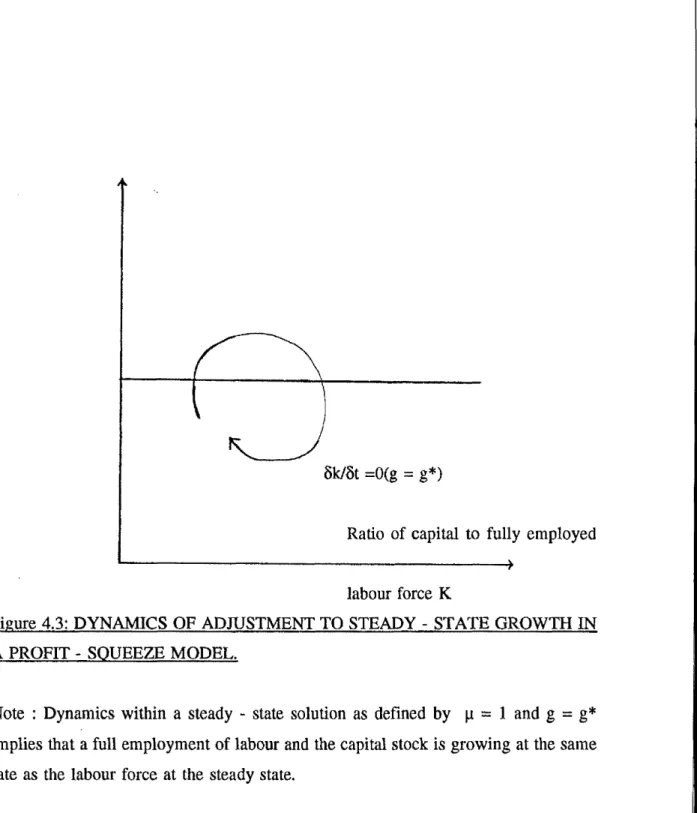
4.3 Dynamics of Adjustment to Steady-State Growth in A Profit
Squeeze Model 133
6.1 Inflation, Fiscal Deficit and Optimal Required Reserves
Tables
1 The Nigerian Exchange Rate 1991 - First Quarter 1992 100
1.2 The Nigerian GDP at Constant 1984 Prices 100
1.3 Domestic Public Debt 104
1.4 The Nigerian Growth Performance 104
1.5 The Nigerian Economy Under The Reform Program 111
4.1 GDP, Savings and MLR 144
5.0 SAP in Africa 167
5.1 SAP: Sub-Saharan Africa 168
5.2 Nominal Exchange Rate (against naira) before
the Liberalisation (quarterly 1974 - 1984) 189
5.3 Balance of Payment (on Current and Capital Accounts)
before the Liberalisation Program 190
5.3b Bank Expansion in Nigeria (1980 - 1987) 204
5.4 Commercial and Merchant Banks in Nigeria from 1893 - 1990 208 5.5 The Structure of the Nigerian Economy: Share of Non-Oil
GDP by Sector 1960 - 1985 (%) 209
5.6 Nigerian Oil Exports and Revenues: 1971 - 1985 210
5.7 The Performance of the Economy during the Period 1965 - 1985
(average real growth rates, percentages) 211
5.7.1 Independent Floating Unitary Exchange Rate Arrangements in Nigeria
Summary Characteristics 1988 218
5.7.2 Independent Floating Exchange Rate 1983 - 86 220
5.8 Pre and Post Reform (indicatives) Rates of
Effective Protection in Nigeria (percentages) 224
5.9 Sectorial Allocations of Credit (%) 233
5.10 Aggregate Credit to the Economy for the Period 1980 - 1984 236
5.10(1) Aggregate Credit to the Economy from 1985 to 1990 237
6.0 Growth Rates and Other Economic Indicators 245
6.1 Exchange Rate Volatility Under Pegged & Floating Exchange 252
6.2 Central Bank Balance Sheet 265
Chapter 1
LITERATURE REVIEW ON THE FINANCIAL REPRESSION
The seminal works by Mckinnon (1973) and Shaw (1973) both independently marked the take-off or trend of empirical research interest into the workings of financially repressed economies and the beneficial effects of financial liberalisation.
Chapter 1 deals with the general review of financial repression, while in chapters 2 to 4 , 1 review the work of Mckinnon, Shaw and the Neo-structuralist. Chapter 5 deals with the structural adjustment and the Nigerian financial system. Chapter 6 is a consolidation of chapters 1 to 5 and review of "Order of Economic Liberalisation". Chapter 6 examines in detail some of the policy prescriptions such as exchange rate misalignment, quotas, GATT, and foreign exchange volatility which were all briefly mentioned in other chapters. Chapter 1 examines the available empirical evidence on the essential relations of what is now termed the financial repression paradigm [Dornbusch & Reynoso (1989)].
The Mckinnon - Shaw hypothesis is that a repressed financial system disrupts development in several ways ie; the savings channel are underdeveloped and the return on savings is negative or unstable and financial intermediaries that collect savings do not allocate them efficiently among competing uses. Firms are discouraged from investing because poor financial policies reduces the returns to investment or make them excessively unstable.
However, liberalisation on the financial sector from interest rate ceilings and other restrictions facilitates economic development and growth, because higher interest rates lead to increased savings and a more efficient allocation of capital.
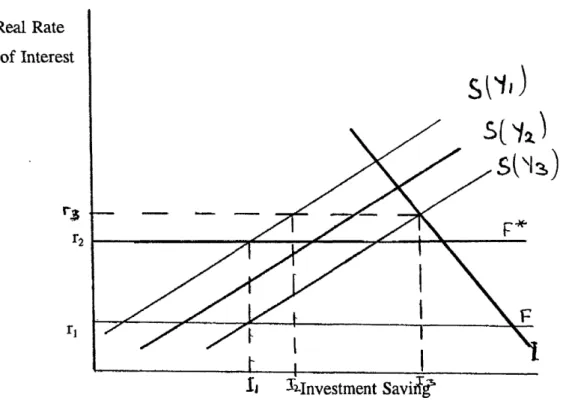
The common features in the Mckinnon - Shaw models are illustrated in a diagram popularized by Maxwell J. Fry (1979, 1980, 1988, 1989). Saving, S(YX) at income level Yj is a function of the real rate of interest, while F denotes financial repression
taken to consist of administratively determined nominal bank lending and deposit rates which hold the real rate of interest below the equilibrium level and actual investment limited to Ix which is equal to the amount of saving receivable at the real interest rate (See Figure 1).
Raising the interest rate ceiling from F to F* ie ^ to r2 , raises saving and investment. It also rations out low yielding investments which are no longer profitable at the higher interest rate r2. The level o f income increases in this process and shifts the savings function to S(Y2). The Mckinnon - Shaw models policy prescription is to raise institutional interest rates and or to reduce the rate o f inflation .
Real Rate of Interest
ij -^Investment Saviifjf*
Figure 1. Saving and Investment Under Financial Repression
The optimal result therefore, is to eliminate entirely the interest rate ceilings so as to maximise investment and raise further the average efficiency of investment. This is indicated on fig. 1 by the equilibrium at S(Y3)/I3 at r3 and a higher level of income Y3.
Before I proceed to review each model separately, I want to discuss briefly five sections survey studies relating to the impacts of interest rates on saving, financial intermediation, investment, economic growth and the demand for money. I will briefly discuss the studies on the impact of financial intermediation on economic growth and the available evidence as well as the assessment of the empirical support for the financial repression paradigm.
1. THE IMPACT OF INTEREST RATES AND SAVING
The hypothesis advanced is that financial liberalisation will develop positive real rates of interest which will equate the demand for and the supply of savings and lead to increased saving (Thorton 1991). Williamson (1968) carried out one of the earliest studies in this area by doing a cross section study of the determinants of personal saving for six Asian countries. He adopted the real rate of interest, permanent and transitory disposable income as explanatory variables in his equation to explain personal saving. The role of interest rate in his study offered little support in that, the interest rate elasticity of saving in five of the Six countries in the sample were negative. The regression coefficients were not statistically significant at the 5% level (t - statistic).
Gupta reported a mixed results in three Asian countries he studied, with personal saving in India responding positively to real rates of interest and per capita disposable income (Gupta 1970). He postulated (1984a) that increases in the interest rate would affect financial saving positively and physical saving negatively based on his study of twelve Asian countries.
He concluded that support for the Mckinnon - Shaw hypothesis was quite limited by reporting a positive and significant coefficient for the real interest rate in only four countries (Gupta 1984b).
Furthermore, he analyzed separately (Gupta 1987) countries from Asia and Latin America using a pooled cross-section and time series data for the period 1967 - 76. By regressing gross national saving on nominal interest rate, permanent income transitory income, expected rate of inflation, the financial intermediation ratio and inflation uncertainty variable, he found that financial conditions do not affect saving in Latin America but they did in Asia1. He then concluded that pooling across continents were inappropriate.
Fry, over a series of studies, found a fairly consistent support for a positive effect of real interest rates on savings, for example, Portugal and Turkey (Fry 1977 & 1978); by regressing the ratio of national saving to Gross National Product (GNP), on the growth rate of GNP, the foreign saving rate and the real deposit rate of interest, with both exhibiting positive and significant interest rate coefficient. Giovannini (1983) contested the stability of Fry’s results by re-estimating the equation used by Fry, but for a later time and also he substituted the national saving with domestic saving variable and found the coefficient of real interest rate insignificant.
In De-Melo and Tybout (1986) study of Uruguay 1962 - 83, by regressing the ratio of gross domestic savings to GDP on real interest rate, the growth rate of real GDP and the ratio of foreign savings to GDP were found to be positive but not significant interest rate coefficient. Their restricted model using the data 1962 - 73, yielded a positive and highly significant interest rate coefficient. Perhaps this could be attributed to a greater shock in the economy between the period 1973 - 83 which caused the reported significant influence on the real interest rate. Rossi’s (1986) examination of the liquidity constraints using a pooled time series and cross section data also found the real rate of interest2, positive and significantly different from zero.
1 ,ie a positive and significant interest rate coefficient for Asia and insignificant for Latin America. 2 ... defined as a time deposit rate of interest or foreign interest rate adjusted for inflation .
2. THE FINANCIAL INTERMEDIATION AND INTEREST RATES
Financial repression postulation is that, higher real rates of interest increase the incentives to save by means of bank deposits. Lanyi and Saracoglu (1983, p.28), provided evidence on the relationship between interest rates and the growth of the broad money supply in real terms in a cross - section study of twenty one countries for the period 1971-80. Their study concluded that, the data supports the argument that positive interest rate policies stimulates output growth and that this stimulus is transmitted mainly through the intermediation of financial asset accumulation. The question here is whether the increase in intermediation comes from the shift out of unproductive assets such as gold or if there is a diversion of funds from the curb market.
The answer may be that curb market could actually reduce total intermediation3 because funds diverted from the curb to the formal market becomes subject to reserve requirements (this is discussed in detail in chapter 6). For example, Van Wijnbergen (1982) found that substitution between the curb market and the time deposits has a greater importance than substitution between currency and time deposits in his study of South Korea.
Total intermediation can be defined as formal (official) banking system intermediation plus curb market intermediation.
3. THE INTEREST RATES AND INVESTMENT
The hypothesis presented by empirical research is that increased real interest rates raise the quantity and quality of investment. This is effected from two sources; first, higher rates increases the availability of domestic credit to finance investment (which can be viewed to be similar to the savings effect). The second potential source is through Mckinnon’s (1973) hypothesis4 of the complementarity of money and capital. Abe, Fry, Min, et al (1975), Fischer (1981) & Jao (1976) tested the complementarity hypothesis and found a positive and significant coefficient by including real money balance in the investment or savings function.
Another group also tested the complementarity hypothesis by including either an investment variable or a savings variable in the demand for money function. Their results were mixed, for example, Akhtar (1974) using the investment rate rejected the hypothesis in a study of Pakistan. In Harris (1979), only Taiwan out of five Asian countries supported the hypothesis.
Fry (1978) using the savings rate, found a negative and significant coefficient in a pooled time series study for ten Asian countries and rejected the hypothesis. Finally, Thorton (1989 & 1990) using a time series data for India and Nepal found a positive and significant coefficient for the savings rate in a demand for money balances in a savings function. Based on this result Thorton concluded that the complementarity hypothesis was relevant for the poorest countries.
4 In this case, investment projects are lumpy and investors must accumulate their investment balances in the form of deposits until the required amount of principal is reached.
4. INTEREST RATES AND ECONOMIC GROWTH
The empirical postulation is that increased real rates of interest promote economic growth. Fry (1980) indicated that about half a percentage point in economic growth was forgone for every one percentage point by which the real rate of interest is set below its equilibrium level (this is expanded in chapter 6).
Lanyi and Saracoglu (1983) identified a positive and significant relationship between interest rates and the rate of growth of real GDP while Khatkhate (1988) results is the complete opposite. Finally, Gupta’s (1984) results for twenty five Asian and Latin American countries were unfavourable but the results for India and Korea (1986), higher real interest rates raised economic growth.
5. IMPACT OF THE DEMAND FOR MONEY
Mckinnon5 stressed the basic complementarity between money and physical capital wherein money was viewed ... as a conduit through which accumulation takes place. But in an empirical test of several Asian countries using a pooled time series data, Fry (1978), found little evidence to support Mckinnon’s hypothesis and concluded that:
"one would have to look a long way down the development ladder, to some of the world’s least developed countries in a search for complementarity (p.474)".
Mckinnon’s work is one of two catalytic pieces of work in financial development, the other being Shaw (1973), Both of them combined theoretical analysis and illustration of the malfunctioning of capital markets in developing economies.
A critical lesson from both works is that, at low real interest rates people would not want to hold much money or other financial assets. As a result, the financial system would not adequately be able to fulfil one of its primary functions of integrating capital and credit markets and equalising returns to investment. The hypothesis that
money and capital are complementary was Mckinnon’s explanation for the way in which real interest rates impact upon saving, investment and growth.
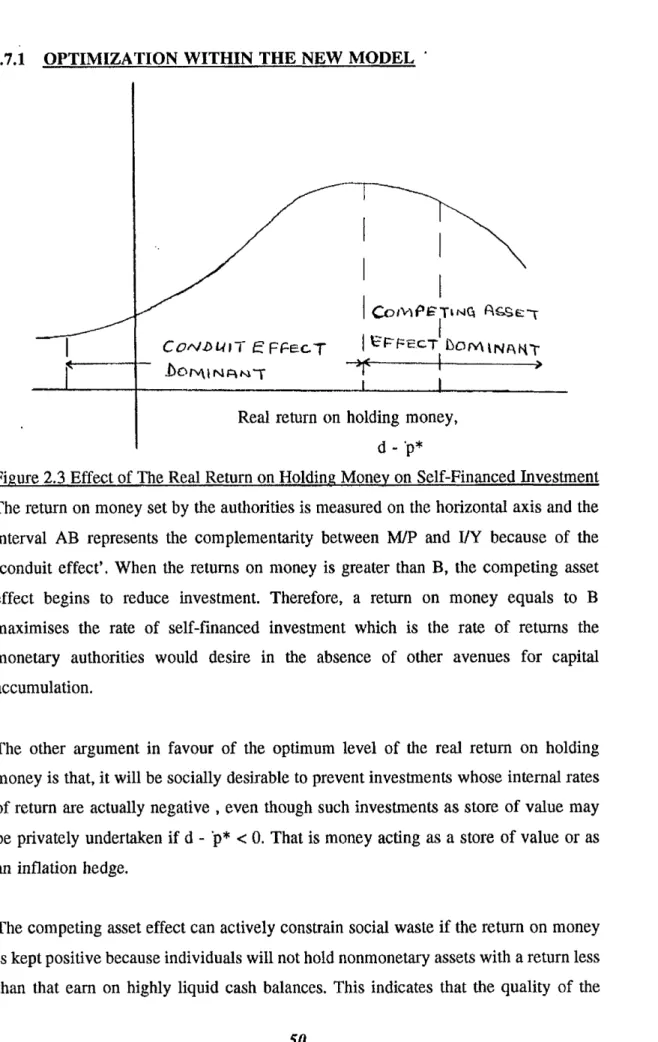
The hypothesis was based on two assumptions. The first is that, all economic units are restricted to self finance and that there are important indivisibilities in investment activities. The second is that potential investors must accumulate money balances before they can be able to invest. The indivisibility of investment implies that the demand for money will be larger, the greater the ratio of investment to total expenditure. Therefore, complementarity is expressed by the following demand for money function:
(M/P)* = / ( Y/P, I/Y, 7 t, T) (1)
where M = money stock P = price level Y = nominal income I = gross investment
7t = the nominal rate of interest on bank deposits and T = expected rate of inflation
The money stock is broadly defined in the formulation because it represented the conduit between saving and investment, while complementarity is reflected by the sign of the partial derivative with respect to the ratio of investment to income i.e:
5(M/P) / 5(I/Y) > 0
Fry indicated that the hypothesis rests on the assumption that investment opportunities are plentiful so that it is actually the supply of saving that is the binding constraint and not the demand for investible funds. This implies that domestic saving Sd, can be substituted for investment as the finance motive in the demand for money function. This is represented as :
(M/P)* = /(Y /P, Sd/Y, k - le) (2)
The reversibility of the complementarity relationship posses the main obstacle. The conditions of money supply has an impact on decisions to save and invest, therefore, it works both ways. The savings function can be specified to be determined simulta neously with the demand for money as:
(Sd/Y) = f ( M/P, 5(Y/P), Sf/Y, E/Y) (3)
where 8 represents the growth rate of real income
Sf = foreign saving which also represents a substitute for domestic saving.
E = exports.
Testing for complementarity between money and capital in the finance motive for economic development, Thorton6 made the demand for money a function of the saving ratio and simultaneously, saving was made a function of the real money balances. Using the 2SLS method of estimation, his results indicated a strong support for the Mckinnon hypothesis in both the demand for money and the saving function.
6 Thornton, J. (1990), ‘The demand for money in India : a test of Mckinnon’s complementarity hypothesis’. S & D no2 1990, pp. 153 - 156.
6. FINANCIAL DEEPENING AND ECONOMIC GROWTH
The hypothesis is that financial deepening and economic growth are positively related. Jao (1976) estimation of sixty seven developing and developed countries indicated a support for a relationship between financial deepening and growth. Restricting his regression to developing countries alone, per capita real money balances showed a significant coefficient. A positive relationship between real GDP and the real supply of domestic credit was obtained by Tun Wai (1980) in a time series study of twelve developing countries. Similar results were also obtained by Lanyi and Saracoglu (1963) between the rate of growth GDP and the rate of growth of the broad money supply. Mckinnon, Shaw and others assumed that causation runs from financial intermediation to economic growth, but an earlier work by Patrick (1966)7,
Fritz (1984) and Jung (1986), used Granger-type causality test to investigate the relationship between financial intermediation and economic growth. Fritz’s result confirmed Patrick’s hypothesis that financial intermediation causes economic growth at an early stage of development and the causation is reversed at a later stage, while Jung concluded for a moderate support for the supply-leading phenomenon in LDCs. Most of the evidence available provided a consistent support to the theoretical argument advanced by the Mckinnon - Shaw’s view for example Fry8. Dornbusch and Reynoso (1989) called the evidence in support of the financial repression paradigm "episodic". They argued that financial repression is only important when financial instability becomes the dominant force in the economy.
W hat Dornbusch and Reynoso failed to consider is the potential for a shift to savings from purchase of gold, real estate and other inflation hedges that predominate under financial repression. Higher domestic interest rates can also reduce the flow of savings
7 Patrick, Hugh T. "Financial Development and Economic Growth in Underdeveloped Countries (1966 p64 )..the direction changed in the course of economic development since as the process o f real growth occurs , the supply - leading impetus gradually becomes important and the demand - following financial response becomes dominant.
8 Maxwell Fry - Money , Interest and Banking in Economic Development .Baltimore : The Johns Hopkins university Press 1988 pl54....The bulk of the empirical evidence is consistent with the Mckinnon-Shaw view that financial liberalization increases saving , improves the efficiency with which resources are allocated among alternative investment projects and therefore raises the rate o f growth .
abroad, thereby increasing the amount available for domestic investment.
Most of the empirical work concentrated their emphasises on the marginal changes in financial conditions rather than discrete changes that result from a deliberate program of financial liberalisation. A few African countries of which Nigeria is now among them, have taken steps to liberalise their financial system. Since 1989, Nigeria has moved quite considerably towards full financial liberalisation.
Ajewole9 (1989), provided a strong evidence for the relevance and workability of Mckinnon’s model of money demand in Nigeria. He indicated that the real demand for money in Nigeria is considerably influenced by real income and return on physical assets. His test also indicated that the broad definition of money performs much better than the narrow definition in the specification of money demand function with respect to Nigeria. His paper finds that there is no significant difference in real money demand when expected and current (actual) income are used and interest rates does not significantly influence money demand in Nigeria, even though it is correctly signed. On this basis he concluded that the Mckinnon model is relevant and very much workable in the Nigerian economy.
Just as Diaz-Alejandro (1985) pointed out, reform programs in many countries achieved success, especially in Asian countries but the support for liberalisation has been called into question by the experience of a number of Latin American countries. Their experience suggests existence of many potential pitfalls for financial liberalisation programs and under certain conditions could lead to a worsening economic situation; more especially, since liberalisation gives money holders access to interest-bearing returns. This could add to public sector financing problems by reducing government revenue from money creation. Therefore, for financial liberalisation to succeed, the conditions must include other factors such as: price stability, fiscal discipline and policies credibility10, realistic exchange rates, balanced budget and a conducive investment climate.
9 Joshua O . Ajewole - some evidence on demand for money in Nigeria A test o f Mckinnon model of demand for money in developing economies . Savings & Development 1989 no.2 ppl83 - 197.
6.1 Summary
This chapter sets out the structure of the thesis. The seminal works of Mckinnon, Shaw and the Neo-Structuralist are outlined. It reviews the hypothesis that a repressed financial system disrupts development especially the savings channel and the financial intermediaries, leading to inefficient allocation of financial resources among competing uses.
The role of interest rates and saving in determining economic growth are important. Hence the postulation that financial liberalisation will develop positive real rates of interest which will equate the demand for and supply of savings, leading to increased saving.
The thesis examines the impact of financial intermediation and interest rates. Analyzing the hypotheses that higher real rates of interest increase the incentives to save by means of bank deposits, leads to a critical analysis of the curb market.
On investments, empirical research suggests that increased real interest rates raises the quantity and quality of investment. That is, higher rates increases the availability of domestic credit to finance investment, as well as through the complementarity of money and capital. There are still some concern as the support for liberalisation. This is because of many potential pitfalls for financial liberalisation, which under certain conditions could lead to a worsening economic situation.
Chapter 2
A REVIEW OF MCKINNON’S
MONEY AND CAPITAL IN ECONOMIC DEVELOPMENT.
Mckinnon attempted to demonstrate the common features of capital market distortions, examination of existing monetary theory and adaptation of a fresh approach to the relation between money and physical capital in developing countries. The Theses aimed to show why liberalisation of financial markets is necessary and how to achieve it without necessarily incurring social and economic costs.
Although his analysis paid less attention to the economies of Africa, one can still relate it very much to the Nigerian economy1. The analysis suggests that as long as potential access to international trade remains free, successful development remains mainly on policy choices made by national authorities in the developing countries. However, the inadequate economic performance of many LDCs has been attributed to repressive economic policies that they pursued. For example, Nigerian interest rates policy has been a subject of controversy. They were controlled and regulated up to
1986 when the structural adjustment programme (SAP) was introduced2.
Money and finance as governed by the banking system played a crucial role in Mckinnon’s analysis. This is because of his concentration on the domestic capital market and the way by that market’s operations are influenced by monetary and fiscal policies. The expansion of real stock of money3 or its fall and high rate of taxation critically affects the relation between saving and income and the efficiency of
1 socialist economies will be included in so far as they use prices to allocate resources in commodity and factor markets ( Mckinnon 1973 p2) . note ..Nigeria is a capitalist economy .
2 Bullion CBN Vol 15 no2 April / June 1991 p l5.
investment; a phenomenon which is very apparent in Nigeria.
Keynesian and Monetarist theory has failed to explain the dominance of real money balances in the capital markets of developing countries4. The theories to treat real money balances and physical capital as substitutes for each other, a relation of complementarity better explains the data in certain circumstances.
Mckinnon developed an alternative monetary model, even though the theoretical approach lacks the completeness and elegance of either the short run Keynesian theory or the long run Monetary growth models, but suitable for explaining the relationship between monetary processes and capital accumulation in developing countries. This is of course to a certain extent depending on which policy is adopted in relation to inflation versus deflation, higher or lower rates of interest and growth or stagnation. Mckinnon assumed that adopting the appropriate strategies will lead to liberalisation of foreign trade and rationalisation of domestic taxes and expenditure policy. Successful liberalisation will in turn allow for radical restructuring5, whereas, a correct policy towards the foreign exchange rate is necessary to secure control over the money supply.
Nigeria has now followed this doctrine of liberalisation - a complete overhaul and indeed a very radical outward looking restructuring of the capital market, with greater vigour since 1989. Although there is ample evidence of success, assessment of its success or failure still needs a little time.
The International Monetary Fund (IMF) and other international consortia of lenders from the industrialised economies has been a source of aid to Less Developing Countries (LDCs), in an attempt to liberalise foreign trade. Nigeria operated one of
4 The theories of monetary and financial processes which assumed capital markets to be ‘perfect’ with a single ruling rate o f interest, whilst underdevelopment is overwhelmingly fragmented in real rates o f interest.
5 of tariff, quotas and licensing restraints on foreign trade .
the most stringent exchange controls throughout the 1970s up to 1986, The policy led to a massive capital flight from the country, in an attempt to secure a better investment elsewhere as a consequence of the repressive interest rates policy followed by the authorities6. There are two prevalent views about the effect of liberalisation of the constricted foreign trade sector. The first is that liberalisation is taken as the removal of import controls and tariffs7. The second is that foreign aid and/or other external credits should come with liberalisation of foreign trade8.
2.1 CAPITAL AND ECONOM IC FRAGM ENTATION
Public intervention is generally viewed as pervasive and unsuccessful. The reason is due to the perception that a particular market or sector is malfunctioning and the authorities as a consequence are obliged to take action. This pressure for intervention is the result of severe fragmentation in the economy, which manifested in the form of distorted effective prices for land, labour, capital and produced commodities as well as unequal access to the same technologies.
Primary commodity exports enclaves in Nigeria were controlled by foreigners in the 19th and early 20th centuries and much of the population remained outside of the market economy. Indigenous entrepreneurs had little access to capital or advanced technologies and limited skilled labour. Hence, eradication of economic and political colonialism requires introduction of new industrial activities, manufacturing of goods previously imported and mobilisation of domestic factors of production. The authorities attempt to achieve this through manipulation of commodities prices and by intervening directly to help some individuals or sectors of the economy at the expense of others. These are usually through large subsidies by the government in the form of
6 CBN Bullion April / June 1991 p l5 , Nigerian SAP p236 -237, Balabkin p9-10 . Nigerian 4th national development plan 1981 - 85 p.40 .
7 Gradual liberalization -(i) essential producer & consumer goods (ii) essential consumer items ; ie , removal of protection first from domestic industries that are capable to withstand foreign competitions and then , the infant industries .
tariff protection, import licenses, tax concessions and low-cost bank finance; mainly to the small urban elites.
The income inequality did not help to induce high rates of saving and the authorities remained reluctant to reduce the disposable income of the rich investors whose unique access to investment opportunities is guaranteed by the web of official controls and the endemic fragmentation.
2.2 TH E IM PA C T O F LIBERALISATION AND CAPITAL M A RK ET
Liberalisation does not require intervention in commodity markets hence, an explicit policy for improving the operations of factor markets is necessary to persuade the authorities to cease intervening in the market. Mckinnon’s main objection is not just the imperfections in factor markets but the use of Neo-classical approach of treating labour, land and capital symmetrically as primary factors,(1973 p. 8).
He hypothesised that fragmentation in the capital market causes the misuse of labour and land, suppresses entrepreneurial development and condemns important sectors of the economy to inferior technologies. Discrepancies in the rates of return on some physical and financial assets causes some worthwhile investments to be forgone.
Development is not accumulation of homogeneous capital of uniform productivity. Hence, Mckinnon accused economic theorists and econometrician’s of incorporating this into production functions and by so doing, most policy makers in LDCs held it implicitly and followed a strategy of maximising short run gross investment in virtually any form. In an attempt to develop a distinct alternative view of the role of capital, he defined economic development as:
"the reduction of the great dispersion in social rates of return to existing and new investments under domestic entrepreneurial control".
By using the capital market in developed economies as an illustration, their success in monitoring the efficiency with which the existing capital stock is developed, by pursuing returns on physical and financial assets towards equality, thereby increasing
the average return. He argued that, economic development so defined is necessary and sufficient to generate high rates of saving and investment. The adoption of Best Practice Technologies and learning by doing.
However, arbitrary measures to introduce modern technology via tariffs or to increase the rate of accumulation by relying on foreign aid or domestic forced saving, will not necessarily lead to economic development. Therefore, there is a need for unification of capital market, which will increase the rates of return to domestic savers by widening exploitable investment opportunities and eliminating other forms of fragmentation.
2.3 FISHERIAN APPROACH
Mckinnon argued that, this approach is not suitable when dealing with capital market in LDCs, because the income categories are not well defined, nor are the processes of saving and investment specialised as in the advanced economies.
By adopting Irving Fishers approach to Impatience and Inter-temporal choice; as extended by Jack Hirchleifer, he provided a framework for viewing the way in which the capital constraint impinges on the decision making of entrepreneurs. Inter-temporal decision making depends upon 3 factors (maximisation of entrepreneurial utility): First is endowment or owned deplorable capital, second is productive or investment opportunity and the third is market opportunities for external lending or borrowing over time outside the entrepreneurs own enterprise. The resulting dispersion in real rates of return reflects the mis-allocation of existing capital and represses new accumulation.
Most Nigerian entrepreneurs with potential production opportunities lacks resources of their own. They have no access to external financing. Those with substantial endowments may lack internal production opportunities. Many have no external investment outlets at rates of return that accurately reflects the prevailing scarcity of capital.
The advantage of Fisherian approach is that it explains the individuality of each entrepreneur with own production opportunity which depends on specialised knowledge or expertise9. With availability of external financing, the need for public decision making in each sphere of economic activities is thus reduced, leaving only the problem of indivisibilities acting as a barrier to productive innovation. Without indivisibilties, self-financed capital accumulation-where saving and investment take place within the same firm, might well be sufficient for a slow diffusion of new technologies and a gradual reduction in the dispersion in rates of return within and between various enterprises.
Marginal innovative investment by poor but thrifty entrepreneurs would thrive because divisible investments could be financed directly by marginal reductions in current consumption. Given the constraint of self-financed, an entrepreneur can still decide on investment and consumption decisions that serve to allocate his capital over time. However, limitation to self finance biases investment strategy toward marginal variations within the traditional technology.
The Neo-Classical theory of technological diffusion and learning differs from this analysis of external financial constraints. The Neo-Classical approach assumed an existence of a perfect capital market which equalises all private rates of return, disregarding the importance of indivisibilities. It also assumed similar production opportunities for entrepreneurs. Imperfections in technological diffusion therefore requires a different approach as to external or extra market effects.
Mckinnon disagrees with Kenneth Arrow’s suggestion
"[the economic implications of learning by doing, Review of economic studies vol 29 June 1962 ppl55 - 173 ] that learning by doing in an industry depends on the level of gross investment undertaken by individual firms and because of spill-overs, becomes socially beneficial, thus warranting subsidy to gross investment in high learning industries".
The view was based on the argument that traditional technologies coexist with modern ones and as such the authorities can determine which of the two has the highest rate
9 Factors of production available to him/her : family labour land holdings and structures .
of return. He admitted that internal rate of return itself can attract enough resources to individual firm-households if an adequate capital market exists. In which case state subsidies can be used to encourage technical innovations in research and development. The essence of high rates of interest according to Mckinnon’s view is that artificially low cost loans or subsidized credit programs may be unnecessary and unwise10. The availability of loans and high rates of interest for both lenders and borrowers introduces a beneficial dynamism for development, such as increase in net saving, investment and technical improvement. The policy of running a low or negative rates of interest on financial assets and limited loan availability may not accomplish these benefits11. This point is discussed further in Chapter 5.
The major set back of capital accumulation through self finance is uncertainty, which fragments the interest rate structure so that it no longer reflects the community or entity’s collective time preference. Thus, the effect of risk is to lower the rate of interest on safe loans and at the same time raise the rate of interest on unsafe loans, hence offsetting the effects of bad debts or defaults in repayments.
In contrast to the fragmentation hypothesis, the existing theories of uncertainty assume that individual savers and investors are free to select whatever portfolios of physical and financial assets they choose. Which means that they can borrow and issue their own liabilities at a given rate of interest. James Tobin -(mean variance) and Kenneth J, Arrow -(state preference) explained the uncertainty phenomenon in their essays- liquidity preference as behaviour toward risks and the role of securities in the optimal allocation of risk bearing. The mean variance and state preference relates to the expected returns in holding an alternative physical and financial assets.
Tobin, in Optimal Monetary Growth [JPE Vol.76 July/Aug. 1968 p.854] indicated that risk - averters will hold safe assets with lower yields, while risk takers will hold high variance high return assets and may borrow or leverage themselves to do so.
10 Borrowing at a rate that exceeds the marginal rate o f return under self financed investments .
In developing countries, individuals and governments do not have a common menu of physical assets, with objectively defined probability distributions of rates of return. Therefore, investment and production opportunities will be highly differentiated. The reason for the existence of subjective uncertainty among firms and households is that economic units are small, and it is difficult for outsiders to obtain reliable information if they contemplate obtaining a loan or to invest. LDCs have poor data on repayment and many units operate with little liquidity. Therefore leverage becomes a key consideration in assessing with this interpersonal uncertainty and imperfect information. Those firms that can obtain access to external financing will have their initial endowments as an essential form of collateral to ensure good performance. Thus, initial endowment and capacity to borrow are complimentary over a long range, while leverage is particularly limited for those with small endowments.
For Nigeria, finance is severely limiting the inter-temporal redistribution of enterpreneurial resources as well as collateral in demand for a quick visible payoff on the trickle of external finance that is provided [ie time and quantity dimension]. As a result of these constraints, the government have implicitly been influenced and responded by adopting a policy of Second-Best.
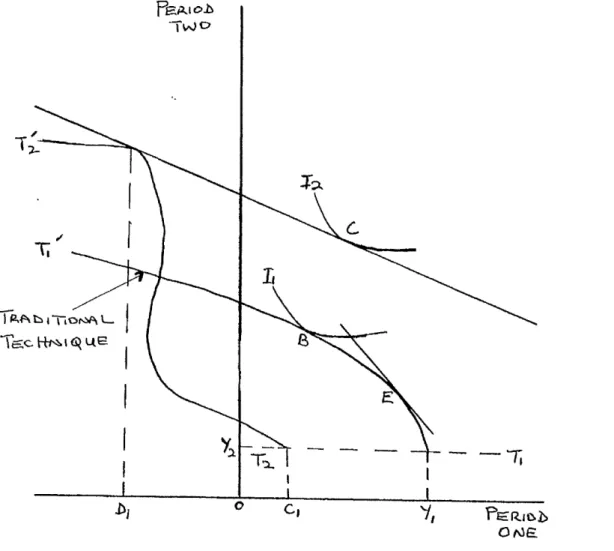
To summarise, Mckinnon essentially used the Two-Period Fisherian diagram to provide a graphic and technical account of how individuals may abstain from consumption (investment) in period one in order to argument their consumable output in period two. He also used it to demonstrate the problem of indivisibilities by assuming that internal investments within the firm can only be in the context of two distinct technologies; Traditional T1 T l ’ and Mechanised T2 T2’ .
Figure 2.1: THF, RELATION OF INVESTMENT TO THE CHOICE BF.TWF.F.N TRADITIONAL AND NEW TECHNIQUES.
I I T iO K A
Ike.
The diagram provided a sketch of how consumption constraint and limited endowment lock the entrepreneur into an inferior technology at point B indicating that with access to external finance, entrepreneurs will break out of the traditional mode with higher production, using new technology [at D] and with much improved consumption at [C] given the rate of interest slope [DC]. The external finance will therefore allow for new investment [Yx D J in the new technology and increased consumption in period one, ie; from B to C, while the gain in private and social productivity permits him to repay the loan in period two.
2.4 THE INTERVENTION SYNDROME
Mckinnon attributed the intervention syndrome on public policies which circumvents domestic capital market as:
a. Tariff protection for infant industries: A technique commonly used by LDCs to implement the Import Substitution Strategy. He argued that only repayment of principal and interest without tariff protection would vindicate new industries, since early losses must be held to social account and also as learning has its own social opportunity costs. The fact is that, even with spin-offs from established firms optimal public policy will still need a functioning capital market for inter-temporal allocation in the learning phase and in the succeeding growth phases of the new industry.
b. Import licenses and financial leverage:
This has a number of merits to the affected firms such as the privilege to import at lower prices which enhances operating cash-flow of the firm, identifying exclusive right to import an essential commodity as an opportunity for the particular firm to obtain external financing more easily as well as force the restraint on leverage to relaxed. A major drawback to this, apart from the financial aspects is the bureaucratic inefficiencies it brings about and the monopolistic power which acts as the offsetting social cost for concentrating import licenses for essential inputs to a selected few industries so as to reduce fragmentation .
c. Corruption - While he did not conclude that corruption is endemic in LDCs, he did however, indicate that disequilibrium commodity prices arising from intervention is a likely outcome of corruption.
d. Diverting from microeconomic arguments in favour of assisting firms , restrictions on foreign trade tilt the whole structure of relative prices, reducing commodities in some areas as it raises some. The cheapening of capital goods therefore implies an acceptance of the doctrine of uniformly productive capital and a disregard of the need for rationalized inter-temporal and inter-entrepreneur allocations.
e. Most governments intentions has been to transfer the rural economic surplus which
may be in the form of redundant labour or of inferior savings to the industrial sector. Failure to create the appropriate financial mechanism which will induce agricultural savers to part with their surplus voluntarily at the posited high rates of return to be earned in industry.
f. With land serving as a crucial endowment, limited leverage increases the importance of initial endowments in defining production opportunities. Therefore, land reform or redistribution should be given a priority in an attempt to achieve equality in current and future incomes in agrarian economies. According to Mckinnon, egalitarianism motives can hardly be faulted when differences in landholding are extreme and nonagricultural production opportunities are severely limited for those without the necessary capital.
His views were based on the findings of Minhas on India’s fragmentation [Minhas - rural poverty, land redistribution and development strategy: facts and policy, IBRD 1970], by advocating for land consolidation, motivated by irrigation or green revolution without waiting for government action, ie through purchase. The idea is that it will achieve the requisite external finance or internal liquidity, especially if there is a prohibition on the resale of land, giving the example of the (ejidos holders) Mexico land reform of the 1920’s of such policy failure.
g. There is some kind of ambivalence in the treatment of foreign direct investment and commercial credit by the LDCs. Initially direct investments are accepted with tax concessions over a certain period and then followed by periods of xenophobia which includes the threat of nationalisation. Nigeria followed a similar policy in the 1960s through to the early 1970’s, then came the indigenization exercise by the then Military government. When the civilian government was returned in 1979, they reversed the policy and throughout the 1980s both the central and state governments sort foreign direct investment by any means they can. This is discussed in greater details in chapter 5.
becomes very attractive, although the risk for foreign investors in the domestic economy may be very expensive, the domestic nationals do not see it in that way. Hence the formulation of the hypothesis that domestic entrepreneurs have investment opportunities but lack financing from outside then' own enterprises to exploit these opportunities.
The pitfalls of reliance on direct foreign investments is the possibility of breaking the external financial constraint at the cost of relinquishing investment opportunities to the foreigners, therefore, forcing the government to intervene by introducing complicated bureaucratic controls. There is also the danger of returning to colonial economy where expatriates operate with freer access to external capital market in such a way as to deprive domestic entrepreneurial development.
2.5, THE IMPACT OF SELF FINANCE AND INCOME DISTRIBUTION
Self finance is defined as the investment within a particular enterprise of savings accumulated in that enterprise. Through public interventions constraints on external finance are relaxed by enriching the holder of a production opportunity or by making that opportunity appeal’ to be more profitable so that the immediate cash-flow from it increased, for example, by raising output prices through tariffs or through subsidies.
The problem with using prices to generate cash-flows for investment is that it distorts their allocation functions in planning. Firms supported by government subsidies or import licenses or through increase in relative prices have their incomes increased irrespective of the level of efficiency and productivity. Changing the commodity terms of trade in favour of manufactured goods extracts forced saving elsewhere especially in rural areas, without compensation. The argument in favour of this policy is that the industrial sector may save more out of given incomes than do the rural people, so that the transfer increases total saving.
In contrast, self finance tilts the distribution of income towards the wealthy in urban areas, who already have some resources, hence a concentration of economic stratification while lucrative productive investment opportunities are forgone.
2.5.1 THE TAX - SUBSIDY SOLUTION AND THE THEORY OF THE
SECOND BEST
Tariffs and other trade restrictions constraints the domestic price structure by differentiating it from the foreign prices through increases in the domestic prices of the protected commodities. Higher internal prices also causes inefficiency by unduly restricting consumption of its output in an attempt to stimulate production. Therefore, the proposition that a direct production subsidy, leaving price unchanged, is the "Best" technique for stimulating production to some predetermined level. Mckinnon used the word " Best" to describe a technique or a policy that achieve some preassigned goal with the least social cost to consumers and to other producers. Thus, tariff is the Second Best Strategy and could diminish welfare even if there were some economically legitimate reason for stimulating production in one industry at the expense of the others. A crucial factor in the liberalization process is the elimination of price distortions.
Since fragmentated economy faces severe fiscal constraints, financing a production subsidy by raising taxes generates its own distortion. Tariff on competing imports has the advantage of being fiscally sound in the sense that consumers of the output of the protected industry are effectively taxed to subsidize producers. However there are few problems with production subsidy. Capital constraints are not recognised as to allocation of resources and budgetary problems. There is biasness towards self finance in the protected industry. There is no recognition of the role an external financial structure in facilitating efficient decision making over time.
Fiscal policy can be very important and can fulfil some essential roles in using differentiated taxes and subsidies aimed at specific industries. Apart from macroeconomic stabilisation policies, the tax instrument of the government can be fully employed financing public goods, redistributing income and mobilising an economic surplus of revenues over current expenditure of capital formation.
2.6. MONEY AND THE PRICE LEVEL
On the nature of the financial structure in LDCs, Mckinnon gave an account of the observations by Raymond Goldsmith [1969 ch.l- 9 and June 1971 pp. 129 - 92]; that individual economic units issue relatively few primary securities as a proportion of saving, indicating the greater reliance placed on self finance by firms in LDCs in contrast to the industrialised economies.
Most of this limited flows of primary securities are obtained by the financial institutions rather than being placed directly with final savers. The liabilities of the monetary system - the central plus deposit banks, accounting for about two-thirds of all claims on intermediary financial institutions that are held by the public.
Modern financial sector consists of instead, indirect financial or intermediaries through which the monetary system operates. In the developed countries, there is a much wider spectrum of available financial assets of which some may be fairly close substitutes for money. Money acting as a legal medium of exchange is uniquely risky and default free for short term transaction.
Since creditors has limited knowledge of the repayment capability of potential debtors in LDCs, financial instruments other money can not easily be marketed. Therefore, money’s role as a means of payment and its sanction by the state, greatly enhance its value as an instrument of private capital accumulation. But the usefulness of money as a financial inshnment depends on the willingness of firms-households to hold it. However, over finite time intervals, no real financial asset is risk-less. The attractiveness of money depends on some combination of the percentage rate of inflation:
P = [ 5p / 8t ]/p (1)
(proportional changes through time in the designated variable) the nominal interest rate on deposit d and the convenience of holding money, especially in demand deposits and currency. P is the comprehensive price index of goods in terms of money, while the real return on holding money is d - P*. The instruments of monetary policy open