WHO NEEDS FOREIGN BANKS?
DANIEL GROS
CESIFO WORKING PAPER NO. 998
C
ATEGORY6: M
ONETARYP
OLICY ANDI
NTERNATIONALF
INANCEJ
ULY2003
An electronic version of the paper may be downloaded
• from the SSRN website: www.SSRN.com
CESifo Working Paper No. 998
WHO NEEDS FOREIGN BANKS?
Abstract
This paper shows that countries with weak banking system and fiscal institutions, should benefit from the presence of foreign banks, which can constitute a commitment and transparency device. Foreign banks can also reduce the probability of self-fulfilling speculative attacks. A strong presence of foreign banks can make a currency peg feasible in the first place by rendering it more resistant to speculative attacks. The European experience is instructive in this respect. In all the 10 countries from Central and Eastern Europe (CEEC) that will join the EU in 2004/7 the banking system is now dominated by foreign banks.
JEL Code: E5, E63, F4.
Daniel Gros
Centre for European Policy Studies Place du Congres 1
B-1000 Brussels Belgium [email protected]
Many thanks to Alexandr Hobza and Peer Ritter for important research assistance. A first version of this paper was prepared for the Stockholm conference on "Managing EU Enlargement » Sverige Riksbank, Stockholm, May 15/17, 2002
I.
Introduction
It is well known that highly indebted countries, or countries with weak fiscal institutions, can fall into a low credibility trap. This occurs when a government loses credibility in the eyes of the financial markets and is forced to pay a risk premium in the form of higher interest rates. The higher debt-service burden that results, if inflation is kept low, makes it even more likely that the authorities will abandon efforts to stabilise the situation and attempt to reduce the real value of the debt through a surprise inflation. This further increases the risk premium demanded by financial markets and can lead to a spiral of increasing interest rates until the government caves in and produces the inflation the market expects.
Moreover, countries with weak financial systems tend to accumulate more public debt because the government has to bail out banks, which represent powerful groups (e.g. farming cooperatives, heavy industry). The topic of this paper is to what extent the presence of foreign banks can mitigate these problems.
One basic prescription of a country with little credibility, and a weak domestic institutional framework, which make it difficult to commit to low inflation, is to use an external anchor. For the Central and Eastern European countries the obvious candidate to be such an anchor would be the euro given that most of their external trade is with the euro area. Some countries have already de facto joined the euro area by linking their money via a currency board to the DM, or, now, the euro (e.g. Estonia, Bulgaria and Lithuania). But can these commitments be credible? In particular can they withstand the ultimate stress test imposed by financial markets when interest rates go to astronomical levels so that it becomes prohibitively expensive to service the debt at stable prices? This paper explores whether the presence of foreign banks makes this problem more manageable.
What is a foreign bank? The presence of foreign banks usually takes the form of subsidiaries, rather than branches. It is clear that in most countries there is no legal distinction between a subsidiary, i.e. a bank whose capital is majority foreign owned and other, domestically owned banks. In both cases the bank is incorporated under domestic law and constitutes a separate legal identity. Moreover, in many cases the top management (the lower level management has to remain local for obvious reasons) is also local. In a number of countries the presence of foreigners among the top management is actually limited. Moreover, a foreign owned bank is usually treated, at least on paper, in exactly the same way as domestically owned banks in terms of banking supervision, reserve requirements, etc. One might thus ask what difference does it
make? For the purposes of this paper it does make a big difference because of something intangible, namely because of the fact that a foreign bank is usually not subject to the same domestic political pressures and, therefore, usually does not accumulate large hidden liabilities on its balance sheet for which the government could in the end become responsible.
Foreign ownership of the banking system is just one facet of a more general phenomenon, namely foreign direct investment (FDI). FDI is usually particularly appreciated because it does not create debt and implies usually also a transfer of know-how. These reasons apply also in banking. Hence, there are many reasons why it might be desirable to have FDI in banking, particularly in transition countries where no banking system existed beforehand so that the skills necessary for running a bank simply did not exist at the local level. While these reasons for welcoming FDI in banking might be very important they will not be discussed in this paper, which will concentrate on how the presence of foreign banks can improve the efficiency of the macroeconomic framework. For an excellent discussion of the weaknesses of domestic banking systems in transition countries see Berglof and Bolton (2002).
The remainder of this paper is structured as follows: the next section shows some basic data illustrating the importance of foreign banks in the countries from Central and Eastern Europe which are candidates for EU membership (CEECs). Section III and IV then present a standard model and its solution if there is no commitment device. This is followed in section V by a discussion of what difference the presence of foreign banks can make. The model is meant to be illustrative of the effects that are likely to operate in countries with weak fiscal institutions. It does not pretend to be innovative. Section VI then shows how the equilibrium is affected in the standard cases by the presence of foreign banks. Section VII uses the model to discuss how a strong presence of foreign banks can make currency (and public finance) crisis less likely. Section VIII concludes.
II.
Foreign banks in Central and Eastern Europe
The importance of foreign owned, or foreign dominated, banks is not one of the statistics that central banks or finance ministries publish regularly because in many countries this is not an issue. Moreover, it is not always straightforward to identify what constitutes a foreign owned bank. The threshold of foreign ownership mostly used appears to be 50 %, but it is possible that even with a minority participation management can be dominated from abroad. A recent report
from the European Commission, however, gives comparable figures for the ten candidates for EU membership from Central and Eastern Europe.
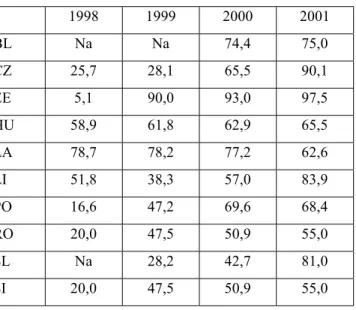
Table 1: Share of majority foreign-owned banks in total assets (in %) Panel a): The CEECs
1998 1999 2000 2001 BL Na Na 74,4 75,0 CZ 25,7 28,1 65,5 90,1 EE 5,1 90,0 93,0 97,5 HU 58,9 61,8 62,9 65,5 LA 78,7 78,2 77,2 62,6 LI 51,8 38,3 57,0 83,9 PO 16,6 47,2 69,6 68,4 RO 20,0 47,5 50,9 55,0 SL Na 28,2 42,7 81,0 SI 20,0 47,5 50,9 55,0
Source: European Commission (2002).
By 2001 foreign banks had more than half of deposits in all of these countries, and in some of the larger ones (e.g. Poland, Hungary, Czech Republic) the share of foreign banks is around two thirds. It is thus fair to say that foreign banks by now dominate the banking system in the CEECs. It would of course be even more interesting to have data on the capital invested in foreign banks. But the dominance in terms of deposits, which presumably translates into a dominance in terms of loans, implies that foreign banks should also dominate in terms of capital given that the same prudential standards are applied to domestic and foreign owned banks. The situation in the ‘old’ EU-15 is quite different. Panel b) of table 1 shows the data collected for 1997 by the ECB. It is apparent that in most member countries foreign banks have only a marginal presence (Luxemburg and the UK constitute exceptions because of their large off shore banking sectors).
Table 1: Share of majority foreign-owned banks in total assets (in %)
Panel b) The EU
Ireland 53.8 Netherlands 7.7
Belgium 36.3 Italy 6.8
Greece 21.9 Germany 4.3
Spain 11.7 Austria 3.3
Portugal 10.5 Sweden 1.6
France 9.8 (1996) Denmark N.a.
Source: European Central Bank (1999).
III.
A standard model
How does the presence of foreign banks contribute to macroeconomic stability? The remainder of the paper explores this question based on a simple model. The model used here is entirely conventional. The starting point is a standard social loss function, Lt, given by:
(1)
[
2 2]
t t t q p
L = α + α ≥0
where pt stands for the inflation rate and qt stands for tax revenues as a percentage of GDP, which is equivalent to the average tax rate. High taxes and high inflation create distortions and are thus socially costly. The parameter α indicates the relative weight of taxes in the social loss function. A high α could be interpreted to mean that the tax collection system is not efficient, i.e. that it causes high distortion costs for a given revenue. The experience in Central and Eastern Europe has shown that there are indeed great differences in the ability of different countries to raise taxes. In Russia, to take an extreme example, until recently, the government was not even able to raise 15 % of GDP, whereas in other countries (e.g. Poland, Estonia) government revenues amount to over 30 % of GDP1.
To concentrate on the issue at hand it is assumed that the authorities can determine inflation via their control over the money supply (or to be more precise its growth rate), and that this control is perfect. Hence the authorities can set directly the inflation rate.
A second standard element of the model is that the authorities (as usual, no distinction is made between the central bank and the Ministry of Finance) have to satisfy a budget constraint:
(2) d(bt)=gt +bt(it − pt)−qt − ptµ +εt
1
An alternative interpretation would be that society and/or the politicians in power dislike high taxes (for example, because their marginal voter is a household with a high marginal tax rate).
where bt is the public debt/GDP ratio and gt represents (non-interest) expenditure relative to GDP. The last but one term in this budget constraint represents seigniorage revenues under the assumption of a constant velocity money demand function with the cash (or rather monetary base) to GDP ratio constant and denoted by µ. The constant velocity assumption implies that seigniorage increases linearly with the money supply (and hence expected inflation). This is not realistic, but this assumption was chosen in order to show that the results do not depend on a ‘Laffer curve’ for seigniorage revenues under which the revenues from the inflation tax fall with very high inflation rates as money demand goes towards zero.
The shock εt will play an important role later. It arises from the fact that it is not possible to know the exact amount of public debt in countries with opaque financial systems. There are many ways in which banks can finance the government indirectly. Hence it is assumed that εt represents a surprise, a real shock with an expected value of zero (meaning its expected component is already incorporated in gt) and variance σε2.
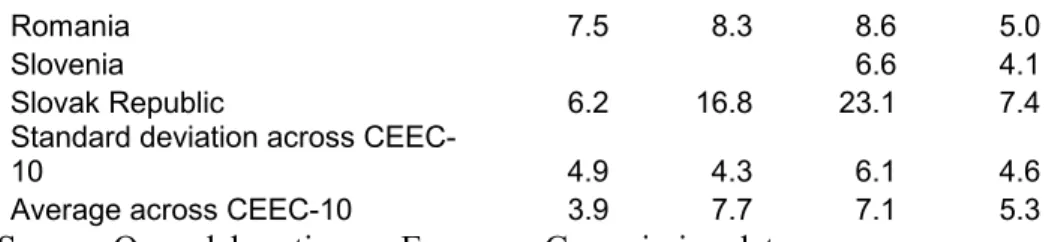
How important could be these ‘shocks’ to public debt? Table 2 below shows the data for the so-called stock flow adjustment, i.e. the increase in the debt to GDP ratio that cannot be explained from the deficit and nominal GDP growth. This should be exactly what the disturbance ε is supposed to represent (although not all will come from problems in the banking system. The values are quite high for some countries (above 10 % of GDP for Lithuania in 1999, for example). The standard deviation across the ten CEESs was 5.2 % of GDP in 1999. This is larger than the average deficit of these countries (which was below 3 % during this year). The average stock flow adjustment was also consistently positive, increasing from 4 to over 6 % of GDP between 1998 to 2000. Unfortunately it is not possible to analyse a longer time series as the data simply does not exist. This fact alone provides a further indication of the uncertainty surrounding the true size of public debts in transition countries.
Table 2: Stock-flow adjustments to public debt ratios
Panel a) CEECs: Increase in debt/ratio not explained by deficit (% of GDP)
1998 1999 2000 2001 Bulgaria -6.3 4.6 4.0 -1.9 Czech Republic 6.3 4.2 6.9 14.4 Estonia 0.4 4.8 -0.2 0.0 Hungary 8.1 8.7 4.1 8.7 Lithuania 6.5 12.0 7.7 3.1 Latvia 9.7 5.6 5.0 Poland 1.7 3.8 5.5 8.1
Romania 7.5 8.3 8.6 5.0
Slovenia 6.6 4.1
Slovak Republic 6.2 16.8 23.1 7.4
Standard deviation across
CEEC-10 4.9 4.3 6.1 4.6
Average across CEEC-10 3.9 7.7 7.1 5.3
Source: Own elaboration on European Commission data
The average and standard deviation of the stock flow adjustment across the EU countries are much smaller than for the CEECs, see panel b) of table 2 below.
Table 2 continued
Panel b) EU countries (as % of GDP)
1998 1999 2000 Belgium -1.6 0 0.3 Denmark -1.7 2.3 -0.1 Germany -0.5 0.2 1.7 Greece 2.4 3.6 5.3 Spain -0.4 1.8 1.4 France 0.1 -0.6 0 Ireland 0.6 4.1 0.7 Italy -1.4 0.1 1.2 Luxembourg 4.1 3.7 6 Netherlands 0.1 0.3 -0.5 Austria -0.7 0.9 0.1 Portugal -1.9 1.1 1 Finland 0.2 2.2 7.6 Sweden 2.6 -0.3 -2.8 UK 0.1 0.9 3.5
Standard deviation across EU 15 1.7 1.5 2.8
Average across EU 15 0.1 1.4 1.7
Source : European Commission, AMECO
Other simplifying assumptions are standard: For the sake of simplicity, real growth is assumed to be zero. Government expenditure could be made endogenous, as in a number of other contributions on the optimal choice of taxes and inflation, but this has not been done here as it would not affect the main results of the paper, which concentrate on the incentive to use surprise inflation to reduce the real value of the public debt.2 Another real world qualification could be that it is implicitly assumed that the monetary base consists only of cash. Introducing required reserves on commercial banks (which could be remunerated) would not change the thrust of the
2See, for example, Mankiw (1987).
analysis. If required reserves were not remunerated (which is usually the case) the value of µ
would just be somewhat higher.
The crucial point about the budget constraint (2) is that real interest payments, given by bt(it -pt), are a function of the difference between actual and expected inflation. The simple form of the budget constraint used here assumes implicitly that all government debt has the same maturity, equal to the length of the period of this model. Another interpretation would be that b represents only the government debt that matures in this period. Interest payments on other government debt would then be subsumed under general government expenditure. This is not a serious limitation of the model since most emerging market countries have a relative short average duration of (domestic) debt (and the little long-term debt that exists is indexed on short-term interest rates3).
The nominal interest rate, it, can be written as the sum of inflation and the real interest rate, required by investors. The latter will be assumed to be constant, denoted by ρ.
(3) it =ρ+Et(pt)
The budget constraint that the authorities have to observe can thus be rewritten as:
(4) d(bt)=gt +bt(ρ+Et(pt)−pt)−qt −ptµ+εt
IV.
… and a standard equilibrium under discretion
The authorities have to take their decisions before the shocks occur. They try to minimise each period the expected loss while observing their budget constraint. The F.O.C. for a minimum of (1), subject to (4), are: (5) t t t t q q L α −λ = = ∂ ∂ 2 0 3
As is well known the time inconsistency problem could also be solved by issuing only foreign currency or inflation indexed debt. In reality this is not done anywhere.
(6) t t
(
t t)
t t p b p L µ λ + − = = ∂ ∂ 2 0Where λt is the shadow price associated with the budget constraint (2)'. As usual, it is assumed that the government reflects accurately the preferences of society in setting taxes and inflation. In order to simplify the notation only the steady state will be considered with a constant debt/GDP ratio, denoted b.4 Conditions (5) and (6) then yield a simple relationship between inflation and tax revenues (as a percentage of GDP):
(7) pt =(b+µ)αqt
This can be substituted into the budget constraint (2)' to obtain an expression for the steady state "tax rate". If one assumes that the public anticipates monetary policy and hence inflation correctly the debt-to-GDP ratio remains constant only if:
(8) qt = g t + bρ − µ
(
b + µ)
αqtIf expenditure is constant at g, the optimal tax ratio changes only if the realisation of the interest rate shock is different from zero5 :
(9)
[
(
(
)
)
]
α µ µ µ ρ + + + + = b b g q t d 1The expected loss under discretion E(Ldisc ) would then be given by:
(10)
[
(
)
]
(
)
[
]
2{
[
]
2 2}
2 1 } { ) ( ρ σε α µ µ α µ α + + + + + + = g b b b L E discAs usual the discretionary equilibrium is not the first best for the country.
5 In a similar model, Gros (1990) shows that this should not affect the conclusions.
The social optimum, if there were no constraints on credibility, can be calculated by using the first order conditions (5) and (6), but without the effect of surprise inflation on debt service in equation (6). This means that in the social optimum the relationship between taxes and money supply would be given by:
(11) pSO =µαq
Which differs from the corresponding relationship (7) in that only seigniorage is a valid argument for having inflation. The optimum tax rate is then given by substituting this expression into the budget constraint (and setting the debt-to-GDP ratio constant), which yields:
(12)
[
[
]
]
α µ ε ρ 2 1 ) ( + + + = t SO b g qThe expected loss under the social optimum, E(LSO), would then be equal to:
(13)
[
( )
]
[
2]
2{
[
]
2 2}
2 1 ) ( ρ σε α µ αµ α + + + + = g b L E SOwhich is lower than the loss under discretion. However, in this set-up there is no way the country could easily reach this bliss point. One way would be to fix the exchange rate to an external anchor, which for the CEECs would normally be the euro. This could take several forms: an informal commitment (Latvia), a currency board (Estonia, Bulgaria, Lithuania) or the outright adoption of the euro as the national currency (Montenegro, Kosovo). In whatever form it is done, it implies the loss of inflation as a tax instrument.
V. The Role of Foreign Banks
This section describes how the presence of foreign banks can make a difference. There appear to be two ways in which foreign owned banks will affect the working of the economy: a) foreign
banks are more likely to have transparent accounts, and, b) foreign banks cannot exert the same pressures for a bail out.
a) Greater transparency
A first consequence of the presence of foreign banks is that they in general are less likely to lend indirectly to the government and know their books better than their (unreformed) domestic counterparts. This should limit the potential for nasty surprises on the true size of public debt.
b) Mitigating inefficiencies in the domestic economic policy process
Since this is a macro model it seems natural to assume that the government and the central bank take their decisions in terms of inflation and the overall level of taxation needed to finance a given level of expenditure. If one assumes that the authorities share the preferences of the population it is then natural to assume also that the decisions on the two key macroeconomic variables should reflect the preferences embedded in the social loss function. However, this assumes an efficient domestic policy process and thus unlikely to be the case in reality, specially in the new democracies of the CEECs (which sometimes are entirely new states).
One particular problem that appears to have been particularly important in the CEECs is the lack of transparency in the financial system and the pressure put by large banks to bail them out when it turned out most of their credits had turned sour. This a particular manifestation of special interest group politics. There are always special interest groups that plead for special treatment. But it appears that large banks which had accumulated a large exposure to (ex-post) loss making enterprises have always been particularly effective in pressuring the central bank (and ultimately the government) into bailing them out. One important reason behind this success of (domestic) banks to obtain large bail outs is that the accumulation of bad debt is not immediately transparent. When it is uncovered it has usually reached already such size that the banks would go bankrupt if there were no help. Since no government can seriously consider letting its own banking system collapse domestic banks usually are saved and their bad debts are paid by the public exchequer.
Any bail out that is granted to a particular bank (usually representing a particular domestic constituency, e.g. the farmers, large industrial enterprises, etc.) must of course be paid for
somehow. In this set-up the only alternative source of revenues is inflationary finance. Using inflation also causes a welfare loss to the special interest group that obtains the bail out. However, as the part of any group in the overall budget will be small, this cost cannot fully offset the direct gain from the bail out (e.g. emergency credit from the central bank). Each special interest group thus faces a shadow price of a bail out which is only a fraction of the economy wide trade-off between inflation and taxes because it takes into account the fact that the overall inflationary impact any bail out has is likely to be proportional to the weight of the special interest group concerned. This fraction should be a function of various elements, for example the share of the interest group in the overall budget, the extent to which benefits have to be shared with other groups (a bail out for one bank alone might not be possible, an exemption for the entire banking system might be acceptable, indeed unavoidable in certain cases).6
Foreign owners, with very deep pockets (at least relative to the size of the potential losses in a CEEC) cannot credibly make the same threat as a domestic bank (whose owners, if private, and at any rate managers, are anyway likely to be politically well connected with the ruling elite). Most of the presence of the foreign banks in the CEECs comes from large, internationally oriented EU banks for which the CEEC exposure represents only a small percentage of overall deposits or capital. This is what one would expect given that deposits in the ten CEECs together represent less than 5% of the sum for the euro area. Moreover, it is politically much more difficult to sell to the national public the need to save at great cost a foreign bank. As the likelihood of being bailed out is lower foreign banks have an incentive to be more prudent in their loan policy. This comes on top of the fact that foreign owned banks are more likely to avoid making the bad loans in the first place. In practice this might be the case because they will be less subject to domestic political pressures. This seems to have happened in reality. There have been no large scale bail outs involving foreign banks.
c) Modelling the influence of foreign banks.
6 For a similar approach, regarding fiscal policy decisions see von Hagen and Harden (1994) with an analysis of EU member countries in this respect. Velasco, (1998) uses a similar approach with two symmetric interest groups whereas Drazen (2000) presents (in chapter 10) a model with a large number of competing groups, which try to extract transfers from the government. For reasons unrelated to interest groups, a monetary bail out for the entire banking system is also advocated by Goodfriend and King (1988).
It will be clearest to start with the case in which there are no foreign banks. If domestic banks dominate the choices of the central bank and the finance ministry they can determine fiscal and monetary policy (at least at the margin). As the constituencies of the banks share the same preferences they will still like, ceteris paribus, lower inflation and taxes, but with their own special interests in mind as well. In pressuring the finance minister to take over the bad debts of a bank the special interest groups, which accumulated this debt are of course counting on the fact that they get all the benefits (i.e. debt relief) whereas society has to carry all the cost in terms of higher taxes (or rather a combination of taxes and inflation). In a Nash equilibrium with n banks (or the interest groups they represent), all identical in terms of size and influence, the minimisation of the loss function (1) under the budget constraint7 (4) leads to the following first order condition, for the setting of the overall average tax rate:
(14) q
( )
n q L t t t =0=2α −λ1 ∂ ∂where λ(1/n) indicates the shadow price perceived by a particular bank or group of banks. This ‘private shadow price’ is the product of λ, the shadow price of the economy wide budget constraint and (1/n), which indicates the weight of the bank in the economy, or rather the budget. To make a concrete example. Assuming there are four interest groups represented in the domestic banking system and the bank of the farmer’s cooperatives is one of them. It asks to be bailed out, representing one fourth of the overall economy and the budget (1/n=0.25). In this case each euro spent on a bail out would be four times as ‘valuable’ to this bank as one euro given to everybody.8
It was argued above that foreign banks cannot (and in reality do not) participate in the bail out game. Hence the greater the share of foreign banks the less important this distortion should become. This can be incorporated in the approach followed so far by splitting fiscal policy decisions into two areas: one area is free of special interest groups politics. This area is the one dominated by foreign banks. In the remainder it is ‘politics as usual’. Denoting the share of
7 It is assumed that the average level of government expenditure remains constant despite the presence of interest groups.
8 As an aside one should note that the model could also be applied to the case of Argentina (and perhaps even Russia) if one substitutes special interest groups with provincial governments. However, if regional governments are the problem the presence of foreign banks should not make a big difference.
foreign banks in the overall banking system by s, meaning that the ‘policy relevant’ shadow price becomes: (15) q
[
s(
s)( )
n]
q L t t t = 0 = 2 − + 1− 1 ∂ ∂ λ αWhen foreign banks dominate the banking system (s goes towards one) the particular fiscal inefficiency considered here disappears. To save on notation the fiscal externality in the presence of foreign banks will be denoted by η, which is defined by:
(16) η≡
[
s+(
1−s)( )
1n]
The parameter η thus shows the inefficiencies that persist in the decision process about domestic fiscal policy. As s goes to one, η also goes to one. Allowing foreign banks to take over the domestic banking system thus eliminates the bail out problem.
It is much easier to model the second consequence of the presence of foreign banks, namely the greater transparency in fiscal accounts. The greater the share of foreign banks the lower smaller will the shocks to public debt coming from the banking system. This can be expressed in a slightly modified budget constraint
(17) d(bt)=gt +bt(ρ +Et(pt)− pt)−qt −µpt +
(
1−s)
εtThe discretionary equilibrium can then be calculated as above, with the only difference being that the first order condition (5) is substituted by (15) and the budget constraint by (17).
VI Equilibrium with foreign banks
The preceding section has provided a way to model the influence of foreign banks in countries with weak fiscal institutions. This makes it possible to consider what difference foreign banks can make to the equilibrium by potentially reducing the social losses associated with excessive inflation. Setting the inflation rate hits all interest groups in the same way; the first order condition (6) is thus not affected. However, the inefficiency in the fiscal process implies that the resulting trade-off between taxes and inflation is different:
(18)
(
)
η α µ t t q b p = +This implies that, ceteris paribus, inflation will be higher as all interest groups push the government to finance their benefits through inflation. As nothing changes in the remainder of the model (i.e. essentially the budget constraint) the resulting tax rate under the discretionary equilibrium is given by an equation that is identical to equation (9) above, except that α is substituted by α/η. This implies that the welfare loss under discretion is given by:
(19)
[
(
)
]
(
)
[
1]
2{
[
]
2 2 2}
2 1 , (1 ) 1 µ µ αη ρ σε αη µ α s b g b b Ldiscif + + − + + + + = − −where the subscript stands for inefficient fiscal policy. For the remaining it will be useful to define a composite parameter Ω, as
(20)
{
[
]
2 (1 )2 2}
ε σ ρ s b g+ + − ≡ Ω .Ω thus contains the impact of foreign banks on balance sheet transparency.
Inspection of equation (19) reveals that the presence of foreign banks is beneficial because it reduces the social loss from having inefficient fiscal institutions in two ways:
a) As the share of foreign banks goes to one the surprises from opaque balance sheets disappear (the term (1-s)σε). Moreover, any trend accumulation of debt by domestic banks would disappear, reducing another element of Ω.
b) The second effect comes from the rent seeking of special interest groups which is reduced. This has a more complicated effect on the social loss. But if one takes the special case of µ=0 it is clear that any increase in s, which bring η closer to one, leads to a lower welfare loss.
From these results it is also intuitive that when the authorities can commit credibly to a tough monetary policy, the usefulness of foreign bank is reduced as this second effect no longer exist. With a credible low inflation policy special interest groups cannot get any privileges. Bailing
out is impossible because the key to the central bank has been thrown away. The welfare loss is given by: (21)
[ ]
[
+]
Ω + = 2 2 2 1 µ α µα α credible LIf follows that the welfare benefit from having more of one’s banking system owned by foreigners is lower when the country has a stable and credible monetary framework (for example, a currency board or a central bank with a well-established independence). A country with weak fiscal and monetary institutions would gain more from selling its banking system to foreigners than a country without such problems.
The gain from tying one’s hand should be higher if there are two many hands at the tiller. This is indeed the case as become apparent if one takes the difference between the loss for a credible commitment and the loss under discretion. For the special case of µ=0 this yields the simple expression:
(22) − = 2 −2Ω
, L αb η
Ldiscif credible
This expression shows that the lower Ω (i.e. the more important foreign banks become) the smaller the welfare gain from a tight commitment to price stability. If there are no foreign banks the inverse of η is equal to the number of competing special interest groups. In this case the gain from tying one’s hand becomes a function of the square of the number of special interest groups (n), see the definition of η (16).
VII. Foreign banks and the potential for self-fulfilling currency crisis
As the focus of this paper is on the importance of foreign banks there is no attempt to build a new and sophisticated model of exchange rate crises. There exist many different models of currency crises. The basic idea emphasised here is the standard one that a foreign exchange crisis can result if interest rates go so high that it becomes prohibitively expensive to service the public debt at stable prices. This can happen after periods during which the authorities
have publicly committed themselves to stabilisation, keeping perhaps the price level constant for a while. But if investors stop believing this, interest rates go up and it will become very costly to persevere with stable prices. This is implies that there might be a potential for multiple equilibria. This also implies that a self-fulfilling currency crisis become possible. This seems to be the simplest definition one can give of this type of crisis (also called second generation model crisis in a survey of the literature).
Under one equilibrium, the authorities initially enjoy a strong anti-inflationary credibility so that interest rates and the debt-service burden remain low. Under the other equilibrium, credibility is initially weak so that the government, as long as it keeps inflation low, has to pay a very high ex post real interest rate. The high debt burden this implies induces financial markets to doubt the resolve of the government — a state of affairs that leads to even higher interest rates. Depending on the parameter configuration, the risk premium could go so high that the government would find it in the interest of the country to cave in and loosen monetary policy. In order to keep things as simple as possible here it assumed that the real exchange rate is constant so that inflation is equivalent to devaluation. The crisis scenario considered here is thus a combined fiscal and exchange rate one. This is not the only way to model foreign exchange crisis, but it seems to be an approach that is used quite frequently.
It is useful at this point to consider the (ex post) alternatives for the authorities under two polar assumptions concerning the ex ante beliefs held by the public:
i) the credibility of the anti-inflationary stance is perfect, and
ii) the credibility is zero, i.e. investors expect the government to follow the discretionary equilibrium
What would be the welfare consequences for the alternatives that are open to the authorities under these circumstances? If credibility is perfect and the government does not exploit the trust of the public and investors the social optimum will result. The resulting welfare losses are calculated in equation (20) above. However, as is well known, in this situation the welfare loss can be reduced, at least for one period, if the authorities actually do go for inflation. When the government exploits the public trust, the loss becomes (neglecting all reputation effects for simplicity):
(23)
[
]
(
)
[
]
[
+ + −]
Ω + + = − − 2 1 2 2 1 1 ) ( αη ηµ µ αη µ α b b b LsurpriseThis is usually called ‘temptation’.
The opposite situation arises when the government decides to abstain from inflation finance of debt (and is hence not giving in to interest groups), but the public does not believe its credibility (and believes that interest group politics will in the end dominate), the loss function becomes:
(24)
( )
(
)
(
)
[
− + − −]
Ω + = −1 2 2 2 2 1 1 η αη α α µ bµ b µ LtoughThe appearance of a difference in the denominator of this expression implies that the welfare cost of sticking to a tight policy in the face of a market which expects inflation can go to infinity (when
[
1−(
b2 +(
1−η)
bµ−µ2)
αη−1]
goes to zero). This is not surprising if onetakes into account the fact that it can become impossible to finance the real ex-post interest burden on a large public. For example, when the debt/GDP ratio is equal to 100% it becomes impossible to stick to zero inflation when the market will re-finance the debt only at interest rates above 100%. This implies that it can become impossible to make a fixed exchange rate regime credible when there is a high combination of public debt (b), an inefficient tax collection system (high value of α) and an inefficient system of expenditure control. As a higher value of η makes it less likely that this happens it follows immediately that selling the domestic banking system to foreigners could be a way to make a fixed exchange rate regime more credible.
The four cases can be tabulated in a compact way for the special case of µ=0:
Table 3
Ex post:
Ex ante:
credible αΩ
[
]
Ω +α α η 2 1 b[
[
+]
]
Ω − + α α η α η 2 2 1 b b not credible[
2 1]
2 1− − Ω η α α b[
[ ]
]
Ω +α η−1 2α 1 b[
[ ]
]
[
]
[
−]
Ω − − + − − − − α η α η α η α 2 1 2 2 1 2 2 1 1 1 1 1 b b bSource: own calculations
This table shows the four combinations of ex post outcomes and ex ante expectations that are possible in this model (with the simplification that µ=0, i.e. there is no seigniorage).
In this type of model it should be the case that in each row (i.e. given the market expectations), the loss is always smaller (essentially from lower taxes) if the government does inflate. It is apparent that is not necessarily the case in the first row. The last entry could be negative if η is very small. As 1/η is equal to the number of interest groups if there are no foreign banks this implies that the ‘temptation’ could actually be negative if n is large, i.e. the fiscal institutions are very fragmented, and if either b (the debt to GDP ratio) or α (the weight of taxes in the loss function) is very low. The last two conditions just say that the main problem of the country is not an excessively high debt or an inefficient tax collection system, but bad interest group politics. Basically this means that if such a country were to leave a straightjacket that kept fiscal policy under control it would no longer be able to control the genie that it has unbottled: interest group politics would run amok. As noted above a stronger presence of foreign banks increases the temptation (because it means that the discretionary equilibrium would not be too bad). This implies that countries with reasonable fiscal institutions might need a stronger political commitment to a fixed exchange rate than countries, which would otherwise be basket cases in terms of inflation.
Returning now to the normal case in which a temptation to inflate exists (because interest groups are not too fragmented or because there are enough foreign banks to keep the process within limits) the issue is whether or not the authorities will actually give in to this temptation; which depends on whether there are other costs of inflating and devaluing. These other costs are not captured by the model. Assume now for simplicity that the cost of reneging on the commitment to a stable exchange rate and hence price stability is equal to a constant Γ. The size of Γ should be determined by confidence effects and possibly by the importance a potential member country of the EU attaches to its credibility. For example, a currency board should be
harder to break (higher value of Г) than a commitment within the ERM II. If Γ goes to infinity, the authorities will always keep price stability because the temptation (the one period lower loss from higher inflation) is more than offset by the loss of credibility. The markets will anticipate this as this policy will be credible. And vice-versa, if Γ is very small, the government will always minimise the loss and hence, as the markets know this, the discretionary equilibrium is the only solution.
At first sight, it appears that there must be a critical value for Γ that separates these two situations: if Γ is below this critical value, which is given by the incentive, the commitment to price stability is not credible and high inflation is the only possibility. The problem is that the incentive to renege depends on the interest rate set by the market. If the market sets very high interest rates it might just be too costly to stick to low inflation. The commitment is really credible only if it passes the stress test, i.e. if it is still in the interest of the authorities to stick to the fixed exchange rate even if the markets expect the discretionary equilibrium. This will be the case only if the cost of remaining tough is smaller than the value of Г.
For values of Γ intermediate between the "temptation" and the “stress test”, two equilibria are possible: if the market initially believes that the government will stabilise, the loss in terms of higher taxes needed to do so will be low and the government will stabilise. And vice-versa, if the market initially believes the government will not stabilise, the cost of stabilising will be high and the government will indeed not do so.
The region inside which two equilibria are possible is represented graphically below:
[
]
[
+]
Ω − + α α η α η 2 2 1 b b[
[ ]
]
[
]
[
−]
Ω − − + − − − − α η α η α η α 2 1 2 2 1 2 2 1 1 1 1 1 b b b 0 Γ Price stability not credibleTwo equilibria (fair weather system can survive, if not tested)
The question here is whether the presence of foreign banks affects the size of the region for Γ
with two equilibria. This seems to be the case on two accounts:
a) Concentrating on the transparency provided by foreign banks and neglecting for the moment the interest group politics by setting n=1 (which implies η=1) it is apparent that the difference between the temptation and cost of remaining tough is proportional to Ω. As this parameter falls with the share of foreign banks, s, this implies that the range for which two equilibria are possible is reduced by the presence of foreign banks if they lead to more transparent balance sheets.
b) But foreign banks can also have a strong impact via their effect on interest group politics, i.e. the value of η. This apparent when one considers the limiting case of η going to αb2. In this case the denominator of the entry in the lower right hand corner of table 3 goes to zero because the welfare cost of staying tough in the face of a sceptical market goes to infinity. In this case there is no way the authorities can render a fixed exchange rate commitment (or alternatively a commitment to price stability via an independent central bank) credible. The market knows that if the interest rate is fixed at the level corresponding to the discretionary equilibrium it will not make sense for the authorities to resist. As above the key condition refers to the relation of the parameter describing inefficiencies in the fiscal institutions (η) to the debt/GDP ratio (b) compounded by the parameter describing the efficiency of the tax system (α). As the upper bound of η is equal to one (i.e. when the entire banking system has been sold to foreigners) it follows that selling banks to foreigners cannot, on its own, make a fixed exchange rate system resistant to the stress test when the country has a combination of a high public debt and an inefficient tax collection system (like Argentina?).
The conundrum that emerges here is thus that countries with inefficient fiscal institutions and a low presence of foreign banks would gain most from a tight constraint. But this constraint will in general have difficulties passing the stress test of financial markets. A strong presence of foreign banks can mitigate the problem (but not eliminate it).
VIII Concluding remarks
This paper has used on purpose a standard model to illustrate the channels through which the presence of foreign banks can mitigate two problems that arise in countries with weak fiscal institutions and opaque financial systems. Most of the CEECs belong into this category because when they emerged from decades of socialist domination they had to create their banking
system (including banking supervision) from scratch and their finance ministries had to face completely new tasks. As most of the CEECs also chose to go for financial openness this exposed them to vagaries of financial markets in which it is sometimes possible that the prior beliefs of markets force governments to do something they would have liked to avoid.
One particular mechanism that has contributed to a number of crisis worldwide is that of a self-reinforcing spiral of higher interest rates on public debt, which makes it more difficult to service this debt at stable prices and thus further increases the doubts of financial markets that the debt can actually be serviced. The long agony of Argentina whose government struggled for years to find the resources to service its large foreign debt at ever increasing rates constitutes just the latest, perhaps also the most tragic example, of this mechanism.
The experience of Argentina also shows that even a massive presence of foreign banks does not constitute a full protection against speculative attacks. One aspect of the very recent developments in this country confirms, however, a basic premise of this paper: the Argentine government has so far refused to bail out the banking system, which is mostly foreign owned. The Argentine authorities have actually gone one step further: they have practically expropriated the foreign owners by the different conversion rates applied to loans and deposits. This step has considerably deepened the crisis while improving only marginally the fiscal position of the government. Such a step would not have been possible in a country that is candidate for EU membership (or already in the EU).
Among the candidates for EU membership a massive presence of foreign banks should be unambiguously beneficial in that it should lead to a greater transparency of the fiscal accounts and mitigate the incentive to bail out banks who overland to powerful interest groups. Of course, there are other ways to deal with these problems: a strong banking supervision would render balance sheets also transparent and giving the finance minister a veto over bail outs (and an incentive to do so) would also help. But these alternatives either take a long time or are politically just not feasible in the short run. Experience has shown that establishing an effective system of banking supervision takes time because it requires a number of competent staff with the required training and experience, which was (and in some cases still is) simply not available in the transition countries of Central and Eastern Europe. Hence it might be quicker to sell the banking system to foreigners than to build up a system of banking supervision that is strong enough to deal with weak domestic banks.
Similar considerations apply to the other mechanism emphasised in this paper: in an economy in transition it is more likely than in the settled market economies of the EU that entire sectors run
into such difficulties that they have to closed down and their banks be bailed out. The case of Crédit Lyonnais shows what can happen even in relatively well organised countries, but the scale of the problem must be different in transition countries in which the entire industry mix had go through a complete overhaul in a decade.
This paper has not discussed one concern that is sometimes raised in opposition to allowing foreigner to dominate the domestic banking system., namely that foreign banks might the first ones to cut their losses and run in case of macroeconomic difficulties. However, a recent study (de Haas and van Lelyveld (2002)) finds that the opposite has happened so far in the CEECs: when times get tough the lending by foreign banks has tended to hold up better than that of domestic banks. This is actually what one would expect: when the economy is in difficulties all banks might become more prudent in extending loans to domestic enterprises and households. However, foreign owned banks have in general ‘deeper’ pockets and should thus be more able to take a longer term view by continuing to lend to solvent enterprises, even if they experience short term difficulties.
As the CEECs mature their banking supervision will become stronger and the pace of industrial restructuring will abate. EU membership will accelerate this change without constituting a discrete step change as the acquis has already largely been taken over and the screening process that preceded entry concentrated on its effective application. Over time the CEECs might then have less of a need for foreign banks. The newer members might then feel that they are stuck in a situation, which is different from that of the older member countries. But in the meantime it will have helped them to weather the transition.
An interesting topic for future research might then be how to organise the EU system of banking supervision in a situation in which the incentives for bail out and lender of last resort differ. The new member countries might well take a much tougher attitude in this respect than the old EU-15 where the many national central banks still try to jealously defend ‘their’ banks against the intrusion of foreign capital.
References
Berglof, Erik and Patrick Bolton (2002): "The Great Divide and Beyond: Financial Architecture in Transition", mimeo
De Haas, and I.P.P. van Lelyveld (2002) “Foreign Bank Penetration and Private Sector Credit in Central and Eastern Europe”, DNB STAFF REPORTS, No. 91/2002, Amsterdam.
Drazen, Allan (2000); "Political Economy in Macroeconomics", Princeton University Press, Princeton, New Jersey.
European Commission (2002): "Report on macroeconomic and financial sector stability developments in candidate countries", Enlargement Papers No.8, DG ECFIN.
Goodfriend, M. and R. King (1988): "Financial Deregulation, Monetary Policy and Central Banking", Federal Reserve Bank of Richmond Economic Review 74(3).
Gros, Daniel (1990), "Seigniorage and EMS Discipline", Chapter 7 in Paul de Grauwe and Lucas Papademos (eds.), The European Monetary System in the 1990s, Longman, London, pp. 162-177.
Hull, Leslie (2002), ‘Foreign-owned banks: Implications for New Zealand’s financial stability’, Reserve Bank of New Zealand, Discussion Paper No. 2002/5
Mankiw, G.N. (1987), "The Optimal Collection of Seigniorage, Theory and Evidence",
Journal of Monetary Economics, Vol. 20, pp. 327-341.
Velasco, Andres (1998) "The Common Property Approach to the Political Economy of Fiscal Policy", chapter 8 in The Political Economy of Reform, edited by Federico Sturwenegger and Mariano Tommasi, MIT, Cambridge, Massachusetts.
Von Hagen, Jürgen and Ian Harden (1994) ‘National budget processes and fiscal performance’
European Economy, Reports and Studies, 3, Commission of the European Communities, Brussels, pp. 310-418.
CESifo Working Paper Series
(for full list see www.cesifo.de)________________________________________________________________________ 932 Myrna Wooders and Ben Zissimos, Hotelling Tax Competition, April 2003
933 Torben M. Andersen, From Excess to Shortage – Recent Developments in the Danish Labour Market, April 2003
934 Paolo M. Panteghini and Carlo Scarpa, Irreversible Investments and Regulatory Risk, April 2003
935 Henrik Jacobsen Kleven and Claus Thustrup Kreiner, The Marginal Cost of Public Funds in OECD Countries. Hours of Work Versus Labor Force Participation, April 2003
936 Klaus Adam, George W. Evans, and Seppo Honkapohja, Are Stationary Hyperinflation Paths Learnable?, April 2003
937 Ulrich Hange, Education Policy and Mobility: Some Basic Results, May 2003
938 Sören Blomquist and Vidar Christiansen, Is there a Case for Public Provision of Private Goods if Preferences are Heterogeneous? An Example with Day Care, May 2003
939 Hendrik Jürges, Kerstin Schneider, and Felix Büchel, The Effect of Central Exit Examinations on Student Achievement: Quasi-experimental Evidence from TIMSS Germany, May 2003
940 Samuel Bentolila and Juan F. Jimeno, Spanish Unemployment: The End of the Wild Ride?, May 2003
941 Thorsten Bayindir-Upmann and Anke Gerber, The Kalai-Smorodinsky Solution in Labor-Market Negotiations, May 2003
942 Ronnie Schöb, Workfare and Trade Unions: Labor Market Repercussions of Welfare Reform, May 2003
943 Marko Köthenbürger, Tax Competition in a Fiscal Union with Decentralized Leadership, May 2003
944 Albert Banal-Estañol, Inés Macho-Stadler, and Jo Seldeslachts, Mergers, Investment Decisions and Internal Organisation, May 2003
945 Kaniska Dam and David Pérez-Castrillo, The Principal-Agent Matching Market, May 2003
946 Ronnie Schöb, The Double Dividend Hypothesis of Environmental Taxes: A Survey, May 2003
947 Erkki Koskela and Mikko Puhakka, Stabilizing Competitive Cycles with Distortionary Taxation, May 2003
948 Steffen Huck and Kai A. Konrad, Strategic Trade Policy and Merger Profitability, May 2003
949 Frederick van der Ploeg, Beyond the Dogma of the Fixed Book Price Agreement, May 2003
950 Thomas Eichner and Rüdiger Pethig, A Microfoundation of Predator-Prey Dynamics, May 2003
951 Burkhard Heer and Bernd Süssmuth, Cold Progression and its Effects on Income Distribution, May 2003
952 Yu-Fu Chen and Michael Funke, Labour Demand in Germany: An Assessment of Non-Wage Labour Costs, May 2003
953 Hans Gersbach and Hans Haller, Competitive Markets, Collective Decisions and Group Formation, May 2003
954 Armin Falk, Urs Fischbacher, and Simon Gächter, Living in Two Neighborhoods – Social Interactions in the LAB, May 2003
955 Margarita Katsimi, Training, Job Security and Incentive Wages, May 2003
956 Clemens Fuest, Bernd Huber, and Jack Mintz, Capital Mobility and Tax Competition: A Survey, May 2003
957 Edward Castronova, The Price of ‘Man’ and ‘Woman’: A Hedonic Pricing Model of Avatar Attributes in a Synthetic World, June 2003
958 Laura Bottazzi and Marco Da Rin, Financing Entrepreneurial Firms in Europe: Facts, Issues, and Research Agenda, June 2003
959 Bruno S. Frey and Matthias Benz, Being Independent is a Great Thing: Subjective Evaluations of Self-Employment and Hierarchy, June 2003
960 Aaron Tornell and Frank Westermann, Credit Market Imperfections in Middle Income Countries, June 2003
961 Hans-Werner Sinn and Wolfgang Ochel, Social Union, Convergence and Migration, June 2003
962 Michael P. Devereux, Measuring Taxes on Income from Capital, June 2003
963 Jakob de Haan, Jan-Egbert Sturm and Bjørn Volkerink, How to Measure the Tax Burden on Labour at the Macro-Level?, June 2003
964 Harry Grubert, The Tax Burden on Cross-Border Investment: Company Strategies and Country Responses, June 2003
965 Kirk A. Collins and James B. Davies, Measuring Effective Tax Rates on Human Capital: Methodology and an Application to Canada, June 2003
966 W. Steven Clark, Using Micro-Data to Assess Average Tax Rates, June 2003
967 Christopher Heady, The ‘Taxing Wages’ Approach to Measuring the Tax Burden on Labour, June 2003
968 Michael P. Devereux and Alexander Klemm, Measuring Taxes on Income from Capital: Evidence from the UK, June 2003
969 Bernhard Eckwert and Itzhak Zilcha, The Effect of Better Information on Income Inequality, June 2003
970 Hartmut Egger and Josef Falkinger, The Role of Public Infrastructure for Firm Location and International Outsourcing, June 2003
971 Dag Morten Dalen and Trond E. Olsen, Regulatory Competition and Multi-national Banking, June 2003
972 Matthias Wrede, Tax Deductibility of Commuting Expenses and Residential Land Use with more than one Center, June 2003
973 Alessandro Cigno and Annalisa Luporini, Scholarships or Student Loans? Subsidizing Higher Education in the Presence of Moral Hazard, June 2003
974 Chang Woon Nam, Andrea Gebauer and Rüdiger Parsche, Is the Completion of EU Single Market Hindered by VAT Evasion?, June 2003
975 Michael Braulke and Giacomo Corneo, Capital Taxation May Survive in Open Economies, July 2003
976 Assar Lindbeck, An Essay on Welfare State Dynamics, July 2003
977 Henrik Jordahl and Luca Micheletto, Optimal Utilitarian Taxation and Horizontal Equity, July 2003
978 Martin D. D. Evans and Richard K. Lyons, Are Different-Currency Assets Imperfect Substitutes?, July 2003
979 Thorsten Bayindir-Upmann and Frank Stähler, Market Entry Regulation and International Competition, July 2003
980 Vivek Ghosal, Firm and Establishment Volatility: The Role of Sunk Costs, Profit Uncertainty and Technological Change, July 2003
981 Christopher A. Pissarides, Unemployment in Britain: A European Success Story, July 2003
982 Wolfgang Buchholz, Richard Cornes, and Wolfgang Peters, On the Frequency of Interior Cournot-Nash Equilibria in a Public Good Economy, July 2003
983 Syed M. Ahsan and Panagiotis Tsigaris, Choice of Tax Base Revisited: Cash Flow vs. Prepayment Approaches to Consumption Taxation, July 2003
984 Campbell Leith and Jim Malley, A Sectoral Analysis of Price-Setting Behavior in US Manufacturing Industries, July 2003
985 Hyun Park and Apostolis Philippopoulos, Choosing Club Membership under Tax Competition and Free Riding, July 2003
986 Federico Etro, Globalization and Political Geography, July 2003
987 Dan Ariely, Axel Ockenfels and Alvin E. Roth, An Experimental Analysis of Ending Rules in Internet Auctions, July 2003
988 Paola Conconi and Carlo Perroni, Self-Enforcing International Agreements and Domestic Policy Credibility, July 2003
989 Charles B. Blankart and Christian Kirchner, The Deadlock of the EU Budget: An Economic Analysis of Ways In and Ways Out, July 2003
990 M. Hasham Pesaran and Allan Timmermann, Small Sample Properties of Forecasts from Autoregressive Models under Structural Breaks, July 2003
991 Hyun Park, Apostolis Philippopoulos and Vangelis Vassilatos, On the Optimal Size of Public Sector under Rent-Seeking competition from State Coffers, July 2003
992 Axel Ockenfels and Alvin E. Roth, Late and Multiple Bidding in Second Price Internet Auctions: Theory and Evidence Concerning Different Rules for Ending an Auction, July 2003
993 Pierre Salmon, The Assignment of Powers in an Open-ended European Union, July 2003
994 Louis N. Christofides and Chen Peng, Contract Duration and Indexation in a Period of Real and Nominal Uncertainty, July 2003
995 M. Hashem Pesaran, Til Schuermann, Björn-Jakob Treutler, and Scott M. Weiner, Macroeconomic Dynamics and Credit Risk: A Global Perspective, July 2003
996 Massimo Bordignon and Sandro Brusco, On Enhanced Cooperation, July 2003
997 David F. Bradford, Addressing the Transfer-Pricing Problem in an Origin-Basis X Tax, July 2003