Gartner
Avaya Partner Advanced Communications System
Summary
Avaya’s Partner Advanced Communications System supports the needs of organizations with up to 48 telephones, is very affordable and continues to be a standout in a highly competitive market segment. Table of Contents Overview Analysis Pricing Competitors Strengths Limitations
Recommended Gartner Research Insight
List Of Tables
Table 1: Overview: Avaya Partner System Table 2: Price List: Avaya Partner
Corporate Headquarters Avaya, Inc.
211 Mount Airy Road
Basking Ridge, NJ 07920-2311, U.S.A. Tel: +1 908 953 6000
Internet: www.avaya.com Overview
Partner Advanced Communications System (ACS) grows modularly, beginning with three lines and eight stations, while addressing feature requirements for home offices and small businesses. The system offers three voice-messaging options that provide basic to advanced capabilities, as well as a range of voice mailbox and storage capacities. Partner ACS features include hold, transfer, five-party conferencing, speakerphone, intercom, auto and system speed dial options, last number redial and dialing restrictions, voice mail, automated attendant and enhanced tip/ring connectivity. Also, Partner ACS is currently the only key system to support voice over digital subscriber line (DSL) via the integrated symmetric digital subscriber line (SDSL) module. In addition, Partner ACS has a fully integrated multibutton wireless offer, TransTalk 9000, that provides coverage from 700 to 900 feet.
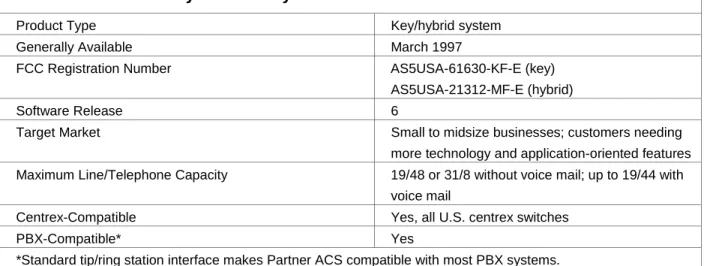
Table 1: Overview: Avaya Partner System
Product Type Key/hybrid system
Generally Available March 1997
FCC Registration Number AS5USA-61630-KF-E (key)
AS5USA-21312-MF-E (hybrid)
Software Release 6
Target Market Small to midsize businesses; customers needing
more technology and application-oriented features Maximum Line/Telephone Capacity 19/48 or 31/8 without voice mail; up to 19/44 with
voice mail
Centrex-Compatible Yes, all U.S. centrex switches
PBX-Compatible* Yes
*Standard tip/ring station interface makes Partner ACS compatible with most PBX systems. Release 6.0 Enhancement Summary
• T1 and direct inward dialing (DID) connectivity.
• Simultaneous ringing of cell phone and desk phone with pull back to voice mail. • PC-based management and administration.
• Built-in communication services unit (CSU) for T1 implementations. • Remote call forwarding to an external number.
• Unified messaging mailbox for mail and voicemail messages, with voice messages appearing as e-mail with a wave file attachment. Uses e-e-mail applications, such as Microsoft Outlook, Outlook Express and Netscape Messenger, without the need for extra client software.
Analysis Unique Features
Partner ACS offers both standard and optional features that are unique for the smaller business customer. These include:
• Voice over DSL and broadband access via SDSL are available via the DSL 1600 module, which allows up to 16 voice-grade circuits and additional bandwidth for data transmission or Internet access. (SDSL and voice over DSL must be available in the user’s local area.)
• Call coverage, up to four calling groups, direct group calling, group call distribution, group call/pickup and a hospitality package are available.
• PC Administration, using an included Remote Access PC card and optional Remote Administration Software (available through dealers), reduces technician dispatches and diagnostics, installation time and expense, and system/station programming.
• Automatic privacy prevents the interruption of data calls being transmitted on a facsimile machine, credit card reader or modem.
• Optional Automatic System Answer (ASA) provides backup answering when receptionists or attendants are busy or away from their desks.
• Direct Extension Dialing (DXD) is an optional feature that gives callers the ability to dial straight through and to specific individuals.
• Fax tone (calling tone or CNG) detection and call routing check whether an incoming call is a fax or voice call. Detection occurs when Partner Messaging R1 Automated Attendant answers a call, when Auto System Answer/Direct Extension Dialing (ASA/DXD) answers an incoming call or when the Partner ACS Incoming Fax Detection feature has been turned on.
• Enhanced tip/ring (ETR) station ports allow the direct use of devices, such as answering machines, modems, credit card readers, and single-line and cordless telephones. This capability eliminates the need for expensive dedicated lines or adapters and allows the attachment of a multibutton Partner telephone and an standard analog device on the same extension. This also allows industry-standard devices to be plugged directly into a proprietary port on the system and eliminates the need for different types of boards for different devices.
• A choice of Expansion Modules allows users to grow per the following: three lines, eight extensions (308); four lines, no extensions (400E/EC); or 0 lines and 12 extensions (012). The 308EC Module provides outside line jacks, ETR extension jacks and message-waiting indication. All modules also support Caller ID.
• Administration enables users to program and perform system translation backup and restore for their Partner ACS. This allows automatic and manual backup/restore to a PC flash card and battery backup memory of 45 days to six months. Backup capability may also be offered from the dealer through remote administration software.
• Integrated Caller ID with logging and dialing is included on the three loop-start lines in the 308 Processor, the 308EC module and four lines in the 400EC modules. The type of calls identified by Caller ID depends on the service offered by the user’s local telephone company.
• Partner ACS supports Avaya’s optional wireless TransTalk (900MHz) Pocket Phone MDW 9031 and 9040. The system-configured MDW 9031 or 9040 provides up to 500,000 square feet of coverage for up to 10 lines plus two intercom paths and supports up to 18 simultaneous users in a single zone. • The Partner ACS choice of telephones provides light-emitting diode (LED) message-waiting lamps
that are visible from a distance; adjustable-tilt multilingual backlit displays; red and green LEDs, under separate lens cap covers, specifically designed for colorblind station users; and 10 fixed-feature buttons. The telephone sets include Partner 6 (six-button), Partner 18 button)/18D (18-button with display) and Partner 34D (34-(18-button with display). Single-line sets and specialty handsets are also available.
• Partner ACS also offers a 48-button Direct Station Selection (DSS) module for attendant and answering positions to add to the 18D or 34D telephones.
Voice-Messaging Options
Partner Voice Messaging is an optional feature that functions like an answering machine to provide basic monolingual messaging. It supports two ports with four voice mailboxes and 40 minutes of storage, or 12 voice mailboxes with 120 minutes of storage. A single-level automated attendant and a capability to transfer calls out of a mailbox to an extension are also built in. The system is PC Card-based and plugs into the Partner ACS control unit.
Partner Messaging R1 expands on the Partner Voice Messaging system’s basic features and can be integrated with Partner ACS. The most recent version accommodates up to 200 voice mailboxes and 100 hours of message storage, whether in a two-, four- or six-port configuration. Partner Messaging R1 is resident on a plug-in module that connects to the Partner ACS backplane. Messaging features include: • Support for up to four 24-hour automated attendants, with up to 99 submenus for each automated
attendant and 99 possible announcements.
• Cascaded outcalling. The system dials up to five user-designated numbers, in turn, to alert the user that a new voice-mail message waits in his or her voice mailbox.
• A live record feature (four-port only) that lets the user record up to two current conversations at the user’s telephone.
• Administrative backup and restore via two methods. One is a PC card, used for backup and port licensing, and is included as standard. The PC Card is capable of backing up the mailbox configurations and automated attendant greetings. The second method, which can be used for disaster recovery, uses a LAN port on the Partner Messaging R1 System. The backup is done to a PC running the Partner Messaging R1 PC Administration software. This software is standard and is a graphical user interface (GUI)-based application that can be used to configure and administer the Partner Messaging R1 system. The LAN-based backup can include all mailbox greetings and the messages in each mailbox. Backup is part of the system administrator’s options, so the backup can occur on demand.
• Automated Attendant Centrex Transfer that allows a caller, from an automated attendant menu, to have the call transferred to a preprogrammed remote telephone number using Centrex lines.
Pricing
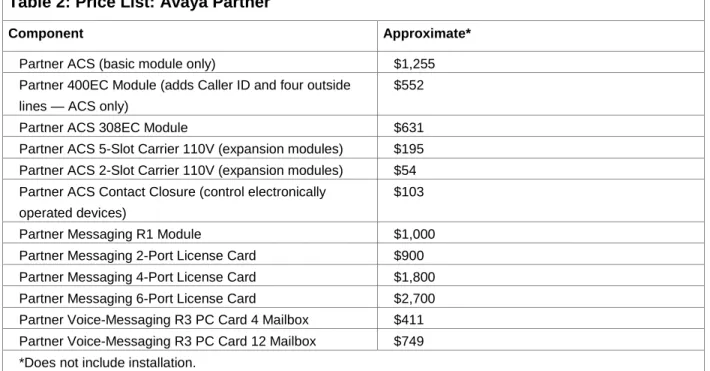
Table 2: Price List: Avaya Partner
Component Approximate*
Partner ACS (basic module only) $1,255 Partner 400EC Module (adds Caller ID and four outside
lines — ACS only)
$552
Partner ACS 308EC Module $631
Partner ACS 5-Slot Carrier 110V (expansion modules) $195 Partner ACS 2-Slot Carrier 110V (expansion modules) $54 Partner ACS Contact Closure (control electronically
operated devices)
$103
Partner Messaging R1 Module $1,000
Partner Messaging 2-Port License Card $900 Partner Messaging 4-Port License Card $1,800 Partner Messaging 6-Port License Card $2,700 Partner Voice-Messaging R3 PC Card 4 Mailbox $411 Partner Voice-Messaging R3 PC Card 12 Mailbox $749 *Does not include installation.
GSA Pricing Yes.
Competitors
Partner ACS competes with the small-to-midsize range of key/hybrid/PBX systems, such as: • Comdial — Unisyn 308/616 and Impact 24/48
• NEC Electra Elite IP Key (IPK) • NEC Infrontia Portrait 308/824
• Nortel Networks Norstar Compact Integrated Communications System (ICS) • Panasonic KX-T and KX-TD Series
• Samsung Digital Communication System (DCS) Compact and DCS 50i • Siemens HiPath 3000 Series
• Toshiba Strata CTX100 and DK40i • Vodavi Starplus Series
Strengths
• Standard PC Card support simplifies the installation of future system software upgrades. One included PC Card enables PC administration, backup and restore capabilities, and system programming.
• Homegrown wireless options enable users to choose the most economical solution for applications where telephone coverage extends beyond conventional office environments.
• Enhanced tip and ring station ports permit attachment of analog devices, such as modems, fax machines and answering machines, without the need for auxiliary equipment.
• Built-in power failure transfer provides emergency access to central office lines in the event of a power outage.
• User-friendly programmability enables small businesses to perform administration without requiring an outside technician. Support for familiar Microsoft Windows-based remote administration is an option.
• Partner ACS includes dialing restrictions and permissions that are programmable by extension and by groups of extensions, which can limit abuse and toll-call fraud. Programmable override of dialing restrictions is also permissible.
Limitations
• Capacity is limited to 48 telephones, beyond which migration to a different platform, such as Avaya’s Merlin Magix Integrated Communications System, is required.
• There is no integrated IP telephony capability. • Partner ACS does not support IP telephones.
• Support for ISDN Primary Rate Interface (PRI) is planned for the future.
• Partner ACS telephones are not compatible with circuit packs used in Avaya MultiVantage platforms. Recommended Gartner Research
Key/Hybrid, PBX and IP-PBX Systems: Comparison Columns, DPRO-89876 Insight
Even with its focus on high-growth opportunities, such as contact centers, converging voice and data technologies, and networking, Avaya continues to support Partner ACS with enhancements such as increased capacity, improved messaging and administration capabilities, as well as attractive pricing. For many years, the Partner product family has been a mainstay in the telephony equipment industry. Organizations considering the purchase of a small telephone system should note that this latest release makes it evident that the Partner ACS platform has staying power for the future.