Ground Penetrating Radar Image Preprocessing for Embedded Object in
Media
QEETHARA KADHIM AL-SHAYEA
ITEDAL S. H. BAHIA
MIS Department
MIS Department
Al Zaytoonah University of Jordan
Al Zaytoonah University of Jordan
Amman Jordan
Amman Jordan
[email protected]
[email protected]
Abstract: - The detection of embedded object from ground penetrating radar GPR imagery is our goal. The GPR image is a cross sectional slices. The embedded objects are metal and/or plastic type. This research has many real world applications such as remote sensing, geology, medicine and civil. The proposed method starts with two dimensional 2D image preprocessing for each slice. The preprocessing involves multispectral to gray conversion, contrast enhancement, segmenting, thresholding and denoising to modify each 2D image slice individually. Preprocessing algorithms involved in this paper are chosen appropriately to have image without noise, with object detected and with object eliminated. After a preprocessing step the proposed algorithm for object detection starts with objects contour finding in each slice, 2D objects transparency and transformation. The last step is the proposed interpolation technique to build the successive slices until the spaces is filled to find out the embedded object. Key-Words: - Object Detection, Object Recognition, Ground Penetrating Radar (GPR), Volume Reconstruction, Interpolation, Image Processing.
1 Introduction
GPR is one of nondestructive methods for physical detection, which utilizes similar principles to the reflection seismic method. Compared with the reflection seismic method, the GPR method might provide high-resolution images of characterized stratigraphy because it propagates a pulse of electromagnetic _EM_ energy, with a high frequency ranging from 10 MHz to 1 GHz, through the subsurface. A pulse-mode GPR system was operated in such a way that a high frequency and short pulse EM wave was transmitted into the earth and reflected radar pulse was received using one or more antennas on the ground [1]. GPR deliver vertical two dimensional 2D images slice of the ground
Wong and Cipolla [2] choose the volume intersection approach due to its ability to describe objects with more complex topologies (e.g., object with holes). Based on Szeliski, an algorithm for generating an octree using profiles from multiple views is developed. The main difference between the work presented by Szeliski and the technique developed in [3] is that instead of using a background subtraction technique as described by Szeliski, the object / backtracking binary images are computed directly from the B-spline snakes which are used to extract and represent the profiles during motion estimation.
Marabin, Sorzano, Matej, Fernadez, Carazo, and Herman [3] propose an iterative method for
performing 3D reconstruction of 2D crystals in real space.
Dell'Acqua, Sarti, Tubaro and Zanzi [4] propose a semi-automatic approach to the detection of linear scattering objects in geo-radar data sets, based on the 3D radon transform. The method that we propose is iterative, as each detected object is removed from the data set before the next iteration, in order to avoid mutual interference or masking.
Ristic, Petrovacki and Govedarica [5] present a new method to simultaneously estimate cylindrical object radius (R) and electromagnetic (EM) wave propagation velocity (v) from ground penetrating radar (GPR) data. Fruehauf, Heilig ,Schneebeli ,Fellin and Scherzer [6] studied a two-step algorithm to locate avalanche victims in real time. The algorithm was validated using realistic test arrangements and conditions using an aerial tramway. The distance dependence the reflection energy with increased flight heights, the coherence between the use of more antennas and the detectable range, and the reflection images of different avalanche victims were measured. The algorithm detected an object for each investigated case, where the reflection energy of the scans was higher than for the scans of pure snow. Airborne GPR has a large potential become a rapid search method in dry snow avalanches. However, a fully operational version still requires substantial improvements in hardware and software. Jeng , Li, Chen and Chien [7] are designed two filters by adopting adaptive algorithms, the optimum 2D median filter, (a 2D median filter with an optimum
window size), and the 2D adaptive Wiener filter (a real time optimal filter renovated from the conventional Wiener filter technology) to investigate the advantages of using adaptive filters in processing ultra-shallow seismic and ground-penetrating radar data.
Mohamed K., Abdullah, R. and Raseed M. [8] have presented an analytical and experimental study for extracting the Doppler signature in FSR for ground target detection. Target signal under the influenced of high clutter has been successfully detected using the proposed method. The detection using Hilbert Transform is only applicable if the target's signal has significant difference from the average noise level. But, detection using Wavelet de-noising is more robust against any clutter and noise. The results again confirmed the feasibility of FSR to be employed as an automatic ground target detection system.
Pasolli, Melgani and Donelli [9] propose a novel pattern-recognition system to identify and classify buried objects from ground-penetrating radar (GPR) imagery. The entire process is subdivided into four steps. After a preprocessing step, the GPR image is thresholded to put under light the regions containing potential objects. The third step of the system consists of automatically detecting the objects in the obtained binary image by means of a search of linear/hyperbolic patterns formulated within a genetic optimization framework.
Negahdaripour, Sekkati and Pirsiavash [10] propose methods for system calibration and 3D scene reconstruction by maximum likelihood estimation from noisy image measurements. The recursive 3D reconstruction method utilized as initial condition a closed form solution that integrates the advantages of two other closed form solution.
Yang, Wang, Liu, Tang and Chen [11] present a novel method for the 3D reconstruction of coronary arteries from two uncalibrated monoplane angiographic images. A non-linear optimization method is developed which takes the influence of the table movement into account for the refinement of 3D structure of vessel skeletons.
2 The Proposed image Preprocessing
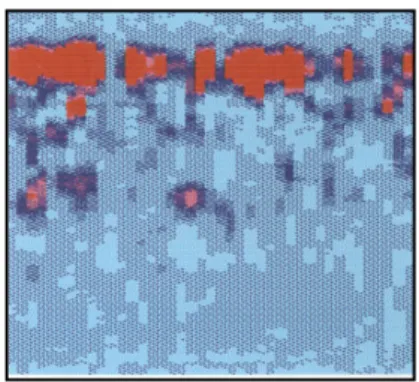
Some image data collecting techniques such as Ground Penetrating Radar image (GPR) generate a series of cross sectional images from which 3D object geometry and density features have to be extracted and reconstructed. Our data are 2D slices GPR images of underground viewed in sagittal direction as in Fig. 1.
Fig. 1
The microwave images of the objects embedded in the ground are included the soil effected and unwanted objects in addition to the wanted objects. However some preprocessing can be used to distinguish the required objects in the 2D images. Fig. 2 shows a GPR image slice.
Fig. 2 GPR slice
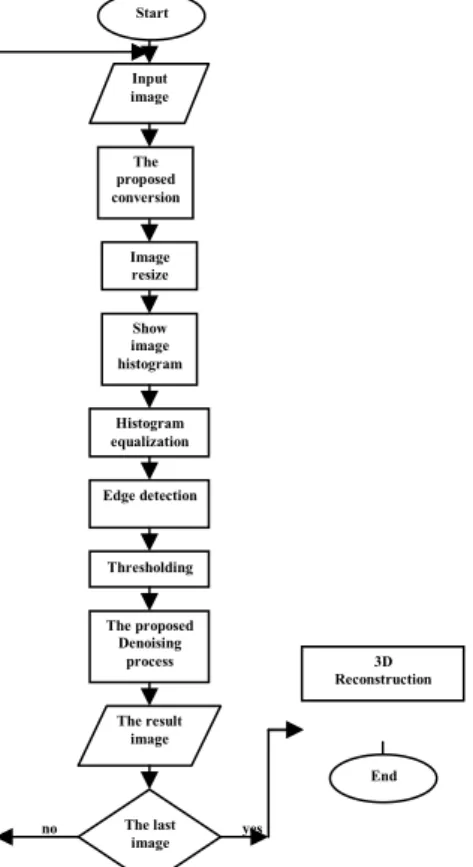
Image preprocessing is used to have appropriate slices. The resultant slices will be taken to reconstruct 3D image. Fig. 3 demonstrates the flowchart for image preprocessing proposed.
After the slice is read, the proposed conversion method to multispectral slice is done. The proposed conversion depends on display the metallic and plastic objects in the image. Since the image size must be compatible with the real world, image resize is chosen to be the next preprocessing stage.
Then draw the histogram for each slice to study it. From studying the histogram of images, it is obvious
that the contrast is very low. So, to enhance the contrast of an image there are more than one way. Since images are better to be enhanced using histogram equalization compared with high pass filter as practical experiment proved, it is chosen.
Because of its capability to detect edge in all directions, Kirsch compass mask is preferred. Thresholding is the best process to be used after edge detection. In each slice the adjacent pixels less than five are eliminated. In the modified denoising process, a median filter is developed in such a way as to eliminate adjacent pixels less than five.
Fig. 3 Flowchart of the proposed image preprocessing
2.1 The Proposed Denoising Algorithm
Median filter is used to eliminate noise of an impulsive nature. Suppose that the diameter of each embedded object is equal to 12.5 centimeters. The following computations are used to compute the number of adjacent pixels to be eliminated.
The width of each slice / number of row in each slice = 400 / 128 = 3.125 centimeters
Number of pixels to be eliminated = diameter of each object / 3.125
= 10 / 3.125 = 4 pixels
So, the purpose here is to eliminate adjacent pixels less than or equal to four pixels. Since median filter does not satisfy this purpose a modified denoising algorithm is proposed to eliminate the noises which appear in the threshold images. The steps of the proposed method are as follows:
1.Apply median filter using 3x3 convolution masks. 2.Check the objects in the image; say for example 6 adjacent pixels.
3.If the number of adjacent pixels less than or equal 4 in 3x3 windows, then delete these pixels.
Fig. 4 shows the result of applying the proposed algorithm to proposed conversion method. The line in the resultant image represents the surface earth. To specify the depth of the object from the earth surface the distance between this line and the object must be determined.
Fig. 4 slice after denoising process
3 The proposed Methodology
An algorithm for the proposed methodology is described as follows:
1- Input the binary level image I
inp of size nrxnc. Also, input the number of images nb.
2- Put the data image of size jxi one after the other in a stack.
3- for j= 0,1,2,…,nr for i= 0,1,2,…,nc for k= 0,1,2,…,nb Indicate the image with k
nb 4- for j= 0,1,2,…,nr for i= 0,1,2,…,nc for k= 0,1,2,…,nb
Find contour for each object in the image. 5- for j= 0,1,2,…,nr
for i= 0,1,2,…,nc for k= 0,1,2,…,nb
Translate the image with the number of spaces between them to the x-axis and y-axis. 6- for j= 0,1,2,…,nr
for i= 0,1,2,…,nc for k= 0,1,2,…,nb
Rotate the image by an angel θ 0.
7- Find the interpolation between two images. 8- Insert the interpolated images between the original data. no yes Input image The proposed conversion Show image histogram Histogram equalization Edge detection Thresholding Start Image resize The last image The proposed Denoising process The result image End 3D Reconstruction
3.1 Contour Generators
If the number of quantization levels is not sufficient, a phenomenon called contouring becomes visible. Tracing of closed boundaries in images is as follows: 1- Scan the image.
2- If object is found label it by object A. 3- Start inside object A.
4- Turn left and step to next pixel if in region A, otherwise turn right and step to next pixel.
5- Continue until arrive at starting point.
The contour is the first step in reconstruction process. The contours are found by scanning the whole image for values other than 255 and if this pixel has a neighbor which is a background 255 then it is recorded as contour pixel, otherwise it is not contour pixel. When we look for neighboring background pixels, the algorithm examines the up, down, right, left, upper right, upper left, down right, and down left pixels only so that the produced contour is 8-connected with the background. Fig. 5 shows the 8-connected neighbors.
Fig. 5 8-connected neighbors.
3.2 Interpolation Scheme
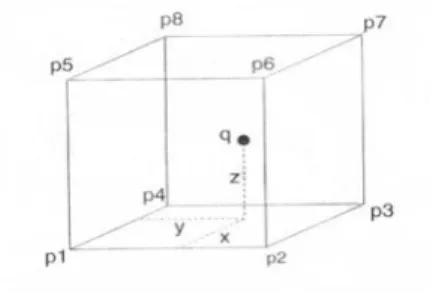
Image interpolation is an important technique in the field of the 3D reconstruction from cross sectional images. Several different interpolation schemes have been used in the past. The most widely used is the so-called trilinear interpolation scheme. The basic idea of trilinear interpolation scheme is to sum up the values of the eight adjacent voxels, where each of the eight values is weighted according to its distances from the true location. Fig. 6 shows this arrangement [12].
Fig.6 Trilinear Interpolation.
Since the trilinear interpolation not serves the process to reconstruct 3D objects, an idea is proposed. The proposed idea is making the logical AND operation between successive slices then we have the interpolated slice.
The distance between successive slices is calculated. So, all empty spaces should be filled instead of leaving to the viewer's imagination.
4 Conclusions
This work presents a technique for 3D reconstruction from 2D cross sectional slices. The purpose of this reconstruction is object detection. The input is GPR successive slices. Specific points of interest of the proposed methods are the use of 2D image preprocessing with its technique as robust methods for the automatic determination of effective starting points of the 3D reconstruction algorithm.
The first algorithm is image preprocessing for each slice. The preprocessing involves multispectral to gray conversion, contrast enhancement, segmenting, thresholding and denoising to modify each 2D image slice individually. Preprocessing algorithms proposed in this paper are chosen appropriately to have image without noise, with object detected and with object eliminated.
After preprocessing a proposed 3D reconstruction methodology is presented. The first stage in the proposed methodology is contour finding. The second stage is to cumulate the data images in stack. It is note from practical implantation that the intersection of two contour generators from two distinct view points generates a point that is visible in both images as a fixed point. Object transparency is the third stage that makes the intersected slices visible. Then translate the images depending on the distances between slices. The translation is to x-axis and y-axis. Rotation will be by an angel θ
0 is the last process in our proposed method. The modified interpolation is needed to improve the proposed volume reconstructing objects from serial cross sections.
References
[1] W. Ting-Nien and H. Yi-Chu, Detection of Illegal Dump Deposit with GPR: Case Study, Practice Periodical of Hazardous, Toxic & Radioactive Waste Management, Vol.10, No.3, Jul 2006, pp144-149. [2] K. K. Wong and R. Cipolla, Reconstruction of Sculpture from its Profiles With Unknown Camera Positions, IEEE TRASACTIONS on Image Processing, Vol.13, No.3, March 2004, PP. 381-389. [3] R. Marabini, C. S. Sorzano, S. Matej, J. J. Fernadez , J. M. Carazo and G. T. Herman, 3D Reconstruction of 2D Crystals in Real Space, IEEE TRANSACTIONS on Image Processing, Vol.13, No.4, Apr 2004, PP. 549-561.
[4] A. Dell'Acqua, A. Sarti, S. Tubaro and L. Zanzi, Detection of linear objects in GPR data, Signal Processing, Vol.84, No.4, Apr 2004,pp785-800. [5] A. V. Ristic, D. Petrovacki and M. A. Govedarica, new method to simultaneously estimate the radius of a cylindrical object and the wave propagation velocity from GPR data, Computers & Geosciences,Vol.35, No.8, Aug 2009, pp1620-1630.
[6] F. Fruehauf, A. Heilig, M. Schneebeli, W. Fellin and O. Scherzer, Experiments and Algorithms to Detect Snow Avalanche Victims Using Airborne Ground-Penetrating Radar, IEEE Transactions on Geoscience & Remote Sensing, Vol.47, No.7, Jul 2009, pp2240-2251.
[7] Y. Jeng, Y. Li, C. Chen and H. Chien, Adaptive filtering of random noise in near-surface seismic and ground-penetrating radar data, Journal of Applied Geophysics, Vol.68, No.1, May 2009, p p36-46. [8] K. Mohamed, R. Abdullah and M Raseed, Detection of Ground Target in Forward Scattering RADAR Using Hubert Transform and Wavelet Technique, International Review of Electrical Engineering (LR.E.E.), Vol.4, No.2, March-April 2009, pp320-326.
[9] E. Pasolli, F. Melgani and M. Donelli, Automatic Analysis of GPR Images: A Pattern-Recognition Approach, IEEE Transactions on Geoscience & Remote Sensing, Vol.47, No.7, Jul 2009, pp. 2206-2217.
[10] S. Negahdaripour, H. Sekkati and H. Pirsiavash, Opti-Acoustic Stereo Imaging: On System Calibration and 3-D Target Reconstruction, IEEE TRANSACTIONS on Image Processing, Vol.18, No.6, June 2009, PP. 1203-1214.
[11] J. Yang, Y. Wang, Y. Liu, S. Tang and W. Chen, Novel Approach for 3-D Reconstruction of Coronary Arteries From Two Uncalibrated Angiographic Images, IEEE TRANSACTIONS on Image Processing, Vol.18, No.7, July 2009, PP. 1563-1572.
[12] G. Lohmann ., Volumetric Image Analysis, John Wiley & Sons Ltd & T. G. Teubner, 1998.