Subclinical Thyroid Dysfunction and Functional
Capacity Among Elderly
Vanessa S. Virgini,1,* Liselotte W. Wijsman,2,3,* Nicolas Rodondi,1
Douglas C. Bauer,4 Patricia M. Kearney,5 Jacobijn Gussekloo,6 Wendy P. J. den Elzen,6J. Wouter Jukema,7Rudi G.J. Westendorp,2
Ian Ford,8David J. Stott,9and Simon P. Mooijaart,2,3,10on behalf of the PROSPER Study Group
Background: Subclinical thyroid dysfunction is common among older people and has been associated with decreased functional capacity but with conflicting data. The aim of this study was to assess the association between subclinical thyroid dysfunction and functional capacity in an elderly population.
Methods:We included 5182 participants with a mean age of 75.2 years from the Prospective Study of Pravastatin in the Elderly at Risk (PROSPER). Self-reported functional capacity was assessed using the Barthel Index (BI) and the Instrumental Activities of Daily Living (IADL) scores at baseline and during follow-up. Participants with subclinical hyperthyroidism (n=65) and subclinical hypothyroidism (n=173) were compared to euthyroid participants (n=4944). The association between persistent subclinical thyroid dysfunction and functional ca-pacity and decline was also investigated.
Results: At baseline, compared to euthyroid participants (BI 19.73–SE 0.06; IADL 13.52–0.02), there was no difference in functional capacity for participants with subclinical hyperthyroidism (BI 19.60–0.09; IADL 13.51–0.12, p>0.05) or subclinical hypothyroidism (BI 19.82–0.06; IADL 13.55–0.08,p>0.05). Over a mean 3.2-year follow-up period, there was no association between thyroid function and annual decline of either BI or IADL (p>0.05). No association was found between persistent subclinical thyroid dysfunction and functional capacity at baseline or during follow-up (p>0.05). Results were similar after excluding participants with a maximum BI and/or IADL score at baseline.
Conclusion:Among well-functioning community-dwelling elderly, we found no evidence that subclinical thy-roid dysfunction contributes to decreased functional capacity.
Introduction
S
ubclinical thyroid dysfunctionis a common condi-tion, particularly among older people (1–3). It is defined as a biochemical perturbation of thyrotropin (TSH) values with normal free T4 levels (1,3,4), irrespective of the presence or absence of symptoms (3,5,6). The prevalence of subclinical thyroid dysfunction increases with age, reaching up to 4% for subclinical hyperthyroidism (1–3) and up to 20% for sub-clinical hypothyroidism in subjects older than 65 years of age (1,3,7).Subclinical thyroid dysfunction has been associated with several adverse outcomes, such as cardiovascular disease (8– 10), osteoporosis (1,11–13), and cognitive dysfunction (6,14,15). Furthermore, subclinical thyroid dysfunction has also been associated with decreased functional capacity (16) and neuromuscular abnormalities (17), but data are conflict-ing (17–20), and reliable evidence on the association between subclinical thyroid dysfunction and functional capacity in an older population is lacking.
Both subclinical hyperthyroidism and subclinical hypo-thyroidism may progress to overt disease or revert to
1Department of General Internal Medicine, Inselspital, University Hospital of Bern, Bern, Switzerland.
Departments of2Gerontology and Geriatrics,6Public Health and Primary Care, and7Cardiology, Leiden University Medical Center, Leiden, The Netherlands.
3
Netherlands Consortium for Healthy Aging, Leiden, The Netherlands.
4Department of Internal Medicine, San Francisco University Medical Center, San Francisco, California. 5
Department of Epidemiology and Public Health, University College Cork, Cork, Ireland.
8Robertson Centre, Institute of Health and Wellbeing;9Institute of Cardiovascular and Medical Sciences; University of Glasgow, Glasgow,
United Kingdom.
10Institute for Evidence-Based Medicine in Old Age, Leiden, The Netherlands.
*These two authors are co-first authors.
ªMary Ann Liebert, Inc. DOI: 10.1089/thy.2013.0071
euthyroidism in the course of months (21). Studies with re-peated TSH measurements, which can identify persistent thyroid dysfunction, may be more strongly associated with specific endpoints than studies with a single measurement of TSH. To date, there are no data on the association between persistent subclinical thyroid dysfunction and functional capacity.
Therefore, we assessed the association between subclinical thyroid dysfunction and functional capacity in the Pro-spective Study of Pravastatin in the Elderly at Risk (PROS-PER) (22). In more than 5000 participants, we investigated the association between thyroid status at baseline and persistent thyroid status after six months, and repeated assessments of functional capacity during a mean 3.2-year follow-up period.
Methods
Subjects
All subjects were participants of the PROSPER trial, designed to assess if pravastatin would reduce the risk of cardiovascular events in an elderly population with cardio-vascular disease or at high risk of developing cardiocardio-vascular disease. Details on the study design have been previously described (23). A total of 5804 men and women aged 70–82 years with pre-existing cardiovascular disease (including coronary, cerebrovascular, or peripheral artery disease) or at risk to develop such a condition (current cigarette smoking, hypertension, known diabetes mellitus, or fasting blood glu-cose >7 mmol/L) were randomized to receive either pra-vastatin 40 mg daily or placebo over a mean 3.2-year period in Scotland, Ireland, and the Netherlands. Participants with congestive heart failure (New York Heart Association III or IV), physical or mental inability to attend the clinic for the screening visit, or poor cognitive function (Mini Mental Score Examination <24 points) were excluded from the PROSPER trial.
From the initial trial population, we excluded participants with missing TSH and/or free T4 levels and with missing Barthel Index (BI) or Instrumental Activities of Daily Living (IADL) scores. Participants using antithyroid medication and/or thyroxine supplementation were also excluded. The trial protocol was approved by the Medical Ethic Committees of all involved centers, and all participants provided written informed consent.
Thyroid function
TSH was measured at baseline in all participants. Mea-surements were performed in three respective laboratory centers (Glasgow in the United Kingdom, Cork in Ireland, and Leiden in the Netherlands). Indications for additional mea-surements of free T4 were different between countries. In Scotland and Ireland, free T4 levels were measured when TSH was abnormal based upon specific cutoff levels of TSH (when TSH was <0.45 or >10 mIU/L in Scotland, and <0.3 or >5 mIU/L in Ireland), while they were measured in all par-ticipants in the Netherlands, independently of the TSH result. TSH and free T4 levels were measured using state-of-the-art immunoassays (third-generation assays with a functional sensitivity £0.05 mIU/L). For both measurements, estimated inter- and intra-assay coefficients of variation were less than 5%. Both TSH and free T4 levels were measured again at six
months of follow-up in available frozen plasma samples of all participants, which were stored at the University of Glas-gow. The same electrochemiluminescence immunodetection method on a Roche Elecsys 2010 (Burgess Hill, United King-dom) was used. The limits of detection were <0.005 mIU/L for TSH and 0.3 pmol/L for free T4 (reference range: 12– 22 pmol/L). A reference range between 0.45 and 4.50 mIU/L derived from relevant literature was used for TSH (4,9). The narrowest free T4 reference range (12–18 pmol/L) was chosen to take interlaboratory differences into account (24).
On the basis of previous publications (4,25–28), we classi-fied participants into three thyroid states groups. At base-line, subclinical hypothyroidism was defined as TSH levels ‡4.5 mIU/L with normal free T4 levels. Subclinical hyperthyroidism was defined as TSH levels £0.45 mIU/L with normal free T4 levels. Participants with normal TSH levels (0.45–4.5 mIU/L) were considered euthyroid. At six months, we used the same classification to define subclinical thyroid status. Participants with the same condition at base-line and after six months were defined as having persistent subclinical hypothyroidism, persistent subclinical hyperthy-roidism, or persistent euthyroidism. Based on previous studies (4,8,9,24,26,28) and expert reviews (4,27), we further stratified our analyses for other TSH ranges (TSH <0.1, TSH 0.1–0.45, TSH 4.5–10, and TSH >10 mIU/L).
Functional capacity
Functional capacity was measured using two question-naires: the BI and the IADL. Both questionnaires have previ-ously been proven to be sensitive to detect changes in an elderly population (29,30). The measurements were per-formed at baseline; after 9, 18, and 30 months; and at the end of the study, which varied between 36 and 42 months.
The BI is a common questionnaire used to assess self-care activities of daily living and level of dependence of an indi-vidual (31). The BI consists of 10 items, in which fecal and urinary continence, grooming, toilet use, feeding, transfers (e.g., from chair to bed), walking, dressing, climbing stairs, and bathing are scored. The maximum score of the BI is 20 points; a higher score represents higher independence and mobility, that is, higher functional capacity.
The IADL questionnaire also measures activities of daily living, but involves interaction with the physical and social environment (32), and is therefore questioning about more complex tasks compared to the BI. The questionnaire includes seven items, including housework, taking medication as prescribed, managing money, shopping for groceries or clothing, use of telephone or other form of communication, using technology, and transportation within the community. The maximum score of the IADL is 14 points; a higher score also means higher independence and mobility in both indoor and outdoor environment, that is, higher functional capacity.
Statistical analyses
of vascular disease, history of diabetes, history of hyperten-sion, and current smoking.
Since treatment with pravastatin did not affect functional capacity (22), we combined data from both groups to inves-tigate the association between subclinical thyroid dysfunction and functional decline. For this longitudinal association, we used linear mixed models, which included baseline thyroid status or persistent thyroid status, time (in years), and the interaction term between time and baseline thyroid status or persistent thyroid status. The dependent variable was the score on BI and IADL questionnaires. The change in func-tional capacity per year for each group was represented by the estimated value for annual change over time. Models were adjusted for age, sex, country, statin treatment, history of vascular disease, history of diabetes, history of hypertension, and current smoking.
Additionally, we further performed analyses in which we (i) investigated participants with suppressed or elevated TSH levels (TSH<0.1 or TSH>10 mIU/L); (ii) included TSH levels as a continuous variable in our analyses; (iii) stratified the analyses by cardiovascular disease and risk factors to inves-tigate their potential confounding effect; (iv) excluded par-ticipants with a maximum BI and/or IADL score at baseline; (v) stratified the longitudinal analyses by treatment group; and (vi) used a wider free T4 range, with 10.3–25.7 pmol/L considered normal according to relevant literature (4,33). Fi-nally, since we previously reported that subclinical hypo-thyroidism with TSH levels>10 mIU/L was associated with a higher rate of heart failure in PROSPER (24), a decreased level of functional capacity among those participants is expected. Therefore, we further investigated whether excluding these participants from the analyses changed our results.
p-Values below 0.05 were considered statistically signifi-cant. All analyses were conducted using SPSS (v20.0; PASW Statistics Inc., Chicago, IL).
Results
Baseline characteristics
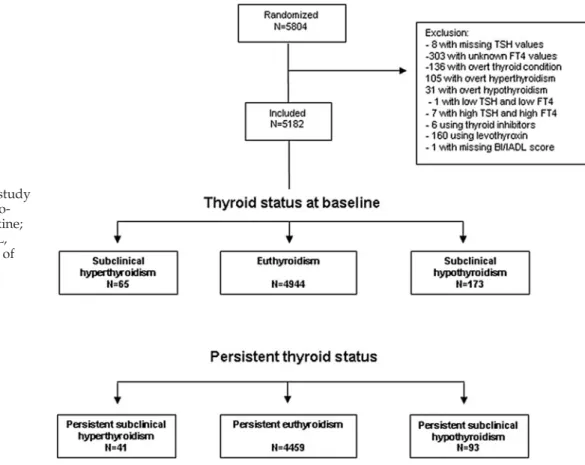
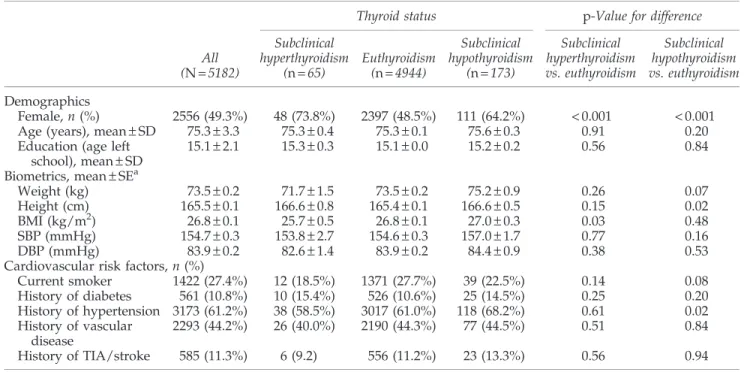
From the initial study population of 5804 participants, 8 individuals with missing TSH values, 303 with abnormal TSH and unknown free T4 values, 136 with overt thyroid disease, and 1 with missing BI and IADL scores were excluded (Fig. 1). Six participants taking antithyroid medication and 160 par-ticipants using thyroxine supplementation were excluded. The final sample of our study was therefore 5182 participants. The mean age of the study population was 75.3 years (standard deviation [SD] 3.3 years; Table 1). A total of 65 participants had subclinical hyperthyroidism. In line with our expectation, this condition was more common in women (73.8%) than in men. Subclinical hypothyroidism was found in 173 participants, and 64.2% were women. Groups were similar on most variables, except for body mass index (BMI) and hypertension. Subclinical hyperthyroidism was associ-ated with lower BMI when compared to euthyroid participants (25.7 vs. 26.8; p=0.03). The prevalence of hypertension was higher in participants with subclinical hypothyroidism com-pared to those with euthyroidism (68.2% vs. 61.0%;p=0.02).
Baseline thyroid status and functional capacity
At baseline, the overall mean BI and IADL scores were high (19.71 and 13.53 points respectively) with a range of 11–20 points for the BI and 4–14 points for the IADL (Table 2). The
mean score on BI and IADL did not differ among participants with subclinical hyperthyroidism and subclinical hypothy-roidism compared to euthyroid participants (p>0.05). Al-though a significant decrease in functional capacity over the 3.2-year follow-up time was observed for both BI and IADL (-0.09 and -0.16 points per year respectively; p<0.001), there was no difference in annual decline of BI or IADL when comparing participants with subclinical thyroid dysfunction to euthyroid participants (p>0.05). The results did not ma-terially change after (i) investigation of potential differences within TSH subgroups (TSH <0.1 and TSH >10 mIU/L); (ii) analysis of TSH as a continuous variable; (iii) stratification by presence or absence of cardiovascular disease at baseline; (iv) exclusion of participants with a maximal BI and/or IADL score at baseline; (v) stratification by treatment group; and (vi) using a wider free T4 range (data not shown). Furthermore, we found that participants with incident heart failure
hospi-talization (n=235) had a significant decrease in both BI and IADL over the 3.2-year follow-up time (-0.31 and -0.51 points per year respectively; p<0.001), but excluding these participants did not change the results.
Persistent thyroid status and functional capacity
Among the 65 participants with subclinical hyperthyroid-ism at baseline, 41 still had subclinical hyperthyroidhyperthyroid-ism after six months and were defined as having persistent subclinical hyperthyroidism. Among the 173 participants with subclini-cal hypothyroidism at baseline, 93 had subclinisubclini-cal hypothy-roidism at six months and were defined as having persistent subclinical hypothyroidism. After exclusion of participants with changing thyroid status, there were no differences in functional capacity between groups with persistent thyroid status at six months (Table 3;p>0.05). No association between Table1. Baseline Characteristics of Study Participants Depending on Thyroid Status
Thyroid status p-Value for difference
All (N=5182)
Subclinical hyperthyroidism
(n=65)
Euthyroidism (n=4944)
Subclinical hypothyroidism
(n=173)
Subclinical hyperthyroidism vs. euthyroidism
Subclinical hypothyroidism vs. euthyroidism
Demographics
Female,n(%) 2556 (49.3%) 48 (73.8%) 2397 (48.5%) 111 (64.2%) <0.001 <0.001
Age (years), mean–SD 75.3–3.3 75.3–0.4 75.3–0.1 75.6–0.3 0.91 0.20
Education (age left school), mean–SD
15.1–2.1 15.3–0.3 15.1–0.0 15.2–0.2 0.56 0.84
Biometrics, mean–SEa
Weight (kg) 73.5–0.2 71.7–1.5 73.5–0.2 75.2–0.9 0.26 0.07
Height (cm) 165.5–0.1 166.6–0.8 165.4–0.1 166.6–0.5 0.15 0.02
BMI (kg/m2) 26.8–0.1 25.7–0.5 26.8–0.1 27.0–0.3 0.03 0.48
SBP (mmHg) 154.7–0.3 153.8–2.7 154.6–0.3 157.0–1.7 0.77 0.16
DBP (mmHg) 83.9–0.2 82.6–1.4 83.9–0.2 84.4–0.9 0.38 0.53
Cardiovascular risk factors,n(%)
Current smoker 1422 (27.4%) 12 (18.5%) 1371 (27.7%) 39 (22.5%) 0.14 0.08
History of diabetes 561 (10.8%) 10 (15.4%) 526 (10.6%) 25 (14.5%) 0.25 0.20
History of hypertension 3173 (61.2%) 38 (58.5%) 3017 (61.0%) 118 (68.2%) 0.61 0.02
History of vascular disease
2293 (44.2%) 26 (40.0%) 2190 (44.3%) 77 (44.5%) 0.51 0.84
History of TIA/stroke 585 (11.3%) 6 (9.2) 556 (11.2%) 23 (13.3%) 0.56 0.94
aAdjusted for age and sex.
N, number; SD, standard deviation; SE, standard error; BMI, body mass index; SBP, systolic blood pressure; DBP, diastolic blood pressure; TIA, transient ischemic attack.
Table2. Functional Capacity and Decline Depending on Thyroid Status at Baseline
Thyroid status p-Value for difference
Functional capacity, mean–SE
All (N=5182)
Subclinical hyperthyroidism
(n=65)
Euthyroidism (n=4944)
Subclinical hypothyroidism
(n=173)
Subclinical hyperthyroidism vs. euthyroidism
Subclinical hypothyroidism vs. euthyroidism
Barthel Index, range 11–20 15–20 11–20 15–20
Baseline score 19.71–0.04 19.60–0.09 19.73–0.06 19.82–0.06 0.147 0.103
Annual change -0.09–0.00 -0.08–0.03 -0.09–0.00 -0.09–0.02 0.859 0.952
IADL, range 4–14 10–14 4–14 7–14
Baseline score 13.53–0.05 13.51–0.12 13.52–0.02 13.55–0.08 0.910 0.721
Annual change -0.16–0.01 -0.23–0.05 -0.16–0.01 -0.14–0.03 0.144 0.641
Data represent mean–SE. Adjusted for age, sex, country, history of vascular diseases, history of hypertension, history of diabetes mellitus, current smoking, and additionally for statin treatment in the longitudinal analyses.
persistent thyroid status and functional decline over time was observed (p>0.05).
Discussion
In this large prospective cohort study of more than 5000 older persons, including an analysis with persistent subclini-cal thyroid dysfunction, we found no consistent association between subclinical thyroid dysfunction and self-reported functional capacity or decline in old age.
Previously, few studies evaluated the relationship between subclinical thyroid dysfunction and functional capacity, with conflicting results. A cross-sectional study that included 42 participants with subclinical hypothyroidism found no asso-ciation with functional capacity as measured by the Bruce treadmill (17). Similarly, the Leiden 85-Plus Study, a popu-lation-based study, showed that subclinical thyroid dysfunc-tion was not associated with funcdysfunc-tional capacity in 558 participants from the age of 85 years onwards (18). Simonsick et al. showed that people between 70 and 79 years of age did not have more frequent mobility problems (20). In this study, individuals with a mild elevation in TSH levels (4.5–7 mIU/L) had a faster mean usual and rapid gait speed and better car-diorespiratory fitness and reported walking ease. Portella et al. reported that subclinical hyperthyroidism was not as-sociated with changes in exercise performance in young female adults (19). This experimental study included only 14 participants with well-differentiated thyroid carcinoma on suppressive levothyroxine therapy leading to subclinical hypothyroidism, and assessed exercise capacity by using the treadmill cardiopulmonary test. Furthermore, a randomized study demonstrated that exercise performance was improved in individuals with subclinical hypothyroidism treated with levothyroxine after six months of TSH normalization (16).
According to several hypotheses, we expected to find an association between subclinical thyroid status and functional capacity. First, as subclinical thyroid dysfunction has been associated with cardiovascular disease (8–10), we hypothe-sized a decline in functional capacity in those with subclinical thyroid status due to a higher rate of cardiovascular events, such as stroke or myocardial infarction (24). Second, literature shows that individuals with both subclinical and overt thy-roid conditions have more frequent musculoskeletal symp-toms. An experimental study demonstrated that higher free
T4 concentrations were associated with decreased physical performance and muscle strength, independently of TSH levels (34). A cross-sectional study including 137 participants showed that Dupuytren’s contracture, limited joint mobility, and carpal tunnel syndrome were significantly more common among middle-aged subjects with hypothyroidism (35). Moreover, subclinical hyperthyroidism and overt hyperthy-roidism have also been associated with increased risk of os-teoporosis (1,11–13), which could also contribute to impaired functional capacity. Therefore, we expected that similar manifestations could be observed in subclinical thyroid states, leading to decline of functional capacity. Finally, as subclinical thyroid dysfunction has been linked to adverse cognitive outcomes (6,14,15), we assumed that functional capacity could be impaired in individuals with subclinical thyroid dysfunction due to additional cognitive decline.
The fact that we did not find any association between subclinical thyroid dysfunction and changes in functional capacity could be explained by two main reasons. The first is that the hypothesized biological relation does not exist. So far, only one study investigated muscle metabolism and exercise tolerance impairments as possible biological mechanisms in-volved in subclinical hypothyroidism (36). Muscle metabo-lism has also been suggested to be impaired in Hashimoto’s hypothyroid myopathy (37). The few other positive studies on the association between subclinical thyroid dysfunction and functional capacity did not clearly report which biological mechanisms could be involved (16,17). Second, the partici-pants in the PROSPER study were excluded at baseline if they had poor cognitive function (Mini Mental Score Examination <24/30 points) or if they were physically or mentally unable to attend the clinic for the screening visit (23). Therefore, the population in this study excluded elderly with functional and cognitive impairment, potentially leading to reduced power to detect changes in functional capacity. However, we did observe a significant decline in functional capacity among all participants (n=5182) and in a small subgroup analysis (n=235), suggesting that our measurements were sensitive enough to detect functional decline. Although the rate of spontaneous normalization of TSH levels in subclinical thy-roid disorders can be as high as 65%, studies evaluating per-sistent subclinical thyroid dysfunction are rare (38,39). The fact that we have data on persistence of subclinical thyroid dysfunction, which is the most robust reflection of subclinical Table3. Functional Capacity and Decline Depending on Persistent Thyroid Status
Persistent thyroid status p-Value for difference
Functional capacity, mean–SE
All (N=4593)
Subclinical hyperthyroidism
(n=41)
Euthyroidism (n=4459)
Subclinical hypothyroidism
(n=93)
Subclinical hyperthyroidism vs. euthyroidism
Subclinical hypothyroidism vs. euthyroidism
Barthel Index, range 11–20 15–20 11–20 18–20
Baseline score 19.73–0.05 19.59–0.11 19.74–0.02 19.85–0.07 0.161 0.151
Annual change -0.08–0.00 -0.04–0.04 -0.08–0.0 -0.09–0.03 0.486 0.807
IADL, range 4–14 10–14 4–14 7–14
Baseline score 13.52–0.06 13.43–0.15 13.53–0.03 13.60–0.10 0.477 0.527
Annual change -0.15–0.01 -0.19–0.06 -0.15–0.01 -0.12–0.04 0.536 0.444
thyroid status and a limitation of several previous studies, together with repeated measurements of functional capacity increased our power to detect a potential association and a decline in functional capacity over time. Moreover, the large sample size of our study and the overall high prevalence of subclinical thyroid dysfunction increased the power to detect an association between subclinical thyroid conditions and functional capacity.
There are several limitations in our study. First, the studied population had a good functional capacity at baseline. Therefore, our findings are only generalizable to a high functioning population. Second, the 3.2-year follow-up period could have limited the power to detect changes in functional capacity among our population. A longer follow-up period might be needed to find changes in functional capacity. Fur-thermore, only two self-reporting questionnaires to assess functional capacity were used, which might be insensible to detect changes. However, it has recently been shown that subclinical thyroid dysfunction was not associated with cog-nitive performance or decline in the present population (33). Although cognitive decline has been reported for many de-terminants in the studied population (40–42), the absence of such association between subclinical thyroid dysfunction and cognitive decline further strengthens the findings of our an-alyses, which shows no association with functional capacity or decline. Finally, as indications for free T4 measurements differed for each country, this could have resulted in some differences between the participants in Scotland, Ireland, or the Netherlands. However, free T4 was measured in all par-ticipants with TSH>10 mIU/L, a group in which we also did not find a significant association.
In conclusion, there is no evidence to support a relationship between subclinical thyroid dysfunction and functional ca-pacity in a large population of well-functioning community-dwelling older people.
Acknowledgments
This study was supported by a grant from the Swiss Na-tional Science Foundation (SNSF 320030-138267) and partially supported by a grant from the Swiss Heart Foundation (both to Prof. N. Rodondi). The original PROSPER trial was sup-ported by an unrestricted, investigator-initiated grant from Bristol-Myers Squibb.
Author Disclosure Statement
No competing financial interests exist. The funders had no role in analysis and interpretation of the data nor in writing and publishing of the manuscript. There are no patents, products in development, or marketed products to declare.
References
1. Cooper DS, Biondi B 2012 Subclinical thyroid disease. Lancet
379:1142–1154.
2. Hollowell JG, Staehling NW, Flanders WD, Hannon WH, Gunter EW, Spencer CA, Braverman LE 2002 Serum TSH, T(4), and thyroid antibodies in the United States population (1988 to 1994): National Health and Nutrition Examination Survey (NHANES III). J Clin Endocrinol Metab87:489–499. 3. Razvi S, Weaver JU, Pearce SH 2010 Subclinical thyroid disor-ders: significance and clinical impact. J Clin Pathol63:379–386.
4. Surks MI, Ortiz E, Daniels GH, Sawin CT, Col NF, Cobin RH, Franklyn JA, Hershman JM, Burman KD, Denke MA, Gorman C, Cooper RS, Weissman NJ 2004 Subclinical thy-roid disease: scientific review and guidelines for diagnosis and management. JAMA291:228–238.
5. Biondi B 2008 Should we treat all subjects with subclinical thyroid disease the same way? Eur J Endocrinol159:343–345. 6. Valenti G, Fabbo A 1996 Subclinical hypothyroidism in the
elderly. Arch Gerontol Geriatr22:585–592.
7. Bemben DA, Winn P, Hamm RM, Morgan L, Davis A, Barton E 1994 Thyroid disease in the elderly. Part 1. Pre-valence of undiagnosed hypothyroidism. J Fam Pract 38:
577–582.
8. Collet TH, Gussekloo J, Bauer DC, den Elzen WP, Cappola AR, Balmer P, Iervasi G, Asvold BO, Sgarbi JA, Volzke H, Gencer B, Maciel RM, Molinaro S, Bremner A, Luben RN, Maisonneuve P, Cornuz J, Newman AB, Khaw KT, Westendorp RG, Franklyn JA, Vittinghoff E, Walsh JP, Ro-dondi N 2012 Subclinical hyperthyroidism and the risk of coronary heart disease and mortality. Arch Intern Med
172:799–809.
9. Rodondi N, den Elzen WP, Bauer DC, Cappola AR, Razvi S, Walsh JP, Asvold BO, Iervasi G, Imaizumi M, Collet TH, Bremner A, Maisonneuve P, Sgarbi JA, Khaw KT, Vander-pump MP, Newman AB, Cornuz J, Franklyn JA, Wes-tendorp RG, Vittinghoff E, Gussekloo J 2010 Subclinical hypothyroidism and the risk of coronary heart disease and mortality. JAMA304:1365–1374.
10. Sawin CT 2002 Subclinical hyperthyroidism and atrial fi-brillation. Thyroid12:501–503.
11. Bauer DC, Ettinger B, Nevitt MC, Stone KL 2001 Risk for fracture in women with low serum levels of thyroid-stimulating hormone. Ann Intern Med134:561–568. 12. Biondi B 2012 Natural history, diagnosis and management
of subclinical thyroid dysfunction. Best Pract Res Clin En-docrinol Metab26:431–446.
13. Lee JS, Buzkova P, Fink HA, Vu J, Carbone L, Chen Z, Cauley J, Bauer DC, Cappola AR, Robbins J 2010 Subclinical thyroid dysfunction and incident hip fracture in older adults. Arch Intern Med170:1876–1883.
14. Begin ME, Langlois MF, Lorrain D, Cunnane SC 2008 Thy-roid function and cognition during aging. Curr Gerontol Geriatr Res 474868.
15. Ceresini G, Lauretani F, Maggio M, Ceda GP, Morganti S, Usberti E, Chezzi C, Valcavi R, Bandinelli S, Guralnik JM, Cappola AR, Valenti G, Ferrucci L 2009 Thyroid function abnormalities and cognitive impairment in elderly people: results of the Invecchiare in Chianti study. J Am Geriatr Soc
57:89–93.
16. Mainenti MR, Vigario PS, Teixeira PF, Maia MD, Oliveira FP, Vaisman M 2009 Effect of levothyroxine replacement on exercise performance in subclinical hypothyroidism. J En-docrinol Invest32:470–473.
17. Reuters VS, Teixeira PF, Vigario PS, Almeida CP, Buescu A, Ferreira MM, de Castro CL, Gold J, Vaisman M 2009 Func-tional capacity and muscular abnormalities in subclinical hypothyroidism. Am J Med Sci338:259–263.
20. Simonsick EM, Newman AB, Ferrucci L, Satterfield S, Harris TB, Rodondi N, Bauer DC 2009 Subclinical hypothyroidism and functional mobility in older adults. Arch Intern Med
169:2011–2017.
21. Jones DD, May KE, Geraci SA 2010 Subclinical thyroid dis-ease. Am J Med123:502–504.
22. Shepherd J, Blauw GJ, Murphy MB, Bollen EL, Buckley BM, Cobbe SM, Ford I, Gaw A, Hyland M, Jukema JW, Kamper AM, MacFarlane PW, Meinders AE, Norrie J, Packard CJ, Perry IJ, Stott DJ, Sweeney BJ, Twomey C, Westendorp RG 2002 Pravastatin in elderly individuals at risk of vascular disease (PROSPER): a randomised controlled trial. Lancet
360:1623–1630.
23. Shepherd J, Blauw GJ, Murphy MB, Cobbe SM, Bollen EL, Buckley BM, Ford I, Jukema JW, Hyland M, Gaw A, Lagaay AM, Perry IJ, Macfarlane PW, Meinders AE, Sweeney BJ, Packard CJ, Westendorp RG, Twomey C, Stott DJ 1999 The design of a Prospective Study of Pravastatin in the Elderly at Risk (PROSPER). PROSPER Study Group. PROspective Study of Pravastatin in the Elderly at Risk. Am J Cardiol
84:1192–1197.
24. Nanchen D, Gussekloo J, Westendorp RG, Stott DJ, Jukema JW, Trompet S, Ford I, Welsh P, Sattar N, Macfarlane PW, Mooijaart SP, Rodondi N, de Craen AJ 2012 Subclinical thyroid dysfunction and the risk of heart failure in older persons at high cardiovascular risk. J Clin Endocrinol Metab
97:852–861.
25. Cappola AR, Fried LP, Arnold AM, Danese MD, Kuller LH, Burke GL, Tracy RP, Ladenson PW 2006 Thyroid status, cardiovascular risk, and mortality in older adults. JAMA
295:1033–1041.
26. Gencer B, Collet TH, Virgini V, Bauer DC, Gussekloo J, Cappola AR, Nanchen D, den Elzen WP, Balmer P, Luben RN, Iacoviello M, Triggiani V, Cornuz J, Newman AB, Khaw KT, Jukema JW, Westendorp RG, Vittinghoff E, Aujesky D, Rodondi N 2012 Subclinical thyroid dysfunction and the risk of heart failure events: an individual participant data anal-ysis from 6 prospective cohorts. Circulation126:1040–1049. 27. Helfand M 2004 Screening for subclinical thyroid dysfunction
in nonpregnant adults: a summary of the evidence for the U.S. Preventive Services Task Force. Ann Intern Med140:128–141. 28. Rodondi N, Bauer DC, Cappola AR, Cornuz J, Robbins J, Fried LP, Ladenson PW, Vittinghoff E, Gottdiener JS, Newman AB 2008 Subclinical thyroid dysfunction, cardiac function, and the risk of heart failure. The Cardiovascular Health study. J Am Coll Cardiol52:1152–1159.
29. Kwiatkowski TG, Libman RB, Frankel M, Tilley BC, Mor-genstern LB, Lu M, Broderick JP, Lewandowski CA, Marler JR, Levine SR, Brott T 1999 Effects of tissue plasminogen activator for acute ischemic stroke at one year. National Institute of Neurological Disorders and Stroke Recombinant Tissue Plasminogen Activator Stroke Study Group. N Engl J Med340:1781–1787.
30. Willis SL, Tennstedt SL, Marsiske M, Ball K, Elias J, Koepke KM, Morris JN, Rebok GW, Unverzagt FW, Stoddard AM, Wright E 2006 Long-term effects of cognitive training on everyday functional outcomes in older adults. JAMA
296:2805–2814.
31. Mahoney FI, Barthel DW 1965 Functional evaluation: the Barthel Index. Md State Med J14:61–65.
32. Lawton MP 1971 The functional assessment of elderly peo-ple. J Am Geriatr Soc19:465–481.
33. Wijsman LW, de Craen AJ, Trompet S, Gussekloo J, Stott DJ, Rodondi N, Welsh P, Jukema JW, Westendorp RG, Mooi-jaart SP 2013 Subclinical thyroid dysfunction and cognitive decline in old age. PLoS One8:e59199.
34. van den Beld AW, Visser TJ, Feelders RA, Grobbee DE, Lamberts SW 2005 Thyroid hormone concentrations, dis-ease, physical function, and mortality in elderly men. J Clin Endocrinol Metab90:6403–6409.
35. Cakir M, Samanci N, Balci N, Balci MK 2003 Musculoske-letal manifestations in patients with thyroid disease. Clin Endocrinol (Oxf )59:162–167.
36. Caraccio N, Natali A, Sironi A, Baldi S, Frascerra S, Dardano A, Monzani F, Ferrannini E 2005 Muscle metabolism and exercise tolerance in subclinical hypothyroidism: a con-trolled trial of levothyroxine. J Clin Endocrinol Metab90:
4057–4062.
37. Siciliano G, Monzani F, Manca ML, Tessa A, Caraccio N, Tozzi G, Piemonte F, Mancuso M, Santorelli FM, Ferrannini E, Murri L 2002 Human mitochondrial transcription factor A reduction and mitochondrial dysfunction in Hashimoto’s hypothyroid myopathy. Mol Med8:326–333.
38. Diez JJ, Iglesias P, Burman KD 2005 Spontaneous nor-malization of thyrotropin concentrations in patients with subclinical hypothyroidism. J Clin Endocrinol Metab 90:
4124–4127.
39. Meyerovitch J, Rotman-Pikielny P, Sherf M, Battat E, Levy Y, Surks MI 2007 Serum thyrotropin measurements in the community: five-year follow-up in a large network of pri-mary care physicians. Arch Intern Med167:1533–1538. 40. Mooijaart SP, Sattar N, Trompet S, Polisecki E, de Craen AJ,
Schaefer EJ, Jahn SE, van HT, Welsh P, Ford I, Stott DJ, Westendorp RG 2011 C-reactive protein and genetic variants and cognitive decline in old age: the PROSPER study. PLoS One6:e23890.
41. Packard CJ, Westendorp RG, Stott DJ, Caslake MJ, Murray HM, Shepherd J, Blauw GJ, Murphy MB, Bollen EL, Buckley BM, Cobbe SM, Ford I, Gaw A, Hyland M, Jukema JW, Kamper AM, Macfarlane PW, Jolles J, Perry IJ, Sweeney BJ, Twomey C 2007 Association between apolipoprotein E4 and cognitive decline in elderly adults. J Am Geriatr Soc55:1777– 1785.
42. Trompet S, de Craen AJ, Slagboom P, Shepherd J, Blauw GJ, Murphy MB, Bollen EL, Buckley BM, Ford I, Gaw A, Mac-farlane PW, Packard CJ, Stott DJ, Jukema JW, Westendorp RG 2008 Genetic variation in the interleukin-1 beta-converting enzyme associates with cognitive function. The PROSPER study. Brain131:1069–1077.
Address correspondence to: Simon P. Mooijaart, MD, PhD Department of Gerontology and Geriatrics Leiden University Medical Center PO Box 9600 2300RC Leiden The Netherlands