Parent Attitudes about and Involvement with Foreign Language Programs for Elementary Students
Lois Elaine McLendon Cansler
A dissertation submitted to the faculty of the University of North Carolina at Chapel Hill in partial fulfillment of the requirements for the degree of Doctorate of
Education in the School of Education
Chapel Hill 2008
Approved by,
Dr. Audrey Heining-Boynton Dr. Frank Brown
© 2008
ABSTRACT
Lois Elaine McLendon Cansler
Parent Attitudes about and Involvement with Foreign Language Programs For Elementary Students
Under the direction of Dr. Audrey Heining-Boynton
The purpose of this study was to investigate parent attitudes about and involvement with their children’s elementary foreign language programs. The FLES (foreign language in the elementary school) Program Evaluation Inventory for Parents was used to collect self-reported data from parents. Participants responded to attitude and involvement items using the Likert scale. Data concerning involvement with foreign language(s) and demographic information were collected at the end of the instrument.
To Bob, my loving husband, who supported and encouraged me throughout this entire endeavor.
And,
to my son Phillip, daughter-in-law Melissa, and grandson Jason, and to daughters Emily and Chelsey,
ACKNOWLEDGEMENTS
Dr. Audrey Heining-Boynton has earned my most sincere appreciation by agreeing to serve as my dissertation advisor and mentor. Dr. Heining-Boynton’s suggestions,
critiques, and cheerleading provided me with the direction and motivation I needed to be successful in this endeavor. Her expertise and patience are qualities I aspire to develop. Dr. Frank Brown taught me invaluable information about the theory of organization and about public school law. Studying for his classes helped lead my interest to learn more about what parents think and do about the way their children are educated. His continued support of my quest to earn my doctorate by serving on my committee was invaluable. Dr. Mary Ruth Coleman most graciously agreed to be a member of my dissertation committee, and set aside time to learn about my and my dissertation topic. Though I did not have the pleasure of studying in one of her classes, her interests in meeting the needs of all children regardless of socio-economic or perceived academically at-risk status mirrored my own so closely as to include her as a member of my committee a natural and supportive choice.
Dr. Tim Hart was an integral member of my committee, as he provided me with suggestions and direction for accessing information critical for conducting my study. I am very grateful for Dr. Hart’s contribution to my dissertation.
Dr. Catherine Zimmer has my deepest gratitude for working so patiently with me as I navigated my way through statistics. Dr. Zimmer always encouraged my efforts, explained the inner workings of statistical analysis in understandable terms, and
TABLE OF CONTENTS
Chapter I: Introduction………. 1
Purpose………. 2
Introduction to the Problem………... 2
Research Questions………. 8
Definitions of Terms………. .10
Significance of the Study………... 10
Assumptions and Limitations……….11
Theoretical Framework……….. 13
Chapter II: Literature Review……… 15
Brief History of Languages in the United States and……….15
Foreign Language Programs Attitudes, Beliefs and Perceptions as Theory……… 17
Parent Attitudes, Beliefs, and Perceptions toward Schools and Schooling……... 22
Research Questions 1 and 2, and Associated Hypotheses………. 27
Parent Attitudes, Beliefs, and Perceptions toward FLES……….. 29
Research Questions 3 and 4, and Associated Hypotheses………. 31
Research Question 5, and Associated Hypothesis………. 33
Summary of the Literature………. 34
Chapter III: Research Design………. 37
Purpose………... 37
Rationale for Quantitative Inquiry………. 37
Population and Sample………...38
Procedures……….. 42
Instrument……….. 44
Parents’ Attitudes about Their Children Learning Foreign Languages………...44
Parents’ Involvement with Their Children Learning Foreign Languages……...45
Instrument Reliability and Validity………... 45
Measurement of Variables………..46
Data Analysis………. 47
Limitations………. 50
Chapter IV: Results and Interpretations………. 53
Purpose………... 53
Quantitative Inquiry………... 53
Demographics of Responding Participants……… 56
Results of the Questionnaire……….. 61
Statistical Analysis………. 67
Research Question 1………... 67
Research Question 2………... 68
Research Question 2: Hypothesis 1………... 69
Research Question 2: Hypothesis 2………... 70
Research Question 2: Hypothesis 3………... 72
Research Question 2: Hypothesis 4………... 74
Research Question 3………... 76
Research Question 4………... 77
Research Question 4: Hypothesis 1………... 77
Research Question 4: Hypothesis 2………... 79
Research Question 4: Hypothesis 3………... 81
Research Question 4: Hypothesis 4………... 82
Research Question 5………... 84
Research Question 5: Hypothesis ……….. 84
Summary of Findings……… 88
Chapter V: Discussion………... 92
Purpose……….. 92
Theoretical Framework……….. 92
Research Questions……… 93
Research Question 1: Attitudes………. 94
Research Question 2: Attitudes………. 97
Parental Race/Ethnicity Effects on Attitudes……….. 97
Parental Educational Background Effects on Attitudes……….. 98
Parental Yearly Income Level Effects on Attitudes………. 100
Research Question 3: Involvement………. 100
Research Question 4: Involvement……….. 102
Parental Gender Effects on Involvement……….. 102
Parental Race/Ethnicity Effects on Involvement……….. 102
Parental Educational Background Effects on Involvement ………. 103
Parental Yearly Income Level Effects on Involvement……… 105
Research Question 5: Attitudes and Involvement over Time………. 105
Further Research……….. 109
Appendix A: Selected Schools……….113
Appendix B: Cover Letter……… 114
Appendix C: FLES Program Evaluation Inventory for Parents………...115
Appendix D: Respondents’ Comments……… 119
LIST OF TABLES
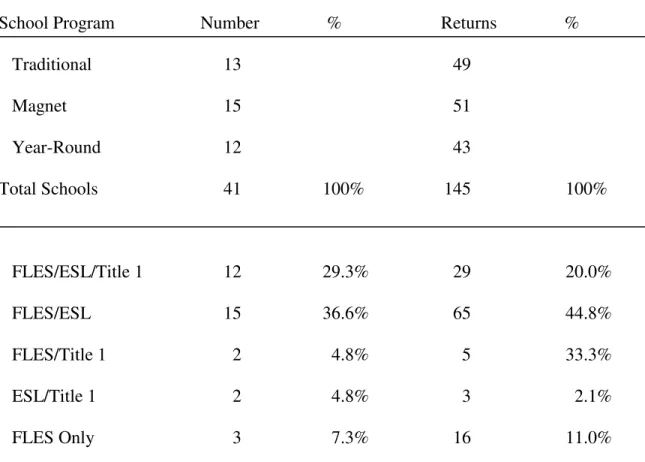
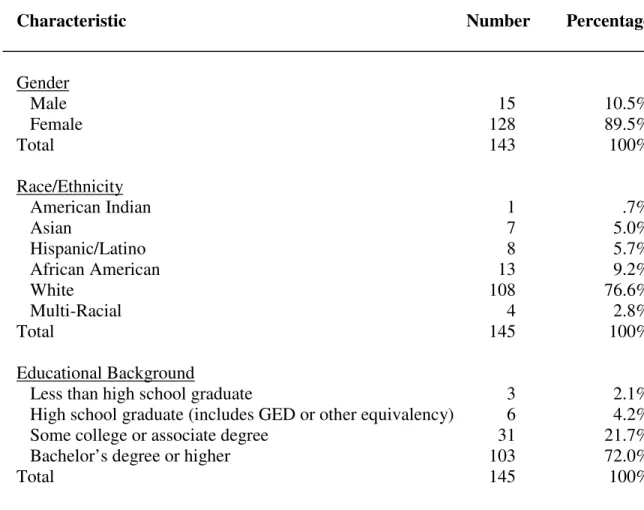
Table 1. Characteristic of Selected Schools………54 Table 2. Demographics: Return Numbers and Return Rates for………60
Gender, Race/Ethnicity, Educational Background, Yearly Income Level, and Study Years 1993, 2002, and 2007
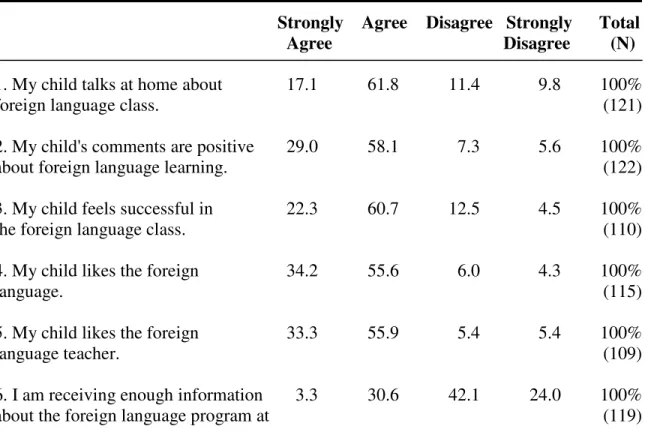
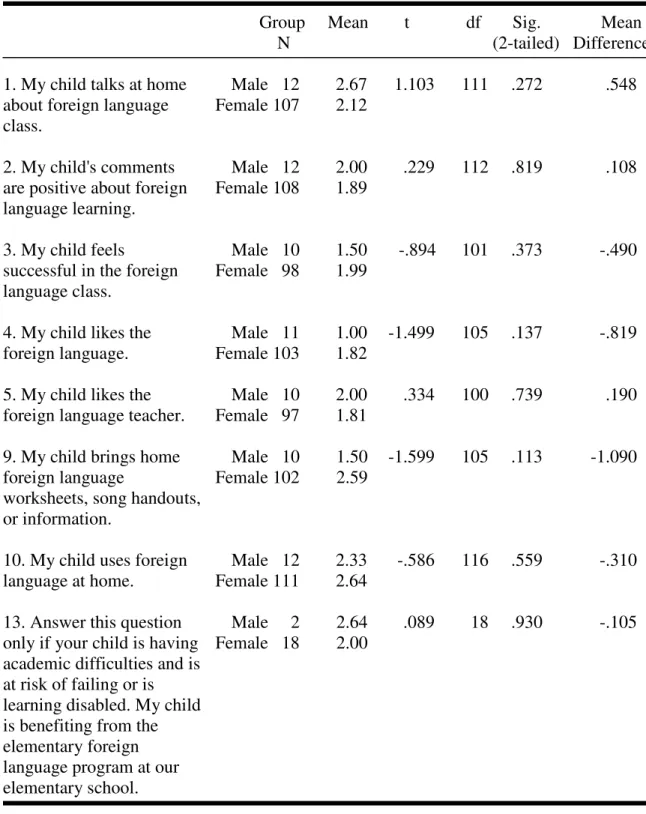
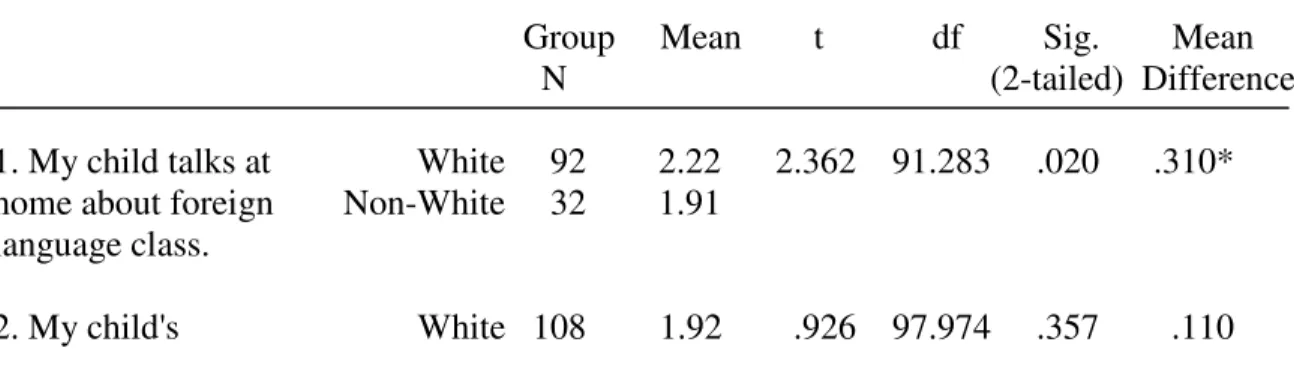
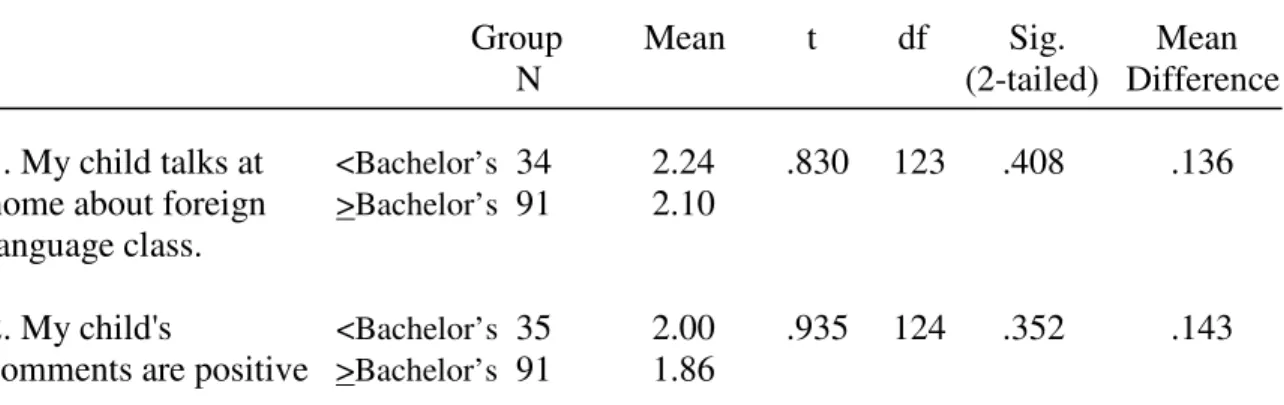
Table 3. Frequencies: Parent Responses to Questionnaire Items………... 65 Table 4. Independent Samples T-Tests: Gender and Parents’ Attitudes……… 69 Table 5. Independent Samples T-Tests: Race/Ethnicity and Parents’ Attitudes…… 71 Table 6. Independent Samples T-Tests: Educational Background……… 73
and Parents’ Attitudes
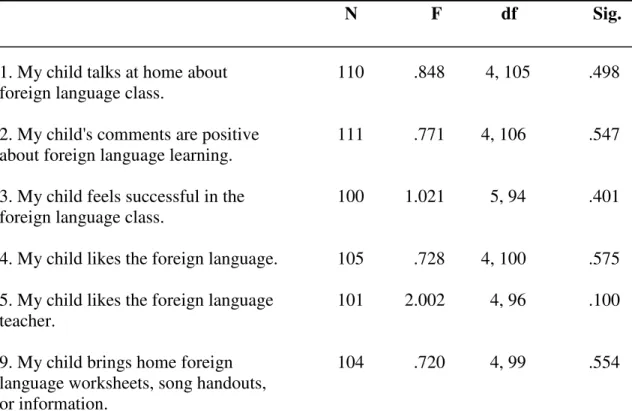
Table 7. Independent Samples T-Tests: Yearly Income Level and Parents’………. 74 Attitudes
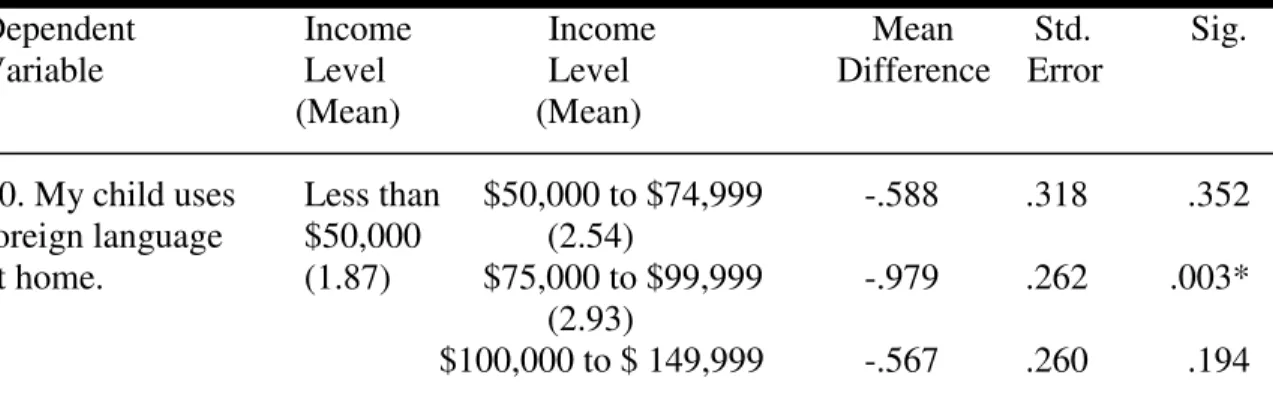
Table 8. Tukey’s HD Test for Income Level and Attitudes Item 10……….. 76 Table 9. Independent Samples T-Tests: Gender and Parents’ Involvement………... 78 Table 10. Independent Samples T-Tests: Race/Ethnicity and……….. 80
Parents’ Involvement
Table 11. Independent Samples T-Tests: Educational Background and……….. 82 Parents’ Involvement
Table 14. Tukey’s HD Test for 1993, 2002, and 2007 Study Years and………86 Items 9 and 10
PARENT ATTITUDES ABOUT AND INVOLVEMENT WITH
FOREIGN LANGUAGE PROGRAMS FOR
ELEMENTARY STUDENTS
Chapter I
Introduction
The widespread rise in immigrants to the United States over the past fifteen to twenty years was chronicled in various media reports, and further evidenced by increasing examples of provisions of services and information in multi-lingual modes. Concurrently North Carolina had experienced an influx of newcomers from other states and from other countries, resulting in an increase of communication services for non-English speakers. non-English-as-a-Second Language (ESL) was available to many public school children, offering the potential for these students to become bilingual. At the same time many foreign language programs were discontinued to make room for other
Purpose
The purpose of this study was to add to the body of knowledge regarding parents’ attitudes and involvement, presently and over time, toward the learning of a foreign language by children, specifically those parents who had children in elementary schools with FLES (foreign language in the elementary school).
Introduction to the Problem
In 1985 the state legislature of North Carolina enacted the Basic Education Program (BEP) to establish and fund comprehensive curricular services for all
kindergarten through twelfth grade public school students (Ward, 2001b). Included in the mandated curriculum was the study of a foreign language by kindergarten through fifth grade students. The Department of Public Instruction in North Carolina (NCDPI) recommended the foreign language in the elementary school (FLES) model of delivery (Heining-Boynton, 1991). The BEP was implemented during the late 1980’s and early 1990’s, but concerns about effective methods of accountability for aspects of the program, and a general economic recession in North Carolina, resulted in an eventual lack of funding for continuing the BEP reform program (Ward, 2001a).
learning for English speaking students may have overlooked the research, or opted to respond to strong national and local pressures to specifically improve reading and mathematics achievement.
NCDPI and local school systems established policies to grant permission to schools interested in providing alternative programs to foreign language courses, such as science enrichment programs or computer technology instruction. Substitutions were permitted when a school demonstrated that the change occurred only when the existing foreign language teacher left voluntarily, creating an open teaching position. This allowed school personnel to design contemporary programs to address the immediate priorities of the served population.
During the 2006-2007 school year, 41 of 93 elementary schools in one central North Carolina county school system included foreign language instruction as a regular part of the curriculum. Traditional, year-round and magnet programs were represented in this subgroup of the county schools. Less than one-half of the elementary aged students within the school system attended these 41 schools (Wake County Public School System, 2006). The remainder of the students in the public schools within this county received no school based instruction in any foreign language at the same time that many of their classmates and peers were provided with ESL services.
classes were designed to offer open enrollment to all students regardless of their primary spoken language. Students not enrolled in the designated schools had no options other than to seek second language class outside of the county schools.
North Carolina, meanwhile, had become increasingly multilingual and multicultural. The non-English speaking population in central North Carolina rose steadily and dramatically over the previous fifteen to twenty years, particularly among the Latino population. This rise was substantiated by the North Carolina State
Demographics (2000) data stating that from 1990 to 2000 the North Carolina Hispanic population grew 393.9%. Among the centrally located counties of the state, Durham experienced an Hispanic growth of 729.6%, Harnett 360.4%, Johnston 648.0%, Orange 312.3%, Vance 622.1%, and Wake 529.8%. This trend in diverse population and
multilingual growth was a continuation of the diversity of cultures and the rich history of languages present since the establishment of the colonies that evolved into the United States.
While North Carolina schools worked to meet the curricular needs of ESL students, the enactments of Goals 2000 (U.S. Government, 1994) and No Child Left Behind (U.S. Government, 2002) each caused reading and mathematics to become priority curricular areas in North Carolina, resulting in time and monies being diverted from FLES into what was commonly referred to as the basics. Reading and mathematics were tested yearly statewide, beginning in grade three and continuing into high school using State written end-of-grade (or high school end-of-course) instruments. Statewide assessment of writing proficiency was administered in fourth, eighth and tenth grades. Results of statewide testing were reported to federal and state government agencies and to the local public. Statewide testing in science was scheduled to begin for fifth graders in the spring of 2008. Instructional money, time, and energy were, therefore, increased and emphasized for that discipline as had been the case for reading and mathematics.
Non-standardized assessments of a particular subject area generally directed attention away from the value of that subject in the overall learning program. Decreased foreign language instruction and achievement seemed to suffer from this tendency. This possible consequence of test-driven priorities did not correspond with the recognition by many institutions of higher learning, governmental services, retail businesses, and the banking industry of the need to offer services at least bilingually. English-only speakers interacted with limited English speakers increasingly during social and business
History of Languages in the United States
The history of languages spoken in the United States since pre-colonial times has been rich and continuing (Watzke, 2003). The late 20th century and early 21st century globalizing effects of the Internet and international travel provided immediate and constant opportunities for multicultural and multilingual interaction (Tinsley & Parker, 2006). The cognitive and social benefits of second language learning for all students have been explored and documented by social scientists. Even as the research in these topics was reported many schools loosened requirements for English speaking students to study foreign language. The more dedicated focus on English-only suggested a
disassociation between the advantages of multilingualism for English speakers within the changing state of socio-cultural realities and political imperatives mandating English-only services. A study of the knowledge and attitudes parents held about the value and benefits of bilingualism for all children, as demonstrated by their interest in and
comments about elementary foreign language classes in American schools, posed a useful topic for discussion generating suggestions for the direction for FLES programs.
The United States has a tradition of being both tolerant and intolerant of
languages other than English (Daniels, 1990), a legacy passed down and continued by the United Kingdom as it endeavored to establish domain worldwide. Public and
satellite Sputnik. The Soviet Union’s early victory in the space exploration race resulted in the 1958 National Defense Education Act (Association of American Universities, 2006) to designate funding for the assessment and reform of mathematics and science education in the United States. This refocus did not diminish requirements of students to study foreign language and basic academic disciplines, but instead shifted the national attitude about educational priorities to highlight the sciences.
The United States had recognized for a number of years the existence of a shortage of Americans qualified for positions requiring bilingual skills (Ruiz, 1998; Wiegand, 1997; May, 2005). The State Department, diplomatic offices, and agencies responsible for negotiating national security were at a measurable disadvantage when they were unable to converse with or translate for participants from other nations. The American military needed personnel with bilingual skills when encountering situations involving other countries. Law enforcement agencies with a shortage of bilingual staff members were at a disadvantage when investigating cases involving non-English speaking parties.
Post-Sputnik discussions and efforts to provide second language education to American students were in line with national goals of supporting ethnic and cultural diversity, and continually seeking to improve educational achievement in the public schools. Similarly, the countries that America recognized as progressive in information and science technology continued to actively promote the study and ongoing assessment of proficiency in English as one of two or three required foreign languages. Research suggested that second language learning enhances cognitive development as patterns are recognized and connections to existing knowledge and experiences are made.
Strengthening these cognitive skills could make it easier to learn a third language as well (Harley, 1986). Familiarity with and fluency in both classical and modern foreign
languages had long been considered by scholars as necessary foundations for the advanced study of mathematics and the sciences, as much of the historical factual knowledge, conceptual comprehension, and application in these domains are grounded and stored in languages other than English (Watzke, 2003).
Educational research supported the benefits of recognizing parents as partners in education (Sheldon, 2005). Various levels of parental involvement were encouraged by schools, beginning with at-home conversations about school and assistance with
homework. In many instances, parents were recruited to volunteer their time by working with small groups of students and attending school events. Parent involvement in the education of their children was shown to result in positive attitudes toward the mission and work of education for parents and for their children (Pape, 1999).
career opportunities when they become adults (Heining-Boynton, 1993). This
investigation was conducted to add to the body of knowledge regarding parents’ attitudes, presently and over time, toward the learning of a foreign language, specifically those parents who had children in elementary schools with FLES.
Research Questions
Addressing the purpose, these research questions and their associated hypotheses guided the investigation:
1. What are parents’ attitudes about and involvement in their children learning foreign languages?
2. Do parents’ characteristics affect their attitudes about their children learning foreign languages?
H2.1 Gender will affect parents’ attitudes about their children learning foreign languages.
H2.2 Race and ethnicity will affect parents’ attitudes about their children learning foreign languages.
H2.3 Educational levels will affect parents’ attitudes about their children learning foreign languages.
H2.4 Income levels will affect parents’ attitudes about their children learning foreign languages.
3. How are parents involved in their child’s foreign language learning?
H4.1 Gender will affect how parents are involved in their children’s foreign language learning.
H4.2 Race and ethnicity will affect how parents are involved in their children’s foreign language learning.
H4.3 Educational levels will affect how parents are involved in their children’s foreign language learning.
H4.4 Income levels will affect how parents are involved in their children’s foreign language learning.
5. Have parents’ attitudes and involvement changed from those reported in 1993 and 2002 surveys?
H5 There will be no difference between attitudes reported in 1993 and 2002 and those reported for the current study.
Definitions of Terms
Terms essential to this study were acknowledged to hold different meanings in various contexts and by various readers. Attitude, belief, and perception were sometimes used interchangeably. The following definitions were provided to reduce
misinterpretations.
1. Foreign language: any and all languages other than American varieties of Standard English.
2. Attitude: manner of feeling or position in regards to a person, object, or idea (Dictionary.com, 2007)
Language, 2007)
4. Perception: insight, recognition, or understanding gained through senses or cognition (Dictionary.com, 2007)
Significance of the Study
The growing population of Latinos as well as other nationalities in North Carolina resulted in the creation of English-as-a-Second-Language programs in schools and the establishment of community laws, policies and services to improve communication with non-English speakers (McGroarty, 1997). Wiegand (1997) described the need for English-speaking Americans to also learn second languages for business, entertainment, and educational purposes, while Corson (2001) observed that foreign language learning led to international and intercultural understanding.
Many progressive nations were training students in multiple languages, including English. It was proposed that limited numbers of American English speakers learning a second language left the United States courting disadvantage in negotiating with an increasingly international community. An examination of the attitudes and involvement of central North Carolina parents concerning accepting, knowing, and using languages other than English provided insight into foundations of curricular decisions concerning academic programs, including foreign language instruction.
bilingual since so many other nations promote the learning of English (Kachru, 1997). Focusing on the attitudes and involvement of one population of parents served to open an additional line of dialogue about language learning and encourage continued scholarly scrutiny of beneficial learning programs for contemporary students.
Assumptions and Limitations
A primary assumption in this study was that the participants would respond reflectively and earnestly. Research has indicated that those who respond to surveys tend to choose the answers they think the researcher expects, or those they believe are more politically correct. The language of the items often exacerbates this tendency.
However, it was also shown that anonymity provides responders with more security in answering honestly than offered in face to face conversations (Gall, Gall, & Borg, 2003). Convenient length and reader-friendly items on the survey instrument for this study served to mediate this limitation. The inclusion of a section for open-ended opinion statements provided the respondents with an opportunity to elaborate on issues raised by the items in the questionnaire.
A second assumption was that all parents who received the survey would be inclined to respond (Dillman, 2000). This was the expectation of the researcher in light of standard encouragement by teachers and the general media for parents to become partners in their children’s education. However, it was also recognized that parents who
This assumption suggested another possible limitation. A recognized phenomenon of survey research occurs when those who care passionately about the topic are more likely to respond than those less interested. This effect may result in response bias, making generalizability to the population being observed very difficult (Creswell, 2005). Again, the length and language of the instrument and the provision of the self-addressed stamped envelope were expected to encourage representative participation from parents with varying levels of interest in the topic.
Theoretical Framework
Naperville Community Unit School District 203 Naperville, Illinois
http://www.naperville203.org/parents-students/EpsteinModelPS.asp?print=y The school sphere is charged with the formal education of the child. The
community overlaps with the school, as the school is situated within the community and operates to meet the goals and needs of that group. Parents bestow substantial influence as members of the community and first teachers of the child, and should remain actively involved in the child’s life throughout the school years.
Epstein’s model graphically portrays the psychological and sociological nature of partnership embedded in the overlaps. As explained by Bandura (2000), people develop and act within social contexts. Therefore parent attitudes are dependent on their
the importance of identifying and analyzing the attitudes and involvement parents have relating to foreign language education in the elementary school.
The intent of Epstein’s theory was not to determine the sequential impact of each of the spheres, though a logical approach for this investigation was to begin with parents. The literature reviewed for this study briefly provided a history of languages and foreign language education in the United States. The review then outlined major understandings of the psychological and social development of attitudes, beliefs and perceptions of individuals and communities. Parents have routinely been advised and encouraged to become involved with their children’s education (Sheldon, 2002). This study
acknowledged the interests parents have about their children’s schooling (Gardner, 1985), while it also served to inform the scholarly understanding of parents’ attitudes and
Chapter II
Literature Review
This chapter provides an overview of the literature that supported the purpose of the study, which was to add to the body of knowledge regarding parents’ attitudes and involvement, presently and over time, toward the learning of a foreign language by children, specifically those parents who had children in elementary schools with FLES. It begins with a brief view of the history of languages and foreign language education in the United States, followed by research on attitudes, beliefs and perceptions. Also reviewed were literature and studies regarding parents’ attitudes toward their children’s schooling, and concerning their children learning foreign language(s) in kindergarten through fifth grade.
Brief History of Languages in the United States and Foreign Language Programs
over 1,000 languages and dialects of peoples indigenous to North and South America. As early newcomers began interacting with the Native peoples, communication and language skills were reciprocally introduced to accommodate trade and social relations.
The United States has since continually experienced a steady wave of immigrants from all over the world. According to the 1980 United States Census report (Waggoner, 1988), the highest numbers of recent immigrants came from Asia and the Pacific Islands, followed by immigrants from Spanish speaking countries, supporting the continuous introduction of multilingual and multicultural opportunities into America. With this wealth of resource and opportunity to study and interact with a second language, foreign language had been reported since the 1950’s to be studied in the United States primarily by students with aspirations to attend college (Crawford, 1992), and did so with
unspecified school or personal expectations for basic proficiency (Walker & Tedick, 2001).
Goals 2000, signed into law by President Clinton, required that the percentage of students proficient in at least two languages would increase, though proficient remained relatively undefined. The Goals also obligated students to become knowledgeable about their own heritage amid the cultural diversity of America and of the world (U. S.
Government, 1994). More recently, the No Child Left Behind (NCLB) Act was signed into law in 2002 by President Bush to refocus national attention on raising the standards of achievement, with the initial lens on the academic subjects of reading and mathematics for every student.
Foreign language study was identified as a core subject in NCLB (Tonkin, 2004), but has yet to become a priority in North Carolina schools. Data suggest that Americans remain considerably behind many nations in requiring students to become proficient in at least one, and generally two or three, languages beyond their primary language (Christian, Pufahl, & Rhodes, 2004). Neither Goals 2000 nor NCLB appear to have inspired overwhelmingly open discussion or action on the part of parents and educators concerning the role of FLES for their own children.
Attitudes, Beliefs and Perceptions as Theory
Substantial research has been conducted to examine and explain the development of human attitudes, beliefs and perceptions. These terms can be defined as follows:
• attitude- “position or posture of the body appropriate to or expressive of an action, emotion, etc.” (Dictionary.com, 2007)
• belief- “ mental acceptance of and conviction in the truth, actuality, or validity of something” (American Heritage Dictionary of the English Language, 2007)
• perception- “a single unified awareness derived from sensory processes while a stimulus is present.” (Dictionary.com, 2007)
also demonstrate the close correlation and nearly synonymous relationships among the terms. It is informative to trace the traditions of understanding the development of these singular and collective characteristics in order to understand the questions that were addressed in this study.
Sir Frederic Bartlett remains respected for his important contributions to psychology, particularly in the field of cognitive science. His extensive work focused primarily on memory and schema, encompassing much of the early to mid 1900’s (Saito, 2000). Bartlett’s characterized of attitude as a feeling or affect about something one is being asked to do or consider. He described it as the element that drives perception and memory, guiding what will be recalled and how it will be remembered based on the feeling(s) an incident invokes. In Bartlett’s construction, attitude was determined by one’s own schemata and temperament, and therefore was inexorably entwined with cognitive development and experience with the environment (Larsen & Berntsen, 2000).
(Malerstein & Ahern, 1979). At the occupational stage young adults make increasingly more focused decisions as they recognize the power of their own influence in their own accomplishments and in those of the group.
A key observation linking the works of Piaget to his contemporary, Bartlett, is the necessary role of the environment in the development of perception and cognition and in the concurrent evolving of beliefs and attitudes. Both scientists recognized that the human being develops cognates and attitudes founded on experiences with objects and other people. At the same time, they each noted that the individual has an impact on the environment and other people by the attitudes and choices he makes (Brewer, 2000).
Vygotsky (Kravtsova, 2006) elaborated further on the works of Bartlett (Larsen & Berntsen, 2000; Saito, 2000) and Piaget (Malerstein & Ahern, 1979) in studying the consciousness and self-awareness features of mental development. Vygotsky’s theory of social development highlights the critical role of communication in the individual’s early and continued growth as a person and as a member of the group. More specifically Vygotsky identified the importance of an adult naming an activity or behavior as a major determinant in the child’s development. An example provided by Kravtsova is where a child may be engaged in playfully banging a toy against a table to hear the noise and feel the vibrations, until the mother points out to the child that he is hammering in nails just like Daddy.
the child’s development of associating a pleasant attitude with desired interactions with his mother and father.
As observed by Piaget, social development theory recognizes the advancement of development from initial experiential activity to self-awareness to awareness of others. Piaget focused on the person’s developmental experiences as he catalogued the stages of human maturation (Malerstein & Ahern, 1979). Vygotsky redirected theories of
development by concentrating on the social aspects of human development and those between a child and adults in particular (Kravtsova, 2006). Piaget and Vygotsky each provided important and reasonably compatible insights into human mental and cognitive development guided by continually evolving attitudes, beliefs and perceptions.
Bem (1970) presented attitudes, beliefs and perceptions as constructs generated through a person’s physical, emotional, cognitive and social growth throughout life. As the individual has contact and experience with objects and other people, beliefs are concerning the consistency of similar situations and generalizing expectations to similar episodes become internalized. As this transference of expectations becomes validated or negated, the individual forms attitudes such as trust, distrust, and curiosity.
In this interpretation of the foundations of attitudes and beliefs, perceptions play a key role. Perception in this sense refers to use of external cues to define or describe both concrete and abstract phenomena (Bem, 1970). For instance, noting the brightness at the end of towering metal poles localized in one central area may be perceived as the
stomach ailment in the other. Reactions to perceptions call upon evolved attitudes and beliefs which in turn are the results of prior experiences with similar situations.
Bandura’s social cognitive theory offers more direct explanations of each person’s place in society and how a person develops recognition of that place. Building on the increasing data from research on brain development, Bandura asserted that human engagement with the environment plays a key role in brain activity and therefore in brain development (Bandura, 2001). In effect, brain development and social cognitive
development affect each other mutually. It is through social cognition developed via interaction with people and objects in the environment that brain activity increases and attitudes and beliefs are fostered.
or resistance to their actions and values they begin to form and express attitudes about what they consider important for themselves and others.
The social aspect of Bandura’s theory incorporates three modes of human agency: personal, proxy, and collective (Bandura, 2002). As noted above, personal efficacy refers to the perceptions one has over one’s own power to produce chosen results. In the proxy mode of agency, a person endeavors to prevail upon others in positions of authority, acclaim, or expertise to act on his behalf to achieve desired outcomes (Bandura, 2000). Collective efficacy is described as the power to reach goals developed from shared beliefs and perceptions through interactive and collaborative actions (Bandura, 2002). Proxy and collective agency theory exemplifies the relationship between attitudes, beliefs and perceptions, and the choices one makes to express and act on them (Bem, 1970).
Parent Attitudes, Beliefs, and Perceptions toward Schools and Schooling
performance by supporting and critically questioning policies and expectations of the schools (Sheldon, 2002). Such focused networking often leads to forming collaborative relationships and support in achieving educational and social goals and activities within the community as well.
Evidence of the power of networking among parents and their beliefs in their own self efficacy to be competent in active involvement in the support of their children’s schooling has been collected by Sheldon (2002). This study investigated the relationships between parent involvement with school matters and their beliefs about the school
inviting their participation. It connected these relationships to the strengths of social and community networking, finding that such networking tends to provide predictors as to if and how parents will perceive and act on the invitation to partner with the school for their children’s success.
Many other studies concerning parents’ actual and perceived access to becoming involved in education have been conducted. One such investigation concerned the active involvement of middle and higher income parents through the Parent Teacher
parents, and parents of minority ethnicities. While the findings of this study were encouraging, this limitation existed and was noted by Kroeger.
Kroeger’s research reaffirmed the value of parent involvement, but indicated there may be some disparity among subgroups of parents in their attitudes toward their own abilities and school receptivity to their becoming part of a support group. The system the urban school established did not permit working parents to volunteer in classrooms, as time availabilities conflicted with job schedules. The PTO focus on fundraising appeared to exclude or intimidate families struggling with limited income. The result was a scene that seemed to perpetuate the perception of the power of the affluent and mostly White parents to influence school decisions and activities. Further investigation into the actual attitudes of less visibly involved parents could shed light on their perceptions of their ability and authority to assist their children in school success.
An exemplar of a school-community-family collaboration was implemented in Virginia to provide support and successful achievement for a population of special needs students (Cohen, Linker, & Stutts, 2006). This model provided evidence that professional learning communities, as envisioned by DuFour (2004) can result in positive attitudes by parents about their personal and collective efficacy to the benefit of all students. In this model all participants were trained to work collaboratively with data to provide
instructional support appropriate for individual students.
achieve. The community benefited as school services, student achievements and valuable parent expertise became vital pathways of social engagement (Cohen et al, 2006). Again, their willingness to enter into a partnership with the school highlights positive parental attitudes of competency when invited to participate in school decisions and programs.
Experiences of non-English speaking parents with American schools provide another example of proactive parent attitudes and perceptions about their influence in their children’s schooling. Lahman and Park (2004) conducted qualitative research into the communication difficulties encountered by teachers in the United States and non-English speaking Chinese and Korean parents. They found that these parents wanted their children to learn English and to develop necessary social skills to be able to interact with their American peers. The parents did not retreat from conferencing with
English-speaking teachers and insisting on school attention to the lingual and academic needs of their children. The small sample size made it difficult to generalize results to the
population of all non-English speaking parents. Yet the requests of these parents for the school to actively meet the needs of their children are noteworthy and may prompt questions of similar concern to all parents of school-aged children. The intentness and immersion of these parents in resolving a problem suggest a positive attitude toward individual and collective influence on school decisions and actions.
The Theory of Overlapping Spheres of Influence clearly portrays the importance of family alongside the community and the schools. Parent attitudes and perceptions of their roles in schools can be mediated by schools earnestly planning six types of
2006). Models based on Epstein’s theory are designed to account for the resources parents believe they can offer, and to provide scaffolded opportunities in which all parents can realize increased efficacy in school-community-parent partnerships (Deslandes, 2001).
Parent involvement in schools has been strongly endorsed in the United States and has become a standard expectation by parents, teachers and students (Sheldon, 2002). Involvement may take many forms; including becoming active in initiating and
implementing school improvement programs (Brandt, 1989). Epstein’s theory notes that parents also enhance their children’s learning by engaging in discussions with them about what they are learning. Parents who ask questions about the most recent foreign language lesson, who assist with or check language homework, and make attempts to learn the language with the child are displaying positive attitudes about the importance of this aspect of school (Cooper & Maloof, 1999).
Parent Attitudes, Beliefs, and Perceptions toward Language Learning
Parents may communicate their attitudes to their children actively or passively (Bartram, 2006). Actively, parents display positive perceptions about language learning by taking an interest in the work and achievement of their child in FLES activities. Parents may also actively display a negative attitude that language learning is
Visible expressions of the attitudes parents hold about language learning are shared when parents attend multicultural events, describe those who speak other languages with praise and admiration, and enjoy being in their company. Parents with positive attitudes toward second languages display an integrative orientation and a desire for association with other-language speakers (Gardner, 1985). On the other hand, parents model their negative attitudes by showing little interest in the second language or in the attempts by their child to learn another language. Attitudes held by parents may be
influenced by their own knowledge or lack thereof of another language (Bartram, 2006). Observations have been made of parents demonstrating incongruent attitudes and actions. This is the case when parents encourage the child to work hard to learn a second language but at the same time question the child’s ability to actually learn another language. Parents may question the value of bilingualism, and make disparaging
comments of the other-language community at the same time as the child is engaging in learning colors or numbers in a second language (Gardner, Masgoret, & Tremblay, 1999). In the fall of 2005 a National Organic Poll (NOP) survey determined that 90% of
American adults believe children should learn a second language. It also found that while respondents claimed to value second language learning, they maintained negative beliefs such as students’ inability to even learn English well, that students will not learn enough to be beneficial, and that everyone else speaks English anyway (Tinsley & Parker, 2006).
Research Questions 1 and 2, and Associated Hypotheses
1. What are parents’ attitudes about and involvement in their children learning foreign languages?
The first research question was drawn from the complexity of beliefs and
perceptions demonstrated by parents who may verbally support their children’s efforts to study another language while not otherwise communicating an attitude of the importance of the skill. The responses to this question provided basic descriptive data about these attitudes.
2. Do parents’ characteristics affect their attitudes about their children learning foreign languages?
This question will explore specifically discernible relationships between attitudes and involvement and parents’ characteristics. As studied and described by Bartlett, Piaget, Vygotsky, Bem and Bandura attitudes are developed based on individual social and physical experiences with the environment. Therefore, the following hypotheses are projected for this question.
H2.1 Gender will affect parents’ attitudes about their children learning foreign languages.
H2.2 Race and ethnicity will affect parents’ attitudes about their children learning foreign languages.
The Chinese and Korean parents observed by Lahman and Park (2004) highlight the effect racial and/or ethnic experiences may have on the attitudes developed by parents about the need for their children to learning foreign language. The NOP finding that some Americans see no reason to learn a foreign language since the rest of the world is learning English (Tinsley & Parker, 2006) suggests there will be differences based on race and ethnicity.
H2.3 Educational levels will affect parents’ attitudes about their children learning foreign languages.
Foreign language study has traditionally been perceived as strengthening
background and new understanding of science, medicine, and mathematics while laborers have a stronger need for vocational skills (Watzke, 2003). Attitudes may be developed based on parents’ knowledge or inexperience with second language learning (Bartram, 2006). These and similar experiences indicate that educational levels of parents will have an impact on their attitudes about their children learning foreign languages.
H2.4 Income levels will affect parents’ attitudes about their children learning foreign languages.
Parent Attitudes, Beliefs, and Perceptions toward FLES
In Greece many parents have enrolled their elementary aged children in private foreign language programs since the public schools do not mandate second language study until fifth grade (Jacobson, 2005). The St. Lambert experiment conducted in Montreal, Canada was initiated at the request of parents insisting that their English speaking children be taught French beginning in kindergarten. This immersion program was designed so that virtually all instruction was in French until second grade (Met, 1980). These are only two examples out of many underscoring the value that parents in other countries place on foreign language education for young learners.
There are also numerous examples of the interest American parents have shown in having their young children learn a second language. Parents in Holland, Michigan formed a collaborative group to research the opinions of other parents about foreign language study in the elementary school (FLES). They were interested in identifying the benefits for their children of second language learning and in making the necessary provisions for implementation of an after school language program. Their work and dedication led to the creation of a successful and expanded FLES program, illustrating the power of their belief in the value of second language learning in the elementary years and in their ability to impact curricular decisions (Heining-Boynton, 1993).
In another case, a magnet school in a suburb of Indianapolis offered a child- centered approach with a focus on progressive technology and on foreign language study. Parents were eager to have their children enrolled in the school, with a supposition by authorities that one of the main draws was the foreign language program. This
parents formed their own small foreign language study group to learn Chinese on Friday nights (Elliot, 1996).
A third example was noted during a period when non-English speakers in many public elementary schools were being provided various English language, cultural, and social learning support services (Fishman, 1997), English-speaking parents and parents who spoke a language besides English in Phoenix, Arizona demonstrated a distinct interest in foreign language instruction (Cooper & Maloof, 1999) for all students. At that time financial barriers prevented implementation of sustained FLES programs. The parents’ strong desire to provide foreign language instruction to the students in the elementary schools prevailed, and parents whose primary languages were not English were recruited and trained to serve as teachers of foreign languages. Parents who were native speakers of Spanish, Chinese, Japanese, and Korean provided language instruction. Their belief in the importance for elementary students to learn the languages and cultures of other countries in order to develop a stronger sense of a global community shows the effectiveness of building on parent attitudes to improve learning opportunities.
Research Questions 3 and 4, and Associated Hypotheses
Parents’ attitudes toward children learning foreign language, as displayed through their involvement with their children’s learning, was investigated with the following questions.
This question provided descriptive data about how parents demonstrate their attitudes about foreign language learning through interactions with their child specifically focused on foreign language learning experiences.
4. Do parents’ characteristics affect how they are involved in their children’s foreign language learning?
Epstein (1987) developed the theory of Overlapping Spheres of Influence
featuring the importance of family involvement in the child’s school experience. Sheldon (2002) reiterated the value of parent involvement in their children’s schooling to provide support and communicate a positive attitude about learning. The following hypotheses were proposed based on observations and studies in the literature:
H4.1 Gender will affect how parents are involved in their children’s foreign language learning.
Parents convey attitudes toward foreign language through integrative activities with the community and involvement with their child’s foreign language study (Gardner, 1985). It was suspected that differences by gender in involvement would be found based on the traditional roles of the male and female in parenting (Watzke, 2003).
H4.2 Race and ethnicity will affect how parents are involved in their children’s foreign language learning.
Maloof, 1999) suggested a possible difference in how race and ethnicity affect involvement in children’s foreign language learning.
H4.3 Educational levels will affect how parents are involved in their children’s foreign language learning.
As further demonstrated by parents of students in an urban school (Kroeger, 2005) and parents of special needs students in Virginia (Cohen, et al, 2006), parents respond positively to invitations to become involved in their children’s learning. The Virginia example in particular adds the dimension of knowledge and attitudes of personal efficacy as described by Bandura (2002). It was foreseen that educational levels of parents would impact how involved parents are in their children’s foreign language learning based on this literature and enhanced by the report of parents initiating their own language learning class in Indiana (Elliot, 1996).
H4.4 Income levels will affect how parents are involved in their children’s foreign language learning.
Referring again to the Kroeger (2005) study, the more affluent parents were the most visibly involved with supporting students during the school day. It was assumed that other parents were not able to be as involved due to work conflicts with the school
schedule. When a school system in Phoenix, Arizona lacked funds to implement FLES, parents whose primary languages were Spanish, Chinese, Japanese and Korean provided this instruction themselves (Cooper & Maloof, 1999). The inability of the schools to find the monetary resources, however, suggested that income has a strong influence in
have similar affects on how parents are involved in their children’s foreign language learning.
Research Question 5, and Associated Hypothesis
In 1993 and 2002 studies parents’ attitudes toward children learning foreign language in the elementary school (FLES) tended to be positive. It was appropriate, then, to
replicate those studies to investigate trends over time.
5. Have parents’ attitudes and involvement changed from those reported in 1993 and 2002 surveys?
The immigrant population in the United States and central North Carolina had risen dramatically during this time span (North Carolina State Demographics, 2000). Renewed efforts at educational reform by way of the No Child Left Behind Act (U. S. Government, 2002) coupled with world events made this question timely and relevant.
H5 There will be no difference between attitudes reported in 1993 and 2002 and those reported for the current study.
Summary of the Literature
Molesky (1988) provided a comprehensive summary of the history of languages in the United States, supported by observations made by Jenkins (2000), Crawford (1992) and Waggoner (1988). These accounts traced the social and experiential contexts of Americans in the development of attitudes about non-English languages and the value placed on studying foreign languages. Language plays a major role in the way people think, the values they develop (Kravtsova, 2006), the traditions and activities in which they participate, and in local and global communication. Parent attitudes toward language learning may be linked to their personal backgrounds and experiences and to their
national histories and cultural traditions (Bem, 1970; Walker & Tedick, 2001; Bartram, 2006).
Theories developed by Bartlett, Piaget, Vygotsky, Bem, and Bandura inform psychologists, sociologists and educators about the development of cognition, attitudes, beliefs and perceptions in human beings. Each scientist has provided rationale and evidence associating the development of the individual and of the socio-cultural community as reciprocally dependent.
about the environment. Bandura (2000) has expanded this description to explain the development of attitudes of personal and collective efficacy as an individual engages in behaviors and relationships.
Gardner added the aspect of integrative motivation to explain how people situate themselves with associates who appear capable of assisting in the achievement of desired results (Gardner, 1985). Bandura supported this explanation of social interaction through the triad of personal, proxy, and collective efficacy human beings pursue as they learn and navigate a path to perceived success and self-satisfaction (Bandura, 2002, 2001, 2000).
The Theory of Overlapping Spheres of Influence underpins family involvement in schools (Epstein, 1987) and formed the conceptual framework for this research project investigating parent attitudes. Epstein’s model illustrates the importance of including parents in educational missions and decisions. Vygotsky and Bem illuminated the effects of socially constructed experiences in the development of an individual’s attitudes and perceptions (Kravtsova, 2006; Bem, 1970). Bandura’s theories of personal and collective efficacy and Vygotsky’s social development theory highlighted possible reasons for tension between the attitudes of authority exhibited by educators and the unstable attitudes and beliefs parents may hold about their effectiveness as partners in their children’s education.
(Jacobson, 2005) and Canada (Met, 1980), as well as in the United States (Heining-Boynton, 1993; Elliot, 1996; & Cooper & Maloof, 1999). These cases suggested parents are actively interested in FLES programs for their children.
Chapter III
Research Design
Purpose
The purpose of this study was to add to the body of knowledge regarding parents’ attitudes and involvement, presently and over time, toward the learning of a foreign language by children, specifically those parents who had children in elementary schools with FLES (foreign language in the elementary school).
Rationale for Quantitative Inquiry
Population and Sample
The participants for this study were randomly selected parents of kindergarten through fifth grade students enrolled in one of 41 elementary schools that offered at least one foreign language program throughout Wake County, a large school system in central North Carolina (Appendix A). These schools were chosen based on information
presented on their 2006-2007 websites indicating that their school had a foreign language program. These 41 schools were a part of a total of 93 elementary schools in the district. However, several of the selected schools had recently dropped their FLES program. These schools remained in the sample to offer their families a chance to share their views based on their experiences with the recently past program.
The setting for the research was a county school system that served urban, suburban and rural families. Job opportunities in the county traditionally and recently included farming, blue-collar craftsmen and apprenticeships, public service and health care careers, computer and telecommunication projects, research positions, and private industry. The state capital is located within the county, providing a model and standard of providing services to a community with a diverse population, high expectations, and continuous technological and educational progress. The county boasts a large state university, along with several smaller private colleges and a community technical college. The surrounding counties are home to major universities and colleges, several less than one hundred miles from virtually any point in the targeted county.
(WCPSS, 2006). The Free and Reduced Lunch program served 28.2% of the students. These percentages were reasonably representative of the general population of the county as estimated by the U. S. Census Bureau in 2005. That count reported 0.4% American Indian, 4.40% Asian, 7.4% Hispanic or Latino, 20.6% African American, 66.4 % White, and 1.4% Multi-Racial. There were three reasons for choosing this site and these
participants: (a) applicability criteria as described by Lincoln and Guba (1990); (b) convenience (Marshall & Rossman, 1999); and (c) funding constraints.
Applicability was established by focusing on parents of students in elementary schools offering a foreign language program, as this is the population of interest. The fact that a few of the selected schools had discontinued their FLES programs during and after the time the schools were selected did not present a fatal problem to the study, as
participants from these schools had very recent knowledge of and experience with FLES. The school system’s focus on maintaining diversity with magnet schools and through purposeful neighborhood school assignment suggested a basic level of confidence that sampling public school parents would be reasonably reflective of the general population of parents.
serve as partners in their children’s education was expected to enhance their desire to respond (Sheldon, 2005) and led to an expectation of a reasonably sound number of returns.
The selected site hosted 93 elementary schools with an enrollment of 62, 395, (WCPSS, 2006). It was determined at the outset of the study that 41 of these schools included foreign language programs of varying descriptions, and served a population of 28, 435 kindergarten through fifth-grade students. Assuming these were not all single child families, the number of available parent participants was assumed to be somewhat fewer. The Tailored Design Method indicates that an initial distribution of 661 surveys with a 30% return would be statistically acceptable for inferring results to the larger population (Dillman, 2000). This study surveyed 615 families, fifteen per school, which was only slightly fewer than the number of contacts recommended. The 1993, which surveyed a larger geographic area of North Carolina, resulted in 180 returns. The 2002 survey resulted in 1458 returns. It was anticipated that the number of responses for this replication would be comparable and statistically sound.
This study was funded primarily by the researcher. Mailed survey research is relatively inexpensive as compared to models such as interviewing (Powell & Connaway, 2004). Educational research funding was not sought as it was not as readily available as in fields such as medicine and transportation (Gall, et al, 2003). The proposed timeframe for conducting the study was six months, which was incompatible with time necessary to seek alternative funding.
The purpose of the study, to add to the body of knowledge regarding parents’ attitudes, presently and over time, toward the learning of a foreign language, specifically those parents who had children in elementary schools with FLES, was timely and informative (Powell & Connaway, 2004) in Dr. Heining-Boynton’s field of expertise.
Though the program and demographic profiles of the sample schools may have shifted slightly since the 1993 and 2002 studies, the respondents were randomly chosen from selected schools leading to a reasonable expectation of acceptable results. The expected satisfactory return allowed for an over-time comparison with data previously collected. A variable that possibly negatively impacted return rates was a first-time mandatory conversion to year round school calendars for several of the selected schools to meet rapid school enrollment growth in the county. This event was not expected to result in dramatically fewer responses as many of the schools were already on the year round calendar, and others were magnet schools, reducing the number of parents who possibly had their focus diverted by calendar concerns.
The 15 families from each identified school were randomly selected as
Levels of parent educational attainments, and socio-economic and race/ethnic indicators for the population served by the county schools were mostly not identifiable by enrollment address lists (Gall, et al, 2003), though sampling from schools throughout this diverse county presumed subset groups would be represented. Cases where surnames suggested Asian, Asian Indian, or Hispanic origins were not excluded or given special consideration in the sampling count.
Only schools that currently offered some form of FLES, or did so in the recent past, were included in the cluster sampling. Parents from schools whose 2006-2007 websites indicated their school did not participate in a FLES program were excluded due to the language of the items on the questionnaire. This population of parents could be chosen as subjects of future research (Creswell, 2005).
Trust in the validity of the study, and a sense of the importance of their responses on the survey, were integral to the participants, and to the success of the study. A
summary of the findings was offered upon request to interested participants (Creswell, 2005) to instill both. In addition to strengthening the bridge of trust, providing said summary was anticipated to initiate parent networking panels focused on discussing common concerns and solutions for FLES (Sheldon, 2002).
Procedures
After securing approval from the Institutional Review Board (IRB), permission and assistance were obtained from the Assistant Superintendent of Evaluation and Research (E&R) of the targeted school system through the established process of
system’s E&R and from the Second Languages Department of Curriculum and Instruction to collect family names and addresses from selected schools. The E&R department provided the enrollment lists directly to the researcher. This support was considered important in the event that a follow-up distribution was indicated due to first time low response. It has been recognized that mailed paper surveys result in
unpredictable and often low returns (Gall, et al, 2003).
After mailing 615 surveys, 147 were returned. One of these had only comments supplied, and one other had no responses. Therefore, the analyzed data set was 145 of the original 615 mailings, for a 23.5% return. A total of 27, or 4.4% were returned to the researcher as undeliverable. The introduction of bias had to be considered since less than a fourth of the sample responded. However, by mailing the surveys in university return-addressed envelopes with a cover letter, survey instrument, and self-return-addressed stamped envelope the researcher determined the return was acceptable. Limited funding was also a barrier to second mailings.
A cover letter explaining the study (Appendix B) and the FLES Program Evaluation Inventory (FPEI) (Appendix C), along with a self-addressed stamped envelope were mailed in university return-addressed envelopes to participants using addresses provided by E&R. Parents were directed to return the completed survey within seven (7) days of receiving it.
purposes of identifying participants who might require a second reminder mailing, should that step become warranted (Dillman, 2000). It was also used to identify mailings
returned as undeliverable, to analyze for possible causes the survey did not reach the intended participant.
Instrument
Data were collected on the FLES Program Evaluation Inventory (FPEI),
(Appendix C), an instrument originally designed and distributed by Dr. Audrey Heining-Boynton (1993). There were five forms of the original instrument to target particular groups with direct association with FLES programs: students, classroom teachers, FLES teachers, school administrators and parents. Only the parent form was administered in this investigation. The questionnaire contained two different types of questions: those specifically asking about the child’s experiences with foreign language lessons at school, and those more focused on parent attitudes about foreign language learning and FLES. Parents indicated their responses on an ordinal 5-point Likert scale. The FPEI was
modified with the permission of Dr. Heining-Boynton to include demographic descriptors of the respondents. Two questions were added asking if children receive foreign language instruction outside of school, and if the responding parent spoke a language other than English.
Parents’ Attitudes about Their Children Learning Foreign Languages
The following eight questionnaire items, as “My child…” statements, were determined to be about attitude:
1. My child talks at home about foreign language class.
3. My child feels successful in the foreign language class. 4. My child likes the foreign language.
5. My child likes the foreign language teacher.
9. My child brings home foreign language worksheets, song handouts, or information.
10. My child uses foreign language at home.
13. Answer this question only if your child is having academic difficulties and is at risk of failing or is learning disabled.
My child is benefiting from the elementary foreign language program at our elementary school.
Parents’ Involvement with Their Children Learning Foreign Languages
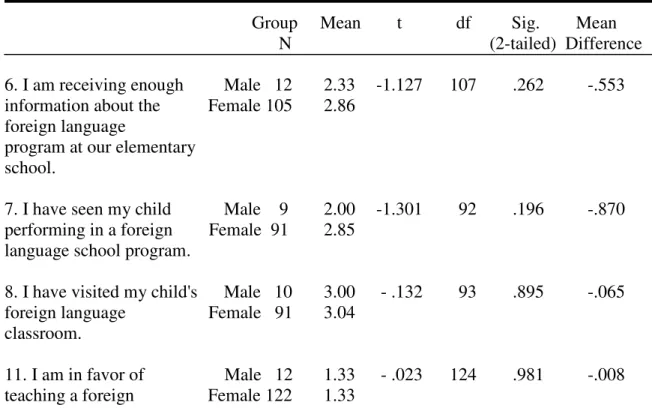
These five questionnaire items, as “I…” statements, were determined to be about involvement:
6. I am receiving enough information about the foreign language program at our elementary school.
7. I have seen my child performing in a foreign language school program. 8. I have visited my child’s foreign language classroom.
11. I am in favor of teaching a foreign language to children.
Instrument Reliability and Validity
Previous replications of the initial study provided evidence for the reliability of the instrument. Inter-item reliability was strong as determined using Cronbach’s alpha with .05 set as acceptable. After evaluating the entire instrument, alpha was 0.86 (N=1278). When adjusting for the portion of the sample responding only to items 1-12 the alpha was 0.94 (N=169). This adjustment was a result of questionnaire directions to respondents to answer item 13 only if “your child is having academic difficulties and is at risk of failing or is learning disabled.”
The FPEI was administered in two previous study sets which served as field tests for the instrument. The original instrument was the result of collaborative designing and piloting by a team of FLES teachers, administrators, and consultants. Designers evaluated face validity by determining if the items were clear and addressed the question of
attitudes toward FLES. The instrument was further evaluated for construct validity. Creswell (2005) described construct validity as assurance that the questions on the instrument are meaningful and purposeful, and if they are useful and significant. The FPEI survey was found to meet these criteria.
Measurement of Variables
The dependent variables for this study were parents’ attitudes about learning foreign language in elementary school, and parents’ involvement with their children’s foreign language learning.
Responses to all attitudes questions (Items 1, 2, 3, 4, 5, 9, 10 and 13) were
be sure the responses had adequate internal consistency, which would mean an alpha of 0.5 or above. In a parallel way, responses to all involvement questions (Items 6, 7, 8, 11 and 12) were summed to create an additive index and Cronbach’s alpha was checked.
To allow comparisons across all three surveys, equivalent additive indices for attitudes and involvement were similarly created for 1993 and 2002.
There were five independent variables in this study. Statistical tests were
performed comparing responses by gender, race and ethnicity, educational level, yearly income level, and year of study.
Gender was measured in two categories, female and male.
Race and ethnicity was measured in six categories: American Indian, Asian, Hispanic or Latino, African American, White and Multi-Racial. These were the same categories from which parents chose on Wake County Public Schools student enrollment forms.
Educational level was measured in four categories of credentials: less than high school, high school graduate (including GED or other equivalency, some college or associate degree, and bachelor’s degree or higher. These categories were defined using levels which are generally familiar to individuals experienced with filling out forms and completing surveys.
Yearly income level was measured in seven consecutive ranges: less than $15,000; $15,000 to $34,999; $35,000 to $49,999; $50,000 to $74,999; $75,000 to $99,999; $100,000 to $149,999; and $150,000 or more. These categories were