LEARNING OF NOUN CLASSES BASED ON SEMANTIC AND PHONOLOGICAL INFORMATION IN AN ARTIFICIAL GRAMMAR
Xuewei Li
A thesis submitted to the faculty of the University of North Carolina at Chapel Hill in partial fulfillment of the requirements for the degree of Master of Arts in the Department of
Linguistics.
Chapel Hill 2015
© 2015 Xuewei Li
ABSTRACT
Xuewei Li: Learning of Noun Classes Based on Semantic and Phonological Information in an Artificial Grammar
(Under the direction of Katya Pertsova)
ACKNOWLEDEMENTS
TABLE OF CONTENTS
LIST OF FIGURES ... viii
CHAPTER 1 INTRODUCTION ... 1
CHAPTER 2 BACKGROUND ... 3
2.1 Children’s Acquisition of Noun Classes Based on Phonological and Semantic Information ... 3
2.2 Adults’ Learning of Noun Classes ... 9
CHAPTER 3 THE EXPERIMENTS AND METHODOLOGY ... 13
3.1 Stimuli ... 13
3.2 Procedure ... 18
3.3 Participants ... 22
CHAPTER 4 RESULTS ... 24
4.1 Result of Pilot Test ... 24
4.1.1 Method ... 24
4.1.2 Result ... 24
4.2 Result of Experiment 1 (phonological condition) ... 26
4.3 Result of Experiment 2 (semantic condition) ... 29
4.4 Result of experiment 3 (phonological and semantic condition) ... 31
4.5 Comparison of the Experiments ... 33
4.5.1 Comparison of Experiment 1&2 ... 33
4.5.3 Comparison of Experiment 2 &3 ... 35
CHAPTER 5 DISCUSSION AND CONCLUSION ... 37
5.1 Discussion ... 37
5.2 Conclusion ... 38
LIST OF TABLES
Table 2.1.1 The classification of Tsez nouns according to semantic information ... 5
Table 2.1.2: Statistical reliability of features used in classification experiment (Gagliardi 2012) ... 5
Table 3.1.1: Relevant features and number of stimuli in each experiment ... 15
Table 3.1.2: The stimuli in the learning section for Experiment 1,2&3 ... 15
Table 3.1.3 The Items Used for Testing in Experiment 3 ... 16
Table 3.1.4 The artificial nouns used in the testing section for Experiment 1,2&3 ... 17
LIST OF FIGURES
Figure 3.2.1: A typical trial in the training section in the experiment ... 20
Figure 3.2.2: A test trial in the learning section in the experiment ... 21
Figure 3.2.2: A typical trial in the test section in the experiment ... 22
Figure 4.1.2.1: The proportion of questions participants answered according to phonological information on new trial in test section of the pilot experiment 25
Figure 4.1.2.2: The proportion of questions participants answered correctly on the old trial in test section of the pilot experiment ... 25
Figure 4.2.1 Proportion of correctness for all questions in test section in experiment 1 ... 27
Figure 4.2.2 Proportion of correctness for 16 subjects in experiment 1 ... 28
Figure 4.3.1 Proportion of correctness for all questions in test section in experiment 2 ... 29
Figure 4.3.2 Proportion of correctness for 16 subjects in experiment 2 ... 30
Figure 4.4.1 Proportion of answers chosen by semantic rules on the new trials ... 31
Figure 4.4.2 Proportion of correctness on old trial for every subject in Experiment 3 ... 32
Figure 4.4.2 Proportion of answers based on semantic rules for each object on new trial in Experiment 3 ... 32
CHAPTER 1 INTRODUCTION
One of the central questions in language learning is how the information in the input, the linguistic statistics the learners can get access to, is used by the learners in constructing grammar. Several studies show that not all information present in the input is noticed or encoded by language learners. For example, Kam and Newport (2009) argue that when learning a language children do not simply reproduce the statistical information in the input. When provided with inconsistent information1 in the input, children tend to regularize the
inconsistency to a systematic form, which shows that they ignore some information available in the input. This study investigates whether or not adult learners preferentially make use of certain information and ignore other information in the input in the process of language learning. Specifically, this study tries to answer the question of whether adult learners favor phonological information over the semantic information when learning the distribution of allomorphs conditioned by inflectional class membership. In many languages the same inflectional features are realized differently on different nouns, depending on what class they belong to. For example, the nouns can be divided into different classes according to the different plural marking. This study investigates how the learners learn the plural forms in an artificial language in which the distribution of plural allomorphs is conditioned either by phonology or by semantics (e.g., animacy), or when the input is ambiguous
between phonological and semantic conditioning (that is, both are equally good in predicting the allomorphs).
CHAPTER 2 BACKGROUND
2.1 Children’s Acquisition of Noun Classes Based on Phonological and Semantic Information
the nouns as members of the same class (masculine or feminine). In other situations, the two features could trigger confusion for the children in determining which gender the nouns belonged to. For example, for the word “un satila”, the natural gender information was absent, but it had a masculine-form determiner and a feminine-form inflectional suffix. Children were asked to describe the color of the items shown in a picture. In this way, from the qualifying adjectives children chose, the experimenter could know what gender children thought a certain noun should belong to. The result showed that children relied more on the morphophonological and syntactic features than the semantic features when classifying the nouns into masculine group or feminine group.
Gagliardi, Feldman and Lidz, (2012) also get very similar results in their study of Tsez children. Tsez is a language that has four noun classes, and these classes can be recognized according to the semantic (e.g. animate, female) and phonological (e.g. r-initial) features on the nouns themselves. The four classes are shown as below:
(1) Tsez Noun Class Agreement (Gagliardi&Lidz 2012)
①
Class 1:
∅
-igu u
ž
i I-good boy
“good boy”
②
Class 2:j-igu kid II-good girl “
good girl”
③
Class 3: b-igu k’et’u III-good cat “
good cat”
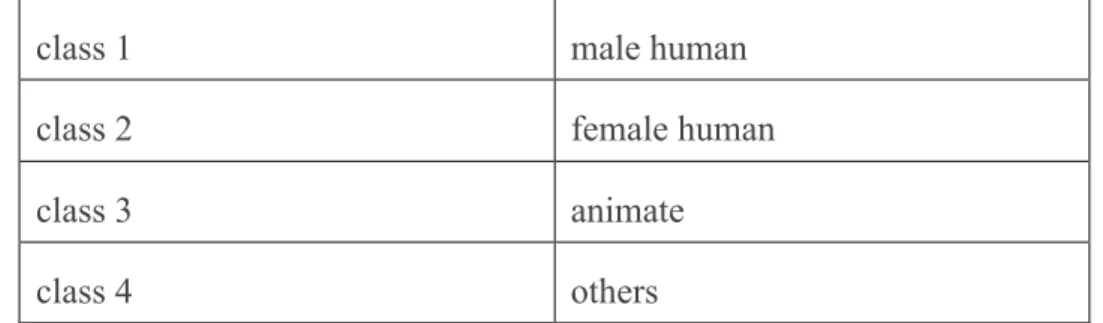
The Tsez nouns can be roughly classified into four categories according to the semantic information. The four classes are shown below:
Table 2.1.1 The classification of Tsez nouns according to semantic information
class 1 male human
class 2 female human
class 3 animate
class 4 others
The nouns classified into four semantic categories also contain some predictable phonological information. Gagliardi(2012) has calculated the probability of predicting the noun classes in Tsez for based on semantic and phonological cues in a corpus study of Tsez. The result is shown in the following table:
Table 2.1.2: Statistical reliability of features used in classification experiment (Gagliardi 2012)
Class Feature Probability of class given feature
Probability of feature given class
1 male human 1 1
2 female human 1 0.22
2 paper, clothing 0.52 0.04
2 G- initial 1 0.14
3 animate 1 0.13
3 b- initial 0.51 0.10
4 r- initial 0.61 0.09
Table 1 shows the distribution of nouns with semantic and phonological cues in four different classes in Tsez. Male human is the most predictable feature since all the nouns which are [+male] and [+human] belong to class 1, and vice versa: all the nouns from class 1 are [+male] and [+human]. The other features the nouns in class 2, class 3 and class 4 are not as reliable as the [+male] and [+human] features in predicting which class the nouns should belong to. There is an overall tendency that semantic features are more indicative of which class the nouns should belong to than phonological features. For example, the probability of nouns with animate feature belonging to class 3 is 1, while there is 0.51 probability that nouns with b-initial feature belongs to class 3. If the noun has the animate feature, it is 100% likely that it belongs to class 3.
have one feature, children are able to classify the nouns to the right class; however, when nouns have two features, like [female] and [r-initial], or [animate] and [r-initial], which conflict in their predictions, children rely more heavily on the phonological feature than the semantic feature even though the phonological feature is less reliable than the semantic feature in the statistical analysis of reliability of features in the corpus study of Tsez.
simply ignored all the semantic information. It turns out that all three models fit the result of the experiment better than the original optimal Bayesian classifier. This indicates that although children didn’t make full use of the information in the input, they may make use of their intake, the information represented in their mind, very well. However, for these three models, it is hard to decide which one is right since all three models fit the data of children’s learning of Tsze very well.
This study demonstrates that children are able to use the phonological information and semantic information to classify novel nouns, and phonological information is more reliable to children than the semantic information in the noun class acquisition. It also suggests that not all information the children can get access to in the input is used in the learning process. One of possible reasons is that at the very early age of acquisition, children are unable to fully attain the semantics of nouns. Another possible reason is that children have a bias to prefer to use the phonological information over the semantic information. However, Gagliardi, Feldman and Lidz’s study cannot prove which is the real reason for why children tend to rely more on the phonological information than the semantic information. So, a further question should be raised: why do children prefer to use phonological information to classify nouns?
information than the semantic information when learning noun classes. If adults also rely more on the phonological cues, it would suggest that the bias for phonological cues in language learning is universal for both children and adults. If adults do not rely more on the phonological information when classifying nouns, this could mean that children’s preference for phonological information is due to their incompetence in perceiving sophisticated semantic information at an early stage of language acquisition. In what follows, I discuss previous studies on adult learning of artificial noun classes.
2.2 Adults’ Learning of Noun Classes
Previous work on noun class learning in artificial languages has mostly focused on children. However, study about adults’ learning of artificial languages can shed light on general learning mechanism, and also can be useful in comparison between first language acquisition and second language acquisition.
dual form, and the suffix “mi” represented plural form. For example, the word for one giraffe is “ganubu”, and the word for two giraffes is “ganuke”. During the training section, the participants heard the sound of the words, and at the same time saw the picture of animals with appropriate number. The gender of the animals was distributed in a random way, which served as an irrelevant cue. In the test section, participants would see a picture of animals with a certain number, and were asked to choose a right answer in a two-alternative multiple-choice question. They were tested on both the words they have learnt in the training section and some novel words. The result showed that adults were capable of learning novel morphological categories, and also adults were able to figure out which cues were relevant, and which cues were irrelevant. This study also indicated that testing adults in an artificial language by using picture-sound pairs in training section and multiple choice questions in the test section was a practical way to explore adults’ language learning mechanism.
and English nouns referring to the objects witch could be divided into long/narrow items or flat/broad items. The classifier for narrow and long items is “ka”, and the classifier of flat and broad item is “po”. The examples of stimuli are shown below:
(2) a. one-ka hammer (Culbertson & Wilson, 2013) one-CL hammer
“one hammer” b. two-po towel two-CL towel “two towels”
paired with objects were at chance, which suggested that the participants didn't learn anything without the semantic cues. This suggested that the learning of noun classes by adults was not simply a memory-based process.
Based on these results, several questions remain for further study: are adult learners able to learn semantically-based noun classes as quickly as the phonologically-based noun classes? Furthermore, what happens when phonological and semantic cues are equally good in predicting which class a noun should belong to? Will one or the other cue be favored?
CHAPTER 3 THE EXPERIMENTS AND METHODOLOGY
In order to answer the question of whether the adult learners prefer to make use of phonological information or semantic information when learning noun classes conditioned by both phonological cues and semantic cues, three experiments were conducted in this study. The first and second experiments tested how adult learners learn the plural forms of nouns in an artificial language in which the distribution of plural allomorphs is only conditioned by phonological or only by semantic information. The third experiment examined how adult learners learn the plural forms when the distribution of plural allomorphs is characterized by both phonological and semantic information. In that experiment, the semantic information and phonological information were equally good in predicting allomorphs, and caused ambiguity in choosing the plural allomorphs for nouns. The first two experiments will reveal whether the learners can learn the distribution of allomorphs based on a single feature (semantic or phonological). Therefore, results of the first two experiments provide a basic condition to analyze the third experiment. They also allow us to compare speed of acquisition of a phonological vs. semantic distinction.
3.1 Stimuli
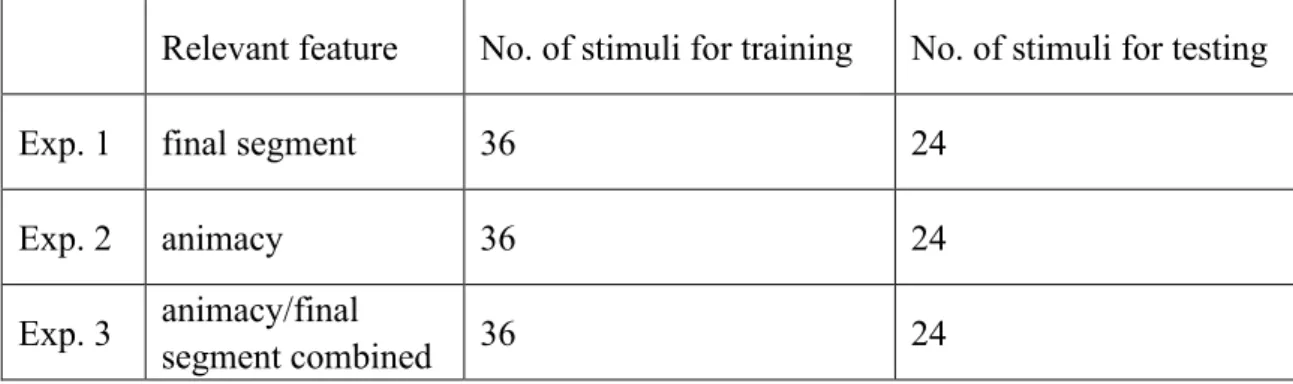
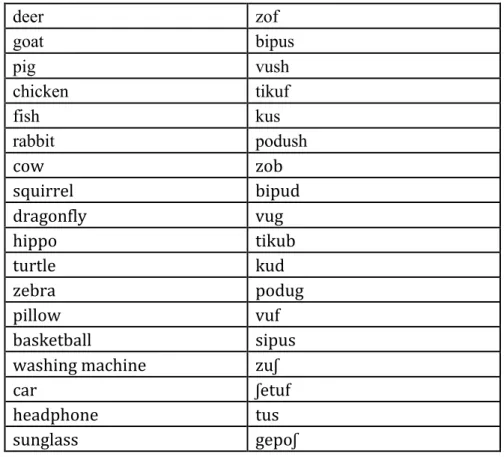
structures of the noun stems are CVC and CVCVC. The vowels are from the set [a, e, i, o, u]. And the consonants are from the set [b, p, d, t, g, k, f, v, s, z,∫], but the final segments are only comprised of voiced stops [b, d, g] and voiceless fricatives [f, s,∫]. Stress for all the words are on the first syllable. There are 36 words in the training section and 24 words in the testing section for each experiment, and the stems of stimuli are the same in all three experiments (see Table 3.1.2). In the training section, for each experiment, every different final segment occurs 6 times: 3 times in monosyllables (CVC), and 3 times in disyllables (CVCVC). In test section, for each experiment, every different final segment occurs 4 times. 2 times are monosyllabic, and 2 times are disyllabic.
In Experiment 1, the nouns are divided into two groups based on the final segments. Nouns in one group all end with voiced stop, and nouns in the other group all end in voiceless fricatives. Each group is assigned one of the two plural allomorphs: –ep is the plural marker used after voiced stops, and –ek is the plural marker used after voiceless fricatives. In each phonological category, half of nouns are animate, and half are inanimate.
In Experiment 2, nouns can also be classified into two groups. One group is animate nouns, and the other group is inanimate nouns. The plural marker after animate nouns is -ep, and the plural marker after inanimate nouns is –ek. Half of the nouns in each semantic category end with voiced stop, and half end in voiceless fricatives.
end in voiced stops, and in the other group, nouns are inanimate and end in voiceless fricatives. The plural of animate nouns ending in voiced stops is -ep, and plural of inanimate nouns ending in voiceless fricatives is -ek. Table 3.1.1 details relevant features and number of stimuli in each experiment.
Table 3.1.1: Relevant features and number of stimuli in each experiment
Relevant feature No. of stimuli for training No. of stimuli for testing
Exp. 1 final segment 36 24
Exp. 2 animacy 36 24
Exp. 3 animacy/final
segment combined 36 24
Table 3.1.2: The stimuli in the learning section for Experiment 1,2&3
Gloss Artificial nouns
giraffe zab
woman pefid
cat deg
man tiseb
dog gid
boy ketog
microphone vub
pencil sipud
hamburger zug
schoolbag ʃetub
scarf tud
key gepog
chair bof
lamp pedas
skirt vosh
book gatif
bowl kes
deer zof
goat bipus
pig vush
chicken tikuf
fish kus
rabbit podush
cow zob
squirrel bipud
dragonfly vug
hippo tikub
turtle kud
zebra podug
pillow vuf
basketball sipus
washing machine zuʃ
car ʃetuf
headphone tus
sunglass gepoʃ
In the test section, as mentioned above, the stems of 24 stimuli in Experiment 1, Experiment 2 and Experiment 3 are the same. However, according to different classification rules in each experiment, the plurals of these stimuli are predicted to be different. In Experiment 1, for words ending in voiced stop, the plural should be ”ep”, and the plural for words ending in voiceless fricatives should be “ek”. In Experiment 2, for animate nouns, the suffix should be “ep”, and inanimate nouns should have suffix “ek”. For Experiment 3, the situation is more complex. Table 3.1.3 displays the structure of stimuli in test section in Experiment 3.
Table 3.1.3 The Items Used for Testing in Experiment 3
Inanimate Animate
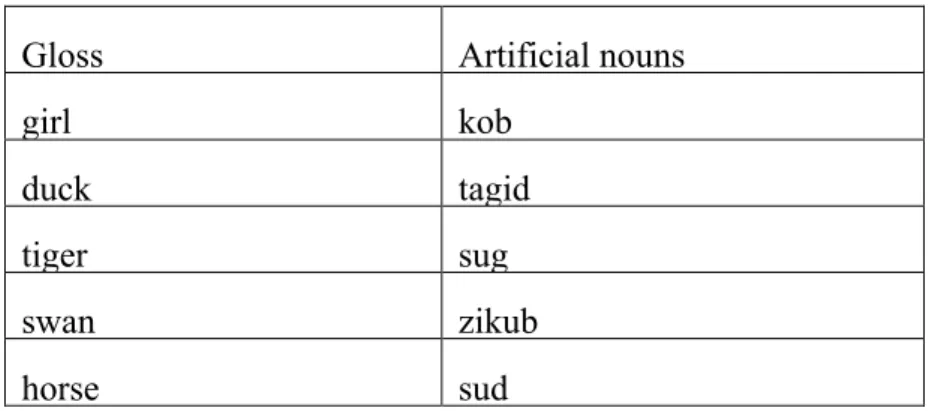
In Experiment 3, there are 12 words in the test phase that have the same features as the words in the training section (named old trials here). That is, 12 words are animate nouns ending with voiced stops and inanimate nouns ending with voiceless fricatives. For these 12 nouns, we can classify the participants’ responses as “correct” or “incorrect” according to what they have been exposed to in the training section. The plural of animate nouns ending with voiced stops is “ep”, and the plural of inanimate nouns ending with voiceless fricatives is “ek”. However, there are 12 other words in which the semantic and phonological features make opposite predictions for classification (named new trials here). That is, the 12 new words are animate nouns ending in voiceless fricatives and inanimate nouns ending in voiced stops. The data for new trials was coded as either conforming to the semantic or the phonological rule. If participants choose “ep” for animate nouns ending with voiceless fricatives, and choose “ek” for inanimate nouns ending with voiced stop, this means the participants have classified the nouns according to semantic information. If participants choose “ep” for inanimate nouns ending with voiced stop, and choose “ek” for animate nouns ending with voiceless fricatives, this means the participants have learned the phonological rules. Table 3.1.4 lists stimuli used in the test section for three experiments.
Table 3.1.4 The artificial nouns used in the testing section for Experiment 1,2&3
Gloss Artificial nouns
girl kob
duck tagid
tiger sug
swan zikub
penguin pezig
monkey kof
elephant digus
ant gosh
bear bipof
pigeon kos
bee zotish
knife teb
necklace dised
guitar vig
plane fekib
pen ved
toothbrush foteg
spoon shof
bike degos
umbrella sesh
watch sutif
comb fes
ice cream gudish
3.2 Procedure
trial:
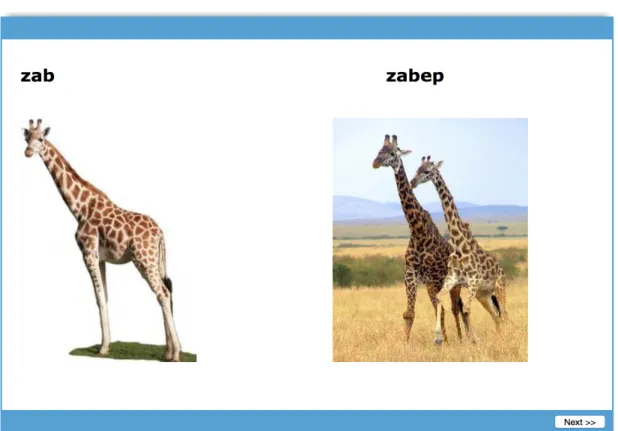
Figure 3.2.1: A typical trial in the training section in the experiment
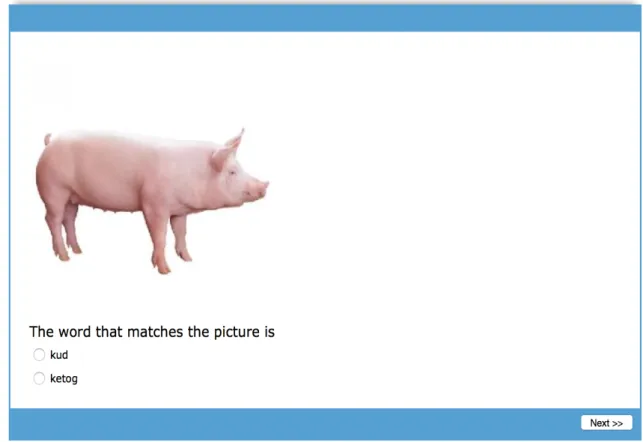
Figure 3.2.2: A test trial in the learning section in the experiment
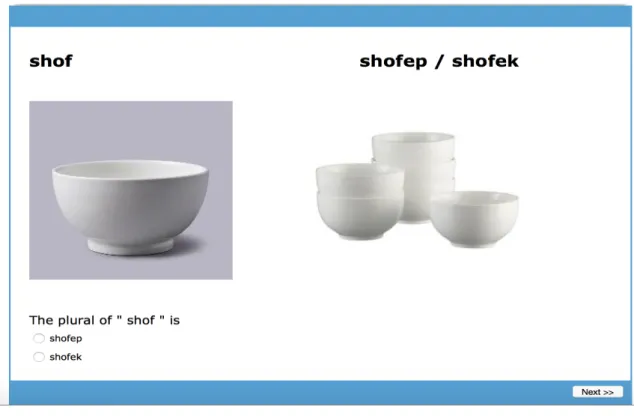
Figure 3.2.2: A typical trial in the test section in the experiment
The post-questionnaire section included basic questions about age, gender, dominant hand (which hand they prefer to use in daily life), native language, other language they have learned plus two questions about how they approached the task in the learning section and whether they noticed any regular patterns for choosing the plural forms.
There were two versions of surveys for each experiment. They differed in how the pictures and stems were matched to each other as well as the order in which they were presented. The 6 different resulting experiments were distributed to participants in a random way.
3.3 Participants
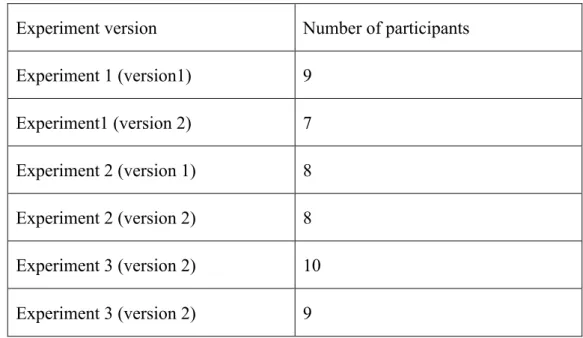
Mechanical Turk. Every participant was paid 5 dollars for completing the survey. No participant participated in more than 1 experiment. The number of participants in each experiment is shown below:
Table 3.3.1 The number of participants in each experiment
Experiment version Number of participants
Experiment 1 (version1) 9
Experiment1 (version 2) 7
Experiment 2 (version 1) 8 Experiment 2 (version 2) 8 Experiment 3 (version 2) 10 Experiment 3 (version 2) 9
CHAPTER 4 RESULTS
4.1 Result of Pilot Test
4.1.1 Method
In the pilot test, the participants were asked to do the survey in a phonetics lab on a computer. They were left alone in the phonetic lab and were required to read the words in the learning section aloud. 8 adults were recruited to participate in experiment 3. Four of them were male, and four of them were female. The native language of 8 participants was English. There were two versions of the surveys for experiment 3. The orders of trials were different in these two versions. The matches between the forms and meanings of all words in both training and test section were randomized automatically by Qualtrics.
4.1.2 Result
Figure 4.1.2.1: The proportion of questions participants answered according to phonological information on new trial in test section of the pilot experiment
Figure 4.1.2.2: The proportion of questions participants answered correctly on the old trial in test section of the pilot experiment
75%
50%
0%
100%
50%
66.67% 66.67%
58.33% 0% 10% 20% 30% 40% 50% 60% 70% 80% 90% 100%
Subject 1 subject 2 subject 3 subject 4 Subject 5 Subject 6 Subject 7 Subject 8
66.67%
58.33%
100.00% 100.00%
33.33% 58.33% 50% 66.67% 0.00% 10.00% 20.00% 30.00% 40.00% 50.00% 60.00% 70.00% 80.00% 90.00% 100.00%
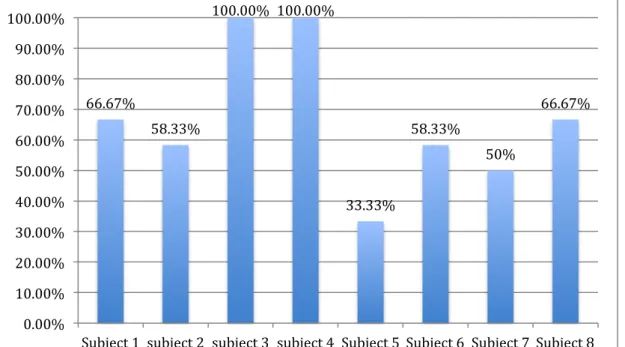
Subject 4 answered all questions on old trial correctly, and answered all questions on new trial according to phonological rules. From the questionnaire he answered, it could be shown that he learned the rule that “the plural of harder consonant is ‘ep’, and plural of softer consonant is ‘ek’.” Subject 3 chose all the plurals correctly for 12 nouns on old trial, and chose all the plurals for 12 nouns on new trial according to semantic information. She also stated in the questionnaire that she found that animals and objects would have different plurals. So she learned the noun classes based on semantic information.
In this pilot test, participants were asked to repeat the words out load in the phonetic lab, and subject 2 has mentioned in the questionnaire section that because she was asked to repeat the words, she paid too much attention to the pronunciation of the words, so she didn’t learn any rules for the plurals. It is possible that repeating the words aloud biases subject to pay more attention to the phonological information than semantic information. Because of this, I have included the four multiple-choice questions, which ask the participants to match the words with pictures into the training section of the online experiments. The pilot study does not provide enough information to draw any conclusions.
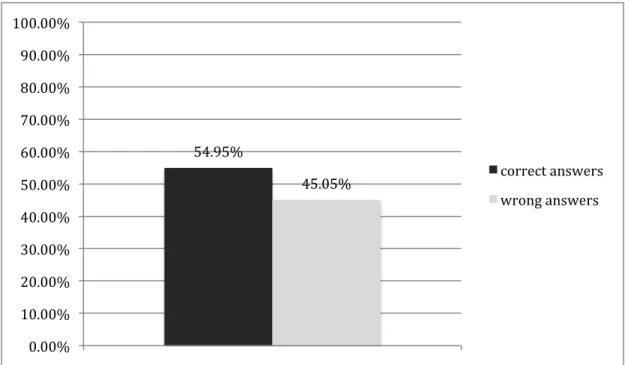
4.2 Result of Experiment 1 (phonological condition)
from chance according to modified Pearson’s square test of proportion with multiple observations (
x²
RS = 1.73, p = 0.19).Figure 4.2.1 Proportion of correctness for all questions in test section in experiment 1
From a total of 16 subjects in experiment 1, one subject learned the phonological rules correctly (he has answered all 24 questions according to phonological rules), and there is another subject who likely learned the phonological rule but applied it to the wrong suffix. The proportion of correctness for her is 25%, which is too low to be at chance. This indicates that she tended to assign “ep” to nouns ending in voiceless fricatives, and “ek” to nouns ending in voiced stops. Except these two subjects, all the others’ answers are around chance level. Figure 4.2.2 provides a more detailed breakdown of proportion of correctness for each subject.
54.95%
45.05%
0.00% 10.00% 20.00% 30.00% 40.00% 50.00% 60.00% 70.00% 80.00% 90.00% 100.00%
Figure 4.2.2 Proportion of correctness for 16 subjects in experiment 1
In post-questionnaire section, out of 16 subjects, 5 subjects stated they found a rule for choosing plurals for the nouns. The subject who answered all questions 100% correctly in the test section said that “ep” is the plural after “b,d,g”, and “ek” is the plural after “s, sh”, which is almost right except he didn’t mention the rule for nouns ending with “f”. The subject who got 25% of correct response also stated the phonological rule, which she thought that “ep” was after “softer” nouns and “ek” was after “harder” nouns. Her response shows that she learned the phonological rule backwards. There is one subject who said she tried to classify nouns according to their “endings”, but failed to find the exact rule. Surprisingly two subjects said that they have found the rule that “ep” goes with animals, and “ek” goes with objects, which is not the rule for experiment 1, but for experiment2.
45.83% 50% 50%
4.3 Result of Experiment 2 (semantic condition)
The result of experiment 2 demonstrates significant learning of noun classes based on semantic information for adult learners. The proportion of correctness for all 16 subjects is 68.49%, which is significantly different from chance (
x²
RS = 7.15, p = 0.0075).2 Figure4.3.1 shows total proportion of correct responses in the test phase.
Figure 4.3.1 Proportion of correctness for all questions in test section in experiment 2
In this experiment, 7 out of 16 (43.75%) subjects learned the semantic rule. The other subjects’ answers are basically at chance, which means they didn’t learn any rules to classify nouns. Figure 4.3.2 gives a detailed proportion of correctness for each participant.
2 Analysis performed in using modified Pearson’s square test of proportion with multiple observations
68.49%
31.51%
0.00% 10.00% 20.00% 30.00% 40.00% 50.00% 60.00% 70.00% 80.00% 90.00% 100.00%
correct answers
Figure 4.3.2 Proportion of correctness for 16 subjects in experiment 2
The data also corresponds neatly with subjects’ answers in post questionnaire section. 7 subjects have mentioned that they have learned certain semantic rules. Out of these 7 subjects, 5 subjects stated the correct semantic rule clearly, and they also performed very well in the test section. There is one subject who reported a partially correct rule by saying that warm-blooded animals end with “ep” and everything else end with “ek”, and his correctness in test section is 91.30%. Another subject stated the semantic rule backwards, which means that the subject associated suffix “ep” with objects, and “ek” with animals (the reverse was true in the training). However, this subject’s correctness is 45.83%, which is at chance. There is also a subject who answered all questions correctly, but she did not mention any rules in post questionnaire section.
45.83% 45.83% 45.83% 50.00% 54.17% 91.30% 87.50% 41.67% 33.33% 100.00% 95.65% 58.33%
100.00% 100.00% 100.00%
4.4 Result of experiment 3 (phonological and semantic condition)
In experiment 3, the results also suggest that adult learners pay more attention to semantic information than phonological information when learning noun classes. Remarkably out of 19 subjects, 13 subjects (68.42%) have learned the noun classes based on semantic rules.
If all responses in Experiment 3 are coded according to whether participants answered questions based on semantic rules on new trials, this can indicate whether subjects were choosing answers based on semantic or phonological information. The percentage of answers chosen based on semantic rules is 77.19%, and the percentage of answers chosen not based on semantic rules is 22.81%, which is statistically significant (
x²
RS = 8.65, p =0.0033), according to modified Pearson’s square test of proportion with multiple observations. This shows that subjects chose their answers mainly based on the semantic information. The data is shown in Figure 4.4.1.
Figure 4.4.1 Proportion of answers chosen by semantic rules on the new trials
77.19% 22.81% 0.00% 10.00% 20.00% 30.00% 40.00% 50.00% 60.00% 70.00% 80.00% 90.00% 100.00%
answers based on semantic rules
Figure 4.4.2 shows percentage of correct responses on old trial for every subject in Experiment 3. Figure 4.4.3 gives the same breakdown on new trials in Experiment 3.
Figure 4.4.2 Proportion of correctness on old trial for every subject in Experiment 3
Figure 4.4.2 Proportion of answers based on semantic rules for each object on new trial in Experiment 3
50% 100%
50.00%
100% 100%
83.33% 100% 75.00% 83.33% 100% 16.67%
100% 100%
83% 75%
33%
100% 100% 100%
0% 10% 20% 30% 40% 50% 60% 70% 80% 90% 100% 75% 100% 33.33%
100% 100%
16.67% 100%
91.67% 91.67% 100%
16.67%
100% 100% 100%
25% 50%
100% 100%
From the statistical analysis above, we see that subjects rely more on semantic cues compared to phonological cues, which is also consistent with the post-questionnaire answers. Out of 19 subjects, 13 subjects have mentioned the semantic rules, and these 13 subjects also performed well in the test section by using semantic rules. 12 of them stated the exact rules. One subject stated he found the difference was whether the nouns were animate or inanimate, but he did not illustrate the rule specifically. The percentage of correctness on old trial for him is 16.67%, and proportion of answers based on semantic rule is 16.67%, which indicates that he learned the semantic rule oppositely. Two subjects mentioned phonological rules. One subject said that her answers were based on phonological rules, but did not state the rule in details. She answered all questions in test section correctly. The other one only described the rule partially, which she said that the plural for nouns ending with “b” is “ep”. This also corresponds with her answers in test section, for her proportion of answers based on phonological information on both old and new trials is 75%. There was another subject whose answers were 83.33% correct both on the old and new trial based on the phonological rule, but he did not mention any rules in the questionnaire section. The remaining subjects were at chance.
4.5 Comparison of the Experiments
4.5.1 Comparison of Experiment 1&2
As results of Experiment 1 and Experiment 2 show, the proportion of correct answers
p = 0.19). The proportion of correctness in Experiment 2 is 68.49%, which is statistically significant (
x²
RS = 7.15, p = 0.0075). The statistical analysis indicates that subjects did notlearn the phonological rules in Experiment 1, but subjects in Experiment 2 did learn the semantic rules to classify nouns. However, as reported by modified Pearson’s square test of proportion, the difference between Experiment 1 and Experiment 2 is not quite
statistically significant (
x²
RS = 3.40, p = 0.065), although it only misses significance by 1percentage point. More subjects are needed to determine whether this difference is significant.
Based on this finding and the result of Experiment 3 that 77.19% answers were
chosen based on semantic rules, we can see that adult learners prefer to use semantic
rules over phonological rules when learning noun classes.
4.5.2 Comparison of Experiment 1 &3
The statistics in section 4.2 and 4.4 show that both in Experiment 1 and Experiment 3,
most subjects did not learn the phonological rules for classifying nouns. In Experiment
1, the percentage of correctness is 54.95%. In Experiment 3, for the new trial, the
percentage of answers based on phonological rules is 22.81%. On the basis of modified
Pearson’s square test of proportion with multiple observations, the difference
between Experiment 1 and Experiment 3 on the trial is statistically significant (
x²
RS =not learn the phonological rule, so their answers were almost at chance. But in
Experiment 3, there is an obvious tendency that subjects preferred to use semantic
rules to classify nouns. Therefore, the proportion of answers based on phonological
rules in Experiment 3 is critically low. This is the reason why the difference between
Experiment 1 and Experiment 3 becomes obvious.
4.5.3 Comparison of Experiment 2 &3
In Experiment 2, the proportion of correct answers for all subjects is 68.49%, which
shows a great learning of semantic rules. In Experiment 3, on the new trial, the
percentage of answers chosen by semantic rules is 77.19%, which also demonstrates a
sufficient learning of semantic rules, and indicated that adult learners prefer to rely on
semantic information in learning noun classes than phonological learning. According
to statistical analysis by modified Pearson’s square test of proportion, the difference
between Experiment 2 and Experiment 3 is not significant (
x²
RS = 0.73, p = 0.39).Figure 4.5.3.1 A comparison of number of subjects who learned semantic rules in Experiment 2 and Experiment 3
43.75%
68.42%
0.00% 10.00% 20.00% 30.00% 40.00% 50.00% 60.00% 70.00% 80.00% 90.00% 100.00%
CHAPTER 5 DISCUSSION AND CONCLUSION
5.1 Discussion
The primary aim of this study was to probe the question of whether adult learners prefer to rely on semantic information or phonological information. To that end, this thesis has shown that adults in this study paid more attention to semantic information than phonological information, which is opposite from the findings with children for several studies (Perez-Pereira, 1991; Gagliardi, Feldman and Lidz, 2012), in which children were biased to use phonological information over the semantic information.
The finding that adults are biasd towards semantic information can indicate that (i) the reason why children rely more on the phonological features has to do with their underdeveloped conceptual capacities, or (ii) the phonology bias does not operate during second language acquisition because second language acquisition proceeds via a different mechanism.
test and one participant in experiment 1 tried to illustrate the phonological rules as “softer” words end with “ep”, and “harder” words end with “ek”. In order to eliminate this uncertainty, following-up experiments can be conducted. If we can find a phonological cue which people can learn as well as they learn the animate and inanimate distinction, then it would be interesting to see what happens in Experiment 3.
Secondly, though the difference between Experiment 2 and Experiment 3 was not statistically significant, there is a possibility that the difference between these two experiments could be significant if more data are provided. If this was the case, we can draw a conclusion that the semantic bias is much stronger when semantic and phonological information are correlated with each other. This would be an interesting finding and it would suggest that instead of triggering ambiguity, multiple cues can be helpful for categorization and generalization. In this study, the structure of the words in experiment 3 is simpler than in experiment 2, because in experiment 3, all animal words end in voiced stop, and all inanimate words end in voiceless fricatives. But in experiment 2, for animate words, as well as the inanimate words, half of them end with voiced stop and half of them end with voiceless fricatives. It is possible that phonological split in experiment 3 helped the learners to learn the semantic generalization.
5.2 Conclusion
REFERENCES
Finley, S., & Wiemers, E. (2013). Rapid learning of morphological paradigms. In Proceedings of the 34th Annual Conference of the Cognitive Science Society. Austin: Cognitive Science Society.
Kam, Hudson C.L., & Elissa, Newport (2009). Getting it right by getting it wrong: When learners change languages. Cognitive Psychology, 59, 30–66.
Gagliardi, A. (2012). Input and intake in acquisition: University of Maryland, College Park dissertation.
Gagliardi, A., Feldman, N. H., & Lidz, J. (2012). When suboptimal behavior is optimal and why: Modeling the acquisition of noun classes in Tsez. In Proceedings of the 34th annual conference of the Cognitive Science Society, 360-365.
Culbertson, J., & Wilson, C (2013). Artificial grammar learning of shape-based noun classification. In Proceedings of the 35th Annual Meeting of the Cognitive Science Society, 1, 2118-2123.