Training and Early Career Received: July 11, 2019; Editorial Acceptance: October 28, 2019 Published Online: January 15, 2020
1 © Society of Breast Imaging 2020. All rights reserved. For permissions, please e-mail: [email protected].
Training and Early Career
Rules of Engagement: Implementing
Student-Centered Learning in Breast Imaging
Sheryl G. Jordan, MD,
*
,Elizabeth C. Deans, MD, Meredith Johnson, MD,
Sheila S. Lee MD, Gary L. Beck Dallaghan, PhD
University of North Carolina School of Medicine, Department of Radiology, Chapel Hill, NC (S.G.J., S.S.L.); UNC Health Care, Department of Radiology, Chapel Hill, NC (E.C.D., M.J.); University of North Carolina School of Medicine, Office of Medical Education, Chapel Hill, NC (G.L.B.D.)
*Address correspondence to S.G.J. (e-mail: [email protected])
Abstract
In response to changing learner needs, our institution launched a new translational curriculum wherein basic sciences and clinical skills were integrated, longitudinal patient care experiences provided, and earlier opportunities in specialty fields introduced to better inform residency pro-gram decisions. Medical students taking the breast imaging elective were enrolled in a breast imaging immersive experience designed to meet the School of Medicine’s core competencies. In focusing the elective on a narrow range of specialized topics and skills, we labeled this experience the Breast Imaging Boot Camp. Outcome data from March 6, 2017, to April 26, 2019, have been analyzed for this report. The modifications made to the elective include: e-mailing a detailed orien-tation document to students prior to the start of the roorien-tation; assigning students to diagnostic, procedural, and screening roles; the attendance of students at introductory radiology symposia; students’ weekly attendance at institutional multidisciplinary and divisional breast radiologic– pathologic correlation conferences; student self-study assignments using faculty-vetted resources; student participation in breast biopsy simulation and small parts ultrasound laboratories; the de-velopment of a student-centric radiology educational website; and student-directed publishing of digital case files. Medical student feedback and course analytics indicated superior course evalu-ation scores reinforced by narrative feedback. In website domain utilizevalu-ation data, the breast file domain is the most viewed subspecialty domain. The Breast Imaging Boot Camp is a successful curriculum. Its novelty lies in both its integrated approach to medical student core competencies and its clinician educators’ use of today’s student-favored teaching tools.
Key words: breast imaging; medical student; education; core competencies; clinician educator; training.
Introduction
In recent years it has been reported that graduating medical students are not prepared for residency training (1). In response to this, the Association of American Medical Colleges (AAMC) produced medical student competencies and further refined them into the Core Entrustable Professional Activities for Entering Residency (2). These concerns have resulted in medical schools considering how to enhance educational experiences to better prepare students for residency training.
(the individualization phase) was extended, which meant the Department of Radiology had more medical students on electives.
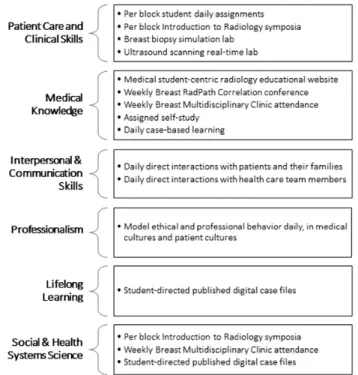
The SOM patterned key curricular components after the Liaison Committee of Medical Education (LCME) Standards, which stress evaluating students based on core competencies and educational outcome measures (3, 4). Six core competencies—patient care and clinical skills, medical knowledge, interpersonal and communication skills, professionalism, lifelong learning, and social and health sys-tems science—were emphasized, with the expectation that all stu-dents graduate with these essential skills (4).
To better meet the expectations of the millennial generation of learners, we revised our breast imaging medical student curriculum to be more engaging and self-directed (5, 6). We had already made sig-nificant changes to the resident curriculum for breast imaging (7, 8). Based on the success with the residents’ curriculum, the medical student elective was modified. The change involved taking an un-structured, service-oriented elective to a student-centric experience, focusing on a narrow range of specialized topics and skills (com-monly referred to as a boot camp) that incorporated self-directed learning, case-based discussions, and defined clinical experiences.
We describe the development of a breast imaging elective cur-riculum, student performance, and the evaluations of this unique educational experience for medical students.
Transforming the Curriculum
Used as a means to maximize teaching time and foster team building, boot camp tenets were employed to meet our students’ core compe-tency needs. Boot camps in medical education typically consist of didactic lectures, simulation activities, and team building in a con-centrated curriculum (10, 11).
The first enhancement was to redesign the four-week elective cur-riculum to fulfill the SOM core competencies (Figure 1). This largely involved mapping activities in the elective to the competencies. Gaps in competency education were rectified by the development of add-itional learning activities for the medical students.
At the start of each breast imaging block, orientation documents were e-mailed to incoming students. These documents included a description of the imaging protocols for the work-up of common presenting breast complaints, the American College of Radiology (ACR) Breast Imaging Reporting and Data System (BI-RADS) Atlas, and a link to a newly created radiology educational website housing additional resources curated by the breast imaging faculty (12, 13). Students were asked what specialty they were pursuing to tailor their learning and involvement in patient care accordingly. A proactive
introduction to the rotation set expectations for an interactive rather than passive experience.
During the four-week block, students rotated among diag-nostic, procedural, and screening services for a well-rounded ex-perience. They were required to participate in two four-hour formal Introduction to Radiology didactic symposia as well as weekly radiology–pathology correlation and multidisciplinary breast conferences.
The updated elective included sequential self-study education modules on breast procedures, radiology–pathology correlation, and the management of breast biopsy results followed by live teaching and an emphasis on learned topics at the weekly confer-ences. The timing of these assignments often preceded their service assignment, employing flipped classroom tenets. Students reviewed teaching files created by peers from prior breast imaging electives. Furthermore, topics encountered in case-based learning were reiter-ated in follow-up via teaching points sent electronically that evening or the next day, applying principles of interleaving and spaced practice (14, 15). New interactive learning components were cre-ated, which included a breast biopsy simulation lab and a small parts ultrasound scanning lab.
Students were observed communicating imaging results to pa-tients. Faculty assured graduated procedural and diagnostic respon-sibilities for the student over the course of the rotation. Typical engaging student activities and skill-set development are shown in
Table 1.
Website
In February 2018, a medical student-centric radiology website was built with limited-access cloud upload capability (available at www.msrads.web.unc.edu). Students had access to the educa-tional content on this open source host site for pre-study, in-clinic education, and post-teaching reference. Using no-cost institutional
Key Messages
• This successful medical student breast imaging elective adopts an integrated approach to medical student core competencies and clinician educators’ use of today’s student-favored teach-ing tools.
• Innovations leverage student-preferred educational tools (eg, e-learning, flipped classroom learning, and simulation learning) and principles of cognitive psychology (eg, spaced repetition and interleaving).
• This model achieves high student satisfaction in the following areas: a positive learning environment, skill set development, and patient care responsibilities.
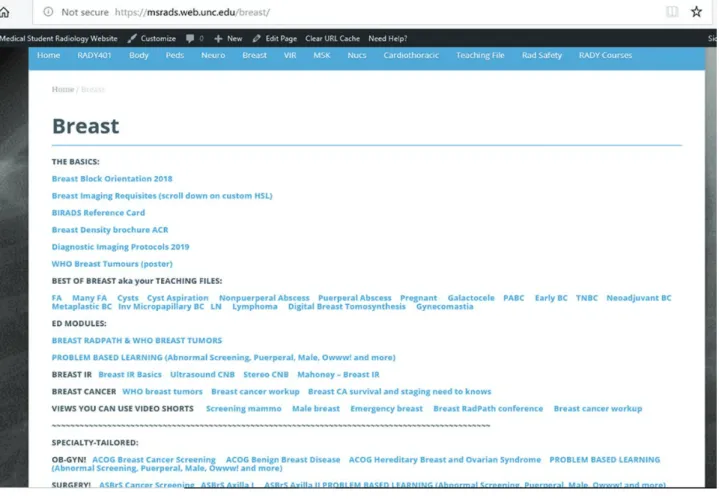
web publishing services on a WordPress platform (Automattic, San Francisco, CA) hosted on enterprise-level hardware, the site is sup-ported by the institution’s information technology digital services. The website main menu links to the student formal didactic radi-ology lecture calendar and a custom-built health sciences library page with e-resources for imaging, teaching files, and each radi-ology course. The breast domain (https://msrads.web.unc.edu/ breast/) is illustrated in Figure 2, showing the faculty-curated edu-cational e-modules spanning breast disease topics, journal reference articles, video shorts, block orientation, digital case files, and the ACR BI-RADS Atlas reference card (12). The educational website ensured consistency within the rotation among students, which is especially crucial when attending faculty schedules change. Website analytics provided by Google Analytics (Google, Mountain View, CA) were analyzed.
Outcomes
Medical student evaluations of the Breast Imaging Boot Camp from the first two academic years of the curriculum were collected using One45 software (One45, Vancouver, BC). Dates included March 2017 to April 2019. Students rated the rotation on a scale of 1–10 (1 being the worst and 10 being the best). Students also provided narrative comments, which were reviewed to identify frequent statements about their experience. This project was ex-empted by the institution’s Office of Human Research Ethics and Institutional Review Board.
The breast imaging radiology course was rated 10 out of a possible 10 in each of the two TEC academic years, with indi-vidual parameters highly scored (Tables 2 and 3). Ratings were greater than all other radiology electives. Upon reviewing the nar-rative comments, students frequently wrote comments similar to this: “I felt included as part of the medical team and was able to actively learn by participating in procedures.” They noted, “The educational resources provided by the radiology department were excellent and helped orient me to the rotation tremendously as well as reinforce clinical examples.” Students also made sugges-tions about how to improve the elective, which were incorporated when possible. One such example is the students’ desire to present more mammographic results.
The medical student education website analytics showed im-mediate subscription to the site and 11 419 page views over its 15-month existence during this study. The breast file domain was the most-viewed subspecialty domain, with 916 views, far surpassing other subspecialty pages (Table 4).
Discussion
Traditionally, medical students take on an observational role during their radiology rotations, peering over the shoulders of the interpreting radiologist and listening to the interpretation as a patient study is dictated. The patient may exist only on a PACS monitor, and patient worklists—rather than an intentional cur-riculum—may determine what is taught. This sets the stage for possible fragmented learning experiences and curricular gaps for the student.
In an effort to ensure that medical student education in breast imaging addressed all core competencies, we sought to challenge this typical radiology rotation. We offered education that was not only more comprehensive and consistent between students and rotations but also more engaging for the student with hands-on learning. Each student was scheduled on diagnostic, procedure, and screening days in a deliberate manner. A centralized website with high-yield resources equipped students to participate in con-ferences and establish their presence as a learner on the rotation. More frequent shoulder-to-shoulder teaching and an overall im-proved rotation experience was emphasized. Finally, emphasis of teamwork and active participation helped to highlight the role of the radiologist as the patient-facing provider and consultant, laying the foundation for future positive multidisciplinary col-laboration. This approach was well-received by medical students independent of their chosen specialty.
These course innovations leverage today’s learner-preferred edu-cational tools of e-learning, flipped classroom learning, and simula-tion learning (5, 6, 16, 17). Today’s learners use smartphones, digital tablets, computers, and online resources extensively, and adapt readily to learning new technology. The students were continuously
Table 1. Breast Imaging Boot Camp Medical Student Activities and Skill-Set Development
Activity: Direct Patient Care
Observe patient screening and diagnostic mammography Observe patient breast ultrasound
Present new diagnostic patient work-ups
Observe patient being given normal and abnormal results Give patient normal results
Activity: Clinical Skills
Participate in introduction to radiology symposia (all modalities)
Participate in intradisciplinary radiology pathology conference Attend breast multidisciplinary conference
Develop clinical breast exam skills
Activity: Point of Care Ultrasound
Observe patient breast and axillary ultrasound
Learn transducer orientation, impact of gain, depth, focal zone Recognize normal rib and normal fat lobule
Perform selected targeted breast ultrasound (palpable mass in young patient, palpable mass, cyst vs solid mass, abscess vs mastitis) Perform selected axillary ultrasound
Activity: Breast Procedural Skills
Observe ultrasound-guided aspiration and ultrasound-guided core needle biopsy
Observe stereotactic-guided core needle biopsy Observe MR-guided core needle biopsy Observe imaging-guided needle localization Develop sterile technique skills
Perform selected ultrasound-guided procedure steps (cyst aspiration, needle biopsy)
Perform selected stereotactic-guided core needle biopsy procedure steps
Perform selected imaging-guided needle localization steps
Activity: Simulation Labs
Participate in point of care ultrasound sim lab Participate in chicken breast biopsy lab
Activity: Case Presentation
able to quickly reference the educational resources on the host site while both on and off rotation, with the ability to access the in-formation in a variety of settings. Implementing flipped classroom learning increased the medical students’ perception of the amount of knowledge acquired during educational activities; we went further and added recap activities (14–16). The qualitative student and fac-ulty evaluation frequently listed the ease with which the educational content was accessed and reinforced when there was full knowledge of the posted resources.
The elective’s point of care ultrasound, in particular, is a con-siderable motivating factor for medical students (18–20). Not only does it allow for real-time imaging and diagnosis, it also familiarizes students with various presentations of pathology and adds to their diagnostic tool belt (18).
There are a few teaching tips to highlight for the busy clin-ician educator role many faculty play (21). After two years of experience, lessons learned include: (1) prepping and delivering the simulation labs in a precise, repetitive manner; (2) sending the reiterative e-mails by harvesting teaching points from a document prefilled with teaching points that can be easily ex-cerpted and sent to students; (3) using a template software platform when developing new educational modules; and (4) committing the specific educational module and case files avail-able online to memory. These are four examples that facilitate efficient teaching and effective learning (21, 22). Knowing the content on the website well enabled faculty to readily refer the students to a follow-up learning module or article. Also featured on the website are student-selected and student-
Table 2. Radiology Course Medical Student Evaluations: Overall Course Rating
TEC Radiology Course 2018–2019 (n = 151) 2017–2018 (n = 113)
General radiology 9.1 (59) 8.3 (55)
Pediatric radiology 7.9 (10) 9.0 (6)
Neuroradiology 9.8 (8) 8.0 (9)
Vascular interventional radiology 9.9 (9) 9.9 (17)
Bone and joint radiology 9.0 (13) 8.3 (4)
Breast imaging 10.0 (6) 10.0 (5)
Cardiothoracic radiology 9.6 (13) 9.0 (10)
Body imaging 8.9 (33) 9.4 (7)
produced teaching files based on actual patient presentations and imaging findings. Referencing these teaching files as a teaching tool readily engages students (22, 23).
This innovative curriculum description is limited in that it is from a single institution. However, the enhancements made to the breast imaging elective can be replicated at other institutions. A fu-ture evaluation of this curriculum will be to quantify faculty time preparing or revising modules to determine the true cost of this effort.
Conclusion
The Breast Imaging Boot Camp is a successful curriculum, readily meeting our learners’ needs. Its novelty lies in both its integrated approach to medical student core competencies and its clinician edu-cators’ daily use of teaching tools. This structure could be developed at any medical school to provide students with a competency-based education in breast imaging.
Conflict of interest statement
None declared.References
1. Sachdeva AK, Loiacono LA, Amiel GE, Blair PG, Friedman M, Roslyn JJ. Variability in the clinical skills of residents entering training programs in surgery. Surg 1995;118:300–8; discussion 308.
2. Association of American Medical Colleges. Core entrustable activities for entering residency. Available at:
https://members.aamc.org/eweb/up-load/Core%20EPA%20Curriculum%20Dev%20Guide.pdf. Accessed 11
August 2018.
3. Liaison Committee on Medical Education. Functions and Structures of a Medical School. Available at: http://lcme.org/publications. Accessed 7 November 2017.
4. UNC School of Medicine Core Competencies. Available at https://
www.med.unc.edu/md/curriculum/files/2018/06/UNCSOM-Core-Competencies.pdf. Accessed 14 February 2019.
5. Hopkins L, Hampton BS, Abbott JF, et al. To the point: medical edu-cation, technology, and the millennial learner. Am J Obstet Gynecol
2018;218:188–192.
6. Scott K, Morris A, Marais B. Medical student use of digital learning re-sources. Clin Teach 2018;15:29–33.
7. Monticciolo DL, Rebner M, Appleton CM, et al. The ACR/Society of breast imaging resident and fellowship training curriculum for breast im-aging, updated. J Am Coll Radiol 2013;10:207–10.e4.
8. Harvey JA, Nicholson BT, Rochman CM, Peppard HR, Pease CS, DeMartini NA. A milestone-based approach to breast imaging instruction for residents. J Am Coll Radiol 2014;11:600–605.
9. Esterl RM Jr, Henzi DL, Cohn SM. Senior medical student “Boot Camp”: can result in increased self-confidence before starting surgery internships.
Curr Surg 2006;63:264–268.
10. Jambhekar K, Meek ME, Major V, Coker DJ, Deloney LA. Radiology boot camp: facilitating the transition of interns into residents. J Am Coll Radiol
2014;11:329–331.e1.
11. Fernandez GL, Page DW, Coe NP, et al. Boot cAMP: educational outcomes after 4 successive years of preparatory simulation-based training at onset of internship. J Surg Educ 2012;69:242–248.
12. D’Orsi CJ, Sickles EA, Mendelson EB, Morris EA et al. ACR BI-RADS® Atlas, Breast Imaging Reporting and Data System. Reston, VA: American College of Radiology; 2013.
13. Ikeda DM, Miyake KK. Breast Imaging: The Requisites. 3rd ed. St. Louis, Missouri: Elsevier Inc; 2017.
14. Poediger HL, Pyc MA. Inexpensive techniques to improve education: ap-plying cognitive psychology to enhance educational practice. JARMAC
2012;1:242–248.
15. Kang SHK. Spaced repetition promotes efficient and effective learning: policy implications for instruction. Policy Insights Behav Brain Sci 2016;3:12–19. 16. Kerfoot BP, DeWolf WC, Masser BA, Church PA, Federman DD. Spaced
education improves the retention of clinical knowledge by medical stu-dents: a randomised controlled trial. Med Educ 2007;41:23–31. 17. Ramnanan CJ, Pound LD. Advances in medical education and
prac-tice: student perceptions of the flipped classroom. Adv Med Educ Pract
2017;8:63–73.
18. Dietrich CF, Hoffmann B, Abramowicz J, et al. Medical student ultra-sound education: a WFUMB position paper, part I. Ultrasound Med Biol
2019;45:271–281.
19. Dietrich CF, Goudie A, Chiorean L, et al. Point of care ultrasound: a WFUMB position paper. Ultrasound Med Biol 2017;43:49–58.
20. Davis JJ, Wessner CE, Potts J, Au AK, Pohl CA, Fields JM. Ultrasonography in undergraduate medical education: a systematic review. J Ultrasound Med 2018;37:2667–2679.
21. Ferenchick G, Simpson D, Blackman J, DaRosa D, Dunnington G. Strategies for efficient and effective teaching in the ambulatory care setting. Acad Med 1997;72:277–280.
22. Richmond A, Cranfield T, Cooper N. Study tips for medical students. BMJ
2019;365:k663.
23. Lilly JF, Verma NV, Jordan SG, Oldan JD, Fordham LA, Noone PG, Beck Dallaghan GL. Medical student imaging case files in the cloud. Clin Teach 2019 Aug 26. doi: 10.1111/tct.13059. [Epub ahead of print] Table 3. Rules of Engagement: Implementing Student-Centered Learning in Breast Imaging
2018–2019 (n = 6) 2017–2018 (n = 5)
This course helped me develop skills in analyzing clinical or research problems. 10.0 9.8
This course helped me develop judgment in addressing patient management issues. 10.0 9.6
The online information for this course was helpful. 9.2 9.8
The site director, faculty, and residents promoted a positive learning environment. 10.0 10.0
How effective was the teaching in the clinical setting by faculty/attendings or preceptors? 10.0 10.0
How effective was the teaching in the clinical setting by residents/fellows? 10.0 9.8
I was given the appropriate level of responsibility for patient care. 10.0 10.0
Table 4. Radiology Medical Student Educational Website Feb 4, 2018–Apr 26, 2019
Page Page Views
Home 4209
General radiology 2545
Teaching file 2334
Breast 916
Body 443
Neuroradiology 252
Pediatric radiology 237
Musculoskeletal radiology 184
Cardiothoracic radiology 159