Peer Racial Discrimination, Temperament and Academics among Black Adolescents
Vanessa V. Volpe
A thesis submitted to the faculty of the University of North Carolina at Chapel Hill in partial fulfillment of the requirements for the degree of Master of Arts in the College of Arts &
Sciences, Department of Psychology (Developmental)
Chapel Hill
2013
Approved by:
Eleanor K. Seaton, Ph.D. Jean-Louis Gariepy, Ph.D.
ABSTRACT
VANESSA V. VOLPE: Peer Racial Discrimination, Temperament and Academics among Black Adolescents
(Under the direction of Eleanor K. Seaton)
The present study examined the role of peer perceptions of racial discrimination on academic self-concept. The sample (N=277) was drawn from a larger study (Seaton, 2013) of 314 African American adolescents aged 13 to 18. Effortful control was examined as a
moderator in this relation. Results suggest that perceptions of peer racial discrimination do not significantly impact adolescents’ academic self-concept. Effortful control was not a significant moderator in the relation between perceptions of peer racial discrimination and academic self-concept. However, a direct effect was observed such that effortful control significantly predicted academic self-concept. Results suggest the importance of individual differences in the development of effortful control capacities for African American
ACKNOWLEDGEMENTS
I gratefully acknowledge the support of my mentor and the Principal Investigator of the DERBY project – Dr. Eleanor K. Seaton. I also thank the members of my Master’s Thesis advisory committee, Dr. Jean-Louis Gariepy and Dr. Lilly Shanahan, for their thoughtful comments and guidance. Another important note of thanks goes to my colleague Adrianne Gilbert for her dedication and expertise regarding the DERBY project. The original DERBY project was partially funded by the generous support of the GlaxoSmithKline Foundation to the University of North Carolina at Chapel Hill Program on Ethnicity, Culture and Health Outcomes (ECHO). Address correspondence to Vanessa V. Volpe, Department of Psychology, The
TABLE OF CONTENTS
ABSTRACT ... II
ACKNOWLEDGEMENTS ...III
LIST OF TABLES ...V
LIST OF FIGURES ... VI
CHAPTER 1. REVIEW OF LITERATURE...2
PERCEPTIONS OF RACIAL DISCRIMINATION...4
TEMPERAMENT AS A POTENTIAL PROTECTIVE FACTOR...5
CHAPTER 2. METHOD ...8
PARTICIPANTS...8
PROCEDURE...9
MEASURES... 10
CHAPTER 3. RESULTS ... 13
CHAPTER 4. DISCUSSION ... 15
REFERENCES ... 22
LIST OF TABLES
LIST OF FIGURES
Figure 1. Moderation Model for the Relation between Perceived Peer Racial
CHAPTER 1. REVIEW OF LITERATURE
The academic achievement gap between African American and European American students remains an important concern for American society. Empirical work has demonstrated that African American students academically underachieve in greater proportions when
compared to their European American counterparts (e.g., Card & Rothstein, 2005). Regardless of socioeconomic background, African American students received substantially lower grades, attained less education, reported higher dropout rates, and scored lower on standardized tests (e.g. Gutman, Sameroff, & Eccles, 2002). The present study sought to evaluate one process by which some African American adolescents may demonstrate resilience through a positive
academic self-concept. Academic self-concept was utilized as a subjective measure that has been found to be linked with academic achievement in the long term. The present study evaluated the potential risk factor of peer racial discrimination and the potential protective factor of effortful control in shaping academic self-concept.
development: net vulnerability level, net stress engagement level, reactive coping strategies, stable coping responses, and coping outcomes. According to this framework, in the course of healthy adolescent development, each individual may experience the interplay of risk and protective factors, termed net vulnerability level. This net vulnerability level is then engaged with through environmental challenges or supports that the individual faces, termed net stress engagement level. Furthermore, the individual employs adaptive or maladaptive reactive coping strategies when facing this net stress engagement level. These reactive coping strategies thereby influence an individual’s identity-based positive or negative stable coping responses. These stable coping responses are linked with coping outcomes, which then influence net vulnerability, beginning the cycle anew.
The present study was specifically concerned with examining one piece of the PVEST theoretical model – the net vulnerability level’s risk and protective factors on the coping outcome. Risk factors are those individual or environmental influences which affect the likelihood that adolescents may face hazards to their healthy development and may predispose adolescents to adverse outcomes (Spencer et al., 2006), such as perceived peer racial
either productive (resilient) or unproductive (Spencer et al., 2006). Therefore, the present study sought to understand whether the risk factor of perceived peer racial discrimination and the protective factor of effortful control influenced African American adolescents’ academic self-concept.
While measures of academic achievement such as test scores, grades, and GPA (grade point average) have been frequently considered as meaningful predictors of African American adolescents’ academic achievement, a growing body of literature has examined academic self-concept as a meaningful long-term indicator of academic success. Academic self-concept refers to an individuals’ perception of how competently they can succeed at their schoolwork, get good grades, and be a “good student” (Harter, 1982). Studies have suggested that school completion and academic achievement are associated with how students feel about their academic selves and their academic abilities (Fordham & Ogbu, 1988; Oyserman, Gant, & Ager, 1995; Oyserman & Harrison, 1998; Ward, 1990; Witherspoon, Speight, & Thomas, 1997). More specifically, studies examining the role of academic self-concept have found that African American adolescents who report higher levels of academic self-concept had higher GPAs, higher grades, and were less likely to drop out of high school (Connell, Halpem-Felsher, Clifford, Crichlow, & Usinger, 1995; Gutman & Midgley, 2000; Saunders, Davis, Williams, & Williams, 2004). Increasingly, scholars have turned to subjective measures of academic outcomes to confirm that high levels of
Perceptions of Racial Discrimination
Previous work has found perceptions of racial discrimination to be an important risk factor for academic outcomes among African American adolescents (e.g. Sellers et al., 2006). During adolescence, school has been found to be a major contextual setting in which African American students experience racial discrimination (e.g., Rosenbloom & Way, 2004). Racial discrimination is defined as systematic actions from the dominant racial group that result in differential and negative effects on non-dominant racial groups (Williams et al., 2003). A vast body of research has confirmed the prevalence of racial discrimination as a risk factor in African American adolescents’ daily lives (e.g. Fisher et al., 2000; Garcia Coll et al., 1996; Seaton, Neblett, Upton, Powell Hammond, & Sellers, 2011; Sellers et al., 2006). The majority of African American adolescents self-reported at least one instance of discrimination in their lifetime (Gibbons et al., 2004), in the past year (Guthrie et al., 2002), and in the past three months (Prelow et al., 2004).
A number of scholars have asserted that the source of perceived racial discrimination merits consideration in understanding outcomes for adolescents (Chavous, Rivas-Drake, Smalls, Griffin, & Cogburn, 2008; Seaton & Yip, 2009; Wong, Eccles, & Sameroff, 2003). Indeed, different sources of perceived racial discrimination may have consequences for the impact of those perceptions on African American adolescents’ academic outcomes. However, the majority of prior research has not distinguished between sources of racial discrimination. Thus, the
present study sought to examine the specific risk impact of adolescents’ perceptions of
excluded due to race more frequently than members of other racial groups (Wong et al., 2003). Additionally, they experienced peer racial discrimination within a classroom setting concerning group projects and presentations (e.g., Romero & Roberts, 1998). Indeed, these perceptions have been found to be related to a decrease in academic self-concept (Wong et al., 2003).
Temperament as a Potential Protective Factor
Racial discrimination has been shown as a risk factor for African American adolescents’ academic outcomes. Thus, the present study sought to examine one protective factor that could buffer the impact of this risk factor. To date no published research has examined the
temperamental dispositions of African American adolescents. However, prior work with European American students has suggested that students’ temperaments, and more specifically their effortful control capacities, are robustly predictive of their standardized test scores (Keogh, 1986). Furthermore, as adolescents encountered challenges to their adaptive functioning in an educational setting (e.g., school transition, new instructors or curricular demands) temperamental characteristics predicted how adolescents face these challenges (Rothbart & Jones, 1998). Thus, the current study sought to understand how one specific aspect of temperament – effortful control – may serve as a protective factor for African American adolescents who perceive the environmental challenge of peer racial discrimination.
In the present study, temperament followed Rothbart et al.’s conceptualization (2006) as reflecting individual differences in biologically-based reactivity and self-regulation. In the
1986). The temperamental dimension of effortful control has been shown to predict positive teacher ratings of students’ behavior and academic outcomes (Talwar, Schwab, & Lerner, 1989).
According to teachers, an “ideal” student possesses high levels of effortful control, a quality which makes it easier for teachers to manage classrooms and students to facilitate their own academic success (Rothbart & Jones, 1998). Therefore, high levels of effortful control may be one protective factor for African American adolescents, as those students who may not match this ideal have been found to suffer academically. Indeed, research with European American students found that a mismatch resulted in adolescents receiving more criticism from teachers (Martin, 1989), being viewed as less teachable, and being disciplined with more punitive and coercive techniques (Pullis, 1985). Furthermore, a mismatch also has been found to result in long-term impacts, such as higher risk of dropping out and lesser tendencies towards orienting goals, preserving in the face of failure, and demonstrating self-initiative (Nunn & Miller, 2000). Thus, examining effortful control may provide important insights in the relation between
perceived peer racial discrimination and academic outcomes.
To date, no published research has examined the role of effortful control in the relation between perceived peer racial discrimination and academic self-concept for African American adolescents. The present study sought to fill this gap in the present literature through
academic self-concept. Regarding the direction and magnitude of this moderation effect, I expect that hypotheses are consistent with Luthar and Cicchetti’s (2000) protective reactive
CHAPTER 2. METHOD
Participants
Data for the present study drew from a sample of the larger Daily Experiences and Realities of Black Youth Study (Seaton, 2013), a cross-sectional investigation of 314 Black adolescents. The present sample included 277 participants, as cases with incomplete
temperament data were removed. Thus, the participants in the present study included 277 Black adolescents ranging in age from 13-18. The sample was largely female (N=185, 67%), and reported an average age of 15.6 (SD = 1.25) years. In terms of grade level, 32.4% of participants were in 9th grade, 24% of participants were in 10th grade, 23.3% of participants were in 11th grade, and 20.4% of participants were in 12th grade at the time of this study. Participants were asked to self-report their GPAs, with the mean standardized GPA for this sample being 3.24 on a 4.0 scale (SD=.59).
bachelor’s degree (29.7%) or a graduate degree (11.5%). In terms of geographic location, while participants came from 33 states, the majority of the sample came from North Carolina (N=158, 57%). More specifically, the regions of residence for the sample consisted of the following: Western (4.3%), Midwestern (6.9%), Northeastern (7.6%) and Southern (81.2%).
Procedure
The DERBY recruitment process involved two separate methodologies –in-person/in-schools and online. Initially, adolescents in high –in-person/in-schools in a group of southeastern cities were recruited in-person in their respective schools. In the present sample, about half of participants were recruited in person/in-schools (N=125, 45.1%). Approval was obtained from two school districts and eight schools were selected on the basis of principals’ individual decisions to participate. After recruitment sessions in classrooms, adolescents who desired to participate were required to first obtain parental consent via paper-and-pencil forms. Once paperwork was complete questionnaires were administered by research assistants and a lead graduate student in small groups in school libraries or unused classrooms. Participants were reminded that their participation was voluntary and that their answers would remain confidential. Questionnaire completion ranged from 30 to 60 minutes. Upon completion, participants were compensated $20 and debriefed.
The second procedure used Facebook to increase the original study sample. In the present sample, about half of participants were recruited via Facebook (N=152, 54.9%). A paid
initial page in Survey Monkey which assessed if the individual was eligible to participate based on their age and racial self-identification. Eligible adolescents were then asked to provide their residential address. These adolescents were mailed a packet that included parental consent forms, information sheets, adolescent assent forms and self-addressed return envelopes. Upon return of the packet, the adolescents were emailed a link to complete the survey in Survey
Monkey. In order to be eligible for compensation participants needed to have at least 75% of the online survey completed. Additionally, questions were added to each scale which served as checks for data that should be flagged for unusual data patterns. When flagged data was detected participants were asked to re-complete the survey in order to receive their compensation. Upon completion, adolescents were given a payment preference for iTunes gift cards, Walmart gift cards, Target gift cards or cash.
Measures
Demographic Information. All adolescents completed questions requesting information about their gender, racial self-identification, grade level, household composition, and parental education level.
perceived racial discrimination from peers for each participant, items were reverse-coded as necessary and a mean score was calculated. Internal consistency as calculated by Cronbach’s alpha was adequate (α = .91).
Temperament.Effortful control was measured using the Early Adolescent Temperament Questionnaire – Short Form (EATQ; Caspaldi & Rothbart, 1992). The EATQ was originally designed for adolescents from 9 – 15 years of age. While the present sample includes adolescents from 13-18 years of age, the EATQ was selected in the absence of a measure for mid-to-late adolescents. It was assumed that the language in the EATQ would likely be more
developmentally appropriate for the present sample than an adult self-report measure of
temperament. From the original EATQ scale of 65 items, 16 items measured effortful control. In general, participants were asked to report how often they had done the list of things presented on a Likert scale from 1 (almost always untrue of you) to 5 (almost always true of you). Effortful control items assessed participants’ self-reported attention, inhibitory control, and activation control capacities. Example items include “When trying to study, I have difficulty tuning out background noise and concentrating,” “When someone tells me to stop doing something, it is easy for me to stop,” and “If I have a hard assignment to do, I get started right away,”
respectively. To obtain a total representation of effortful control for each participant, items were reverse-coded as necessary and a mean score was calculated. Internal consistency as calculated by Cronbach’s alpha was adequate (α = .75 effortful control).
themselves as students and their ability to perform successfully in school. This specific subset of questions measured "cognitive competence" in the form of perceptions of competence at
CHAPTER 3. RESULTS
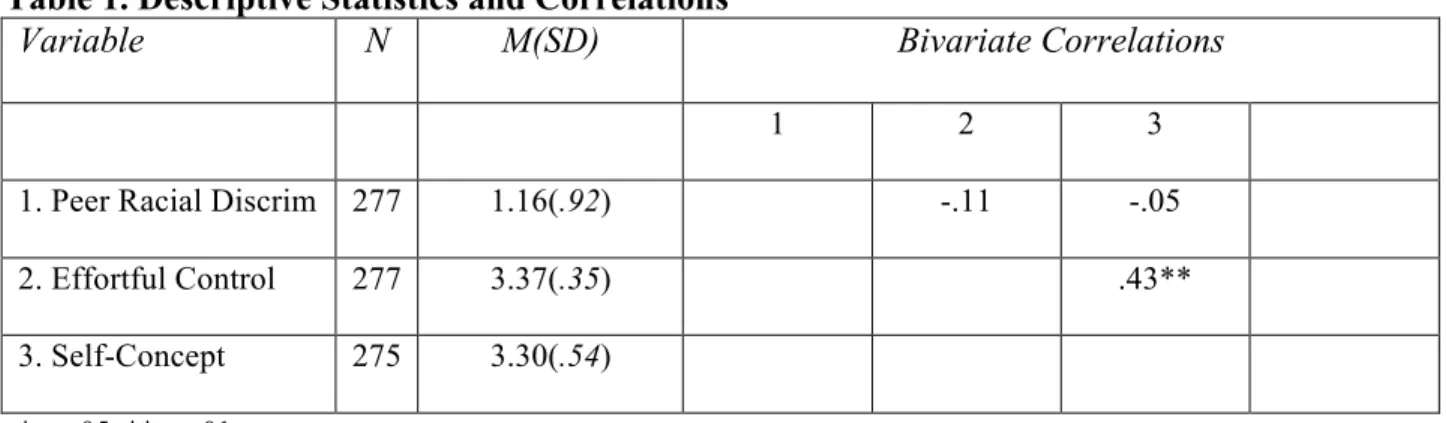
Means, standard deviations, and bivariate correlations for the main study variables are presented in Table 1. Bivariate correlations between measures revealed non-significant negative relations between perceptions of peer racial discrimination and adolescents’ self-reported
academic self-concept. Effortful control was significantly positively correlated with academic self-concept. As two different strategies were used to recruit the present sample (in-person/in-schools and online), it was feasible that elements of these different strategies may have resulted in group differences on key study variables in the present sample. To address this concern, t-tests were conducted to evaluate group differences in academic self-concept, peer racial
discrimination, and effortful control as a function of recruitment strategy. These T-tests did not detect significant group differences as a function of recruitment strategy.
CHAPTER 4. DISCUSSION
The results shed light on the potential impact of individual differences in effortful control for African Americans’ academic outcomes. Contrary to the first hypothesis, the present study finds that perceived peer racial discrimination is not significantly related to academic self-concept in this sample. There are a few potential reasons for this unexpected finding. The participants in the present sample may come from relatively homogenous school systems or classrooms, thereby reducing the availability of their peer-based racial discrimination
The results also indicate that effortful control is directly linked with academic self-concept. As expected, with an increase in adolescents’ self-reported effortful control capacities, academic self-concept consequently improves. This finding is in line with previous research with European American children (e.g., Keogh, 1986; Rothbart & Bates, 1998). Effortful control is linked with academics over time among European American children (e.g. Liew, McTigue, Barrois, & Hughes, 2008). Indeed, higher levels of effortful control beginning in first grade predict academic self-beliefs as well as achievement. While the majority of empirical work has been conducted with children, the present study was novel in confirming that effortful control – even at a more advanced developmental age – appears to be an important factor for some African American adolescents’ academic self-concepts. Therefore, the results of the present study stress the importance of considering the role of normative developmental capacities – such as effortful control – on the academic trajectories of African American adolescents. While African American adolescents face unique risk factors such as peer racial discrimination, they also are a diverse group with many individual differences, one of which may be their continuing development of effortful control capacities.
sample size did not allow us to make these comparisons. However, it may be that informative instances of the most protection and the most risk were not adequately captured by the present study. Future empirical investigations should consider what might be happening at the extreme tails of the effortful control spectrum. Those individuals extremely high and extremely low on effortful control may be most in need of tailored interventions.
The present study has several limitations that need to be considered. First, as the study is cross-sectional, causality cannot be inferred from the results presented. It may be that academic self-concept contributes to perceptions of peer racial discrimination rather than the reverse relation. Further research should seek to examine this relation with a longitudinal design.
Second, measurement of peer discrimination and effortful control may limit the results that were observed. Measurement remains a critical area in discrimination research and scholars should continue to explore the types, content and sources of discrimination African American
Table 1. Descriptive Statistics and Correlations
Variable N M(SD) Bivariate Correlations
1 2 3
1. Peer Racial Discrim 277 1.16(.92) -.11 -.05
2. Effortful Control 277 3.37(.35) .43**
3. Self-Concept 275 3.30(.54)
Table 2. Moderation Analysis For Peer Discrimination on Academic Self-Concept
Variable β Se R2
Step 1 Gender Household Parent’s Education -.01 .10 .13
.52 .03
Step 2 Gender Household Parent’s Education Peer Discrimination -.01 .10 .13 -.01
.52 .03
Step 3 Gender Household Parent’s Education Peer Discrimination Effortful Control -.01 .07 .14 .03 .42**
.47 .20**
Step 4 Gender Household Parent’s Education Peer Discrimination Effortful Control Interaction Term -.01 .07 .15 .02 .41 .08
.47 .22
Perceived Peer Racial Discrimination
Temperament: Effortful Control
Academic Self-Concept Figure 1. Moderation Model for the Relation between Perceived Peer Racial
REFERENCES
Aronson, J., Fried, C.B., Good, C. (2002). Reducing the effects of stereotype threat on African American college students by shaping theories of intelligence. Journal of Experimental Social Psychology, 38(2), 113-125.
Barbarin, O.A., & Soler, R.E. (1993). Behavioral, emotional, and academic adjustment in a national probability sample of African American children: Effects of age, gender, and family structure. Journal of Black Psychology, 19(4), 423-446.
Baron, R.M., & Kenny, D.A. (1986). The moderator-mediator variable distinction in social psychological research: Conceptual, strategic, and statistical considerations. Journal of Personality and Social Psychology, 51(6), 1173-82.
Caldwell Howard, T. (2003). “A tug of war for our minds:” African American high school students’ perceptions of their academic identities and college aspirations. The High School Journal, 87(1), 4-17.
Card, D., & Rothstein, J. (2005). Racial segregation and the black-white test score gap. Journal of Public Economics, 91(11-12), 2158-2184.
Caspaldi, D.M., & Rothbart, M.K. (1992). Development and validation of an early adolescent temperament measure. Journal of Early Adolescence, 12(2), 153-173.
Chavous, T. M., Rivas-Drake, D., Smalls, C., Griffin, T., & Cogburn, C. (2008). Gender matters, too: The influences of school racial discrimination and racial identity on academic
engagement outcomes among African American adolescents. Developmental Psychology, 44, 637–654.
Clark, R., Anderson, N.B., Clark, V.R., Williams, D.R. (1999). Racism as a stressor for African Americans: a biopsychosocial model. American Psychology, 54, 805-816.
Cogburn, C.D., Chavous, T.M., & Griffin, T.M. (2011). School-based racial and gender discrimination among African American adolescents: Exploring gender variation in frequency and implications for adjustment. Race and Social Problems, 3(1), 25-37. Connell, J.P., Halpem-Felsher, B.L., Clifford, E., Circhlow, W., & Usinger, P. (1995). Hanging
in there: Behavioral, psychological, and contextual factors affecting whether African American adolescents stay in high school. Journal of Adolescent Research, 10(1), 41-63. Fisher, C. B., Wallace, S. A., & Fenton, R. E. (2000). Discrimination distress during
adolescence. Journal of Youth and Adolescence, 29, 679–695.
Garcia Coll, C., Lamberty, G., Jenkins, R., McAdoo, H. P., Crnic, K., Wasik, B. H., et al. (1996). An integrative model for the study of developmental competencies in minority children.
Child Development, 67, 1891–1914.
Gibbons, F.X., Gerrard, M., Cleveland, M.J., Willis, T., & Brody, G. (2004). Perceived
discrimination and substance use in African American parents and their children: A panel study. Journal of Personality and Social Psychology, 86, 517-529.
Gottfried, A.E. (1985). Academic intrinsic motivation in elementary and junior high school students. Journal of Educational Psychology, 77, 631-645.
Greene, M.L., Way, N. & Pahl, K. (2006). Trajectories of perceived adult and peer
discrimination among Black, Latino and Asian American adolescents: Patterns and psychological correlates. Developmental Psychology, 42, 218-238.
Guthrie, B.J., Young, A.M., Williams, D.R., Boyd, C.J., & Kintner, E.K. (2002). African American girls’ smoking habits and day-to-day experiences with racial discrimination.
Nursing Research, 51, 183-190.
Gutman, L.M., & Midgley, C. (2000). The role of protective factors in supporting the academic achievement of poor African American students during the middle school transition.
Journal of Youth and Adolescence, 29(2), 223-249.
Gutman, L.M., Sameroff, A.J., & Eccles, J.S. (2002). The academic achievement of African American students during early adolescence: An examination of multiple risk, promotive, and protective factors. American Journal of Community Psychology, 30(3), 367-399. Guyll, M., Matthews, K.A., & Bromberger, J.T. (2001). Discrimination and unfair treatment:
relationship to cardiovascular reactivity among African American and European American women. Health and Psychology, 20, 315–325.
Harter, S. (1982). The perceived competence scale for children. Child Development, 53(1), 87-97.
Hill, L.K., Kobayashi, I., & Hughes, J.W. (2007). Perceived racism and ambulatory blood pressure in African American college students. Journal of Black Psychology, 33, 404– 421.
Hughes, D., Rodriguez, J., Smith, E.P., Johnson, D. J., Stevenson, H.C. & Spicer, P. (2006). Parents’ ethnic-racial socialization practices: A review of research and directions for future study. Developmental Psychology, 42, 747 – 770.
Keogh, B.K. (1986). Temperament and schooling: Meaning of “goodness of fit”? New
Directions for Child and Adolescent Development, 31, 89-108.
Liew, J., McTigue, E.M., Barrois, L., & Hughes, J.N. (2008). Adaptive and effortful control and academic self-efficacy beliefs on achievement: A longitudinal study of 1st through 3rd graders. Early Childhood Research Quarterly, 23(4), 515-526.
Luthar, S.S., & Cicchetti, D. (2000). The construct of resilience: Implications for interventions and social policies. Development and psychopathology, 12(4), 857-885.
Martin, R.P. (1989). Activity level, distractability, and persistence: Critical characteristics in early schooling. In G.A. Kohnstamm, J.E. Bates, & M.K. Rothbart (Eds.), Temperament in childhood (pp.451-461). New York: Wiley.
Midgley, C., Maehr, M.L., Hruda, L.Z., Anderman, E. Anderman, L., Freeman, K.E…Urdan, T. (2000). Manual for the patterns of adaptive learning scales (PALS). University of Michigan.
Neblett, E.W., & Carter, S.E. (2012). The protective role of racial identity and Afrocentric worldview in the association between racial discrimination and blood pressure.
Psychosomatic Medicine, 74(5), 509-516.
Noguera, P.A. (2003). The trouble with Black boys: The role and influence of environmental and cultural factors on the academic performance of African American males. Urban
Education, 38, 431-459.
Nunn, G.D., & Miller, M. (2000). At-risk adolescents perceptions of learning temperaments: Implications for educational intervention. Journal of Instructional Psychology, 27(4), 266-272.
Oyserman, D., Gant, L., & Ager, J. (1995). A socially contextualized model of African American identity: Possible selves and school persistence. Journal of Personality and Social
Psychology, 69(9), 121-1232.
Oyserman, D., & Harrison, K. (1998). Implications of cultural context: African-American identity and possible selves. In J.K. Swim & C. Stangor (Eds.), Prejudice, the target’s perspective. Academic Press: San Diego, CA. 281-300.
Patterson, C.J., Kupersmidt, J.B., & Vaden, N.A. (1990). Income level, gender, ethnicity, and household composition as predictors of children’s school-based competence. Child Development, 61(2), 485-494.
Preacher, K.J., Curran, P.J., & Bauer, D.J. (2006). Computational tools for probing interaction effects in multiple linear regression, multilevel modeling, and latent curve analysis.
Prelow, H.M., Danoff-Burg, S., Swenson, R.R., & Pulgiano, D. (2004). The impact of ecological risk and perceived discrimination on the psychological adjustment of African Americana and European American youth. Journal of Community Psychology, 32, 375-389.
Pullis, M. (1985). Students’ temperament characteristics and their impact on decisions by resource and mainstream teachers. Learning Disability Quarterly, 8, 109-122. Querido, J.G., Warner, T.D., & Eyberg, S.M. (2002). Parenting styles and child behavior in
African American families of preschool children. Journal of Clinical Child and Adolescent Psychology, 32(2), 272-277.
Rimm-Kaufman, S.E., Early, D.M., Cox, M.J., Saluja, G., Pianta, R.C., Bradley, R.H., & Payne, C. (2002). Early behavioral attributes and teachers’ sensitivity as predictors of competent behavior in the kindergarten classroom. Journal of Applied Developmental Psychology, 23(4), 451-470.
Romero, A.J., & Roberts, R.E. (1998). The impact of multiple dimensions of ethnic identity on discrimination and adolescents’ self-esteem. Journal of Applied Social Psychology, 33(11), 2288-2305.
Rosenbloom, S.R. & Way, N. (2004). Experiences of discrimination among African American, Asian American, and Latino adolescents in an urban high school. Youth & Society, 35(4), 420-451.
Rothbart, M.K., Posner, M.I., & Kieras, J. (2006). Temperament, attention, and the development of self-regulation. In K. McCartney & D. Phillips (Eds.),Blackwell handbook of early childhood development (pp. 338–357). Malden, MA: Blackwell.
Rothbart, M.K., & Bates, J.E. (1998). Temperament. In W. Damon (Series Ed.) & N. Eisenberg (Vol. Ed.), Handbook of child psychology: Vol. 3. Social, emotional, and personality development (5th ed., pp. 105-176). New York: Wiley.
Rothbart, M.K., & Jones, L.B. (1998). Temperament, self-regulation, and education. School Psychology Review, 27(4), 479-491.
Sameroff, A. J., Bartko, W. T., Baldwin, A., Baldwin, C., & Seifer, R. (1998). Family and social influences on the development of child competence. In M.Lewis & C. Feiring (Eds.),
Families, risk, and competence. Mahwah, NJ: Lawrence Erlbaum Associates. Saunders, J., Davis, L., Williams, T., Williams, J.H. (2004). Gender differences in
self-perceptions and academic outcomes: A study of African American high school students.
Seaton, E.K., Neblett, E., Upton, R.D., Powell Hammond, W. & Sellers, R.M. (2011). The moderating capacity of racial identity between perceived discrimination and
psychological well-being over time among African American youth. Child Development, 82, 1850 - 1867.
Seaton, E.K., Yip, T., & Sellers, R.M. (2009). A longitudinal examination of racial identity and racial discrimination among African American adolescents. Child Development, 80(2), 406-417.
Sellers, R. M., Copeland-Linder, N., Martin, P. P., & Lewis, R. L. (2006). Racial identity matters: The relationship between racial discrimination and psychological functioning in African American adolescents. Journal of Research on Adolescence, 16(2), 187–216. Spencer, M.B., Dupree, D., & Hartmann, T. (1997). Phenomenological Variant of Ecological
Systems Theory (PVEST): A self-organization perspective in context. Development in Psychopathology, 9, 817-833.
Swanson, D.P., Spencer, M.B., & Peterson, A. (1998). Identity formation in adolescence. In K. Borman & B.Schneider (Eds.), Ninety-seventh yearbook of the National Society for the Study of Education: Pt. 1. The adolescent years: Social influences and educational challenges (pp. 18-41). Chicago: University of Chicago Press.
Talwar, R., Schwab, J., & Lerner, R.M. (1989). Early adolescent temperament and academic competence: Tests of “direct effects” and developmental contextual models. Journal of Early Adolescence, 9(3), 291-309.
Thomas, O. N., Caldwell, C. H., Faison, N., & Jackson, J. S. (2009). Promoting academic
achievement: The role of racial identity in buffering perceptions of teacher discrimination on academic achievement among African American and Caribbean Black Adolescents.
Journal of Educational Psychology, 101, 420-431.
Ward, J.V. (1990). Racial identity formation and transformation. In C. Gilligan, N.D. Lyons, & T.J. Hammer (Eds.), Making connections: The relational worlds and adolescent girls at Emma Willard School. Harvard University Press: Cambridge, MA.
Way, N. (1998). Everyday Courage. The Lives and Stories of Urban Teenagers. New York: New York University Press.
Wentzel, K. R. (1997). Student motivation in middle school: The role of perceived pedagogical caring. Journal of Educational Psychology, 89, 411–419.
Williams, D. R., Neighbors, H. W., & Jackson, J. S. (2003). Ethnic–racial discrimination and health: Findings from community studies. American Journal of Public Health, 93, 200– 208.
Witherspoon, K., Speight, S., & Thomas, A. (1997). Racial identity attitudes, school
achievement, and academic self-efficacy among African American high school students. Journal of Black Psychology, 23(4), 344-357.