FIRE ECOLOGY AND FIRE MANAGEMENT IN THE SOUTHERN APPALACHIANS: RATIONALE FOR AND EFFECTS OF PRESCRIBED FIRE
Naomi Beth Schwartz
A thesis submitted to the faculty of the University of North Carolina at Chapel Hill in partial fulfillment of the requirements for the degree of Master of Science in the
Curriculum for the Environment and Ecology.
Chapel Hill 2012
Abstract
NAOMI BETH SCHWARTZ: FIRE ECOLOGY AND FIRE MANAGEMENT IN THE SOUTHERN APPALACHIANS: RATIONALE FOR AND EFFECTS OF
PRESCRIBED FIRE
(Under the direction of Aaron Moody)
Fire suppression in the Southern Appalachians has led to changes in forests dominated by yellow pine (Pinus subgenus pinus) and oak (Quercus) species. Recently, management agencies have begun to prescribe fire with the aim of restoring
pre-suppression conditions. Here, I examine the use of prescribed fire in the Southern
Appalachians from two perspectives. First, I review the values and goals that underlie fire management, how they apply in the Southern Appalachians, and what the implications of these are for fire management planning. Second, I use long-term monitoring data to examine how prescribed fire affects forest structure and composition in the Great Smoky Mountains National Park and how these effects vary with environment and fire severity. I find that prescribed fire creates conditions conducive for pine reproduction and is
Acknowledgements
Many people have helped and supported me during the completion of this thesis, and I gratefully acknowledge and thank them here.
I thank my committee members, Aaron Moody, Peter White, and Dean Urban for their guidance, support, advice and endless patience as my master’s thesis evolved through its many iterations. I could not have done this thesis without the National Park Service’s Fire Effects Monitoring program in the Great Smoky Mountains National Park. They shared more than 15 years worth of data with me; I am very grateful to all those who established the program and helped to collect data over the years. In particular I thank Rob Klein for answering my endless questions and facilitating my joining in on monitoring fieldwork and Wylie Paxton, Bob Dellinger, Huma Alvarado, and Matt Wood for welcoming me onto their field crew and being excellent teachers of new skills, lots of plants, and about fire ecology in the Smokies.
I thank the members of the Moody lab, in particular Ian Breckheimer, Amanda Chunco, Christine Urbanowicz, and Anne Trainor for their camaraderie and friendship. The Plant Ecology lab has been a wonderful “second lab” and I’m grateful to them for taking me in and sharing their space with me when I found myself office-less. The Curriculum for Ecology and the Environment at UNC funded me for two years while I completed my master’s thesis; I am grateful for the opportunity to have done so.
Table of Contents
Chapter 1: Introduction ... 1
References ... 4
Chapter 2: Rationale for fire in conservation management: A case study of the Southern Appalachians ... 5
Introduction ... 5
Fire and pines in the Southern Appalachians ... 7
Goals of fire management in the Southern Appalachians ... 10
Practical implications ... 22
Figures and Tables ... 27
References ... 28
Chapter 3: Effects of prescribed fire on forest structure and composition in the Great Smoky Mountains National Park ... 34
Introduction ... 34
Methods ... 38
Results ... 45
Discussion ... 52
Figures and Tables ... 58
References ... 69
Chapter 4: Conclusion ... 74
List of Tables
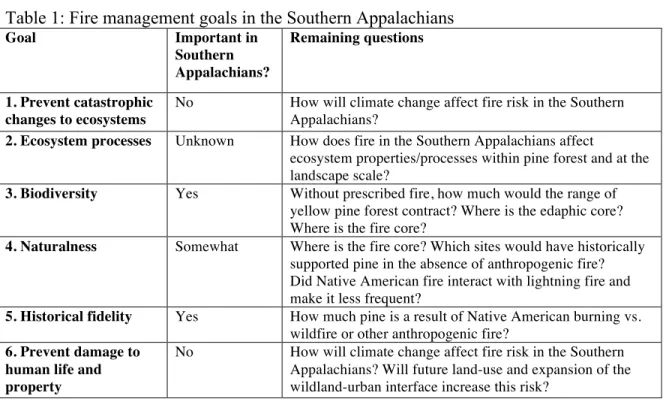
Table 1: Fire management goals in the Southern Appalachians………27
Table 2: Environmental variables used in analyses………...65
Table 3: Results from 2-dimensional NMS ordination of raw density data...66
Table 4: Results from 2-dimensional NMS ordination of relativized density data...66
Table 5: Spearman’s correlation between environment variables and plots’ dissimilarity to itself calculated from raw density data for given monitoring statuses...67
Table 6: Spearman’s correlation between environment variables and plots’ dissimilarity to itself calculated from relativized density data for given monitoring statuses………....68
List of Figures
Figure 1: The fire-pine hypothesis in the Southern Appalachians……….27
Figure 2: Prescribed fires in the Great Smoky Mountains National Park..………58
Figure 3: Results from NMS ordination of abundance data...59
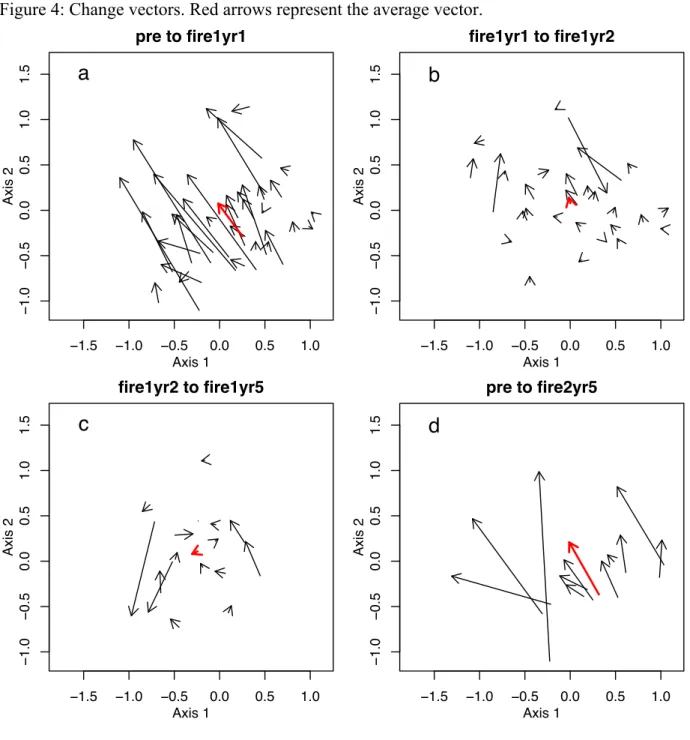
Figure 4: Change vectors...60
Figure 5: Results from ordinations with relative abundance data...61
Figure 6: Example plot 1 dynamics ...62
Figure 7: Example plot 2 dynamics...63
Figure 8: Example plot 3 dynamics...64
List of Abbreviations DBH: diameter at breast height
CHAPTER 1:
INTRODUCTION
Prior to European settlement, Native American use of fire was widespread throughout North America, and left a lasting imprint on the North American landscape (Pyne 1982). Changes to these fire regimes due to land-use change and active fire suppression, among other drivers, have resulted in changes to ecosystem structure, composition, and diversity, and today, many managers aim to reverse or mitigate these changes through the use of prescribed fire and other fire management techniques. This is true in the Southern Appalachians, where Native Americans used fire for at least the past 4000 years (Delcourt and Delcourt 1997, 1998, Brose et al. 2001, Fesenmyer and
Christensen 2010). These fires created open, park-like conditions favorable for
establishment and regeneration of yellow pine (Pinus subgenus pinus) and oak (Quercus) species (Harrod et al. 1998). Today, forests dominated by these fire-adapted species remain on the landscape as a legacy of past Native American burning.
Recently, management agencies in the Southern Appalachians such as the National Park Service and the US Forest Service have begun to prescribe fire with the aim of restoring pre-suppression conditions. These efforts are relatively recent, with the first prescribed fire in the Great Smoky Mountains National Park occurring in 1997, and their long-term effects have yet to be established. Resources for prescribed fire are limited, and there is likely not the capacity to restore fire to the Southern Appalachians at the frequency and extent that it would have been present under Native American fire regimes. Therefore, managers must prioritize areas in which to focus prescribed fire efforts. These decisions are motivated by the values and goals underlying conservation and management efforts and should also be based in the scientific understanding of the role of fire in the Southern Appalachians and of the effects of prescribed fire.
In this thesis, I address the use of prescribed fire in the Southern Appalachians from two perspectives. In the first chapter, I examine how the various values and goals that can underlie fire management apply to the Southern Appalachians, and what the implications of these goals are for fire management policies and planning. Different sets of goals can have different implications for management, and in designing and
References
Brose, P., T. Schuler, D. Van Lear, and J. Berst. 2001. Bringing fire back: the changing regimes of the Appalachian mixed-oak forests. Journal of Forestry 99:30–35. Delcourt, H. R., and P. A. Delcourt. 1997. Pre Columbian Native American Use of Fire
on Southern Appalachian Landscapes. Conservation Biology 11:1010–1014. Delcourt, P. A., and H. R. Delcourt. 1998. The Influence of Prehistoric Human-Set Fires
on Oak-Chestnut Forests in the Southern Appalachians. Castanea 63:337–345. Fesenmyer, K. A., and N. L. Christensen. 2010. Reconstructing Holocene fire history in a
southern Appalachian forest using soil charcoal. Ecology 91:662–670.
Harmon, M. E. 1984. Survival of trees after low-intensity surface fires in Great Smoky Mountains National Park. Ecology 65:796–802.
Harrod, J. C., and R. D. White. 1999. Age structure and radial growth in xeric pine-oak forests in western Great Smoky Mountains National Park. Journal of the Torrey Botanical Society 126:139–146.
Harrod, J., P. S. White, and M. E. Harmon. 1998. Changes in xeric forests in western Great Smoky Mountains National Park, 1936-1995. Castanea 63:346–360. Pyne, S. J. 1982. Fire in America: A Cultural History of Wildland and Rural Fire.
University of Washington Press, Seattle, WA.
CHAPTER 2:
RATIONALE FOR FIRE IN CONSERVATION MANAGEMENT: A
CASE STUDY OF THE SOUTHERN APPALACHIANS
Introduction
Fire is an important driver of ecosystem structure, composition, and function in many ecosystems worldwide (Bond and Keeley 2005, Bowman et al. 2009, Pausas and Keeley 2009). However, fire regimes and the functional role of fire vary from place to place (Krawchuk et al. 2009), and even within a single ecosystem, the role of fire is often complex and variable. Fire management planning is likewise not straightforward: plans can vary significantly depending on the goals articulated by managers. Articulating these goals and discussing their basis in science and policy is critical. In this paper, I briefly review six alternative, though not mutually exclusive, bases for fire management and then turn my attention to an interesting case: fire in the Southern Appalachians.
species (e.g. the red cockaded woodpecker; James et al. 1997), promoting regeneration for species adapted to fire (Angelstam 2009), or promoting landscape heterogeneity (Brockett et al. 2001). Fourth, fire management is used to restore “natural” processes and ecosystems. Fire has burned vegetation since shortly after the appearance of the first terrestrial plants (Scott and Glasspool 2006) and has played an important role in shaping the characteristics and distributions of global vegetation (Bond and Keeley 2005).
Therefore fire is necessary to maintain some ecosystems in their natural states, and as fire regimes change with human influence, deliberate fire management is necessary. Fifth, humans have used fire for a variety of purposes for millennia with widespread ecological impacts (Bowman et al. 2011), and fire may be used to maintain historic anthropogenic conditions. Finally, despite the paradigm shift towards using fire to maintain natural ecosystems, the major goal of fire management is still, in many places, to minimize damage to human life and property (Haines et al. 1998, Fernandes and Botelho 2003).
Fire is important for the establishment and maintenance of forests dominated by yellow pines (Pinus subgenus diploxylon) in the Southern Appalachians. These forests have changed as a result of fire suppression over approximately the last 70-80 years, and yellow pines are in decline (Vose et al. 1999). In some parts of the Southern
(including sites both currently and historically dominated by pine) or on sites presumed to be appropriate for pine in the Southern Appalachians, and what the implications of each is for management planning.
Fire and pines in the Southern Appalachians
Pine and mixed pine-oak forests in the Southern Appalachians are found on xeric exposed slopes and ridgetops at mid-elevations, and are dominated by the yellow pine species pitch pine (Pinus rigida), shortleaf pine (Pinus echinata), Virginia pine (Pinus virginiana), and the Appalachian endemic Table Mountain pine (Pinus pungens), as well as oaks such as scarlet oak (Quercus coccinea) and chestnut oak (Quercus montana) (Whittaker 1956, Jenkins et al. 2011). Fire promotes pine and oak regeneration in these forests by killing shade tolerant, fire sensitive species such as red maple (Acer rubrum), black gum (Nyssa sylvatica), Eastern hemlock (Tsuga canadensis), and white pine (Pinus strobus) and by creating high light and low litter conditions conducive to germination and establishment of yellow pines (Barden and Woods 1976, Harrod et al. 2000). Yellow pines display several adaptations to fire: they have relatively thick bark, are shade
intolerant, and regenerate only when litter and duff are reduced (Harmon 1984, Jenkins et al. 2011). In addition, Pinus pungens is partially serotinous, and will release seeds after fire (Zobel 1969).
following another disturbance such as a southern pine beetle outbreak or ice storm, that promoted episodes of pine recruitment (figure 1; White 1987, Lafon and Kutac 2003, Brose and Waldrop 2006, Aldrich et al. 2010). Lightning fire in the region is too infrequent to account for the observed pre-suppression fire frequency, unless fire sizes were much larger in the past (Barden and Woods 1976, Harmon 1982, Lafon and Grissino-Mayer 2007). Fire appears in the Southern Appalachian charcoal record as far back as 10,000 years ago, and it has regularly occurred since about 4000 years ago coinciding with the arrival of the Woodland tradition Native Americans in the region (Delcourt and Delcourt 1997, Fesenmyer and Christensen 2010). Therefore,
anthropogenic fire likely played an important role in creating and maintaining pine forests
For about the past 75 years successful fire suppression in the Southern
disturbances are not followed by fire and episodes of pine recruitment as they would have been in the past (Brose and Waldrop 2006). As a result these disturbances now accelerate succession to hardwood forest types instead of playing a role in maintaining them (Figure 1).
such as very severe fires, stand thinning, or herbicide treatment may be required to restore the ecosystem to its pre-suppression state.
Because there is ambiguity about the natural or historical role of fire in the
Southern Appalachians and restoration pathways are not clear-cut, fire management must be clear about its goals. Additionally, it is important to acknowledge what is known, what is unknown, and what will unlikely ever be known for certain about fire in the Southern Appalachians; and what the implications of this knowledge, or lack there of, are for management decisions. Below, I review the previously described goals of fire
management as they apply to the Southern Appalachians, in an attempt to highlight the most important considerations for fire management in the region and how our existing knowledge and unanswered questions inform decisions about where, why, and how to manage.
Goals of fire management in the Southern Appalachians
abundant and vertically continuous fuels and raises the likelihood of large,
stand-replacing crown fires (Parsons and DeBenedetti 1979). These fires create risks for human life and property, and can result in major changes to ecosystem structure and function. In the short term, stand-replacing fires in Pinus ponderosa ecosystems may amplify erosion and flooding (Robichaud 2005), and in the long term they can leave treeless scars on the landscape which can persist as grasslands or shrublands for decades to centuries (Allen et al. 2002). Thus, a major goal of forest management in the Southwestern US has been to use prescribed fire and mechanical treatments to restore conditions that are within the “natural range of variability” (Landres et al. 1999, Allen et al. 2002).
In the Southern Appalachians, managing fire to reduce fuels and prevent catastrophic fire is not generally considered a major goal of fire management for a number of reasons. First, while fuels are abundant in the Southern Appalachians,
humidity and fuel moisture are rarely low enough to allow for fire and when fire weather does occur, it is rarely accompanied by lightning (Barden and Woods 1976). Second, topography and vegetation in the Southern Appalachians are heterogeneous and exert strong controls on spread of fire, especially in moister regions like the Great Smoky Mountains (Flatley et al. 2011). Fire-prone vegetation is topographically restricted to south and southwest facing slopes and ridgetops (Whittaker 1956, Jenkins 2007), meaning that there is little continuity of flammable fuels across the landscape and therefore low probability of intense fire burning across large areas and producing major hazards to people or catastrophic changes to the landscape. All this means that fire
fire suppression is generally successful at limiting the extent of wildfire (Vose et al. 1995).
Last, although fire suppression in Southern Appalachian yellow pine forests does result in changes to forest structure and species composition, there is evidence that these changes in forest structure actually decrease the risk of wildfire. With fire suppression, open, fire maintained areas are converted to shady, closed canopy forests, and conditions improve for shade-tolerant, fire-sensitive, mesophytic plants. As these species increase in abundance and forest stands get more dense, microenvironmental conditions become more shady and mesic, preventing establishment of shade-intolerant, fire-adapted species, increasing average fuel moisture conditions, and decreasing the likelihood of fire in a process dubbed “mesophication” (Figure 1; Nowacki and Abrams 2008). So, in the Southern Appalachians, prescribed fire or fuel treatments might actually create conditions more favorable to wildfire than would occur if fire suppression and accompanying
mesophication continued.
In the Southern Appalachians, forests stay forests. Discussions around slowing or reversing the effects of fire suppression in the Southern Appalachians lack the sense of urgency present in discourse about southwestern forests, which are more prone
catastrophic fire and accompanying sudden and drastic changes to vegetation structure. As dominant yellow pines and oaks die off, other trees replace them. With the exception of some logging-related fires in the early 20th
pine-oak dominance may represent a shift to an alternate stable state. Restoring fire dependent vegetation once a community has become mesophytic may be prohibitively difficult and expensive (Figure 1; Abrams 2005, Nowacki and Abrams 2008). So, even though prevention of catastrophic fire is not a major goal in the Southern Appalachians, the changes that are occurring may prove to be catastrophic in the sense of being difficult or impossible to reverse, if not ecologically dramatic.
Finally, while there is not currently a major risk of dangerous of catastrophic wildfire in the Southern Appalachians, in future years this could change. Anthropogenic climate change is expected to increase fire risk in many parts of the world, including in the Southeastern US (Scholze et al. 2006). To my knowledge there have not been any detailed predictions about the effects of climate change on fire regimes in the Southern Appalachians, but changes in the amount or timing of precipitation and increases in temperature could affect the potential for wildfire. Further research into the potential effects of climate change on wildfire risk in the Southern Appalachians will be necessary to better inform long-term fire management planning.
Goal 2: Maintain ecosystem function
Fire affects physical, chemical, and biological properties of soils, hydrology, and water quality along with carbon and nutrient cycling and storage (Boerner 1982, Richter et al. 1982, Neary et al. 2005, Bowman et al. 2009). Fire management may thus be motivated by considerations related to soil conservation, nutrient cycling, carbon storage, productivity, or hydrology. To my knowledge, there have not been any studies
carbon, and nitrogen cycling, and have found they are limited. In a study of the
biogeochemical effects of a prescribed fire in the Nantahala National Forest, Vose et al. (1999) found no significant changes in carbon pools or soil and stream chemistry, and found significant nitrogen loss only in small wood and litter pools in areas that
experienced the most intense fires. Similarly, Hubbard et al. (2004) found minimal effects of prescribed burning on ecosystem processes in the Consauga River watershed. Groeschl et al. (1993) found that wildfire significantly reduced nutrient contents in the forest floor and surface soil, although low severity fire had modest impacts relative to high severity fire. These studies, along with the fact that fire-prone vegetation covers less than 5 percent of the Southern Appalachian landscape (Vose et al. 1995), suggest that the effects of fire on ecosystem processes in the Southern Appalachians are likely small. Therefore, managing fire to maintain, restore, or manipulate ecosystem function in the Southern Appalachians is not currently a major concern. Still, more research as to the stand and landscape level effects of prescribed fire and fire suppression on ecosystem processes in the Southern Appalachians is needed.
Goal 3: Conserve biodiversity
Fire management decisions have implications for biodiversity at local, landscape, and regional scales, and managers may devise fire management plans to conserve
2006). Fire also affects landscape diversity and heterogeneity and may help maintain a patch mosaic of successional stages or community types across a landscape (White 1979, Baker 1992). Fire management is therefore important for biodiversity conservation from several angles: to promote regeneration and maintenance of species that are more fit under a given fire regime, to maintain species rich communities, and/or to promote heterogeneity in community types or successional stages across a landscape.
Within fire dependent stands in the Southern Appalachians, fire suppression can lead to increases in tree species richness in the short term, as new hardwood species are able to establish themselves on sites where they once would have been excluded (Harrod et al. 1998). Over time, however, richness is expected to decline as fire dependent species are eventually excluded (Nowacki and Abrams 2008). Herbaceous cover and understory species richness have been found to increase immediately after fire, especially hotter, more severe fires (Groeschl et al. 1992, Harrod et al. 2000, Reilly et al. 2006, Wimberly and Reilly 2007). Some understory herbaceous species, such as Schizachyrium scoparium and Solidago odora, flower and fruit more in recently burned plots than in unburned plots (Harrod 1999).
years without fire (Barden 1979), and populations of Table Mountain pine on shallow, rocky soils maintain themselves in the absence of fire (Barden 1977, 1988, 2000, Newell and Peet 1998).
Here, I refer to these xeric, infertile sites where pine will persist in the absence of fire as their “edaphic core”. Yellow pine species will remain at their edaphic core in the Southern Appalachians regardless of management decisions about fire. If the goal of fire management were just to prevent regional extinctions, prescribed fire would not be absolutely necessary. There has been little research on the extent or distribution of this edaphic core, but these sites are rare relative to the entire range of conditions occupied by yellow pines in the Southern Appalachians (Waldrop and Brose 1999). Therefore,
continued fire suppression and succession from pine to hardwoods on less xeric (non-core) pine-dominated sites would represent a loss of landscape diversity. Fire is necessary to maintain yellow pines at their current extent, and the distributions of these species would contract to only the driest and most infertile sites in the absence of continued fire.
and other species commonly found in pine-oak forests or loss of the capacity to adapt to climate or other environmental change.
Goal 4: Conserve ‘natural’ ecosystems
Fire occurs without anthropogenic ignitions in the Southern Appalachians: it has been present in the region for at least 10,000 years, and lightning fires, although currently rare, do occur (Cohen et al. 2007, Lafon and Grissino-Mayer 2007, Fesenmyer and Christensen 2010). Therefore, the use of fire to conserve “natural” ecosystems is applicable in the Southern Appalachians. However, this is complicated by two factors. First, in the Southern Appalachians, as elsewhere, ‘natural’ can mean different things to different people and its meaning in a particular context is often not specified. Second, even within a particular definition of natural, we lack the necessary information to know what “natural” should look like in the Southern Appalachians. Here, I consider natural to mean “free from human influence.” This definition can manifest itself in a number of forms, summarized by Aplet and Cole (2010) as: 1) free from intentional human manipulation and intervention; that is, devoid of management actions meant to manipulate ecosystems, and 2) pristine and unaffected by humans, in conditions resembling those found prior to human settlement. Aplet and Cole also present a third definition of natural as true to historic conditions, which I consider as a separate case below.
Adherence to the first definition of natural would require a hands-off approach, in which managers take no actions to manipulate or control ecosystem structure,
prescribe fire. While this would serve the purpose of preserving autonomous nature, our current understanding is that a lightning fire regime would not provide the conditions required for the maintenance of fire-dependent vegetation. The frequency of lightning fires is not enough for the maintenance of pine and oak dominance: Harmon (1982) calculated that lightning fires would have to burn 258 to 1070 times more frequently in his study area, or else be far larger than under the fire suppression regime to account for the observed pre-suppression fire rotation of 10 to 40 years. Similarly, Lafon et al. (2005) calculated a fire rotation period of 6138 years for natural fires based on fire occurrence data from 1970-2003 in the Central Appalachians. Although it seems unlikely that lightning fire could have maintained pine-oak forests, it could have been the case that despite infrequent ignitions, naturally ignited fires in the past were much larger than they are now, or that anthropogenic fire interacted with lightning fire to make it less frequent. Additionally, a truly hands-off approach is, in most contemporary landscapes, impossible. Even if we do not actively suppress fires, we manipulate the size and frequency of
contemporary natural fires. Fragmentation, roads, and other built structures serve as barriers to the spread of fire (Sharitz et al. 1992, Duncan and Schmalzer 2004), decreasing the so-called “fire compartment size,” the area over which fire can spread unimpeded (Frost 2006). A truly hands-off management approach seems impossible, and would result in a loss of landscape diversity, local scale species richness declines, or declines in regional species richness.
Managing to recreate ecosystems or landscapes that resemble pre-human
for at least 4000 (Delcourt and Delcourt 1997, 1998, Fesenmyer and Christensen 2010). There is also a long history of fire-use by European settlers (Jurgelski 2008). As far as we know, none of the fire dependent ecosystems in the Southern Appalachians could be considered pristine and unaffected by humans. Additionally, we lack a clear idea of what pre-human fire regimes and vegetation looked like in the region. There are few natural lakes in the Southern Appalachians, making charcoal and pollen studies difficult. Trees like Pinus rigida and Pinus pungens rarely live to be older than 350 and 250 years, respectively (Burns et al. 1990), precluding dendroecological analysis of pre-human conditions. Due to this dearth of information, perhaps the best approach to restore pre-human conditions would be to let naturally ignited fires burn unsuppressed, refrain from prescribed fire, and suppress anthropogenic fires.
edaphic core that exists for pine forests: places where fire, and thus fire-dependent vegetation would have historically persisted without human intervention, and could persist in the future without the aid of prescribed fire or with minimal prescribed fire. Further research should attempt to identify if such a “fire core” exists, and if so, how extensive it is. Existing information tends to suggest such a fire core, even if present, would not account for the degree of pine forest dominance in the pre-suppression era. Goal 5: Historical fidelity
Fire management may aim to maintain or restore historic conditions in
ecosystems, generally taken to mean “pre-European” or “pre-industrial.” This strategy has historically been important for management of National Parks and other protected areas. The report by Leopold et al. (1963) said: “As a primary goal, we would
recommend that the biotic associations within each park be maintained, or where necessary recreated, as nearly as possible in the condition that prevailed when the area was first visited by the white man. A national park should represent a vignette of primitive America.” This was the thinking behind the first National Park Service policy that formally recognized the ecological importance of fire, allowed managers to let natural fires burn, and permitted the use of prescribed burning.
most fires set by Native Americans were probably low-intensity surface fires (Delcourt and Delcourt 1997, 1998, Brose et al. 2001). However, the overall extent of Native American burning relative to the pre-human, “natural” distribution of fire and the degree to which Native American burning is responsible for pine-oak forests’ current extent are not well understood. While most agree that at least some of these forests were created and maintained by Native American fire, some have originated relatively recently and could be artifacts of fires caused by early European settlers or industrial logging (Williams and Johnson 1990, Williams 1998). This confusion may undermine attempts to recreate a “vignette of primitive America” at the landscape scale, and future research into how much pine forest is a result of Native American burning vs. other sources could help better inform management in National Parks and elsewhere.
Historical fidelity may also refer to industrial (but not necessarily
Southern Appalachians would have resulted in vegetation with similar characteristics to that created by Native American fire.
Practical implications
Of the six fire management goals, the ones that are most relevant in the Southern Appalachians are managing for biodiversity, in particular landscape diversity, for
naturalness, and for historical fidelity (Table 1). Each has different implications for management, but none of them are mutually exclusive and often, application of one requires careful examination and analysis of the others.
Managing for biodiversity first requires the definition of a metric of interest (local or regional species richness, landscape diversity, number of populations of fire-associated species, etc.) and a target level or state for the chosen metric. Here, there is overlap with the goals of naturalness and historical fidelity: defining a target for landscape diversity requires consideration of what pre-human, Native American, or early European
settlement levels of landscape diversity were, and then a decision as to whether
management should aim to recreate those conditions or novel ones. Similarly, in defining targets for numbers of populations for fire-associated species, managers may consider establishing a target in line with past conditions, or may define a target number based on a metapopulations model or a model looking at population viability in the face of climate change.
Adhering to a “hands-off” definition of naturalness would be logistically simple as it would not require any active management—just a passive commitment to “let things burn.” But, as described above, this would result in further loss of fire-dependent
some places, managers may decide this is acceptable, in particular given the limited resources available for fine management in the Southern Appalachians. Under such a scheme there will still be at least some fire, and pine forests would remain on at least the edaphic core and perhaps the “fire core,” under current climate and environmental conditions.
Managing for historical fidelity to pre-European or pre-industrial conditions would require extensive restoration and continued prescribed fire, as these conditions were maintained by widespread anthropogenic fire. This may just involve reintroducing fire to fire suppressed areas according to the hypothesized Native American fire regime of frequent, low severity fires with occasional high severity fires, but could also require some other restoration treatments such as fuel treatments or very high severity fires. There has been some success at regenerating pines and oaks with prescribed fire, but most studies suggest that higher severity prescribed fires are necessary to kill off
encroaching hardwoods and shrubs to allow pines to establish (Elliott et al. 1999, Welch et al. 2000, Jenkins et al. 2011). To my knowledge, there have been no studies that have tracked long-term effects of prescribed fire on pine and oak regeneration or the effects of multiple prescribed fires; this is an area in need of further research to guide restoration and management activities.
prescribed fire in the Southern Appalachians it is unlikely that managers would be able to replicate the frequency and extent of Native American fire across the whole Southern Appalachian landscape, or even at the scale of a single national park or wilderness area. Therefore, managers must prioritize areas within the landscape in which to concentrate prescribed fire and other restoration efforts. This prioritization should not be done arbitrarily and should be based on other fire management goals, such as promoting biodiversity.
treatments beyond prescribed fire due to mesophication will help managers identify sites at which to focus their prescribed fire efforts.
Anthropogenic climate change will likely alter fire regimes and vegetation in the Southern Appalachians. Climate change could affect fire risk in the Southern
Appalachians, though we do not yet know how, and could affect the prevalence and frequency of southern pine beetle outbreaks and other non-fire disturbances or rates of succession. Warming climates and shifts in the location, timing, and amount of precipitation could also result in shifts in species distributions and no-analog
communities (Williams and Jackson 2007). No-analog communities may also have no-analog fire regimes as fuel structure, moisture, and connectivity could be different from conditions that exist today. These changes may require consideration of goals that are not currently applicable to fire management in the Southern Appalachians, such as managing for ecosystem processes or to prevent catastrophe, and will complicate attempts to maintain historical fidelity or naturalness. With widespread climate change, maintaining viable populations of fire-associated species may be the most practical goal for fire
managers: working to conserve particular community types or associations could be futile. Continued monitoring and research, flexibility, and adaptive management will be
necessary to determine whether this is the case. In the meantime, using prescribed fire and promoting landscape heterogeneity may be the best way to hedge against climate change when outcomes are so uncertain.
Figures and Tables
Table 1: Fire management goals in the Southern Appalachians
Goal Important in
Southern Appalachians?
Remaining questions
1. Prevent catastrophic changes to ecosystems
No How will climate change affect fire risk in the Southern Appalachians?
2. Ecosystem processes Unknown How does fire in the Southern Appalachians affect
ecosystem properties/processes within pine forest and at the landscape scale?
3. Biodiversity Yes Without prescribed fire, how much would the range of yellow pine forest contract? Where is the edaphic core? Where is the fire core?
4. Naturalness Somewhat Where is the fire core? Which sites would have historically supported pine in the absence of anthropogenic fire? Did Native American fire interact with lightning fire and make it less frequent?
5. Historical fidelity Yes How much pine is a result of Native American burning vs. wildfire or other anthropogenic fire?
6. Prevent damage to human life and property
No How will climate change affect fire risk in the Southern Appalachians? Will future land-use and expansion of the wildland-urban interface increase this risk?
References
Abrams, M. D. 1992. Fire and the Development of Oak Forests. BioScience 42:346–353. Abrams, M. D. 2005. Prescribing fire in eastern oak forests: is time running out?
Northern Journal of Applied Forestry 22:190–196.
Aldrich, S. R., C. W. Lafon, H. D. Grissino-Mayer, G. G. DeWeese, and J. A. Hoss. 2010. Three centuries of fire in montane pine-oak stands on a temperate forest landscape. Applied Vegetation Science 13:36–46.
Allen, C. D., M. Savage, D. A. Falk, K. F. Suckling, T. W. Swetnam, T. Schulke, P. B. Stacey, P. Morgan, M. Hoffman, and J. T. Klingel. 2002. Ecological restoration of southwestern ponderosa pine ecosystems: a broad perspective. Ecological
applications 12:1418–1433.
Angelstam, P. K. 2009. Maintaining and restoring biodiversity in European boreal forests by developing natural disturbance regimes. Journal of Vegetation Science 9:593– 602.
Aplet, G.H., and Cole, D.N. 2010. The trouble with naturalness: Rethinking park and wilderness goals. Pages 12–29 in Beyond naturalness: rethinking park and wilderness stewardship in an era of rapid change. Island Press, Washington, DC. Baker, W. L. 1992. Effects of settlement and fire suppression on landscape structure.
Ecology 73:1879–1887.
Barden, L. 2000. Population maintenance of Pinus pungens Lam.(Table Mountain pine) after a century without fire. Natural Areas Journal 20:227–233.
Barden, L. S. 1977. Self-Maintaining Populations of Pinus Pungens Lam. in the Southern Appalachian Mountains. Castanea 42:316–323.
Barden, L. S. 1979. Serotiny and Seed Viability of Pinus pungens in the Southern Appalachians. Castanea 44:44–47.
Barden, L. S. 1988. Drought and Survival in a Self-Perpetuating Pinus pungens Population: Equilibrium or Nonequilibrium? American Midland Naturalist 119:253–257.
Barden, L. S., and F. W. Woods. 1976. Effects of fire on pine and pine-hardwood forests in the southern Appalachians. Forest Science 22:399–403.
Boerner, R. E. 1982. Fire and nutrient cycling in temperate ecosystems. BioScience 32:187–192.
Bowman, D. M. J. S., J. Balch, P. Artaxo, W. J. Bond, M. A. Cochrane, C. M. D'Antonio, R. DeFries, F. H. Johnston, J. E. Keeley, and M. A. Krawchuk. 2011. The human dimension of fire regimes on Earth. Journal of Biogeography 38:2223-2236. Bowman, D. M. J. S., J. K. Balch, P. Artaxo, W. J. Bond, J. M. Carlson, M. A. Cochrane,
C. M. DíAntonio, R. S. DeFries, J. C. Doyle, and S. P. Harrison. 2009. Fire in the Earth system. Science 324:481-484.
Brockett, B. H., H. C. Biggs, and B. W. van Wilgen. 2001. A patch mosaic burning system for conservation areas in southern African savannas. Int. J. Wildland Fire 10:169–183.
Brose, P. H., and T. A. Waldrop. 2006. Fire and the origin of Table Mountain pine pitch pine communities in the southern Appalachian Mountains, USA. Canadian Journal of Forest Research 36:710–718.
Brose, P., T. Schuler, D. Van Lear, and J. Berst. 2001. Bringing fire back: the changing regimes of the Appalachian mixed-oak forests. Journal of Forestry 99:30–35. Burns, R. M., B. H. Honkala, and US Forest Service. 1990. Silvics of North America. Cohen, D., B. Dellinger, R. Klein, and B. Buchanan. 2007. Patterns in Lightning-caused
Fires at Great Smoky Mountains National Park. Fire ecology 3:68-82.
Delcourt, H. R., and P. A. Delcourt. 1997. Pre Columbian Native American Use of Fire on Southern Appalachian Landscapes. Conservation Biology 11:1010–1014. Delcourt, P. A., and H. R. Delcourt. 1998. The Influence of Prehistoric Human-Set Fires
on Oak-Chestnut Forests in the Southern Appalachians. Castanea 63:337–345. Duncan, B., and P. Schmalzer. 2004. Anthropogenic influences on potential fire spread in
a pyrogenic ecosystem of Florida, USA. Landscape ecology 19:153–165. Elliott, K. J., Hendrick, R.L., A. E. Major, Vose, J.M., and Swank, W.T. 1999.
Vegetation dynamics after a prescribed fire in the southern Appalachians. Forest Ecology and Management 114:199–213.
Feathers, I. C. 2010. Fire History from Dendrochronological Analyses at Two Sites near Cades Cove, Great Smoky Mountains National Park, USA.
Fernandes, P. M., and H. S. Botelho. 2003. A review of prescribed burning effectiveness in fire hazard reduction. International Journal of Wildland Fire 12:117–128. Fesenmyer, K. A., and N. L. Christensen. 2010. Reconstructing Holocene fire history in a
Flatley, W. T., C. W. Lafon, and H. D. Grissino-Mayer. 2011. Climatic and topographic controls on patterns of fire in the southern and central Appalachian Mountains, USA. Landscape ecology 26:1–15.
Frost, C. 2006. History and future of the longleaf pine ecosystem. Pages 9-48 in S. Jose, E. J. Jokela, and D. L. Miller, editors. The Longleaf Pine Ecosystem. Springer, New York.
Gilliam, F. S., and N. L. Christensen. 1986. Herb-layer response to burning in pine flatwoods of the lower Coastal Plain of South Carolina. Bulletin of the Torrey Botanical Club 113:42–45.
Groeschl, D. A., J. E. Johnson, and D. W. Smith. 1993. Wildfire effects on forest floor and surface soil in a table mountain pine-pitch pine forest. International Journal of Wildland Fire 3:149–154.
Groeschl, D., J. Johnson, and D. Smith. 1992. Early vegetative response to wildfire in a table mountain-pitch pine forest. International Journal of Wildland Fire 2:177– 184.
Haines, T., J. Martinez, and D. Cleaves. 1998. Influences on prescribed burning activity in the United States national forest system. International Forest Fire News 19:43– 46.
Harmon, M. 1982. Fire history of the westernmost portion of Great Smoky Mountains National Park. Bulletin of the Torrey Botanical Club 109:74–79.
Harmon, M. E. 1984. Survival of trees after low-intensity surface fires in Great Smoky Mountains National Park. Ecology 65:796–802.
Harrod, J. 1999. Disturbance history and ecological change in a Southern Appalachian landscape : western Great Smoky Mountains National Park, 1936-1996.
Dissertation, University of North Carolina at Chapel Hill, Chapel Hill, NC. Harrod, J., M. Harmon, and P. White. 2000. Post fire succession and 20th century
reduction in fire frequency on xeric southern Appalachian sites. Journal of Vegetation Science 11:465–472.
Harrod, J., P. S. White, and M. E. Harmon. 1998. Changes in xeric forests in western Great Smoky Mountains National Park, 1936-1995. Castanea 63:346–360. Hubbard, R. M., J. M. Vose, B. D. Clinton, K. J. Elliott, and J. D. Knoepp. 2004. Stand
James, F. C., C. A. Hess, and D. Kufrin. 1997. Species-centered environmental analysis: Indirect effects of fire history on red-cockaded woodpeckers. Ecological
Applications 7:118–129.
Jenkins, M. A. 2007. Vegetation communities of Great Smoky Mountains National Park. Southeastern Naturalist 6:35–56.
Jenkins, M. A., R. N. Klein, and V. L. McDaniel. 2011. Yellow pine regeneration as a function of fire severity and post-burn stand structure in the southern Appalachian Mountains. Forest Ecology and Management 262:681–691.
Jurgelski, W. 2008. Burning season, burning bans: fire in the southern Appalachian Mountains, 1750-2000. Appalachian Journal 35:170–217.
Keeley, J. E., J. G. Pausas, P. W. Rundel, W. J. Bond, and R. A. Bradstock. 2011. Fire as an evolutionary pressure shaping plant traits. Trends in plant science 16:406-411. Kloor, K. 2000. Returning America’s Forests to Their “Natural” Roots. Science 287:573–
575.
Krawchuk, M. A., M. A. Moritz, M.-A. Parisien, J. Van Dorn, and K. Hayhoe. 2009. Global Pyrogeography: the Current and Future Distribution of Wildfire. PLoS ONE 4:e5102.
Lafon, C., and H. Grissino-Mayer. 2007. Spatial Patterns of Fire Occurrence in the Central Appalachian Mountains and Implications for wildland Fire Management. Physical Geography 28:1–20.
Lafon, C. W., J. A. Hoss, and H. D. Grissino-Mayer. 2005. The contemporary fire regime of the central Appalachian Mountains and its relation to climate. Physical
Geography 26:126–146.
Lafon, C. W., and M. J. Kutac. 2003. Effects of ice storms, southern pine beetle infestation, and fire on Table Mountain pine forests of southwestern Virginia. Physical Geography 24:502–519.
Landres, P. B. 2010. Let it be: A hands-off approach to preserving wilderness in protected areas. Pages 88–105 Beyond naturalness: rethinking park and
wilderness stewardship in an era of rapid change. Island Press, Washington, DC. Landres, P. B., P. Morgan, and F. J. Swanson. 1999. Overview of the use of natural
variability concepts in managing ecological systems. Ecological Applications 9:1179–1188.
Neary, D. G., K. C. Ryan, and L. F. DeBano. 2005. Wildland fire in ecosystems: effects of fire on soils and water. Gen. Tech. Rep. RMRS-GTR-42-vol 4:250.
Newell, C. L., and R. K. Peet. 1998. Vegetation of Linville Gorge Wilderness, North Carolina. Castanea 63:275–322.
Nowacki, G. J., and M. D. Abrams. 2008. The demise of fire and “mesophication” of forests in the eastern United States. Bioscience 58:123–138.
Parsons, D. J., and S. H. DeBenedetti. 1979. Impact of fire suppression on a mixed-conifer forest. Forest Ecology and Management 2:21–33.
Pausas, J. G., and J. E. Keeley. 2009. A burning story: the role of fire in the history of life. BioScience 59:593–601.
Reilly, M. J., M. C. Wimberly, and C. L. Newell. 2006. Wildfire effects on plant species richness at multiple spatial scales in forest communities of the southern
Appalachians. Journal of Ecology 94:118–130.
Richter, D. D., C. W. Ralston, and W. R. Harms. 1982. Prescribed fire: effects on water quality and forest nutrient cycling. Science 215:661–663.
Robichaud, P. R. 2005. Measurement of post-fire hillslope erosion to evaluate and model rehabilitation treatment effectiveness and recovery. International Journal of Wildland Fire 14:475–485.
Scholze, M., W. Knorr, N. W. Arnell, and I. C. Prentice. 2006. A Climate-Change Risk Analysis for World Ecosystems. Proceedings of the National Academy of Sciences 103:13116–13120.
Scott, A. C., and I. J. Glasspool. 2006. The Diversification of Paleozoic Fire Systems and Fluctuations in Atmospheric Oxygen Concentration. Proceedings of the National Academy of Sciences 103:10861–10865.
Sharitz, R. R., L. R. Boring, D. H. V. Lear, and J. E. Pinder. 1992. Integrating Ecological Concepts with Natural Resource Management of Southern Forests. Ecological Applications 2:226–237.
Vose, J. M., W. T. Swank, B. D. Clinton, R. L. Hendrick, and A. E. Major. 1995. Using fire to restore pine/hardwood ecosystems in the southern Appalachians of North Carolina. Pages 149–152 Proceedings First conference of fire effects on rare and endangered species and habitats.
Waldrop, T. A., and P. H. Brose. 1999. A comparison of fire intensity levels for stand replacement of table mountain pine (Pinus pungens Lamb.). Forest Ecology and Management 113:155–166.
Welch, N., T. A. Waldrop, and E. Buckner. 2000. Response of southern Appalachian table mountain pine (Pinus pungens) and pitch pine (P. rigida) stands to prescribed burning. Forest Ecology and Management 136:185–197.
White, P. S. 1979. Pattern, process, and natural disturbance in vegetation. The botanical review 45:229–299.
White, P. S. 1987. Natural disturbance, patch dynamics, and landscape pattern in natural areas. Natural Areas Journal 7:14–22.
Whittaker, R. H. 1956. Vegetation of the Great Smoky Mountains. Ecological Monographs 26:1–80.
Williams, C. E. 1998. History and status of table mountain pine-pitch pine forests of the Southern Appalachian Mountains (USA). Natural Areas Journal 18:81–90. Williams, C. E., and W. C. Johnson. 1990. Age structure and the maintenance of Pinus
pungens in pine-oak forests of southwestern Virginia. American Midland Naturalist 124:130–141.
Williams, J., and S. Jackson. 2007. Novel climates, no-analog communities, and ecological surprises. Frontiers in Ecology and the Environment 5:475–482. Wimberly, M. C., and M. J. Reilly. 2007. Assessment of fire severity and species
diversity in the southern Appalachians using Landsat TM and ETM+ imagery. Remote Sensing of Environment 108:189–197.
CHAPTER 3:
EFFECTS OF PRESCRIBED FIRE ON FOREST STRUCTURE AND
COMPOSITION IN THE GREAT SMOKY MOUNTAINS
NATIONAL PARK
Introduction
Fire suppression in the eastern United States can drive a process called
“mesophication,” a positive feedback in which fire-prone, open-canopy forests undergo succession towards dense, closed-canopy forests with moist microclimatic conditions that are unfavorable for fire ignition and spread (Nowacki and Abrams 2008). This
phenomenon occurs in the fire-dependent pine-oak forests of the Southern Appalachians, which were once dominated by fire dependent yellow pine (Pinus subgenus pinus) and oak (Quercus)species. In the absence of frequent fire, fire-sensitive species such as Acer rubrum, Nyssa sylvatica, and Pinus strobus can grow large enough to resist fire (Harmon 1984). These trees fill in the canopy and create shady, moist conditions that are
conducive to their own reproduction and unfavorable for reproduction of fire-dependent species such as Pinus rigida and Pinus pungens, which require high light conditions and exposed mineral soil to reproduce (Zobel 1969, Waldrop and Brose 1999). Fire
Mesophication occurs more quickly at wetter sites where fire-sensitive
mesophytic species can establish and grow more quickly than on more xeric sites. This can transform formerly fire-dependent communities to an alternate stable state in which restoration of previous forest structure and composition may be exceedingly difficult (Nowacki and Abrams 2008). While prescribed fire may help slow or reverse the process of mesophication, doing so becomes increasingly difficult as mesophication progresses (Abrams 2005). Understanding how the effects of prescribed fire vary depending on local environmental conditions or the length of time since the start of fire suppression can help managers prioritize sites for prescribed fire, by both identifying conditions under which prescribed fire is most effective at restoring and maintaining fire-dependent communities and places where fire is most urgently needed to prevent a shift to an alternate stable state.
In the Southern Appalachians, fire-dependent forest communities dominated by yellow pines and oaks are found on xeric south and southwest facing slopes and ridgetops at mid elevations (Whittaker 1956, Jenkins 2007). These communities have undergone changes to their structure and composition due to fire suppression and changes in human fire-use patterns (Harmon 1982, 1982, Harrod et al. 1998). Prior to suppression, frequent, low-intensity surface fires occurred at approximately 3 to 13 year intervals (Harmon 1982, White 1987, Aldrich et al. 2010, Feathers 2010). These fires maintained open, park-like stands with a rich herb layer and shallow litter and duff layers dominated by fire resistant pine species such as Pinus rigida, and Pinus pungens, as well as oak species such as
canopy, increased light availability, reduced the litter and duff layers, and promoted episodes of pine recruitment (Harrod et al. 2000, Wimberly and Reilly 2007, Jenkins et al.
2011). Prior to suppression, most fire in the Southern Appalachians was anthropogenic. Native Americans used low-intensity surface fire to maintain hunting and gathering grounds (Delcourt and Delcourt 1997, 1998, Brose et al. 2001) and early European settlers in the pre-industrial Southern Appalachians used fire to improve common grazing lands and conditions for hunting and gathering, or for pest and disease prevention
(Jurgelski 2008).
Fire suppression since the early 20th century has caused these stands to undergo succession towards dense closed-canopy forests dominated by fire sensitive species such as Acer rubrum and lacking conditions conducive to regeneration of fire resistant species (Harrod and White 1999). Deep litter and duff layers have accumulated, and conditions have become shady and moist so that many fires are not hot enough to reduce the litter and duff, kill back fire sensitive species, and promote pine or oak regeneration (Vose et al. 1995, Harrod et al. 1998). As a result, management agencies such as the National Park Service and US Forest Service have begun to use prescribed fire to restore
pre-suppression conditions.
fire. However, shrubs and hardwoods were not exposed to lethal temperatures, and resprouted to such an extent that understory density within a year of prescribed fire was double pre-fire density. Jenkins et al. (2011) found that below a certain threshold of fire severity, yellow pine seedlings were not observed following prescribed fire in the Great Smoky Mountains National Park (GSMNP). These studies demonstrate that to
successfully promote pine regeneration, prescribed fire must open the canopy, reduce litter and duff, and expose competitors to lethal temperatures. They also suggest that conditions conducive for pine regeneration created by low-intensity prescribed fire may be too short-lived to promote pine regeneration. As data for longer than two years after a prescribed fire is often unavailable, it is difficult to evaluate the effectiveness of
prescribed fire at achieving management goals in the long-term.
environmental, topographical, and fire conditions across which to compare. In order to better understand where to focus prescribed fire efforts, it is necessary to examine the effects of multiple fires across an environmental gradient.
In this study, I use long-term fire effects monitoring data from GSMNP spanning 16 years and 21 fires to address the following questions:
1) How do community composition and structure change in fire suppressed stands after a prescribed fire?
2) Are these changes maintained over time?
3) Do the magnitude of change and the degree to which changes are maintained over time vary with site environment conditions and/or fire severity?
Methods
Study area
This study focuses on the effects of prescribed fire in xeric ridge forests in the Great Smoky Mountains National Park (GSMNP). The park is located in the southern Appalachian Mountains, along the border between North Carolina and Tennessee. Elevation ranges from 267 m to 2025 m. Mean annual precipitation averages 143 cm and mean annual temperature in nearby Gatlinburg, TN is 13°C (Jenkins et al. 2011).
Precipitation is highest at high elevations in the park (Shanks 1954).
Xeric ridge forests cover about 16% of total park area (33,000 ha), largely on ridgetops and exposed south- to west-facing slopes, and are dominated by Pinus and
Quercus species (Jenkins 2007). The yellow pine species P. rigida (pitch pine), P. pungens (Table Mountain pine), Pinus echinata (shortleaf pine),and Pinus virginiana
dominated by Pinus strobus (white pine), Quercus coccinea (scarlet oak),and Quercus montana (chestnut oak). These forests would have historically experienced regular fire, with a fire return interval of approximately 13 years prior to suppression (Harmon 1982). Several of the dominant pine and oak species display adaptations to fire, such as thick bark and the ability to resprout after fire. Table Mountain pine is partially serotinous (Zobel 1969) and some P. rigida cones remain closed until exposed to heat (Jenkins et al. 2011). These dominant species also reproduce more successfully in the presence of fire. The yellow pine species in GSMNP require high light conditions and shallow litter and duff in order to germinate and the oaks are shade intolerant and germinate well on recently burned substrate (Zobel 1969, Williams and Johnson 1992, Brose et al. 2001, Brose and Waldrop 2006). Other common tree species are A. rubrum (red maple), N. sylvatica (black gum), Tsuga canadensis (eastern hemlock)and Oxydendrum arboretum
(sourwood), all of which are relatively shade tolerant and fire sensitive. There is a well-developed shrub layer, with common species including Kalmia latifolia (mountain laurel),
Vaccinium species (blueberry), and Gaylussacia species (huckleberry). Prior to fire suppression, these communities may have had a rich herbaceous layer, but this is largely absent today (Harrod et al. 2000). The elevation in the study area ranges from 330 m to 1030 m.
As elsewhere in the Southern Appalachians, fire suppression since the founding of the park in 1931 has resulted in changes to forest structure and composition and
regenerating fire dependent species, especially yellow pines (Jenkins et al. 2011). Since the start of the program, there have been 21 prescribed fires conducted in the GSMNP ranging in size from 18 to 939 ha (Figure 2). Fires have been conducted throughout the park, with the majority in the western portion of the park. In order to monitor vegetation communities’ responses to prescribed burning and to provide feedback for adaptive management, the National Park Service (NPS) established the fire effects monitoring program in 1997 (Jenkins et al. 2011). The program uses a standardized set of protocols to monitor conditions during fires and to assess fuel and vegetation conditions prior to burning and at set intervals following fire (USDI National Park Service 2003).
Data collection
Vegetation and fuels data were collected according to the protocols in the National Park Service’s fire monitoring handbook (USDI National Park Service 2003). Since 1997, permanent 0.1 ha plots have been established within each prescribed fire in the GSMNP and have been regularly sampled since. Plots are sampled within one year prior to the first burn, and again one, two, five, and ten years after fire. Sampling events are denoted throughout this paper as “pre”, “fire1year1”, “fire1year2”, etc. The
plot that was burned for the second time six years after the first burn will have fire1year5 data. Sample events in some plots were occasionally skipped due to safety considerations.
During each sampling event, trees larger than 15 cm dbh were measured and identified to species. Trees larger than 2.5 cm dbh and smaller than 15 cm dbh were measured and identified in a 250 m2 subplot. Measurements from subplots were multiplied by four to match the full plot scale. Herb, shrub, subshrub, and vine cover were measured along two 50 m transects in each plot. Along each transect, a pole was dropped every 30 cm and the height and species of every individual intersecting the pole were recorded. Cover was calculated by totaling the number of points at which a species was recorded by the total number of points sampled. Cover by lifeform (herb, shrub, subshrub, vine) was calculated by summing percent cover of all herb and shrub species in a plot.
Dead and down woody fuels, litter, and duff were sampled using methods
included in analyses as it is an important factor in determining success of pine and oak regeneration.
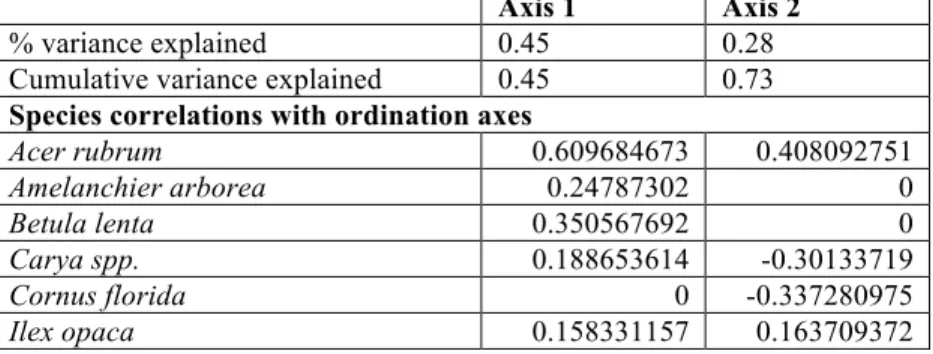
Measures of topographic position (elevation, slope, aspect, topographic convergence index) were used as environment variables. A digital elevation model (DEM) for GSMNP was derived from the United States Geological Service nationwide 10-m DEM (Gesch et al. 2002, Gesch 2007). Slope and aspect were derived from the DEM in ArcGIS (ESRI 2011). Aspect is used as a proxy for evaporative demand. Southwest facing slopes experience the highest evaporative demand, while northeast facing slopes experience the lowest. To reflect this, aspect was transformed using the equation , so that a maximum value of 1 represents southwest facing slopes and a minimum value of -1 represents a northeast facing slope (Pierce et al. 2005). Topographic convergence index (TCI), the ratio of uphill contributing area to slope, was used as a proxy for soil moisture (Beven and Kirkby 1979). TCI was calculated from the USGS DEM using the terraflow package in GRASS (Arge et al. 2003).
Analysis
Management objectives in GSMNP are largely focused on restoring pine and oak dominance. Therefore, I focused on examining and explaining changes in density and species composition of trees. Prior to analyses, all trees in genus Carya were grouped together because the majority were missing species identifications, and species found in less than five percent of samples were removed from the dataset.
When analyzing multivariate community data, it is routine to use data transformed in various ways, including relativized by site or by species, square root transformed, or some combination of these. Here I used stem density data and conducted analyses with
both raw data and data relativized by site totals. Analysis of raw stem density data captures changes in the number of stems in a plot in addition to changes in species composition, whereas analyses of data for relative density will reflect only changes in composition. Because many plots underwent major changes in tree density after fire, analyses of raw density data predominantly reflected changes in structure and not necessarily in composition. Therefore, I repeated the analyses with both sets of data to assess trends in composition as well as structure after fire.
Ordination is a set of methods used to analyze multivariate data in low
dimensional space. To assess changes in community structure and composition, I used non-metric multidimensional scaling ordination (NMS, Kruskal 1964) as implemented in the vegan package in R (Oksanen et al. 2007, R Development Core Team 2010). NMS makes no assumptions about the shape of species occurrence distributions or about the relationship between species occurrences and environmental gradients. Individual
observations are arranged in a low-dimensional space so that the distances between points in ordination space correspond to observed dissimilarities between samples.
Environmental variables are overlaid as biplot vectors after the fact, where the direction of a vector represents the direction in which that variable increases and the length represents the strength of the correlation between the environmental gradient and the ordination axes.
determine the proper dimensionality of each NMS solution. Varimax rotation was used to rotate each solution so that NMS axis 1 explained the most variance. Individual
environment variables (Table 1) were overlaid on the ordination. Only correlation vectors that were significant at the P<0.05 level were plotted. Species scores were calculated as average ordination scores weighted by species abundances. Correlations between the ordination axes and environment variables and species abundances were calculated using the ecodist package in R (Goslee and Urban 2007). To analyze plots’ changes over time, change vectors connecting a plot at one time to itself at a later time were visually
compared.
There is a longitudinal gradient present in the dataset, with plots spanning the
width of the park (Figure 2). Because the mountains to the east are higher than those to the west, elevation is correlated with longitude (r=0.87, P<0.0001). I expected that the effect of longitude would be largely a reflection of the effect of elevation. To test whether
there was an effect of longitude beyond the effect of elevation, I used linear regression to predict ordination scores on NMS axis 1 (the axis with which elevation and longitude
were most strongly correlated) from elevation, and then from elevation and longitude. An F-test of the two models demonstrated that longitude does not contribute significantly beyond elevation (P=0.08). Therefore, I excluded longitude from analyses.
itself is proportional to the length of the change vectors plotted in ordination space, but is preferable for use in statistical analyses because the ordination does not perfectly
represent the dissimilarities between plots in two-dimensional space.
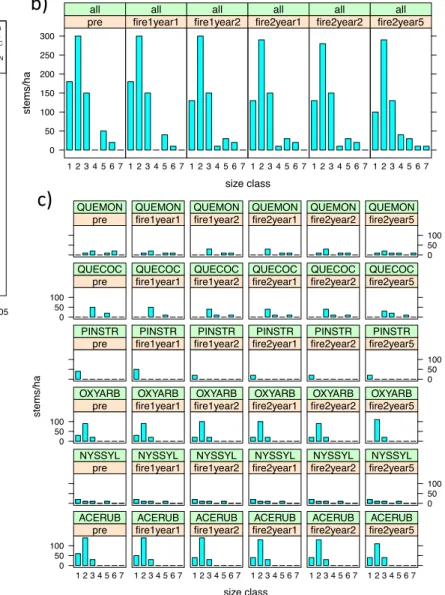
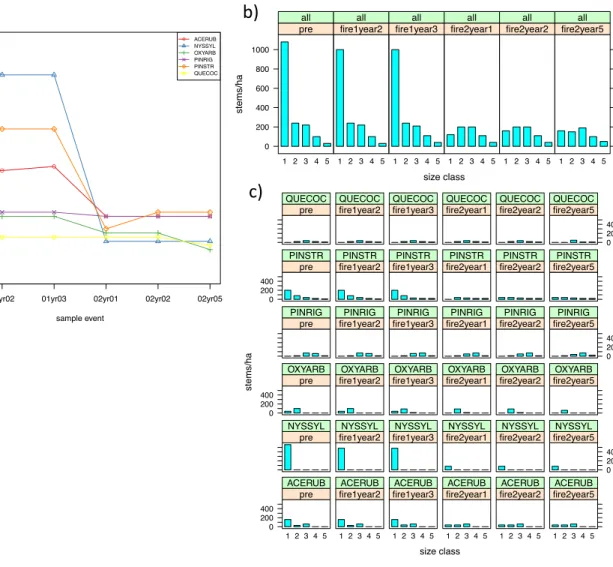
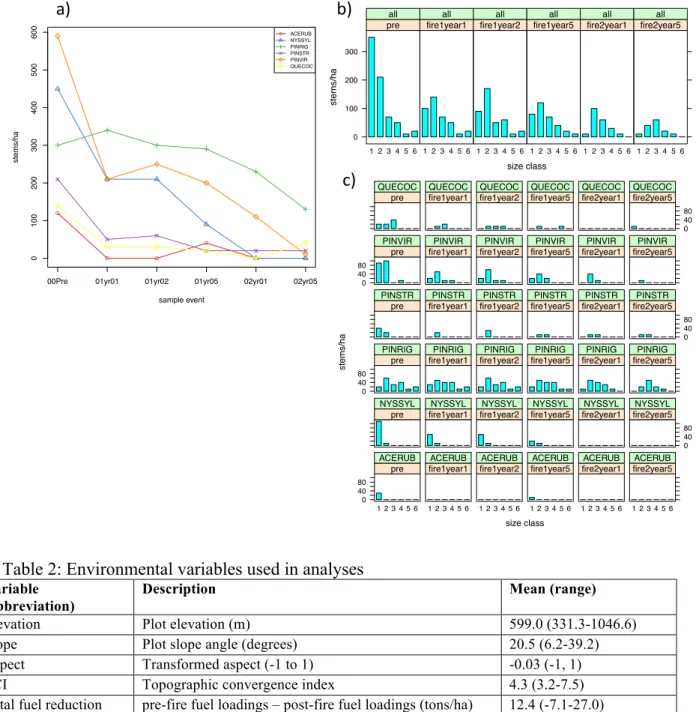
Because not all plots were sampled at all sampling events, it was not possible to examine trends across the entire dataset over time in terms of species abundances or size class distributions. Instead, to qualitatively assess dynamics on the plot level, I examined individual plots that were burned twice and were sampled five years after the second fire and at most time points along the way. For each of these plots I calculated size class distributions in 10 cm dbh bins, grouping trees with dbh > 70 cm together, and examined changes in the size class distribution over time for the entire plot and for selected species within the plot. Additionally, I plotted density over time for the dominant species in each plot. Plots of density over time illustrate trends in terms of both absolute density as well as relative abundance of different species. Downward sloping lines indicate declines in species’ density, and if two species’ lines cross it indicates a shift in relative dominance.
Results
Ordination of raw density data
The step-down procedure suggested a two-dimensional solution, and the final stress in two dimensions was 0.22. The ordination axes had a cumulative r2 of 0.71 with
(Legendre and Legendre 1998) that contrasts pairs of samples that are in the same group of burned vs. unburned with those that are in different groups. The results of this test were not significant, indicating that between group dissimilarities are not significantly different from the within group dissimilarities despite the visual pattern in ordination space (Mantel r=0.02, P=0.25), possibly due to variation in sample size between the two groups.
A plot of species scores indicated that all species had their maximum expected abundances on the right side of the graph, corresponding with the area occupied by the unburned plots (Figure 3b). This suggests that all species are most abundant in unburned plots and decline in abundance after fire although the fact that burned plots span the range of NMS axis 1 affects the certainty of this interpretation. The species scores for the yellow pines (Pinus rigida, Pinus echinata, and Pinus virginiana) are the furthest into the side of the graph where burned plots dominate, suggesting that these species’ densities change the least after fire.
NMS axis 1 was most strongly correlated with elevation, and most negatively correlated with herbaceous cover and total fuel reduction, while NMS axis 2 was correlated with the fire severity measures (fuel reduction), variables that are affected by fire (shrub and herb cover, total tree density), and with aspect (Table 3, Figure 3c, 3d).
after fire, and from two years after fire to five years after fire, are shorter on average, and do not show any major trend in any direction (Figure 4b, 4c). Change vectors drawn from before fire to five years after the second fire show an overall trend towards lower density, lower shrub cover, and higher herb cover (Figure 4d), suggesting that changes in density after the first fire are maintained over time if there is a second fire. There is substantial variation in the magnitude of change in the time period from before fire until fire2year5, with dissimilarity values ranging from 0.15 to 0.85, with a mean of 0.5.
Results indicate that for the most part, changes after fire are maintained after the first year. If changes to plot structure and composition caused by fire began to revert to prior conditions in the years following fire, I would expect change vectors for years two and five to trend in the opposite direction than the change vectors immediately following fire. Instead, change vectors plotted from fire1year1 to fire1year2, and fire1year2 to fire1year5 (Figure 4b, c) are short on average and no single direction predominates, indicating that changes in later years are much smaller in magnitude than those immediately following fire, and are not necessarily in the opposite direction of the immediate changes.
Ordination of relative density data
between group dissimilarities were not significantly different from within group dissimilarities (mantel r= -0.06, P=0.97).
Correlation analyses
Analysis of the correlation between environmental variables and fire severity with plots’ fire effects (dissimilarity to itself) calculated from raw density data found a
significant correlation with elevation over all periods examined. Variables associated with fire severity were significantly positively correlated with a plot’s fire effects in the shorter term, and less important in the long-term, whereas variables associated with topography (slope and aspect) were not correlated with fire effects in the short term, but were correlated with the longer-term magnitude of change (Table 5). Inference here is limited as a different subset of plots were included in correlation analyses from year to year due to differences in sampling between the plots, and thus a different range of each of the variables tested was represented in each round of analysis. For example, the range of elevation in the analyses for fire1year1 is 331 m to 1047 m, while the range for fire1year5 is only 331 m to 635 m, explaining the switch in the sign of the relationship for pre to fire1year5 dissimilarity.
Correlation analyses conducted with fire effects values calculated from relativized density data showed different patterns. Elevation was negatively correlated with the magnitude of change after fire for some time intervals, but not others. Aspect and TCI were never significant, and slope was significant only in the interval from pre-fire to fire1year5. Variables relating to fire severity were significantly correlated with the magnitude of compositional change from pre-fire to two years after the first fire, and depth of litter and duff was important for the first two years after a prescribed fire.