THE COPING EFFORTS OF INTIMATE PARTNER VIOLENCE SURVIVORS: REVIEW OF THE LITERATURE, EXPLORATORY INQUIRY, AND SCALE
DEVELOPMENT
Cynthia Fraga Rizo
A dissertation submitted to the faculty at the University of North Carolina at Chapel Hill in partial fulfillment of the requirements for the degree of Doctor of Philosophy in the School of
Social Work.
Chapel Hill 2013
Approved by: Rebecca J. Macy
Sarah E. Bledsoe-Mansori Mimi Chapman
ABSTRACT
Cynthia Fraga Rizo: The Coping Efforts of Intimate Partner Violence Survivors: Review of the Literature, Exploratory Inquiry, and Scale Development
(Under the direction of Rebecca J. Macy)
Intimate partner violence (IPV) is a significant and prevalent social problem that impacts a considerable number of women each year. This often traumatic experience is strongly
associated with a number of negative consequences affecting survivors’ well-being. Fortunately, survivors’ coping efforts have been shown to mitigate the impact of IPV on survivors’ well-being. However, there is limited information regarding IPV as a distinct stressor, and the field is hampered by the lack of a comprehensive IPV-specific coping scale. The following three-paper dissertation addresses this critically important knowledge gap by contributing to the knowledge and measurement of coping among IPV survivors.
The first paper provides a systematic and critical review of the literature on coping among female IPV survivors. The review identified 46 articles focused on survivors’ coping experiences that met the study’s criteria. This review highlighted what is known about IPV survivors’ coping efforts as well as the methodological strengths and limitations of this literature. Further, this review found that coping has been conceptualized and measured in disparate and inconsistent ways across the reviewed articles.
survivors use multiple and varied strategies to cope with IPV and IPV-related stress; (b) IPV survivors face multiple challenges and barriers in coping with the violence and stress in their lives; and (c) IPV is a unique stressor.
I dedicate this dissertation to my husband, Roger Rizo; my parents, Lazaro and Marina Fraga; and the countless survivors of intimate partner violence who continue to surprise me every day
ACKNOWLEDGEMENTS
I would like to thank my husband, Roger, for always believing in me. His constant support, love, and faith served as an immense source of comfort throughout my doctoral career and dissertation work. Thank you for being my safe space and my biggest cheerleader.
I am also grateful to my family and friends for a lifetime of unconditional love, guidance, and encouragement. I want to especially thank my mother, Marina. Thank you, thank you, thank you! You are an amazing woman and role model. Your humility, generosity, and self-sacrificial nature have permanently left a mark on me and the person I strive to be. Thank you for always believing in me, pushing me to my highest potential, and supporting my dreams. I know that I would not be where I am today without you.
I would like to thank Rebecca Macy. I feel extremely fortunate to have had such an amazing scholar as my mentor and dissertation chair. Your mentorship throughout the past five years has been an essential component of my personal and professional growth. I cannot thank you enough for our many conversations. You will never know how much your critical feedback, words of encouragement, and guidance have shaped the scholar I am today. Thank you for believing in me and providing me numerous opportunities to grow and learn.
I would like to thank my committee members: Mimi Chapman, Betsy Bledsoe-Mansori, Michael Lambert, and Cecilia Casanueva. Thank you for your thoughtful feedback regarding my dissertation work. You have allowed me to broaden my understanding of coping and
I would like to thank my professors and fellow doctoral students, especially my cohort members: Krysti Webber, Kate Wegmann, and Sarah Dababnah. You ladies have become some of my best friends. I could not have made it through my doctoral career without your support and friendship. I will always remember our delirious late nights, Sunday writing days, and practice presentations. Thank you for sharing my tears and successes.
I would like to thank all of the providers, experts, and survivors who participated in this research. This work would not be possible without your willingness to share your knowledge and stories.
TABLE OF CONTENTS
LIST OF TABLES ...x
LIST OF FIGURES ... xi
LIST OF ABBREVIATIONS ... xii
CHAPTER 1: A SYSTEMATIC REVIEW OF COPING AMONG IPV SURVIVORS: HOW IS COPING MEASURED, WHAT DO WE KNOW, AND WHERE ARE WE HEADED? ...1
Methods...5
Results ...6
Discussion ...39
References ...49
Figure 1.1: Bar graph of Coping Measures Used Across Articles ...58
Table 1.1: Review of Articles Examining Coping among Female IPV Survivors ...59
CHAPTER 2: A QUALITATIVE EXPLORATION OF INTIMATE PARTNER VIOLENCE RELATED STRESS AND THE COPING EXPERIENCES OF SURVIVORS: “THERE'S ONLY SO MUCH THAT A PERSON CAN HANDLE” ...88
Methods...91
Results ...98
Discussion and Limitations ...128
References ...136
Table 2.1: Survivor Participant Characteristics ...141
CHAPTER 3: MEASURING THE COPING EXPERIENCES OF INTIMATE PARTNER VIOLENCE SURVIVORS: DEVELOPMENT AND INITIAL
VALIDITY OF THE INTIMATE PARTNER VIOLENCE COPING SCALE ...144
Development of the IPV Coping Scale ...148
Methods...156
Results ...165
Discussion and Limitations ...176
References ...179
Table 3.1: Organizational Framework of the IPV Coping Scale ...184
Table 3.2: Steps for Think-Aloud and Concurrent Verbal Probes...185
Table 3.3: Expert Review Participant Characteristics ...186
Table 3.4: Expert Review Findings Regarding Section I ...187
Table 3.5: Expert Review Findings Regarding Section II ...192
Table 3.6: Cognitive Interviewing Participant Characteristics ...216
Table 3.7: Changes to Section I based on Cognitive Interviewing Findings ...218
Table 3.8: Changes to Section II based on Cognitive Interviewing Findings ...221
CHAPTER 4: INTEGRATIVE DISCUSSION ...230
References ...235
LIST OF TABLES
Table 1.1: Review of Articles Examining Coping among Female IPV Survivors ...59
Table 2.1: Survivor Participant Characteristics ...141
Table 2.2: Provider Participant Characteristics ...143
Table 3.1: Organizational Framework of the IPV Coping Scale ...184
Table 3.2: Steps for Think-Aloud and Concurrent Verbal Probes...185
Table 3.3: Expert Review Participant Characteristics ...186
Table 3.4: Expert Review Findings Regarding Section I ...187
Table 3.5: Expert Review Findings Regarding Section II ...192
Table 3.6: Cognitive Interviewing Participant Characteristics ...216
Table 3.7: Changes to Section I based on Cognitive Interviewing Findings ...218
LIST OF FIGURES
LIST OF ABBREVIATIONS
AA Alcoholics Anonymous
ABOC Abusive Behavior Observation Checklist ANCOVA Analysis of covariance
ASSIA Applied Social Services Index and Abstracts
BST-OCT Brief Symptom Inventory – Obsessive Compulsive Tendencies Scale COPE Coping Orientations to Problems Encountered Scale
CISS Campbell Incident Severity Scale CPA Childhood physical abuse
CPO Civil protection order
CSA Childhood sexual abuse
CTS Conflict Tactics Scale
DAST Drug Abuse Screening Test DSE Daily Spiritual Experiences Scale
DV Domestic violence
DVPO Domestic violence protection order EMT Emergency medical technician
EOR Effectiveness in Obtaining Resources Scale GED General Educational Development
HARASS Harassment in Abusive Relationships – A Self-Report Scale HLM Hierarchical linear modeling
HMO Health maintenance organization
IPVSI Intimate Partner Violence Strategies Index
ISA Index of Spouse Abuse
ISEL Interpersonal Support Evaluation List LCA Latent class analysis
LGBT Lesbian, gay, bisexual, and transgender
M Mean
MANCOVA Multiple analysis of covariance MANOVA Multiple analysis of variance
MAST Michigan Alcoholism Screening Test
N Number
NA Narcotics Anonymous
NVAWS – PCS National Violence Against Women Survey – Power and Control Scale NVAWS – SS National Violence Against Women Survey – Stalking Scale
OBGYN Obstetrician gynecologist
OCT Obsessive compulsive tendencies
PI Principal Investigator
PMWI Psychological Maltreatment of Women Inventory PPO Preferred provider organization
P-SACS Preliminary Strategic Approach to Coping Scale PTSD Posttraumatic stress disorder
RCOPE Religious Coping Activities Scale SBCL Stalking Behavior Checklist
SDIEQ Strategies for Dealing with IPV Effects Questionnaire
SES Sexual Experiences Survey
SESBW Self-Efficacy Scale for Battered Women SEM Structural equation modeling
SSBS Social Support Behaviors Scale
SSI Supplemental Security Income
TMM Transtheoretical Model of Change
VAWS Violence Against Women Survey
WCCL Ways of Coping Checklist WCQ Ways of Coping Questionnaire
CHAPTER 1: A SYSTEMATIC REVIEW OF COPING AMONG IPV SURVIVORS: HOW IS COPING MEASURED, WHAT DO WE KNOW, AND WHERE ARE WE HEADED?
Intimate partner violence (IPV) is a significant and prevalent public health problem that impacts a considerable number of women each year. In the United States, more than 1 in 3 women experience lifetime rape, physical violence, or stalking by an intimate partner, and over a third of these women experience multiple forms of abuse (Black et al., 2011). Further, about 1 in 4 women experience severe forms of physical IPV, such as being hit with a fist, kicked, slammed against a wall, choked/suffocated, burned, or having a partner use a knife or gun on them (Black et al., 2011).
In addition to being pervasive and highly prevalent, IPV is associated with a plethora of negative sequelae, including numerous mental health problems (e.g., Black et al., 2011;
Campbell et al., 2002; Hien & Ruglass, 2009; Macy, Ferron, & Crosby, 2009). Although IPV severity is a significant risk factor for impaired mental health (i.e., the likelihood of suffering from impaired mental health increases as partner violence escalates; Carlson, McNutt, Choi, & Rose, 2002; Johnson, Zlotnick, & Perez, 2008), negative mental health outcomes can result from a single incident of abuse or chronic battering (Waldrop & Resick, 2004). Physical,
found PTSD prevalence rates of 31% to 84% and depression rates of 15% to 83% among IPV survivors (Golding, 1999). In addition, major depression and PTSD comorbidity is common in this population (O’Campo et al., 2006).
Other mental health consequences of IPV include phobias, cognitive disturbances,
dissociation, sexual problems, and low self-esteem (Briere & Jordan, 2004). IPV survivors report experiencing fear and terror, recurrent thoughts and flashbacks of prior abuse incidents, denial and avoidance, blurred memory of traumatic events, increased arousal (e.g., anxiety, panic attacks, hypervigilance, and phobias), physiological reactivity, and constrained affect (Browne, 1993; Walker, 1991). Fortunately, the path between IPV and its negative outcomes is not
deterministic. A number of factors can influence the relationship between experiencing IPV and subsequently presenting with harmful, IPV-related consequences. Specifically, survivors’ coping efforts have been shown to mitigate the impact of IPV on mental health (e.g., Calvete, Corral, & Estevez, 2008; Krause, Kaltman, Goodman, & Dutton, 2008).
Overview of Coping
Coping refers to a range of cognitive and behavioral strategies used to reduce, minimize, master, or tolerate the internal and external demands of a stressful or threatening situation (Lazarus & Folkman, 1984). Situations are considered to be stressful when the demands of the situation are perceived as taxing or exceeding one’s resources (Lazarus & Folkman, 1984). The concept of coping has been of interest to mental health professionals and researchers for over 40 years (Pollock, 1988). During this time, coping has been conceptualized in various ways.
approaching and attempting to alter the stressful situation (e.g., problem-solving), whereas emotion-focused coping refers to cognitive and behavioral strategies aimed at ameliorating or managing the emotional response (i.e., distress) associated with the stressful situation (e.g., venting of emotions through crying or yelling, restructuring one’s perception of the problem; Lazarus & Folkman, 1984). Other coping models classify coping strategies as: (a) active versus passive (Finn, 1985), (b) approach versus avoidance (Moos, 1995), and (c) engagement versus disengagement (Flicker, Cerulli, Swogger, & Talbot, 2012; Fowler & Hill, 2004). Tobin and colleagues (1989) propose a unique coping model that incorporates both approach/avoidance and problem-focused/emotion-focused dimensions of coping (i.e., problem-focused engagement, problem-focused disengagement, emotion-focused engagement, and emotion-focused disengagement).
Coping among IPV Survivors
Research suggests that coping is an important construct in understanding the relationship between IPV occurrence and mental health (Calvete et al., 2008; Krause et al., 2008; Lee, Pomeroy, & Bohman, 2007). Existing literature shows that coping is not only impacted by IPV, but also influences IPV survivors’ mental health (Calvete et al., 2008; Krause et al., 2008; Lee et al., 2007; Clements & Sawhney, 2000; Kocot & Goodman, 2003). Various IPV researchers declare the utility of exploring the construct of coping in effort to advance the IPV field,
physical well-being (Waldrop & Resick, 2004).
During the past three decades, there has been a substantial growth in studies examining IPV survivors’ coping strategies. IPV researchers have been increasingly interested in learning about what strategies these women employ to cope with the stress and violence in their lives, as well as the predictors and outcomes of such strategies. Despite the augmentation of research on coping among IPV survivors, very little work has been done to integrate this literature. Notable exceptions include the work by Follingstad and colleagues (1988) and Waldrop and Resick (2004), which provide cursory and non-systematic reviews of the literature regarding coping among IPV survivors. Although these reviews represents initial attempts to amalgamate this literature, a systematic and updated review is needed to synthesize and critically appraise the existing literature in a comprehensive, transparent, objective, and replicable manner (Littell, Corcoran, & Pillai, 2008). A systematic review of this literature is necessary to: (a) understand what is currently known about IPV survivors’ coping experiences; (b) identify methodological strengths and limitations of the extant literature; and (c) identify pressing research questions and knowledge gaps. Findings from such a review are critical for informing social work practice, research, and policy.
Current Study
review include:
Research Question 1: What is known about coping among IPV survivors (i.e., What
strategies do IPV survivors use to cope with the stress and violence in their lives? What predictors are associated with survivors’ coping responses? What outcomes are
associated with survivors’ coping responses?)?
Research Question 2: What theories are used in the IPV literature to understand coping?
Research Question 3: How is coping conceptualized and measured in the IPV literature?
Research Question 4: What are the methodological strengths and limitations of the
literature on coping among IPV survivors? Methods
This study employed systematic searches of the following eight computerized article databases: Academic Search Premier; Health Source: Nursing/Academic Edition; PsychINFO; PubMed; Sociological Abstracts; Social Work Abstracts; Social Service Abstracts; and Applied Social Services Index and Abstracts (ASSIA). A review group found that restricting a search to one general database tends to identify only about half of all relevant studies (Systematic Review Study Group, 2005). Use of multiple databases served to increase the likelihood of identifying all possible studies that fell within the scope of the review. No time frame restrictions were placed on the search; therefore, all articles published through the spring of 2013 were included in the search. The keywords used in the database searches included: domestic violence, family violence, partner violence, battered, wife abuse, partner abuse, spouse abuse, spousal abuse, coping,
adjustment, psychological adjustment, psychological adaptation, psychologic adaptation, and
adaptive behavior. In addition, a forward and backward citation search (i.e., searching the studies
keyword search) was conducted to locate additional publications for review. These search efforts yielded over 7,000 articles addressing aspects of coping and IPV (e.g., children’s coping with IPV exposure, coping with relationship conflict as predictor of IPV perpetration/victimization).
To identify those articles most relevant to IPV survivors’ coping efforts and the
measurement of coping, each article was assessed by applying the following inclusion criteria: (a) the study was empirical, (b) quantitative methods were used, (c) female IPV survivors served as either the focal sample or a sub-focal sample for which results were presented separately, (d) the IPV relationship was characterized as heterosexual, (e) the research focused on survivors’ coping efforts directed at IPV and/or IPV-related stress, (f) the study was conducted in the U.S., and (g) the article was available in English. Although important, articles that focused exclusively on women’s coping efforts directed at stalking and those that sampled female perpetrators of IPV (who many times were also victims) were excluded from the current review based on the unique characteristics and needs of these populations. Using these inclusion and exclusion criteria, the systematic search identified 46 articles for review. These studies were systematically reviewed and abstracted using an abstraction form. The abstraction form was used to document key elements of each study, including study aim, design, use of theory, sample, analysis,
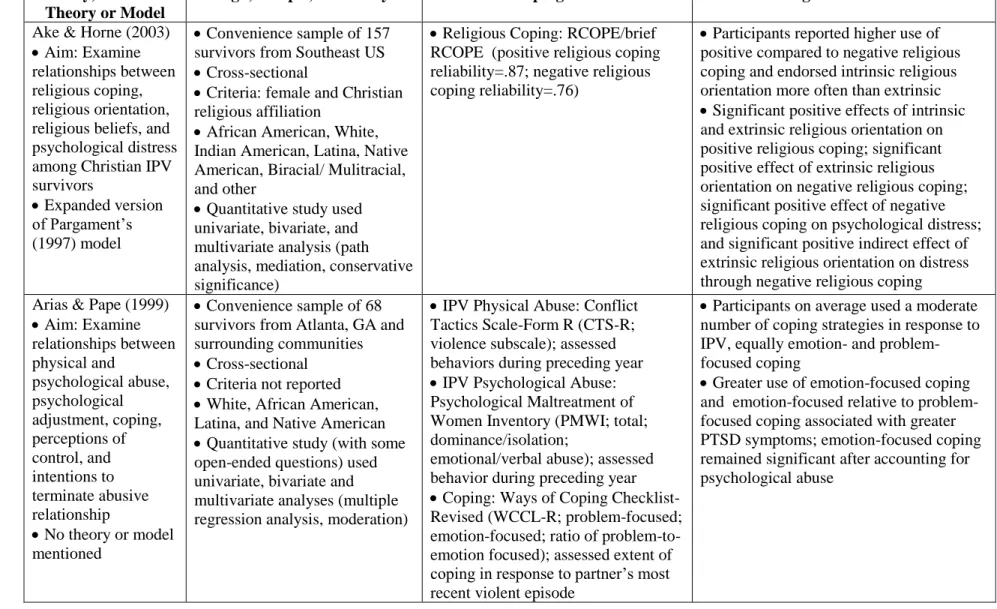
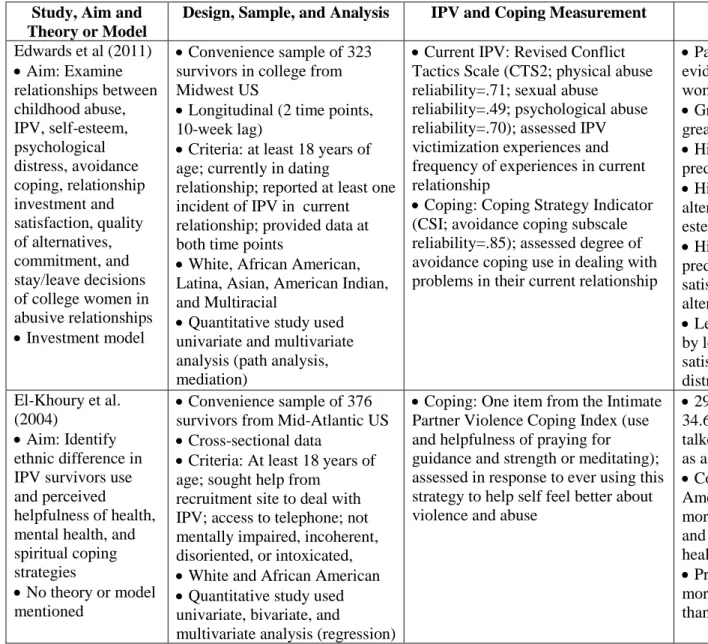
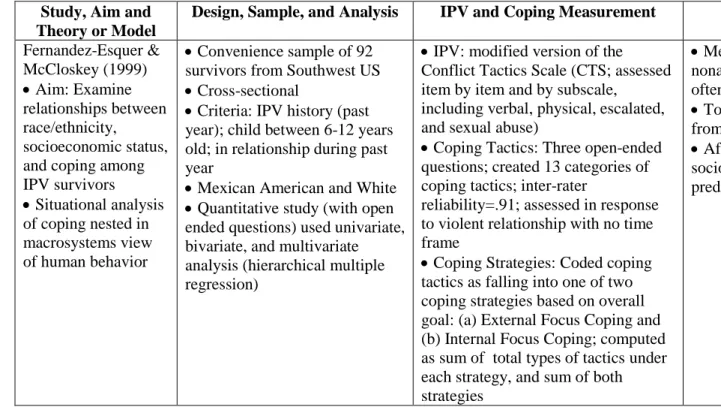
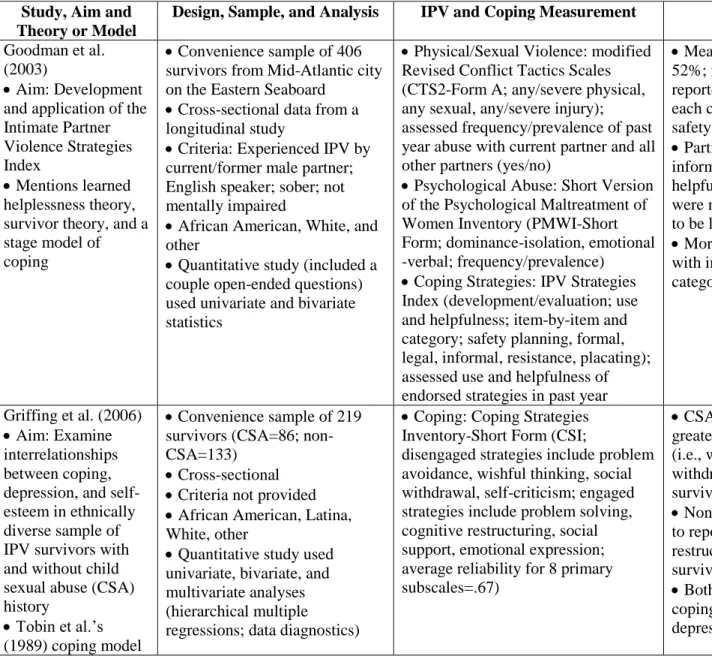
measurement of key variables (with particular attention to coping), and key findings. Detailed summaries of all 46 articles are provided in Table 1.1.
Results Study Aim
(and often other variables) on psychological health. Psychological health was typically operationalized as depression and PTSD symptoms (e.g., Flicker et al., 2012; Kocot &
Goodman, 2003; Waltington & Murphy, 2006), but also included hopelessness (e.g., Clements, Sabourin, & Spiby, 2004; Clements and Sawhney, 2000), self-esteem (e.g., Griffing et al., 2006), mastery (Mitchell & Hodson, 1983), spiritual well-being (Arnette et al., 2007), anxiety (Taft, Resick, Panuzio, Vogt, & Mechanic, 2007a), and general psychological distress (Ake & Horne, 2003; Pape & Arias, 1995). Fifteen studies compared different groups (e.g., racial/ethnic groups; rural vs. urban survivors; child abuse history vs. no child abuse history; victims vs. nonvictims) on their coping experiences (e.g., Clements & Ogle, 2009; El-Khoury et al., 2004; Howard, Riger, Campbell, & Wasco, 2003; Shannon, Logan, Cole, & Medley, 2006). Five studies aimed to assess the impact of coping on other variables of interest, including helpseeking (Hodges & Cabanilla, 2011), the decision to leave an abusive relationship (Edwards, Gidycz, & Murphy, 2011; Strube & Barbour, 1984), previous suicide attempt (Meadows, Kaslow, Thompson, & Jurkovic, 2005), and social reactions (Sullivan, Schroeder, Dudley, & Dixon, 2010).
2008),and survivors of Mexican descent (Brabeck & Guzman, 2008). One study described the development of an instrument to measure IPV-specific, problem-focused coping and used this instrument to examine survivors use of coping strategies, interrelationships between different coping strategies, and the relationships between coping strategies and abuse (Goodman, Dutton, Weinfurt, & Cook, 2003).
Theory
Slightly over half of the studies mentioned a particular theory, model, or framework guiding their work (n=24; 52%). Of these, 16 studies (34.8%; e.g., Ake & Horne, 2003; Edwards et al., 2011; Sabina & Tindale, 2008) reported one theory whereas eight (17.4%; e.g., Bapat & Tracey, 2012; Lewis et al., 2006) relied on multiple theories to inform their research. Theories reported by more than one study include stress and coping theory, hopelessness theory of depression, survivor theory, Tobin and colleagues’ (1989) multi-factorial coping model, learned helplessness theory, and goodness-of-fit hypothesis of coping (with attention to culture).
However, no theory was used by more than three studies. Two studies developed and tested their own models. Specifically, Mitchell and Hodson (1983) proposed the stress-support-coping paradigm whereas Nurius and colleagues (1992) proposed the coping capacity model.
an ecological framework, personality helplessness theory using an ecological perspective, Hamby and Gray-Little’s (2007) risk-based model, and Herman’s (1995) complex PTSD and stages of recovery model.
Study Sample
Sample size. Sample sizes ranged from 60 to 757 participants. The majority of studies had relatively large sample sizes. Thirty two studies (70%) reported sample sizes greater than 100 (e.g., Ake & Horne, 2003; Pape & Arias, 1995; Zanville & Cataneo, 2012), of which eleven (24%) reported samples greater than 300 participants (e.g., Bauman et al., 2008; Shannon et al., 2006). A notable percentage had relatively small sample sizes. Fourteen studies (30%) had sample sizes smaller than 100 (e.g., Arias & Pape, 1999; Mitchell & Hodson, 1983).
Sampling strategy and recruitment. The majority of studies used convenience samples (n=44; 96%). Only two studies relied on a random sample. Of these studies, one randomly selected women from all women with non-faculty positions at a large state university (Hamby & Gray-Little, 1997), the other randomly selected women from a list of L.A. households containing persons with a Japanese surname (Yoshihama, 2002). None of the studies used a nationally representative sample.
Samples were generally comprised of women engaged in help-seeking efforts. Over 70% (n=33; 71.7%) of studies recruited women from help-seeking settings, including DV
participants from the general community through strategies including media, flyers, and
community outreach events (e.g., Fernández-Esquer & McCloskey, 1999). Another 8.7% (n=4) included samples comprised of both general community and help-seeking women (e.g., Kemp & Green, 1995).
As per this review’s inclusion criteria, all of the studies were conducted in the U.S. About 22% (n=10) of studies took place in the Southeast, 19.6% (n=9) in the Mid-Atlantic, 15.2% (n=7) in the Mid-West, 8.7% (n=4) in the Southwest, 6.5% (n=3) in the Northeast, 4.3% (n=2) in the Gulf, 2.2% (n=1) in the West, and 2.2% (n=1) in both the Southwest and Gulf. The
remaining approximately 20% (n=9) of the studies did not report the US region in which the study took place.
A number of studies included IPV-related inclusion criteria (n=30; 65%); however, these criteria varied across the studies. Eight studies used a general criterion requiring that participants report having experienced IPV by a current or former partner either in the present or past (17%; e.g., Ake & Horne, 2003; Meyer et al., 2010). Four studies (8.7%) included criteria specifying the type of IPV or perpetrator. In particular, one study specified the occurrence of physical IPV not including sexual violence (Bapat & Tracey, 2012), another focused on recruiting women who experienced at least one incident of physical or verbal IPV (Hamby & Gray-Little, 1997), one study focused on IPV perpetrated by the participant’s spouse or a man with whom she has children in common (Flicker et al., 2012), and another focused on physical, psychological, and sexual IPV perpetrated by the participant’s current partner (Edwards et al., 2011).
severe violence (or some combination) and that the most recent IPV incident had to have occurred within the past six months and at least two weeks ago (Mechanic et al., 2010; Taft et al., 2007a, 2007b). Further, two of these studies focused on physical IPV (Taft et al., 2007a, 2007b).
Other inclusion criteria reported by less than 25% of studies include the following: race/ethnicity (n=10; see section on sample race/ethnicity); at least 18 years of age (n=11; e.g., Brabeck & Guzman, 2008; Kemp & Green, 1995); between 18 and 49 years of age (n=1; Yoshihama, 2002); lack of mental impairment and/or intoxication (n=9; e.g., El-Khoury et al., 2004; Krause et al., 2008); fluency in English (n=5; e.g., Flicker et al., 2012); able to complete study protocol (n=4; e.g., Reviere et al., 2007); no life threatening medical condition with imminent death (n=3; e.g., Kaslow et al., 2002); access to a telephone (n=2; e.g., Bauman et al., 2008); suicide attempt within past year (n=2; e.g., Arnette et al., 2007); provided data at two time points (n=2; Howard et al., 2003); Christian religious orientation (n=1; Ake & Horne, 2003); annual household income equal to or less than $50,000 (n=1; Sullivan et al., 2010); child between the ages of 6 and 12 (n=1; Fernández-Esquer & McCloskey, 1999); disclosed IPV victimization to at least one person (n=1; Sullivan et al., 2010); and responded to a particular item in the questionnaire packet (n=1; Howard et al., 2003).
& Arias, 1995). These studies were included in this review because coping was assessed in response to the abusive relationship, the abuser, or the most recent IPV incident.
Forty-three articles provided information on participants’ ages. Participants ranged from 17 to 82 years of age, with the majority of participants between 25 and 40 years of age. Thirty-three articles provided information on participants’ level of education. The majority of these studies (n=27) included samples consisting primarily of women who at least received a high school degree or equivalent. Twenty-four studies reported on the employment status of their sample. Of these, 15 studies were mostly comprised of women who were unemployed, six studies consisted primarily of employed participants, and three studies reported on samples roughly split in terms of employment status. Sample income was reported by thirty-three studies, the majority of which (n=29) were comprised of primarily low-income samples.
Marital/relationship status was provided by thirty two studies. Of these, 16 studies were mostly comprised of married or cohabiting women, 12 studies consisted primarily of non-married women, and four studies were equally comprised of married and non-married women. Twenty-one studies reported on whether participants had children and noted that the majority of the women in their samples had at least one child.
Race and ethnicity. Slightly less than a quarter of the studies reviewed (21.8%) focused
2004) or predominately White (n=10; 21.7%; e.g., Lerner & Kennedy, 2000).
A number of the studies included a more diverse sample. However, representation of minority groups varied across these studies. For instance, among the 20 studies including a subset of Latina survivors, representation varied from 1% to 45% of the sample (e.g., Griffing et al., 2006). Asian survivors were included as a subsample in five studies, ranging from less than 1% to 38% of the total sample (e.g., Lee et al., 2007). Survivors identifying as Native American (n=5), Indian American (n=3), or bi/multiracial (n=6) were included in only a handful of studies and tended to make up less than 8% of the sample in these studies (e.g., Ake & Horne, 2003). About 43% of the studies (n=20) included an “other” category, which ranged from 2% to 9.5% of the overall sample (e.g., Sabina & Tindale, 2008).
Study Design
Graham-Bermann, 2010). Two studies (4%) used archival data (Howard et al., 2003; Strube & Barbour, 1984).
Measurement of Coping
Figure 1.1 presents a bar graph demonstrating the measurement of coping across the articles included in this review. All of the studies assessed participants’ coping. However, coping was conceptualized in various ways across the studies, including: problem-focused/emotion-focused coping (n=11), engaged/disengaged coping (n=6), active/passive coping (n=4), religious coping (n=4), coping model posited by Carver and colleagues (1989, 1997; n=3), avoidance coping (n=3), help-seeking (n=2), multiaxial model of coping posited by Hobfoll and colleagues (1994; n=2), ineffective coping (n=1), general coping (n=1), action responses (n=1),
public/private coping (n=1), internal-focus/external-focus coping (n=1), and Billings and Moos’ (1981) three-method-of-coping model (n=1). Further, several studies examined a number of coping concepts in combination with no true overarching conceptualization (n=5). Examples of these include: help-seeking and personal strategies (n=1); help-seeking and spirituality (n=1); general coping, maladaptive/adaptive coping, accessing resources, self-efficacy, social support, and alcohol/drug use (n=1); and social support, problem-solving, and avoidance (n=1).
Guzman, 2008; Hamby & Gray-Little, 1997). Further, two studies presented the development of a standardized IPV-specific coping instrument (Bauman et al., 2008; Goodman et al., 2003). The subsequent subsections describe the various standardized and non-standardized coping
instruments used by the reviewed literature.
Standardized and modified standardized coping instruments.
IPV-specific coping instruments. Five studies reported the use of standardized or
modified standardized IPV-specific coping instruments (Bauman et al., 2008; El-Khoury et al., 2004; Goodman et al., 2003; Meyer et al., 2010; Zanville & Cattaneo, 2012). Bauman and colleagues (2008) reported using the Strategies for Dealing with IPV Effects Questionnaire, an instrument specifically developed as part of a larger study. The Strategies for Dealing with IPV Effects Questionnaire has been used in other research and assesses the use and helpfulness of emotion-focused coping strategies to deal with feelings related to IPV victimization (e.g. thought that things would get better, cried to let my feelings out, imagined myself fighting back).
Bauman and colleagues (2008) used this instrument to examine the prevalence of using individual coping strategies and the helpfulness of those strategies, as well as participants’ overall extent of coping and overall helpfulness of coping (reliability=.89).
helpfulness. The IPV Strategies Index was also used by two other studies included in this review (Meyer et al., 2010; Zanville & Cattaneo, 2012). However, these studies differed in the time frame applied to the index and the subscales used in their analysis. Meyer and colleagues (2010) did not report the time frame used and calculated the extent of participants’ safety planning, formal help-seeking, informal helpseeking, legal coping, resistance, placating, and total coping. On the other hand, Zanville and Cattaneo examined participants’ coping during the past three months and calculated the extent of participants’ private coping and public coping.
Another study included in this review used four individual items taken from the two IPV-specific coping instruments (El-Khoury et al., 2004). Three items were taken from the IPV Strategies Index to measure the use and helpfulness of seeking help for the abuse from a (a) doctor or nurse, (b) mental health counselor, and (c) clergy member. The fourth item was taken from the Strategies for Dealing with IPV Effects Questionnaire to examine the use and
helpfulness of prayer or meditation to deal with feelings related to the abuse
Coping Orientation to Problems Encountered Scale. The most commonly used coping
instrument was the Coping Orientation to Problems Encountered (COPE) scale (Carver, Scheier, & Weintraub, 1989). COPE was used by seven studies – three studies used the full version (Bapat & Tracey, 2012; Kocot & Goodman, 2003; Watlington & Murphy, 2006) and four used the brief version (Clements & Ogle, 2009; Clements et al., 2004; Flicker et al., 2012; Street et al., 2005). The COPE scale was used in diverse ways by these studies. Four studies reported the time frame applied to the COPE scale. Of these, two studies examined coping during the past month or so, one study examined coping during the past year, and one study examined coping
coping (reliability=.90), active coping, seeking social support, denial, and acceptance (Bapat and Tracey, 2012). Two studies calculated 14 subscales (i.e., active coping, planning, positive
reinterpretation, acceptance, humor, religion, emotional support, instrumental support, behavioral distraction, denial, substance abuse, avoidance, self-blame, and venting), however, each study dropped a different subscale because of low reliability (Clements and Ogle, 2009 dropped venting, reliabilities ranged from .56-.85; Flicker et al., 2012 dropped self-distraction,
reliabilities ranged from .54-.82). Clements and colleagues (2004) used the brief COPE scale and calculated coping subscales considered to be “ineffective coping,” including drug use
(reliability=.92), denial (reliability=.75), behavioral disengagement (reliability=.66), and self-blame (reliability=.64). Watlington and Murphy (2006) only used the religious coping subscale (reliability=.85). One the other hand, Kocot and Goodman (2003) and Street and colleagues (2005) modified the scale by using specific items or subscales to create new coping scales. Kocot and Goodman (2003) created a problem-focused coping scale (reliability=.91) by combining the active, planning, and seeking instrumental support COPE subscales. Street and colleagues (2005) created an avoidant coping subscale (reliability=.75) by combining nine items from the following five original subscales: self-distraction, alcohol/drug use, behavioral disengagement, stoicism, and denial. Six of the studies using some version of the COPE scale reported information on scoring and/or anchors, of which all assessed the frequency in which participants engaged in certain coping activities.
Ways of Coping Checklist. The second most commonly used coping instrument was
the 42-item version of the WCCL (Vitaliano et al., 1985) was used by two studies (Clements and Sawhney, 2000; Lee et al., 2007); and the 66-item version of the WCCL (Folkman & Lazarus, 1985; Forsythe & Compas, 1987) was used by two studies (Arias & Pape, 1999; Pape & Arias, 1995). Four studies reported the time frame examined in their use of the WCCL. Two studies examined coping in response to the most recent IPV incident (Arias & Pape, 1999; Clements & Sawhney, 2000), and one study assessed coping in response to battering generally but did not specify parameters (e.g., current relationship, most recent incident, most severe incident) or an exact time frame; Lee et al., 2007). The fourth study included IPV survivors and nonabused women (Pape & Arias, 1995). In this study, the victim group reported coping in response to the most recent IPV incident, whereas the nonabused group reported coping in response to a negative relationship event that did not include violence. The various studies using this
coping (reliability=.85), problem-focused coping (reliability=.78), and emotion-focused coping (reliability=.78), as well as the frequency of various coping subscales (i.e., confrontive coping, distancing coping, self-controlling, seeking social support, accepting responsibility, escape avoidance, problem solving, and positive reappraisal).
Coping Strategies Inventory. Five studies used the Coping Strategies Inventory (Tobin,
Holroyd, Reynolds, & Wigal, 1989) – three studies used a short form of this inventory (Griffing et al., 2006; Kemp & Green, 1995; Lewis et al., 2006) and two used the long form (Taft et al., 2007a, 2007b). Only one study provided information on the time frame applied to the Coping Strategies Inventory and reported assessing the likelihood of using certain coping strategies in reference to IPV over the prior two weeks (Taft et al., 2007a). Two studies assessed the
frequency of using coping captured by the scale’s eight primary subscales: problem avoidance, wishful thinking, social withdrawal, self-criticism, problem-solving, cognitive restructuring, social support, and emotional expression (Griffing et al., 2006, average reliability=.67; Lewis et al., 2006). One study used the scale’s four secondary subscales: problem-focused engagement, emotion-focused engagement, problem-focused disengagement, and emotion-focused
disengagement (Taft et al., 2007a, reliabilities ranged from .85 to .92). The other two studies used the two tertiary subscales of engaged and disengaged coping (Kemp & Green, 1995; Taft et al., 2007b, engaged coping reliability=.92, disengaged coping reliability=.91)
Brief Religious Coping Activities Scale. The Brief Religious Coping Activities Scale
religious coping (Arnette et al., 2007). All of the studies provided reliability estimates, which ranged from .76 to .94 (positive religious coping=.87-.94; negative religious coping=.76-.80). However, only two studies provided information on scoring and reported calculating the frequency of religious coping activities (Ake & Horne, 2003; Arnette et al., 2007).
Preliminary Strategic Approach to Coping Scale. The Preliminary Strategic Approach to
Coping Scale (P-SACS; Hobfoll, Dunahoo, Ben-Porath, & Monnier, 1994) was used by three studies (Kaslow et al., 2002; Meadows et al., 2005; Reviere et al., 2007). None of the studied provided a time frame and all calculated a total coping score. Two studied provided a reliability estimate of .76 (Meadows et al., 2005; Reviere et al., 2007). P-SACS is typically used to measure coping ability or general coping tendencies and not coping strategies actually used by
respondents. Only one study provided information on the scoring and anchors used. Specifically, Meadows and colleagues (2005) assessed the frequency of which participants reported they would use certain coping strategies based on anchors ranging from 1 (not at all what I would do) to 5 (very much what I would do). Further, Reviere and colleagues (2007) used the P-SACS in combination with several additional instruments designed to measure other aspects of coping (i.e., maladaptive/adaptive coping, help-seeking, effectiveness of obtaining resources, self-efficacy, social support, and alcohol and drug abuse) that will be discussed in subsequent sections.
Coping Strategy Indicator. The Coping Strategy Indicator (Amirkhan, 1990) was used
with their intimate partner in the past six months, and then examined the frequency of social support coping (reliability=.92), problem-solving coping (reliability=.82), and avoidance coping (reliability=.75) used to address that conflict.
Other standardized and modified standardized coping instruments. The following 10
standardized and modified standardized instruments were each used by one study: (a)
Interpersonal Support Evaluation List (ISEL; Cohen, Mermelstein, Kamarck, Hoberman, 1985), (b) modified Daily Spiritual Experiences (DSE; Underwood, 1999), (c) Ways of Coping
Questionnaire (WCQ; Folkman & Lazarus, 1985), (d) Brief Symptom Inventory – Obsessive Compulsive Tendencies subscale (BSI-OCT; Derogatis & Melisaratos, 1983), (e) Billings and Moos’ (1981) Coping Measure, (f) Effectiveness in Obtaining Resources (EOR; Sullivan, Tan, Basta, Rumptz, & Davidson, 1992), (g) Self-Efficacy Scale for Battered Women (SESBW; Varvaro & Palmer, 1993), (h) Social Support Behaviors Scale (SSBS; Vaux, Riedel, & Stewart, 1987), (i) Brief Drug Abuse Screening Test (Brief DAST; Skinner, 1983), and (j) Brief Michigan Alcoholism Screening Test (Brief MAST; Pokorny, Miller, & Kaplan, 1972).
and Hodson (1983) used the Billings and Moos Coping measure to examine the extent to which participants used active behavioral coping, active cognitive coping, and avoidance coping in response to the IPV incident prior to the incident that precipitated their leaving the abusive relationship. Reviere and colleagues (2007) used the EOR (reliability=.87), SESBW
(reliability=.88), SSBS (friends support reliability=.99, family support reliability=.99), Brief DAST (reliability=.92), and Brief MAST (reliability=.83) in combination with the P-SACS and a qualitative interview to comprehensively examine participants coping efforts.
Non-standardized coping instruments. Thirteen studies assessed coping using non-standardized assessment tools. These studies assessed coping using study developed measures (n=7), qualitative interview or open-ended questions (n=3), study developed measures and qualitative questions (n=2), and archival data (n=1).
Miller (2006) developed two scales, the Miller Scale for Learned Helpfulness and the Miller Obsessive-Compulsive Tendency Scale using items from several standardized instruments. Learned helpfulness was conceptualized to represent passive coping, whereas obsessive-compulsive behaviors were conceptualized to represent active coping. These two scales were used in combination with the BSI-OCT discussed earlier.
Sabina and Tindale (2008) developed a seeking index to reflect the number of help-seeking strategies used by participants in the past year following an IPV incident. Strategies included talking to someone they knew about the abuse or contacting an agency, counselor, doctor, medical center, or the police. Sabina and Tindale (2008) also used two items to assess whether participants sought a protection order or stayed away from the abuser as means of coping during the past year. In this study, help-seeking, obtaining a protection order, and staying away from the abuser were conceptualized and examined as three distinct problem-focused coping strategies. Nurius and colleagues (1992) used two study-developed indices to examine the number of help-seeking and protective behaviors taken immediately and those taken later in response to abuse. The specific behaviors that comprise these indices were not reported.
Yoshihama (2002) developed a list of 13 coping strategies (i.e., confronted partner, sought help from family, sought help from friends, left partner temporarily, left partner permanently, suggested partner get help, saw counselor, sought information, focused on positive, minimized seriousness, avoided potentially violent situation, did things to calm down, and used alcohol and drugs) based on previous studies and practice experience. Participants were asked about their use of these coping strategies in dealing with IPV perpetrated by their most abusive partner
indices – active coping and passive coping. The ratio of active to passive coping was also
calculated in this study. Helpfulness scores were provided for the individual strategies as well as the active and passive coping indices.
Three studies used a qualitative interview or open-ended questions to examine
participants’ coping. Mechanic and colleagues (2000) used a standardized battering interview that asked participants about their use of several coping strategies in response to IPV (i.e., mental health care, police, protection order, shelter, medical care, and clergy). In addition to examining use of these strategies individually, the authors created a global strategic responding score reflecting the number of endorsed strategies. Reviere and colleagues (2007) also used a qualitative interview in addition to several standardized instruments to measure coping in response to IPV. This qualitative data was coded in terms of individual strategies (interrater reliability=.70). The individual strategized were then coded as adaptive or maladaptive and summed to create two indices (interrater reliability=.98). In addition to creating adaptive coping and maladaptive coping variables, the study also calculated the ratio of maladaptive to adaptive coping. Reviere and colleagues (2007) also used the qualitative interview to specifically probe the use of broad coping categories such as friends, family, religious or spiritual beliefs, work, children, community resources, and therapy or counseling (interrater reliability=.91). Fernández-Esquer and McCloskey (1999) used three open-ended questions to assess what participants did when violence occurred in their intimate relationships, as well as what participants thought to help themselves feel better. These open-ended questions assessed participants’ responses to IPV generally and did not specify current or past IPV. The qualitative data was coded into 13
fantasy, self-deprecation, suicidal ideation; interrater reliability=.91) that were then labeled as either external focus coping or internal focus coping. These authors then created three variables to examine the extent of external focus coping, internal focus coping, and total coping.
Two studies used a combination of study developed measures comprised of close-ended questions and qualitative data to examine coping. Shannon and colleagues (2006) used a resource utilization index developed based on pilot data as well as qualitative questions asking
participants what they did to cope with the abuse. The resource utilization index examined the use and helpfulness of various formal and informal resources ever used to deal with IPV. Individual resources included DV shelter, marriage counselor, religious figures, family, friends, medical personnel, support groups, crisis lines, alcohol or drug treatment, AA/NA, lawyer, police, victim advocate, homeless shelter, and other professionals. In addition to reporting the prevalence and helpfulness of individual resources, Shannon and colleagues (2006) also reported the total number of resources used and overall helpfulness, as well as the helpfulness of criminal justice resources, judges, domestic violence protection order (DVPO), informal help-seeking, and formal help-seeking. Further, the qualitative data was coded as problem-focused coping codes: active coping, planning, instrumental social support), emotion-focused coping (sub-codes: emotional support, avoid problem, denial, positive appraisal, withdrawal, venting,
forceful or physically threatening incident in their relationship. Specifically, the indices examined the following responses: problem-minimizing reactions, problem-focused reactions, critical attitudes toward the incident (reliability=.71), active problem-solving, behavioral self-protective responses (interrater reliability=61), discussion of conflict (interrater reliability=.61), and passive behavioral responses (interrater reliability=.61).
One study relied on archival data. Specifically, Strube and Barbour (1984) examined information documented on the participants’ counseling intake forms regarding the coping actions recommended by counselors and taken by participants following the intake interview. This information was used to calculate the extent of participants’ overall coping (i.e., number of coping strategies used), as well as the percentage of participants that used the following coping strategies: received counseling for self, received counseling for children, filed assault charges, obtained a protection order, obtained a restraining order, and other legal aid actions.
Analysis
The majority of studies conducted univariate (e.g., descriptive statistics), bivariate (e.g., chi-square tests, t tests, analysis of variance), and multivariate statistical analyses (e.g., multiple regression analysis; n=39; 85%). However, several studies (n=5; 11%) solely provided
descriptive and bivariate statistics (e.g., Brabeck & Guzman, 2008; Flicker et al., 2012). One study performed person-centered analyses (Zanville & Cataneo, 2012) and seven conducted path analysis or structural equation modeling (e.g., Lee et al., 2007; Street et al., 2005). Further, a number of studies examined for moderation (n=10; 22%; e.g., Kemp & Green, 1995) and
Few studies provided more detailed information about data preparation or analysis procedures. For example, less than 10% of studies discussed screening or transforming the data, conducting power analysis, or handling of missing data (e.g., Hodges & Cabanilla, 2011). About 20% reported conducting data diagnostics to ensure the data met the assumptions of the
statistical analyses employed (e.g., Miller, 2006; Yoshihama, 2002). Key Findings
Coping strategy use and helpfulness. Consistent with Survivor Theory (Gondolf and Fisher, 1988), the IPV survivors in the reviewed studies engaged in various coping strategies and sought help multiple times from multiple sources (e.g., Arias & Pape, 1999; Bauman and
colleagues, 2008; Brabeck & Guzman, 2008; Goodman and colleagues, 2003; Sabina & Tindale, 2008). For instance, Fernandez-Esquer and McCloskey (1999) found that participants used between one and nine coping strategies, with a mean of 3.24 strategies (SD=1.65). Similarly, Bauman and colleagues (2008) found that the majority of the 29 emotion-focused coping strategies examined were used by more than half their sample. Sabina and Tindale (2008) examined problem-focused coping strategies and found about 90% of participants used at least one problem-focused strategy and about 80% engaged in at least one help-seeking behavior. Some inconsistency emerged regarding participants’ use of problem-focused or engaged coping versus emotion-focused or disengaged coping. Some studies reported that participants relied on both forms of coping rather equally (e.g., Arias and Pape, 1999). On the other hand, Shannon and colleagues (2006) found that less than 20% of participants reported using some type of problem-focused coping strategy, whereas about 90% reported using some type of emotion-problem-focused coping strategy.
religious coping, maintaining relationship with God, praying for guidance/strength or meditating; Ake & Horne, 2003; Bauman et al., 2008; Brabeck & Guzman, 2008), wishful thinking (Bauman et al., 2008; Lewis et al., 2006), trying to become more independent (Bauman et al., 2008), walking away, talking perpetrator out of abuse, protecting one’s body, encouraging perpetrator to receive counseling, moving to an undisclosed location, maintaining relationships with others, locking self in a room (Brabeck & Guzman, 2008), placating and resisting (Brabeck & Guzman, 2008; Goodman et al., 2003), and talking to someone (Sabina & Tindale, 2008). The least frequent forms of coping were generally those characterized as problematic or dysfunctional, including using food, thinking about killing the perpetrator or oneself, using substances, taking it out on others, minimizing their children’s responses to the abuse, and self-criticism (Bauman et al., 2008; Lewis et al., 2006). Other uncommon forms of coping included not involving family members out of concern for their safety, teaching children to call the police, disguising oneself, saving money, speaking with other survivors (Brabeck & Guzman, 2008), obtaining a protection order, and seeking help from police, medical personnel, or counselor (Sabina & Tindale, 2008).
(Brabek & Guzman, 2008). Further, seeking legal recourses as a form of coping was considered to be more helpful in some studies (Goodman et al., 2003) compared to others (Brabeck & Guzman, 2008).
Fortunately, many of the strategies rated as minimally helpful consisted of those infrequently used by survivors (i.e., using food, thinking about killing perpetrator/self,
minimizing children’s responses to IPV exposure, using substances, and taking it out on others; Bauman et al., 2008). However, other strategies rated as least helpful were commonly used by survivors, including placating and resisting (Brabeck & Guzman, 2008; Goodman et al., 2003), encouraging the perpetrator to seek counseling, locking oneself in a room (Brabeck & Guzman, 2008). Although these strategies were seen as less helpful, they were used by survivors because of the temporary relief they offered these women (Brabeck & Guzman, 2008).
Predictors of coping. A number of studies examined various predictors (e.g., IPV severity/frequency, abuse characteristics, attributions, socioeconomic status, and personal resources) of different types of coping, including religious coping, avoidance and active coping, engaged and disengaged coping, and internal focused coping, as well as specific coping
Engaged coping was positively predicted by social coping resources, and negatively related to personal income, childhood physical abuse, and childhood sexual abuse (Taft et al., 2007b). On the other hand, disengaged coping was predicted by violence escalation (Lewis et al., 2006; Taft et al., 2007b), greater peritraumatic dissociation, exposure to parental IPV as a child, and fewer social capital resources (Taft et al., 2007b). Greater use of internal focused coping strategies was positively predicted by socioeconomic status (Ferandez-Esquer & McCloskey, 1999).
Greater help-seeking was positively predicted by psychological abuse and threats (Lewis et al., 2006), the number of IPV incidents, IPV severity, harassment, and social support (Sabina & Tindale, 2008). Informal help-seeking and safety planning were both predicted by the
percentage of blame attributions endorsed by participants (i.e., attributions related to blaming the partner for the violence), after accounting for ethnicity, violence severity, and excuse attributions (Meyer et al., 2010). After accounting for ethnicity, violence severity, and blame attributions, use of placating coping strategies was predicted by the percentage of excuse attributions (i.e.,
attributions related to excusing the abuse) endorsed by participants (Meyer et al., 2010). The odds of obtaining a DVPO were increased by IPV severity, the partner’s use of power and control tactics, and being employed or a homemaker versus being unemployed (Sabina & Tindale, 2008). The odds of staying away from the abusive partner were increased by harassment, the partner’s use of power and control tactics, and health (Sabina and Tindale, 2008). These odds decreased for those who reported being a homemaker (Sabina & Tindale, 2008). Increased social support was positively predicted by external solution attribution (Bapat & Tracey, 2012), religious involvement, and spirituality (Waltington & Murphy, 2006).
strategies characterized as emotion-focused, disengaged, and avoidant were associated with increased psychological distress. Specifically, greater use of emotion-focused coping and emotion-focused coping relative to problem-focused coping predicted greater PTSD symptoms (Arias & Pape, 1999; Lilly & Graham-Bermann, 2010). Emotion-focused coping was also found to moderate the relationship between IPV and PTSD, with survivors reporting infrequent use of emotion-focused coping also reporting fewer PTSD symptoms (Lilly & Graham-Bermann, 2010). Disengaged coping was found to predict greater PTSD symptoms (Flicker et al., 2012; Kemp & Green, 1995), greater depressive symptoms (Flicker et al., 2012; Griffing et al., 2006; Lewis et al., 2006; Taft et al., 2007a), greater anxiety, greater hopelessness (Taft et al., 2007a), and lower self-esteem (Griffing et al., 2006, Lewis et al., 2006). Greater use of avoidance coping and avoidance coping styles were also associated with lowered self-esteem (Mitchell & Hodson, 1983), more severe depressive symptoms (Clements & Sawhney, 2000; Mitchell & Hodson, 1983), and more severe PTSD symptoms concurrently and at one year follow-up (Krause et al., 2008). In addition, avoidance coping was found to mediate the relationship between trauma-related guilt and PTSD symptoms, such that trauma-trauma-related guilt was associated with greater avoidance coping which in turn was associated with greater PTSD symptoms (Street et al., 2005). Another mediational relationship was found between IPV, passive coping, and
psychological outcomes as measured by depression and PTSD (Lee et al., 2007). IPV severity was associated with greater passive coping which was associated with poorer mental health.
Goodman, 2003). However, this relationship was moderated by social support and the nature of advice provided by survivors’ closest sources of support. Specifically, problem-focused coping was only associated with poorer mental health for survivors with low levels of social support and survivors whose closest supporters gave mixed advice or advised these women to stay with their abusive partners (Kocot & Goodman, 2003).
Individual coping tactics were also examined in relation to mental health. Increased drug use, behavioral disengagement, denial, and self-blame were associated with increased
psychological distress (i.e., increased depressive and PTSD symptoms, lower self-esteem; Clements et al., 2004; Clements & Sawhney, 2000; Flicker et al., 2012). On the other hand, problem-solving and seeking social support were predictive of positive mental health (i.e., decreased dysphoria/depression and hopelessness; Clements & Sawhney, 2000; Fowler & Hill, 2004). The research examined here also found that positive religious coping was predictive of increased religious well-being over time (Arnette et al., 2007), whereas negative religious coping was associated with increased psychological distress (i.e., increased trauma-related and PTSD symptoms; Ake & Horne, 2003; Bradley et al., 2005). Further, it was found that PTSD severity mediated the relationship between abuse and negative religious coping such that abuse was associated with increased PTSD severity, which was in turn associated with negative religious coping (Bradley et al., 2005).
variable and found greater coping abilities predicted non-suicide attempter status.
Decision and confidence to leave the abusive relationship. Avoidant coping was found
to indirectly impact the decision to leave an abusive relationship through relationship investment, relationship satisfaction, quality of alternatives, and commitment (Edwards et al., 2011).
Specifically, greater use of avoidant coping was related to increased relationship investment, which was associated with increased commitment. Less use of avoidant coping was associated with greater relationship satisfaction, which was associated with: (a) reduced quality of
alternatives, (b) increased commitment, and (c) the decision to stay in the abusive relationship. Reduced quality of alternatives was associated with increased commitment, which was
associated with the decision to stay in the abusive relationship. Greater confidence for leaving the abusive relationship was predicted by less emotion-focused coping and greater problem-focused coping (Lerner & Kennedy, 2000). Greater temptation to stay or return to a violent relationship was predicted by greater use of emotion-focused coping (Lerner & Kennedy, 2000). Further, survivors who reported using a greater number of coping strategies were more likely to subsequently leave their abusive partner (Strube & Barbour, 1984).
Social reactions experienced. Various coping strategies were found to mediate the
relationship between different forms of IPV victimization and social reactions to abuse
greater number negative social reactions to abuse disclosures. Psychological IPV was also indirectly related to negative social reactions through avoidance coping and demonstrated a similar pattern to physical IPV.
Group comparisons regarding coping. Various studies made group comparisons regarding coping. These groups included women who differed in terms of: (a) history of suicide attempt; (b) acknowledgement of victimization; (c) racial/ethnic background; (d) history of child maltreatment; (e) IPV experiences and relationship status; and (f) rural/urban geographic
location.
History of suicide attempt. IPV survivors who had not attempted suicide reported greater
coping abilities, more efficacious behavioral strategies in response to IPV, more effective use of resources, greater use of social support, and less substance use compared to survivors who had attempted suicide (Kaslow et al., 2002; Reviere et al., 2007). Further, Reviere and colleagues (2007) found that IPV survivors who had attempted suicide reported less adaptive coping (e.g., placating coping strategies), whereas survivors who had not attempted suicide reported the use of strategies aimed at leaving the relationship and/or staying safe.
Acknowledgement of victimization. Clements and Ogle (2009) examined differences in
coping among IPV survivors who acknowledged their victimization experiences and those who did not acknowledge their victimization. Survivors who met IPV criteria but did not
acknowledge their IPV victimization reported higher use of impaired coping strategies compared to IPV survivors who acknowledged their abuse (e.g., greater use of behavioral distraction, denial, avoidance, and self-blame). These women also reported more avoidance coping compared to women with no abuse experiences.
of different racial and ethnic backgrounds as well as women of similar backgrounds who were born in different countries. Comparisons between African American and White IPV survivors found that White survivors engaged in significantly more coping strategies (Meyer et al., 2010). In particular, White survivors were more likely to use placating strategies and seek help from informal, formal (e.g., mental health counseling), and legal sources (El-Khoury et al., 2004; Meyer et al., 2010). On the other hand, African American survivors were significantly more likely to engage in prayer as a means of coping with IPV and perceived prayer to be more helpful than White survivors (El-Khoury et al., 2004). Comparisons were also made between White and Mexican American survivors and between African American and Latina survivors. Although no significant differences emerged between the coping strategies used by African American and Latina survivors (Lewis et al., 2006), Mexican American survivors were significantly more likely to report using nonaggressive fantasies to cope with IPV relative to White survivors (Fernandez-Esquer & McCloskey, 1999).
In examining the coping experiences of White and Asian survivors, Lee and colleagues (2007) found different coping models for these two groups of women. For Asian survivors, IPV severity was directly related to psychological outcomes (i.e., depression and PTSD). For White survivors, perceived social support and passive coping mediated the relationship between IPV severity and psychological outcomes. Specifically, IPV severity was associated with decreased perceived social support and increased passive coping, both of which were associated with increased depression and PTSD. Comparisons were also made between US-born and Japan-born survivors of Japanese descent (Yoshihama, 2002). US-born survivors were more likely to engage in active coping strategies and perceived these strategies to be more helpful than Japanese
active strategies was associated with greater psychological distress, whereas increased perceived effectiveness of passive strategies was associated with lower psychological distress. For US-born survivors of Japanese descent, increased perceived effectiveness of active strategies was
associated with lower psychological distress.
History of child maltreatment. Differences in coping were found among IPV survivors
with and without a history of child maltreatment. Compared to IPV survivors without a history of child sexual abuse, those who reported this form of child maltreated also reported significantly greater use of disengaged coping strategies (i.e., including wishful thinking, self-criticism, and social withdrawal) in response to IPV (Griffing et al., 2006). Another study (Miller, 2006) found that IPV survivors with a history of child physical abuse reported significantly more obsessive-compulsive tendencies compared to survivors without this abuse history. In this study, obsessive compulsive tendencies were measured to reflect active coping.
IPV experiences and relationship status. Some of the studies examined coping among
abusive relationship. Among the infrequently stalked IPV survivors, increased coping was associated with greater depression and PTSD symptoms. Another study compared IPV survivors who experienced verbal aggression, minor violence, and moderate-to-severe violence (Hamby & Gray-Little, 1997). Survivors who experienced physical violence reported more problem-focused cognitions and responses, more self-protective responses, more critical reactions, and less
passive responses compared to survivors who only reported experiences of verbal aggression. Further, survivors who experienced moderate-to-severe violence reacted more critically and used more problem-solving and less passive responses compared to survivors who experienced minor violence. Disapproving reactions were found to mediate the relationship between level of
violence and active responses to the worst IPV incident experienced.
Lerner and Kennedy (2000) examined coping among IPV survivors still in the abusive relationship and those who had been out of the abusive relationship for less than six months, six months to one year, one to three years, and more than three years. IPV survivors who left the abusive relationship within the previous six months reported higher endorsement of emotion-focused coping and total coping compared to IPV survivors who left the abusive relationship more than one year ago. Pape and Arias (1995) compared survivors to non-abused women, and found survivors were more likely to use both emotion-focused coping and problem-focused coping. For survivors, engagement in emotion- and problem-focused coping was associated with greater general distress. Pape and Arias (1995) also found that survivors tended to use similar coping strategies in dealing with both violent and non-violent relationship conflict events.
Rural/urban geographic location. Significant differences were found regarding the
among urban survivors, whereas denial was more common among rural survivors. Urban
survivors also sought help from more sources than rural survivors. In particular, urban survivors were more likely to seek help from the police, victim advocates, friends, drug and alcohol treatment, and AA/NA. On the other hand, rural survivors were more likely to seek help from lawyers. In terms of perceived effectiveness of help-seeking sources, rural survivors perceived judges and the justice system to be less helpful and women’s shelters to be more helpful than urban survivors.
Discussion
This research identified and reviewed 46 published, empirical articles that used quantitative methods and shared a common research focus on the coping efforts of IPV survivors. Guided by the review’s research questions, here I discuss: (a) what is known about coping among IPV survivors, (b) theories applied to understand survivors’ coping efforts, (c) the conceptualization and measurement of coping in the IPV literature, and (d) methodological strengths and limitations of literature reviewed.
What Do We Know About Coping Among IPV Survivors?
problem-solving strategies (e.g., trying to become more independent), religious and spiritual strategies (e.g., praying, meditating, maintaining relationship with God), strategies focused on self-care and emotional expression, and strategies focused on seeking social support (e.g., talking to someone, maintaining relationships with others). Strategies perceived as least helpful were typically those characterized as problematic or dysfunctional (e.g., self-criticism, homicidal/suicidal thoughts, minimization, substance use), as well as strategies that offer survivors temporary relief, but ultimately serve to keep survivors trapped in the abusive relationship (e.g., placating and resistance strategies, encouraging partner to seek counseling, locking self in room).
The different coping strategies used by IPV survivors were found to be predicted by various factors. For example, greater use of coping strategies characterized as active or engaged was predicted by greater external solution attribution (i.e., beliefs that help from others is necessary to deal with the abuse), positive responses from institutional sources, greater social capital resources, and less personal income. Further, survivors who experienced childhood physical or sexual abuse were less likely than survivors without these childhood abuse experiences to use these forms of coping. On the other hand, greater use of coping strategies characterized as avoidant or disengaged was predicted by experiencing forms of threat and intimidation, increased violence, greater trauma-related guilt and peritraumatic dissociation, fewer personal and social capital resources, fewer sources of support, and exposure to parental IPV as a child. Greater engagement in helpseeking behaviors and likelihood of using strategies like obtaining a protection order were predicted by greater victimization (i.e., psychological abuse, frequency of IPV incidents, IPV severity, harassment, power and control tactics) and more resources (e.g., more social support, being employed/homemaker versus being