
Clinical Infectious Diseases
M A J O R A R T I C L E
Effectiveness and Safety of Sofosbuvir-Based Regimens
for Chronic HCV Genotype 3 Infection: Results of the
HCV-TARGET Study
Jordan J. Feld,1Raoel Maan,1,2Stefan Zeuzem,3Alexander Kuo,4David R. Nelson,5Adrian M. Di Bisceglie,6Michael P. Manns,7Ken Sherman,8 Lynn M. Frazier,9Richard Sterling,10Mark Mailliard,11Monica Schmidt,12Lucy Akushevich,13Monika Vainorius,13and Michael W. Fried13 1
Toronto Centre for Liver Disease, Sandra Rotman Centre for Global Health, University of Toronto, Ontario, Canada;2
Department of Gastroenterology and Hepatology, Erasmus MC University Medical Center, Rotterdam, The Netherlands;3
Goethe University Hospital, Frankfurt, Germany;4
University of California, San Diego;5
University of Florida, Gainesville;6
Saint Louis University School of Medicine, Missouri;7
Hannover Medical School, Germany;8
University of Cincinnati, Ohio;9
Liver Wellness Center, Little Rock, Arkansas;10
Virginia Commonwealth University Health System, Richmond; 11
University of Nebraska Medical Center, Omaha;12
University of North Carolina, Chapel Hill, and13
Carolinas Healthcare System, Charlotte, North Carolina
Background. Sofosbuvir (SOF) is active against all hepatitis C virus (HCV) genotypes, and SOF-based therapies lead to high rates of sustained virologic response (SVR). However, genotype 3 (GT3) HCV remains a challenge with lower SVR rates reported, particularly in pa-tients with cirrhosis. This study reports the effectiveness and safety of SOF-based therapy in papa-tients with GT3 HCV treated in clinical practice.
Methods. Hepatitis C Virus Therapeutic Registry and Research Network is an international, prospective observational study eval-uating patients treated in usual clinical practice. Patients with GT3 HCV were analyzed to assess predictors of treatment response and adverse events using descriptive statistics and multivariable logistic regression.
Results. Treatment outcomes were available for 197 patients treated with SOF and ribavirin (RBV), with or without peginterferon, including 54% with cirrhosis and 49% who failed prior therapy. Of 178 patients treated with SOF/RBV, 60% achieved SVR at 12 weeks (SVR12), compared with 84% of 19 patients treated with SOF/peginterferon/RBV. For patients treated with SOF/RBV, the SVR12rate
was 58% in treatment-naive patients with cirrhosis, and 42% in those with cirrhosis who failed prior therapy. In noncirrhotic patients, SVR12rates were 89% in treatment-naive and 88% in treatment-experienced patients. After controlling for age and sex, absence of
cir-rhosis (odds ratio [OR], 6.4; 95% confidence interval [CI], 2.78–14.74), albumin levels≥3.2 g/dL (OR, 12.48; 95% CI, 3.86–40.33), and platelet count >105cells/µL (OR, 7.44; 95% CI, 3.51–15.78) were associated with greater odds of SVR12.
Conclusions. SVR rates were acceptable in patients with GT3 HCV without cirrhosis; however, in those with cirrhosis, treatment with SOF/RBV was suboptimal, highlighting the need for new therapies for this population.
Keywords. genotype 3; sofosbuvir; ribavirin; cirrhosis; interferon.
Chronic hepatitis C virus (HCV) infection continues to be a major global public health problem, with recent estimates sug-gesting that >103 million people are infected worldwide [1]. There is wide geographical variation in HCV genotype distribu-tion; genotype 1 is most common (46%), followed by genotype 3 (GT3) (22%) [1]. Chronic infection leads to progressive liver
fibrosis that may eventually lead to cirrhosis, putting patients at risk of liver failure and/or hepatocellular carcinoma (HCC) [2–4]. Several studies have shown that both the risk forfibrosis progression and the risk of developing HCC are increased among patients with HCV GT3 [5,6].
Therapy for chronic HCV was originally based on interferon, and resulted in different response rates by genotype [7]. Genotypes 2 (GT2) and 3 are relatively interferon sensitive and required
shorter duration of therapy with lower doses of ribavirin (RBV) to achieve high rates of sustained virologic response (SVR). Even in the interferon era, data suggested that GT3 was more difficult to cure than GT2, particularly in patients with established cirrhosis [8]. The discovery of direct-acting antivirals (DAAs) has revolutionized treatment of chronic HCV infection. Sofosbuvir (SOF) is a well-tolerated nucleo-tide polymerase inhibitor with activity against all HCV ge-notypes. However, despite initially promising results, large clinical trials reported lower rates of SVR in patients with GT3 infection receiving SOF-based therapy than with other HCV genotypes [9].
The FUSION, FISSION, and POSITRON trials showed that the combination of SOF and RBV was more effective and much better tolerated than pegylated interferon ( peg-IFN)/ RBV in patients with GT2 and GT3 HCV [10,11]. However, a breakdown of the results by genotype and cirrhosis status revealed that patients with GT3, particularly those with cirrho-sis, had high rates of relapse. With extension of therapy to 24 weeks, the SVR rates rose to 93% in treatment-naive patients; however, in patients who had failed prior peg-IFN/RBV, the
Received 17 March 2016; accepted 6 June 2016; published online 19 June 2016. Correspondence: J. J. Feld, Toronto Centre for Liver Disease, Toronto General Hospital, 200 Elizabeth Street 9EB-240, Toronto, Ontario, Canada M5G 2C4 ([email protected]).
Clinical Infectious Diseases®
2016;63(6):776–83
SVR rates were 85% without cirrhosis, but only 60% in those with cirrhosis [12].
Studies then evaluated adding peg-IFN to SOF/RBV for 12 weeks and showed that SVR rates increased to 85%, even in treatment-experienced patients with cirrhosis [13,14]. Based on these results, guidelines recommend either a 12-week course of SOF/peg-IFN/RBV or a 24-week course of SOF/RBV for pa-tients with GT3 infection [15,16]. Daclatasvir (DCV), a relative-ly pan-genotypic NS5A inhibitor, has also been combined with SOF, and the combination has been recommended as an alter-native therapy for GT3 infection [15,16].
The efficacy and safety of these regimens are based on treat-ments administered to patients who fulfilled the eligibility criteria for clinical trials. Whether these results apply in daily clinical practice is unknown. This study reports the safety and effective-ness of 2 SOF-based regimens for the treatment of chronic GT3 HCV in an international, prospective observational study.
METHODS
Study Population and Design
Hepatitis C Virus Therapeutic Registry and Research Network (HCV-TARGET) is an international, prospective observational study enrolling patients from academic (n = 44) and communi-ty (n = 17) centers in the United States, Canada, Germany, and Israel who receive antiviral treatment for chronic HCV infec-tion. Sequentially enrolled patients with no history of liver transplant or prior DAA treatment,≥18 years old with GT3 HCV who received treatment with SOF and RBV, with or with-out peg-IFN, were included. The treatment regimen was chosen by the treating physician. Redacted medical records were col-lected by a central team of trained coders and reviewed, and baseline and on-treatment demographic, clinical, and virologic data were entered into a common, standardized database. Data were managed using REDCap electronic data capture tools hosted at the University of North Carolina at Chapel Hill and reviewed for completeness and accuracy by study monitors. Ex-treme or unlikely values were verified or resolved with addition-al queries.
The protocol was conducted in accordance with the Declara-tion of Helsinki and Good Clinical Practice guidelines. The pro-tocol was approved by each local institutional review board (IRB). All patients provided written informed consent or an in-formed consent waiver was granted by the IRB overseeing the site.
Definitions
The following clinical definitions were applied to the study population.
Cirrhosis. Cirrhosis was defined by an algorithm imple-mented for HCV-TARGET analyses [17]. The primary indicator of cirrhosis was a liver biopsy with Metavir score F4. Patients with a liver biopsy reported as Metavir score F3 with at least 1 second-ary indicator were also defined as having cirrhosis. Secondary
indicators included serumfibrosis scores above thresholds for cir-rhosis (FibroSure/FibroTest, FibroSpect, Hepascore); transient elastography (Fibroscan)≥12.5 kPa; or signs of portal hyperten-sion (esophageal/gastric varices, portal gastropathy, or platelet count <140 000/µL). In the absence of a biopsy, patients with
≥2 secondary indicators were defined as having cirrhosis [18]. Decompensated cirrhosis was defined as documented pres-ence of current or past ascites, hepatic pres-encephalopathy, sponta-neous bacterial peritonitis, hepatic hydrothorax or variceal hemorrhage, or use of medications specifically prescribed for one of these indications.
Adverse Event. An adverse event (AE) was defined as any reported AE regardless of the need for dose reduction or discon-tinuation of HCV therapy.
Serious Adverse Event. A serious adverse event (SAE) was defined as an AE that either required hospitalization or met cri-teria for expedited reporting per US Food and Drug Adminis-tration form MEDWATCH 3500.
Anemia. Anemia was reported as an AE, or documented RBV dose reduction, treatment with erythropoietin, or blood transfusion.
Statistical Analyses
Demographics, baseline laboratory values, and frequencies of AEs were collected and analyzed by treatment regimen for the evaluable population (N = 197), which comprised patients who ended treatment with a known virologic outcome or were
con-firmed to be lost to posttreatment follow-up (counted as non– virologic failures).Those lost to follow-up during treatment or who withdrew consent were excluded.
The per-protocol population (n = 174) comprised patients who completed treatment or ended treatment early due to viro-logic failure only, and have a known viroviro-logic outcome.
The unadjusted rates of SVR were calculated for the evaluable and per-protocol populations, and multivariable analyses of fac-tors associated with response and results in subgroups of inter-est are reported for the per-protocol population, including treatment history, presence of cirrhosis, and features of cirrho-sis. Confidence intervals (CIs) of unadjusted rates were calculat-ed using exact binomial methods.
event in patients with cirrhosis. Results are presented as an odds ratio (OR) with 95% CIs. Analyses were performed using SAS version 9.4 software (SAS Institute, Cary, North Carolina).
RESULTS
Patient Disposition
Between December 2013 and January 2015, 210 patients with GT3 HCV infection with no history of liver transplant or prior DAA therapy started treatment with SOF/RBV or SOF/ peg-IFN/RBV. A total of 185 patients completed the prescribed regimen. Eighteen patients discontinued treatment early due to AEs [4], lack of efficacy [4], noncompliance [3], or other reasons [3] (eg, loss of insurance or planned surgery). Twelve patients were excluded due to loss to follow-up during treatment [4], withdrawal of consent [1], or ongoing posttreatment follow-up at the time of reporting [5].
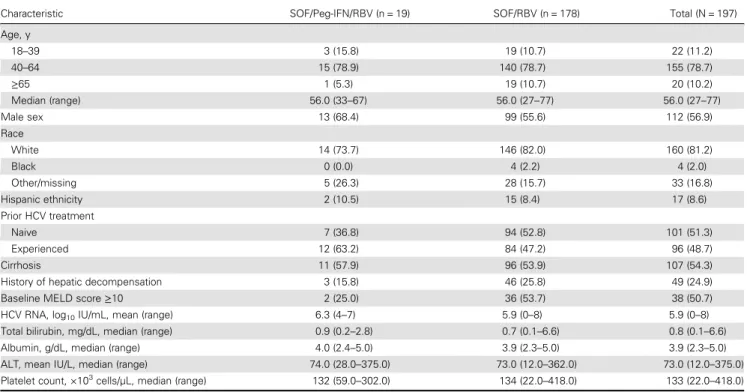
The majority of patients (178/197 [90%]) were treated with SOF/RBV, with 87% receiving 24±2 weeks of therapy, while 19 (10%) patients received 12 (n = 12), 16 (n = 1), or 24 (n = 5) weeks of SOF/peg-IFN/RBV, including 1 patient who discontin-ued treatment at week 4. In total, 112 (57%) were male, 81% were white, and the mean age was 56 years (range, 27–77 years). Just under half (49%) were treatment experienced and 3 patients (1.5%) were coinfected with human immunodeficiency virus (HIV). Of 107 (54%) patients with cirrhosis, 49 (46%) had a
history of prior hepatic decompensation. Of cirrhotic patients with complete MELD data (70%), the median baseline MELD score was 10 (range, 6–24). MELD score was <10 in 49% (n = 37), 10–15 in 44% (n = 33), and >15 in 7% (n = 5) of patients with cirrhosis (Table1;Supplementary Table 1).
Treatment Response
SVR12was achieved by 107 of 178 (60.1%) patients treated with
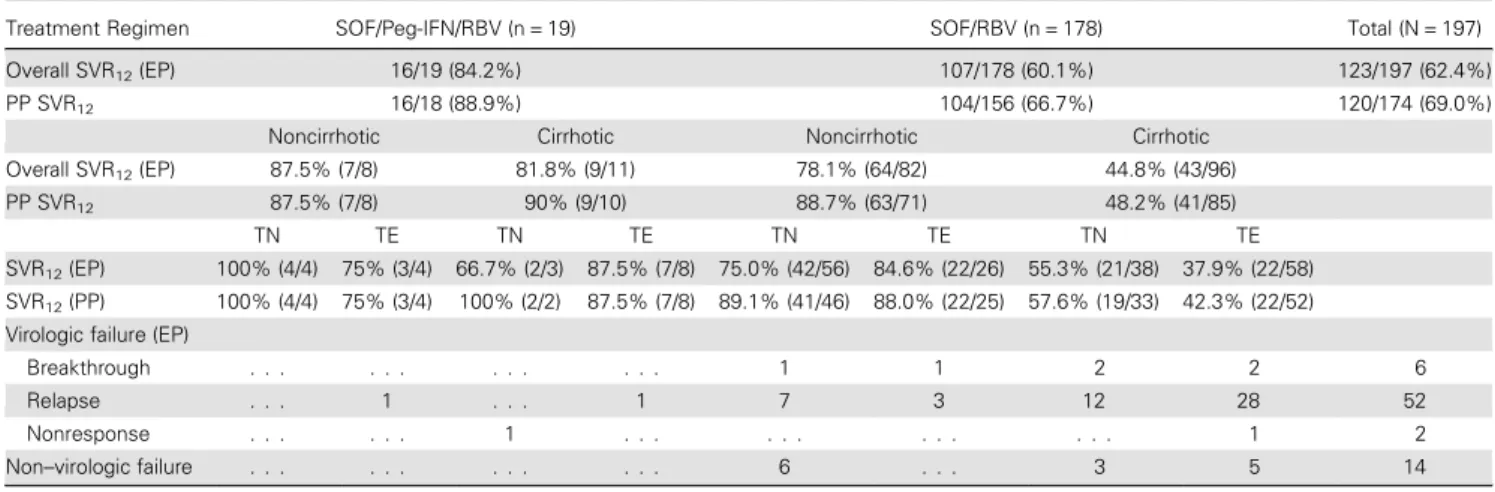
SOF/RBV. The reasons for virologic failure included relapse in 50 (28%) patients, viral breakthrough in 6 patients (3.4%), and lack of efficacy in 1 patient (<0.5%). Fourteen patients (8%) were lost to posttreatment follow-up and were counted as failing treat-ment. Of those who received SOF/peg-IFN/RBV, 16 of 19 (84%) achieved SVR12; 1 was a nonresponder and 2 relapsed (Table2).
In the per-protocol population, the SVR12rate was similar in
patients without cirrhosis who received SOF/RBV, whether treat-ment naive (41/46 [89%]) or experienced (22/25 [88%]). In pa-tients with cirrhosis treated with SOF/RBV, the SVR12rate was
58% (19 of 33) in treatment-naive patients and fell to 42% (22 of 52) in those who had failed prior therapy (Table2). In contrast, of 8 treatment-experienced patients with cirrhosis who received SOF/peg-IFN/RBV, 7 (88%) achieved SVR12(Table2). Overall,
treatment with SOF/RBV was associated with a lower rate of SVR than treatment with SOF/peg-IFN/RBV (OR, 0.25; 95% CI, .06–1.13), but the difference did not reach statistical signifi -cance given the few patients treated with triple therapy. After
Table 1. Baseline Demographic and Clinical Characteristics of Patients With Genotype 3 Hepatitis C Virus Who Completed Therapy With Sofosbuvir and Ribavirin With or Without Peginterferon
Characteristic SOF/Peg-IFN/RBV (n = 19) SOF/RBV (n = 178) Total (N = 197)
Age, y
18–39 3 (15.8) 19 (10.7) 22 (11.2)
40–64 15 (78.9) 140 (78.7) 155 (78.7)
≥65 1 (5.3) 19 (10.7) 20 (10.2)
Median (range) 56.0 (33–67) 56.0 (27–77) 56.0 (27–77)
Male sex 13 (68.4) 99 (55.6) 112 (56.9)
Race
White 14 (73.7) 146 (82.0) 160 (81.2)
Black 0 (0.0) 4 (2.2) 4 (2.0)
Other/missing 5 (26.3) 28 (15.7) 33 (16.8)
Hispanic ethnicity 2 (10.5) 15 (8.4) 17 (8.6)
Prior HCV treatment
Naive 7 (36.8) 94 (52.8) 101 (51.3)
Experienced 12 (63.2) 84 (47.2) 96 (48.7)
Cirrhosis 11 (57.9) 96 (53.9) 107 (54.3)
History of hepatic decompensation 3 (15.8) 46 (25.8) 49 (24.9)
Baseline MELD score≥10 2 (25.0) 36 (53.7) 38 (50.7)
HCV RNA, log10IU/mL, mean (range) 6.3 (4–7) 5.9 (0–8) 5.9 (0–8)
Total bilirubin, mg/dL, median (range) 0.9 (0.2–2.8) 0.7 (0.1–6.6) 0.8 (0.1–6.6)
Albumin, g/dL, median (range) 4.0 (2.4–5.0) 3.9 (2.3–5.0) 3.9 (2.3–5.0)
ALT, mean IU/L, median (range) 74.0 (28.0–375.0) 73.0 (12.0–362.0) 73.0 (12.0–375.0)
Platelet count, ×103
cells/µL, median (range) 132 (59.0–302.0) 134 (22.0–418.0) 133 (22.0–418.0)
Data are presented as No. (%) unless otherwise indicated.
controlling for the presence of cirrhosis, neither treatment history nor treatment duration was associated with SVR.
After controlling for age and sex, the absence of cirrhosis (OR, 6.4; 95% CI, 2.78–14.74), albumin levels of≥3.2 g/dL (OR, 12.48; 95% CI, 3.86–40.33), and platelet count >105cells/µL (OR, 7.44; 95% CI, 3.51–15.78) were associated with greater odds of achiev-ing SVR12, whereas male sex (OR, 0.44; 95% CI, .22–.86) and
in-creasing baseline bilirubin levels (OR, 0.37; 95% CI, .22–.63) were negative predictors of response (Figure1).
Among patients with cirrhosis, after controlling for age and sex, patients with baseline albumin≥3.2 g/dL (OR, 7.13; 95% CI, 2.09–24.32) and those with platelet count >105cells/µL (OR,
5.27; 95% CI, 1.84–15.08) were more likely to achieve SVR. In-creasing baseline total bilirubin (OR, 0.43; 95% CI, .23–.79), base-line MELD score (OR, 0.75; 95% CI, .61–.92), and history of decompensating events (OR, 0.29; 95% CI, .12–.70) were each as-sociated with a decreased likelihood of SVR (Figure2). The SVR rate in patients treated with SOF/RBV with compensated cirrhosis was 64.8% (35/54) compared with 36% (4/11) in those with a his-tory of decompensated disease (P= .08). Baseline HCV RNA was not predictive of SVR. Week 4 HCV RNA values were available in 153 patients (81%) and although patients with undetectable HCV RNA by week 4 were more likely to achieve SVR, this did not reach statistical significance (P= .09).
Table 2. Virologic Response in Patients With Genotype 3 Hepatitis C Virus Who Completed Therapy With Sofosbuvir and Ribavirin With or Without Peginterferon
Treatment Regimen SOF/Peg-IFN/RBV (n = 19) SOF/RBV (n = 178) Total (N = 197)
Overall SVR12(EP) 16/19 (84.2%) 107/178 (60.1%) 123/197 (62.4%)
PP SVR12 16/18 (88.9%) 104/156 (66.7%) 120/174 (69.0%)
Noncirrhotic Cirrhotic Noncirrhotic Cirrhotic
Overall SVR12(EP) 87.5% (7/8) 81.8% (9/11) 78.1% (64/82) 44.8% (43/96)
PP SVR12 87.5% (7/8) 90% (9/10) 88.7% (63/71) 48.2% (41/85)
TN TE TN TE TN TE TN TE
SVR12(EP) 100% (4/4) 75% (3/4) 66.7% (2/3) 87.5% (7/8) 75.0% (42/56) 84.6% (22/26) 55.3% (21/38) 37.9% (22/58)
SVR12(PP) 100% (4/4) 75% (3/4) 100% (2/2) 87.5% (7/8) 89.1% (41/46) 88.0% (22/25) 57.6% (19/33) 42.3% (22/52)
Virologic failure (EP)
Breakthrough . . . 1 1 2 2 6
Relapse . . . 1 . . . 1 7 3 12 28 52
Nonresponse . . . 1 . . . 1 2
Non–virologic failure . . . 6 . . . 3 5 14
Abbreviations: EP, evaluable population; peg-IFN, pegylated interferon; PP, per protocol; RBV, ribavirin; SOF sofosbuvir; SVR12, sustained virologic response at 12 weeks; TE, treatment experienced; TN, treatment naive.
Adverse Events
At least 1 AE was reported by 86% (169/197), whether treated with SOF/RBV or SOF/peg-IFN/RBV (Table3). The most com-monly reported AEs were fatigue (40%), headache (21%), and anemia (20%) (Table3). Rash was reported in 5 (26%) patients treated with SOF/peg-IFN/RBV and 23 (13%) of those treated with SOF/RBV. Depression was documented in 25 (14%) pa-tients on SOF/RBV compared to none on SOF/peg-IFN/RBV. In total, 11 patients experienced hepatic decompensation dur-ing therapy, all of whom had a prior history of decompensation (Table4). Hepatic encephalopathy (n = 10) was the most fre-quently reported decompensating event, followed by ascites (n = 2) and variceal hemorrhage (n = 2).
Anemia was reported in 37 (21%) patients on SOF/RBV and 3 (16%) patients on SOF/peg-IFN/RBV. The median hemoglobin decline was 2.1 g/dL in SOF/RBV-treated patients, and 2.7 g/dL in patients treated with SOF/peg-IFN/RBV. Anemia led to RBV dose reduction in 33 (18.5%) and discontinuation in 2 (10.5%) pa-tients. The initial RBV dose ranged from 4.6 mg/kg to 19.2 mg/kg (mean, 13.1 mg/kg). As shown in the forest plots (Figures1and
2), initial RBV dose was not associated with SVR in those with cirrhosis but was associated with SVR in the overall population, suggesting the effect was greatest in those without cirrhosis. The correlation between RBV dose and SVR is shown in Figure3. RBV dose reduction was not associated with SVR (Figure1and 2). Addition of erythropoietin was needed by 7 patients (4%) and a blood transfusion by 4 (2%) individuals, all in patients treated with SOF/RBV. A total of 18 SAEs were reported in 13 patients (all treated with SOF/RBV), of which 8 SAEs in 7 patients were likely related to HCV therapy per the treating physician.
Table 3. Adverse Events and Management of Anemia
Event
SOF/Peg-IFN/ RBV (n = 19)
SOF/RBV (n = 178)
Total (N = 197)
Any adverse event 15 (79.0) 154 (86.5) 169 (85.8)
Fatigue 8 (42.1) 70 (39.3) 78 (39.6)
Headache 4 (21.1) 38 (21.4) 42 (21.3)
Anemia 3 (15.8) 37 (20.8) 40 (20.3)
Insomnia 2 (10.5) 35 (19.7) 37 (18.8)
Nausea 1 (5.3) 33 (18.5) 34 (17.3)
Rash 5 (26.3) 23 (12.9) 28 (14.2)
Dyspnea 2 (10.5) 25 (14.0) 27 (13.7)
Influenza-like illness 5 (26.3) 21 (11.8) 26 (13.2)
Depression 0 (0.0) 25 (14.0) 25 (12.7)
Dizziness 2 (10.5) 21 (11.8) 23 (11.7)
Irritability 3 (15.8) 19 (10.7) 22 (11.2)
Pruritus 2 (10.5) 20 (11.2) 22 (11.2)
Decreased appetite 3 (15.8) 15 (8.4) 18 (9.1)
Abdominal pain 3 (15.8) 13 (7.3) 16 (8.1)
Asthenia 2 (10.5) 13 (7.3) 15 (7.6)
Diarrhea 2 (10.5) 11 (6.2) 13 (6.6)
Muscle spasms 2 (10.5) 11 (6.2) 13 (6.6)
Cough 2 (10.5) 11 (6.2) 13 (6.6)
Serious adverse events
(18 events)a 0 (0.0) 13 (7.3) 13 (6.6)
Anemia management
RBV dose reduction 2 (10.5) 33 (18.5) 35 (17.8)
Erythropoietin use 0 (0.0) 7 (3.9) 7 (3.6)
Blood transfusion 0 (0.0) 4 (2.2) 4 (2.0)
RBV discontinuation 0 (0.0) 1 (0.6) 1 (0.5)
Data are presented as No. (%) of patients.
Abbreviations: peg-IFN, pegylated interferon; RBV, ribavirin; SOF, sofosbuvir. a
Anemia, colitis, gastrointestinal hemorrhage, esophageal varices hemorrhage, chest pain, hepatocellular carcinoma (2), hepatic encephalopathy (4), dizziness (2), depression, psychotic disorder, renal failure acute (2), epistaxis.
DISCUSSION
This large observational study evaluated the effectiveness and safety of 2 SOF-based therapies in patients with GT3 HCV in-fection. Although treatment was generally safe and fairly well tolerated, the SVR12results were suboptimal (69%), particularly
in patients with cirrhosis treated with SOF/RBV alone, high-lighting the need for improved therapies for this population.
As reported in clinical trials, the main determinant of out-come in GT3 infection was the presence of cirrhosis [10–12]. Less than half (48%) of those with cirrhosis treated with SOF/ RBV achieved SVR12. Notably, cirrhosis was a negative
predic-tor of response even in patients who were previously untreated.
Although the VALENCE trial reported a 92% SVR rate in treat-ment-naive patients with cirrhosis, only 13 such patients were included in the trial [12]. In this real-world study, only 19 of the 33 (58%) treatment-naive patients with cirrhosis achieved SVR12. Whether this reflects differences between clinical trials
and clinical practice, or inclusion of patients with more ad-vanced disease, or highlights the uncertainty of drawing conclu-sions from the small numbers included in the trial is difficult to determine.
How cirrhosis affects response to therapy is not clear but is likely multifactorial [20]. Data from patients with genotype 1 in-fection suggest that even in a cirrhotic liver, SOF is effectively taken up by hepatocytes and phosphorylated to the active com-pound [20]. Shunting due to portal hypertension may affect local drug concentrations and cirrhosis has important effects on innate and adaptive immune function, which are likely still important for viral clearance even with potent DAA therapy [20]. Younossi and colleagues recently reported that patients with GT3 infection had lower levels of lipids and, specifically, lower levels of metabolites from late in the cholesterol biosyn-thesis pathway [21]. Although the specific mechanisms remain unclear, thesefindings support the hypothesis that the unique effects of GT3 HCV on lipid metabolism may affect responses to antiviral therapy, an effect that appears to be more pronounced in the presence of cirrhosis. Unfortunately, cirrhosis is important even when SOF is combined with other approved DAAs for GT3 infection. Only 63% of patients with cirrhosis achieved SVR when SOF was combined with DCV for 12 weeks [22]. In the small ALLY 3+ study, patients with GT3 HCV and cirrhosis who re-ceived SOF/DCV plus RBV for 12 or 16 weeks achieved SVR rates of 83%–89%; however, the small sample size makes it difficult to draw strong conclusions or to distinguish the preferred duration [23]. Additional data from the French compassionate use program showed that 24 weeks of SOF/DCV with or without RBV led to
Table 4. Details on 14 Decompensation Events in 11 Patients During Antiviral Therapy
Patient ID Decompensation Event Regimen Releated to Treatment Timing of Event, wk Past History of Decompensation Treatment Outcome
1 Hepatic encephalopathy SOF/RBV N 8.3 Y SVR
2 Hepatic encephalopathy SOF/RBV Y 16.1 Y Relapse
3 Variceal hemorrhage SOF/RBV N 11.7 Y Relapse
4 Hepatic encephalopathy SOF/RBV Y 4.9 Y Relapse
4 Hepatic encephalopathy SOF/RBV Y 24.4 Y Relapse
5 Variceal hemorrhage SOF/RBV Y 0.4 Y SVR
6 Hepatic encephalopathy SOF/RBV Y 0.1 Y Relapse
7 Hepatic encephalopathy SOF/RBV Y 19.4 Y SVR
7 Hepatic encephalopathy SOF/RBV Y 16.6 Y SVR
8 Hepatic encephalopathy SOF/RBV Y 0.1 Y LTFU
8 Ascites SOF/RBV Y 9 Y LTFU
9 Hepatic encephalopathy SOF/RBV N 4.3 Y BT
10 Hepatic encephalopathy SOF/RBV Y 4.9 Y BT
11 Ascites SOF/RBV Y 13.3 Y SVR
Abbreviations: BT, breakthrough (on treatment); LTFU, lost to posttreatment follow-up; SOF/RBV, sofosbuvir/ribavirin; SVR, sustained virologic response.
Figure 3. Correlation of probability of sustained virologic response at 12 weeks (SVR12) and initial ribavirin (RBV) dose (by body weight [BW]; mg/kg). The impact of
SVR rates >80% despite inclusion of some patients with decom-pensated disease [24]. SOF/RBV plus LDV has also been evaluated in GT3 HCV. With the very limited activity of LDV against GT3 in vitro, it was perhaps surprising to see SVR rates as high as 73% in patients with cirrhosis [25]. These results clearly leave room for improvement for patients with GT3 infection and cirrhosis.
The disappointing outcomes with SOF/RBV therapy led to evaluation of the reintroduction of peg-IFN. Similar to the ini-tial small studies evaluating this approach, the SOF/peg-IFN/ RBV regimen proved quite effective in this cohort, most notably in the 8 patients with cirrhosis who had failed prior therapy, 7 of whom achieved SVR. A randomized controlled trial comparing SOF/RBV for 16 or 24 weeks to SOF/peg-IFN/RBV for 12 weeks in patients with GT3 HCV [14] showed that the inclusion of peg-IFN increased response rates in all patient subgroups but most notably in those with cirrhosis, whether treatment naive or experienced. Peg-IFN was well tolerated, with only 1 patient discontinuing treatment prematurely. Similarly, in this real-world experience, peg-IFN was well tolerated, with similar rates of AEs and higher rates of SVR reported compared with SOF/ RBV alone. However, despite these encouraging results, SOF/ peg-IFN/RBV was prescribed to only 19 of the 197 (9.6%) pa-tients with GT3 who have started therapy in HCV-TARGET to date. Clearly there is a great reluctance by both clinicians and pa-tients to accept interferon-based therapies. Fortunately, recent studies have shown that SOF combined with velpatasvir, a pan-genotypic NS5A inhibitor, is highly effective for GT3 HCV infec-tion, leading to SVR12rates of 90% even in patients with
cirrho-sis, without the need for RBV [26]. Other promising DAA combinations hold promise for GT3 HCV as well [27]. With this in mind, although SOF/peg-IFN/RBV may be considered for patients, particularly those with cirrhosis, waiting for approval of new therapies may be prudent, as it is unclear if an unsuccessful course of SOF/RBV or SOF/DCV will affect responses and/or ac-cess to future therapies.
Among patients with cirrhosis, low baseline albumin and low platelet count were associated with much lower odds of achieving SVR12. Only 20% of patients with albumin levels <3.2 g/dL
achieved SVR, whereas 39% with baseline platelet count <105 cells/µL achieved SVR12 with SOF/RBV. Of the 18 patients
with albumin <3.2 g/dL and platelets <105cells/µL, only 4 (22%) achieved SVR, suggesting that for such individuals, waiting for availability of new multi-DAA regimens would be advisable. This study has some important limitations. The lack of ran-domization limits the ability to directly compare treatment groups, which is further compounded by the small number of patients who received SOF/peg-IFN/RBV therapy. However, the results clearly demonstrate the limitations of SOF/RBV in pa-tients with GT3 HCV infection and cirrhosis. In addition, by including a broader population of patients, many of whom may not have qualified for clinical trials, the safety and effective-ness profile provide very useful data for clinicians and patients.
CONCLUSIONS
This large observational, real-world study demonstrated that GT3 remains a clinical challenge. SOF/RBV for 24 weeks result-ed in low SVR rates in patients with cirrhosis, particularly those with low baseline albumin and platelet levels. Although high
ef-ficacy and acceptable tolerability were seen in patients treated with SOF/peg-IFN/RBV, the extremely low uptake of this regi-men highlights the poor acceptance of peg-IFN among patients and clinicians. Therapies in development will hopefully im-prove outcomes for this difficult-to-cure population.
Supplementary Data
Supplementary materialsare available athttp://cid.oxfordjournals.org. Consisting of data provided by the author to benefit the reader, the posted materials are not copyedited and are the sole responsibility of the author, so questions or comments should be addressed to the author.
Notes
Author contributions. Data analysis, drafting and editing of manu-script: J. J. F., R. M. Study concept, data collection, editing of manumanu-script: M. W. F., D. R. N. Editing of manuscript: S. Z., A. K., A. M. D. B., M. M., K. S., L. M. F., R. S.
Financial support. Hepatitis C Virus Therapeutic Registry and Re-search Network is an investigator-initiated study jointly sponsored by the University of Florida, Gainesville ( principal investigator [PI]: D. R. N.) and the University of North Carolina at Chapel Hill (PI: M. W. F.). It was funded in part by AbbVie, Bristol-Myers Squibb, Gilead, Janssen, Kadmon, Merck, and Vertex, and by the Clinical and Translational Science Award, University of Florida (UL1TR000064). M. W. F. was funded in part by a Na-tional Institutes of Health Mid-Career Mentoring Award (number K24 DK066144).
Potential conflicts of interest. J. J. F. reports receiving honoraria and/or research funds from AbbVie, Bristol-Myers Squibb (BMS), Gilead, Janssen, Merck, and Theravance. R. M. receivedfinancial compensation for consultancy from AbbVie. S. Z. reports honoraria for speaking/consultancy from AbbVie, BMS, Gilead, Janssen, and Merck. A. K. reports grant funding from Gilead. D. R. N. reports grant funding from AbbVie, BMS, Gilead, GSK, Janssen, and Merck. A. M. D. B. reports grant and consultancy fees from AbbVie, BMS, and Gilead. M. P. M. reports speaking, research, or consultancy fees from Achillion, Biotest, BI, BMS, Gilead, Idenix, Janssen, Merck, Novartis, and Roche. K. S. reports research grants from AbbVie, BMS, Gilead, Innovia, Medimmune, and Merck and consultancy fees from Medimmune and ViiV. L. M. F. reports research or consultancy fees from AbbVie, Gilead, Janssen, and Merck. R. S. reports grants support from AbbVie, BMS, Gilead, Merck, and Roche and con-sultancy fees from AbbVie, Baxter, Bayer, Gilead, GSK, Janssen, and Salix. M. S. reports funding from Merck. M. W. F. reports grant funding from AbbVie, BMS, Gilead, GSK, Janssen, Merck, Roche, and Vertex and consultancy fees from AbbVie, BMS, Gilead, Janssen, Merck, Novartis, and Roche. All other au-thors report no potential conflicts. All authors have submitted the ICMJE Form for Disclosure of Potential Conflicts of Interest. Conflicts that the editors con-sider relevant to the content of the manuscript have been disclosed.
References
1. Gower E, Estes C, Blach S, Razavi-Shearer K, Razavi H. Global epidemiology and genotype distribution of the hepatitis C virus infection. J Hepatol2014; 61:S45–57. 2. Hajarizadeh B, Grebely J, Dore GJ. Epidemiology and natural history of HCV
in-fection. Nat Rev Gastroenterol Hepatol2013; 10:553–62.
3. Kanwal F, Hoang T, Kramer JR, et al. Increasing prevalence of HCC and cirrhosis in patients with chronic hepatitis C virus infection. Gastroenterology2011; 140:1182–1188.e1181.
5. Probst A, Dang T, Bochud M, Egger M, Negro F, Bochud PY. Role of hepatitis C virus genotype 3 in liverfibrosis progression—a systematic review and meta-analysis. J Viral Hepat2011; 18:745–59.
6. van der Meer AJ, Hansen BE, Fattovich G, et al. Reliable prediction of clinical out-come in patients with chronic HCV infection and compensated advanced hepatic
fibrosis: a validated model using objective and readily available clinical parameters. Gut2015; 64:322–31.
7. Vezali E, Aghemo A, Colombo M. A review of the treatment of chronic hepatitis C virus infection in cirrhosis. Clin Ther2010; 32:2117–38.
8. Duarte-Rojo A, Heathcote EJ, Feld JJ.‘Easy to treat’genotypes were not created equal: can rapid virological response (RVR) level the playingfield? J Hepatol2011; 55:466–73. 9. Feld JJ. Interferon-free strategies with a nucleoside/nucleotide analogue. Semin
Liver Dis2014; 34:37–46.
10. Jacobson IM, Gordon SC, Kowdley KV, et al. Sofosbuvir for hepatitis C genotype 2 or 3 in patients without treatment options. N Engl J Med2013; 368:1867–77. 11. Lawitz E, Mangia A, Wyles D, et al. Sofosbuvir for previously untreated chronic
hepatitis C infection. N Engl J Med2013; 368:1878–87.
12. Zeuzem S, Dusheiko GM, Salupere R, et al. Sofosbuvir and ribavirin in HCV ge-notypes 2 and 3. N Engl J Med2014; 370:1993–2001.
13. Lawitz E, Poordad F, Brainard DM, et al. Sofosbuvir with peginterferon-ribavirin for 12 weeks in previously treated patients with hepatitis C genotype 2 or 3 and cirrhosis. Hepatology2015; 61:769–75.
14. Foster GR, Pianko S, Brown A, et al. Efficacy of sofosbuvir plus ribavirin with or without peginterferon-alfa in patients with hepatitis C virus genotype 3 infection and treatment-experienced patients with cirrhosis and hepatitis C virus genotype 2 infection. Gastroenterology2015; 149:1462–70.
15. European Association for the Study of the Liver. EASL recommendations on treat-ment of hepatitis C 2015. J Hepatol2015; 63:199–236.
16. American Association for the Study of Liver Diseases/Infectious Diseases Society of America HCV Guidance Panel. Hepatitis C guidance: AASLD-IDSA recom-mendations for testing, managing, and treating adults infected with hepatitis C virus. Hepatology2015; 62:932–54.
17. Sulkowski MS, Vargas HE, Di Bisceglie AM, et al. Effectiveness of simeprevir plus sofosbuvir, with or without ribavirin, in real-world patients with HCV genotype 1 infection. Gastroenterology2016; 150:419–29.
18. Gordon SC, Muir AJ, Lim JK, et al. Safety profile of boceprevir and telaprevir in chronic hepatitis C: real world experience from HCV-TARGET. J Hepatol2015; 62:286–93.
19. Thein HH, Yi Q, Dore GJ, Krahn MD. Estimation of stage-specificfibrosis progression rates in chronic hepatitis C virus infection: a meta-analysis and meta-regression. Hepatology2008; 48:418–31.
20. Al Marzooqi SH, Feld JJ. Sorting out cirrhosis: mechanisms of non-response to hepatitis C therapy. Liver Int2015; 35:1923–33.
21. Younossi ZM, Stepanova M, Estep M, et al. Dysregulation of distal cholesterol bio-synthesis in association with relapse and advanced disease in CHC genotype 2 and 3 treated with sofosbuvir and ribavirin. J Hepatol2015; 64:29–36.
22. Nelson DR, Cooper JN, Lalezari JP, et al. All-oral 12-week treatment with dacla-tasvir plus sofosbuvir in patients with hepatitis C virus genotype 3 infection: ALLY-3 phase III study. Hepatology2015; 61:1127–35.
23. Leroy V, Angus P, Bronowicki JP, et al. Daclatasvir, sofosbuvir, and ribavirin for hepatitis C virus genotype 3 and advanced liver disease: a randomized phase III study (ALLY-3+). Hepatology2016; 63:1430–41.
24. Hezode C, de Ledinghen V, Fontaine H, et al. Daclatasvir plus sofosbuvir with or without ribavirin in patients with HCV genotype 3 infection: interim analysis of a French multicenter compassionate use program. International Liver Congress, European Association for the Study of the Liver, Vienna, Austria,2015. 25. Gane EJ, Hyland RH, An D, et al. Efficacy of ledipasvir and sofosbuvir, with or without ribavirin, for 12 weeks in patients with HCV genotype 3 or 6 infection. Gastroenterology2015; 149:1454–61.
26. Foster GR, Afdhal N, Roberts SK, et al. Sofosbuvir and velpatasvir for HCV geno-type 2 and 3 infection. N Engl J Med2015; 373:2608–17.

![Figure 3. Correlation of probability of sustained virologic response at 12 weeks (SVR 12 ) and initial ribavirin (RBV) dose (by body weight [BW]; mg/kg)](https://thumb-us.123doks.com/thumbv2/123dok_us/8314020.2202406/6.890.76.433.675.954/figure-correlation-probability-sustained-virologic-response-initial-ribavirin.webp)
