ADDRESSING HUMAN PAPILLOMAVIRUS VACCINATION RATES IN THE 11-12 YEAR OLD AGE GROUP THROUGH IMPROVED PROVIDER RECOMMENDATION
Erica Harberger
A project submitted to the faculty at the University of North Carolina at Chapel Hill in a partial fulfillment of the requirements for the degree of Doctorate of Nursing Practice in the Department
of Nursing in the School of Nursing.
Chapel Hill 2018
Approved by: Carrie Palmer Amanda Davis
ABSTRACT
Erica Harberger: Addressing Human Papilloma Virus Vaccination Rates in the 11-12 Year Old Age Group Through Improved Provider Recommendation
(Under the direction of Carrie Palmer)
Background/Purpose: Human papillomavirus (HPV) is the most common sexually transmitted infection (STI) in the United States and the cause of significant morbidity and mortality from HPV-related cancers. The HPV vaccine is recommended for 11-12 year olds for the prevention of HPV-related cancers. Although HPV is recommended at the same visit as the Tetanus, Diphtheria, and Pertussis (Tdap) vaccine and Meningococcal vaccine, HPV vaccination rates remain low and trail Tdap and Meningococcal vaccination rates. Health care providers report the need for education of HPV and strategies to address vaccine hesitancy. Literature shows that providers with high HPV vaccination rates provide strong recommendations for the vaccine and parents report that the provider recommendation has the most influence on the decision to vaccinate. The purpose of this study is to determine influential factors for parental acceptance or refusal of the HPV vaccine and to increase HPV vaccination rates by improving provider
recommendation for the HPV vaccine through education and implementation of an evidence-based communication tool.
vaccine at 11-12 year old well visits over a three-month time period. During the same period, parents of 11-12 year old patients presenting for well visits were surveyed regarding influential factors for their decision to accept or refuse the HPV vaccine for their child.
ACKNOWLEDGEMENTS
Reflecting on the past three years as a graduate student in the BSN-DNP/FNP program brings forward mixed emotions, from gratitude and pride for the achievement of a personal goal set years ago, to anxiety and excitement as I embark on the start of a new career as a Family Nurse Practitioner.
I feel immense gratitude for the love, support, and understanding my fiancé has shown me through this process. He has been my rock and I will be forever grateful for him.
To my parents, family, and friends who have been there for me with words of encouragement or a break from school, I can’t thank you enough for your support.
I am immensely thankful for my committee members for the time, energy, and support they have shown throughout the DNP project. I am grateful for my committee chair, Dr. Carrie Palmer, for always being there to provide encouragement, ease my concerns, and answer any questions. I can’t thank Jamila Palmer enough for her commitment to my project as a committee member from the project site. Her involvement at the project site was crucial to the success of this project. And to Dr. Amanda Davis, your expertise as a Pediatric Nurse Practitioner and attention to detail was extremely beneficial to the planning and implementation of this project.
Finally, I am thankful for the providers and parents who participated in this DNP project. This project could not have happened without your support and commitment.
TABLE OF CONTENTS
Acknowledgements ... v
List of tables ... viii
List of figures ... ix
CHAPTER 1: BACKGROUND ... 1
CHAPTER 2: SIGNIFICANCE TO HEATHCARE ... 4
Purpose ... 4
CHAPTER 3: LITERATURE REVIEW ... 6
Definition of Terms ... 6
Provider related barriers ... 7
Parental barriers ... 9
Disparities in HPV vaccination ... 10
Recommended interventions ... 11
Provider education. ... 12
Provider recommendation style. ... 12
CHAPTER 4: THEORETICAL DOMAINS FRAMEWORK ... 14
Use of the Theoretical Domains Theory ... 15
CHAPTER 5: PROJECT DESIGN... 17
Methods and Interventions ... 17
Phase one. ... 18
Phase four. ... 22
Chapter 6: Results ... 24
Modified Provider Communication Survey ... 24
Provider participant characteristics. ... 24
Recommendation practices ... 25
Quality of HPV Vaccine Recommendation and Provider Participation. ... 35
Provider Knowledge Assessment ... 36
Adolescent Vaccine Rates ... 37
Well Visit Data ... 38
Baseline Adolescent Vaccine Data by Vaccine ... 39
Intervention Period Vaccine Data by Vaccine ... 39
Comparing Baseline Time Period Results to Intervention Time Period Results ... 40
Parent Survey ... 45
Survey Results: Accepted HPV Vaccine ... 45
Survey Results: Refused HPV Vaccine. ... 46
Chapter 7: Discussion ... 52
Key Findings ... 52
Provider Knowledge and Quality of Recommendation ... 52
Parent Survey ... 52
Vaccination Rates... 53
Implications for Practice ... 54
Limitations ... 55
Appendix 1: Theoritical Domain Framework domain definitions and constructs ... 57
Appendix 4: Provider knowledge assessment ... 74
Appendix 5: AAP HPV Champion Toolkit Communication tool ... 76
Appendix 6: Provider reminder card ... 77
Appendix 7: Parent survey- accept HPV vaccine ... 78
Appendix 8: Parent survey-refuse HPV vaccine ... 79
LIST OF TABLES
LIST OF FIGURES
Figure 1. Importance provider participants place on adolescent vaccinations
during recommendation ... 27
Figure 2. Provider responses when asked if the discussion of an STI makes discussing the HPV vaccine uncomfortable ... 30
Figure 3.Provider perception of importance parents of 11-12 year olds place on adolescent vaccinations: Phase one response ... 34
Figure 4. Provider perception of importance parents of 11-12 year olds place on adolescent vaccinations: Phase four responses ... 34
Figure 5. Composite Quality Scores for Recommendation of HPV Vaccine compiled from the Modified Communication Survey Results: Phase 1 and Phase 4 ... 36
Figure 6. Provider Knowledge Assessment Results Pre- and Post- Education ... 37
Figure 7. Number of Well Visits by Age, Sex, and Combined from 10/05/2016-01/05/2017 ... 38
Figure 8. Number of Well visits by Age, Sex, and Combined from 10/05/2017-01/05/2018 ... 38
Figure 9. Tdap Vaccine Rates by Age, Sex, and Combined from 10/01/2016-01/05/2017 ... 41
Figure 10. Tdap Vaccine Rates by Age, Sex, and Combined from 10/05/2017-01/05/2018. ... 42
Figure 11. Meningococcal Vaccine Rates by Age, Sex, and Combined from 10/05/2016-01/05/2018. ... 42
Figure 12. Meningococcal Vaccine Rates by Age, Sex, and Combined from 10/05/2017- 01/05/2018 ... 43
Figure 13. HPV Vaccine by Age, Sex, and Combined from 10/05/2016-01/05/2017 ... 43
Figure 14. HPV Vaccine by Age, Sex, and Combined from 10/05/2017-01/05/2018. ... 44
Figure 15. Logistic Regression of adolescent vaccine data ... 44
Figure 16. Parent Survey Responses to Cancer Related Questions Categorized by Acceptance or Refusal of HPV vaccine ... 48
Figure 19. Parental Reasons for Refusing HPV Vaccination for Child from Parent Survey ... 50 Figure 20. Most Influential Reason for Refusing HPV Vaccination for Child
CHAPTER 1: BACKGROUND
The Centers for Disease Control and Prevention (CDC) ranks Human Papillomavirus (HPV) as the most common sexually transmitted infection in the United States (CDC, 2016a). According to the National Vaccine Advisory Committee (NVAC) (2016), 14 million individuals are diagnosed with HPV in the United States each year and half of these individuals are between 14 and 25 years of age. Responsible for almost all cervical cancers, as well as the majority of anal, vaginal, oropharyngeal, vulvar and penile cancers, HPV causes significant morbidity and mortality (NVAC, 2016). For the prevention of HPV-related cancers, three HPV vaccinations have been developed and made available for routine vaccination in the United States since 2006 (NVAC, 2016).
High-risk HPV strains 16 and 18 cause 70% of cervical cancers, as well as a high percentage of other HPV-related cancers (National Cancer Institute (NCI), 2016). Five additional high-risk HPV strains, 31, 33, 45, 52, and 58, have also been found to cause HPV-related cancers. Human papilloma virus strains 6 and 11 are the cause of genital warts (NCI, 2016).
effectiveness of nearly 100% in the prevention of cervical infection and cellular changes from persistent infection from HPV strains 16 and 18 when given prior to exposure to HPV (NCI, 2016). Gardasil 9 has an effectiveness of 97% in the prevention of cervical cancer and HPV-related vulvar and vaginal cancers (NCI, 2016). Gardasil has also effectively reduced the risk of HPV-related anal and oropharyngeal cancers in men and women (NCI, 2016). The duration of Gardasil 9 vaccine effectiveness remains unknown as long-term studies still ongoing (NCI, 2016). So far, documented prevention of HPV infection after Cervarix vaccination is at least nine years and after Gardasil vaccination, at least eight years (NCI, 2016). Recent studies in younger adolescents showed that immunity after two doses of Cervarix or Gardasil was equivalent to three doses in older adolescents (NCI, 2016). Current recommendations for the administration of HPV vaccinations allows for two doses, at least six months apart, in those aged 9-14 years
(CDC, 2016b). Individuals aged 15-26 will continue to receive the three dose regimen (CDC, 2016b).
The Advisory Committee on Immunization Practices (ACIP) and the CDC recommend the initiation of the vaccination series at 11 years old, along with other vaccinations
CHAPTER 2: SIGNIFICANCE TO HEATHCARE
Sexually active males and females are negatively impacted by a lack of protection against HPV-related cancers, increasing their risk of HPV related cancer death that would be prevented by vaccination (NVAC, 2016). An average of 11,771 women are diagnosed with HPV-related cervical cancer and 15,738 men are diagnosed with HPV-related oropharyngeal cancer in the United States annually (Viens et al, 2016). It is estimated that by 2020, the number of men dying from HPV-related oropharyngeal cancer will outnumber the number of women dying from cervical cancer (Dempsey, 2017). Of the 38,793 HPV-related cancers diagnosed each year, 28,400 cases are caused by HPV strains that are prevented by the 9-valent HPV vaccine (Viens et al., 2016).
Each year, $8 billion is spent on preventable HPV associated diseases in the United States (Chesson et al., 2012). Cervical cancer screening and follow up care alone account for $6.6 billion, 82% of the financial burden associated with HPV diseases (Chesson et al., 2012). An additional $1 billion is spent on the treatment of HPV related cancers and $228 million spent on the treatment of genital warts and recurrent respiratory papillomatosis (RRP) (Chesson et al., 2012).
Purpose
• To implement evidence-based strategies to improve healthcare provider recommendation of the HPV vaccine in the recommended 11-12 year old age group with the goal of increasing initial HPV vaccinations rates in the
recommended age group in a North Carolina pediatric primary care setting. • To evaluate the factors that influence parental acceptance or refusal of the HPV
CHAPTER 3: LITERATURE REVIEW
To identify gaps in practice and possible interventions to address low HPV vaccination rates in North Carolina, a literature review was performed. Databases searched include PubMed and CINHAL. Exclusion criteria include articles written in a language other than English, inclusion of a target population age over 13 years old, articles older than 5 years. Search terms used: Human papillomavirus, HPV, and vaccine acceptance. PubMed produced 476 results and CINAHL produced 20. After duplicate studies and irrelevant articles were omitted, 295
remained. Twenty articles, including systematic reviews, literature reviews and most recent research articles not studied or cited within the reviews were ultimately chosen for use in this thematic literature review.
Definition of Terms
For the purpose of this literature review, the term “initiation” refers to the first
vaccination in the three-part vaccine series. The term “completion” refers to the receipt of all three HPV vaccinations in the series. The term “uptake” refers to acceptance and receipt or administration of the HPV vaccine.
Perkins, Lin, Silliman, Clark, & Hanchate, 2015b; Rimer, Harper, & Witte, 2014). Missed opportunities occur when at least one vaccination appropriate for the 11-12 year old age group is given, but the HPV vaccination is not (Rimer et al., 2014). Racial, ethnic, gender, sexual
orientation and socioeconomic disparities in HPV knowledge and vaccination uptake have been observed and discussed, as well (Bond et al., 2016; Daniel-Ulloa, Gilbert, & Parker, 2016; Davlin, Berenson, & Rahman, 2015; Kepka et al., 2016).
Provider Related Barriers
Provider-related barriers include poor recommendation, lack of knowledge, financial concerns, parental attitudes, and discomfort with addressing adolescent sexuality (Hofstetter & Rosenthal, 2014; NVAC, 2016; Rimer et al., 2014). A strong provider recommendation greatly influences HPV vaccination acceptance and uptake (Berenson, 2016; Fontenot, Domush, & Zimet, 2016; Hofstetter & Rosenthal, 2014; NVAC, 2016; Rimer et al., 2014). Berenson (2016) concludes that a lack of provider recommendation is the most cited reason for vaccination refusal or deferral and is the strongest predictor of HPV vaccination uptake. Hofstetter and Rosenthal (2014) report that only 53% of providers are recommending the vaccine to females and only 14% are recommending the vaccine for males.
Poor provider recommendation is associated with a lack of provider knowledge of HPV and the vaccination, perceived high likelihood of parental hesitancy or refusal upon
2011). A survey of family practice physicians and pediatricians found that the expectation of parental refusal of the HPV vaccine diminished provider recommendation (Allison et al., 2016).
Many providers report difficulty discussing adolescent sexual health and attempt to base their recommendation for HPV vaccination on their perceived patient risk on an individual basis. Of physicians surveyed in the U.S., 59% report using a risk based approach to their
recommendation for the vaccine, although it has been shown that predicting sexual activity is difficult and often underestimated (Bratic et al., 2016). This approach to recommendation is an example of lack of provider knowledge of the HPV vaccination. The vaccination is
recommended at 11-12 years of age, because the vaccination provides the best protection when given prior to the adolescent’s sexual debut (Hofstetter & Rosenthal, 2014). Higher HPV
vaccination series completion rate is another benefit of the initiation of the HPV vaccine series at a younger age (St. Sauver et al., 2016).
Financial barriers to the HPV vaccination exist and can influence provider
recommendation for the vaccine. The HPV vaccination is expensive and practices must provide the up-front cost of purchasing the vaccinations for privately insured patients without
reimbursement until the administration of the vaccine, causing some practices to not stock the vaccine (Rimer et al., 2014). Low reimbursement for vaccination through Medicaid is also a financial concern that is currently being addressed by the Affordable Care Act (Rimer et al., 2014).
Survey (NIS) (Hofstetter & Rosenthal, 2014). Fifty-seven percent of females aged 13-17 received the HPV vaccination, compared to 78% receiving the meningococcal vaccination and 86% receiving the Tdap vaccination in 2013 (Perkins et al., 2015b).
Parental Barriers
Parents who lack knowledge of HPV, the HPV vaccine, and adolescent sexual behavior are more likely to refuse or delay the initiation of the HPV vaccine series (Hofstetter &
Rosenthal, 2016). Parents who believe their child is not at risk of contracting HPV during this age group because they are not sexually active tend to refuse or delay vaccination (Hofstetter & Rosenthal, 2014). Safety concerns regarding the vaccination are common among parents of unvaccinated adolescents (Berenson, 2016). Fear of future fertility problems in males and females has been cited as a reason for refusal of the vaccine (Berenson, 2016). Fear of increased risky sexual behavior after the HPV vaccination has also been noted to be a reason for parental refusal, although research does not support this (Hofstetter & Rosenthal, 2014). Additionally, sexually transmitted infections are not higher in those vaccinated compared to those not
vaccinated (Berenson, 2016). Some parents are not aware the vaccine is recommended for males as well as females, though there is less parental concern for promiscuity post vaccination for males (Berenson, 2016; Hofstetter & Rosenthal, 2014).
The time commitment for a three injection vaccine series was also cited in the literature as a parental barrier (Bratic et al., 2016; Javaid et al., 2016). Jacobson, Agunwamba, St Sauver, & Finney report that the delayed benefit of the HPV vaccine as a parental barrier the vaccine being viewed as less of a priority by parents leading to delayed vaccination (as cited in Bratic et al., 2016).
Disparities in HPV Vaccination
A review of the 2013 National Health Interview Survey revealed many disparities in HPV vaccination initiation and completion when comparing gender, race/ethnicity and sexual
orientation (Daniel-Ulloa e al., 2016). Gender comparison revealed 30% of women reported receiving the vaccination compared to 5% of males (Daniel-Ulloa et al., 2016). Kepka et al. (2016) found that Hispanic males who were not privately insured were more likely to be vaccinated compared to non-Hispanic white males.
Many differences were found when comparing race/ethnicity among women. Black women were vaccinated 30% less than white women and other races were vaccinated at
marginally lower rates compared to white women (Daniel-Ulloa et al., 2016). Black and Latina women completed the vaccination series at a lower rate when compared to white women (Daniel-Ulloa et al., 2016). Sexual orientation had a marginal impact on vaccination initiation among women, with higher rates reported among lesbian and bisexual women compared to heterosexual women (Daniel-Ulloa et al., 2016). No significant difference was observed in rates among men when comparing race/ethnicity and sexual orientation in this particular study
(Daniel-Ulloa et al., 2016).
these groups have low knowledge of HPV and the vaccine benefits, according to a recent study (Davlin, et al., 2015). A focus group based study of African American, Hispanic, and Caucasian female adolescents found that awareness of HPV and the HPV vaccination was high, but
understanding was low, and the majority of subjects did not object to the HPV vaccination (Bond et al., 2016).
Parental concerns differ when comparing race or ethnicity. Fears that the vaccination promotes sexual activity, concerns regarding safety, and low perceived risk of children
contracting HPV are common concerns among Latina parents (Galbraith et al., 2016). Barriers to vaccination among African American parents include promotion of premarital sexual activity, lack of knowledge, lack of provider recommendation, perceived provider hesitancy with
recommendation, mistrust of providers and pharmaceutical companies (Galbraith et al., 2016). Religion was found to have a large impact on HPV vaccination acceptance in African Americans. It was found that non-Baptist Christian African Americans were over three times more likely to accept the HPV vaccine for daughters compared to Baptists.
Recommended Interventions
Interventions to improve HPV vaccination should focus on provider education of HPV and provider communication of the recommendation for the vaccine. In comparison to patient demographics, age, insurance, and parental factors, provider recommendation has been found to have the most impact on HPV vaccine uptake (Dempsey, 2017). Perkins et al. (2015b) notes that not enough providers receive training in communication surrounding difficult topics and
Provider education.
Educational, communication based, and practice based interventions for increasing HPV vaccination rates are recommended. Hofstetter and Rosenthal (2014) references the success of study reported by The Community Guide (2014) of an expert-led HPV educational workshop for community health educators and counselors that led to an increased knowledge of the HPV vaccine and barriers to uptake and increased provider’s willingness to recommend the vaccine. It is recommended that provider education be delivered through multiple modalities, such as, online training, continuing education, and educational detailing (Hofstetter & Rosenthal, 2014). The use of graphic presentation and the CDC tip sheet for communication with families are examples of communication-based interventions recommended by research (Hofstetter & Rosenthal, 2014). Physicians reported favorable attitudes toward the use of the CDC “You are the Key” website which provides support for provider recommendations (Scherr, C., Augusto, B., Ali, K., Malo, T.L. & Vadaparampil, S. T., 2016). Perkins et al. (2015a) studied the impact of a provider-focused interventions on HPV vaccination rates with increased vaccination rates compared to the control group. Provider based interventions included repeated contacts, education, individualized feedback and strong quality improvement incentives (Perkins et al., 2015a).
Provider recommendation style.
The wording or phrasing of the provider recommendation has been shown to influence acceptance. Vaccine recommendation for vaccinations in early childhood have been studied and found that the presumptive style of recommendation increased vaccination uptake when
driven communication style compared to the patient driven style (Moss, Reiter, Rimer, & Brewer, 2016). Based on a study of providers with high vaccination rates, recommendation of the HPV vaccine as “a safe, routine, immunization that prevents cancer” may increase HPV vaccine acceptance and increase vaccine uptake (Bratic et al., 2016). Bratic et al. (2016) found that presenting the vaccine as “due” with other age-related vaccinations, along with “a straight forward discussion with strong support” can have a positive impact on vaccine uptake and reduce time spent discussing the vaccine. Malo et al., 2016 studied the use of motivational messages by providers when recommending the HPV vaccine. The phrasing “I strongly believe in the
importance of this cancer preventing vaccine for [child name]” was found to be the most influential in vaccine acceptance by parents (Malo et al., 2016). Framing the HPV vaccine as cancer prevention is also supported by a study by Gilkey et al., 2016. This study showed higher HPV vaccination rates when providers “strongly” recommended the HPV vaccine for cancer prevention on the same visit as the recommendation (Gilkey et al., 2016). Using these
recommendation strategies is easy and has been found to decrease the time taken during visits for vaccine discussion with parents (Dempsey, 2017). For vaccine hesitant parents, motivational interviewing by providers has also been found to have an impact on vaccination rates (Dempsey, 2017).
CHAPTER 4: THEORETICAL DOMAINS FRAMEWORK
The implementation of evidence-based practice by healthcare providers is needed to improve healthcare and healthcare outcomes. (Cane, J., O’Connor, D., & Michie, S., 2012). In many instances, this requires providers to change their behavior (Cane et al., 2012).
Interventions for practice change guided by evidence and theory are shown to be more effective than those that are not (Cane et al., 2012). The Theoretical Domains Framework (TDF) was developed by a group of psychological theorists, health service researchers, and health
psychologists to allow for the simple integration of behavior change theory into implementation design (Cane et al., 2012). By integrating 33 theories and 128 theoretical constructs into a single framework, TDF simplifies the use of behavioral change theories for disciplines outside of psychology for use in healthcare improvement (Cane et al., 2012). The framework was expanded upon and validated by Cane et al. (2012). Originally 12 domains, Cane et al. expanded the framework to 14 domains (Appendix 1).
1. Who needs to do what, differently?
2. Using a theoretical framework, which barriers and enablers need to be addressed? 3. Which intervention components (behavior change techniques and mode of delivery) could overcome the modifiable barriers and enhance the enablers?
4. How can behavior change be measured and understood? (French et al., 2012, p.38).
Use of the Theoretical Domains Theory
By asking these four questions, the TDF guides the design of the intervention, implementation and evaluation portions of this DNP project.
Who needs to do what, differently? Based on the evidence reported in the literature review, the healthcare provider’s recommendation of the HPV vaccination has the most influence on the uptake of the HPV vaccine in the recommended 11-12 year old age group. Due to this finding, the provider recommendation is the target clinical behavior. The selected site for this study is a primary care pediatric practice.
Which intervention components (behavior change techniques and mode of delivery could overcome the modifiable barriers and enhance the enablers? It is hypothesized that provider education of HPV, HPV-related cancers, and the vaccination, in addition to the implementation of a communication tool for the recommendation of the HPV vaccine will
increase provider knowledge of these topics and increase their confidence in the recommendation of the HPV vaccine and any discussion related to the vaccine, as well as strengthen the quality of the recommendation. The educational intervention and communication tool were chosen based on the theoretical domains of the TDF.
How can behavior change be measured and understood? Providers will be given an educational intervention and a communication tool for the recommendation of the HPV
CHAPTER 5: PROJECT DESIGN Methods and Interventions
This project was conducted at all three Novant Health Forsyth Pediatrics Kernersville locations. Novant Health Forsyth Pediatrics Kernersville is a Level III patient-centered medical home with locations in Kernersville, Oak Ridge, and Walkertown, North Carolina (Novant Health, 2017). Recruitment of study health care provider participants was conducted through presenting at a provider staff meeting and approval to conduct the study at that practice was obtained at that time. Approval was obtained by the Nursing Research Council at Novant Health Forsyth Medical Center and Institutional Review Board (IRB) approval was obtained from Novant Health. The University of North Carolina at Chapel Hill IRB agreed to rely on the Novant Health IRB. Following IRB approval, health care provider participants were consented at two staff meetings. Consent was obtained for 14 of 15 health care providers. At the second staff meeting, staff nurses were informed of the study and agreed to assist the provider
participants in distributing parent surveys at 11-12 year old well visits during the intervention time period.
survey served as consent from the parent. The intervention phase took place from October 5, 2017- January 5, 2018 and was completed in four phases.
Phase one. To measure the baseline quality of provider recommendations for the HPV vaccine, health care provider participants completed the modified Physician Communication Survey. Following completion of the Modified Communication Survey, providers completed the HPV knowledge assessment.
Phase one tools.
Modified communication survey. For the baseline measurement of the provider participant’s quality of HPV vaccination recommendation and recommendation practices, the health care provider participants completed the Modified Communication Survey. The Modified Communication Survey was based on the Physician Communication Survey (2014) developed by Gilkey, Malo, Shah, Hall, & Brewer (2015) of UNC Gilling School of Global Public Health (Appendix 2). Gilkey, et al., (2015) developed the Physician Communication Survey to study the quality of physician recommendation of the HPV vaccination nationally in order to inform best recommendation practices (Gilkey et al., 2015). The survey was administered to 776 family medicine physicians and pediatricians throughout the United States (Gilkey et al., 2015). The survey assesses four quality indicators of the HPV vaccine recommendation based on literature and national practice guidelines: timeliness, consistency, urgency, and strength of endorsement (Gilkey et al., 2015). One point per indicator of quality allows for an index of overall
parents that the vaccine can prevent cancers and/or genital warts (Gilkey et al., 2015). This survey also asks for the provider’s medical specialty and years in practice since residency (Gilkey et al., 2015). This survey was modified for use in this project by use with pediatricians, in addition to physician assistants and pediatric nurse practitioners. The survey did not ask medical specialty, as all participants are in the pediatric specialty and “how many years in practice” took the place of “how many years in practice since residency?” Questions regarding vaccination laws, endorsement knowledge and pharmacy provisions were excluded from the modified survey. The Modified Communication Survey was provided online through the use of the Qualtrics Research Suite software provided by the University of North Carolina at Chapel Hill for use in research. Written permission for use of survey from author was obtained via email correspondence with Noel Brewer and appears on http://www.unc.edu/~ntbrewer/hpv.htm.
Provider knowledge assessment. The 10-question knowledge assessment was developed by the primary investigator based on the educational module content (Appendix 4). The
knowledge assessment was administered to the provider participants using Qualtrics Research Suite provided by the University of North Carolina Chapel Hill. The responses were kept anonymous and the participants chose alternate identifiers for all project related activities. The knowledge assessment was given twice, before and after provider completion of the online educational module. Completion of the knowledge assessment was used to notify the primary investigator of participant completion of the educational module. The knowledge assessment was scored one point per correct answer with a total of 12 possible points to equal a 100% score on the assessment.
Phase two tools.
Provider education tool. For provider education of HPV, HPV-related cancers, the HPV vaccine, and how to provide a strong recommendation, health care provider participants
completed the “HPV Vaccination is Cancer Prevention” educational module provided by Boston University School of Medicine in partnership with the AAP (Boston University School of
Medicine, 2017). This educational module was designed for use with the AAPHPV Champion Toolkit for education of physicians, physician assistants, and advanced practice nurses in pediatric, family medicine, and OBGYN practices (Boston University School of Medicine, 2017). The module was developed to increase provider motivation to recommend the vaccination for the protection of their patients against HPV related cancers by providing education of the burden of HPV and how to provide a strong recommendation for the vaccine (Boston University School of Medicine, 2017). This video is accredited by the Boston University School of Medicine, the Accreditation Council for Continuing Medical Education (ACCME), and the American Nurses Credentialing Center’s Commission on Accreditation (Boston University School of Medicine, 2017). The faculty presenters, Drs. Rebecca Perkins, Sharon Humiston, Kristin Oliver, Michael Moore and Sean O’Leary, and members of the
planning committee reported no financial relationships for disclosure (Boston University School of Medicine, 2017). The activity was free, provided one credit of continuing medical education and one credit of continuing nursing education. It was estimated to take one hour to complete (Boston University School of Medicine, 2017).
recommendation for the adolescent vaccinations was made by the provider, the parents were offered a survey to evaluate the factors leading to acceptance or refusal of the HPV vaccine.
Phase three tools.
AAP HPV Champion toolkit recommendation style: Developed by the AAP and funded by the CDC, the HPV Champion Toolkit provides evidence-based communication strategies for the strong recommendation for the HPV vaccination (AAP, 2017). The implementation phase of this project took place during a three-month period starting October 5, 2017 and ending January 5, 2018. During the implementation phase of this project, providers recommended the adolescent vaccinations, including the HPV vaccination, at the 11-12-year-old visits. Providers chose one of two recommendation styles from the HPV Champion Toolkit (AAP, 2017):
• “Your child needs three vaccines today- Tdap, HPV and meningococcal.”
• “Today your child should have three vaccines. They’re designed to protect (him or her) from meningitis, cancers caused by HPV and tetanus, diphtheria, and pertussis.”
Reminder card: At the request of the provider participants, a reminder card with the HPV Champion Toolkit communication tool was given to each provider for them to have a convenient reminder of how to word their recommendation for the HPV vaccine (Appendix 6).
a history of head and neck or oropharyngeal cancer, in addition to cervical or female organ cancer. Parents who accepted the HPV for their child were asked to select all that apply from six options for reasons for acceptance of the vaccination (Appendix 7) (Brown et al., 2017). Parents who refused the HPV vaccination were to be given a survey and asked to choose all that apply from 12 listed reasons for refusal of the vaccine (Appendix 8) (Brown et al., 2017). Both
surveys asked parents to select the reason that was most influential to their decision and provided the option to write a reason (Brown et al., 2017). Written permission for use of survey has been obtained from Dr. Brandon Brown via email correspondence.
Phase four. Provider participants completed the post-Modified Provider Communication Survey for comparison to the pre-intervention period survey results. The vaccine rates for the HPV, Tdap, and Meningococcal vaccinations during phase three were analyzed and compared to the vaccination rates during the same three-month period in the previous year, to determine any change in HPV vaccine acceptance rates. Using R software and the assistance of the Odum Institute at UNC Chapel hill, a logistical regression model controlling for age, sex, and time period was used to evaluate the effect of the interventions on the odds a patient received the HPV vaccination.
Phase four tools.
through January 1, 2018 and compared to the same time period from the prior year (baseline time period).
Post-Modified Provider Communication Survey. The post- Modified Provider
Communication Survey is identical to the pre-Modified Provider Communication Survey, except the space to insert a unique identifier was replaced with an item added to gauge provider
CHAPTER 6: RESULTS Modified Provider Communication Survey
The response rates for the pre- and post- Modified Provider Communication Survey were 50% and 36% respectively. This survey allowed for the analysis of the participant’s
recommendation practices for adolescent vaccinations and the quality of HPV vaccine recommendation. To determine the quality of the recommendation for the HPV vaccine, the responses to five questions were used to determine a composite quality score (Gilkey et al., 2015). The five questions assessed the “urgency”, “timeliness”, “consistency”, and “strength of endorsement” for the participant’s recommendation of the HPV vaccine in the 11-12 year old age group (Gilkey et al., 2015). One point was earned for each high quality response (Gilkey et al., 2015). A score of 3-5 is determined high quality and a score of 0-2 is considered low quality (Gilkey et al., 2015).
Provider participant characteristics.
Provider characteristics, including years in practice and type of health care provider were analyzed as part of the survey. A total of four pediatricians and three pediatric nurse
Recommendation practices.
Baseline recommendation practices for adolescent vaccinations were assessed using the Modified Provider Communication Survey through questions pertaining to the order the
providers recommend the vaccinations, importance placed on the vaccinations, typical length of discussion for each vaccination, age they typically start recommending each vaccination, and whether the HPV vaccination is discussed at sick visits (Gilkey et al., 2015).
Order of adolescent vaccine recommendation.
in the recommendation order. The majority of phase one participants report using no particular order, while the majority of phase four participants discuss the Tdap vaccination first.
Importance of vaccine.
Providers were asked to choose from “extremely important,” “very important,” “moderately important,” “slightly important,” or “not important,” when asked the importance placed on the Tdap, HPV, and meningococcal vaccinations during their recommendation (Figure 1). An increase in the number of providers recommending the vaccine as “extremely important” was observed for all three adolescent vaccinations. One hundred percent of phase one and phase four participants report recommending the Tdap vaccination as either “extremely important” or “very important”. The percentage of providers recommending the Tdap vaccine as “extremely important” increased from 57% in phase one to 80% in phase four (Figure 1).
When asked the same question regarding the meningococcal vaccination during phase one, 100% of providers in both phase one and phase four report recommending the vaccine as either “extremely important” or “very important.” The percentage of providers recommending the vaccine as “extremely important” increased from 43% in phase one to 80% in phase four.
When asked about the HPV vaccine, 100% of providers in both phase one and phase four report recommending the vaccine as either “extremely important” or “very important.” The percentage of providers recommending the HPV vaccine as “extremely important” increased from 43% in phase one to 80% in phase four.
Figure 1. Importance provider participants place on adolescent vaccinations during recommendation
Time spent discussing adolescent vaccinations.
Next the providers were asked to give the length of time typically spent discussing each vaccination during the 11-12 year old well visit. This answer was provided by free text. Phase one respondents report spending less than one minute to three minutes discussing the Tdap vaccine, while phase four respondents report spending less than 10 seconds to five minutes. Phase one respondents reports spending one to three minutes discussing the meningococcal vaccine, while phase four respondents report spending one to five minutes. Phase one
respondents report spending less than five minutes to 10 minutes discussing the HPV vaccine, while phase four respondents report spending one to 10 minutes. When asked if vaccines are discussed at sick visits with mild complaints, phase one respondents report that this discussion does not take place. While the majority of phase four participants do not discuss vaccines at sick visits, seventeen percent of participants report discussing the Tdap and meningococcal vaccines at sick visits. Reasons for not discussing adolescent vaccinations at sick visits include,
0% 10% 20% 30% 40% 50% 60% 70% 80% 90% Extremely important Very important Extremely important Very important Phase 1 (n=7) Phase 4 (n=5)
Per cen t o f Pr ovid er s
Stated Importance during Provider Recommendation
Stated Importance of Vaccine During Provider
Recommendation for Adolescent Vaccines
Tdap
“vaccination is better suited for a well visit” and “parents may blame the vaccine if current illness worsens.”
Timing of HPV vaccine recommendation.
The timing and urgency of the recommendation for the HPV vaccine was assessed by asking the age for which the providers typically initiate the HPV vaccine recommendation and when they recommend it is given. One hundred percent of phase one and phase four participants report initiating the recommendation for the HPV vaccine starting at nine to 12 years of age for females. Sixty percent of phase four respondents report initiating the HPV vaccine in the
recommended age group at 11-12 years of age. Forty percent report delaying the initiation of the HPV vaccine, with 20% initiating the recommendation at 13-14 years of age, and 20% at 15 -16 years of age. The percentage of providers recommending the vaccine to be given at the current visit increased from 57% in phase one to 80% in phase four. The percentage of providers that give a choice to receive the HPV vaccine at the 11-12 year old visit decreased from 42% in phase one to 20% in phase four. One point towards the composite quality score was given for
recommendations initiated by 11-12 years of age and at the current visit.
Recommendation styles.
To determine the recommendation style, tone, and education provided with the
majority of phase one and 100% of phase four participants chose “I say the child is due for the HPV vaccine.” When asked what the provider states next, “I ask if there are any questions” was chosen by 57% of phase one and 80% of phase four participants. “I give information about it” was chosen by 14% of phase one and 20% of phase four participants. “I suggest we give the child the vaccine” was chosen by 14% of phase one participants, but was not chosen in phase four.
When asked if the recommendation for the HPV vaccine includes information regarding cancer prevention, 86% of phase one and 100% of phase four participants report informing parents that the vaccine can prevent cervical cancer, other cancers, and genital warts.
When asked about the importance of tone used by the provider when recommending the HPV vaccine, 86% of phase one and 100% of phase four respondents report that “tone is as important as what I say.” Fourteen-percent of phase one respondents report feeling that “tone is more important than what I say.”
Figure 2. Provider responses when asked if the discussion of an STI makes discussing the HPV vaccine uncomfortable
Risk based recommendations.
To analyze the respondents perceived risk of HPV in adolescents, they were asked to choose from answers on a five-answer scale of “strongly disagree” to “strongly agree” when asked to respond to the statement, “I recommend the HPV vaccine more often for adolescents at higher risk for getting HPV.” Phase one results are as follows: 43% chose “strongly disagree,” 29% chose “somewhat disagree,” 14% chose “somewhat agree,” and 14% chose “strongly agree.” Phase four responses were less diverse, with the majority of providers choosing “neither agree or disagree,” and “somewhat disagree” and “somewhat agree” chosen at 20% each. Participants were then asked to choose “all that apply” when asked “which adolescents do you think are at most risk for HPV?” Fifty-seven percent of phase one and 33% of phase four respondents chose “all adolescents are at equal risk for HPV.” “Adolescents who are sexually active” was chosen at 29% and 22% by phase one and phase four respondents respectively.
0% 5% 10% 15% 20% 25% 30% 35% 40% 45%
Strongly disagree Somewhat
disagree Neither disagreeor agree Somewhat agree Strongly agree
Discussion of and STI makes discussing the HPV
vaccine uncomfortable: Provider responses
sexually transmitted infection,” “gay or bisexual male adolescents,” “Black or Latino
adolescents,” and “adolescents with limited access to health care” were chosen at rates between 11% and 14%. One point towards the composite quality score was earned for choosing “strongly disagree.”
Provider perceptions of a persuasive recommendation for HPV.
Respondents were asked to free text statements that they find to be the most persuasive leading to HPV vaccination in 11-12 year olds. The majority of phase one and phase four providers report that informing parents that the vaccine prevents cancer is most persuasive. One provider reports that discussing the mortality from HPV-related cancers is most persuasive. Another provider reports the most persuasive statement is to say “it is due, it is cancer prevention and is well studied.” A participant from phase one and four reports that sharing that their own children are vaccinated is the most persuasive statement. One provider answered that they did not know what statement is most persuasive.
Based on the provider’s experience, 71% of phase one respondents chose that assuming the parents agree to the vaccine when recommending the vaccine “leads to same day
recommendation,” while 40% chose this style of recommendation “instills confidence,” and 40% chose that it can “cause mistrust.” Forty-three percent of phase four respondents chose “instill confidence,” while “cause mistrust” and “lead to same day vaccination” were each chosen by 28% of providers. When asked if recommending the HPV vaccination by engaging in
conversation about the vaccine, giving information about the vaccine, providing the recommendation and asking if the parent had any questions, the majority of phase one
recommendation “instills confidence,” while 20% chose “cause mistrust”. The option “leads to same day vaccination” was not chosen by phase two respondents.
When asked which statements the respondents would be willing to use to persuade parents to accept the HPV vaccination, 25% of phase one and 38% of phase four respondents report willingness say “I strongly believe in the importance of this cancer preventing vaccine.” 25% would be willing to say, “Your daughter can get cervical cancer as an adult, but you can stop that right now. The HPV vaccine prevents most cervical cancers.” Twenty-percent of phase one respondents and 25% of phase four respondents report willingness to say, “There will be many things in your son’s life you can’t control. But, you can control whether he gets some dangerous kinds of HPV.” Fifteen- percent of phase one and 12% of phase four respondents report willingness to say their family member has received the HPV vaccine, “and your child should too.” Only 5% of phase one respondents were willing to state, “I see you got the hepatitis vaccine for your child. That’s also a cancer vaccine for an infectious disease,” or “would you wait until your child was in a car accident before you tell him or her to wear a
seatbelt?” These statements were not chosen by phase four participants. One respondent in phase one reported they would not be willing to use any of the statements.
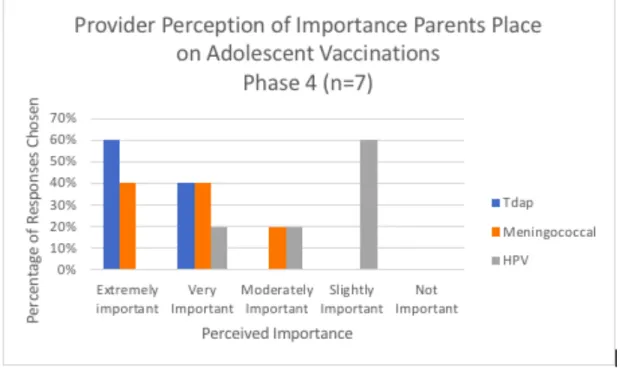
Provider perception of parent views of adolescent vaccinations.
Figure 3.Provider perception of importance parents of 11-12 year olds place on adolescent vaccinations: Phase one response
Figure 4. Provider perception of importance parents of 11-12 year olds place on adolescent vaccinations: Phase four responses
0% 10% 20% 30% 40% 50% 60% 70% 80% 90% 100%
Extremely important
Very Important Moderately Important
Slightly Important
Not Important
Provider Perception of Importance Parents Place
on Adolescent Vaccinations
Phase 1 (n=7)
When asked to “choose all that apply” when choosing the most receptive tones, “informative” tone was the most chosen answer at 33%, followed by “concerned” and “non-judgmental” at 20% each, and “warm” and “upbeat” at 13% each during phase one. None of the participants surveyed chose “humorous” or “my tone doesn’t matter.” During phase four, “informative” tone was chosen at 38%, followed by “concerned” at 25%, followed by “upbeat,” “warm,” and “non-judgmental” at 12% each.
During phase one, all providers surveyed agree that the school entry requirement for the Tdap vaccine and not the HPV vaccine, makes some parents think the HPV vaccine is not as important, with the majority, 47%, selecting “strongly agree” and 43% selecting “somewhat agree.” During phase four, 60% selected “strongly agree”, 20% selected “somewhat agree” and 20% selected “neither disagree or agree.”
Quality of HPV Vaccine Recommendation and Provider Participation.
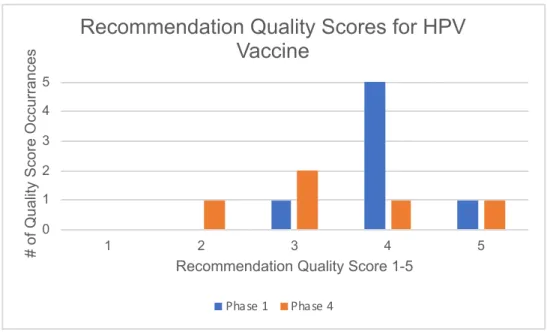
All phase one Modified Communication Survey respondent’s recommendation practices scored “high quality,” with 71% scoring 4, 14% scoring 3 and 5 respectively (Figure 5). Eighty percent of phase four respondents scored “high quality,” with 20% scoring “low quality.” Twenty percent scored 2, 40% scored a 3, 20% scored 4, and 20% scored 5. When asked, “over the past 3 months, what percentage of the time did you use the AAP HPV Champion Toolkit
Figure 5. Composite Quality Scores for Recommendation of HPV Vaccine compiled from the Modified Communication Survey Results: Phase 1 and Phase 4
Provider Knowledge Assessment
To determine knowledge of HPV, the vaccine, HPV-related cancers, and recommendation for the HPV vaccine, provider participants completed a pre- and post-education quiz during phase two. The response rates for the pre- and post-quizzes were 71% and 29% respectively. The average scores increased from 50% pre-education to 81% post-education. Improvement was seen on 6/10 questions. Pre- and post-quiz responses are displayed in Figure 1. Most
improvement was seen on question two, “what is the most common presentation of HPV related oropharyngeal cancer?” Ten percent of respondents answered this question correctly on the pre- quiz and 75% answered correctly on the post- quiz, for an improvement of 65%. A 60%
improvement from pre- to post- quiz answers was observed in question five, “how many doses of the HPV vaccine should immunocompromised patients receive?” (Figure 6). A decrease in percentage of correct responses was observed in question seven, “anal cancer is more common in
0 1 2 3 4 5
1 2 3 4 5
# of Quality Score Occurrances
Recommendation Quality Score 1-5
Recommendation Quality Scores for HPV
Vaccine
selected the correct response (false) and 10% selected the correct answer on the post-test (Figure 6). No improvement was seen on two questions when comparing pre- and post-quiz questions (Figure 6).
Figure 6. Provider Knowledge Assessment Results Pre- and Post- Education Adolescent Vaccine Rates
Vaccination rates for Tdap, meningococcal, and HPV vaccines were determined considering the following variables: time period, age, sex, and combined. To determine the vaccination rates, the number of vaccines administered to 11-12 year olds was divided by the number of 11-12 year old well visits during the same time period. Vaccine administration data and well visit data were obtained from the EHR for all three practice locations includes: number of Tdap, meningococcal, and HPV vaccinations given to 11-12 year olds and number of 11-12 year old well visits from 10/5/16-01/5/17 (baseline) and 10/5/17-01/05/18 (intervention period). To determine the effect of the provider education and AAP HPV Champion Toolkit
logistic regression model controlling the effects of age (11 years old vs. 12 years old) and gender was used.
Well Visit Data
Displayed in figures seven and eight, the number of baseline and intervention period well visits were similar even when comparing age and sex.
Figure 7. Number of Well Visits by Age, Sex, and Combined from 10/05/2016-01/05/2017
Figure 8. Number of Well visits by Age, Sex, and Combined from 10/05/2017-01/05/2018 0 50 100 150 200 250 300
Total 11 years 12 years
Nu m be r o f V is its
Well Visits: By age, sex, and combined
11-12 year old Well Visit
10/05/16-01/05/17
Combined Male Female 0 50 100 150 200 250 300Total 11 years 12 years
Nu m be r o f V is its
Well Visits: By age, sex, and combined
11-12 year old Well Visit
10/05/17-01/05/2018
Baseline Adolescent Vaccine Data by Vaccine
Tdap. The percentage of 11-12 year old patients receiving the Tdap vaccine was 43% (Figure 9). The vast majority, 89%, of those vaccinated were 12 years old. Males were vaccinated more often than females at 46% and 40% respectively. Of the 12 year olds, more males were vaccinated compared to females at 100% versus 80%.
Meningococcal. The percentage of 11-12 year-old patients receiving the meningococcal vaccine was 42% (Figure 11). Males were vaccinated more often than females at 46% versus 38%. Only 12 year olds were vaccinated during this time period, with all 12-year-old males vaccinated and 78% of 12-year-old females vaccinated.
HPV. The percentage of 11-12-year-old patients receiving the Gardasil vaccine was 23%. All of those vaccinated were 12 years old and males were vaccinated at a higher rate than females, 59% versus 41% (Figure 13).
Intervention Period Vaccine Data by Vaccine
Tdap. The percentage of 11-12 year old patient receiving the vaccine was 53% (Figure 10). 11 year olds were vaccinated at a higher rate than 12 year olds at 76% and 25%. 11-year-old females were vaccinated at a higher rate than 11 year 11-year-old males at 83% and 69%. 12-year-old males were vaccinated more often than females at 27% and 23%.
HPV. The percentage of 11-12 year old patients vaccinated was 41% (Figure 14). Females were vaccinated at a higher rate than males at 45% and 37 percent respectively. Twelve-year-old patients were vaccinated at a higher rate than 11-year-old patients at 58% and 26% respectively.
Comparing Baseline Time Period Results to Intervention Time Period Results To determine the effect of the provider education and AAP HPV Champion Toolkit
recommendation style on the acceptance of the HPV vaccine during the interventional period, a logistical regression model controlling the effects of age (11 years old vs. 12 years old) and gender was used (Figure 15).
Tdap. After controlling for effect to age (12 years vs. 11 years) and gender (male vs. female), the odds for getting a Tdap vaccine are 1.48 times greater during the intervention time period compared to the baseline time period (95% confidence interval (CI) 1.03, 2.14). After controlling for the effect to age and time period (baseline vs. interventional), the odds of getting a Tdap vaccine are 1.66 times greater for males compared to females (95% CI [1.06, 2.63]). After controlling for the effect of gender and time period, the odds for getting a Tdap vaccine are 2.96 times greater for 12 year olds compared to 11 year olds (95% CI [1.76, 5.02].
meningococcal vaccine are 2.71 times greater for 12 year olds compared to 11 year olds (95% CI [1.62, 4.58].
HPV. After controlling for effect to age (12 years old vs. 11 years old) and gender (male vs. female), the odds for getting the HPV vaccine are 2.43 times greater during the intervention time period compared to the baseline time period (95% CI [1.59, 3.73]). After controlling for the effect to age and time period (baseline vs. interventional), the odds of getting a HPV vaccine are 2.8 times greater for males compared to females (95% CI [1.76, 4.51]). After controlling for the effect of gender and time period, the odds for getting a HPV vaccine are 13.7 (1.37e+01) times greater for 12 year olds compared to 11 year olds (95% CI [6.95-2.90e+01]).
Figure 10. Tdap Vaccine Rates by Age, Sex, and Combined from 10/05/2017-01/05/2018.
Figure 11. Meningococcal Vaccine Rates by Age, Sex, and Combined from 10/05/2016-01/05/2018.
0 0.2 0.4 0.6 0.8 1 1.2
Total 11 years 12 years
Meningococcal Vaccine Rates by Age, Sex, and Combined 10/05/2016-01/05/2017
Figure 12. Meningococcal Vaccine Rates by Age, Sex, and Combined from 10/05/2017- 01/05/2018
Figure 13. HPV Vaccine by Age, Sex, and Combined from 10/05/2016-01/05/2017
0 0.1 0.2 0.3 0.4 0.5 0.6 0.7 0.8 0.9
Total 11 years 12 years
Meningococcal Vaccine Rates by Age, Sex, and Combined 10/05/2017-01/05/2018
Figure 14. HPV Vaccine by Age, Sex, and Combined from 10/05/2017-01/05/2018.
Parent Survey
From October 5, 2017 to January 5, 2018, parents of 11-12 year old patients presenting for well visits were asked to complete a survey after the recommendation for the HPV
vaccination was made. Parents that accepted the survey completed the survey based on whether they accepted or refused the HPV vaccine for their child. The results were analyzed monthly. Over the three-month time period, there were 239 11-12 year old well visits and 30 parents completed a survey, a 12.5% response rate. Of the 30 completed surveys, 16 parent participants accepted the HPV vaccine and 14 refused the HPV vaccine for their child.
Survey Results: Accepted HPV Vaccine
Of those surveyed that accepted the HPV, six of the children were 11 years of age and 10 were aged 12 years. Of the 12-year-olds, four were female and six were male. Of the 11-year- olds, three were female and three were male. Five answered “yes” when asked “do you have a friend or family member that was diagnosed with cervical or female organ cancer?” (Figure 16). One respondent answered “yes” when asked “do you have a friend or family member that was diagnosed with oropharyngeal (mouth and throat) cancer?”
someone who has had HPV disease, cervical or female organ cancer, or oropharyngeal cancer (mouth and throat cancer)” (Figure 17). An option was provided for parents to choose “other” and write in a reason they chose to vaccinate. One respondent chose “other” and wrote “I know what is best for my children.” Parents were then asked to choose the one reason that had the most influence on their decision (Figure 18). Fifteen respondents answered this question. Forty percent chose reason one, 33% chose reason three, 13% chose reason four, and 13% chose reason five. Reason two was not chosen as most influential.
Survey Results: Refused HPV Vaccine.
Of those surveyed that refused the vaccine, 10 parents reported their child as age 11 years and four reported them as age 12. The 11 year olds consisted of eight females, one male, and one sex was not provided. The 12 year olds consisted of three females and one male. Five parents answered “yes” when asked “do you have a friend or family member that was diagnosed with cervical or female organ cancer?” and three answered “yes” when asked “do you have a friend or family member that was diagnosed with oropharyngeal (mouth and throat) cancer?” (Figure 16).
Figure 16. Parent Survey Responses to Cancer Related Questions Categorized by Acceptance or Refusal of HPV vaccine
0 1 2 3 4 5 6
Accepted HPV vaccine for child Refused HPV vaccine for child
Parent Survey Responses by Acceptance or Refusal of HPV Vaccine-Cancer
Answered "yes" to "do you have a friend or family member that was diagnosed with cervical or female organ cancer?"
CHAPTER 7: DISCUSSION Key Findings
Provider Knowledge and Quality of Recommendation
Based on pre- and post- HPV knowledge assessment scores, pediatric health care
providers can benefit from education on HPV, the vaccine, HPV-related cancers, and strong HPV vaccine recommendation practices, which is consistent with the literature (Hofstetter &
Rosenthal, 2016; Perkins et al., 2015a; Scherr et al., 2016). Parent Survey
Vaccination Rates
During phase three, provider participants recommended the HPV vaccine at the 11-12 year old visits using the AAP HPV Champion toolkit recommendation style. The odds for getting an HPV vaccine during this time period was 2.43 times more likely than during the baseline time period, providing evidence that the AAP HPV Champion toolkit recommendation style leads to increased HPV vaccine acceptance. When including both sexes and age groups, an increase in vaccination rates is observed from baseline to the intervention time period (figure 11). The Tdap and Meningococcal vaccination rates of 53% and 52% respectively, with an HPV vaccine rate of 41%, provides evidence for missed opportunities at well visits for the HPV vaccination.
Vaccination rates in the 11-year-old age group with both sexes combined increased significantly for each adolescent vaccination. However, a significant decrease in vaccination rates is observed in the 12-year-old age group for the Tdap and Meningococcal vaccinations from baseline to the intervention time period, while an increase in the HPV vaccination was observed in this age group. There is a possibility that the low vaccine rates for Tdap and Meningococcal vaccines in the 12-year-old age group are attributed to vaccination administered outside this time period, however, providers completing the Modified Communication Survey report they do not routinely recommend adolescent vaccines at sick visits and is unknown how many vaccinations are
administered outside of the practice. Other efforts to increase HPV vaccination rates could have also influenced parents to accept the HPV vaccine including, increased public campaigning for the Gardasil vaccine through television commercials starting in 2016 and the new vaccine schedule that reduced the 3-vaccine series to a 2-vaccine series before 15 years of age in
vaccine series were recommended by the President’s Cancer Panel for increasing HPV vaccine rates (Rimer et al., 2014).
Implications for Practice
National and state HPV vaccination rates remain below the Healthy People 2020 goal of 80% for HPV vaccination completion by age 13 years (NVAC, 2016). Pediatric primary care providers routinely recommend adolescent vaccines (Tdap, meningococcal, and HPV) during the 11-12 year old well visits due to state requirements for Tdap and meningococcal vaccinations for schools (Rimer et al., 2014). Based on the vaccination rates and logistical regression analysis results of this study, future HPV-related cancers can be prevented by increasing HPV vaccine acceptance. Acceptance can be achieved through the use of an evidence-based communication tool for the recommendation of adolescent vaccinations, in combination with up to date provider education.
Arming health care providers with up to date education regarding HPV, the HPV vaccine, HPV-related cancers, the use of a strong recommendation, and strategies to address vaccine hesitancy can improve the acceptance of the HPV vaccine in the recommended age group. Using an evidence-based communication tool for the recommendation of the HPV vaccine along with the other recommended adolescent vaccinations proved to be a simple and effective method part of providing a strong recommendation for the HPV vaccine.
to gauge what information is most needed by parents and educate the providers and parents alike to address vaccine hesitancy.
Limitations
This study was limited by a short implementation period, small sample sizes of provider participants and parent participants, as well as low response rates for the Pre- and Post-Modified Provider Communication Surveys, Pre- and Post- Provider Knowledge Assessment, and Parent Surveys. Due to low Modified Provider Communication Survey response rates, there is not enough data to determine evidence that provider education leads to increased quality of recommendation for the HPV vaccination. Due to low Post-Modified Communication Survey response rates, there is not enough data to determine provider use of the AAP HPV Champion Toolkit communication tool during the intervention period.
The EHR used by the pediatric practice where this study took place tracks Tdap and Meningococcal vaccines by tracking how many patients have received at least one vaccination of each required vaccination by their 13th birthday. However, it was determined that the EHR did not have a system in place for tracking HPV vaccinations, or number of patients due for
adolescent vaccines. Therefore, vaccine rates were determined by number of well visits and number of vaccines administered during the specified time periods, rather than number of patients due for vaccine during the well visit and number of vaccines administered.
Conclusion
Protecting children from future morbidity and mortality from HPV-related cancer is of high importance, especially due to the rising rates of oropharyngeal cancers in men (Rimer et al., 2014). Although much of the blame is cast on the parents for the refusal of the HPV vaccine, the literature shows that parents believe this vaccine is important and that a strong provider
recommendation has the most impact on their decision to vaccinate (Dempsy, 2017). It is the duty of health care professionals to address the poor uptake of the HPV vaccine in the
recommended age group through the use of evidence-based strategies to improve knowledge of HPV, recommendation of the vaccine and work to personalize provider recommendation based on the needs identified by the parents of their patient population.
Difficulty obtaining vaccine rates for the recommended age group through the EHR highlights a specific area for improvement in use of technology for tracking HPV vaccinations. In addition to developing effective communication strategies, the President’s Cancer Panel calls for use of EHRs to decrease missed opportunities for the HPV vaccine (Rimer et al., 2014). Not only should the EHR be used to decrease missed opportunities, it should also be used to track HPV vaccination rates of the recommended age group, in addition to tracking the other adolescent vaccine rates, allowing for the practice to evaluate their vaccine rates, amount of missed opportunities and aid in efforts to address low rates and missed opportunities.
APPENDIX 1: THEORITICAL DOMAIN FRAMEWORK DOMAIN DEFINITIONS AND CONSTRUCTS
Domain Definitions and Constructs
Domain: Definition Constructs
1. Knowledge: an awareness of the
existence of something • Knowledge of condition/scientific rationale
• Procedural knowledge • Knowledge of task
environment 2. Skills: an ability or proficiency
acquired through practice •• Skills Skills development • Competence • Ability
• Interpersonal skills • Patience
• Skill assessment 3. Social/Professional role and identity:
a coherent set of behaviors and displayed personal qualities of an individual in a social or work setting
• Professional identity • Professional role • Social identity • Identity
• Professional boundaries • Professional confidence • Group Identity
• Leadership
• Organizational commitment 4. Beliefs about capabilities:
acceptance of the truth, reality, or validity about an ability, talent or facility that person can put to constructive use
• Self confidence • Perceived competence • Self-efficacy
• Perceived behavioral control • Beliefs
• Self esteem • Empowerment
• Professional confidence 5. Optimism: the confidence that things
will happen for the best or that desired coals will be attained
• Optimism • Pessimism