OPERA IN ENGLISH: CLASS AND CULTURE IN AMERICA, 1878–1910
Kristen M. Turner
A dissertation submitted to the faculty at the University of North Carolina at Chapel Hill in partial fulfillment of the requirements for the degree of Doctor of Philosophy in the
Department of Music in the College of Arts and Sciences.
Chapel Hill 2015
Approved by: Annegret Fauser Mark Evan Bonds John Nádas
ABSTRACT
Kristen M. Turner: Opera in English: Class and Culture in America, 1878–1910 (Under the direction of Annegret Fauser)
European grand opera performed in English translation was a potent cultural force in the United States at the end of the long nineteenth century. Analysis of business correspondence, theater records, advertisements, reviews, and social commentaries, reveals that rhetoric about opera engaged with issues of class, race, gender, and nationalism. Critics identified foreign-language grand opera as a high art, suitable primarily for the upper class and educated listeners. In contrast, writers viewed the same operas sung in English as entertainment for a middle-class audience who wished to enjoy opera in the vernacular performed by American singers. Southern small towns, such as Raleigh, North Carolina, used English-language opera and art music to reinforce racial boundaries and to project a civic identity as a refined, middle-class city. The African American community, as a result of segregation and oppression, had different conceptions about art, class, and culture than the white majority. African American writers framed English-language performances by the all-black Theodore Drury Grand Opera Company as a way to resist racial tyranny by emphasizing the skill of the troupe’s singers and the
sophistication of its educated black audience. The operatic marketplace was shaped by the same issues that influenced the discourses about opera. Advertisements and other types of marketing referred to class, race, and nationalism, while performers and impresarios created public
Pantomimes and crucial cuts recorded in scores used by English-language troupes at the time served to manipulate the audience’s perceptions of Carmen’s main characters to support the critics’ reactions to the work, which were colored by contemporary political and social
conditions. By 1910, when it had become clear that grand opera sung in English could not move into the high-art sphere occupied by foreign-language grand opera, the cultural niche for
ACKNOWLEDGMENTS
Similar to a child, it takes a village to raise a research project. My village stretched across the country. My research would not have been possible without the help of the librarians and staff at the Mills Music Library at the University of Wisconsin-Madison (especially Tom Caw), the Houghton Library at Harvard University, the Performing Arts Division of the New York Public Library (in particular Jonathan Hiam), the Kiplinger Library in the Historical Society of
Washington, DC, the Library at the Maryland Historical Society, and the Music Library at the University of Toronto. Too many people to count, and many whose names I do not even know, helped me locate materials, patiently answered all my questions, and replied to many emails asking for help. I am especially grateful to the wonderful staff at the UNC library: Diane Steinhaus, Carrie Monette, Shaw Lentz, and Philip Vandermeer (who also served on my dissertation committee) for helping me find sources, examine microfilm without permanent physical damage, and understand the resources available to students of American music.
Many friends and fellow graduate students have helped me through this long process by reading my work, listening to my conference presentations, and providing much-needed
Other scholars have contributed their time to my projects by reading my work or agreeing to meet with me at conferences. Not only is this dissertation richer for their input, but my intellectual growth was aided by their generosity and patience. Thank you to Judith Tick, Hilary Poriss, John Koegel, Gillian Rodger, Jean Snyder, Louise Toppin, Doug Shadle, and Kira Thurman. My research was supported by the Kenan Graduate Student Activities Fund and a UNC Summer Research fellowship. My final year at Chapel Hill was funded by a Dissertation Completion Fellowship which gave me the great gift of being able to concentrate on my work without teaching for the only time in my graduate career.
My dissertation committee was all that I could have hoped for and more. Phil
Vandermeer helped me think about the way forward in this dissertation at the very beginning of the process. John Nádas’s expertise in interpreting messy manuscripts and opera performance was invaluable. Evan Bonds contributed his clear-headed slightly skeptical eye to all my work. Kitty Preston introduced me to the joys of American music history and was extremely generous not only with her time, but also with her work and the fruits of her many years of research. Annegret Fauser, my advisor, calmed me down when I was stressed, advised me when I needed it, read everything very carefully but never tried to stifle my independence, encouraged me to send my work to many different people, and put up with my compulsive revising which resulted in many emails that read, “I know I sent this to you a few days ago, but here’s a newer version if you haven’t read it already.”
but were always there when I wanted to talk. My colleagues at North Carolina State University were very supportive and encouraged me to go back to school even when the idea seemed preposterous, especially Tom Koch, Mark Scearce, and Jonathan Kramer.
TABLE OF CONTENTS
LIST OF TABLES ... xiii
LIST OF FIGURES ... xiv
INTRODUCTION ... 1
Opera and Class in America ... 5
Opera and the Historiography of the Gilded Age and Progressive Era ... 12
Operatic Geography ... 15
Opera and Identity ... 20
Sources ... 24
Chapter Overview ... 27
CHAPTER 1: “NO REAL OPERA HERE”: AMERICAN DISCOURSES ABOUT OPERA IN ENGLISH TRANSLATION, 1878–1910 ... 31
High or Low Art? ... 34
Bringing Opera to the Middle Class ... 43
Opera, Democracy, and the Quest for Government Support ... 48
Opera and the Formation of the American Bourgeoisie ... 54
The Star System and Social Class ... 58
The Upper Class and Opera in English Translation ... 61
Cultural Ambition, Opera in English, and the Question of an American National Style ... 65
Grand Opera and American Patriotism ... 73
Musical Aesthetics and Opera in English Translation ... 80
The Castle Square English Opera Companies and Critical Reception of
English-Language Troupes ... 89
CHAPTER 2: THE BUSINESS OF OPERA ... 95
Organizing the Company ... 99
Performer Networks and Staffing an Opera Company ... 106
Arranging a Tour ... 118
The Syndicate’s Effect on Opera ... 119
Ticket Prices ... 124
Repertoire and Revenue ... 126
Dividing the Spoils ... 132
The Process of Advertising a Company ... 137
Marketing the Company ... 144
The End of the Season ... 160
CHAPTER 3: GENDER AND OPERA IN THE UNITED STATES ... 165
The Musical Man and the Challenge of the Feminine ... 168
Women and Work at the End of the Long Nineteenth Century ... 182
Emma Juch: Femininity and the Challenges of the Female Professional Musician ... 184
Prima Donnas and Middle-Class Respectability ... 187
Prima Donnas as Strong Americans ... 195
Prima Donnas and the Business of Opera ... 199
Prima Donnas and Gossip ... 205
CHAPTER 4: UPLIFT AND OPERA ... 211
Defining Uplift in Nineteenth-Century America ... 213
Moral Uplift ... 214
Municipal Uplift ... 224
Racial Uplift ... 226
Case Study No. 1: The Theodore Drury Grand Opera Company: Racial Uplift ... 230
The Beginning of Drury’s Career ... 237
The Theodore Drury Grand Opera Company and the Rhetoric of Uplift ... 241
Opera, Race, and Spectacle ... 249
The End of the Drury Opera Company... 253
Case Study No. 2: Raleigh, NC: Municipal Uplift ... 255
The Role of Amateur Music-Making in Municipal Uplift ... 263
Spectacle and Comic Opera in Raleigh ... 271
Municipal Uplift and the Meanings of Grand and Comic Opera ... 278
Grand Opera Outside of the Opera Company ... 283
African Americans and Entertainment in Raleigh ... 288
CHAPTER 5: PERFORMING CARMEN IN THE UNITED STATES... 293
Producing Opera in Nineteenth-Century Europe ... 296
Transatlantic Circulation of Staging Manuals ... 299
The Tams-Witmark Carmen Scores ... 303
English- versus Foreign-Language Performances ... 307
Practical Cuts ... 316
The Abbott Score’s Modifications: An Early Interpretation ... 330
A Consistent Reading of Carmen in the Bostonians, Liesegang, and Young Sources ... 332
Carmen in Translation ... 337
CHAPTER 6: “HALF-WILD, SELF-WILLED, RECKLESS, AND REBELLIOUS”:
CARMEN’S RECEPTION IN NINETEENTH-CENTURY AMERICA ... 349
Carmen and the “Opera War”... 351
Carmen, Genre, and the High-Art Ideal ... 357
Carmen, Gender, and America’s Double Standard ... 361
Michaela: The “Real” Woman of the Opera ... 371
Carmen and the Middle Class ... 373
Carmen and Masculinity ... 378
Carmen and Race ... 382
Carmen, Realism, and the Progressive Era ... 387
EPILOGUE ... 395
APPENDIX 1: DRAMATIS PERSONAE ... 407
LIST OF TABLES
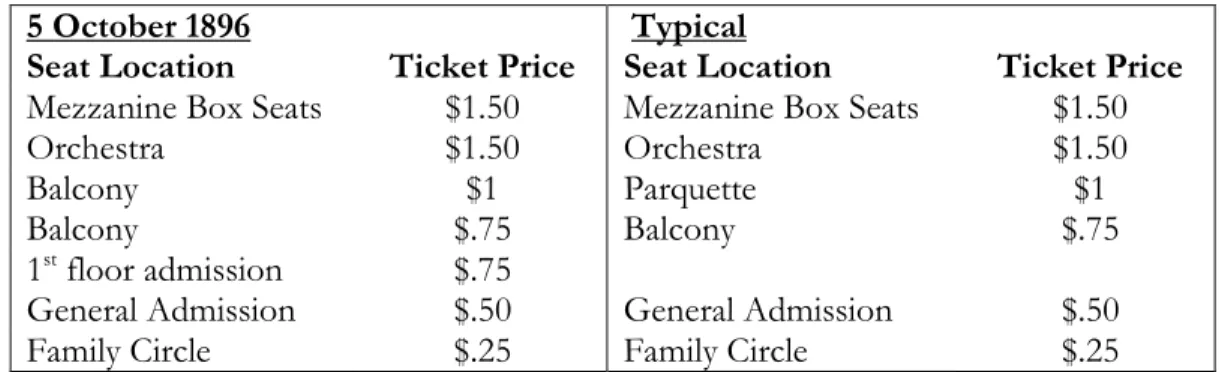
Table 2.1 – Ticket prices for Lafayette Square Opera House versus typical charges, week of 5 October 1896 ... 126 Table 2.2 – Ticket sales and Gross Ticket Revenue, Lafayette Square Opera House, 5–10
LIST OF FIGURES
Figure 2.1 – Advertisement for the Emma Juch Grand Opera Company ... 104
Figure 2.2 – Cover and inside of the front cover of a publicity pamphlet for Marie Roze ... 109
Figure 2.3 – Detail of the Lafayette Theater Band and Orchestra letterhead ... 118
Figure 2.4 – Excerpt from a full-page advertisement for Henry W. Savage’s productions, 18 December 1904 ... 147
Figure 2.5 – Excerpt from a full-page advertisement for Henry W. Savage’s productions, cast list for Savage’s English-language Parsifal, 18 December 1904 ... 148
Figure 2.6 – Advertisement for the Emma Abbott Grand English Opera Company, 9 November 1880 ... 149
Figure 2.7 – Advertisement for the Emma Abbott English Grand Opera Company, 25 November 1882 ... 151
Figure 2.8 – Cover of the Playbill/Program for Savage Grand Opera Company, 1903 ... 154
Figure 2.9 – Inner page of Playbill/Program for Savage Grand Opera Company, 1903 ... 158
Figure 3.1 – William T. Carleton (1859–1922) in costume ... 172
Figure 3.2 – Emma Juch in costume, 1889 ... 187
Figure 3.3 – Emma Juch and her mother, Augusta Juch ... 192
Figure 4.1 – Theodore Drury as Faust ... 243
Figure 4.2 – Advertisement for Drury Company’s Production of Aida ... 249
Figure 4.3 – Academy of Music, Raleigh, NC, c. 1900 ... 259
Figure 4.4 – Advertisement, Raleigh Evening Times, 22 April 1907 ... 270
Figure 5.1 – Anne Seguin’s promptbook for Maritana ... 302
Figure 5.2 – Opening of Chorus No. 4 in the Abbott Stage Manager’s Score ... 306
Figure 5.3 – Enhanced close-up of the inside cover of the Abbott conductor’s score with Strakosch Company’s cast... 309
Figure 5.5 – Choudens Act I set design, owned by the
Emma Abbott English Grand Opera ... 313
Figure 5.6 – Minnie Hauk as Carmen, c. 1880 ... 315
Figure 5.7 – Opening of number 3 from the Liesegang conductor’s score with evidence of multiple cuts ... 325
Figure 5.8 – Excerpt from number 3, Young score ... 322
Figure 5.9 – Excerpt from number 3, Abbott conductor’s score ... 327
Figure 5.10 – Excerpt from the finale of Carmen, Young score ... 336
Figure 5.11 – “Seguidilla,” mm. 81–89, Choudens Score, 1875 ... 341
Figure 5.12 – “Seguidilla,” mm. 9–21, Bostonians score ... 341
INTRODUCTION
In recent years, scholars of the Gilded Age and Progressive Era in the United States have found themselves in unusual demand. Politicians, social commentators, and historians have noted that many of today’s political debate can be interpreted as re-arguing the great controversies from the 1890s to the 1920s, with disturbingly similar rhetoric. While these disputes are largely centered on political and economic issues, many of today’s controversies and challenges in the classical-music industry are not all that different from those of the late nineteenth century. Then, too, critics interrogated who should listen to art music, how it should be funded, and what repertoire should be performed. The ways opera companies and orchestras of the early twentieth century responded to these questions profoundly influenced the development of the American cultural hierarchy and are directly relevant to the artistic life of the United States in 2015.1 Today, most opera companies are struggling, with their financial troubles often attributed to the fact that the genre is so far at the periphery of American culture that it has lost its social significance and thus its audience.2 In the 1880s, however, many critics were arguing that art music such as opera was complex and primarily appropriate for the educated elite. For these writers, opera could claim its proper status as “important” music only if it was confined to a small set of devoted listeners
1For the purposes of this dissertation I will use “America” as a synonym for United States.
2The San Diego Opera almost closed at the end of the 2013–14 season citing declining audiences and rising costs.
James Chute, “San Diego Opera Votes to Fold,” U-T San Diego, 19 March 2014,
http://www.utsandiego.com/news/2014/mar/19/san-diego-opera-fold/ (accessed 10 November 2014). In a surprise move, after an outcry from the community and a reorganization both of the season’s offerings and of the Board of Directors, the Opera announced they would return for the 2015–16 season. Angela Carone, “San Diego Opera Will Not Close, Announces 2015 Season,” KPBS Radio News (San Diego, CA), 19 May 2014,
who understood the works properly. The wealthy patrons who provided much of the financial support for opera companies were grudgingly admitted to the opera house as well. Today, singers, opera troupe managers, and critics complain that this elitist attitude has sucked the life and vitality from opera, and many now seek to convince listeners that an aria can be as
emotionally powerful as a pop ballad and as accessible as a Disney movie turned into a hit musical. Peter Gelb, the manager of the Metropolitan Opera Company, the country’s oldest and most prestigious opera troupe, has sought to bring new listeners to opera through live
international simulcasts and avant-garde productions by hip directors, even though he is presenting basically the same nineteenth-century repertoire that the Met has always sung.3 Recently composer Suby Raman analyzed the Metropolitan’s repertoire since 1905 and found that 1870 was the median year of composition. Indeed, the works the Metropolitan performs today are very similar to the operas they sang in 1890.
How did American opera get into this mess—with a repertoire stuck in the 1870s and a reputation for a wealthy, snobbish audience? The answer lies, in large part, in the development of the American cultural hierarchy during the crucial period around the turn of the twentieth century. This dissertation addresses the role of opera in the cultural life of the United States between 1878 and 1910. I concentrate on European grand opera sung in English translation often by casts of primarily American-born singers. Historians such as Lawrence Levine and Bruce A. McConachie would have their readers believe that the American upper class all but stole opera from the middle class after the Civil War and locked it away in a sacralized space— one of the symbols of wealth and prestige that they needed to differentiate and protect
3 “10 Graphs to Explain the Metropolitan Opera,” last modified 26 October 2014,
themselves from the masses.4 This interpretation privileges foreign-language opera in New York without properly considering opera outside of New York City, English-language opera
performances, opera among African Americans, or broader aesthetic issues related to the genre. I join with Karen Ahlquist, Joseph Horowitz, Ralph P. Locke, Katherine K. Preston, and others to argue that the change in opera’s place in the cultural hierarchy happened late in the nineteenth century and involved many social, cultural, and political influences in addition to the class
pressures cited by Levine.5
By concentrating on English-language opera, I necessarily omit a close consideration of the Metropolitan Opera, established in 1883, because the troupe did not perform operas in English translation during this period.6 Because of its central position in American operatic culture, more research has been done on this organization than any other opera company in the U. S., and scholars tend to accord it pride of place in histories of opera in America. The
viewpoint from the periphery can provide insights that are impossible to access when looking from a central position, however. Opera in English had a different audience and cultural valence than the Metropolitan, leading to conclusions about opera’s place in American life that might be hidden otherwise.
4Lawrence Levine, Highbrow/Lowbrow: The Emergence of Cultural Hierarchy in America (Cambridge, MA: Harvard
University Press, 1988); Bruce A. McConachie, “New York Operagoing, 1825–50: Creating an Elite Social Ritual,” American Music 6, no. 2 (Summer 1988): 181–92.
5Responses to Levine include Karen Ahlquist, “Musical Assimilation and ‘the German Element’ at the Cincinnati
Sängerfest, 1879,” Musical Quarterly 94, no. 3 (Fall 2011): 381–416; Steven Baur, “Music, Morals, and Social Management: Mendelssohn in Post-Civil War America,” American Music 19, no. 1 (Spring 2001): 64–130; Joseph Horowitz, “‘Sermons in Tones’: Sacralization as a Theme in American Classical Music,” American Music 16, no. 3 (Autumn 1998): 311–40; Joseph Horowitz, “Music and the Gilded Age: Social Control and Sacralization Revisited,” Journal of the Gilded Age and Progressive Era 3, no. 3 (July 2004): 227–45; Steven Ledbetter, “Higginson and Chadwick: Non-Brahmins in Boston,” American Music 19, no. 1 (Spring 2001): 51–63; Ralph P. Locke, “Music Lovers, Patrons, and the ‘Sacralization’ of Culture in America,” 19th-Century Music 17, no. 2 (Autumn 1993): 149–73.
6I will use the phrases “English-language opera” and “European opera performed in English translation”
My focus on English-language opera allowed me to discover not only an overlooked discourse on opera in America at the turn of the century, but also a network of performers and impresarios whose operatic activities had been forgotten once musicologists, singers, and conductors had discredited the use of translated libretti. It was easy for some scholars to overlook the significance of English-language opera because American opera companies today rarely perform opera in English translation, nor have they been successful in maintaining a large middle-class audience. Right now many Americans believe that opera is for rich, snobby, white, old people with a dead, boring repertoire. Even though musicologists know that most of that stereotype is incorrect, it infects the way that many writers and readers think about opera in the nineteenth century when the situation was much different.
reputation for relatively low quality. Even if this stereotype was more perception than reality, English-language performers and impresarios had to battle this opinion.
Musical and theatrical life in the United States at this time was dominated by professional touring companies. Smaller troupes (often performing in English) primarily traveled along regional theatrical circuits, while larger foreign-language troupes usually visited only more populous cities that had bigger theaters and more people who could pay high ticket prices.7 By 1910, there were few traveling opera companies left. Foreign-language troupes had become so large that transportation costs made it prohibitively expensive to tour. Only a few companies, including the Metropolitan, attempted substantial tours as a supplement to a long residency in one city. Smaller opera companies were forced out of the business by the Theatrical Syndicate’s stranglehold on the booking for smaller houses, and the advent of the silent film which
encouraged many theaters to discontinue live performances. This dissertation begins around the time many of the largest English-language opera troupes were still active (such as the Hess Opera Company and the Clara Louise Kellogg Company) and ends when the last of the successful English-language troupes managed by Henry W. Savage folded.
Opera and Class in America
Because class is a key aspect of my interpretation of American operatic culture, it is important to define the composition of different classes in the United States during this period. For the purposes of this study, I will often interchange the terms “wealthy” and “upper class.” When I refer to the white upper-class, I mean people who either inherited substantial wealth or made a significant income primarily through business ventures and chose to spend their money to
7The Metropolitan Opera Company stayed in New York for up to six months at a time before traveling, which
maintain a lavish lifestyle.8 The term “middle class” is particularly hard to delineate in this period as its composition and formation differed substantially depending upon factors such as race, ethnicity, and location (urban or rural, South, North or West). I define the white middle class as consisting of people who were part of professional households (doctors, lawyers, shopkeepers, businessmen, etc.), who had enough disposable income to spend on leisure activities, but were not wealthy and did not consider themselves part of the upper class, even if they sometimes crossed paths at entertainment events—the elite usually in the boxes, and the middle-class in moderately-priced mezzanine seats.9
Among the African American upper class of the nineteenth century, educational achievement and descent from free blacks rather than enslaved peoples were more important markers of social class than profession or income levels. Those people who could claim free black ancestry and were well educated often considered themselves to be part of the colored aristocracy or the top of the black cultural hierarchy. Many scholars argue that there was no black middle class, although there were African Americans who made a comfortable income through professional employment and could be identified on that basis as “middle class.” The significant hardships caused by segregation and racism in this period kept African Americans from identifying as part of the middle class which they saw as reserved for whites.10
8See Sven Beckert, The Monied Metropolis: New York City and the Consolidation of the American Bourgeoisie, 1850–1896
(Cambridge: Cambridge University Press, 2001) for a discussion of elite upper class and the process of its formation during the second half of the nineteenth century.
9For a variety of perspectives and methodological approaches on the development of the middle class in the U. S.
see Burton J. Bledstein and Robert D. Johnston, eds., The Middling Sorts: Explorations in the History of the American Middle Class (New York: Routledge, 2001); Andrew P. Haley, Turning the Tables: Restaurants and the Rise of the American Middle Class, 1880–1920 (Chapel Hill: University of North Carolina Press, 2011); and Jonathan Daniel Wells and Jennifer R. Green, eds., The Southern Middle Class in the Long Nineteenth Century (Baton Rouge: Louisiana State University Press, 2011).
10See Leslie H. Fishel, Jr., “The African-American Experience,” in The Gilded Age: Perspectives on the Origins of Modern
Finally, the idea of the “educated elite” is also important when considering the formation of the American cultural hierarchy around 1900. By this term, I mean a set of people who were educated in the arts (either through formal schooling or self-taught) and prided themselves on their good taste and refinement, which they demonstrated, in part, through attendance at high-art events. People in this group could be of any socio-economic class, though they had the time and money to devote to going to concerts, plays, art galleries, and museums, which probably placed many of them at least in the middle class.
The working class will enter this study less often, given that its members usually did not have the resources to attend opera. As is true for the middle class, historians disagree as to how to describe this socio-economic set. The definition I use is a group in which the family’s income was derived from skilled or unskilled labor often performed by as many people (men, women, and children) who were old enough to work, and whose standard of living ranged from so minimal they could not afford basic necessities to those who could purchase the essentials and had a limited discretionary income.11
Recently Gayle Sherwood Magee and Dale Cockrell charged that musicologists have ignored or minimized the importance of class as an element of U. S. musical life during the nineteenth century.12 They apparently discounted researchers such as Karen Ahlquist, Steven Baur, Michael Broyles, Ralph P. Locke, and Katherine K. Preston who recognize in their work
11See John F. McClymer, “Late Nineteenth-Century American Working-Class Living Standards,” Journal of
Interdisciplinary History 17, no. 2 (Autumn 1986): 379–98; Kathy Lee Peiss, Cheap Amusements: Working Women and Leisure in New York City, 1880 to 1920 (Philadelphia: Temple University Press, 1985); Gillian M. Rodger, Champagne Charlie and Pretty Jemima: Variety Theater in the Nineteenth Century (Urbana: University of Illinois Press, 2010).
12Gayle Sherwood Magee, “Rethinking Social Class and American Music,” Journal of the American Musicological Society
that class helped to determine the development of cultural life in the United States.13 Cultural historians such as Daniel Cavicchi, Jessica Gienow-Hecht, Joseph Horowitz, and Kathy Peiss also position class as a central issue in nineteenth-century American musical life.14 Moreover, Levine’s Highbrow/Lowbrow, with its class-based interpretation of American culture, is one of the most important secondary sources on the development of the cultural landscape in the United States during the nineteenth century. Although musicologists have disputed many of Levine’s conclusions, because he begins from a position that American culture was shaped by elite-class formation, it is difficult for succeeding scholars to ignore the issue.
I consider many other topics besides class in this dissertation, but the discourse about opera, the audiences for different types of opera, and the reception of specific works were all fundamentally influenced by the assumptions and behaviors fostered by the socio-economic conditions associated with different classes. As far back as at least the 1840s, social
commentators argued that opera should properly be enjoyed only by the wealthy and the musically educated.Preston points out that for many years these pronouncements were more aspirational than anything else.15 Opera companies had to appeal to a large and heterogeneous
13Examples include Karen Ahlquist, Democracy at the Opera: Music, Theater, and Culture in New York City, 1815–60
(Urbana: University of Illinois Press, 1997); Steven Baur, “‛Let Me Make the Ballads of a Nation and I Care Not Who Makes its Laws’: Music, Culture, and Social Politics in the United States, c. 1860–1890,” (PhD diss., University of California at Los Angeles, 2001); Michael Broyles, Music of the Highest Class: Elitism and Populism in Antebellum Boston (New Haven, CT: Yale University Press, 1992); Ralph P. Locke, “Paradoxes of the Woman Music Patron in
America,” Musical Quarterly 78, no. 4 (Winter 1994): 798–825; Katherine K. Preston, Opera on the Road: Traveling Opera Troupes in the United States, 1825–1860 (Urbana: University of Illinois Press, 1993).
14See Daniel Cavicchi, Listening and Longing: Music Lovers in the Age of Barnum (Middletown, CT: Wesleyan University
Press, 2011); Jessica Gienow-Hecht, Sound Diplomacy: Music and Emotions in Transatlantic Relations, 1850–1920 (Chicago: University of Chicago Press, 2009); Joseph Horowitz, Wagner Nights: An American History (Berkeley: University of California Press, 1994); Peiss, Cheap Amusements.
15Katherine K. Preston, Opera on the Road: Traveling Opera Troupes in the United States, 1825–60 (Urbana: University of
Illinois Press, 1993), 136–39. In one example, the Astor Place Opera House built in New York in 1847, only about twenty years after the first operas in Italian were performed in the city, was designed to make the theater
audience in order to survive, because revenue from ticket sales was their only source of financial support. As a result, a wide cross-section of the American population enthusiastically attended opera at least until the last quarter of the nineteenth century. According to Preston, “the ubiquity of operatic music in the United States … demonstrate[s] clearly that most Americans did not consider it as the chosen preserve of the musical and social elite.”16
Complete operas performed in foreign languages eventually became dependent upon the patronage of elite society, however. The transformation from aspirational social discourse to fact happened over the decades from the late 1870s until the early twentieth century. Of course, this change occurred slowly and inconsistently. Looking at the development of the cultural hierarchy from the perspective of opera performed in English, it is clear that foreign-language opera was not simply appropriated by the upper class; it was also an art form rejected by the middle class.
As part of the formation of an elite social class, the wealthy, especially in New York, turned to the European aristocracy (primarily in Britain) for models of the sort of lifestyle they wished to achieve. Attendance at foreign-language opera performances was one of the social rituals that marked the English elite. Naturally, those people who wanted to be part of the American aristocracy followed suit. The Panic of 1873 and the depression that followed led many in the middle class to turn to English-language opera and to abandon foreign-language opera, in part because it was associated with the European upper social classes that many blamed for the catastrophic failure of the economy, but also because of the high cost of foreign-language tickets.17 Foreign-language opera impresarios lured audiences by creating lavish spectacles with the best singers in the world, causing their productions to become more and more expensive.
16Preston, Opera on the Road, 316.
17Katherine K. Preston, “Opera is Elite/Opera is Nationalist: Cosmopolitan Views of Opera Reception in the
This priced the middle class out of foreign-language opera and, for some, bred resentment against grand opera in general, while simultaneously making it more attractive to the wealthy who wanted to attend the best performances and to exclude a less privileged audience. Foreign-language grand opera companies active near the end of the century such as the Abbey-Grau Grand Opera Company, the Damrosch German Opera Company or the Ellis Grand Opera Company became so large that smaller towns and mid-sized cities could no longer support them. Thus the place in the cultural hierarchy that opera in foreign languages once inhabited outside of large cities was taken over by the cheaper English-language opera troupes, and later by comic opera, and then musical comedies.18 By the 1890s, for most people in the United States who did not live in or near a really large metropolis such as New York or Chicago, foreign-language grand opera became a big-city luxury—something that touched their lives only peripherally, and for which they had to make a significant expenditure of time and money to attend.
The failure of several large English-language opera companies in the 1880s also contributed to the change in the cultural hierarchy. The American Opera Company (AOC), its successor company, the National Opera Company (NOC), and the Emma Juch English Grand Opera Company attempted to educate the public and provide English-language opera at the same production levels as the Metropolitan. Had the key figures in these troupes—the manager of the three companies, Charles E. Locke, the founder of the AOC and NOC, Jeannette Thurber, the AOC and NOC’s conductor, Theodore Thomas, and soprano Emma Juch—been better money managers and more pragmatic, they might have made their enterprises work. Yet
18I will use the terminology of the time period when referring to different types of opera. Grand opera connoted
by misreading their audiences and through a lack of business acumen, these prominent and large English-language troupes failed spectacularly, leaving a lasting legacy in the minds of potential operagoers and (more importantly) the critics, that English-language opera could not survive in the United States.19 Some English-language companies thrived in the same period—particularly the Emma Abbott Company (1879–1891) and the opera troupes managed by Henry W. Savage (1895–1911). Their marketing tactics, unfortunately, had the unintended effect of reinforcing the view that English-language opera was a second-class entertainment for the middle class and not “real” opera, which over the long term damaged its audience appeal and was a key factor in the demise of widespread English-language grand-opera productions in the United States.
Throughout this period, opera performed in full (no matter the language) was declining. As it became more expensive to tour with bigger and more elaborate companies, fewer
impresarios even attempted it. Fewer companies were founded, and by 1900, their touring schedule was less ambitious.20 It is tempting to interpret this development to mean that opera was no longer important in popular culture, but this assumption would be wrong. Opera was everywhere—just not in the form of complete works performed from start to finish. Minstrel shows offered opera burlesques, vaudeville troupes featured opera singers and adaptations of popular works, arias were published in sheet music, opera plots and narratives were appropriated by other artists (such as Carmen in a play version or in the shows given by the dancer
Carmencita), opera excerpts were so common on band and orchestral programs they were
19Katherine K. Preston makes this argument in her forthcoming monograph on opera in English translation from
the Civil War until 1900, Opera for the American People: English-Language Opera and Women Managers in the Late Nineteenth Century. I thank her for the opportunity to read much of the draft manuscript of her book.
20It is notoriously difficult to determine accurate numbers of opera companies in any given season because there is
practically mandatory, and even Tin Pan Alley songs referred to opera stories, tunes, and
performers.21 Opera was not sacralized. Rather different types of operatic performance practices took on different social valences. Only opera staged in full and sung in a foreign language with expensive tickets was sacralized by World War I. It was a high-art, high-class event that was geared towards, and attended by, the upper class and the educated elite. The middle and lower classes, however, had ample access to opera in other forms in their own homes through sheet music and (later) recorded arias, as well as in performance in many different theatrical contexts. If the definition of opera is extended to include excerpts, adaptations, and re-interpretations, then it is clear that opera was ubiquitous in American culture.
Opera and the Historiography of the Gilded Age and Progressive Era
The events discussed in this dissertation took place in the historical periods now called the Gilded Age and Progressive Era. Although periodization is almost always controversial, at least since the 1980s historians have debated the dating of these two eras and the historical forces that hold them together. The Journal of the Gilded Age and Progressive Era has printed no less than three roundtables recently in which some of the participants have proposed abolishing the designation of the Gilded Age entirely, usually in favor of a “long Progressive Era” from Reconstruction to the 1920s.22 At its most conservative, the Gilded Age is dated from around 1877 (the end of
21Much research still needs to be done to understand why and how opera was appropriated by popular culture in
this period. Larry Hamberlin’s monograph Tin Pan Opera: Operatic Novelty Songs in the Ragtime Era (New York: Oxford University Press, 2011) is one of the best initial studies of this phenomenon. Other sources include: Nicole N. Aljoe, “Aria for Ethiopia: The Operatic Aesthetic of Pauline Hopkins’s Of One Blood,” African American Review 45, no. 3 (Fall 2012): 277–90; George W. Martin, Opera at the Bandstand Then and Now (Lanham, MD: Scarecrow Press, Inc., 2014), Renee Lapp Norris, “Opera and the Mainstreaming of Blackface Minstrelsy,” Journal of the Society for American Music 1, no. 3 (August 2007): 341–65; and Katherine K. Preston, “A Rarefied Art? Opera and Operatic Music as Popular Entertainment in Late Nineteenth-Century Washington City,” in Music, American Made: Essays in Honor of John Graziano, ed. John Koegel (Sterling Heights, MI: Harmonie Park Press, 2011), 3–46.
22Richard Schneirov, “Thoughts on Periodizing the Gilded Age: Capital Accumulation, Society, and Politics, 1873–
Reconstruction) until 1900 and Theodore Roosevelt’s rise to Presidential power. In general the Gilded Age has a negative connotation as explained by historian Rebecca Edwards,
this was the era when capital and labor fought their first pitched battles on a national scale, and capital won. Wealth became far more concentrated; the super-rich turned their backs callously on the poor, lavishing millions on banquets and Worth ball gowns. Multinational corporations arose to exercise untrammeled power, while government stood by passively.23
Some scholars have tried to rehabilitate the Gilded Age’s bad reputation. In the pages of Joseph Horowitz’s most recent book, Moral Fire: Musical Portraits from America’s fin de siècle,he portrays the Gilded Age as a time of unbridled passion, when people were not afraid to show their
enthusiasm for art music (standing on chairs to cheer Wagner for instance), instead of a period of snobbish sacralization.24
The Progressive Era (conservatively dated between the 1890s and the 1920s) was
characterized by reform movements that swept the United States. Activists in grassroots political and social movements worked to regulate business practices that were dangerous or abusive to workers, protect children, abolish vices such as gambling, drinking, and prostitution, allow women to vote, and improve or establish government services from public schools to mass transit. The country moved away from laissez-faire ideals in political, economic, and social institutions which caused the relationship between citizens and the government to change
Rodgers, “Capitalism and Politics in the Progressive Era and in Ours,” Journal of the Gilded Age and Progressive Era 13, no. 3 (July 2014): 379–86.
23Rebecca Edwards, “Politics, Social Movements, and the Periodization of U. S. History,” Journal of the Gilded Age and
the Progressive Era 8, no. 4 (October 2009): 464.
24Joseph Horowitz, Moral Fire: Musical Portraits from America’s fin de siècle (Berkeley: University of California Press,
fundamentally. People began to look to the government to protect them from forces over which they had little or no control.25
Historians who want to abandon the term the “Gilded Age” generally point out that the influential reform movements that characterized the Progressive Era had their roots in the Gilded Age with some organizations having begun their activities before the 1890s. In addition, scholars claim that the “vulgar, materialistic, and corrupt” behavior that is so often ascribed to Gilded-Age businesspeople is far from unique in American history. Rather than focusing on a few wealthy Robber Barons, these scholars think it would be better to regard the period between the Civil War and the 1920s as years when industrialization and modernization gave birth to governmental and social reforms, as well as to many of our current ideas about democracy within a market-based economy.26
In an essay titled “Men are from the Gilded Age, Women are from the Progressive Era,” Elisabeth Israels Perry argues that adding women and their accomplishments into the historical narrative in such diverse areas as the suffrage movement, the Social Gospel movement, the labor movement, and women’s clubs rendered older conceptions about the timing and development of reform movements so inaccurate as to bring down the idea of a “Gilded Age.” It was only when the focus of historiography was on men and their accomplishments that dividing the time period into the Gilded Age and the Progressive Era made sense.27
I might suggest something along the same lines when thinking about musical culture. That is, foreign-language opera is from the Gilded Age, English-language opera is from the
25Maureen Flanagan, America Reformed: Progressives and Progressivisms, 1890s–1920s (New York: Oxford University
Press, 2007), vi.
26Quotation from Richard R. John, “Who were the Gilders? And Other Seldom-Asked Questions about Business,
Technology, and Political Economy in the United States, 1877–1900,” Journal of the Gilded Age and Progressive Era 8, no. 4 (October 2009): 476.
27Elisabeth Israels Perry, “Men are from the Gilded Age, Women are from the Progressive Era,” Journal of the Gilded
Progressive Era. The story that opera moved into the realm of uplifting high art and into the ballrooms and expensive theaters of Gilded-Age business tycoons works as long as scholars privilege elite culture and modern stereotypes about opera. This narrative is called into question when English-language opera is added to the mix. The impresarios, critics, and singers who advocated for English-language opera used the rhetoric of wholesome entertainment,
democratization, uplift, and salvation through education and moral behavior that is reminiscent of the Progressive Era anti-vice campaigns and the “applied Christianity” of the Social Gospel Movement. I would not want to push this metaphor too far. The Wagnerites in Brooklyn’s Seidl Society genuinely seemed to want to share their adoration for the German composer’s music as part of an impulse to pursue activities for the collective good, not to create an exclusive space for the super wealthy and educated elite. The hard-nosed English-language impresario Henry W. Savage was certainly primarily interested in his companies’ financial success and used idealistic language about democratizing American operatic culture for the benefit of the middle class as a means to that end. Yet, the fact remains that the agendas of the audience and producers of English-language opera were in many respects quite different from that of many who supported foreign-language opera.
Operatic Geography
reviews, gossip items, and cultural news from across the Atlantic. British musical culture was a particularly strong influence, and there was extensive coverage of music in London and the British Isles in many American publications.
The hold Europe had on American cultural life began to lessen slightly in the early twentieth century. For instance, the column on London musical news in the American Art Journal
ended in the late 1890s, replaced by one that covered all of Western Europe. By 1900, items about European music were only included as the editor decided, instead of being a regular feature in every issue. Despite the importance of European music and cultural life to the United States, surprisingly few studies on nineteenth-century music concentrate on comparing artistic cultures or detailing exactly how a particular concept was translated from Europe to the United States.28 Fewer still investigate ways that the reception of musical works differed between the two continents.29 This is understandable because comparisons between two vast geographical areas with many national and regional differences is a difficult undertaking and tends to oversimplify and erase important concepts and events. On occasion, I will compare European and American musical cultures, but for the most part, I will concentrate on the United States alone.
In a recent colloquy on the study of American music published in the Journal of the American Musicological Society, several scholars (Robert Fink, George Lewis, and Alejandro L. Madrid) cautioned against the trap of American exceptionalism and advocated in one way or
28Exceptions to this statement include Gienow-Hecht, Sound Diplomacy; John Graziano, ed., European Music and
Musicians in New York City, 1840–1900 (Rochester, NY: University of Rochester Press, 2006); Ora Frishberg Saloman, On Beethoven, Berlioz, and Other Music Criticism in Paris, Boston, and New York, 1764–1890 (New York: Peter Lang, 2009); and Derek B. Scott, Sounds of the Metropolis: The 19th-Century Popular Music Revolution in London, New York, Paris, and Vienna, (New York: Oxford University Press, 2008).
29See Robert L. A. Clark, “Local Color: The Representation of Race in Carmen and Carmen Jones,” in Operatic
another for a musicological and pedagogical approach that removes the nation-state from the foreground of studies on music in the United States.30 All three were writing primarily about music from the twentieth and twenty-first centuries. In the late nineteenth century, however, the United States was becoming a world power within a global context in which the nation-state was a fundamental organizing principle. Therefore, American national style in all the arts was a vital concern of most critics and composers as well as many performers. These musicians struggled to find a way to construct a uniquely American mode of artistic expression while still remaining true to ways of thinking about, performing, and composing music that were familiar to them. Thus, making nationalism one of the central concerns of this dissertation is appropriate.
Fink also suggested that Americanists need to determine the influence of both “place (the physical environment through which we move) and space (the practice and lived experience of place),” and certainly this is true in the nineteenth century.31 Opera companies were constantly on the move, performing the same works many times in a season, traveling from place to place, but more importantly, visiting new spaces. Where people attended an opera helped to determine what they heard, the cultural context of that performance, and how an individual work was received. Of course, it is possible to make generalizations about the American musical landscape, and I make them. It is also important to remember that there is a specificity to localized
performance and reception. Issues of place—big city or small town, rural or urban, and region of the country—controlled many aspects of operatic culture because the space changed. An opera performance, for example, that was just one within a long season in a large urban area had a very different meaning than a performance by the same troupe in a smaller town that might not host
30Charles Hiroshi Garrett and others, “Studying U. S. Music in the Twenty-First Century,” Journal of the American
Musicological Society 64, no. 3 (Fall 2011): 689–719.
31Robert Fink, “File Under: American Spaces,” Journal of the American Musicological Society 64, no. 3 (Fall 2011): 709.
a full grand opera again for years. Even among the biggest metropolises, the way opera was received differed between New York (a city with a thriving musical-theater scene where opera companies went to establish their reputations), Boston (which supported orchestral music more vigorously and heard opera less often), and San Francisco (a frontier boom town that was home to an active operatic scene quite early in its history), to name just a few.32 Because local
newspapers reprinted many articles and musical criticisms from New York publications, it is tempting to assume that attitudes about music expressed by New York-based writers were universal. The extent to which their opinions were really shared across the country is often difficult to discern. In order to widen the geographic scope of my work, I use commentaries and reviews from a variety of places around the country, as well as focus on Raleigh, North Carolina, as an example of a mid-sized, growing city in the South. It will take many more studies before scholars have a more complete picture of the ways that opera was received and performed throughout the nation.
The language of opera performance took on much more importance in the United States than in Europe where most opera was performed in the vernacular. From an American
perspective, German was the language of depth and artistic worth, while Italian meant frothy theater with a connotation of effeminate, snobbish luxury, and English was for middle-class, middlebrow entertainment.33 Companies that performed entirely in one language took on a
32Studies that focus on the musical or operatic life of individual cities include Michael Broyles, Music of the Highest
Class;Gavin James Campbell, Music and the Making of a New South (Chapel Hill: University of North Carolina Press, 2004); John Frederick Cone, Hammerstein’s Manhattan Opera Company (Norman: University of Oklahoma Press, 1966); John Koegel, Music in German Immigrant Theater: New York City, 1840–1940 (Rochester, NY: University of Rochester Press, 2009); George W. Martin, Verdi at the Golden Gate: Opera and San Francisco in the Gold Rush Years (Berkeley: University of California Press, 1993); Catherine Parsons Smith, Making Music in Los Angeles: Transforming the Popular (Berkeley: University of California Press, 2007).
33Although Carmen and Faust were both very popular operas in nineteenth-century America, French opera was rarely
reputation consistent with that language, no matter the repertoire. For instance, the Metropolitan performed only in German from 1884 to 1891. Although Wagner dominated their repertoire, they performed other operas in German translation, such as Verdi’s Il Trovatore and Gounod’s
Faust. The fact that they performed everything in German gave the company a certain artistic heft and intellectual credibility. When the troupe switched to Italian, some critics lamented that the move signaled the victory of style over substance (even though they continued to perform essentially the same operas—just in Italian translation). In disgust, critic George William Curtis slammed the Metropolitan for abandoning German-language performance. He interpreted the change to Italian as bowing to the wealthy and shallow box holders. “Nothing has seemed more natural than the precedence of German opera at a time in which the German musical genius and cultivation are dominant, and in a city in which the German audience abounds…[but now] the lovely Danaides of the boxes, in the shining garments of Worth, with soft disdain of difficulty,” would dominate the Metropolitan.34
The production language signaled to the audience the type of performance and
atmosphere they could anticipate. Italian opera companies such as Her Majesty’s Italian Opera Company, for example, were known for high-quality singers and expensive, excellent production values which necessitated costly tickets. Critics, however, stereotyped Italian opera’s audiences as social-climbing wealthy listeners more interested in being seen in their boxes than in the music itself. German companies, so the conventional wisdom went, also charged high ticket prices because they had to pay elevated salaries for the singers, but the premium was worth it to their educated listeners because of the artistic value attributed to the works themselves. English, on the other hand, indicated that the middle class was the target audience and that patrons should expect lesser quality to go with the lower ticket price. Therefore, it was not so much that
Wagner’s operas suddenly lost all their artistic depth when they were sung in Italian or English, but that the audience’s expectations of the performance were affected by the language.
According to these prejudices, audiences and critics would have expected Wagner performed in Italian to be produced in a luxurious manner that de-emphasized the deeper meaning of the opera in favor of spectacle.
These stereotypes were so strong that in the 1890s, when some foreign-language
companies began to sing works in their original languages, impresarios portrayed the move as an attempt to broaden the appeal of a company beyond a single-language cohort. In 1897, when conductor Walter Damrosch switched his company from an entirely German-language repertoire (including operas in German translation) to one that included operas sung in the original French and Italian as well, he explained, “my enlargement of the operatic scope of my company so as to include opera in Italian and French, as well as in German, is the natural result of my desire to please all tastes. All classes of the public have supported me, though I have more specially given Wagnerian music-drama, and I should try to please all classes in return.”35
Damrosch also hired new singers to perform the non-German operas. Although this was in part because he needed performers who knew the roles in the appropriate language, it was also because audiences and critics believed that there were national styles of singing. Writers thought that a singer who was a native Italian and trained in Italy was uniquely suited to sing the Italian repertoire, but might not be able to sing in French or German.
Opera and Identity
Issues of identity affected operatic performers, audiences, reception, and the development of the American cultural hierarchy profoundly, and so this dissertation crosses disciplinary boundaries
into Gender, Immigration, and African American Studies. For women, opera (and the arts in general) was a relatively welcoming professional space.36 Because music was already feminized by the late nineteenth century in the United States, professional singers could justify their career choices as an extension of respectable female behavior. This was also a time period when many women entered the workforce as small business owners in addition to taking on a variety of blue-collar jobs. In music, besides singers, some women became agents or managers.37 With the advent of important social and political movements that included women (such as the suffrage and labor movements along with anti-vice campaigns), many middle-class women challenged notions of Victorian respectability and “separate spheres” for men and women.38 Meanwhile, men involved in the arts had to find ways to preserve their masculine identity while working within a largely feminized space.39
36See Adrienne Fried Block, “Matinee Mania, or the Regendering of Nineteenth-Century Audiences in New York
City,” 19th-Century Music 31, no. 3 (Spring 2008): 193–216; Linda Whitesitt, “Women as ‘Keepers of Culture’: Music
Clubs, Community Concert Series, and Symphony Orchestras,” in Cultivating Music in America: Women Patrons and Activists Since 1860, eds. Ralph P. Locke and Cyrilla Barr (Berkeley: University of California Press, 1997), 65–86.
37Sources on women and the arts in this period include Mary Warner Blanchard, Oscar Wilde’s America: Counterculture
in the Gilded Age (New Haven, CT: Yale University Press, 1998); Rachel Cowgill and Hilary Poriss, eds., The Arts of the Prima Donna in the Long Nineteenth Century (New York: Oxford University Press, 2012); M. Alison Kibler, Rank Ladies: Gender and Cultural Hierarchy in American Vaudeville (Chapel Hill: University of North Carolina Press, 1999); Martha H. Patterson, Beyond the Gibson Girl: Reimagining the American New Woman, 1895–1915 (Urbana, IL: University of Illinois Press, 2005); Katherine K. Preston, “‘Dear Miss Ober’: Music Management and the Interconnections of Musical Culture in the U. S., 1876–1883,” in European Music and Musicians in New York City, 1840–1900, ed. John Graziano (Rochester, NY: University of Rochester Press, 2006), 273–315; Preston, Opera for the American People; Susan Rutherford, The Prima Donna and Opera, 1815–1930 (Cambridge: Cambridge University Press, 2006).
38See Jane Kathleen Curry, Nineteenth-Century American Women Theatre Managers (Westport, CT: Greenwood Press,
1994); Wendy Gamber, “A Gendered Enterprise: Placing Nineteenth-Century Businesswomen in History,” Business History Review 72, no. 2 (Summer 1998): 188–217; Barbara J. Harris, Beyond Her Sphere: Women and the Professions in American History (Westport, CT: Greenwood Press, 1978); Angel Kowlek-Folland, Incorporating Women: A History of Women and Business in the United States (New York: Twayne Publishers, 1998).
39Studies of masculinity in this period includes Stephen Garton, “The Scales of Suffering: Love, Death and
In a nation so heavily reliant on immigration, opera inevitably found itself in a contested position. German immigrants dominated the music profession, bringing ideas of Kultur and the conviction of the superiority of the Austro-German repertoire with them. Opera, in part because it was originally composed in a foreign language, was a European import. Indeed, some critics such as Arthur Weld argued that there might never be an American opera tradition. Critics and performers agreed that even if there might someday be a vibrant opera scene dominated by American compositions, that time had not yet come, nor was it likely to occur any time soon. For some people, opera’s European association was an advantage—the wealthy were interested in emulating European behaviors and would support imported operas. Moreover, a widespread bias against locally-trained performers and composers made opera more appealing precisely
because it was identifiably from Europe. In this cultural milieu, opera in English translation occupied a “no man’s land” between American and European music. Not really American because it was not originally written by a composer who identified as American, but also not really European because it was performed in English often by American singers.
This did not keep some people from using opera to help construct an American musical identity. Some critics used the essential foreignness of the genre and its performers in foreign-language opera to help define American music by contrasting European opera with music they could label “American” such as African American folk music or orchestral music by American composers.40 On the other hand, many English-language opera supporters created a dichotomy between foreign-language opera and their supposedly American product. Even though the operas English-language troupes performed were by European composers, impresarios and
40See Katie J. Graber, “American Dreams: Opera and Immigrants in Nineteenth-Century Chicago,” (PhD diss.,
singers privileged the language of performance to the extent that the presence of English was all that they required to designate an opera “American.”41
During this period, immigration patterns also changed with more people arriving from Southern Europe. Americans generally thought these new arrivals were poor, badly educated, and a potential drain on the nation. Europeans and Americans based ideas about race and cultural difference more upon national origin than upon appearance. Thus many Americans thought that Anglo-Saxons were purely white, with other northern European immigrants (particularly those from Germany) also accorded high social status as part of a white set. Southern Europeans were “blacked” and placed in the racial hierarchy closer to African
Americans, which affected how other people treated them.42 These stereotypes, in turn, affected the reception of compositions and the reputation of performers and composers associated with Southern Europe.
Legal restrictions as well as custom limited access by African Americans to opera as performers and as audience members. Sissieretta Jones, for instance, began her career singing opera arias in recitals, but turned to vaudeville in the late 1890s, in part, because she could no longer secure the financial backing or attract the white audience she needed to perform art music in a mixed-race touring company.43 Opera was one of many ways that whites enforced racial boundaries by refusing blacks entrée to opera performances. Therefore, whites constructed the art form itself as created for whites by whites, which, in turn, helped to define whiteness.44 The exception that proves this rule is the remarkable Theodore Drury Grand Opera Company, the
41Katherine K. Preston, “Opera is Elite,” 535–39.
42Peter Kolchin, “Whiteness Studies: The New History of Race in America,” Journal of American History 89, no. 1
(June 2002): 154–73.
43See John Graziano, “The Early Life and Career of the ‘Black Patti’: The Odyssey of an African American Singer in
the Late Nineteenth Century,” Journal of the American Musicological Society 53, no. 3 (Autumn 2000): 543–96.
first long-running African American opera troupe in the United States active between 1900 and 1907. The company did not exactly thrive, but its challenge to white domination of opera performance and its audience’s reception of the troupe not only provided a space for African Americans to access grand opera, but also (in a perverse way) emphasized racial separation. Unable to perform opera with whites, blacks had to have their own isolated company.
Sources
Much of the primary source material for this dissertation comes from reviews and critical commentaries published by major newspapers, general-interest magazines, and music journals in the United States. The late nineteenth century was a very active time in journalism. Even small towns often had multiple newspapers, and a large city like New York had scores of them, from specialized publications to general-interest papers to the basest sorts of gossip sheets. Mainstays such as Godey’s Lady’s Book, Harper’s, and the Atlantic Monthly enjoyed nation-wide distribution and were some of the most important general-interest periodicals. Monthly or weekly journals devoted to the arts were also common, from primarily trade publications such as the Musical Courier to journals devoted to in-depth criticism and contemplation of American musical life such as W. S. B. Matthews’s Music. Many of these publications are available through online, searchable databases.
about music and other art forms. Music, a monthly magazine out of Chicago edited by W. S. B. Mathews, printed long, often intellectual articles about music and culture and paid significant attention to pedagogy, including many pieces designed for piano teachers and content for music-club lectures.
There are few secondary sources devoted to an investigation of American critics and nineteenth-century musical thought. Mark N. Grant’s Maestro of the Pen, as well as a few articles about individual critics and journals active at the end of the century cover this topic, but there is still much work to be done to understand the nuances and complexity of American musical criticism.45 Drawing on the theories of Pierre Bordieu, James Deaville positions the music critic as a “cultural businessman.” Deaville sees the critic as an intermediary exploiting the symbolic capital he accumulated in the cultural arena and then using his power to consecrate particular cultural products by assigning them value.46 Indeed, critics’ evaluations of art, institutions, and performers helped boost (or lessen) not only the symbolic capital of the specific subject of their critique, but also the symbolic capital of the writers themselves.
Sociologist Gary Alan Fine focuses on “reputational entrepreneurs:” people who seek to control the ways that others think of historical figures.47 He posits that historians, journalists, and others confirm or challenge their readers’ assumptions to influence the public’s perceptions
45Secondary sources on the American musical press, as well as the role of critics and newspapers in the formation of
the U. S. cultural landscape include J. Heywood Alexander, “Brainard’s (Western) Musical World,” Notes 36, no. 3 (March 1980): 601–14; Mark N. Grant, Maestros of the Pen: A History of Classical Music Criticism in America (Boston: Northeastern University Press, 1998); Joseph Horowitz, “Henry Krehbiel: German American, Music Critic,” Journal of the Gilded Age and Progressive Era 8, no. 2 (April 2009): 165–87; and William E. Terry, “The Negro Music Journal: An Appraisal,” Black Perspective in Music 5, no. 2 (Autumn 1977): 146–60.
46James Deaville, “Critic and Conductor in 1860s Chicago: George Upton, Hans Balatka, and Cultural Capitalism,”
in American Orchestras in the Nineteenth Century, ed. John Spitzer (Chicago: University of Chicago Press, 2012), 176.
47Gary Alan Fine, “Reputational Entrepreneurs and the Memory of Incompetence: Melting Supporters, Partisan
of people or events. Critics and tastemakers in the nineteenth century performed much the same function as Fine’s reputational entrepreneurs as they sought to shape musical culture by
manipulating how Americans thought about particular composers, performers, genres, and even individual pieces.48 Fine’s concept is attractive because prominent nineteenth-century music critics saw themselves as the arbiters of musical taste, educators of the American population, and the logical people to influence the future of culture in the United States. To that end they wrote, lectured, and worked with performers behind the scenes, to create an artistic landscape that met their idealistic visions, all the while burnishing their own reputations. While critics functioned as reputational entrepreneurs, many other people also had multiple motivations to frame music and culture in ways that benefited their interests. Presidents of Women’s Clubs, for instance, who arranged countless concerts, lectures, and other events worked not only for the good of their communities, but also to establish the reputations and influence of their organizations and themselves through supporting specific types of “uplifting” music.
In addition to newspaper and journal articles, I also draw upon a diverse set of primary documents from a variety of libraries and archives in the United States. I have examined box office receipts and other financial documents from Ford’s Opera House in Baltimore (partial records 1885, 1894–95, 1899, 1901, 1903) the Lafayette Square Opera House in Washington, DC (partial records 1896–98, 1899–1900, 1902) and the Chestnut Street Opera House in
Philadelphia (partial records 1887–88, 1893–96). The Lafayette Square Opera House records are the most complete of the theatrical records and include business correspondence as well as financial information. I have also studied the personal financial records of Augustin Daly, an important theater owner, playwright, and impresario, Francis Wilson, a comic opera singer and
48Some critics did the opposite, and suggested they were in favor of democratizing art by endorsing popular
impresario, Walter Damrosch, conductor and impresario, as well as Marcella Sembrich and Louise Homer (both foreign-language opera singers). Finally, I examined the papers of David Blakely, a prominent touring manager and agent. The Mills Music Library at the University of Wisconsin at Madison holds an enormous collection of scores and other performing materials once owned by the Tams-Witmark lending library. Although I examined sources from over fifteen operas and operettas, in this dissertation I focus only on the performing materials for
Carmen by Georges Bizet.
Chapter Overview