RACIAL IDENTITY CONSTRUCTION: A CRITICAL CASE ANALYSIS OF WHITE CHILDREN RECOGNIZING, REIFYING, AND RESISTING WHITENESS
Ronda Taylor Bullock
A dissertation submitted to the faculty at the University of North Carolina at Chapel Hill in partial fulfillment of the requirements for the degree of Doctor of Philosophy in the Policy,
Leadership, and School Improvement Program in the School of Education.
Chapel Hill 2018
Approved by:
Dana Thompson Dorsey George Noblit
© 2018
ABSTRACT
Ronda Taylor Bullock: Racial Identity Construction: A Critical Case Analysis of White Children Recognizing, Reifying, and Resisting Whiteness
(Under the direction of Dana Thompson Dorsey)
Ideological racism is ever-present in America. Several studies of adults indicate that Whites still hold negative racial attitudes toward people of color (Bonilla-Silva, 2014; Rudd, 2014; Okonofua & Eberhardt, 2015). However, extensive knowledge of how White children articulate their racial identity or embody racial biases is lacking. Adults went through a process of becoming White and did not wake up suddenly as White (Morrison, 1992; Thandeka, 1999). By three months old, Black, Brown, and White babies demonstrate a preference for people who share a similar skin color (Kelly, Quinn, Slater, Lee, Gibson, Smith, Ge, & Pascalis, 2005; Dunham, Baron, & Banaji, 2008). By kindergarten, however, this preference for in-group association significantly decreases in Black and Brown children but not White children
(Dunham, Baron, & Banaji, 2008; Katz & Kofkin, 1997). Research seeking to better understand this population’s racial identity is lacking. As such, this study took a critical approach to
researching the racial identity construction of White children participating in two, one-week anti-racism summer camps.
children and will highlight the need for intentionality in fostering healthy racial identities in children.
To my children, Zion and Zaire. I dedicate this study to you, for you are my inspiration for continuing to fight and not giving up.
Pass it down to the children. Pass it down.
Carry it on. Carry it on now.
Carry it on TO FREEDOM!
ACKNOWLEDGEMENTS
First and foremost, I give glory and honor to my Lord and savior, Jesus Christ, from whom all blessings flow. Apart from Him I am nothing. I could not have made it through this doctoral process without His covering. I am thankful for waking up each day clothed in my right mind, with the will to keep going. I thank my amazing advisor, Dr. Dana Thompson Dorsey, whose mere presence packed enough inspiration that she would never have to speak to have an impact. Thanks for all the of things, Dr. T, that you never knew you did, as well as for those things of which you were aware. You are the epitome of #BlackGirlMagic. Dr. Sherick Hughes, thank you for being my advocate inside and outside of the School of Education. Thank you, Dr. George Noblit, for believing in me, supporting my work, and pushing me to be better. Dr. Eileen Parsons, your research design course had such a positive impact on me that I knew I wanted an opportunity to collaborate. I am grateful for your insight. Dr. Erin Miller, I cannot believe that a happenstance encounter at AERA in Chicago brought us together. I appreciate your work and guidance. Dr. Eric Houck, thank you for showing up when I needed you most. I had the best committee ever!
Tiffany, thank you for keeping my children after hours so that I could work. I also want to thank my mom, Lorna Taylor and dad, Ronald Taylor, for laying a foundation where I was afforded opportunities that they were denied. Thanks to my granny, Floretta Womble, my sister and brother, Robin and Eric, and my two nieces Jaisen and Jordyn for keeping me grounded. Last, I am overwhelmed by the support of my mother and father-in-law, Dannie and Wanda Bullock, and my sister-in-law, Jessica Bullock. This degree belongs to my whole family because it took a village to get me here. To my other family and friends who held me up and rooted for my success, thank you and I love you.
TABLE OF CONTENTS
LIST OF TABLES ... xiii
LIST OF FIGURES ... xiv
LIST OF ABBREVIATIONS ... xv
CHAPTER 1: INTRODUCTION TO THE STUDY... 1
Purpose of the Study ... 2
Problem Statement ... 3
Background of Research Problem ... 4
Background of DPI ... 7
The foundation ... 7
Summer camp goals ... 7
Summer camps for elementary students ... 7
Site of Research... 8
Research Questions ... 9
Significance of the Study ... 9
For elementary educators ... 10
For White parents ... 11
For policymakers ... 11
Conceptual and Theoretical Framework ... 11
Critical race theory ... 13
White critical theory ... 14
My Positionality ... 16
When race became real ... 17
Motherscholar ... 18
Educator experience ... 18
Study Limitations ... 19
Key Terms and Definitions ... 20
Conclusion to Chapter 1 ... 21
CHAPTER 2: LITERATURE REVIEW ... 22
Purpose ... 22
Significance... 23
Positionality ... 23
Whiteness: Another Invisible Man ... 23
Racial formation ... 23
Culture of Dominance ... 25
White Wage ... 26
Whiteness as property ... 27
Oppositional Identity ... 28
Visibility ... 31
White fragility and visibility ... 32
From Privilege to Supremacy ... 33
Individual vs group identity ... 35
Whiteness Reified Through Law and Policy ... 35
Whiteness Studies in Education ... 38
Whiteness Studies in Psychology and Sociology... 42
Recognition of racial difference in infancy ... 45
Discourses of whiteness ... 46
The First R ... 47
Conclusion to Chapter 2 ... 51
CHAPTER 3: METHODOLOGY ... 52
Research Questions ... 52
Case Study ... 53
DPI Background ... 54
Research Context... 56
Building trust and creating community ... 59
Primary participants... 61
Secondary participants ... 63
Data Collection... 64
Participant observation ... 65
Additional data sources... 66
Data Analysis ... 67
Application of frameworks ... 69
Role of the Researcher ... 69
Trustworthiness ... 70
Transferability ... 71
Authenticity... 71
Ethics ... 71
Limitations ... 72
Conclusion to Chapter 3 ... 73
Emerging Themes ... 75
Recognizing Whiteness ... 76
Seeing White ... 76
Shame and guilt ... 85
Reifying Whiteness ... 86
Little white lies ... 86
White lives matter ... 89
Deflection ... 91
Resisting Whiteness ... 94
(Re)direction ... 94
Conceding power ... Error! Bookmark not defined. Parents and protesting ... 96
Discussion of Findings ... 97
Ownership before allyship ... 97
On the need to understand #BlackLivesMatter ... 99
Making sense of Claire’s shift ... 100
The dangers of little white lies ... 101
Conclusion to Chapter Four ... 102
CHAPTER 5: IMPLICATIONS ... 103
Contributions of Study... 106
Limitations ... 108
Implications... 108
For White parents ... 108
For elementary educators ... 110
Recommendations for Future Research ... 111
Researcher Reflections: A Counternarrative ... 112
Letting my guard down ... 112
On educating White people’s children ... 113
Nothing to celebrate: An open letter to White parents ... 114
Conclusion ... 116
APPENDIX 1: LITERATURE SELECTION ... 117
APPENDIX 2: DPI SUMMER CAMP DAILY PLAN ... 118
APPENDIX 3: DPI SUMMER CAMP REGISTRATION FORM……….... 119
APPENDIX 4: DPI SUMMER CAMP PARENT PRE-SURVEY……….... 124
APPENDIX 5: DPI SUMMER CAMP PARENT POST-SURVEY…..……….... 127
LIST OF TABLES
LIST OF FIGURES
Figure 1.1 Conceptual and Theoretical Framework ... 12
Figure 3.1 Community Beliefs ... 61
Figure 4.1 Model of White Children’s Racial Identity Construction ... 75
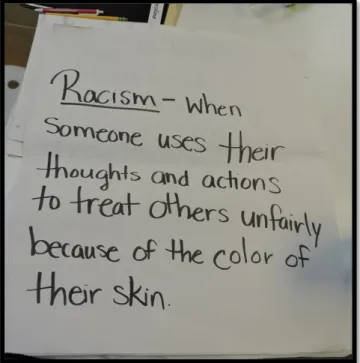
Figure 4.2 Racism Defined ... 77
Figure 4.3 Race Defined... 77
Figure 4.4 Note to Claire’s Parents ... 79
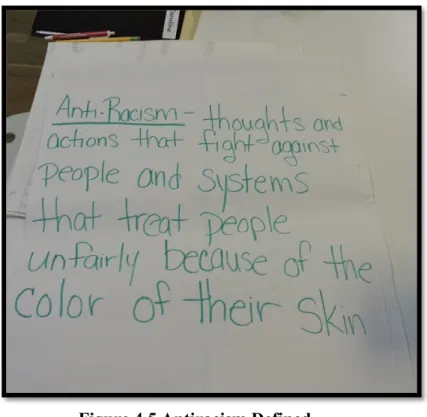
Figure 4.5 Antiracism Defined ... 80
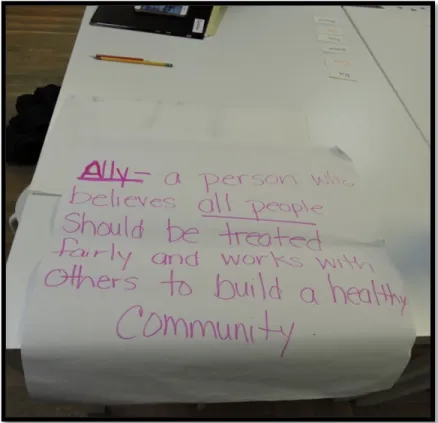
Figure 4.6 Ally Defined Image ... 81
Figure 4.7 School-to-Prison Pipeline Model ... 82
LIST OF ABBREVIATIONS
CRT Critical Race Theory
CHAPTER 1: INTRODUCTION TO THE STUDY “Princesses are White.” ~White boy, age 6
I was leading a school community conversation titled Let’s Talk Race at a local charter school. Parents and school leaders were having a follow-up discussion about creating an affinity group for girls of color. Some of the White parents at the school were upset that their daughters were excluded from joining the group. During the conversation, a Latinx teacher at the school shared a personal story that illustrated the need for children of color to have spaces away from White children that affirmed their racial identity. She described a time when she noticed one of the Black girls in her class drawing a princess. The teacher was socially conscious. She
expressed her desire to use that moment to affirm the young Black girl’s self-esteem. She asked in a supportive tone, “Will your princess be brown?” I believe she used brown instead of black because young children often use brown to refer to Black people. Before the child could answer, a White boy in the class chimed in, “Her princess can’t be Brown. Princesses are White.”
I begin with this story to illustrate that children, unbeknownst to many adults, are constantly making sense of the racial world around them (Park, 2011; Aboud, 2003). I doubt that anyone explicitly told the White boy that “princesses are White.” He synthesized
analyzing this encounter would focus on the Black child and how the comment impacted her. On one hand, we have not learned enough about how racial micro-aggressions impact young students of color. On the other hand, what often receives little attention in encounters like the one described above is how whiteness impacts White children’s identity. We need to know more about how White children construct their racial identity so that we—researchers, parents, and educators—can help them foster healthy racial identities. A closer analysis of racism and racial formation should accompany these studies because a contextualized history will help explain present realities.
In this chapter, I provide a detailed overview of the study, starting with the purpose and problem statement. I talk about the background of the problem and proceed to offer an in-depth understanding of the research study context.
Purpose of the Study
Education research with a racialized focus generally examines the educational
experiences of students of color. The topics usually include analyzing their responses to racism and racial prejudice, closing the achievement gap, assigning cultural blame for poor
performance, looking at grit and soft skills, or promoting culturally relevant pedagogy. This study, however, will not be analyzing people of color. I will instead critically examine the racial identities of the youngest perpetrators of racialized violence: White children. Love (2017) offers spirit murdering as way of explaining racialized violence. Citing Williams (1991), a critical race scholar who coined the term spirit murdering, Love (2013) defines it as “the personal,
psychological, and spiritual injuries to people of color through the fixed, yet fluid and moldable, structures of racism, privilege, and power” (p. 302). She adds context by noting,
needs to be human and to be educated” (Love, 2013, p. 302). The young Black girl in the opening vignette experienced a spiritual injury at the hands of a White child.
The purpose of this qualitative, single-case study is to gain a better understanding of how White children, ages 6 to 11, understand and construct their racial identity. Psychologist Janet Helms (1993) is well known for theorizing and measuring racial attitudes. Racial identity, according to Helms (1993), “refers to a sense of group or collective identity based on one’s perception that he or she shares a common racial heritage with a particular racial group” (p. 3). The study critically analyzes the interactions, behaviors, and discourses of children participating in two five-day anti-racism summer camps. The children represent diverse racial and ethnic backgrounds. Disruptive Peacemaking Institute (DPI), a nonprofit organization, hosts the
summer camps. This research is significant because it will help inform what we know about how White children construct their racial identities during their formative years. If we can better understand how children view themselves and others through a racial lens, we can help build anti-racist identities, lessen the formation of racial biases, and decrease harm caused by racism. This research will also inform educational policy, practice, and parenting.
Problem Statement
By three months old, babies show a preference for people who share a similar skin color (Kelly, Quinn, Slater, Lee, Gibson, Smith, Ge, & Pascalis, 2005; Dunham, Baron, & Banaji, 2008). By kindergarten, however, this preference for in-group association significantly
multiplicative effect of being a victim of racialized violence has negative educational outcomes for people of color (Sue, Lin, Torino, Capodilupo, & Rivera, 2009). I will achieve the purpose of this study by investigating the racial identity of White children from a critical race theory
perspective and by examining their racial identity construction as discussed in white critical studies.
Background of Research Problem
Racism is embedded in the foundation of America (Bell, 1991; Harris, 1993; Lopez, 1994; Thandeka, 1999; Crenshaw, 1988). As a function of racism, wealthy Whites engineered a White identity to create divisions along race and class lines, starting with slavery (Thandeka, 1999). Racial identity is connected to one’s beliefs about another racial group. Consequently, several studies indicate that Whites who have a strong racial preference for their own race also hold strong anti-blackness beliefs (Brown, Spatzier, & Tobin, 2010; Pope-Davis & Ottavi, 1994; Parker, Moore, & Neimeyer, 1998). However, these studies primarily focus on adults and not on White children. Knowledge of how White youth, in particular, articulate their racial identity and beliefs about the racialized other is lacking.
that it is difficult for Whites in a society where they rarely view themselves as having a race (Thandeka, 1999; Bonilla-Silva, 1997; Lewis, 2004) to think about themselves as White.
Current educational research that encompasses a racial construct primarily focuses on diversity, culturally relevant pedagogy, or multicultural education (Greene & Abt-Perkins, 2003; Nieto, 2003; Rogers & Mosley, 2006) but rarely do these studies explicitly address racism or racial biases. Moreover, this literature almost always omits White culture as one of the cultures to study. Diversity and multicultural education usually does not involve an examination of White youth’s investment in whiteness (Lipsitz, 1998). An investment in whiteness, according to Lipsitz (1998) and Harris (1993), allows whiteness to function like a property, something in which to stake a claim, something that holds value and power, something that allows one the right to exclude others and gain access to spaces and places. Nieto (2003) recognizes the persistent nature of racism and believes there should be a stronger challenge to it through research and in schools. Researchers and educators play vital roles in addressing this problem.
constructing their racial selves so that researchers, educators, parents, and policy makers can better understand how to help White youth construct anti-racist identities.
It is difficult to acknowledge the impact racism has on White people because it pales in comparison to being the victim of racial oppression. Nonetheless, there are negative effects White people experience regarding racism. Thandeka (1999) writes, “The first racial victim of the white community is its own child” (p. viii). She included this statement not to erase the victimization of people of color, but to shine a light where racialized violence begins. Similar to other victims of abuse, White children project abuse, and people of color are the recipients. No longer can we focus solely on restoring children of color’s wholeness after they have been subjected to racialized violence. This is reactive. A proactive approach would examine the place whence the harm flows and work upstream toward addressing at least one of the sources. To do so, it is imperative to gain an understanding of how White youth understand their racial identity so that developing an anti-racist identity can begin much sooner than adulthood.
I use Helms’ (1993) definition of the Autonomy stage, though I believe identities are iterative and not fixed, to define an anti-racist identity. Therefore, an anti-racist White person is one who “no longer feels a need to oppress, idealize, or denigrate people on the basis of group membership characteristics such as race because race no longer symbolizes a threat to him or her” (pp. 62 & 66). I nuance this definition by offering who no longer, whether consciously or subconsciously, feels a need to oppress. This additional statement is an intentional effort to recognize subconscious bias, where people are not aware of their feelings or beliefs. This work is important because racism has negative health, economic, educational, social, and political
racist practices “[exchange their] humanity for the power, wealth and status attained through the oppression of others” (p. 111). For those who choose to challenge white supremacy, they are caught in a constant internal struggle to accept reality, one where they acknowledge their own complicity in the oppression of others (Thandeka, 1999; Sue, 2005).
Background of DPI
The foundation. DPI is an organization I co-founded with my partner, Dr. Daniel Kelvin Bullock. The organization works to dismantle systemic racism in education through offering anti-racism summer camps for kids, workshops for parents, and professional development for educators. We offer one five-day camp for kids in first through second grade and another for kids in third through fifth grade. We target White families and spaces because research shows that White people opting for colorblind approaches are not as likely as people of color to have race-based conversations in their homes (Aboud and Doyle, 1996; Pahlke, Bigler, and Suizzo, 2012; Bonilla-Silva, 2014).
Summer camp goals. The DPI Summer Camps have three goals: 1) to foster healthy racial identities in children, 2) to build a historical understanding of race and racism, and 3) to equip families with tools and resources to extend anti-racist practices in the home and
community. We use a literacy-based curriculum to engage students in conversations that explicitly address race, racism, anti-racism, and activism.
walls that were too wide and too deep to overcome. Even though my personal experiences have created a less-than- hopeful stance on the impact of anti-bias training with adults, research shows that such work can influence the thoughts and behaviors of educators (Lawrence and Tatum, 2004). Lawrence and Tatum (1998) found “that anti-racist teaching built upon a sound blend of psychological and pedagogical theories can be instrumental in assisting White educators, both in development of their racial identities and in a re-visioning of their current curriculum” (p. 10). As such, possibility for continuous growth and learning exists. I believed, however, that by working with children prior to their enduring years of exposure to biases and bigotry, I could find more hope in the “becoming” process (Morrison, 1992; Thandeka, 1999) of creating a racial identity. The foundations of our racial identities begin in early childhood. It only made sense to work with children before they become resistant adults (McIntyre, 1997), so that the likelihood of adopting an anti-racist identity was more feasible.
Site of Research
I chose DPI Summer Camps as the site for my study for several reasons. First, it was convenient. I am one of the co-facilitators of the camps; therefore, I would be in a space where I would not have to overcome structural barriers, such as approval from a school district or
Research Questions
In this study, I explored what White children understand about whiteness. Two questions guided my work:
1. What does White racial identity construction look like for White children participating in an anti-racism summer camp?
2. How do White children normalize or resist whiteness? Significance of the Study
This study is significant for several reasons. First, I focused on White children’s identity and not children of color. This approach is similar to Van Ausdale and Feagin (2001), Rogers and Mosely (2006), and Miller (2015); it is uncommon. Findings from this study will, therefore, fill a gap in the literature.
Second, it is significant because it is timely. In a society where Dylann Storm Roof murdered nine Black people at the Emanuel African Methodist Church in South Carolina, where several hundred Nazis marched openly in Charlottesville, Virginia, shouting “Jews will not replace us!” and where the 45th national leader of our country failed to condemn these acts as an abomination, there needs to be a much stronger emphasis on what it means to become White. These incidents of overt racism demonstrate a clear need to understand whiteness. Additionally, racism is simultaneously occurring in less overt ways. Sue (2005) argues that if we solely
categorize racism as “extreme acts of hatred,” we “engage in self-deception” by thinking that we, ourselves, cannot hold racially prejudiced beliefs (p. 107).
whiteness is normalized in subtle ways such as through intonation and in media advertisements. In well-intentioned homes, white superiority is reified. How Whites view themselves impacts how they treat others (Thandeka, 1999; Sue, Lin, Torino, Capodilupo, & Rivera, 2009; Helms, 1997). In order for Black and Brown children to have better educational experiences and outcomes, we need to understand how White children construct their racial identity. I always return to Black and Brown children’s experiences because I do not want to get lost trying to understanding White children without naming whom they impact. This is akin to talking about White privilege while leaving out the subordination of people of color. I believe that the
liberation of people of color is tied to White children’s ability to develop an anti-racist identity. This study’s findings are significant for society at large but can be of particular importance for three specific audiences: elementary educators, White parents, and policymakers. Below I provide specifics.
For elementary educators. Educators play a vital role in shaping children’s identities (Miller, 2015a). As they become more aware of their students’ abilities to make sense of race, they can actively become a part of creating anti-racist learning environments and curriculum. Many educators are apprehensive about discussing race and racism with children, while others erroneously believe that children do not see color (Miller, 2015a). Current literature
For White parents. It is well-known among Black communities that Black parents have the talk with our children. The purpose of this talk is to equip our children with knowledge about the racist world around them—to tell them that their Black skin holds meaning in this world, and that others, White people particularly, will judge and mistreat them due to the color of their skin. Most Black families know this is a necessary rite of passage for survival. Colorblind ideologies and a reticence to talking about race prevent some White parents from believing these
conversations are necessary (Phalke, Bigler, & Suizzo, 2012; Njoroge, Benton, Lewis, & Njoroge, 2009). With the current Black Lives Matter movement and emphasis on police brutality, Black parents are having these conversations more frequently (Bouchard, 2016). White parents should be having a parallel conversation about racism. Data from my study will help White parents understand the need for their own talk and will let them know what needs to be included.
For policymakers. To date, there has not been a systematic effort to provide anti-racist education through our schools. As the United States continues to grapple with ways to respond to the recent uptick in racialized violence since the 2016 presidential election season, we should pass policies that prioritize racial equity. Policymakers can use data from this study to advocate for curriculum shifts that address early racist formations, beginning with elementary-aged
children. Racial equity standards, which hold school systems accountable for teaching about race and identity, would be a transformational place to start.
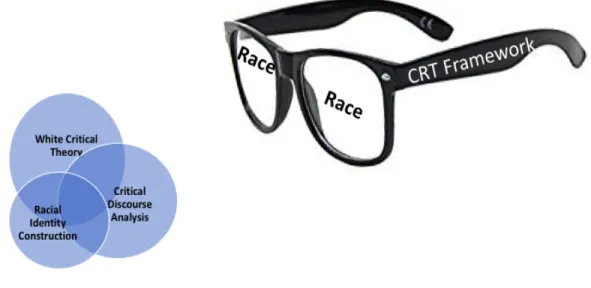
I used a Critical Race Theory (CRT) framework to guide this study. Through this lens, race was the central focus, and I interpreted all data with an emphasis on the role race plays in connection with power and oppression. I wore these metaphorical glasses as I observed the interplay of whiteness as explained through White Critical Theory (WhiteCrit), critical discourse analysis, and racial identity construction (see Figure 1.1). This conceptual framework helped me integrate multiple theories and perspectives as I conducted the literature review and
Figure 1.1 Conceptual and Theoretical Framework
interpreted the data (Imenda, 2014). The glasses in Figure 1.1 are situated looking to the left, or backward rather than forward, because the history of racial formation is significant to
Critical race theory. Critical Race Theory (CRT) served as the main framework for this study. CRT emerged from Critical Legal Studies (CLS) around the 1970s (Bell, 1992; Delgado, 1987; Ladson-Billings & Tate, 1995). CLS analyzes the law and ways in which a hierarchical structure benefits certain groups of people (Bell, 1992; Delgado, 1987; Ladson-Billings & Tate, 1995). CRT scholars critiqued CLS for not focusing on the way race disproportionately impacted people of color while benefiting Whites (Bell, 1992).
CRT is a framework that asserts racism is endemic to and permanent in society. CRT situates race and racism at the center of analysis, and incorporates an intersection of race, class, and gender (Bell, 1992; Ladson-Billings & Tate, 1995). In education research, CRT asserts that:
1) Race and racism is centralized in all studies, along with the intersections of other forms of oppression such as gender, class, and legal status.
2) Dominant perspectives should be challenged through the telling of counter-narratives, voices from marginalized communities.
3) A social justice agenda must always be present.
4) Experiential knowledge is valued knowledge. The voices of people of color should be centered in attempts to right social wrongs.
5) The world is complex, comprised of myriad components and research should represent diverse perspectives (Solórzano and Delgado Bernal, 2001).
CRT posits a structural analysis of racism. Racism is much more than ideological beliefs and instances of individual meanness. Racism was legally sanctioned and woven into the
Further, CRT challenges the normalization and invisibility of whiteness as the dominant perspective. Whiteness is often contrasted to the other, with the other being people of color (Harris, 1993). The use of counternarratives, allowing the voices of marginalized communities to be heard and validated, aids in deconstructing this normalization (Delgado, 1989; Solórzano and Yosso, 2002).
I pulled from the first three tenets listed above for my study. Race and racism were, first of all, key focal points. Second, I used my voice and perspective, as a Black female researcher, to tell a story about White children. This was a deliberate effort to uphold what Black feminist scholar bell hooks (1992) coined as the oppositional gaze. The oppositional gaze is the
recalcitrant look of Blacks who challenged the White supremacist power structures and declared, as hooks (1992) notes, “Not only will I stare. I want my look to change reality” (p. 180). Whites punished enslaved Blacks for looking in general, but also for gazing at Whites (hooks, 1992). Consequently, my research project about White children’s racial identity represents a
counternarrative and a rebellious gaze. Last, while CRT promotes a structural analysis to disrupting racism and fighting for social justice, the study did not directly create systemic change. I used the study results, though, to make recommendations for policy and school curriculum revisions, thus furthering social justice efforts.
and Gallagher, 2008). Additionally, White supremacy is upheld and maintained through whiteness, which affords White people material, social, and psychological advantages (Bell, 1992; Harris, 1993). Lipsitz (1998) and Harris (1993) argue that an investment in whiteness allows whiteness to function as property—something in which to invest, that holds value and power, that allows one the right to exclude, and that gives one access to spaces and places.
Whiteness as property affords Whites a material wage, one that Lipsitz (1998) believes bestows a benefit that
accounts for advantages that come to individuals through profits made from housing secured in discriminatory markets, through the unequal educations allocated to children of different races, through insider networks that channel employment opportunities to the relatives and friends of those who have profited most from present and past racial
discrimination, and especially through intergenerational transfers of inherited wealth that pass on the spoils of discrimination to succeeding generations (p. vii).
Over the years, whiteness as property has taken on nuanced forms, making it less visible but still very real and present (Harris, 1993; Lewis, 2004; Lipsitz, 1998). This new racism (Bonilla-Silva, 2014) gives a different meaning to Ralph Ellison’s (2010) Invisible Man.
Critical discourse analysis. Critical discourse analysis (CDA) emerged during the 1990s out of critical theory (Wodak and Meyer, 2009). Critical theorists believed that rather than merely describing life, life should be critiqued in a way that works toward improving society (Wodak and Meyer, 2009). Additionally, Gee (2005) noted that critical theorists moved beyond understanding social relationships to analyzing them “in terms of their implications for things like status, solidarity, the distribution of social goods, and power” (p. 23). Therefore, with CDA discourses include but are not limited to language, how we construct reality, sounds, gestures, and behaviors (Gee, 2005). Van Djik (1993) discussed three principals of CDA: 1) Emphasis on the role of power in constituting inequity and dominance; 2) Avoidance of apolitical stances; neutrality is not an option; and 3) Structural analysis connected to context. Van Djik argued that CDA scholars should challenge hegemony and prioritize the perspectives of those who are marginalized. I used the principles of CDA to analyze how White children make sense of their racial identity while interacting with others at the camps.
My Positionality
Where are you from?
I am from late nights, rocking my brown babies, Zion & Zaire to sleep I am from shucking corn and bailing hay under the hot summer sun
I am from fresh cut grass and sweet honeysuckle I am from my ancestor’s wildest dreams
I am from resistance
necessary disruption to the status quo. As such, my voice is a counternarrative, and I use my positionality statement to move from the margins to the center.
When race became real. Growing up in Goldston, NC, I attended a predominately white elementary school (kindergarten – 8th grade) and high school. Ironically, my elementary school was once the all-Black school for kids in our area. My racial experiences through the school system have shaped and molded me into the anti-racist activist that I am today. Race became real to me at five years old. I was in kindergarten, sitting at a round table where I was the only Black student. One of the young White girls invited everyone at our table to her birthday party, except for me. Being the inquisitive child that I was, I asked her why she excluded me. I do not recall her exact words, but she said something like, “You can’t come to my birthday party because my dad said that Black people are not allowed in our home.” At the time, I did not understand what this meant. I remember my mom turning to my dad in shock, I imagine, when I recounted this story to her. Her response was, “Ronda, we don’t invite ourselves to other
people’s birthday parties.” I did not believe I had done this, but I chose to accept my mom’s response. Her answer sufficed until it happened again when I was seven. The situation was similar, but the setting was different.
me. Just like before, I shared the story with my mom, but this time, she talked to me about racism, slavery, and Abraham Lincoln freeing the slaves. As an adult, I have learned that Lincoln was much more complicated than my mom shared, but at the time she did her best to explain a complex topic to a young child.
These two early experiences with race and racism solidified my desires to better
understand how the two operate in this world. I have been awakening since I was five years old. This journey into understanding my role in creating a socially just world has been a beautiful struggle.
Motherscholar. Cheryl Matias (DePouw & Matias, 2016) coined the word
nestled in the poppy seed field from the movie The Wizard of Oz (LeRoy & Fleming, 1939). There was also a flying monkey placed prominently on the front of the shirt.
Needless to say, this act of the White teachers elicited much racial tension and angst among the teachers of color. I facilitated a conversation with the staff at the small school so that we could get answers as to why the teachers wore the shirt. By the end of the conversation, the White teachers revealed that they created the shirts as a joke because the students often told the White teachers that they looked alike. They also shared that they never considered the racial implications of their actions. I was devastated by their level of ignorance and could only imagine what other racist things they had blindly said or done to our Black and Brown students. Looking back, Daring Dialogue was probably my first organized, anti-racist event.
Because I am the sum of all of my experiences, who I am has impacted my study and analysis. My interests in better understanding white children’s racial identity construction is connected to the life I have had and continue to live.
Study Limitations
study, however, was not designed to be generalizable, and there was value in learning about a subset of our population.
Key Terms and Definitions
1. Black- I use Black to reference people who phenotypically and ethnically share a common African ancestry. I capitalize the B in line with APA capitalization standards. 2. Construction- I use construction to mean the ways in people create ideas through their
thoughts, actions, and discourse.
3. Discourse- I use discourse to refer to the language, both verbal and nonverbal, used to communicate ideas.
4. Identity- I define identity as the characteristics that contribute to who a person is. These characteristics may be individual or shared among a group.
5. Marginalized- I use marginalized to reference people or ideas that have been made insignificant by the dominant culture.
6. People of color- My use of people of color refers to people who are not White. 7. Race- When I use race, I align with CRT scholars who define it as a social construct
Whites created to institute a hierarchy that privileges those who are White.
8. Racism- When I use racism, I am referring to the system of racial privilege and power Whites created to keep people of color in subordinate positions in society.
9. White- I use White to reference people who phenotypically and ethnically share a
common European ancestry. I capitalize the W in line with APA capitalization standards. 10.Whiteness- My use of whiteness reflects the beliefs and actions Whites use to maintain
11.White supremacy- I use white supremacy to reference the systematic use of power— through laws, policies, education, etc.—to keep Whites in a superior position in society at the expense of people of color.
Conclusion to Chapter 1
Research studies dedicated to understanding race and racism have put people of color under a microscope. This microscope contributes to otherizing marginalized communities, as if we are deviants from the norm. In Chapter One, I argued for shifting the gaze to White
CHAPTER 2: LITERATURE REVIEW
The objective of this case study is to explore how White children construct their racial identity. I used critical race theory (CRT) and White critical theory (WhiteCrit) to frame the study. Aligned with CRT tenets, race is central to the study, and as a form of praxis, I will use my findings to further anti-racism work in my local community through grassroots efforts and policy change. I am a Black woman researching whiteness and White children in particular. My study is a counternarrative.
In this chapter I will share the purpose and significance of studying whiteness, state my positionality, provide an overview of the history and construction of whiteness, explain how whiteness is reified in policies and practices, and explain examples of whiteness studies in the disciplines of education, psychology, and sociology. Studies regarding race, racism, and racial identity have largely been relegated to studies of people of color and how we, as Black and Brown folks, have traditionally navigated our survival in a white supremacist world. As such, in order to the shift the gaze, I will conclude this review with studies regarding how White youth construct their racial identity (see Appendix 1 for rational behind literature selection).
Purpose
problem with white supremacy. The purpose of this literature review is to connect how White people created race to the formation of White children’s racial identity construction.
Significance
White adults are often the focus of whiteness studies; however, they do not wake up all of a sudden as representatives of their race. They spent years becoming and embodying their racial selves (Cross, 2001; Thandeka, 1999; Morrison, 1992), and rather than looking back on
childhood from an adult-centric perspective, we need to look at White children during their actual childhood. Rather than starting at this point, though, it is necessary to dive into the history of racial formation because for one, this history is rarely known, and two, because it explains how embedded race is into our individual and collective racial existence.
Positionality
As an African American female, I bring a racialized lens to the study. My earliest
memory of a racial experience occurred at five-years-old in my kindergarten class, when another White female student said, “You can’t come to my birthday party because my dad said that Black people are not allowed in our home.” The student was clearly instituting whiteness as property in exercising her power to exclude and deny access to space (Harris, 1993). Since then, the onslaught of racial micro-aggressions coupled with both overt racist experiences have
continued to pique my interest in learning how racism, with a focus on whiteness specifically, exists and persists as an ideology in its youngest perpetrators.
Whiteness: Another Invisible Man
1992; Leonardo, 2004; Thandeka, 1999). Black scholars have written for years on whiteness. W.E.B. DuBois (1935) provided some of the earliest critical analysis of White racial formation. According to him, immigrant workers coming to America in the late 1700s and early 1800s found material and psychological benefits to adopting White identity with those in power, over joining forces with the freed Black workers and those who were enslaved (DuBois, 1935; Twine and Gallagher, 2008). These immigrant workers observed the ways in which the dominant group used capitalism and labor exploitation to move out of poverty. They came to understand that access to land and voting rights meant access to power. While all immigrants did not receive equal material benefits of adopting a White identity, they received the psychological benefits of knowing that at the end of the day, at least they were not Black (DuBois, 1935; Thandeka, 1999; Harris, 1993).
In 1705, the Virginia legislature, adding to the race laws, mandated masters give White indentured servants fifty acres of land, along with items such as clothes and food, upon the completion of their servitude (Thandeka, 1999). The class struggle faded in many Whites’ mind as they could now associate themselves with the elites. As this association grew, their disdain for Blacks intensified, as well. Enslaved and freed Blacks were viewed as competition and blamed for lowering wages. How could a White laborer who needed money to feed his family compete with the free labor of enslaved persons? Further, how could they compete when their skill level was often not as high as many of the enslaved men? Adding additional perspective, roughly 25% of White laborers could read and write (DuBois, 1935), so many were ignorant with limited opportunities available to them. Thus, the division worked, and a permanent hostility was born.
Culture of Dominance
The construction of whiteness was about more than just class division and racial animus: whiteness involved state sanctioned racial domination and supremacy. In Learning to Be White (1999), Thandeka noted that race laws “legislated [white’s] right to feel superior to all
nonwhites” (p. 46). She was particularly referencing poor Whites’ elevated status by means of laws that afforded them privileges over the enslaved; however, this feeling of superiority
reverberated for all Whites. Thandeka (1999) also acknowledged that Virginia’s slave laws set a sinister precedent for other colonies to follow. She explained that, as a nation, colonies were “on the road to establishing a legal caste system that would be based on the precept of [B]lack
a race but to denigrate a class. White racism was thus a means to an end, and the end was the defense of Virginia’s class structure and the further subjugation of the poor of all “racial” colors (p. 47). Uplift and debasement go hand-in-hand when it comes to the social construction of whiteness. One does not exist without the other.
The ownership and debasement of Blacks, though treated as property, was a goal or coveted prize White workers sought. In Black Reconstruction in America: 1860-1880 (1935), DuBois explained, “But above and beyond this, it fed [the White worker’s] vanity because it associated him with the masters…If he had any ambition at all, it was to become a planter and to own ‘niggers’” (p. 12). Owning another human being literally put Whites in a different class.
White racial dominance was reified not only through ownership over other human beings, but also through the law. Whites created Black codes to deepen their collective power. Blacks, whether free or enslaved, could not own property, travel without a permit, own weapons vote, testify, bring a case to court, or be considered a citizen (Harris, 1993). All of these privileges, however, were granted to White males. As will be explained later, additional policies and laws came after the codes were put in place to strengthen structural racism, cementing whiteness into society and creating a wage for the color of white skin.
White Wage
Whiteness comes with a wage, or type of value. Whiteness became something that people could own and physically possess. DuBois (1935) professed that even though White workers received meager earnings, “they were compensated in part by a sort of public and psychological wage” (p. 700). He listed that White workers received “public deference,” traveled freely with other Whites in public spaces, voted on governing officials, had
through the most positive lenses (DuBois, 1935, p. 700-701). Using DuBois’ (1935) description of white wages, Harris (1993) further explained how whiteness took on the value of property. She noted during slavery, white became synonymous with free and black synonymous with slave (Harris, 1993). To be White meant that one was free. This association served as the building blocks to transition whiteness to property.
Whiteness as property. Whiteness as property began to formalize as many law cases existed where people sued for the right to be considered White or at least not Black. For
example, Lopez (2004) further illustrates this point referencing the Hudgins v. Wright (1806) and Ozawa v. United States (1922) cases. The Wright family sued Hudgins, a slave master who hoped to move the enslaved Wright family out of Virginia, arguing that they should be considered free because they were not Black, but Indian. During this time, only Whites and Indians were considered free, without having to provide substantial proof of their lineage. Due to an arbitrary test of examining one of the plaintiff’s straight hair, which was unlike Negro hair, the plaintiffs were considered Indian and allowed to be free (Lopez, 1994). Regarding Ozawa v. United States (1922), Takao Ozawa was a Japanese man who applied for US citizenship on the basis that his skin color was white (Lopez, 1994). However, the court ruled that the color of one’s skin was insufficient evidence to prove one was indeed White; thus, Ozawa’s appeal for citizenship was denied. Both Hudgins v. Wright (1806) and Ozawa v. United States (1922) demonstrated how arbitrarily whiteness was defined. Moreover, both cases also demonstrated that freedom and citizenship not only belonged to Whites, but also that they were the arbiters for who was allowed to be considered White.
example, the possession of whiteness allowed one the “right to transfer or alienability, the right to use and enjoyment, and the right to exclude others” (Harris, 1993, p. 281), along with forms of social and cultural capital (Twine and Gallagher, 2008). Exclusion was a salient tool used to reinforce whiteness (Lopez, 1994; Leonardo, 2004; Harris, 1993; Thandeka, 1999). Embracing the ideological beliefs of white supremacy meant being included in an exclusive group. Even though poorer White laborers were marginalized Whites, they still had their skin color that elevated them above Blacks (Harris, 1993; Thandeka, 1999; Lopez, 1994).
Ironically, as Whites evolved their whiteness into property, they simultaneously reduced slaves to property as a form of subordination. Harris (1993) explains that the boundaries between Blacks and property were eliminated. Slaves could be purchased, “transferred, assigned,
inherited, or posted as collateral” (Harris, 1993, p. 279). Slaves, considered three fifths of man in the United States Constitution, were treated like chattel. Whites and Blacks becoming property was a form of dual dehumanization with vastly different long-term consequences. This mirror effect, was the basis of whiteness as an oppositional identity (Thandeka, 1999; Twine and Gallagher, 2008; Morrison, 1992; Lopez, 1994). Without Blacks, Whites would not exist. Oppositional Identity
In describing the “white racial induction process” (p. 29), which occurs typically
throughout the youth and young adult years, Thandeka (1999) alludes to the confinement created by fences. She references language such as “racial exile” (p. 9), “forbidden to venture beyond the gates of their backyard” (p. 11), “separateness and isolation” (p. 18), and “self-alienation” (p.19) to establish that becoming White was about creating boundaries to keep the nonwhite other out, while holding the whiteness inside. Daring to transcend these hidden fences was a double-edged sword. If one was successful, in transcending these hidden fences, then
banishment from the White community and one’s own family was imminent (Thandeka, 1999). If one failed, then he or she lost a sense of humanity and suffered from “repressed
desires” (Thandeka, 1999, p. 26) in order to keep one’s place within the White community. Pain, a sense of loss, and shame resided behind this “fenced-in feeling” (p. 20), created when being forced to choose whiteness. This pain, however, is occurring at a subconscious level and is not always acknowledged by those experiencing it (Thandeka, 1999).
The metaphorical fences were present throughout Thandeka’s (1999) book. Living within constricted boundaries created much internal conflict for Whites. In fact, becoming White meant a denial of one’s self and humanity. When a person is not allowed to be one’s authentic self, he or she often finds a way to release that pent-up frustration. This is shown as Thandeka explains Whites’ obsession with blackface:
Their attachment to the black image was a desire to recover feelings that for themselves as ‘whites’ were intolerable, but as prewhites, were the hallmarks of their humanity: sensuality, sexuality, free play, the premodern home, whimsy, strutting, zipping, dashing, clowning, cooing, cooning (p. 70).
Toni Morrison (1992) also writes about the creation of whiteness as an oppositional identity in her book, Playing in the Dark: Whiteness and the Literary Imagination. She analyzes the way White authors create whiteness through literature. White American writers’ depictions of Blacks, according to Morrison (1992), said as much about them as it did about their
objectified characters. American Africanism was a tool for writers to establish a master narrative about a mythical Black people. They used blackness for whatever purpose they needed, and oftentimes to establish a White identity. In doing so, authors created an interesting juxtaposition between freedom and bondage. According to Morrison, freedom was depicted through
enslavement. She used an excerpt from author Bernard Bailyn’s (1986) Voyages to the West to help illustrate this point. In the text, Bailyn (1986) described William Dunbar, a character who was a distinguished, highly educated Scot who dared to venture West. However, it was not until Dunbar gained absolute authority over Black bodies that he found himself, his true identity:
Endlessly enterprising and resourceful, his finer sensibilities dulled by the abrasions of frontier life, and feeling within himself a sense of authority and autonomy he had not known before, a force that flowed from his absolute control over the lives of others, he emerged a distinct new man, a borderland gentleman, a man of property in a raw, half-savage world (p. 42).
Not only did taking other people’s freedom give Dunbar a life he had never had, it also gave him his manhood—something his education and previous elite lifestyle could not afford. In essence, the White man’s validation and power were tied to Black bodies; therefore, without Black bodies, his life lacked substance (Morrison, 1992). This is ironic, though, considering Dunbar came from an elite background. Should not his wealth and class status have been sufficient for his livelihood?
Morrison (1992) further highlights this point of oppositional identity through the
Not. Harry and Marie, two of the main characters, spend time visiting Cuba. During one excursion, Harry violently confronted a Black male who spoke to Marie. Afterwards, Marie bleached her hair from a dark color to blonde, symbolically representing a transition from black to white (Morrison, 1992). Both of these incidences allowed Harry and Marie to gain power and establish themselves as different from the Black male character. Morrison (1992) said that this depiction of Africanism “becomes not only a means of displaying authority but, in fact,
constitutes its source” (p. 80). Morrison’s literary analysis is key to understanding the
construction of whiteness. Morrison argues that whiteness is created and recreated in the literary imaginary. Therefore, texts such as Bailyn and Hemmingway’s are used to establish and
perpetuate whiteness as an oppositional identity. Visibility
The permanence of whiteness largely hinges on its ability to be invisible; this is by design (Morrison, 1992; Lopez, 1994; Thandeka, 1999; Sullivan, 2006; Lipsitz, 1998; Leonardo, 2004; Twine and Gallagher, 2008). Lipsitz (1998), in The Possessive Investment in Whiteness, notes that while whiteness permeates all parts of our society, “it is very hard to see” (p. 1). He further notes that “as an unmarked category against which difference is constructed, whiteness never has to speak its name, never has to acknowledge its role as an organizing principle in social and cultural relations” (Lipsitz, 1998, p. 1). Further, cultural arbitrary is a cultural form adopted by the state, those in power, used to subjugate others to a standard or norm that is superficially relevant (English and Bolton, 2016). Cultural arbitrary is used to shape reality and is
challenging white supremacy is convincing people, particularly White people, that it exists, is real, and carries privileges for some and disadvantage for others.
Sullivan (2006) argues that many White people actively work to remain unaware of the privileges afforded them. Many of these privileges, according to Whites, are considered normal benefits, and if someone else is not receiving them, then they are doing something wrong. This is just the way that things are. If normalization is not the go-to answer, then the privileges are linked to meritocracy, pulling oneself up by their bootstraps (Lipsitz, 1998; Sullivan, 2006; Lopez, 1994; Thandeka, 1999; Crenshaw, 1988). Sullivan (2006), in Revealing Whiteness: The Unconscious Habits of Racial Privileges, professes that “any emotion that threatens white
privilege must be transformed into a different emotion that does not conflict with it” (p. 56). This form of cognitive dissonance allows the status quo to remain in place.
White fragility and visibility. Scholar Robin DiAngelo (2011) coined the term white fragility, which is related to how Whites respond when their race is made visible to others and the status quo is challenged. In essence, their response is a reaction to feeling hyper-visible, when normally Whites are afforded invisibility. White fragility, then, is an emotional state where talking about race or racism elicits discomfort in Whites, “triggering a range of defensive
diverted to the White person who is uncomfortable. In these instances, White people’s pain is prioritized over Black and Brown people’s livelong experiences.
Growing up in racially isolated spaces fosters experiences where racialized habits, beliefs and behaviors often go unchecked (McIntyre, 1997; Thandeka, 1999; DiAngelo, 2011; English & Bolton, 2016). Whites living in insular neighborhoods produces what Bourdieu termed as habitus. Habitus is the living environment that shapes a person’s characteristics and life chances, whether intentional or unintentional (English and Bolton, 2016). Within the habitus, both a person’s past and future are impacted. This aligns with Thandeka’s (1999) assertions that the preservation of whiteness results in harm and a sense of loss that Whites experience from childhood through adulthood.
Whites, in essence, engage in an idolatry of whiteness within their communities,
contributing to solipsism. White solipsism, Sullivan (2006) argues, creates the false reality that society is comprised of just White people. Further, this ideology proposes a white is right mentality which contributes to group think; therefore, whatever White people do, regardless of morality, must be ok. This results in a lack of endurance or “stamina” (DiAngelo, 2011, p. 57) to handle situations where others make whiteness visible and challenge it through discussion. The inability to handle these situations connects back to white fragility.
From Privilege to Supremacy
fervently deny their existence. Scholar Peggy McIntosh (1988), author of White Privilege: Unpacking the Invisible Knapsack, helps us to name these often-unnoticed advantages, whether to represent oneself as an individual and not a group or having the freedom of not be racially profiled. McIntosh’s emphasis, though, fails to encompass the systemic nature of whiteness and locates many of these privileges at the individual level (Leonardo, 2004; Omi and Winant, 1994). Leonardo (2004), Sullivan (2006), Lopez (1994), Omi and Winant (1994), and Lipsitz (1998) argue that there should be a shift to an analysis that acknowledges the laws and policies that created the privileges, leading to racial domination.
When Whites fail to acknowledge the systemic impact of race privilege, they believe that their singular acts relieve them of culpability. They are surely not guilty for those racist
problems over there. Further, they fail to own their complicity as beneficiaries of the racist practices. Whites also hide behind the argument that they had nothing to do with slavery and that it was a long time ago. Leonardo (2004), in contrast, argues that “despite the fact that racial domination proceeds us, Whites daily recreate it on both the individual and institution level. He adds further, that contrary to popular belief, white supremacy is an equal opportunity offender, and it not solely perpetuated by hate groups or those who are unapologetically white
supremacists. Leonardo (2004) asserts, “it is not solely the domain of white supremacist groups. It’s rather the domain of average, tolerant people, of lovers of diversity, and of believers in justice,” (p. 270) who are guilty of perpetuating racial domination.
(Leonardo, 2004). Leonardo’s (2004) article calls into question the American ideal of meritocracy, especially when so much of the privilege that Whites enjoy is unearned.
Individual vs group identity. Part of moving beyond a white privilege analysis towards one that includes white supremacy involves shifting from individual to group identity (Leonardo, 2004; Sullivan, 2006; Anders, Bryan, and Noblit, 2005). Keeping the analysis of whiteness nestled in the discourse of privilege centers the advantages of Whites and erases the victims of subordination: people of color. Further, this level of analysis keeps the conversation focused on individual meanness rather than collective power. Looking at the ways in which whiteness functions for White people, as a group, fosters a structural analysis of white supremacy. A structural analysis is necessary because there are legitimate barriers that prevent access for so many.
Bonilla-Silva (1997) further reiterates this point as he posits that most analytical work around race and racism focuses too much on racism as an individual ideology. He believes that a structural framework is missing, and that in order to fully understand how racism manifests itself in society, a “sound theoretical apparatus” must exist (Silva, 1997, p. 465). Bonilla-Silva (1997) believes that with a structural view of racism, a racialization framework explains racism as dynamic and can be represented through both overt and covert means.
Whiteness Reified Through Law and Policy
critical legal scholar Derrick Bell (1991) are futile because Blacks will never achieve it. Battles seemingly won somehow do not always position people of color as the greatest beneficiaries of said laws or policies. For example, Bell (1980) helps us to rethink our framing of the landmark decision of the Brown v. Board of Education (1954) case.
Bell (1980) proclaims that the victory in Brown (1954) was more an issue of interest convergence than a genuine concern for equality in education for Black children. Interest convergence, as defined by Bell (1980), “The interest of [B]lacks in achieving racial equality will be accommodated only when it converges with the interests of [W]hites” (p. 523). In other words, racial progress for Blacks will occur if and only if there is a benefit to maintaining the hierarchy whiteness. Bell (1980) explains that it was advantageous for White America to grant school desegregation because at the time, America needed to persuade people in third world countries to side with the United States as we were in battle with Communist countries, to convince Black soldiers who fought in World War II that it was possible to enjoy freedoms in their own country, and lastly to increase the economic growth potential of the South. Further, stories of those families and communities impacted by the decision to desegregate are often silenced during the victory celebrations of what Brown (1954) had to offer.
Without these stories, especially those of Black women, we are left with the majority narrative of superior White schools and inferior Black schools (Mungo, 2013; Brown, 2016; Van and Noblit, 1993). Contrary to the common narratives about all-Black schools prior to
desegregation, the overwhelming feeling of most students was not one of inferiority or deficiency (Brown, 2016; Dempsey and Noblit, 1993; Hughes and Swain, 2015; Patterson, 2015). The Black participant stories serve as counternarratives because their voices and
emerge from their stories such as the ethic of care, family-like atmosphere, nurturing teachers, Black pride and empowerment, validation, and a sense of loss accompanying school
desegregation (i.e. Black culture, mascots, teachers, community, etc.) (Brown, 2016; Dempsey and Noblit, 1993; Hughes and Swain, 2015; Patterson, 2015; Shircliffe, 2001; Walker, 2015). These intersecting themes create complex, multi-faceted stories about pre-and
post-desegregation. While desegregation was supposed to be a victory for communities of color, it also brought about the destruction of communities of color where Blacks thrived through underfunded, yet supportive familial connections. Other moments of seemingly racial progress also served to reify white dominance.
benefits them but focus on Blacks now having something that they coveted as their own (Thompson Dorsey and Chambers, 2014). At this point, interests begin to diverge.
As the impact of affirmative action policies began to show positive effects for Blacks— increased college attendance, employment, and enrollment in graduate programs—Whites became possessive of those spaces and began to push back (Thompson Dorsey and Chambers, 2014). One of the ways this pushback manifested itself was through individuals, such as Marco DeFunis (DeFunis et al. v. Odegaard et al., 1974) Allan Bakke (Regents of the University of California v. Bakke, 1978), Cheryl Hopwood (although she was joined by others) (Hopwood v. Texas, 1996) and Abigail Fisher (Fisher v. University of Texas at Austin, 2013) who, in essence, argued that they were denied admission to higher educational programs because underqualified minorities took their spot, or a spot that they did not deserve (Thompson Dorsey and Chambers, 2014).
According to Thompson Dorsey and Chambers (2014), this portion of the CDR cycle is related to imperialistic reclamation. Not only did these White plaintiffs believe that they owned a seat at the proverbial table, some of them sued the universities for punitive damages as if their property was damaged (Thompson Dorsey and Chambers, 2014). While not all of the plaintiffs were successful in arguing their cases of discrimination, they have effectively etched in public discourse the idea of reverse discrimination and the pervasiveness of white supremacy
(Thompson Dorsey and Chambers, 2014; Crenshaw, 1988). Whiteness Studies in Education
women, rather than White men, are the main participants in most studies. These studies, often using a qualitative approach, focus on discursive practices, white racial identity, and pedagogical practices (Leonardo, 2004; Hytten and Warren, 2008; Hughes, 2008). Further, pre-service educational programs are becoming a focal point of study, as more and more schools of
education are critically thinking about educator preparation for diverse classrooms. For example, researchers Hytten and Warren (2008) studied pre-service teachers in course designed to teach students about the structural power associated with whiteness. The Education and Culture class was comprised of fifteen graduate students, with all but two identifying as White (Hytten and Warren, 2008). From their study, four discursive patterns emerged which serve to perpetuate white supremacy and secure racial dominance: “Appeals to self, Appeals to Progress, Appeals to Authenticity, and Appeals to Extremes” (Hytten and Warren, 2008, p. 70). Each pattern
included several, more specific rhetorical themes.
Regarding Appeals to self, for example, Hytten and Warren (2008) found that students employed discourse of connections, discourse of self-absorption, and discourse of friends and family. Class discussion and written student reflections revealed that when talking about whiteness, White students would narrate stories of discrimination, often resulting in a false equivalency. Examples of being mistreated or stereotyped for being blonde, overweight, or being a part of a fraternity (Hytten and Warren, 2008). Or, in another example, White students would center themselves as victims. Sue, a student in the class, lamented, “Does feeling that my whiteness is a normal condition condemn me to the rans of a racist?” (pf. 73). “Shall I feel guilty,” Sue continued, “or as if there is something wrong with me, just for feeling normal?” (p. 73). Hytten and Warren (2008) argue that while guilt is a starting place, the unfortunate
the discursive patterns that emerged overlap with patterns Bonilla-Silva (2014) found during his studies. These are further explained later.
In Seeing the Strange in the Familiar: Unpacking Racialized Practices in Early Childhood Settings (Brown, Souto-Manning, and Tropp Laman, 2010), researchers study common, unexamined practices in elementary schools and reveal practices that contribute to racially inequitable environments for students of color and those living in poverty. Using
Critical Race Theory and Critical Discourse Analysis, researchers studied the discursive patterns within and across three different contexts: a school’s Parent Teacher Association (PTA)
fundraising activity, an Accelerated Reader (AR) program, and a read aloud classroom activity. By critically studying the language used in each of these three contexts, whether by parents, students, or teachers, the researchers found that minority students were aware of how their identities were shaped and impacted by the social practices of the three different contexts.
The researchers used qualitative case studies for the three different contexts. Data were collected through observations, transcripts, and interviews. To analyze the data, researchers looked for discursive patterns and themes related to racism and segregation. For example, regarding the PTA fundraiser, researchers found that class practices were embedded in school fundraising. For example, students were gathered in a cafeteria and a White female representing the company exclaimed that “The best students will earn prizes like this robot” and “Good students will help the school by selling the chocolate candies” (Brown, et al., 2010, p. 517). This language implied that “bad” students would not earn prizes or sell candy. Tyrone, a black
buying stuff, even though they didn’t have it, because their daughter really wanted the accompanying prize. Upon reflection, the researcher noted how classism and racism were inherent in the fundraising practices.
The researchers concluded that it is necessary to become aware of the hidden messaging of common, everyday practices in the school setting. They added that
ignoring the historically hidden messages that are sent to children and that children send us only perpetuates the practices that demean and disenfranchise families, schools, and communities where the privileged few remain in a powerful state oppressing and silencing the others. When this happens, racism and social positioning are allowed to continue and go unquestioned. Racial understanding in the classroom is one small step toward moving beyond pronounced neutrality to disrupting commonplace practices and perplexing the familiar (Brown, et al., 2010, p. 530).
Whether or not the parents and educators had positive intentions with their fundraiser, they were still enacting whiteness values.
One of the ways in which educators of pre-service teachers engage teachers in reflections of their racial identity is through writing narratives. In Revisiting the Back Jesus: Re-emplotting a Narrative Through Multiple Retellings (McVee, 2005), the researcher studies a White female teacher’s retelling of a particular story involving her first encounter at a predominately Black Catholic school. As a student in the researcher’s class, the teacher shared her narrative, as a part of a class assignment, six different times, both orally and written. As the teacher retold the story, her attempts to re-emplot the narrative revealed that the story changed each time (McVee, 2005). The researcher, using theoretical perspectives related to narratives and White teachers,