WHAT IS THE VALUE OF SEX SPEECH?
EXPLORING THE DISCONNECT BETWEEN LAW &SOCIETY TO DETERMINE FIRST AMENDMENT
PROTECTION FOR SEX SPEECH
Kyla P. Garrett Wagner
A dissertation submitted to the faculty of the University of North Carolina at Chapel Hill in partial fulfillment of the requirements for the degree of Doctor of Philosophy in the School of
Media and Journalism.
Chapel Hill 2019
Approved by:
Victoria S. Ekstrand
William P. Marshall
Clay Calvert
Daniel Riffe
Francesca Dillman Carpentier
ii ©2019
iii ABSTRACT
Kyla P. Garrett Wagner: What is the Value of Sex Speech?
Exploring the Disconnect between Law and Society to Determine First Amendment Protection for Sex Speech
(Under the direction of Victoria S. Ekstrand)
According to First Amendment doctrine, speech and expression related to sex (henceforth
referred to as “sex speech”) are considered low-value speech. As a result, sex speech receives
marginal legal protection. But the lack of protection for sex speech seems inconsistent with
American society in the 21st century. Thus, is sex speech really low-value?
Guided by this question, this dissertation studied the social perceptions of sex speech to
determine the scope of the disconnect between law and society on the value of sex speech. This
dissertation relied on a combination of legal and social science research methods: a legal analysis
of 108 U.S. Supreme Court cases on sex speech and a national public opinion survey of 1,300
U.S. citizens.
The case analysis and public opinion survey revealed that both the Court and the U.S.
public perceive sex speech serves little social and political purposes and that sex speech is less
valuable than other speech types. Additionally, the Court and the U.S. public perceive a
value-based speech hierarchy that ranks political speech at the top and sex speech near the bottom. But
the two disagree on the distance between the speech rankings. The Court perceived significant
differences between political speech and sex speech, while the U.S. public did not. This
iv
speech. As a result, this dissertation recommends that the value of sex speech not be equated
with its level of protection and that the level of constitutional scrutiny applied to sex speech be
raised so that it is not treated differently from other speech types. Additionally, the low-value
speech concept should incorporate speech mobility to allow for changes in speech value and
status.
Ultimately, the findings from this dissertation served three purposes: First, they shed light
on the value of sex speech according to law and society. Second, they inform First Amendment
doctrine regarding the protection of sex speech and the low-value speech concept. Finally, they
demonstrate the usefulness of combining legal research and public opinion survey for questions
v
To my husband, Kyle, for making my dream come true and for never giving up on me, even in the times when I gave up on myself.
To my advisor, Tori, for always championing my ideas, even the crazy ones.
To my parents, Bambi and Terrence, for teaching me to be tough and to always get back up when knocked down. If you want sugar and spice, go buy a doughnut!
To Andy and Abigail for always looking out for me like academic guardian angels. To Mr. Hitchcock and Mr. Emmert for fostering my love of government and science at a young
vi
ACKNOWLEDGMENTS
Special thanks to Dr. Daniel Riffe, the Richard Cole Eminent Professor in the School of
Media and Journalism at the University of North Carolina at Chapel Hill. Not only was Dr. Riffe
an incredible mentor and advisor on this research, but his generous contributions made this
project possible. Many, many thanks to Dr. Riffe for his kindness and support of graduate
vii
TABLE OF CONTENTS
LIST OF TABLES ... ix
CHAPTER I:THE DISCONNECT BETWEEN LAW &SOCIETY ON THE VALUE OF SEX SPEECH ...1
A Review of Sex Speech Law ...9
Defining Sex Speech ...9
The Law on Unprotected Sex Speech ...11
The Law on Protected Sex Speech ...15
Low-Value Speech ...19
The Value of Speech ...19
Identifying Low-Value Speech ...22
Critiques of Low-Value Speech ...26
Sex Speech as Low-Value Speech ...29
Research Questions ...32
Chapter Outline ...33
CHAPTER II:THEORETICAL FRAMEWORK &METHODS ...35
The Status of Communication and Law Research ...37
Contribution to Interdisciplinary Research ...40
Methods ...41
viii
Qualitative Case Analysis...42
Quantitative Public Opinion Survey ...45
Limitations ...55
CHAPTER III:DECISIONS &JUSTIFICATIONS:UNDERSTANDING WHAT “LOW-VALUE” SPEECH MEANS &WHY THE U.S.SUPREME COURT CLASSIFIES SEX SPEECH AS LOW-VALUE ...58
What does it mean for speech to be “low-value” according to the U.S. Supreme Court? ...60
What are the U.S. Supreme Court’s justifications for classifying sex speech as low-value? ...66
What has the U.S. Supreme Court said about the value of sex speech in comparison to other speech types? ...68
Conclusion ...75
CHAPTER IV:THE PUBLIC’S OPINION:DETERMINING THE VALUE OF SEX SPEECH ACCORDING TO U.S.CITIZENS ...78
Sample Demographics ...79
Sample Characteristics of Sex Speech ...83
Descriptives ...89
What are the first-person and third-person values of sex speech? ...99
What are the first-person and third-person values of sex speech in comparison to other speech types? ...115
How do the values of sex speech differ across demographic characteristics? ...131
Conclusion ...136
CHAPTER V:THE VALUE OF SEX SPEECH, THE DISCONNECT BETWEEN LAW &SOCIETY, AND RECOMMENDATIONS FOR LOW-VALUE SPEECH ...138
ix
What do the findings from the case analysis and the public opinion survey suggest about sex speech and the concept of low-value speech in First
Amendment doctrine? ...143
Public Opinion in First Amendment Law ...153
Future Research ...156
APPENDIX A:LIST OF THE SEX SPEECH CASES FOR LEGAL ANALYSIS ...158
APPENDIX B:COPY OF THE QUANTITATIVE NATIONAL PUBLIC OPINION SURVEY...162
x
LIST OF TABLES
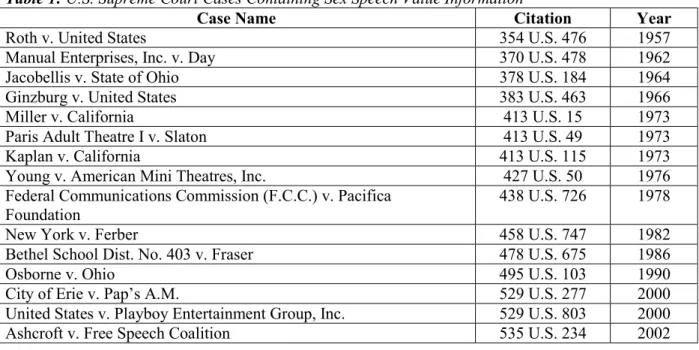
Table 1: U.S. Supreme Court Cases Containing Sex Speech Value Information ...59
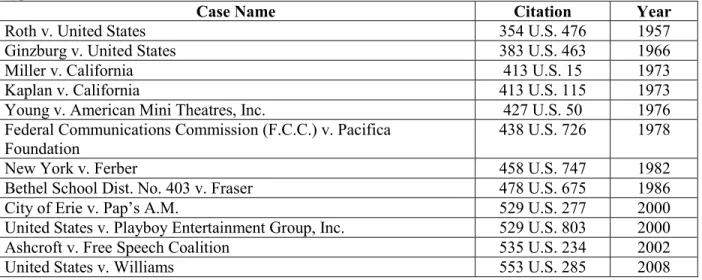
Table 2: U.S. Supreme Court Cases Containing Information on the Meaning of Speech “Value” ...60
Table 3: U.S. Supreme Court Cases Containing Comparisons between Sex Speech and Other Speech Types ...69
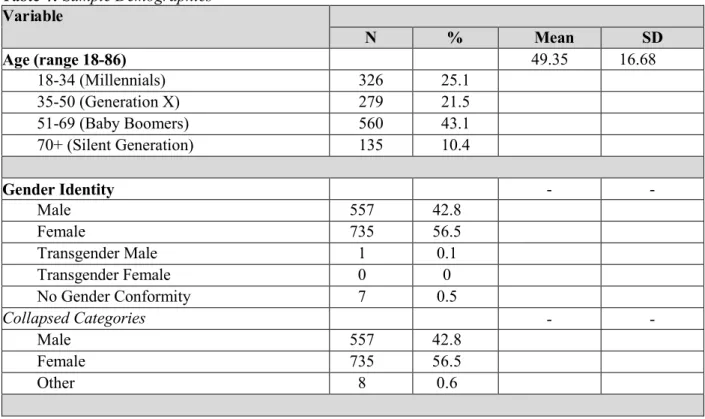
Table 4: Sample Demographics ...81
Table 5: Free Speech Beliefs ...84
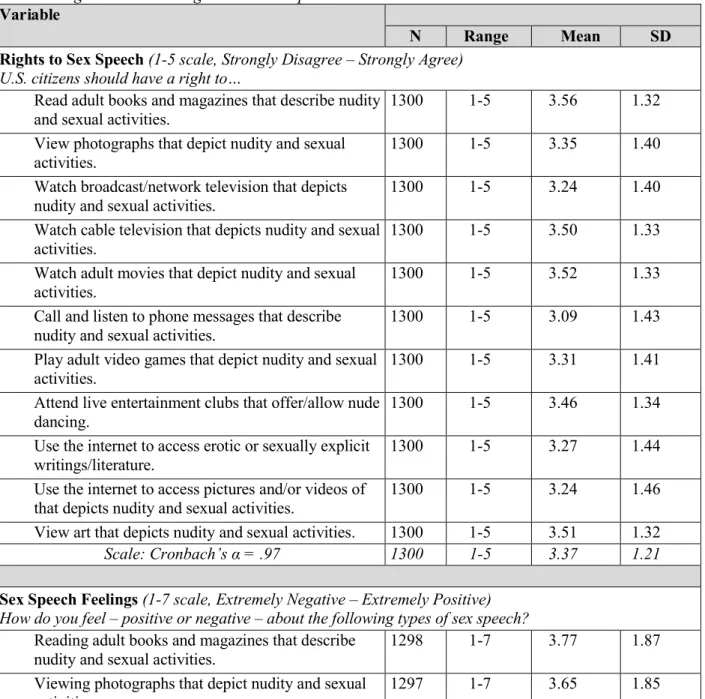
Table 6: Rights to and Feelings toward Sex Speech ...85
Table 7: Social Acceptability of Sex Speech ...87
Table 8: First-Person Values of Sex Speech ...91
Table 9: Third-Person Values of Sex Speech ...93
Table 10: First-Person Speech Comparisons ...96
Table 11: Third-Person Speech Comparisons...99
1 CHAPTER I
THE DISCONNECT BETWEEN LAW &
SOCIETY ON THE VALUE OF SEX SPEECH
On the evening of February 1, 2004, millions of Americans tuned in to watch Super Bowl
Sunday XXXVIII. Two National League Football League teams, the New England Patriots and
the Carolina Panthers, were battling for the championship but temporarily left the field for
halftime.1 As the teams ran to their locker rooms, fans poured out onto the field as large stage
equipment unfolded for the famous Super Bowl Halftime Show. That year the live broadcast
performance featured international pop sensations Janet Jackson and Justin Timberlake.2
The halftime show began with a roar of music and a cascade of lights. The two
performers sang and danced with incredible spirit, captivating their audience of nearly 90 million
viewers.3 The show was a near success until, in its final moments, a costume malfunction
1 For more a review of Super Bowl XXXVIII see Bernd Buchmasser, New England Patriots Super Bowl history:
Super Bowl XXXVIII, SBNATION (Jan. 29, 2018), https://www.patspulpit.com/2018/1/29/16944428/new-england-patriots-history-super-bowl-38-carolina-panthers-brady-branch-vinatieri-vrabel-belichick.
2 Bethonie Butler & Elahe Izadi, Everything you forgot about Janet Jackson and Justin Timberlake’s 2004 Super
Bowl controversy, WASHINGTON POST (Oct. 23, 2017),
https://www.washingtonpost.com/news/arts-and- entertainment/wp/2017/10/23/everything-you-forgot-about-janet-jackson-and-justin-timberlakes-2004-super-bowl-controversy/?noredirect=on&utm_term=.ccd412678203.
3 Television rating data report the 2004 Super Bowl XXXVIII had 89.80 million viewers. Sports Media Watch,
2
occurred. Fans gasped, and parents shielded the eyes of their children as Jackson’s breast was
exposed on national television.4
The immediate response to Jackson’s exposure was apology and reprimand. The
performers issued apologies for the exposure,5 while the Federal Communications Commission
(FCC) fined CBS, the show’s broadcaster, more than a half million dollars for the indecent
images.6 But these replies left the event far from over. The hefty fines triggered a protracted
legal fight between CBS and the FCC about the policies of fleeting indecent images.7 It took
seven years for the courts to resolve the case, but, in the end, the U.S. Court of Appeals for the
Third Circuit ruled in favor of CBS.8 The court vacated the fines on the grounds that the FCC
had not adequately announced its policy about fleeting indecent images, and therefore
improperly fined CBS for Jackson’s exposure.9
4 Bethonie Butler & Elahe Izadi, Everything you forgot about Janet Jackson and Justin Timberlake’s 2004 Super
Bowl controversy, WASHINGTON POST (Oct. 23, 2017),
https://www.washingtonpost.com/news/arts-and- entertainment/wp/2017/10/23/everything-you-forgot-about-janet-jackson-and-justin-timberlakes-2004-super-bowl-controversy/?noredirect=on&utm_term=.ccd412678203.
5 Bethonie Butler & Elahe Izadi, Everything you forgot about Janet Jackson and Justin Timberlake’s 2004 Super
Bowl controversy, WASHINGTON POST (Oct. 23, 2017),
https://www.washingtonpost.com/news/arts-and- entertainment/wp/2017/10/23/everything-you-forgot-about-janet-jackson-and-justin-timberlakes-2004-super-bowl-controversy/?noredirect=on&utm_term=.ccd412678203.
6 Exposure of sex organs, including a woman’s nipple, on broadcast media is punishable by the Federal
Communications Commission (FCC). For Janet Jackson’s exposure CBS was initially fined $550,000 by the FCC, which cited the grave harm such exposure could have on the children and minors who were in the show’s audience. But the fines were ultimately determined invalid by the U.S. Court of Appeals for the Third Circuit in the fall of 2011, CBS Corp. v. F.C.C., 663 F.3d 122 (3d Cir. 2011).
7 CBS Corp. v. F.C.C., 663 F.3d 122 (3d Cir. 2011).
8 CBS Corp. v. F.C.C., 663 F.3d 122 (3d Cir. 2011).
3
Years have passed since the Jackson broadcast, but the event is a constant reminder of the
fine line that exists in U.S. law between acceptable and punishable sex speech.10 But, the event
also represents vast changes to sex speech over the last two generations. In the 1950s, primetime
programs like “I Love Lucy” depicted married couples sleeping in separate beds,11 and films
were outlawed for depicting promiscuity and infidelity.12 But 21st-century entertainment depicts
unmarried couples fighting for the last condom,13 pornography stars as candidates for political
office,14 and women obtaining legal abortions.15 Likewise, broadcast news regularly reports
about politicians’ affairs,16 pornography use,17 and cases of sexual assault.18
10 See Chapter I, “Defining Sex Speech” of this dissertation. The term “sex speech” is used in this dissertation to represent all sexually-related speech and expression, including both protected and unprotected speech and expression.
11 Adam Bulger, How the Hays Code Forced On-Screen Couples into Separate Beds - and Changed Hollywood
Forever, VAN WINKLE’S (Dec. 28, 2016, 10:49 AM), https://vanwinkles.com/why-lucy-and-ricky-slept-in-separate-beds.
12 E.g., Times Film Corporation v. City of Chicago, 365 U.S. 43 (1961).
13 In the 1994, NBC aired the popular TV series, Friends, which told the story of six friends living and working in
New York City. Part of the storyline included the romantic relationships of the friends, which included explicit conversations between the characters about their birth control and condom use. Friends: The One Where Dr. Ramoray Dies (NBC television broadcast March 21, 1996).
14 In 2009, NBC aired a popular TV series, Parks & Recreation, which told the story of a local Indiana Parks Department and its employees. A reoccurring character of the series was a fictional pornographic film actress, which, at one point in the series, was depicted as a political candidate for the local city council. Parks & Recreation: The Debate (NBC broadcast television April 26, 2012).
15 In 2012, HBO aired a popular but controversial series, GIRLS, which depicted the lives and sexual relationships of
four young women living in New York City. The series explicitly discussed birth control use and women’s
reproductive health, including depictions of women receiving abortions from unplanned pregnancies. GIRLS: Close-Up (HBO cable television Feb. 22, 2015).
16 ENTMAN,ROBERT M.SCANDAL AND SILENCE:MEDIA RESPONSES TO PRESIDENTIAL MISCONDUCT (2012).
17 Ryan Bort, Politicians and Porn: 10 Great Internet Fails, ROLLING STONE (Sep. 14, 2017),
https://www.rollingstone.com/culture/pictures/politicians-and-porn-10-great-internet-fails-w503069.
4
The changes surrounding sex speech are credit to the great strides made in sex and
society. In the 1950s, married women struggled to acquire birth control, even when they had the
permission of their husbands.19 With few exceptions, abortion was illegal.20 And homosexuality
was a crime.21 But in 21st century America, men and women of all ages and marital status can
acquire contraceptives in the family planning aisles of pharmacies and supermarkets.22 Women
have a constitutional right to abortion.23 Sodomy law has been overturned,24 and same-sex
marriage is legally recognized in all fifty states.25
Given these incredible strides, it is peculiar that exposure of a woman’s breast on
broadcast television is punished by modern law.26 To that point, George Carlin’s seven dirty
19 Until Griswold v. Connecticut, 381 U.S. 479 (1965), birth control use by married couples was criminalized under
the Comstock Act.
20 David Grimes, The Bad Old Day: Abortion in America Before Roe v. Wade, HUFFINGTON POST (Jan. 15, 2015),
https://www.huffingtonpost.com/david-a-grimes/the-bad-old-days-abortion_b_6324610.html.
21 Homosexuality was criminalized in all fifty states until 1962, when Illinois first decriminalized same-sex
intercourse. Am. Civ. Liberties Union, History of Sodomy Laws and the Strategy that Led Up to Today’s Decision, Am. Civ. Liberties Union (last visited March 1, 2018), https://www.aclu.org/other/history-sodomy-laws-and-strategy-led-todays-decision.
22 See Eisenstadt v. Baird, 405 U.S. 438 (1972). The Court established the right of unmarried people to possess
contraception on the same basis as married couples.
23 See Roe v. Wade, 410 U.S. 113 (1973). The Court established a woman’s right to an abortion under the right to
privacy, which is protected by the Fourteenth Amendment; the decision gave women total autonomy over pregnancy during the first trimester but defined different levels of state interest for the second and third trimester.
24 See Lawrence v. Texas, 539 U.S. 558 (2003). The Court struck down a Texas sodomy law and, by extension,
invalidated sodomy laws in 13 other states, which made same-sex sexual activity legal in the U.S.
25 See Obergefell v. Hodges, 576 U.S._ (2015). The Court established that the fundamental right to marry is
guaranteed to same-sex couples.
26 Referring to the initial $550,000 fines issued by the FCC against CBS for Janet Jackson’s breast exposure during
5
words are still censored in broadcast media.27 Federally-funded sex education teachers must still
refrain from teaching about sexuality and safe sex practices.28 And, pornography was declared a
public health crisis.29 Together, these decisions suggest there is an ongoing disconnect between
the social progress of sex speech and the legal protection for sex speech.
However, a disconnect between law and society in sex speech is explainable. First
Amendment jurisprudence is clear that the freedoms of speech, expression, and press are not
absolute and may be subject to regulation.30 First Amendment case law also makes clear that not
all speech is equally protected, with some categories of speech receiving more constitutional
protection than others.31 The justification for this hierarchy of speech is based on the idea that
27 During a midafternoon broadcast, a New York radio station aired comedian, George Carlin, and his monologue
“Filthy Words,” which listed a series of profane words. The radio station was fined by the F.C.C. for the broadcast, and later the Court ruled that it is within the power of the F.C.C. to regulate and punish indecent broadcast content during the daytime hours when children are in the audience, F.C.C. v. Pacifica Foundation, 438 U.S. 726 (1978). Decades later, George Carlin’s monologue is still considered indent and is punishable content on broadcast. Timothy
Bella, The ‘7 Dirty Words’ Turn 40, but They’re Still Dirty, THE ATLANTIC (May 24, 2012),
https://www.theatlantic.com/entertainment/archive/2012/05/the-7-dirty-words-turn-40-but-theyre-still-dirty/257374/.
28 Federally-funded sex education programs consist of abstinence-only education. This means educators of
federally-funded sex education programs are only permitted to educate students about abstaining from sex; the educators are not allowed to teach about safe sex practices, such as birth control and condom use. John Santelli et al., Abstinence and Abstinence-only Education: A Review of U.S. Policies and Programs. J. Adolescent Health. 38, 72-81 (2006). 29 Starting in 2016, states began to declare pornography a ‘public health crisis,’ calling for more research and regulations to curb the negative effects of pornography exposure on citizens and communities. Niraj Chokshi, ‘Evil, degrading, addictive, harmful’: Utah officially deems porn a public health crisis, THE WASHINGTON POST (April 19, 2016), https://www.washingtonpost.com/news/post-nation/wp/2016/04/19/evil-degrading-addictive-harmful-utah-officially-deems-porn-a-public-health-crisis/.
30 E.g., Schenck v. United States, 249 U.S. 47, 52 (1919). The Court established that the freedom of speech is not
absolute, and that speech may be punished if the speech resulted in crime or posed a severe danger, “The most stringent protection of free speech would not protect a man in falsely shouting fire in a theatre and causing a panic”).
6
speech varies in its value to society.32 For example, political speech is said to hold more value
and influence than commercial speech.33 Thus, political speech receives greater First
Amendment protection than commercial speech. The result of this practice is a system in which
speech is classified as either “high-value” or “low-value.”34
But classifying speech as high- or low-value is not static. Throughout the 20th century,
seminal First Amendment cases changed the landscape of speech freedoms, with some
categories, such as commercial speech, gradually gaining protection when it originally had
none.35 Despite this apparent mobility of value, one category of speech has maintained its
low-value status since the inception of its First Amendment protection: sex speech.
32 E.g., Roth v. United States, 354 U.S. 476, 484 (1957). The Court established that obscenity is beyond the
protection of the First Amendment because this type of speech is without social importance: “All ideas having even the slightest redeeming social importance—unorthodox ideas, controversial ideas, even ideas hateful to the
prevailing climate of opinion—have the full protection of the guaranties, unless excludable because they encroach upon the limited area of more important interests. But implicit in the history of the First Amendment is the rejection of obscenity as utterly without redeeming social importance.”
33 E.g., R.A.V. v. City of St. Paul, 505 U.S. 377, 391 (1992). The Court established that First Amendment prevents
government from punishing speech and expressive conduct because it disapproves of the ideas expressed: “One could hold up a sign saying, for example, that all ‘anti-Catholic bigots are misbegotten; but not that all ‘papists’ are, for that would insult and provoke violence “on the basis of religion.” St. Paul has no such authority to license one side of a debate to fight freestyle, while requiring the other to follow Marquis of Queensberry rules.” Within this decision the Court reinforced the social priority of political speech over other speech type and that political speech has more First Amendment protection because of its greater social purpose.
34 Genevieve Lakier, The Invention of Low-Value Speech, 128 HARV.L.REV. 2166, 2171 (2015).
35 Central Hudson Gas & Electric v. Public Service Commission of New York, 447 U.S. 557, 562-63 (1980). In its
decision to invalidate a state law regulating advertisements by state utility companies, the Court reinforced the lower level of protection given to commercial speech when it stated, “Nevertheless, our decisions have recognized ‘the ‘commonsense’ distinction between speech proposing a commercial transaction, which occurs in an area
7
In 1957, the U.S. Supreme Court ruled in Roth v. United States36 that obscene sex speech
did not receive First Amendment protection. This decision was reaffirmed in 1973, amidst
political and sexual revolution, when the Court in Miller v. California37 reconstructed the
standard for identifying obscene sex speech. Since Miller, the Court’s decisions about obscene
sex speech has remained untouched. Using Miller, courts decided that non-obscene sex speech is
legal but receives minimal protection and may be subject to greater government regulation.38
These decisions were made, in part, because of the courts’ beliefs that non-obscene sex speech
serves few and insignificant purposes;39 thus it is low-value speech.
But, in the near half-century since Miller, the U.S. experienced a digital revolution that
changed the availability of information and media and a political revolution that challenged
social norms around love, marriage, and sex.40 With those revolutions came monumental
changes to the landscape of speech, especially in sex speech. The number of web pages
36 Roth v. United States, 354 U.S. 476 (1957).
37 Miller v. California, 413 U.S. 15, 24 (1973).
38 Young v. American Mini Theatres, Inc., 427 U.S. 50, 70-71 (1976). In its decision to uphold a local zoning
ordinance regulating the location of adult entertainment businesses, the Court stated, “Moreover, even though we recognize that the First Amendment will not tolerate the total suppression of erotic materials that have some arguably artistic value, it is manifest that society’s interest in protecting this type of expression is of a wholly different, and lesser, magnitude than the interest in untrammeled political debate that inspired Voltaire’s immortal comment.”
39 Young v. American Mini Theatres, Inc., 427 U.S. 50, 70-71 (1976). In its decision to uphold a local zoning
ordinance regulating the location of adult entertainment businesses, the Court stated, “Moreover, even though we recognize that the First Amendment will not tolerate the total suppression of erotic materials that have some arguably artistic value, it is manifest that society’s interest in protecting this type of expression is of a wholly different, and lesser, magnitude than the interest in untrammeled political debate that inspired Voltaire’s immortal comment.”
40 See, e.g., Barry Leiner et al., A brief history of the Internet. 39 ACMSIGCOMMCOMPUTER COMM.REV.22
8
containing sexually explicit media reaches into the millions,41 entire radio and podcast channels
are dedicated to answering questions about sex and relationships,42 and mainstream
entertainment depicts actors discussing sexual issues, such as sexually transmitted diseases and
pornography use.43 Despite this progress, the law on sex speech remains unchanged - sex speech
still has limited First Amendment protection and it is still perceived as low-value.44 But is this
correct? Is sex speech still low-value speech?
Guided by this question, this dissertation explored the relationship between the law on
sex speech and the social perceptions of sex speech to determine the scope of the disconnect
between law and society on the value of sex speech. To answer this inquiry, this dissertation
relied on a combination of legal and social science research methods: a legal analysis of over 100
U.S. Supreme Court cases on sex speech and a national public opinion survey of 1,300 U.S.
citizens. Findings from this dissertation serve multiple purposes: First, the findings shed light on
the value of sex speech for both legal and social science communities. Second, the findings
inform First Amendment doctrine regarding the protection for sex speech and the concept of
speech value. Finally, the findings demonstrate the value of combining legal and social science
research methods to address questions about First Amendment doctrine.
41 See OGI OGAS &SAI GADDAM,ABILLION WICKED THOUGHTS:WHAT THE WORLD’S LARGEST EXPERIMENT REVEALS ABOUT HUMAN DESIRE (2011). Pornhub, 10 Years of Pleasure and Data, Pornhub (last visited April 15, 2018), https://www.pornhub.com/event/10years.
42 Ellen Huerta, The 10 Most Intimate Podcasts About Love and Sex, HUFFINGTON POST (Feb. 26, 2016),
https://www.huffingtonpost.com/ellen-huerta/the-10-most-intimate-podcasts-about-love-and-sex_b_9310214.html.
43 Television shows like Friends and GIRLS are known for their explicit discussions on sexual issues like condom
use and effectiveness, pornography use, and sexual diseases.
9
Ultimately, the goal of this dissertation was to inform First Amendment doctrine on
protections for sex speech and to serve as an example for First Amendment and social science
research in the area of sexual speech and expression. This research is important because, in the
wake of the revolutions involving sex and speech, the findings provide much-needed information
for crafting legal protections and regulations for sex speech. Understanding how Americans view
sex speech can provide a better foundation for justifying the government’s interest in regulating
sex speech and ultimately crafting narrowly tailored regulation.
AREVIEW OF SEX SPEECH LAW
Defining Sex Speech
Before reviewing the law on sex speech, the terminology must be defined. Within First
Amendment jurisprudence and research, a web of terminology is used to describe speech and
expression involving sex. Terms like “pornography,” “sexually explicit,” “indecent,” “erotica,”
and “sexual expression” are used in the case law, legislation, and legal literature to describe the
type and explicitness of sexual speech. The mix of terminology is likely the result of the vast
array of sexual speech and expression at issue in First Amendment law. For example, First
Amendment law uses different names for protected and unprotected sex speech: “obscenity” is
used to classify unprotected sexual speech and expression,45 while “indecent” refers to sexual
speech and expression in broadcast that is protected for adults but may be unprotected for
children and minors.46 Other terms like “pornographic”47 and “sexually explicit”48 are
45 E.g., Roth v. United States, 354 U.S. 476 (1957).
46 E.g., F.C.C. v. Pacifica Foundation, 438 U.S. 726 (1978). During a midafternoon broadcast, a New York radio
10
sometimes employed to describe speech and expression, such as its level of explicitness.
However, these terms are not used consistently and therefore muddy the terminology. For clarity,
this dissertation uses one term to describe all speech and expression (protected and unprotected)
related to sex: “sex speech.” If the content is sexual and it implicates the First Amendment, then
it falls under the term “sex speech.”
The term “sex speech” is used instead of terminology like “sexual expression” for three
reasons. First, at the time of this dissertation, the term “sexual expression” may refer to ideas of
sexual identity and classification, not expression that implicates the freedom of speech.49 To
avoid confusion and to help readers understand that this work is about the protection for free
speech and expression related to sex, not sexual identity, this dissertation relies on the term “sex
speech.” Second, within First Amendment jurisprudence and research it is common for the term
“speech” to be used as the “catch-all” for speech and expression. For example, speech and
expression referring to political or commercial content are often referred to as “political speech”
and “commercial speech,” respectively.50 Therefore, for the sake of consistency, this dissertation
F.C.C. to regulate and punish indecent broadcast content during the daytime hours when children are in the
audience.
47 E.g., American Booksellers Association, Inc. v. Hudnut, 771 F.2d 323 (7th Cir. 1985). The U.S. Court of Appeals
for the Seventh Circuit found an Indiana state law banning pornography unconstitutionally violated the freedom of speech.
48 E.g., Ginzburg v. U.S., 383 U.S. 463 (1966). The Court established that the ways in which sexual but non-obscene
content is advertised, such as exploiting the material for its sexual content, can lead the material to qualify as obscene.
49 “Expression” is a termed used throughout the LGBTQQ definitions and terminology, and is connected with a
common terms, like “gender expression.” Because of the frequent use of “expression” and for the sake of clarity, it is best to rely on the term “speech” when referring to speech and expression of a sexual nature. See, e.g., Human Rights Campaign, Glossary of Terms, Human Rights Campaign (last visited April 17, 2018),
https://www.hrc.org/resources/glossary-of-terms.
11
relies on the term “sex speech” instead of a term like “sexual expression.” Third, social science
and public opinion research on free speech frequently uses the term “speech” when referring to
speech and expression.51 Collectively, these justifications support the decision to use “sex
speech” when referring to sexual speech and expression.
Having established the terminology, the next section reviews sex speech law, starting
with unprotected sex speech and moving onto protected sex speech. This history of sex speech
law serves as the backbone for the rest of this dissertation.
The Law on Unprotected Sex Speech
Protecting and regulating sex speech has been an issue in U.S. law since the colonial
era.52 The most significant starting point for sex speech law, however, is Roth v. United States,53
a 1957 case in which the U.S. Supreme Court denied obscene speech protection under the First
Amendment. In Roth, the operator of a book-selling business was prosecuted for violating
provisions of federal mail law when he used the postal service to sell and distribute obscene
materials.54 The business operator, Samuel Roth, argued that the law impeded his First
Amendment right to free expression, but the Court reasoned that obscenity was “not within the
51 E.g., ROBERT O.WYATT, FREE EXPRESSION AND THE AMERICAN PUBLIC:A SURVEY COMMEMORATING THE 200TH
ANNIVERSARY OF THE FIRST AMENDMENT 91 (1991). Richard Wike & Katie Simmons, Global Support for Principle of Free Expression, but Opposition to Some Forms of Speech, PEW RESEARCH CENTER (Nov. 18, 2015),
http://www.pewglobal.org/2015/11/18/global-support-for-principle-of-free-expression-but-opposition-to-some-forms-of-speech/.
52 See GEOFFREY R.STONE,SEX AND THE CONSTITUTION:SEX,RELIGION, AND LAW FROM AMERICA’S ORIGINS TO
THE TWENTY-FIRST CENTURY (2017).
53 Roth v. United States, 354 U.S. 476 (1957).
12
area of constitutionally protected speech or press.”55 Ultimately, Roth’s conviction was upheld
and federal precedent on sex speech freedoms took form.
In Roth, the Court issued its first definition of obscenity: “Obscene material is material
which deals with sex in a manner appealing to prurient interest”,56 “i.e., material having a
tendency to excite lustful thoughts”;57 and its first standard of obscenity: “whether to the average
person, applying contemporary community standards, the dominant theme of the material taken
as a whole appeals to prurient interest.”58 But the Roth standard held for only a decade until A
Book Named “John Cleland’s Memoirs of a Woman of Pleasure” v. Attorney General of
Massachusetts.59 The book, which was written in the mid-1700s, detailed the life of a prostitute
and was argued obscene.60 Upon review, the Court determined the book, despite any
offensiveness, was not obscene because it was not “utterly without redeeming social value.”61 In
Memoirs, the Court clarified the Roth standard with a three-prong test that must “coalesce” for
speech to be obscene: (a) the dominant theme of the material taken as a whole appeals to a
prurient interest in sex; (b) the material is patently offensive because it affronts contemporary
community standards relating to the description or representation of sexual matters; and (c) the
55 Roth v. United States, 354 U.S. 476, 485 (1957).
56 Roth v. United States, 354 U.S. 476, 487 (1957).
57 Roth v. United States, 354 U.S. 476, 488 (n. 20) (1957).
58 Roth v. United States, 354 U.S. 476, 489 (1957).
59 A Book Named “John Cleland’s Memoirs of a Woman of Pleasure” v. Attorney Gen. of Com. of Mass., 383 U.S.
413 (1966).
60 A Book Named “John Cleland’s Memoirs of a Woman of Pleasure” v. Attorney Gen. of Com. of Mass., 383 U.S.
413 (1966).
61 A Book Named “John Cleland’s Memoirs of a Woman of Pleasure” v. Attorney Gen. of Com. of Mass., 383 U.S.
13
material is utterly without redeeming social value.62 Most importantly, the Court explained that
for speech to be obscene it must be entirely without value; even speech with only a “modicum of
social value” was worthy of protection.63
The Memoirs standard was a win for free speech because it made proving speech entirely
without value virtually impossible. After the establishment of the Memoirs standard, the Court
went nearly a decade without finding speech obscene.64 But changes to the composition of the
Court near the end of the 1960s brought new decisions about sex speech. In late June of 1973,
the new Court handed down three precedent-changing opinions: Miller v. California,65 Paris
Adult Theater I v. Slaton,66 and Kaplan v. California.67 Miller involved the prosecution of
mailing obscene advertisements;68 Paris Adult Theater I reviewed the powers of a local
government to enjoin an adult movie theater from showing allegedly obscene films to consenting
adults;69 and Kaplan concerned the conviction of an adult bookstore proprietor for selling a
“plain-covered” but an explicitly natured book.70 In these three opinions, the Court ruled on a
62 A Book Named “John Cleland’s Memoirs of a Woman of Pleasure” v. Attorney Gen. of Com. of Mass., 383 U.S.
413, 418 (1966).
63 A Book Named “John Cleland’s Memoirs of a Woman of Pleasure” v. Attorney Gen. of Com. of Mass., 383 U.S.
413, 420-21 (1966).
64 In the seven years proceeding Memoirs, the Court gave opinions in roughly 45 cases, but in none of these opinions
did it determine the content in question obscene.
65 Miller v. California, 413 U.S. 15 (1973).
66 Paris Adult Theatre I v. Slaton, 413 U.S. 49 (1973).
67 Kaplan v. California, 413 U.S. 115 (1973).
68 Miller v. California, 413 U.S. 15 (1973).
69 Paris Adult Theatre I v. Slaton, 413 U.S. 49 (1973).
14
series of procedural and definitional issues, which included redefining the three-prong obscenity
test: (a) whether ‘the average person, applying contemporary community standards’ would find
that the work, taken as a whole, appeals to the prurient interest; (b) whether the work depicts or
describes, in a patently offensive way, sexual conduct specifically defined by the applicable state
law; and (c) whether the work, taken as a whole, lacks serious literary, artistic, political, or
scientific value.71 This test, commonly referred to as the Miller test, is the standard today for
assessing obscenity.
But when the Miller test was established, individual parts of the test were undefined.
Thus, subsequent cases helped to clarify the test. For example, in Jenkins v. Georgia, which
involved an obscenity conviction of a Georgia theater manager for showing the film “Carnal
Knowledge,” the Court clarified that “patently offensive” must “depict or describe patently
offensive ‘hard core’ sexual conduct.”72 Additionally, the Court provided two examples of how
states could define the “patently offensive” part of the Miller test: 1) “representations or
descriptions of ultimate sexual acts, normal or perverted, actual or simulated,” and 2)
“representations or descriptions of masturbation, excretory functions, and lewd exhibition of the
genitals.”73 In Smith v. United States74 and Pope v. Illinois,75 both of which involved convictions
for distributing obscene materials, the Court explained that the “prurient appeal” and “patently
offensive” prongs of the Miller test were questions of fact and can, therefore, be assessed using
71 Miller v. California, 413 U.S. 15, 24 (1973).
72 Jenkins v. Georgia, 418 U.S. 153, 160 (1974).
73 Jenkins v. Georgia, 418 U.S. 153, 160 (1974).
74 Smith v. United States, 431 U.S. 291 (1977).
15
community standards,76 but the “value” prong of the test must be assessed using national
standards, not community standards.77 Collectively, these cases defined the individual parts of
the Miller test and provided clarity about how the test must be applied. In the end, these cases
shaped one of the least protective standards for speech in First Amendment jurisprudence.
Despite the less protective nature of the Miller test, speech is seldom determined obscene.
One might, therefore, assume if speech is found non-obscene, then it should receive full First
Amendment protection. But the law of non-obscene sex speech law is neither that simple nor
generous.
The Law on Protected Sex Speech
Since Roth, the U.S. Supreme Court has heard many cases involving sex speech,
answering questions about search and seizure procedure,78 censorship schemes,79 licensing
schemes,80 advertising regulations,81 jury instructions,82 and protections for specific types of sex
76 Smith v. United States, 431 U.S. 291, 293 (1977).
77 Pope v. Illinois, 481 U.S. 497, 500 (1987).
78 E.g., Fort Wayne Books, Inc. v. Indiana, 489 U.S. 46, 63 (1989). The Court established that materials challenged
as obscene cannot be seized and removed from circulation until officially found obscene, “While a single copy of a book or film may be seized and retained for evidentiary purposes based on a finding of probable cause, the
publication may not be taken out of circulation completely until there has been a determination of obscenity after an adversary hearing.”
79 E.g., Freedman v. State of Md., 380 U.S. 51 (1965). From the 1950s-80s it was common for local governments to
use censorship systems, like prior review of movies, to screen for obscene content, but the Court ruled that such systems had to include safeguards, such as prompt judicial review, to prevent unfair censorship.
80 E.g., FW/PBS, Inc. v. City of Dallas, 493 U.S. 215 (1990). It was common for local and state governments to
establish special licensing schemes to regulate the location and business practices of adult entertainment companies.
81 E.g., Ginzburg v. U.S., 383 U.S. 463 (1966). The Court established that the ways in which sexual but non-obscene
16
speech.83 At the root of each case was the Court’s struggle to protect both free speech and
society. Additionally, the Court recognized that perceptions of sex speech are context-specific
and vary by community.84 As a result, the Court seldom made hard-and-fast rules about
protecting sex speech, and it hesitated to define terms like “pornography” and “indecency” or to
draw definitive lines of protection for non-obscene sex speech. But because of these hesitations,
protection for non-obscene sex speech is somewhat unclear.
According to the case law, the protection for sex speech depends on a variety of factors,
such as the audience viewing the speech,85 the medium through which the speech is accessed,86
where the speech is accessed,87 the state interests for regulating the speech,88 and, of course, the
82 E.g., Pope v. Illinois, 481 U.S. 497 (1987). There was confusion in the lower courts about the instructions to juries
on how to apply the three prongs of the Miller test for obscenity. In Pope, the Court held that, while the first two prongs of the Miller test may be determined based on contemporary community standards, the third prong must be determined based on whether a reasonable person would find value in the material.
83 Within the sex speech case law there are a series of different sex speech types the Court addresses. For nude
dancing see City of Erie v. Pap’s A.M., 529 U.S. 277 (2000); for live entertainment see Southeastern Promotions, Ltd. v. Conrad, 420 U.S. 546 (1975); for broadcast media see United States v. Playboy Entertainment Group, Inc., 529 U.S. 803 (2000); for child pornography see Osborne v. Ohio, 495 U.S. 103 (1990); for dial-a-porn/phone sex services see Sable Communications of California, Inc. v. F.C.C., 492 U.S. 115 (1989).
84 The Court determined that obscenity (Miller v. California, 413 U.S. 15 (1973)), child pornography (Osborne v.
Ohio, 495 U.S. 103 (1990)), and indecent content on broadcast during daytime programming (F.C.C. v. Pacifica Foundation, 438 U.S. 726 (1978)) were unprotected by the First Amendment.
85 The Court was most concerned about protecting minors from exposure to sex speech. See, e.g., U.S. v. American
Library Association, Inc., 539 U.S. 194 (2003); U.S. v. Playboy Entertainment Group, Inc., 529 U.S. 803 (2000); Bethel School Dist. No. 403 v. Fraser, 478 U.S. 675 (1986); F.C.C. v. Pacifica Foundation, 438 U.S. 726 (1978); Ginsberg v. State of N. Y., 390 U.S. 629 (1968).
86 According to the Court, the medium matters: “We have long recognized that each medium of expression presents
special First Amendment problems,” Southeastern Promotions, Ltd. v. Conrad, 420 U.S. 546, 557 (1975) (citing Red Lion Broadcasting Co. v. F.C.C., 395 U.S. 367 (1969) and Joseph Burstyn, Inc. v. Wilson, 343 U.S. 495 (1952).).
87 Sex speech, both obscene and non-obscene, is legal in the privacy of one’s home: “If the First Amendment means
anything, it means that a State has no business telling a man, sitting alone in his own house, what books he may read or what films he may watch. Our whole constitutional heritage rebels at the thought of giving government the power to control men’s minds.” Stanley v. Georgia, 394 U.S. 557, 565 (1969). But sex speech may be regulated or
17
speech itself.89 These ideas are also reflected in legal research on sex speech. For example,
Milagros Rivera-Sanchez determined that the context of speech impacts its level of protection.
Examining the Federal Communications Commission’s (FCC) dismissed indecency complaints,
Rivera-Sanchez determined that the context of sex speech is crucial to its protection on broadcast
media.90 According to Rivera-Sanchez, sex speech expressed in humor and non-educational
contexts is more likely to be penalized by the FCC than sex speech used in purely educational,
non-entertainment contexts.91 Thus, the context of sex speech is critical. Similarly, Stephen Sher
determined the purpose of sex speech drives its level of protection. Analyzing the decency
provision of the National Endowment for the Arts (NEA), Sher revealed that the Court gives
variable protection to speech that lies on the border between artistic indecent speech and
non-artistic indecent speech (i.e., pornography), with more protection given to speech that is believed
to have artistic merit, like nude dancing.92 Thus, protection for sex speech depends on its artistic
88 State interests in regulating sex speech include protecting vulnerable audiences, like minors (F.C.C. v. Pacifica
Foundation, 438 U.S. 726 (1978)), protecting social order and morale (National Endowment for the Arts v. Finley, 524 U.S. 569 (1998); Erznoznik v. City of Jacksonville, 422 U.S. 204 (1975); Paris Adult Theatre I v. Slaton, 413 U.S. 49 (1973)), and preventing the secondary-effects of sex speech, such as increased crime and decreased property values (City of Los Angeles v. Alameda Books, Inc., 535 U.S. 425 (2002); City of Erie v. Pap’s A.M., 529 U.S. 277 (2000); Barnes v. Glen Theatre, Inc., 501 U.S. 560 (1991); City of Renton v. Playtime Theatres, Inc., 475 U.S. 41 (1986); Young v. American Mini Theatres, Inc., 427 U.S. 50 (1976)).
89 The Court determined that obscenity (Roth v. U.S. 354 U.S. 476 (1957)), child pornography (New York v. Ferber,
458 U.S. 747 (1982)), and indecent content on broadcast during daytime programming (F.C.C. v. Pacifica Foundation, 438 U.S. 726 (1978)) were unprotected by the First Amendment.
90 Milagros Rivera-Sanchez, How Far Is Too Far? The Line Between “Offensive” and “Indecent” Speech, 49 FED.
COMM. L.J. 327, 328 (1997).
91 Milagros Rivera-Sanchez, How Far Is Too Far? The Line Between “Offensive” and “Indecent” Speech, 49 FED.
COMM.L.J. 327, 328 (1997).
92 Stephen N. Sher, The Identical Treatment of Obscene and Indecent Speech: The 1991 NEA Appropriations Act, 67
18
value and perceived purpose.93 Finally, research by David Cole determined that the protection
for sex speech depends on the social acceptability of sex speech. The Court is often concerned
that sex speech brings private behavior into the public sphere. 94 As a result, the Court often
balanced the right of free speech against social decency. This is reflected in Cole’s finding that
society works to repress those speakers “who challenge the public/private line by making public
sexual matters that the majority would prefer remained private.”95 This creates a system in which
protection for sex speech depends on how much the speech violates social standards of decency
and how much the speech breaks the spheres of public and private behavior.96 Collectively, the
case law and the research show that the protection for non-obscene sex speech varies and is
context-dependent.
However, the Court’s perception of sex speech, both obscene and non-obscene,97 as
low-value speech contradicts the case-by-case nature of sex speech law. Regardless of speech’s
context or content, the Court consistently classifies sex speech as low-value speech – speech that
has less value to society than other categories of speech 98 and, therefore, is given less First
93 Stephen N. Sher, The Identical Treatment of Obscene and Indecent Speech: The 1991 NEA Appropriations Act, 67
CHI.-KENT L.REV. 1107 (1991).
94 David Cole, Playing by Pornography’s Rules: The Regulation of Sexual Expression, 143 U.PA.L.REV. 111, 115
(1994).
95 David Cole, Playing by Pornography’s Rules: The Regulation of Sexual Expression, 143 U.PA.L.REV. 111, 115
(1994).
96 David Cole, Playing by Pornography’s Rules: The Regulation of Sexual Expression, 143 U.PA.L.REV. 111, at
131 (1994).
97 Roth v. United States, 354 U.S. 476, 484-85 (1957) determined that obscenity is not protected by the First
Amendment, while Young v. American Mini Theatres, Inc., 427 U.S. 50, 70 (1976) determined that non-obscene sex speech is protected but receives only marginal First Amendment protection.
98 Chaplinsky v. New Hampshire, 315 U.S. 568, 571-72 (1942). When the Court upheld the conviction of a
19
Amendment protection.99 But is this true? Is sex speech really low-value speech? To guide these
questions, the next section reviews the background and scholarship of low-value speech and its
relationship with sex speech.
LOW-VALUE SPEECH
The Value of Speech
Freedom of speech is not absolute, and not all speech is equally important.100 According
to the U.S. Supreme Court, some speech is more valuable than others, and thus worthy of more
First Amendment protection.101 This has created a two-tier structure of “high-value” and
“low-value” speech within the jurisprudence. This structure of high- and low-value speech is
especially prevalent in the adjudication of regulations that control the content or messages of
speech (i.e., content-based speech regulations).102 Accordingly, the degree of constitutional
scrutiny afforded to content-based regulations depends on whether the speech the regulation
targets is considered high- or low-value.103
any Constitutional problem. These include the lewd and obscene, the profane, the libelous, and the insulting or ‘fighting’ words—those which by their very utterance inflict injury or tend to incite an immediate breach of the peace. It has been well observed that such utterances are no essential part of any exposition of ideas, and are of such slight social value as a step to truth that any benefit that may be derived from them is clearly outweighed by the social interest in order and morality” (internal citations omitted).
99 Chaplinsky v. New Hampshire, 315 U.S. 568, 571-72 (1942).
100 Chaplinsky v. New Hampshire, 315 U.S. 568 (1942).
101 Chaplinsky v. New Hampshire, 315 U.S. 568 (1942).
102 Geoffrey R. Stone, Content Regulation and the First Amendment, 25WM.&MARY L.REV. 189, 194-97 (1983).
20
High-value speech, such as political speech,104 is considered to be of the greatest social
importance, and therefore worthy of the most First Amendment protection.105 As a result,
content-based restrictions on high-value speech are generally presumed invalid.106 This is
because content-based restrictions on high-value speech must survive strict scrutiny to be
constitutional.107 Strict scrutiny is a test applied by the courts to assess the constitutionality of
laws aimed at speech content.108 To pass strict scrutiny, the government must show a compelling
interest in the regulation and that the regulation uses the least restrictive means available to
directly advance the compelling interest.109 This is such a challenging standard that most
content-based restrictions on high-value speech have been invalidated by the Court.110 Thus,
content-based restrictions on high-value speech are rare. The same, however, cannot be said
about content-based regulations of low-value speech.
104 Political speech is speech that comments on the government, policies and/or candidates for political office. For
example, posting a yard sign that supports a candidate, or protesting outside a courthouse. Political speech is considered high-value speech because it promotes a free and functioning democracy, which the Court interprets as the core purpose of the First Amendment. See, e.g., Virginia v. Black, 538 U.S. 343 (2003).
105 See, e.g., Virginia v. Black, 538 U.S. 343 (2003).
106 See, e.g., R.A.V. v. City of St. Paul, 505 U.S. 377, 382–83 (1992). The Court established that First Amendment
prevents government from punishing speech and expressive conduct because it disapproves of the ideas expressed: “One could hold up a sign saying, for example, that all ‘anti-Catholic bigots are misbegotten; but not that all ‘papists’ are, for that would insult and provoke violence “on the basis of religion.” St. Paul has no such authority to license one side of a debate to fight freestyle, while requiring the other to follow Marquis of Queensberry rules.” Within this decision the Court reinforced the social priority of political speech over other speech type and that political speech has more First Amendment protection because of its greater social purpose.
107 See, e.g., United States v. Alvarez, 567 U.S. 709, 717-21 (2012). The Court struck down a portion of the Stolen
Valor Act, which criminalized false statements about having a military medal, as an unconstitutional violation to the freedom of speech. Specifically, the Court determined that the government failed to meet the substantial interest this content-based restriction implicated.
108 See, e.g., United States v. Alvarez, 567 U.S. 709, 717-21 (2012).
109 See, e.g., United States v. Alvarez, 567 U.S. 709, 717-21 (2012).
21
Low-value speech is considered to have little or no social importance and therefore
receives little to no First Amendment protection.111 As a result, content-based restrictions on
low-value speech face a lower standard of constitutional scrutiny than high-value speech.
However, because the level of protection given to low-value speech can range from little to no
protection, the standard of scrutiny applied to content-based regulations of low-value speech
varies. For example, obscenity is considered low-value speech that receives no First Amendment
protection,112 while commercial speech is considered low-value speech but worthy of some First
Amendment protection.113 For low-value speech types like obscenity, the constitutional scrutiny
will be the lowest, meaning that rational basis review applies.114 Rational basis review assumes
the constitutionality of reasonable legislation and applies a minimal level of scrutiny to
government regulation.115 But for low-value speech worthy of some First Amendment
protection, such as commercial speech, the need for constitutional scrutiny will be moderately
111 Chaplinsky v. New Hampshire, 315 U.S. 568 (1942).
112 Roth v. United States, 354 U.S. 476, 483 (1957).
113 Central Hudson Gas & Electric v. Public Service Commission of New York, 447 U.S. 557, 562-63 (1980). In its
decision to invalidate a state law regulating advertisements by state utility companies, the Court reinforced the lower level of protection given to commercial speech when it stated, “Nevertheless, our decisions have recognized ‘the ‘commonsense’ distinction between speech proposing a commercial transaction, which occurs in an area
traditionally subject to government regulation, and other varieties of speech.’ The Constitution therefore accords a lesser protection to commercial speech than to other constitutionally guaranteed expression. The protection available for particular commercial expression turns on the nature both of the expression and of the governmental interests served by its regulation” (internal citations omitted).
114ERWIN CHEMERINSKY, CONSTITUTIONAL LAW: PRINCIPLES AND POLICIES 709-14 (5th ed. 2015) (discussing
rational basis review). See also Minnesota v. Clover Leaf Creamery Co., 449 U.S. 456, 461 (1981) (discussing “the familiar ‘rational basis’ test”).
115ERWIN CHEMERINSKY, CONSTITUTIONAL LAW: PRINCIPLES AND POLICIES 709-14 (5th ed. 2015) (discussing
22
high, meaning the intermediate scrutiny test applies.116 To pass intermediate scrutiny, the
government must show a substantial interest in the regulation and that the regulation is narrowly
tailored so it imposes only an incidental restriction on speech freedoms.117 Despite these
variations, what unites all low-value speech is that content-based regulations of low-value speech
are subject to lower standards of constitutional scrutiny than high-value speech.118 As a result,
identifying speech as either high- or low-value is a crucial step in the adjudication of
content-based speech regulations.
Identifying Low-Value Speech
The U.S. Supreme Court begins its assessment of speech protection with the
presumption that all speech is protected by the First Amendment.119 From this starting point, the
Court carves out exceptions to the rule, such as creating classes of unprotected speech.120 But
identifying low-value speech is a complex task. The concept of low-value speech first appeared
116 Turner Broadcasting System, Inc. v. F.C.C, 512 U.S. 622, 661-62 (1994) (citing Ward v. Rock Against Racism,
491 U.S. 781, 799 (1989).). See also Central Hudson Gas & Electric v. Public Service Commission of New York, 447 U.S. 557, 566 (1980) for the test of regulations of commercial speech, specifically: “At the outset, we must determine whether the expression is protected by the First Amendment. For commercial speech to come within that provision, it at least must concern lawful activity and not be misleading. Next, we ask whether the asserted
governmental interest is substantial. If both inquiries yield positive answers, we must determine whether the regulation directly advances the governmental interest asserted, and whether it is not more extensive than is necessary to serve that interest.”
117 Turner Broadcasting System, Inc. v. F.C.C, 512 U.S. 622, 661-62 (1994) (citing Ward v. Rock Against Racism,
491 U.S. 781, 799 (1989).).
118 Genevieve Lakier, The Invention of Low-Value Speech, 128 HARV.L.REV. 2166, 2171 (2015).
119 See Geoffrey R. Stone, Content Regulation and the First Amendment, 25 Wm. & Mary L. Rev. 189, 194 (1983),
“the Court begins with the presumption that the first amendment protects all communication and then creates areas of nonprotection only after it affirmatively finds that a particular class of speech does not sufficiently further the underlying purposes of the First Amendment.”
120 This process is referred to as “defining out” speech. Geoffrey R. Stone, Content Regulation and the First
23
in Chaplinsky v. New Hampshire.121 In Chaplinsky, the Court upheld the conviction of a
Jehovah’s Witness who was charged with breaching the peace when he called a city marshal a
“God-damned racketeer” and “a damned fascist.”122 In upholding the conviction, the Court
reasoned there are:
“certain well-defined and narrowly limited classes of speech, the prevention, and
punishment of which have never been thought to raise any constitutional problem. These include the lewd and obscene, the profane, the libelous, and the insulting or ‘fighting’ words…It is well observed that such utterances are no essential part of any exposition of ideas, and are of such slight social value as a step to truth that any benefit that may be derived from them is clearly outweighed by the social interest in order and morality.”123
This passage presents a few ways in which speech may be low-value: First, the Court points to a
historical practice of certain categories of speech receiving no First Amendment protection. The
Court cites categories like obscenity and libel and states that there has never been a problem with
regulating or punishing such speech. In doing so, the Court implies that historical precedent
justifies deeming speech low-value. Second, the Court is concerned with speech’s ability to
transmit and explain ideas. Speech that fails to do so is not considered valuable speech. This
reflects the notion that speech should further the tenants of the First Amendment, such as
advancing political discourse. Therefore, speech that fails to further First Amendment values is
less valuable than speech that does. Finally, the Court suggests a balancing test in which the
value of speech is determined by weighing the social benefits and costs of speech. In Chaplinsky,
121 Chaplinsky v. New Hampshire, 315 U.S. 568 (1942).
122 Chaplinsky v. New Hampshire, 315 U.S. 568, 569 (1942).
24
the Court determined that the value of the speech was minimal to the point that protecting the
speech was outweighed by other social needs, such as maintaining social order and morale.124
Using the Chaplinsky balancing test, several classes of speech have been deemed
low-value. Examples of low-value speech that do not receive First Amendment protection include
incitement,125 libel,126 obscenity,127 fighting words,128 and child pornography.129 And examples
of low-value speech that receives some First Amendment protection include commercial
speech,130 hate speech,131 and non-obscene sex speech.132
124 Chaplinsky v. New Hampshire, 315 U.S. 568, 572 (1942).
125 Brandenburg v. Ohio, 395 U.S. 444, 447-48 (1969). The Court decided that speech can be prohibited and deemed
illegal incitement if it is “directed at inciting or producing imminent lawless action” and it is “likely to incite or produce such action.”
126 Beauharnais v. Illinois, 343 U.S. 250 (1952). The Court upheld an Illinois state law outlawing libel and, by
extension, decided that libel is outside constitutional protection.
127 Roth v. United States, 354 U.S. 476, 485 (1957). The Court established that obscenity was “not within the area of
constitutionally protected speech or press.”
128 Chaplinsky v. New Hampshire, 315 U.S. 568 (1942).
129 New York v. Ferber, 458 U.S. 747 (1982). The Court determined that the entire category of speech that is sexual
depictions of children, i.e., child pornography, is not protected by the First Amendment. The assessment of the content as obscene under Miller is not needed, a state can outlaw child porn even if it is not considered obscene.
130 Central Hudson Gas & Electric v. Public Service Commission of New York, 447 U.S. 557, 562-63 (1980). In its
decision to invalidate a state law regulating advertisements by state utility companies, the Court reinforced the lower level of protection given to commercial speech when it stated, “Nevertheless, our decisions have recognized ‘the ‘commonsense’ distinction between speech proposing a commercial transaction, which occurs in an area
traditionally subject to government regulation, and other varieties of speech.’ The Constitution therefore accords a lesser protection to commercial speech than to other constitutionally guaranteed expression. The protection available for particular commercial expression turns on the nature both of the expression and of the governmental interests served by its regulation” (internal citations omitted).
131 Terminiello v. Chicago, 337 U.S. 1, 4-5 (1949). The Court held that speech could be restricted only in the event
that it was “likely to produce a clear and present danger of a serious substantive evil that rises far above public inconvenience, annoyance, or unrest.”
132 Young v. American Mini Theatres, Inc., 427 U.S. 50, 70-71 (1976). In its decision to uphold a local zoning
25
Despite its frequent use in First Amendment law, the Chaplinsky approach was highly
criticized.133 Thus, changes were made to the process of identifying low-value speech in 2010
when the Court heard United States v. Stevens, a case that challenged the conviction of Robert
Stevens, a pit-bull enthusiast who was charged with violating federal law banning depictions of
animal cruelty, such as “crush” videos, when he sold dog fighting videos online.134 In Stevens,
the government called for the Court to balance the value of the video’s speech against its social
costs.135 In its application of the Chaplinsky test, the government claimed that the depictions of
animal cruelty did not play an essential role in the exposition of ideas and that the social costs of
the speech were so significant that the speech could be outlawed without violating the First
Amendment.136 But the Court disagreed with the government for its suggestion that the Court
should use such an approach for identifying speech as low-value:
The Government thus proposes that a claim of categorical exclusion should be considered under a simple balancing test: “Whether a given category of speech enjoys First
Amendment protection depends upon a categorical balancing of the value of the speech against its societal costs.” Brief for United States 8; see also id., at 12.
As a free-floating test for First Amendment coverage, that sentence is startling and dangerous. The First Amendment’s guarantee of free speech does not extend only to categories of speech that survive an ad hoc balancing of relative social costs and benefits. The First Amendment itself reflects a judgment by the American people that the benefits of its restrictions on the Government outweigh the costs. Our Constitution forecloses any attempt to revise that judgment simply on the basis that some speech is not worth it.137
different, and lesser, magnitude than the interest in untrammeled political debate that inspired Voltaire’s immortal comment.”
133 See Chapter I, “Critiques of Low-Value Speech” of this dissertation.
134 United States v. Stevens, 559 U.S. 460 (2010).
135 United States v. Stevens, 559 U.S. 460, 468-72 (2010).
136 United States v. Stevens, 559 U.S. 460, 468-72 (2010).