WACCO AND LOKO:
STRONG CONSISTENCY AT GLOBAL SCALE
Darrell Bethea
A dissertation submitted to the faculty of the University of North Carolina at Chapel Hill in partial fulfillment of the requirements for the degree of Doctor of Philosophy in the
Department of Computer Science.
Chapel Hill 2015
Approved by: Michael K. Reiter Jay Aikat
c
ABSTRACT
DARRELL BETHEA: WACCO AND LOKO: STRONG CONSISTENCY AT GLOBAL SCALE
(Under the direction of Michael K. Reiter)
Motivated by a vision for future global-scale services supporting frequent updates and widespread concurrent reads, we propose a scalable object-sharing system called wacco offering strong consistency semantics. wacco propagates read responses on a tree-based topology to satisfy broad demand and migrates objects dynamically to place them close to that demand. To demonstrate wacco, we use it to develop a service called loko that could roughly encompass the current duties of the DNS and simultaneously support granular status updates (e.g., currently preferred routes) in a future Internet. We evaluate loko, including the performance impact of updates, migration, and fault tolerance, using both traces of DNS queries served by Akamai and traces of NFS traffic on the UNC campus. waccouses a novel consistency model that is both stronger than sequential consistency and more scalable than linearizability. Our results show that this model performs better in the DNS case than the NFS case because the former represents a global, shared-object system which better fits the design goals of wacco. We evaluate two different migration techniques, one of which considers not just client-visible latency but also the budget for the network (e.g., for public and hybrid clouds) among other factors.
ACKNOWLEDGMENTS
I thank my advisor, Dr. Michael Reiter, for accepting me as his student and for all that he taught me at UNC. I will certainly miss our weekly meetings—sometimes insightful, sometimes hilarious, and often both. I thank my other committee members: Dr. Jay Aikat, Dr. Bruce Maggs, Dr. Morley Mao, and Dr. Don Smith for their feedback, their advice, and the time they committed to serving on my committee.
I am grateful for everyone who helped me obtain real-world data sets, including: Dr. Bruce Maggs, KC Ng, Akamai Technologies, Inc., Dr. John Strunk, NetApp, Inc., Charles Hammitt, and UNC Research Computing.
I thank all my collaborators, including: Dr. Morley Mao and everyone at the University of Michigan who helped during the early part of this work; Dr. Bruce Maggs who helped me understand the difficulties of working with large data sets; and Dr. John Strunk, who had good ideas and suggestions every time I spoke to him about my progress.
Funding for my work was generously provided by NSF Award Number 1040626 and a fellowship from NetApp, Inc.
Dr. Fred Brooks deserves a special thanks for unknowingly inspiring me in a number of ways. Thanks, too, to every other teacher I have had along the way—in school or out—so many of whom went out of their way to help me understand. I have not forgotten.
Thanks to all my friends, without whom my time at UNC would not have been nearly as enjoyable. In particular, thanks to Alana Libonati, Robby Cochran, Srinivas Krishnan, and the now-Drs. Catie Welsh, Brittany Millman, and Dave Millman: my Bandidos amigos and fellow graduate school sufferers. I also thank the people at The Think Tank for encouraging me to write things up and everyone down at Dave’s Appliance Repair for distracting me from work from time to time.
I thank Alana Libonati, who knows me so well and endures me nonetheless. I lean on her when I need support, and she is always there to give it. She is my closest friend and my loving companion.
TABLE OF CONTENTS
LIST OF FIGURES . . . x
1 Introduction . . . 1
2 Background . . . 5
2.1 Consistency models . . . 5
2.1.1 PRAM consistency . . . 6
2.1.2 Causal consistency . . . 7
2.1.3 Sequential consistency . . . 9
2.1.4 Linearizability . . . 10
2.1.5 Eventual consistency . . . 12
2.2 CAP theorem and PACELC . . . 13
2.3 Other related work . . . 15
3 Protocol Design . . . 18
3.1 Design considerations and goals . . . 18
3.2 wacco design . . . . 21
3.2.1 Basic protocol . . . 22
3.2.2 Caching . . . 24
3.2.3 Migration . . . 25
3.2.4 Resilience . . . 27
4 Cluster Consistency . . . 29
4.1 Definition . . . 29
4.2 Proof of cluster consistency . . . 30
5 Case study: DNS traces . . . 38
5.1 loko . . . . 38
5.2 Traces . . . 39
5.3 Experimental setup . . . 40
5.4 Experimental results . . . 46
5.5 Limitations . . . 52
6 Case study: NFS traces . . . 54
6.1 Introduction . . . 54
6.2 Differences from DNS case study . . . 55
6.3 Design changes . . . 55
6.3.1 Reducing memory usage . . . 56
6.3.2 Reducing network load: migration . . . 56
6.3.3 Reducing network load: block requests . . . 57
6.4 Changes to the data set . . . 58
6.5 Experimental setup . . . 59
6.6 Evaluation . . . 60
6.6.1 Problems with the existing setup . . . 62
6.7 Changes to the data and setup . . . 65
6.7.1 Client duplication . . . 65
6.7.2 Log window . . . 66
6.7.3 File size . . . 67
6.8 Evaluation of NFS-β . . . . 67
6.9 Conclusion . . . 69
7 Migration strategies . . . 71
7.1 Computing optimal object placement . . . 71
7.2.1 Decision variables . . . 73
7.2.2 Compile-time values . . . 73
7.2.3 Run-time values explicitly measured . . . 74
7.2.4 Run-time values derived from other values . . . 74
7.2.5 BILP . . . 76
7.2.6 Optional constraints . . . 76
7.2.7 Assumptions and limitations . . . 77
7.3 Local, per-proxy BILP . . . 78
7.3.1 Decision variables . . . 78
7.3.2 Compile-time values . . . 79
7.3.3 Run-time values explicitly measured . . . 80
7.3.4 Run-time values derived from other values . . . 80
7.3.5 BILP . . . 83
7.3.6 Optional constraints . . . 84
7.3.7 Benefits, limitations, and assumptions . . . 88
7.4 Experimental setup . . . 89
7.4.1 Configuration and environment . . . 89
7.4.2 Forbidden locations . . . 90
7.4.3 Migration limits . . . 90
7.4.4 Caching . . . 90
7.4.5 Setting maximum request rateλmax . . . 91
7.4.6 Infeasibility . . . 92
7.5 Evaluation results . . . 93
7.6 Conclusion . . . 95
8 Conclusion . . . 97
BIBLIOGRAPHY . . . 98
LIST OF FIGURES
Figure 2.1 An example execution history for a single object.
Time increases left-to-right. Each row denotes one process. . . 6 Figure 2.2 Execution histories for a single object. Time
in-creases left-to-right. Each row denotes one client. . . 7 Figure 2.3 A causally consistent execution history for a single
object. Time increases left-to-right. Each row
de-notes one client. . . 8 Figure 2.4 An sequentially consistent execution history for a
single object. Time increases left-to-right. Each row
denotes one process. . . 10 Figure 2.5 Execution histories for a single object. Time
in-creases left-to-right. Each row denotes one client. . . 11 Figure 3.1 Example of pausing some reads and resuming them
later . . . 21 Figure 4.1 Execution histories for a single object. Time
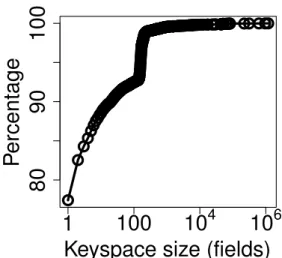
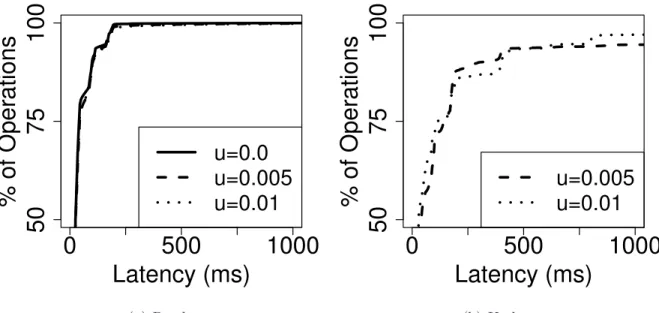
in-creases left-to-right. Each row denotes one client. . . 31 Figure 5.1 Keyspace query and size distributions . . . 44 Figure 5.2 CDFs of latencies (ms) as u varies. . . 47 Figure 5.3 Impact of varying m, with u = 0.0. Lines for some
values ofm are omitted from Figure 5.3(b) for
clar-ity. . . 49 Figure 5.4 CDFs of latencies (ms) when using backups, with
u= 0.01. . . 50 Figure 5.5 Throughput and messaging overhead as load factor
varies, with u= 0.01. . . 50 Figure 5.6 Impact of varying load factor on median latency and
total bytes sent in both the cluster consistent (CC)
Figure 6.3 CDFs of latency as cand b change . . . 64 Figure 6.4 Effects of varying migration threshold m inNFS-β . . . . 68 Figure 6.5 Effects of varying load factor in NFS-β . . . . 70 Figure 7.1 Impact on latency and run cost of varying P′
max,
with u= 0.01. . . 94 Figure 7.2 Impact on various measurements of varying P′
max,
with u= 0.01. . . 96
Chapter 1: INTRODUCTION
Today’s Internet is served by infrastructures that, in general, scale remarkably well to the massive demands placed on them. Both the Domain Name System (DNS) and content-distribution networks (CDNs) are examples of dramatic feats of engineering that facilitate global and quick access to content. The power of these infrastructures, however, derives in part from the largely static nature of the data they serve. DNS scales through caching on the basis of time-to-live (TTL) values that are typically large enough to hide updates from parts of the network for minutes or hours. CDNs serve primarily static data or else data that, if updated, need not be viewed consistently by different parts of the network.
The viability of such approaches may be challenged, however, as the Internet evolves. Multiple visions for future Internet designs anticipate the need to support more dynamic in-formation in the network (e.g., SCION’s address and path servers [83], NIRA’s NRLS [81], or rendezvous servers to support mobility in content-centric networking [46]), which may enable, e.g., mobile network location, dynamic route control, or diagnosis of network anomalies. Because this information can change quickly—in some cases at the granu-larity of seconds or less—there is a need for infrastructure services that support dynamic updates, strong consistency, and global scalability. Even for existing uses to direct clients to servers or to exercise route control, today’s DNS has limited ability to provide fine-grained control [62, 65], and we expect this shortcoming to become more acute in the future.
This dissertation describes a system called Wide-Area Cluster-Consistent Objects (wacco). wacco manages access to stateful, deterministic objects that support invocations of ar-bitrary types, each of which is either an update that may modify object state or a read
arranged with respect to geography; i.e., neighbors in the tree tend to be close geographi-cally or, more to the point, enjoy low latency between them. Each client is assigned to a nearby proxy to which it connects to access objects, and object access is managed through a protocol that offers a novel consistency model that we dub cluster consistency. Clus-ter consistency is strong: it ensures sequential consistency [49] and also that clusters of concurrent reads see the most recent preceding update to the object on which the reads are performed. The resulting agreed-upon order and rapid visibility of updates facilitate a wide range of applications, e.g., network troubleshooting, trajectory tracking of mobile nodes, and content-oriented network applications.
Scalability of services implemented using wacco is achieved through two strategies. First,wacco uses the tree structure of the overlay to aggregate read demand, permitting the responses to some reads to answer others. As such, under high read concurrency, the vast majority of reads are not propagated to the location of the object; rather, most are paused awaiting others to complete, from which the return result can be “borrowed”. Second,waccouses migration to dynamically change where each object resides, permitting the object to move closer to demand as it fluctuates, e.g., due to diurnal patterns.
To demonstrate and evaluatewacco, we use it to build a service called Low-Overhead Keyspace Objects (loko). loko permits clients to create, modify and query keyspace objects. A keyspace is identified by a public key pk, and the keyspace for pk stores (or generates) mappings, each from a query string qstr to a value val and bearing a digital signature that can be verified bypk. So, for example, querying the keyspace forpk for the string nytimes/publicKey might return the signed public key certificate that the owner of pk believes to be for nytimes. Similarly, the query www/bestRoute on the keyspace identified by pk′
might return a signed mapping indicating the currently preferred route to reach the web server representing the owner ofpk′
. By iterating queries to a “chain” of keyspaces, each referring the client to the next keyspace in the chain, a client could securely resolve a multipart pathname, much as is done with DNSSEC [13]. In this respect, loko
could encompass one of the main duties of today’s DNS/DNSSEC, while supporting more dynamic mappings due to the consistency provided bywacco.
In evaluatingloko(andwacco), we were handicapped in not having a global workload for such a service. So, we approximated a global workload in two case studies, each using a different data set. The first case study uses a trace of over 4.4 billion DNS requests served by Akamai servers over 36 hours to 83,448 clients in four geographic regions across Asia, North America and Europe. We used this trace to drive 76-proxy emulations oflokowith network delays induced to represent a loko deployment across these four regions. Our emulations show that loko provides good latency for operations, e.g., with up to 89% of reads completing in under 100 ms. We also show that our implementation can sustain the full per-proxy query rate represented by the Akamai trace, while guaranteeing cluster consistency.
The second case study uses a trace of NFS requests collected on the UNC campus with the help of NetApp and their Chronicle project [43]. We adapt loko to handle the new challenges presented by the NFS workload and evaluate the results. We also evaluate loko on a version of the NFS workload that more closely fits with the original design goals of wacco. We illustrate the effectiveness of the components of our design using measurements from these two case studies.
We also use the data set from the first case study to evaluate an alternative migration strategy that moves beyond a purely latency-based view object placement. This new strategy uses integer linear programming to allow wacco to make migration decisions using a number of additional, user-configurable factors, including traffic cost, hosting cost, proxy capacities, etc.
Chapter 7 includes our discussion of the alternate migration strategy, and we conclude in Chapter 8.
Chapter 2: BACKGROUND
2.1 CONSISTENCY MODELS
When choosing a distributed system, an administrator might have some questions about the behavior of the system. For example: (i) When one client in a distributed system updates the value of some shared state, how long will it be before a second client can read the new value? (ii) If two clients each separately update some shared state, in which order will a third client observe those updates to have taken place? (iii) Will a fourth client’s observations always agree with those of the third client? (iv) Do the answers change if the two updates came from a single client instead of two? The answers to these and related questions compose what are called the consistency semantics of the system. The consistency semantics are quantified guarantees by a system about what clients see what object versions and when. They describe the kinds of guarantees the administrator can expect the system to provide—and the kinds of caveats to be aware of. For example, the semantics could allow a delay between when a client writes a value and when the new value can be read back, or they may ensure that written values can always be immediately read. In our discussion below we may refer to clients as client processes or simply processes.
One way researchers classify distributed systems is by grouping them by their consis-tency semantics using different consisconsis-tency models. Each model comprises a set of these semantic guarantees, and any system implementing those semantic guarantees (at least) is said to implement or to use the consistency model.
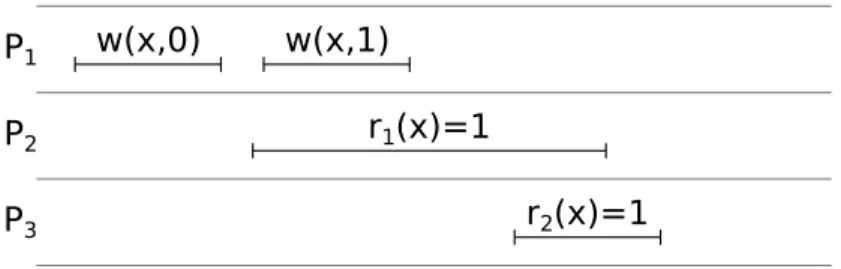
P1 w(x,0)
P2 r1(x)=1
w(x,1)
P3 r2(x)=1
Figure 2.1: An example execution history for a single object. Time increases left-to-right. Each row denotes one process.
one another and to cluster consistency.
Throughout this section, we will use diagrams like the one in Figure 2.1 to illustrate execution histories of shared memory systems under various conditions and consistency models. Each row represents a separate process, with time increasing from left to right. Read and write operations performed by a process appear on its row, marked with the variable affected and the value read or written. For example, w(x,0) in the first row indi-cates that processP1 wrote 0 to the variablex. Similarly,r2(x) = 1 in the third row means
thatP3 read the variablexand got the value 1. Read and write operations are sometimes
subscripted (as both read operations are above) only to make them easier to isolate in our discussion—the subscripts have no bearing on the execution history itself. Finally, the lines beneath each operation indicate its duration, from invocation to completion (as seen at the process invoking the operation).
2.1.1 PRAM CONSISTENCY
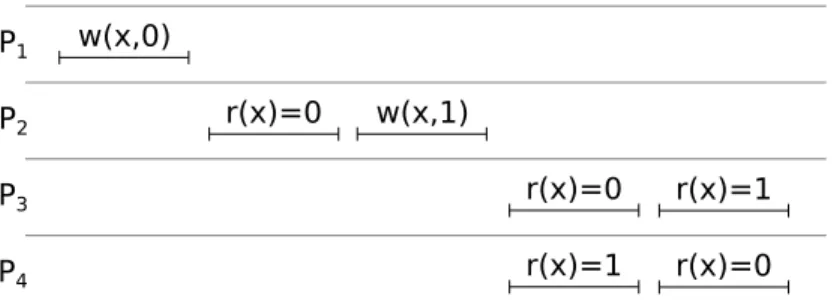
The weakest consistency model we will discuss in detail is the pipelined RAM (PRAM) [51, 59] model.1 This model guarantees only that each processPi observe the write operations
from each other process Pj in the order in which they were actually performed by Pj. However, each Pi may observe the write operations originating from differentprocesses as being interleaved in a different order. Figure 2.2(a) shows an example of such an execution
1
The PRAM consistency model is unrelated to the Parallel Random Access Machine [31], a variant of the (sequential) Random Access Machine used in algorithm analysis.
P1 w(x,0)
P2 w(x,1)
P3
P4
r(x)=0
r(x)=0 r(x)=1
r(x)=1 r(x)=0
(a) A PRAM-consistent execution history for a single object.
P1 w(x,0)
P2
w(x,1)
P3
P4
r(x)=0
r(x)=0 r(x)=1
r(x)=1 r(x)=0
(b) An execution history that is not PRAM-consistent, sinceP4has
reordered the updates fromP1.
Figure 2.2: Execution histories for a single object. Time increases left-to-right. Each row denotes one client.
history in a system that implements PRAM consistency. Processes P3 and P4 disagree
on the order in which the updates from P1 and P2 take place. But, since no Pi has
re-ordered updates from a single process—each process issues at most one update in this execution history—the history is PRAM-consistent. In Figure 2.2(b) we have created a new history by altering the previous one so that P1 performs both updates. Since P4 is
not allowed to reorder the updates (but has done so in the history), this altered history is not PRAM-consistent.
2.1.2 CAUSAL CONSISTENCY
P1 w(x,0)
P2
w(x,2)
P3
P4
w(x,1)
r(x)=2 r(x)=1
r(x)=1 r(x)=2 r(x)=0
r(x)=0
r(x)=0
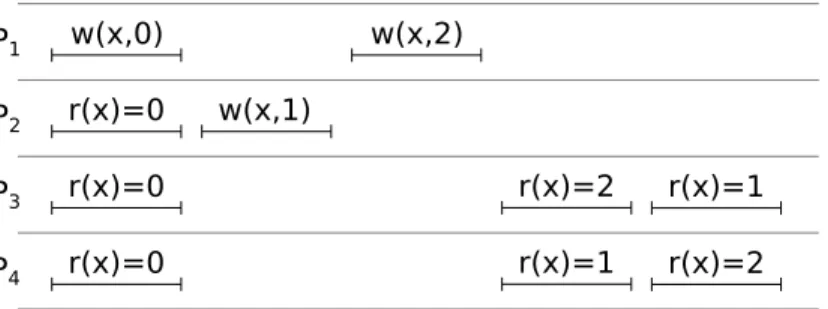
Figure 2.3: A causally consistent execution history for a single object. Time increases left-to-right. Each row denotes one client.
here is that if a process reads a value then later writes another value, there is a possibility that the value that was read influenced the choice of what to write. For example, imagine a process that reads a number, then writes back its square. The process first readsr(x) = 7 then later does w(x,49). In causal consistency, all processes must agree thatw(x,7) came before w(x,49). Intuitively, we know that the fact that the read has occurred means that
w(x,7) may have influenced the choice to do w(x,49) (as indeed it has).
Multiple updates by the same process share a causality link as well. Imagine our squaring process starts with 1 and starts writing squared numbers tox consecutively: e.g.,
w(x,1),w(x,4),w(x,9), and so on. The update w(x,4) causally precedesw(x,9)—it must, or w(x,9) would not be written at all. Because causality holds between updates from a single process, and because all processes must see updates in causality order, all processes must see updates from a single process in the same (correct) order. Therefore, causal consistency implies PRAM consistency.
The execution history in Figure 2.3 is causally consistent (and thus PRAM consistent). There is disagreement between P3 andP4 about whetherw(x,1) orw(x,2) happened first,
but those two updates are not causally related. Because w(x,0) is written before w(x,2) by the same process, those two writes are causally related. And becauseP2 reads r(x) = 0
beforew(x,1),w(x,0) must precede w(x,1). But, no causal relationship binds the order of
w(x,1) andw(x,2).
Note, though, that the set of causally consistent systems is a strict superset of the set
of PRAM-consistent systems. For example, the execution history in Figure 2.2(a) is not causally consistent, because the read atP2establishes a causal relationship betweenw(x,0)
and w(x,1), whichP4 does not honor.
Though weaker than the next two models, causal consistency is sometimes used in distributed services—e.g., COPS [52], Eiger [53]—because the concurrency it allows can make it faster than linearizability, and it is stronger than eventual consistency (both dis-cussed below). Another advantage is that causal consistency can be easy to add to existing system: Bailis et al. [17] have developed a “bolt-on” architecture that can provide causal consistency given an eventually consistent back-end. We discuss consistency choices and tradeoffs more in Section 2.2.
2.1.3 SEQUENTIAL CONSISTENCY
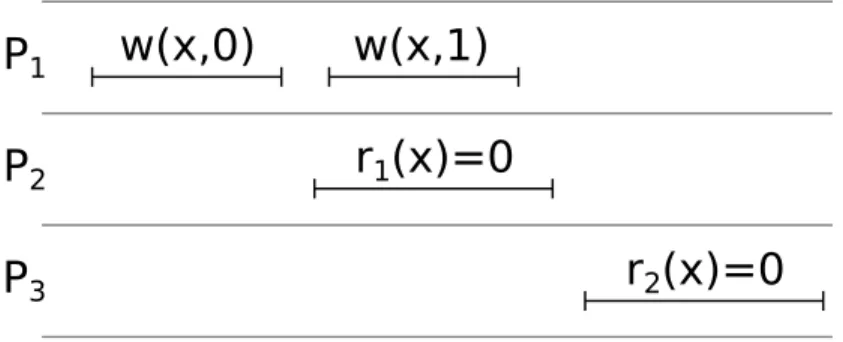
Sequential consistency [49] is a consistency model that implies causal consistency but is strictly stronger. To be sequentially consistent, an execution history must be indistin-guishable from one in which all the operations (by all processes) were executed in some sequential order (a total ordering of all operations) that does not reorder any single pro-cess’s operations (i.e., preserves local order).
P
1w(x,0)
P
2P
3w(x,1)
r
1(x)=0
r
2(x)=0
Figure 2.4: An sequentially consistent execution history for a single object. Time increases left-to-right. Each row denotes one process.
in Figure 2.3 is not sequentially consistent. Consider a potential sequential ordering of its execution history. If the ordering places w(x,1) before w(x,2), then there is no legal way to order the last two read operations atP3 without violating local order. If insteadw(x,2)
comes beforew(x,1) in the ordering, then we have the same problem but at P4.
Sequential consistency implies causal consistency because in sequential consistency all processes agree on the order of all operations, not just potentially causally related ones. Also, the combination of the local-order and legality rules ensures that the sequential or-dering will respect the potential causality requirements. There are many existing protocols and systems designed to guarantee sequential consistency [24, 30, 50, 73], due to its stronger guarantees than causal consistency.
2.1.4 LINEARIZABILITY
One weakness of sequential consistency is that it is defined in such a way that some operations could potentially be delayed indefinitely. For example, imagine a version of Figure 2.4 in which P2 and P3 do many more read operations, each time with the result
r(x) = 0. The result is still a sequentially consistent execution, no matter how far out in time the read requests span, because w(x,1) can always be delayed until after them, according to the rules above. Linearizability [40] addresses this weakness by adding a time constraint to sequential consistency. To be linearizable, an execution history must be sequentially consistent and also have the following property: that each operation must
P1
P2
r(x)=1
P3
r(x)=0 w(x,0)
w(x,0) w(x,1)
(a) A linearizable execution history for a single object.
P1
P2
r1(x)=1
r2(x)=1 w1(x,0)
w2(x,0) w(x,1)
P3
(b) An execution history that is not linearizable, since no effective
time forw(x,1) will result in a legal history.
Figure 2.5: Execution histories for a single object. Time increases left-to-right. Each row denotes one client.
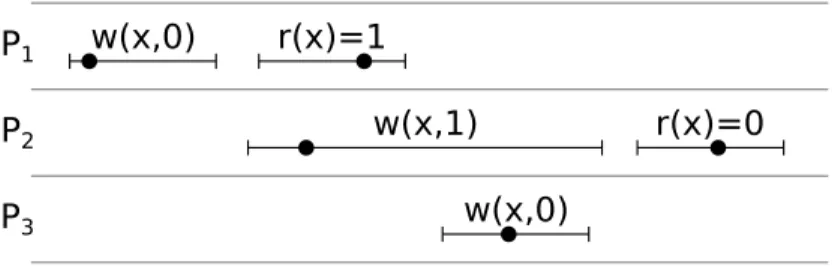
appear—to all processes—to have taken place at a single instant in time, somewhere be-tween its invocation time and its return time (i.e., on the line beneath it on the diagram). This liveness guarantee comes at significant performance and scalability cost, as shown both in theory [14, Ch. 9] and in practice [11, 34, 66, 76].
Figure 2.5(a) shows an execution history that is linearizable. The dot (•) on the dura-tion line shows the time at which an operadura-tion is (effectively) visible to all other processes. Notice thatw(x,1) takes effect beforer(x) = 1, to maintain legality. Figure 2.5(b) shows a variant of the history in which the last read operation returns a different value. This new execution again requires that w(x,1) must take effect before r1(x) = 1 does—i.e., before
r1(x) = 1 ends. Butw(x,1) must also take effect afterw2(x,0) does—which must certainly
be after w2(x,0) starts—so that r2(x) = 1 can return the correct value. These required
intervals are non-overlapping, and so there is no possible effective time forw(x,1) that will preserve legality, and the execution history is not linearizable.
cannot be delayed long enough to allow r2(x) = 0 to read the earlier value, and so
lineariz-ability is not subject to the same potential staleness as sequential consistency.
wacco introduces a new consistency model called cluster consistency that sits on the consistency spectrum between sequential consistency and linearizability—i.e., linearizabil-ity implies cluster consistency, and cluster consistency implies sequential consistency. We give formal definitions for both cluster consistency and sequential consistency, as well as a proof that cluster consistency implies sequential consistency in Chapter 4.
Scatter [35] is one system that provides linearizability. However, partly due to its use of distributed hash tables, it does not offer the same benefits of request aggregation and geographic proximity that wacco achieves through its tree structure and migration. Spanner [27] also implements linearizability, though it does so in part by relying on syn-chronized real-time clocks, which wacco does not, and again does not leverage request aggregation. Other systems provide either linearizability or a weaker consistency model, as a configuration option. For example, Quiver [66], from which wacco borrows certain features, supports either linearizability or sequential consistency. Apache Cassandra [5] provides several levels of consistency configurations, from linearizability down to eventual consistency.
2.1.5 EVENTUAL CONSISTENCY
There are some weak consistency models less related to our work on cluster consistency. Most notably, a model called eventual consistency [74, 77] guarantees only that, if enough time passes with no new updates to a variable, then eventually read operations at all pro-cesses will return the same value. DNS is one notable example of a widely used, eventually consistent system on the Internet today: after the time-to-live (TTL) for all stale DNS entries has passed, all DNS clients should read the most recently written value (assuming no other updates have taken place since then).
Despite its lack of concrete guarantees, eventual consistency has been a popular choice
for distributed systems—e.g., Amazon S3 [3], Bayou [74]—because it can yield better performance with consistency that works “well enough.” In practice, eventually consistent systems have advanced to the point that they can perform indistguishably from strongly consistent systems for a significant portion of operations (and after a small interval) [16]. Still, designers must often add an extra layer of application logic to check for inconsistencies and repair them when they do arise—e.g., if two customers each appear to have bought the last seat on a plane, or if a bank customer manages to withdraw more money from an ATM than was actually in his account [16, 19]. For cases in which these kinds of inconsistencies (generally caused by reading stale values or reordering updates) are not an option, a stronger consistency model is best. A popular design today is to support eventual consistency as a baseline but allow the user to optionally upgrade to stronger consistency: e.g., Apache Cassandra [5], Amazon DynamoDB [1], Amazon SimpleDB [4], and Oracle NoSQL Database [9].
2.2 CAP THEOREM AND PACELC
the cost of availability or vice versa.
As a result of the CAP theorem, developers might be tempted to focus on the tradeoff between consistency and availability, but that distracts attention from the more common case: when then is no partition at all [21]. In fact, we expect partitions to become even more rare in the future Internet (e.g., due to redundant routing paths [60, 78, 80]). During normal operation, when there are no partitions, there is no need to sacrifice either consistency or availability (at least, not because of CAP), and a different tradeoff takes precedent: between consistency and performance.
This tradeoff arises naturally from the semantics themselves. Intuitively, it takes more work and more communication to ensure that a value being returned is the most recent than it would to, e.g., return a locally cached copy without checking it. For any distributed system, we can ask where on the spectrum the system lies: generally, the stonger the con-sistency it provides, the more performance will suffer. Conversely, increases in performance often come at the cost of consistency (e.g., however short the window might be when using eventual consistency [16], inconsistency is still present). Abadi formalized this idea with a classification system called PACELC [11] (pronounced “pass-elk,”) which characterizes the behavior of distributed databases in the presence and absence of partitions. The name PACELC itself spells out the key rule: If there is a Partition, systems face a tradeoff between Availability and Consistency. Else, when there is no partition, the system faces a tradeoff between Latency and Consistency. A system favoring availability during a par-tition and consistency otherwise would be classified as a PA/EC system under PACELC. wacco represents a PC/EC system, having prioritized consistency in both cases. But we believe that cluster consistency itself strikes a good balance between latency and con-sistency, as it weakens linearizability [40] somewhat in exchange for better performance. In contrast, DNS is a PA/EL system, because once a client reads a value for a domain name, it generally cannot read any future values until the TTL expires—whether there is a partition or not—due to caching along the way.
2.3 OTHER RELATED WORK
The use of a tree-based topology inwaccofor object access is reminiscent of hierarchi-cal caching, which has been studied and deployed extensively for wide-area systems such as the World-Wide Web [25, 58, 67]. In some respects,waccocan be viewed as using
polling-every-time cache validation [23], in which the authoritative object copy is consulted before returning a cached answer in order to enforce strong consistency. To reduce the overheads and response latencies induced by such polling, wacco employs two strategies. The first is to leverage the tree structure to aggregate polling by many concurrent reads into few messages along the tree. This aggregation also allows waccoto reduce polling latency by using ongoing polling requests to accelerate others; this strategy has implications for the consistency offered by wacco, which we characterize precisely in Chapter 4. The second strategy is to migrate the authoritative object copy closer to where demand is largest, an option available towaccobecause it manages the authoritative copy of each object itself, in contrast to web caches that do not. Resource migration has been studied for many years in order to improve performance in terms of, e.g., client-visible latency [72]. Vari-ous other systems use migration to manage the locations of distributed objects [64, 72], files [32, 38, 47], memory pages [18, 20, 69], and processes [38, 68, 71].
same object are concurrent).
Our work is also related to prior research in “edge services” and wide-area storage that employs migration to place objects close to their demand. GlobeDB [70] is one such ex-ample that provides only weak object consistency, and Nomad [75] is an exex-ample for data accessed primarily by a single user. Quiver [66] uses migration together with object access protocols that, for single-object accesses, can be configured to provide either sequential con-sistency [49] or linearizability [40]. As we will discuss, sequential concon-sistency will generally be too weak for a service such as loko that requires that updates be globally visible im-mediately, and while linearizability would be ideal, Quiver sacrifices significant scalability to achieve it (e.g., serving every read from the authoritative object copy). waccostrikes a novel balance in offering a new type of consistency (stronger than sequential consistency, weaker than linearizability) in a still-scalable fashion. Nevertheless, our present wacco implementation borrows basic migration and request routing algorithms from Quiver.
If a replication (or caching) scheme is to prevent conflicting object versions and to make updates available to reads immediately, it must apply reads and updates at a quorum of replicas that intersects the quorum used in another update [33, 39]. Different designs use different quorum systems; e.g., in read-one-update-all quorum systems, every proxy (the update quorum) must be contacted on the critical path of an update. wacco uses a quorum per object consisting of a single authoritative copy, uses a tree-based overlay to reach this copy, is optimized toward widespread concurrent read load and moderate concurrent update load, and, to our knowledge, offers a new type of consistency achieved by a novel combination of tree-based aggregation and migration.
Our implementation oflokoas a demonstration ofwacco(see Chapter 5) is motivated by shortcomings of the current DNS for future Internet architectures or even for serving more dynamic data in support of today’s mobility and content management [62, 65]. These shortcomings have led to numerous attempts to modify DNS usage [79], to enhance DNS operation [26], to replace it outright with alternative designs [28, 44, 65], and to understand
Chapter 3: PROTOCOL DESIGN
3.1 DESIGN CONSIDERATIONS AND GOALS
We anticipate an object access workload that is generally read-dominated—maybe by orders of magnitude—but that may nevertheless involve frequent and even concurrent up-dates per object. Upup-dates to an object may be frequent due to the transient nature of the information used to update an object (e.g., the current performance characteristics of a network link), and object updates may be concurrent due to contributions from many parties (e.g., one per link, for an object that calculates preferred routes based on current characteristics of many links). Such workloads temper our willingness to trade update performance for read performance arbitrarily, e.g., as in a typical read-one-update-all sys-tem (see Chapter 2). Rather, wacco takes a more balanced approach that favors read performance but that still limits updates to a single authoritative object copy.
The consistency implemented inwaccoimplies sequential consistency [49] (and more, see below). Sequential consistency is a “strong” consistency model: it implies that clients observe update operations to objects in the same total order (cf., [14, Ch. 9]). Sequential consistency implies causal consistency [12]: updates related by potential causality [48] (e.g., a client reads an update and then performs another) will be observed by any client in order of their potential causality. But unlike causal consistency, sequential consistency also implies that all clients will observe all updates that are not related by potential causality in the same order.
in the example in Section 2.1.3). As such, our goal is to enforce rapid propagation of updates, i.e., updates “take effect” (nearly) immediately. Linearizability [40] strengthens sequential consistency by mandating that an update be observed by any operation on the same object that begins after (in real time) the update operation returns to its caller. However, linearizability comes at substantial performance cost [14, Ch. 9], and so we adopt a weaker requirement that nevertheless strengthens sequential consistency to make updates take effect quickly.
The middleground we adopt allows read operations on the same object to be partitioned intoclusters of concurrent reads,1 so that all reads in each cluster return results based on
the latest update preceding the cluster in real time (or a more recent update, i.e., one concurrent with the cluster). The resulting consistency property, which we term cluster consistency, is weaker than linearizability in that a read returns results based only on updates that preceded the cluster containing it, rather than all updates that precede the individual read. (Updates to the same object are still ordered according to their real-time order, however.) In exchange for this weaker property, we show that cluster consistency can be implemented scalably in wide-area settings by permitting a read to carry responses to other reads in its cluster, thereby accelerating the response times of those reads and reducing load on the authoritative copy.
Beyond applications to future Internet designs (see Chapter 1), we also see cluster consistency as potentially useful in nearer-term applications of wacco, e.g.:
• Network troubleshootingUpdates from network sensors that publish towaccowill appear in the same order, enabling consistent diagnosis and actuation of the network by distributed analysis engines. For example, routing anomalies caused by MED os-cillation [36] and BGP policy divergence [37] in today’s Internet require distributed monitoring to quickly detect and react to an anomaly, e.g., by modifying local routing
1
policies to eliminate the divergent behavior and so to minimize its impact on traffic. A cluster-consistent view of routing updates published towaccowill make it simpler for distributed monitors to concur on the anomaly and effect changes in policy at multiple locations to rectify the problem. Another example is real-time response to routing pollu-tion, e.g., prefix hijacking [84]. Rapid update propagation and consistent event ordering (e.g., which networks are polluted first) could help reveal the source of pollution and enable a faster reaction to the propagation of polluted routes.
• Trajectory tracking of mobile nodes Predicting the future location of a mobile endpoint (e.g., a train) for use in routing [61] would be greatly simplified with a cluster-consistent view of the endpoint’s trajectory. For example, if each network appends its name to a waccoobject representing the endpoint’s trajectory when the endpoint attaches to the network, cluster consistency implies that the trajectory will be accurate. A weaker property like causal consistency might yield incomplete and even conflicting trajectories, since appends would not be causally related (in the sense of Lamport [48]). • Online gaming applications To keep online games fair to all players, it can be at least as important for users see the same content as it is that the content they see is the most up-to-date [29, 56]. Such applications can be simplified if built on objects that appear to all clients to be modified in the same order.
As suggested in Chapter 2 and detailed below, waccoimplements cluster consistency using a protocol in which each read cluster collectively polls an authoritative object copy before returning responses for the reads it contains. Prior work has generally found polling costlier than cache invalidation [23]. That said, polling serves dual purposes in wacco; in addition to consistency, polling messages carry load information to the proxy holding the authoritative object copy, which it uses to determine if the object should be migrated. Migration enables an object to be placed closer to the predominant sources of demand and, as we will show, can significantly reduce response times for operations.
object
read1
read2
read3
(a) Second and third reads are paused on the first.
object
read1
response
read2
response
read3
response
(b) Return value for first read used to resume (respond to) sec-ond and third reads.
(c) Fourth read carries aggre-gated count of recently paused read invocations toward object.
Figure 3.1: Example of pausing some reads and resuming them later
3.2 WACCO DESIGN
The object-sharing protocol that underlieswaccouses a logically tree-structured over-lay network that spans a collection of proxies. This overlay network should be assembled in a “geographically aware” manner, i.e., so that geographically close (and so presumably well-connected) proxies are also close to one another in the tree. The manner in which a client is paired with a proxy can be decoupled from the rest of our system design; our present design simply leverages a few widely-known proxies to refer each new client to a proxy near it. We assume that each client interacts with only a single proxy at a time, awaiting the completion of any operations it issued to one proxy before switching to another (if it switches at all).
3.2.1 BASIC PROTOCOL
waccomaintains a single authoritative copy of each object. At any point in time, the proxy at which this copy of the object resides is said tohost the object and, synonymously, to be the location of the object. Proxies implement a protocol (based on Quiver [66]) to route client invocations toward the current location of the object over tree edges. Once performed on the object, an operation’s response is routed back over the tree to the client that invoked it.
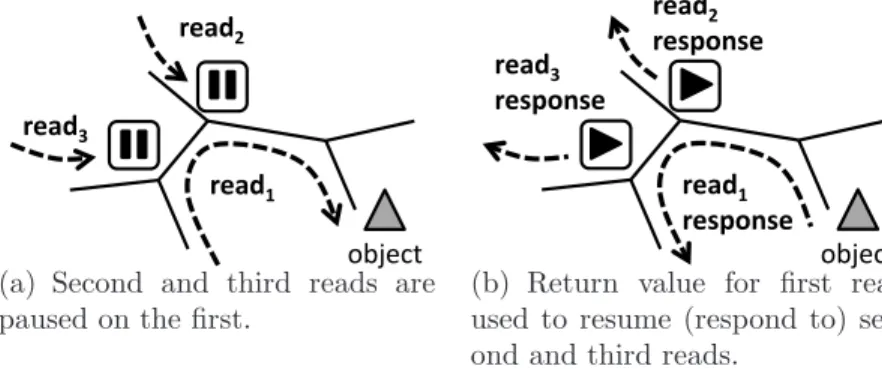
While all update invocations are always routed to the object itself, a read invocation will be paused in the tree if the invocation, while en route to the object, encounters a proxy that already forwarded a read request for the same object and has not yet received a response. The paused read will not be forwarded further in the tree; rather, it will be held by the proxy until the response to the invocation on which it paused is returned. When that response arrives, it can serve as the response for any read invocation on the same object that was paused awaiting it and that meets certain conditions described below. In this way, a single read invocation that reaches the object may, in fact, end up serving numerous read requests that are paused on it elsewhere in the tree. This effect is shown in Figure 3.1, where the second and third reads are paused waiting on the first (Figure 3.1(a)) and then adopt the response to the first read as their own (Figure 3.1(b)).
Pausing read requests in this way offers at least two benefits. First, it reduces overall latency in comparison to forwarding each request all the way to the object, since the read request on which another is paused is farther along the path to the object (and so should solicit a response sooner) than the paused read is. That is, in Figure 3.1(a), the first read is at least as close to the object as the second or third read is when each is paused, and a response may even already be traversing the path back. Second, in comparison to forwarding every read request to the object and returning each read response individually, pausing reduces bandwidth use, routing costs to proxies, and computational load on the
proxy hosting the object.
Pausing also presents some challenges. First, a paused read constitutes state that a proxy must store until the response for the read on which it is paused returns, possibly opening the door to resource exhaustion. That said, aside from read invocations submitted to a proxy directly by clients, the number of paused reads for an object that a proxy must maintain simultaneously is limited by the number of its neighbors. Reads submitted to a proxy directly by clients (and that are paused) still pose a denial-of-service risk, but it can be managed using any of several techniques [42], and moreover, dropping these read requests as needed can never interfere with other reads (since none are paused on these reads). Resource exhaustion will be discussed further in Section 3.2.4.
Second, pausing erodes the consistency of the protocol, and, indeed, to achieve clus-ter consistency—and specifically to achieve the sequential consistency that it implies—we must restrict which read responses can be used to respond to paused reads. Intuitively, implementing cluster consistency requires that a paused read is not answered by an incom-ing response that is too outdated. Specifically, as we prove in Section 4.2, the followincom-ing conditions suffice to implement cluster consistency: Each read request from a client carries the largest Lamport time [48] (see Section 4.2 for a description of Lamport timestamps) at which any update that the client has observed was applied, and each read response carries the Lamport time at which the response was emitted from the authoritative object. A read response that returns to a proxy can be used to satisfy a read request paused at that proxy only if the response’s timestamp exceeds the request’s timestamp. If this require-ment leaves any reads paused at the proxy unsatisfied, then the proxy unpauses one and forwards it along toward the object.
them back in their entirety in responses could be detrimental to performance. Therefore, having objects that are relatively easy to send across the wire is an important assumption of the waccodesign.
3.2.2 CACHING
Each object state has aversion number (an integer, initially zero). Applying an update to the object increments that version number. wacco uses these version numbers to optimize the protocol above as follows.
Each proxy maintains a cache holding at most one cached state per object. The proxy is free to delete states from this cache and manage it using policies independent of those of other proxies. Each read request is augmented to carry a version number. If upon receiving a read request with version numberv(new read requests submitted by clients havev =−1), a proxy has a version v′
> v of the relevant object in cache, then the proxy can increase the read request’s version number tov′
when forwarding it. If it does so, the proxy is said to have taken responsibility for the request and is obligated to retain the cached object state until it has responded to this request. (Our current proxy implementation defaults to taking responsibility; others could do so more selectively.)
When responding to a read request, the proxy hosting the authoritative copy sends the object state (as in Section 3.2.1) if the current object version is larger than the version number in the read request, and sends same otherwise. On receiving a response to a read for which a proxy took responsibility, the proxy identifies the latest object version it now has—either the object state in the response or, if the response was same, the version in its cache —and responds to paused reads similarly (subject also to the constraints of Section 3.2.1 on Lamport timestamps). That is, it returns same to paused reads bearing the version number of the proxy’s latest object version, and it responds with the latest object state to the rest.
A proxy that forwards a read request but that does not take responsibility for it might
receive a same response, at which point it may not have the latest object version and so would be unable to respond to any read it paused bearing an older object version number. These paused reads therefore remain paused while one is unpaused and forwarded toward the authoritative object, as discussed in Section 3.2.1. Note that forwarding any read request bearing an old object version number guarantees that the response will contain an object state, and so when the proxy selects one to unpause and forward, it gives preference to those with smaller object version numbers.
3.2.3 MIGRATION
wacco responds to demand by strategically moving objects among proxies, a process called migration. For example, a proxy may migrate an object to a neighbor that is forwarding a majority of the invocations for that object, or a proxy that is becoming too heavily loaded may choose to migrate objects away. In this way, migration can be used to reduce load by moving objects closer to areas of greater interest and to otherwise reposition load as needed to deal with hotspots. The former use of migration is particularly beneficial forloko(see Chapter 5), since migration can be used to position objects to best accommodate the time zones that are most active at a particular time of day. Moreover, many entities will be accessed with a clear geographic preference—e.g., websites in Chinese will presumably be accessed most often from China—and so migration makes sense for positioning such an object near where it is accessed most.
The first question is resolved in waccoby amending each message carrying an object invocation to also include the number of read invocations for that same object that were
recently paused along the path the message has traveled. If this invocation is paused, the proxy that does so accumulates the message’s count into a per-object, per-neighbor counter that the proxy maintains (i.e., for the object to which the invocation pertains and the neighbor from which the proxy received the invocation) and then further increments this counter by one (for the invocation that was just paused). Otherwise, the proxy accumulates its counters for this object and for all of its neighbors into the field on the invocation message and forwards the message along toward the object, subsequently setting each of these counters to zero. Figure 3.1(c) shows an example where the field of a fourth read invocation, initially with value 0, is updated to 1 at the proxy where read3 was formerly
paused and then to 2as it travels through the proxy at which read2 was formerly paused.
In this way, a count of paused reads trickles toward the object at all times, which the proxy holding the object can similarly incorporate into per-object, per-neighbor counts of paused invocations.2
As described so far, this approach for conveying the numbers of paused reads to the proxy holding the object does not adjust these counters for the passage of time, but in-tuitively such adjustment is necessary. After all, reads paused ten minutes ago should presumably have less bearing on whether to migrate the object than reads paused within the last few seconds. For this reason, eachwaccoproxydecays its per-object, per-neighbor counters to account for the passage of time before incorporating them into invocation mes-sages bound for the object (or, in the case of the proxy hosting the object, before calculat-ing whether to migrate an object). In our present implementation, the proxy decays these counters linearly as a function of the time that passed since last unpausing (and returning values for) reads for that object, i.e., the interval between the proxy seeing the last object
2
Though an update invocation cannot be paused, the proxy holding the object incorporates each update invocation into this count, as well, so that updates too are reflected in the load calculations.
response and the subsequent object invocation.
Finally, this brings us to the question of how a proxy holding an object determines whether to migrate an object and if so, to which of its neighbors. In our implementation, we test two different migration strategies. In the first (used in Chapter 5 and Chapter 6), the proxy hosting an object periodically sums its per-neighbor counters for that object and, if one such counter accounts for more than a fraction m of this sum (for a fixed threshold m), then the proxy asks the neighboring proxy corresponding to that counter to migrate the object to it. That neighboring proxy might not do so, e.g., because it is already hosting too many other objects. If it decides to do so, however, then it initiates the object migration. Note that the threshold m value can be different per object, though in our experiments we simply set m the same for all objects.
The second migration strategy, detailed in Chapter 7, also takes into account the num-ber of requests for an object coming from (the direction of) each neighbor, but it can also consider other factors: e.g., hosting capacities, traffic costs, forbidden object loca-tions. This second strategy gives waccomuch more flexibility and its users more ability to configure its behavior to fit their specific environments.
3.2.4 RESILIENCE
the same datacenter.
Denial-of-service defense The most acute threat of denial-of-service attacks is inter-fering with proxy-to-proxy communication. Multi-path routing [60, 78, 80], using private leased lines, or other suitable defenses [82] can mitigate the threat of link overload. In addition, each proxy should ensure that it reserves adequate resources to retain communi-cation with its neighbor proxies. For example, each proxy can use two network interfaces, one dedicated to proxy-to-proxy communication and the other for serving clients that con-tact it directly. Moreover, proxies can prioritize tasks for managing inter-proxy activities ahead of those responding to clients and can terminate (or refuse) client requests in favor of retaining communication with neighbor proxies.
Migration opens the possibility of a degradation of service if, e.g., a flood of read requests can cause an object to be migrated (see Section 3.2.3) to a region of the network far from legitimate demand. This risk can be mitigated by each object expressing towacco its preferences or requirements for where it can be hosted, if the region of legitimate demand is known in advance. This mechanism is also useful to enforce regulatory constraints on where data can be hosted, for example. The migration strategy described in Chapter 7 enables these kinds of placement restrictions. In other cases, allowing onlyauthorized reads to influence migration can mitigate this risk. One method for doing this is described in Section 5.1 in the context of loko.
Chapter 4: CLUSTER CONSISTENCY
Here we define cluster consistency precisely. We then show in Section 4.2 that our protocol implements it faithfully.
4.1 DEFINITION
An object consists of state and a set of methods that can be invoked. Each invocation returns aresponse, and an invocation/response pair is called anoperation. Correct behavior of the object is defined by its sequential specification, which specifies the return results of operations invoked sequentially on the object.
We useop to denote any operation, andr-op oru-op denote a read or update operation, respectively. The invocation and response for any op occur at distinct real times op.inv
and op.res, respectively, with op.inv < op.res and [op.inv,op.res] denoted as op.interval. A history H is a set of operations and an induced partial order ≺H defined as op1 ≺H op2 ⇐⇒ op1.res < op2.inv. If ≺H is a total order, H is sequential. For an object obj, the setH|obj includes only those operations in H that are invoked on obj, and for a client c, the set H|c includes only those operations in H that are invoked by c. By convention, we assume that H|c is sequential for each client c. (In practice, each “client” is a client
thread.) A serialization S of H is the set H totally ordered by a relation ≺S.
Definition 1 (Sequential consistency [49]). A history H is sequentially consistent if there exists a serialization S of H such that the following properties hold: (i) Legality: For each
object obj , S|obj is legal (i.e., is in the sequential specification of obj ). (ii) Local-Order:
If op1 and op2 are executed by the same client and op1 ≺H op2, then op1 ≺S op2.
object, and each update operation produces a new version of the object on which it op-erates. The version number of the new object instance is one greater than that of the object instance to which the update was applied. Let u-op.ver be the version number of the object instance produced by u-op.
Definition 2(Read cluster). A read cluster Cis a nonempty set of read operations (i) that return the same object version, and (ii) for whichS
op∈Cop.interval is a contiguous interval
of time. For a read clusterC, we defineC.inv= minop∈Cop.invandC.res= minop∈Cop.res.
Let C.ver be the version of the object when it was read by C.
We also represent each u-op as its own update cluster C = {u-op}, with C.inv =
u-op.inv, C.res = u-op.res, and C.ver = u-op.ver. We then use C1 ≺H C2 (where C1 and
C2 are read or update clusters) to mean C1.res < C2.inv.
Definition 3 (Cluster consistency). A set of operations is cluster-consistent if it is se-quentially consistent and satisfiesCluster-Order: There exists a partition of the operations
into clusters so that if C1, C2 are performed on the same object and C1.res < C2.inv, then
C1.ver≤C2.ver.
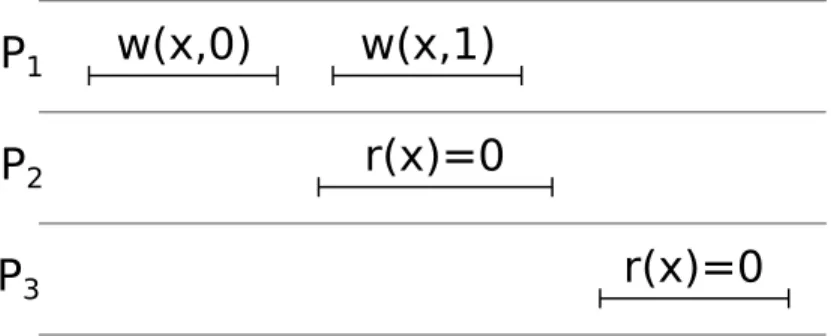
Figure 4.1(a) shows an execution that is sequentially consistent but not cluster-consistent, and so cluster consistency is strictly stronger. However, cluster consistency is weaker than linearizability [40], which requires that for any op1 and op2, if op1.res < op2.inv then
op1.ver ≤ op2.ver; i.e., history precedence must hold at the operation level, not only the
cluster level. Figure 4.1(b) shows a cluster-consistent execution that is not linearizable.
4.2 PROOF OF CLUSTER CONSISTENCY
We now prove that the protocol described in Section 3.2.1 implements cluster consis-tency, ignoring caching (Section 3.2.2), migration (Section 3.2.3), and proxy backups (Sec-tion 3.2.4), as these do not alter the semantics of the protocol. Given a historyH, consider a directed graphGH with operations in H as vertices and three types of edges:
P
1P
2w(x,1)
w(x,0)
r(x)=0
r(x)=0
P
3(a) A sequentially consistent history. To be cluster-consistent, the read atP3must return 1 since
its read cluster (itself only) occurs after w(x,1).
P
1P
2w(x,1)
w(x,0)
r(x)=0
r(x)=0
P
3(b) A cluster-consistent history (since the read operations form a cluster). To be linearizable, the
read atP3 must return 1 since it occurs afterw(x,1).
• Client order(−→c ): ifop
1andop2are performed by the same client and ifop1 ≺H op2,
thenop1−→c op2.
• Reads-from order (−−→rf ): if u-op results in an object state on which op is applied,
thenu-op−−→rf op.
• Version order (−−→v ): Let u-op
1 and u-op2 denote distinct update operations on the
same object, and letop denote any other operation on that object such thatu-op1 −−→rf op. If u-op1.ver>u-op2.ver, then u-op2−−→v u-op1 and otherwise op−−→v u-op2.
We use natural shorthands such as −−−→c,rf = −→ ∪c −−→rf . We also use −→c
+ to denote
the irreflexive transitive closure of −→c , and similarly for other orders. c
−→ and −−→rf naturally capture the temporal and data-flow relationships relevant when serializingH, whereas −−→v constrains any serialization to respect the object versions
observed by operations. To prove the sequential consistency ofH, we first show thatGH is acyclic (Lemma 6) and then that this implies that there is a serialization of H respecting
Legality and Local-Order (Corollary 1). We then argue in Lemma 7 that there must be such a serialization that also satisfies Cluster-Order.
Our algorithm relies on Lamport timestamps [48], and so we will briefly describe them here. Lamport time is an algorithm for synchronizing logical clocks across processes in a distributed system. Each process maintains its own clock, which can simply be an integer. Before each event that occurs within a process (e.g., updating some state or sending a message), that process increments its clock, giving a new timestamp that is assigned to that event. Each message sent to another process includes the sender’s current clock value (for the send event), and the recipient of the message must, on receipt of the message and before acting on it, set its own clock value to be greater than both the sender’s clock value and its own clock value. The clock values induce a partial order on the events in the distributed system. Lamport showed that if eventa causally precedes eventb, then the Lamport time for eventa must be less than the time for eventb. Here, causal precedence is the irreflexive, transitive closure of the relation consisting of client order (−→c ) and the
send/receive event pair for each message.
Below we prove several lemmas which we then use to prove that GH is acyclic. Our proofs below involve the following additional notation. To each operation op is associated a logical (Lamport) time op.linv at which the client invoked it and another logical time op.lres at which it returned its result at that client. In addition, each u-op has a (logical) effective timeofu-op.leff, which is the Lamport clock value assigned to the event applying
u-op to the object at the proxy hosting the object. For reads, r-op.leff is the logical time at which a response for r-op was issued, either by the last proxy to pause r-op or (if
r-op reached it) by the proxy hosting the object. N.B., op.linv <op.leff < op.lres for all operations.
Lemma 1. The subgraph of GH consisting of only edges in −−−→c,rf is acyclic.
Proof. Since op1−→c op2 implies op1.lres < op2.linv, it also implies op1.leff < op2.leff.
Similarly, it must be that op1−−→rf op2 implies op1.leff < op2.leff, since an update must
have been written before it can be read from. Therefore, each edge in −−−→c,rf represents an
increase in op.leff, meaning op1 c,rf
−−−→+ op2 impliesop1.leff <op2.leff.
If there is a cycle consisting only of edges in −−−→c,rf , then we have op −−−→c,rf + op,
implyingop.leff <op.leff, a contradiction.
Lemma 2. If there is a cycle in GH, then there is a cycle in GH in which every −−→v edge
appears in an edge sequence of the form u-op1 −−−→c,rf + r -op2−−→v u-op3.
Proof. We prove the result by first showing that for any cycle in GH, any −−→v edge
not already in an edge sequence of the form op1 −−−→c,rf + r-op2−−→v u-op3 can be
re-placed by edges not in −−→v to produce a new cycle in GH. Since −−→v edges must
point to an update, we must consider −−→v edges of only the forms r-op−−→v u-op and u-op′ v
−−→u-op. In the first case, since op−−→v r-op is impossible (again, −−→v edges point
object are applied sequentially, u-op′
is applied before u-op, and so there is a chain of updates to the object such thatu-op′ rf
−−→+ u-op. Replacing the edge u-op′−−→v u-op with
this chain produces a cycle not containing u-op′−−→v u-op.
To complete the proof, we now must argue that for any edge sequence of the form
op1 −−−→c,rf +r-op2−−→v u-op3on the cycle, there is a corresponding edge sequenceu-op1 −−−→c,rf +r-op2−−→v u-op
on the cycle. If op1 is an update, then setting u-op1 =op1 completes the argument.
Oth-erwise, consider walking the cycle backward along −−→rf and −→c edges from op
1,
termi-nating at a −−→v edge. Since this −−→v edge must point to an update, this update suffices
for u-op1.
If there is a cycle inGH, then Lemma 2 guarantees the existence of a cycle in which all
v
−−→ edges occur within edge sequences of a certain form. Below we refer to such a cycle asconstrained.
Lemma 3. If there is a cycle in GH, then within a constrained cycle, at least one edge sequence u-op1 c,rf
−−−→+ r -op2−−→v u-op3 has u-op3.leff ≤ u-op1.leff.
Proof. Consider an alternative graph G′
H that includes all of the edges of GH and ad-ditionally the edge u-op1−→s u-op3 whenever u-op1 −−−→c,rf + r-op2−−→v u-op3. From any
constrained cycle in GH we can construct a cycle op −−−−→c,rf,s
+ op in GH′ by replacing edge sequences u-op1 −−−→c,rf + r-op2−−→v u-op3 on the constrained cycle with the edge u-op1−→s u-op3. Recall from the proof of Lemma 1 that op
′ c,rf
−−−→+ op implies op′.leff < op.leff. Moreover, if Lemma 3 were false, then u-op1.leff < u-op3.leff for every edge u-op1 s
−→u-op3 used in the cycle in G
′
H. So, from the cycle op −−−−→c,rf,s + op we could infer op.leff <op.leff, a contradiction.
Each read cluster C has exactly one read operation that reads from the authoritative object itself. We call this “representative” read operation C.rep.
Lemma 4. If there is an edge sequence u-op′ c,rf
−−−→+ r -op −−→v u-op in GH where
u-op .leff ≤ u-op′
.leff, then r -op′
.leff ≤ u-op′
.leff where C is the read cluster containing
r -op and r -op′
=C.rep.
Proof. Ifu-op′.leff <r-op′.leff, we haveu-op.leff ≤u-op′.leff <r-op′.leff. Sincer-op′ read from the object itself andu-op.leff <r-op′
.leff,r-op′
(and thusr-op) must have read from
u-op (or a later update), giving u-op −−→rf
+ r-op, contradicting r-op −−→v u-op.
Lemmas 1–4 show that forGH to have a cycle, a necessary condition is an edge sequence of the formu-op′ c,rf
−−−→+ r-op−−→v u-op wherer-op is contained in a read cluster Cwhose
representative r-op′
=C.repis too outdated, i.e.,r-op′
.leff ≤u-op′
.leff. Therefore,wacco is designed to prevent this possibility, viz., by building clusters conscientiously. Specifi-cally, each returning response to a read operation r-op carries with it the effective time of representative r-op′
of the cluster containing r-op and the effective time of the update from which r-op′
and thus r-op are reading, called r-op.lueff. That is, if u-op−−→rf r-op,
thenr-op.lueff =u-op.leff. Responses to updates can also carry the effective time back to the requester, so that u-op.lueff =u-op.leff.
Each client c tracks the largest op.lueff for all operations op it has issued, denoted c.after; i.e., c.after = maxop{op.lueff} where the maximum is taken over all operations
issued by c. The outbound request for each r-op carries with it the current value of c.after, called r-op.after. When a read response arrives at a proxy, it carries with it the effective time of the read operation r-op′
that reached the authoritative object to elicit that response. The proxy will use this read response to answer a paused read operation
r-op only ifr-op′.leff >r-op.after; in this case,r-op is added to the cluster for which r-op′ serves as the representative and so r-op.lueff is set to r-op′
.lueff. Any reads r-op′′ that were not answered by r-op′
(i.e., because r-op′
.leff ≤r-op′′
.after) must still be addressed, and now no response is expected inbound. Therefore, the proxy chooses any remaining
r-op′′
to forward along to elicit another response.
Lemma 5. There is no edge sequence u-op′ c,rf
−−−→+ r -op −−→v u-op in GH such that