Students at the university have an information need to find the courses of their interest. The current university registration portals do not fulfill this information need completely. We have proposed the development of a recommender system which can take a course name and based on the description of that course recommend other courses to students. The recommended course list could help save time and effort for students registering for courses. The proposed system was trained with sample data collected from the course catalog of the University of North Carolina at Chapel Hill. We tested the recommender system with different courses as input and evaluated the resulting recommended courses.
Headings:
by Harish Yadav
A Master’s paper submitted to the faculty of the School of Information and Library Science of the University of North Carolina at Chapel Hill
in partial fulfillment of the requirements for the degree of Master of Science in
Information Science.
Chapel Hill, North Carolina May 2019
Approved by
Table of Contents
1 INTRODUCTION ... 2
1.1 Background ... 2
1.2 Problem Statement ... 2
2 LITERATURE REVIEW ... 4
2.1 Recommender systems and their techniques ... 4
2.2 Recommender systems using different concepts: ... 7
2.3 Recommendation system using topic modeling and association rule mining ... 10
2.4 Recommender systems using additional controls ... 13
2.5 Evaluation metrics for recommender systems ... 14
3 THE PROPOSED RECOMMENDER SYSTEM ... 18
4 METHODOLOGY ... 20
4.1 Dataset Creation and Preprocessing... 20
4.2 Preprocessing ... 24
4.3 Model for the Recommender system ... 26
5 RESULTS AND DISCUSSION ... 33
5.1 Dataset 1 (STOR, INLS and COMP) ... 33
5.2 Dataset 2 (HIST, GEOG and ENGL) ... 41
5.3 Combined Dataset (STOR, INLS, COMP, HIST, GEOG and ENGL): ... 44
6 CONCLUSION AND LIMITATIONS ... 52
7 FUTURE WORK ... 54
REFERENCE ... 55
1
Introduction
1.1
Background
Recommendation systems using predictive modeling have been widely implemented in applications from online retail stores to restaurant menu suggestions. Machine learning techniques, for example, clustering and topic modeling, can provide effective ways to identify potential options that might interest the user. It may be beneficial for the user to select directly from the recommendations rather than wasting unnecessary time and energy in browsing through all the available options.
Within course registration portals, there are hundreds of courses in different departments, and for a student to search for a course of interest by browsing is time-consuming and frustrating. The registration portals typically give the flexibility to choose a particular course on the basis of course name, course number (course code), semester (fall/spring/summer) and instructor name. However, the portals generally lack the flexibility to recommend potential courses that a student might be interested in.
1.2
Problem Statement
course name and to obtain recommended courses based on the description of the entered course. Consequently, our system will help students in finding courses of interest.
2
Literature Review
This section provides an overview of previous research about recommender systems. It introduces and summarizes the methodologies and techniques for different recommender systems which outlines our approach to address the problem statement.
2.1
Recommender systems and their techniques
Different techniques, for example, clustering and topic modeling, can be
employed for the purpose of finding items which might fall in the same category due to some of their characteristics. These techniques can serve as an initial step for the similarity functions which help recommender systems to find relevant items for
suggestions. Al-Badarenah & Alsakran (2016) proposed a recommendation system that could recommend courses to the students and the expected grades in those courses. The dataset was created with the help of a sample of 2000 graduate students of Electrical Engineering. Their dataset contained records of courses and grades for the students where each record was associated with a unique student ID. The dataset was divided into
training and testing sets. They performed K-means clustering on the training dataset to cluster the student data. Once the clustering was performed, they used n-nearest neighbor
as their similarity function to decide the cluster in which a target student from the test set would belong on the basis of the student’s courses and grades. Consequently, the
recommended course. Association rules are a way to find the correlations between the items based on their occurrence together in a transactional dataset (Al-Badarenah & Alsakran, 2016). The association rules were built on the basis of grades. An example of course association rule was [Alg:A] ^ [OS:D] => [Parallel:C], this indicated that if the target student got an A in Algorithms and a D in Operating Systems courses, then the system would recommend the student to take the Parallel Computing course with an expected grade of C. To evaluate the performance, Precision and Recall were calculated with the help of the following formulae –
Precision = number of recommended courses taken
total number of recommended courses
Recall = number of recommended courses taken
total number of courses taken by students
However, the proposed system tended to prompt the students to select only those courses where chances of getting better grades were higher.
Similarly, Grewal & Kaur (2016) presented a recommender system that
recommended courses on the basis of students’ interests and their grades of five courses in high school. The system used students’ interests as an added characteristic as opposed to Al-Badarenah & Alsakran (2016) The dataset was created with the help of the
university students who volunteered for the study and provided their information through a questionnaire. The information collected was the grades of any five courses from high school and the field of interest like accounting, medicine, etc. Grewal & Kaur (2016) employed K-means clustering algorithm to cluster student data based on students’
evaluation of the system was based on the students’ feedback about satisfaction with the recommendations. This method of evaluation did not provide a robust way of assessment, as it did not take into account the bias in the sample population. The bias was created since the responses of students who volunteered for the study may not be representative of the responses of the entire population of student in the university.
2.2
Recommender systems using different approaches
2.2.1 Content-based recommender system
Sarwar, Karypis, Konstan, & Riedl (2001) proposed generation of
recommendations from Content-based algorithms. They created a dataset by randomly selecting enough users to gather 100000 ratings of the movies from MovieLens1 (a web-based research recommender system). The dataset was divided into train and test sets They used Content-based recommendation algorithm which focused on computing similarity between the items and then selecting the most similar items. The similarity was calculated using Correlation-based similarity, Cosine-based similarity, and Adjusted Cosine similarity. Once the similarity was calculated the recommendations were generated using Regression model and Weighted sum on the most similar items for a user. The results of Content-based algorithms were compared to the basic k-nearest neighbor approach which is the widely accepted technique used in the recommender systems. Their experiments showed that Content-based recommender systems provided better sensitivity than k-nearest neighbor based recommender systems.
2.2.2 Context-aware recommender system
The Content-based recommender systems use simple models. Adomavicius & Tuzhilin (2011) proposed a Context-based recommender system which was built based on the knowledge of partial contextual user preferences. The context here took into account the factors like in what situation the product was being used. For example, a user may be willing to buy a phone because of its better camera quality while another user
might give preference to its sound quality. A user’s choice would differ in a different context and hence recommending choices without considering the context might not prove beneficial for the users. The context independent approach of Content-based recommender systems loses its prediction ability.
Adomavicius & Tuzhilin (2011) discussed the use of contextual prefiltering where the selection of only relevant features was performed. The selection was based on the importance of features of the product in determining user’s choice. Then with the help of those features, the traditional recommendation system was utilized for the prediction. However, in contextual post filtering, only the users and items were considered as input in the recommendation process to predict the rating at first, and the context was ignored. The usage of two features, users and items, is referred to as two-dimensional (2D) recommendation model. The recommendations were finally adjusted by applying the contextual information. Thus, contextual based filtering not only considered the reasons due to which the user liked the item, but also the information about the context in which the item was used.
2.2.3 Context-aware recommender system in a multi-dimensional model
Adomavicius et al. (2005) explained that the multi-dimensional model provided recommendations over several other dimensions like time, place, and so on along with user and item. For example, for movie recommendations user, time and place could be considered as the different dimensions where place represented the places where the movie can be seen like a movie theatre, home TV, VCR and DVD. Time represented when the movie can be seen as a time of day, day of the week, month and year. User represented for whom the movie was recommended which was defined by user attributes (Age, Occupation, Address etc.)
The author considered different dimensions as different sides of a cube in 3D space in the model. A traditional recommender system would provide recommendations of movies to a user, on the other hand, the multi-dimensional recommender system would recommend movies to the user considering the time and place as well.
2.2.4 Knowledge-based recommender system
Another approach of finding the recommendations is employing Knowledge-based recommender system. Knowledge-Knowledge-based recommender system utilizes knowledge about users and products to pursue a Knowledge-based approach for generating a recommendation by reasoning about which products meet the user’s requirements. For example, if a user enters the movie name in recommender system as “The Verdict,” a courtroom drama starring Paul Newman, the system would recommend a handful of other movies that are similar. However, if the user wants something suspenseful as well, the system allows user to add features. The knowledge of this feature will help the system to find a movie with courtroom drama and mystery. Burke (2000) suggested that
recommender systems as it did not need a large dataset, also there was no dependence on an initial base user set. Burke (2000) favored knowledge-based recommender system over Content-based. However, there has not been much development in the area of Knowledge-based recommender systems.
2.3
Recommendation system using topic modeling and association rule
mining
Topic modeling has been widely used for the purpose of recommender system development. The section below describes two such uses of topic modeling, one to check the behavior of Android application against its description mentioned in the Google Play Store and other is to identify the legitimate access to the files in hospital management systems.
2.3.1 Topic modeling (Latent Dirichlet Allocation LDA)
CHABADA (CHecking App Behavior Against Descriptions of Apps) approach. They collected the description of more than 25,500 Android applications downloaded from the Google Play Store to create a dataset.
CHABADA approach used LDA to perform topic modeling using descriptions of all the applications. Then the topics were categorized under different categories like “weather”, “map” etc. After that, they clustered applications by related topics. For instance, apps related to “navigation” and “travel” shared several topics in their description, so they formed one cluster. Finally, they identified the APIs used by the applications in each cluster and tried to check if any of the application using the APIs which were not expected as per the cluster they belonged. For example, if an application belonging to a cluster related to “navigation” and “travel” but it was using the APIs to fetch personal account information then it was flagged as malicious application due to this behavior. Gorla et al. (2014) were able to flag 56% percent of known malware using their dataset. Pandita, Xiao, Yang, Enck, & Xie (2013) also tried to find the risk
associated with an Android application using application description but their approach required manual annotation of the sentences in the description which might be using sensitive APIs whereas CHABADA approach did not require this annotation.
topics helped to create the categories of diagnosis, medications, procedures and
locations/services. They further made use of these categories to classify users on the basis of their access to the records in any of those categories. If a user’s access was category specific, for example only to location/services, with no random access to another
category, then the access was not considered a threat to the hospital system. However, if the access was class agnostic then it was considered to be a threat to the system. The Area Under curve from Receiver Operating Curve for all the users was calculated to decide the efficiency of the model. The maximum Area Under Curve obtained was 0.8 for all the users.
2.3.2 Association rule mining
Association rule mining is one of the popular data mining techniques which focuses on finding the association rules in a dataset (Shaheen & Shahbaz, 2017).
Association rule, in its basic form, is described as” if an event X occurs it is more likely for event Y to occur”. It is written as X → Y where X is the antecedent and Y is the consequent (Shaheen & Shahbaz, 2017). Association rule mining is the underlying technique used in many recommender systems to find similar items. It uses Support and Confidence to create the rules. Support is an indication of how frequently the itemset appears in the dataset and Confidence is an indication of how often the rule has been found to be true. Apriori algorithm which is a conventional association rule mining technique finds general trends in a dataset by searching the antecedent (X) and the
required a modified version to find patterns in a dataset. Shardanand & Maes (1995) and Resnick, Iacovou, Suchak, Bergstrom, & Riedl (1994) have also proposed variants of association rule mining techniques that used the Pearson correlation between two user profiles to predict the rating of an item. They predicted the rating for an item I by a user U on the basis of the rating given by a user U’ for the same item I. One of the drawbacks of conventional rule mining is that it uses the entire dataset which can lead to a lot of time consumption with a large number of rules. Lin et al. (2002) proposed to mine rules only for one target user at a time. They proposed an algorithm which selected a certain number of rules for each, thereby reducing the overhead of using the entire dataset. The certain number of rules were selected by adjusting the minimum support for each user. This saved a significant amount of processing time.
2.4
Recommender systems using additional controls
Course recommender systems in the majority of the literature discussed so far do not take account of any constraints while generating recommendations. There was no consideration of curriculum requirements before the courses were recommended. For example, completion of certain prerequisite courses for higher level Math courses is one of the constraints which course recommender systems should take into account.
account for the constraints required in taking a course. They applied the Ford-Fulkerson algorithm, one of the max-flow algorithms, on the dataset. The algorithm could help select a path on a network of nodes where nodes can represent anything like cities, airports etc. The selected path ensures that all the constraints are met in the network to reach from source to destination node. Parameswaran et al. (2011) used the algorithm to find a combination of courses which satisfied all the constraints. Once the combination was retrieved, traditional recommender system techniques (Sarwar et al., 2001;
Adomavicius & Tuzhilin, 2005; Burke, 2000; Pazzani & Billsus, 2007; Burke, 2002) were used to find the best recommendation.
Likewise, Feng, Cao, Wang, & Qian (2017) proposed a recommender system which could recommend movies. They discussed that movie recommendation should not be based on movie ratings only. They suggested the use of text-based information
available about the movies and their ratings to generate recommendations. They talked about extracting the hidden features like the adventure picturized in the movie or some other characteristic from the text which can make the user to like the movie. The use of hidden features of movies enabled their recommender system to recommend movies with no user ratings as well.
2.5
Evaluation metrics for recommender systems
Terveen, & Riedl (2004) evaluating recommender system and their algorithms was a very tough task due to the different reasons mentioned below,
Firstly, many collaborative filtering algorithms have been designed specifically for datasets where there were many more users than items (e.g., the MovieLens data set has 65,000 users and 5,000 movies). Such algorithms may be entirely inappropriate in a domain where there were many more items than users (e.g., a research paper
recommender with thousands of users but tens or hundreds of thousands of articles to recommend).
Secondly, the goals for evaluation performance may differ. Much early evaluation work mainly focused on the accuracy of the recommender systems in prediction but in today’s era, the evaluation relies on other properties which have much more effect on user’s satisfaction. Serendipity was one of the properties which played a great role in the recommendation system. In a recommender serendipity is the experience of receiving an unexpected and fortuitous recommendation. Also, the system should take into account if recommendations have been previously explored by the user. However, if the system did not take this into account, then the accuracy of the system was not affected.
Finally, another challenge in the evaluation was about the decision of a
optimum, produced almost similar results. So, reduced Mean Absolute Error may not increase the usefulness of the recommender system.
All the recommender systems get evaluated on rather common evaluation techniques like accuracy, precision, recall, or Mean Absolute Error. Current accuracy metrics, such as Mean Absolute Error (Herlocker, Konstan, Borchers, & Riedl, 1999), measure recommender algorithm performance by comparing the algorithm’s prediction against a user’s rating of an item. In essence, the recommender system is rewarded for recommending courses a user has previously explored. This prevents the recommender system to provide recommendations which are fruitful. McNee, Riedl, & Konstan (2006) discussed that the common metric of evaluation of recommender systems as accuracy could hurt the quality of recommender system even if the accuracy of the system was very high. Such a recommender system providing the same recommendation, again and again, would achieve higher accuracy even though practically they were not a quality recommendation. Rashid et al. (2002) also expressed concerns about the same suggestion popping up again and again in a recommender system with the example of Star Trek (once a user rated one Star Trek movie, she would only receive recommendations for more Star Trek movies). Hence, McNee et al. (2006) proposed some aspects which could be considered to find out if the recommendations provided by a recommender system could potentially be relevant to the user.
Serendipity was proposed as one aspect. A recommender system with
User’s experience and the expectation of finding user specific recommendations was another aspect. Many recommender systems with high accuracy are employed in a diverse setting without taking into account as to which background and culture the recommender system was originally developed. For example, the Portuguese version of a research paper recommender system being converted to the English version without considering subtle nuances of the language can disappoint users (Torres, McNee, Abel, Konstan, & Riedl, 2004).
3
The Proposed Recommender System
Course recommender systems can be seen as a tool for students. Generally, the registration process starts before the end of a semester when students are busy preparing for exams and other deliverables. A student who has many deliverables during the end of the semester is required to do both, register for the mandatory courses and explore the courses of personal interest. In this situation, students may not be able to provide ample time for proper research about the courses they plan to take in the next semester. We developed a recommender system in this paper which may help ease the pain points of students and universities. With the help of the recommender system, the students would be able to enter any course in which they have some interest and the system would recommend a few courses which the student might like to enroll in. These recommendations will benefit students as they will have a shorter list for the purpose of course selection.
4
Methodology
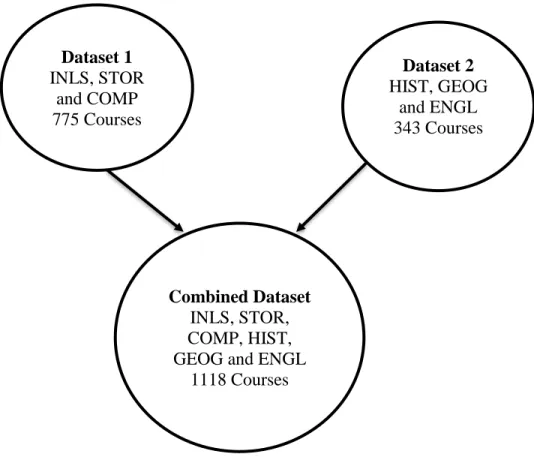
To develop the proposed recommender system, we created three datasets. We prepared Dataset 1 containing courses mainly related to science, technology, and mathematics while Dataset 2 contained courses mainly related to arts. We also developed a Combined Dataset which was a union of Dataset 1 and 2. This type of dataset creation strategy helped us to train our model on homogeneous course datasets (Dataset 1 and 2) and on the combined courses dataset. The disparate courses in the Combined Dataset could play a role in recommending courses which are not always obvious or expected.
In order to test the recommender system trained on Dataset 1, it was fed with a query course (a query course is the input course provided to the recommender system). We fed 10 different query courses to the recommender system trained on Dataset 1. Similarly, the recommender system trained on Dataset 2 was fed with 10 different queries. Finally, the recommender system trained on the Combined Dataset was fed with the same queries used in the case of Dataset 1 and 2, making a total of 20 queries.
4.1
Dataset Creation and Preprocessing
The data was scraped from the course catalog of the University of North Carolina at Chapel Hill2. The catalog provides the following information:
• Course number • Course name • Number of credits • Course description • Requisites
• Grading status
Figure 1 shows a sample course from the course catalog website:
Figure 1: Course information in the course catalog
The modeling was performed with the help of three fields described above: department abbreviation, course name and course description. These three fields played a major role in course distinction. The course description was most crucial as it elucidated different characteristics of the course, the department abbreviation helped in distinguishing the department of the course. The course name helped in distinguishing from other courses as all the courses have distinct names. We used the combination of department name and course number as the unique ID for each course.
courses in the Department of School of Information and Library Science had grading status as “Letter Grade”. Similarly, the number of credits ranged from 0 to 4 for all the courses and did not play a role in distinguishing what a course was about, so the number of credits was also dropped to scrape. Furthermore, Course Number and Requisites also did not play a role in discriminating one course from another, on the contrary, they had the potential to create ambiguity in topic modeling since different departments tend to have same course numbers for different courses. Hence course number and requisites were also not scraped. We used BeautifulSoup3, a Python library which can read HTML files and search relevant content in the file using find_all functionality. BeautifulSoup helped to create a dataset in a CSV format out of the web page from the course catalog. All Python codes have been presented in a GitHub repository4
Below is the detailed description of three datasets developed using the three fields (department abbreviation, course name and course description).
4.1.1 Dataset 1
The first dataset was created using three departments: School of Information and Library Science (SILS), Statistics and Operations Research (STOR) and Computer Science (COMP). These three departments were chosen to create the first dataset to train the model because they had courses which were of common interest with respect to the career paths. The content of the courses also overlapped to some extent in these departments. So, one can assume that the students searching for courses in one of these departments could potentially find the courses useful in the other two departments. Hence, these departments
3 https://pypi.org/project/beautifulsoup4/
would serve as a good choice to be included in Dataset 1. The dataset contained 343 courses scraped from the three departments. We excluded the courses with no description and the courses pertaining to thesis or master’s paper. In order to test the recommender system trained on Dataset 1, we arbitrarily chose query courses, 3 from STOR, 3 from COMP and 4 from INLS.
4.1.2 Dataset 2
The second dataset was developed using three departments, distinct from the departments used in Dataset 1. The departments were History (HIST), Geography (GEOG) and English (ENGL). The courses in these departments fall under the arts category. The same information, i.e., department abbreviation, course name and course description were scraped for these departments. This dataset contained 775 courses. The courses pertaining to thesis or master’s paper and the courses with no description were eliminated. In order to test the recommender system trained on Dataset 2, we arbitrarily chose query courses, 3 from GEOG, 3 from ENGL and 4 from HIST.
4.1.3 Combined Dataset
Figure 2: Schematic diagram of the three datasets
Once the three fields were scraped in a CSV format for all the datasets, the preprocessing of the dataset was performed. The preprocessing involved the following steps:
4.2
Preprocessing
a) Tokenization: Tokenization is one of the initial steps in Natural Language Processing. Before any real text processing is to be done, the text needs to be segmented into linguistic units such as words, punctuation, numbers,
alpha-Dataset 1
INLS, STOR and COMP 775 Courses
Dataset 2
HIST, GEOG and ENGL 343 Courses
Combined Dataset
INLS, STOR, COMP, HIST, GEOG and ENGL
numerics, etc. This process is called tokenization5. There are different Python packages available for tokenization. We used Gensim6 for tokenization.
b) Lemmatization: Then lemmatization or stemming were the available options to convert the inflected words like “walking”, “walked”, “walks” to the base form as “walk”. Since the morphological analysis performed in stemming is less accurate than lemmatization (Manning, Raghavan, & Schütze, 2008), so lemmatization was performed on the datasets. We used Python package Spacy7 for the same.
c) Stopwords removal: The resulting datasets from lemmatization were employed for stopword removal. Then the datasets were processed to remove the unwanted text in the description of the courses. For example, the description contained a lot of hyperlinks which were not required in topic modeling. All of these characters and stop words were removed using NLTK8.
d) Vectorization: In order to ensure convenient data handling, one of the pre-processes which typically needs to be performed for recommender system development is vectorization. We used Genism, an efficient open-source Python toolkit for vector space modeling and topic modeling. Gensim can be used to convert the datasets into vector space representation which essentially is the number of occurrences of the feature terms in each document. It can be seen as a bag of words representation used to create the word-frequency tuples for each document.
5https://www.ibm.com/developerworks/community/blogs/nlp/entry/tokenization?lang=en 6https://tedboy.github.io/nlps/gensim_tutorial/tutorial.html
4.3
Model for the Recommender system
The description of each course along with its name and department abbreviation was used to find out the similar courses for recommendations. Below are a few terms which we used in our model of the recommender system:
• Document: One course with its description, name and department abbreviation was referred to as one document.
• Query Document: The name, description and department abbreviation of the course provided as an input to the recommender system through the search box was referred to as Query Document.
• Recommended Documents: The course description, name and department abbreviation of the courses provided by the model which were most similar to the Query Document were referred to as recommended documents.
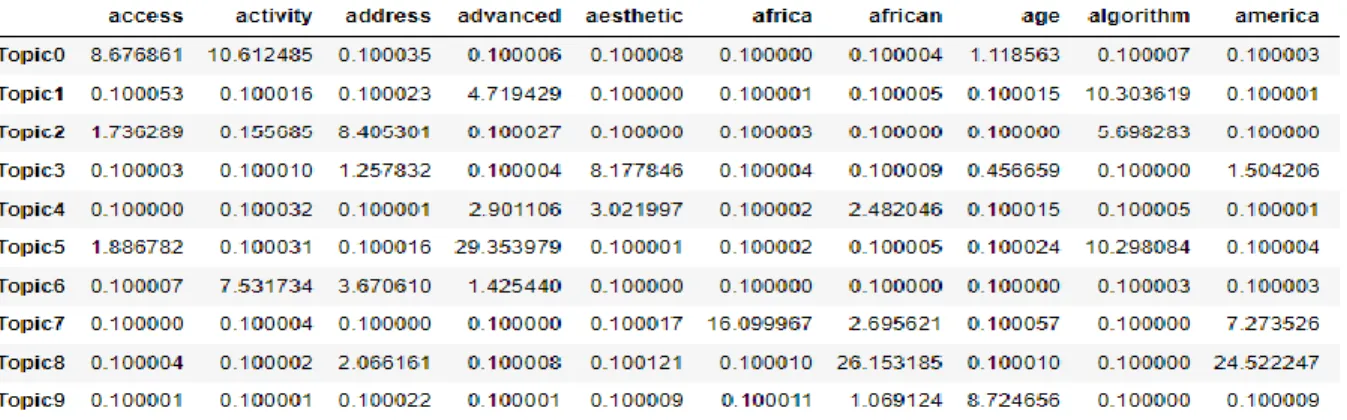
considered as the fingerprint of that topic, therefore, each topic was a distinct topic with respect to the dataset. Figure 3 shows the distribution of topics over different features.
Figure 3: Topic distribution among different features (not all features are shown) In Figure 3 it can be seen that each topic is represented by a list of features which are associated with a numeric value. The value is the share of that feature in the topic. If the value is larger for a feature in a topic then the feature is important for the topic. For example, if we consider topic 0, the features like “access” and “activity” have higher values, approximately 8.6 and 10.6 respectively, therefore these two features are important for topic 0. Also, if we consider the topic 8, we could see that the features like “africa” and “america” have higher values approximately 26.1 and 24.5 respectively which represents that these features are important for topic 8. So, it can be inferred that the features which are important in one topic may not be important in other topics.
29
30
Because the LDA algorithm provided topics and the features with their respective shares, and each document was a collection of features, we were able to represent each document as a combination of different topics in the form of vector representation. The same vectorization was applied to the Query Document so that the similarity of the Query Document with the documents in the dataset can be calculated. Figure 6 shows the vector representation of a sample Query Document.
Sample Query Document:
0.00555873 (T1) + 0.00555681 (T2) + 0.00555758 (T3) + 0.00555654 (T4) +
0.12258361 (T5) + 0.12722173 (T6) + 0.00555698 (T7) + 0.09109146 (T8) +
0.00555678 (T9) + 0.62575977 (T10)
Figure 6: Vector representation of sample Query Document
We used the Euclidean distance to find the similarity as it is efficient when we need to find out the distance between two points in an n-dimensional space. The Query Document and the documents in the dataset were easily represented in an n-dimensional space through their vectors. The Euclidean distance between two points in an n-dimensional space is given as follows,
where p and q are two points in an n-dimensional space.
5
Results and Discussion
5.1
Dataset 1 (STOR, INLS and COMP)
The recommender system obtained after training on Dataset 1 was tested using query courses. There were 10 query courses which were fed as an input one by one to the recommender system. For each query course, we recorded 12 recommended courses. Out of 12 recommended courses, the first or first two courses were the same as the query course depending on the case whether the query course was listed in one or two departments.
34
Figure 7: Queries performance on Dataset 1
-0.1000000 0.0000000 0.1000000 0.2000000 0.3000000 0.4000000 0.5000000 0.6000000
R1 R2 R3 R4 R5 R6 R7 R8 R9 R10 R11 R12
Dis ta n ce o f r ecomm en d at ion f ro m q u ery d o cu m en t Ranked recommendations
Queries performance on Dataset 1
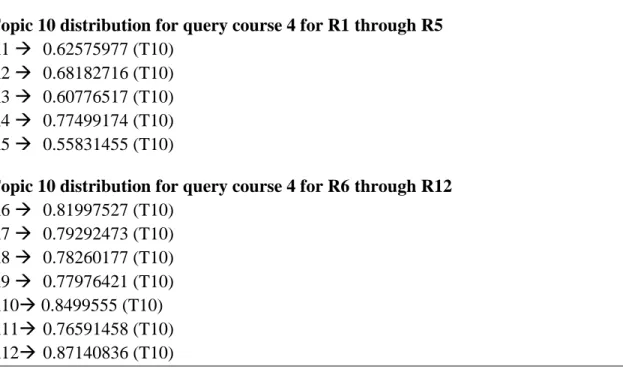
Topic 10 distribution for query course 4 for R1 through R5
R1 → 0.62575977 (T10) R2 → 0.68182716 (T10) R3 → 0.60776517 (T10) R4 → 0.77499174 (T10) R5 → 0.55831455 (T10)
Topic 10 distribution for query course 4 for R6 through R12
R6 → 0.81997527 (T10) R7 → 0.79292473 (T10) R8 → 0.78260177 (T10) R9 → 0.77976421 (T10) R10→ 0.8499555 (T10) R11→ 0.76591458 (T10) R12→ 0.87140836 (T10)
Figure 8: Topic 10 distribution for R1 through R12 of query course 4
Course description: query course 4
“An introduction to information visualization through reading current literature and studying exemplars. The course reviews information visualization techniques provides a framework for identifying the need for information visualization and emphasizes interactive electronic visualizations that use freely available tools. Students will construct several visualizations. No programming skills are required.”
R12:
“Explores the evolution implications and complications of social media in multiple
spheres of life including sociality community politics power and inequality education and information from theoretical and empirical perspectives.”
Topic distribution: query course 4
[0.00555873 (T1), 0.00555681 (T2), 0.00555758 (T3), 0.00555654 (T4), 0.12258361
(T5), 0.12722173 (T6), 0.00555698 (T7), 0.09109146 (T8), 0.00555678 (T9), 0.62575977 (T10)]
R12
[0.0142863 (T1), 0.01428744 (T2), 0.01428689 (T3), 0.01429411 (T4), 0.01428571
(T5), 0.01429148 (T6), 0.01428572 (T7), 0.01428603 (T8), 0.01428797 (T9), 0.87140836 (T10)]
39
Query course 3
“Introduction to Markov chains Poisson process continuous-time Markov chains
renewal theory. Applications to queueing systems inventory and reliability with
emphasis on systems modelingdesign and control.”
R2 STOR 113 Decision Models for Business and Economics
“An introduction to multivariable quantitative models in economics. Mathematical
techniques for formulating and solvingoptimization and equilibrium problems will be
developedincluding elementary models under uncertainty.”
R3 STOR 756 Design and Robustness
“Introduction to experimental design including classical designs industrial designs
optimality and sequential designs. Introduction to robust statisticalmethods; bootstrap cross-validation and resampling.”
R4 STOR 712 Mathematical Programming I
“Advanced topics from mathematical programming such as geometry of optimization
parametric analysis finiteness and convergence proofs and techniques for large-scale and specially structuredproblems.”
R12 INLS 512 Applications of Natural Language Processing
“Study of applications of natural language processing techniques and the representations
and processes needed to support them. Topics include interfaces text retrieval machine
translation speech processing and text generation.”
5.2
Dataset 2 (HIST, GEOG and ENGL)
The recommender system obtained after training on Dataset 2 was also tested using query courses. The same method was followed as in Dataset 1 for testing Dataset 2. We used the same method as in Dataset 1 to plot the data points in Dataset 2. Figure 12 shows queries performance on Dataset 2.
The distances of recommended courses for each query course is represented with a different color. The articulation point can be seen at R6 in Figure 12. Like the Dataset 1, in Dataset 2 as well, the courses after the articulation point did not prove to be relevant recommendations. Hence, we decided to take only the first five recommended courses to present as recommendations.
42
Figure 12: Queries performance on Dataset 2
-0.1000000 0.0000000 0.1000000 0.2000000 0.3000000 0.4000000 0.5000000
R1 R2 R3 R4 R5 R6 R7 R8 R9 R10 R11 R12
Dis ta n ce o f r ecomm en d at ion f ro m q u ery d o cu m en t Ranked recommendations
Queries performance on Dataset 2
Figure 13 shows the description of query course 9 and its R2, R3, R4 and R12. The italicized words in Figure 13 are the words which are present in all of the ten topics of the recommender system.
Description
Query course 9:
Required preparation a working knowledge of Old English. The translation and
interpretation of Old English poetry including works such as The Wanderer The Seafarer Deor The Dream of the Rood and Beowulf.
R2: Hist 714 Introductory Colloquium in the History of Latin America since 1810
Directed readings on Latin American history in the National Period; required for
students entering the field.
R3: ENGL 100 Basic Writing
Required for incoming students with SAT I Writing scores of 460 or lower. Provides
frequent practice in writing from short paragraphs to longer papers focusing on analysis
and argument. Workshop format.
R4: HIST 726 Introductory Colloquium in United States History to 1788
Directed readings on American history from the precolonial period through the
American Revolution; required for students entering the field.
R12: HIST 534 The African Diaspora
A comparative examination of the movements experiences and contributions of Africans
and people of African descent from the period of the Atlantic slave trade to the present.
5.3
Combined Dataset (STOR, INLS, COMP, HIST, GEOG and
ENGL):
The third dataset, a combination of Dataset 1 and Dataset 2, was used to train the recommender system. To study the behavior when query courses of Dataset 1 and 2 were provided as input to the recommender system trained on the Combined Dataset, we used the same query courses of Dataset 1 and 2. So, we analyzed a total of 20 query courses on this recommender system. Similar to the Dataset 1 and 2, twelve recommended courses were recorded for each query course. Out of 12 courses the first or first two courses matched with the query course depending on the case whether the query course was listed in one or two departments.
45
Figure 14: Queries performance on Combined Dataset
0.0000000 0.0500000 0.1000000 0.1500000 0.2000000 0.2500000 0.3000000 0.3500000 0.4000000
R1 R2 R3 R4 R5 R6 R7 R8 R9 R10 R11 R12
Dis ta n ce o f r ecomm en d at ion f ro m q u ery d o cu m en t Ranked recommendations
Queries performance on Combined Dataset
Query 1 Query 2 Query 3 Query 4 Query 5 Query 6 Query 7 Query 8 Query 9 Query 10
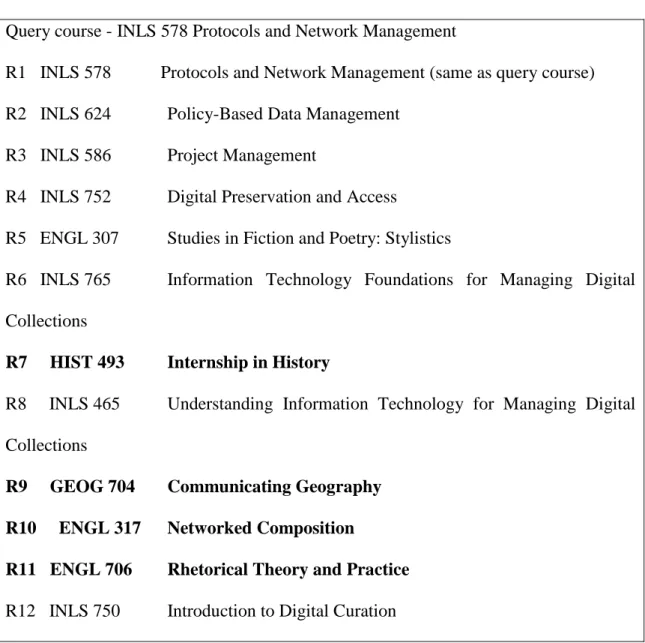
We compared the courses before and after articulation point and found that the quality of recommended courses after articulation point was getting degraded. For example, if the query course was from technology or Mathematics field then after the articulation point there were many courses from the arts field. So, we decided to take only the first five recommended courses to present as recommendations. Figure 15 shows the recommended courses for INLS 578 Protocols and Network Management. The courses from arts are in bold from R6.
Query course - INLS 578 Protocols and Network Management
R1 INLS 578 Protocols and Network Management (same as query course) R2 INLS 624 Policy-Based Data Management
R3 INLS 586 Project Management
R4 INLS 752 Digital Preservation and Access
R5 ENGL 307 Studies in Fiction and Poetry: Stylistics
R6 INLS 765 Information Technology Foundations for Managing Digital Collections
R7 HIST 493 Internship in History
R8 INLS 465 Understanding Information Technology for Managing Digital Collections
R9 GEOG 704 Communicating Geography
R10 ENGL 317 Networked Composition
R11 ENGL 706 Rhetorical Theory and Practice
R12 INLS 750 Introduction to Digital Curation
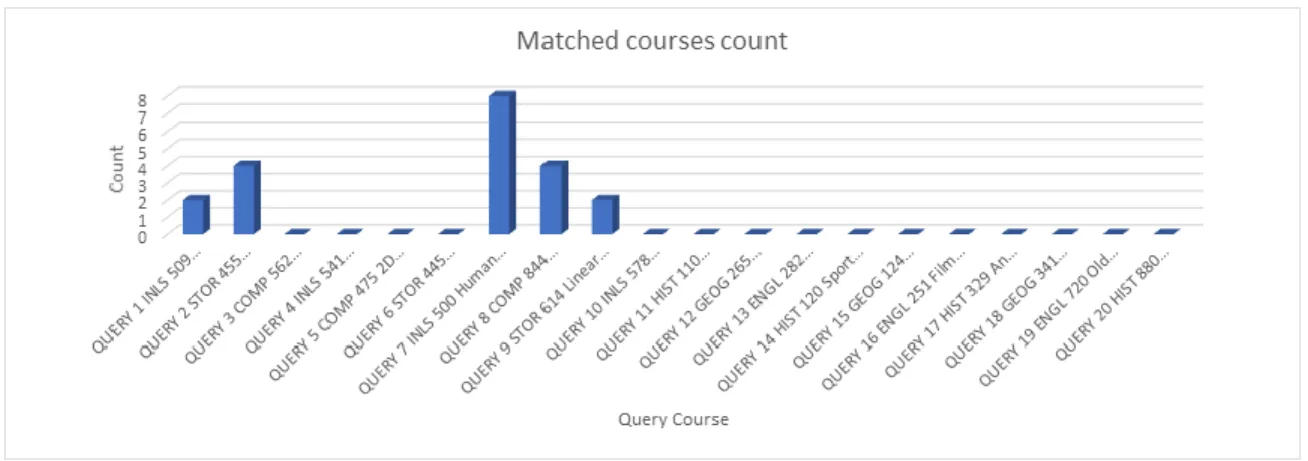
For each of the 20 query courses we compared their recommended courses obtained in the case of Dataset 1 or 2 with that of the recommended courses obtained in the case of Combined Dataset. We found that for 5 query courses in the Dataset 1, their recommended courses matched with the recommended courses generated in the case of Combined Dataset. However, no recommended courses for the query courses from Dataset 2 were matched with the recommended courses generated in the case of Combined Dataset. In Figure 16 the horizontal axis shows the query courses and the vertical axis shows the count of matched courses for all the query courses. It can be seen in Figure 16 that there is a great variation in the count of matched courses for the query courses 1 to 10 which are from the Dataset 1 and the count of matched courses for the query courses 11 to 20 is zero.
Figure 16: Matched course count for the queries between combined and individual datasets
words in that topic. We looked for the same words in topic 5 developed in case of Combined Dataset. We found that the words which were distinguishing/relevant words of topic 5 in Dataset 2 were no longer the distinguishing/relevant words of topic 5 in the Combined Dataset. This reflected that the topics developed in the Combined Dataset had different distinguishing words as compared to the Dataset 2. This was possible since the contribution of a word in a topic depended on the overall word list of the dataset. Therefore, the difference in the words associated with the topics and their contribution resulted in different course recommendations.
Figure 17 shows the top distinguishing/relevant words of topic 5 in Dataset 2 and Combined Dataset. The number to the right of each word shows their share in the topic 5.
Topic 5: Dataset 2
23.42232462 write, 7.287268113 art, 18.46869932 contemporary, 7.884062302 cultural, 7.746595757 environment, 19.74341978 explore, 20.15437652 field, 18.94350835 focus, 17.64226138 geographic, 18.47048471 geography
Topic 5: Combined Dataset
12.32652259 write, 6.841830192 art, 0.100001191 contemporary, 1.293170758 cultural, 0.100017514 environment, 8.274840325 explore, 0.100019252 field, 0.100031085 focus, 0.100003769 geographic, 2.858061006 geography
Figure 17: Contribution of top distinguishing/relevant words of topic 5 in Dataset 2 and their contribution in Combined Dataset
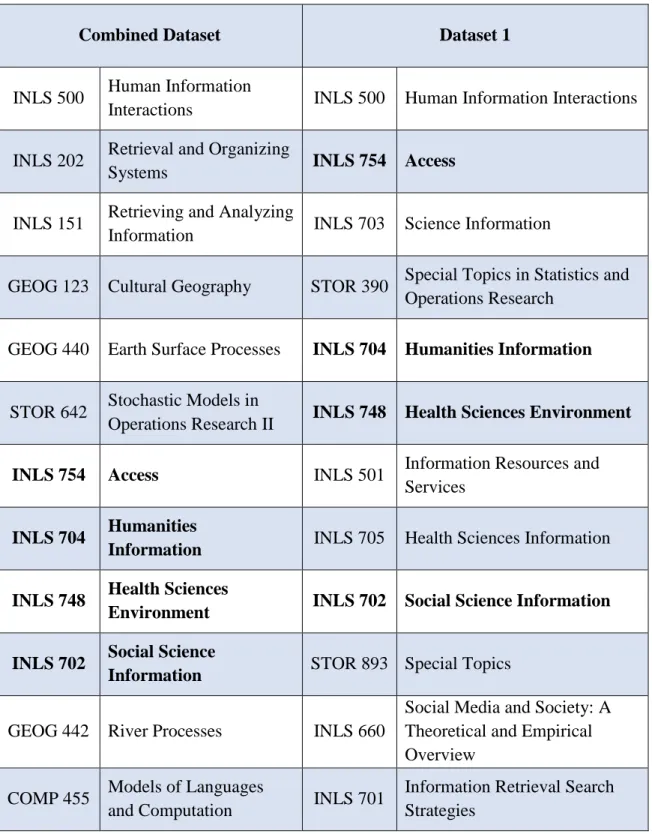
Combined Dataset. There were 8 matched recommended courses for query 7. Figure 18 contains the description of query course 7 and GEOG 123 Cultural Geography, one of the recommended courses.
query course 7: INLS 500 Human Information Interactions
Description:
“The behavioral and cognitive activities of those who interact with information with emphasis on the role of information mediators. How information needs are recognized and resolved; use and dissemination of information”
Recommended course:
GEOG 123 Cultural Geography
Description:
“How population environment and human culture is expressed in technology and organization interact over space and time”
Combined Dataset Dataset 1
INLS 500 Human Information
Interactions INLS 500 Human Information Interactions INLS 202 Retrieval and Organizing
Systems INLS 754 Access
INLS 151 Retrieving and Analyzing
Information INLS 703 Science Information
GEOG 123 Cultural Geography STOR 390 Special Topics in Statistics and Operations Research
GEOG 440 Earth Surface Processes INLS 704 Humanities Information
STOR 642 Stochastic Models in
Operations Research II INLS 748 Health Sciences Environment
INLS 754 Access INLS 501 Information Resources and
Services
INLS 704 Humanities
Information INLS 705 Health Sciences Information
INLS 748 Health Sciences
Environment INLS 702 Social Science Information
INLS 702 Social Science
Information STOR 893 Special Topics
GEOG 442 River Processes INLS 660
Social Media and Society: A Theoretical and Empirical Overview
COMP 455 Models of Languages
and Computation INLS 701
Information Retrieval Search Strategies
6
Conclusion and Limitations
datasets. Therefore, we got different recommended courses for the same query course on the Combined Dataset as compared to Dataset 1 or Dataset 2. We demonstrated that the recommender system trained on disparate set of courses in the Combined Dataset could provide useful recommendations which were unexpected. There were some limitations to the system.
• One of the fields used for finding recommended courses was course description. The course description used here was from the university catalog website where the descriptions were not very detailed and were generic a lot of times. To build a robust recommender system we need to train the system on a rich text with sufficient amount of details available.
• The data used for the recommender system was static, but the course details and description tend to get updated very frequently in academic settings. So, the system would need to be trained regularly on the updated data in order to provide the relevant recommendations.
7
Future Work
The recommender system developed in this paper can be improved in a lot of ways. Below are some of the ways which could be used to enhance the efficiency of our recommender system.
• The student’s resume could provide details about the student’s academic background and details which can be used to develop a personalized dashboard for the student. In this way, students will find recommended courses which are best suited for their profile.
• The course syllabus can be used to enrich the text in the training dataset. The detailed description in the syllabus can help describe courses effectively which can be used to generate recommended courses. However, the course syllabus is lengthy and consists of a lot of information which could pose a problem to search for useful keywords and use them in the training dataset.
• Student’s review about the courses they have taken could be provided to the recommender system by the students and this information can be used by the recommender system in order to generate the recommended courses.
Reference
Adomavicius, Gediminas, Sankaranarayanan, R., Sen, S., & Tuzhilin, A. (2005). Incorporating contextual information in recommender systems using a
multidimensional approach. ACM Transactions on Information Systems, 23(1), 103–145. https://doi.org/10.1145/1055709.1055714
Adomavicius, G., & Tuzhilin, A. (2005). Toward the next generation of recommender systems: a survey of the state-of-the-art and possible extensions. IEEE
Transactions on Knowledge and Data Engineering, 17(6), 734–749. https://doi.org/10.1109/TKDE.2005.99
Adomavicius, Gediminas, & Tuzhilin, A. (2015). Context-Aware Recommender Systems. In Recommender Systems Handbook (pp. 191–226).
https://doi.org/10.1007/978-1-4899-7637-6_6
Aher, S. B., & Lobo, L.M.R.J. (2012). Combination of Clustering, Classification & Association Rule based Approach for Course Recommender System in
E-learning. International Journal of Computer Applications, 39(7), 8–15. https://doi.org/10.5120/4830-7087
Burke, R. (2000). Knowledge-Based Recommender Systems. Encyclopedia of Library and Information Systems, 69(Supplement 32), 175-186, 2000.
http://citeseerx.ist.psu.edu/viewdoc/summary?doi=10.1.1.21.6029
Burke, R. (2002). Hybrid Recommender Systems: Survey and Experiments. User Modeling and User-Adapted Interaction, 12(4), 331–370.
https://doi.org/10.1023/A:1021240730564
Feng, S., Cao, J., Wang, J., & Qian, S. (2017). Recommendations Based on
Comprehensively Exploiting the Latent Factors Hidden in Items’ Ratings and Content. ACM Transactions on Knowledge Discovery from Data, 11(3), 1–27. https://doi.org/10.1145/3003728
Gorla, A., Tavecchia, I., Gross, F., & Zeller, A. (2014). Checking app behavior against app descriptions. Proceedings of the 36th International Conference on Software Engineering - ICSE 2014, 1025–1035. https://doi.org/10.1145/2568225.2568276 Grewal D.S., Kaur K. (2015). Developing an Intelligent Recommendation System for
Course Selection by Students for Graduate Courses. Business and Economics Journal, 7(2), 1–9. https://doi.org/10.4172/2151-6219.1000209
Gupta, S., Hanson, C., Gunter, C. A., Frank, M., Liebovitz, D., & Malin, B. (2013). Modeling and detecting anomalous topic access. 2013 IEEE International Conference on Intelligence and Security Informatics, 100–105.
Herlocker, J. L., Konstan, J. A., Borchers, A., & Riedl, J. (1999). An algorithmic
framework for performing collaborative filtering. Proceedings of the 22nd Annual International ACM SIGIR Conference on Research and Development in
Information Retrieval - SIGIR ’99, 230–237. https://doi.org/10.1145/312624.312682
Herlocker, J. L., Konstan, J. A., Terveen, L. G., & Riedl, J. T. (2004). Evaluating collaborative filtering recommender systems. ACM Transactions on Information Systems, 22(1), 5–53. https://doi.org/10.1145/963770.963772
Koren, Y., Bell, R., & Volinsky, C. (2009). Matrix Factorization Techniques for Recommender Systems. Computer, 42(8), 30–37.
https://doi.org/10.1109/MC.2009.263
Lin, W., Alvarez, S. A., & Ruiz, C. (2002). Efficient Adaptive-Support Association Rule Mining for Recommender Systems. Data Mining and Knowledge Discovery, 6(1), 83–105. https://doi.org/10.1023/A:1013284820704
Manning, C. D., Raghavan, P., & Schütze, H. (2008). Introduction to information retrieval. Cambridge University Press, Cambridge, UK.
https://doi.org/10.1017/CBO9780511809071
Pandita, R., Xiao, X., Yang, W., Enck, W., & Xie, T. (2013). {WHYPER}: Towards Automating Risk Assessment of Mobile Applications. 22nd {USENIX} Security Symposium ({USENIX} Security 13) (pp. 527–542).
https://www.usenix.org/conference/usenixsecurity13/technical-sessions/presentation/pandita
Parameswaran, A., Venetis, P., & Garcia-Molina, H. (2011). Recommendation systems with complex constraints. ACM Transactions on Information Systems, 29(4), 1– 33. https://doi.org/10.1145/2037661.2037665
Pazzani, M. J., & Billsus, D. (2007). Content-Based Recommendation Systems. In the Adaptive Web (pp. 325–341). https://doi.org/10.1007/978-3-540-72079-9_10 Rashid, A. M., Albert, I., Cosley, D., Lam, S. K., McNee, S. M., Konstan, J. A., & Riedl,
J. (2002). Getting to know you: learning new user preferences in recommender systems. Proceedings of the 7th International Conference on Intelligent User Interfaces - IUI ’02, 127-134. https://doi.org/10.1145/502716.502737
Resnick, P., Iacovou, N., Suchak, M., Bergstrom, P., & Riedl, J. (1994). GroupLens. Proceedings of the 1994 ACM Conference on Computer Supported Cooperative Work - CSCW ’94, 175–186. https://doi.org/10.1145/192844.192905
Ricci, F., Rokach, L., & Shapira, B. (2011). Introduction to Recommender Systems Handbook. In Recommender Systems Handbook (pp. 1–35).
Sarwar, B., Karypis, G., Konstan, J., & Reidl, J. (2001). Item-based collaborative filtering recommendation algorithms. Proceedings of the Tenth International Conference on World Wide Web - WWW ’01, 285–295.
https://doi.org/10.1145/371920.372071
Shaheen, M., & Shahbaz, M. (2017). An Algorithm of Association Rule Mining for Microbial Energy Prospection. Scientific Reports 7, Article number 46108. https://doi.org/10.1038/srep46108
Shardanand, U., & Maes, P. (1995). Social information filtering. Proceedings of the SIGCHI Conference on Human Factors in Computing Systems - CHI ’95, 210– 217. https://doi.org/10.1145/223904.223931
Appendix
Recommended courses on Dataset 1. The first course is R1 and the last course is R12 QUERY COURSE 1 INLS 509 - Information Retrieval
[('COMP 487', ' Information Retrieval'), ('INLS 509', ' Information Retrieval'), ('INLS 758', '
International and Cross-Cultural Perspectives for Information Management'), ('INLS 786', ' Marketing of Information Services'), ('COMP 787', ' Visual Perception'), ('INLS 318', ' Human Computer
Interaction'), ('INLS 418', ' Human Factors in System Design'), ('INLS 151', ' Retrieving and Analyzing Information'), ('INLS 723', ' Database Systems III: Advanced Databases'), ('INLS 620', ' Web
Information Organization'), ('INLS 581', ' Research Methods Overview'), ('INLS 745', ' Instruction for Youth in School and Public Libraries')]
QUERY COURSE 2 STOR 455- Methods of Data Analysis
[('STOR 455', ' Methods of Data Analysis'), ('STOR 754', ' Time Series and Multivariate Analysis'), ('STOR 64', ' First-Year Seminar: A Random Walk down Wall Street'), ('STOR 855', ' Subsampling Techniques'), ('STOR 155', ' Introduction to Data Models and Inference'), ('STOR 665', ' Applied Statistics II'), ('INLS 781', ' Proposal Development'), ('STOR 61', ' First-Year Seminar: Statistics for Environmental Change'), ('INLS 572', ' Web Development I'), ('COMP 723', ' Software Design and Implementation'), ('STOR 66', ' First-Year Seminar: Visualizing Data'), ('INLS 721', ' Cataloging Theory and Practice')]
QUERY COURSE 3 'COMP 562- Introduction to Machine Learning
[('COMP 562', ' Introduction to Machine Learning'), ('COMP 782', ' Motion Planning in Physical and Virtual Worlds'), ('COMP 555', ' Bioalgorithms'), ('STOR 824', ' Computational Methods in
Mathematical Programming'), ('STOR 713', ' Mathematical Programming II'), ('COMP 730', ' Operating Systems'), ('COMP 777', ' Optimal Estimation in Image Analysis'), ('COMP 752', '
Mechanized Mathematical Inference'), ('COMP 455', ' Models of Languages and Computation'), ('STOR 822', ' Topics in Discrete Optimization'), ('COMP 822', ' Topics in Discrete Optimization'), ('COMP 825', ' Logic Programming')]
QUERY COURSE 4 INLS 541- Information Visualization
[('INLS 541', ' Information Visualization'), ('STOR 56', ' First-Year Seminar: The Art and Science of Decision Making in War and Peace'), ('INLS 718', ' User Interface Design'), ('INLS 513', ' Resource Selection and Evaluation'), ('INLS 626', ' Introduction to Big Data and NoSQL'), ('STOR 790', ' Operations Research and Systems Analysis Student Seminar'), ('STOR 894', ' Special Topics at SAMSI'), ('INLS 842', ' Seminar in Popular Materials in Libraries'), ('INLS 73', ' First-Year Seminar: Smart Cities'), ('INLS 609', ' Experimental Information Retrieval'), ('INLS 697', ' Information Science Capstone'), ('INLS 660', ' Social Media and Society: A Theoretical and Empirical Overview')]
QUERY COURSE 5 COMP 475- 2D Computer Graphics
Smoothing Methods'), ('COMP 755', ' Machine Learning'), ('COMP 724', ' Programming Languages'), ('STOR 833', ' Time Series Analysis'), ('STOR 734', ' Stochastic Processes'), ('INLS 623', ' Database Systems II: Intermediate Databases'), ('COMP 721', ' Database Management Systems'), ('INLS 382', ' Information Systems Analysis and Design')]
QUERY COURSE 6 STOR 445- Stochastic Modeling
[('STOR 445', ' Stochastic Modeling'), ('STOR 113', ' Decision Models for Business and Economics'), ('STOR 756', ' Design and Robustness'), ('STOR 712', ' Mathematical Programming I'), ('STOR 565', ' Machine Learning'), ('STOR 722', ' Integer Programming'), ('COMP 662', ' Scientific Computation II'), ('COMP 560', ' Artificial Intelligence'), ('COMP 781', ' Robotics'), ('STOR 763', ' Statistical Quality Improvement'), ('COMP 486', ' Applications of Natural Language Processing'), ('INLS 512', ' Applications of Natural Language Processing')]
QUERY COURSE 7 INLS 500- Human Information Interactions
[('INLS 500', ' Human Information Interactions'), ('INLS 754', ' Access'), ('INLS 703', ' Science Information'), ('STOR 390', ' Special Topics in Statistics and Operations Research'), ('INLS 704', ' Humanities Information'), ('INLS 748', ' Health Sciences Environment'), ('INLS 501', ' Information Resources and Services'), ('INLS 705', ' Health Sciences Information'), ('INLS 702', ' Social Science Information'), ('STOR 893', ' Special Topics'), ('INLS 660', ' Social Media and Society: A Theoretical and Empirical Overview'), ('INLS 701', ' Information Retrieval Search Strategies')]
QUERY COURSE 8 COMP 844- Advanced Design of VLSI Systems
[('COMP 844', ' Advanced Design of VLSI Systems'), ('COMP 763', ' Semantics and Program
Correctness'), ('INLS 793', ' Health Informatics Practicum'), ('COMP 735', ' Distributed and Concurrent Algorithms'), ('COMP 744', ' VLSI Systems Design'), ('INLS 672', ' Web Development II'), ('STOR 734', ' Stochastic Processes'), ('COMP 721', ' Database Management Systems'), ('COMP 116', ' Introduction to Scientific Programming'), ('COMP 475', ' 2D Computer Graphics'), ('COMP 101', ' Fluency in Information Technology'), ('COMP 991', ' Reading and Research')]
QUERY COURSE 9 STOR 614- Linear Programming
[('STOR 614', ' Linear Programming'), ('COMP 764', ' Monte Carlo Method'), ('STOR 757', ' Bayesian Statistics and Generalized Linear Models'), ('INLS 550', ' History of the Book and Other Information Formats'), ('COMP 776', ' Computer Vision in our 3D World'), ('STOR 635', ' Probability'), ('INLS 755', ' Archival Appraisal'), ('STOR 62', ' First-Year Seminar: Probability and Paradoxes'), ('COMP 180', ' Enabling Technologies'), ('STOR 471', ' Long-Term Actuarial Models'), ('STOR 52', ' First-Year Seminar: Decisions, Decisions, Decisions'), ('STOR 60', ' First-Year Seminar: Statistical Decision-Making Concepts')]
QUERY COURSE 10 INLS 578- Protocols and Network Management
Recommended courses on Dataset 2. The first course is R1 and the last course is R12 QUERY COURSE 1 HIST 110- Introduction to the Cultures and Histories of Native North America [('HIST 110', ' Introduction to the Cultures and Histories of Native North America'), ('HIST 84', ' First-Year Seminar: Monsters, Murders, and Mayhem in Microhistorical Analysis: French Case Studies'), ('HIST 85', ' First-Year Seminar: What Concentration Camp Survivors Tell Us'), ('ENGL 319', ' Introduction to Medieval English Literature, excluding Chaucer'), ('HIST 377', ' History of African Americans, 1865 to Present'), ('HIST 562', ' Oral History and Performance'), ('ENGL 67', ' First-Year Seminar: Travel Literature'), ('HIST 722', ' Readings in Contemporary Global History'), ('HIST 576', ' The Ethnohistory of Native American Women'), ('ENGL 125', ' Introduction to Poetry'), ('HIST 120', ' Sport and American History'), ('HIST 571', ' Southern Music')]
QUERY COURSE 2 GEOG 265 - Eastern Asia
[('GEOG 265', ' Eastern Asia'), ('GEOG 435', ' Environmental Politics'), ('GEOG 232', ' Agriculture, Food, and Society'), ('GEOG 212', ' Environmental Conservation and Global Change'), ('GEOG 60', ' First-Year Seminar: Health Care Inequalities'), ('GEOG 370', ' Introduction to Geographic Information'), ('GEOG 110', " The Blue Planet: An Introduction to Earth's Environmental Systems"), ('GEOG 121', ' Geographies of Globalization'), ('GEOG 55', ' First-Year Seminar: Landscape in Science and Art'), ('GEOG 141', ' Geography for Future Leaders'), ('GEOG 542', ' Neighborhoods and Health'), ('GEOG 253', ' Introduction to Atmospheric Processes')]
QUERY COURSE 3 ENGL 282 - Travel Literature
[('ENGL 282', ' Travel Literature'), ('ENGL 310', ' Fairy Tales'), ('ENGL 281', ' Literature and Media'), ('ENGL 58', ' First-Year Seminar: The Doubled Image: Photography in U'), ('ENGL 326', ' Renaissance Genres'), ('ENGL 441', ' Romantic Literature--Contemporary Issues'), ('ENGL 385', ' Literature and Law'), ('ENGL 355', ' The British Novel from 1870 to World War II'), ('ENGL 466', ' Literary Theory--Contemporary Issues'), ('ENGL 315', ' English in the U'), ('HIST 475', ' Feminist Movements in the United States since 1945'), ('ENGL 270', ' Studies in Asian American Literature')]
QUERY COURSE 4 HIST 120 Sport and American History
[('HIST 120', ' Sport and American History'), ('HIST 584', ' The Promise of Urbanization: American Cities in the 19th and 20th Centuries'), ('HIST 142', ' Latin America under Colonial Rule'), ('ENGL 863', ' Seminar in Postcolonial Literature'), ('ENGL 666', ' Queer Latina/o Photography and Literature'), ('HIST 282', ' China in the World'), ('HIST 585', ' Race, Basketball, and the American Dream'), ('HIST 268', ' War, Revolution, and Culture: Trans-Atlantic Perspectives, 1750-1850'), ('ENGL 271', ' Mixed-Race America: Mixed-Race in Contemporary American Literature and Culture'), ('HIST 539', ' The Economic History of Southeast Asia'), ('HIST 571', ' Southern Music'), ('HIST 771', ' Topics in Modern European History')]
QUERY COURSE 5 GEOG 124 Gender and Place: Feminist Geographies
[('GEOG 124', ' Gender and Place: Feminist Geographies'), ('GEOG 710', ' Advanced Physical Geography - Biogeoscience'), ('GEOG 419', ' Field Methods in Physical Geography'), ('GEOG 268', ' Geography of Africa'), ('GEOG 63', ' First-Year Seminar: The Problem with Nature and Its
Middle East'), ('GEOG 225', ' Space, Place, and Difference'), ('HIST 582', ' American Constitutional History since 1876'), ('GEOG 228', ' Urban Geography'), ('GEOG 111', ' Weather and Climate'), ('HIST 460', ' Late Medieval and Reformation Germany')]
QUERY COURSE 6 ENGL 251 Film Performance and Stardom
[('ENGL 251', ' Film Performance and Stardom'), ('ENGL 55', " First-Year Seminar: Reading and Writing Women's Lives"), ('GEOG 692H', ' Honors'), ('ENGL 134H', " First-Year Honors: Women's Lives"), ('GEOG 89', ' First Year Seminar: Special Topics'), ('HIST 863', ' Readings in Urban History'), ('HIST 815', ' Topics in African History'), ('HIST 890', ' Topics in History for Graduates'), ('HIST 234', ' Native American Tribal Studies'), ('ENGL 121', ' British Literature, 19th and Early 20th Century'), ('ENGL 295', ' Undergraduate Research Seminar'), ('ENGL 318', ' Multimedia Composition')]
QUERY COURSE 7 HIST 329 An Introduction to the History of Medicine
[('HIST 329', ‘An Introduction to the History of Medicine'), ('HIST 311', ' Ghettos and Shtetls? Urban Life in East European Jewish History'), ('HIST 357', ' The Old South'), ('HIST 510', ' Human Rights in the Modern World'), ('HIST 179H', ' Honors Seminar in American History'), ('HIST 287', " Japan's Modern Revolution"), ('HIST 340', ' Ethics and Business in Africa'), ('HIST 721', ' Readings in
European Expansion and Global Interaction, 1400-1800'), ('ENGL 141', ' World Literatures in English'), ('ENGL 71', ' First-Year Seminar: Doctors and Patients'), ('HIST 476', ' Borderlands: Religion and Ethnicity in Modern East Central Europe'), ('HIST 880', ' Readings in the Global History of Capitalism')]
QUERY COURSE 8 GEOG 341 Hydrology, Ecology, and Sustainability of the Humid Tropics
[('GEOG 341', ' Hydrology, Ecology, and Sustainability of the Humid Tropics'), ('HIST 565', ' Civil War and Reconstruction, 1848-1900'), ('HIST 288', ' Japan in the 20th Century'), ('HIST 325', ' Food and History: The Local and Global, the United Kingdom and the United States'), ('HIST 509', ' The World History of Slavery'), ('HIST 460', ' Late Medieval and Reformation Germany'), ('HIST 151', ' European History to 1650'), ('HIST 131', ' Southeast Asia to the Early 19th Century'), ('HIST 347', ' Fascist Challenge in Europe, 1918-1945'), ('ENGL 748', ' Studies in American Poetry'), ('HIST 480', " Russia's 19th Century: Cultural Splendor, Imperial Decay"), ('HIST 364', ' History of American Business')]
QUERY COURSE 9 ENGL 720 Old English Poetry
[('ENGL 720', ' Old English Poetry'), ('HIST 714', ' Introductory Colloquium in the History of Latin America since 1810'), ('ENGL 100', ' Basic Writing'), ('HIST 726', ' Introductory Colloquium in United States History to 1788'), ('ENGL 129', ' Literature and Cultural Diversity'), ('ENGL 300', ' Advanced Expository Writing'), ('ENGL 304', ' Advanced Expository Writing for Business'), ('ENGL 305', ' Advanced Expository Writing for Law'), ('ENGL 301', ' Advanced Expository Writing for the Humanities'), ('HIST 727', ' Introductory Colloquium in United States History, 1788 to 1900'), ('HIST 775', ' Studies in Modern English History'), ('HIST 534', ' The African Diaspora')]
QUERY COURSE 10 HIST 880 Readings in the Global History of Capitalism