Literacy for What? An Exploration of the Literacy Practices, Relationships, and Schooling Experiences of a Latino Family
Charna D’Ardenne
A dissertation submitted to the faculty of the University of North Carolina at Chapel Hill in partial fulfillment of the requirements for the degree of Ph.D. in the School of Education
Chapel Hill 2016
Approved by:
Jocelyn Glazier
Julie Justice
Karen Erickson
George Noblit
Madeleine Grumet
©2016 Charna D’Ardenne ALL RIGHTS RESERVED
ABSTRACT
Charna D’Ardenne: Literacy for What? An Exploration of the Literacy Practices, Relationships, and Schooling Experiences of a Latino Family
(Under the direction of Jocelyn Glazier)
In this two-‐‑year post-‐‑critical ethnography, critical literacy was used as a theoretical framework for exploring the literacy practices, relationships, and public schooling experiences of a Latino child, Javier, and his mother, Nina. The study illustrates the push and pull between school and home, and between cognitive and critical literacies, in a way that attends to the complexities of enacting critical literacy practices in a context where schooling is authoritatively maintaining a cognitive, individualized construction of literacy. This authority is compounded by a culture that privileges individual performance on high-‐‑ stakes standardized texts and sees difference from the white, middle-‐‑class, academic definition of literacy in deficit terms. Findings highlight the varied and vibrant literacy practices in which Javier and Nina engage, as well as the relationships between child, mother, and researcher. The study reveals how school authoritatively trespasses on these relationships and, in doing so, narrows Javier’s literacy practices and his understanding of literacy. Recommendations are made for researchers and educators to embrace the wealth of literacy practices that exist in students’ homes and to seek spaces in which to engage in critical literacy practices.
ACKNOWLEDGEMENTS
This would never have been completed without the help of many people in my life. Thank you, first, to Nina and Javier, whose friendship I cherish deeply and who help me grow every day. Thanks to my advisor, Dr. Jocelyn Glazier, who provided critical, ongoing, and meticulous support to me at all hours of the day and night, who met all of my ups and downs with grace and an energy that was always just right, and who graciously put up with my aversion to deadlines. Thanks to my wonderful committee members, Dr. Julie Justice, Dr. Karen Erickson, Dr. George Noblit, and Dr. Madeleine Grumet, who gave me the best gift by paying attention and helping me think through the work. Several cherished friends did the same while providing unconditional emotional and spiritual support: thank you Beth Coleman, Dr. Kate Allman, Dr. Julie Justice, and Joy Mariama Smith. Thank you to Dr. Jan Goldfield, who paved the way for me and many other women in so many ways. Thanks to my Grandmom Frankie, who always wanted me to look beyond my ceiling. Thanks to my mom, who is and has always been my first and most important role model. Thank you to my Rosie. Thanks to my husband, Jack, who deserves his own title for standing and working with me through this whole experience. There should be an honorary degree for partners of doctoral candidates.
And thank you to my Lee. You are my love and light.
TABLE OF CONTENTS
List of Figures...……….…………...vi
Chapter 1: Introduction to the Study ……….…..1
Research Questions ……….………...…..6
Chapter 2: Literature Review ……….…10
Historical Context……….………..……….15
Literacy Models ……….………..…25
Relationships………..………37
Chapter 3: Methodology ………46
Methodological Foundations ………...…46
Research Design Overview ………..……….52
Participants and Site Selection………52
Data Collection ……….……53
Data Analysis……….………...…..59
Chapter 4: Findings………64
Javier………...…….68
Nina………...…..….94
Charna………..……120
Chapter 5: Discussion………..……….135
Appendix …………...………169
LIST OF FIGURES
1. Literature Map……….………..……14
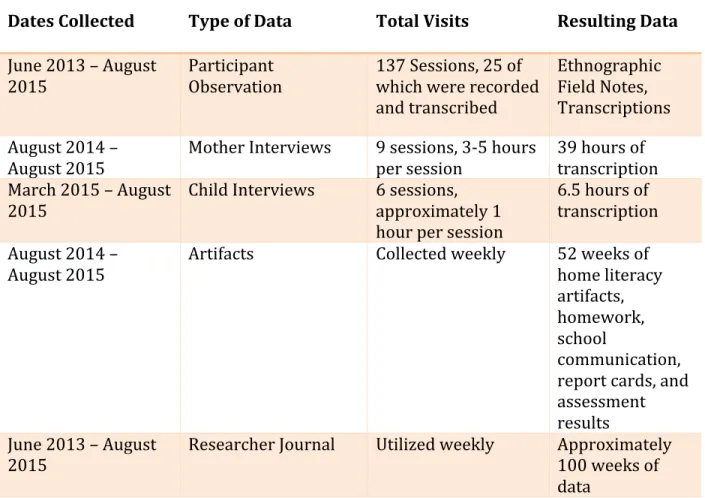
2. Data Collection Table………...…………..63
CHAPTER 1: INTRODUCTION TO THE STUDY Background
Context
The student population in U.S. public schools is undergoing unprecedented change, becoming increasingly ethnically diverse, due in large part to growing numbers of Latino1 families immigrating to the United States. Between 1990 and 2010, more than 7.5 million Mexican immigrants arrived in the U.S. (Migration Policy Institute, 2014). This
transformation is particularly salient in North Carolina, where 2000 and 2010 census numbers indicate that the general Latino population in the state grew by almost 400% between 1990 and 2000 and then doubled between 2000 and 2010 (U.S. Census Bureau, 2010). The resulting diversification within North Carolina public schools presents the possibility for an increasingly heterogeneous public school community, one in which rich cultural differences among students and families can nourish the culture of learning in classrooms in new and meaningful ways.
This increased diversification in public schools is happening in conjunction with a larger political shift toward conservatism. Anti-‐‑immigration rhetoric is ubiquitous and
1 I use the word “Latino” throughout this study to refer to people of Mexican, Central
immigration policies are a hot-‐‑button topic in many political races. Historically, U.S. public schools have been conceived with overt nationalist goals of assimilating immigrant
populations into white American culture and creating a citizenry “worthy” of American democracy (Graham, 2005; Spring, 2011; Tyack, 1993). Today, schools are controlled more than ever by the Federal Government via the standardization of curricula and the
omnipresence of standardized testing. That standardized tests—and accompanying curricula—are culturally biased in favor of white, middle-‐‑class students has been widely discussed (Banks, 1995; Giroux, 2001; Ladson-‐‑Billings, 1998; Salinas, 2009). Some argue that standardized tests are particularly oppressive to students who speak a language other than English at home due to the tests’ incongruity with students’ home cultures and
languages (Lopez, 2004; Macedo, 2000).
This “norming” of American public schools (Gutierrez, Baquedano-‐‑Lopez & Hector, 1999) via the standardization of curriculum and the high-‐‑stakes testing environment oppresses students from non-‐‑dominant (that is, non-‐‑white, non-‐‑middle-‐‑class, non-‐‑English-‐‑ speaking) communities. When schooling is directed toward normalization, any difference from the norm is ignored or treated as a deficit to be remedied. Whether it is because they are essentially unseen or poorly ‘remediated,’ “…national trends demonstrate that Latina/o students are being underserved in public schools, and this situation has resulted in the lowest educational attainment of all racial/ethnic groups, with approximately 43% of Latina/os achieving less than a high school diploma” (Orfield, Losen, Wald, & Swanson, 2004, p. 251).
the potential to further water down the curriculum and make teaching less child-‐‑centered (Au, 2007; Heilig & Darling-‐‑Hammond, 2008; Johnson, Boyden & Pittz, 2001). Teachers and administrators are charged with the task of reconciling the tension between a diverse student body and uniform curricula that hold performance on standardized tests as paramount. Many schools struggle with the challenge of how to equip students from diverse home cultures with the academic tools they need to succeed in the public school system when there is a gap between the home culture and the school culture (Kostogriz, 2011).
Literacy and language learning is a primary site for this tension. In her work, Brice Heath (1983) found that there was a disconnect between the home language practices in a working class community and the language expectations in schools the children from the community attended. Her ethnography illustrated the fact that these home language practices were not “less than” school language practices but that they were based on the social and cultural practices of the communities themselves. Children’s language
development served its purpose well in their home communities, but when the children entered school, a whole new set of language expectations were placed upon them.
Schools, Brice Heath found, privilege the home literacy practices of white, middle-‐‑ class homes including “attending to books, acknowledging questions about books,
accepting book-‐‑related activities as entertainment, and engaging in conversation around books"(1994, p. 76-‐‑7). Calling these “mainstream practices,” Brice Heath wrote,
Thus, children whose home language and literacy practices do not mirror those privileged in schools may feel they are entering a whole new world upon starting school, one with potentially unfamiliar literacy and language practices.
Some educators bridge this gap by basing the curriculum on children’s “funds of knowledge, or historically accumulated and culturally developed bodies of knowledge and skills essential for household or individual functioning or well-‐‑being” (Moll, Amanti, Neff & Gonzalez, 1992, p. 133). Bringing students’ funds of knowledge into the classroom both honors their home literacy practices and also helps provide a foundation of understanding for them to do better in school (Gutierrez, 2008; Ladson-‐‑Billings, 1998; Luke & Freebody, 1997; Moje, Ciechanowski, Kramer, Ellis, Carrillo & Collazo, 2004; Moll, et. al., 1992).
While some schools embrace their students' funds of knowledge, other schools remain more traditional in their approach. Often, especially with students who are learning English as a second language, schools focus heavily on teaching English language and literacy skills in order to prepare these students to succeed in school and beyond (Snow, Porche, Tabors & Harris, 2007). In order to increase the literacy achievement of all students, including those students who speak a language other than English at home, schools “raise standards” which in practice often entails using standardized tests widely and often. While the intention may be for all students to succeed, the result is often that the literacy curriculum and learning experiences are narrowed substantially (McNeil, 2002; Kohn, 2000). This has the effects both of further ostracizing Latino students from an
Furthermore, the benefit of schools focusing primarily on providing students access to English language and literacy skills, at the expense of other learning contexts, is
questionable. It cannot be assumed that access to this dominant discourse is inevitably positive. In fact, numerous ethnographies have documented situations in which, despite the fact that non-‐‑dominant populations gained access to the dominant discourse, this access did not translate into tangible change in the form of social or economic power for these communities (Blackburn, 2003; Branch, 1998; Collins, 1995; Ghose, 2002). In addition, when schools teach students academic English and the “ways of being” that will help students succeed in school, they often do so at the expense of students’ home cultures.
In this dissertation study, I explore the home literacy practices of a Latino mother and son, paying particular attention to how literacy practices shape and are shaped by the participants’ relationship with each other and with me as a participant observer. I further consider how navigating school literacy tasks influence the participants’ literacy practices and their relationships. School literacy tasks are defined here as school-‐‑based activities that occur in the home, such as homework and nightly reading, that are focused on teaching children to read, write, speak and understand the English language and to use that
language with facility to meet academic standards. The following questions guide the research:
1. What sorts of literacy practices does Javier engage in at home?
2. How do Javier’s relationships with his mother and the researcher shape, and become shaped by, his understanding of literacy?
3. How does school define literacy, and what literacy practices are valued in school? 4. How does school literacy shape Javier's understanding of literacy and impact his
relationships with his mother and the researcher?
has the potential to add to the existing research on sociocultural literacies and qualitative research methodologies because the study illustrates how literacy practices shape and are shaped by relationships.
Definition of Key Terms
Literacy – A broad term, used to refer to the idea of literacies. “Thus, literacy is, in a sense, ‘multiple:’” literacy becomes different ‘literacies,’ as reading and writing are
differently and distinctively shaped and transformed inside different sociocultural practices” (Gee, 1999, p. 356). These literacies are embodied in literacy practices (see definition below), and they are not limited to traditional representations of text (see Multiple Literacies, below).
Literacy Practices – “The basic unit of a social theory of literacy…the general
cultural ways of utilizing written language which people draw upon in their lives…practices are not observable units of behavior since they also involve values, attitudes, feelings and social relationships” (Street, 1993, p. 12). In this study, literacy practices are understood in conjunction with multiple literacies (defined below) to refer to a broad range of ways individuals “read the word and the world” (Freire, 1970) in order to make meaning of themselves and the world.
Othering – Marking and naming those considered different from oneself (Weiss, 1995).
Emerging Bilingual – a label for students learning two languages at the same time. Often used in place of “English Language Learner” because the latter names the student based only on the student’s deficit, that is, their learning of English (Soltero-‐‑Gonzalez, Escamilla, & Hopewell, 2012).
Multiple Literacies -‐‑ Ways in which individuals “read texts,” in the sense of
visual, oral, written, and possibly tactile forms" (p. 176). Gee (2014) further clarifies, denoting texts as “semiotic domains,” or things that hold meaning. From this standpoint texts can be all sorts of things that “take on meaning, such as images, sounds, gestures, movements, graphs, diagrams, equations, objects, even people like babies, midwives, mothers, and not just words” (p. 17). All of these things are considered texts because “these things are signs (symbols, representations, whatever term you want to use) that “stand for” (take on) different meanings in different situations, practices, cultures, and historical periods” (p. 17-‐‑8). For my purposes in this work, then, multiple literacy practices involve an engagement with a text (understood broadly) for the purpose of imbuing,
understanding, or communicating meaning.
CHAPTER 2: LITERATURE REVIEW United States Public Schooling: A Historical Context
The history of U.S. Public Schooling is a chronicle of how those in power in this country have struggled to make sense of a nation made increasingly diverse by
immigration. In colonial America, schools were created to teach children to read and write so that they could obey the laws of the state and religion, and “a just society was to result from inculcating religious commandments and teaching obedience to civil law” (Spring, 2011, p. 13). Schools, especially institutions of higher learning, helped maintain social distinction, as only the elite were able to attend. For young colonial children, schools were an extension of the family and church, where students studied “the Bible, along with spellers, books of prayers, catechisms, and other religious texts” (Reese & Rury, 2008, p. 31). Still, not all children had the privilege to attend these schools, and those who did often only remained for seven or eight years (Reese & Rury, 2008).
The colonists had escaped religious persecution in England, and they were
Christianity was foreshadowing for how dominant groups in the United States would perceive the ‘other’ with respect to schooling.
From the 1820s to the 1870s, the second major wave of immigrants came to the United States. This group included people from Great Britain, Ireland, and Western Germany. During this time, the common school movement took shape in America.
Primarily conceived by Horace Mann, the common school was a free school that was open to all students regardless of social class (Fielding & Moss, 2010; Reese, 2011). The idea of the common school was based on several ideologies. First, like the early colonists, creators of common schools believed that “human nature can be formed, shaped, and given
direction by training within formally organized institutions” (Spring, 2011, p. 81). But common schools distinguished themselves from earlier schools in that they were not to be limited to Protestant doctrine, and they would be locally controlled by state agencies (McLaughlin, 1995). Common school advocates believed that a public school could
“improve public morality, end crime and poverty, and provide equal opportunity” for all of America’s citizens, while creating a “common culture and reducing social class conflict” (Spring, 2011, p. 80).
Intrinsic to these goals was a paternalistic stance that in some ways echoed that of the colonialists. Common schools would be available to all children in the hopes of
common in American cities in the decades before the Civil War” (Tyack, 1993, p. 27). While arguably freer from specific sectarian doctrine and open to a greater number of students, common schools still operated under assumptions of moral norms and values that were espoused as neutral. These principles, imposed on all students, were
representative of the culture of the white, Christian, elite classes and did not value differences among races, ethnicities, or cultures.
When the United States government made school attendance compulsory in 1865, a new facet was added to the picture. Students were now required to attend schools that indoctrinated them into predetermined social strata (Glenn, Jr., 1988; Graham, 2005.)
The structure of social relations in education not only inures the student to the discipline of the workplace, but develops the types of personal demeanor, modes of self-‐‑presentation, self-‐‑image, and social class identifications which are the crucial ingredients of job adequacy. Specifically, the social relationships of education—the relationships between administrators and teachers, teachers and students, and students and students, and students and their work—replicate the hierarchical divisions of labor (Bowles & Gintis, 2002, p. 131).
In this way, schooling can be thought of, not as a provider of equal opportunities for all, but as a means of perpetuating the social hierarchy of United States culture by both explicitly and implicitly indoctrinating students, via their school tasks and relationships, to the hierarchical divisions of labor in the U.S.
Tyack (1993) notes that at this time national discourses were forming with regard to the education of immigrant children. There was a sense of growing anxiety in
government that foreign “colonies” of immigrants were forming in city neighborhoods. The prevailing opinion in the government was that the “newcomers were inferior in
political and cultural values” (Tyack, 1993, p. 14). William Torrey Harris, the U.S.
commissioner of education in 1877, wrote in the Wall Street Journal, “Our public schools are filled with a conglomerate mass of foreigners and children of foreigners sprung from generations of ignorance and untrained intelligence…what this country needs at this time more than all else is the elevation of its citizenship” (in Graham, 2005, p. 11). Thus, ideals of a democratic citizenry and equal opportunity were shadowed by implicit, narrow assumptions of a good, intelligent, moral citizen whom school would make worthy of United States citizenship.
The 1880s brought a third wave of roughly 23.5 million immigrants to the United States, primarily from southern and eastern Europe. Ellis Island opened in 1892, and 1907 saw one million people immigrate to the U.S. in one year. This, along with World War I, created a milieu of increased anti-‐‑immigrant sentiment (Graham, 2005, Tyack, 1993). The 1917 Immigration Act restricted the immigration of “undesirables” in part by
implementing a literacy test for immigrants 16 or over to demonstrate their ability to read and write in any language. It also created an “Asiatic Barred Zone” which excluded from entry anyone born in Asia, excepting those born in Japan or the Philippines (U.S.
assimilated to American culture by being taught English and the moral norms of white American society.
During this time, John Dewey helped to establish the progressive education
movement. Dewey pushed back on the frenzy for national conformity, disparaging the idea of the immigrant ‘other,’ as Irish-‐‑American or Italian-‐‑American, for example, writing, “The fact is, the genuine American, the typical American, is himself a hyphenated character” (Dewey, 1916, p. 185). Dewey’s philosophy of education placed a greater emphasis on the agency of the individual child, where education would work toward a balance of individual self-‐‑actualization and an understanding of the world. Dewey’s progressive education also focused on social change, but it did so through a focus on self-‐‑actualization and civic responsibility. Dewey and other progressives looked forward to what skills they believed would be necessary in an industrialized world ruled by scientific progress. Progressive schools emphasized problem solving and critical thinking in the context of highly personalized, child-‐‑centered goals.
students and families of color by aiming to assimilate them into “universal” culture without regard to their home cultures and identities.
Mexican-‐‑Americans in United States Public Schools: A Historical Context This phenomenon of exclusion and/or whitewashing was striking with Mexican-‐‑ American citizens. Historically, many Mexican-‐‑Americans are descendants of people who settled on land that was either an independent republic or under Spanish or Mexican rule. The United States seized southwestern territory by winning the Texas War of 1836 and the Mexican-‐‑American War, as well as by the Gadsden Purchase of 1853. Half of Mexico’s land was taken by the U.S. as a result of the Mexican-‐‑American War alone. The majority of Mexicans who lived in these territories became full U.S. citizens at that time, but many of those landowners lost their land in subsequent lawsuits or were sent to Mexico in mass deportations (Guerra, 1998; McDonald & Carrillo, 2010).
Since then, there have been several waves of Mexican immigration to the United States, fueled by numerous political and economic factors (Rong & Preissle, 2009). “From the moment the ink was dry on the Treaty of Guadalupe Hidalgo, in 1848, the thousands of Mexicans who had previously moved fluidly across the Rio Grande into Northern Mexico were now immigrants, not citizens in their own country” (McDonald & Carrillo, 2010). Because Mexicans were considered racially “white” at the time, their immigration was not restricted by the Immigration Act of 1924. The 1910 Mexican Revolution and agricultural demands from U.S. farmers caused an increase in immigration from Mexico to the border states, primarily Texas and California.
school, a statistic owed in great part to the fact that historically, white ranch owners comprised much of the school boards in Texas. Children who did attend school were segregated from white students in all-‐‑Mexican schools. One “American rancher” was quoted thus,
If I wanted a [Mexican] I would want one of the more ignorant ones— possibly one who could read and write and weigh his own cotton. The educated Mexicans are the hardest to handle. Educate them? We have to do that under the law of the state. It is right; they pay taxes. It is all right to educate them no higher than we do in these little towns. I will be frank; they would make more desirable citizens if they would stop about the seventh grade. The Mexican parents don’t send their children. Some children near here have never been to school” (Salinas, 2009, p.79).
If community school boards contained attitudes such as these, Mexican children could hardly hope to be treated to academic opportunities equal to those given their white counterparts, if they were expected to attend school at all.
In 1923, Los Angeles Superintendent Susan B. Dorsey told a gathering of district principals, “’We have these Mexicans to live with, and if we Americanize them we can live with them’” (Gonzalez, in Darder and Torres, 2014). Menchaca (1995) notes that the school board in Santa Paula, California justified segregation and discriminatory actions based on three “’smoke screens:’ Mexican students had language problems, Mexican students were unhygienic, and Mexican students had learning problems and therefore needed to be taught proper behavior in special Americanization classes” (in Tejeda,
simply too important to the agricultural economy and were denied entry into schools” (Gonzalez, 2013, p. 52).
A crucial part of this Americanization of Mexican children was teaching them English. “Educators expected Americanization instruction to result in the understanding and use of English and the termination of the Spanish language” (Gonzalez, 2013, p. 19). Salinas (2009) writes, “Another early educational policy as to Latinos involved segregation into ‘language handicap’ schools” (p. 331). In 1930, a federal court judge determined in Independent School District v. Salvatierra that Mexican-‐‑American students could not be segregated from Anglo students based on their ethnicity, but they could be separated for educational (language-‐‑learning) purposes. This meant that, in practice, Mexican children were still segregated into all-‐‑Mexican schools (Tejeda, et al, 2000).
In 1947, a federal judge ruled in Mendez, et al. v. Westminster [sic] School District of Orange County that separate schools were in violation of Mexican students’ constitutional rights, and furthermore, that segregating Spanish-‐‑speaking children in separate classrooms within schools was not beneficial to their learning the English language (Teaching
Tolerance, 2015). Though this ruling did not immediately change the law of the land, similar lawsuits began to be filed elsewhere, and white schools began to admit Mexican students.
The mid-‐‑twentieth century saw the creation of the Hart-‐‑Celler/Immigration Act of 1965, which abolished national origins quotas. Immigration from Mexico and other Latin American countries increased, and the first Spanish-‐‑English bilingual school was
ruled in Lau v. Nichols that a group of Chinese American students could not be
discriminated against on the basis of their language learning status, further expanding the rights of students who spoke a language other than English at home. The ruling also paved the way for expanded research on teaching emerging bilingual children (Rong & Preissle, 2009).
The 1980s saw another spike of Mexican immigration, due in part to the massive devaluation of the peso in Mexico (Vukelich-‐‑Selva, 2014). Negative sentiments toward non-‐‑ white, non-‐‑English-‐‑speaking ‘others’ persisted. Residential segregation meant that
Mexican children often attended schools that were majority African-‐‑American and Mexican. When Mexican children did attend white-‐‑majority schools, they continued to be segregated within the schools (McDonald & Carrillo, 2010). In 1994, California’s Proposition 187 ruled that illegal immigrants could not receive publically funded services, including public
schooling. Four years later, Proposition 227 banned bilingual education in California, thus guaranteeing that Spanish-‐‑speaking students would need to abandon their home language while at school. Both propositions were subsequently overturned, but they remain
important indicators of pro-‐‑white, pro-‐‑English-‐‑only attitudes in the U.S. (Salinas, 2009). The current political milieu in the United States is arguably not a great deal better. The 9/11 attacks, as well as the economic recession, have contributed to a political trend toward nationalism, conservatism, and a reinvigorated fear of the ‘other’ (Chandrasekhar, 2003; Johnson, 2002; Naber, 2006). Though California’s anti-‐‑immigrant propositions were overturned, Gandara & Rumberger (2009) note that they served as signposts for the nation. The author further laments that, in a country where the discussion of academic
achievement of English learners in particular. Orfield (in Suarez-‐‑Orozco & Paez, 2002) points out, “Latino students, whose numbers have exploded since national data were first collected in the late 1960s, are by far the least successful group of students in finishing high school, and their access to college is declining” (p. 390).
Many scholars agree that these national trends demonstrate that Latino students continue to be underserved by U.S. public schools (Beck & Allexsaht-‐‑Snider, 2002; Darder & Torres, 2014; Harris & Kiyama, 2015; Villenas & Foley, 2010). It is necessary to understand the institutional barriers and systems that “limit and derail schooling for this student
population” (Harris & Kiyama, 2015). What is it about public schools that positions Latino students as either separate and inferior or invisible?
How U.S. Public Schools ‘Other’ Latino Students
Literacy researchers agree that the home provides a foundation for language and literacy learning (Bhola, 1996; Brice Heath, 1983; Carter, 2006; Ladson-‐‑Billings, 1992; Mui & Anderson, 2008; Orellana, Reynolds, Dorner & Meza, 2003; Cairney, in Anderson, 2005). As reflected in chapter one, Brice Heath (1983) documented the language practices of young children in two working-‐‑class communities (one white and one African American). She found that the “place of language in the cultural life of each social group is
interdependent with the habits and values of behaving shared among members of that group,” values that are formed by family structures, religious groups, and concepts of childhood (p. 11). She furthermore found that there was a disconnect between the
language expectations in the working class communities and the language expectations in school. Her ethnography illustrates the complexity and worth of the home language
Rather, she demonstrates how the two are different and suggests that this distinction makes schooling more difficult for children whose home cultures contrast from school culture.
Brice Heath’s work further details several home literacy practices that exist in white, middle-‐‑class homes, including attending to books, acknowledging questions about books, accepting book-‐‑related activities as entertainment, and engaging in conversation around books (1994, p. 76-‐‑7). Labeling these as “mainstream practices,” she holds that students with this pre-‐‑school preparation do better in school than children who engage in different language and literacy practices at home, because the home practices culturally match the school practices. The way that school language and literacy practices align (or not) with students’ home language and literacy practices has a great bearing on how pre-‐‑ school children will do in their early years in school.
as farming, knowledge of contemporary and folk medicine, and household management, to name only a few) as the basis for the curriculum.
Moje and colleagues (2004), examined the “intersections and disjunctures” between everyday home and community funds of knowledge and school-‐‑based, content area literacy practices of Latino middle-‐‑school students. The authors found that students drew upon many different funds of knowledge from their homes and communities to inform their school experiences, but they did not make their everyday knowledge part of the “official scripts” of their classrooms. The researchers highlight the importance of teachers engaging students in academic activities that focus on, or at least include, the texts and experiences from various communities of which the students are a part (p. 65).
However, U.S. public schools have been criticized for having a subtractive approach to working with Latino students, or a stance that emphasizes deficiencies in students and their home cultures, as defined by the school system. In their work on immigrants in schools, Rong and Preissle (2008) note that subtractive processes are “prevalent throughout schools and social institutions.” Proponents of this traditional, subtractive approach emphasize complete assimilation via “English-‐‑only instruction, rapid
Americanization, and a mono-‐‑cultural approach [to schooling.]” This perspective, the authors contend, “dismisses the influence of ethnic cultures and discredits the authority of parents as well as the support systems of ethnic communities” (p. 16).
overt and hidden curriculums” (2001, p. 214). The hidden curriculum entails the style, language, and mannerisms with which the overt curriculum is taught. Both the explicit and hidden curriculum of American public schools favor the white, English speaking, middle-‐‑ class in how they socialize children to perform their roles within the social and economic hierarchy of U.S. culture (Anyon, 1980; Bowles & Gintis, 2002; Popkewitz, Pereyra & Franklin, 2001).
For students in a classroom who do not themselves identify with this culture of power (Delpit, 1998) the process of retaining their historical and familial cultural ties while assimilating to the dominant culture is fracturing (Calhoun, 1994; Souto-‐‑Manning, 2006). Apple (2000) describes how Western schooling’s endeavor to acculturate students into the normative paradigm has created a racialized ‘other.’
Put another way, the dominant discourse ensures its dominance in how it describes (and thus defines and validates) itself and that which is ‘other’ than itself. This is in part because “race” as a category is usually applied to “non-‐‑white” people. “White people are centered as the human norm. ‘Others’ are raced; ‘we’ are just people” (Apple, 1998, p. 14). The school-‐‑related values and practices that the dominant (white, middle-‐‑class) culture engage in are likewise tacitly accepted as the norm, while ‘other’ values and practices are set apart as undesirable. In this framework, students and families who do not identify with the dominant discourse are then left either to be invalidated by it, or to abandon their own cultures in order to gain access to it.
of meritocracy, see Delgado, 1995). Tyack (1993) writes, “Though theoretically they have adapted schooling to individuals, in practice educators have also created tracks and niches in schools that have tended to segregate pupils by class, gender, and racial or ethnic
background” (p. 13). Latino students who speak Spanish at home are often separated from mainstream students based on their language status. Moreover, Latino students are more likely to be referred for Special Education services than white students (Skiba, et al., 2008). This segregation and increased rate of referral often occurs based on standardized
assessment measures in spite of the fact that standardized tests are culturally biased in favor of white, middle-‐‑class students (and thus against ‘other’ students) (Banks, 1995; Giroux, 2001; Ladson-‐‑Billings, 1998; Salinas, in Dyson & Weddle, 2009). Some argue that standardized tests are particularly oppressive to students who speak a language other than English at home due to their incongruity with students’ home cultures and languages (Lopez, in Ybarra & Lopez, 2004; Macedo, 2000).
Taking on the English-‐‑only movement, Macedo (2000) articulates that the debate over bilingual education in the U.S. cannot be understood unless analyzed “within the context of a theory of power relations and an understanding of social and political production and reproduction” (p. 21). The author pronounces the ideological principals undergirding the English-‐‑only movement as consonant with the colonial ideology
“…designed to devalue the cultural capital and values of the colonized” (p. 20). Students’ language, he contends, is “the only means by which they can develop their own voice, a prerequisite to the development of a positive sense of self worth” (p. 22).
2008). This is despite the fact that a great deal of research has demonstrated that the use of a first language is helpful for learning a second language (Cook, 2001; Storch &
Wigglesworth, 2003; Swain & Lapkin, 2000). The result is not to empower students by providing access to the dominant discourse, but rather to strip them of their identities and notions of self-‐‑worth. The cultural disconnect children feel between their home lives and school lives is compounded when schools, even unintentionally, erase their home identities entirely.
Valenzuela writes, “…students are objectified by a double standard that calls on them to make sense of schooling when schooling is not attempting to make sense of them.” This objectification is experienced by students as a “forced-‐‑choice proposition between being Mexican or American…When the definition of what it means to be educated in U.S. society systematically excludes the Mexican culture, the Spanish language, and all things Mexican, the prescription that students ‘care about’ school can be a hard pill to swallow” (1999, p. 258). Ironically, students’ resistance to ‘swallow the pill’ of assimilation in
schools, whether it be in the form of truancy, poor academic performance, or unwillingness to give up their home language, serves to bolster the deficit-‐‑based labels to which they are subjected.
using mainstream white, middle-‐‑class communication structures involves asking them to “change their cultural identity … this pattern of teaching does epistemological violence to Latino students because of the marginalization and cultural implications that take place” (p. 90).
Freire writes, “Education thus becomes an act of depositing, in which the students are the depositories and the teacher is the depositor…the more students work at storing the deposits entrusted to them, the less they develop the critical consciousness which would result from their intervention in the world as transformers of that world. The more completely they accept the passive role imposed on them, the more they tend simply to adapt to the world as it is and to the fragmented view of reality deposited in them (2005, p. 72). This practice “removes the student from any active participation in the construction of knowledge or the sharing of power” (Giroux, 2001, p.39). In this way, the student is
stripped of her subjectivity and becomes an object to be manipulated, intentionally or unintentionally, by others. Because language and literacy are primary sites for this manipulation, these schooling practices call into question the way we choose to define literacy and literacy learning for students. As Ladson-‐‑Billings asks, “Literacy for what?” (1992, p. 318).
Literacy Paradigms
The Cognitive Model of Literacy
The cognitive model of literacy learning has its beginnings in the work of cognitive psychology. Early cognitive literacy scholars sought to understand the cognitive
discussions about cognitive perspectives on literacy, conducted research with communities deemed literate and illiterate and constructed a theory that positioned literacy as having an independent effect on other human cognitive abilities. In particular, Goody claimed that the development of logical thought is dependent on knowledge of print (Goody & Watt, 1963; see also Stanovich & Cunningham, 1992).
Purcell-‐‑Gates, Jacobson and Degener (2004) describe the main connection between cognitive psychology and current literacy research as being exemplified by the use of empirical research to study human cognitive functioning, thus legitimizing literacy
research as scientific, observable and applicable to large populations of students. Purcell-‐‑ Gates and colleagues further note that constructs from research on cognitive functions such as perception, attention, memory, problem solving and comprehension “run deep in the knowledge base of reading researchers [who study]: (a) letter and word recognition; (b) automaticity; (c) bottom-‐‑up/top-‐‑down processing; (d) schemas; and (e) stages of learning” (p. 42).
This last element represents an important theme in the cognitive literacy paradigm. A great deal of research has been undertaken to isolate and describe stages of learning to decode print. This work, conducted in order to inform literacy pedagogy, is largely done in controlled experimental situations and focuses on the “in-‐‑the-‐‑head” operations that
individual processes that can be scientifically determined to be universal elements in learning to decode and encode.
Snow (2000) argues that in spite of this focus on individual, internal processes does not mean that cognitive literacy researchers disregard the importance of the social
contexts of literacy. She asserts that the cognitive view regards reading “as an inherently developmental process—a process in which cognitive changes within individuals affect the nature of their participation in the social events that constitute literacy” (p. 117). Snow points to the importance of sub-‐‑skills involved in decoding, including letter recognition and sound-‐‑symbol correspondence, as well as those needed for more general literacy practices, such as “skills with various forms of discourse privileged in the classroom” (p. 117).
Conceived this way, literacy is first a set of individual developmental processes that can be thought of as being situated in social and cultural contexts.
However, a number of literacy scholars have suggested that the cognitive model of literacy has several fundamental problems. Luke (2000; 2003a; 2003b) warns against the naïve empiricism of the cognitive literacy model. He claims that it is dangerous to assume that there can be “free-‐‑standing pedagogical and psychological decisions around the official classification and framing of literacy as school knowledge independent of broader
sociological, linguistic, and ethnographic analyses” (2003a, p. 136). Luke argues that such a stance is destined to have “limited, accidental, and contradictory effects” (2003a, p. 136). Macedo (2000) specifies these effects as including the censorship of certain (non-‐‑English, non-‐‑dominant) languages and bodies of knowledge (p. 17) as well as the treatment of students and families as objects to be manipulated rather than subjects who possess an agency of their own (p. 18).
This empiricism of the cognitive model is naïve because positivist science ignores the existence of a culture of power and unwisely treats scientific research and often literacy itself as neutral when in fact it is not. Privileging academic literacies often has the effect of encouraging students to relinquish their home cultures and non-‐‑academic literacies (Au, 1998; Brandt & Clinton, 2002; Ghose, 2002). Collins (1995) points out the importance of mass schooling and universal literacy in constructing particular national identities and allegiances (p. 82). He writes, “Schooling did not replace illiteracy with literacy, but rather these heterogeneous domestic, religious, and workplace literacies were replaced with that particular shaping and standardizing of scripted practices we can call schooled literacy” (p. 82; see also Giroux, 1988; Hull & Schultz, 2001).
solely within the (white, middle-‐‑class) discourse of schooling. In her study, Ghose (2002) likewise discusses literacy’s power to enforce dominant values, specifically dominant national languages (p. 161). Taken together, these authors provide a compelling argument for skepticism regarding cognitive literacy’s claims to an “objective” method of arriving at “the truth” about literacy practices as neutral and autonomous concepts.
Another site of contention for critics of the cognitive literacy model is the idea that teaching children with non-‐‑dominant status how to read and write in English will provide them with tools they need to succeed in U.S. culture. Learning to read and write in
academic English, researchers say, gives children access to the dominant discourse, or way of knowing, thinking, and speaking that is sanctioned as important and correct by people and institutions of power.
This view is an alluring argument for the cognitive literacy model because it is assumed that this access will help all children obtain cultural and social capital. Citing Bourdieu (1984), educational researchers have adapted notions of cultural and social capital to educational settings (Hill & Taylor, 2004; Lareau & Horvat, 1999; Lee & Bowen, 2006; Martínez, Martínez & Pérez, 2004). Lee and Bowen (2006) provide definitions for both concepts that capture their use in the research. They maintain that cultural capital for students and parents in relation to the educational system is primarily comprised of
However, to view cultural or social capital either as stable traits that must be mitigated or as one-‐‑dimensional characteristics that can, for example, be taught (or bought) within intervention settings is detrimentally simplistic. It encourages educators and researchers to turn their analyses away from complex social and cultural systems represented in public schools and toward the families themselves, locating the problem within ‘othered’ families. In this way, the dominant paradigm of inequality based on race, class and educational difference is, either intentionally or unintentionally, perpetuated. This only continues to “naturalize and normalize the cultural practices of some while stigmatizing and marginalizing the cultural practices of less-‐‑powerful others” (Prins & Toso, 2008, p. 585). Operating within this framework also threatens to build relationships, between teachers and students as well as between schools and families, that are dependent upon replacing families’ cultural practices, including literacy practices, with new, “better” ones (Moll, Amanti, Neff & Gonzalez, 1992).
Finally, treating cultural and social capital in this manner makes the assumption that access to the dominant discourse will inevitably lead to academic success and future empowerment. In fact, numerous ethnographies focused on literacy practices within non-‐‑ dominant communities have documented situations in which this was not the case
(Blackburn, 2003; Branch, 1998; Collins, 1995; Ghose, 2002). These studies illustrate complex contexts in which, despite the fact that non-‐‑dominant populations gained access to the dominant discourse, this access did not supersede systemic barriers. That is, this