Unraveling Chemoselectivity in Complex Natural Products
Through Parallel Functional Group Studies
Project Goal
The goal of this project is to determine the relative rates of reaction of different chemical
functional groups utilizing the catalyst tris(pentafluorophenyl)borane (BCF) along with a tertiary
silane (R3SiH) reductant. The focus is on establishing a series of reactivity trends that will allow
one to rank the reactivity of diverse functional groups. The insight obtained from these trends
will be used to gain predictive powers over more complex structures such as multifunctional drug
molecules, all of which compete for reactivity with the catalyst.
Introduction
Over half of the compounds used in the pharmaceutical industry today are derived from
natural products1, many of which are large, complex, and contain many functional groups. Some examples are compounds such as Colchicine, which is derived from the flower of the crocus plant
and is used to treat gout, and Paclitaxel, which is derived from the bark of the pacific yew tree
and used as a chemotheraputic.2,3 To optimize a drug’s activity for treatment, functional group modifications are often used to explore how changes in the drug’s structure influences its bioactivity, and to additionally map out the active site of the drug target with the goal of
improving desired activity and minimizing off target reactivity which leads to ineffectiveness or
unwanted side effects. This is often referred to as obtaining a structure activity relationship, or
SAR. This can be accomplished by carrying out selective modifications of the functional groups in
question, which can then be targeted for further functionalization if desired.
A ground up synthesis of modified compounds from small starting materials would
require techniques that maintain stereospecificity throughout the course of the synthesis as well
as various protecting conditions to ensure the stability of the established position. However, by
starting with a large, complex drug, one can modify the compound using site selective techniques
with less complicated synthesis steps being required. These techniques are referred to as late
complex starting material and selectively modify a desired location in less steps, saving time,
money, and material.
The inherent problem with LSF techniques is a lack of selectivity. In a compound
containing a multitude of functional groups, reactivity can be hard to determine. Beyond the ideal
reactivity order of the functional groups present, one needs to account for possible steric
hinderances and neighboring group effects. Adjacent groups can lead to unforeseen electronic
properties that shift the expected reactivity.
This project is focused on developing the protocol for the predictive modification of a
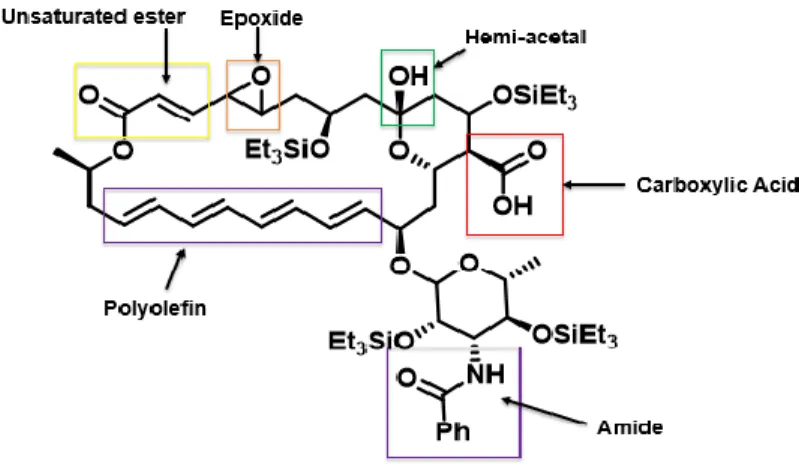
complex molecule such as natamycin, which is commonly found in soils and is used in many
applications as an antifungal or as a food preservative. (Figure 1) We hypothesize that the
chemoselectivity trends that we will find studying natamycin will be general and thus applicable
to other complex molecule modifications.
Figure 1. Structure of natamycin.
The Piers group has shown that BCF can catalytically reduce carbonyl functional groups
through a silane activation mechanism,4,5,6,7 while others have shown that BCF is also capable of reducing imines and enol ethers (Figure 2).8,9 Subsequent work by the Gagné group has demonstrated that BCF can also selectively reduce functional groups and single carbon-oxygen
bonds in complex sugars.10 The ability to activate sp3 C–O bonds in complex environments is rare. This diverse reactivity profile suggests that BCF would be capable of modifying multiple functional
groups if reacted with a compound like natamycin. The C–O containing functional groups within
insight on the selectivity that one might predict for such a structure, we determined comparative
reactivities of these functional groups using small molecule analogs. This approach has the
benefit of isolating each individual functional group from others and yielding the inherent
reactivity profile that we seek. The reactivity trend was then compared to the reactivity of the
complex compound natamycin to determine how structure affects reactivity.
Figure 2. Piers mechanism of BCF-silane catalyzed ketone reduction.4
Recent work has been done by the Gagné group to demonstrate that selective
modification is possible for complex natural products through the employed borosilane catalytic
system. Through sequential silane additions to the catalytic system, it was shown that gibberellic
acid, dihydroartemisinin, and natamycin can be modified without significant over-reductions
Figure 3. Structures of dihydroartemisinin and gibberellic acid.
Further modification can be applied to the Piers catalytic mechanism through the addition
of a Lewis base. This is important because for more reactive substrates, such as less hindered
epoxides, because the strength of the Lewis acidic BCF can directly decompose the material. In
regard to complex natural products, it was found that the addition of a Lewis base such as a triaryl
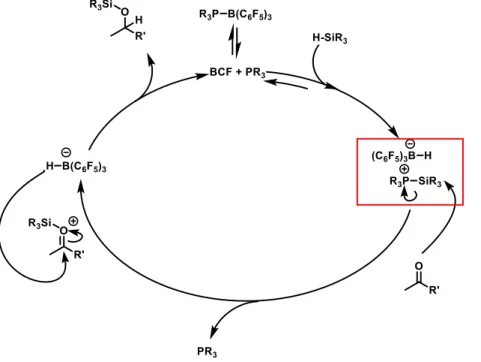
phosphine minimized background decomposition and led to higher yield.11 In the modified cycle, the free BCF is sequestered in a milder Lewis pair. The Lewis pair still activates the silane, but
prevents the decomposition associated with free BCF Lewis acidic conditions.12
Figure 4. Lewis base modified catalytic cycle. The Lewis base for this cycle is a tertiary phosphine.13
the oxygen species shown previously (Figure 2, 4). It is unclear at this time where the silylium sits
on amides. However, the nitrogen is not as electrophilic as the oxygen analog and is unreactive
to borohydride attack. The catalytic cycle is thus broken and the resting state of the system is as
the N–Si bonded complex.
Experimental Methods
To generate a reactivity series, the rate of consumption of starting material for two
small-molecule functional group models was compared on a small scale with one equivalent each of
the competing functional groups and the silane using catalytic quantities (5-10 mol %) of BCF.
The solvent and silane used were chosen to replicate reaction conditions in the chemoselective
reactions conducted previously for the modification of natamycin.11 Thus triethyl silane (TES–H) and 10 mol % BCF in DCM/toluene were picked as the standard condition set. To track the
reactivity, the rate of consumption of starting materials was used because many products can be
formed due to over reductions. The products are often unable to be identified thus starting
material disappearance was tracked for ease. To minimize decomposition, a Lewis base was
added to the reaction and an internal standard, hexamethylbenzene, was used.
In a nitrogen filled glovebox at room temperature, BCF (5-10 mol %), the appropriate
Lewis base (11 mol %), hexamethylbenzene (2.7 mg), and CD2Cl2 (0.5 mL) were added to a 1 dram
vial. The substrates (1 eq.) were then added and transferred to an NMR tube capped with a
septum lid. In a separate vial, H–SiEt3 (1 eq.) was added and both were brought out of the box. A
1H NMR was taken of the starting material. The silane was then added via syringe to the NMR
tube. 1H NMR spectra were acquired at 5 min, 2 h, 12 h, and 24 h intervals. Using 1H NMR allows for quick assessment of substrate concentration versus time to track conversion.
More quantitative data was obtained of the consumption of starting material using gas
chromatography with flame ionization detection (GC-FID). This method was chosen because it
simplifies the separation, identification (from retention time), and quantification of the products
quickly. In a nitrogen filled glovebox at room temperature, BCF (5-10 mol %), the appropriate
Lewis base (11 mol %), hexamethylbenzene (2.7 mg), and CD2Cl2 (0.4 mL) were added to a 1-dram
separate vial, H–SiEt3 (1 eq.) and CD2Cl2 (0.1 mL) was added and both vials were brought out of
the box. A GC-FID chromatogram was taken of the starting material. The silane was then added
via syringe to the vial containing the substrates. GC-FID spectra were then take at 5 min, 20 min,
and 2 h intervals.
To get quantitative yields for each product, a calibration plot of relative integrations was
made using standard solutions for each of the functional groups tested. The integration of the
starting material remaining in question was then quantified. The integrations in both GC-FID and
1H NMR were taken with respect to an internal standard, hexamethylbenzene. The compound
that was consumed in excess was thus favored (i.e. more reactive). The faster species was then
compared to other functional groups to determine which was the most reactive. This process
was repeated with the fastest and slowest species until a comprehensive series was generated.
Results
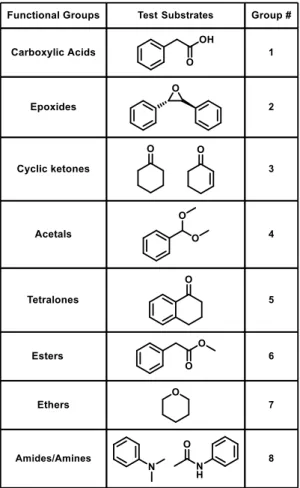
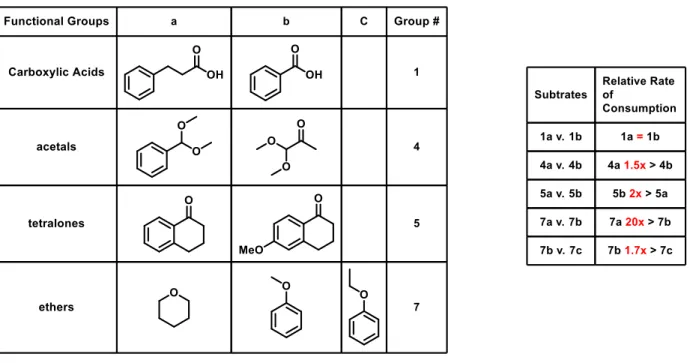
To model the functional groups present in the structure of natamycin, a number of
relatively simple compounds containing epoxides, carboxylic acids, α, β-unsaturated ketones, acetals, esters, cyclic ketones, tetralones, amines, amides and ethers were examined (Figure 5,
Table 1). Polyolefins were not examined because they are not Lewis basic enough to participate
in the catalytic cycle, which is observed in the functional group reactivity in previous natamycin
reactions.
Table 1. Functional groups to be examined.
It was observed that Lewis bases, such as amides are not reactive under the BCF/silane
reaction conditions, but instead act as silylium carriers. It was previously shown that phosphines
expressed this characteristic.11,12 The reactivities observed for amides, as well as tertiary and primary amines, supports this observation.
On the other end of the spectrum, carboxylic acids were found to react vigorously upon
the addition of silane with hydrogen gas evolution being observed. The product formed in-situ
was determined to be the carboxylic silyl ether formed that results from a dehydrocoupling
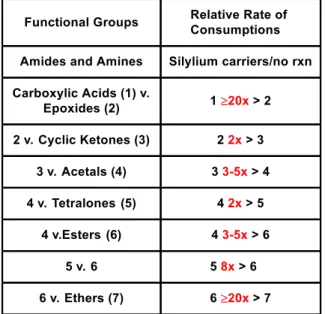
reaction. Carboxylic acids were the most reactive of the tested functional groups, being ≥20x faster than the next fastest class of substrates, epoxides.
Epoxides were the most reactive non-OH containing functional group. Less hindered
epoxides, such as cyclohexene oxide rapidly decompose, a reactivity traced to the Lewis acidic
adding a Lewis base (LB), which provides a silylium source with attenuated electrophilicity as
shown in Figure 4 for phosphines. For these experiments, the BCF and LB were pre-mixed before
the addition of the substrate. Under catalytic conditions, many minor products were observed in
both 1H NMR and GC-FID.
Next most reactive examples were cyclic ketones. Epoxides were consumed twice as fast
as cyclic ketones. The major product of the ketones, both for saturated and α,β-unsaturated was
1,2-hydrosilylation with minor over-reduction products being formed. The tested cyclic ketones
were 3-5x faster than the tested acetals. The faster acetal being the benzoic acetal and the slower
acetal being the ketone-containing, 1,1-dimethylglyoxal. In the manner of the other groups,
acetal consumption was tracked by GC, however over-reduction was problematic. For instance,
2 C–O bonds can be broken from either end, each giving different products, which could then be
reduced at other sites on the molecule (Figure 6). For some, this could be a reactive ketone
center. For ease only the consumption of the starting materials was tracked.
Figure 6. Reaction products with over reduction of 1,1-dimethylglyoxal acetal
It was found that acetals were consumed twice as fast as tetralones and 3-5x faster than
esters. The major product of tetralone reactivity was hydrosilylation at the ketone. The
consumption of tetralones was found to be 8x greater than that of esters. The major product of
ester reactivity was the 1,2-hydrosilylation of the sp2 carbon. Following the first major reduction, an abundance of over-reduction products are observed, thus only the disappearance of the
starting material can accurately be tracked.
Of the tested groups, the least reactive functional groups were the ethers. The Lewis basic
oxygen in the ether group is typically adjacent to an sp3 carbon, which are not as electrophilic as sp2 carbons and are thus not as reactive to the borohydride reduction. Esters are consumed 13-20x faster than ethers. The consumption difference is smaller for non-aromatic ethers, such as
In all of the reactions conducted, the presence of a Lewis base additive did not change
chemoselectivity. The effect of the LB carrier tended to depress the overall reaction rate, but not
the relative consumption of the starting materials in question.
Table 2. Relative consumption rates of molecule analogues. Substrates combined in 1:1 ratio, 5-10 mol%
BCF, 11 mol% N,N-dimethylaniline, 1 eq. silane, 0.5 mL DCM, 2.7 mg hexamethylbenzene.
The impact of electronic variations was probed by exploring the rate of reaction of
molecules with the functional group modified with substituents to alter how electron rich or poor
the group was. Within the carboxylic acid family, the chain length of the alkyl group was changed
to observe the electron withdrawing effects of the neighboring aromatic group using
hydrocinnamic acid and benzoic acid. It was observed that regardless of the length of the chain,
the carboxylic acid is dehydrocoupled rapidly with no selectivity. (Figure 7)
Figure 7. Reaction between hydrocinnamic acid and benzoic acid.
In the acetal family, the structure of the acetal was varied to observe its effects. It was
acetal with an electron withdrawing group, 1,1-dimethylglyoxal. The primary reduction product
from the reaction of phenyl acetal was benzyl methyl ether, the product of a putative SN1-type
reduction that proceeds through an intermediate oxo-carbenium ion (Scheme 1). Since there are
multiple reducing groups in dimethyl glyoxal, the silylium equivalent can activate either the Lewis
basic ketone or the acetal oxygens. There are a number of products produced in this reaction
that were in low yield and not isolable (Figure 6). Using 1H NMR, the mixture of products contained hydrosylilated ketone and acetal C–O cleavage from both directions to give both
demethylation and the MeOTES products.
Scheme 1. Proposed mechanism of (dimethoxymethyl)benzene reduction.
The effect of an electron donating group on the reactivity of the ketone in tetralone was
probed by comparing α-tetralone and its 6-methoxy derivative. It was observed that the consumption of the more electron-rich, 6-methoxy-1-tetralone was twice as fast as the
consumption of the tetralone itself. This demonstrates the importance of the Lewis basicity of
the starting material in the complex catalytic cycle. The methoxy group increases the Lewis
basicity of the ketone, but subsequently lowers the electrophilicity of the activated carbon center
(Scheme 2). Since the electron donating group reacted faster it appears that the Lewis basicity of
Scheme 2. Scheme of catalytic free energy diagram. The Lewis basicity of the ketone is the determining
step in the scheme as shown by the addition of the methoxy group on the tetralone, thus it is the higher barrier. The scheme therefore follows the dashed line.
The ether family has more complex possibilities. In simple, cyclic ethers, such THP, the
C-O bond is cleaved to give the ring opened product. Through the addition of an electron
withdrawing aromatic group, for instance in anisole, the basicity of the oxygen is reduced which
led to a consumption rate that is ≥20x slower than that of the simple THP reduction. The product
of aromatic ethers favors the cleavage of the non-aromatic substituent to prevent breaking
aromaticity. Further increasing the alkyl chain on the anisole ring to yield ethoxybenzene slows
the reaction. The borohydride reduces via an SN2 mechanism; therefore it is less favorable to
reduce off ethane than methane due to the increased steric bulk associated with a secondary
carbon, leading the anisole consumption to be 1.7x faster than the consumption of
Table 3. Summary of electronic effect reactions. Substrates combined in 1:1 ratio, 5-10 mol% BCF, 11
mol% N,N-dimethylaniline, 1 eq. silane, 0.5 mL DCM, 2.7 mg hexamethylbenzene.
Single molecules with multiple functional groups were examined in order to observe
possible adjacent functional group effects. To observe the strength of amine Lewis basicity and
silylium carrying potential, aminoacetaldehyde dimethyl acetal was reacted with 1 eq. of TESH.
(Figure 8) Acetals are typically fast reacting substrates; however, no reaction is observed for the
molecule indicating that the primary amine has sequestered the silylium, preventing the reaction
from moving forward as was expected from the single functional group studies.
Figure 8. Aminoacetaldehyde does not reduce under the catalytic conditions.
To compare the reactivity of a ketone adjacent to an epoxide,
7-oxabicyclo[4.1.0]heptan-2-one, a cyclohexenone derivative, was reacted. Under the standard conditions this substrate
results in various over reduction processes, making it challenging for a major product to be
ketone reduction. However, it is apparent via 1H NMR that the ring structure is no longer intact. The more rapid epoxide reactivity is the expected product in this experiment, supporting our
previous determination of consumption rates. The epoxide reactivity was further probed with a
linear molecule containing an olefin and epoxide moderately separated, 1,2-epoxy-5-hexene. It
was again seen that the major product was the epoxide reactivity over hydrosilylation of the
olefin.
Figure 9. Reactivities of molecules containing epoxides.
The reactivity trend can be summed up as shown in figure 10.
Figure 10. Carboxylic acids >> epoxides > cyclic ketones > acetals > tetralones > esters > ethers
Returning to natamycin, the original reason for these studies, one predicts that the
functional groups in this complex structure would react as follows using sequential additions of
silane. (Figure 5) Since carboxylic acids are the most reactive group, on would predict rapid
dehydrocoupling of the natamycin carboxylic acid to occur first, followed by epoxide reactivity,
hydrosilylation of the unsaturated ester, and finally the hemi-acetal. Under standard conditions
As seen in the reactions of natamycin, when silane is added one equivalent at a time a
similar reaction profile is observed is observed, with one exception. As expected, the first
addition of silane led to dehydrocoupling of the carboxylic acid to form a silyl ester. The second
equivalent of silane, however, was shown to conjugatively hydrosilate the unsaturated ester
instead of reacting with the adjacent epoxide.11 We hypothesize that in the natamycin
3-dimensional structure, the epoxide may be sterically blocked by other groups preventing it from
being activated. To confirm this hypothesis, we are currently seeking a crystal of natamycin to be
analyzed using X-Ray diffraction, however, these efforts have been, so far, unsuccessful. The third
equivalent of silane was seen to react at the hemi-acetal, as expected.
Conclusion
In summary, a reactivity series for the functional groups found in the natural product
natamycin has been determined by measuring consumption rates under competitive conditions.
The reactivity series was then used to show the predictive power of a catalytic system used for
site selective functional group modification. The results generally parallel previous observations
by the Gagné group in selective modification studies. Where inconsistencies where noted
(epoxides) new studies are being devised to determine why these exceptions occurred.
Future work will seek a 3-dimenstional structure of natamycin via the crystal structure of
to confirm our hypothesis for the lack of epoxide reactivity. Using the predictive capabilities
determined for the BCF-silane system, further testing can be done with other natural products
to demonstrate its versatility in complex molecule derivatization. The scope of the reactivity
series can also be expanded to include a larger number of functional groups that are found in
natural products, such as peroxides, alkynes, etc. The various BCF catalysts can also be probed to
examine the extent of their steric effects on small molecule analogues.
References
1. Newman, D. J.; Cragg, G. M. J. of Nat. Prod. 2007, 70 (3), 461–477.
2. Hartung, E. F. Annals of the Rheumatic Diseases. 1954, 13 (3), 190–200.
3. Sneader, W. Paclitaxel (taxol). 2005, 112–113.
5. Piers, W. E.; Marwitz, A. J. V.; Mercier, L. G. Inorg. Chem. 2011, 50, 12252−12262.
6. Houghton, A. Y.; Hurmalainen, J.; Mansikkamaki, A.; Piers, W. E.; Tuononen, H. M. ̈ Nat.
Chem. 2014, 6, 983−988.
7. Oestreich, M.; Hermeke, J.; Mohr, J.Chem. Soc. Rev. 2015, 44, 2202−2220.
8. Blackwell, J. M.; Sonmor, E. R.; Scoccitti, T.; Piers, W. E. Org. Lett. 2000, 2, 3921− 3923.
9. Wei, S.; Du, H. J. Am. Chem. Soc. 2014, 136, 12261−12264.
10.Bender, T. A.; Dabrowski, J. A.; Zhong, H.; Gagné, M. R. Org Lett. 2016, 18, 4120–4123.
11.Bender, T. A.; Payne, P. R.; Gagné, M. R. Nature Chemistry. 2017, 10(1), 85–90.
12.Stephan, D.W.; Erker, G. Angew. Chem. Int. Ed. 2009, 49, 46-76