ANALZYING TEXT MESSAGES REAGARDING ADOLESCENT SEXUAL HEALTH
by Sarah McDaniel
A paper presented to the faculty of The University of North Carolina at Chapel Hill in partial fulfillment of the requirements for the
degree of Master of (Master of Science in) Public Health in the Department of Maternal and Child Health.
Chapel Hill, N.C. April 4, 2015
Approved by:
Advisor
Abstract
Sexual and reproductive health during adolescence has been historically
overlooked in education, policy, and research. The United States has one of the highest rates of STI transmission and pregnancy among teenagers of developed nations,
underscoring the need for comprehensive sexual health information available to teens. Barriers such as embarrassment and perceived lack of confidentiality prevent adolescents from seeking answers to questions about sex, development, and relationships from parents and medical professionals. Services that provide information in a text message format can overcome these barriers. BrdsNBz is a two-way text messaging service that allows adolescents to send anonymous questions to trained health educators who provide personalized, confidential, and factually accurate answers to questions regarding sexual health. This analysis coded the 2,171 text messages that were sent to BrdsNBz North Carolina from January 1, 2012, to December 31, 2014. Text messages regarding contraception, pregnancy, and relationships were further sub-coded to understand what concerns about sexual health and related topics from adolescents ages 13 to 19 years old in North Carolina.
Introduction
adulthood, teenage sexuality has been historically overlooked in education, policy, and research.
Adolescence, usually defined as the ages between 13 and 19, is marked by puberty, increased sexual interest, and the development of sexuality (DeLamater and Friedrich, 2002). Often, sexual experiences during adolescence shape sexual health during adulthood. Most obvious are the effects of sexually transmitted infections (STIs) and the Human Immunodeficiency Virus (HIV), teen pregnancy, and sexual coercion that can last long into adulthood.
For example, while teens comprise only one fourth of the sexually active
population in the United States, they account for about half of STIs contracted annually, approximately 10 million infections among this population. They also account for 25% of the 50,000 new HIV infections each year (CDC, 2013; Weinstock, Berman, & Cates, 2004). In addition, while teen pregnancy and teen birth rates have been on the decline, the U.S. still has the highest teen birth rate of any developed country (National Research Council, 2013). The Centers for Disease Control and Prevention (CDC) reports that nearly 1.5 million high school students are affected by dating violence annually, with sexual coercion especially high among lesbian, gay, bisexual, transgender, and questioning (LGBTQ) youth and young women (CDC, 2006). Sexual violence
negatively impacts self-esteem and self-efficacy in sexual decision-making and can lead to mental health disorders such as depression and post-traumatic stress disorder (CDC, 2014).
States has historically focused on disease and pregnancy prevention through abstinence only until marriage (AOUM) education (Shalet, Santelli, Russell, Halpern, Miller, Pickering, Goldberg, & Hoenig, 2014). AOUM programs have proven to be ineffective in delaying sexual debut, preventing STI transmission, and reducing teen pregnancy (Stranger-Hall & Hall, 2011; Ott & Santelli, 2007). In addition, they are heterosexually biased in that they promote abstinence only until heterosexual marriage.
In 2010, the teen pregnancy prevention initiative required federally funded programs to be based on scientific evidence, called evidence-based interventions (EBI). While an obvious improvement in sexual health education, current EBIs continue to focus on disease and pregnancy prevention. In addition, they often exclude information regarding sexual orientation (Shalet, et al., 2014). Such information is critical for adolescent sexual health, as defined by the WHO. For example, hetero-normative programs may promote condom use among heterosexual partners to prevent STI transmission, but not explain that condom use is important for STI prevention among same-sex partners.
behaviors (Shalet, et al., 2014). The sexual double standard harms boys in that they are encouraged to engage in heterosexual sex even when it is risky. Boys that have more traditional masculine attitudes report having more sexual partners and a decrease in condom use, which can result in STI transmission and pregnancy (Shalet, et al., 2014).
This information underscores the need for honest, comprehensive sexual
education that is inclusive of sexual minorities and promotes gender equality. However, discomfort with adolescent sexuality prevents educators, medical professionals, and parents from providing this information. Similarly, barriers such as embarrassment, concerns about cost, perceived lack of confidentiality, and lack of access prevent many teens from seeking information about sensitive topics from parents, medical
professionals, and educators. (Ackard & Neumark-Sztainer, 2001; Perry, Kayekjian, Braun, Cantu, Sheoran, & Chung, 2012; Rideout, 2002). These two perceptions provide little opportunity for parents, providers, educators, and youth to communicate about sexual health.
Instead of seeking information from medical providers or parents, teens often turn to other sources for sexual health information. A recent study found that about 44% of adolescents obtained information about pregnancy, birth control, HIV/AIDS, and other STIs from the Internet (Rideout, 2002). Although the perceived reliability of information found on the Internet is relatively low―only 17% would trust the Internet “a lot”―teens rely on the information due to perceived confidentiality; 82% say protected
(2002). However, the Internet has a relatively low perceived reliability for a reason. It
can be an unreliable source with regard to accuracy of information. In addition, many teens report being blocked from certain sites when searching for sexual health topics such as HIV, other STIs, sexuality, and contraception (Rideout, 2002).
In order to provide accurate and confidential sexual health information, many sexual health education services are looking for ways to incorporate technology into their programs. One type of technology involves the use of cell phones. More than three-quarters, 78%, of U.S. teens now have a cellphone (Lenhart, Purcell, Smith, & Zickuhr, 2010; Madden, Lenhart, Duggan, Cortesi, Gasser, 2013). Teens who text spend about an hour and a half sending and receiving text messages each day (Rideout & Foehr, 2010). In addition, the median number of texts messages sent by teens age 12-19 on a typical day has increased from 50 in 2009 to 60 in 2011, with older girls texting the most frequently (Lenhart, 2012). Furthermore, cell phone ownership is relatively high among youth from all races, level of parental education, and household income (Madden, et al., 2013). The nearly ubiquitous use of cell phones and texting provides a novel opportunity to improve access to sexual health education, through text-messaging services.
Another type of text messaging service involves participants opting in to receive regular messages related to sexual health. An example of this is one called the Hookup, which sends weekly recommendations and referrals related to sexual health. In 2008, a study of young people aged 16–29 in Melbourne, Australia, found that short text messages about sexual health sent fortnightly for four months significantly increased participants’ knowledge of sexual health (Gold, Lim, Hocking, Keogh, Spelman, & Hellard, 2011).
A third type is a two-way text messaging service, which allows teens to opt-in and then text questions and receive personalized and specific responses. An example of this type of service is BrdsNBz, which currently operates in Indianapolis and Marion County, Indiana; statewide with an additional Parent Text Line in New Mexico; North Carolina; a five-county region around Jacksonville, Florida; and Austin, Texas. The first
implementation of this service was launched in 2009 in North Carolina to provide personalized, confidential, and medically accurate answers to questions about sexual health questions and related topics via text message to adolescents aged 14–19
(Anonymous, 2013). Since then, BrdsNBz North Carolina has extended their services to teens aged 13–19 in light of the FTC’s COPPA law (Child Online Privacy Protection Act) that requires adolescents under aged 13-–19 to obtain parental consent before submitting information electronically (COPPA).
The question-and-answer format of BrdsNBz keeps adolescents engaged and often leads to follow-up questions. There is no limit to the number of questions teens can ask. In order to participate, teens must first opt in to the service by texting
conditions of the service. In order to opt out, teens need only to text “STOP” to the same five-digit short code. It is free to use BrdsNBz, although standard text messaging rates may still apply.
The service was initiated in response to the increasing rates of teen pregnancy and sexually transmitted infections (Phillips, 2010). In 2007, more than 20,000 females aged 15 to 19 became pregnant in North Carolina (Phillips, 2010). Since then, teen pregnancy rates have been decreasing in the United States–an 8% decrease in 2011–and in North Carolina, in particular. In 2013, there were 9,145 reported pregnancies in mothers aged 11–19 in North Carolina (North Carolina State Center for Health Statistics, 2013). However, compared with other high-income countries, the United States still has one of the highest teen pregnancy rates. In addition, the transmission of STIs in the United States is also high with about half of all U.S. teens acquiring a STI (Willoughby, 2013b). Furthermore, dating violence continues to remain a serious problem in the U.S., and disproportionately affects younger women; almost half of women who report being raped experience their first rape before the age of 18 (Miller & McCauley, 2013). Therefore, continued research is needed to ensure the positive trajectory of teen pregnancy, STI transmission, and sexual coercion among adolescents.
BrdsNBz, including why people used the service and why not. The researchers found that adolescents trusted the service, found it less awkward or embarrassing to use than other resources, and were also more likely to follow up on answers from BrdsNBz than from other resources (Phillips, 2010; Willoughby, 2013a).
• Sexual acts, 33.9%
• Unplanned pregnancy, 20.2% • Contraception, 13.7%
• Development, 12.9% • STIs, 10.8%
• Masturbation, 2.7% • HIV/AIDS, 2.4% • Sexual identity, 2.3% • Unprotected sex, 1.6% • Waiting for sex, 1.5% • Abortion, 0.6%
• Rape/sexual violence, 0.5% • Others, 13.0%
DISTRIBUTION OF
QUESTIONS
A quantitative content analysis of the first twoyears of the BrdsNBz NC service found that teens primarily use the service to get information rather than advice about sexual health (Willoughby & Jackson, 2012). Willoughby and Jackson also found the
following distribution of questions listed in the textbox to the right. Sub-categories were not mutually
exclusive, so percentages sum to greater than 100% (Willoughby & Jackson, 2012).
As of the present date, no mixed-methods content analyses have been processed and published
regarding the types of information asked by adolescents using the BrdsNBz NC service. The following analysis adds to previous research by investigating the topics most
frequently asked by adolescents aged 13–19 in North Carolina from January 1, 2012, to December 31, 2014.
Objectives
The primary objectives of this study were to identify categories commonly asked about by participants aged 13 to 19 in North Carolina of the BrdsNBz Text Message Warm Line Service, quantify the number of messages from each category, and
Methodology
A qualitative content analysis is “used to refer to any qualitative data reduction and sense-making effort that takes a volume of qualitative material and attempts to identify core consistencies and meanings” (Patton, 2001, p. 453). In this study, content analysis was used to determine the questions asked by adolescents to BrdsNBz sexual health text-messaging service in North Carolina. Quantitative methods were also used to understand the frequency of a given topic.
Sample
The sample analyzed by the study consisted of all text messages sent to the BrdsNBz North Carolina from January 1, 2012, to December 31, 2014. Of the 2,171 text messages that were sent, 669 were excluded for being either acknowledgments, non-‐questions, irrelevant, or inappropriate. Examples of text messages that were excluded for being acknowledgments, non-‐questions, irrelevant, or inappropriate include texts such as “hi,” “ok,” “thanks,” and “I have a question.” Twenty-‐two text messages were excluded for asking about sexual technique, as BrdsNBz does not answer questions about sexual technique. Sixty-‐nine duplicate questions sent more than once by the same user were also excluded from analysis. After exclusions, the sample consisted of 1,411 text messages.
• Contraception • Development • HIV/AIDS • Pregnancy • Relationships • Sex
• Sexual Identity • STIs
BrdsNBz Priority
Code Areas
Coding
Only text messages asking questions were coded for the purpose of analysis; all non-‐questions were excluded from the data set. In many cases, a single question was asked over a series of text messages. In these cases, only one text message was coded, unless more than one question was asked.
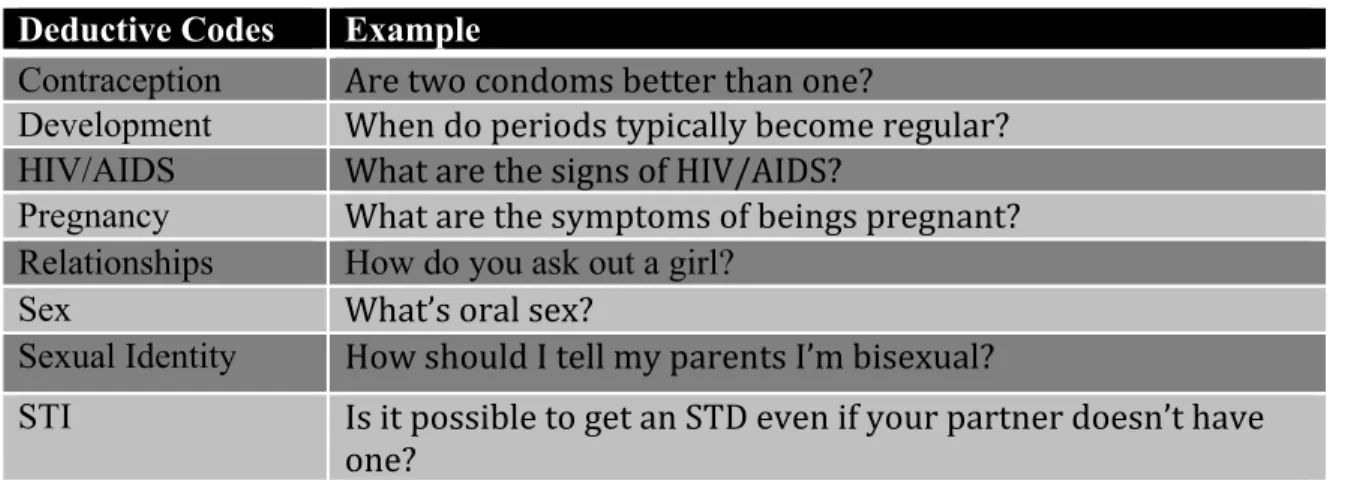
Text messages were initially coded deductively and were assigned one of eight codes, based on the priority areas of BrdsNBz. These codes are listed in the text box to the left. Data that would be excluded (acknowledgment/non-‐questions/irrelevant/inappropriate, duplicate, and sexual technique) were also coded deductively. After an initial coding, an expert researcher checked for accuracy. Text messages coded as contraception, pregnancy, and
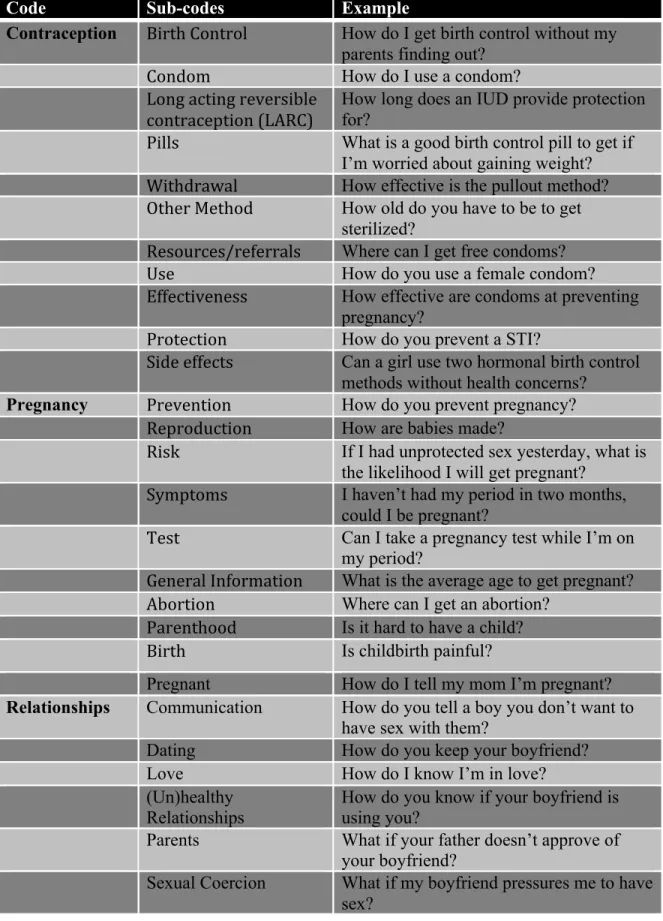
relationships were sub-‐coded for emerging themes identified during the first coding process.
Table 1. Codes with corresponding examples
Deductive Codes Example
Contraception Are two condoms better than one?
Development When do periods typically become regular? HIV/AIDS What are the signs of HIV/AIDS?
Pregnancy What are the symptoms of beings pregnant? Relationships How do you ask out a girl?
Sex What’s oral sex?
Sexual Identity How should I tell my parents I’m bisexual?
STI Is it possible to get an STD even if your partner doesn’t have one?
Table 2. Codes with sub-codes and corresponding examples
Code Sub-codes Example
Contraception Birth Control How do I get birth control without my parents finding out?
Condom How do I use a condom?
Long acting reversible contraception (LARC)
How long does an IUD provide protection for?
Pills What is a good birth control pill to get if I’m worried about gaining weight? Withdrawal How effective is the pullout method? Other Method How old do you have to be to get
sterilized?
Resources/referrals Where can I get free condoms?
Use How do you use a female condom?
Effectiveness How effective are condoms at preventing pregnancy?
Protection How do you prevent a STI?
Side effects Can a girl use two hormonal birth control methods without health concerns?
Pregnancy Prevention How do you prevent pregnancy? Reproduction How are babies made?
Risk If I had unprotected sex yesterday, what is the likelihood I will get pregnant?
Symptoms I haven’t had my period in two months, could I be pregnant?
Test Can I take a pregnancy test while I’m on my period?
General Information What is the average age to get pregnant? Abortion Where can I get an abortion?
Parenthood Is it hard to have a child?
Birth Is childbirth painful?
Pregnant How do I tell my mom I’m pregnant?
Relationships Communication How do you tell a boy you don’t want to have sex with them?
Dating How do you keep your boyfriend?
Love How do I know I’m in love?
(Un)healthy
Relationships How do you know if your boyfriend is using you?
Parents What if your father doesn’t approve of
your boyfriend?
Analytic Methods
All data were analyzed using Microsoft Excel. Several analytic methods were utilized to analyze the data. First, the frequencies and percentages of codes were calculated. Questions coded as contraception, pregnancy, and relationships were sub-‐coded. The frequency and percentages of these sub-‐codes were then calculated and translated into pie charts to better understand the weight of each topic. Codes were also qualitatively analyzed by sorting text messages and identifying trends.
Results
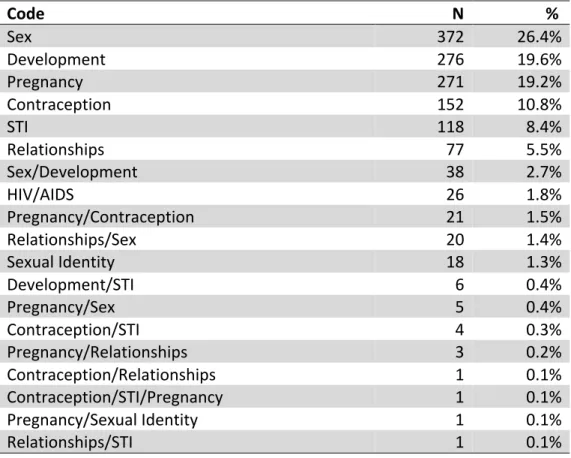
Table 3: Codes and frequencies
Code N %
Sex 372 26.4%
Development 276 19.6%
Pregnancy 271 19.2%
Contraception 152 10.8%
STI 118 8.4%
Relationships 77 5.5%
Sex/Development 38 2.7%
HIV/AIDS 26 1.8%
Pregnancy/Contraception 21 1.5%
Relationships/Sex 20 1.4%
Sexual Identity 18 1.3%
Development/STI 6 0.4%
Pregnancy/Sex 5 0.4%
Contraception/STI 4 0.3%
Pregnancy/Relationships 3 0.2%
Contraception/Relationships 1 0.1%
Contraception/STI/Pregnancy 1 0.1%
Pregnancy/Sexual Identity 1 0.1%
Relationships/STI 1 0.1%
Sex
There were a total of 2,171 text messages sent during the years 2012, 2013, and 2014. Of these, 760 were excluded from the data set and 1,411 were
quantitatively and qualitatively analyzed. The most frequently asked questions were about sex (n= 437, 31%). This is consistent with previous research by
Willoughby and Jackson who found about one third of text messages regard sex acts (n=374, 33.9%) (Willoughby & Jackson, 2012). Sex is also the broadest category, encompassing a variety of questions including questions about oral, anal, and vaginal sex as well as other sexual acts. It may also include questions about virginity, orgasms, and pornography. The wide variety of text messages that fall under this category further explains the high frequency of this code type.
Development
was normal, OK, or average. Frequently these questions regarded penis or breast size, masturbation, menstruation, or weight.
STIs and HIV/AIDS
STIs and HIV/AIDS combined accounted for 11.1% of the text messages sent to BrdsNBz NC. Many questions asked what HIV/AIDS is and how it is transmitted. There were relatively few questions specifically asking about HIV/AIDS, however, and many more about STIs in general, suggesting that teens are not as concerned about HIV/AIDS as they are about other STIs. Most questions about STIs were about infections in general, rather than about specific infections such as HPV, gonorrhea, or syphilis. Several text messages, however, concerned a fake STI that originated on the Internet.
Contraception
common questions asked included: “How do I put on a condom?” and “Where can I get free condoms?” Also, a subset of questions asked why it was important to use condoms and if it was “OK” to not use condoms in certain situations. Some of these situations included during anal sex, while menstruating, while having sex with a virgin, and if planning to use the “pull-‐out” method. In these cases, BrdsNBz responded in saying that there is risk with all kinds of sex and that condoms can reduce that risk.
The second most commonly asked questions were about birth control in general. The relative frequency of these questions may have been skewed by the fact that birth control pills are commonly referred to as simply “birth control.” However, because pills were not specified, all questions asking about “birth control” were coded as birth control in general. Eleven of the 33 questions about birth control in general inquired how the user could get birth control without their parents’
knowledge or consent. The third most common contraception question was about birth control pills (n=35, 20%). There were relatively few questions regarding long-‐ acting reversible contraception (LARC) (n=12). Of these, six were about
intrauterine devices (IUDs), and six were about injections. Other methods that were mentioned included: emergency contraception (2), sterilization (2), the patch (1), dental dam (1), and the sponge (1). Lastly, the “pull-‐out” or withdrawal method was asked about 11 times. Most of these questions were concerned with its
Graph 1: Pie chart of contraception methods sub-‐codes and percentages
Pregnancy
Twenty-‐one and half percent of all questions were about pregnancy. The majority of questions about pregnancy regarded the risk of getting pregnant during certain sexual acts (n=142, 47.2%). Most frequently users asked if you could get pregnant: during anal or oral sex, while menstruating, while using birth control, during manual stimulation, in water (hot tubs, pools, etc.), and from pre-‐ejaculation. The second most commonly asked question regarded pregnancy symptoms (n=64, 21.3%). Questions asking about symptoms were frequently dual-‐coded as either
Birth Control (General)
18%
Condom 46% Condom/Pills
7% LARC
6% LARC/Pills
1%
Other Method 3%
Pills 12% Withdrawal
5% Withdrawal Condom/ 1%
Risk/Symptoms or Symptoms/Test. Questions coded as Risk/Symptoms commonly described a sexual situation and then a possible symptom of pregnancy. For
example: “I had sex 3 days before my last period, and my period came on time… now a month later I am almost a week late. But I haven’t had sex since, could I be
pregnant?” Questions coded as Symptoms/Test usually inquired how one would know if she were pregnant or not. Questions were also coded only as symptoms if they were simply asking about symptoms of pregnancy. Questions regarding pregnancy tests only were coded as Test. There were 33 questions total regarding tests: 12 questions coded as Symptoms/Test and 21 questions coded as Test.
About 10% of questions suggested that the user or someone they knew was already pregnant (n=30). However, due to follow-‐up questions by individual users, there were only 19 unique users who suggested that they or someone they knew was pregnant. Users requested information about care during pregnancy (12), childbirth (2), communicating with parents about the pregnancy (6), normalcy of symptoms (3), and general information (7). It is important to note that it is not possible to know if the user or someone they know is actually pregnant, but that their questions indicate that they are or could be.
Graph 2: Pie chart of pregnancy sub-‐codes and percentages
Relationships
Questions regarding relationships were given one of the following codes: (Un)healthy relationships, communication, dating, love, and sexual coercion or rape. Most relationship-‐type questions regarded dating (n=40, 39%). Examples of dating-‐ type questions include: "How do I ask a girl out?” and “How do I know if a guy likes me?” The second most common relationship code was love (n=25, 24%). Examples of love-‐type questions include: “Am I in love?” and “How do you know if your (sic) in love?” Sexual coercion or rape was the third most commonly coded text message (n=17, 17%). Of the total text messages coded, sexual coercion or rape is consistent with the findings of Willoughby & Jackson, 1.2% and 0.5% respectively (2012). The remaining text messages were coded as either (un)healthy relationships (n=11) or
Abortion
2% Information General 9%
Parenthood 3%
Pregnant 10%
Prevention 3% Reproduction
2%
Risk 43% Risk/Symptoms
4%
Symptoms 13% Symptoms/Test
questions could also be coded as communication or (un)healthy relationships due to the generalizability of these codes.
Graph 3: Pie chart of relationship sub-‐codes
Sexual Identity
Twenty-‐three questions were coded as sexual identity (1.6%). All of these questions regarded having same-‐sex attractions. Users were curious about the appropriateness of the attractions and others wanted advice on how to
communicate with their parents about their sexual identities. Questions related to heterosexual attractions were not coded under sexual identity, because these
(Un)healthy relationships
11%
Communication 9%
Dating 39% Love
24%
questions were not specifically concerned about their sexual identity. For example, questions related to heterosexual dating were coded as relationships because the user’s main concern was about dating, not sexual identity. Coding these questions as sexual identity would have significantly increased the number of questions under this code.
Graph 4: Bar graph of codes and percentages
152
1 4 1 276
6 26
271
21
3 5 1 77
20 1
372
38 18
118
0 50 100 150 200 250 300 350 400
Fre
que
n
cy
Discussion
Adolescents have a variety of questions about sexual health. Most frequently teens ask about sexual acts. Teens have questions regarding anal, oral, and vaginal sex as well as genital manipulation, masturbation, and pornography. The wide variety of questions that fall under this category help explain the high frequency of questions. Another possible explanation is that embarrassment may be a significant barrier when seeking information about sexual acts. Also, unlike information about STIs, HIV, and pregnancy, there may not be easily accessible, factually accurate information available on the Internet regarding sexual acts, further explaining the high-‐frequency questions.
users are more concerned about pregnancy than male users. Therefore, educating teenagers, especially teenage boys, about pregnancy prevention and parenthood may be useful in increasing condom use and reducing teen pregnancy rates. The fourth most commonly asked questions were about contraception. Teens have questions about a variety of contraceptive methods, but asked most frequently about condoms. Most users who asked about condoms wanted to use them appropriately and effectively. There were a few users who wanted to know why it was important to use condoms during various sexual acts such as during anal or oral sex, while having sex with a virgin, or while menstruating. This
demonstrates how BrdsNBz is inclusive of sexual minorities. For example,
traditional, heterosexist sexual health programs may not explain that it is important to use condoms during anal sex with same-‐sex partners because it is assumed that all teens are heterosexual. BrdsNBz on the other hand is user-‐directed and allows LGBTQ teens to ask if it is important to use condoms with their same-‐sex partner. This also shows how BrdsNBz helps challenge traditional gender norms by
informing teens that pregnancy and STI prevention are the responsibility of both male and female partners.
methods of birth control include LARCs such as the IUD, injections, implants, and rings. The IUD and the implant, for example, are more than 99% effective with perfect and typical use (BedsiderInsider, 2015). Teens may face barriers in
acquiring these types of birth control methods. For example, several teens inquired about how to get birth control without their parents’ knowledge. The implant and the IUD require a short procedure and, therefore, teens may perceive them being more difficult to acquire without their parents. It may be important to educate teens on the various birth control methods available and explain the risks and benefits of each one.
STIs and HIV/AIDS were the fifth and sixth most commonly coded questions. Users asked more questions about STIs in general and fewer about specific STIs. This may indicate a lack of information provided to teens regarding specific STIs. There were several text messages concerning a fake STI that originated on the Internet. This highlights that teens are regularly seeking information from the Internet that may or may not be reliable, and underscores the need for factually accurate sexual health information available to teens.
of the total text messages (1.2%), but it should not be overlooked. Because dating violence disproportionately affects LGBTQ individuals and young women, sexual health education that perpetuates traditional gender norms and excludes LGTBQ youth may contribute to dating violence among teens. Therefore, sexual health education should focus on deconstructing gender norms and being inclusive of sexual minorities.
Lastly, teens inquired about sexual identity. All questions regarding sexual identity indicated the user was attracted to the same sex. Questions regarding heterosexual relationships were not coded as sexual identity because the user was not concerned with their sexual identity but with some aspect of the relationship, (i.e., pregnancy, STIs, sexual coercion, love, etc.). This indicates that LGBTQ youth are more concerned about their sexual identity than heterosexual youth. Sexual health educators should support LGBTQ youth and aim to break hetero-‐normative beliefs.
In conclusion, teens have questions about sexual health, development, and relationships and may feel uncomfortable asking these questions to adults. The Internet, while confidential and readily accessible, is often unreliable. BrdsNBz fills this information gap by providing confidential, factually accurate, sexual health information. Moreover, it is user-‐directed and, in this way, inclusive of all teens regardless of sexual attraction or gender.
Limitations and future research
Due to the anonymity of the service, demographic information was not included in the data set. Furthermore, not only was it impossible to identify who was sending the text messages, the extent to which adults were using the service instead of adolescents is unknown. However, by sending the “NCTEEN” keyword to the BrdsNBz Text Line the user receives an automatic text message response linking him or her to the Terms and Conditions of Use for BrdsNBz NC. The Terms and Conditions of Use state, “… by opting in to BrdsNBz NC – the user agrees that he or she is aged 13 to 19 and resides in North Carolina.” Lastly, it is unclear if users are actually using the information they receive. Future research should analyze BrdsNBz users’ knowledge of sexual health information.
Acknowledgments
The author thanks BrdsNBz North Carolina Text Line for providing this information. She also thanks the organization’s representative, Kennon Jackson, Jr., and advisor, Claudia Fernandez, DrPH, for their support and guidance on this project.
Code Book
1. Acknowledgment/Non-‐questions/Irrelevant/Inappropriate-‐ Includes all non-‐questions and irrelevant or inappropriate questions. Does not include questions about sexual technique. EXAMPLES: Hi. I have a question. Thanks. I am pregnant. How do you have sex?
2. Contraception – Includes questions regarding use, reliability, and accessibility of various forms of contraception. Also includes general
questions about contraceptive methods. EXAMPLES: Are two condoms better than one? What if the condom rips? Where do you go to get girl condoms?
3. Development – Includes questions regarding menstruation, puberty, masturbation, and other physical conditions associated with sex
characteristics (acne, pubic hair, genitalia, etc.) during development. Also includes questions about age of sexual debut. EXAMPLES: Can a girl get pimples on her vagina? When do periods typically become regular? How do you know you’re ready for sex? Is my penis too small?
4. HIV/AIDS – Includes questions about HIV/AIDS. EXAMPLES: What are the signs of HIV/AIDS? Can a baby be born with HIV/AIDS?
5. Pregnancy – Includes questions regarding pregnancy. EXAMPLES: What are the symptoms of beings pregnant? How do I tell my parents I’m pregnant?
6. Relationships – Includes questions regarding romantic and intimate relationships. EXAMPLES: How do you ask out a girl? What should I do if I have a boyfriend who pressures me?
7. Resources/Referrals – Includes all questions requesting resources, referrals, or additional information. EXAMPLES: Where can I get more information on safe sex? Where can I get free condoms? Where can I get tested?
8. Sex – Includes questions about anal, oral, vaginal sex or genital stimulation. Includes questions about virginity or sexual debut. Also includes questions pertaining to masturbation and other sexual activity. EXAMPLES: What’s oral sex? Is it bad to swallow semen? What does sex feel like? How do you know when you’re ready to have sex? What is a BJ?
9. Sexual Technique – (BrdsNBz DOES NOT ANSWER QUESTIONS ABOUT SEXUAL TECHNIQUE) EXAMPLES: My partner wants me to entertain him. What should I do? How do you give a blowjob?
10. Sexual Identity – Includes questions about sexual orientation or gender identification. EXAMPLES: How should I tell my parents I’m bisexual? How do I know if I’m gay?
11. STI – Includes all questions regarding STIs or STDs and yeast infections. Does not include questions specifically about HIV/AIDS. EXAMPLES: Is it possible to get an STD even if your partner doesn’t have one? Do you have to go have sex a number of times to get a certain STI? It burns when I pee after having unprotected sex, do I have an STD?
Dual codes:
12. Contraception/Relationships – Includes questions regarding both
contraception and relationships. EXAMPLES: How do you get your boyfriend to use condoms?
13. Contraception/STI – Includes questions regarding prevention of STIs through condom use. EXAMPLES: Do condoms prevent all STDs?
14. Contraception/STI/Pregnancy – Includes questions regarding
contraception, STIs, and pregnancy. EXAMPLES: What are the chances of getting pregnant or a STI if you use a condom?
15. Development/STI – Includes questions regarding symptoms of puberty or STIs, but the inquirer does not know the source of the symptoms. EXAMPLES: “Is it normal to have bumps on your pubic area?” “What color should your discharge be?”
16. Sex/Development – Includes questions related to sexual debut. EXAMPLES: When should I have sex? How do I know I’m ready for sex?
17. Pregnancy/Contraception– Includes questions related to both
contraception and pregnancy. EXAMPLES: If a condom breaks, can I get pregnant? If I miss a day of my pills, will I get pregnant?
18. Pregnancy/Relationships – Includes questions related to both pregnancy and relationships. EXAMPLES: How do I tell my boyfriend I’m pregnant?
19. Pregnancy/Sex – Includes questions regarding performing sexual acts while pregnant. EXAMPLES: Can I have sex while pregnant?
20. Pregnancy/Sexual Identity – Includes questions regarding both pregnancy and sexual identity.
21. Relationships/Sex – Includes questions related to communicating about sex with intimate partners. EXAMPLES: My boyfriend wants to have sex and I don’t want to. What should I do?
22. Relationships/STI – Includes questions related to both relationships and STIs. EXAMPLES: How do I tell my girlfriend I have a STD?
23. Sex/Development – Includes questions related to when it is appropriate to start engaging in sexual activity. EXAMPLES: What is a good age to have sex? How can you delay sexual involvement? What is the age most kids start having intercourse?
Sub-‐codes:
Contraception sub-‐codes:
1. Birth Control – Includes questions that ask about birth control in general and do not specify which type of birth control method. EXAMPLES: Where do you get birth control? What are the negative effects of birth control?
2. Condoms – Includes questions about either male or female condoms. In most cases, questions that did not specify which type of condom were considered to be questions about male condoms. EXAMPLES: Are two condoms better than one? What is the best brand of condom? Do latex condoms provide protection against STDs and pregnancy? How do you use a female condom?
3. LARC – Includes questions regarding long acting reversible contraceptives (LARCs) including: IUDs, injections, implants, and the Nuva Ring. EXAMPLES: How long does an IUD provide protection for? How long does it take for an injection to work?
4. Other method – Includes questions regarding other methods other than condoms, LARCs, pills, and withdrawal. These may include: patches, emergency contraception, sterilization, and various barrier methods. EXAMPLES: How effective is the Today Sponge? Where can I get emergency contraception?
5. Pills – Includes questions regarding birth control pills. EXAMPLES: What is a good birth control pill if I’m worried about gaining weight? Where can I get birth control pills?
6. Withdrawal – Includes questions about the withdrawal or “pull-‐out”
method. EXAMPLES: How effective is the pull-‐out method? Is it true that if I pull out I won’t get anyone pregnant?
7. Effectiveness – Includes questions regarding the effectiveness of a given contraceptive method. EXAMPLES: How effective is the pull-‐out method? If I use condoms and birth control pills, will I not get pregnant?
8. General Information – Includes questions requesting information about contraception in general. EXAMPLES: What is birth control? Is there a girl condom?
9. Protection – Includes questions regarding the purpose of contraception. EXAMPLES: Why is it important to protect yourself? Is it OK to not use a condom during anal sex?
10. Resources/Referrals – Includes questions regarding accessing further information, resources, or referrals. EXAMPLES: Where can I get free condoms? Where can I get birth control without my parents knowing?
11. Side effects – Includes questions regarding side effects of a specific contraceptive method. EXAMPLES: What is a good birth control pill if I’m worried about gaining weight? What are the negative side effects of birth control?
12. Use – Includes questions regarding how to use a specific contraceptive method. EXAMPLES: How do I put on a condom? If I miss a day of my birth control pills, what should I do?
Pregnancy sub-‐codes:
1. Abortion – Includes questions that inquire about abortion. EXAMPLES: Is abortion legal in the US? Where can I get an abortion?
2. General Information – Includes questions requesting information bout pregnancy in general. EXAMPLES: What is a stillbirth? What state has the most teen pregnancies? What is the youngest age someone has ever gotten pregnant?
3. Parenthood – Includes questions about being a parent and birth.
EXAMPLES: Would a baby be hard to take care of? How much does it cost to have a baby?
4. Pregnant – Includes questions indicating that the user may be pregnant. EXAMPLES: How to I tell my mom I’m pregnant? I’m pregnant. What should I do?
5. Prevention – Includes questions about preventing pregnancy in general. EXAMPLES: How do I stop from getting pregnant? How to I prevent pregnancy?
6. Reproduction – Includes questions about reproduction. EXAMPLES: Where do babies come from? Who decides the sex of a baby? How are twins formed?
7. Risk – Includes questions about risk of pregnancy in relation to certain sexual acts. EXAMPLES: Can you get pregnant in a hot tub? Can you get pregnant during anal sex?
8. Symptoms – Includes questions inquiring about pregnancy symptoms. EXAMPLES: I am five days late on my period, could I be pregnant? I have been peeing a lot, could I be pregnant?
9. Test – Includes questions regarding pregnancy tests. EXAMPLES: Do you have to be 18 to buy pregnancy tests? Can I take a pregnancy test when on my period? What do I do if I think I’m pregnant?
Relationship sub-‐codes:
1. (Un)healthy relationships – Includes questions that suggest an unhealthy relationship or how to have a healthy relationship. EXAMPLES: How do you know if a boy is using you? How are you supposed to treat a woman?
2. Communication – Include questions about how to communicate with romantic partners. EXAMPLES: How do you tell your boyfriend you have an STD? How do you tell a boy you don’t want to have sex with them?
3. Dating – Includes questions about dating. EXAMPLES: How do I know if a guy likes me? How do you keep your boyfriend?
4. Love – Includes questions that inquire about love. EXAMPLES: What is love? How do I know if I’m in love?
5. Sexual Coercion or Rape – Includes questions suggesting sexual violence, coercion, or rape. EXAMPLES: How would you know if you’re being sexually abused? What if my boyfriend pressures me into having sex?
References
1. Ackard, D. M., & Neumark-Sztainer, D. (2001). Health care information sources for adolescents: Age and gender differences on use, concerns, and needs. Journal of Adolescent Health, 29(3), 170-176. doi:10.1016/S1054-139X(01)00253-1 2. Anonymous. (2013). Technology holds the key -- help young women pick
prevention options. Contraceptive Technology Update, 34(11), 121. 3. BedsiderInsider. (2015). The pill. Retrieved from
http://bedsider.org/methods/the_pill#details_tab
4. Centers for Disease Control and Prevention. (2006). Physical dating violence
among high school students-United States, 2003. Morbidity and Mortality Weekly
Report, 61(47), 971-976.
5. Centers for Disease Control and Prevention. (2013). Incidence prevalence, and
cost of sexually transmitted infections in the United States. Retrieved from
http://www.cdc.gov/std/stats/sti-estimates-fact-sheet-feb-2013.pdf.
6. Centers for Disease Control and Prevention. (2014). Sexual violence:
Consequences. Retrieved from
http://www.cdc.gov/violenceprevention/sexualviolence/consequences.html
7. COPPA – Children’s Online Privacy Protection Act. Title XIII-Children’s online
privacy protection. Retrieved from http://www.coppa.org/coppa.htm
8. DeLamater, J., & Friedrich, W. N. (2002). Human sexual development. The
Journal of Sex Research, 39(1), 10-14.
to young people. Sexually Transmitted Diseases, 38(4), 247-252. doi:10.1097/OLQ.0b013e3181f68d7b
10. Lenhart, A. (2012). Teens, smartphones, & texting. Pew Research Center’s Internet & American Life Project. Retrieved from
http://www.pewinternet.org/files/old-media/Files/Reports/2012/PIP_Teens_Smartphones_and_Texting.pdf
11. Lenhart, A., Purcell, K., Smith, A., & Zickuhr, K. (2010). Social media & mobile internet use among teens and young adults. Pew Research Center’s Internet & American Life Project (1-51).
12. Levine, D., McCright, J., Dobkin, L., Woodruff, A. J., & Klausner, J. D. (2008). SEXINFO: A sexual health text messaging service for San Francisco
youth. American Journal of Public Health, 98(3), 393-395. doi:10.2105/AJPH.2007.110767
13. Madden, M., Lenhart, A., Duggan, M., Cortesi, S., & Gasser, U. (2013). Teens
and technology, 2013
14. Miller, E., & McCauley, H. L. (2013). Adolescent relationship abuse and
reproductive and sexual coercion among teens. Current Opinion in Obstetrics & Gynecology, 25(5), 364-369. doi:10.1097/GCO.0b013e328364ecab
15. National Research Council (2013). U.S. Health in international perspective: Shorter lives, poorer health. Washington, DC: National Academy Press. 16. North Carolina State Center for Health Statistics. (2013). Basic automated birth
yearbook North Carolina residents, 2013. Retrieved from:
17. Ott, M. A., & Santelli, J.S. (2007). Abstinence and abstinence-only education.
Current Opinion in Obstetrics and Gynecology, 19(5). 445-452. doi:10.1097/GCO.0b013e3282efdc0b
18. Patton, G. C., & Viner, R. (2007). Pubertal transitions in health. The Lancet, 369(9567), 1130-1139. doi:10.1016/S0140-6736(07)60366-3
19. Patton, M. Q. Qualitative research & evaluation methods (3rd ed.). Thousand Oaks, CA: Sage Publications, Inc.
20. Perry, R. C. W., Kayekjian, K. C., Braun, R. A., Cantu, M., Sheoran, B., & Chung, P. J. (2012). Adolescents' perspectives on the use of a text messaging service for preventive sexual health promotion. The Journal of Adolescent Health: Official Publication of the Society for Adolescent Medicine, 51(3), 220-225. doi:10.1016/j.jadohealth.2011.11.012
21. Phillips, K. R. (2010). BrdsNBz: A text-messaging forum for improving the sexual health of adolescents in North Carolina. North Carolina Medical Journal, 71(4), 368-371.
22. Rideout, V. (2002). Generation Rx.com. Marketing Health Services, 22(1), 26-30. 23. Rideout, V. J., Foehr, U. G., & Roberts, D. F. (2010). Generation M2: Media in
the lives of 8-to 18-year-olds (Vol. 54). Menlo Park, Ca: Henry J. Kaiser Family Foundation.
doi:10.1007/s10964-014-0178-8
25. Stranger-Hall, K.F., & Hall, D.W. (2011). Abstinence-only education and teen pregnancy rates: Why we need comprehensive sex education in the U.S. PLoS ONE, 6(10), doi:10.1371/journal.pone.0024658
26. Weinstock, H., Berman, S., & Cates, W. (2004). Sexually transmitted diseases among American youth: Incidence and prevalence estimates, 2000. Perspectives on sexual and reproductive health, 36(1), 6-10.
27. Willoughby, J. F. (2013a). BrdsNBz: A mixed methods study exploring adolescents' use of a sexual health text message service. ProQuest, UMI Dissertations Publishing.
28. Willoughby, J. F. (2013b). Everyone has questions: Developing a social marketing campaign promoting a sexual health text message service. Social Marketing Quarterly, 19(4), 265-278. doi:10.1177/1524500413505570
29. Willoughby, J. F., & Jackson, K. (2012). ‘Can you get pregnant when u r in the pool?’: Young people's information seeking from a sexual health text line. Sex Education, 1-11. doi:10.1080/14681811.2012.677746
30. World Health Organization. (1946). Constitution of the World Health
Organization as adopted by the International Health Conference. Official Records of the World Health Organization, 2, 100.