James B. Missé. Male School Library Media Specialists as Role Models: Do They Make a Positive Impact on Boys in Elementary Schools? A Master’s Paper for the M.S. in L.S degree. November, 2009. 49 pages. Advisor: Sandra Hughes-Hassell.
Male educators have been encouraged by many to become role models for boys in elementary schools. Similar to male teachers in elementary education, males represent a very small number of school library media specialists in elementary schools. This paper examines arguments for and against male role models and uses these arguments as a platform to construct a study which analyzes whether or not male media specialists make an impact on the academic achievement of boys in elementary schools. In this study, simple random sampling in conjunction with snowball sampling is used to compare the academic achievement of boys in North Carolina elementary schools with male school library media specialists to similar and randomly sampled schools without male library media specialists in the same state.
Headings:
School librarians
MALE SCHOOL LIBRARY MEDIA SPECIALISTS AS ROLE MODELS: DO THEY MAKE A POSITIVE IMPACT ON BOYS IN ELEMENTARY SCHOOLS?
by James B. Missé
A Master’s paper submitted to the faculty of the School of Information and Library Science of the University of North Carolina at Chapel Hill
in partial fulfillment of the requirements for the degree of Master of Science in
LibraryScience.
Chapel Hill, North Carolina November, 2009
Approved by
Dedication
This paper is dedicated to the memory of three very special people who have impacted my life tremendously. Without their positive impacts on my life, I would not be here today.
Erin Duffy
April 2, 1981 – April 27, 2002
Jamie Loeper
February 27, 1981 – January 6, 2004
Doug Behm
Acknowledgements
Table of Contents
Chapter 1: Introduction ...6
Importance of the Topic ... 8
Chapter 2: Background ...10
School Media Specialists ... 10
School Library Media Centers ... 12
Elementary Education ... 13
Role Models ... 14
Conclusion ... 15
Chapter 3: Literature on Male Role Models ...16
Research that Argues Against Male Teachers as Role Models ... 16
Research That Supports Male Teachers as Role Models ... 18
Conclusion ... 20
Introduction ... 22
Research Questions ... 22
Research Strategy ... 23
The Research ... 26
Chapter 6: Discussion ...38
Chapter 7: Conclusion...40
Limitations of the Study ... 40
Further Research ... 41
Final Conclusion ... 43
List of Tables
Table 1: List of Sampled Elementary Schools ... 26 Table 2 : Demographic Data for the 2008-2009 School Year ... 27 Table 3: Percent Change of Passing Test Scores in Boys Achievement in Reading and
Math ... 28 Table 4: Comparison of Blue School with the Random Sampled Schools and the
Controlled Sample in 2008-2009 School Year ... 28 Table 5 : Percent Change of Passing Test Scores in Boys Achievement in Reading and
Mat ... 29 Table 6 : Comparison of Brown School with the Random Sampled Schools and the
Controlled Sample in 2008-2009 School Year ... 30 Table 7 : Percent Change of Passing Test Scores in Boys Achievement in Reading and
Math ... 31 Table 8 : Percent difference in boys' Reading and Math achievement when compared to
the district and state in the 2008-2009 school year ... 31 Table 9 : Expected and Observed Totals of 3rd grade Boys involved in Reading Tests in
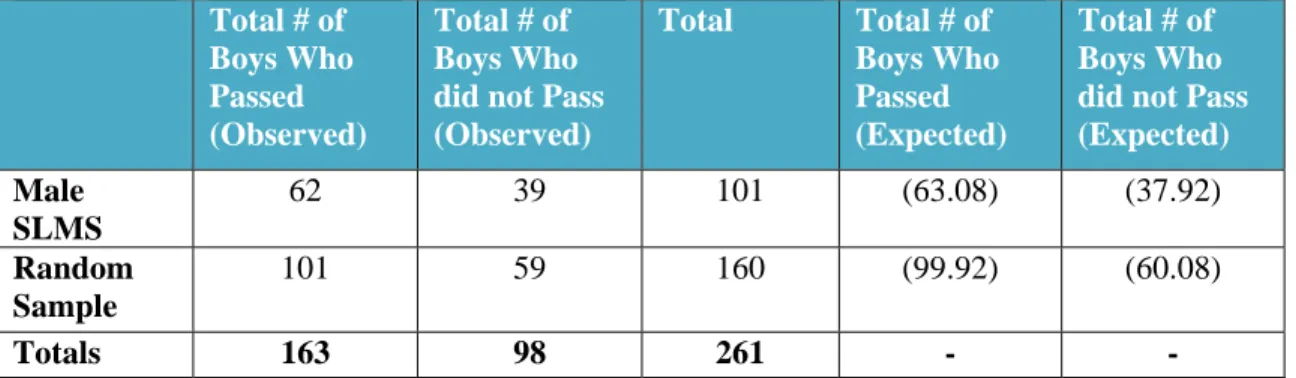
2008-2009 ... 34 Table 10 : Chi-Square Test Results between Male SLMS Schools and Controlled Sample
Schools ... 34 Table 11 : Expected and Observed Totals of 3rd grade Boys involved in Reading Tests in
2008-2009 ... 34 Table 12 : Chi-Square Test Results between Male SLMS Schools and Randomly Sample
List of Figures
Figure 1: Percentage of Boys who Passed Reading and Math End of Year Tests by
School ... 27 Figure 2: Percentage of Boys who Passed Reading and Math End of Year Tests by
School ... 29 Figure 3: Percentage of Boys who Passed Reading and Math End of Year Tests by
School ... 30 Figure 4: Percentage of 4th Grade boys' Reading achievement in Male SLMS Schools . 32 Figure 5: Percentage of 4th Grade boys' Reading achievement in Controlled Schools ... 32 Figure 6 : Percentage of 4th Grade boys' Math achievement in Male SLMS Schools ... 33 Figure 7: Percentage of 4th Grade boys' Math achievement in Controlled Schools ... 33
Chapter 1: Introduction
Librarianship is a career path that has always employed more women than men (Piper and Collamer, 2001). In 2001, the number of women enrolled in ALA accredited master’s degree programs outnumbered men 80.5% to 19.5% (ALISE, 2001). Upon graduation from a library science program, the men and women who were formerly students will enter many different careers within the librarianship profession. Many will become school library media specialists (SLMSs).
According to ALA (2007), there were over 54,000 certified SLMSs in 2000. A mere 8.3% of them were male (ALA, 2006). There are a number of articles that 1) take a closer look at male role models in education, and 2) attempt to explain the absence of male teachers in primary education. These articles cover a wide range of issues. Unfortunately, there is a void where the research documenting male SLMSs should be located. Aside from statistics that show the number of male SLMSs in K-12 education, information about male SLMSs is scarce. This paper attempts to shed light upon the lack of male SLMSs as it relates to their potential to serve as role models in elementary education.
Despite the fact that male SLMSs are a rarity in elementary education, it is not the purpose of this paper to attempt to discuss why, nor to act as a public service
been prepared in order to provoke thought on why male SLMSs might be categorized as the type of male role model that educators, scholars and students have been searching for in elementary education. Scholars have been providing readers with information about the potential benefits of male role models in primary education for some time now. This paper is now asking readers to consider the possible benefits of a male role model who also happens to be the SLMS in elementary schools.
Role models, for the purpose of this paper are not just figures who can potentially raise academic achievement by setting an example. They are people who possess various skills and techniques that another person lacks and who have the ability to teach said person those same skills and techniques through observation and comparison with their own actions (Spiezer, 1981). A sizable portion of the literature describes the elementary male classroom teacher as the primary role model in elementary education. This is due to the earlier mentioned lack of information on male SLMSs. However, it can be argued that much of this literature is transferrable to the male SLMSs because of the duties SLMSs perform that coincide with the duties of a classroom teacher, such as their instructional role in schools. Todd (2002), for example, states that the SLMS’s duties include instruction in addition to facilitating the information search process and promoting intellectual freedom.
Importance of the Topic
race, or ethnicity) role models is based upon these expanded definitions. Unfortunately, the general view of what a role model, especially a gender- or race-based one, should be is cloudy (Allen, 2000). It is, therefore, up to further research to alter the general
perception of male SLMSs so they can be considered and utilized as male role models in elementary education.
While the topic of male SLMSs serving as role models in elementary education is not a heavily researched topic, the lack of research does not constitute a lack of
importance. The call for more male role models as teachers in elementary education has been immense. In addition to that, there is research concerning male librarians and their position as a minority in librarianship. Lastly, there have been a number of studies on male role models, especially in elementary education. This paper intends to explore how male SLMSs might serve as male role models in elementary schools.
Chapter 2: Background
This chapter provides a brief look at four factors that are involved when
considering male SLMSs as role models in elementary education. These include the role of SLMSs in general, school library media centers, elementary education, and role models. This paper aims to get the reader to objectively view the information piece by piece. The section on SLMSs deletes gender from the subtopic and focuses on the skills that all SLMSs are expected to teach and the services that they are expected to provide. The school library media center is the title of the section that focuses on the resources that are offered and what draws students to the school media center. The section on elementary education analyzes the demographic makeup of faculty in today’s elementary schools, and the expectations of the students, including the increased pressure they face. Role models, the final section of this chapter, presents an introductory look at the
literature on role models. The chapter concludes with a discussion that uses these
subtopics to make more sense of the topic that this paper seeks to explore. By looking at these subtopics individually, the chapter aims to provide evidence that suggests that male SLMSs could serve as male role models, and have a positive impact on students, if they were employed in elementary schools.
The school library profession requires SLMSs to perform many roles for the patrons of the media center. Information Power: Building Partnerships for Learning (AASL & AECT, 1998) defines these roles as a teacher, instructional partner,
information specialist and program administrator. Each role has the following duties in order to maintain a quality library media program:
Teacher The SLMS takes part in collaboration efforts with students and other learners in order to teach them how to use resources, provide them with the location of resources and understand the information that the resources have to offer (AASL and AECT, 1998. p. 4)
Instructional Partner The SLMS collaborates with teachers and other instructors in order to show students how information needs relate to curriculum lessons, learning outcomes and various resources (AASL and AECT, 1998, p. 4).
Information Specialist The SLMS provides leadership and expertise in gathering and evaluating quality resources in all different formats (AASL and AECT, 1998, p. 5).
Program Administrator The SLMS defines the policies of the library media program and works to ensure that the library media program lives up to those previously defined standards (AASL and AECT, 1998, p. 5).
of the entire school are represented within the collection of resources and the services offered. This includes students and faculty.
SLMSs are also encouraged to be change agents. This means that they must adapt to the unpredictability of an ever changing environment and either lead the change or help facilitate it (Hughes-Hassell and Harada, 2007). Doing this requires intimate knowledge of the change process and understanding that others who are involved in the process have varying knowledge on the subject of information and change (Oberg, 2009). Preparedness and organization are characteristics that work well for SLMSs, especially those that are considered to be change agents. Constant improvements and adjustments to the library media program can always be made and SLMSs that are change agents
understand this very well.
The fact that SMS are encouraged to be change agents and leaders in schools and education in general suggests that they could be role models to faculty and students. Their various duties and roles within the media center suggest the same.
School Library Media Centers
School library media centers house information. The resources that are found within the school library media center can provide individuals with knowledge they can use to change their lives, knowledge they can use for their own enjoyment, and
had risen 22.7% for school library media centers in the 25th percentile, 12.5% in the 50th percentile and approximately 25% in the 95th percentile (ALA, 2009).
Wiltsee and Yates (1998) list a number of strategies that SLMS can utilize to bring patrons into the school library media center. These strategies include providing pathfinders for research assignments, creating a library website to market the benefits of using the school library media center, utilizing online suggestion boxes, and publishing the student work. Two major themes that reoccur within these strategies are technology and student ownership. The school library media center has the potential to be a place where students and faculty feel connected, part of the library, while maintaining it as the “go to” location for information.
The school library media center can affect its users in significant ways. While the resources should serve the academic needs of the students and teachers, they should also reflect the school’s diverse population and the individual needs of each user. This paper argues that the school library media center is a location that allows its patrons to have the intellectual freedom to locate, gather and learn any form of information, thus making it a location with a significant degree of influence on the minds of its patrons. In other words, because the media center is viewed as a location to learn new information, patrons are predisposed to learning when entering the media center. This point will be revisited in later chapters.
Elementary Education
Teacher diversity has been an issue for a long time in all schools, not just
Fewer than 10% of elementary school teachers are male and minority representation is also less than 10% (Toppo, 2003). There has been a call to encourage more men and minorities to teach in elementary school, however, that call has yet to be answered. At the same time, according to an NEA (2008) article, students are more diverse than ever making up 42% of public schools in 2005. This was an increase of 22% from 1972 (NEA, 2008). NEA (2004) maintains that diversity is a key factor in improving the teaching force in America. Attempts to improve teacher diversity are also suggested as key factors to improving the achievement gap that many schools face.
Despite the lack of diversity in teaching, teachers are more qualified than ever before and students are expected to learn more information earlier and at a higher level. The implementation of the No Child Left Behind (NCLB) legislation in 2002 has caused educators to focus on standardized test scores in order to meet achievement qualifications (Hallinan, 2008). Stipek (2006) argues that never before has so much academic pressure been put on early childhood education. Elementary school students are expected to not only perform well academically, but also socially. The social and academic demands in elementary education can be heavy on students, especially males and minorities.
Role Models
Morrow (2006) concur arguing that much learning is vicarious. That is, it occurs through observing others. Drawing on social cognitive theory, Bandura (1986) argues that a role model is more likely to have an impact on another person if they share similar
characteristics. Thus, in schools, it is important not only to have women teachers, but also to have male and minority teachers to serve as role models for the increasingly diverse population.
Conclusion
A separate overview of these factors was necessary to set the stage for this paper. Understanding the duties and roles of a SLMS helps provide insight into what is involved in the management of a school library media center. Background knowledge on school library media centers is also useful because it describes the type of environment in which students and SLMSs interact so that this paper can later theorize how male SLMSs might serve as role models. The section on elementary education describes the type of
Chapter 3: Literature on Male Role Models
This chapter focuses on the research which looks at male educators and their relationships with elementary aged boys and individuals from single (female) parent households in order to suggest the type of relationship that a male SLMS may have with both groups. However, because there are distinct differences between how male teachers and male SLMS interact with students, the chapter will examine the consulted works that highlight the differences.
The chapter will begin by discussing research that argues that male teachers do not impact the lives of students.
Research that Argues Against Male Teachers as Role Models
teachers” (Gold and Reis, 1982, p. 506). This study is heavily cited in articles that claim that male teachers are not a factor in boys’ achievement.
Warwick and Jatoi (1994) analyzed the relationship between teacher gender and math achievement in Pakistani elementary schools (Warwick & Jatoi, 1994). The study sought to answer two questions that relate to this paper. First, did the gender of the teacher matter when it came to mathematics achievement? Second, if there was a difference in achievement in terms of teacher gender, would the difference only be related to Pakistan or could the issue be generalized to the United States? The study included elementary schools with all boys and all male teachers, schools with all girls and all female teachers, and coed schools in which students were taught by male and female teachers. The study found that boys scored higher on math achievement tests, but the gender of the teacher had no relationship to that achievement. This is similar to the results of other studies outside of Pakistan (e.g. Bricheno and Thornton, 2008; Carrington et al, 2008).
Bricheno and Thornton (2007) studied children’s views of role models. They asked whether or not boys need role models and whether or not children even consider their teachers as role models. Drawing on work done by earlier researchers, Bricheno and Thornton created a questionnaire which asked children to select from a list the people they would look to as role models and what attributes they believe role models must possess. Male and female students from four schools in England participated in the study. The researchers found that relatives were most frequently chosen as role models and teachers were “only” chosen 2.4% of the time. The most frequently selected
The Carrington, Tymms and Merrell (2008) study entitled “Role models, School Improvement and the 'Gender Gap'—Do Men Bring Out the Best in Boys and Women the Best in Girls?” attempted to find out if male teachers really do raise the achievement level of boys. The study consisted of 8,978 children in the 1997/98 academic year in 413 separate classes which were composed of 50.4% boys and 49.6% girls. Of the 413
teachers, 113 were male and 300 were female. The children were assessed in math, science and reading at the 6th grade level. The researchers found that matching the gender of the student to the teacher did not have a distinguishable impact on boys or girls achievement.
Research That Supports Male Teachers as Role Models
Sciarra (1970) analyzed male role models for young children in her dissertation. Drawing on prior research, she hypothesized that the introduction of male role models in the classroom would reduce the peer influence of boys, increase boys’ attendance and interest in school, and reduce aggression in boys’ behaviors. The study consisted of 16 girls and 17 boys in an inner-city daycare center ranging in ages of 3 to 5 years old. The children were divided into 3 groups by their ages and exposed to volunteers serving as male role models for different periods of time. Sciarra did not find a change in boys’ behavior. However, there was evidence that suggested that attendance was positively affected by male role models.
teacher experience. During his interviews, he probed the teachers about their experience as role models. All of the men believed local citizens and parents expected them to serve as role models for children and claimed that role modeling was “part of the work”
referring to their interactions with children from single parent homes and male students. Allan concluded that men in elementary education are male role models by default.
Rice and Goessling (2005) discussed the topic of male special education teachers as male role models in elementary schools in their article entitled “Recruiting and Retaining Male Special Education Teachers”. They argued that boys need male role models in elementary education in order to show boys that men should be interested in academics and to provide boys with a balanced educational experience
Cushman (2008) investigated the call for more male teachers to serve as role models in a study entitled “So what do you want? What principals mean when they say ‘male role model’”. The study explored how elementary school principals thought of male teachers serving as role models. The study consisted of a survey that was sent to 250 random elementary school principals. Cushman found that 94% of male principals and 87% of female principals interviewed agreed with the argument of needing more male role models in elementary schools. Cushman also found that the principals’ reasons for wanting male role models mostly had to do with societal concerns, such as a lack of a male role model in homes (Cushman, 2008).
except two of the interviewees claimed to have a clear idea of what it was to be a male role model. Because of this lack of clarity, the interviewees tended to revert back to traditional explanation of gender roles in order to explain the need for male role models, while expressing their dissatisfaction for that explanation (Sevier and Ashcraft, 2007). Sevier and Ashcraft (2007) claim that while social reforms in the 20th century have changed what a male role model is today, the perceptions concerning male role models has not changed.
Conclusion
This literature review highlighted resources that found that male teachers were important figures as role models in elementary education. The focus of these sources is particularly on elementary aged boys and individuals from single (female) parent households. It also highlighted the research that found that male teachers were no different than female teachers as role models in elementary education. In reviewing the literature that described male teachers as not making a difference as role models, the issue of the differences between a teacher’s interaction with students and a school media specialist’s interaction with students was made apparent. This showed that male teachers are similar to male SLMSs, but also showed that there were some major differences in their interactions with students. Because of this unique interaction with students, the issue of male SLMSs serving as role models in elementary education should be further
Chapter 4: Methodology
Introduction
The articles discussed above demonstrate a lack of consensus on the value of male role models in elementary education. The research conducted for this paper aims to add to the debate by examining whether there is a correlation between male SLMSs as role models and the academic achievement of boys. Although much of the empirical evidence suggested that there is no correlation between male teachers and male student
achievement, there is evidence that reading scores of students rise as the leadership role of the school media specialist increases (Lance, 2000). If this is indeed true, then it may be possible for male SLMSs who also act as role models to have an impact on the academic achievement of boys. This paper uses data provided by public elementary schools in North Carolina to examine this possibility.
Research Questions
The research questions guiding this study are as follows:
1. Does empirical evidence indicate that there is a relationship between male SLMSs who act as role models and the academic achievement of boys?
2. Is academic evidence the correct manner in which to analyze the impact of male role models in elementary education?
4. Is the call for male role models in elementary education based on untrue assumptions?
5. Are there enough male SLMSs in elementary education to provide meaningful interpretations from data?
This paper will explore these questions in an accurate and scholarly manner. Answering these questions will give insight into the hypothesis that the academic achievement of boys is linked to the presence of male SLMSs who serve as role models in elementary schools.
The hypothesis and null hypothesis for this study were as follows:
H1 The academic achievement of boys is linked to male SLMSs serving as role
models in elementary education.
H0 The academic achievement of boys is NOT linked to male SLMSs serving as role
models in elementary education. Research Strategy
The following research strategy was used.
The first step was to choose a state. North Carolina was chosen because it provides a great deal of publically available data on the academic performance of students from the 114 school districts in the state. As of 2000, North Carolina employed 1,676 certified media specialists (BLS, 2007).
of http://www.randomizer.org, this online random number generator was used to generate 10 numbers between and including 1 and 114. The numbers that were generated were, 76, 3, 49, 15, 92, 94, 44, 64, 114 and 101. These generated numbers represented school districts that were scattered all over the state of North Carolina.
Once the school districts were randomly selected, all of the elementary schools in those districts, 69 in total, were researched to find out whether the SLMS was male or female. Upon researching the gender of the SLMSs in all of the schools, a major problem occurred. There was only evidence of one male SLMS in the sample. Because the study was looking at the achievement of elementary school boys that have a male SLMS in their school, more male SLMSs were needed. This required an additional sampling technique. The next sampling technique used was the snowball sample technique. The sole male SLMS was contacted and asked if he knew of other elementary male SLMSs in the state. He provided the names of two other schools that had male SLMSs, bringing the total number of male SLMSs to three. The schools at which these SLMSs were
employed became part of the study sample.
To select the “random” schools, another spreadsheet was created which contained the names of all of the elementary schools in North Carolina that were either
pre-kindergarten to fifth grade or pre-kindergarten to sixth grade; the total number was 1,271. The simple random sample generator was used again to come up with three “random” elementary schools. The generated numbers were 724, 757 and 1190. Each of these schools had a female SLMS
To select the schools with similar attributes, labeled “the control schools”, the list of elementary schools was reviewed. As stated above, three schools were chosen based on certain attributes such as the number of teachers with advanced degrees, the
demographics of the student population, the rural or urban location of the school, the percentage of economically disadvantaged students, and the school’s performance designation. Performance designation is the label that North Carolina assigns to schools depending on the percentage of students who have passed the end of year tests. Those labels include honor school of excellence, school of excellence, school of distinction, school of progress, most improved school, no recognition, priority school and low performing school.
Now the sample had been selected, the following data was gathered for each of the nine schools in the sample:
2. Data describing the geographical area in which the school was located. This data was gathered from the U.S. Census Bureau.
The Research
The nine schools that comprised the sample were divided into three categories. They were titled “Male SLMSs Schools”, “Random Sampled Schools”, and “Controlled Schools”. Table 1 shows how the specific schools in each category will be indentified.
# Male SLMSs Schools Controlled Schools Random Sampled Schools
1 Red School Green School Yellow School
2 Blue School Gray School Pink School
3 Brown School Orange School Black School Table 1: List of Sampled Elementary Schools
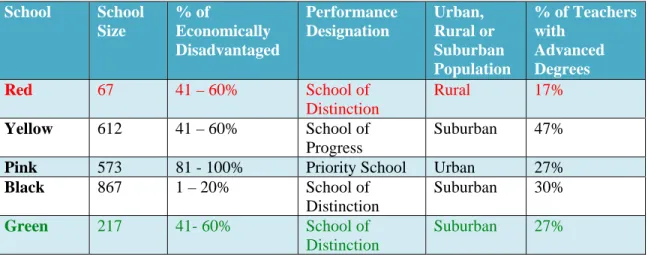
Red School Compared with the School That Shares Similar Attributes (Green
School) and the Three Schools in the Random Sample:
School School Size % of Economically Disadvantaged Performance Designation Urban, Rural or Suburban Population
% of Teachers with
Advanced Degrees
Red 67 41 – 60% School of
Distinction
Rural 17%
Yellow 612 41 – 60% School of Progress
Suburban 47% Pink 573 81 - 100% Priority School Urban 27%
Black 867 1 – 20% School of
Distinction
Suburban 30%
Green 217 41- 60% School of
Distinction
Suburban 27%
Table 2 : Demographic Data for the 2008-2009 School Year
0 10 20 30 40 50 60 70 80 90 100
2006‐2007 2007‐2008 2008‐2009 Red Yellow Pink Black Green
School % Change from 2006-2007 to 2007-2008
% Change from 2007-2008 to 2008-2009
Red -14.3% +22.4%
Yellow -24.4% +11.9%
Pink -5.6% +9.3%
Black -14.6% +11.8%
Green -23.1% 18.1%
Table 3: Percent Change of Passing Test Scores in Boys Achievement in Reading and Math
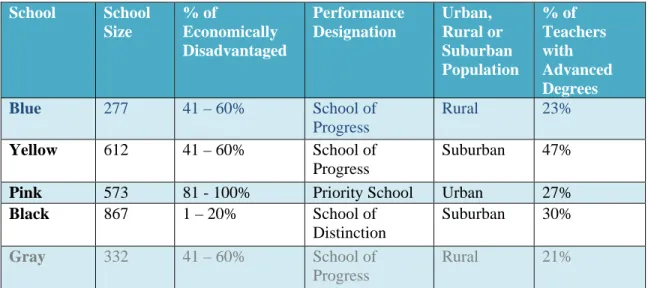
Blue School Compared with the School That Shares Similar Attributes (Gray
School) and the Three Schools in the Random Sample:
School School Size % of Economically Disadvantaged Performance Designation Urban, Rural or Suburban Population % of Teachers with Advanced Degrees Blue 277 41 – 60% School of
Progress
Rural 23%
Yellow 612 41 – 60% School of Progress
Suburban 47%
Pink 573 81 - 100% Priority School Urban 27%
Black 867 1 – 20% School of
Distinction
Suburban 30%
Gray 332 41 – 60% School of Progress
Rural 21%
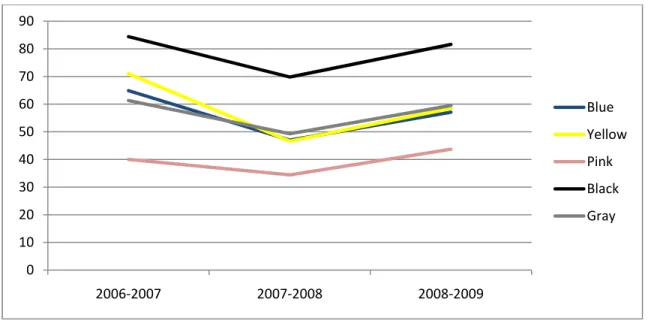
0 10 20 30 40 50 60 70 80 90
2006‐2007 2007‐2008 2008‐2009
Blue
Yellow
Pink
Black
Gray
Figure 2: Percentage of Boys who Passed Reading and Math End of Year Tests by School
School % Change from 2006-2007 to 2007-2008
% Change from 2007-2008 to 2008-2009
Blue -12.1% +10.1%
Yellow -24.4% +11.9%
Pink -5.6% +9.3%
Black -14.6% +11.8%
Gray -10.2% 12%
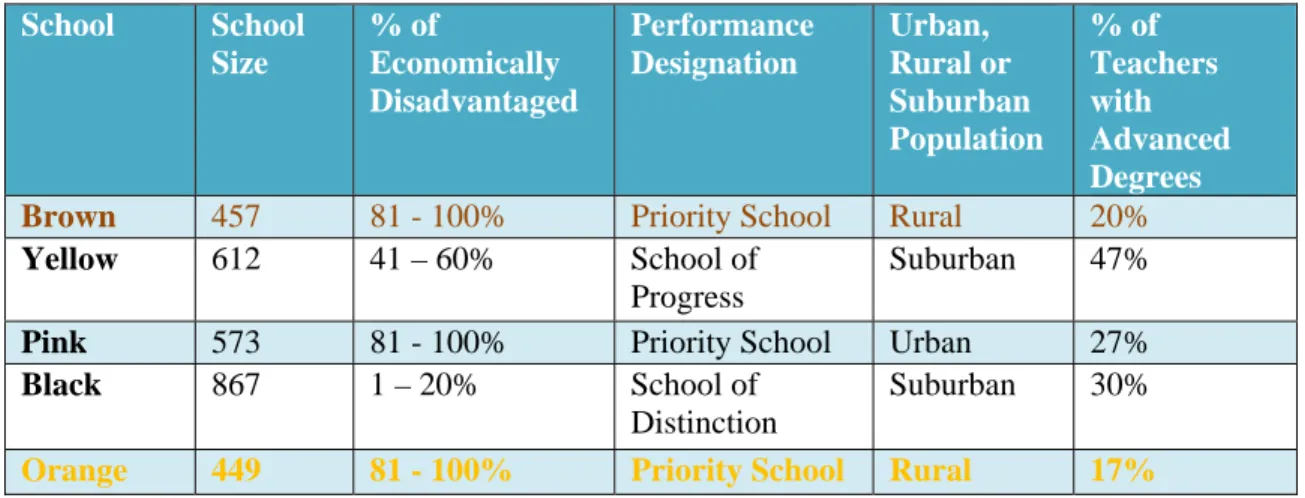
Brown School Compared with the School That Shares Similar Attributes (Orange
School) and the Three Schools in the Random Sample:
School School Size % of Economically Disadvantaged Performance Designation Urban, Rural or Suburban Population % of Teachers with Advanced Degrees
Brown 457 81 - 100% Priority School Rural 20%
Yellow 612 41 – 60% School of Progress
Suburban 47% Pink 573 81 - 100% Priority School Urban 27%
Black 867 1 – 20% School of
Distinction
Suburban 30%
Orange 449 81 - 100% Priority School Rural 17%
Table 6 : Comparison of Brown School with the Random Sampled Schools and the Controlled Sample in 2008-2009 School Year
0 10 20 30 40 50 60 70 80 90
2006‐2007 2007‐2008 2008‐2009
Brown
Yellow
Pink
Black
Orange
School % Change from 2006-2007 to 2007-2008
% Change from 2007-2008 to 2008-2009
Brown -23% +17.1%
Yellow -24.4% +11.9%
Pink -5.6% +9.3%
Black -14.6% +11.8%
Orange -5.6% 11.1%
Table 7 : Percent Change of Passing Test Scores in Boys Achievement in Reading and Math
The following tables and figures compare the reading and math achievement data for all of the schools in the sample.
School % of boys who passed the Reading and Math End of Year Test
% of boys who passed the Reading and Math End of Year Test in the
District
% Difference in change between the school and
district % Difference in change between the school and state
Red 86.7% 76.5% +10.2% 25.2%
Blue 57.1% 64.3% - 7.2% -4.4%
Brown 42.1% 57.9% -15.8% -19.4%
Green 83.1% 67.7% +15.4% +21.6%
Grey 59.5% 54.3% +5.2% -2%
Orange 40.7% 35.7% +5% -20.8%
Yellow 58.5% 68.1% -9.6% -3%
Pink 43.7% 60.6% -16.9 -17.8%
Black 81.6% 60.6% +21% +20.1%
Table 8 : Percent difference in boys' Reading and Math achievement when compared to the district and state in the 2008-2009 school year
0 10 20 30 40 50 60 70 80 90 100
2006‐2007 2007‐2008 2008‐2009
Red
Blue
Brown
Figure 4: Percentage of 4th Grade boys' Reading achievement in Male SLMS Schools
*Red School did not have enough students to create accurate data for the 2008-2009 school year*
0 10 20 30 40 50 60 70 80 90 100
2006‐2007 2007‐2008 2008‐2009
Green
Gray
Orange
0 10 20 30 40 50 60 70 80 90 100
2006‐2007 2007‐2008 2008‐2009
Red
Blue
Brown
Figure 6 : Percentage of 4th Grade boys' Math achievement in Male SLMS Schools
*Red School did not have enough students to create accurate data for the 2008-2009 school year*
0 10 20 30 40 50 60 70 80 90
2006‐2007 2007‐2008 2008‐2009 100
Green
Gray
Orange
Total # of Boys Who Passed (Observed)
Total # of Boys Who did not Pass (Observed)
Total Total # of Boys Who Passed (Expected)
Total # of Boys Who did not Pass (Expected)
Male SLMS 62 39 101 (60.90) (40.10)
Controlled Sample
61 42 103 (62.10) (40.90)
Totals 123 81 204 - -
Table 9 : Expected and Observed Totals of 3rd grade Boys involved in Reading Tests in 2008-2009
x2 Degrees of Freedom P - Value
Passing Students 0.039 1 .8428
Non-Passing Students
0.060 1 .8069
Table 10 : Chi-Square Test Results between Male SLMS Schools and Controlled Sample Schools
Total # of Boys Who Passed (Observed)
Total # of Boys Who did not Pass (Observed)
Total Total # of Boys Who Passed (Expected)
Total # of Boys Who did not Pass (Expected)
Male SLMS
62 39 101 (63.08) (37.92)
Random Sample
101 59 160 (99.92) (60.08)
Totals 163 98 261 - -
Table 11 : Expected and Observed Totals of 3rd grade Boys involved in Reading Tests in 2008-2009
Table 12 : Chi-Square Test Results between Male SLMS Schools and Randomly Sample Schools x2 Degrees of Freedom P – Value
Passing Students 0.030 1 .8621
Non-Passing Students
Chapter 5: Results
Findings and Analysis
The hypothesis and null hypothesis for this study were as follows:
H1 The academic achievement of boys is linked to male SLMS serving as role
models in elementary education.
H0 The academic achievement of boys is NOT linked to male SLMS serving
as role models in elementary education.
The results suggest that the data compared between the schools with male SLMSs and the randomly sampled schools or controlled sample schools are not statistically significant. However, comparing the data visually in graphs and tables suggests some differences that are worth noting. An example of this is when the three male SLMS schools were analyzed by male achievement in Reading and Math separately from each other but compared to each of the randomly sampled schools and the one controlled sample school that had the similar characteristics. These figures are located on Table 3, Table 5 and Table 7. When those schools were compared, 2 of the 3 schools with male SLMSs had the highest positive changes in test score pass percentage for boys from the 2007-2008 to 2008-2009 school year. The only school that had a male SLMS that did not have the highest percent change in test score pass percentage was the blue school.
change in percentage by 1.9%. The red school was at the top at a 22.4% change and higher than the next school it was compared to by 4.3%. The brown school also had the highest positive change of the schools it was compared to at 17.1%, which was 5.2% higher than any other positive change that it was compared to.
The boys’ test passing percentage of every school in every sample was also compared to their respective districts in order to see if all the male SLMS schools boasted passing percentages that were higher than the passing percentages of the district in
Reading and Math. In doing this, there did not seem to be a relationship between the male SLMS schools and the percentages of the district. Two male SLMSs schools were below the district average. This suggests that there are other factors that may cause a particular schools’ passing average to be below or above the district average.
The Reading and Math scores of the male SLMSs schools and controlled sample schools were graphed separately. In each subject, the test passing percentages of the male SLMS schools rose higher than their controlled sample counterparts from the 2007-2008 to 2008-2009 school year. The only exception was the red school because they could not provide the data for 2008-2009 in Reading or Math due to fact that fewer than 5 boys took the test.
passing or not passing in the male SLMS schools were not significant when compared with the randomly sampled schools. Passing tests corresponded to P=.8621 and not passing tests corresponded to P=.8228. This data suggests that passing or not passing the achievement tests and having a male SLMS were not significant.
Due to the results of the chi-squared test which does not reveal any significance between male SLMS and boys’ achievement in elementary schools, it must be noted that the null hypothesis in this study remains valid and cannot be rejected:
H0 The academic achievement of boys is NOT linked to male SLMS serving
as role models in elementary education.
Chapter 6: Discussion
The discussion of male SLMSs serving as role models in elementary education has gotten even cloudier as the findings and results of this study were provided in the last chapter. When looking at the graphs and tables that display the percentage of students who passed Reading and Math in all three samples, compared separately or compared in just Reading or just Math a relationship between male SLMSS and boys achievement seems plausible. However, the chi-square test suggests the opposite, which resulted in failing to reject the null hypothesis.
because it showed how male elementary teachers felt that they were perceived, even believing that they automatically need to serve as male role models. This study could be easily transferred to school librarianship. However, most things need to have a
Chapter 7: Conclusion
Limitations of the Study
This paper is no exception to the fact that all studies have a margin of error. Some are consequences of the study and others are uncontrollable. This paper contains
limitations that fit into both categories.
Further Research
Research on male school media specialists as role models in elementary education has never been done. This paper attempts to give underrepresented members of a
challenging and rewarding profession a voice in the world of academia. There is not much research on school media specialists in general. That number takes a sharp decline when the terms “men”, “male” or “males” are included in the search query. Can male SLMS serve as role models in elementary education? That is a question that requires more than just one study to answer. There are so many directions that this study could have taken. These directions may even lead to some significant discoveries. Academic achievement and male role models was just one of the roads that could have been taken. Further research could provide an alternate view of the social implications of male SLMSs as role models. Additional qualitative research can attempt to measure qualities, feelings and understandings, qualities that cannot necessarily be measured with
quantitative research. The probability of forging into new territory is highly likely. The view of male role models in elementary education is a very interesting issue, but bringing male SLMSs into the argument makes it intriguing. This is because the view of male role models in terms of masculinity and the perceptions and stereotypes that are attached to male librarians in general and males in elementary education. Articles have been looking into the “types” of male librarians for years, but not one has considered the male librarian a “male role model”. Further research on this issue could not only demolish the
intact and feelings are never expressed. Male SLMS in elementary education may be small in number, but their potential impact might not be. The only way we will know is through additional research.
Future qualitative research on this subject could reveal non-measurable impacts that the male SLMS makes. Interviews of male SLMSs on the elementary level could provide some intriguing insight on male role models from their point of view, as the Allan (1995) study did with male elementary school teachers. Surveys for male SLMSs, elementary aged boys, or school administration could also produce some interesting thoughts on male SLMSs serving as role models that may not necessarily be measured quantitatively. Also, observing the interaction between male SLMSs and their male students could be a useful tool in defining the type of impact that male SLMSs make on young male students.
Final Conclusion
This research paper began as informational literature. Then, it transformed into a comparison of scholarly literature. Later, it became a study of an underrepresented population. Now, it has become a persuasive essay in order for others to see the importance of this topic. The results may not have yielded statistical significance, but they do provoke thought. Questions of whether a larger sample would have provided similar results arise. So do questions of why the visual data does seem noteworthy. The limitations provide a way for readers to assess the paper, possibly creating a more accurate and overall better study to take its place. The paper introduced the idea of male SLMS as role models who affect the achievement of boys. It did not prove that idea wrong, but it brought forth another idea that maybe the advantages of male role models for boys cannot be measured quantitatively. The call for male role models in elementary education has been said to be merely assumed and not proven (Carrington, Tymms and Merrell, 2008). Providing studies that suggested that male teachers do not make a difference in the achievement of children did not close the male role model argument in elementary education because a male role model may be much more than a link to
achievement. However, this literature did not stop the paper from going in that direction. This is because SLMSS and media centers are also linked to achievement. It is arguable that the link between the school media specialist, media center and achievement validated school libraries everywhere. The goal of this paper was to validate male SLMSs
everywhere by linking their ability to be male role models to boys’ academic
made and that link has not been destroyed. Rather, the link between male SLMSs and boys achievement just may not be in that exact location.
In closing, male SLMSs in elementary education identify few individuals. However, these few are serving as role models in elementary education. An important factor that was learned in the research of this topic is that male role models do not have a universally accepted definition. Though this was mentioned earlier in the literature review, the lack of a common definition makes many studies done on role models an opinion. In attempting to establish a link between boys’ achievement and male SLMSs, this study partially conforms to the recent opinion that male role models need to
Works Cited
Association for Library and Information Science Education. (2001).Library and
information science education statistical report 2002. Retrieved October 15, 2009 from http://ils.unc.edu/ALISE/2002/Students/Table%20II-1-a-1.htm
Allan, Jim. (1994). Anomaly as Exemplar: The Meanings of Role-Modeling for Men Elementary Teachers, Iowa.
Allen, A. (1995). The role model argument and faculty diversity. The Affirmative Action Debate. New York: Routledge, 121-134.
American Library Association. (1998). Racial and ethnic diversity among librarians: a status report. ALA.org. Retrieved October 30, 2009
from http://www.ala.org/ala/research/librarystaffstats/diversity/racialethnic.cfm American Library Association. (2006). Librarians, library technicians and assistants:
diversity profile 2000 and 1990, library employees living in same sex partner households, first look from the American community survey. ALA.org. Retrieved October 15, 2009
from http://www.ala.org/ala/aboutala/offices/diversity/diversitycounts/aladiversity .pdf
American Library Association. (2007). Diversity counts. ALA.org. Retrieved October 15, 2009
from http://www.ala.org/ala/aboutala/offices/diversity/diversitycounts/diversityco unts_rev0.pdf
American Association of School Librarians and Association for Educational
Communications and Technology (AASL & AECT). (1998). Information power: Building partnerships for learning. Chicago: American Library Association. Bandura, A. (1986). Social foundations of thought and action: a social cognitive theory.
Prentice-Hall: Englewood Cliffs, NJ.
Bureau of Labor Statistics. (2007). Occupational Outlook Handbook, 2008-09 Edition, Librarians. Retrieved October 30, 2009
Bricheno, P. and Thornton, M. (2007). Role model, hero or champion? Children’s views concerning role models. Educational Research, 49(4), 383-396.
Carrington, B., Tymms, P. and Merrell, C. (2008). Role models, school improvement and the ‘gender gap’: do men bring out the best in boys and women in girls?, paper presented to the EARLI 2005 conference, University of Nicosia.
Cushman, P. (2008). So what exactly do you want? What principals mean when they say 'male role model'. Gender & Education, 20, 123-136.
Gold, D. and Reis, M. (1982) Male teacher effects on young children: a theoretical and empirical consideration, Sex Roles, 8(5), 493–513.
Gustafson, K.L. and Smith, J.B. (1994) Research for school library media specialists. Ablex Publishing Corporation: Norwood, NJ.
Hallinan, M.T. (2008). Teacher Influences on Students' Attachment to School. Sociology of Education,81(3), 271-283.
Hughes-Hassell, S., & Harada, V. H. (2007). School reform and the school library media specialist. Westport, CT: Libraries Unlimited.
Hutchings, M., B. Carrington, B. Francis, C. Skelton, B. Read, and I. Hall. (2008). Nice and kind, smart and funny: What children like and want to emulate in their teachers. OxfordReview of Education,34(2), 135–57.
Martino, W. (2008). Male teachers as role models: Addressing issues of masculinity, pedagogy and the re-masculinization of schooling. Curriculum Inquiry 38( 2), 189–223.
National Education Association. (2004). Assessment of Diversity in America’s Teaching Force. NEA.org. Retrieved October 24, 2009
from http://www.nea.org/assets/docs/diversityreport.pdf
National Education Association. (2008). Promoting educators’ cultural competence to better serve culturally diverse students. NEA.org. Retrieved October 24, 2009 from http://www.nea.org/assets/docs/mf_PB13_CulturalCompetence.pdf
Oberg, D. (2009). Libraries in schools: essential contexts for studying organizational change and culture. Library Trends. 58(1). 9-25.
Piper, P.S. and Colamer, B. (2001). Male librarians: men in a feminized profession. Journal of Academic Librarianship, 27 (5), 406-411.
teachers. Remedial and Special Education, 26(6), 347-356.
Sciarra, D. J.(1970). A study of the effects of male role models on children's behavior in a day care center. Unpublished doctoral dissertation, University of Cincinnati. Sevier, B. and Ashcraft, C. (2007). Be Careful What You Ask For: Exploring the
Confusion around and Usefulness of the Male Teacher as Male Role Model Discourse. Men and Masculinities, 10(0): 1-25
Speizer, J. J. (1981). Role models, mentors, and sponsors: The elusive concepts. Signs: Journal of Women in Culture and Society, 6, 692-712.
Steiner, S.F. (2000). Where have all the men gone? male role models in the reading crisis. PLNA Quarterly.
Stipek, D.J. (2006). No Child Left Behind comes to preschool. Elementary School Journal, 106, 455-465.
Todd, R.J., and Kuhlthau, C.C. (2005). Student learning through Ohio school libraries part 2. Columbus, OH: Ohio Educational Library Media Association. Retrieved October 21, 2009,
from http://webfiles.rbe.sk.ca/rps/terrance.pon/OELMAReportofFindings.pdf Toppo, G. (2003). The face of the american teacher: White and female while her students
are ethnically diverse. USA Today. Retrieved October 24, 2009
from https://www.teachforamerica.org/assets/documents/070203_USAToday_Fac eOfAmericanTeacher.pdf
Warwick, D.P. and Jatoi, H. (1994). Teacher gender and student achievement in Pakistan. Comparative Education Review, 38(3), 377-399.