November 2005. 34 pages. Advisor: Deborah Barreau
This study explores the perceptions that information technology (IT) professionals have of optimizing end user involvement during application development. The Discovery IT staff at GlaxoSmithKline is studied. Using seven distinct stages of systems development, the study is able to make precise conclusions about the selection, timing, and degree of end user involvement. It was found that involving intelligent end users early on in the development process is beneficial, creating only limited drawbacks.
Headings:
End User Involvement Optimization
End Users in the System Development Life Cycle Information Technology
by
Timothy M Farris
A Master’s paper submitted to the faculty of the School of Information and Library Science of the University of North Carolina at Chapel Hill
in partial fulfillment of the requirements for the degree of Master of Science in
Information Science.
Chapel Hill, North Carolina November 2005
Approved by
Table of Contents
LIST OF FIGURES ... 3
INTRODUCTION... 4
OVERVIEW... 4
CURRENT PROBLEM... 4
PURPOSE... 5
RESEARCH QUESTION... 5
DEFINITION OF TERMS... 6
BACKGROUND ... 7
END USER PARTICIPATION... 7
ITSTAFF AND END USER COOPERATION... 7
END USER SELECTION... 8
CHANGING ECONOMIC TIMES... 9
EVOLVING DESIGN APPROACHES... 9
MODERN SYSTEMS ANALYSIS AND DESIGN... 10
METHODOLOGY ... 11
PARTICIPANTS... 11
DATA COLLECTION METHOD... 11
SURVEY... 12
A BREAKDOWN OF THE SURVEY QUESTIONS... 12
RESULTS ... 16
POPULATION DISCOVERY... 16
INVOLVEMENT TIMING... 16
INVOLVEMENT AND PROJECT COMPLETION... 18
USER SELECTION... 19
INVOLVEMENT BENEFIT... 20
DISCUSSION ... 22
STRATEGY AND TOOLS... 22
THE STRATEGY:THE HOW AND WHEN OF OPTIMIZING INVOLVEMENT... 22
THE TOOLS:BUILDING THE PERFECT USER... 22
BETTER AND FASTER DEVELOPMENT... 23
ISSUES WITH INVOLVING USERS... 23
CONCLUSIONS ... 25
REFERENCES... 27
BIBLIOGRAPHY ... 29
APPENDIX A: SURVEY COVER SHEET ... 30
List of Figures
Introduction
Overview
As information technology (IT) professionals, our primary goal is to serve our clients, the end users. They are the individuals who carry out the competitive advantage that an organization leverages to perform a service or produce a good for profit. The understanding of the needs of end users is essential so that the IT staff is able to provide them with first class applications and support.
This study will explore the perception that IT personnel have of end users during the development process. Through a qualitative study of IT staffers at the pharmaceutical company GlaxoSmithKline (GSK), this study will aim to provide a guideline for the better understanding of how to involve end users during application development.
This study is unique because it addresses how IT professionals perceive end user involvement during development rather than the views of management or end users. Although management and end users may have their own
perceptions about involvement during the development process, it is necessary to understand what the IT staff believe because they are responsible for bringing systems to fruition (Peffers, Gelner, and Tuure, 2001).
Current Problem
The understanding by IT professionals of how end users fit into the
important than ever. Refining system development strategies has become essential to enhance the chances of success (Saleem, 1994).
Purpose
The purpose of this study is to explore the perceptions that IT
professionals at GlaxoSmithKline have of end users’ involvement during systems development. A greater understanding of the timing, degree, and selection of end users during development is sought through a survey of IT professionals.
Analysis of the survey data may lead to conclusions that will aim to contribute to general knowledge that can be applied to organizations other than
GlaxoSmithKline.
This study is rooted in experiences that the researcher had during a co-op position with GSK. During his tenure there, he had experiences as a developer, designer, tester, and analyst. These different experiences helped him to build a perspective of the end user in the eyes of the information technology staff. This study builds on that perspective to achieve a greater understanding of what end users need in the eyes of IT staff.
Research Question
Definition of Terms
The following definition of terms will clarify how each will be used in terms of this study.
IT professionals are the individuals who create systems applications to further
business processes.
End users are the individuals who use the systems applications that are created by
one or a group of IT professionals.
Systems development is the process of bringing a system to life.
The stages in the process are called the systems development life cycle (SDLC).
The stages of the SDLC are: project identification and selection, project initiation and planning, analysis, logical design, physical design, implementation, and maintenance.
Interaction is involvement during the systems development process.
Perception is the unique view that an IT professional has of the end user during
Background
End User Participation
End user participation is considered a key ingredient for system success in an organization (Saleem, 1994). It is imperative that end users provide their systems use expertise in active ways to ensure that the process of
implementing a system goes through in a timely manner (Hoffer, George, and Valacich, 2002). Progress has been made in understanding how user adopt systems, but little is known about what factors influence user attitudes towards IT services development (Xia and Lee, 2000)
Many researchers argue that the relationship between user participation and successful systems development is neither grounded nor substantiated by research data (Butler and Fitzgerald, 1997). Brancheau and Brown (1993) define how end users fit into the development equation, stressing that it is a combination of tying together management action, strategy, and end user actions in the
development process.
IT Staff and End User Cooperation
Some of the most serious constraints on the development of computer-based systems are not technical in nature (Lucas, 1971). The proper development and use of systems has been inhibited by the inability of computer professionals and users to cooperate effectively. The work of the IT staff has the potential to transpose individual and organizational welfare for the better through increased productivity and effectiveness of daily activities (Shayo and Igbaria, 2003).
must be involved with the IT staff in the process of locating, retrieving, and assembling software into a particular environment (Hoek and Wolf, 2003). Addressing the issue of software development management and how to manage the release of the software, Hoek and Wolf (2003) iterate the definitive need for IT staff to properly stage end users in the development process. A well designed system will encourage cooperation between users and the IT department (Lucas, 1971).
A study by Robey, Ross, and Boudreau (2002) showcases the need to improve the management of incorporating users into the work processes created by new systems. Their case study reviewed the development and implementation of Enterprise Resource Planning (ERP) systems in 13 industrial firms. The study revealed that users encountered difficulty in using new systems and incorporating the new work process that the system created into their daily routine. “Consulting relationships” between the two groups helped to overcome the assimilation
barriers of new processes (Robey, Ross, Boudreau, 2002). The need for end user interaction is established, but the level and timing is yet to be determined.
End User Selection
Finding the right end user is essential. Carefully selecting from the end user population will ensure that the needs of all individuals are met (Wilson et al., 1997). Users possess the necessary system related functional expertise that will determine how a system is created and used (Saleem, 1994). Earlier studies by Wilson et al. (1997) show that selecting representatives from the end user
should be a cross-section of users that will accurately represent the needs of individuals on every level, not just the needs of the senior most “super users” (Wilson, et al., 1997).
The study by Harris (1999) of the redesign of the Information Services department at a major health science institution supports this, noting that the IT staff dealt most with power users. Power users tend to be the most literate group among the users in terms of system usage and knowledge of what additional components a system needs. Power users are not often the best representatives of the group. Finding the right end users will ultimately lead the creation of systems that increase the literacy level of overall user population (Harris, 2003).
Changing Economic Times
Josefek and Kauffman (2003) discuss how the changing economic
landscape necessitates need for greater understanding of how IT processes fit into an organization. With the shift towards a truly global economy, organizations must streamline every aspect of the business to stay afloat. Incorporating the human capital theory, Josefek and Kauffman (2003) emphasize that a better understanding of the people factor will lead to more efficient information systems because the quality of the human capital creating the systems is higher.
Evolving Design Approaches
the design approaches. In an early age of computing, Lucas understood the need of an improved design methodology to increase the probability of developing successful computer systems.
In the present day, systems development has woven its way into the social fabric of organizations (Butler and Fitzgerald, 1997). Butler and Fitzgerald point out that development has become institutionalized in a sense, an integral
dimension of an organization’s culture. Systems development has evolved into explicit policies and structures within organizations. The dimension of the user in these policies and structures calls for further analysis as the views of individuals evolve with IT innovation (Xia and Lee, 2000).
Modern Systems Analysis and Design
For the purpose of this study, the modern systems development life cycle will be considered because of its clearly defined stages. There is an evolution away from these clearly defined stages and how the user fits into the new
development picture. The traditional waterfall method of one stage following and building upon the previous one no longer applies.
Methodology
Participants
To determine IT staff perceptions about what level of end user
involvement produces the most effective application development, access to the Discovery IT section of the Research and Development Department within GlaxoSmithKline was leveraged. Discovery IT is a specialized information technology support and development group. This group consists of system designers, testers, developers, data analysts and business analysts that provide IT goods and services to drug discovery scientists world wide. Discovery IT is constantly in the process of developing applications for their users, therefore they were an excellent group for collecting data concerning when and at what level end users should be involved during development.
Data Collection Method
Data were collected via an anonymous nine question survey (see
Appendix B). Accompanying the survey was a cover sheet (see Appendix A) that explains the purpose of the survey to the participants and their rights. The study, survey, and cover sheet were formally approved by the Academic Affairs
Institutional Review Board (AA-IRB) to ensure that the rights of the participants were protected.
Discovery IT group. She provided access to GlaxoSmithKline and the required security clearances.
Twenty-six surveys were distributed. A locked collection box was put outside of the office door of Ms. Leslie for 24 hours in order for the surveys to be returned at the convenience of the participant. The lock box was collected on October 19, 2005.
Survey
The survey (see Appendix B) consists of nine questions that are a mix of nominal, interval, ratio, open ended and mixed questions. The survey was
designed to assess perceptions of the Discovery IT team about involving end users during application development.
A breakdown of the survey questions
Question #: 1
Question: Which title/position best describes your role with GlaxoSmithKline? Response Choices: A. Developer B. Help Desk/Support C. Designer D.
Tester E. Analyst
Reason for question: To classify the survey respondents into general groups within the IT department in order to assess if attitudes differ by role. Results Category: Population Discovery
Question #: 2
Response Choices: A. 0-25% B. 26-50% C. 51-75% D. 76-100%
Reason for question: To see what percentage of projects the respondents view are necessary to have end users involved.
Results Category: Involvement Timing
Question #: 3
Question: In terms of number of users, what was the size of your last project? Response Choices: User response (open ended).
Reason for question: To identify the range of the project sizes that the Discovery IT group manages.
Results Category: Population Discovery
Question #: 4
Question: During which stages of application development do you perceive that end user involvement is necessary?
Response Choices: (Check all that apply):
A. Project Identification and Selection B. Project Initiation and Planning C. Analysis
D. Logical Design E. Physical Design F. Implementation G. Maintenance
Reason for question: To find all the stages of development that the Discovery IT staff perceives as necessary to have end user involved.
Question #: 5
Question: During which one stage of application development do you perceive that end user involvement is most necessary?
Response Choices: (Choose one :)
H. Project Identification and Selection I. Project Initiation and Planning J. Analysis
K. Logical Design L. Physical Design M. Implementation N. Maintenance
Reason for question: To determine which one stage is viewed as the most important to have end users involved.
Results Category: Involvement and Project Completion
Question #: 6
Question: Do you perceive that project completion time is faster when end users are involved?
Response Choices: A. Yes B. No
Reason for question: To ask the IT staff if they feel that their development projects are completed faster when end users are involved.
Results Category: Involvement Level Question #: 7
Response Choices: A. Yes B. No Also, if the person answers yes, they are asked to elaborate. Lines to write on provided.
Reason for question: The reason for this is to find the point when the IT staff feels that end user involvement hinders the development process.
Results Category: Involvement Level
Question #: 8
Question: How do you select end users to be involved in development? Response Choices: User response (open ended).
Reason for question: This question is to determine the selection criteria that the IT staff uses for selecting end users for involvement.
Results Category: User Selection
Question #: 9
Question: What is the most important benefit that you see when involving end users in the development process?
Response Choices:
A. Faster project completion
B. Greater understanding of application usage C. Provide greater reliability of system functions
D. Increased awareness of end user needs for other projects
Reason for question: To find the most important benefit that the IT staff perceives when end users are involved.
Results
Population Discovery
Of the twenty six surveys distributed, seventeen were returned. According to question one of the survey to determine the job functions of the population, respondents consisted of six developers, five analysts, three support agents, two testers, and one designer. One of the respondents indicated after the first question that she was too new to the job to answer anything about end users in the
development process. For the purpose of analyzing the rest of the surveys, only the remaining sixteen surveys were considered.
The project sizes of the IT staff varied greatly. Project size was measured in terms of the number of users involved. Small projects were considered 1-10 users, medium projects 11-1000 users, and a large project was 1000+ users. Three people worked on small projects, 8 on medium projects, and 5 on large projects.
Involvement Timing
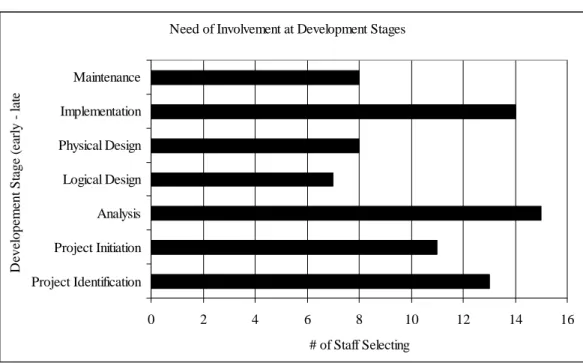
The Discovery IT staff returned that users should be involved in all stages of development (Figure 1). Implementation, analysis, project initiation, and project identification led the survey, with fourteen, fifteen, eleven, and thirteen members of the staff noting the need for end user involvement, respectively. The other stages of maintenance, physical design, and logical design were also
Figure 1. Need of Involvement at Development Stages
Need of Involvement at Development Stages
0 2 4 6 8 10 12 14 1
Project Identification Project Initiation Analysis Logical Design Physical Design Implementation Maintenance D ev el o p em en t S tag e ( ear ly l at 6 e
# of Staff Selecting
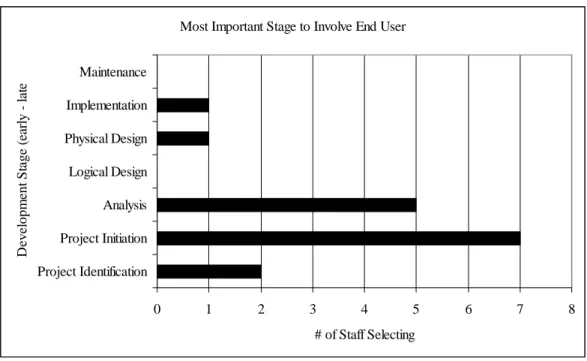
Figure 2. Most Important Stage to Involve End User
Most Important Stage to Involve End User
0 1 2 3 4 5 6 7 8
Project Identification Project Initiation Analysis Logical Design Physical Design Implementation Maintenance D evel o p m en t S ta g e ( ear ly l at e
# of Staff Selecting
By selecting the need for user involvement at project initiation as the most important stage, the staff perceives that end users should be involved early on in the development process, most notably in the project identification, project initiation and analysis stages. The staff also views that it is important to involve the end user in the implementation stage, which can be seen from its high selection in Figure 1 and selection in Figure 2.
Involvement and Project Completion
Ten of the surveys indicated “No.” Five of the remaining six that responded “Yes” stated that scope creep was the biggest hindrance that they encountered. It was noted that additional requirements were often asked for during development, but these additions would usually bring minimal return for the effort it took to fulfill the requirement. One staff member added that the cause for the scope creep was the inability of the end user community to be able to “deliver a clear, concise, and definitive message about what they want.”
The other reason given for end users being a hindrance to the development process was the lack of research done about the user community. The respondent noted,
“It has to do with asking the right questions at the right time. When not enough homework and prep has been done you won’t know the user. Don’t ask [the user] questions before you know what you want to ask.”
User Selection
The following characteristics were described by the Discovery IT staff when choosing end users:
A. Recognized as subject matter/domain experts for the need that the system is trying to fulfill.
B. Visionary on what needs to be changed and what can be changed. C. Understanding of the underlying business process that the system
supports.
D. Likely to use the system that is created.
F. Would be selected as a representative by a group of peers.
If you were to create a picture of the “perfect” based on the this study, the user would be an expert in the domain that the system will operate, have a great understanding of where the working group needs to go, elected by his/her peers, and would be the someone who would use the system daily upon implementation.
Involvement Benefit
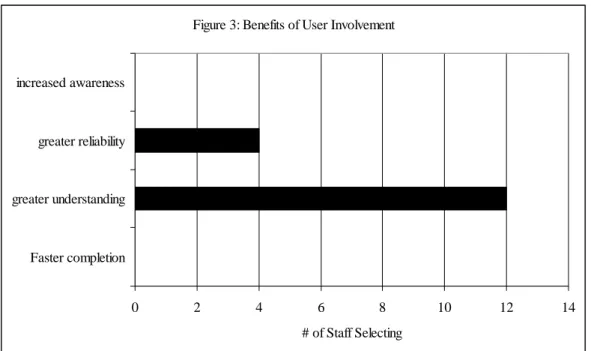
Determining the perceived overall benefit of end users in the development process was the last area explored with the survey. The benefit choices the participants were given were:
A. Faster project completion
B. Greater understanding of application usage C. Provide greater reliability of system functions
D. Increased awareness of end user needs for other projects The aim was to discover if end user involvement helped the IT staff complete projects faster, have a better understanding of how their projects were used, create more reliable systems, or had a better understanding of what end users need.
Figure3. Benefits of User Involvement
Figure 3: Benefits of User Involvement
0 2 4 6 8 10 12 1
Faster completion greater understanding greater reliability increased awareness
# of Staff Selecting
Discussion
Strategy and Tools
Just as Brancheau and Brown (2003) illustrate the management’s
perspective on the components of strategy, the tasks, and the tools for involving end users, this study has shown these components from the perspective of the IT staff. The study shows that the IT staff does have a game plan for how and when they will involve users (the strategy), and who they will involve (the tools).
The Strategy: The How and When of Optimizing Involvement
The Discovery IT staff at GlaxoSmithKline indicated the need for early participation by end users in the development process. Participation in the first three stages of project identification, project initiation, and analysis appear to the highly valued, with project initiation and analysis being the perceived as the most important. The study demonstrates that the IT staff prefers end user interaction in the implementation stage, but at a lower rate than the aforementioned stages. The need for early participation shows that developers are looking for systems
requirements to accurately guide development from the word go.
The Tools: Building the Perfect User
If you were to create a picture of the “perfect” user according to the study, the user would be an expert in the domain that the system will operate, have a great understanding of where the working group needs to go, be elected by his/her peers, and would be someone who would use the system daily upon
represent the population without neglecting select user groups. End users who are going to help in development must be aware of what their group needs, and have the vision and ability to accurately communicate these needs to the IT staff.
Better and Faster Development
The study shows that IT staff believes that overall projects were
completed faster when end users are involved. Also, when users are involved, the IT staff is able to create systems of superior reliability. If the staff has an
understanding of the end users, knowing how, when, and to whom to ask questions during development, they are able to complete the task at hand in a timely manner. Just as the end users must know what they need and want from the systems, the IT staff must know how to find what the end users need and want from the systems they create.
Issues with Involving Users
Conclusions
This study explored the perceptions of a variety of IT professionals to further the understanding of user participation during system development that was explored in the literature. The participation of end users is still an invaluable part of systems development. Bringing users in early in development is essential; their input is vital in order that the IT professionals will have a better
understanding of their needs, giving them the opportunity to create systems of greater reliability and functionality.
This study is novel in the aspect that it has approached the IT staff about end user participation during the seven stages of system development.
Concentrating on this widely taught and accepted approach to developing
systems, the aim of understanding how IT professionals optimize end users in the development process has been achieved. There are limitations of the study, however as it is a case study and results may not apply to other organizations.
Implication for Further Research
As Ambler (2005) notes, development trends show the usage of an
iterative process of development. Rather than focusing on one stage at a time, this method calls for a development approach that constantly looks at several phases at a time. The process has the ability to revert back to previous stages if necessary. Just as technology continues to grow, so does the development methodology for systems development.
References
Amber, Steven. (2005) Agile Analysis.
http://www.agilemodeling.com/essays/agileAnalysis.htm
Braa, Kristen. (1995) Priority Workshops: Springboard for User Participation in Redesign Activities. ACM Conference on Supporting Group Work, 258-267.
Brancheau, J. & Brown, C. (1993) The management of end user computing: Status and Directions. ACM Computing Surveys , 25(4), 437-482. Butler, T. & Fitzgerald, B. (1997) A Case Study of User Participation in the
Information Systems Development Process. Proceedings of the
Eighteenth International Conference in Information Systems. 411-426. Harris, Donald. (1994) Reassessing user needs. Journal of the American Society
for Information Science, 45(4), 331-335.
Hoek, A. & Wolf, A. (2003) Software Release Management for Compent Based Software. Software-Practice and Experience, 33, 77-98.
Hoffer, J. George, J. Valchich, J. (2002) Modern Systems Analysis and Desgin. Third edition, Upper Saddle River, NJ: Prentice Hall.
Josefek, Robert. (2003) Kauffman, Robert. Nearing the Threshold: An
Economics Approach to Pressure on Information Systems Professionals to Separate from Their Employer. Journal of Management Information Systems, 20(1), 87-122.
Lucas, Henry. (1971) A User-Oriented Approach to Systems Design. Proceedings of the 26th Annual Confernce of the ACM. 325-338. Peffers, Jen. & Genler, Charles. (2003) Tuunanaen, Tuure. Extending Critical
Robey, D. Ross, J. Boudreau, M. (2002) Learning to Implement Enterprise Systems: An Exploratory Study of the Dialects of Change. Journal of Management Information Systems, 19(1), 17-46.
Saleem, Naveed. (1994) Alternative Perspectives of User Participation: Practical Implications. Compter Personnel. 25-31.
Shayo, Conrad. & Igbaria, Magid. (2003) Information Technology Adoption. Enclycopedia of Library and Information Science. 1358-1368.
Van der Hoek, Andre. (2003) Wolf, Alexander, L. Software Release
Management for component based software. Software-Practice and Experience, 33, 77-98
Wilson, S. Bekker, M. Johnson, P. (1997) Johnson, Hilary. Helping and Hindering User Involvement – A Tale of Everyday Design. CHI. March 178-185.
Xia, W. & Lee, G. (2000) The Influence of Persuasion, Training, and Experience on User Perceptions and Acceptance of IT Innovation. ACM
Bibliography
Ball, M. Douglas, J. (1988) Part II- Planning and implementing integrated information services Integration and Outreach: Integrated Academic Information Management Systems. Journal of the American Society for Information Science, 39(2), 107-112.
Clemons, E. Gu, B. (2003) Justifiying Contingent Information Technology Investments: Balancing the Need for Speed of Action with Certainty Before Action. Journal of Management Information Systems, 30(2), 11-48
Cole, Charles. (1999) Activity of understanding a problem during interaction with an enabling information retrieval system: Modeling information flow. Journal of the American Society for Information Science, 50(6), 544-552.
Ellis, D. Allen, D. (1999) Wilson, Tom. Information science and Information systems: Conjunct subject disjunct disciplines. Journal of the American Society for Information Science, 50(12), 1096-1107.
Harman, Donna. (1999) User Friendly Systems instead of user friendly front-ends. Journal of the American Society for Information Science, 43(2) 164-174.
Kowalski, Gerald. (1997) Information Retrieval Systems: Theory and Implementation. Boston, MA: Kluwer Academic Publishers.
Livari, J. Hirschheim, R. Klein, H. (200) A dynamic Framework for Classifying Information Systems Development Methodologies and Approaches. Journal of Management Information Systems, 17(3), 179-218. Syder, H. Davenport, E. (1997) Costing and Pricing in the Digital Age: A
Practical Guide for Information Services. Herbert New York: Neil-Schuman.
Appendix A: Survey Cover Sheet
Dear Discovery IT,
My name is Timothy Farris and I am a Masters of Science in Information Science candidate at the University of North Carolina. I am in the process of completing my Masters Paper which is entitled, Information Technology Staff Perceptions of Optimizing End User Interaction during Application Development.
As developers, analysts, programmers and help desk personnel, I am asking for your help. I have a short survey about your perceptions about the level of end user involvement during the application development process.
The survey is nine questions and should take approximately 10 minutes to
complete. There will be approximately 20 participants in this study. Participation in this study is voluntary. If you decide not to participate, there will be no
penalty. If you choose to participate, there will be no reward. Your participation in this survey will be anonymous. You may skip any question for any reason. The data that results from the survey will be shared with the project sponsor, Laura Leslie.
If you have any questions or concerns about the study, please contact me at 923-1896 or [email protected], or my advisor, Dr. Deborah Barreau at 919-966-5042 or [email protected].
All research on human volunteers is reviewed by a committee that works to protect your rights and welfare. If you have questions or concerns about your rights as a research subject you may contact, anonymously if you wish, the Institutional Review Board at 919-966-3113 or by email to
I will be passing out the surveys on October, 18, 2005. If you choose to participate, please return it to the locked box in the office of Laura Leslie. Thank you very much for your time and participation in helping me complete my academic journey.
Appendix B: Survey
1. Which is your title/position best describes your role with GlaxoSmithKline? (Circle one)
A. Developer B. Help Desk/Support C. Designer D. Tester E. Analyst 2. Approximately what percentage of development projects do you perceive that require end user interaction? (Circle one)
A. 0-25% B. 26-50% C. 51-75% D. 76-100%
3. In terms of number of users, what was the size of your last project? ____________________________
4. During which stages of application development do you perceive that end user involvement is necessary? (You may circle more than one)
A. Project Identification and Selection B. Project Initiation and Planning C. Analysis
D. Logical Design E. Physical Design F. Implementation G. Maintenance
5. During which one stage of application development do you perceive that end user involvement is most necessary?
A. Project Identification and Selection B. Project Initiation and Planning C. Analysis
D. Logical Design E. Physical Design F. Implementation G. Maintenance
6. Do you perceive that project completion time is faster when end users are involved?
7. Is there a point during development where you view end user involvement as a hindrance?
A. Yes B. No If yes, please explain:
__________________________________________________________________ _____
__________________________________________________________________ ______
8. How do you select end users to be involved in development?
__________________________________________________________________ ___
__________________________________________________________________ ___
9. What is the most important benefit that you see when involving end users in the development process? (circle one)
A. Faster project completion
B. Greater understanding of application usage C. Provide greater reliability of system functions
D. Increased awareness of end user needs for other projects