In light of the recent Gamergate controversy, the tension between male and female video game players is as discernable as ever. It behooves behavioral scientists, information scientists, and game developers to investigate the differences between men and women in video game environments, particularly in the ways in which they choose to physically represent themselves for online interaction. Several previous studies observed gender differences in avatar selection and customization, which typically only included human avatars as options to participants. Some of these studies also identified correlations between gender, Big Five personality traits, self-esteem, and avatar selection. The current study sought to improve upon these past studies by presenting other non-human races as additional avatar options. The results of the current study reflected similarities in men and women’s avatar selection choices and corresponding personality traits to previous studies in terms of avatar-participant discrepancies in light of the additional non-human race options.
Headings:
Video Gamers
Avatars (Virtual Reality) Gender Identity in Mass Media Big Five Model
by Vida Djaghouri
A Master’s paper submitted to the faculty of the School of Information and Library Science of the University of North Carolina at Chapel Hill
in partial fulfillment of the requirements for the degree of Master of Science in
Information Science.
Chapel Hill, North Carolina November 2014
Approved by
T
ABLE OFC
ONTENTS1. INTRODUCTION 2
2. LITERATURE REVIEW 5
2.1.SELF-REPRESENTATION IN WEB 2.0ENVIRONMENTS 5 2.2.COMMON VIDEO GAME CHARACTER DESIGN AND THEIR ON PLAYER PERCEPTION 7
2.3.GENDER-BASED STEREOTYPES 10
2.4.GAMING HABITS AND BEHAVIORS OF RESPECTIVE GENDERS 12
2.5.THE GENDER-SWITCHING PHENOMENON 15
2.6.GENDER AND PERSONALITY INTERACTION:THE DUNN AND GUADAGNO STUDY (2011) 16
3. METHOD 19
3.1.PARTICIPANTS 19
3.2.SURVEY 20
3.3.VARIABLES 22
4. RESULTS 26
4.1.SURVEY DATA 26
4.2.GENDER 29
4.3.SELF-ESTEEM 30
4.4.OPENNESS 31
4.5.CONSCIENTIOUSNESS 32
4.6.EXTRAVERSION 32
4.7.AGREEABLENESS 33
4.8.NEUROTICISM 34
4.9.GENDER SWITCHING 35
5. DISCUSSION 37
5.1.GENDER 37
5.2.PERSONALITY 39
5.3.SELF-ESTEEM 40
5.4.LIMITATIONS 41
6. CONCLUSION 42
7. REFERENCES 44
1. I
NTRODUCTIONVideo games have been a widespread recreational fascination since their inception in the 1960s. Since the beginning of the industry, a perceived tension between male and female players has been commonly observed. Currently, a controversial movement in the media called “Gamergate” brings this tension to light. Many women have complained that female video game characters are objectified and marginalized characterizations and stereotypes. Similarly, female players have often experienced aggression and
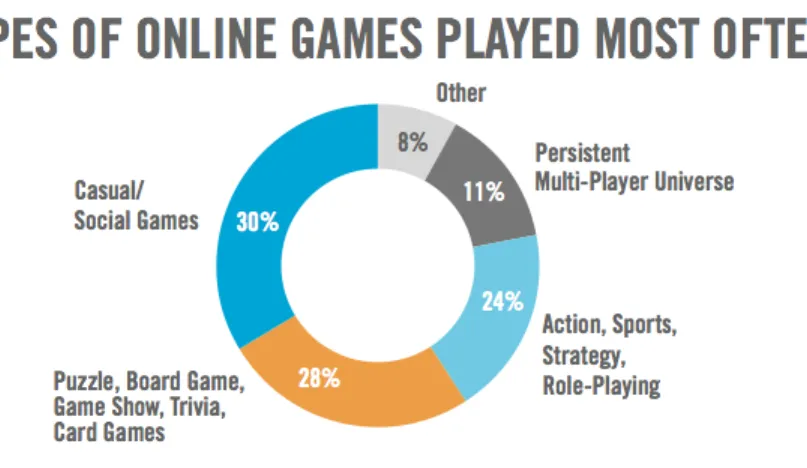
discrimination, particularly in online gaming situations, such as massively multiplayer online role playing games (MMORPGs). Despite minimizing treatment, women constitute 48% of the video-game playing population (ESA, 2014).
As the burgeoning industry itself develops, so have studies on video game culture, permeating from commercial studies and traversing the realm of academia. Many
Figure 1: From Entertainment Software Association (2014).
In MMORPGs, players represent themselves on-line via animated avatars;
therefore, self-representation is often the first decision a player must make when entering these environments. There are many observable differences in men and women’s avatars as well as their interactions and researchers assert that gender can have an effect on the way these players choose to represent themselves in order to interact. For this reason, it is important to establish the phenomenon behind these seemingly inherent differences.
2.
L
ITERATURER
EVIEW2.1.Self-Representation in Web 2.0
2.2.Common Video Game Character Design and their Effects on Player Perception 2.3.Gender-Based Stereotypes in Video Games
2.4.Gaming Habits and Behaviors of Respective Genders 2.5.The Gender-Switching Phenomenon
2.6.Gender and Personality Interaction: The Dunn and Guadagno Study
Much of the research in this field seeks to describe the difference between genders amongst video game players. Such differences can be categorized in several different ways: some studies focus on the habitual differences in self-representation and gameplay elected by members of different genders, while others discuss gender
stereotyping. Additionally and popularly, many studies also focus on the strategy called “gender-switching.” One study of particular import, titled “My avatar and me—Gender and personality predictors of avatar-self discrepancy,” by Dunn and Guadagno (2011) instead sought to determine the predicting factors for such differences.
2.1. Self-Representation in Web 2.0 Environments
Though it is not always the case, much of the time in off-line gaming
plot and the genre of this game dictate that the protagonist be a certain type of male: The film noir genre the game attempts to emulate often features rough male protagonists who are detectives or journalists, in an unwelcome and gritty environment. In this
environment, women are portrayed as victims, dull domestics, or femmes fatales—none of which are suitable to play as the protagonist in such stories. Similarly, when playing any game in the Tomb Raider series, one must play as the series’ well-established protagonist Lady Lara Croft, an English adventurer. Each game, comic book, and film created in that series only further establishes canon surrounding Croft and her world. Therefore allowing players to customize her, to be playable as a man, for example, would be out of the question.
Video game character customization is more likely a Web 2.0 affordance and lends itself to certain types of games better than those mentioned above. The term “Web 2.0” refers to “a shared environment that embraces collective intelligence and
participation” (Samouelian, 2009, p. 42). Common examples of such environments include social media sites like Facebook and Twitter, online photo tagging sites like Flickr, blogs, and wikis. By this definition, Web 2.0 environments can also include on-line video games, such as multi-user domains (MUDs) and massively multiplayer on-on-line role playing games (MMORPGs). In lieu of physical contact, players in these
“nerdy” sophisticated (p. 12). In his study of a game titled Asheron’s Call 2 (AC2), Williams (2006) described the affordances of avatars in an MMORPG environment:
This avatar is created and directed by the player and maintained indefinitely rather than for a single play session. In AC2, players create human characters and endow them with skills, abilities, and a customizable appearance, including height, build, skin and hair color, and gender. Players also choose weapons and control the avatar’s actions within the game world, most of which consists of battling with monsters. (p. 73)
In these environments identity and self-representation, whether it be via text, images, or avatars, are inherently linked. Trepte and Reinecke (2010) investigated correlations between player self-satisfaction, and avatar personality traits. They discovered, “Participants who were well satisfied with their lives created avatars that resemble themselves in terms of personality factors, whereas dissatisfied users created dissimilar avatars. Player-avatar similarity was positively related to identification” (p. 171). This suggests that players can take “corrective” measures in terms of their
personality or appearance via an avatar. One may “play with their identity and to try out new ones. MUDs make possible the creation of an identity so fluid and multiple that it strains the limits of the notion” (Turkle, 1995, p. 12). The present study is concerned with the identity behind the identity—traits such as personality and gender that influence a player’s physical self-representation decisions regarding avatar design.
2.2. Common Video Game Character Design and Their Effects on Player Perception
gender-focused content analysis of 115 distinct video game characters from video game trade magazine articles, Miller and Summers (2007) found:
Males were more likely to be heroes and main characters, use more weapons, have more abilities, and were more muscular and powerful. Females were more often supplemental characters, more attractive, sexy, and innocent, and also wore more revealing clothing. (p. 733)
These findings are confirmed by a Beasley and Standley study (2002) focused on the character and costume design of approximately 600 video game characters,
particularly sleeve length, neckline, lower body coverings, as well as cleavage, and breast size for female characters. Of all the characters analyzed, only 13% were women. “In fact, there were more characters of indeterminate gender [animals and non-speaking aliens] (88) than there were female characters (82)” (p. 289). These characters invariably exposed more skin and more than half of them were big-busted. In similar studies, females were more likely to be hypersexualized, scantily clad, with smaller waists and bigger busts (Downs & Smith, 2009, Haninger & Thompson, 2004). Further, there are often more playable male characters than female characters (Haninger & Thompson, 2004).
Several studies confirm this notion that appeal is inherent in character design and that its impact on players’ perception—though unconscious—is quite effective.
According to Wallace and Maryott (2009), “Negative social attitudes such as ethnic prejudice have been shown to persist in virtual worlds; participants in virtual settings tend to respond to avatars as they would respond to real people with similar characteristics” (p. 1). Conversely, participants in their study were less willing to participate in a virtual environment with avatars that featured certain ethnic characteristics. For example, “Chamorro participants were least willing to collaborate with European avatars,” (p. 4) and participants were more willing to collaborate with attractive avatars (p. 5). These results illustrate an analogous response to physicality in virtual worlds as in reality.
Unconscious response to physical characteristics is not necessarily tied to facets as explicit as race, ethnicity, gender, or attractiveness. The Peña, Hancock, and Merola (2009) study observed player behavior in two control groups in which players were assigned avatars with either white robes and coats or black ones. This study sought to test the priming effect avatar appearance may have on player perception and behavior. They found that, “Across two experiments, avatars with negative associations elicited
digital self-representation independent of how others perceive them” (Yee & Bailenson, 2007). Therefore, not only does that appearance of an avatar affect the way in which others may interact with it, but that it also may influence the player harnessing it himself.
2.3. Gender-Based Stereotypes
Several different studies explore the role that gender stereotypes play in the character design choices described above. The Mou and Peng article (2008) serves as a strong foundation for gender studies as it explores many of the assumptions about gender taken for granted by researchers in other articles. The researchers performed content analysis on 19 video games’ trailers, introductory sequences, and game package covers. What they discovered was that among the 70 identified characters in these 19 games, all leading characters were males, 74% of which were ethnically White. None of their villain opponents were women. The researchers concluded:
…female characters appear in stereotypical roles. Female characters are
predominately supporting characters, who are either to be rescued or assistants to the leading male character. Female characters are also never portrayed as
opposing characters, which in most of the cases are villains. The portrayal of female characters is consistent with the stereotypical mass media female characters. (p. 929)
promotional material. For example, in the Mass Effect series, players may choose to play as either a male or female version of the lead character, Commander Shepherd
(“maleshep” and “femshep,” respectively). The popularity of “femshep” grew “with considerable affection in the fan community. This has, in turn, led producer BioWare to feature Collector's Edition box art and a promotional trailer with the "femShep"
character” (Danforth, 2011, p. 53). This inclusion of the female alternative, though
progressive in gender inclusiveness, appears to only have been an afterthought on the part of BioWare in response to fans.
Other studies have shown that customization and selection is a vital cornerstone in understanding gender relations in video game environments. The DiGiuseppe and Nardi (2007) article discussing stereotypes delves deeply into character selection by way of interview analysis of 47 MMORPG players. In the game studied, World of Warcraft, characters are able to select different classes for their characters. The researchers
concluded that some classes appealed to both while some appealed specifically to men or to women. Female players were likely to select classes that foster supportive roles, such as healing in a team environment. This finding supports those of the Mou and Peng (2008) study. The researchers purported that more observation was necessary, however, to determine a correlation between gender and class selection in role-play simply due to the fact that players were operating along stereotypical gender lines but their reasons appeared to be very personal and idiosyncratic (2007).
These studies work hard to suggest that women are marginalized by video game culture, including other players; however, they say very little about the interactions between genders. According to DiGiuseppe and Nardi, “common stereotypes mask important ways in which male and female characters are alike” (2007). This refers to behaviors that go beyond mere appearance.
2.4. Gaming Habits and Behaviors of Respective Genders
women were more likely to be introduced to video games by a man, to play with a male partner, and to play in the same physical space as someone else. A few assumptions based on the notion that men and women’s gaming habits greatly differ were somewhat debunked as well. For example, the motivations to play MMORPGs differed less between members of different genders than it did between those of different age groups. The Funk and Buchman (1996) study revealed that male players preferred games that feature “human violence” while female players preferred those with “fantasy violence” (p. 26). These articles did not attempt to assess reasons for such differences; however, the studies involved were each designed to identify the differences themselves.
Further studies regarding the information seeking behavior between of men and women in video game environments revealed gender-based habits as well. One empirical study observed that men were less likely to receive sought-after help and that women were more likely to receive unsolicited assistance (Lehdonvirta, M., Nagashima, Lehdonvirta, V., and Baba, 2012). These results harken back to previously discussed gender stereotypes. They suggest that males tend to judge other males who seek help and players tend to view women as in need of assistance. Such players may be conforming to such societal norms as chivalry. In a real-world example, a majority of the surviving members of the infamous Donner Party that were stranded in the Sierra Nevadas in 1846 were female, leading to speculation that men were inclined to care for the women in wilderness situations (Grayson, 1990). Many MMORPGs are set in similar wilderness conditions, involving travel, conflict with animals, and resource collection. Lehdonvirta et al. (2012) similarly concluded, “men and women tend to pick an avatar that
help-seeking behaviors as they do in face-to-face interactions” (p. 40). Notably, male avatars from that study were less likely to receive help in online forums than female avatars, regardless of the true genders behind such avatars (2012).
Other studies focus mainly on the motivations that underlie player gaming habits. Yee (2006) took a factor analytic approach to create an empirical model of player
motivations, based on questionnaire results from 3,000 MMORPG players. The study revealed 10 motivations that could be grouped into three major categories: achievement, social, and immersion (Yee, 2006). Further, results from the study revealed that gender interacted with each motivation in meaningful ways. For example, “Male players scored significantly higher on all the achievement components than female players… while female players scored significantly higher than male players on the relationship
subcomponent” (p. 774). This relates to the stereotypes discussed above, suggesting that not only are women’s gaming habits more social, but their motivations to play these games are social as well. Gender did not strictly correlate to these motivation categories, however. “If a player scored high on the achievement component that did not mean they scored low on the social component” (Yee, 2006, p. 774).
self-reporting, which the researches had neither hypothesized nor anticipated (Williams et al., 2009).
The most notable conclusion of these studies, however, is the notion that studying gameplay mechanics may not reveal much about gender-differentiated behavior. This is due to findings that suggest there are few differences between men and women in terms of their motivations to play within the context of game design (Yee, 2008). These studies demonstrate that while in some cases, gender correlates greatly with video game
mannerisms, it is not always the case.
2.5. The Gender-Switching Phenomenon
One remarkable phenomenon in video game culture and interaction is the concept called “gender switching” or “gender swapping.” According to Hussain and Griffiths (2008), this refers to “playing a different gendered character from oneself” (p. 48). Multiple studies demonstrate that the motivations for gender switching differ between men and women in significant ways. Such conclusions are mainly drawn through interviews and qualitative analysis. According to one article, “men may not necessarily seek to mask their offline gender when they use a female avatar,” which is the case with many female players (Martey, Stromer-Galley, Banks, Wu, & Consalvo, 2014, p. 286). However, the study suggests that men “reinforce idealized notions of feminine
The following conclusions were drawn in a similar study:
Male players achieve higher levels faster than females in general, but female players also do so when they play with male avatars; and players tend to whisper more to opposite gender avatars, but they are likelier to become friends with players of the same gender. Our study also showed that female avatars in many cases profited from trade more than male avatars did. (Lou, Park, Cha, Park, Lei, & Chen, 2013, p. 834)
As suggested in the three studies discussed here, the motivations for men were often to benefit from female aesthetics while the motivations for gender switching for females was to avoid gender discrimination.
2.6. Gender and Personality Interaction: The Dunn and Guadagno Study (2011)
Most of the studies cited above use self-reported survey data and case studies to parse out anecdotal evidence of discrepancies between men, women, and their
representation in video game communities. Such evidence is quite useful in outlining the tension between male and female video game enthusiasts, including the nuances of gender discrimination. One less-frequently pursued topic is that of the effect gender has on both the player and the player’s decisions in regards to avatars in video game
environments. Again, while many of these studies describe the problems and identify correlations, very few attempt to predict (or identify predictors for) such behaviors. The Dunn and Guadagno (2011) study stands out in that it seeks to do just that.
Five personality test and the Rosenberg self-esteem test to participants, photographed subjects for comparison, and had those comparisons drawn by non-partisan analysts. They compared physical attributes of players with those of their customized avatars and performed regression analysis to determine correlations between avatar-participant discrepancies and certain personality traits (Dunn & Guadagno, 2011).
Some of the results of the study aligned with the researchers’ original predictions while others did not. The following conclusions were drawn:
• Men and women generally designed avatars consistent with ideal male and
female body types (or stereotypes).
• Men did not build taller avatars than themselves, while women did.
• Men who were high in openness to new experiences were more likely to select
avatars with skin tone variations.
• Introverts – both male and female – and women high in neuroticism were
more likely to build attractive avatars.
• Those with low self-esteem were more likely to select lighter skin tones than
those with high self-esteem. (Dunn, 2011).
These conclusions strongly suggest that gender and personality types greatly affect players’ self-representation and the decisions that determine them. While the study presented is quite sound, it does not feature non-human classes in character design. Often in MMORPGs, players are given the option to play as humanoid creatures such as elves, dwarves, and orcs.
3.
M
ETHOD3.1. Participants 3.2. Survey 3.3. Variables
3.1. Participants
For the purposes of this study, 148 individual responses were gathered on-line. Respondents demographically broke down as follows:
Age:
• 18-24: 44 (30%) • 25-34: 86 (58%) • 35-44: 16 (11%) • 45-54: 1 (<1%) • 55-64: 1 (<1%)
Ethnicity:
• Asian / Pacific Islander: 9 (6%) • Black / African American: 7 (5%) • Hispanic / Latino: 4 (3%)
• Native American / American Indian: 1 (<1%) • White: 121 (82%)
• Other / Decline to Respond: 6 (4%)
91 56
1
Participant Gender
Participants were recruited through the researcher’s personal social media accounts (Facebook, Twitter, Instagram), as well as the UNC School of Information and Library Science Masters Student Listserv. All participants were anonymous volunteers on-line. No incentive was offered for participation in this study.
3.2. Survey
The current study involved a Qualtrics web-based survey, in four parts. The survey began with a description of the game, World of Warcraft (WoW) by Blizzard Entertainment, Inc.1, a massively multiplayer online role-playing game (MMORPG). As is typical of most MMORPGs, players control a self-customized avatar within a game world alongside thousands of other players. This and several other facets of the game were explained to participants at the onset of the survey, including the game’s setting, gameplay actions (e.g., fighting, questing), and interpersonal affordances of the avatars (e.g., chat, trade, emote). Survey participants were then asked to suppose that they were to begin a game of WoW for the purposes of the first activity, avatar design.
The first section of the survey tasked participants with customizing an avatar for use in a hypothetical game of WoW. Players first selected one of three races: Human, Night Elf, and Worgen (Appendix 1). The following screen generated ten skin tone and gender combinations for the selected race, male and female, skin tones 1-5 (Appendix 2). Upon this selection, participants were presented with an array of fifteen options, each reflecting the selected race, gender, and skin tone, in addition to three hair styles in five
1©2004 Blizzard Entertainment, Inc. All rights reserved. World of Warcraft, Warcraft and Blizzard
colors (Appendix 3). This selection finalized their avatar design and concluded the section. All in all, there were 450 different combinations for participants to choose from.
The second section of the survey was designed to establish each participant’s personality profile and self-esteem level. It comprised of twenty questions. The first ten questions were a modified Big Five (or “OCEAN”) Personality test, which is used to determine one’s personality in five dimensions (Benet-Martinez and John, 1998). The original Big Five Inventory is a 44-item questionnaire, but for the sake of brevity, a shorter 10-item version2 was used. The following ten questions are those that comprise Rosenberg’s Self-Esteem Scale (Rosenberg, 1965). Each of these twenty questions relied on the participant’s agreeableness with individual statements on a Likert-scale.
The third section of the survey gathered demographic, though non-identifying, data about each participant. This included age, gender, ethnicity, and video game playing habits, as well as some physical attributes such as hair color, skin tone, and self-reported physical attractiveness to be later compared with human avatars (if selected).
The final section of the survey, titled “Avatar-Participant Comparison,” asked questions that attempted to gauge the participant’s connection to their avatar as well as any physical similarities and differences. It began with a single piped image of the participant’s final customized avatar for reference. Participants were asked to gauge the attractiveness of their selected avatar on the same scale as they had previously used to self-report their own (to be compared later by the researcher). They also self-reported on a scale how much they thought their selected avatar resembled them. To measure
connectedness, participants performed two tasks: The first was to describe how likely
2See Rammstedt, B. and John, O.P., (2007). In their study, they demonstrate the reliability of this 10-item
they would be to use the word “we” to refer to themselves and their avatar on a bipolar scale. The second was to select, among sets of concentric circles, which pair described the level of identification they felt with their avatar, from 0, which depicted two completely separate circles, to 4, which depicted two completely over-imposed circles, and several different degrees in between (Appendix 4).
That concluded the survey. No part of the survey was free-response. Each response took an average of 5 minutes and 58 seconds to complete. Results of the Big Five and the Rosenberg Self-Esteem Scale were automatically scored later.
3.3. Variables
3.3.1 Independent Variables
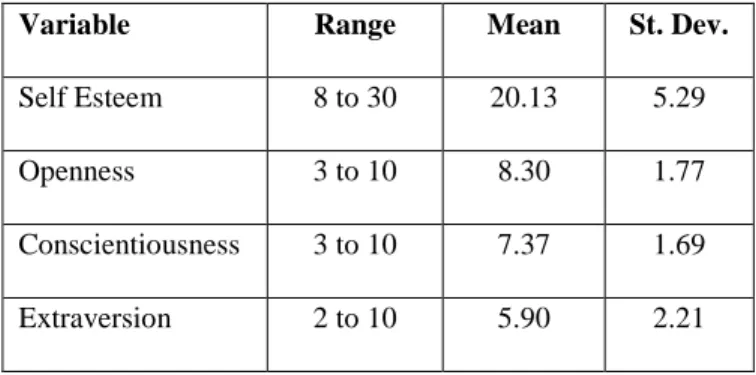
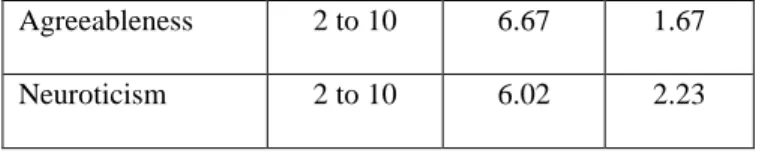
This study seeks to identify certain correlations that relate to gender, Big Five Personality traits, and self-esteem. Therefore, the primary independent variable for this study is gender (male and female). The study also utilizes Rosenberg’s Self-Esteem Scale and the Big Five Personality Scale, which generate six other independent variables: self-esteem, openness, conscientiousness, extraversion, agreeableness, and neuroticism (see Table 1).
Table 1: Independent Variables
Variable Range Mean St. Dev.
Self Esteem 8 to 30 20.13 5.29
Openness 3 to 10 8.30 1.77
Conscientiousness 3 to 10 7.37 1.69
Agreeableness 2 to 10 6.67 1.67
Neuroticism 2 to 10 6.02 2.23
While self-esteem’s definition is self-explanatory, the Big Five are often defined in the following ways: openness refers to one’s appreciation for a variety of experience and reflects one’s general curiosity and creativity; conscientiousness refers to one’s tendency to demonstrate discipline and dependability; extraversion refers to one’s sociability and positive energy; agreeableness refer to level of compassion and
cooperation that one exhibits; and neuroticism refers to one’s tendency to feel negative emotions easily and emotional stability (Benet-Martinez and John, 1998). Each of these six variables are scored in a manner that reflects the participant’s demonstrated level of that particular attribute, low to high (see Table 2). For example, a participant with a self-esteem score of 27 is considered to have high self-self-esteem. Further, a participant with a low agreeableness score, ranging from 2 to 7, could be said to contrarian or
uncooperative.
Table 2: Personality Scoring Ranges.
Results
Self-Esteem
Openness Conscientiousness Extraversion Agreeableness Neuroticism
Low: 0-15 2-6 2-6 2-5 2-7 2-4
Average: 16-25 7-8 7 6-7 8 5
High: 26-30 9-10 8-10 8-10 9-10 6-10
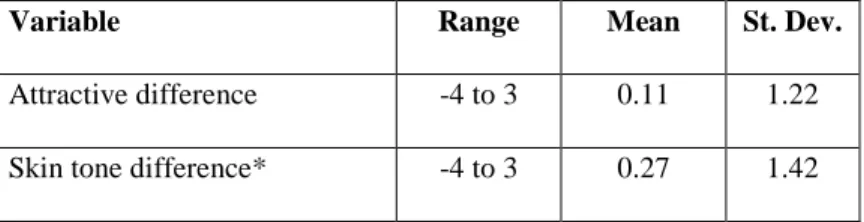
Five of the eight dependent variables for this study (see Table 3) were physical avatar-participant discrepancies, or those metrics that reflected measured differences between the appearances of participants and their customized avatars. To derive these differences, the researcher compared the results of sets of corresponding traits and calculated the mathematical difference of each set. Participants self-reported their own attractiveness and selected the attractiveness of their avatars on the same scale: from 1, very unattractive, to 5, very attractive. Skin tone differences were assessed for those players who selected human avatars only as the other two race options did not have comparable skin tones. Night elf skin tones were non-human shades of blue, purple, green, pink, and yellow and Worgen did not have skin, but rather fur that could not be compared to human skin tones. Participants selected their own skin tone from a set of swatches and those who selected human avatars selected skin tones from the same set of swatches, ranging from 1 to 5 (Appendix 5). Hair color, race, and gender differences were assessed in a binary manner. If a participant selected a different hair color, skin, or gender from their own, they were coded in the following fashion: same traits were assigned a value of 0 and different traits were assigned a value of 1. For example, if a male player selected a female avatar, his gender difference score was 1. Similarly, if a brunette player customized an avatar with brown hair, their hair color difference score was 0.
Table 3: Dependent Variables
Variable Range Mean St.Dev.
Attractive difference -4 to 3 0.11 1.22
Hair color difference* 0 to 1 0.52 0.50
Race difference 0 to 1 0.62 0.49
Gender difference 0 to 1 0.12 0.33
Connected to avatar 0 to 3 0.76 0.78
Refer to avatar as ‘we’ 1 to 5 1.80 1.24
Avatar resemblance to player 1 to 5 2.05 1.12
The remaining three dependent variables assessed participant-avatar connection. They were each modeled after the Dunn and Guadagno study and seek to measure what it refers to as participant-avatar “connectedness” (2011). The first item was an altered measure of oneness, or what Dunn and Guadagno call an “inclusion of the other in the self” (2011). Participants were presented with sets of two circles each, one labeled “self,” the other labeled “avatar” on a scale ranging from 0 (completely separate circles) to 3 (completely superimposed). Participants were asked to select the set of circles that best described the level of identification they felt with their avatar. The second adapted oneness item asked participants how likely they would be to use the word “we” to
4.
R
ESULTS4.1. Survey Data 4.2. Gender 4.3. Self-Esteem 4.4. Openness
4.5. Conscientiousness 4.6. Extraversion 4.7. Agreeableness 4.8. Neuroticism 4.9. Gender Switching
4.1. Survey Data
Figure 1: Frequency of survey results over open period
After receiving all completed surveys, the researcher manually assessed participant scores in each of the six personality categories, based on the responses
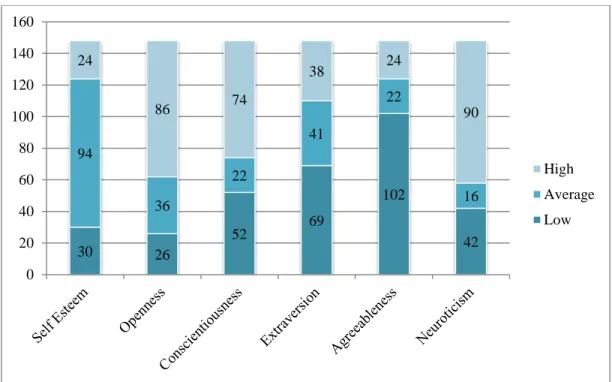
recorded in the personality section of the exam (see “Methods” above for a description of this scoring process). Figure 2 illustrates the six independent personality variable traits as the participant pool of this study exhibited them.
0 20 40 60 80 100 120
16-Oct 17-Oct 18-Oct 19-Oct 20-Oct 21-Oct
Figure 2: Personality variable frequency
After personality trait scores were assessed, the researcher calculated avatar-participant discrepancies such as gender, race, and hair differences (scored 0 for
unchanged traits and 1, for different), and skin and attractiveness differences, which were on scales of 1 to 5. Further, the researcher performed multiple regression and correlation tests comparing independent variables and dependent variables, controlling for gender. See Table 1 for a correlation matrix of gender, player-avatar discrepancy metrics, personality, and connectedness.
Table 1: Inter-correlations for gender, player-avatar discrepancy metrics, personality, and connectedness.
1 2 3 4 5 6 7 8 9 10 11 12 13 14 15
1. Gender ~ -.06 -.25 .09 -.06 -.07 -.08 .21 .29 -.08 -.03 .25 .07 .26 .19
2. Gender Difference ~ -.01 .05 .35 0.26 -.01 .05 -.14 .04 -.04 -.12 -.03 -.11 -.04 3. Race Difference ~ -.03 .c .c -.01 -.08 -.14 .07 -.08 -.10 -.01 -.48 -.24
4. Attractiveness Diff ~ .13 .34 -.22 -.04 -.13 .01 .01 <.01 .10 .12 .26
5. Skin Tone Diff ~ .31 -.02 .18 .23 -.08 -.22 -.08 .09 -.30 -.03 6. Hair Color Diff ~ -.08 .04 -.06 .04 -.10 -.15 -.05 -.27 .04 7. Self Esteem ~ -.07 .21 .22 .14 -.38 <.01 -.09 -.18
8. Openness ~ .17 .05 .02 .15 -.02 .09 .17
9. Conscientiousness ~ -.13 -.01 .07 .09 .07 -.10 10. Extraversion ~ .15 -.17 -.04 .04 -.10 11. Agreeableness ~ -.06 -.06 .15 -.01 12. Neuroticism ~ .02 .13 .03 13. Likeliness to use "we" ~ .15 .26
14. Resemblance ~ .35
15. Connectedness ~
p < 0.01 | p < 0.05
4.2. Gender
Several correlations related to gender suggest that men and women behave differently in avatar customization. Females were more likely to make avatars that resembled themselves3. They also tended to identify more with their avatars than men
and were more likely to use the word “we” to describe themselves and their avatars. Curiously, they were also more likely to report attractiveness rating discrepancies between themselves and their avatars. Males behaved differently in that they were more likely to select avatars with more discrepancies. For example, males were more likely to select human races, such as night elves and worgen (79% of males selected non-human races, while approximately half of females did so). They were also more likely to select darker skin tones and different hair colors than their own.
Gender also proved to impact a few of the other independent variables as well. Females tended to be more open to new experience, conscientious, and neurotic than males in this study. See Table 2 and for inter-correlations reflecting the impact of gender and the six tested personality traits on avatar selection and connectedness.
Table 2: Inter-correlations, controlled for gender.
Females Extravert Agreeable Conscientious Neurotic Open Self Esteem
Race Difference -0.005 -0.165 -0.063 0.065 -0.031 -0.112
Gender Switching 0.043 -.074 -0.287 -0.185 0.083 -0.02
Attractiveness .060 0 -0.225 0.028 0.04 -0.288
Skin Tone -0.061 -0.05 -0.005 -0.043 0.094 -.024 Hair Color 0.069 -0.173 -0.164 -0.23 0.014 -.028 Likeliness to use 'We' 0.015 -0.054 0.018 0.005 -0.101 0.02
Avatar Resemblance 0.175 .132 -0.004 0.108 0.089 -0.187
Connectedness -.117 -0.012 -0.209 0.001 0.022 -0.3
Males Extravert Agreeable Conscientious Neurotic Open Self Esteem Race Difference 0.107 0.067 -0.107 -0.262 -0.045 0.175
Gender Switching -0.061 0.017 0.037 -0.046 0.038 -.161 Attractiveness -0.048 0.021 -0.088 -0.081 -0.173 -0.121
Skin Tone -0.139 -0.459 0.64 -0.166 0.416 0.022
Hair Color -0.11 0.111 0.286 0.182 0.221 -.227 Likeliness to use 'We' -0.104 -0.067 0.188 0.015 0.077 -0.046
Avatar Resemblance -0.116 0.224 0.003 0.022 -0.031 .125 Connectedness 0.031 0.013 -0.085 -0.043 0.353 0.052
p < 0.05 | p < 0.01
4.3. Self-Esteem
Self-esteem impacted avatar-participant connectedness independently of gender. Participants with low self-esteem tended to create avatars they found to be more
attractive than them. Similarly, participants with low self-esteem were more likely to identify strongly with their avatars.
Male behaviors were affected by self-esteem in several ways: Males with low self-esteem were more likely to switch gender and select female avatars. These men were also more likely to select different hair colors than their own. Self-esteem interacted female avatar-participant discrepancies. Women with high self esteem elected fewer skin tone and hair differences for their avatars than those with low self-esteem.
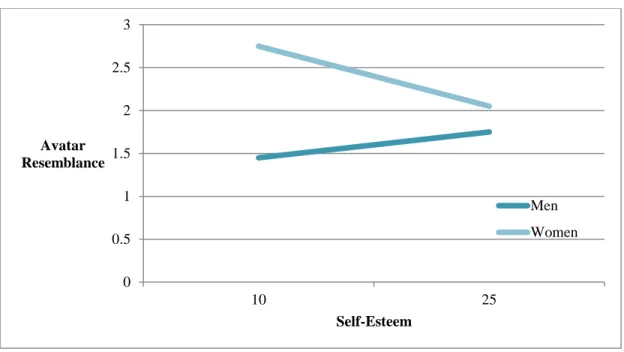
Similarly, males with high self-esteem likely felt that the avatars they created resembled themselves while women with high self-esteem were less likely to think so (see Figure 3).
Figure 3: Linear model of self-esteem and resemblance correlation as controlled for gender
4.4. Openness
Participants who were more open to new experiences (scoring highly in openness) typically felt more connected to their avatars. This interaction also occurred in the Dunn and Guadagno study. Further, as previously stated, females tended to exhibit more openness than males. Openness to new experiences interacted most notably with men in this study and inspired several avatar-participant discrepancies. Males who scored highly in openness tended to select darker skin tones and different hair colors than their own.
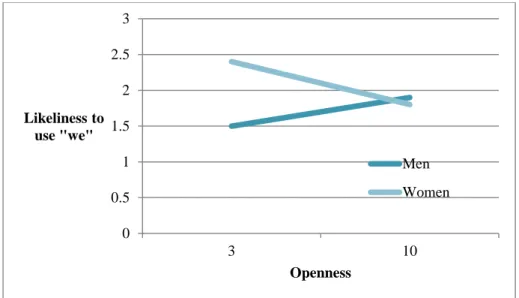
Openness interacted with avatar-participant connectivity in a number of ways. Men and women who are open to new experiences were inversely likely to use “we” to describe themselves and their avatars. Males high in openness are more likely to use the
0 0.5 1 1.5 2 2.5 3
10 25
Avatar Resemblance
Self-Esteem
term “we” (see Figure 4). Similarly, very open men were more likely to select avatars they felt did not resemble themselves.
Figure 4: Linear model of openness and connectedness measure as controlled for gender
4.5. Conscientiousness
Females typically demonstrated more conscientiousness than males in this study. Highly conscientiousness women were less likely to switch genders. They also tended to select avatars they felt were as attractive as them. Men who were more conscientious tended to create avatars with fewer discrepancies, including skin tones and hair colors. Further, while conscientious men were slightly less likely to feel connected to their avatars, they were far more likely to use “we” to describe themselves and their avatars than conscientious women.
4.6. Extraversion
0 0.5 1 1.5 2 2.5 3
3 10
Likeliness to use "we"
Openness
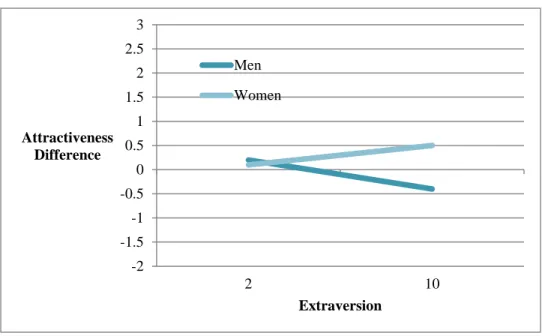
Extraverts in this study, regardless of gender, tended to demonstrate more self-esteem and less neuroticism. The trait, however, interacted with gender in several meaningful ways. Male introverts were slightly more likely to select avatars with physical discrepancies and, in turn, with lower resemblances. While extrovert males tended to select avatars with lower resemblance to themselves, highly extroverted females tended to select avatars with greater resemblance to themselves. These women were also more likely to perceive attractiveness differences between themselves and their avatars than extroverted males (see Figure 5). Further, extroverted females tended to not identify as much with their avatars as introverted females. These results differed from similar comparisons in the Dunn and Guadagno study.
Figure 5: Linear model of extraversion and attractiveness as controlled for gender
4.7. Agreeableness
When not controlling for gender, agreeableness did not seem to interact with other variables in significant ways; however, there were meaningful interactions when
controlled for gender, particularly in the case of female participants. Women with high scores in agreeableness were likely to select female avatars (they did not switch genders). There were also several negative correlations between agreeableness and
avatar-participant discrepancies such as hair color and skin tone. Agreeable men and women were also more likely to create avatars that they felt resembled themselves than less agreeable participants. Agreeableness did not appear to interact significantly with other traits for men4.
4.8. Neuroticism
Although females tended to exhibit more neuroticism than males in this study, neuroticism interacted with both genders similarly for a few variables. Neurotic men and women were slightly less likely to switch genders. Further, neurotic men were less likely to select avatars with physical discrepancies, as they were less likely to select non-human races, different skin tones, and tended to select comparably attractive avatars. Men and women differed in the manner in which neuroticism interacted with their hair color choices. Neurotic women were less likely to change their hair color while neurotic men were more likely to change the hair color (see Figure 6).
Figure 6: Linear model of neuroticism and hair color difference as controlled for gender
4.9. Gender Switching
In this study, only 12% of the participants selected avatars of different genders than their own (see Figure 7). Neither men nor women represented clear majorities in this group, as they each represent nearly half of the group. One of the participants identified themself as transgender and was therefore included in this group. The avatars themselves are half male and half female (9 each).
0 0.1 0.2 0.3 0.4 0.5 0.6 0.7 0.8 0.9 1
2 10
Hair Color Difference
Neuroticism
Men
Figure 2: Gender switching populations in the current study
83 56%
47 32%
9 6%
8 5%
1 1% 18
12%
Gender Switching Data
5.
D
ISCUSSION5.1. Gender 5.2. Personality 5.3. Self-Esteem 5.4. Limitations
Other studies have established that players of different genders behave differently and are differently motivated in online video game environments. How those players are impacted by their gender and personality are at the core of the current study. The findings in this study not only suggest that players behavior is affected by player personality and gender, but also that different genders interact with certain personality traits in inverse ways.
5.1. Gender
Women were more likely to attempt to create avatars that resembled themselves, with whom they identified with, but also altered to appear more attractive. This conforms to some of the previous findings that establish that women may be more socially
motivated in online video game environments and would therefore desire to feel socially connected while being approachable (or attractive to) other players. Females may also feel more connected to their avatars because of the numerous resemblances.
they were also more likely to select non-human avatars, which were not available in the Dunn and Guadagno study. Whatever inspired male players to select darker skin tones in other studies may have equally inspired them to select non-human avatars in the current one. These voluntary discrepancies may explain why men typically feel less connected to their avatars.
Gender switching occurred 12% of the time in the current study, nearly evenly among men and women. Other studies suggest that men and women have different motivations for gender switching. Such motivations were not pursued in this study—only personality and gender predictors. The sample may have been too small; however, the current study finds only one strong correlation: between gender-switching and different skin tones. The correlation is logical in that players selecting differently gendered avatars cannot necessarily design avatars that resemble themselves.
5.2. Personality
Openness correlated strongly with connectedness in both genders. This may be because people who are open to new experience may be more open to the interaction involved in virtual realities. Even very open players who did not feel that their avatars resembled them still identified strongly with their avatars.
Conscientiousness interacted with men and women in opposite ways. Because conscientiousness refers to being thorough, men and women with this attribute may have worked hard to perfect their images. Women worked hard to perfect versions of
themselves as their avatars seemed to resemble themselves. Men with this trait may have been hard at work to establish an avatar that improved upon themselves. Similarly, extraverted males and females operated in much the same way. Male extraverts may have felt less of a need to present perfected versions of themselves in order to be social online. Female extraverts may have used their resemblances to their avatars for social
engagement.
agreeableness assessment. It was not used in this study, which may have affected results relating to agreeableness.
Neurotic men behaved differently from other men in that they were the likely few who created avatars that more closely resembled themselves. Many of the neurotics in this study also had average to low self-esteem. This interaction may have inspired less exploratory, more pragmatic, customization in self-representation habits.
5.3. Self-Esteem
A majority (64%) of participants were of average self-esteem, which proved to be a significant predictor for certain behaviors in avatar selection. It interacted with
dependent variables sometimes in unexpected ways. For example, males with low self-esteem created avatars with more discrepancies than themselves, while those who
selected non-human avatars (the ultimate discrepancy) tended to have higher self-esteem. Perhaps those with low self-esteem attempted to improve upon their likeness while those with high self-esteem, already satisfied with their likeness, felt comfortable enough to explore non-human avatars as options for self-representation.
Women with high self-esteem did not behave the way men with high self-esteem did. Women with high self-esteem customized avatars that, not only shared some of their physical traits, but also their attractiveness levels. This women may have been operating on their own self-esteem. Notably, Fun and Buchman (1996) observed an inverse
5.4. Limitations
One major limitation of the current study is the absence of explicit items regarding motivation. The survey did not ask players about their selections. Perhaps question items such as those in the Wallace and Maryott (2009) study would have been useful in this case.
In order to determine whether participants in this study preferred avatars for self-representation that were similar to their physical selves, we used a question from the instrument that dealt with the reason for choosing a particular avatar. A majority of participants indicated that they chose their avatar because "it looks like me” (83%) rather than "it allows me to be someone different” (17%) (p. 3)
They may have been useful because there would be less guesswork behind some of the correlations and interactions observed. For example, it may have been useful to ask men and women of high self esteem why they behaved so differently.
6.
C
ONCLUSIONThe findings in this study not only suggest that player behavior is affected by player personality and gender, but also that different genders interact with certain
personality traits in inverse ways. Several of the personality traits, such as agreeableness, did not interact with customization decisions or avatar-participant connectedness initially. Once controlled for gender, however, personality traits did interact with some of the dependent variables in the study. This suggests that men and women with similar personality traits will be influenced by those traits in different ways. Further, this study finds that women may be more concerned with accurate self-representation than men.
The research question that the current study seeks to answer is: Given the option of non-human avatars, will the same types of participants who elected for participant-avatar discrepancies in the Dunn and Guadagno (2011) study after which this study is modeled, display similar interactions? Results indicate that participants in the current study behaved much in the same manner. This further establishes that personality interacts with gender in different ways and impacts the way men and women choose to represent themselves in online video games, whether as humans or not.
7. R
EFERENCESBeasley, B., & Standley, T. C. (2002). Shirts vs. skins: Clothing as an indicator of gender role stereotyping in video games. Mass Communication & Society, 5, 279-293. Benet-Martínez, V. & John, O. P. (1998). Los Cinco Grandes across cultures and ethnic
groups: Multitrait multimethod analyses of the Big Five in Spanish and English.
Journal of Personality and Social Psychology, 75, 729–750. Danforth, L. (2011). Gender and Games. Library Journal, Aug., 53.
DiGiuseppe, N. & Nardi, B. (2007). Real Genders Choose Fantasy Characters: Class Choice in World of Warcraft. First Monday. Vol. 12, 5. Retrieved from: http://firstmonday.org/issues/issue12_5/digiuseppe/index.html
Downs, E. & Smith, S. (2009). Keeping Abreast of Hypersexuality: A Video Game Character Content Analysis. Sex Roles, 62(11-12) 721-733. DOI:10.1007/s11199-009-9637-1
Dunn, R.A. & Guadagno, R.E. (2011). My avatar and me – Gender and personality predictors of avatar self-discrepancy. Computers in Human Behavior, 28, 97-108. DOI: 10.1016/j.chb.2011.08.015
Entertainment Software Association. (2014). 2014 Essential Facts About the Computer and Video Game Industry. http://www.theesa.com/facts/pdfs/ESA_EF_2014.pdf Funk, J. B., & Buchman, D. D. (1996). Playing violent video and computer games and
Grayson, D.K. (1990). Donner Party Deaths: A Demographic Assessment. Journal of Anthropological Research, 46(3) 223-242. Albuquerque: University of New Mexico http://www.jstor.org/stable/3630425
Haninger, K., & Thompson, K. M. (2004). Content and ratings of teen-rated video games.
Jama, 291(7), 856-865.
Hussain, Z., & Griffiths, M. (2008). Gender Swapping and Socializing in Cyberspace: An Exploratory Study. Cyberpsychology & Behavior, 11(1) 47-53. DOI:
10.1089/cpb.2007.0020
John, O.P. and Srivastava, S. (1999). The Big-Five Trait Taxonomy: History,
Measurement, and Theoretical Perspectives. Handbook of personality: Theory and research (2nd ed.). New York, NY: Guilford.
Lehdonvirta, M., Nagashima, Y., Lehdonvirta, V., & Baba, A. (2012). The Stoic Male: How Avatar Gender Affects Help-Seeking Behavior in an Online Game. Games and Culture. DOI: 10.1177/1555412012440307
Lou, J. K., Park, K., Cha, M., Park, J., Lei, C. L., & Chen, K. T. (2013). Gender swapping and user behaviors in online social games. Proceedings of the 22nd international conference on World Wide Web, 827-836. Retrieved from: http://dl.acm.org/citation.cfm?id=2488460
Martey, R. M., Stromer-Galley, J. Banks, J., Wu, J., & Consalvo, M. (2014). The strategic female: gender-switching and player behavior in online games.
Miller, M. K., & Summers, A. (2007). Gender differences in video game characters’ roles, appearances, and attire as portrayed in video game magazines. Sex Roles, 57(9-10), 733-742.
Mou, Y., & Peng, W. (2008). Gender and racial stereotypes in popular video games. In R. Ferdig (Ed.), Handbook of Research on Effective Electronic Gaming in
Education, 922-937. Hershey, PA: IGI Global.
Peña, J., Hancock, J., & Merola, N.A. (2009) The Priming Effects of Avatars in Virtual Settings. Communication Research, 36, 838-856. DOI:
10.1177/0093650209346802
Rammstedt, B. and John, O.P. (2007). Measuring personality in one minute or less: A 10-item short version of the Big Five Inventory in English and German. Journal of Research in Personality. 41(1) 203-212.
http://dx.doi.org/10.1016/j.jrp.2006.02.001.
Rosenberg, M. (1965). Society and the adolescent self-image. Princeton, NJ: Princeton University Press.
Samouelian, M. (2009). Embracing Web 2.0: Archives and the Newest Generation of Web Applications. The American Archivist, 72, 42-71.
Turkle, S. (1995). Life on the screen: Identity in the age of the Internet. New York, NY: Simon & Schuster.
Trepte, S., & Reinecke, L. (2010). Avatar Creation and Video Game Enjoyment Effects of Life-Satisfaction, Game Competitiveness, and Identification with the Avatar.
Wallace, P., & Maryott, J. (2009). The impact of avatar self-representation on collaboration in virtual worlds. Innovate, 5(5).
http://www.innovateonline.info/index.php?view=article&id=689
Williams, D. (2006). Virtual cultivation: Online worlds, offline perceptions. Journal of Communication, 56, 69–87.
Williams, D., Consalvo, M., Caplan, S., & Yee, N. (2009). Looking for Gender: Gender Roles and Behaviors Among Online Gamers. Journal of Communication, 59, 700–725. DOI: 10.1111/j.1460-2466.2009.01453.x
Yee, N. (2006). Motivations for Play in Online Games. CyberPsychology & Behavior, 9(6) 772-775. doi:10.1089/cpb.2006.9.772.
Yee, N. (2008). Maps of Digital Desires: Exploring the Topography of Gender and Play in Online Games. In Kafai, Y., Heeter, C., Demer, J., & Sun, J. (Eds.), Beyond Barbie and Mortal Kombat, 85-96. Cambridge: MIT.
8.
A
PPENDICESAppendix 1:
Appendix 2:
Appendix 3:
Appendix 4:
Connectedness circles, referenced on page 19.
Appendix 5: