Paper for the M.S. in I.S. Degree. August, 2010. 89 pages. Advisor: Jeffrey Pomerantz.
Institutions using or piloting Sakai were studied in order to gather grey literature on their use of Sakai. These documents were analyzed in order to find common themes. From the sample frame multiple institutions were chosen for use as case studies in multiple case study analysis. Bijker's concept of Interpretive Flexibility is used to examine the differences.
Headings:
by
Cristóbal M. Palmer
A Master’s paper submitted to the faculty of the School of Information and Library Science of the University of North Carolina at Chapel Hill
in partial fulfillment of the requirements for the degree of Master of Science in
Information Science
Chapel Hill, North Carolina August, 2010
Approved by
Table of Contents
Introduction ...4
About this Document and its Audience ...4
About Sakai ...4
Describing Sakai and the Rest of the Marketplace...7
Literature Review ...13
SCOT and Multiple Case Study Analysis ...13
VLE and LMS literature ...14
Methodology ...21
Results and Analysis ...24
Charles Sturt University ...24
About CSU...24
Sakai at CSU...24
Summary...27
Claremont Colleges Consortium...28
About the Claremont Colleges...28
Sakai at Claremont...28
Summary...31
Columbia University ...32
About Columbia...32
Sakai at Columbia...32
Summary...33
Graham and Charles Schools...33
About the Graham and Charles Schools...33
Sakai at the Graham and Charles Schools...34
Summary ...36
Hiram College...36
Sakai at Hiram...36
Summary...37
Hebrew Union College—Jewish Institute of Religion...37
About HUC-JIR ...37
Sakai at HUC-JIR...38
Summary...39
Abilene Christian University...39
About Abilene Christian...39
Sakai at Abilene Christian...40
Summary...41
Lagrange College...41
About Lagrange...41
Sakai at Lagrange...42
Summary ...43
Discussion and Cross-case Analysis...44
Limitations and Future Research ...46
A Word about Consortia ...46
Enrollment Numbers ...47
Grey Literature...47
Interviews...47
Higher Granularity of Social Groupings...49
Finding more failures...49
Future Quantitative Study...49
Conclusion ...50
Bibliography...52
Appendix 1: tabulated data...61
Appendix 2: script for processing with R...68
Illustration Index
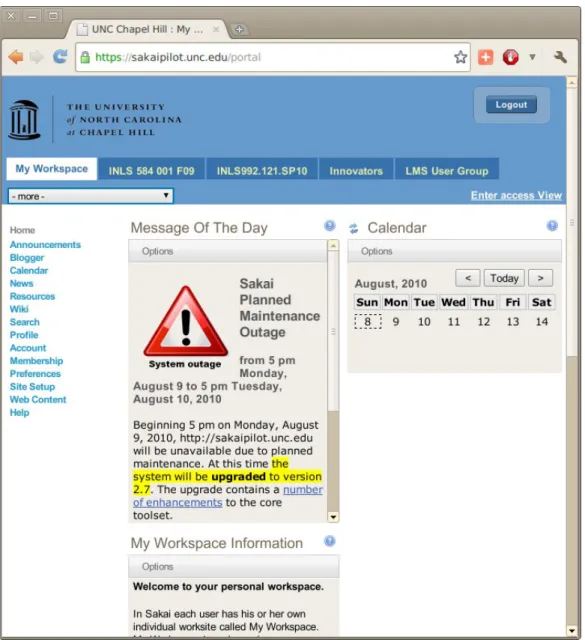
Illustration 1: View of UNC-CH Sakai instance just after login...6
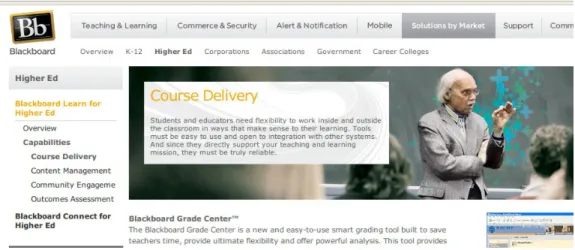
Illustration 2: Blackboard website screen capture...8
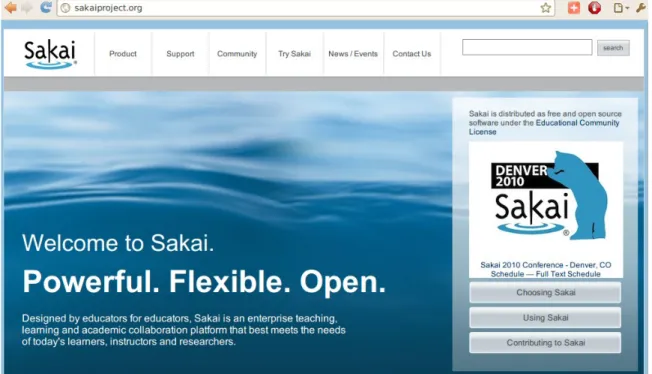
Illustration 3: Sakai website screen capture...10
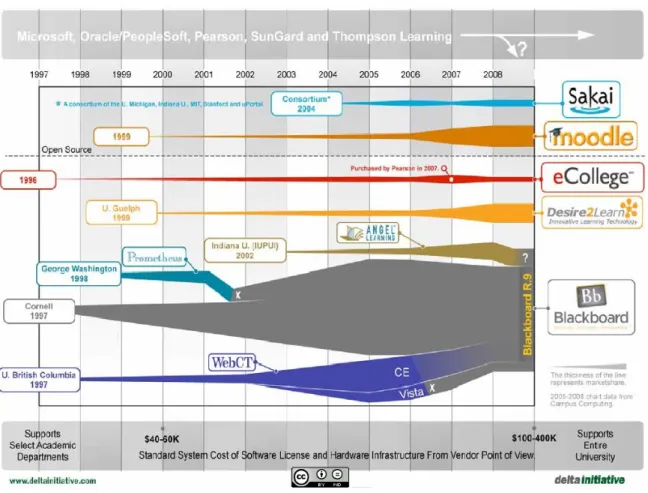
Illustration 4: Delta Initiative LMS timeline...11
Illustration 5: Profile tool in Sakai...16
Illustration 6: Discussion Forum tool in Sakai...17
Illustration 7: The VLE 2.0 Concept from Weller (2006)...18
Illustration 8: CSU Interact site, About Sakai page...24
Illustration 9: Sakai tools at CSU screen capture...27
Illustration 10: multi-campus login screen at Claremont...30
Illustration 11: Site search of CELLT Sakai instance showing no courses after Fall 2009.35 Illustration 12: Campus technology at ACU screen capture...41
Introduction
About this Document and its Audience
Institutions using or piloting Sakai were studied in order to gather grey literature on their use of Sakai. These documents were analyzed in order to find common themes that cross institutional boundaries. Past research on Sakai has looked for themes across organizational boundaries within the same large institution. This work seeks to break new ground by looking at the use or exploration of Sakai in very different institutional
settings.
For an example of past research we can look to Brian Moynihan’s 2009 thesis, which analyzed the needs assessment process that lead to the selection of Sakai as a replacement for the UNC School of Medicine’s current Learning Management System (LMS). Where that document approached one institution and examined it in fine detail, this work takes a different approach to building our understanding of Sakai by describing more institutions at a lower level of detail.
This document should be immediately useful to information and technology managers and administrators at large doctoral/research-extensive universities similar to UNC, but may also prove useful to smaller colleges and universities, especially those with needs not being met by their current LMS offering.
About Sakai
Begun in 2004 with funding from the Mellon Foundation's Research in Information Technology Program (RIT) and development support from Indiana
This project’s purpose is to develop an open source course management system that would serve a broad range of institutions of higher education in a much better organized, much more cost-effective way than they are being served now. The Foundation is contributing $2.4 million over two years, and four universities (Michigan, Indiana, MIT, and Stanford) are making an in-kind contribution, primarily staff time, totaling more than $4 million. These universities are joining forces to integrate and synchronize their enormous investments in educational software to create an integrated set of open source tools that would draw upon the “best-of-breed” from among existing open source course management systems and related tools. If successful, the result would be an economically sustainable approach to high quality open source learning software for higher education that would overcome the two main barriers that have consistently impeded such collaborative efforts: (1) unique local architectures, including heterogeneous software, software interoperability requirements between systems, and diverse user interfaces that hinder the portability of software among institutions; and (2) timing differences in institutional funding and mobilization that reduce synergy and result in fragmented, often incomplete offerings and weak interoperability.
[…] SAKAI [sic] is an effort in which the core schools are doing the development themselves (with partial matching support from the Foundation). Each core institution has agreed to provide full-time technical staff that will be under the direction of the SAKAI Board. In addition, a SAKAI Education Partners Program (SEPP) has been formed to permit interested schools to participate in the discussion of the strategic directions for SAKAI. Each of the partner schools will commit to contribute $10,000/year for 3 years. In order to get the SEPP launched, the William and Flora Hewlett Foundation has agreed to provide seed funding of $300,000. So far, without any formal announcement of SEPP, 13 schools have agreed to join, and staff expect that we will attract more than 100 in the next 6 months (Bowen, 2004).
Since that 2004 beginning, Sakai has grown and matured into a system on even footing with commercial products such as Blackboard from the perspective of decision-makers at many institutions of higher learning, but that direct comparison masks both the interpretive flexibility (discussed in the literature review below) of Sakai itself and the common themes seen among successful Sakai deployments.
of that software. Sakai is Open Source. Sakai is a Collaborative Learning Environment, Virtual Learning Environment, or a Learning Management System depending on your choice of term. Sakai looks like this (Illustration 1) when I first log in to the pilot instance at UNC Chapel Hill. Sakai is an opportunity to use software to accommodate existing practice while pushing new or different pedagogy. Sakai allows us to apply and expand on lessons learned from distance education and blended learning, reduce costs, increase coöperation, or replace an obsolete LMS. Sakai is a platform on which to innovate or simply build a tool that meets an existing need. Sakai is a chance for small
service providers to compete for higher education business. Sakai is a software
prerequisite for a tool the school wants to use. Sakai is a large, labor-intensive project that can't be properly integrated at the school and should be decommissioned in favor of a tool that better fits the existing infrastructure. We will see Sakai be each of these (sometimes conflicting) things in the case studies.
Describing Sakai and the Rest of the Marketplace
Learning Management System, Course Management System, Collaborative Learning Environment and Virtual Learning Environment are terms used when discussing Sakai, Moodle, Blackboard, and other related software. We explore these terms briefly.
Why not use Course Management System if it was good enough for Mellon in 2004? The emphasis on the concept of a course is problematic both because Sakai (and Moodle, Blackboard, etc.) can provide for other kinds of collaboration that are clearly not a course (such as a research lab with no students, which we hypothesize exists somewhere), and because the term “course” is vague. While an instructor may be necessary for a course to be listed in a University's bulletin and some number of students must register for it to be offered for credit, neither is sufficient to explain learning or justify the deployment of Sakai, and the course as listed in the bulletin is at once an arbitrarily narrow and broad use case, since it can describe everything from a 400-person Spanish lecture or 12-person chemistry lab to a Masters Thesis with one faculty reader. There is also the problem that outside the US the term “course” often means a complete course of study spanning several semesters, and what in the US is called a course might be referred to by some other name, such as unit. As tools such as Sakai are adopted worldwide, then, the term Course Management System has fallen into disuse.
If we were to start afresh and design software to help us implement our pedagogical ideas and leave room for others to come, what core questions might we start with? Certainly after awhile we might ask, “How shall we use software to aid in the process of learning assessment?” But would we not much sooner start with the
question: “How shall we use software to aid in the learning process?” If we accept that as our core question, Learning Management System (LMS) might be a serviceable term, but “management” still presumes a hierarchy or leadership, and much academic learning takes place in a context where there may be a nominal leader, but students may be empowered to take various leadership roles, or perhaps be expected to take more of an apprenticeship or portfolio approach to their learning. What's more, regardless of which people are doing what kind of leading, many (if not most) educators would bristle at the idea of the software doing the leading in their classrooms.
Sakai calls itself a Collaborative Learning Environment, and in that sense is very philosophically similar to Moodle (Modular Object-Oriented Dynamic Learning Environment). Weller (2006) refers to both as second generation Virtual Learning Environments (VLEs), saying: “There is an analogy with plant succession here. When there is a new environment, for example barren rock, a few pioneer species, such as lichens begin to grow” (2006, p. 100). Commercial offerings such as WebCT (now Blackboard) are lichens, then, making the academic environments in which they are deployed more receptive to the more fundamentally disruptive Open Source projects such as Moodle, Sakai, LAMS, and others.
This new generation, the VLE 2.0 generation, is more disruptive at least in part because its designers are not meeting incumbent pedagogical models and practice on their terms, but rather are taking constructivist learning principles and ideas about experiential learning and collaboration and encoding them in their software. These are software architects who very much want instructors to take a seat in the student’s desk as in Error: Reference source not found. As we’ll see in the literature, whether or not institutions and instructors adopt these principles as their own is another matter entirely.
package. On their public website they do not call their product a “Virtual Learning
Environment” or “Collaborative Learning Environment” or anything else, for that matter. They refuse to be classed, but instead have functional areas listed: Course Delivery, Content Management, Community Engageme[nt], and Outcomes Assessment. Note also the image they use under “Course Delivery” on their site: a white-haired professor in a lecture hall with a cloud of colorful “+” symbols floating out from his the hand with which he is emphasizing a point. Presumably these symbolize the digital value-add to the face-to-face core of the course.
Compare this to Sakai's homepage (Illustration 3): abstract blue water with large, bold adjectives: “Powerful. Flexible. Open.” Below this a succinct statement: “Sakai is an enterprise teaching, learning and academic collaboration platform that best meets the needs of today's learners, instructors and researchers.” This is rather radical in terms of how little it presumes about who will be using it and how. At the same time we might complain that Sakai is trying to be all things to all people by being intentionally vague. Earlier we complained that Course was vague and broad; we might
easily level the same complaints against “learners, instructors and researchers.” Perhaps this vagueness is both intentional and good, since it allows for Interpretive Flexibility.
What terms have people chosen to use when studying software such as Sakai, Moodle, and Blackboard? When shopping for it? When building it? What can we learn from the way people describe this software? Do different people describe the same software (Sakai) in very different terms, perhaps because they see very different things when they look at it?
In the next section we will review the existing literature, including literature on systems like Sakai. First we have a brief reality check. The market for VLE/LMS software is very heavily skewed. If you are an employee at an institution that you know is going to need significant outside expertise to implement and maintain your VLE/LMS
(or migrate from an existing LMS to a different one), Illustration 4 above may come as a shock. It comes from a presentation (“webinar”) given by the Delta Initiative (DI), a consulting firm based out of Illinois (Hill, Langstaff, & Fernandes, 2009).
DI did not identify any LMS projects that started after Sakai began in 2004, and they highlight Blackboard's acquisition of WebCT and Angel, along with the rocketing licensing costs for the commercial offerings. They also call attention to the stagnation in growth for Open Source systems from 2008 to 2009, but hypothesize that major Student Information System (SIS) players may step into the LMS market, causing another shift. The elephant in the room is the massive Blackboard install base, which dwarfs all the other offerings. Moodle is in second place, but DI rendered it at less than a fourth of the size of Blackboard’s total.
Literature Review
SCOT and Multiple Case Study Analysis
Social Construction of Technology is a variety of Social Constructivism, a sociological approach to the development of technologies that has been popular since the 1980s. It is an approach rooted in the work of diverse Philosophers such as Kant, Hegel, Lukács, and Marx (Dusek, 2006, p. 198).
Beyond the philosophical underpinnings, SCOT as presented by Bijker provides a framework for sociological analysis of a technology. For a successful technology, the success is not an explanation but rather something to be explained, since a technology cannot have inherent superiority if it is socially constructed—what we are after is its sociological significance, its social superiority. This ensures a symmetric focus on success and failure of technologies (Bijker, Hughes, & Pinch, 1987, p. 24). It is also important to explain the interpretive flexibility of technologies in question. Bijker’s classic example of interpretive flexibility is the bicycle:
The bicycle case showed that the development of technical designs cannot be explained solely by referring to the intrinsic properties of artifacts. For example, the high-wheeled Ordinary was at once a dangerous machine, prone to failure in the marketplace, and a well-working machine that allowed highly skilled physical exercise, resulting in a commercial success. I showed that this double character could be clarified by looking at the alternative bicycle designs through the meanings attributed to them by relevant social groups (Bijker, 1995, p. 270).
In our cases, Sakai may be an LMS for one institution, while for another it simply provides e-portfolio tools, and another system is used for course management.
Step program, an early childhood education project. Stake presents several country cases and separately gives us a cross-case report. Similarly, we will look at individual cases of Sakai pilots and deployments, later presenting a cross-case summary.
VLE and LMS literature
Research involving systems like Sakai can be found spread across CMC literature, education literature, management literature and other disciplines. We take
Online learning (Dabbagh & Bannan-Ritland, 2005), which takes an education perspective, as our starting point and branch out, tying the literature to Sakai and giving more background on Sakai where possible. Dabbagh gives us the following categories for “online learning” research: asynchronous vs. synchronous learning, interactivity, online learning communities, hypertext and hypermedia, web-based instruction, student perceptions of online learning, and faculty and instructor perspectives (2005, p. 68). With each of these, the summary and emphasis are on effective instructional strategies suggested by the literature. In the case of of
asynchronous learning, for example, a suggested strategy is to "Use asynchronous tools such as issue-based forums or debates and comment labeling for deeper discussions" (2005, p. 75). This and much more of the advice in Dabbagh is platform-agnostic; it could be implemented with the forum tool in Sakai, a similar tool in another VLE, or with an independent forum tool or service.
By contrast the section on synchronous communication cites Chou (2001), which singles out WebCT (purchased by Blackboard in 2006) as having had initially poor reviews by students, with impressions of the tool improving with use, such that one of the suggested instructional strategies is “Teachers must provide time for students’ adoption of a new instructional system” (Dabbagh & Bannan-Ritland, 2005, pp. 77-79).
Tu makes the connection between social presence and social learning theory, and in the process lists the factors of social presence as social context, on-line
importance of social presence in online learning, only Dabbagh (leaning on McIsaac et al. 1999) suggests “providing face-to-face opportunities before meeting online” as necessary (2005, p. 83). Kreijns et. al. (2003), by contrast, in their list of strategies to avoid the “pitfalls for social interaction in computer-supported collaborative learning environments,” list interactivity and social presence separately, but note that their categories are not necessarily independent (2003, p. 346).
Kreijns goes on to caution that the lack of social interaction negatively impacts the learning outcomes we may have hoped for from our collaborative learning tools. They may be based on social construction of knowledge and competence-based learning principles, but the “lack of social interaction is due to the assumption that social interaction will automatically occur because the environment permits it,” and our forgetting that people “are looking for affiliation, support and affirmation,” or in other words: community (2003, p. 349). This connects nicely with Dabbagh’s section describing research on online learning communities, which touches on issues of social support, bonding, and (without framing it explicitly this way) regular social grooming that will prevent online learners from “fading back” away from the community that is necessary to have a successful course (2005, pp. 84-87).
It is worth giving a brief nod at this point to the flaws in “community” as a model, since our immediate goal is to effect mobilization of social relations in support of learning outcomes, not to build a community for its own sake. Furthermore, Latour (2005) would caution us that we risk making “the social” some ephemeral other with explanatory power, some force distinct from the technologies (software, pedagogical, organizational) rather than critically examining the associations at play. Postill (2008) suggests:
The concept of ‘social field’ [is] one possible way of overcoming the
Postill uses this framework to examine a Malaysian suburb (notably discussing a web forum focused on that suburb), and finds that, “In common with countless people around the globe, they are appropriating internet technologies selectively for specific purposes” (2008, p. 427). Whether we use a “social field” or an “online learning
community” as our model, Postill and Latour remind us to re-evaluate those models as we examine a particular milieu.
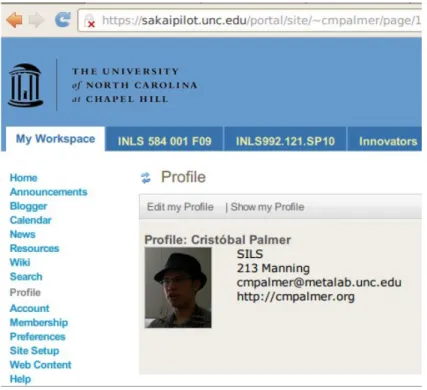
Sakai offers instructors and administrators a variety of tools to help promote social presence, interactivity, and promote social bonding and grooming. Two tools that we can focus on briefly are the Profile tool (Illustration 5) and the Discussion Forum tool (Illustration 6). Some institutions (such as UNC Chapel Hill) make the ID card pictures (which are stored in the SIS) of students on the class roster available to the instructor for every class. If system administrators set up the necessary links between the SIS and the VLE, the students’ Profile tools could be populated with these pictures, such that the entire class would have access to them. The Profile tool also allows for the uploading of an arbitrary image, which allows for more personalization
and expression, though in personal communication with administrators at the UNC School of Medicine, it came to light that some faculty were concerned that this would undermine the expectations of professionalism they had for their students—or perhaps wanted to project onto them. Since Sakai is an Open Source product, it is possible to explore the disabling of the feature that would allow students to alter their profile pictures without any need for interaction with a vendor. Students would still be able to list other information such as email address, website, phone number, and arbitrary text.
The Discussion Forum tool in Sakai (http://www.etudes.org/jforum.htm) was developed by a Brazilian (Rafael Steil) and integrated into Sakai by Etudes. It takes the popular phpBB interface and makes it available as a java package that can be added as a tool in a a Sakai site. This is rather remarkable: a popular php-based forum tool was
ported to Java by a Brazilian, then further ported to work with Sakai 2.5.x by Etudes staff with funding from The William and Flora Hewlett Foundation and from the California Community Colleges Chancellor's Office. This tool, then, is an asynchronous communication tool that in addition to being used to submit reading responses (and
other similar uses) can be used for social support, building shared meanings, etc. The forum pictured in Illustration 6 was for a graduate course with in-person class meetings multiple times per week. Note that the class was divided into five groups for an
assignment, and each group was required to post its summary to the forum under the “Discussion of Garcia...” section. There were no responses from students to these posts. That is, it was merely used to submit work, with no student replying to any of the summaries. Contrast this with the “Student Lounge” section of the forum, which saw 64 messages across 40 topics (right-most columns in the image).
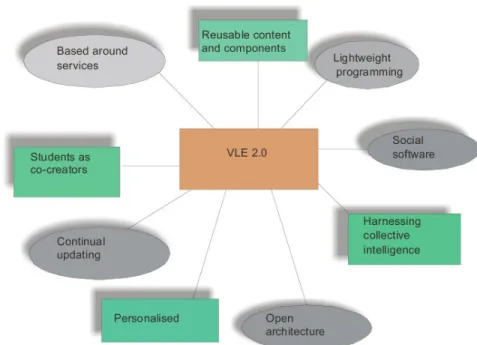
Returning to the literature, we have already mentioned Weller (2006), which analogizes plant succession that alters the environment to make it more hospitable for other species to VLEs such as WebCT that open the door for a new generation of VLEs— VLE 2.0 as Weller calls it—such as Sakai or Moodle. We borrow Weller's VLE 2.0 concept diagram to aid in a brief
explanation.
VLE 2.0 leans heavily on concepts from Software as a Service (SaaS) and Open Source. We've already seen how the Forum tool is a reusable component; all Sakai tools are designed this way. This is also an example of lightweight programming, in which features are “loosely coupled, rather than
tightly integrated” (Weller, 2006, p. 104). Harnessing collective Intelligence and Students as co-creators are both very much Open Source principles, but not simply Open Source Software principles. As Weller points out, Wikipedia is an excellent
example of a project that uses this principle to great effect. He also emphasizes that a 2.0 VLE need not be licensed with an Open Source license, but it must follow principles of Open Architecture, ie. guaranteeing that functional parts are based on standards and are therefor interchangeable. We discussed personalization above, so lastly we focus on continual updating, or as Weller calls it, the perpetual beta. Say for example a newer, better Forum tool were to be built. A university operating under this model might make it available to a limited number of students or classes (eg. a class within the School of Medicine), and after confirming that it works as expected, it would fully replace the old Forum tool for all students.
Ozkan and Koseler (2009) propose a six-factor assessment model they call HELAM (hexagonal e- learning assessment model ) and an associated survey
instrument that they validated as a measure of student satisfaction with U-link, the VLE developed in-house at Brunel (in the UK) in 1999, which they still use and maintain. Their six factors were: (1) system quality, (2) service quality, (3) content quality, (4) learner perspective, (5) instructor attitudes, and (6) supportive issues. Again, note that while instructor attitudes is a factor, their instrument was validated as a measure of learner satisfaction only. Interestingly, the Delta Initiative also used a six-factor model in discussing LMS adoption, though they divide their model into two major areas: educational practice and support structures, with three factors in each (Feldstein, 2009).
Tu and Corry (2003)
Continuing with the theme that increased interactivity improves learning outcomes, Northrup uses Moore’s theory of interaction as a starting point in “A Framework for Designing Interactivity into Web-Based Instruction” (Rossett, 2002, p. 127). Sakai provides various tools that, combined with the best practices articulated in the literature, promote better learning outcomes, but how well are instructors and learners putting these tools to use? How does their use compare with use of Moodle, Blackboard, and other tools? Since our focus is on Sakai, and especially on publicly-available information about its use, these questions are left to future research.
For now the conclusion that we can draw from the literature is that a
Methodology
This is a multiple case study roughly in the vein of Stake (2006), with the quintain being institutions that are using or have piloted Sakai. Cases, therefore, were not chosen by random sample, nor because they were assumed to allow coverage of cells in our typology, but rather because they “seem to offer the opportunity to learn a lot” and were highly accessible (2006, p. 25). Having said this, the cases chosen give us diversity in some key ways. For example, there are large and small institutions, public and private, and successful deployments along with a college that chose not to deploy to production after a pilot of Sakai. We set out to be more descriptive than scientific, then, but still with the goal of making meaningful generalizations about the quintain— Sakai deployments and pilots—in the end.
Beginning with a convenience sample of institutions that are using or have at least piloted Sakai found on the Sakai Project website, we collected data on 98
institutions, most of which were colleges or universities, and some of which were sub-units of others. For example, Scripps College is one of the colleges in the Claremont Colleges Consortium. Data collected include approximate student population, religious affiliation or lack thereof, public/private status, whether the institution is a member of a consortium, whether the institution is in the United States of America, the status (live or not) of the Sakai instance, and publicly-available statements about use of Sakai at the institution.
Student population is collected as a loose proxy for Sakai deployment size, but just as importantly to explore whether institutional size plays some role in how the institution characterizes its use of Sakai. Put another way, are large Sakai deployments and small Sakai deployments fundamentally different things?
Colleges and Universities (such as Columbia—formerly King’s College) which long ago had religious connections or seminaries were not described as having a religious affiliation. If a separate seminary was closely related but not part of the institution (again, see Columbia), it was not listed as having a religious affiliation. In short, if the institution has a seminary and lists its religious affiliation (eg. with a Christian
denomination such as the Churches of Christ in the case of Abilene) prominently, it is considered to have a religious affiliation for the purposes of our study.
Large state land grant colleges and small private liberal arts colleges in some ways have very different needs. We have already tried to account for size as the difference. What about public vs. private? We use this in the American sense of the term, meaning that a college or university is only listed as public if it receives a
significant part of its budget from a state appropriation, its facilities from a land grant, etc. While making this determination can be slightly problematic, especially for
institutions outside the US, in the vast majority of cases deciding whether to call an institution public or private was an obvious choice. Similarly, determining whether an institution was a member of a consortium for the purposes of this study was at times problematic (see limitations below), but some very clear-cut examples of consortia such as the Claremont Colleges and ETUDES merit more detailed analysis. Here we will use the Claremont Colleges as one of our cases.
Results and Analysis
Charles Sturt University
About CSU
Charles Sturt University (CSU) is a public, multi-campus university in Australia with approximately 30,000 students. The Distance Education website says that
approximately 21,000 students take distance courses, but it is not clear to what extent this number overlaps with the 30,000. The nine campuses are located in New South Wales, the Australian Capital Territory, Ontario (Canada), and Victoria.
Sakai at CSU
CSU calls its Sakai deployment CSU Interact, and they take the time to explain both what Sakai is and why it is good for the University. It is worth quoting the
about page at length:
CSU Interact is the name given to CSU's scholarly online environment for research and collaboration as well as learning and teaching. The technical framework used for this environment is known as Sakai.
CSU implemented Sakai as the framework for our online learning environment. Sakai is a type of open source system called community source, which provides a collaboration and learning environment to meet the needs of higher education. Sakai's framework can support a wide range of collaboration tools which can be mixed and matched to suit the needs of the particular scholarly environment in which it is deployed.
I want to draw attention to three major points in this description. The first is the repetition of the words collaboration and environment. The second is the time spent explaining the general class and more specific class of license (and linking to Wikipedia for further explanation). The third is the phrase “mixed and matched,” which emphasizes flexibility. Note that so far there is no mention of cost or contract with an external support entity. The emphasis on licensing is an indication of the level of engagement of CSU staff in Open Source development, and engagement in the sakai-dev mailing list by Matt Morton-Allen is even clearer evidence of this (“Removing the login button,” 2006). Returning to the about page, we see that after pointing to some large, notable institutions that also use Sakai, we are given the following explanation and bulleted list of benefits:
As a community source approach, Sakai offers many benefits to the University, including:
• Interaction with a growing community of wide-ranging perspectives from learning and teaching, technical and research areas
• Ability for customisation, further development and enhancements meeting the unique requirements of CSU
• Consistency in user interaction within the environment including the interface, navigation, communication and appearance
• Intuitive to use hence minimizes training and support
• Facilitate access for those with disabilities
• The ability to use more integrated online teaching and recording of data
• The ability to bring together content, resources and services into a seamless interface
• Reusability of learning objects (import/ export objects)
• Provision of a collaborative environment within the University for researchers
Again, note the emphasis on priorities that largely align with Weller’s (2006) VLE 2.0 framework. For CSU, then, Sakai brings with it the opportunities for reusable content and components, collaboration tools that can be used just as easily for research collaboration as for teaching and learning, and the flexibility of a lightweight
Beyond this introductory about page, there is also a Microsoft Word document (.doc) prepared by Mr. Morten-Allen for a working group which consisted of a Library Services representative, a representative from the Center for Research and Graduate Training (CRGT), a Student Services representative, a representative from the Center for Enhancing Learning and Teaching (CELT), and finally Mr. Morton-Allen from the Division of Information Technology (DIT). The document describes the conclusions of the requirements-gathering phase for CSU Interact (Morton-Allen, 2007). The
document divides the requirements into Overarching, Research, Collaboration,
Learning and Teaching, and finally Organizational and Professional Development. From the start, then, CSU was focused on identifying or building a VLE solution that
promotes a collaboration, but this is not seen necessarily as having to do with teaching. That is, “collaboration” is not a shibboleth indicating CSU as an institution puts an emphasis on constructivist learning.
The specific requirements were that the Overarching system allow for
Integration, eg. a research project might be part of a course site; that the system have Consistency in appearance and functionality; that the system be Silo-less, ie. that it not reinforce organisational boundaries but rather allow users to more easily span them; that the system promote Ad-hoc usage; and finally tha there be a Single point of access.
When discussing research more specifically, CSU wanted Remote Access, a Secure space for sensitive materials, and a Slight learning curve. The two
requirements to promote collaboration were that the system provide for
Discoverability of people and sites, and that it promote the Transferability of materials.
CSU’s large Distance Education program depends heavily on CSU Interact, so the Learning and Teaching section is broken out and given to a separate group to manage.
Illustration 9). Notable tools include EASTS, a CSU-developed Electronic Assignment Submission Tracking System. This custom development is one indicator of CSU's commitment to Sakai as a platform for future growth and development, but for a a better window into that commitment, the reader is directed to review the many presentations made available on the AuSakai 09 Conference website. CSU hosted the AuSakai Conference at its Bathurst campus, and 20 of the presentations at the
conference were from CSU employees (Charles Sturt University, 2009). Summary
Charles Sturt University is a large public, multi-campus university that has heavily invested in Sakai. It has hosted a Sakai conference and developed a Sakai tool, EASTS, to meet its specific needs. CSU brought together stakeholders from the Library, IT, Student Services, and other parts of the organization to specify their VLE needs, and their articulated needs closely match the VLE 2.0 concept articulated by Weller (2006). Sakai is an excellent example of software that lives up to this concept, so it is no surprise that Sakai has been a big success at CSU.
Claremont Colleges Consortium
About the Claremont Colleges
The Claremont Colleges include five undergraduate colleges (in order of founding: Pomona, Scripps, Claremont McKenna, Harvey Mudd, and Pitzer) and two graduate institutions: Claremont Graduate University and the Keck Graduate Institute. The “Claremont University Consortium” is a separate entity and “the central
coordinating and support organization” that provides financial services, facilities management, and other services to the campuses (Claremont University Consortium, 2009). The loosely-affiliated Claremont School of Theology shares some resources with the consortium and was considered part of the consortium for purposes of data
analysis, but is not an official consortium member.
Collectively, the Claremont Colleges have approximately 6,000 students. They share a library system, athletic and other facilities, and can cross-register, but the Colleges retain an independent identity. Harvey Mudd, for example, is known for its Engineering program, while Scripps is a women’s college.
Claremont (the city) is approximately 33 miles East of downtown Los Angeles, California. All of the five Undergraduate colleges are in a walkable cluster, while the Keck Graduate Institute and the Claremont School of Theology are located a few blocks away in different directions.
Sakai at Claremont
Sakai is provided to all the colleges at sakai.claremont.edu, but staff at Harvey Mudd are primarily responsible for provisioning, maintenance, and Tier 3 support. While Harvey Mudd has played and continues to play a lead role, other institutions in the consortium have made major contributions, so it is worth examining the
statements made by each of the institutions about Sakai on their websites, along with statements made by staff about the use of Sakai across all the colleges.
& Roig, 2009). The group was: Elizabeth Hodas (Director of Educational Technology and Media Services at Harvey Mudd), Benjamin Royas (Instructional Technology Specialist at Claremont McKenna), Mary McMahon (Director of Instructional Services at Pomona), Jezmynne Dean (Science Librarian), and Susan Roig (Director of Academic Technology at the Claremont Graduate University).
When Sakai was first implemented across the campuses, a Sakai Implementation Team (SIT) was convened with a member from each of the member institutions and one more from the Libraries. After the successful
implementation, the team was renamed the Sakai Administration Team (SAT), which continues to hold monthly meetings. The team is responsible for testing new Sakai tools and reporting on them, bringing bug reports and other concerns to the group, and votes on issues such as the default tool set on sites and timing of upgrades.
even residence hall management. The major themes of use of Sakai by administrators are listed as: materials repository, de facto standard, ease of access, and
communication.
Ms. Dene highlighted the (lack of) integration of electronic reserves and Sakai. Library staff deposit requested materials in a folder which the instructor has access to, but the instructor must then take the step of copying that material to the resources section of the course site. This avoids the “political issue” of library staff being given a level of access that would give them the ability to place resources directly into a course site resources folder, but at this level of service, it becomes more convenient for the instructor to simply download a PDF file and place it in the course reserves system, circumventing the electronic reserves system entirely, which creates copyright infringement concerns for the library. As an aside, in the period from 2002 to 2010 we have neither seen nor heard of a course that had an intuitive, seamless integration of E-Reserves and LMS.
Finally, Ms. Roig discussed ePortfolio at Claremont Graduate University, which at the time of the presentation was not yet live to all students.
Summary
Collectively, the Claremont Colleges are a medium-sized private University with no religious affiliation, while its member institutions are small undergraduate colleges, a graduate school, and a management and financial services entity.
Investment in Sakai began at Harvey Mudd and was quickly expanded to include all member institutions. Governance in the form of a Sakai Implementation (later Administration) Team was established, such that stakeholders had a seat at the table from the very early stages. At the time that Sakai was chosen, the Claremont Colleges chose it as a replacement for WebCT rather than continue under the merged
Columbia University
About ColumbiaColumbia University in the City of New York is a large (26000 student) private, urban research university in Manhattan. Founded as King’s College (1754) and affiliated with the Church of England, Columbia no longer has a direct religious affiliation.
Sakai at Columbia
Columbia began a Sakai pilot in 2006, which as of 30th December 2009 was listed on the Sakai Foundation tracker as having moved from a pilot url to a production URL, and a Sakai FAQ is available from CUIT (Columbia University Information Technology) which indicates Sakai is in production use, but there is a paucity of documentation, announcements, etc. from CUIT related to Sakai (Fleming, 2006; “[#PROD-57] Columbia University deployment data - Sakai,” 2009; “Sakai Support,” n.d.). This may be at least in part because responsibility for Sakai is split institutionally between CUIT and and the Columbia Center for New Media Teaching and Learning (CCNMTL), with CUIT handling implementation and CCNMTL handling front line faculty support (“CULIS Strategic Plan 2010-2013,” 2010, p. 12; “Events | Sakai: Getting Started,” 2010).
There is plenty of evidence in the archives of the Columbia Spectator that funding is a major factor in the drawn-out pilot (or perhaps now “soft launch” production system), with articles from 2008 and 2009 discussing the delay of the planned switch to Sakai from the existing Prometheus-based
courseworks.columbia.edu system (Davis, 2009; Husk, 2008; Johnston, 2008). The University Library also explicitly mentions funding for Sakai in its strategic plan: “Partnering with CUIT, gain funding support to fully implement the Sakai course management system, replacing the aging Prometheus system currently used to manage courses across the University. Ensure that the Sakai installation meets faculty and library needs and provides a smooth transition from the old to the new system” (“CULIS Strategic Plan 2010-2013,” 2010, p. 12).
functionality for eight years. It is understandable that a transition from that system would be long, delicate and possibly bumpy, to the point that the migration is mocked by the informal CU wiki: “They expect this to take at least 5 years as of January 2007. The fact that by the time they implement an already old technology in 5 years will mean that Columbia will be close to a decade late in implementing technology around since 2002 has apparently been lost on everyone” (“Sakai - WikiCU, the Columbia University wiki encyclopedia,” 2010).
Summary
Like Charles Sturt, Columbia is a large public University, but where CSU was heavily invested in Sakai, Columbia has not even customized the text on the “About Sakai” page, since its deployment has been continuously in a pilot phase since 2007. While responsibility for Sakai at CU seems to be split across organizational boundaries, there is no public evidence of a team with members from the various units that meets to plan and push forward Sakai implementation. The student newspaper and wiki report delays in deployment with distance and derision, with bright spots of excitement about Sakai’s features fading into the increasingly distant past of 2008.
Graham and Charles Schools
About the Graham and Charles Schools
Creative Commons and Open Source solutions: “CELLT releases all of its work under the Creative Commons attributions license so that any organization may use or
redistribute any of our content (provided they attribute the original work to CELLT). Open Content is the future of education, and CELLT is proud to be a part of this open standard.” (CELLT, n.d.).
Sakai at the Graham and Charles Schools
The Sakai instance for the Graham and Charles schools is hosted by the Longsight Group (a consulting firm that provides hosting for select Open Source
products) and can be found at skills.cellt.org. These institutions have built an extensive experiential learning curriculum, so it makes sense that the ePortfolio tool provides the core for their use of Sakai, but is not the only tool that they use, as the introductory exercises also walk students through use of the Discussion Forum tool.
It is not clear that all is well with the Sakai deployment, however. As
Illustration 11 below shows, there are no new courses in their Sakai instance after Fall of 2009. We cannot know why this is, nor whether new classes will appear when the Fall 2010 courses begin. It is possible, however, that TGS has abandoned Sakai. There is public evidence that would indicate they have abandoned it in favor of another LMS or no LMS.
Summary
TGS is unique among the schools under study both in its strong emphasis on ePortfolio and in its population, which is mostly high school age. While the Charles School is an early college in partnership with Ohio Dominican University and therefore has needs similar to some liberal arts colleges, it deals with students starting at 9th grade and at a smaller scale than most colleges. With the support of the Longsight group, TGS was able to deploy Sakai and use it as their primary LMS and ePortfolio platform. It is not clear whether there use will continue, however, since there is some evidence that Sakai has not been used at TGS since Spring 2010.
Hiram College
About Hiram CollegeLocated in Hiram Ohio, Hiram College is a small (1500 student) liberal arts college founded as the Western Reserve Eclectic Institute by the Disciples of Christ (Hiram College, 2009a, 2009b). The “nonsectarian and coeducational” Hiram College today boasts of high acceptance rates to medical schools, both a nearby field station and another on Michigan’s upper peninsula, and a marine lab in Maine (Hiram College, 2009a, 2009c). Hiram makes use of these field stations during three week seminar-style session. The traditional semester is split into a longer 12-week and a short 3-week session at Hiram. Hiram offers distance courses, but does not advertise them prominently (Hiram College, 2008).
Sakai at Hiram
Originally deployed on Sakai 2.3.x as http://courses.hiram.edu, that URL no longer loads (Whyte, 2007). There is evidence that Hiram was pulling in different directions with regard to Sakai at different times in the recent past. For example, an August 2009 help desk blog post declares “If you are class of 2012 or later then you will use a service called Live Text in place of Sakai because Sakai is being phased out”
clue to this mystery is the fact that courses.hiram.edu still exists in DNS, and the IP that it points to is not within Hiram’s IP range, but is a Global Crossing (a colocation
provider) IP address. The new home at lms.hiram.edu does point to an IP address under Hiram’s control, however. This suggests that Hiram originally outsourced (at least some portion of) their Sakai deployment, but for some reason was unsatisfied with the deployment and for a period of time considered changing LMS software completely, but instead changed their hosting arrangement.
A follow up interview with Hiram staff is warranted and would likely yield insights into possible problems with Sakai deployment and their workarounds. It would also reveal to what extent the effort to switch away from Sakai had to do with Sakai failing to meet some set of internally-articulated expectations of what Sakai is and does.
Summary
Hiram College is a small liberal arts college that uses Sakai as its primary LMS. While in the Fall of 2009 Hiram staff expressed that the college was moving away from Sakai, exploration of the Sakai instance indicates that it is still being actively used for first year classes. There is not publicly-discoverable evidence that Hiram has invested heavily in the Sakai development community, and yet deployment of Sakai seems to have momentum that carries it forward.
Hebrew Union College—Jewish Institute of Religion
About HUC-JIR
Sakai at HUC-JIR
The consortium-wide deployment of Sakai may in part be a reflection on HUC-JIR’s progress toward more coördinated planning an action in areas that affect all campuses, which would have been motivated in part by findings from an accreditation report:
One of the unique challenges this institution confronts is related to data gathering and the sharing of information among the New York, Cincinnati and Los Angeles campuses. It appears that although they are one institution, they function together in some departments but quite separate in others. It appeared that the Cincinnati office controlled the recruitment and admissions data and had not disseminated it to the New York staff. There was also no evidence of a written strategic plan, annual plan, five-year plan or a financial plan (HUC, 2002).
Given the above and other such reports, it makes sense that HUC would explore a low-cost, 3rd-party hosted LMS, but this is not sufficient to explain why they chose Sakai. Exploration of HUC-JIR’s process of selecting Sakai shows, for example, that cost was a minor, implied factor in the decision.
Many successful deployments of Sakai included a blog that tracked the selection and pilot phases. HUC-JIR is one such institution, and the second blog post in their blog gives us insight into their framing of Sakai and is worth quoting at length:
HUC-JIR’s decision to adopt the Sakai platform reflected practical, technological and ethical concerns. These concerns are reflected in our choice to become an active member of a vibrant and diverse community of higher education institutions, rather than just a client of a commercial product. Sakai is being created and managed by an international community of 100’s of major
universities including Stanford, UC Berkeley, Indiana, Michigan and MIT, just to name a few. While not all of the tools within Sakai are as mature as those in commercial products such as Blackboard, we are convinced that, in the long run, the Sakai platform will continue to grow and surpass any other commercial or open source product currently available. The Sakai community is designing its 3.0 release which will be a major step forward in innovation, flexibility and user-based design. Although Sakai requires no license, we have also chosen to operate Sakai in partnership with a commercial vendor in Arizona who is focused solely on servicing the educational community and also has expertise in the
The most interesting thing about this explanation of Sakai and why it was chosen is the assertion (without elaboration) that there are ethical concerns that Sakai satisfies. It would be interesting to know whether HUC-JIR avoids elaboration out of legal concern or because they believe (for example) that the ethical benefits of Open Source Software and Creative Commons licensed media are obvious. Since it is framed negatively, perhaps the concerns involve the Desire2Learn patent suit (settled in 2009) or one of several Blackboard acquisitions.
The Arizona-based commercial Sakai vendor referenced in the quote is rSmart, who began hosting the HUC-JIR instance on Sakai 2.5.1 in early 2008 (Whyte, 2008). Despite starting on and continuing with a Sakai instance hosted by a third party, HUC-JIR identifies itself an active member of the Sakai community. After identifying key members of that community, HUC-JIR bets on a more collaborative, coöperative future. Note, then, that HUC-JIR has not focused on one particular aspect of Sakai (eg. Its licensing), but rather has sounded a generally hopeful note based on a collection of factors, including a broad view of Saka’s role: “The Sakai CLE, which is currently providing support for on-site courses, projects and programs, will also serve as our learning space for online and hybrid course development” (HUC, n.d.).
Summary
Hebrew Union College—Jewish Institute of Religion is a consortium of small geographically diverse college campuses. Despite their distance and limited resources, they were able to engage rSmart to provide Sakai for all the campuses. It is also clear that HUC-JIR views this engagement as a collective investment in the future of higher learning technologies that aligns with their goals and identity as an institution. For them it is not simply a cost-saving measure.
Abilene Christian University
About Abilene Christianin ministry and theology, but a required daily chapel and “All faculty, staff, administrators and members of the Board of Trustees are Christians.” (Abilene Christian University, 2001, 2009a, 2010c).
ACU is primarily an undergraduate teaching institution, boasting of high acceptance rates to law and medical schools elsewhere. It has 25 master’s degree programs, but only one doctoral program: Ministry (Abilene Christian University, 2009a). In Computer Science and related fields ACU only offers undergraduate degrees, but it gained press attention for a technology decision in 2008: giving iPhone and iPod touch devices to incoming freshman (1105 Media, 2008). The timing of this mobile learning project may help explain the failure of ACU’s Sakai pilot.
Sakai at Abilene Christian
ACU began a Sakai pilot in June 2007, and the domain name
(eportfolio.acu.edu) makes it abundantly clear that ACU was exploring Sakai not as an alternative to the LMS it had been using since 2002—Blackboard—but for the very limited use of the popular ePortfolio tool. Just a few months earlier in April of 2007, ACU had held the first meeting of what would become the mobile learning initiative (Abilene Christian University, 2009b). While there are no updates to the Sakai project entry for ACU past October 2008 and the eportfolio.acu.edu host no longer responds, the mobile learning initiative has grown, including additional press coverage and a $1.8 million award from AT&T toward expansion of the program (Abilene Christian
ACU’s investments in mobile learning also include hosting ConnectEd 2009, a conference that exceeded their attendance expectations and included corporate attendees from companies such as AT&T and Blackboard (Abilene Christian University, 2010a). The relatively minor Sakai ePortfolio project simply lacked oxygen, so to speak. With the energy and funds directed at mobile learning,
ePortfolio fell by the wayside. Summary
Abilene Christian University explored use of Sakai only for its ePortfolio tool in 2007 and 2008, but never went beyond the pilot phase. Instead, ACU put
its energy and resources into a mobile learning initiative centered on Apple’s iPhone and iPod Touch products. ACU’s LMS was and continues to be Blackboard.
Lagrange College
About Lagrange
Lagrange College, in Lagrange Georgia, is a small (1000 student) private liberal arts college affiliated with the United Methodist Church. In addition to its
undergraduate curriculum, Lagrange offers Masters degrees in Education and
Organizational Leadership. The Organizational Leadership program is offered from the Albany Georgia campus, some 130 miles South of the Lagrange campus (Lagrange College, 2010).
Sakai at Lagrange
As with Claremont, Lagrange chose Sakai as a replacement for WebCT, but at Lagrange the public champion of Sakai is a single individual: the chair of the Biology, Chemistry & Physics department, Dr. Bill McCoy, who also spends time managing instructional technology for the college (McCoy, 2009). He has named their Sakai instance “Mentor”, and has prepared videos, PDFs, and other materials to help students and faculty get started with Mentor.
Dr. McCoy spends much of a PDF slide presentation on Mentor (designed as an introduction for faculty) explaining the differences between Sakai and WebCT and giving a guided tour of common tasks such as editing which tools are available to a course site, uploading materials, and making the site “joinable” since at the time of the presentation there was no SIS integration (McCoy, 2008).
Early in the presentation, Dr. McCoy talks about what Sakai is. Here are his bullet points:
Sakai is :
• Open Source
• No fees or seat restrictions
• User/Developer supported
• Active international organization based in the US
• Originally funded by NSF
• Built upon the home-grown U. Mich.: CHEF
• Named for one of the first Iron Chef’sn [sic] Hiroyuki Sakai
Note the very second bullet point is about cost. This may have been related as much to the timing of the presentation, which was the middle of a financial panic in the Fall of
2008, as it was to any perceptions of what is most important about Sakai. Also note that where Claremont pitches Sakai as being supported by a list of known and well-respected institutions, Dr. McCoy focuses on its “home-grown” roots at Michigan.
Summary
Discussion and Cross-case Analysis
While there were no predictive patterns found in the quantitative analysis, several themes emerge when examining the cases together. The first we have just mentioned: Student Information System (SIS) integration is often not implemented at small institutions. While tools are available for large institutions to connect Sakai and Peoplesoft (for example), many small institutions lack the large-scale SIS or the in-house expertise to connect Sakai to their SIS. Fortunately, for an institution of 1000 students or fewer, the burden on staff to create courses by hand is not too much to bear. It is not clear at what institutional size the management of courses by hand would become untenable, and this is likely an area of possible improvement for the Sakai project. Lower administrative burden may encourage more small institutions to consider Sakai.
Regardless of institution size, successful Sakai deployment comes from
investing in Sakai primarily as an LMS. While several institutions that piloted Sakai did so primarily for its e-portfolio features (notably Abilene Christian) and later abandoned Sakai, several institutions that first chose Sakai as an LMS later pursued e-portfolio. While direct comparison of Sakai to Blackboard (for example) is problematic, it is warranted in that an institution should consider Sakai first and primarily as an LMS. Counter-examples do exist outside our group of case studies, however. The Chariho Regional School District in Rhode Island, for example, uses Sakai primarily as an ePortfolio tool (Chariho Regional School District, n.d.).
Another common theme among highly successful, visible deployments of Sakai was the existence of a team of stakeholders. This could be found at all but the very smallest institutions, and was exemplified by both Charles Sturt and Claremont.
switched to self-hosting. It was not just hosting options that were varied, however. It was all the factors that we considered as we began our research. As mentioned above and described in detail in the appendices, we failed to reject the null hypothesis that some combination of institutional student population size, religious affiliation, public/private status, consortium status, and geographic location (within the US or outside it) would account for whether a Sakai pilot or production deployment listed on the Sakai website would still be running.
Stated positively, we could say this means “Sakai can and does work for all kinds of schools.” If we wanted to be more negative, we could say, “From the outside looking in, we can't know with confidence whether Sakai is right for your institution.” The most concise statement would more likely be that quantitative analysis of
successes and failures of Sakai deployments using only publicly-available information is insufficient.
In that vein, we could ask what information institutions likely already collect that might help researchers and managers predict whether a deployment of Sakai is feasible and likely to succeed. First would be what mechanisms your institution has in place for managing learning technologies. If management is spread between
organizational units, and especially if costs are controlled by those units, then some amount of formalized coöperation will be necessary. A board or committee that has the authority to direct the planning of pilots and deployments of VLE/LMS technology will be necessary. Next up would be where and how student information is stored, and who on staff manages either that information store or the relationship with a vendor. Another piece of information might be technology expenditure per student, student to technology staff ratio, total learning technologies budget, etc. Yet another source of information that might not be formally tracked but would be easy to ask for if access to staff were available would be satisfaction with an LMS product, vendor, and licensing cost.
or deployment. Here we are thinking specifically of the recommendations from literature for use of technology in classroom contexts. Are faculty using LMS/VLE technologies primarily for the gradebook and posting of a syllabus, or are they making extensive use of the tools at their disposal to improve learning outcomes? Ongoing engagement with faculty and students about their use of LMS/VLE technologies such as in Chang (2008) will help guide any LMS/VLE decisions, and, given the
recommendations from literature, are likely to steer institutions toward systems that will allow for the selective replacement of tools. Currently that would mean the selection of a VLE/LMS system such as Moodle or Sakai, but in the future that might also be Blackboard.
Limitations and Future Research
A Word about Consortia
Many of the institutions under study are members of some sort of Consortium for various purposes, such as sharing of faculty, cross-registration, cost savings, etc. For the purposes of this study, however, institutions were only listed as being members of a Consortium if their Consortium status had some relationship to their use of Sakai. For example, Columbia was not listed as being part of a Consortium, though it has various Consortium or Consortium-like relationships with nearby institutions such as Barnard College, Teachers College, NYU, etc. Readers are strongly encouraged to review
Enrollment Numbers
While some colleges and universities make full accreditation reports and related
documents easy to find and review, others only supply a few summary documents, so it is impossible to say how consistent universities are in their reporting of enrollment numbers. For this reason, where one or a pair of snapshot numbers was given (eg. 9800 undergraduate students, 600 graduate students) a single number, usually with only one significant figure, was used (eg. 10000). Where exact enrollment numbers for a range of years were available, this was again reduced to a single combined enrollment average with one significant figure. A more thorough study would have a better standard for evaluating population size for Sakai use; one which would be both more precise and more consistent across cases. Specifically, based on past experience at UNC Chapel Hill, there are likely to be institutions in our broad sample frame which have Sakai
deployments that are under-utilized either because they are in a pilot phase or because Sakai is in use primarily by a smaller organizational unit within the university.
Surveying faculty and/or staff at institutions under study is likely the solution here.
Grey Literature
At the outset we had the idea that there was more information about Sakai and its use available on the public Internet than could be reduced to one paper, and in a way that is true, but there are also major limitations when one excludes collecting new data from human subjects. This is especially true when looking at institutional
decision-making that may be kept relatively private. For example, there were clues in several cases that which Student Information System a school uses might be a
significant factor in Sakai deployment, for example, but finding reliable public
information on the SIS a school uses is often as difficult or more difficult than finding public statements about the LMS in use.
Interviews
respondents’ satisfaction with Sakai. Possibly the best approach would include open-ended interviews with a limited number of institutions and then follow up structured interviews conducted with a larger group.
Such an interview process would begin by asking respondents about the process for selection, deployment, and maintenance of learning technologies at their institution, along with broader questions about their institution and narrower questions about the VLE/LMS in use. Example starter questions could include:
1. Briefly describe your institution and how learning technology responsibilities are distributed across it.
2. What Learning Management System (LMS) or Virtual Learning Environment (VLE) software is currently in use at your institution? 3. What are the ideal roles of LMS/VLE software at an institution like
yours?
4. Briefly, what roles does LMS/VLE technology play at your institution? 5. When and how was that technology selected? Who was involved in the
process?
6. How do faculty use LMS/VLE software at your institution?
7. Who is responsible for training new faculty or supporting faculty in their use of VLE/LMS technology? Describe the mechanics of that training and support.
8. Similarly, how are new students trained in the use of the LMS/VLE technology? Who is responsible for that?
Part of the key here would be to ask these questions of a variety of constituents at an institution. Key constituencies to include would be technology managers responsible for learning technologies (possibly multiple such people if it is a large university with responsibilities split across organizational units), faculty
members, administration, and (if possible) students. One of the purposes would be to identify differences across such constituencies, since these may be an impediment to successful LMS/VLE change.
Higher Granularity of Social Groupings
With more time and significantly different data collection methods, opinions on Sakai from Faculty, Administration, Students, and Technologists would be
separately analyzed to see if attitudes in a particular group have a significant impact. This would likely be three closely related studies using Ozkan and Koseler (2009)as a model. With funding, such a study could reasonably be fielded for assessing Faculty attitudes to existing LMS installations at institutions in the UNC system.
Finding more failures
Early drafts of this research allocated more space to examining Sakai’s failures, and more specifically what was believed to be a failed pilot at Dana College, but in fact the entire college had folded while under study, which cannot rightly be called a failure of Sakai. The only failure at Columbia is one of delay and at least a partial lack of
student buy-in, and the partial failure at Hiram is not clear. Part of the problem here is also the convenience sample we used. For example, LSU never piloted Sakai, but did in fact consider it before choosing Moodle (Schaffhauser, 2010). The several defunct e-portfolio pilots also merit further study.
Future Quantitative Study
In order to build robust, predictive models for success or failure with Sakai, it will first be necessary to engage (possibly with semi-structured interviews)
feedback from decision-makers within the institutions, we may find factors that were masked from our public grey literature research due to privacy or other concerns. In short: more exploratory research is required before a large-scale quantitative analysis can be performed.
Conclusion
Using Bijker (1995) we have a program for analysis of each of our cases: we describe the relevant social groups and examine what meanings they attribute to the technology under study. In our case we found that there is a shared core of recognizing both the fact of Sakai’s Open Source license and attributing a positive utility to it. As the Delta Initiative authors noted, Open Source is not a panacea, but institutions of all stripes recognize that there are valuable Open Source products that may play a role in their organizations.
Given our limitations, we defined our social groups very broadly, mainly staying at the campus level and asking if broad institutional characteristics predict the meanings attached to Sakai by those institutions. We did not find meaningful
correlations at this level.
tool, also use Sakai as their primary LMS. Contracting with an external support entity for a Sakai pilot or full deployment can be a major factor in satisfaction and ultimate success, as we saw with the Longsight-hosted Graham Schools and the rSmart-hosted HUC-JIR.
Another salient pattern was the presence of both push and pull in the decision to deploy Sakai. That is, the institution was pulled to Sakai by attractive features, flexibility, licensing, availability of multiple vendors, and possibly other reasons, but just as importantly it was pushed by an issue with its current LMS. In the Claremont case the timing suggests it was the sale of WebCT to Blackboard. In the Lagrange case the cost of WebCT was a factor. For Columbia, updating Prometheus to meet the University’s needs was unsustainable.