Implicit and Explicit Gender Stereotypes and Their Relationship to Self-Concept Katelyn L. Dryden
University of North Carolina at Chapel Hill Spring 2013
A thesis presented to the faculty of The University of North Carolina at Chapel Hill in partial fulfillment of the requirements for the Bachelor of Arts
degree with Honors in Psychology
Committee Chair: Beth Kurtz-Costes, Ph.D.
Abstract
Traditionally, boys are viewed as better in math and sports than girls. This study
examines children's implicit and explicit gender stereotype endorsement and their self-ratings in math and sports. Fifty-seven children participated. The affective misattribution procedure (AMP) was used to measure implicit stereotypes, and children completed a paper and pencil measure of explicit stereotypes and self-concept. No correlations were found between implicit and explicit stereotypes among boys and girls, suggesting implicit and explicit views are not in accordance. Boys and girls differed on both implicit and explicit stereotype measures. A significant three-way interaction on explicit stereotype scores showed that girls viewed girls as equally competent in math and sports, whereas boys viewed girls as better in math than in sports. Both boys and girls viewed boys as better in sports than girls, and as better in sports than in math. Implicit scores indicated that boys were also more likely to associate girls with being better at math than sports. Regarding gender group stereotype endorsement, boys support traditional sports
Acknowledgements
I would like to thank my advisor, Dr. Beth Kurtz-Costes for her patience, guidance and support. Graduate Student Katherine Perkins served as a supportive and positive mentor.
Acknowledgment is also due to Dr. Desirée Griffin for serving on my Honors Committee. Graduate students Adam Hoffman and Elizabeth Adams as well as the undergraduates,
Implicit and Explicit Gender Stereotypes and Their Relationship to Self-Concept Gender stereotypes are still present and pervasive in the United States and can impact children’s academic and athletic performance (Rowley, Kurtz-Costes, Mistry, & Feagans, 2007). Stereotypes are qualities assigned to groups, which may or may not accurately reflect the actual characteristics of such groups (Pickering, 2007). Gender stereotypes can be assessed in many forms, through direct or indirect means, and can be positive, negative, or neutral. Misattributions, otherwise called mistaken attributions, refer to judgments of neutral stimuli that reflect
stereotypes. For example, many individuals are more likely to believe they saw a weapon rather than a cell phone when it is paired with the photo of an African American man (Payne, Cheng, Govorun, & Stewart, 2005). In this case, the photo of an African American man might elicit a fear reaction, which is then mistakenly attributed to the ambiguous object (cell phone/handgun). These misattributions, labeled and experienced routinely, are often unrecognized by the
individual such that he or she does not realize that a stereotype has caused the misattribution (Payne et al., 2005). One way in which these stereotypes and misattributions shape individual development is through their influence on children's perceptions of their abilities in both
academic and athletic domains (Evans, Copping, Rowley, & Kurtz-Costes, 2011; Kurtz-Costes, Rowley, Harris-Britt, & Woods, 2008).
Societal attitudes about gender influence individuals' perceptions of themselves (Ames, 2004). In adolescence, children become more aware of stereotypes and membership in their gender group (Rowley, et al., 2007). This increased awareness influences beliefs and behavior. Therefore, it is important for researchers to study the development of such stereotypes,
specifically as they become salient from middle childhood to early adolescence. The study of stereotype development in children may better aid researchers in disentangling the roots of how, when, and why such stereotypes become more salient and influence children's developing identity-related beliefs.
Implicit and Explicit Stereotypes
Researchers have studied both implicit and explicit stereotypes. Implicit stereotypes are automatically activated and operate indirectly, and thus individuals may not be aware that they possess such beliefs. In contrast, explicit stereotypes are accessible to conscious awareness and are what individuals report when asked about group differences. Examining both implicit and explicit stereotypes aids in the understanding of the overarching development of stereotypes by uncovering the development of attitudes regarding gender in adolescents. In this study, I aim to examine the relationship between implicit and explicit attitudes about gender; this relationship will be explored through the examination of girls' and boys' stereotypes about gender differences in math and athletic ability.
Implicit Attitudes
Implicit attitudes, in contrast with explicit attitudes, are automatic and uncontrolled (Payne et al., 2005). The most common method used to measure such attitudes is to record reaction times to assigning a characteristic to presented stimuli. Slower reaction times
pairing "butterfly" with "ugly" instead of with "beautiful") might be inconsistent with the individual's beliefs. Measures of implicit attitudes can be used to better understand the early foundation of stereotypes in adolescents. Banaji and Greenwald (1995) demonstrated the unconscious nature of implicit stereotypes, showing that stereotypes impact people’s attitudes without their knowledge of such an influence. Additionally, whether or not behavior reflects an underlying implicit attitude is dependent upon whether the individual wants to avoid showing the attitude by taking more time to answer, such as the fear of appearing racist or sexist. Therefore, the outcome may depend on whether or not the individual is trying to avoid the influence (Blair & Banaji, 1995).
Wilbourn and Kee (2010) measured implicit attitudes in a sample of 57 children who were 8 to 9 years old. The researchers found it took children more time to create a sentence with a male name and a stereotypically female occupation (e.g. nurse) than in other gender-occupation pairings that were stereotype congruent (e.g., female name with female occupation, and male name with male occupation) or incongruent (e.g., female name with male occupation) Wilbourn & Kee, 2010). Additionally, they found that counterstereotypic pairings of a typically male name with a female occupation, and a typically female name with a male occupation, were more salient to children of both genders; participants demonstrated less difficulty recalling pairing of a male name with female occupation, or female name with male occupation. The researchers suggest that these results indicate it took participants more time to encode this information, and therefore were more likely to remember it later on given that it was an abnormal pairing
that even today, jobs usually considered to be feminine are less respected by both genders than are jobs traditionally held mostly by men.
Several measures of implicit attitudes have been developed. Greenwald, McGhee, and Schwartz (1998) developed the Implicit Attitude Test (IAT) as an indirect means of assessing implicit attitudes. This assessment includes pairings of words with objects on a desktop computer. Individuals are instructed to press one of two keys after viewing a stimulus to pair the word with an object. After a designated number of trials, the meaning of which key is pressed to denote a positive or negative attribution is alternated. Reaction times are measured to analyze how long it takes to pair certain words and stimuli together, and then how long it takes to switch back (Greenwald et al., 1998). For example, pairing “spider” with “good” and “ladybug” with “bad” may take longer than pairing “ladybug” with “good” and “spider” with “bad” based on
preconceived notions. However, problems arise when relying solely upon the IAT to discern implicit attitudes. The IAT has participants categorize, instead of formulate, an overall opinion. Categorization into groups does not necessarily directly indicate an opinion or a stereotype. In the task individuals are asked to give a correct answer, not to provide an opinion of their
individual attitude (Payne, Burkley, & Stokes, 2008). In recent years, other measures of implicit attitudes have been developed. Specifically, through the measurement of misattribution of affect, researchers are better able to decipher subconscious attitudes (Payne et al., 2005).
ultimately apply their own feeling to the event (Payne et al., 2005). The attribution is not only measured in the form of “good” or “bad,” but also timed to measure how long an individual takes to make a judgment. Payne and his colleagues (Payne, Hall, Cameron, & Bishara, 2010)
formulated the AMP to measure implicit attitudes as a way of addressing concerns about the IAT. The AMP procedure allows researchers to better identify stereotypes that are formulated and maintained subconsciously (Payne et al., 2010). The AMP is also significant in that individuals may not know how they respond emotionally to different sources of priming (Payne et al. 2010). The benefits of the AMP measure include larger effect sizes, increased reliability, increased ease of use, and overall decreased resistance to improvement efforts (Payne et al., 2005). Implicit measures allow researchers to overcome issues associated with self-reported explicit measures. The measurement of implicit attitudes increases the likelihood of measuring an automatic internal stereotype, and responses are less likely to be influenced by social desirability. Explicit Attitudes and Their Relationship to Implicit Attitudes
Because of this awareness, a potential problem with such explicit measures is that
individuals might not report their actual beliefs in order to present themselves in a positive light. While it is true that implicit and explicit measures do not share many of the same attributes (Nosek, 2007), it is worthwhile to examine correlations between implicit and explicit
measurements of attitudes to better understand the process of stereotyping. By evaluating both implicit and explicit attitudes, an overall picture of the development of stereotype attitudes in adolescence can be formed. Nosek (2007) suggested that although the measurements are different, the underlying constructs are related.
Payne and colleagues (2010) suggest that implicit and explicit attitudes are related, but perhaps only when the individual being tested is not trying to control his or her responses (Payne et al., 2010). Payne et al., (2010) also found racial differences within the AMP procedure.
examine the relationships between children's gender stereotypes about math and sports and their beliefs about their own abilities in those domains.
Self-Concept
concept refers to individuals' perceptions of their own traits and abilities. Self-concept is important in academic domains because it can greatly impact motivation and academic performance. While this measurement is important in the study of academic stereotypes, self-concept can also be measured in other domains, such as sports. Researchers have examined how beliefs about self-performance in various domains (e.g., math ability) are related to beliefs about how social groups (e.g., one's own racial or gender group) perform in the same domain (e.g., Evans et al., 2011).
Self-concept impacts both the judgments and behaviors of individuals (Briñol, Petty, & Wheeler, 2006). The study of how implicit and explicit attitudes impact decision-making, and how stereotypes are related to self-concept would be beneficial to the overarching understanding of individuals' attitudes. The development of beliefs about self in adolescence undoubtedly shares a bi-directional relationship with beliefs about others, including gender and racial groups. An individual’s belief about self influences beliefs about the overall group of which they belong (Ames, 2004). While it cannot be assumed that implicit and explicit attitudes are the same (Briñol et al., 2006), it would be beneficial to better understand the relationship between each of these measures and self-concept to better understand the development of academic self-concept. Hypotheses
In this study, I examined the relationships between children's implicit and explicit
(Hypothesis 1) because it is advantageous for self-esteem to not endorse stereotypes that reflect negatively on one's social group (Rowley et al., 2007). The absence of a consistent relationship between implicit and explicit traditional stereotype endorsement could be viewed as a protective measure for girls. In contrast, I expected that boys, who are positively stereotyped in math and sports, would show responses favoring boys on both implicit and explicit measures, and these scores would be positively correlated within each domain (Hypothesis 2). Implicit and explicit stereotype endorsement when rating boys and girls was posited to depend on gender, with boys showing traditional attitudes on both implicit (Hypothesis 3a) and explicit (Hypothesis 3b) measures, and girls showing traditional implicit attitudes (Hypothesis 3a) but either egalitarian or non-traditional (favoring girls) explicit beliefs (Hypothesis 3b). Also, consistent with prior research, it was expected that boys would have higher self-concept in math and sports than girls because these are domains in which boys are positively stereotyped (Hypothesis 4).
Method Participants
The participants for this study were 57 children (19 girls, 38 boys) living in the
southeastern United States. Children were from a summer Young Men’s Christian Association (YMCA) sports camp (n = 23) and an elementary afterschool program (n = 34). Participants’ ages ranged from 8 to 13 years with an average age of 9.5 years (SD = .98). Information about children's race and ethnicity was available for 50 children. Of those children, 31 were non-Hispanic Caucasian, 9 were Latino American, and 10 were African American. Parents gave their consent for their child to participate in the study, and children also gave their assent to participate in the study. One survey was missing at random, and is not expected to influence results.
Data were collected at two different sites. An undergraduate research assistant recruited participants by visiting a local YMCA and obtaining permission from the organization, as well as the participants and their parents. Graduate student research assistants also recruited participants by visiting local schools. Upon entry to the site of data collection, trained graduate and
undergraduate research assistants explained the procedure to the participants. Laptop computers were used to measure children's implicit attitudes using the Affective Misattribution Procedure (Payne et al., 2005). Because many of the participants were young children, research assistants explained the instructions regarding how to use the laptop and which buttons to push for the attributions of “GOOD” or “NOT GOOD” (in that particular domain). Research assistants also offered to read each of the slides aloud to children who might not be able to read the instructions. Children were told that the study examines how people make guesses about the meanings of words.
Children also completed a paper and pencil survey that included an explicit measure of stereotypes and a measure of self-concept. Data were collected twice in order to measure test-retest reliability, and children were compensated for both trials. For the completion of the Trial 1 portion of the study, children were given the choice of an item from a goody bag. For the
completion of Trial 2, each child received a $10 gift card. Together, the AMP and the questionnaire took about 30 minutes to complete.
Apparatus and Measures
domain of math, sports, and language arts. In total, three stereotype domains were measured: math, sports, and language arts. Initial trials included a fourth domain of science, but due to participant fatigue, the researchers elected to shorten the implicit measure and remove the science domain. The domains were presented one at a time before the next domain measure occurred. The participants underwent two practice trials before data were recorded. For each domain (i.e., sports, math, language arts), each child viewed 40 photos of faces (10 of each of these groups: African American girls, African American boys, White girls, and White boys). Presentation of photos and presentation of domains (i.e., math, sports, language arts) was
randomized across participants. These scores were compiled into a larger database. Scores within each group (i.e., the number of times the child chose the Chinese symbol as meaning "good" in a particular domain) were added and divided by ten for each social group (e.g., White girls, White boys, Black girls, Black boys) to create an overall proportion of positive association for each participant for each photo among all of the trials.
Explicit Stereotypes
measuring the number of millimeters from the left scale anchor to the vertical line drawn by the child, with item scores ranging from 0 to 100, and higher scores indicating greater competence of group members in that domain. All items for each social group were presented together, and social groups were counterbalanced with race (e.g., Black, White) and gender (e.g., boy/girl) groups non-adjacent.
Self-Concept. Academic and athletic self-concepts were measured on a scale from 1 to 25. Children were instructed to circle a figure on the vertical scale of figures from 1 (Worst) to 25 (Best), showing how they perceived themselves compared to their peers in each domain. Self-concept was measured in several academic and non-academic domains, but for the purpose of this study only math and sports self-concept were used.
Results Descriptive Statistics
On the explicit stereotype measure, children's scores for the two math items within each social group were averaged. Table 1 contains means and standard deviations for the whole sample as well as a breakdown by participant gender. For the AMP measure, analyses were conducted only on children's responses to items in which photos of White girls and White boys appeared. AMP items that included photos of Black children were not included in the analyses because of possible race by gender interactions. However, Table 1 includes overall means and standard deviations for children's implicit gender stereotype endorsements collapsed across race as well as scores for gender stereotype endorsement using only photos of White children. Correlations Between Implicit and Explicit Stereotype Endorsement
Boys were expected to show a relationship, while girls were expected to have no relationship. Using scores on the explicit stereotypes measure, difference scores were calculated subtracting children's rating of girls from their rating of boys' competence in each domain, thus showing the strength of their endorsement of traditional gender stereotypes. Similar difference scores were calculated for children's responses to the AMP, showing to what extent boys were more likely to be associated with math/sports competence than girls. Correlations between these implicit and explicit scores were calculated separately for boys and girls. None of the correlations was significant. In the domain of math, the correlation between implicit and explicit stereotypes among boys was r(38) = .15, p = .39; among girls it was r(19) = -.27, p = .28. For the domain of sports, the correlations between implicit and explicit scores were r(38) = -.08, p = .64 among boys and r(19) = .03, p = .89 among girls. Hypothesis 1 was supported: Girls implicit and explicit stereotypes were not related in math or sports. However, Hypothesis 2 was not supported: Boys' implicit and explicit domain-specific stereotypes also were not correlated. Gender Differences in Implicit Stereotype Endorsement
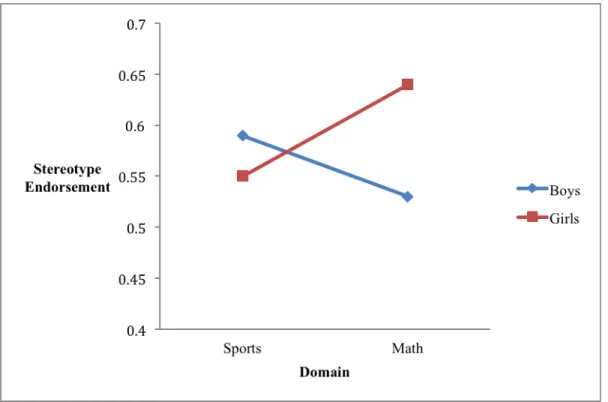
Gender x Target Gender interaction, and the Target Gender x Domain interaction were significant, F(1, 55) = 43.39, 4.00, and 71.72, p's < .05. The main effect of Gender, the Rater Gender x Target Gender interaction, and the Rater Gender X Target Gender X Domain were not significant, F(1, 55) = 0.98, 1.17,1.14, p’s > .05. Hypothesis 3a was partially supported for the domain of sports: Boys associated boys more than girls with "good at sports." However, girls were equally likely to select "good at sports" after viewing photos of either boys or girls (see Figure 1). The hypothesis was not supported within the math domain, as boys were more likely to associate girls with "good at math" than boys. Girls' "good at math" proportion scores did not differ depending on the gender of the child in the target photo.
Gender Differences in Explicit Stereotype Endorsement
Both boys and girls viewed boys as better in sports than math. The hypothesis was partially supported that stereotype endorsement would depend on gender, as boys rated boys as
significantly better at sports than girls, but this same significant difference was not found in the math domain (see Figure 2 & Figure 3).
Self-Concept in Math and Sports by Gender
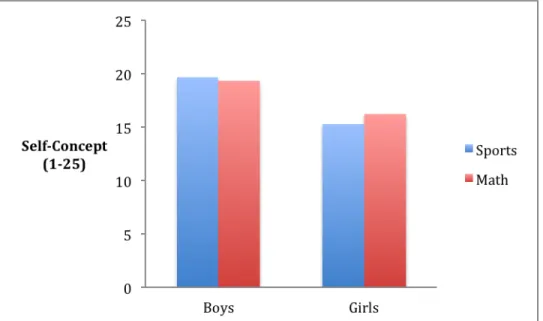
One-way ANOVAs were conducted to analyze gender differences in math and sports self-concept. Boys reported having significantly higher self-concept than girls in both math and sports F(1,55) = 6.3 and 7.7, respectively, p's < .05. Hypothesis 4, that traditional stereotypes would be reflected in gender differences in self-concept, was supported for both math and sports (see Figure 4).
Discussion
and explicit stereotype endorsements in math or sports among boys. This finding suggests that, like girls, boys are not demonstrating consistency in the relationship between implicit and explicit stereotype endorsement.
Children's implicit and explicit gender stereotype endorsement was expected to differ by gender. The significant three-way interaction on explicit stereotype scores showed that girls viewed girls as equally able in math and sports, whereas boys viewed girls as better in math--an academic domain--than in sports. Both boys and girls viewed boys as better in sports than girls, and also as better in sports than in math.
Implicit scores indicated that boys were also more likely to associate girls with being "good in math" than as "good in sports." Although boys were more likely to select "good in sports" after viewing a photo of a boy than a photo of a girl, they were equally likely to indicate that a Chinese character indicated "good in math" after viewing either gender. These results support the hypothesis that boys support traditional sports stereotypes, but not the hypothesis that they would endorse traditional math stereotypes. Contrary to expectations, girls' scores on the AMP showed that both boys and girls were more strongly associated with being good in sports than with being good in math.
Limitations
Given that this study took place in two separate locations, a possible confounding variable for this study includes the two types of sites where data collection took place. The first set of data collection took place at a summer sports camp with mostly male campers, while the second portion of the study took place at a structured school environment. Children were pulled out of their current sports camp activity in the first round of data collection, while children were pulled out of a classroom setting in the second wave of data collection. The mindset of each group possibly differed at the time of data collection, with academic standards more salient in a school setting, and sports standards more salient in the YMCA setting. Additionally, the sports camp had significantly more male than female campers, possibly influencing the mindset of both groups, making gender identity more salient at one location than another location.
Fatigue was problematic for some of the participants. After preliminary data collection, the researchers decided to remove the science section of the implicit, laptop portion of the study because children began to show boredom and exhaustion. This removal decreased the total number of trials. It was helpful to make this change to prevent the children, many of whom were younger than 10, from experiencing boredom and frustration. Children learn at different rates, and reading level could certainly differ among children who participated in this study. Reading level undoubtedly differed not only among participants within the same grades, but between grades as well.
asked to rate group differences for Black and White students, but not Latino students. Regarding ethnic or racial identity, the measures should include the group of the participating children when possible. Having been left out of the racial category could influence responses, whether
decreasing or increasing bias.
The implicit and explicit stereotype endorsement measures differed in that the implicit AMP measure used photographs of children. These photographs differed by race and gender, complicating the ability to disentangle race from gender identity. Therefore, the analysis of the implicit data is composed of all White participants rather than collapsing across race. This complication could have influenced the results.
When studying gender differences, it is possible for the gender of the data collector to influence the responses of the participants. However, the researchers tried to avoid this problem by not watching children's responses and by using a blank copy of the explicit questionnaire when children raised questions. These procedures were used in order to increase the comfort level of the participants and make children feel comfortable responding accurately and truthfully. However, race and gender did differ among research assistants, and it is possible that the results were influenced by the gender or race of the data collector.
Future Research
stereotypes of Latino children as well as non-Latino children's views of gender differences in the abilities of Latinos would enhance our understanding of stereotype development.
While it is true that children of this age are aware of gender stereotypes, it is also likely that parental stereotype endorsement impacts their children’s stereotype endorsement. Wood, Kurtz-Costes, Rowley, and Okeke-Adeyanju (2010) found that within African American families, African American mothers had higher educational expectations for their daughters than sons. A possible explanation for the finding that boys report being better than average across domains is to possibly view the group in which they identify as more competent in order to overcompensate for lower expectations. This circumstance could be a result of the need to boost self-esteem as a protective measure against negative stereotypes. While Wood et al. (2010) examined gender only within African American families, future research could examine the relationship between parental and child stereotype endorsement across a diverse ethnic sample. The messages parents send their children regarding gender stereotypes could be conscious or unconscious, but likely influence what subjects in school both boys and girls pursue, as well as career paths later on in their lives.
Future studies should replicate these findings. The lack of correlation between explicit and implicit stereotype endorsement indicates that there is a discrepancy between how
An electronic explicit measure to facilitate the process of data collection and make the process more fluid would also be beneficial. Researchers discussed making this adaptation during the study in order to provide more uniformity in the data collection. Given that these data were Time 1 data, it would be beneficial to analyze Time 2 data, utilizing the ability to match the gender of the data collector to the participant in order to reduce the probability that research collector gender influences the outcomes. Ideally, this future replication would match the gender of the data collector with the gender of the participant in order to remove any confounding variable of potential demand characteristics. If the gender is not matched, children could possibly change their responses based on what they think the data collector would like to see rather than how they actually feel.
As evidenced in this study, traditional stereotypes are still present under certain circumstances, and such stereotypes differ by gender. Future studies should study stereotype endorsement longitudinally, both implicitly and explicitly to accurately measure developmental changes. While the measures may be difficult to employ with younger children, examining implicit and explicit stereotypes within younger groups could be useful for assessing
References
Ames, D. R. (2004). Strategies for Social Inference: A Similarity Contingency Model of Projection and Stereotyping in Attribute Prevalence Estimates. Journal of Personality and Social Psychology, 87(5), 573-585. doi: 10.1037/0022-3514.87.5.573
Briñol, P., Petty, R. E., & Wheeler, S. (2006). Discrepancies between explicit and implicit self-concepts: Consequences for information processing. Journal Of Personality And Social Psychology, 91(1), 154-170. doi:10.1037/0022-3514.91.1.154
Greenwald, A. G., McGhee, D. E., & Schwartz, J. K. (1998). Measuring individual differences in implicit cognition: The implicit association test. Journal Of Personality And Social
Psychology, 74(6), 1464-1480. doi:10.1037/0022-3514.74.6.1464
Kurtz-Costes, B., Rowley, S. J., Harris-Britt, A., & Woods, T. A. (2008). Gender stereotypes about mathematics and science and self-perceptions of ability in late childhood and early adolescence. Merrill Palmer Quarterly, 54, 386-409.
Nosek, B. A. (2007). Implicit-explicit relations. Current Directions In Psychological Science, 16(2), 65-69. doi:10.1111/j.1467-8721.2007.00477.x
Payne, B. K., Hall, D., Cameron, C. D., & Bishara, A. J. (2010). A process model of affect misattribution. Personality and Social Psychological Bulletin, 36, 1397-1408.
Payne, B. K., Burkley, M. A., & Stokes, M. B. (2008). Why do implicit and explicit attitude Tests diverge? The role of structural fit. Journal of Personality and Social Psychology, 94, 16-31.
Pickering, Michael. (2007). Stereotyping and Stereotypes. Blackwell Encyclopedia of Sociology. doi: 10.1111/b.9781405124331.2007.x
Rowley, S. J., Kurtz-Costes, B., Mistry, R., & Feagans, L. (2007). Social status as a predictor of race and gender stereotypes in late childhood and early adolescence. Social Development, 16, 150-168.
Stewart, B. D., von Hippel, W., & Radvansky, G. A. (2009). Age, race, and implicit prejudice: Using process dissociation to separate the underlying components. Psychological Science, 20(2), 164-168. doi:10.1111/j.1467-9280.2009.02274.x
Wilbourn, M., & Kee, D. (2010). Henry the Nurse is a Doctor Too: Implicitly Examining Children’s Gender Stereotypes for Male and Female Occupational Roles. Sex Roles, 62(9/10), 670-683. doi:10.1007/s11199-010-9773-7
Wood, D., Kurtz-Costes, B., Rowley, S. J., & Okeke-Advaniu, N. (2010). Mother’s academic gender stereotypes and education-related beliefs about sons and daughters in African American families. Journal of Educational Psychology, 102(2), 521-530. doi:
Note. Standard deviations in parentheses. Superscript indicates the means are significantly different from each other, p’s < 0.05
Means and Standard Deviations for Implicit Attitudes, Explicit Attitudes, and Self-Concept, by Rater Gender
Rater Boys’ Ratings
(n = 38)
Girls’ Ratings (n = 19)
Total (N = 57) Implicit Attitudes
Sports
Boys (Black and White) 0.65 (0.14) 0.48 (0.16) 0.59 (0.17)
Girls (Black and White) 0.51 (0.14) 0.54 (0.10) 0.52 (0.13)
Boys (White only) 0.65b (0.14) 0.64a (0.16) 0.59 (0.17)
Girls (White only) 0.51a (0.23) 0.64a (0.21) 0.55 (0.23)
Math
Boys (Black and White) 0.53 (0.12) 0.47 (0.11) 0.51 (0.12)
Girls (Black and White) 0.56 (0.12) 0.56 (0.10) 0.56 (0.11)
Boys (White only) 0.59b (0.18) 0.42b (0.21) 0.53 (0.20)
Girls (White only) 0.64a (0.18) 0.45 b (0.16) 0.64 (0.17)
Explicit Attitudes
Sports
Boys’ Competency 89.6a (15.20) 87.9a(19.12) 89.1 (16.43)
Girls’ Competency 44.6c (24.71) 60.90b (19.36) 49.9 (24.12)
Math
Boys’ Competency 72.1b (14.60) 66.2b (19.39) 70.1 (16.38)
Girls’ Competency 70.4b (14.95) 68.2b (16.80) 69.7 (15.45)
Self-Concept
Sports 19.7d (5.65) 15.3e (5.64) 18.2 (5.97)