Taxes and Toxicity:
Exploring the Feasibility and Political Landscape Surrounding a State-Level Carbon Initiative in North Carolina
By Emily Hennen
Senior Honors Thesis
Environment, Energy, and Ecology Program University of North Carolina at Chapel Hill
April 3, 2019
Approved:
Dr. Léda Van Doren, Thesis Advisor
Jonas Monast, Reader
Table of Contents
I. Abstract 3
II. Prologue 4
III. Introduction 4
IV. Background 5
Global Relevance and Example Initiatives 5
Relevance for North Carolina 9
North Carolina’s Energy Production 12
Structuring a Carbon Tax 13
V. Methods 16
VI. Results 17
Nonprofit and Individual Perspectives 17
Dr. Stanley Meiburg – Wake Forest University, Former EPA Deputy Administrator, NCDEQ 17 Dr. Yoram Bauman – Washington and Utah Initiatives, Carbon Tax Center 19 David Kelly – NC Environmental Defense Fund (EDF): Senior Policy Manager 20 Grady McCallie – North Carolina Conservation Network, Policy Director 22 Bridget Hillyer – Citizens Climate Lobby, Lobby Team Leader 23
NC State Legislators 24
Charles McGrady – House of Representatives, Henderson, Republican 24 Pricey Harrison – House of Representatives, Guilford, Democrat 26 John Woodard – Senate, Durham Granville and Person, Democrat 27 John Autry- House of Representatives, Mecklenburg, Democrat 28
Detailing Mentioned Revenue Uses 28
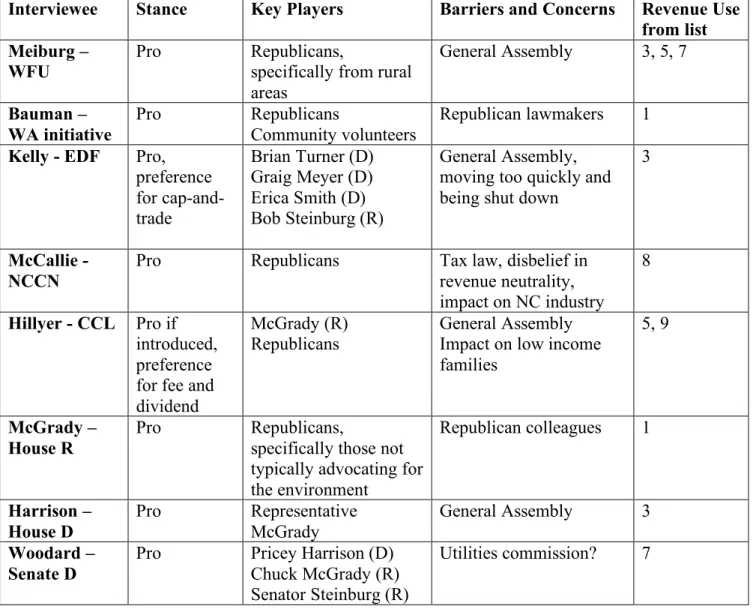
Interview Summary 31
Table 1: Summarization of Interviews 31
VII. Discussion 32
Map 1: Senator’s Number of Terms in Senate by District 33 Map 2: Senator’s Number of Terms in General Assembly (House + Senate) By District 34 Map 3: Senate Republican and Democratic Distribution by District 34 Map 4: Representative’s Number of Terms in House by District 35 Map 5: House of Representatives Republican and Democratic Distribution by District 35 Map 6: Counties of Relevance for a Carbon Pricing Initiative 36 Map 7: North Carolina Urban, Suburban, and Rural Counties 37
VIII. Conclusion 38
IX. Acknowledgements 41
I. Abstract
This paper specifically explores carbon tax at the state-level as a method to reduce carbon emissions, discussing its feasibility and political landscape within North Carolina. This is done through nine interviews with state politicians, environmental nonprofits, and experts in
environmental policy. Each was asked their personal opinions on a state-level carbon tax, their thoughts on its feasibility, what tax revenue uses would be optimal, and who they felt would be key players in making such an initiative successful. “Toxic” is used by interview subjects in this paper not only to describe coal ash and greenhouse gas emissions, but also the political and economic structures directed at regulating these emissions. Interview results have shown that a conservative and revenue-neutral proposal is most likely to succeed in the state’s republican-majority General Assembly, but even that is highly unlikely, and activists are concerned with the disproportionate impact of such a tax on low-income families. Results found that key individuals would support a carbon tax, but agree such policy is unlikely to be successful in North Carolina in the near future and significant Republican support would be necessary in making one possible. It was found that while most Democratic legislators and environmental experts would prefer a carbon pricing system that addresses issues of environmental injustice, that is least likely to succeed. Instead, targeting renewable energy expansion and economic growth would be most approved by Republican lawmakers. Additionally, these Republican lawmakers would likely need to be the ones to present the initiative in order for ultimate success, which remains unlikely and would not address concerns of environmental injustice and energy inequality. This research can be utilized to provide insight for future efforts in pursuing state-level carbon pricing
II. Prologue
“Today we are faced with a challenge that calls for a shift in our thinking, so that humanity stops threatening its life-support system. We are called to assist the Earth to heal her wounds and in the process heal our own - indeed to embrace the whole of creation in all its diversity, beauty and wonder. Recognizing that sustainable
development, democracy and peace are indivisible is an idea whose time has come”
–Wangari Maathai
III. Introduction
Substantial renewable energy economy, breathtaking mountainscapes and beaches, massive agricultural production: each of these are sources of pride and identity for North Carolinians. For many, so too are low tax rates and small government. With this, North
Carolina’s position within the Southeast and as the nation’s number two producer in both solar energy and hog products is both economically meaningful and seemingly contradictory. For this reason, the exploration of the feasibility of a carbon tax is particularly unique and interesting. Economic and political models that are successful in other states might not carry weight in the heterogeneity of North Carolina’s geography and population. This research aims to decipher whether or not a carbon tax would be a successful and feasible model in North Carolina, particularly in light of carbon pricing initiatives in the Northeast and along the Western coast. North Carolina is uniquely situated amongst these initiatives and as a major driver of renewable energy production and innovation, but it still maintains its conservative political and economic singularity. With this, this paper aims to answer:
1. Is a carbon tax initiative is feasible for North Carolina, and what would need to change in order to make one successful?
2. What revenue uses for such a tax would be favorable?
Carbon pricing, specifically taxation, is of the most well-known methods for reducing global greenhouse gas emissions. However, less than five percent of the world’s fossil fuels have a carbon tax (Bauman & Komanoff, 2017). It is widely controversial in that it can take on many forms and impacts; Who bears the cost? Where does the added tax revenue go? Who benefits? The answers to these questions can vary greatly from location to location, and generally determine from where support for such an initiative can come. North Carolina recently lost its Republican supermajority in the legislature and has a Democratic governor in office, but Republicans still have most of the power in the state. For this reason, conservative insight on carbon taxation is of particular importance when moving forward. However, the activism and concerns of the larger population may have significant influence on the interest to explore such initiatives. This research could be used to help inform policymakers and environmental activists moving forward who are interested in pursuing a state-level carbon price in North Carolina. It provides a range of perspectives and insight on its potential, but is lacking in some diverse perspectives due to inability to receive interviews with some key players. By discussing the topic through a set of nine interviews with state legislators and a few of the state’s major
environmental organizations, this project works to map the current political framework
surrounding carbon pricing in North Carolina and what would need to change in order to pass a carbon tax.
IV. Background
Global Relevance and Example Initiatives
which stressed the severity and risk associated with current carbon emissions. It recommended a shift from the typical mentality of risk surrounding a two-degree Celsius increase in global temperature, stressing the risk surrounding even a one and a half degree increase (IPCC Special Report: Global Warming of 1.5oC, 2018).
William Nordhaus, a Yale Economist who won the Nobel Prize for his work on carbon pricing, describes a carbon tax as the singular most effective mitigation strategy for solving the climate crisis defined by the UN. However, he claims that the UN target of 1.5 degrees Celsius will be far more expensive than the public has been lead to believe, possibly even more
economically harmful than future reparations would be after surpassing that threshold. He also describes carbon tax as “politically toxic” in the United States (Nordhaus, 2018). This is true on a national level – Grover Norquest has Republicans sign agreements that they will never raise taxes, making it nearly impossible to pass a tax increase. Nonetheless, a number of regions and states have taken on the task to explore and implement carbon taxes.
little harm to the economy. A number of factors were noted to have came together to make this tax possible, specifically “availability of untapped hydro potential, a surge in public concern for climate change, a committed leader with the institutional capacity to pursue his personal policy preferences, and a right-of centre government with the trust of the business community”
(Harrison, 2013). Of particular interest is the note of untapped renewable potential, of which North Carolina has plenty, and a right-leaning government with trust in the business community, which to some also reflects North Carolina’s political situation. While North Carolina has been identified as an ideologically challenging location to pursue a carbon tax (Bauman & Komanoff. 2017), the view of a right-of center government as an asset for a carbon tax economy in British Columbia might be of interest to those wishing to find North Carolina adopting one as well. The tax in British Columbia covers combustion emissions of all greenhouse gases, but excludes emissions from non-combustion, like cement production (which is a major industry for the province). The strategy of exclusions or limits for certain industries could be a politically
significant strategy to gain support. Additionally, all revenue from the tax is used to cut taxes for individuals and corporations, which has aided in increased support and limited negative
economic impacts (Harrison, 2013).
equity” (Metcalf, 2008). There is a wide range of proposed social-cost estimates for carbon pricing to offset the unequal burden, and consensus to suggest a price for environmental impact alone is just as lacking. “[The Proposal] suggests setting an unambiguous price signal through a tax at a modest level initially with a commitment to increase it over time. The revenue would be used to fund a reduction in the income tax. A clear price signal would provide the incentive for firms to begin the process of adjusting their behavior and investment to offset and avoid
emissions” (Metcalf, 2008). Metcalf goes on to recommend placing this tax on producers, or “upstream,” rather than “downstream” on varied individuals and firms. “[Consumers] are more influenced by the final price of energy, regardless of whether that price is affected by taxes or other factors. Offsetting any apparent advantage of downstream visibility is the greater
administrative burden of levying the tax on many more firms and individuals,” (Metcalf, 2018). In other words, it is significantly easier to tax large producers, as consumers will still see the increased cost of electricity and adjust consumption habits accordingly. Additionally, this puts the responsibility of reducing emissions and opting for more renewable energy on electricity producers. This is important because, were the burden on consumers, they would have less capacity to choose from where their electricity comes, unless they were to invest in personal solar panels. Industries can make these decisions and invest in renewables to decrease their tax payments and shift the state’s energy portfolio.
Finally, this project developed from close connection with carbon tax initiatives
doing enough.” The initiative proposed a replacement of the state’s tax on electricity with a carbon tax with the intention of being “revenue neutral” (Bauman, 2018). Following the failure of this initiative, Bauman now works to develop a similar carbon tax initiative in the state of Utah. Here, his legislative efforts have failed in chambers, and so he is working to run a ballot initiative for the bill. It is important to note that both initiatives have noted preference for ballot measures, which allow voters to decide on an issue in elections without as much legislative engagement (Bauman, 2018). Ballot measures are not an option for North Carolina, and thus all bills and resolutions must be proposed by and passed through the General Assembly. However, these initiatives and the work of Dr. Bauman provide insight into the workings of propositioning a carbon tax.
Relevance for North Carolina
In 2018, North Carolina Governor Roy Cooper signed an executive order to reduce the state’s greenhouse gas emissions by 40% by the year 2025. This call to action for carbon reduction is not reflected in the state’s General Assembly and its legislation. However, the election on November 6, 2018 led to a break in the Republican supermajority, which leaves more room for compromise, discussion, and debate across the aisle. Nevertheless, this research has been conducted under the premise that a state-level carbon tax in North Carolina is not actively discussed nor considered, and looks upon previous research and interviews to gain insight as to why that is so.
energy through power-houses like Duke Energy. The hope for a carbon tax in North Carolina would be that it may work as a method to disincentivize carbon based energy, encouraging consumers to turn towards more sustainable forms of energy (like wind and solar). However, in North Carolina especially, there are significant ideological challenges that might prevent a carbon tax initiative from gaining support amongst legislators, businesses, and even
environmentalists. These varying perspectives are explored to some extent throughout this paper, although there remain voices that are missing. Through examining the perspectives of some major actors in NC energy policy, a landscape of the political climate surrounding an NC carbon tax is developed, while challenges that would need to be overcome in order for one to be
successful are put forth.
One cannot discuss carbon reduction in North Carolina without also discussing the role of renewable technology on the economy. “When climate-specific [Research and Development] targeting instruments are available, policy has to use these to step up early innovation. When these instruments are not available, policy has to steer innovation through creating demand for emission saving technologies” (Gerlagh et al, 2009). As a state recognized for its solar energy production and renewable energy research, this statement implies that the best way to enhance research and development in North Carolina is through renewable energy policy and an economic focus. However significant the renewable energy sector is, the impacts of climate change and extreme weather on the state are also worth noting.
A University of Stony Brook experimental report released in September 2018 following Hurricane Florence estimated the change in rainfall relevant to climate change, noting a
significant increase due to overall rising temperatures. The study specifically noted a significant increase in rainfall during Hurricane Florence, arguing that the impacts would be less
consequential without global rise of temperature (Reed et al., 2018). This year, North Carolina experienced numerous incidences of extreme weather, most notably Hurricane Florence, which destroyed homes, impacted water quality, and impaired the agricultural sector in the Eastern part of the state. Research estimates that rainfall and intensity increased 50% and storm sized
2018). The order went on to address concerns for public health and safety, then noting a goal to reduce carbon emissions and energy consumption by 40% while increasing zero-emission vehicles in the state. This shows direct interest and concern of the state’s government and significance for citizens impacted by climate change.
Other contextual factors for North Carolina may make this more challenging. Electricity use is significantly higher in the South, meaning a carbon tax on consumers would put a greater burden on individuals in our state (Pizer et al., 2009). This could cause particular concern for low-income individuals with older systems or poor insulation, and would be a concern for the legislature. Exploration of this electricity use and production is thus significant.
North Carolina’s Energy Production
According to the North Carolina Department of Environmental Quality’s Greenhouse Gas Emission Inventory, the state had gross emissions of 150.08 millions of metric tons (MMT) of CO2-equivalent. Of this, 81% comes from CO2, while the remaining 19% comes from other greenhouse gases that were converted to CO2-equivalent using their global warming potential. The prevalence of other greenhouse gases in the state’s emission inventory should be considered in determining if these gases should be taxed as well.
Fossil fuel combustion is responsible for the majority of North Carolina’s emissions, and these are distributed amongst different energy sectors. The figure below shows that 35% of emissions are from electricity use, 32% from transportation, 14% from
While 150.08 MMT is significant in terms of pollution, the state has reduced its gross emissions by 19% since 2005. Its coal related emissions have been reduced by 53%, although natural gas has seen a massive 122% increase in emissions (NCDEQ, 2017). Exploration on if North Carolina could tax emissions from this increase, as well as additional details on the structure of a potential carbon tax, can be found below.
Structuring a Carbon Tax
Although multiple states are considering their own carbon tax or carbon pricing
Who should be taxed? At the state-level, it appears to be easiest and most direct to tax at the supply chain of fuels. “Large industrial emitters, including power plants, refineries, and a wide range of industrial facilities must report their GHG emissions to EPA each year. EPA makes this data publicly available and any state can use this information to identify potential taxable emissions and estimate their potential revenues under different assumptions about which facilities would be subject to the tax,” says a guide to state-level carbon tax initiative from Brookings (Bauman et al., 2016). The burden of the tax would still fall upon consumers, as producers would adjust their prices accordingly to address the tax. However, these producers have a higher capacity to change their sources of energy production to renewables, while
consumers have less control over where their electricity comes from unless they choose to install personal home solar systems.
Which sectors should be taxed? The initial project under which this research started proposed this tax as a replacement on the state sales tax on electricity. This would be particularly easy considering the fact that these industries already report their emissions to the EPA.
What should the tax price and trajectory be? In North Carolina, the tax would need to start low in order to avoid significant political opposition. However, if the tax were to start too low or progress slowly may not provide enough power to shift energy production and reduce emissions (Bauman et al., 2016). The benefit of a tax over other carbon pricing options is that the increasing prices can be standardized according to the state of the economy, as the price can increase more gradually (Kennedy et al., 2015). This will limit economic shock for North Carolina’s economy. Additionally, a carbon tax has significantly lower administrative costs compared to other pricing structures, which can allow for a lower cost on consumers (Bauman, 2019). Regardless, the cost of implementing and managing a tax would need to be explored and considered by finance specialists if legislation is put forth.
How can it be passed? The Washington State and Utah initiatives both developed from a ballot measure, which is an option that is not present in North Carolina. For this reason, a bill or resolution can only be introduced by an elected member of the state’s General Assembly. Given the interview subjects and their affiliations, it is most likely this bill would be presented in the House in its first reading. It is then referred to a committee. Most likely, this would be referred to the House Finance Committee, where all six chairs are Republican. It could also be referred to the House’s Committee on Energy and Public Utilities, on which both chairs and the vice chair are also Republican, or the Environment House Standing Committee, where both chairs are also Republicans and both vice chairs were interviewed for the purpose of this project
the second chamber, it must return to its chamber of origin (UNC School of Government, n.d.). This can be a lengthy process, and given the Republican majority present in the North Carolina General Assembly, its feasibility for a carbon tax is of particular concern. This drives the research to follow.
V. Methods
In order to understand the political climate surrounding carbon tax in North Carolina, state legislators and individuals from environmental nonprofits were interviewed. Four state legislators were interviewed, as well as five individuals from different governmental and
nongovernmental affiliations. Each were asked a series of questions relating to their thoughts on a carbon tax in North Carolina, its feasibility, and potential revenue uses. These four core questions are listed below, while follow-up questions related to the topic varied by interview content and time allowance.
1. Do you think a carbon tax would be a feasible option for North Carolina? 2. What would need to change in order to make one successful?
3. What revenue uses would be favorable?
4. Who else needs to be on board or involved for this?
an Earned Income Tax Credit, further research on renewable resources, or more money for farmers.
These interviews were documented via hand-written notes. Interviews were not recorded due to the nature of these conversations. The following provides a synthesis of thoughts and insight given in these conversations, listed by interviewee, and direct quotes are only shown within quotation marks and italics when given.
VI. Results
Nonprofit and Individual Perspectives
Dr. Stanley Meiburg – Wake Forest University, Former EPA Deputy Administrator, NCDEQ Dr. Stanley Meiburg, who was the previous Deputy-Administrator of the EPA and now the Director of Sustainability at Wake Forest University and chair of the NCDEQ’s Air Quality Commission, feels emphasis on mitigating current extreme weather should be prioritized over the discussion of “climate change” when discussing the importance of emission reductions. This is due to the partisan association of the term and the tendency for Republican officials to deny its validity. This is particularly important given the extended period over which Republicans have been in the majority in the state’s legislature; it means little compromise with the left has been necessary in order for conservative efforts to be successful. For this reason, a project would need to be within the direct interest of Republican legislators and would have less success were it a negotiation or compromise.
Senator Apodaca that prompted the presentation of such a bill. Dr. Meiburg noted that creating a direct, personal impact on Republican legislators can be done through focusing the project on resiliency in the face of extreme weather events or on benefits for agricultural communities. This would mean key players in this aspect would include legislators who represent coastal and agricultural communities, and potential revenue uses could target coastal resiliency projects or economic development tools for farmers. Meiburg specifically noted expanding research
surrounding biofuel from hog waste, acknowledging that farmers would not like the government dictating their farm’s fuel use and energy operations, but would be more likely to support a tax if it could provide them with a monetary gain for their waste. This would dually interest coastal communities in that it would prevent nutrient loading and runoff from agricultural waste. Dr. Meiburg stated that emphasis on rural and agricultural concerns is also of importance due to the general trend wherein rural legislators experience less turnover in their roles, thus holding more seniority and power in the legislature.
Likewise, although seemingly straightforward, wind and solar energy expansion could also incentivize farmers and rural communities by providing stable income for their land. Given the uncertainty of international and trade policies, farmer subsidies have become significant to incentivize continued agricultural production. However, if farmers can be assured of a stable income source through renewable energy sales, the government cost for farmer’s subsidies could decrease significantly.
funds represent a strong demand for renewable energy growth and a potential need for tax revenue to fund solar rebate expansion.
Dr. Yoram Bauman – Washington and Utah Initiatives, Carbon Tax Center
PhD economist Yoram Bauman has worked on carbon tax initiatives in the states of Washington and Utah while educating and assisting other carbon pricing initiatives nationwide. In the past, opposition of a carbon tax from organizations and legislators on the left may not have been a concern. However, his previous ballot initiative in Washington State faced such
opposition, as groups like the Sierra Club felt the tax did not do enough; that is to say, it did not address the issues of climate change to their satisfaction. Their ideal would have been to use revenue to promote climate mitigation and adaptation strategies while correcting issues of
environmental injustice. The Washington ballot initiative ultimately failed, in part because of this opposition, and groups on the left are now working to create their own bill. Despite the
challenges brought on from the left, when the founder and co-chair of the first ballot initiative, Dr. Yoram Bauman, was asked what he would do differently, he said he would spend less time on working to change the minds of folks on the far left and more time gaining support from the rest of the community. While North Carolina does not have the option for a ballot initiative (and thus a bill needs to be presented by an elected official), he emphasized that it is important that the initiative be supported by officials on the left and the organizations and communities which support them. This may be even more relevant should there be a shift or increase in Democratic seats during the upcoming election.
However, the most important revenue option is that which will get the most approval in the general assembly. His main objective is to gain support and push a bill forward, which has been his goal in his most recent Utah initiative. In Utah, a team working on a carbon tax got a bill introduced, but it was ultimately unsuccessful. The question is now whether the initiative should try once again through the legislative process or push for a ballot initiative. Bauman favors the ballot initiative, specifically one which gains is signatures through volunteers. This would be less threatening to the legislature while also encouraging the community to get involved in climate issues. “Why not try,” he said, “you energize and mobilize people, you open up certain pathways for them and the community as a whole, just by trying.”
David Kelly – NC Environmental Defense Fund (EDF): Senior Policy Manager
David Kelly from the Environmental Defense Fund in Raleigh has significant expertise in clean energy and creating partnerships between key stakeholders and institutions. In speaking in his official capacity, Kelly stated that EDF prefers cap-and-trade to a carbon tax because it allows a greater ability for regulated entities to drive reduction deeper and go beyond the cap. However, the organization would be interested in any initiative to put a price on carbon, but with particular interest in revenue use for a dividend directed back at consumers.
for the state. Additionally, the rebates act as a profit center for industries like Duke Energy, which provides rebate money through credit that they are later able to cost recover.
David Kelly says he believes there is no right policy, only right players. With this, champions in the general assembly are key. The structure of the tax should benefit rural areas in the state, as the majority of North Carolina’s counties are rural. The initiative should start by recruiting Republican legislators who support clean energy, focusing on the business and
economic aspects, and others will follow. As seats shift, the state moves towards narrow margins where there can be bipartisan progress. He believes more Republicans believe the science behind climate change than the public knows of, but they are not speaking on it, and questions if it is a result of politics or belief in unurgency? On the other side of the aisle, Democrats often defer to one another if one is identified as an environmental expert, which can help gain support from that party.
Kelly identified a number of key players, both from legislative and utility perspective (which he identified as key). These are: Brian Turner from Asheville, whose district leans conservative while he is Democrat; Graig Meyer, who is rising in environmental policy; Erica Smith, the former chair of the legislative black caucus; Bob Steinburg, who recently transitioned from the House to the Senate and promotes wind while opposing offshore drilling. This senate placement is key, as there are fewer environmental allies present.
Grady McCallie – North Carolina Conservation Network, Policy Director
Grady McCallie was interviewed from the North Carolina Conservation Network in 2018, and began his discussion by emphasizing the importance of equitable and sustainable environmental solutions. He expressed that public awareness on climate policy is a public good, but that the best direction forward for North Carolina is on merits aside from climate –
specifically, the benefit of renewables for the economy. Republican legislators will be responsive if and when they see their districts making money. Although Governor Cooper would support a carbon price, the General Assembly would not, and as such a truly bipartisan policy would be necessary. However, he does not think it would feasibly pass in the Senate, and furthermore in North Carolina at all.
In terms of tax revenue, McCallie is hesitant on a tax introduction given its surrounding contention in the state legislature. This is especially true considering the needs surrounding education and healthcare, and some may argue that the use or replacement of tax revenue to address environmental concerns is unethical and unlikely to be looked at by the legislature. Additionally, he believes that replacement of sales tax on electricity would not be truly revenue neutral and would work with his team to look and see if the tax would be progressive or
regressive and how the revenue is being used. A carbon tax could be used to fund current budget deficits, but revenue would need to be directed towards essential services.
so that tax would need to effectively shrink government. This might be the case if revenue decreases over time as the energy systems transition.
He ended the conversation by stating that it is hard to imagine something like this being successful in 2019. If the Republican party fractures and Trump leaves office, there might be a situation in North Carolina where the Republicans left are willing to compromise. Similarly, if Democrats take over in 2020, it would be hard, but easier as a revenue raiser. Ultimately, his methodology is to work to accomplish the same goals through a number of smaller, unrelated policies like opening more renewable options and providing renewable tax credits. These can provide the same market result of making renewable energy cheaper, but without the significant conflict.
Bridget Hillyer – Citizens Climate Lobby, Lobby Team Leader
When asked if it would be feasible in North Carolina, she says “If you say carbon tax, people will laugh at you.” Although a number of Republicans are pushing for renewable energy innovation, the makeup of the legislature would need to continue to change. The awareness and concern for climate change in constituents is increasing, and she noted the hurricanes as an event that really got the public’s attention. Although more extreme weather events are not ideal, they encourage citizens to speak out in concern for the state’s future (as she has seen in her lobbying efforts at the coast). She states that the important action moving forward at the national level is the same as it would be at the state level: get people involved and help them to feel empowered, because when someone sees the change that they can make in changing the minds of legislators and promoting change, it is much harder to feel hopeless about the planet’s future.
Her concern is with environmental justice, so using revenue to direct money back into families who will experience higher prices is the preferred option. If that was mitigated in other ways, she would also like to see funds used to further spur innovation and incentivize
development of new technologies and job retraining in the renewable energy sectors. Regardless, she acknowledges that Republicans have the power and most influence in the legislature, and that their support would be essential in getting legislation passed. She specifically mentioned Representative McGrady as a Republican who could make something like this possible.
NC State Legislators
Charles McGrady – House of Representatives, Henderson, Republican
said that he feels the effort would be best led by the GOP, and that the market should be used to act on climate change. He feels it is important in matters like this to gain voter support by “creating a demand,” ie: raising awareness about an issue and its causes that will lead them to demand change or action from legislators.
He then went into some detail regarding how to navigate these issues in North Carolina’s current political climate. Numerous times throughout the meeting he emphasized the tribal nature of the GOP and how that may prove to be an obstacle. He emphasizes that his colleagues are concerned with conservative voters, but that they will be more likely to respond if other legislators face backlash for anti-environmental stances.
He recommended some individuals and groups to contact for support, emphasizing the importance of leaders over supporters. First, he mentioned the military, as this is a direct issue on their radar. He later brought up John Szoka who served in the US army and has experience with climate policy (he worked on a specific initiative to open 3rd party energy sales in NC to open up to solar market). In terms of other legislators, he said finding a “finance guy” would be important (as he serves on the appropriations committee, and could not provide specific financial insight). Then he recommended Paul Steinberg (who is from a coastal district and familiar with climate issues/wind energy policy), John Harvester (a young legislator from Greensboro), Bill Brawley (Charlotte Representative interested in tax policy), and Jonathan Jordan (who is connected with Appalachian State). He said this is a good time to be tackling a new issue because policy makers are focused on reelection.
immediately turn off Republicans, which should be avoided. With this, working to convince legislators of climate change issues and their validity may be ineffective. As Republican Representative Chuck McGrady, who is in support of carbon pricing, said: an initiative that promotes activism and rallying behind an issue (particularly from young persons and/or
academic institutions) is unlikely to get conservative support in the current legislature. In fact, it serves as a deterrent for some.
Pricey Harrison – House of Representatives, Guilford, Democrat
Representative Pricey Harrison, a Greensboro Democrat serving her eighth term in the House, recognizes her role as an environmental champion in the House. She has chaired the NC Envrionmental Commission, and states that the main concern for environmentalists in state policy are in preventing the current rollbacks that are taking place. In her words, a carbon tax at the state level is not feasible right now; “You can’t say ‘sustainability’ or ‘climate change’ on the house and senate floors.” For that reason, environmental initiatives need to be packaged
differently, often putting an emphasis on farmers and agriculture. Representative Harrison stated she would be very much in favor of a carbon tax, but she along with other environmental
advocates sitting at the table (namely Grady McCallie, who was interviewed previously and discussed below) stated the hope is to develop a number of smaller policies that accomplish the same goals as a carbon tax. Harrison says she worked on a project within the Smithfield
settlement to redirect money to farmers for carbon offsets; in her mind, it was the closest North Carolina has gotten to carbon pricing, but it was not called that. Instead, the focus is on
standard. Similarly, the focus of smaller initiatives that are less controversial to achieve the same result of a carbon tax is her method for promoting renewable energy in North Carolina at this time and under these political restrictions.
John Woodard – Senate, Durham Granville and Person, Democrat
Senator Woodard stated that he thinks the theory behind carbon tax is solid and one he would support, but it would be a political challenge. He said he would be curious to see all of the data behind a potential tax and how it could benefit the state and encourage others to get on board.
After asking what revenue options had been explored and hearing the example of
replacing sales tax on electricity, he expressed hope and concern that low income families would still pay proportionally less of that tax. He then went on to recommend that perhaps carbon tax revenue could be used to insulate low-income homes, as some local governments have
undertaken similar projects.
He feels the two most important people within the House moving forward are
He finished the meeting by saying “I would love to work on something like this and think about how we could do it.” He thought it might take a few tries before it is successful, but he would be interested in trying.
John Autry- House of Representatives, Mecklenburg, Democrat
In a brief interview, Representative John Autry stated that he thinks a carbon tax would not do enough to insure environmental protection. Instead, he held preference for something more radical. There was once a time when he feels this would have been possible, and he emphasized the importance of public education in leading climate initiatives and investment in education as a potential revenue use for a carbon tax.
He was working to propose formal laws that would require reduced emissions, as
opposed to economic incentives to lessen them. However, in this exploration, he asked the House Majority Leader (republican) if there were any members of his party with whom Autry could speak on environmental issues. The majority leader could provide no names and was seemingly disinterested, although Autry said his interest was piqued when renewable fuel options were mentioned. He thinks a study bill is needed to build upon what has been done and can be done, but left the brief interaction to go the House floor to propose radical legislation that required reduced emissions.
Detailing Mentioned Revenue Uses
tax to determine its structure and political support, and as such, detailing the numerous options favored by key individuals gives insight to the different values and concerns surrounding carbon pricing in North Carolina.
1. Use the revenue to replace the sales tax on electricity. This option was presented by Yoram Bauman to reflect similar initiatives he has undertaken. The intention is that it would be revenue neutral and not increase tax on individuals, as the idea would be to completely replace the income from the sales tax with the carbon tax. Those who already utilize renewable energy would see a decrease in their taxes, and consumers who do not would be incentivized to transition out of carbon-based energy sources. However, David Kelly expressed concern with this method and stated that no shift is truly revenue neutral in the long-run: either it increases state funding or decreases it. Since this method is ultimately working to incentivize carbon reduction, it could lead to decreased state revenue or an overall shift in funding. The implications of this would need to be further explored.
2. Use the revenue to fund state-level earned income tax credit (EITC). In the past session, democratic legislators presented a bill to re-introduce an EITC in North Carolina. However, similar bills have been presented in the past and failed. This method would be of the most direct ways to ensure revenue from the tax ends up back in the pockets of North Carolina citizens.
3. Use the revenue to fund rebates for solar installation supported under House Bill 589.
The speed with which the rebate funds ran out shows significant interest and demand for solar development, and revenue form a carbon tax could be used to address the limitations of HB589 and meet the demand for solar projects.
4. Use the revenue to fund wind energy. Although wind is not as significant in North Carolina as solar energy, Dr. Meiburg from Wake Forest suggested that it may be compelling for rural communities. Wind energy allows for most land to still be used for agriculture or other industries, while providing a steady source of income to land-owners who are fearful of the current “trade war” and economic burdens for farming. The federal government is currently giving away large farming subsidies, and this would be a compelling income option to act as an alternative to these controversial mass subsidies.
5. Use the revenue to fund research for renewable energy advancements. Dr. Meiburg specifically recommended research into hog waste this revenue option as a way to incentivize rural communities, whose legislators are perhaps even more important to receive support from than urban areas. This is because rural communities tend to have elected officials that serve longer terms and face less opposition, thus holding significant and lasting power in the house and senate. Adding value to hog waste would benefit farmers and incentivize rural support while decreasing improper disposal of this waste that leads to runoff and
environmental justice concerns.
6. Use the tax revenue to fund insulation projects for low-income homes in the state, so as to address concerns that a carbon tax would disproportionately impact families who lose heat and air conditioning to poorly insulated homes.
7. Use the revenue to fund coastal resiliency projects or address increased concerns from
8. Use tax revenue to fund other essential services that may be otherwise cut due to the
state’s budget deficits.
9. Use revenue to provide dividends back to consumers. This takes on a different form from the structure of a carbon tax, but the frequency of its mention was significant and thus included in this list.
Interview Summary
Table 1: Summarization of Interviews
Interviewee Stance Key Players Barriers and Concerns Revenue Use
from list Meiburg –
WFU Pro Republicans, specifically from rural areas
General Assembly 3, 5, 7
Bauman – WA initiative
Pro Republicans
Community volunteers
Republican lawmakers 1
Kelly - EDF Pro, preference for cap-and-trade
Brian Turner (D) Graig Meyer (D) Erica Smith (D) Bob Steinburg (R)
General Assembly, moving too quickly and being shut down
3
McCallie - NCCN
Pro Republicans Tax law, disbelief in revenue neutrality, impact on NC industry
8
Hillyer - CCL Pro if introduced, preference for fee and dividend
McGrady (R)
Republicans General Assembly Impact on low income families
5, 9
McGrady – House R
Pro Republicans,
specifically those not typically advocating for the environment
Republican colleagues 1
Harrison – House D
Pro Representative
McGrady
General Assembly 3
Woodard – Senate D
Pro Pricey Harrison (D) Chuck McGrady (R) Senator Steinburg (R)
Autry – House D Pro,, preference for more radical policy
Republicans General Assembly Carbon tax will not do “enough”
Unable to ask in given time
VII. Discussion
This project spanned over the course of nine months, wherein midterm elections took place and the General Assembly saw the loss of its Republican supermajority. For this reason, the importance of Republican support may have been overstated in some earlier interviews that spoke to a situation the state is not currently in. However, there is still a majority in place, and all interviewees identified the General Assembly’s population as the main obstacle in passing a carbon tax. Although each person interviewed appeared to have a vested interest in a state-level carbon tax, each felt that significant change would need to occur in order for one to pass in both the House and Senate. Specifically, the Senate was identified as the main barrier wherein the largest challenges would lie. To address this, the bill would need to focus on renewable energy innovation and economic growth, as opposed to climate change concerns. The interests and concerns of rural districts and their constituents would also significantly benefit a carbon pricing initiative, whether that come from protecting farmland, coastal resiliency, or investing in
opportunities for landowners to earn income through new energy technologies. Even so, all agreed that the term “carbon tax” would not receive significant support from North Carolina Republicans, regardless of how revenue would be used.
districts experience less political turnover, and thus elected officials from these areas serve longer and hold seniority.
To consider if and how these dynamics function in North Carolina’s General Assembly, a number of maps were developed to show the qualities of different districts. Map 1 shows the number of terms each Senator has served within the Senate, while Map 2 takes terms in both the House and Senate into consideration. Map 3 shows the Republican and Democratic distribution of State Senators across North Carolina districts. These are of particular value in that they demonstrate the correlation between Republican Senators and, on average, longer terms and seniority. This data was retrieved from the North Carolina General Assembly website’s Senate Member List (NCGA, 2019)
Map 2: Senator’s Number of Terms in General Assembly (House + Senate) By District
Map 4 shows the number of terms each member of the North Carolina House of Representatives has served in the House, while Map 5 shows the party distribution of
Representatives amongst House districts. The same correlation is between party and terms served is not as apparent in these cases, but provide information on party distribution. This data was retrieved from the North Carolina General Assembly House Member List (NCGA, 2019).
Map 4: Representative’s Number of Terms in House by District
Map 6 below shows the counties represented by legislators who were interviewed, who are represented in green. Interviewees were asked who they felt would be key contacts in order to successfully pass legislation, who are represented in orange. These legislators were contacted, but did not respond to requests to be interviewed. Finally, those who were interviewed were asked who might act as significant opposition to a carbon pricing initiative, and these legislators are represented in red. Those named were Senator Phil Berger, who is the President Pro Tempore and could easily block the proposed legislation if it increased government size and power
(McCallie, 2018). Representative Jimmy Dixon was also named as someone who advocates against solar energy expansion with the belief it negatively impacts farmland, proposing legislation to increase taxes on solar panels (Harrison, 2019).
Map 6: Counties of Relevance for a Carbon Pricing Initiative
those with an average population density greater than 750 people per square mile (NC Rural Center, 2019).
Map 7: North Carolina Urban, Suburban, and Rural Counties
Through the geographic comparison as it relates to insight gained through these
interviews, one can see that the majority of counties of interest or concern are rural. In the Senate specifically, these rural counties host legislators who serve longer terms. Emphasis was also placed on counties with republican legislators due to their majority in the General Assembly, and Republicans in rural coastal districts were of particular interest. These Republicans, namely Senator Steinburg, often advocate for renewable energy. In cases where they do not, the impacts of extreme weather on constituents who vocalize their concerns can create a “demand” through which their legislators may be inclined to support climate change policy.
livelihoods of rural communities would be more effective. Hopefully, these could ultimately achieve the same result of a carbon tax without significant political opposition.
There existed a wide range of opinions on how revenue from a hypothetical carbon tax should be used. This alone would become a barrier in preventing many stakeholders from collectively supporting a potential tax. There is a discord between that which is desired by most Democratic legislators and activists (ways to mitigate the impacts on low income families), and that which was deemed most likely to receive bipartisan support (investment in the renewable energy economy and economic growth). Nonetheless, each expressed potential support for a carbon tax, while being weary that the impacts on families would need to be considered. Any potential concern regarding opposition from the left regarding a carbon tax may not be
significant. However, it is worth noting that environmental justice focused organizations do not feel carbon pricing solves the root issues of climate change, and thus prefer more radical structural changes (NCEJN, 2015).
VIII. Conclusion
A carbon tax in North Carolina would create the potential for reduced carbon emissions and increased economic productivity through renewable energy. However, relevance and
administration? What would this mean if a federal carbon tax came into play, and would such a tax be preferable? Do initiatives in California, and federal responses, have an impact on state’s rights and North Carolina’s ability to achieve this? Additionally, is the carbon pricing method being explored at current the best for North Carolina? In discussion with David Kelly, he expressed concern with this tax model because the burden falls on consumers, rather than producers. Would this initiative incentivize lasting change on an industry level if industries are not the groups footing the bill? How do both renewable industries and carbon-based industries feel, and how would their responses impact the legislators they support? Each of these questions will be important to consider in further research and inquiry.
There is an increased political relevance in carbon reduction methods in light of the UN Climate report, the Green New Deal, and the focus of platforms of presidential candidates on environmental protection. Concern for this issue has manifested itself in a number of state-level campaigns designed to reduce regional carbon emissions. This research explores the feasibility and applicability of a similar initiative in the state of North Carolina. Concerns for environmental protection are of particular interest in this state concerning coastal resiliency and the impact of extreme weather events on our citizens and economy. In addition, the state has seen significant growth in its solar renewable energy economy. Nonetheless, climate-change specific policy is not present within the state, and this paper works to explore why that is and if it may change. In being able to gauge perspectives from leaders in environmental initiatives within the state, this research can be used in future efforts to understand future assets and obstacles to carbon reduction in the state. This is significant for a number of reasons:
2. However, Republicans hold a majority in the state legislature, and while many favor growth of the renewable energy economy, many deny the human impacts on climate change.
3. With the multitude of states looking to take on their own carbon pricing initiatives, it is thought that enough “drops in the bucket” could influence US Congress to institute a universal carbon pricing policy so as to limit complications in having many different regulations across the country. A federal policy could cut emissions nationwide and encourage further growth and innovation in renewable energy technology.
All things being said, this research could help inform policymakers or advocates on strategies moving forward to address environmental concerns. Interviewees provided multi-faceted
perspectives that bring to light both structural norms and collective viewpoints. This could have been more effectively realized if the interviews had a more standardized format and were
recorded and transcribed. In addition, a more diverse pool of respondents would have been ideal in order to bring in as many different perspectives as possible. This could more clearly illuminate potential pros and cons of potential carbon pricing projects in North Carolina.
This study can bring to light many of the challenges in developing carbon pricing policy in a majority-conservative state, but it does not fully address the impacts of said policy (or continued inaction). However, it provides a base in understanding the landscape of environmental policy in North Carolina and what compromises would need to be made. Interview results have shown that a conservative and revenue-neutral proposal is most likely to succeed in our republican-majority General Assembly, but even that is highly unlikely, and activists are concerned with the
and trade or fee and dividend approach. Nonetheless, they state they would support a revenue-neutral carbon tax if presented, because any form of carbon pricing is in their minds progress.
Ultimately, this research brings to light one of the major issues environmentalists have to consider: do you compromise in policy to avoid making perfect the enemy of good? Or do you put the interest of the most at-risk in your community first and foremost? In the case of North Carolina, both are not possible in the near future. As someone who is concerned first and
foremost in environmental justice, it is a challenge to support something that further exacerbates the disproportionate burden of electricity costs on low-income (especially rural) communities. The clean energy transition must be equitable. However, the urgency of the matter is becoming more evident daily, and inaction will disproportionately impact the livelihoods of low-income communities and communities of color. Both of these concerns have been acknowledged by interviewees, and thus the interview-structure of this research has proved very informative and beneficial in seeing how decision makers weight different impacts and perspectives as they relate to policy and the community. Hopefully, a time will come when environmentalist support is larger and it will be relevant in informing carbon pricing policy in our state.
IX. Acknowledgements
This research would not have been possible without the help and guidance of my advisor, Dr. Léda Van Doren, and my thesis committee, Jonas Monast and KD Brown. I would like to thank Yoram Bauman, who brought me into this project and provided continued insight and
This research makes significant use of data from the North Carolina Department of
X. Works Cited
Autry, John. (2019, February 26). NC House of Representatives Democrat [Personal interview]. Bauman, Yoram, & Komanoff, Charles. (2017, April). “Opportunities for Carbon Taxes at the
State Level (Rep.)”. Retrieved
https://www.carbontax.org/Opportunities_for_Carbon_Taxes_at_the_State_Level.pdf Bauman, Y., Bookbinder, D., Morris, A. (2016). “State-Level Carbon Taxes: Options and
Opportunities for Policy Makers.” In The Climate and Energy Discussion Paper. Brookings Institute. https://www.brookings.edu/wp-content/uploads/2016/07/State-level-carbon-taxes-Options-and-opportunities-for-policymakers.pdf
Bauman, Yoram. (2018, July 21). Washington Ballot Initiative [Telephone interview]. Bauman, Yoram. (2019, March 22). Utah Carbon Tax Initiative [Telephone interview].
Cooper, Roy. (2018, October 29). North Carolina Department of Environmental Quality (North Carolina, Executive Order No. 80).
Gerlagh, Reyer, Snorre Kverndokk, and Knut Einar Rosendahl. 2009. “Optimal Timing of Climate Change Policy: Interaction between Carbon Taxes and Innovation Externalities.” Environmental and Resource Economics, 43(3): 369–90.
Harrison, K. (2013), “The Political Economy of British Columbia's Carbon Tax”, OECD Environment Working Papers, No. 63, OECD Publishing, Paris.
http://dx.doi.org/10.1787/5k3z04gkkhkg-en
Harrison, Pricey. (2019, February 26). NC House of Representatives Democrat [Personal interview].
Kennedy, K., Obeiter, M., Kaufman, N. (2015, April). “Putting a Price on Carbon: A Handbook for US Policy Makers”, World Resources Institute. Working Paper.
http://www.wri.org/sites/default/files/carbonpricing_april_2015.pdf
McCallie, Grady. (2018, August 2). NC Conservation Network [Telephone interview]. McGrady, Charles. (2018, July 6). NC House of Representatives Republican [Personal
interview].
Meiburg, Stanley. (2018, July 26). NC DEQ/Former EPA Deputy Administrator [Personal interview].
Metcalf, Gilbert E. (2008, 06 November) “Designing a Carbon Tax to Reduce U.S. Greenhouse Gas Emissions.” Review of Environmental Economics and Policy, Volume 3, Issue 1, 1 January 2009, Pages 63–83, https://doi-org.libproxy.lib.unc.edu/10.1093/reep/ren015 NC Rural Center. North Carolina Counties. (2019). Retrieved from
https://www.ncruralcenter.org/about-us/
North Carolina General Assembly [NCGA]. House Member List. 2019. https://ncleg.gov/House North Carolina General Assembly [NCGA] . Senate Member List. 2019. https://ncleg.gov/Senate North Carolina Environmental Justice Network [NCEJN]. (2015). “Position Statement on
Climate Change”
https://ncejn.files.wordpress.com/2016/01/ncejn_positiononclimatechange_2016-01-05.pdf Reed, Kevin & Stansfield, Alyssa. (2018, October 01). Estimating the potential impact of climate
change on Hurricane Florence. Retrieved from
UNC School of Government. (n.d). The North Carolina General Assembly: Overview of the Structure, Legislation, and Process of North Carolina’s Legislature. UNC SOG. Retrieved: https://www.sog.unc.edu/sites/www.sog.unc.edu/files/course_materials/General%20Assembl y%20Handout%20-%20Master_0.pdf