Melissa Tardiff. Methods Ten Year Olds Use To Select Reading Material. A Master’s paper for the M.S. in L.S. degree. April, 2003. 31 pages. Advisor: Brian Sturm
This study describes a series of focus group interviews of ten year olds placed in the media center of an elementary school in central North Carolina. The interviews were conducted to determine the different methods ten year olds use to select reading material.
The methods the students used to select reading material were: reading the blurb on the back of the book or a section in the book, looking at the title, looking for a particular author, looking at the cover, by the book’s topic or genre, by the language the book is written in, using the computer to find books, by peer recommendation, and by browsing. Almost none of the participants asked a librarian or another adult to help them select reading material.
Headings:
METHODS TEN YEAR OLDS USE TO SELECT READING MATERIAL
by Melissa Tardiff
A Master’s paper submitted to the faculty of the School of Information and Library Science of the University of North Carolina at Chapel Hill
in partial fulfillment of the requirements for the degree of Master of Science in
Library Science
Chapel Hill, North Carolina April, 2003
Approved by:
Table of Contents
Introduction…………..……….4
Literature Review………..………5
Research Methodology……….………..16
Data Analysis……….……….19
Implications and Further Research………..26
Works Cited………29
Appendix A……….………30
Introduction
Children’s reader’s advisory is an often-overlooked area of interest. Most reader’s advisory tools, and even the reference interview are tailored to adults and not children, who often have very different needs. A children’s librarian may have a difficult time picking out reading material that a particular child may enjoy. In order to assist children’s librarians, the way that children choose their reading material needs to be examined. Discovering the methods of selection most used by children could assist not only librarians, but also teachers, parents, babysitters, and anyone else who may be in the position to help a child find reading material.
Parents, teachers and other adults sometimes pick out a child’s reading material, and the child may enjoy it or may not. Children may pick out books themselves in a myriad of different ways. They may choose reading material because they enjoy reading about a certain topic, because their friends recommend it, or because it has a pretty cover. Knowing how a child picks out books can help a librarian, teacher, or parent, pick out a book that the child will enjoy. For example if children pick out reading material based on the cover design, then librarians can order the book with the more attractive cover, or display the books with their covers facing out.
Determining how children choose reading material can help adults better serve children, by finding what attracts children, and can help to recommend other reading material they might also find enjoyable.
Literature Review
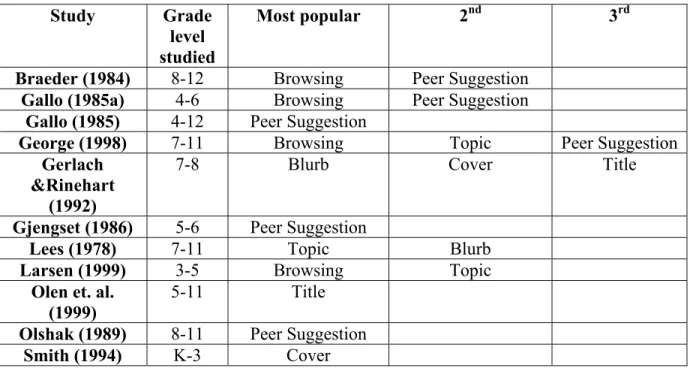
The question of how children select their reading material is one that has been examined in current research. It is a subject that is often linked with studies that examine how much children read, children’s reading preferences, and where children obtain reading material. However, this topic is rarely researched standing alone. Methodologies used to study children’s methods of selection include surveys (Braeder 1984, Gallo 1985a, 1985b, George 1989, Gjengset 1986, Larsen 1999, Lees 1978, Olen, Chamberlain and Machet 1999, Olshak 1989) experiments (Smith, 1994), interviews (Gerlach and Rinehart 1992) and observations (Gerlach and Rinehart 1992). Although the research studies have different findings, they are all similar in recognizing the importance of a few distinct selection methods. These selection methods are discussed in each study listed in alphabetical order below (For review in table form see Figure 1 on page 15).
Braeder Study
Browsing was the preferred method of selection: 71.3% of the students surveyed selected browsing as their method of selection, with friend coming in a distant second with
13.18% of the students (Braeder, 1984, p. 213). The Braeder study’s questionnaire left out several other possible answers such as title, and cover illustration; however, a large majority of students chose browsing, and its importance cannot be ignored.
Gallo Study
Gallo (1985a) also found that browsing is a popular method students use to select reading material. In this study, 760 students in grades four through six were surveyed and asked which of the following is how they select their reading material: friend’s suggestion, browsing in store, browsing in library, teacher’s suggestion, parent’s suggestion, store display, advertising, sibling suggestion, book club catalog, library display, librarian’s suggestion, school list (Gallo, 1985, p. 736). This list is very complete, but again an “other” category could be deemed useful. In this study a 17.1% majority of students ranked browsing for books in the library first. Gallo (1985b) also discovered that a friend’s suggestion was the most common method of selection in children in grades four through twelve (p.736). The study surveyed 3,399 students in age groups split up between grades 4-6, 7-9, and 10-12. In each age group friend’s
George Study
George (1989) found that subject was a popular method of selection in her survey of 305 male and 305 female seventh through eleventh graders. The possible methods of selection listed in the questionnaire were browsing, by subject, family/friend
recommends, author, teacher recommends, and librarian recommends (George, 1989). George found that browsing was the number one method of selection. Of those surveyed 62.1% chose browsing, as their most frequent method of selection (George, 1989). Subject was the second most common method, chosen by 36.2%. The study also found that peer recommendation was the third most common method of selection; thirty-two percent of the participants surveyed chose “family and friend recommends” as the way they most often selected books.
The George study also had a slim list of choices, but again browsing was the clear favorite method of selection among these students. The George study was performed in Canada and there may be some cultural differences between those children and the ones I studied.
Gerlach and Rinehart Study
found that the summary inside the flap was the most often mentioned criterion for book selection at 49%. Cover illustration was the second most mentioned criteria at 22%. The study found that title was also a high-ranking factor in material selection. Students they observed and interviewed mentioned title as the third most popular method of selection at 18% (p.293). The size of the print and vocabulary level were both barely mentioned as methods of selection.
The Gerlach and Rinehart study was richer than the previous study mentioned in that the students were interviewed to find out why they chose the books, instead of merely being observed. However, this study examines slightly older children than the ten year olds that were studied in my research.
Gjengset Study
Gjengset (1986) interviewed students aged ten and eleven to discover children’s reading habits, and what or who influences children’s reading (p.101). The findings showed that the most important sources for finding out about books were children’s classmates, who often recommend series to each other (Gjengset, 1986, p. 103).
Larsen Study
In the Larsen (1999) study, 21 students in the third, fourth and fifth grade rated their top three methods of selection from the following list: having a book assigned in class, hearing about the book from a friend, hearing about the book from a librarian, hearing about the book from a parent, hearing about the book from a teacher, hearing part of the book read aloud, looking through bookshelves for books that seem interesting, receiving the book as a gift, searching for books on particular subject, and seeing a movie or TV show based on the book (p. 58). Browsing along the shelf was one of the top methods of selection found by several different studies. Larsen (1999) found that 35% of third, fourth, and fifth grade students surveyed by questionnaire most commonly selected books by looking through bookshelves for books that seem interesting (p.33). Larsen (1999) found that the second most popular way to find books was searching for books on a particular subject. Although this list seems very complete, an “other” category would have allowed children the possibility that none of these is the way they select reading material. Larsen (1999) also chose to study the reading habits of only gifted children, which undoubtedly impacted the responses.
Lees Study
Lees (1978) surveyed 573 young adults aged twelve to sixteen to discover their reading habits (p. 59). One of the questions asked how books are selected, and gave a variety of possible responses. The choices were: friend, family, study, teacher, librarian, subject, cover, description, short, film, T.V., or author (Lees, 1978, p.60). Some children pick a book because the title sounds interesting, and some children pick books purely because they are on a specific topic in which the child has an interest. An example of this would be books about ballet or horses, two topics that are often very popular with middle school girls. In the study described above, Lees (1978) found the most popular method of selection in all age groups was by subject (p.60). The second most popular answer in all age groups was description (blurb) except in the case of sixteen year olds, who cited friends as the second most frequent selecting method (Lees, 1978, p.60).
The Lees survey was fairly extensive with a large choice in answers, but it did not contain an “other” category, so it is possible that some students may have had another reason for selecting books that was not listed. Some of the students may have been embarrassed to say they chose books by print size or cover illustration. In addition this study is aimed at young adults rather than the ten year olds in my research study. This study is also slightly older, and trends may have changed since 1978.
Olen, Chamberlain, and Machet Study
survey was to discover the methods of selection, reading preferences, and reading habits of the children (Olen, et. al., 1999, p. 115). In this study 49.6% of the boys and 53.3 % of girls surveyed said they pick a book because of the title (Olen, et. al, 1999, p. 115).
There were a few limitations of the Olen study based on cultural differences. Many of the students surveyed did not speak English as a first language, and had
difficulty understanding the questions (Olen, et. al, 1999, p. 113). The large age range of the children also makes it difficult to see trends, as ages were not broken down in survey results. There may also be cultural differences between these students and the American students in my study.
Olshak
Olshak (1989) surveyed 1,500 schoolchildren in Estonia ranging from ages twelve through fifteen to discover reading habits and factors influencing reading. Through a questionnaire Olshak found that although the students themselves selected half the books, 22% of those surveyed were influenced by their peers (p.89). It must be noted that only 6% of those surveyed were influenced by a librarian (Olshak, 1989, p.89). The Olshak (1989) study surveyed students in Estonia, where there may be cultural differences between these students and students participating in similar studies in America.
Smith Study
In an experiment in which 39 children in grades kindergarten through third were given a choice between books with dull covers and bright attractive covers Smith (1994) found that children largely selected the books with the bright covers (p.17). The study found that 93.4 % of the works selected were the books with the attractive covers, and only 6.4% of the books in plain binding were chosen (Smith, 1994, p. 17). A limitation of the Smith study is the fact that it is impossible to tell if there were other factors at work besides the book covers. The books in the study were all different and participants were not asked why they chose their particular books. It was very possible they chose a book because of the title, or the author, or because they had heard of it before from friends. In addition the study surveyed children in grades kindergarten through third, and it is likely that fifth graders may have different methods of selection. Smith (1994) acknowledges that younger children are more likely to choose books based on cover illustration when she states “The influence of the jacket upon selection was stronger with the younger the child. Several older children opened the books and scanned for content when making their selections” (p.19). Despite this limitation, this study and the Gerlach & Rinehart (1992) study described below did show a clear disposition for children to choose material with attractive covers, and the importance of a visually pleasing cover cannot be denied.
Implications
summary information, title, and topic all relate to browsing, as those criteria are things children may be looking for as they browse. Peer influence is a separate but interesting factor, mentioned by almost all children, and gaining importance as the age of the child increases. The studies rely on three methods: observation, surveys, and interviews. Interviewing seems to be the most effective way to gain insight into how children choose reading material, by allowing children to expand and explain, rather than just select a method out of a list.
Almost all of these studies contained one common finding. Children seem to be rarely if ever influenced by librarians as they make their reading selections. This suggests that children’s librarians are not fully serving children. Librarians should be aware of the ways children select books and use them to their advantage. For example, if children are attracted to books with attractive covers, librarians should keep this in mind when ordering books, and attempt to obtain the copy of the book with the nicest cover illustration. Peer influence is also a factor, so librarians need to find some way to make asking a librarian catch on within a peer group.
Figure 1
Study Grade level
studied
Most popular 2nd 3rd
Braeder (1984) 8-12 Browsing Peer Suggestion
Gallo (1985a) 4-6 Browsing Peer Suggestion
Gallo (1985) 4-12 Peer Suggestion
George (1998) 7-11 Browsing Topic Peer Suggestion
Gerlach &Rinehart
(1992)
7-8 Blurb Cover Title
Gjengset (1986) 5-6 Peer Suggestion
Lees (1978) 7-11 Topic Blurb
Larsen (1999) 3-5 Browsing Topic
Olen et. al. (1999)
5-11 Title
Olshak (1989) 8-11 Peer Suggestion
Research Methodology
It is important to narrow the scope of the study, by focusing on a certain age group. For this reason ten year olds were studied. It would be very difficult to ascertain how children of many different ages choose their reading material, as their methods of selection most likely change as they develop. Ten year olds are particularly intriguing because this age group has reached a more advanced stage in their intellectual
development. They have also most likely passed the picture book and easy reader stages and are reading chapter books. Chapter books are more complex than picture books and thus there is the potential that children may pick them for many different reasons.
The most efficient way to discover how ten-year-old children select their reading material is to ask them. They could be asked in several different ways. One possible method is to fill out a questionnaire and another is to be interviewed. As pointed out in the literature, very often surveys are not the best way to gain information. It is difficult to devise a complete list of all the many ways children select books, and children may be unwilling to fill out an “other” category if one is provided. Also, surveys may be
considered confusing or boring to children and this could result in forms not being filled out completely, or children lying just to complete the task sooner. Because of these reasons, interviews are a better way to gain more complete information and to answer the problem statement “How do children select reading material?”. Due to time constraints the subjects were interviewed in small focus groups.
group mixed both male and female. The group was split by the sexes this way to address any differences that might occur in same-sex versus mixed- sex groups. An example of a possible issue would be the willingness of boys to talk about books and reading in front of each other, or in front of girls. This was not a random sample, but rather a
convenience sample. Because of restrictions placed upon working with children it is difficult to have access to a large group of children at one time, which was needed for this study. A school classroom provided a “captive audience” that would be difficult to find elsewhere.
Gaining access to the study participants was a four step process. First, it was necessary to go through the UNC Academic Affairs Institutional Review Board to gain permission for using human study participants. After the IRB approval it was approved by the Chapel Hill Carrboro City School board. Then it was approved by the
administration of the school, and the teacher whose students will be study participants. Finally, each study participant gave their informed consent, and since the participants are minors, their parents also gave their consent as well. This was accomplished by sending a letter home with the students the week before the interviews began. Please see
appendix A for information given to the study participants and their parents, explaining the research project and their rights as participants.
Interview Protocol
Warm Up Questions:
• What kinds of books do you like to read?
• How often do you read?
• What is the worst book you ever read?
• What is the last book you read?
• Have you seen the Harry Potter movies? Read the books?
Research Problem Questions:
• When you do read, how do you choose what to read next? Take a minute, may
have children write down some ways for discussion?
• Follow up questions such as why do you think that’s important? Which way do
you think is the way you most often choose books? Which way do you think is best?
• What do you use to decide you don’t want to read a book?
• Make sure every child answers, fully discuss each point made
Concluding Questions:
• Can prompt now, if ways suggested in the current literature are not brought up.
• May ask if they ever ask librarians to help them choose a book, and why or why
not?
Possible methods:
Data Analysis
Reading the Back Cover
it really carefully. Using reviews to make a decision was not mentioned in the relevant literature; however, in this case the student was not searching for reviews independently, but rather looking for segments of the reviews on the back cover. However, it is still interesting to note that the reviews on the back of the book were a method of selection for one student.
Title
Author
Although it is not mentioned in today’s relevant literature, author was mentioned by a few of the study participants. Looking for books by a favorite author seemed to assure the students they would like it for two reasons, writing style, and type of story. When asked why she thought the author was important one student answered, “Because you can tell what writing style they usually use. Most authors stick to one kind of book that you might like”. Another student agreed, “Sometimes if it’s by my favorite author it usually means I’m going to like it”. It is interesting to note that writing style was mentioned as a selection method here again, although it is not found in the relevant literature. Although these students sometimes decided to read books based on the author, none of the students thought it was the best way, or the way they used most frequently to search for a book.
Cover
Language
Also not mentioned in current literature was language as a selection method. Two of the students I interviewed spoke English as a second language. As the United States grows more diverse there will be more school children that speak English as a second language, and it is only natural that when searching for books, they might take into account the language in which the book is written. One student said that since Hebrew was his first language, he often looked to see if a book was in Hebrew or English, preferring his native Hebrew. Another student for whom English was also a second language said that the way he most often selected books was by the level of difficulty. This same student also said that he also looked to make sure that the book did not have many pages. It is plain to see how having a different first language can
influence the way students choose books.
Computer as a Finding Tool
Genre
Many children said that they looked at the kind of book when they were deciding whether to select it. Students mentioned topic in conjunction with several other methods of selection. They often used the back of the book, title and cover to determine what the book was about and whether they thought they would enjoy reading it. For example one student said, “Sometimes I look at the title and then I get attracted especially if it’s about outer space or a science book of facts”. Children who looked at the cover were often looking for a particular kind of book, such as a humorous book, or an adventure story. One male student said when he was choosing comic books he looked to see if they were funny. Two students said that topic was the best way to choose books as well as the way they most often used.
Peer Recommendation
recommend. There may be a few different reasons that most students did not mention peer recommendation. It may be that this did not seem like a “serious” enough answer, so they may not have thought of giving it, even if they used peer recommendation. It is also possible that peer recommendation is a stronger factor in children older than the ten year olds in this study.
Browsing
None of the groups brought up browsing for books on their own although several students when prompted said they did browse to find books, and two students said that was the most common way they chose books. One student said, “ I like to look on the shelves and look at the titles on the sides of the books”. Another student said “ I discovered the Lemony Snicket series by browsing”. One of the participants was browsing the shelves in the media center as we spoke exclaiming, “I’m getting attracted by titles!” It may be that browsing is so tied in with cover, title, topic and blurb, that the participants did not think to mention it on its own, seeming almost to take it for granted that they all look on the shelves to see what books look good.
Asking an Adult
anyone such as one female who said, “ I usually just look around in the library and if I see a book that looks good I check it out”. A male student stated, “At the moment I usually just go over to the science fiction section and find a book”. One student said “Usually I wouldn’t go to librarians for a suggestion on a book because sometimes I don’t know what I want to read myself”. Other students expressed doubt that librarians or teachers would be able to recommend a book they liked. One student commented she would not ask a librarian “Probably because they may like, fantasy and magic and stuff like that and you may just like the complete opposite and then they would just give you a clue of all the books you wouldn’t like to read but nothing that would help you find one that you might like”. Another student pointed agreed “Because a lot of people refer me to books where people are happy the whole way through” which were not books which she enjoyed. Another student echoed this by saying “ No because usually they give you one of those boring books you would never like, probably like Alice in Wonderland.” Another student said librarians “are old and probably like different books than us”. A female student pointed out “ They might have different views of books so that they might like something we don’t and sometimes they go on and on”.
Conclusion
There was no one resounding way the children said they used to choose reading material. The most common way most children mentioned was reading either the blurb on the back of the book or a section within the book. This method was closely followed by title, cover, and topic. Methods that were also mentioned by students although somewhat less strongly included author, browsing, language of the work, using the computer as a finding tool, and peer recommendation. One of the strongest findings in the study is that most of the participants would not consider asking a librarian or another adult as a way to select reading material.
Implications and Further Research
There are a few implications of this for librarians. If we know how children look for books, we can find ways to help them. Since browsing by title, cover and topic are important, librarians should make the most of display areas. Displays of certain kinds of books, such as adventure stories can help a reader locate material. Books with attractive covers should be ordered whenever necessary, and displayed around the room. Because children often choose books by authors, bookmarks or other lists could be made featuring popular children’s authors as well as read-a-likes to help them find similar books.
Librarians can also capitalize on peer recommendation by having children write their own book reviews on their favorite books and displaying them around the library. With rising numbers of children who speak English as a second language, librarians should be
rise librarians should offer bibliographic instruction on how to use some of the children’s reader advisory databases, as well as the public access catalogs. Finally, there are some things that need to be done regarding the perception of librarians by children. Librarians are viewed as out of date and boring. There should be an effort made to keep current with the trends in children’s literature, and a willingness and enthusiasm in helping children select reading material that they will enjoy. Particular emphasis should be placed on listening during the reference interview to determine what types of books the reader likes, with an eye toward not overwhelming the child with too much information. With a friendly attitude, and an effort in these areas, children may eventually begin to see librarians as an excellent resource in recommending material.
The all male group, however, was a little more difficult to work with, and seemed to take the interviews less seriously than the other two groups. The best way a new study might address this is to interview the students individually; this would assure that the
Works Cited
Braeder, D. (1984). Booktalking: a survey of student reaction. Canadian Library Journal, 41, 211-214.
Gallo, D.R. (1985a)(1985b) Ask your librarian! Four surveys reveal where young people turn for reading advice. American Libraries, November, 736-739.
George, A.(1989). Young Adult Library Survey. Retrieved October 8, 2002, from
http:www.umanitoba.ca/cm/cmarchive/vol117no3/youngadultlibrarysurvey.html Gerlach, J.M., & Rinehart, S.D. (1992). Can you tell a book by its cover? Reading
Horizons, 32, 289-298.
Gjengstat, G.H. (1986). Children’s reading habits-a preliminary project report. Scandinavian Public Library Quarterly, 19, 100-103.
Larson, A.W. (1999). A Study of reading interests of high-ability readers in a North Carolina elementary school. Unpublished master’s thesis, University of North Carolina, Chapel Hill.
Lees, S. (1978). A survey of reading. Australian School Librarian, 17, 59-61. Olen, S., Chamberlain, A., & Machet, M. (1999). Young people’s reading and
information use at the end of the century. Unleash the Power! Knowledge-Technology-Diversity: Paper’s Presented at the Third International Forum on Research in School Librarianship, Annual Conference of the International Association of School Librarianship (IASL). Retrieved October 15, 2002 from
ERIC database.
Olshak, L. (1989). Estonian library research on reading habits of children. In Roman, S. (Ed.), US-USSR Colloquium on library services to children . September 12-21, 1989. Chicago: American Library Association.
Appendix A
Participant Assent Form
I am trying to learn how children choose reading material. I would like to ask permission to talk to you about your reading habits. These interviews will take place in groups with a few other students, and you may also be interviewed individually.
Every student is invited to participate, but you do not have to be interviewed if you do not want to be. If you ever feel like you do not want to continue the interview, you can stop right away. You do not have to answer any question you do not want to.
Participation is completely voluntary. Whether or not you choose to participate will not affect your grade, or any treatment you normally receive. You may choose not to participate, even if your parents have given permission. If you have any questions or desire further information, please call me at (919) 828-7871 or email me at
[email protected] or contact my faculty advisor Dr. Brian Sturm at [email protected].
This study has been reviewed and approved by the ACADEMIC AFFAIRS
INSTITUTIONAL REVIEW BOARD (AA-IRB) at the University of North Carolina at Chapel Hill. You may contact the AA-IRB if you have any questions or concerns about your rights as a research participant at (919) 962-7761 or [email protected].
There are two copies of this letter. Please return one to me, and keep the other one. Please check next to whether or not you choose to participate, and sign the letter below. ____ I want to participate
____ I do not want to participate
Appendix B
Parental Permission
Dear Parent or Guardian,
I am conducting a research project on how children select reading material. I request permission for your child to participate. The study consists of one 20 minute focus group session and/or individual interview. Children will be asked questions about the kinds of material they read, and the methods they use to select it. The goal of the study is to detail the different ways children select reading material.
Each child will be invited to participate in this special activity. The project will be explained in terms that your child can understand, and your child will participate only if he or she is willing to do so. Any child who expresses a desire to return to the classroom will be escorted back immediately, and your child may choose not to answer any question they wish. I will conduct all interviews and record them on audio tape. At the conclusion of the study I will erase the tapes. Only my research staff and I will hear the tapes.
Participation in this study is voluntary. Your decision whether or not to participate will not affect the services normally provided to your child by the school. Your child’s teacher and principal have approved this study, and I will be working with your child’s teacher to arrange times so that your child will not miss anything important. At the conclusion of this study a summary of the group results will be made available to all interested parents and teachers. Should you have any questions or desire further information, please call me at (919) 828-7871 or email me at [email protected] or contact my faculty advisor Dr. Brian Sturm at [email protected].
There are two copies of this letter. After signing them, keep one copy for your records and return the other one to your child’s teacher. Thank you in advance for your cooperation and support.
Sincerely,
Melissa L. Tardiff Master’s Student
School of Information and Library Science University of North Carolina at Chapel Hill
This study has been reviewed and approved by the ACADEMIC AFFAIRS INSTITUTIONAL REVIEW BOARD (AA-IRB) at the University of North Carolina at Chapel Hill. You may contact the AA-IRB if you have any questions or concerns about you child’s rights as a research participant at (919) 962-7761 or [email protected]. Please indicate whether or not you wish to have tour child participate in this project below. After signing your name, return this sheet to your child’s school.
___ I DO grant permission for my child to participate in Ms. Tardiff’s research project ____ I DO NOT grant permission for my child to participate in Ms. Tardiff’s research project
______________________ _______
(Parent/Guardian Signature) (date)