Jacqueline M. Dunlap. Violence and Children’s Preferences in Fairy Tale Story Endings. A Master’s Paper for the M.S. in L.S. degree. April, 2012. 68 pages. Advisor: Brian Sturm
Violence in children’s stories is an important debate in the field of children’s literature. Within that controversy, there is another, perhaps even bigger issue: that of justice. Specifically in fairy tales, violence serves the purpose of bringing about justice. Many claim that the lack of justice is more problematic for children than the presence of violence.
This study seeks to approach this issue from children’s perspectives. This interview-based content analysis study of fourteen kindergarten students in the southeastern United States brings children’s voices to the general conversation about violence and justice. The children heard two fairy tale stories, each with two alternate endings characterized by punishment or leniency. The children chose which ending they preferred and then
explained their selections in individual interviews. The results show that these children do prefer justice and fairness but that they also consider violence and the extremity of punishments in their evaluation of appropriateness.
Headings:
Fairy tales
Children’s literature – History & criticism
by
Jacqueline M. Dunlap
A Master’s paper submitted to the faculty of the School of Information and Library Science of the University of North Carolina at Chapel Hill
in partial fulfillment of the requirements for the degree of Master of Science in
Library Science.
Chapel Hill, North Carolina April 2012
Approved by
Table of Contents
Introduction………..3
Literature Review……….5
Violence in Children’s Literature………5
History of Fairy Tales………..7
Fairy Tales and Violence……….9
Children and Story Violence………..12
The Concern About Fear………14
The Concept of Justice………...18
Fairy Tales, Justice, and Law……….20
Children’s Judgments Regarding Justice and Morality……….22
Fairytale Justice and Child Morality………..24
Appropriateness of Fairy Tales………..26
Story Liking………...28
Conclusion..………...31
Methodology………..33
Results………41
Discussion & Conclusion………...49
General Explanations……….49
Empathy and Resolution………53
Conclusion……….55
Future Research……….56
References………..58
Appendices……….62
Appendix A: Story Synopses………62
Introduction
Once upon a time, fairy tales were filled with evil witches, ogres, and dragons, who were punished, and heroic knights and kind princesses, who lived happily ever after. Children loved these stories and asked for them again and again, even though they knew them by heart. However, parents and other grownups began to fear that the violence in these stories was too scary for children and could be harmful to them. Then the
grownups changed the stories so that the violence was less extreme and the punishments were less severe. Little did they know that by ameliorating the violence in fairy tales, they actually might be making the stories more problematic for children, not less. Throughout the land, there was great debate about this issue, and it went on for a long time. In fact, it has continued to this day.
This is not the end of the story, but only the beginning. The issue of violence in children’s literature is a long-standing one, dating back to the beginning of written
literature for children. Fairy tales play a leading role in the drama of violence in children’s stories, as they were a large part of early children’s literature and as they are
likely today to retain violent elements that they had hundreds of years ago.
The controversy regarding violence in children’s stories, particularly in fairy tales,
Traditional fairy tales characterize a type of justice uniquely attractive to young children, because it mirrors their own understanding of the world. This includes retributive punishment, in which bad characters always face bad consequences. Such stories are developmentally appropriate, according to many psychologists and educators, and in fact provide a sense of comfort and stability for children. However, there are others who question whether violence in any form should be included in repertoires for young people.
Drawing from this ongoing debate and from literature exploring factors involved in children’s liking of stories and story endings, I devised this study to explore children’s
preferences regarding fairy tale endings. Specifically, I wanted to examine their preferences in terms of punishment and leniency. This provided insight into their understanding of justice, the role of violence in justice, and the children’s own desires
Literature Review
Violence in Children’s Literature
There has been a longstanding debate about the issue of violence in children’s literature. The subject is multifaceted, with advocates for and against violence in children’s stories addressing a variety of angles. The academic literature on the topic is
varied, and scholars, psychologists, writers, teachers, and parents all contribute to the discussion.
Maureen Nimon (1993), in “Violence in Children’s Literature Today,” argues that
we as adults have the responsibility of monitoring what type of literature is available to children. She writes:
As arbiters of the content and distribution of children’s books, we are responsible if violence appears in them. Its inclusion should therefore be a considered
decision and its nature and the manner of its treatment ones we have judged to be appropriate. Similarly, its exclusion must also be justified. (p. 29)
The issue of violence in children’s literature is particularly significant in the
context of fairy tales, as they are typically more likely to contain elements of violence than other children’s books and stories. Michaelis-Jena, cited in Koehler-Widney (1989),
writes, “The question of cruelty in fairy tales is a perennial one, and a passionate controversy whether they make good reading for children started the moment the
edition of their fairy tale collection in 1812, this controversy has been going on for quite some time. In fact, fairy tales were being told long before the Grimms’ publication.
Whenever it began, the discussion continues today. It includes well-known figures, including Maria Montessori, who holds that fairytales can “do serious or even permanent damage” for children too young (Tucker, as cited in Koehler-Widney, 1989, p.
8).
Kay Stone (1981), a supporter of fairy tales herself, reports that “‘experts’ have continued to attack fairy tales for their violence, their misleading fantasy, or both” (p.
234). She notes a 1977 newspaper article entitled "Psychology Prof Cleans Up Fairy Tales to Eliminate Violence," in which Duke University Professor Gentry "attempts . . . to launder the tales for impressionable minds” (Stone, 1981, p. 234).
Another headline “Teachers Boycott Grimm Fairy Tales” is even more extreme.
This article, also from the 1970s, describes a Melbourne, Australia, boycott led by psychiatrist Dr. Francis A. Macnab. He and many kindergarten teachers find Grimms’ fairy tales “much too horrifying and frightening” and “far too sadistic for young children”
(McCracken, 1972, p. 422). Glenn McCracken, a reading consultant, pairs this headline with the results from a cursory study that found completely opposite results. He writes, “a composite of the replies would be something like this, ‘No-o-o-o-o! It was only a
make-believe story. It didn’t scare me!’”( McCracken, 1972, p. 423). More seriously, of the primary-grade students and teachers and almost 300 parents asked or observed, “no person could identify that he had endured any ill effects from reading such tales”
The other side of the argument posits positive outcomes of including violence in children’s books. Rose Blue (in Koehler-Widney, 1989), for example, believes that “discussing violence through the avenue of good literature can have beneficial results,”
particularly toward developing humanity and tolerance (p. 8). Bruno Bettelheim is a Freudian psychologist and an emphatic advocate of fairy tales for children. Koehler-Widney describes his beliefs by saying “children have violent and aggressive fantasies (whether or not violent stories are told to them)” and fairy tales provide an important “means of coping” (1989, p. 9). Moustakis (1982) also describes the benefit to the child who through violent literature “meets his inner monsters . . . and vicariously masters them, over and over again with every tale” (p. 30).
Ann Trousdale (1989), in “Who’s Afraid of the Big Bad Wolf?”, points out that others see the tales as “not only suitable for young children but actually beneficial to them” (p. 71). One of these advocates, Linda Dégh, takes the position that “exposure to the tales is so essential for young children’s healthy development that being deprived of them will result in negative effects in adult life” (Trousdale, 1989, p. 71). Not all
proponents of fairy tales for children take the argument that far, but it shows that there is certainly a side to the story other than that of concern.
History of Fairy Tales
Fairy tales are a classic part of children’s written literature, but they existed in the
marriage (Russell, 2001, p. 151-2). Today’s “fairy tales” come primarily from the märchen.
Folktale and fairy tale collecting was motivated largely by a sense of national pride and identity. In the early 1800s, Jacob and Wilhelm Grimm “viewed themselves as
patriotic folklorists” who “undertook the fairy-tale collection with the goal of saving the endangered oral tradition of Germany” (O’Neill, 1999, para. 6). They and Charles
Perrault, writing in France in the 1600s, are responsible for many of the tales that are still popular today. Tatar (1992) reports that “our fairy-tale canon is drawn, for the most part, from collections produced by Charles Perrault and the brothers Grimm” (p. xxi). Other
popular collectors include Hans Christian Andersen, a Danish collector and writer in the 1800s, and Andrew Lang, writing in English in the late 1800s and early 1900s.
Fairy tales have remained an integral part of children’s literature and general cultural literacy. O’Neill even asserts that “as a publishing phenomenon the Grimms’ opus competes with the Bible” (1999, para. 3). However, fairy tales were never
originally intended exclusively for children, or even for children at all.
On writing about fairy-stories, J. R. R. Tolkien (1975) says, “the common opinion seems to be that there is a natural connexion (sic) between the minds of children and fairy-stories. . . I think this is an error” (p. 34). He does not argue that fairy tales are inappropriate for children; he simply asserts that it is a mistake to have treated them as though they are exclusively for children and to have them “relegated to the ‘nursery’” (Tolkien, 1975, p. 34). “Actually,” Tolkien explains, “the association of children and
Connie Koehler-Widney (1989) also argues that the Brothers Grimm did not intend their original fairy tale collection for children. She cites the lack of illustrations and the inclusion of scholarly notes in the first edition as evidence that children were not the intended audience. Instead, she claims, “they were attempting a scholarly work, which would contribute to the preservation of German folk heritage” (Koehler-Widney, 1989, p. 1). O’Neill also points to the style of the Grimms’ first edition of tales as
evidence that it was not intended for children. He observes, “the brothers initially refused
to consider illustrations, and scholarly footnotes took up almost as much space as the tales themselves” (O’Neill, 1999, para. 5).
However, the Grimms discovered that they could have an audience in children and edited later versions with that in mind. Koehler-Widney (1989) states, “By the second edition of 1819, the brothers had come to realize that the work was indeed popular with children, emphasizing the value of the tales for them in its Preface and claiming to have deleted any material unsuited to children” (p. 2). The multiple editions underwent
various changes, additions, and deletions. Jack Zipes, in When Dreams Came True, relates that after 1815 the Grimms “make the contents of the tales more acceptable for a children’s audience, or, really, for adults who wanted the tales censored for children” (p.
75).
Fairy Tales and Violence
Fairy tales have always contained elements of violence, but its degree has fluctuated among editions, translations, and adaptations. The effect of the newfound children’s readership of fairy tales, however, was not straightforward. Some scholars
It is true that several significant changes took place in the world of books and stories at about the same time. Fairytales’ transition from the oral tradition to print
corresponds to its move from an entertainment for adults to a genre for children. Also, some see this period marking a significant point in fairy tales’ use as a didactic
moralizing instrument. Maria Tatar (1992), in Off With Their Heads!, explains the publishing phenomenon that addresses both the appropriation of fairy tales for child audiences and their emphasis on moralistic violence. She explains that details dealing with bodily functions, sex, and anti-religious sentiment were mostly edited out, but interestingly, violence was often increased and used for teaching lessons. “Instead of disguising it or blotting it out, they preserved and often intensified it, though usually only when scenes of physical suffering or mental torment could be invested with a higher moral purpose” (Tatar, 1992, p. 5). In fact, the moralizing of stories was itself reason for adding or escalating the violence. “Recorders and collectors often added moral lessons
that, in their eyes, gave them license to emphasize or even exaggerate descriptions of punishment and death” (Tatar, 1992, p. 11). Not everyone agreed with this approach, however. Stone (1981) states, “the magical forces which, among other things, marked
[fairy tales] as serious literature followed the tales into print and disturbed adults, who felt that children's stories should be less violent and irrational” (p. 232-3).
leaving them blind (Tatar, 1992, p. 7). Perrault’s version, the basis for the American version, is a contrasting exception among multiple versions of the story that include violent punishments. In the Perrault story, Cinderella was “‘as good as she was
beautiful’” and provided places for the stepsisters to live in her palace and husbands for
them to marry (Tatar, 1992, p. 7). Stone (1981) claims that in this telling of Cinderella, “Perrault unwittingly provides a model for future adaptations. . . [with] the brutal elements softened” (p. 233).
Some claim the Grimms, too, watered down their tales. In The Hard Facts on the Grimms’ Fairy Tales, Tatar (2003) points out “As much as some readers may be shocked
by the cruelty and violence of the Grimms’ tales, they would find many of the stories tame by comparison with their corresponding peasant versions” (p. 24). She also claims they “rewrote the tales so extensively” that they “can be credited with sanitizing folktales
and thereby paving the way for the process that made them acceptable children’s literature in all cultures” (Tatar, 2003, p. 24).
However, Alison Lurie has found that many didn’t think the early amelioration of fairy tales went far enough. “Despite the socializing and sanitizing efforts of Perrault and
the Grimms, some parents and educators still objected to the heavy-handed justice of fairy tales, and the harsh acts of violence they contained” (as cited in Roberts, 2001, p.
516).
Disney also exaggerated the negative forces of the Märchen, making the
stepmothers in ‘Snow White and the Seven Dwarfs’ and ‘Cinderella’ even more villainous than in the originals . . . His stepmother in ‘Snow White and The Seven Dwarfs,’ in fact, was exaggerated enough to send children (and perhaps some
adults) screaming from movie theatres when it was first released. (p. 237)
Creasey (2010), however, has found that violence has been toned down recently. She sees, “modern storytellers’ decisions to modify the gruesome parts of classic fairy tales to make them more palatable for modern readers” (para. 1). Later, Stone (2008) also says that Disney “developed absurdly cute characters who overcome any sense of real evil” (p. 30) and “emphasizes love rather than conflict” (p. 31).
The subject of violence in fairy tales has been an issue for a long time, and is probably going to continue to be debated for a lot longer.
Children and Story Violence
Although the issue is an ongoing and controversial one, the violence in fairy tales may not actually be a problem for children. Adults perceive violence to be disturbing to children, but they may be expecting children to see it as worse than they really do.
Kay Stone (1981) conducted research in 1973 and 1974 with children and adults about their reactions to fairy tales. The interviews did not intentionally address the issue of violence, but her results are relevant to the topic. Several informants commented on the issue, but few responded negatively. On the contrary, she reports, “In fact, I found no
name of children claim that fairy tales in their original form are dangerous. Children speaking for themselves disagree” (p. 242).
Gloria Toby Blatt conducted research in 1972, analyzing ALA Notable Children’s Books listings for violent content and analyzing children’s reactions to the content. She concluded that “young readers become intensely interested in violence, enjoy it, and develop a taste for it” (as cited in Koehler-Widney, 1989, p. 14).
James C. Giblin (1972) addresses the topic of violence from the perspective of a children’s book editor. As an editor himself, he believes that appropriateness is “not . . . necessarily the most important criterion” . . . but is often “the most controversial” (p. 65). He states “over the years there’s been much discussion about the inappropriateness of violence in books for young people” (Giblin, 1972, p. 65). He feels that “very few subjects are inappropriate in and of themselves; it’s all in how the author treats them”
(Giblin, 1972, p. 65). Similarly, Arnold, cited in Koehler-Widney (1989), says “more than literary or media violence itself, we must question the end it serves” (p. 15). All
violence is not the same; we should consider why it is there.
One of the reasons for violence to be present in children’s stories is to show its
hurtfulness. Nimon (1993) relates that some think violence has a place in children’s literature, but that its consequences should be demonstrated as well. She relays, “… children’s books may encompass violence and conflict, but it is essential that they do so
in ways that show the suffering caused” (Nimon, 1993, p. 31).
elements of violence because it causes the child to “bottle up his own strong feelings” and denies the child’s sense of reality (p. 65).
It may be alarming to realize that children sometimes prefer violence in their literature, but it can be helpful to recognize that it may be appropriate for them as well. The Concern About Fear
Within the debate about violence, there is more specifically the concern about fear. Several scholars point out that fairy tales do not create fear and actually provide a context for fighting against it.
Children know that bad things happen in the real world, or if they don’t they will
soon. C. S. Lewis (1975) argues heartily against trying to completely shelter children from seeing that the world contains darkness. He does not agree that “we must try to keep out of [a child’s] mind the knowledge that he is born into a world of death, violence, wounds, adventure, heroism and cowardice, good and evil” (Lewis, 1975, p. 31). To do so would give the child a “false impression” of reality and would obscure some truly good things as well. Writing about children, Lewis asserts, “Since it is so likely that they
will meet cruel enemies, let them at least have heard of brave knights and heroic courage” (1975, p. 31). Fairy tales themselves are not the problem; in fact, they inspire courage and bravery that helps children fight against fear. G. K. Chesterton (1909) makes this argument in a different way much earlier:
Lewis (1975) also addresses the concern about frightening children with fairytales by pointing out that the stories do not actually cause fear. Fear, particularly in the case of phobias, is in many ways irrational, and “we do not know what will or will not frighten a child” (Lewis, 1975, p. 30). “Violence and bloodshed, in a story” do not, Lewis states, “actually produce any haunting dread in the minds of children” (p. 31). Chesterton also asserts that fairy tales “are not responsible for producing in children fear” (1909, p. 129). He explains, “The fear does not come from fairy tales; the fear comes from the universe of the soul” (Chesterton, 1909, p. 129).
André Favat (1977) also acknowledges the issue of fear associated with fairy tales:
One of the things that teachers and parents always have to confront in bringing children and fairy tales together is the notion that giving fairy tales to children runs the risk of frightening them with the gruesome characters and violent events. The tales do contain such content and some children might be frightened; so the worry cannot be easily dismissed. (Favat, 1977, p. 59)
However, Favat understands that children will not necessarily be frightened by fairy tales. He refers to Frank’s (1941) response to this issue that “children are not so easily frightened as adults may think” (as cited in Favat, 1977, p. 59), agrees with Lewis (1966) that “while the tale may indeed occasion fear, it is not the cause of fear” (as cited
in Favat, 1977, p. 59), and appeals to Lesser’s (1957) defense that in fiction “[terror’s] dominion is limited” (as cited in Favat, 1977, p. 59). Favat (1977) also challenges teachers and parents to recognize that “however many gruesome characters may lurk in
time and place that children are assured that they are beyond the reach of the tale’s threatening force” (p. 60).
A similar position on the topic of fear in children and violence in stories comes from Earl R. Hutchinson, summarized in Koehler-Widney (1989): “Because greed, cruelty, and envy are present in the world, he advocates that children be introduced to such facts of life through literature, rather than be shocked at a later age with reality” (p. 12). It may be a source of greater fear to encounter violence and cruelty first hand than to be introduced to its reality through the lens of literature. Blue agrees that violence in children’s stories can be helpful to them, saying that “children see violence all around them” and seeing it in books can help them interpret it (as cited in Koehler-Widney,
1989, p. 13).
Detractors of this position, such as John J. DeBoer, acknowledge that violence is part of the world but take a different approach toward addressing that fact. DeBoer (in Koehler-Widney, 1989) asserts that “we have a responsibility for shielding [children] in early years . . . from the terrors to which they will all eventually be exposed” (p. 16).
Ann Trousdale (1989) affirms that fairy tales can be very frightening for children, in a specific context. She concludes that “when [evil forces] are not conquered in the end of a story, their ability to arouse fear can be overwhelming” (p. 77).
Trousdale relates an anecdote about a 2 ½ year old girl named Christie. She is troubled by the anticipated return of the Big Bad Wolf in a version of “The Three Little Pigs” in which the wolf is scared away, not killed. Christie regularly declared “He’s gonna come back” when reading the story and even had nightmares about the wolf, but
possible that “attempts to make the story less frightening” may have “resulted in making
the story far more frightening to her” (p. 70). She asks:
Is it possible that when the wolf is allowed to survive and roam free, children are left with the sense that, indeed, he may certainly come back at any time? An element of gruesomeness has been deleted from the story, but along with it has been lost the security of knowing that in the end the danger is resolved for good. (Trousdale, 1989, p. 70)
At the end of Trousdale’s (1989) story of Christie, the author recounts that the child’s family finally “put the Big Bad Wolf to rest” (p. 77) after reading a version of the story in which the wolf is killed. In keeping with the author’s original speculations, it
seems that in this instance at least it was far more comforting to have the resolution of the wolf being killed in the end. “As long as the only story she knew allowed the wolf to run free in the end, [the little girl] could not resolve the struggle” (Trousdale, 1989, p. 77). Trousdale takes this as evidence that it is important for children’s stories to resolve. She
states:
The implications of these studies are not, I think, to deprive children of fairy tales. It seems, rather, that adults should question the value of attempting to soften the fairy tales by removing any violence from them. The punishment of the villain in the tales does not seem to have a pathological effect upon children – but it is quite possible that a lack of resolution of the danger that is presented may have such an effect. (1989, p. 77)
violence and fear are significant considerations, justice may be even more important.
The Concept of Justice
The concept of justice is a major issue related to the discussion of violence in children’s literature. Many argue that more problematic than violence is the lack of
justice in stories. With the removal of violence from stories often comes the removal of justice, and this is more psychological troubling for children than the presence of violence.
Justice and, more generally, fairness, are immensely important to children. Kimberley Reynolds, in Children’s Literature: A Very Short Introduction (2011) even calls it “a familiar preoccupation of childhood” (p. 119). She notes that “everyone who
works with children is regularly confronted with outraged complaints that something is ‘not fair’” (Reynolds, 2011, p. 119).
Stone, in Some Day Your Witch Will Come (2008), considers that this child’s interest in fairness and justice may be part of the reason fairy tales have been cast off by adults and relegated to the domain of children’s literature. She quotes Tolkien in saying
that fairy tales, like old furniture, end up in the nursery “because the adults do not want it” (as cited in Stone, 2008, p. 27). Why? Because “who but a child would always expect
the small and weak to be treated fairly . . . with a natural justice in which villains chose their own punishment or are punished by unknown forces?” (as cited in Stone, 2008, p.
27).
In Stone’s (1981) findings about children’s responses – or rather, lack of
violence and brutality in the stories at all. In fact, they sometimes find it amusing. Stone speculates on this subject:
Can we assume from this that children are already corrupted by violence at an early age, or that they are naturally prone to brutality and must be weaned away from it? Or is it possible that they are more concerned with firm justice for villains who threaten the destruction of heroes and heroines? (1981, p. 240) Trousdale (1989) has conducted research on children’s responses to fairy tales,
particularly focusing on their responses to fearful texts. In her interviews with children she discovered that a significant reaction to violent elements, specifically the killing of the villain, was relief (Trousdale, 1989, p. 74). She concluded that children’s responses “indicated that they tolerated and approved of the punishment of the villain – if it made
sense to them. If the resolution of the danger did not require the punishment of the villain, however, the story could be brought to a satisfying conclusion without it”
(Trousdale, 1989, p. 75). Referring to this sense that children are not interested in violence for violence’s sake, she suggests that “the violence found in the stories does not provoke in children an unhealthy interest in brutality” (Trousdale, 1989, p. 76).
Katherine J. Roberts (2001) brings up a different point worth considering in the discussion of the appropriateness of violence in fairytales. She points out that “the genre … consistently seeks to uphold legal distinctions between legitimate and illegitimate acts of violence” (Roberts, 2001, p. 499). Not only is justice to be considered and desired, but
the difference between violence used to bring about justice and violence used in unjust ways is highlighted. Additionally, the objective of justice permits the audience to
is also what allows us to overcome our inhibitions to violence and revel in the depictions of punishment” (p. 514).
The stories themselves were originally written with a strong punishment and reward message to communicate. At the time folklore first began to be printed, and adapted for print, there were two primary types of stories for children – cautionary tales and exemplary tales. Editors fit folklore into one or the other (Tatar, 1992, p. 8). Nimon (1993) agrees that children’s literature has long been a moralizing institution, and was very heavy handed at it. She states emphatically, “The [moral] lessons were nothing if not direct” (p. 29).
Bettelheim (1976), however, emphasizes that “it will not do to approach the telling of fairy tales with didactic intentions.” He argues for telling fairy tales to children
rather than reading them, so that they can be adapted, consciously or unconsciously, to the needs of the child. He writes, “The purpose in telling a fairy story ought to be . . . a shared experience of enjoying the tale . . . and enriching the child’s experience” (p.
153-4).
The findings show that although children are not particularly troubled by violence in general, they are troubled by situations in which in which villains go unpunished. In order to have a happily ever after, there may be some characters—the bad ones—who do not end happy.
Fairy Tales, Justice, and Law
obeyed within the fairy tale,” (p. 498). She claims that “the genre demands that good
characters are duly rewarded and evil ones justly punished, thus guiding a young audience's conception of justice” (Roberts, 2001, p. 498). This is such a necessary component of fairy tales that “stories that subvert this thematic core have been banished from the genre” (Roberts, 2001, p. 498). Charles Perrault himself wrote in a preface to a collection of fairy tales, "Virtue is rewarded everywhere and vice is always punished” (as
cited in Roberts, 2001, p. 512).
Tolkien (1975) describes another possibly necessary component of fairy tales. He emphasizes the importance of the “Consolation of the Happy Ending.” “Almost I would
venture to assert that all complete fairy-stories must have it” (Tolkien, 1975, p. 62). Tolkien does not make this claim himself, but it is possible that justice is a part of the happy ending that he references.
Roberts (2001) claims that in their collection of fairy tales the Brothers Grimm and Charles Perrault “instituted a system of consistently rewarding the good and punishing the bad” (p. 499). It is because of this system of “retributive justice” that
violence is appropriate. In fact, within this system, violence is not only permissible, but useful and instructive. “Fairy tales make it their primary business to punish the bad and reward the good, and to teach readers the boundary between the two” (Roberts, 2001, p.
511).
Nimon (1993) has found that punishment and reward is emphasized throughout the entire tradition of children’s literature. She maintains that in the sixteenth to
were rewarded and evildoers suffered retribution. Violence, particularly physical violence, was frequently part of punishment” (Nimon, 1993, p. 29).
There seems to be a reciprocal relationship between fairy tales and the law. Roberts (2001) points out that “both Charles Perrault and the Brothers Grimm . . . had degrees in law before turning to collecting tales” (p. 511). Also, “the tales the Grimms
preserved for us were historically accurate in terms of the punishment meted out for various crimes in the Middle Ages, the period of origin of the classic tales” according to Meuller (as cited in Roberts, 2001, p. 512). In keeping with the retributive system of justice in the world of fairy tales, the punishments are also “often the very tortures that
the villains hoped to use on the hero” (as cited in Roberts, 2001, p. 513). Also, Roberts (2001) notes, “interestingly, the "eye for an eye" version of poetic justice settled upon in
fairy tales is the same retributive balance found in biblical law, Hammurabi's Code, and other early legal systems” (p. 517). In addition to fairy tales communicating reward and punishment to children, they have also been so influential that they have affected the modern American legal system as well. It is not uncommon for fairy tales to be referenced in legal cases (Roberts, 2001).
Fairy tales are very effective at communicating the message of reward and punishment. Since fairness and justice are very important topics to young children, it is no small wonder that the ideology of fairy tales is appealing to them.
Children’s Judgments Regarding Justice and Morality
Anderson and Butzin (1978) examined information integration in four to eight year old children’s judgments of fairness and deservingness and found that “even the
were able to make graded quantitative judgments of deservingness and equitable reward”
(Anderson & Butzin, 1978, p. 599). They consider integration as opposed to
“centration”, which they explain to mean a child “‘centers’ on one piece of information”
(Anderson & Butzin, 1978, p. 593).
Anderson and Butzin (1978) state that “centration tendencies are considered to be a pervasive characteristic of the preoperational child in Piagetian theory” (p. 593). They cite Piaget’s results, in which he reports:
Up to the age of 10, two types of answers exist side by side. In one type actions are evaluated in terms of the material result and independently of motives; according to the other type of answer motives alone are what counts. (as cited in Anderson & Butzin, 1978, p. 593)
They understand that this “denies that children under 10 integrate the intent and damage information” (Anderson & Butzin, 1978, p. 593). Anderson and Butzin (1978)
propose that the data suggest otherwise – that “preoperational children can integrate information in moral and social judgement (sic)” (p. 603).
Smetana, Killen, and Turiel (1991) conducted studies of third, sixth, and ninth grader students “to determine if children make judgments about both justice and
interpersonal relations in conflictful (sic) situations” and found that “children generally gave priority to justice and rights over friendship” (p. 629). However, Smetana et al. (1991) found that for their subjects “there are not clear-cut individual or group
Fairytale Justice and Child Morality
Fairytale justice is uniquely comparable to children’s sense of morality. This
conjunction of characteristics of the stories and the developmental stage of young
children creates a fit that is both appropriate and attractive, leading to interest on the part of the child.
“Bettelheim argues that since polarization dominates the child's mind, it also dominates the fairy tale” (Roberts, 2001, p. 522). Bettelheim (1975) states “The manner
in which the child can bring some order into his world view is by dividing everything into opposites” (p. 74). “This is also how the fairy tale depicts the world: figures are ferocity
incarnate or unselfish benevolence. . . . every figure is essentially one-dimensional, enabling the child to comprehend its actions and reactions easily” (Bettelheim, 1975, p.
74).
Others have come to similar conclusions. Vigen Guroian observes that children are “intensely concerned with distinguishing good from evil” (as cited in Roberts, 2001,
p. 522). Evelyn G. Pitcher (as cited in Koehler-Widney, 1989) has also found that children “are fascinated by good and evil and that they seek interpretation of these values” (p. 13).
Bettelheim (1975) is emphatic in his interpretation of the implications. He asserts:
Lerner, Miller, and Holmes (1976) agree. They have found that “[a person] will
be motivated to maintain and protect the belief that he lives in (or can create) an
environment where each person’s fate corresponds to what he deserves, in other words, a “just world” (p. 136). Children will not be interested in accepting fairy tales that do not
demonstrate this just world.
Favat (1977) has found the same relatedness between the type of justice embodied in fairy tales and children’s perceptions of morality. He writes, “there are many
similarities between the characteristics of children and the characteristics of fairy tales, similarities so precise they compel the conclusion that the tales embody an accurate representation of the child’s conception of the world” (p. x). Favat (1977) considers children’s psychological development in making this association. He has found that “the
characteristics of the fairy tales correspond precisely with the characteristics Piaget ascribed to children” (p. 25). For example, “just as a morality of constraint prevails in the fairy tale, so does it prevail in the moral system of the child” (Favat, 1977, p. 38). Favat refers to Piaget’s theory, summarized by Flavell, of “two moralities in children, the earlier being a morality of constraint” (as cited in Favat, 1977, p. 32). During this period of early childhood, young children’s sense of justice is authority based, and includes
unquestioned prohibitions and following the letter of the law (Favat, 1977, p. 32). Favat (1977) explains that “during that period defined by a morality of constraint, the child’s notion of retributive justice—that system whereby rewards and punishments
are meted out for merit or guilt—is characterized by what Piaget (1965) calls the child’s belief in expiatory punishment” (p. 33). In keeping with young children’s adherence to
necessarily a function of the offense. “With expiatory punishment there is no relation between the content of the guilty act and the nature of its punishment” (Favat, 1977, p. 33). Also, Favat’s (1977) findings show that “retributive justice was most just when it
was most severe” (p. 33).
Contrary to Roberts (2001), Favat (1977) asserts that “such retributive justice through expiatory punishment abounds in fairy tales” (p. 33). However, “such obviously
expiatory punishments are by no means the only sort that exist in fairy tales. There are many instances of a close connection between the content of the guilty act and the nature of its punishment” (Favat, 1977, p.33).
Later in the period of morality of constraint, children recognize another form of punishment – punishment by reciprocity. Favat (1977) has found that some of these punishments may serve double duty. “Though some of the most memorable punishments
in fairy tales can be seen as reciprocity, they are also expiatory, and therefore do correspond to the young child’s notion of just punishment” (Favat, 1977, p. 34).
Children’s ideas about retributive justice correspond closely with that of fairy tales. “For the child, the laws of the world are the laws of the adult, and to violate the
laws of the adult is to violate the laws of the world” (Favat, 1977, p. 34). Similarly “in the fairy tale, the laws of the world are located in the adult or authority figures” (Favat, 1977, p. 34). Also “with the fairy tale as with the child, it is the deed rather than the
motivation behind it that matters” (Favat, 1977, p. 35). Appropriateness of Fairy Tales
Considering the many issues surrounding violence and children’s stories, specific
fairy tales are indeed appropriate for children. Of course, all children are not the same, so discretion is needed for individual situations. Stone (1981) writes, “The needs and
interests of children are as individualistic as those of adults, and no pronouncement from above is appropriate to all” (p. 242). Tolkien (1975) also observes:
[Children] are young and growing, and normally have keen appetites, so the fairy-stories as a rule go down well enough. But in fact only some children, and some adults, have any special taste for them; and when they have it, it is not exclusive, nor even necessarily dominant. (p. 35)
Additionally, fairy tales are strong and powerful stories, often dealing with serious themes and topics. It is because of this that many critics disapprove of changing them so much as to fundamentally alter the heart of the stories. Wanda Gág (2006) writes in her 1936 translation of Tales From Grimm on the issue of “goriness” in the tales, “As I did not want to rely solely on my own judgment, I consulted several
authorities. The general opinion was that too much bowdlerizing creates a spineless quality which is not characteristic of these tales…” (p. x). It seems as though her sources
agreed that there is something in the very nature of fairy tales that makes it inappropriate to go too far in removing the violence.
However, if fairytales seem to be too violent for a sensitive audience, it is recommended to choose gentler stories rather than remove the punishment from
fairytales. Tucker agrees with those who are concerned that “small children can become very disturbed by terrifying tales”, but he advocates “gentler stories” rather than
Story Liking
Fairy tales are also of interest to many children. In addition to seeking insight into whether and why children like the fairytale genre, it is also relevant to consider why children like stories in general.
Favat (1977) suggests that Jungian explanations of psychic unity and Freudian explanations of inner conflict and latent content fall short in their attempts to explain children’s interest in fairy tales. Freud himself didn’t address the subject of fairy tales,
but many of his followers did. One, Bettelheim, explained that “fairy tales personify inner conflicts and suggest to the child’s unconscious how these conflicts may be solved” (Favat, 1977, p. 46). Favat (1977) argues that “the problem here is that this approach . . .
refer[s] to a conjunction of reader and text which never occurred” (p. 47).
Favat (1977) proposes that instead, “children are interested in certain types of
reading at certain stages in their development because they fulfill the needs and desires children have at these stages” (p. 71). He describes the connection between children and
fairy tales:
Just as magic, animism, and morality of constraint characterize the world order of the fairy tale, so do they characterize the real world order as the child has believed it to be. In the world of the tale, however, these characteristics remain stable and constant, whereas in the world of the child, they are waning. (Favat, 1977, p. 51) Children’s early concepts of the world only last temporarily. As children discover that the real world doesn’t operate the way they think it should, the fairy tale world is
Favat (1977) describes the coalescence of multiple characteristics of fairy tales, including those of form: regular patterns, repetition, symmetrical contrasts, short length for quick gratification and resolution; and content: magic, animism, egocentrism, and morality of constraint based on the rule of authority. He concludes that fairy tales are especially appealing to children because these are characteristics especially relevant to children’s development and perception of the world, uniquely combined only in fairy tales. “Indeed, one or another of these factors might be found in other literature available
to children. Rather, the appeal is that only in fairy tales do all these factors come together in unique conjunction and form an ambiance that children once believed characterized their own world” (Favat, 1977, p. 54).
Zillmann and Cantor (1977) conducted a study examining second and third grade viewers’ responses to films, challenging the commonly held idea that these responses are primarily based on empathy. They suggest that “observers, may . . . develop notions of ‘deservingness’ based on a protagonist’s behavior” which cause them to “develop
predispositions to sanction or to oppose particular outcomes” (Zillmann & Cantor, 1977, p. 156). This suggests that “a viewer may be expected to respond positively when a
protagonist receives the treatment he is seen to deserve, but to respond negatively when the outcome seems unjustified and unfair” (Zillmann & Cantor, 1977, p. 156-7). “Viewers should respond positively to a benevolent protagonist’s euphoria and a malevolent protagonist’s dysphoria” (Zillmann & Cantor, 1977, p. 157).
Zillmann and Cantor (1977) found that their subjects responded as they had expected: “Although the subjects expressed affective responses similar to those of the
when he had behaved malevolently” (p. 162). The second and third graders were
empathetic with the characters in the stories they watched as long as the characters were good or even neutral. However, if they perceived the characters to be bad, the children did not demonstrate empathy but instead responded positively to their misfortune.
Jose and Brewer (1984) conducted a similar study evaluating story liking of second, fourth, and sixth graders. They proposed that children’s liking of a story is
directly related to their identifying with the characters, experiencing suspense, and liking the outcome of the story. They also proposed that liking of outcome is a “joint function
of character valence (good or bad character) and outcome valence (positive or negative outcome)” (Jose & Brewer, 1984, p. 911). This joint function may not be equally
balanced, however. Jose and Brewer interpret Zillmann and Cantor’s study to show that “outcome valence exerted more influence on the outcome liking judgment than character valence” (1984, p. 913).
Melvin Lerner’s idea of a “Just World” assumes that the world is a generally fair place with consequences based on actions (1980, p. 9-10). Jose and Brewer reference this idea in explaining story appreciation: “the just world hypothesis predicts that readers will prefer stories structured [in this way]” (1984, p. 912). However, they found that between second and sixth grade children demonstrate “the gradual acquisition of the just world belief” (Jose & Brewer, 1984, p. 920). They reject the centration theory based explanation that the second graders “were cognitively unable to combine two types of information in the judgment” (Jose & Brewer, 1984, p. 920), specifically information
developed the just world belief that character valence should be involved in evaluation of outcomes; instead, they just liked positive outcomes” (Jose & Brewer, 1984, p. 920).
Favat (1977) refers to “Piaget’s contention that a relationship existed between chronological age and justice concepts” (p. 23) and cites Durkin (1959a) as substantiating Piaget’s position.
Jose and Brewer (1984) point out that “reliance on outcome information is a distinguishing characteristic of Piaget’s (1932/1965) concept of ‘moral realism’” (p. 921). They see their findings aligning with Piaget’s conclusions that children perceived
outcomes as more important than intentions. Conclusion
The issues of violence, children, justice, and stories are complicated and complex. The issues have been discussed for hundreds of years and yet “the battle rages today” (Stone, 1981, p. 234). Nimon (1993) says “…there are still those who believe that an essential criterion of children’s literature should be that good can be seen to win over evil” (p. 32). Oscar Wilde quips that this is what happens in stories at all levels: "The
good ended happily, and the bad unhappily. That is what Fiction means” (1983, p. 31). Yet there are adults who think children should be shielded from violence, even if it is used for the purpose of conquering evil. There are legitimate concerns about
frightening children. However, there are also concerns about the implications of letting wrongdoing go unpunished. It is important to consider issues of children’s psychological
The debate regarding violence, fairy tales, and children includes primarily issues of what is appropriate and best for them. However, it is also important to consider children’s preferences. Stone (1981) found:
Methodology
This study addresses the question “Do children prefer justice (punishment for wrongdoing) or forgiveness (leniency in spite of wrongdoing) in their literature?” To
answer the question, I visited a class of kindergarteners and told two fairytale stories, each with two alternate endings. The children chose which ending they liked better for each story. Then I conducted individual interviews with the children to explore why they liked the endings they did. After transcribing the interviews, I used qualitative research methods, specifically content analysis, to analyze the transcriptions as data.
Data Collection
I have used “nonprobability sampling”, meaning that “samples are selected in some way not suggested by probability theory” (Babbie, 2007, p. 183). Instead, I have used “reliance on available subjects” (Babbie, 2007, p. 183). In this situation, my sample
is one particular class of kindergarten students, chosen because of my access to the subjects. Since I have used nonprobability sampling, the results are not generalizable. Therefore, I acknowledge that the results will not necessarily apply to all kindergarteners. Since I do not have a probability sample, I also do not have a sampling frame, or “the list
or quasi list of elements from which a probability sample is selected” (Babbie, 2007, p. 199).
guidelines for survey interviewing” found in his text The Practice of Social Research (p.
265-7). However, I have also heeded his recommendation that following these guidelines will vary depending on the population being interviewed and the content being addressed (Babbie, 2007, p. 265). I attempted to make the subjects as comfortable as possible with talking to me, I deviated from the interview question wording and sequence in order to probe for responses, and I recorded interviewees’ responses faithfully. To this end, I
used an audio recording device to created digital audio files of the interviews. Later, I transcribed the content of the interviews. During the interviews, I realized that some of the children used nodding and shaking their heads to reply to yes/no questions.
Consequently, I was intentional about verbally confirming their responses myself so that I would be able to record their nonverbal responses accurately in the transcriptions.
My interviews meet Richards and Morse’s (2007) description of “semistructured questionnaires” in which “open-ended questions are developed in advance” and “probes may also be used” (p. 111). I used pre-prepared guiding questions (listed in Appendix
B), asked generally the same questions of all the participants, occasionally probed for more information, and recorded and transcribed the interviews for analysis.
Seidman (2006) cautions that interviewing children “may not work” below a certain age, but “would not rule out the possibility” (p. 11). He cites a study in which an interviewer was “successful at exploring with first graders their experiences with books,”
also not as well developed as I had expected, so many of their responses are especially simplistic.
Subjects
The participants in this study were five and six year old second semester
kindergarteners from the same class. There were 8 girls and 6 boys. Group 1 and 2 refer to the groups in which the children listened to the stories, and therefore to the order in which they heard the endings. Group 1 had 7 children; group 2 had 7 children.
Group 1 selected punishment 8 times and leniency 6 times; Group 2 selected punishment 6 times and leniency 8 times. Therefore, the order in which the children heard the stories does not seem to have made a difference.
Materials
I selected two fairy tale stories – Cinderella and Snow White – and prepared outlines of the stories with two possible endings for each. The stories are based on the Grimms’ Fairy Tales (1947), Charles Perrault’s “Cinderella” (2000), and Disney’s film version of “Snow White” (2001).
I chose adaptations of the endings with similar themes to make the study design parallel. For instance, the lenient non-violent ending of both stories sees the evildoers’ cruelty dismissed by the main character. In the violent punishment ending of both stories, the justice is carried out by animals. Outlines of both stories and their alternate endings are in Appendix A.
Procedure
they wanted the story to end, not how they thought the story should end to try to avoid them answering in the way they thought I or some other authority wanted them to answer. Instead, I wanted to understand their own preferences.
The class was divided into two groups, and I told both stories – Cinderella and Snow White – to each group. When I reached the end of the stories, I told two different possible endings and asked the children to choose which one they liked better.
The class was divided into two groups so that I could alternate the order in which the children heard the story endings. This was done to guard against the study results being skewed by sequence factors. It is possible that children could prefer story endings based on the immediacy of having heard them, in which case they would choose the second ending told, or demonstrate a preference for continuity, in which situation they would choose the ending directly following the main part of the story.
Both groups heard Cinderella first and Snow White second. The first half of the class heard Cinderella’s lenient ending first and the punishment ending second. Then they heard Snow White’s punishment ending first and lenient ending second. The second half of the class heard Cinderella’s punishment ending first and lenient ending second. Then they heard Snow White’s lenient ending first and punishment ending second.
GROUP STORIES ENDINGS
1
Cinderella Lenient
Punishment
Snow White Punishment
Lenient
2
Cinderella Punishment
Lenient
Snow White Lenient
Each student was given a notecard with ‘Cinderella’ written at the top of one side, in green, and ‘Snow White’ written on the other side, in red. The students used the card
to write the number, one or two, of the ending that they preferred for each story. I
referred to the number they wrote on their card during the interview to remind them what they had written, in case they forgot which story ending they had chosen.
After telling the stories and having the children choose the endings they liked better, I conducted individual interviews which each child who chose to participate. Five males and eight females participated in the interviews. The interviews were conducted at the back of the kindergarten classroom, so that we were within sight of the classroom teacher, but far enough removed for the children to not be overheard. I made audio recordings of the interviews, which I later transcribed, and then destroyed the audio recordings. Thus, all interviews were anonymous.
In the interviews I asked the children to retell the ending that they chose for each story, to clarify what they heard. I asked why they chose the ending they did and why they didn’t choose the other ending. I inquired about how the ending made them feel,
and whether they thought it was fair, scary, or happy. I gave the children the opportunity to suggest another ending, different from either of mine. I also asked whether they had heard these stories before, and if so, how they ended then. The interviews lasted 3 to 5 minutes each.
interviews was conducted in the same way as the first, with a few exceptions. I collected the children’s cards with their written story ending preferences and names on Friday and
brought them with me to the interviews on Monday. At the beginning of each interview, I reminded each child of the stories and their two possible endings by summarizing them and asking questions to make sure they remembered. For each story, I asked which ending the child had preferred and inquired as to whether that was the ending they still preferred. In five cases, the child indicated a story ending preference different from the one he or she had written, but it appeared as though they may have written the wrong number in the first place. This indicates a complicating factor: it is possible that children may have been confused about which number represented the choice they wanted to record. The interviews provided an opportunity to clarify their intended content, not just the associated numeral.
I have given precedence to responses students provided in their interviews if they are different from the responses written on paper. I believe it to be a more accurate representation of their preference since they had the opportunity to confirm the content of their selection during the interview, not just the written number of the selection.
Although the children may not have remembered the choice they made on the first day, they remembered the stories or recognized them when I summarized them, and indicated their preference at the time of the interview. Recall does not seem to be a major confounding factor, but the difference between the children’s first impression and their
choice three days later could be a confounding factor.
However, between the written responses and the preferences stated in the
changes in the interviews conducted on Monday. Consequently, it does not seem as though conducting interviews on Monday made a meaningful difference in terms of children changing their responses.
Data Analysis
After collecting children’s written responses indicating their preferred story
endings and transcribing the interviews I conducted with them, I used qualitative data processing techniques to interpret the data. Specifically, I used content analysis, “a
careful, detailed, systematic examination and interpretation of a particular body of material in an effort to identify patterns, themes, biases, and meanings” (Berg, 2007, p. 303-4). Content analysis is typically used to examine human communications, and in my research the interviews are the raw data. Berg (2007) affirms that as part of the
“interpretative approach,” one of three major approaches to qualitative data analysis, “interviews . . . can be transcribed into written text for analysis” (p. 304).
I developed “operational definitions” of the variables under investigation (Babbie,
2007, p. 320) and built these variables into my research design by creating one ending for each story characterizing each of these variables. I defined justice as punishment for wrongdoing and forgiveness as leniency in spite of wrongdoing.
The “units of analysis,” or individual units that I used to make “descriptive and explanatory statements” (Babbie, 2007, p. 321), are the portions of each child’s interview dealing with a particular story. For example, Child A’s interview about Cinderella is one unit and Child A’s interview about Snow White is another unit.
“Coding” is “the process of transforming raw data into a standardized form” and
process of “classifying or categorizing individual pieces of data” (Babbie, 2007, p. 384)
and involves assigning labels and fracturing data into parts, as well as interpreting the data at the same time (Richards & Morse, 2007, p. 137). Coding is a cyclic process in which data in analyzed according to categories, but the categories also come from the data. “Data make the categories, in the sense that they alert the researcher to certain patterns” (Richards & Morse, 2007, p. 137). Coding is linking, in that it “leads you from
the data to the idea, and from the idea to all the data pertaining to that idea” (Richards & Morse, 2007, p. 137). Coding is also an iterative process in which successive occasions of coding become increasingly specific (White & Marsh, 2006).
Coding can be applied to “manifest content,” “the visible, surface content,” or to “latent content,” “its underlying meaning” (Babbie, 2007, p. 325). Babbie (2007) and
Results
General Findings
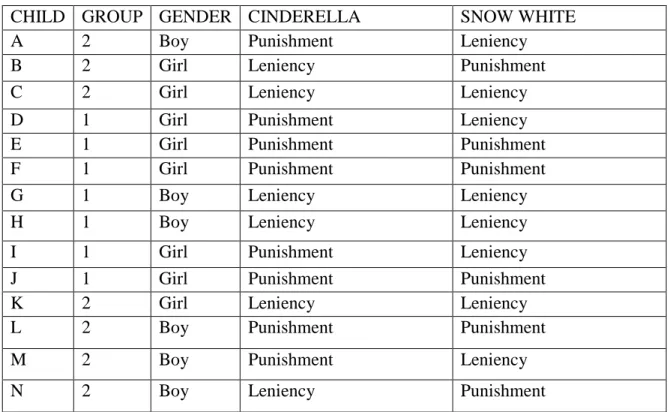
Children selected story endings characterized by either punishment or leniency for the stories “Cinderella” and “Snow White.”
CHILD GROUP GENDER CINDERELLA SNOW WHITE
A 2 Boy Punishment Leniency
B 2 Girl Leniency Punishment
C 2 Girl Leniency Leniency
D 1 Girl Punishment Leniency
E 1 Girl Punishment Punishment
F 1 Girl Punishment Punishment
G 1 Boy Leniency Leniency
H 1 Boy Leniency Leniency
I 1 Girl Punishment Leniency
J 1 Girl Punishment Punishment
K 2 Girl Leniency Leniency
L 2 Boy Punishment Punishment
M 2 Boy Punishment Leniency
N 2 Boy Leniency Punishment
Table 2. Children’s story ending preferences.
There is an exactly even split between selections of punishment and leniency.
Punishment Leniency
14 14
Between the two stories, punishment and leniency were also chosen to about the same degree. However, in the story of Cinderella, punishment was slightly preferred, and in the story of Snow White, leniency was slightly preferred.
Punishment Leniency
Cinderella 8 6
Snow White 6 8
Table 4. Preference distribution between stories.
There is more of a difference between the number of times punishment and leniency is chosen by girls versus boys, with girls being more likely to choose punishment than boys.
Punishment Leniency
Girls 9 7
Boys 5 7
Table 5. Preference distribution by gender.
This becomes more interesting when comparing girls’ and boys’ selections of punishment or leniency depending on the story. For the story of Cinderella, girls were more likely to prefer punishment, whereas they selected punishment and leniency equally for Snow White. Boys, however, selected punishment and leniency equally for
Cinderella, whereas they preferred leniency for the story of Snow White.
Cinderella Snow White
Punishment Leniency Punishment Leniency
Girls 5 3 4 4
Boys 3 3 2 4
Table 6. Preference distribution by story and gender.
Findings from Interviews
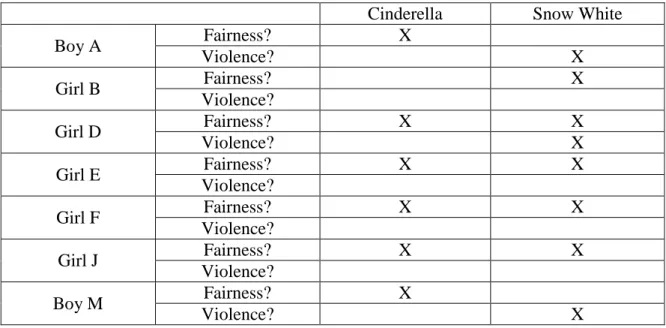
I examined the transcriptions of the interviews and looked for evidence as to why the children chose punishment or leniency in the story endings. I coded the interview transcriptions for interest in fairness and violence, indicated by explicit, voluntary mention of something relating to these ideas. For “fairness” I looked for mention of meanness or niceness as an explanation for why punishment was deserved. For
“violence” I looked for descriptions of actions that seemed to the child to be too extreme
to be justified. I only counted ideas that were expressed in the children’s own words, and I did not count yes or no answers.
I found that seven interviewees voluntarily mentioned something related to fairness and/or violence, in their own words.
Cinderella Snow White
Boy A Fairness? X
Violence? X
Girl B Fairness? X
Violence?
Girl D Fairness? X X
Violence? X
Girl E Fairness? X X
Violence?
Girl F Fairness? X X
Violence?
Girl J Fairness? X X
Violence?
Boy M Fairness? X
Violence? X
Table 7. Voluntary mention of fairness or violence.
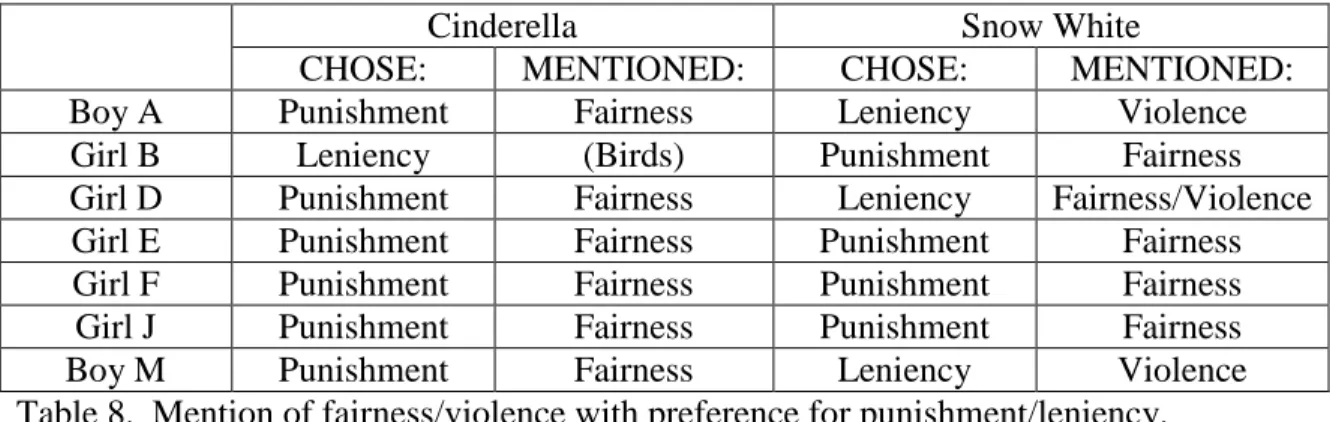
to a mention of fairness, and their preferences for leniency correspond to a mention of violence.
Cinderella Snow White
CHOSE: MENTIONED: CHOSE: MENTIONED:
Boy A Punishment Fairness Leniency Violence
Girl B Leniency (Birds) Punishment Fairness
Girl D Punishment Fairness Leniency Fairness/Violence Girl E Punishment Fairness Punishment Fairness
Girl F Punishment Fairness Punishment Fairness
Girl J Punishment Fairness Punishment Fairness
Boy M Punishment Fairness Leniency Violence
Table 8. Mention of fairness/violence with preference for punishment/leniency. Of the ten instances of preference for punishment, every child also mentioned factors related to the concept of fairness as an explanation for his or her story ending selection. Boy A simply cited Cinderella’s stepsisters’ actions as his reason for choosing punishment for them. When asked, “Why did you pick that one?” he responded, “They didn’t let Cinderella go [to the ball].” In the other nine situations in which the children
preferred punishment, they referred to meanness as their justification. Regarding Cinderella’s stepsisters, they said “because they were so mean” (Girl D), “because they were mean to Cinderella” (Girl E), “because they were mean to Cinderella” (Boy M), “because the little girls, they were mean to Cinderella” (Girl F), and “um, the birds, um,
sisters were really mean to they, and the birds, they really need to poke at them” (Girl J). The children also noted meanness in Snow White’s evil queen: “because [she] was so mean and [she] deserved it” (Girl B), “it was ‘cause the evil queen was so mean to her” (Girl E), “because the queen, she was so mean to Snow White” (Girl F), and “well, her was so mean to Snow White” (Girl J).
circumstances related to violence or extremity of punishment as his reason for not
choosing punishment. Boy A was very straightforward about the lenient ending of Snow White:
Interviewer: Why did you pick that one?
Boy A: Because …they can be nice to each other. Interviewer: Why didn’t you pick the other ending?
Boy A: Because the animals chased her and she would be dead.
Boy M had similar ideas regarding the lenient ending of Snow White: Interviewer: Why do you like that one better?
Boy M: Since it’s nicer.
Interviewer: Why didn’t you like the other ending, where the animals chased her Boy M: No response
Interviewer: Is there a reason you didn’t pick that one? Boy M: Mmhmm. (Nod)
Interviewer: Why didn’t you pick that one? Boy M: Because that’ll be mean.
Interviewer: Do you think it would be fair for the evil queen to be pushed off the cliff?
Boy M: (Shake head no) Interviewer: Why not?
Boy M: Because that would be so mean.
The other two times in which children chose leniency may not actually be
exceptions to the pattern when examined further. In one of them, Girl D mentioned both fairness and violence in explaining her choice of leniency in “Snow White.” When asked which ending she preferred she said, “when she forgave the evil queen,” but she also
explained the events of the other ending: “because they get her because she’s so mean.” However, even though she acknowledged possible reasons for the punishment, she did not prefer it:
Interviewer: But do you think that was a fair thing to happen to the evil queen? Girl D: Yes.
Girl D: No.
Interviewer: If you think it was fair for that to happen, why didn’t you choose it? Girl D: Uhh, because I didn’t like when the uhh the queen, they chase her.
In the other possibly exceptional instance, Girl B says that she doesn’t like birds.
Interviewer: Why did you like that ending? Girl B: I don’t know.
Interviewer: Why didn’t you pick the other ending? Girl B: ‘Cause I didn’t like it.
Interviewer: What didn’t you like about it?
Girl B: I don’t like a lot of birds. . . I don’t like birds.
Considering only the children who mentioned fairness or violence, there is a dramatic demonstrated preference for punishment over leniency. Punishment is selected more than twice as often as leniency.
Punishment Leniency
10 4
Table 9. Preference distribution within subset of children.
Considering these seven children’s choices according to story, there is a greater
preference for punishment in the story of Cinderella than there is in Snow White.
Punishment Leniency
Cinderella 6 1
Snow White 4 3
Table 10. Preference distribution between stories within subset of children. Looking Deeper
Looking deeper into the children’s responses reveals specific evidence as to why