Descriptions. A Master’s paper for the M.S in L.S. degree. April 2000. 29 pages. Advisor: Diane Sonnenwald.
The study investigates qualifications employers seek in new employees with regards to the position of reference librarian and whether library and information science programs are offering courses that will help students interested in a career in reference librarianship meet employers’ expectations and requirements. The investigation is based on a content
analysis of 58 job announcements for reference librarians and 60 course descriptions from library science programs. The job announcements and library and information science programs were selected randomly from Northeast, South, Midwest and West regions across the United States using job announcements that were posted on the World Wide Web. Course descriptions were selected using the online course catalog from school. Over half (50%) of the job announcements listed excellent interpersonal skills as required for the job with over a third (33%) listing technological abilities/skills as the next most frequently mentioned qualification. In contrast, only 21% of school course descriptions appeared to emphasize interpersonal skills in the course while collection development skills and technological abilities/skills were emphasized in 36% and 38 % respectively of the courses.
Headings:
Content Analysis Job Analysis
ANALYSIS AND COMPARISON OF REFERENCE LIBRARY JOB ANNOUNCEMENTS AND LIBRARY SCIENCE COURSE DESCRIPTIONS
by Pamela Foreman
A Master’s paper submitted to the faculty of the School of Information and Library Science of the University of North Carolina at Chapel Hill in partial fulfillment of the
requirements for the degree of Master of Science in Library Science.
Chapel Hill, North Carolina May 2000
Approved by:
TABLE OF CONTENTS
Introduction... 1
Literature Review ... 3
Method... 7
Findings...11
Discussion and Conclusion...17
References ...21
INTRODUCTION
What are the skills and abilities that employers are looking for in a reference librarian? Are students preparing for a career in reference librarianship being properly prepared by accredited library and information science programs to meet employers’ needs and expectations? These are the questions that this paper addresses in order to investigate if library school programs are adequately preparing students for careers as reference librarians.
LITERATURE REVIEW
There have been several articles written that discuss the changing role of the reference librarian with regard to the 21st century. These articles discuss the importance of finding a balance between using traditional print resources versus using newer resources such as the Internet.
In Julia Kelly’s and Kathyrn Robbin’s article, “Changing Roles for Reference Librarians” (1996), they make the observation that technology has changed reference services forever. The arrival of such services as the Internet and web databases have meant new job skills and new job duties for today’s and tomorrow’s reference librarian. Now more than ever, reference librarians must be able to master technology in order to do their jobs properly.
Circumstances such as these mean that the reference librarian, who is usually the first point of contact in the library, will have to especially sensitive to the variety of people they will encounter during the course of their job. Reference librarians will need to be able to present a welcoming attitude and demonstrate a commitment to customer service to people with a variety of English language skills(Dawson & McCook, 1996). Reference librarians must also be aware of how patrons search for information. “High end user university faculty, computer literate students—may circumvent the services of librarians, but a larger number of potential users feel more remote and disenfranchised than ever before”(1996, p. 65). The reference librarian must be able to effectively communicate and interact with the user who may not be familiar with the technology, acting as a
intermediary between individual (user) and machine (tools used to extract information) (1996). With increased use of technology comes an increased need for better and more comprehensive interpersonal skills.
In 1993, a content analysis of special library job posting showed that this was indeed the case as the study showed that approximately 25% of 100 employers analyzed required good interpersonal skills, 37% required on-line search proficiency, 22%
considered a working knowledge of CD-ROMS important and 22% required a working knowledge of the Internet and World Wide Web (Tauraso, 1993).
• Assisting with interlibrary loan
• Developing bibliographic guides
• Providing research assistance
By 1985 this list had expanded to include these requirements: • Experience in online database searching
• Familiarity with microcomputer applications • Flexibility
• Human relation skills
• Ability to work as part of a team
By 1998, the list of requirements had grown to include these skills: • Knowledge of HTML
• Experience using the Internet, CD-ROMS, computer hardware, and software
• Demonstrated teaching ability
• Experience with library instruction
It is apparent that by the 1990s, the qualifications that employers were seeking were centered on a reference librarian’s ability to communicate effectively and use technology.
It is clear that “as librarianship moves towards the 21st century, librarians must educate themselves to survive in the evolving Information Society” (Nofsinger, 1999, p.9). In the article, “Training and Retraining Reference Professionals: Core Competencies for the 21st Century,” Nofsinger highlights several core competencies for reference librarians. Communication and interpersonal skills, technological know-how and dedication to
able to use current and emerging technologies and assist members of the public in using these tools requires both interpersonal abilities and technological knowledge on the reference librarian’s part.
Thus the literature suggests that job requirements for reference librarians are changing to include abilities that require knowledge of current technology such as web page design and internet searching and that employers seek job candidates with
METHODOLOGY
Job announcements were selected from a variety of sources in order to more accurately reflect the varying job qualifications across the United States. Job
announcements were limited to those positions advertising for reference librarians, either full or part-time. The time frame for the job announcements was limited to those jobs which were posted between February 1999 and April 2000. Some of the resources used include the following sources:
• April 2000 American Libraries' Career Leads at http://www.ala.org/education/.
• March 2000 American Libraries' Career Leads at http://www.ala.org/education/. • February 2000 American Libraries' Career Leads at http://www.ala.org/education/. • Academic Librarian Positions from College & Research Libraries NewsNet at
http://www.ala.org/education/ .
This represents a sample of the sources used, a complete list can be found in Appendix A.
Job announcement were selected from four regions in the United States:
Delaware, Virginia, West Virginia, Kentucky, North Carolina, South Carolina, Tennessee, Georgia, Alabama, Arkansas, Mississippi, Louisiana, Texas, and Florida), Midwest (Ohio, Michigan, Indiana, Illinois, Wisconsin, Minnesota, Iowa, Missouri, Oklahoma, Kansas, Nebraska, South Dakota, North Dakota), West (Montana, Idaho, Washington, Oregon, Wyoming, Colorado, Utah, Nevada, New Mexico, Arizona, California, Hawaii, and Alaska).
An attempt was made to obtain a sample of 15 job announcements per region, however for the South and West regions only 14 job announcements for each region were found. A total of 58 job announcements were investigated in this content analysis. The majority of the job announcement were a page in length consisting of one to three paragraphs. The job announcements were also classified according to library type and a final count showed that 22 job announcements came from public libraries, 30 job
announcements came from academic libraries, and 6 job announcements came from special libraries.
library users and other members of the library staff. The collection development category covered duties that involved collection building activities of the library. The technological abilities/skills category involved any job qualification that is required or desired by a library employer that involves a reference librarian to use or have knowledge of certain computer applications. The systems infrastructure category included duties that involved the maintenance or setup of library systems operations such as network administration, systems administration, database administration, and similar operations. Complete definitions for each category and coding units used can be found in Appendix B. An example of how a job announcement was coded can be found in Appendix C.
The coding scheme focused on the presence or absence of a coding unit(s) within a single document. A single document was considered to be a single job announcement. Duplicate occurrences of a single coding unit within a single document were not recorded; only the first occurrence of a coding unit within a single document was noted on the coding sheet in the proper category. After all of the job announcements were coded, the results were tabulated to reflect national percentages, regional percentages and library type percentages for each category.
listed as required courses in the school catalog or admission requirements for that library science program. Required courses were chosen for two main reasons: (1) to make sure that courses analyzed were ones that every student was required to take as part of defining the core or foundation of their library science education and (2) to minimize bias by
looking at courses not specifically geared toward any student’s particular interest. A total of 60 course descriptions were analyzed.
The coding scheme focused on the presence or absence of a coding unit(s) within a single document. A single document was considered to be a single course description. Duplicate occurrences of a single coding unit within a single document were not recorded; only the first occurrence of a coding unit within a single document was noted on the coding sheet in the proper category. The same categories were used to analyze the course descriptions as were used to analyze the job announcements. After the coding was
FINDINGS
The results of the content analysis for the job announcements indicate that
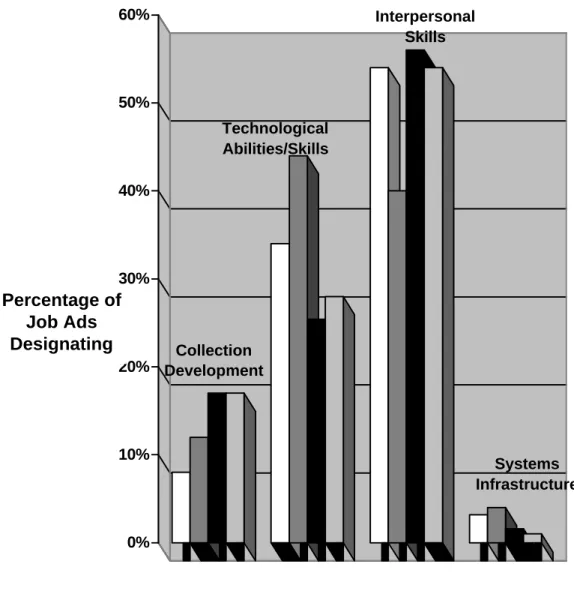
employers are looking for job candidates who possess primarily interpersonal skills (50%) and secondarily technological abilities/skills (33%) (see Figure 1). Skills or duties that involve collection development were at 14 % and systems infrastructure duties were at 3% (see Figure 2).
Looking at the results by region (see Figure 2), 54 % of job announcements in the Northeast wanted employees who were well versed in interpersonal skills, while in the South 40% of employers desired this quality. The other regions, the Midwest (56%) and the West (54%) showed percentages very similar to that of the Northeast region for interpersonal skills. Employers desired employees with technological skills in 34% of the job announcements for the Northeast, 44% in the South, 25% in the Midwest and 28% in the West. Qualifications dealing with collection Development and Systems Infrastructure followed the trend seen in the national statistics showing under 20% for collection
Figure 1. Job Announcements: National Percentages
0% 5% 10% 15% 20% 25% 30% 35% 40% 45% 50%
Collection Development
Interpersonal Skills
Technological Skills/Abilities
Systems Infrastructure
Percentage of Job Ads Designating
Figure 2. Job Announcements: By Region
Collection Development
Technological Abilities/Skills
Interpersonal Skills
Systems Infrastructure
0% 10% 20% 30% 40% 50% 60%
Northeast South Midwest West
Category Investigated Percentage of
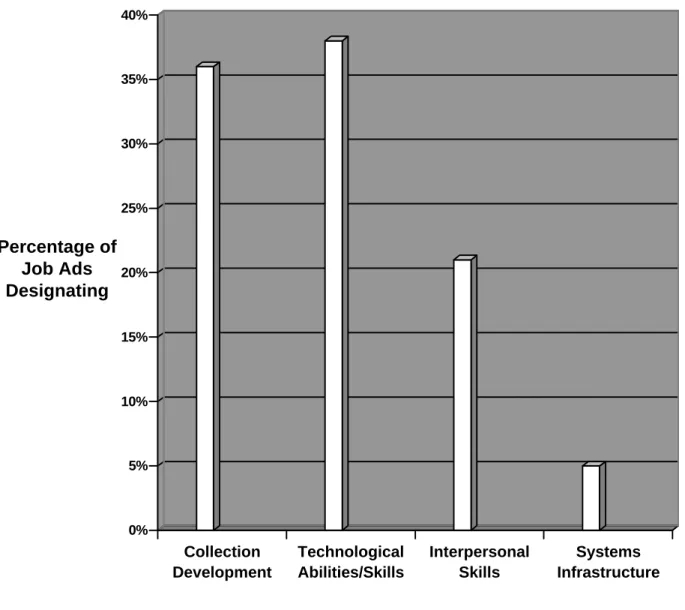
In the school course descriptions, the figures show different results from the job announcements content analysis. As illustrated in Figure 3, overall the categories of collection development and technological abilities/skills were emphasized in 36% and 38% of the courses respectively. Interpersonal skills were stressed 21% of the time and
systems infrastructure was represented 5% of the time.
Figure 3. School Course Descriptions: National Percentages
0% 5% 10% 15% 20% 25% 30% 35% 40%
Collection Development
Technological Abilities/Skills
Interpersonal Skills
Systems Infrastructure Percentage of
Job Ads Designating
Figure 4. School Course Description: By Region
0% 10% 20% 30% 40% 50% 60%
Collection Development
Technological Abilities/Skills
Interpersonal Skills
Systems Infrastructure
Northeast
South
Midwest
West Percentage of
Job Ads Designating
DISCUSSION AND CONCLUSION
By comparing the job announcement results and the course description results, there appears to be a disconnect between what library schools are teaching and what employers want in future reference librarians. Employers mention interpersonal skills most frequently as the skills an employee should possess followed by technological abilities and skills, collection development and systems infrastructure. Schools on the other hand, are stressing collection development and technological abilities and skills in their courses followed by interpersonal skills.
regions showed high percentages in interpersonal skills, but much lower percentages in technological abilities/skills. The South on the other hand had nearly equal percentages in these two categories, showing that both interpersonal skills were sought about as much as technological abilities/skills. None of the job announcements indicated that collection development or systems infrastructure was very important in terms of the job skills that job candidates should possess.
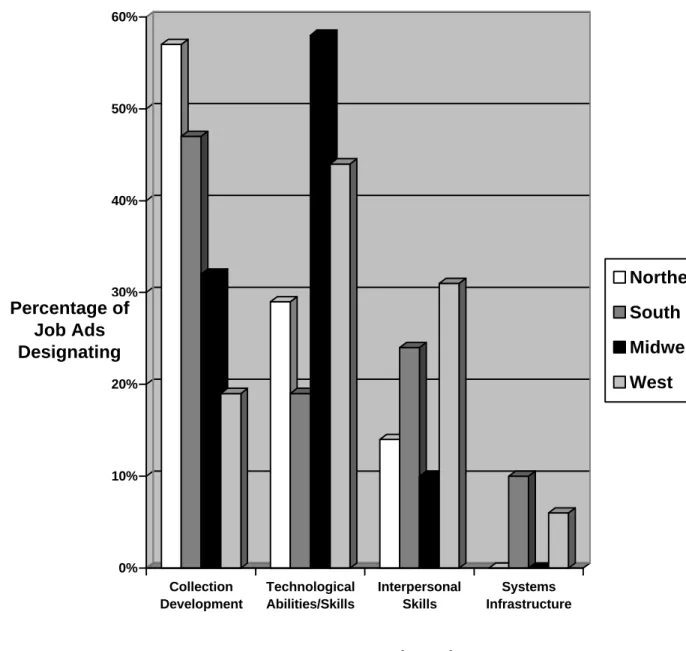
A comparison of the school course descriptions by region shows very different results from the regional comparison of job announcements. In the Northeast, collection development and technological abilities/skills are emphasized as the most important followed by interpersonal skills and systems infrastructure. The south region shows courses concentrating mostly on collection development while technological abilities/skills, interpersonal skills, and systems infrastructure are not nearly as stressed. In the Midwest and West, technological abilities/skills are well above the percentages for the other three categories.
A final comparison of the regional job announcements and the regional course descriptions yields an interesting pattern. Job announcements show a general pattern of ascending order of importance for collection development, technological abilities/skills, and interpersonal skills, respectively. While the school course descriptions show a general pattern of descending order of importance for collection development, technological abilities/skills and interpersonal skills, respectively. The importance of systems
possess more “people skills.” Perhaps this is so they can effectively interact with peers, or assist library users in using this new technology. This is speculation because without direct feedback from other reference librarians using questionnaires or surveys, it is hard to know what a reference librarian’s job actually entails. Another limitation of this study was the time frame over which course descriptions and job announcements were collected. It would have been more conclusive if perhaps a span of several years had been used in order to see if a pattern or trend emerged in terms of what schools taught and what employers required in employees. Or perhaps limiting the study to one geographic area would have been a good idea to see any differences or similarities were occurring over the years. Another limitation is that no intercoder reliability testing was done to validate the coding scheme and coding technique.
In general, I was somewhat surprised by the results of my study. Before
REFERENCES
Dawson, A., & McCook, de la Pena, K. (1996). Trends affecting the roles of reference librarians. The Reference Librarian, 54, 53-73.
Ezzell, J.R. (1998). It was the most uncertain of times: Academic reference librarianship at the end of the twentieth century. North Carolina Libraries, 56 (3), 96-99. Kelly, J. & Robbins, K. (1996). Changing roles for reference librarians. Journal of
Library Administration, 22, (2-3), 111-121.
Nofsinger, M.M. (1999). Training and retraining reference professionals: Core competencies for the 21st century. The Reference Librarian, 64, 9-19. Tauraso, M. (1996). The Qualifications Sought by Special Library Employers: A
Content Analysis of Job Advertisements. Unpublished master’s paper, University
Appendix A
Complete List of Job Announcements Resources
• American Libraries Late Job Ads Online at http://www.ala.org/education/.
• April 2000 American Libraries' Career Leads at http://www.ala.org/education/.
• March 2000 American Libraries' Career Leads at (http://www.ala.org/education/. • February 2000 American Libraries' Career Leads (http://www.ala.org/education/. • Academic Librarian Positions from College & Research Libraries
NewsNet at http://www.ala.org/education/. • Library Job Posting on the Internet at
http://webhost.bridgew.edu/snesbeitt/libraryjobs.htm.
• The Mountain Plains Library Association: MPLA Jobline Posting at
http://www.usd.edu/mpla/jobline.
• Pacific Northwest Library Association Mailing List Archive at
http://archive.wln.com/pnla/index.html.
• Northeast Massachusetts Regional Library System Jobs page at
http://www.nmrls.org/jobs/.
• New Hampshire Library Job Line at http://www.state.nh.us/nhsl/ljob. • LORI Jobs Discussion Group at http://lori.state.ri.us/jobs.
• Western Massachusetts Regional Library System at
• University of Rhode Island Graduate School of Library and Information Studies
(URI-GSLIS) at http://www.uri.edu/artsci/lsc/JL.html.
Appendix B
Category 1: Interpersonal Skills
Definition: This category covers any job qualification or duty required or desired by a public, academic or special library that involves a reference librarian’s ability to interact and work with library patron and/or co-workers. This category addresses the ways in which a reference librarian should meet the needs of a library’s community using communication and human relation skills.
Examples of Phrases Indicating Interpersonal Skills • customer service
• bibliographic instruction
• instructing
• interpersonal
• teaching
• reader’s advisory
• public relations • human relations
• team
• friendly
• flexible
• flexibility
• outreach
• communication skills
• assistance
• assist
• assisting
• training
• advising
• reference interview
• people skills
• educate
Appendix B
Category 2: Collection Development
Definition: This category involves library activities that require a reference librarian to be involved in the collection building activities of the library such as selecting and evaluating books for purchase by the library in order to meet curricular and research needs of faculty, students and other members of the public.
Examples of Phrases Indicating Collection Development Activities • collection development
• research needs
• curricular needs
• materials selection
• evaluate
• evaluating
• evaluation
• select • selecting
• collection building
Appendix B
Category 3: Technological Abilities/Skills
Definition: This category involves any job qualification or duty that is required or desired by library employers. This also involves a reference librarian’s ability to use or have knowledge of computer applications such as web searching, internet searching, online searching, and web page creation. This category does not involve or include basic computer applications such as word processing or typing.
Examples of Phrases Indicating Technological/Abilities Skills • HTML
• CD ROM
• Internet searching
• Web searching
• Online searching
• Database searching
• Javascript • Coding
• WWW
• World Wide Web
• Mark up language
• Computer instruction
• Searching
• Electronic resource(s)
• Software
• Metadata
• Navigation
• Database design
• Database development
• Digital
• PC skills • Computer skills
• Web page development
• Web page creation
• Web site development
• Internet
• Database construction
Appendix B
Category 4: Systems Infrastructure
Definition: This category involves activities that involve the maintenance or setup of library systems operations such as network administration, systems administration, database administration, and similar operations.
Examples of Phrases Indicating Systems Infrastructure Activities • Database administration
• Systems administration
• Network administration
• LAN
• TCP/IP
• Protocol
Appendix C
Example of a Coded Job Announcement * Posted: 2/7/2000
Position:
Part-Time Reference Librarian Duties:
Research information requests using print and non-print sources. Assist library patrons with information searches and with use of library equipment. Assist with collection development. Collect and maintain appropriate statistics. Prepare written
bibliographies and reading lists. Other duties as required. Qualifications:
ALA-accredited MS in Library and Information Science or eligibility for certification as Provisional Librarian. Good oral and written communication skills, knowledge of reference skills and resources. Computer skills/experience required. Prior public library reference experience desirable.
Hours:
15 - 20 hours per week, including evenings, Saturdays and Sundays in rotation.
In this job announcement the coding terms and phrases have been highlighted in grey. As each term or phrase appears for the first time in the document it is marked on the coding sheet in the appropriate category. Three categories are represented in this job
announcment: Interpersonal Skills (assist and communication skills), Technological Abilities/Skills, (computer skills) and Collection Development (collection development). Duplicate appearances of a term or phrase were not counted.
Appendix D
Example of Coded Course Descriptions from One School * Core Courses
Management of Library and Information Services (I and II, SS, 3) Introduction to the process, principles, practices, theories and case studies in the administration, management and supervision of libraries and information services. Focus on management functions: planning, organizing, staffing, directing, controlling.
Collection Development (I and II, 3) Introduction to process, practices, and problems of collection building, maintenance, and evaluation regardless of format or subject of
material, type of institutional setting, or community or client group served.
Reference and Information Services (I and II, 3) Practical experience in the use of basic information sources with readings and discussion on the philosophy and administrative aspects of reference work.
Organization of Information (I or II, 3) Theory and practice of organizing information following national and international standards; focus on bibliographic information. Emphasizes the understanding and application of cataloging and classification principles, standards, tools, bibliographic utilities and networks.
Introduction to Information Science and Technology (I, II, or SS,3) Introduction to the organization, retrieval, and analysis of information and the technologies used to control the manipulation and dissemination of information in library and information settings.
In these course descriptions the coding terms and phrases have been highlighted in grey. As each term or phrase appears for the first time in a single document, in this case a single course description, it is marked on the coding sheet in the appropriate category. Two categories are represented in these course descriptions: Interpersonal Skills (community), and Collection Development (evaluation, collection development and collection building). Duplicate appearances of a term or phrase were not counted.