David M. Tenenholtz. A Complex Web: Upgrading to Linked Data in Digital Repositories. A Master's paper for the M.S. in I.S. degree. April, 2017. 55 pages. Advisor: Ryan Shaw
As libraries, archives, and museums (“LAMs”) adopt linked data for purposes of enhancing their bibliographic and authority metadata, the technologies around digital repositories also are similarly changing course to model digital objects using linked data standards such as RDF. This study explores the digital
repository community's engagement and perceptions of linked data modeling. The study is split into two phases consisting of a web survey and
semi-structured interviews. Qualitative analysis of the data summarizes key characteristics of the community of practice, and open problems in transitioning to linked data in the redesign of the Fedora storage and
preservation architecture commonly used in digital repositories. Other areas of discussion include the perceived concerns in cross-walking MODS to RDF, as well as the community’s recommended implementation of the Portland Common Data Model (PCDM).
Headings: Data modeling
Digital library software Digital preservation Institutional repositories Linked Data (Semantic Web)
A COMPLEX WEB: UPGRADING TO LINKED DATA IN DIGITAL REPOSITORIES
by
David M. Tenenholtz
A Master's paper submitted to the faculty of the School of Information and Library Science of the University of North Carolina at Chapel Hill
in partial fulfillment of the requirements for the degree of Master of Science in
Information Science.
Chapel Hill, North Carolina April, 2017
Approved by:
1
Table of Contents:
Acknowledgements ... 3
Introduction ... 4
The Web of Data and Cultural Heritage Institutions ... 4
Fedora ... 7
Open-Source IRs: Development and Community Steering ... 10
Purpose of This Study ... 11
Literature Review ... 12
The LOD Community of Practice ... 12
Towards a Common Data Model ... 15
Research Questions ... 17
Research Design ... 18
Phase 1: Web Survey ... 18
Phase 2: Case Study ... 19
Results ... 20
Phase 1 Results ... 21
Phase 2 Results ... 29
Discussion ... 32
Research Question 1 ... 32
Research Question 2 ... 32
Research Question 3 ... 34
Research Question 4 ... 34
Study Limitations ... 35
Conclusion ... 36
Bibliography ... 39
Appendices ... 44
Appendix A: Glossary ... 44
Appendix B: Qualtrics web survey for Phase 1 of study ... 46
2
List of Figures:
Figure 1: Size of Repositories (in Digital Objects) ... 21
Figure 2: Staff Size, N=24 ... 22
Figure 3: Chosen Repository Platform ... 23
Figure 4a: Man-Years Devoted to Upgration, N=16 ... 25
Figure 4b: Man-Years Devoted to Upgration, N=14 ... 25
Figure 5: Man-Years Remaining to Complete Upgration ... 26
Figure 6: Survey Responses for Familiarity with Linked Data ... 29
3
Acknowledgements
I must offer my thanks to many people that helped me in the course of
constructing this paper, and the following mentions come in no particular
order. To formulate my knowledge of the subject of linked data and digital
repositories that was invaluable to conduct this study, I have to thank my
master’s paper advisor Dr. Ryan Shaw, and Sonoe Nakasone, my supervisor in the Resource Description and Management department at UNC’s Davis Library
during my first year at SILS. Further thanks go to UNC Libraries staff Ben
Pennell, Julie Rudder, and Moira Downey; SILS doctoral students Deborah
Maron and Jacob Hill; Code4Lib Data Modeling pre-conference workshop
facilitators Christina Harlow, Mark Matienzo, Steve Van Tuyl, and Hector
Correa. Instrumental to the survey construction was DuraSpace's David Wilcox,
who provided vital feedback during the survey’s development. For helping me build the survey itself, I am grateful to The Odum Institute staff members
Teresa Edwards, and Paige Ottmar; also at Odum, Paul Mihas, whose course on
NVivo was essential for me to conduct the qualitative data analysis presented
here. My thanks also go to the survey and interview participants, and the
community of practice around the Fedora Project and associated software.
Lastly, I am grateful for all of the words of encouragement and support from
4
Introduction
The Web of Data and Cultural Heritage Institutions
Since its formal definition in 2006, linked data has moved from a
heavily-hyped niche technology within libraries, archives, and museums (LAMs)
to a recommended model for digital collections (Stuart, 2014). In 2011, the
Andrew W. Mellon Foundation awarded Stanford University $50,000 in order to
fund a workshop that explored prototyping linked data for scholarly use.
Although these beginnings were humble, in the intervening years more Mellon
grants have been issued. The most recent, dated March 10, 2016, for
$1,500,000 to Cornell, Stanford, Harvard, and the University of Iowa, was
funded to “support library initiatives that develop and advance the use of
linked open data.”1 The progression for cultural heritage institutions to adopt
linked data as a solution to expose and share data has surpassed the
recommendation phase, and now is an accepted practice. Indeed, there is a
clear push to advance the implementation of linked data within the LAM
community, and the expression of increased funding is only one indication that
the tides are now shifting to make this initiative move from aspiration to
common practice.
5
The aspiration to transform library data into library linked data was perhaps best explained in the 2011 Stanford grant description, which offered
this manifesto:
We in the cultural heritage and knowledge management institutions are discovering better ways of publishing, sharing, and using information by linking data and helping others do the same. Through this work, we have come to value and to promote the following practices:
1. Publishing data on the web for discovery and use, rather than preserving it in dark, more or less unreachable archives that are often proprietary and profit driven;
2. Continuously improving data and Linked Data, rather than waiting
to publishing “perfect” data;
3. Structuring data semantically, rather than preparing flat, unstructured data;
4. Collaborating, rather than working alone;
5. Adopting Web standards, rather than domain specific ones; 6. Using open, commonly understood licenses, rather than closed
and/or local licenses.
While we recognize the need for both approaches in each "couplet," we value the initial ones more. (University, Stanford, & Complaints, n.d.)
To explain how linked data might serve the LAM community, the technologies
involved must be defined. To publish structured data on the web, Tim
Berners-Lee set out the four principles of linked data:
1. Use [Uniform Resource Identifiers] URIs as names for things. 2. Use HTTP URIs so that people can look up those names. 3. When someone looks up a URI, provide useful information.
4. Include links to other URIs so that they can discover more things. (Berners-Lee, 2006)
Tom Heath and Christian Bizer describe how linked data builds on the Web’s
architecture:
6
Within the Stanford grant manifesto lie allusions to another vital concept
to the changing face of data modeling in LAMs: “open data.” This is a concept similar to “open source” in that the content is freely accessible, published with
a non-restrictive license, and is compatible with other pools of materials.
Science and government can gain the most from sharing their open data freely
through formed relationships with other open data. Discoverability across the
web of “open data” is seen as one of the major benefits of this ideological
shift, along with transparency (as in the case of government-funded research).
Ultimately, this interoperable version of publicly-available science and
government data results in a variation of linked data, called Linked Open Data
(LOD).
Alongside the recent adoption of LOD for sharing information coming out
of LAMs, there also has been a consistent growth in the field of institutional
repositories since the early days of pre-print servers for the sciences, such as
arXiv.org. In many government-supported locations contributing to research
(state-affiliated institutions of higher education being only one such setting)
the push to provide “open access” to research data has led to an adoption of
an LOD approach for institutional repositories. As a result, digital repository
software systems used by institutional repositories have moved from
unsophisticated metadata modeling in relational databases to newer structures
that support the mandate to expose state-funded research using LOD (Babu, et
7
Dorothea Salo describes the data challenge that comes with stewardship
over research data, and indicates that digital repositories are the ideal location
for this purpose. Indeed, particularly institutional repositories (IRs) are the most capable setting to handle a variety of digital objects (Salo, 2010). In a
2013 survey of 150 digital repositories, Nicholas segmented out the many
content types that IRs can provide preservation and access to. Nicholas
suggests that institutions aim to mandate that scholars deposit their research
into institutional repositories (Nicholas et al., 2013).
Not everyone in this domain has such a positive outlook for institutional
repositories. Former director of the Coalition for Networked Information
Clifford Lynch, in discussion with Richard Poynder, expressed skepticism about
the outlook for institutional repositories going forward, saying that IRs have not
reached their potential since they were first conceptually outlined at the 1999
Santa Fe meeting of the Open Archives Initiative. Reasons for this
under-realized potential, Lynch suggested, are due to the barriers to faculty who
should self-deposit their research output but choose not to, and a lack of
disciplinary archives that are linked together and possibly replicated across
repositories (Poynder, 2016).
Fedora
Institutional repositories are typically built on a feature-rich technology
stack that incorporates a variety of open-source software tools. These tools
8
control, and more. In many cases, one tool is based on another, or incorporates
some outside features loosely into itself.
Currently, one of the most commonly used digital object storage
platforms for digital repositories is FEDORA, which stands for Flexible
Extensible Durable Object Repository Architecture.2Conceived at Cornell’s
computer science department by Sandra Payette and Carl Lagoze, and
described through their 1998 publication, Fedora has changed shape over time
to be an enriched framework with community-driven support (Lagoze, Payette,
Shin, & Wilper, 2006; Payette & Lagoze, 2013).
Fedora occupies a unique role within the institutional repository
community, because many repositories are commonly built on the Hydra and
Islandora digital asset management systems.3 Hydra is a set of “solution
bundles” that at their core include Fedora, the Blacklight discovery layer, Apache Solr search index, and Ruby on Rails web application codebase.4
Islandora is also a modular stack comprised of the Drupal content management
system, Apache Solr, and Fedora.5 That both Hydra and Islandora use Fedora as
the storage and preservation component within their systems is a testament to
Fedora’s ubiquity in this space.
2 Some members of the Fedora community also consider the “D” to stand for “Digital” rather than “Durable.”
3 In recent practice, the name Fedora is typically spelled only with the first letter capitalized.
9
Fedora’s development has been gaining speed and at the time of this
writing is at release version 4.7.2. Fedora’s latest major upgrade from version
3.8.2 to 4.0 implemented a new data model, one that is based on a
conceptually different idea for how digital repositories should function and
take advantage of emerging web technologies. At its core lies native support
for linked data.
Fedora has a growing member-driven community, with stewardship
provided by DuraSpace. In 2016, the Fedora community was adding members
rapidly, and it will soon have 100 member institutions defining their IRs as
“built on Fedora.” There are already an estimated 400 digital libraries that leverage Fedora’s conceptual architecture in some way.6
Fedora 3.x is now a legacy system not under active development. It used
a proprietary method of associating various digital objects through an XML set
it called RELS-EXT and RELS-INT. In June 2014, Fedora 4.0 Beta was released.
The release was a conceptual departure in various ways in that it allowed for
more flexibility and scalability, but most predominantly through the adoption
of an emerging technology called the Linked Data Platform (LDP), which
defines a RESTful web services API mechanism to interact with digital assets.7
In a conference report from May 2016, Carol Minton Morris defined what Fedora
4 would mean to the broader digital library community:
6 This metric was provided by David Wilcox during his workshop on Fedora at the 2016 Digital
Library Federation Forum meeting in Milwaukee, WI, November 8, 2016.
7 “Fedora 4 implements the LDP specification for create, read, update and delete (CRUD)
10
The nature of Fedora 4, a modular repository framework that scales, has linked data capabilities, provides research data support, is easier to develop with, and more. Recent community work towards developing a stable, independently-versioned Fedora RESTful API will make it possible for future users to adopt alternative implementations that meet the Fedora specification. Attendees discussed the idea of a bundled
trademark as a way to brand the product as part of a technology stack to ensure that the community understands the value of having ‘Fedora inside’. (Minton Morris, 2014)
Open-Source IRs: Development and Community Steering
At the core of the early philosophy for open-source software
development lies the concept of “simplicity.”8 For large open access
repositories that preserve research data at universities, this ideal is upheld at
least as an aim, but the need to manage large amounts of heterogeneous data
at an enterprise scale creates complex data management plans and codebases.
How do the sweeping changes in the Fedora codebase, and the decisions within
the community to adopt varied data models and services, support this ideal?
Coping with profound codebase changes is a difficulty within the
interconnected world of software development. Even in open-source codebase
development, there is centralization of what becomes a part of the software
and what does not. Typically this is called the “Cathedral” model in open -source development (Raymond, 2001). Providing a definition of the general
mission of the next version of a piece of software, and helping developers not
be surprised by foundational changes, goes a long way to continued support
11
and involvement from the community for which the software is intended.9
Assessing how the change is accepted, and how it is disruptive, can help
achieve greater adoption. Providing an implementation path towards one
drastically changing feature of Fedora 4 is one aspect of this development work
that must be completely understood.
With the move from Fedora 3.x to 4, repository development teams must
work to rebuild their technology stack to accommodate the new data model.
Not having an easy upgrade path may cause some disruption, and some
frustration for this growing community.10 The data model changes also spark
some more general questions about where LAMs stand in the adoption of linked
data to share their data across the web.
Purpose of This Study
The purpose of this study is to evaluate the work that is done in digital
repositories to implement linked data, and understand how to migrate to
Fedora 4.11 The Linked Data Platform used with Fedora 4 supports interaction
with collections of linked data, but this technology’s new place within the
9 One example of an open-source technology that did not successfully broadcast the major changes from a version 1 to 2 upgrade was Google’s AngularJS framework. After the version 2 announcement in 2014, there was profound backlash from the developer community.
https://jaxenter.com/angular-2-0-announcement-backfires-112127.html Accessed 2016-10-15.
10 One research presentation in January 2016 suggests that confusion starts with
conceptualizing linked data (Deng, 2016). Is this confusion easily overcome for developers working to support repositories?
11 Numerous research institutions around the world are now at Fedora version 4. At the time of
this writing, Lafayette College is the one academic institution in the United States that reports a full commitment to the Hydra Community’s efforts to move to linked data. They are listed on the Fedora Commons registry as having implemented Fedora 4 (in this case, 4.4)
http://registry.duraspace.org/registry/fedora?f%5b0%5d=field_institution_type%3Aacademic
12
development community bears exploration. While there are discernable
aspirations to use linked open data for collections of scholarly research data,
there is a fundamental need to scan the work being done within this
community of practice. This study starts with an evaluation of what factors
into the migration to Fedora 4.
Literature Review
The LOD Community of Practice
As discussed in Chapter 1, a community of practice within cultural
heritage institutions has developed in recent years centering on linked open
data. Now organizations like Linked Open Data in Libraries, Museums, and
Archives (LODLAM)12 and Semantic Web in Libraries (SWIB)13 are
well-established. A newer addition to this community is the Andrew W. Mellon
Foundation grant-funded project called Linked Data for Libraries (LD4L)14,
which is at the time of this writing the most well-funded initiative, and
encompasses work at Cornell, Stanford, Harvard, the University of Iowa, and
other institutions. These communities of practice offer guidance for the unique
challenges the “web of data” poses in their domain, and helps to extend the
work done by the organizations involved.
12 http://lodlam.net/ Accessed 2016-09-10.
13
In the past three years, there has been an international survey of LAM
organizations by OCLC researcher Karen Smith-Yoshimura, as well as a lengthy
assessment through multiple American Library Association (ALA) Library Technology Reports by Erik Mitchell. The resulting analyses from Smith-Yoshimura and Mitchell provide more insight into how the LOD community
within cultural heritage institutions can be better served and continue to
develop. Looking at the outcomes of her study, Smith-Yoshimura posed the
following most common barriers that speak to the needs of the projects
implemented within this community:
1. Steep learning curve for staff 2. Inconsistency of legacy data
3. Selecting appropriate ontologies to represent our data 4. Establishing the links
5. Little documentation or advice on how to build the systems 6. Lack of tools
7. Immature software
8. Ascertaining who owns the data (Smith-Yoshimura, 2016)
In her analysis, Smith-Yoshimura categorized some of the predominant use
cases within LAMs. There are modern bibliographic cataloguing efforts through
BIBFRAME15, published datasets and exploratory “proof-of-concept”
implementations, as well as some successful pilot projects, such as the work
done at North Carolina State University and at the University of Nevada-Las
15 The Bibliographic Framework Initiative (BIBFRAME) is “an initiative to evolve bibliographic
description standards to a linked data model, in order to make bibliographic information more useful both within and outside the library community.”
14
Vegas (UNLV). Sylvia Southwick described UNLV’s work with linked data, and
how they worked from a point of confusion about how to structure data in
triples to building a digital collection represented with linked data
functionality and properties (Southwick, 2015).
The vast majority of the OCLC survey respondents reported that they
had set forth only one project that used linked data in some way. Many of
those respondents had yet to complete their projects at the time they
responded to the survey. Of the ninety total respondents, there were six that
reported that their project had to do with Fedora and/or Hydra. These
institutions were: (1) Dartmouth College, (2) Villanova University, (3) New York
University, (4) University of Tennessee-Knoxville, (5) The Chemical Heritage
Foundation, and (6) The Big Data Institute. For institutional repositories using
Fedora 4, where there is a mandate to do development using the Linked Data
Platform, the eight barriers as described by Smith-Yoshimura not only apply,
but they must also be overcome in order for the repository to function.16
In writing his Library Technology Reports for ALA in 2013 and Jan 2016, Erik Mitchell gave a nod to the emerging standards within the community of
practice around Fedora, but focused more on assessing the larger LAM
community. In his most recent survey of linked data, he argued that there is an
element of “hype” around library linked data implementations, saying:
16 The sixth point of Stanford’s 2011 grant “manifesto” concerned using open licensing. Some
15
A related policy question surfaced in this survey is how LAM institutions should approach LD production or adoption. It appears that despite the transition to Linked Data for large-scale and core services such as the transformation of library MARC platforms and the migration of EAD finding aids, the community has not yet distilled a set of activities or
systems into an ‘easy-to-implement’ platform or adoption approach.
Indeed, LD efforts might still be categorized as existing in the startup phase of a technology adoption hype cycle given the variation in standards, tools, approaches, and perceived benefits documented in survey results and published literature. (Mitchell, 2016, pg. 6)
Implementing a small linked data project for a cultural heritage institution, let
alone a large-scale restructuring of an institutional repository’s data to drive
new functionality, is seemingly dependent on factors unique to the
organization, as well as the data. In order to go further, this established
community of practice related to linked open data must grapple with each of
these outlined barriers.
Towards a Common Data Model
In contrast to earlier data modeling in LAMs that emphasized strict
authority control, and that could be constructed automatically, the flexibility
and “latitude” offered in linked data provides many breakdowns for authority
control. Myntti and Cothran argue that the abilities of linked data to bypass
constructing matches on authority files can either help or hinder data sharing
(Corbett, 2016; Myntti & Cothran, 2013). However, if the data are weakly
represented, the result is a loss of semantic precision (Isaac & Baker, 2015).
In terms of metadata standards implementations, IRs typically describe
data using Dublin Core. Salo explains how the IR reliance on Dublin Core suits a
16
Most repositories rely on Dublin Core metadata, largely because the OAI-PMH metadata exchange standard asserts unqualified Dublin Core as a minimum interoperability layer. Few repositories venture beyond qualified Dublin Core. Those who do, or wish to, find that much
repository software can only manage key-value pairs. Now that many, if not most, metadata and exchange standards for research data use XML
or RDF as a base, this limitation seriously vitiates repositories’ ability to
manage datasets. (Salo, 2010)
DuraSpace, the not-for-profit governing body over the Fedora project,
recommends that IRs moving to Fedora 4 implement a metadata application
profile using the emerging Portland Common Data Model. In contrast, Fedora
3.x used Dublin Core, along with complex uses of many metadata application
profiles truncated together, and constructed in a proprietary schema called
FOXML. The now-outmoded FOXML representation incorporates various models
of information objects into one complex file (Dublin Core, MODS, RDF,
thumbnails, and more). Noticeably, RDF takes up a portion of the FOXML
specification. This is because relationships between objects stored in Fedora
had to be made. Using the data streams “REL-EXT” and “REL-INT,” the Fedora Digital Object Model can form these associations.
A major bottleneck in moving towards RDF is due to a silo-ed digital
object description resulting from the Metadata Object Description Schema
(MODS). Hardesty describes the nuanced conflicts in the conversion of MODS
records to RDF that is mandated in an upgrade from Fedora 3 to 4 (Hardesty,
2016). A community has formed to resolve this issue, led in part by Steve
Anderson at the Boston Public Library and others. While the problem of
transforming MODS to RDF is not fully resolved yet, the Fedora 4 community
17
The digital asset management community, and particularly the Hydra
Community, is now building towards a more formalized integration of data
models. The emerging standard that will drive an off-the-shelf solution called
“Hydra-in-a-Box” is the Portland Common Data Model (PDCM).
The choice to implement the Linked Data Platform with the upgrade
from Fedora 3 to Fedora 4, along with the more recent data modeling effort of
PCDM, leaves steering Fedora development, and the larger Hydra Community,
in an uncomfortable and unresolved area. Is the community successfully
managing the changes? How does the PCDM implementation for Hydra-in-a-Box
help or hurt the institutions that look to build on this platform? Assessment of
these system integration and vendor options provide increasing challenges.
How did the DuraSpace/Fedora team resolve to move to PCDM, and how does
this impact institutional repositories, and also the broader LAM community?
Research Questions
With the forthcoming move to Fedora 4, and the varied understanding of
how to implement linked data in LAMs, this study aims to ask research
questions as follows:
RQ1. What do digital repositories moving to Fedora 4 see as positives and
negatives?
RQ2. Which data model does a given digital repository setting choose to
implement? Why reject the data models that weren’t chosen? Why reject
the Portland Common Data Model in particular, as it is a
18
RQ3. At a given digital repository setting, how do the developers evaluate
their institutional repository technology stack functioning as a whole
with the Linked Data Platform implementation through Fedora? What
sort of benchmarking can be done to evaluate if the potential benefit(s)
were achieved?
RQ4. What sort of training has been implemented at the given digital
repository setting to describe resources using linked data, or in working
to support and interact with Fedora?
Research Design
Phase 1: Web Survey
The aim of the study is to examine the Fedora community of practice
and what some perceptions within the community might be around
implementing Fedora 4 and linked data for digital repositories. To this end, I
conducted a web survey, distributed through three Google mailing lists—
Fedora-Community, Hydra-Community, and Islandora. To develop the survey
questions (see Appendix B), I consulted with the Odum Institute at UNC, and
built the survey using Qualtrics. In order to establish more contextually
appropriate questions on the nature of the Fedora data model, and evaluation
over the adoption of Fedora 4, I solicited the aid of DuraSpace’s Fedora
Product Manager, David Wilcox. In order to incentivize responses, I provided an
option to users to include an email address to opt in for inclusion into a random
19
I established the four winners, and then their reward was disseminated
electronically forty-eight hours after survey closed.
Phase 2: Case Study
To conduct this study with deeper understanding of Fedora, I formulated
a set of ten questions that could be asked of a library department that is
currently involved in the “upgration” process of moving from Fedora 3 to
Fedora 4. The ten questions (see Appendix C) were then asked in
semi-structured interviews of two staff members at a university that implements a
large institutional repository using Fedora 3. A third staff member received the
questions via email, and due to six of the questions being out of scope of their
knowledge-base, they answered the four questions that they were able to. The
two staff members at this location that were interviewed were the Repository
Program Librarian and the Lead Repository Developer. The aim of these
interviews was to learn about the planning to implement Fedora 4, and what
unique challenges these staff members had experienced in the course of their
work to implement Fedora 4. Additionally, the topic of linked data, and
perceived usefulness to repositories, was discussed. For these interviews, I
recorded the in-person sessions, and generated full transcriptions that were
used during the analysis phase. To analyze the transcripts using the NVivo
software, I applied a coding scheme to the transcripts, which provided
qualitative data in the form of groupings of themes for further analysis (see
20
Results
Phase 1 of this study comprised the web survey, which was built using
Qualtrics, and then distributed through three Google groups “fedora
-community”, “hydra-community”, and “islandora.” Being that there may have been a sizeable number of duplicate users across two or more of these Google
groups, the actually total of potential unique responders is unknown, but can
be reasonably determined to be under 2,500.
The survey remained open for responses for the duration of three weeks.
At the close of the survey, there were thirty-three total responses, with six
responses being entirely incomplete (other than the required first question),
and another two responses being largely incomplete. The reason for this
abandonment is a conundrum, but may be due in part to first question of the
survey being designed to enforce that the user provided a response. None of
the other questions were built with this limitation. As a result, a portion of the
responders did not answer the questions, despite clicking through to the end of
the survey. In total, there were twenty-five completed responses, where the
responders provided answers to all of the questions presented to them.
The twenty-five complete responses were tabulated and analyzed in
Microsoft Excel. Initial questions were constructed to profile the responders’
job roles, years of experience, and the repository development team size
21
Phase 1 Results
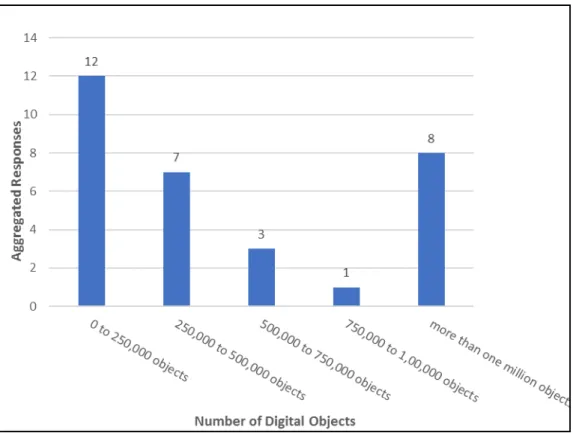
The survey delivered results that related to RQ2 and RQ4. The majority of
responders were experienced with development for digital repositories, with an
average of 6.25 years of experience, and a maximum value reported of 15
years. The responders either worked at locations developing smaller-scale
repositories, choosing “0 to 250,000 digital objects,” or very large-scale repositories, responding with the choice of “more than one million objects”
(Figure 1).
22
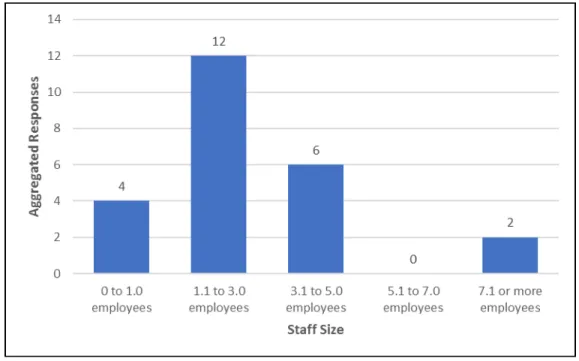
In response to question Q2.4, in most cases, the department that directly
developed the digital repository consisted of three full-time employees. The
data for this survey metric was nuanced, however, since one responder
provided a response of “50” full-time employees (Figure 2).
FIGURE 2: STAFF SIZE, N=24
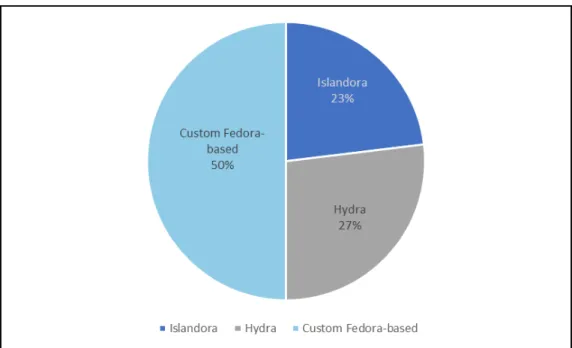
Within the group of twenty-five responses that completed the survey, and
accounting for the fact that question Q3.2 allowed responders to select more
than one answer, the result points to a strong selection of customized
Fedora-based repositories, as opposed to “off-the-shelf” bundled solutions as provided
by Islandora or Hydra. With 50% of responders indicating their work location
builds a customized Fedora-based repository, and may also include an “off
23
would need to understand the underpinning Fedora architecture for their
repository to support all use cases.
FIGURE 3: CHOSEN REPOSITORY PLATFORM
Regarding the move from Fedora version 3 to version 4, an often-cited pain
point for many Fedora-based repositories, the responses to questions Q3.3
through Q3.5 all suggest that the vast majority of repositories remain on
version 3 without feasibility to complete the move to version 4 within an
eighteen-month window. The survey provided the following aggregated results
for Q3.3, Q3.4, and Q3.5:
Q3.3: What version of Fedora do you currently use?
Responses:
LEFT BLANK VERSION 3 VERSION 4
24
Q3.4: Have you started the upgrade/migrate process (what DuraSpace calls
"upgration") from version 3 to version 4 of Fedora?
Responses:
LEFT BLANK YES NO
14 9 10
Q3.5: Will your repository complete the "upgration" process in the next 18
months?
Responses:
LEFT BLANK YES NO I'M NOT SURE
14 6 9 4
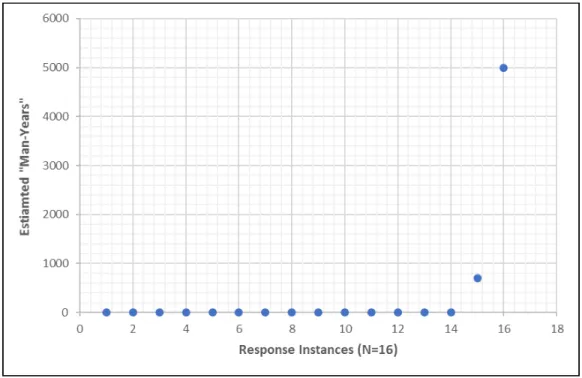
In terms of staffing resources devoted to the “upgration,” there was an
operationalized metric of “man-years” (i.e. 2,000 work hours). This metric was used in questions Q3.6 and Q3.7 to ask responders about their perceived time
and effort up to present, as well as going forward. Results to question Q3.6 had
marked outliers (Figure 4A) which made averages and other aggregate data
meaningless. There was some indication, based on the range of responses, that
the survey question may have been too difficult to provide an adequate
response. Excluding the outliers of “5,000” and “700” man-years, other responses to Q3.6 resulted in a tighter set of values: [0.5, 1, 2, 4, 6]. This
25
FIGURE 4A: MAN-YEARS DEVOTED TO UPGRATION, N=16
FIGURE 4B: MAN-YEARS DEVOTED TO UPGRATION, REMOVING TWO OUTLIERS, N=14
Within the responses to question Q3.7, again there was an outlier that skewed
26
values between zero (0) and eight (8) remaining man-years. The resulting set of
responses with exclusion of the single outlier had an average of 2.5667
remaining man-years to complete the upgration (Figure 5). The result from
question Q3.7 provided some support to the results of question Q3.5, which
suggested that many Fedora-based repositories would remain at version 3 over
the next eighteen months, or longer, going forward.
FIGURE 5: MAN-YEARS REMAINING TO COMPLETE UPGRATION17
The perceived positive and negatives aspects of moving to linked data within
digital repositories was explored within the survey. The aggregated responses
might provide some illustration of the perceived benefits of linked data across
this community, but the small sample size of twenty-five completed responses
to the survey was not large enough to point to any obvious conclusion. Question
27
Q4.2 was constructed to be an open attempt to gather responses to the notion
of perceived benefits of implementing linked data. The results presented some
strong indication that the digital repository community was not skeptical of
linked data, in theory or practice. The majority of responders indicated there
was “moderate benefit.” Notably, no responders chose to answer “no benefit”
to question Q4.2.
Q4.2 How much benefit, if any, do you find from implementing linked data in
digital repositories?
Responses:
LEFT BLANK NO BENEFIT BENEFIT LITTLE MODERATE BENEFIT BENEFIT GREAT
10 0 7 10 6
Within the resulting set of twenty-three responses, there is one clear
indication. Although the majority of Fedora-based repositories have not yet
completed the upgration to a linked data architecture for their data (i.e.
version 4), there is a strong sense that the movement in that direction is
perceived as positive, and that Fedora 4 offers a discernable benefit to the
community.
Survey responses concerning data modeling choices and the adoption of
PCDM, were varied and problematic. The question logic itself made an
assumption that if you were not adopting PCDM, you inherently had decided to
28
survey suggested that if PCDM was not chosen at that time, it was still a
consideration for the future.
There were, however, numerous free-text responses that suggested that
PCDM does not support the use cases of many digital repositories. One
responder said the following:
“There is already a great ontology for structural metadata: ORE. It is an established, well-known standard, and there is no need, from our
perspective to re-invent the wheel with PCDM. PCDM divides the world into three categories: Collections, Objects and Files. The notion of a pcdm:Collection is fraught, since it makes particular assumptions about the "identity" of the objects it contains. We needed a "looser" notion of collection: hence dctype:Collection, which we are using. The notion of pcdm:File is unnecessary, since any pcdm:File is already an
ldp:NonRDFSource. In our opinion, restating the obvious is not necessary. What is left is a pcdm:Object, which at this point doesn't really serve any purpose beyond being an ore:Aggregation. Furthermore, we are not using explicit typing (rdf:type) in our repository, relying instead on rdfs entailment, which is already a fundamental part of the semantic web architecture and which allows us to infer types. Hence, there is no need
for us to use PCDM.”
According to the survey results, there is some impasse between the data
modeling recommendation for Fedora, and what is needed among responders.
Responses to the question asking whether or not the given repository had
adopted PCDM as their chosen primary data model (Q4.3, see Appendix B),
responses were ten (10) “Yes” and fourteen (14) “No.”
The research question RQ3, regarding evaluation of the Linked Data
Platform (LDP) and benchmarking, was not substantially covered through the
survey questions. The final research question RQ4 that focused on training and
the knowledge of linked data and associated tools, was covered in full. There
29
provided constructive results (Figure 6). It could be concluded that the
majority of responders had some strong-to-moderate knowledge of graph data,
modeling data in triples, RDF serialization syntaxes, and SPARQL. The
noticeable limitation, however, is that the responders did not report the same
strong-to-moderate knowledge-base majority regarding the Linked Data
Platform. A total of thirteen responders had no-little-basic knowledge, while
twelve reported that they had moderate or strong knowledge. While familiarity
with linked data itself is not a struggle for most responders, there is still not
enough comfort with the W3C Linked Data Platform for the purposes of
interacting with Fedora 4.
FIGURE 6: SURVEY RESPONSES FOR FAMILIARITY WITH LINKED DATA
Phase 2 Results
The semi-structured interviews were conducted in-person with
participants, and the sessions were recorded and later transcribed. Final drafts
30
provide clarifications, and one participant provided edits to the transcription
to this end. Resulting texts were imported into NVivo Pro 11, and subsequent
themes were created as “nodes,” which aided in inductive work to understand the contextual implications of the interviews. Ultimately, the NVivo coding
work resulted in conceptual themes grouped to illustrate thoughts around the
research questions RQ1 (perceived benefits of Fedora and linked data), and
RQ3 (evaluation and benchmarking of the Linked Data Platform).
Separating out themes into nodes within NVivo, numerous areas of
concern re-appeared: 1) Fedora’s performance concerning large ingest
operations and other transactions, 2) descriptive metadata cross-walking from
MODS to RDF, and 3) a generalized perception that the Fedora community was
un-settled on solutions with regard to areas #1 and #2. Although the sample
size for Phase 2 of this study was extremely limited (N=2), some of the
resulting transcript data provided greater elucidation of the survey responses,
which also expressed similar concerns.
The interviewees did convey that the design of Fedora version 3 allowed
for consistent preservation of digital objects. This positive sentiment tended to
focus on the software’s ability of “keeping track of things well” and that “it
definitely gives us stuff in a structured way. For us, it's been really reliable as
far as storing our data in a way that's understandable and that we can work
31
The interviewees also conveyed that linked data and RDF have
appreciable benefits, but that the promise of what is offered as an increased
ability to share data is not yet seen, with one participant saying:
“It allows us to integrate vocabularies and standardizations, to be able to link out to those things and not define them all locally. It also gives us the promise of interacting with the web in a standard way that is known outside of library-land. So, we like that, because that helps our
materials be discoverable, which is right along the lines of why we do things. I would say that we haven't seen the benefits of that stuff yet. It's still very much at the beginning stages.”
With regard to evaluative performance measures and benchmarking of
linked data (RQ3) within the given repository at the interviewee’s location,
some details came to the foreground during the sessions, but remain open as
the location does not have the current infrastructure to do this work. Over
time, as the repository at that location completes the Fedora 3 to 4 upgration,
they will stress-test their system using a similar amount of data to what is
currently in their repository, and will make an effort to do a needs assessment
one year after the upgration is complete. This needs assessment will be
designed to make performance improvements, begin taking advantage of the
aspects of linked data within Fedora 4 that they identify as beneficial, and
32
Discussion
Research Question 1
The perceived benefits and ease-of-use of RDF and LDP within Fedora 4
remain limited in implementation, as evidenced by the survey responses. Once
response regarding this challenge summarized the problem with clarity:
“Figuring out how to manage descriptive metadata in Fedora 4 has been challenging. We use MODS and there is no direct simple RDF mapping. Fedora 4 has a hard time managing complex hierarchical RDF so figuring out how we'll be handling descriptive information moving forward has
been a big blocker.”
Research Question 2
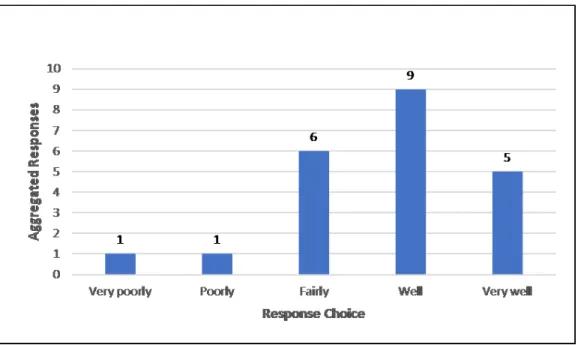
Responses to questions regarding the choice of a data model had at least
four re-occurring themes: 1) The majority of responders were not yet
committed adopting PCDM, despite the recommendation for that ontology, 2)
the Open Archives Initiative’s ontology called Object Reuse and Exchange (ORE) had some design benefits over PCDM, 3) there is a development issue in taking
descriptive metadata in the form of nested XML (MODS) and translating that
metadata at large scale into RDF types, and 4) the majority of responders felt
33
FIGURE 7: HOW WELL DOES YOUR REPOSITORY IMPLEMENT YOUR CHOSEN DATA MODEL?
Going forward, PCDM will continue to be updated, versioned, and enhanced,
but at the time of this writing, the data model itself has well-articulated
limitations for many digital repositories. One survey responder provided a more
high-level reasoning as to why PCDM had adoption in some areas, and was to be
avoided in others:
“PCDM, while a community effort, is probably overly complex for most uses. Community members bend to using PCDM, perhaps because they use Sufia, such as we do, but absent something that 'hides' the
complexity of PCDM, such as Sufia does, one would likely implement a simpler data model. Sufia's use of ACLs [Access Control Lists]
complicates things, mostly by adding many, many ACLs to the repository
unnecessarily.”
The MODS-to-RDF open problem requires added attention in order to have more
repositories successfully move from Fedora 3 to 4. This problem is compounded
by the heterogeneity and inconsistency in data modeling across collections and
repositories. One survey response provided a thorough picture of this open
34
“Complex XML-based descriptive metadata (such as MODS) is extremely difficult to model as RDF without using blank nodes. Doing this properly requires minting hundreds of thousands of additional objects
representing titles, creators, subjects, geographic entities, collections, etc. Fedora is not well-suited to this type of entity creation, meaning an external triplestore is likely to be needed. RDF is also less
human-readable, making spot-checking and quality assurance more difficult.”
Research Question 3
Neither the survey nor the interview sessions provided much useful data
on evaluation of the Linked Data Platform (LDP) within Fedora, but given the
results from RQ4 that determined that most responders did not have moderate
or strong understanding of LDP, there could be a future study that explores this
question further.
Research Question 4
In analyzing the varied approaches that responders took to learning
about Fedora, linked data, and associated technologies, there were
re-occurring themes that could be summarized as follows.
Textual sources of information included:
Google, Internet sources, articles.
W3C documentation
Reading Semantic Web for the Working Ontologist (Allemang & Hendler,
2011)
Reading Linked Data for Libraries, Archives, and Museums (Hooland &
Verborgh, 2014)
Audio-visual sources of information included:
35
Courses on RDF by Library Juice Academy
In-person consultative sources of information included:
Engagement with the Fedora 4 community
Slack channels like #pcdm
Conferences and workshops (20 responders out of 22 replied “Yes” to
having attended Fedora workshops; see Appendix B-Q5.5)
Some responses to the survey also showed that many responders were active
practitioners with these technologies, and reported that they are “learning by doing” and experimenting. At least three survey responders were contributors to the Fedora project. This subset of Fedora developers committed code and
participated in development sprints.
Study Limitations
The four research questions as designed could be approached through a
combination of the two phases, but not completely through any one phase.
Centering on only the two main themes (the perceived benefits of linked data,
and the state of the Fedora software) through survey methods may have
limited the survey’s scope to more quantitative questions on those topics.
However, the data collected through the survey method was useful for
coverage of the broad state of the community, as it relates to adoption of
Fedora 4, PCDM, and experience and knowledge of staff.
The interviews did provide a more atomic view of the challenge of
upgration, which was not as directly approachable through the survey.
36
also was not as approachable via the conducted interviews, being that the goal
of RQ2 was to scan the larger community to understand their decisions.
The interviews, had they been increased in scope to include possibly up
to ten distinct repository instances at various institutions, could have been
used to advance the research questions of adoption of PCDM and data modeling
choices, but was not feasible in this study. Additionally, since the “PCDM”
Google mailing list was not included as a channel to distribute the survey,
there may have been some additional users that could have participated, and
possibly offered a more specialized set of responses regarding PCDM.
Conclusion
While the transition to linked data within digital repositories remains
ongoing, this study may provide some reporting on the current state of the
effort. Responses to the survey pointed to the slow adoption of Fedora 4, which
in most cases is still out of reach. Although the upgration process is an open
problem, the level of activity within the community provides a bolster to
digital repositories going through this process. In terms of data modeling, there
are established best practices, and there is no need to start from scratch.
However, the slow adoption of PCDM points to an awareness that PCDM itself
does not cover several common use cases. Increasing adoption of PCDM may
entail a revision based on further input from the community.
Although the majority of responses indicated that the principles of
37
knowledge-base of linked data technologies among the community is strong,
there are also known challenges. Inconsistent data modeling is one such
challenge, which is made worse by the need to translate from nested XML
structures like MODS to the graph-based structure of RDF. Although the
performance at large-scale of Fedora 4 is in some ways related to a limitation
of the RDF modeling, it is also considered a separate issue from other metadata
efforts focused around overcoming the large heterogeneity of content types
within digital repositories.
Another nuance of Fedora is that there are numerous “off-the-shelf”
digital asset management solutions such as Hydra, Hydra-in-a-Box, Sufia, and
Islandora, which serve as alternatives to a customized Fedora repository (see
Figure 3). Approaches to building these “off-the-shelf” systems are more
volatile within the community of practice and at the time of this writing, there
is substantial “churn” of designs and attitudes: Sufia is now merging with another Fedora-based solution called Curation Concerns to become “HyRax”;
Hydra development practice has numerous “bundled solutions” that each support distinct use cases (images versus electronic theses and dissertations,
for example); the Hydra Project itself is undergoing a larger rebranding with a
forthcoming name-change. The linked data implementations and unique data
modeling decisions within these unique platforms could be an area for further
exploration in smaller-scale studies.
Purpose-built open-source software has firm standing within LAMs, and
38
within the LAM digital repository community. As Fedora 4 implementations
increase in numbers, it will be necessary for the community to continue
shaping the features that are core to the application, and how to ensure that
these core features are modeled consistently and effectively going forward.
While the Linked Data Platform (LDP) serves as an architectural component to
this end, the data collected in this study suggests that LDP’s mechanisms and features are not fully understood yet. Increased training on LDP structures and
processes within Fedora 4 from DuraSpace, and across the entire LAM
community, could shore up broader initiatives to accomplish the task of
39
Bibliography
Arlitsch, K., Obrien, P., Clark, J. A., Young, S. W. H., & Rossmann, D. (2014).
Demonstrating library value at network scale: Leveraging the semantic
web with new knowledge work. Journal of Library Administration, 54(5),
413-425. doi:http://dx.doi.org/10.1080/01930826.2014.946778
Berners-Lee, T. (2006). “Linked Data - Design Issues”. Web.
Borst, T. (2014). Repositories on their way into the semantic web: Semantically
driven interoperability as perspective for repositories. Bibliothek, 38(2),
257-265. doi:https://dx.doi.org/10.1515/bfp-2014-0034
Corbett, L. E. (2016). Linked Data Advice Anyone? (Who Uses Google?).
Technicalities, 36(1), 1–7.
Deng, S. (2016). Preparing for linked data in digital repositories. Accessed
2016-10-13
Hallo, M., Luján-Mora, S., Maté, A., & Trujillo, J. (2016). Current state of
linked data in digital libraries. Journal of Information Science, 42(2),
117.
Hardesty, J. L. (2016). Transitioning from XML to RDF: Considerations for an
effective move towards Linked Data and the Semantic Web. Information
Technology & Libraries, 35(1), 51–64.
40
Heath, Tom, and Christian Bizer. “Linked Data: Evolving the Web into a Global Data Space.” Synthesis Lectures on the Semantic Web: Theory and
Technology 1.1 (2011): 1–136. CrossRef. Web.
Introduction to communities of practice | Wenger-Trayner. (n.d.). Retrieved
from
http://wenger-trayner.com/introduction-to-communities-of-practice/
Isaac, A., & Baker, T. (2015). Linked Data Practice at Different Levels of
Semantic Precision: The Perspective of Libraries, Archives and Museums.
Bulletin of the Association for Information Science & Technology, 41(4),
34–39.
Jones, E. (2016). Linked data for cultural heritage (UK ed.). London: Facet
Publishing.
Konstantinou, N., Kouis, D., & Mitrou, N. (2014, June). Incremental export of
relational database contents into RDF graphs. In Proceedings of the 4th
International Conference on Web Intelligence, Mining and Semantics
(WIMS14) (p. 33). ACM. Accessed 2016-10-13.
Konstantinou, N., Spanos, D. E., Kouis, D., & Mitrou, N. (2015). An approach for
the incremental export of relational databases into RDF graphs.
International Journal on Artificial Intelligence Tools, 24(2), 1540013.
Accessed 2016-10-13.
Konstantinou, N., Spanos, D.E. and Mitrou, N. (2013). "Transient and persistent
41
repositories". In Metadata and Semantics Research (MTSR 2013),
Thessaloniki, Greece, pp. 342-354. Accessed 2016-10-13.
Lagoze, C., Payette, S., Shin, E., & Wilper, C. (2006). Fedora: an architecture
for complex objects and their relationships. International Journal on
Digital Libraries, 6(2), 124–138. https://doi.org/10.1007/s00799-005-0130-3
Latif, A., Borst, T., & Tochtermann, K. (2014). Exposing data from an open
access repository for economics as linked data. D-Lib Magazine, 20(9), 2.
doi:http://dx.doi.org/10.1045/september2014-latif Accessed
2016-10-13.
“Linked Data Platform 1.0 Primer.” N.p., n.d. Web. 2 Apr. 2017.
Minton Morris, C. c. (2014). Unpacking Fedora 4. D-Lib Magazine, 20(7/8),
11-12. Accessed 2016-10-13.
Mitchell, E. T. (2015). The Current State of Linked Data in Libraries, Archives,
and Museums. Library Technology Reports, 52(1), 5-13.
Myntti, J., & Cothran, N. (2013). Authority control in a digital repository:
Preparing for linked data. Journal of Library Metadata, 13(2-3), 95-113.
doi:http://dx.doi.org/10.1080/19386389.2013.826061 Accessed
2016-10-13.
Nicholas, D., Rowlands, I., Watkinson, A., Brown, D., Russell, B., & Jamali, H.
R. (2013). Have digital repositories come of age? The views of library
42
Payette, S., & Lagoze, C. (1998, September). Flexible and extensible digital
object and repository architecture (FEDORA). In International
Conference on Theory and Practice of Digital Libraries (pp. 41-59).
Springer Berlin Heidelberg. Retrieved from
http://arxiv.org/abs/1312.1258
Preedip Balaji Babu, Kadari Santosh Kumar, Nilesh A. Shewale, & Abhinav K.
Singh. (2012). Rationale of institutional repository categories and IR
development challenges in India. Library Review, 61(6), 394–417. doi:https://dx.doi.org/10.1108/00242531211284320
Radio, E., & Hanrath, S. (2016). Measuring the impact and effectiveness of
transitioning to a linked data vocabulary. Journal of Library Metadata,
16(2), 80-94. doi:http://dx.doi.org/10.1080/19386389.2016.1215734
Raymond, E. S. (2001). The Cathedral and the Bazaar: Musings on Linux and
Open Source by an Accidental Revolutionary. Sebastopol, CA, USA:
O’Reilly & Associates, Inc.
Salo, D. (2010). Retooling libraries for the data challenge. Ariadne, (64).
Accessed 2016-10-13.
Smith-Yoshimura, K. (2016). Analysis of international linked data survey for
implementers. D - Lib Magazine, 22(7), 1. Retrieved from
doi:https://doi.org/10.1045/july2016-smith-yoshimura
Solodovnik, I. (2013). Development of a metadata schema describing
43
strategies. JLIS.it: Italian Journal of Library and Information Science,
4(2), 109-144.
doi:http://dx.doi.org/10.4403/jlis.it-8792
Southwick, S. B. (2015). A guide for transforming digital collections metadata
into linked data using open source technologies. Journal of Library
Metadata,15(1), 1-35.
doi:https://doi.org/10.1080/19386389.2015.1007009
Staples, T., Wayland, R., & Payette, S. (2003). The Fedora Project. D-Lib
Magazine, 9(4), 1082-9873.
http://dlib.org/dlib/april03/staples/04staples.html Accessed
2016-11-21.
Stuart, D. (2010). Linked data and government data: More than mere
semantics. Online, 34(3), 36.
Stuart, D. (2014). Librarians Should Embrace Linked Data. Research
information, 71, 14.
Stanford University & Complaints, C. 94305 C. (n.d.). Linked Data. Retrieved
44
Appendices
Appendix A: Glossary
Community of Practice: “Communities of practice are groups of people who
share a concern or a passion for something they do and learn how to do it
better as they interact regularly.” (“Introduction to communities of
practice | Wenger-Trayner,” n.d.)
FEDORA: Originally published by Sandra Payette and Carl Lagoze as a
“Flexible and Extensible Durable Object Repository Architecture,” the FEDORA concept has evolved to become an open-source storage and digital
preservation platform suited for digital repositories.
Linked Data: According to the W3C’s Linked Data Platform 1.0 Primer, Linked Data “refers to an approach to publishing data that puts linking at the heart of the notion of data, and uses the linking technologies provided
by the Web to enable the weaving of a global distributed database. By
naming real world entities - be they web resources, physical objects such as
the Eiffel Tower, or even more abstract things such as relations or concepts
- with http(s) URLs, whose meaning can be determined by dereferencing the
document at that URL, and by using the relational framework provided by
45
the World Wide Web, and which has become the prevailing web
architecture that links information, the “web of data” connects individual
data points via unique identifiers (Uniform Resource Identifiers, or URIs).
This makes it possible to form bridges between data points that otherwise
46
Appendix B: Qualtrics web survey for Phase 1 of study
Survey Title: “Upgrading to Linked Data in Digital Repositories”
Q1.1 Does your current job entail responsibilities or involvement in any aspect
of a digital repository?
Yes
No
Q2.1 In terms of digital objects, what is the estimated size of the repository
you work on?
0 to 250,000 objects
250,000 to 500,000 objects
500,000 to 750,000 objects
750,000 to 1,00,000 objects
more than one million objects
Q2.2 How many years of experience do you have in developing or supporting a
digital repository? (Please enter a number.)
Q2.3 What duties are you tasked with for your digital repository?
Q2.4 Considering all staff, what is the total Full-Time Equivalent (FTE) labor
effort spent directly on the digital repository? One FTE represents 40 hours of
labor per week. For example, if there are three employees that work 40 hours
per week for the digital repository, and one that works 20 hours per week, the
47
Q3.1 Does your repository currently use Fedora? (If not, what storage and
preservation architecture do you use?)
Yes
No ____________________
Condition: No Is Selected. Skip To: End of Block.
Q3.2 Do you currently use a Fedora-based implementation such as Hydra or
Islandora? (You may select more than one response.)
Hydra
Islandora
customized Fedora implementation not using Hydra or Islandora
Q3.3 What version of Fedora do you currently use?
Version 3
Version 4
Condition: Version 4 Is Selected. Skip To: End of Block.
Q3.4 Have you started the upgrade/migrate process (what DuraSpace calls
"upgration") from version 3 to version 4 of Fedora?
Yes
No
I'm not sure
Display This Question: If What version of Fedora do you currently use? Version
3 Is Selected
Q3.5 Will your repository complete the "upgration" process in the next 18
48
Yes
No
I'm not sure
Q3.6 Considering the work done so far to accomplish the upgration process,
how many "man-years" has it taken to get to the point you are at now with this
process? (Please enter a number.)
One man-year is equivalent to the number of hours a full-time employee
works in a given 52-week period. We can say one man-year amounts to
2,080 hours (40 hours x 52 weeks). To calculate man-years, you can
consider the total hours worked on the "upgration" from all staff that are
involved, and divide by 2,080. For example, if total staff for a given
institutional repository do "upgration"-related work for a combined total of
16,000 hours in a given year, the resulting man-years are 16,000/2,080 = 7.7
man-years.
Q3.7 Based on the point your digital repository is at currently, how many more
man-years do you estimate it might take to complete the upgration? (Please
enter a number.)
Q4.1 What data modeling difficulties, if any, have you experienced with the
digital objects in your current repository architecture?
Q4.2 How much benefit, if any, do you find from implementing linked data in
digital repositories?
no benefit
49
moderate benefit
great benefit
Q4.3 Have you adopted the Portland Common Data Model (PCDM) in your
repository?
Yes
No
Condition: No Is Selected. Skip To: What factored into your decision to reject…
Condition: Yes Is Selected. Skip To: What factored into your decision to
adopt...
Q4.4 What factored into your decision to adopt PCDM?
Condition: What factored into your dec... Is Displayed. Skip To: How well do
you think your digital re....
Q4.5 What factored into your decision to reject PCDM?
Q4.6 How well do you think your digital repository implements your chosen
data model?
Very poorly
Poorly
Fairly
Well
Very well
Q5.1 How would you describe your own level of knowledge with each of the
50
little to no
knowledge basic knowledge
moderate
knowledge strong knowledge
graph data
modeling data in triples
RDF serialization syntaxes (Turtle, RDF/XML,
JSON-LD, etc)
SPARQL
The W3C Linked Data Platform
Q5.2 How did you gain the knowledge you currently have of linked data? Here
you can provide details on the courses, workshops, or webinars you've taken
part in, useful reference sites, and any other details you like.
Q5.3 Please describe your experience working with RESTful web APIs.
This could include interacting with web services via HTTP methods, writing API
documentation, and/or building RESTful web APIs.
Q5.4 In which ways do you interact with the Fedora community of practice?
Through Google mailing lists like "Fedora Tech", "Fedora Community",
"Hydra Tech", "Hydra Community", "Islandora", etc.
Through IRC channels like #code4lib, #pcdm, etc
DuraSpace scheduled tech meetings
51
other ____________________
I don't have any interaction with the Fedora community
Q5.5 Have you attended a workshop on Fedora by DuraSpace or another
workshop that teaches the concepts and features of Fedora?
Yes
52
Appendix C: Interview questions for Phase 2 of study
Introduction:
1. Please describe your title and responsibilities within your digital repository.
2. What is the mission of your digital repository?
3. Please describe the current data modeling for digital objects in your
repository.
Benefits, Ease-Of-Use, and Usefulness of Linked Data:
4. In general, how does implementing linked data support the mission of the
repository?
5. Through implementing Fedora 4, how does the repository achieve its goals?
6. In your current implementation, what feature(s) of the Fedora software are
a pain point for you and/or your staff?
7. What feature(s) of the Fedora software work well in your current
implementation?
“Upgration" to Fedora 4:
8. What parts of your future implementation of Fedora might require the most
staff time and effort?
9. Since you have been working on the “upgration” in going from Fedora 3 to Fedora 4, what would you say is the current prognosis?
53
Other Questions:
(If we discuss scale or performance issues like caching, etc.)
11. Have you implemented a strategy to deal with problems related to look-up