Sharif University of Technology
Scientia IranicaTransactions E: Industrial Engineering http://scientiairanica.sharif.edu
The surgical case scheduling problem with fuzzy
duration time: An ant system algorithm
R. Behmanesh
a, M. Zandieh
b;, and S.M. Hadji Molana
aa. Department of Industrial Engineering, Science and Research Branch, Islamic Azad University, Tehran, Iran.
b. Department of Industrial Management, Faculty of Management and Accounting, Shahid Beheshti University, G.C., Tehran, Iran. Received 3 March 2017; received in revised form 6 October 2017; accepted 23 June 2018
KEYWORDS Surgical case scheduling; Ant system; Operating theater; Fuzzy duration time; Makespan;
Mixed integer programming.
Abstract. In this paper, we address the surgical case scheduling problem in multi-operating theater environment with uncertain service times in order to minimize makespan. In surgical case scheduling, not only the hospital resources are allocated to surgical cases, but also the start time of performing surgeries is determined based on a sequence of cases in a short-term time horizon. We consider fuzzy numbers for duration times of all stages and hereafter, the problem is called fuzzy surgical case scheduling. Since the operational environment in the problem is similar to no-wait multi-resource fuzzy exible job shop problem, we consider constraints of the latter for formulating and solving the problem. This problem is strongly an NP-hard optimization problem, hence we employ ant system algorithm to tackle it. The proposed approach is illustrated by detailed examples of three test cases and numerical computational experiments. The performance of the proposed algorithm is compared with a schedule constructed by rst-come-rst-service rule in all test instances. Also, a real case is provided from a hospital in Isfahan to evaluate the proposed algorithm. The computational experiments state that the algorithm outperforms hospital planning as well as fuzzy rule, indicating eciency and capability of the algorithm for optimizing the makespan.
© 2019 Sharif University of Technology. All rights reserved.
1. Introduction
Healthcare industries have been growing in the last decades and with the passing of time, costs of this
large industry will increase. Based on statistics,
healthcare expenditure of US in 2007 was estimated at 16.2% the gross domestic product [1] and it will reach 19.5% US GDP by 2017 [2]. On the other hand, Operating Rooms (ORs) are considered as the engine and the most critical causes of carrying the highest
*. Corresponding author.
E-mail addresses: [email protected] (R. Behmanesh); m [email protected] (M. Zandieh); [email protected] (S.M. Hadji Molana)
doi: 10.24200/sci.2018.20602
costs for a hospital; in many hospitals, more than 40% of costs come from several resources of surgery and ORs [3]. Therefore, it seems essential to improve OR management and patient ow by optimized sequencing and assigning available resources of ORs to patients. As a result, planning and scheduling play a crucial role in OR management and thereby, in recent decades, many researchers and practitioners have been attracted to the study of operating room scheduling problem.
In healthcare, a \surgical schedule" is arranged by determining the sequence of surgical cases and as-signing them to operating rooms, surgeons, nurses, etc. in order to optimize objectives such as utilization, idle time, overtime, etc. [4]. Operating room scheduling generally deals with strategic, tactical, and operational problems [5-8].
surgical case scheduling and classied in operational level. In the literature on the operating room schedul-ing problems [9], a \Surgical Process Schedulschedul-ing (SPS) problem" is divided into two sub-problems called \ad-vance scheduling" and \allocation scheduling". The rst sub-problem solves the planning step by deter-mining some future dates for surgical cases in medium time horizon. The next level, namely \Surgical Case Scheduling (SCS) problem," as the second part of SPS solves scheduling step, which determines the start time and resource allocation of cases over a short time hori-zon (typically a day). It must be noted that allocation scheduling is within the scope of SCS problem, whereas advance scheduling is not. In some researches [10-15] both sub-problems were addressed, while in other studies [2,16-22], the researchers reviewed the SCS problem.
Surgical process is divided into three
sub-processes including pre-operative/surgery,
peri-operative/surgery, and post-operative/surgery for which various parameters are considered as input to each stage [16,18,21]. In the literature, upstream units comprise Pre-operative Holding Units (PHUs) and wards, while Post Anesthesia Care Units (PACUs) and Intensive Care Units (ICUs) are put in downstream units. Multiple operating rooms connect upstream to downstream units [5,21,23-25]. Also, the patients are divided to elective (inpatient and outpatient) and non-elective (urgent and emergency) cases. An elective case is the patient that is scheduled in advance by determining multi-resources as well as the start time of the case, while an emergency case that may arrive randomly on the day of surgery requires to be performed online in the same day. To measure operating room planning and scheduling, 8 main performance indicators have been used in the literature, namely waiting time, utilization, leveling, throughput, patient deferrals, makespan, preferences, and nancial measures [26]. Also, there are three well-known scheduling strategies/booking systems that dedicate time of ORs to surgeon groups, namely open scheduling strategy, block scheduling strategy,
and modied block scheduling strategy. In block
scheduling strategy, a set of time slots is allocated to every surgery in a special group, typically in cyclic timetable (some weeks) manner. Surgical cases are scheduled in these time slots and they cannot be released. In contrast to block scheduling, in open scheduling strategy, surgical cases are scheduled on First-Come-First-Service (FCFS) and assigned to available ORs at the surgeon's convenience. In the other policy, namely modied block scheduling, block scheduling is modied by combining strategies of both block and open scheduling in order to enhance exibility of strategy [6,18,19].
In the literature on operating room scheduling,
deterministic conditions are considered for scheduling and therefore, some deterministic models are con-structed for this problem [21], while some condi-tions such as unpredicted incidents related to loss of resources, incidents in the surgical case, etc. in-crease duration of surgeries in operating room in real practice. This has motivated practitioners and researchers [27,28] to focus on this problem under uncertain conditions and propose new algorithms to tackle uncertain operating room scheduling problem.
The following sections are organized as follows. In Section 2, we present various studies on operating room planning and scheduling regarding the scope of our problem. In Section 3, the problem is stated and then, the mathematical model for fuzzy surgical case scheduling is built. In Section 4, we propose fuzzy ant system algorithm in order to achieve fuzzy ant solution. Section 5 provides illustrative examples and computational experiments; nally, we conclude and present our suggestions for future research in Section 6. 2. Literature review
Some researches [5,7,26,29] provide the review of the most recent literature on operations research within the scope of surgery planning and scheduling prob-lems. The major discussion in some studies relates to uncertain conditions in operating room scheduling and planning at three levels. Therefore, rst, some papers which model this problem using deterministic times are reviewed and then, new researches that tackle the problem under uncertainty are addressed.
Xiang et al. [21] formulated a surgical case scheduling problem as multi-resource FJSP by using mixed integer linear programming model in order to minimize makespan during a day as they observed similarities between operating theater scheduling and FJSP. The authors considered sequence of operations (pre-operative, peri-operative, and post-operative) for each elective surgery in FJSP under open scheduling policy, and the deterministic durations were provided in all stages. They elaborated on Ant Colony Opti-mization (ACO) approach with a two-level hierarchical graph to integrate sequencing jobs and allocating re-sources at the same time to solve their model. It should be noted that they used variation coecient of working time for all resources in their analysis so as to evaluate their ACO algorithm. Meskens et al. [19] addressed a multi-objective surgical case scheduling problem. The researchers applied genetic algorithm to tackle the problem by minimizing makespan, minimizing overtime hours, and maximizing desiderata of the surgical team. Moreover, block scheduling system and deterministic duration of surgery were assumed for operating rooms. Lamiri et al. [30] addressed surgery planning prob-lem assumed as SPS in planning level. Assigning
elec-tive cases to dierent periods over a planning horizon was done in order to minimize two objectives consisting of the sum of costs related to the elective patients and overtime costs of operating rooms. The authors modeled the problem under uncertain condition. First, a novel stochastic mathematical programming was proposed and then, the Monte-Carlo simulation and MIP model were integrated to tackle the problem. In another advanced study, Lamiri et al. [31] addressed the same previous problem, and proposed and compared several optimization approaches in order to minimize expected overtime costs and patient-related costs, si-multaneously, under stochastic condition. The authors applied Monte-Carlo simulation, MILP model, and meta-heuristics to solve the problem. Saremi et al. [32] proposed simulation-based optimizations in order to tackle outpatient case scheduling or SCS problem by providing stochastic service time data from a major Canadian hospital. The researchers modeled the prob-lem to minimize multiple objectives including waiting time of the patient, completion time of the patient, and the number of surgery cancellations. Their rst approach was Simulation-based Tabu Search (STS), which integrated discrete-event simulation and tabu search to schedule surgical cases. The second and third methods were Integer Programming Enhanced Tabu Search (IPETS) and Binary Programming Enhanced Tabu Search (BPETS). IPETS and BPETS were im-proved on STS by combination with integer program-ming and binary programprogram-ming models, respectively. Lee and Yih [27] introduced a fuzzy scheduling strategy to nd the start time of surgical cases in operating theaters as an SCS problem with uncertainty. The authors formulated this problem as exible job shop with fuzzy sets. Resources of downstream, such as PACU and service time, were applied as constraints to their model. The researchers considered multiple objectives consisting of waiting time of the patient in the process ow, clinical resource idling, and total completion times in order to evaluate their model. The genetic algorithm was applied to solve the problem in two phases. In the rst step, the relative order of surgical cases was determined and then, in the second stage, denite start time of surgical cases was found. A Monte-Carlo simulation was conducted to assess the schedules obtained and then, the results were compared with those of the previous studies with simulation based scheduling. It was concluded that the new approach outperformed the traditional approach. Marques and Captivo [28] focused on the surgical case assignment in a Portuguese hospital in order to optimize the use of the available surgical resources, and improved equity and access to operated and waiting elective patients. The researchers dealt with the problem in two stages; rst, some patients from a large waiting list were selected to be scheduled
for surgery; then, a day, an operating room, and a time block were allocated to the patients. To tackle the problem, three deterministic MILP models were constructed concerning the administration intention, surgeons, and a halfway between administration and surgeons; nally, they proposed a robust approach concerning the OR and surgeon occupation time for each surgery under uncertainty. The authors developed deterministic models in uncertain conditions using the approaches in the literature. In another work conducted by Mateus et al. [33], elective surgeries scheduling problem was studied in a Portuguese public hospital. The authors developed local search heuristics to tackle dierent versions of the problem. In this study, the problem was divided into two sub-problems; rst, patients were selected from a waiting list for surgery and then, a day, an operating room, and a time block were assigned to patients. The researchers evaluated the proposed algorithms for a real case compared with MILP models.
As it was described, the nature of the proposed surgical operations problem, especially durations of ser-vice times, in all stages is considered certain. However, as given in the literature [27,30,32], duration times in operating theaters are not precise and, due to uncertain conditions of service time for operations in the SCS problem, it would be better to insert probabilistic data into this problem. On the other hand, if uncertainty is taken into account for duration time parameters, the complexity of the problem will be increased. Dubois et al. [34] stated that we were permitted to use either probabilistic distributions or fuzzy numbers in order to represent uncertainties in setting of possibility theory. Besides, they emphasized using fuzzy set in scheduling problems, because fuzzy scheduling addressed not only scheduling under exible constraints but also schedul-ing with incomplete or imprecise information. On the other hand, Gonzalez-Rodriguez et al. [35,36] argued that it was possible to model ill-known durations in job shop scheduling problems using fuzzy numbers instead of stochastic scheduling, because fuzzy theory and possibility theory could be considered as alternatives to the probabilistic models. Furthermore, applying fuzzy set has advantages over probability distribu-tions in scheduling as fuzzy logic demands less data and thus, it reduces computational diculties; also, it has expressive capability for uncertain events in order to handle incomplete knowledge of scheduling data. Moreover, Palacios et al. [37] declared that in the application of probability distributions, other representations of uncertain processing times would be a human-originated condence interval, while we might have incomplete or little knowledge available for the Flexible Job Shop Problem (FJSP). In some studies on FJSP [38-41], both the processing time of operations on the eligible machine and completion time followed by
the processing times are represented as triangular fuzzy numbers. The researchers have underlined using fuzzy data since processing times of machines are not precise enough. In fact, the problem is concerned with the scheduling scope and as in some real cases (especially in Iran), the database for the durations of surgeries is incomplete, modeling SCS with fuzzy data and nding an approach to tackling this problem would be very important.
This paper deals with a fuzzy surgical case scheduling problem in which all patients are elective and all processing time parameters are assumed fuzzy. We contribute to the eld of operations research tech-nique in employing available resources and making surgical case schedules by minimizing fuzzy makespan of operating theater under open scheduling policy. This paper has two novelties: a) extension of surgical case surgery problem using fuzzy processing time in all stages of operating room, and b) proposing and constructing a fuzzy ant system based on the model to tackle the problem under uncertain condition. 3. Problem statement
In this part, problem statement is thoroughly
de-scribed. For this propose, details are divided in
four subsections: a) fuzzy surgical case scheduling for elective patients, b) structure of no-wait multi-resources fuzzy exible job shop scheduling in operating theater, c) operations on triangular fuzzy numbers, and d) mathematical programming for fuzzy surgical case scheduling.
3.1. Description of fuzzy surgical case scheduling for elective patients
In this section, we give a brief description of surgical case processing from input to output in operating theater (Figure 1). First, the patient is transported from either ward or Ambulatory Surgical Unit (ASU) to PHU. While the patient is being held in PHU,
the nurse checks the documents and prepares him/her for surgery. The patient occupies both nurse and PHU bed. Then, he/she is moved to operating room where the anesthetist manages anesthesia process and a specic surgeon performs surgical procedure on the case. In this stage, other resources such as nurse, OR, anesthetist, medical technicians, scrubs, and surgeon are allocated to the surgical case. In the end of the surgical process, anesthesia is reversed by the anesthetist and then, the patient is transported to PACU where he/she recovers from residual eects of anesthesia under the care of PACU nurse. In the third stage, the nurse and PACU bed are assigned to the patient. When eects of anesthesia are being diminished and the condition of the patient becomes stable, he/she is moved to several dierent destinations according to the existing conditions. The usual inpa-tient is returned to ward, the critical inpainpa-tient (e.g., cardiac or thoracic case) is moved directly to ICU, where he/she benets from specially trained nurses and specialized equipment, and the outpatient is taken to ASU for going through a second recovery. It must be noted that all processing times including duration of pre-surgery stage, duration of surgery, and duration of post-surgery or recovery stage are under uncertain condition in operating theater and considered fuzzy based on information of the expert.
3.2. Structure of no-wait multi-resources fFJSP in operating theater
The various structures of the shop are taken into account to model and solve the SCS problem. For instance, Guinet and Chaabane [42] formulated a two-stage hybrid ow shop model in order to minimize total overtime in operating rooms and Augusto et al. [43] modeled the SCS problem as a four-stage ow shop un-der open scheduling policy. In other studies [16,21,27], the similarities between operating room scheduling environment and Job Shop scheduling Problem (JSP) were observed. An FJSP was introduced by Pinedo [44]
Figure 2. Fuzzy surgical case scheduling in operating theater.
as generalization of the job shop and the parallel machine environments. Each order has its own route to follow through the shop. Even though the ow shop may be modeled for operating theater in case of identi-cal surgiidenti-cal procedures, in real world, various surgiidenti-cal cases with several surgical procedures require their own routes and this has motivated researchers to apply JSP environment in their studies. Pham and Klinkert [16] developed a novel multi-mode blocking JSP to model SCS problem in order to minimize makespan; however, Xiang et al. [21] considered generalization of job shop and then, formulated a multi-resource FJSP in order to minimize makespan by applying a novel two-level ACO procedure. The authors assumed that the operating sequence of three stages should be followed completely and one after another; therefore, this assumption made a constraint that followed the rules of no-wait ow shop. Pinedo [44] dened the no-wait requirement as a phenomenon that might occur in ow shops with zero intermediate storage. In no-wait situation, orders are not permitted to wait between two successive machines. By using this constraint in FJSP, the start time of the rst stage in PHU for the surgical case has to be delayed to ensure that the case can go through the FJSP without having to wait for any resource. Therefore, the surgical cases are actually pulled down the line by the resources that have become idle. Xiang et al. [21] assumed that three general stages were essential for all cases in FJSP. We can observe exibility in all stages because of diversity of resources in each stage. Furthermore, there are diverse routes for cases in the second stage because of the varieties of specic surgical procedure; this conrms the similarities between SCS in operating theater and FJSP environment. On the other hand, we describe fuzzy FJSP (fFJSP) in operating theater, because the fuzzy conditions are considered in the problem. There are some studies that have focused on fFJSP in which the researchers have combined fuzzy scheduling and exible scheduling in job shop environment. To solve an fFJSP, a co-evolutionary genetic algorithm was proposed by Lei [38] as this problem had high com-plexity. The author introduced fuzzy Gantt chart and considered triangular fuzzy start time and completion
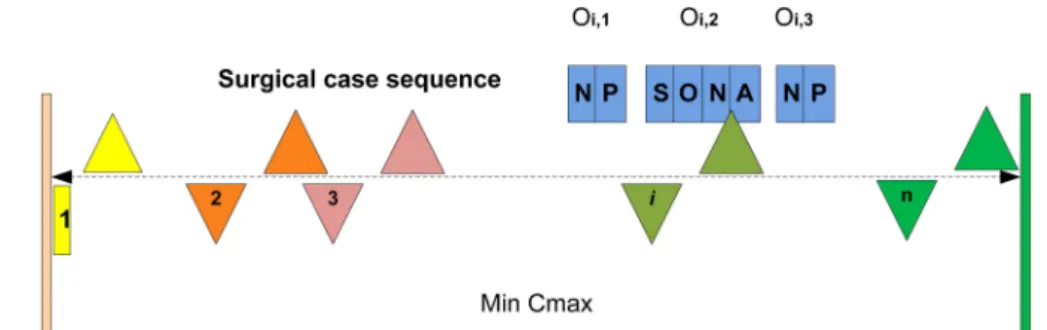
time. In another work conducted by Xu et al. [39], a teaching-learning based optimization algorithm was introduced to tackle FJSP with fuzzy processing time. Liu et al. [40] proposed a fast estimation distribu-tion algorithm to solve fFJSP. Comparison of their approach with estimation distribution algorithm indi-cated that their algorithm outperformed the previous work. Also, Lin [41] applied a hybrid biogeography-based optimization as meta-heuristic to fFJSP. In our study, we take into account the fuzzy exible job shop environment introduced by Lei [38] for SCS problem because of similarities between fFJSP and SCS. As it is shown in Figure 2, there are a set of surgical cases, SC = fSC1; SC2; : : : ; SCng, to be operated
by a combination of the available required resources, R = fNurse1; : : : ; Nursem; Bed1; : : : ; Bedm; An1;
: : : ; Anm; S1; : : : ; Sm; OR1; : : : ; ORmg, in each stage.
Since there are three stages for each case, each surgical case, SCi, is formed by a sequence of three operations,
fOi;1; Oi;2; Oi;3g. Also, multiple resources assigned
to the i-th surgical case for each stage are presented
in blue boxes over the SCi. The processing time
of Oij (pre-surgery, surgery, post-surgery) for the
required resources is represented as a Triangular Fuzzy Number (TFN), ~Pijrk =
Pb
ijrk; Pijrkm ; Pijrkw
, where Pb
ijrk pertains to the best processing time, Pijrkm is the
most probable processing time, and Pw
ijrkrelates to the
worst processing time (Figure 3). Similarly, the fuzzy completion time of Oij (here notated by ET , which is
the abbreviation of end time) is displayed as a TFN, ~
ETijrk =
ETb
ijrk; ETijrkm ; ETijrkw
, where ETb ijrk is
Figure 3. Triangular possibility distribution of fuzzy parameter (Pijrk).
the best completion time, ETm
ijrk is the most probable
completion time, and ETw
ijrk is the worst completion
time. Hereafter, we call fuzzy Surgical Case Scheduling (fSCS) instead of fFJSP problem, in which both allocation of ecient available resources and sequence of surgical cases for all resources are determined in order to minimize fuzzy makespan (Cmax).
Based on the dened problem in this paper (extension of the model presented by Xiang et al. (2015) [21] to apply fuzzy duration time), the surgeon as the main resource plays the key role in operating room and is eective on duration of makespan as a key performance for assessing the scheduling problem. As it was explained, the OR scheduling problem is similar to FJSP environment, and the role of special surgeons in the operating room is similar to that of eective human resources in FJSP. In real cases, some assumptions may be relaxed to construct a complex and realistic model. For example, in real cases, the surgeon and her/his assistance are eective on makespan, simoltaneously, and a dual constraint model is required to consider this condition; this makes the model more complicated. However, in this study, a basic model is extended using fuzzy parameters to be practicable in some real cases. 3.3. Operations on triangular fuzzy number For providing and using fuzzy duration time in operat-ing room scheduloperat-ing problem, the denitions of fuzzy number operations for TFN are essential to build a feasible schedule. The necessary operations in this paper include operation of adding two fuzzy numbers, the ranking approach to fuzzy numbers, and max operation of two fuzzy numbers. Summation operation is applied to add up the fuzzy start time and the process with fuzzy processing time, and to calculate the fuzzy completion time. The ranking operation is used to nd the maximum fuzzy makespan value. The max operation is to determine the fuzzy start time of the process.
For two TFNs ~S = (s1; s2; s3) and ~P =
(p1; p2; p3), the summation is obtained by ~S + ~P =
(s1+ p1; s2+ p2; s3+ p3).
The following criteria are adopted to rank ~S and ~
P in fuzzy scheduling [45]:
Criterion 1: If C1( ~S) = s1+2s42+s3 > (<)C1( ~P ) = p1+2p2+p3
4 , then ~S > (<) ~P is applied to rank them;
Criterion 2: If both TFNs have identical values of C1, then C2( ~S) = s2 is compared with C2( ~P ) = p2
as the second criterion to rank them;
Criterion 3: If both TFNs have the same C1 and
C2, then the dierence of the spreads, i.e., C3( ~S) =
s3 s1, is compared with C3( ~P ) = p3 p1, is utilized
as the last criterion to rank them.
Moreover, the approximate max of two TFNs ~S
and ~P is obtained by the rule introduced in [38]. That is, if ~S > ~P , then ~S [ ~P = ~S; else, ~S [ ~P = ~P .
It should be notated that the above fuzzy equa-tions are used to construct the schedule as applied before by Lei [38] and Lin [41] in order to solve fFJSP. However, this is the rst time that TFN processing times are provided in operating room scheduling, and fuzzy results of scheduling are presented according to fuzzy Gantt chart [38] as a robust output.
As it was noted in introduction, there are un-predicted incidents in operating room that increase usual surgery times and hence, some criteria such as makespan are increased. Thus, using deterministic times under uncertain condition does not give us a near optimal and reliable schedule. When there is incomplete or little knowledge available concerning surgery time in operating room, using TFNs according to the information of the expert in the model presents a robust schedule in which three makespans (the best, the most probable, and the worst) are obtained and the real makespan is obtained according to the knowledge of the expert considering the worst (under incidents that increase duration of surgery) or the best (surprising incidents that reduce duration).
3.4. Mathematical programming based on no-wait multi-resource fFJSP
Since the structure of fFJSP is NP-hard problem, mathematical programming models cannot provide ef-cient tools to tackle the problems with large sizes, but they can be considered as the rst step to develop an eective heuristic. In a study conducted by Demir and Isleyen [46], mathematical models for FJSP were evaluated. The models were divided into three classes based on their binary variables: sequence-position variable based model, precedence variable based model, and time-indexed model. The authors concluded that precedence variable based models, especially the MILP model developed by Ozguven et al. [47], outperformed other models with the lowest computation time. It is noteworthy that this model is the only linear one among them. Therefore, we formulate and develop the MILP model of Ozguven for fSCS problem based on the no-wait multi-resource fFJSP. Several assumptions are made in order to dene daily fSCS as follows:
1. Only elective patients (inpatients) are involved in this study and all of them are in access before scheduling on a given day at zero time; therefore, release/arrival time is assumed static and equal to zero;
2. Preemption is not allowed because no stages can be interrupted;
3. The required resources are determined before
scheduling;
Table 1. Indices and sets for MILP model.
Index or set Description
I Set of all the surgical cases SG Set of specialties for surgeries
Is Subset of surgical cases based of specialty of surgery s
Ji Set of operations of case i 2 I
R Set of all resource types
Oij Surgical case i 2 I in stage j 2 J
Rij Set of capable resource types for operation Oij
Krij
Set of all the resources in resource type r
(with the exception of surgeon group) r 2 R f3g, rij2 Rij
Krs Subset of all specialist surgeons based on specialties of surgeries s 2 SG in resource type r = 3
Table 2. Parameters for MILP model.
Parameter Description
~
Pijrk= Pijrkb ; Pijrkm ; Pijrkw
Fuzzy processing time (pre-surgery, surgery, and post-surgery durations) of operation Oij if performed with resource k of type r
M A large positive number
n Total number of surgical cases
mr Total number of resources for each resource type (8 types) In this study, 8 resource types are introduced.
are always available and there is no resource failure, so failure time is not assumed;
5. Clean-up and setup time are assumed to be included in surgery time and setup time is not sequence dependent;
6. All human and equipment resources are assumed to be identical in processing time with the exception of specic surgeons;
7. The priorities of all surgical cases are assumed to be identical;
8. The transportation times between operations
(surgery stages) for each case are neglected, because the transporters are always assumed to be available;
9. All surgical cases must be operated in a sequence of three stages completely and one after another;
10. All data, consisting of pre-surgery, surgery, and post-surgery durations, are assumed uncertain or fuzzy in the problem;
11. Patients are only allowed to be operated by a subset of surgeons based on specialty.
Some assumptions in this paper are made to simplify the model under uncertainty. If some as-sumptions such as (5), (6), and (7) are relaxed, the
complexity of the model and algorithm will increase. Therefore, Assumptions (5) and (7) are considered in MILP modeling based on [2,21,27], and (6) is according to [16,21]. This paper focuses on the simple model with these assumptions under uncertain con-ditions. The model with these assumptions is solved by simulated data and suitable real cases in hospital. Some assumptions such as (1), (3), (4), (8), (9), and (11) are case dependent and a case is selected that is consistent with all assumptions for assessing the model. Finally, assumption (2) is consistent with real cases, because the surgical operating cannot be interrupted [19].
The sets/indices are described in Table 1. In the problem, some elective patients in set I and 8 resource types in set R, among which some types are involved in each surgical stage, are dened. In the rst stage, there are two resource types including nurse and PHU bed and in the second stage, there are four types including surgeon, OR, nurse, and anesthesia.; nally, in the last stage, there are two types including PACU bed and nurse. This structure is based on [21]. Also, some parameters are dened in Table 2.
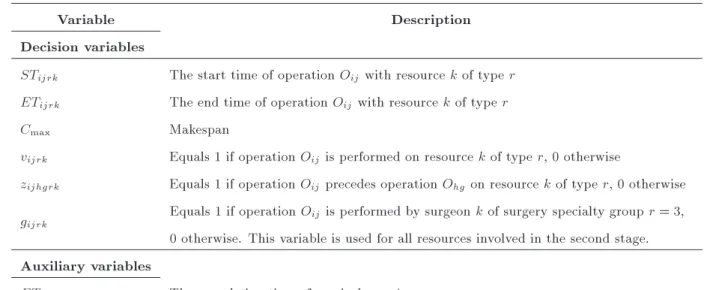
The applied variables in this mathematical model are divided into decision and auxiliary ones, which are described in the notation in Table 3. In Table 3,
aux-Table 3. Decision and auxiliary variables for MILP model.
Variable Description
Decision variables
STijrk The start time of operation Oij with resource k of type r
ETijrk The end time of operation Oij with resource k of type r
Cmax Makespan
vijrk Equals 1 if operation Oij is performed on resource k of type r, 0 otherwise
zijhgrk Equals 1 if operation Oij precedes operation Ohg on resource k of type r, 0 otherwise
gijrk Equals 1 if operation Oijis performed by surgeon k of surgery specialty group r = 3,
0 otherwise. This variable is used for all resources involved in the second stage. Auxiliary variables
ETi The completion time of surgical case i
iliary variable ETi is employed to calculate makespan
as the objective function.
A general model of MILP is formulated for the fSCS problem with n patients as follows:
min Cmax; (1)
s.t.
ETi Cmax8i 2 I; (2)
ETi
X
k2Krij
ETijrk8i 2 I; j = 3; r = 8; (3)
STijrk+ ETijrk Mvijrk8i 2 I=Is;
j 2 f1; 2; 3g ; r 2 Rijf1; 2; 3; 7; 8g ; k 2 Krij; (4)
STijrk+ ~Pijrk M (1 vijrk) ETijrk8i 2 I=Is;
j 2 f1; 2; 3g ; r 2 Rijf1; 2; 3; 7; 8g ; k 2 Krij;
(5) STijrk+ ETijrk Mvijrk8i 2 I; j = 2;
r 2 Rijf4; 5; 6g ; k 2 Krij; (6)
STijrk+
X
k2Krs
~
Pijrkgijrk M (1 vijrk)
ETijrk8i 2 I;
j = 2; r 2 Rijf4; 5; 6g ; k 2 Krij; (7)
EThgrk Mzijhgrk STijrk8i; h 2 I=Is; i h; j;
g 2 J; r 2 Rij\ Rhg; k 2 Krij\ Krhg; (8)
ETijrk M (1 zijhgrk) SThgrk8i; h 2 I=Is;
i h; j; g 2 J; r 2 Rij\ Rhg;
k 2 Krij\ Krhg; (9)
X
k2Krij
STijrk=
X
k2Kri(j 1)
ETi(j 1)rk8i 2 I=Is;
j 2 f2; 3g ; r 2 Rij; (10)
X
k2Krij
STijrk=
X
k02K rij
STijr0k08i 2 I=Is;
j 2 J; r; r02 R
ij; (11)
X
k2Krij
ETijrk=
X
k02Krij
ETijr0k08i 2 I=Is;
j 2 J; r; r02 R
ij; (12)
X
k2Krij
vijrk= 18i 2 I=Is; j 2 J; r 2 Rij; (13)
X
k2Krs
gijrk= 18i 2 Is; j = 2; r = 3; (14)
STijrk 08i 2 I; j 2 J; r 2 Rij; k 2 Krij;
(15) ETijrk 08i 2 I; j 2 J; r 2 Rij; k 2 Krij;
(16)
ETi 08i 2 I; (17)
vijrk2 f0; 1g 8i 2 I; j 2 J; r 2 Rij; k 2 Krij;
(19) gijrk2 f0; 1g 8i 2 Is; j = 2; r = 3; k 2 Krs;
(20) zijhgrk2 f0; 1g 8i; h 2 I=Is; i h; j; g 2 J;
r 2 Rij\ Rhg; k 2 Krij\ Krhg: (21)
In the above model, Eq. (1) states minimum objective functions, i.e., makespan. Constraint (2) determines makespan based on completion time of surgical cases. Eq. (3) reects completion times of surgical cases at the end of the third stage. Constraints Eqs. (4) and (5) make sure that the dierence between the start time and the end time of the operation of the surgical cases in the rst to third stages (only surgeon in the second stage) is equal to the processing time of these stages for related resources. Constraints (6) and (7) guarantee the same requirements for equations (4) and (5); however, among the other involved re-sources in the second stage, surgeon is an exception, i.e., (resource types #4, #5, and #6). Constraints (8) and (9) are used to specify that two dierent
operations of Oij and Ohg cannot be performed at
the same time on any resource in the set Rij \ Rhg.
Eq. (10) ensures that the jth operation of a surgical case should be started exactly after the completion
time of the (j 1)th operation of the same surgical
case. Constraints (11) and (12) specify that all the required resources for each surgery stage should have the same start time and completion time, respectively. Eq. (13) demands that one and only one resource from each resource type can be allocated to an operation of surgical case. Finally, Constraint (14) states that one and only one surgeon from surgery specialty group can perform the surgical procedure and it is possi-ble that others are idle or allocated to other cases. Constraints (15)-(21) are positive and binary decision variables.
Since our mathematical programming represents a possibilistic model, rst, we transform it into a crisp equivalent model based on the Weighted Average Method (WAM) introduced by Noori-Darvish [48]. We consider WAM for defuzzication of processing time in left-hand side of Constraints (5) and (7) as follows:
STijrk+ w1Pijrkb + w2Pijrkm + w3Pijrkw
M (1 vijrk)=ETijrk8i2I=Is;
j 2f1; 2; 3g ; r 2 Rijf1; 2; 3; 7; 8g ; k 2 Krij;
(22) STijrk+
X
k2Krs
w1Pijrkb + w2Pijrkm + w3Pijrkw
gijrk
M (1 vijrk) = ETijrk8i 2 I;
j = 2; r 2 Rijf4; 5; 6g ; k 2 Krij: (23)
Xu et al. [39] dened (x1+ 2x2+ x3)/4 as
Aver-age Response Variable value (ARV) for defuzzication of TFN, X = (x1; x2; x3). We set w1= 0:25, w2= 0:5,
w3 = 0:25 for processing time. All positive decision
variables such as start time, end time, and makespan are obtained as crisp numbers.
In our model, the start and end times of each surgery, the start and end times for the involved resources in each stage of surgery, and the required resources in each stage of surgery are variable in order to minimize makespan. Also, some parameters are needed as input to the model, such as available resources in each type, fuzzy processing time of each stage for each surgical case, specialist surgeon groups, and surgeons inside each specialist group. Finally, the output of the model includes variables representing the start and end times of surgeries to determine sequencing surgical cases as a part of the problem, and the start and end times of involved resources to determine the resource assigned to each surgical case as another part of the problem.
4. Fuzzy ant system for solving fSCS
In this paper, we suggest a meta-heuristic approach in order to tackle the combinatorial nature of fSCS problem. In many researches in the eld of crisp SCS problem, some heuristic or meta-heuristic procedures such as genetic algorithm [12,13], column generation based heuristic [10], tabu search [31,32], and ant colony optimization [21] have been developed to achieve near optimal solutions. As it was described, structure of the problem is similar to that of fFJSP and thereby, Ant System (AS) algorithm is extended to solve op-timization problems such as fFJSP. [21] proposed an ACO algorithm with two-level hierarchical graph (outer and inner graphs) to solve SCS. The authors considered outer and inner graphs in order to combine sequencing surgical cases and allocating resources. The rst ACO algorithm, namely AS, was introduced by Dorigo et al. [49] as an optimizer, learning, and natural algorithm; also, it was applied to tackle Traveling Salesman Problem (TSP) by Dorigo et al. [50]. To the best of our knowledge, in the area of fSCS in the literature, no research is available that employs AS algorithm; therefore, we develop it for operating theater problem with fuzzy parameters. Then, we compare our proposed procedure with the surgical case scheduling solved by using FCFS rule and eciency of the method is determined based on quality of the solutions obtained. Our elementary AS algorithm is based upon the proposed algorithm by Xiang et al. [21]
and we extend it so as to solve fSCS. 4.1. Description of fuzzy AS algorithm
Two-level ACO algorithm is tailored by mapping cities to surgical cases and thereby, a nodes tour turns to be the sequence of surgical cases. In Xiang's procedure, surgical cases are sequenced in the outer graph and the required multi-resource types of every stage are allocated to surgical cases in the inner graph. Available resources of the same resource type are represented by nodes inside the inner graph. The resource assigned to the surgical case in each stage is determined based on the path the ant forages in the inner graph. A mix pheromone update strategy is dened for the algorithm and it comprises one local and two global strategies. In the outer level, the best ant updates the trails based on the global iteration best strategy in order to search for the best sequence. In the inner level, surgery-related pheromone is dened to save the information that connects the surgical case to the required resource based on global strategy, while an inner resource-related pheromone is dened to record the information related to resource utilization based on local strategy. It must be noted that local updating is eective until the ant forages the path of the inner graph and it is invalid after going out. Algorithm 1 shows the framework of fuzzy ant system.
It must be noted that the start (available) time of all resources before planning in the algorithm is set to (0,0,0).
The procedure of pheromone updates for the algorithm fuzzy AS (fAS) and transition rules are described in this section. Since the objective value in our problem is fuzzy makespan, we employ the same
defuzzication method used in MILP to transform the fuzzy ~Cmaxinto a crisp Cmax. This approach is applied
in order to calculate crisp k
ij in Eq. (25) as Kuo et
al. [51] discussed in their fuzzy ACO method. In fAS algorithm, all computations are based on operations of triangular fuzzy numbers while pheromone update computation is based on ordinary deterministic oper-ations. Pheromone update strategy in outer graph is based on the following equation:
ij(t + 1) = (1 ) :ij(t) + m
X
k=1
k
ij; (24)
where:
k
ij =
8 > < > :
Q
Cmax if ant k goes through (i; j)
in this iteration
0; otherwise
(25)
and k
ij is increasing value of pheromone from patient
i to patient j in the iteration related to the route of the kth ant and crisp Cmax is makespan of the kth agent.
Besides, Pheromone update strategy in the inner graph is based on the following equation:
in(i
tm(t + 1)) = (1 ) :in(tmi (t)) + m
X
k=1
in(i;k
tm);
(26) where:
in ibest tm
=
8 > > > < > > > :
Q
Cmax if ant k goes through surgery
(i) with resource graph (t; m)
0; otherwise (27)
and in(tmi;k) is increasing value of pheromone for
patient i by choosing resource m from resource type t in the iteration related to the route of the kth ant and crisp Cmax is makespan of the kth agent.
Transition rules in the outer and inner graphs are shown in the following equations. In the outer graph, choosing the probability of patient j after patient i is presented as follows:
Pk
ij(t) = [ij(t)] :[
ij]
P
l2Ik i [il(t)]
:[
il] if j 2 I k
i; (28)
where ij(t) is pheromone value of the current iteration
for arc patients i to j, and and are pheromone factor and heuristic factor, respectively. Heuristic information of the problem in the outer graph for arc patients i to j is ij, which is presented based on
Xiang's equation as follows: ij = Tj1+ Tj3+ max Tj2SGm
= Tj1+ Tj3+ max Tj2SGm
+ A; (29)
where, Tj1, Tj2SGm, and Tj3 are crisp processing times
(pre-surgery, surgery, and post-surgery) defuzzied based on Xu's equation; also, parameter A is constant and determined based on the level of initial pheromone. In the inner graph, choosing probability of resource m from resource type t is shown as follows:
Pki tm(t) =
in(i
tm(t)):in (m):[in(tm)]
P
g2Gk i
in(i
tg(t)):in (g):[in(tg)]
if j 2 Gk
i; (30)
where, in(i
tm(t)) is pheromone value of the current
iteration for edge resource m from resource type t, and in(tm) is heuristic information in the inner graph
for edge resource m from resource type t, which is presented as follows:
in(tm) = B= EStmil + Tiltm
; (31)
where, EStm
il is the crisp earliest time for the available
resource m from resource type t for patient i in stage l, and Ttm
il is crisp processing time of patient i in
stage l when resource m from resource type t is involved. These parameters are defuzzied based on Xu's equation. Also, parameter B is constant and determined based on the level of initial pheromone. On the other hand, in(tm) is resource-related pheromone
in the inner graph, which is described in Eq. (32). Finally, there is a new pheromone update strategy, namely resource-related pheromone in(tm), which is
shown in the array of Figure 4; it is very eective for resource utilization (red boxes are less probable to be selected by ant in the inner graph). Because this
Figure 4. The sample of inner resource related pheromone for the resources of the operating room.
strategy decreases pheromone value of each resource node in the inner graph, selection probability of the same resource by the ant is diminished and other resources can have the opportunity to be selected. This strategy is performed locally. When an agent trails pheromone in the inner graph and selects a resource for a case in each stage, the value of the resource-related pheromone is updated and then, it will be reset to the preliminary pheromone (in(0)) after obtaining
a feasible sequence by the agent.
in (tm) = in (tm) q0; (32)
where, q0 states decremented pheromone value.
5. Computational experiments 5.1. Illustrative examples
In order to evaluate the proposed approaches, we consider three surgery test cases. These cases are classied into small, medium, and large as they are dierent in terms of duration of surgery, the number of the surgery cases, and the allocated resources. It should be noted that each case consists of three various instances or problems. Categories of cases and their specications are shown in Table 4. Surgeries are categorized into ve types of small, medium, large, extra-large, and special based on their durations (Table 5); deterministic durations of surgeries are determined based on the simulation model constructed by Xiang et al. [21] and each problem in each case can be generated based on the specic structure of the duration type of the surgery. Since processing durations in this paper are fuzzy numbers, we provide fuzzy processing times (t u; t; t + v) in which u and v are approximated between intervals of 1% to 30% of deterministic duration (t), randomly. As it is observed in Table 4, three problems for each case are dierent in terms of size of surgery (column 3), size of resources (column 4-9), and surgery type structure (column 10). The fAS algorithm was coded in MATLAB language run on an Intel Core (TM) Duo CPU T2450, 2.00 GHz computer with 1 GB of RAM. Moreover, MILP model was coded in GAMS software and run by CPLEX solver.
5.2. Setting parameters of the proposed algorithm
Various parameters in general ACO algorithms are eective on their performance, especially solution
Table 4. Test cases and structures. Case Problem Surgical
case PHU bed Nurses Surgeons ORs PACUbeds Anesthesia Surgery type(S:M:L:EL:S) Case 1
1 8 1 5 5 2 2 5 2:4:1:1:0
2 10 2 8 6 4 4 6 2:6:1:1:0
3 10 2 8 6 4 4 6 2:5:2:1:0
Case 2
1 15 3 10 6 4 3 8 3:9:2:1:0
2 20 3 15 10 5 4 8 4:12:3:1:0
3 20 3 15 10 5 4 8 4:10:3:3:0
Case 3
1 30 4 19 10 6 5 9 7:16:3:2:2
2 30 4 22 12 6 5 11 5:15:3:4:3
3 30 5 22 12 6 6 12 3:15:3:4:5
Table 5. Duration of surgery stages in dierent surgery types. Surgery case
Pre-surgery Small Medium Large E-large Special Post-surgery Duration Random.
normal
Random. normal
Random. normal
Random. normal
Random. normal
Random. normal
Random. normal (min) (8,2) (33,15) (86,17) (153,17) (213,17) (316,62) (28,17)
Table 6. Setting parameters of AS algorithm.
Case no. (Max-it, m) q0 0
1 25-40 0.1 4 0.9 5 0.1
2 30-40 0.1 5 0.9 12 0.1
3 60-50 45 9 0.9 2 0.2
parameters like the number of ants (m), the number of iterations (Max It), evaporation rate (), weighted importance of pheromone (), and weighted impor-tance of heuristic information () are considered as the elementary ones. However, two novel parameters are introduced based on Xiang's two-level ACO, which are inner resource-related pheromone (0) and
decre-mented pheromone value (q0). We design experiments
based on orthogonal Taguchi Design Of Experiment (DOE) in order to examine the eect of parameter settings on each ARV obtained by the algorithm for the three test case groups. The nal parameter settings of the algorithm for three cases are displayed in Table 6.
5.3. Evaluation of the performance of the algorithm for all the considered instances Assessing the proposed algorithm is done in this sub-section in two parts; rstly, the algorithm is validated for the small simulated case in comparison with MILP model and after that, it is evaluated for small to large simulated cases in comparison with FCFS rule. Secondly, a real case in accordance with our model (considering all assumptions) in a private hospital in Isfahan province is presented to evaluate the proposed algorithm against real data.
Firstly, we ran fFCFS method and MILP model for the very small case as presented in Table 7 along with small data of Table 4 to validate the approach. The algorithm was repeated 10 times and the makespan mean found by fAS was compared with that by MILP. It is noteworthy that fAS algorithm was validated in comparison with MILP model for ve small cases as shown in Table 8 in which columns 2 and 3 show the results of the methods and columns 4 and 5 display the
Table 7. Test cases for comparing MILP and fuzzy ACO algorithm. Sample Surgical
case PHU bed Nurses Surgeons ORs PACUbeds Anesthesia Surgery type(S:M:L:EL:S)
1 3 2 6 6 2 2 2 0:2:1:0:0
Table 8. Comparison of the performances of the fuzzy AS and MILP.
Sample no. MILP fAS GAP (%) CT(MILP/fAS)
1 (very small) 160.25 (144,160,177) = 160.25 0.00% 8/15 2 (very small) 249.5 (234,250,264) = 249.5 0.00% 180/25 3 (small) 421.75 (391,437,484) = 437.25 3.67% 1000/50 4 (small) 270.5 (248,293,336) = 292.5 8.13% 1200/80 5 (small) 283.75 (253,297,347) = 298.5 5.19% 1200/80
6 (medium) { (336,381,433) = 382.75 { {/120
Table 9. Comparison of the performances of the algorithms in all the considered test case problems.
Problems Method Makespan
Average Best Worst
Instance 1 fAS (397.8,443.6,492.4) (391,437,484) (404,451,501) fFCFS (500,547,599) (500,547,599) (500,547,599) Instance 2 fAS (247.6,299.8,353.7) (248,293,336) (220,310,401)
fFCFS (328,389,450) (328,389,450) (328,389,450) Instance 3 fAS (253.1,302.2,356.7) (253,297,347) (284,312,339)
fFCFS (359,415,479) (359,415,479) (359,415,479) Instance 4 fAS (339.1,388.3,438) (336,381,433) (334,394,448)
fFCFS (458,496,542) (458,496,542) (458,496,542) Instance 5 fAS (359.6,403.2,449.3) (358,398,444) (365,406,454)
fFCFS (558,603,651) (558,603,651) (558,603,651) Instance 6 fAS (419.2,470.1,528.3) (417,468,520) (407,476,555)
fFCFS (615,693,790) (615,693,790) (615,693,790) Instance 7 fAS (502.4,577.3,652.6) (485,570,653) (532,583,633)
fFCFS (703,770,834) (703,770,834) (703,770,834) Instance 8 fAS (614.2,679.7,746.1) (630,676,722) (605,684,764)
fFCFS (741,832,923) (741,832,923) (741,832,923) Instance 9 fAS (727.7,801.5,890) (737,799,873) (724,801,909)
fFCFS (815,907,1012) (815,907,1012) (815,907,1012) Table 10. ANOVA results for ARV (crisp makespan).
Source of variation DF SS MS F P -value
Method 1 924787 924787 130247.40 0.000
Sample problem 8 4951180 618897 87165.82 0.000
Interaction 8 102208 12776 1799.37 0.000
Error 162 1150 7
Total 179 5979324
gaps between results of the two methods and between their computational times.
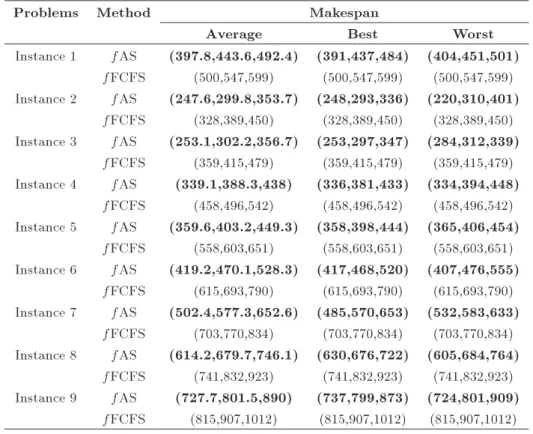
After determination of the best parameter setting for solving the small to large instances tested, we ran fAS algorithm in order to evaluate the performance of the algorithm. Table 9 presents the comparison between the average performance of fAS and the results of fFCFS for all instances. The rst and second columns of Table 9 display the considered test problems
and approaches, respectively. The next three columns represent the average, best, and worst fuzzy makespans for the solutions obtained. As the table shows, fAS outperforms fFCFS in solving all instances from small to large sizes.
The ANOVA test results for ARV as a response variable are presented in Table 10. Considering the P -values for the main eects of the sample prob-lem and the algorithm, it is seen that the eect of
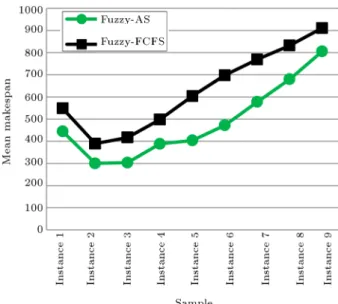
Figure 5. Interaction between the algorithms and test problems for the ARV (crisp makespan).
the aforementioned factor is signicant. It means that there is signicant dierence between the mean makespans obtained for the two methods as well as between those obtained for the nine sample problems. Moreover, interaction eect of problems and algorithms is signicant. Figure 5 shows that the proposed fAS algorithm obtains lower ARV than fFCFS does for each instance.
A hospital from Isfahan, Iran, is selected, which is consistent with all assumptions of the model under open strategy. For instance, in this real case of operat-ing theatre, priorities of patients are assumed identical in some days and are not important in planning management, because surgical cases are categorized in the same age group and there are not cardiac, thoracic, and some urgent cases. To implement the proposed algorithm for the real case, the specialist surgeons are divided into two groups for inpatients and outpatients. The specialist group for inpatients consists in only a surgeon assigned to a surgical case and this is a clinical decision, whereas the group for outpatients includes at least two general surgeons with dierent processing times assigned to the case; this is not necessarily a clinical decision, because there are more resources to be allocated. Therefore, assigning a general surgeon by the model can optimize makespan and improve the schedule.
Real data, including fuzzy durations for all stages of each surgical case, were collected in 8 dierent days by getting data from experts such as anesthetists, nurses, and surgeons. Therefore, each instance in-cluded elective cases to be operated during a day, fuzzy durations for cases, and available required resources for all surgeries in the same day. The proposed algo-rithm was repeated 10 times and the mean makespan
Figure 6. Main eect plot and LSD intervals (at 95% condence level) of makespan for algorithms.
achieved by fAS was compared with the result of the real hospital planning. The global solutions achieved by fAS for all cases tested outperformed real planning as shown in Table 11. Also, the ANOVA test results for the achieved ARV (algorithm and real planning) methods are displayed in Table 12. Considering the results, the P -value for the main eect of the solution method is less than 0.05. So, the main eect of the solution method is signicant for the mean makespans. It means that there is signicant dierence between the mean makespans obtained for the proposed algorithm and real planning. Moreover, Figure 6 shows the interval plots (at 95% condence level) of makespan for the methods, indicating that the proposed fAS algorithm obtains lower ARV than the real planning does for all instances.
6. Conclusion
In this paper, we addressed the surgical case scheduling problem in operating theater under uncertain condition of service time; a new approach was proposed so as to tackle the NP-Hard problem. The unique contribution of this paper is to provide fuzzy processing time in all stages of surgery as well as to introduce a meta-heuristic approach from ACO family so as to solve the fSCS problem for the rst time. The criterion of the problem was to minimize fuzzy makespan. Our methodology was based on ACO algorithm; we developed a fuzzy two-level AS and introduced a new algorithm, namely fAS. To illustrate our methodology, we provided the data on three case tests; each case com-prised three problems with dierent sizes. The sizes of the problems were changed by increasing duration of surgery, number of surgical cases, and the number of required resources for all stages of surgery. First, we modeled fSCS by using a mathematical programming model and then, compared our approach with this
model for problems of small sizes. On the other
hand, we constructed fuzzy schedules with FCFS rule, evaluated both methods by AVR, and compared their
Table 11. Comparison of the performance of the algorithm with real planning in all the real case problems.
Problems Method Objectives
Mean fuzzy makespan ARV (crisp makespan) Instance 1 fAS (406.8,505.4,613.9) 507.875
Hospital 569
Instance 2 fAS (404.2,458.1,503.5) 455.975
Hospital 537
Instance 3 fAS (623.7,708.9,791.5) 708.25
Hospital 714
Instance 4 fAS (603.2,681.3,753.7) 679.875
Hospital 761
Instance 5 fAS (601.9,670.7,744) 671.825
Hospital 823
Instance 6 fAS (479,530,586) 531.25
Hospital 666
Instance 7 fAS (639,709.7,773.2) 707.9
Hospital 778
Instance 8 fAS (364.8,419.3,461.3) 416.175
Hospital 469
Table 12. ANOVA results for ARV (crisp makespan). Source of variation DF SS MS F P -value
Method 1 254303 254303 18.75 0.000 Error 158 2142369 13559
Total 159 2396672
performances. Moreover, real data were provided from a private hospital in Isfahan to evaluate the proposed algorithm. It was observed that our proposed fAS algorithm outperformed fFCFS as well as the hospital planning. Here are some directions as opportunities for future research in this area. Emergency cases as patients can be taken into account in the problem and a new ACO algorithm can be constructed in order to solve online surgical case scheduling in real world. On the other hand, building a new fuzzy ACO algorithm for bi-objective surgical case scheduling problem can be a novel path in future research. In this way, our future research goal will be to extend a fuzzy two-level ant system in order to solve fuzzy bi-objective surgical case scheduling problem.
Acknowledgements
The authors are sincerely grateful to the anonymous
referees for their helpful comments and constructive suggestions.
References
1. Vijayakumar, B., Parikh, P.J., Scott, R., Barnes, A., and Gallimore, J. \A dual binpacking approach to scheduling surgical cases at a publicly-funded hospi-tal", European Journal of Operational Research, 224, pp. 583-591 (2013).
2. Zhao, Z. and Li, X. \Scheduling elective surgeries with sequence-dependent setup times to multiple operating rooms using constraint programming", Operations Re-search for Health Care, 3(3), pp. 160-167 (2014).
3. Denton, B., Viapiano, J., and Vogl, A. \Optimization of surgery sequencing and scheduling decisions under uncertainty", Health Care Management Science, 10(1), pp. 13-24 (2007).
schedul-ing", PhD Thesis, Dep. Indsturial Engineering, Tarbiat Modares University, Iran, Tehran (2011).
5. Guerriero, F. and Guido, R. \Operational research in the management of the operating theatre: a survey", Health Care Manag Sci, 14, pp. 89-144 (2011).
6. Zakaria, Y. Abdelrasol, Z.Y., Harraz, N., and Eltawil, A. \A proposed solution framework for the operating room scheduling problems", Proceedings of the World Congress on Engineering and Computer, 2, pp. 1149-1157 (2013).
7. Samudra, M., Van Riet, C., Demeulemeester, E.,
Cardoen, B., Vansteenkiste, N., and Rademakers, F.E. \Scheduling operating rooms: achievements, chal-lenges and pitfalls", J Sched, 19(5), pp. 493-525 (2016).
8. Dellaert, N. and Jeunet, J. \A variable neighborhood search algorithm for the surgery tactical planning problem", Computers and Operation Research, 84, pp. 216-225 (2017).
9. Magerlein, J.M. and Martin, J.B. \Surgical demand scheduling: A review", Health Service Research, 13, pp. 418-433 (1978).
10. Fei, H., Meskens, N., and Chu, C. \A planning and scheduling problem for an operating theatre using an open scheduling strategy", Computers & Industrial Engineering, 58, pp. 221-230 (2010).
11. Adan, I., Bekkers, J., Dellaert, N., Jeunet, J., and Vissers, J. \Improving operational eectiveness of tac-tical master plans for emergency and elective patients under stochastic demand and capacitated resources", European Journal of Operational Research, 213, pp. 290-308 (2011).
12. Marques, I., Captivo, M.E., and Vaz Pato, M.
\Scheduling elective surgeries in a Portuguese hospital using a genetic heuristic", Operations Research for Health Care, 3(2), pp. 59-72 (2014).
13. Marques, I. and Captivo, M.E. \Bicriteria elective surgery scheduling using an evolutionary algorithm", Operations Research for Health Care, 7(24), pp. 14-26 (2015).
14. Aringhieri, R., Landa, P., Soriano, P., Tanfani, E., and Testi, A. \A two level metaheuristic for the operating room scheduling and assignment problem", Computers & Operations Research, 54, pp. 21-34 (2015).
15. Guido, R. and Conforti, D. \A hybrid genetic approach for solving an integrated multi-objective operating room planning and scheduling problem", Computers and Operation Research, 87, pp. 270-282 (2017).
16. Pham, D.N. and Klinkert, A. \Surgical case scheduling as a generalized job shop scheduling problem", Euro-pean Journal of Operational Research, 185, pp. 1011-1025 (2008).
17. Ghazalbash, S., Sepehri, M.M., Shadpour, P., and
Atighehchian, A. \Operating room scheduling in teach-ing hospitals", Advances in Operations Research, 2012 (2012).
18. Davila, M.P., Centeno, G., Fabri, P., Laurentis, K., Reeves, K., and Weng, M. \A methodology for schedul-ing operatschedul-ing rooms under uncertainty", PhD Thesis, University of South Florida (2013).
19. Meskens, N., Duvivier, D., and Hanset, A. \Multi-objective operating room scheduling considering desiderata of the surgical team", Decision Support Systems, 55, pp. 650-659 (2013).
20. M'Hallah, R. and Al-Roomi, A.H. \The planning
and scheduling of operating rooms: A simulation approach", Computers & Industrial Engineering, 78, pp. 235-248 (2014).
21. Xiang, W., Yin, J., and Lim, G. \An ant colony
optimization approach for solving an operating room surgery scheduling problem", Computers & Industrial Engineering, 85, pp. 335-345 (2015).
22. Saadouli, H., Jerbi, B., Dammaka, A., Masmoudi, L., and Bouaziz, A. \A stochastic optimization and sim-ulation approach for scheduling operating rooms and recovery beds in an orthopedic surgery department", Computers & Industrial Engineering, 80, pp. 72-79 (2015).
23. van Essen, J.T., Hurink, J.L., Hartholt, W., and van den Akker, B.J. \Decision support system for the operating room rescheduling problem", Health Care Manag Sci, 15(4), pp. 355-372 (2012).
24. Erdem, E., Qu, X., and Shi, J. \Rescheduling of elec-tive patients upon the arrival of emergency patients", Decision Support Systems, 54, pp. 551-563 (2012).
25. Fugener, A., Hans, E.W., Kolisch, R., Kortbeek,
N., and Vanberkel, P.T. \Master surgery scheduling with consideration of multiple downstream Units", European Journal of Operational Research, 239, pp. 227-236 (2014).
26. Cardoen, B., Demeulemeester, E., and Belien, J. \Op-erating room planning and scheduling: A literature review", European Journal of Operational Research, 201, pp. 921-932 (2010).
27. Lee, S. and Yih, Y. \Reducing patient-ow delays
in surgical suites through determining start-times of surgical cases", European Journal of Operational Re-search, 238, pp. 620-629 (2014).
28. Marques, I. and Captivo, E.M. \Dierent stakehold-ers's perspectives for a surgical case assignment prob-lem: deterministic and robust approaches", European Journal of Operational Research, 261(1) , pp. 260-278 (2017).
29. Van Riet, C. and Demeulemeester, E. \Trade-os in
operating room planning for electives and emergencies: A review", Operations Research for Health Care, 7, pp. 52-69 (2015).
30. Lamiri, M., Xie, X., Dolgui, A., and Grimaud, F. \A stochastic model for operating room planning with elective and emergency demand for surgery", Eur J Oper Res, 185(3), pp. 1026-1037 (2008).
31. Lamiri, M., Grimaud, F., and Xie, X. \Optimization methods for a stochastic surgery planning problem", Int J Prod Econ, 120(2), pp. 400-410 (2009).
32. Saremi, A., Jula, P., ElMekkawy, T., and Wang,
G.G. \Appointment scheduling of outpatient surgical services in a multistage operating room department", Int. J. Production Economics, 141, pp. 646-658 (2013).
33. Mateus, C., Marques, I., and Captivo, M.E. \Local search heuristics for a surgical case assignment prob-lem", Operations Research for Health Care, 17, pp. 71-81 (2018).
34. Dubois, D., Fargier, H., and Fortemps, P. \Fuzzy
scheduling: Modelling exible constraints vs. coping with incomplete knowledge", European Journal of Operational Research, 147, pp. 231-252 (2003).
35. Gonzalez-Rodriguez, I., Vela, C.R., Puente, J., and Hernandez-Arauzo, A. \Improved local search for job shop scheduling with uncertain durations", Proceed-ings of the Nineteenth International Conference on Au-tomated Planning and Scheduling, pp. 124-131 (2008a).
36. Gonzalez-Rodriguez, I., Puente, J., Vela, C.R., and Varela, R. \Semantics of schedules for the fuzzy job-shop problem", IEEE Transactions on Systems Man and Cybernetics - Part A: Systems and Humans, 38, pp. 655-666 (2008b).
37. Palacios, J.J., Vela, C.R., Puente, J., and Gonzalez-Rodriguez, I. \Hybrid cooperative coevolution for fuzzy exible job shop scheduling problems", Proceed-ings of Erofuse, pp. 199-206 (2013).
38. Lei, D.M. \Co-evolutionary genetic algorithm for fuzzy exible job shop scheduling", Appl. Soft Comput., 12(8), pp. 2237-2245 (2012).
39. Xu, Y., Wang, L., Wang, S., and Liu, M. \An eective teaching-learning-based optimization algorithm for the exible job-shop scheduling problem with fuzzy pro-cessing time", Neurocomputing, 148, pp. 26-35 (2015).
40. Liu, B., Fan, Y., and Liu, Y. \A fast estimation of distribution algorithm for dynamic fuzzy exible job-shop scheduling problem", Computers & Industrial Engineering, 87, pp. 193-201 (2015).
41. Lin, J. \A hybrid biogeography-based optimization for the fuzzy exible job-shop scheduling problem", Knowledge-Based Systems, 78, pp. 59-74 (2015).
42. Guinet, A. and Chaabane, S. \Operating theatre plan-ning", International Journal of Production Economics, 85(1), pp. 69-81 (2003).
43. Augusto, V., Xie, X., and Perdomo, V.
\Operat-ing theatre schedul\Operat-ing with patient recovery in both operating rooms and recovery beds", Computers & Industrial Engineering, 58(2), pp. 231-238 (2010).
44. Pinedo, M., Scheduling: Theory, Algorithms and
Systems, Prentice-Hall, Ed., 3th Edn., New Jersey, Englewood Clis (2008).
45. Sakawa, M. and Kubota, R. \Fuzzy programming
for multiobjective job shop scheduling with fuzzy processing time and fuzzy due date through genetic algorithms", Eur. J. Oper. Res., 120(2), pp. 393-407 (2000).
46. Demir, Y. and Isleyen, S.K. \Evaluation of mathe-matical models for exible job-shop scheduling prob-lems", Applied Mathematical Modelling, 37, pp. 977-988 (2013).
47. Ozguven, C., Ozbakr, L., and Yavuz, Y. \Mathemati-cal models for job-shop scheduling problems with rout-ing and process plan exibility", Applied Mathematical Modelling, 34, pp. 1539-1548 (2010).
48. Noori-Darvish, S., Mahdavi, I., and Mahdavi-Amiri, N. \A bi-objective possibilistic programming model for open shop scheduling problems with sequence-dependent setup times, fuzzy processing times, and fuzzy due dates", Applied Soft Computing, 12, pp. 1399-1416 (2012).
49. Dorigo, M., Maniezzo, V., and Colorni, A. \Positive feedback as a search strategy", Technical Report 91-016, Dip. Elettronica, Politecnico di Milano, Italy (1991).
50. Dorigo, M., Maniesso, V., and Colorni, A. \The
ant system: optimization by a colony of cooperating agents", IEEE Trans. Systems Man Cybernet, Part B, 26, pp. 29-42 (1996).
51. Kuo, R.J., Wibowo, B.S., and Zulvia, F.E. \Applica-tion of a fuzzy ant colony system to solve the dynamic vehicle routing problem with uncertain service time", Applied Mathematical Modelling, 40(23-24), pp. 9990-10001 (2016).
Biographies
Reza Behmanesh is currently a PhD candidate in Industrial Engineering with specialty in Operation re-search and System Engineering at Science and Rere-search Branch, Islamic Azad University, Tehran, Iran. He received his BSc degree in Mining Engineering from Isfahan University of Technology, Isfahan, Iran, in 2001 and his MSc degree in Industrial Engineering from Yazd University, Yazd, Iran, in 2010. He has three years of experience in EORC as a planner in maintenance workshop. His current research interests are swarm and evolutionary computations, scheduling, and optimization techniques.
Mostafa Zandieh received his BSc degree in Indus-trial Engineering from Amirkabir University of Tech-nology, Tehran, Iran, in 1998, and MSc degree in Indus-trial Engineering from Sharif University of Technology, Tehran, Iran, in 2000. He also obtained his PhD degree
in Industrial Engineering from Amirkabir University of Technology, Tehran, Iran, in 2006. Currently, he is an Associate Professor in Industrial Management De-partment at Shahid Beheshti University, Tehran, Iran. His research interests are production planning and scheduling, nancial engineering, quality engineering, applied operations research, simulation, and articial intelligence techniques in the areas of manufacturing
systems design.
Seyed Mohammad Hadji Molana was graduated with BSc from Sharif University of Technology, and MSc and PhD from Amirkabir University of Tech-nology in Iran. His research interests are in supply chain management, advanced inventory control, and production planning.