EunJeong Cheon. Information Practices of Young Users in the Context of Health
Tracking Technologies. A Master’s Paper for the M.S. in IS degree. July, 2015. 71 pages. Advisor: Mohammad Hossein Jarrahi
Use of health tracking devices by Digital Natives has drawn the attention of the health tracking technology industry. Despite that, it is not clear how those technologies really work for them in their life contexts, and more study is needed to understand how they interact with the large amount of information generated by these technologies. My study borrowed the Savolainen model of everyday information practice as a theoretical lens to focus on life contexts around the use of health tracking technologies. The data was collected qualitatively, through semi-structured interviews with nine college students. In the findings, information practices, personal life contextual factors, and technology enablement are identified. In evolving relationships among these factors, how
information affordance was offered was discussed. Many information practices still relied on manual means, as reflected by life contexts.
Headings:
Information science -- Research Information technology -- Health Information practice
INFORMATION PRACTICES OF YOUNG USERS IN THE CONTEXT OF HEALTH TRACKING TECHNOLOGIES
by
EunJeong Cheon
A Master’s paper submitted to the faculty of the School of Information and Library Science of the University of North Carolina at Chapel Hill
in partial fulfillment of the requirements for the degree of Master of Science in
Information Science.
Chapel Hill, North Carolina July 2015
Approved by
ACKNOWLEDGEMENTS
In wrapping up my thesis, I can finally feel the fresh summer breeze and realize how many flowers have blossomed around my department building. They smell sweeter than ever.
I want to thank my parents, grandparents and my siblings in Korea for their endless love, prayers and moral support during my studies. I would also like to thank my uncles and aunts for their wonderful concern and support during my stay in the U.S.
“… it struck me as both magical and mundane that technology that had saved me was simply hands. Of course, our technology is us.”
― Eula Biss, On Immunity: An Inoculation
“ .. We are stuck with technology when what we really want is just stuff that works.”
Table of Contents
INTRODUCTION ...4
1.1 Research Motivation ...4
1.2 Literature Gaps...6
LITERATURE REVIEW ...8
2.1 Contextual Literature Review ...8
2.2 Conceptual Literature Review ...14
2.3 Information Practice...17
RESEARCH METHODS ...20
3.1 Study Participants ...20
3.2 Data Collection ...22
3.3 Data Analysis ...24
FINDINGS ...26
4.1 Summary of Findings Identified Based on the Model of Everyday Information Practice...26
4.2 Information Practices ...28
4.3 Personal Contextual factor ...36
4.4 Technology Enablement ...41
DISCUSSION ...45
CONCLUSION ...56
Contribution& Limitation ...58
BIBLIOGRAPHY ...60
Appendix A: Photographs of participant’s log data for complementing interviews ...67
INTRODUCTION
1.1 Research Motivation
Health tracking technologies have rapidly gained popularity in recent years as such devices have become prevalent in our daily lives. According to Soreon Research in Switzerland (2014), the market for wearable healthcare devices is expected to grow 65% each year and over $40 billion by 2020. The technologies hold great promise for
promoting health and physical performance by tracking users’ health states and activities. In most cases, these technologies come in the form of built-in mobile applications through personal digital devices, such as smartphones and tablets. The healthcare device industry is also keeping an eye on these changes. According to digital health philosopher John Nosta, in an interview in Real Business (2015), the young generation — individuals who have grown up with prolific digital technologies environment all their lives — will bring about a major shift in developing mobile health technology, because they use smart devices very skillfully and are used to ubiquitous computing.
Marc Prensky (2001) referred the generation born after 1980 as to ‘Digital Natives (DNs)’. It is often called the‘Net Generation’ (Tapscott, 1998, 2009), or more
recently the ‘Google Generation (Rowlands et al. 2008, JISC-Ciber 2008) or the
i-Generation (Rosen 2010). Dingli, A. and Seychell, D (2015) narrowed down the scope of ‘the second generation of Digital Natives (2DNs)’ by referring to them as the 2DNs —
citizens” (p.20).
Digital natives are expected to be more knowledgeable about their healthcare by taking advantage of the growing numbers of smart health monitoring devices. For example, some digital native parents use such health technologies to monitor their children (Shenolikar, 2015). The digital natives are gradually drawing attention from health industry as major users of smart health technologies in near future
However, despite their popularity and the rising number of prospective users among Digital Natives, it is still not clear whether smart health monitoring technologies really work to for young people as promised, and if so, how. Additionally, how they use health tracking technologies seems complicated. According to recent research by Flurry, a mobile analytics subsidiary company from Yahoo (Simon Khalaf , 2014), usage of over 6,800 health and fitness applications in 100,000 devices were sampled. The results showed that usage among the Digital Natives generation (18-24 ages) was actually under-index by 57% compared to the average. Unlike their general tendency toward technology use, Digital Natives don’t necessarily prefer smart health tracking technologies in the context of managing their daily health care, such as tracking fitness and diet.
In this regard, research may need to go into detail for understanding how Digital Natives actually take advantage of health tracking technologies, particularly by looking at their daily life contexts. This is because, as Dingli and Seychell underline in their book, “we cannot understand the digital natives without also understand the context in which
they live” (2015, 3p).
This study was designed to explore research questions: (1) what kinds of
information practices are implemented while using health tracking technologies (2) how those technologies offer information affordances to digital natives, and (3) what usage looks like in their daily life context.
1.2 Literature Gaps
Research on the use of mobile technologies for use in tracking exercise or diet has been conducted widely in many disciplines, particularly, in the field of Human-computer interaction (HCI). Most research observed practices around interactions with health related technologies, while few studies took the approach of practice theories. Likewise, despite the fact that studies in the theory of practice have drawn on everyday life
examples to support its perspectives, it’s hard to find practice theory studies dealing with how people are informed by using health tracking technologies in everyday practices.
However, some fields such HCI, CSCW (Computer Supported Coop Work), information science and etc, recently called for research that uses “practices” as a tool of analysis. Some researchers of sustainable HCI have already adopted a practice approach by emphasizing its insightful perspective. In this regard, Entwistle et al (2015) noted that “what we should be focusing on is how people engage in the practices of everyday life, ⋯, if we are to truly affect their behaviors through technology” (p.1125).
Furthermore, Kuutti and Bannon (2014) proposed that HCI researchers pay more attention to practice-based approaches as a methodological framework. In terms of researching the daily life uses of healthcare technology, practice theory was
approaches as a conceptual framework allow us to give rich description on how people bring healthcare technologies into their life contexts and use. Aligned with this view, specifically for researching healthcare technology, theoretical frameworks and models are needed in order to embrace uses of the technologies in non-clinical settings (Grönvall and Verdezoto2013; Fitzpatrick and Ellingsen, 2013).
LITERATURE REVIEW
2.1 Contextual Literature Review
Health and fitness technologies have gained increasing popularity in the recent years. Such technologies, including mobile applications and wearable technologies, allow users to track steps, calories, heart rate, sleep, etc. It’s no longer unusual to see people using health and fitness technologies during their daily routines. As health and fitness technologies has spread, research on the topic of health and well-being has grown in academia, especially in personal informatics (Choe et al., 2014; Consolve, S et al., 2008 ; Rooksby et al., 2014; Li et al., 2010), HCI (Ahtinen, A et al., 2009; Klasnja, P et al., 2011; Meyer, J et al, 2014; Nylander, S et al.,2014; Fritz T et al., 2014) and healthcare informatics (Dalgaard, L et al., 2013; Fanning, J et al., 2012; Klasnja, P., & Pratt, W, 2012) sustainable design studies (Grönvall, E., & Verdezoto, N, 2013; Wakkary, R et al., 2013).
information and technologies- has not been emphasized enough. Without considering user’s practices and their contextual factors, those practices are likely to be outlined as
general device usages.
Many researchers in health and wellness technologies have focused more on technology (Albinali et al., 2010; Gupta & Jilla, 2011) or users’ aspect (Ahtinen,
Isomursu, et al., 2008; Oh, J., & Lee, U, 2015). For example, they evaluate technologies in terms of their system design and usability or studied user’s motivation for adapting or using technologies. In order to examine about how to promote user’s health behavior with mediated technologies, some studies often borrow theories from diverse area, such as cognitive psychology (Yoganathan, D., & Kajanan, S, 2013; Short.C.E et al., 2014), social psychology (D. Yoganathan, et al, 2014) and health behavior science etc, which often makes data analysis more complementary and manifest. Using theoretical
frameworks is important because it illuminates what data tell us by drawing researcher’s “attention to particular events or phenomena, and sheds light on relationships that might otherwise go unnoticed or misunderstood” (Maxwell, 2012, p.49).
The majority of research on health and wellness technology in HCI have evaluated particular devices or applications by recruiting participants who hadn’t used those technologies before.(Rooksby et al., 2014) Those studies often missed how users’ life contexts affected how they interacted with those technologies. Some studies on “Quantified-Selfers” (Q-Selfers) in the field of personal informatics have paid attention
adopted one or two devices and have used those in their daily life. In this regard, Fritz, Huang, Murphy, & Zimmermann (2014) is a rare exception.
Fritz, (2014) investigated users who have continually used activity tracking technologies over the long term to figure out how health technologies can continue to support users’ values and practices as they change over time. By exploring users’ experiences with feedback and reward from the devices, as well as motivation and sharing data, the study found design implications emphasizing social features of technologies and how the features may facilitate the long-term uses of health
technologies. The research reflected users’ real life contexts, such as considering their initial motivation on adoption of activity tracking technologies. However, by excluding participants who stopped using along the way, the research only focused on the merits and impact of technologies in long-term uses.
Similarly, the recent study by Rooksby, J., Rost, M., Morrison, A and Chalmers, M. C (2014) also stressed a range of users’ life events and how those were closely
connected to their uses of activity tracking technologies. Like the study by Fritz et al (2014), researchers recruited diverse activity trackers who had previously used such devices and individuals who would like to use the devices. With their findings, they introduced the term “lived informatics,” which underlines the importance of our daily life
Different styles activity-tracking technology use were also found among individuals in another recent study by Tollmar, K., Bentley, F., Viedma, C (2013). Researchers combined a large amount of data from various devices, including mobile applications, activities tracking and sensors, and individual contextual factors. They investigated how integrated health information affected users’ health behavior changes. As in previous studies, daily life contexts were stressed in the research. Researchers pointed out that proper approaches to logging and tracking should be different in order to get accurate results that reflected each user’s wellness goals and individual contexts.
However, records and data were the main focus of in this study, rather than how users use and implement the information obtained by the devices.
Efforts to find contextual variables that may affect the usability of activity tracking devices were also shown in the research by Temir (2013). By evaluating two mobile applications for tracking outside running through user study, she tried to discover design implications for similar health and fitness applications. She found that users’ previous experiences and motivation, such as running for hobby or for health, led different needs in using mobile applications. However, she accounted for a somewhat narrower scope of contextual factors, such as sunshine and the physical limitations of mobile phones, rather than general day-to-day life contexts.
Recently, studies on activity-tracking device users have placed a greater emphasis on user’ life contexts and their specific practices in using technologies. They have
acknowledged that taking life practices and contexts into account helped to evaluate health-related technologies appropriately, which has led to promoting user’s engagement in health and wellness technologies. Even though theoretical frameworks can manifest things that were missed in research process (Maxwell, 2012), most studies on health tracking technologies, particularly in HCI area, have tended to rely on empirical data. There have been few studies using both theory-based approaches and empirical data.
One recent study (D. Yoganathan, et al, 2014) used the Computers Are Social Actors (CASA) paradigm and cognitive load theory as theoretical frameworks to clarify the effects of humanized feedback on fitness applications in improving users’ fitness performance. Based on CASA, researchers conceptualized mediators such as language style (formal or informal), modalities (visual or voice), and activity types (aerobic or anaerobic). Using cognitive load theory, relationships among mediators, user
engagement, and cognitive load were effectively manifested in the research results.
Base on the Social Cognitive Theory (SCT) and persuasive technology design principles, the research (2013) by Yoganathan, D., & Kajanan, S evaluated current commercial fitness applications to figure out effective design guidelines. They found some components were drawn from SCT, such as self-efficacy, outcome expectation, self-regulation and social facilitation. They evaluated the effective of applications by combing this with data collected from online assessments.
studying technologies-based intervention for healthy eating, previous research commonly compared the paper diary to mobile applications for food journaling. Lee, G et al (2006), Duncan, M et al (2014) showed that there was no significant difference between those groups, although mobile-based interventions and applications had a slightly better score. (Lee, G et al, 2006)
It’s hard to find research using theories as theoretical frameworks — most research has been based on user studies conducted to design new systems. A study by Short.C.E et al (2014) is the rare exception. It drew on social cognitive theory and self-regulation theory to design effective mobile application-delivered intervention for
promoting physical activity and nutrition. Using intervention based on those two theories, they experimented with two groups; one given mobile application-delivered intervention and another with paper-based intervention. Researchers observed the groups using conceptual frameworks based on social cognitive theories, such as knowledge, self-efficacy, provided information, goal setting and self-monitoring.
Despite such requests for the practice-based research, there is a lack of studies using practice theories in studying information practices with health and wellness technologies. 2.2 Conceptual Literature Review
Practice theory has developed over time, with slightly different emphasized points depending on the scholar, from Heidegger, Wittgenstein, Foucault, Bourdieu and
Giddens, who is considered as the first generation of theorists (Postill, 2010), to Schatzki and Reckwitz. More recent practice theory is concerned with ‘material and contextual dimensions of practices.’(Entriw, 2015) Practice theory has also been debated in diverse disciplines, such as anthropology, philosophy, sociology, and science and technology studies. Scholars agree that practice theory provides noble ways to defy dualism between individuals and society, because it is equally dependent on the individual’s mind and social structures.
From a practice theorist’s perspective, our everyday life and its meaning is manifested in our specific activities and practices. Feldman and Feldman (2011) summarized general agreement among various perspectives of the theory; “(1) that situated actions are consequential in the production of social life, (2)that dualisms are rejected as a way of theorizing, and (3) that relations are mutually constitutive. These principles cannot be taken singly, but implicate one another” (p.1241).
It’s difficult to define what practice is in a few words, especially in science
He further elaborated that a practice “is a temporally evolving, open-ended set of doings and sayings linked by practical understandings, rules, teleo-affective structure and general understandings” (p.87).
Reckwitz (2002) described a practice in a way that stressed materiality or artifacts.
“A practice is a routinized type of behaviour which consists of several elements, interconnected to one other: forms of bodily activities, forms of mental activities, ‘things’ and their use, a background knowledge in the form of understanding, knowhow, states of emotion and motivational knowledge.” (p.249).
From this definition, Shove and Pantzar (2005) described a practice as the integration of three aspects; materials, meanings, and forms of competence. In different disciplines such as consumption studies, environmental studies, and HCI design studies, practice theory has been a useful lens to look closely at our practices in life in order to better understand it.
In one consumption study based practice theory, Shove and Pantzar (2005) offer a definition of practice by Schatzki (2001) and Reckwitz (2002) to emphasize the material aspects of practices. They point out how attention had not been paid to materiality in practices, even though practices evolve and reproduce with associated objects and meaning. Based on practice theory, they conceptualized products, techniques and
constituent meanings, and how practice theory can clarify relationships between products and new practices as they evolve with new meaning and techniques.
consumers. During interviews, the researcher asked householders how their day to day practices related to energy and water consumption has changed by using an in-home display system. By focusing on practices in everyday life, the research demonstrated how eco-feedback systems could produce new practices in those contexts.
Shove et al’s definitions and perspectives on practice theory have been used as
frameworks particularly in HCI design studies. The recent study by Entwistle et al (2015) also explained two practices of cooking and laundry based on the practices perspectives. Through this study they developed a new frame model to support the practice theory called Contextual Wheel of Practice (COWOP), demonstrating how their practice model could be applied in diverse domains. They especially pointed out that practice theory could provide a rich understanding of self-monitoring technology and its practices. Aligned with this, Fitzpatrick and Ellingsen (2013) also called for theoretical frameworks that can articulate practices using healthcare technologies.
Practice theories also often have been applied in serious hobby fields. Hartel J (2006, 2010) demonstrated gourmet cooking as practices consisting of information activities and resources by showing how recipes and cookbooks had been documented and managed at home.
Using knowledge management literatures as a starting point, information science scholars have recently paid attention to practice theories. A few scholars, such as
Savolainen, Talja and Lloyd, have drawn on practice theories in their work on
information behavior studies (e.g. Cox, 2012; Huizing and Cavanagh, 2011; Lloyd, 2009, 2010; Savolainen, 2007, 2008). These authors adopted Schatzki’s philosophical
Savolainen (2008), for example, introduced the concept of “information practice,” which incorporated perspectives from practice theories and social phenomenology. The concept emphasizes our everyday practice and its socio-cultural contexts to better understand information seeking, use, and sharing.
Drawing on practice theory perspectives, a book, Knowing in organizations: A practice-based approach, edited by Nicolini D, Gherardi S and Yanow D (2003)
described a variety of daily life practices, such as hammering, flute making, roof tiling, and cooking. Personal photographic works (Rose, 2010; Schwartz.D, 1986; Griggin M, 1986; Peterson SM, 2008; Cox and Blake, 2011) also have been illustrated from the perspective of practice theory. Cox (2013) used those works to discuss how information is implemented in daily life practices.
Despite so many studies on real life examples from the perspective of practice theory, the contexts of the use of health tracking technologies has not been covered based on practice theory, even though practice theory reflects life contexts and allows in-depth data analysis.
2.3 Information Practice
The concept of information practice has recently been discussed by Savolainen in his book Everyday Information Practices (2008). According to Savolainen, information practice is “a set of socially and culturally established ways to identify, seek, use, and share the information available in various sources such as television, newspapers, and the Internet’ (p. 2)
Since Savolainen’s works on information practice came out, a few studies tried to gain insights from it.
Pamlea McKenzie developed a model of information practice in the context of everyday life information seeking. The model consists of four seeking activities; active seeking, active scanning, non-directed monitoring, and obtaining info by proxy.
Unlike McKenzie, Sanna Talja and Preben Hamsen (Talja, S, 2002; Talja, S., & Hansen, P, 2006, Hansen, P., & Järvelin, K, 2005) have focused on the social aspects of practice, such as work contexts. They described information practice as “practices of info seeking, retrieval, filtering, and synthesis” (Savolainen, 2008).
However, the concept of information practices has been understood as having very broad meaning, about which there is still no consensus among scholars. Scholars of information practice do commonly acknowledge its social and cultural factors in
information seeking, use, and sharing. In addition, information practice can be habitual and can be applied to diverse settings, not just work contexts (Savolainen, 2008).
The concept of information practices could be unclear when compared to similar concepts, such as information behavior and information action. Those concepts all explain “the ways in which people deal with information”. Information practice
differentiates itself from information behavior and information action by emphasizing social and contextual meanings. Information behaviors are usually explained by
individual needs and motivation. Similarly, information action is understood mainly by individual intention, such as one’s goals and interests (Savolainen, 2008).
Savolainen. He combined practice theories and social phenomenology to conceptualize information practice in everyday contexts. According to Savolainen’s model of everyday information practices, information seeking, use, and sharing are shaped in social and dialogical ways. Contextual factors around information practices play significant roles by giving rich description on how practices are embedded in everyday life. Practices shape our information activities, from how information is defined to how it is managed. According to Savolainen, focusing on practices gives details of “how our desire for routine makes us rather conservative in our information use.” (2012)
Even though witnessing information practices is common, there is lack of studies on “exactly how information is used” (Savolainen, 2008). Information can be meaningful
when it is used. In this regard, he called for more qualitative research, since it can offer a rich discourse on how certain information practices and its daily life context intertwine with each other to produce meaning. My general approach will proceed from the perspective of everyday information practice. With my qualitative data, I also will elaborate on conceptual research questions concerning how health tracking technologies allow information affordances and how personal life contexts are interwoven with both.
This paper attempt to substantiate information practices in the uses of fitness and wellness technologies among young individuals by drawing on practice theories. I will use Savolainen’s model of everyday information practice as my theoretical lens. Shove and Pantzar (2005)’s definition of practices will complement this model, in order to
RESEARCH METHODS
The study was designed as a qualitative research. Among the qualitative methods, semi-structured interviews were the most commonly conducted, with the intention of obtaining a rich and holistic understanding of fundamental behaviors, motivations, and needs (Gillham, 2005). This method relies open and exploratory research questions analyzed as meaning-based (Elliott, 1999)
In-depth, face-to-face interviews were conducted to understand information practices and their real-life contexts while young people interact with technologies for journaling their fitness and foods intake. Also, photographs were taken of participants’ notebook logs and of their data recorded by mobile application and physical-activity tracking devices. Those photographs also were closely treated as research data. (Silverman, 2006). They complemented the interview data by giving more detail and comprehensive contexts of participant’s experiences regarding using technologies for
journaling fitness and food. The interviews were transcribed and carefully reviewed for major themes. This process was repeated to refine research themes (Boyatzis, 1998; Hayes, 2000).
3.1 Study Participants
The participants had to meet the following criteria: be an enrolled student of the university, at least 18 years of age, and currently using or have ever used technology for logging their exercise records or food intake. Technology was defined broadly, and included notebooks, mobile applications, and physical activity tracking devices. Those usages had to be at least for two weeks to ensure that participants had enough interaction with the technology for the purpose of tracking fitness or food intake. They were
compensated with a $10 Starbucks gift cards for participating in a short survey and semi-constructed interview.
Seven females and two males participated, ranging in age from 18 to 23 years old (the mean age was 19.8 years). They self-identified as Digital Natives. To track running and diet, five participants used technologies such as mobile applications, physical activity tracking devices, laptops, and smartphones. They were all users of mobile applications for running and two occasionally used wearable devices such as a Fitbit or Jawbone Up. Three participants didn’t use digital technologies for logging their exercise or diet, using instead notebooks or papers, even though they carried smartphones to listen to music, watch cable TV, text, and use social media. Table 1 displays participant demographics and key information.
N Age Sex Technologies for
tracking fitness and diet in the past
Technologies for tracking fitness and
diet in the present
Fitness to log Diet to log
P1 19 M Notebooks (paper)
Notebooks(paper) o Strength training o Running
N/A
P2 23 F Mobile phone & apps, Excel worksheet wearable
devices
Mobile phone & apps, laptop (spreadsheet)
o Running, o Yoga or
Pilates
P3 19 F Notebooks (paper), Mobile phone & apps
Notebooks(paper), Mobile phone & apps
o Strength training o Running o Yoga or
Pilates o Boxing
N/A
P4 21 M Notebooks (paper)
Notebooks(paper) o Strength training
N/A
P5 19 F Notebooks (paper), Mobile phone
& apps
Notebooks(paper) o Strength training Running
N/A
P6 18 F Notebooks (paper), Mobile phone
& apps
Mobile phone & apps
o Strength training o Running, o Yoga or
Pilates
List of foods intake
P7 20 F Wearable device (jawbone up) Mobile phone
& apps
Mobile phone & apps
o Strength training o Running
N/A
P8 20 F Mobile phone (including mobile apps)
Mobile phone (including mobile apps) o Strength training o Running List of foods intake P9 19 F Wearable
device (Fitbit) Mobile phone
& apps
Wearable device (Fitbit)
Mobile phone & apps
o Running o Yoga or
Pilates o Cycling o Zumba o Volleyball List of foods intake
Table 1. Study Participants’ demographic information and their technologies for tracking fitness or diet
3.2 Data Collection
Procedure
pilot study, interview questions for the main study could be guided and completed.
The main user study consisted of two data collection phases for each participant:
1. Online short survey
2. Semi-structured interview
Online short survey
All participants were required to register a time slot for interviews, and to
complete a short questionnaire to provide demographic information, (i.e. gender, age), the exercise they were keeping track of, technologies that they had used in the past and were currently using, what kinds health related information that they recorded through the technologies, and the period of using the device. They were asked to provide not only their devices but also past and current records logged through the devices. The survey form is attached in Appendix B.
Semi-structured interviews
Before the interviews, the researcher explained the goals of the research and ensured participants that all data collected would keep confidential. An informed consent form was given to each participants and was acknowledged. The interview was
conducted semi-structurally and lasted 50-70 minutes. During the interviews, with participants’ consent, handwritten logs and data created by technologies were
photographed. This helped participants describe specific contexts and processes involved with recording their data based.
how often they exercise per week, and their motivation.
Following those question were main questions under four themes:
1) Technology adoption (e.g.: How and why you start using a certain technology for logging fitness or diets?)
2) Information representation (e.g.: Describe your process of logging information.)
3) Technology affordance and constraints (e.g.: If allowed, are you willing to share your data on social media?)
4) Reflection from data (e.g.: How do you feel while tracking data, or how does data matter to you?)
3.3 Data Analysis
Thematic Analysis
Thematic analysis (Braun & Clarke, 2006) was implemented as a coding technique for analyzing collected data. Thematic analysis is defined as “a method for identifying, analyzing, and reporting patterns (themes) within data” (Braun & Clarke,
2006, p.79) In the thematic analysis, researcher generated initial codes based mainly on interesting features and repeated words. Potential codes were searched, and key concepts or themes were developed. In center of those themes, data was reviewed, categorized, and reduced to main ideas.
coding by searching for alternative analyses. This rigorous thematic approach helped the researcher develop “insightful analysis that answers particular research questions” (Braun & Clarke, 2006, p.97)
Using photographs of participant’s log data for complementing interviews
FINDINGS
4.1 Summary of Findings Identified Based on the Model of Everyday Information Practice
The model of everyday information practice introduced by Savolainen (2008) describes how everyday projects are related to three components of information
Figure1. Model of Everyday Information Practice (Savolainen, 2008, p.65)
Journaling fitness and food is influenced not merely by individual motivation or technological affordance, but by “socially and culturally shaped value and interests,” such as wellbeing. Practice-focused analysis based on this Savolainen model explains the findings in this research, and is useful for understanding how information practices are transformed and evolved along with journaling fitness and food as an everyday life project.
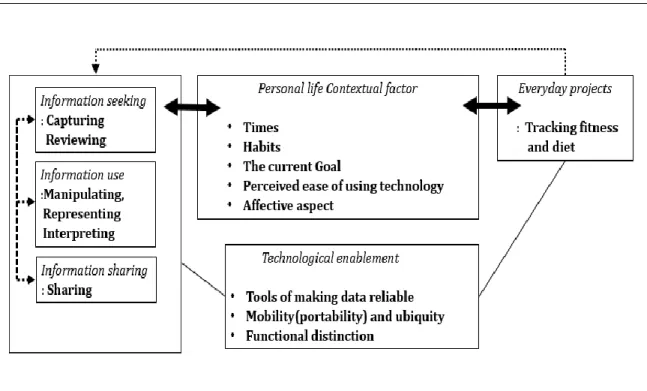
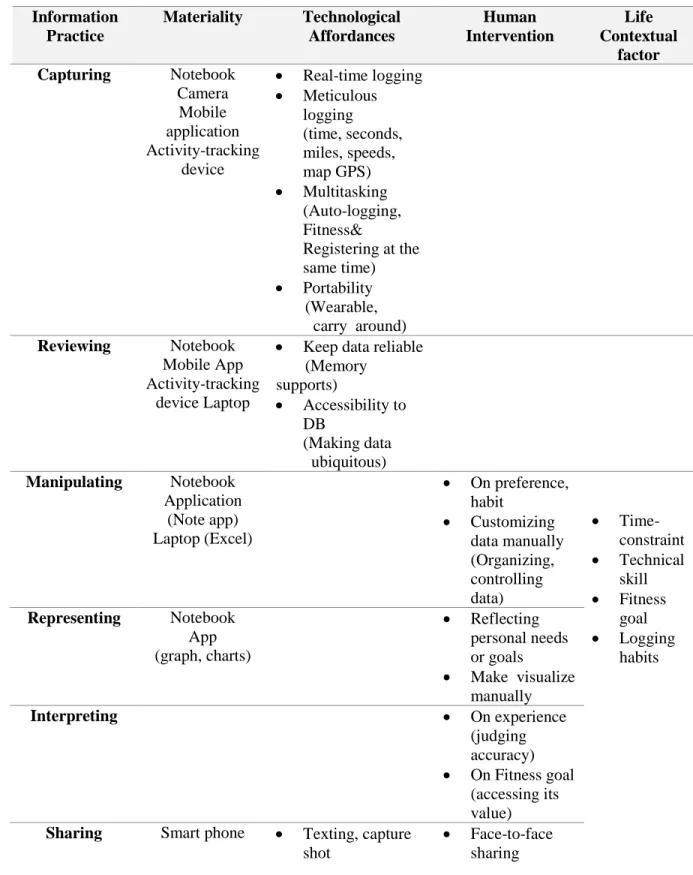
Based on this framework, specific information practices and personal contextual factors, in the context of fitness and food journaling, could be clearly identified from the research data. In terms of everyday information practices, six information practices were found; capturing information, reviewing information (Information seeking); manipulating information, representing information, interpreting information (Information use);
teleo-affective structures frequently overlap each other. I combined these into a group of personal contextual factors, and revised the model based on that. To highlight the role of materiality in information practices (which was ignored in the model), ‘technology enablement’ was added to the reframed model. It is given to figure 2
Figure 2 Summary of findings identified based on the model of everyday information practice
By focusing on information practices, personal life context factors, and technology enablement, the interactions among them clarify how health tracking
technologies and life contexts enable users to achieve certain information practices, and how information affordance flows from those interactions.
4.2 Information Practices
Information Seeking; capturing information, reviewing information
of information seeking, since identifying and selecting information source are included in the process of capturing information. In that information sources are determined by information needs, the practice of reviewing information, which is often implemented in support of the user’s memory, could be considered information seeking.
Capturing Information
Capturing information describes the practice of acquiring data/records or useful tips related to their physical activities or food intake. Captured information from this practice often becomes a source for monitoring or logging information. Participants could capture information either through technologies or by acquiring it from other people. Participants usually obtained information about workout performance records, such as distance running, duration, calories burned, or nutrition information from technology. In terms of information from others, usually people close to them, participants gained useful tips or advice when trying new exercises or starting to log physical activities.
The capturing of information from fitness machines such as elliptical bikes or treadmills using technology such mobile applications, while or after working out or having food, was identified. For example, participant 2 took a picture of the data on an elliptical bike with her smartphone once she has finished working out, then brought her data home and logs her record.
I just take a picture and then bring it home and then like before I go to bed or whenever I don’t feel like studying I just log all my workout, diet, and finances. (P2)
.. after workout whenever it pops up on the treadmill or elliptical I take a picture of it. I take a picture of it and then when I go back home like whenever, even when I forget it I can do it later. (P2)
the context of food intake, participants have found nutrition information provided by mobile food bank database applications.
..it will like give me like the calorie amounts because it’s just like in the
information bank and so if something does change, like if for some reason like I can’t eat oatmeal because I’m out of it and I have cereal, like I can just look for the cereal and just put it in and I won’t have to like go and it will come up with the calorie information and I won’t have to go look up the calorie information (P8)
The practice of capturing information was also identified through human relationships. Participant 1 got some general ideas from his baseball trainer regarding how to log exercise information.
I mean I used to do like in my sophomore year of high school I used to have a personal trainer for baseball and he kind of had like a notebook where he logged workouts and he kind of had like he printed it out and then he’d have a set amount of workouts of what we were going to do for the day and that kind of, I don’t know, I guess that would be the inspiration for this [way to log workout]. (P1)
Reviewing Information
Reviewing information incorporated overall activity tracking or keeping what an
individual logged. Reviewing information presumed that keeping information preceded doing so, or was in progress. Whether or not participants reviewed information had a tendency to depend on whether their past logs were informative or useful.
Participants who rarely tracked what they had logged said that they only took advantage of the logs when it became necessity. They also pointed that this was because they hadn’t thought about how the logs would be useful. Those participants seemed rarely to care about their past fitness or diet logs.
Like this just now looking back at the very first day was probably one of the first times I did that. Like I just don’t need to know about it anymore.(P4)
it go. (P9)
The only time they had gone back to the past logs and reviewed them was when they were seeking some answers to solve certain problems, such as suffering from injury or feeling fatigued for no reason.
I really don’t unless I’m like trying to figure something out like why I might have gotten injured or why I feel like my fitness level is higher or something like that. (P7)
On the other hand, there were participants who kept and reviewed their fitness or food intake logs frequently.
The majority of participants said memory was an issue. Participants wanted to remember how much physical activity they did and what specific food they ate. There were various reasons for this, but the major reason was the desire to track progress in their physical activity or to be more careful about their diet.
I think it was because I was worried I was going to forget it and like I would go to the gym without like a clear intension and then I wouldn’t follow through because now that I have it like written down, like I said before I can look at it and I know I’m halfway through, two thirds of the way through, but if I don’t have anything like really written down and like solidified like planned(P6)
I look at it whenever I’m recording it and probably that’s about really it, cause it’s kind of a notebook and I just record it. I mean occasionally like I said a couple days I just look at it to just see what workout I need to do that day and then also like when I’m kind of struggling to remember the workout, like just looking at it kind of helps motivate me just to go to the gym and figure it out on the way there instead of being like well I’m not going to go because I can’t figure out what I’m supposed to do. (P1)
Because I think it was important for me to be able to remember what the
workout was, like if I really wanted to do it again it would be easier for me to go back and find it than if I had to think about a whole new workout. (P3)
Information Use: manipulating information, representing information, interpreting
information
The practices of manipulating, representing, and interpreting information belong to the field of information use. Manipulating and Representing information are in the category of filtering information. Interpreting information is aligned with the activity of judging the value of information content, in that through the information practice individuals valued information for future action.
Manipulating Information
Manipulating information could be defined as the activity of editing. It embraces the related practices such as updating, deleting, integrating information, or separating information into different categories. The practice often decides how much amount information will be saved. For example, through manipulating information, records are simplified or specified. The practice also made individual differences in ways in which people created their own logs.
Manipulating information reflected participants’ fitness or diet patterns.
information for mobile application users.
I update it sometimes, so like the number of times I’ve increased so it didn’t used to be 40 walking lunges total, like it started out I think as 30 and then I ended up I could up it to 40 and so I increased the number of squats, actually I need to update that because now it’s 36 instead of 30 which means it also increased the number of wide leg squats from 30 to 36 and so the backward lunges increased recently and so did the wall sit, it went from a minute to two minutes. So as I get stronger I’ll update it on my phone and like increase it. (P8)
If I do increase the weight then I erase it and then I put my new weight that I’m doing. (P6)
Participants used different methods for logging information depending on the types or roles of information they needed, such as dates or names of workout. For example, they might organize information by putting it in different places.
It’s either this type of format or it’s just a calendar, but the calendar would be just it’s basically reversed whereas here I’m logging the dates, whereas the calendar I’d be logging the workouts. (P1)
because it’s easier to do that on notes because I already have everything and I just have to erase my weight, whereas if I do it on this I have to individually put in each exercise and how many reps I did and how many sets, and I think I can only put in sets, I can only put in reps separately then sets, so I might have to put in one exercise three times if I did it for that many sets. (P6)
A majority of the participants tended to categorize information as binary (dichotomous). For example, rather than logging specific fitness class names, they were only concerned with the information regarding dates or whether they attended the class or not. For food journals, only the names of foods were logged, rather than specific time or nutrition information. In this way, manipulating information was done among participants for simplification purposes.
I like to keep everything as simple and organized as possible, so a device that gives me things that I don’t need to know or care about, it’s just extra stuff to have to think about. (P4)
I’ll still generalize it as good bad, satisfactory or not satisfactory kind of day. (P9)
Representing information
Representing information involves the practice of visualizing acquired
information. The information was represented in various forms of texts, numbers, marks, color or matrices for each participant. Some participants drew circles or others did checkmarks to mark the exercise they had completed.
…like if I don’t run for an hour I would probably put like a circle on it or
something, but it’s just this is kind of something else I kind of just did like an extra step to kind of just see how much I’m running. (P1)
For each person, a checkmark had a different meaning, such as a completed workout or pointing out that something had changed in their workout or diet.
The checkmark, that was because that was a good weight because this squat machine changed on this date. (P4)
By using different colors or shapes of marks, information was separated for different meanings.
All the black stuff doesn’t matter time I get it done but it’s required to do that day and anything in blue means it’s related to my business (P4)
Interpreting information
Interpreting information includes the practice of assessing the value, usefulness, or importance of information. Specifically, interpreting information was deeply related to perceived accuracy, reliability, and future usefulness. How participants interpreted information revealed how much they valued information.
Looking back on like the whole time I’ve been doing it, that’s the only time that I really do care about it really, because it’s kind of like I feel like once I complete a month it’s like I’m starting over again. So I just kind of, it’s more also just like if I complete a month that’s fine. (P1)
I don’t mind losing it but for February and this month I don’t want to lose it kind of but if it’s a little bit more in detail, so I can’t really memorize all of them. (P2)
Information Sharing: sharing information
Sharing information is the practice of giving information to or receiving information from others.
Sharing Information
In the context of logging fitness or food intake, the information was related to physical activities or diet in daily activities. Few participants shared their fitness or diet logs with others. Even though most participants were sharing or willing to share only with their close friends or family by texting or meeting face to face, they were very negative about sharing their records on social media such as Facebook or Twitter. They were concerned about privacy and how others would respond. They also pointed out that their successful physical activities or diets were just their “personal agenda” and it would not be helpful to others.
not very detailed. I don’t think it would be like really helpful for anyone. (P3)
Because I feel like that’s annoying for people to see every run I do. Like I don’t want then to think I’m bragging or anything like that because I’m not, you know. So yeah I just don’t post much on social media as it is so I don’t want the only thing I post to be like I ran today or something like that. (P7)
4.3 Personal Contextual Factor
: Time, Habits, Current goal, Perceived ease of using technology, Affective aspects
Time
Time made a difference in the ways participants implemented information
practices, such as logging, manipulating, and representing information. Most participants felt under time pressure in their lives and managed their logging practices accordingly.
No, definitely not, cause you can see like a block this big can get covered up by your little flyer, that’s a whole day’s log. So it takes my like maybe two seconds of a set to write down a number. So not a long time at all, plus I have to stand there for two minutes anyway, so it doesn’t waste time. (P4)
But yeah it works pretty well and I don’t mind, like it doesn’t take that long to like type if out and so I normally get to class early so I’ll get to my first class and I’ll just like write this all down or I’ll like write it down like on my way to the gym or like a lot of times I’ll be filling up my water bottle at the gym so it doesn’t really take that long. (P8)
Whenever participants felt a lack of time to log their records, they manipulated and represented them with minimal effort. For example, some participants logged less meticulously.
I think it’s like that’s maybe part of the reason why I keep it so short is because it’s just like … (P3)
records of her/his strength training rather than using a mobile application.
…You have to figure it [using mobile application] out and I find that’s such a waste of time. That [Logging weight training] is a lot more detail to have to write down reps and stuff like that. Like it only takes a minute to write down like times and stuff like that (P7)
Participant 8, by contrast, said she felt no time constraints about using mobile applications for typing out what food she ate.
So it never really feels like a big time commitment because this is a pretty convenient app and it doesn’t take that long. (P8)
Habit
As participants engaged in logging and tracking practices over time, they said it became a matter of habit. They found that they logged their exercise information without reflecting on how they did it or what they logged. For example, for participant 9, she said that wearing activity tracking devices became a part of her routine.
I guess it’s just habit now, like I set it next to my mirror when I’m getting ready and I have, I wear a hair band every day, so it’s just like wearing a hair band, slap it on and it’s my watch and it goes with me everywhere. (P9)
Habitual logging made participants stick whatever logging method they had experienced in the past.
I think it just turns logging into a habit so like I like write down the exercises and I just do (P8)
Yeah I guess, like I didn’t have a Smart Phone when I started logging things, so like back in high school I didn’t get an iPhone until I think my junior year of high school, so I think I just you know the old flip phones didn’t have calendars so I think it was just part of habit and routine. (P7)
I checked them off as I went along and so like the gym was three different parts, so just like indent it because I just like the way it looks better cause that’s also how I take my notes so it’s kind of just habit. (P8)
Participant 3 used paper for logging her exercises. She also said her current method of logging workout information followed her prior experience using a card.
I think it may have started because when I started working out a long time ago I did used to write down the workout plan, like on a little card and I would bring it to the gym with my friends and ⋯ So that would be a much more detailed, like that would be a specific like your sets and your reps for each exercise that we do and I have it all planned out on a card and I bring it so we could use it when we worked out. Then I would keep the cards and I’d file them away but I wouldn’t ever really look at them and so I think that’s how it started. (P3)
Current Goal
Setting goals was identified as an effective motivator to promote physical activity. Goal setting is often built into wearable health devices as a default function (Munson, S. A., & Consolvo, S, 2012).
The findings showed that whether participants have a goal or not affected how they logged and represented information. Participants who didn’t have goals didn’t log in in a
specific way. For these participants, the main reasons to log were to maintain their current patterns of exercise or to keep consistency in their daily lives.
I think I have, I want to keep my running logging the same because I really like it. I think in the future it might be important for me to keep more detailed written records but I don’t have any active plans to change the way I record. (P3)
I mostly use it to make sure that I’m around the goal and then because I’m watching it throughout (P6)
bench 250 by this point and I’m like I’m happy if I can bench the bar eventually. So like it’s not, I don’t have a set goal for like weight lifting, (P8)
Perceived Ease of Using Technology
How comfortable participants feel about manually entering their activity records on mobile application or laptop had little effect on participant’s preferred method for
logging and tracking activities. Subjective factors divided users who felt more comfortable writing by hand and those more comfortable with typing. Even though typing was the preferred way to record information, some participants strongly preferred hand writing to log exercise records.
Any time I write anything down like even letters in the mail I type them out because it’s faster. I can type so much faster than I can write. I’m left handed so I don’t smear anything when I’m typing. …. it would be so annoying to have to like get all these fractions and dates and everything put in the way that I want to and there’s like what, there’s like 30 characters down here in a little box and it would take me more time to power on a computer and get that all put in, I waste a lot of time, (P4)
I feel perfectly comfortable using them [technologies], I just when logging workouts I prefer using paper. (P5)
Affective Aspects
I think both, I feel proud that I did continuously write down all my food for the past however long and then I’d feel proud that my numbers do increase for the strength training. (P6)
Like while logging … most of the time I’m like generally satisfied with myself cause I’m like I remembered to do something today, so it is satisfying to see that like to enter so .. So it’s nice to see and I like to just like seeing it written out. (P8)
Participants said that looking back their records and reflecting on them was fun and interesting, since the records and logs represented their dynamic lives.
It is kind of fun to look back and see how it continues to change over time, so I do flip back on occasion but it’s nothing I do regularly. (P3)
I think I work out regularly, but I always mix up what I’m doing so I think like I’ll go to different classes different days, so I think like it’s interesting to look back and see what I was doing mostly at one time and stuff like that… I think it’s kind of like a motivating factor to like look back and see how often I’ve been running or how infrequently I’ve been running and I don’t know, I just like that sort of stuff interests me. (P7)
Logging information seems to be associated with affective feelings, such as motivation and self-assurance. Participants overall wanted to be aware of their health related activities by logging their fitness activities or diets. The fact that they had been doing well in their physical activity or healthy diet became good motivators.
I like logging cause it reminds me if I worked out that day and that how much I worked out the day before and I should probably workout more the next day. It keeps you like motivated (P5)
Simply continuing to log activity seemed to motivate some participants. For them, logging meant reporting what they did and this played a role in self-management and self-discipline.
…. because my own workouts since I don’t get a grade for it I can skip it [workouts] if I really wanted to, but by writing it I don’t skip it. (P5)
information. They wanted not only maintain their fitness and diet patterns, but also make sure that they kept up a healthy lifestyle throughout their logging.
My motivation [for food logging] was to, well one was my doctor as well and just making sure that I was eating right and still continuing to exercise and of course keeping up kind of I wanted to keep up with appearances throughout the last part of my senior year so it was about staying fit, staying slim and eating and being nutritionally healthy. (P9)
This [logging] helps me see like if I’ve really done a lot that week like I should probably chill out because I worked out this day and this day. It also kind of, sometimes I do feel like I haven’t done enough even though I know I have and so this is a good way to remind myself like you’ve been active, you don’t have to worry about it. So it’s also kind of self -assurance. (P3)
4.4 Technology Enablement
Reliable Tool to Keep Data in either Systematical or Physical Ways
In the context of fitness and healthy diets, health and wellness technologies was a reliable tool in keeping a systemic or physical record of one’s health activities. Whether
using mobile applications for tracking running and steps, or through notebooks for strength training, participants believed that their records should be stored reliably.
No, so how I used the steps is at the end of the day like it [step data] is always there like it doesn’t get removed, it’s always there (P2)
Some participant pointed out that all past records could be accessed through not only mobile application but also through websites associated with their personal
accounts. For example, they said that even if they might lose the device, their data would not be lost. This is because, according to them, their data had been stored in their
personal account system, which is expected to be accessible any time through any
Because it’s an app I have an account with Nike and so my data doesn’t go anywhere it’s still there it’s posted with them. (P3)
Also, they generally thought that their movements have been tracked accurately as well. A notebook for logging exercises also was considered a reliable tool for some
participants, particularly when they were logging rather than tracking. According to participant 4, a piece of paper and a pen were reliable methods to log fitness records, especially in terms of the time required.
Technology is not going to make it faster or easier and be as reliable as me writing it down, you know what I mean. Reliability is 100% and time spent is one second, technology can’t beat that with anything else. (P4)
Non-digital tools like a notebook were perceived to be reliable because there was no risk of data errors or system crashes. According to participants, they didn’t have to worry about losing records in their notebook.
I guess I’m very like old school, I like even like books more than electronic books. I guess it’s like easier on the eyes too when you’re looking at it. I like like the feel when you write on it, you know, cause when you write on the tablet you have a different feel. Then also like it’s you won’t lose that paper. When online there’s that chance you could crash and lose it or you have to find it in a folder. (P5)
Mobility and Ubiquity
Mobility and ubiquity of mobile application and wearable tracking devices allowed participants to multitask. Doing other work right in the middle of logging was allowable as well, due to its automatic logging system built into the technology and the device’s portability. For example, while running, participants were informed about their
speed at each mile in the voice of the application, even while listening to music.
food logging activities.
I think I just do it on my phone more [comfortable] because I’ll write my to do lists while I’m on the go because I multitask, so as I’m walking somewhere I’ll be like typing it up or like I’m in class and I actually don’t have to bring my computer to my class this semester, just by chance, it makes my backpack so much lighter, so I don’t bring it so I don’t have it, so I’ll just type it up on my phone. So most of, a lot of it is out of sheer convenience because I always have my phone on me all the time. (P8)
The portability of wearable devices facilitated logging activity by offering more convenience than using a smartphone or notebook.
They pretty similar as far as the information they give you except that the Garmin includes heart rate and your phone doesn’t. It’s just the Garmin is more
comfortable because you don’t have to carry anything. (P7)
Particular Functional Features Built into Different Technologies
Whether particular functions were provided by mobile applications or wearable tracking devices affected participants’ decision whether or not they journaled their fitness results and diets. Some applications for tracking nutrition and fitness count only certain physical activities and foods. For example, how many calories were burned from weight training usually was not included when the application calculated total calories consumed a day. For this reason, participant 6 said that she didn’t log.
There’s an option for strength training but see if I do cardio and I put in say zumba for 60 minutes then it will add my calories, but if I put in exercise if I put in strength and then I put in sit ups then it doesn’t change my calorie count at all. So I didn’t feel like it was necessary to put in because I didn’t see like a physical change. (P6)
..good thing about My Fitness Pal I think is that it’s database is so gi-normous that I can say I ate a Quaker oatmeal packet with skimmed milk and it can give me the brand and everything like that whereas in outfit class we had to use the government, I don’t know what that website is called but the government like My Plate kind of thing and you have to go in and enter like one cucumber and then it would ask you like sliced, raw, those kind of things whereas on here I can just kind of scroll, click and it all goes in. This was the website was way more time consuming than My Fitness Pal, so relatively I kept that in mind. It was like this is actually the fastest way to do it, so just go ahead and do it. (P9)
Similarly, a sync function connecting smartphone and laptop gave participants an alternative place to log. If smartphone was not in their hands, they could log easily by using a laptop. This sync function helped to free participants from depending on one device.
It’s just an app that came on my phone and it’s super easy to use and it also saves over onto my computer too cause like they synch with each other. So like if I’m on my computer and my phone is like out of my grasp I can just like type it down and it will synch eventually. So it’s just mostly ease because it came with the phone. … I’ll copy and past it into my note section on my phone so I’ll have it and I don’t have to like retype it on my phone I can just copy and paste it from my computer and so it’s just ease. (P8)
Additionally, sync functions between technologies, such as laptops and mobile applications, the data could be considered ubiquitous.
Logging to an exhaustive degree was also enabled by some mobile application. For example, the Nike Run application that most participants used created data about running total miles, speed per minute, a running map. Real-time data capturing and meticulous recording, which a manual logging could hardly replace, greatly supported participants’ fitness activities. From data collected by the device, participants were able
DISCUSSION
Practice is deeply ingrained in materiality aspects of life, so they are often
identified by how we use technology or tools. For example, when we pay attention to the technological affordances of activity-tracking technologies, they unfold vividly how devices play a role in generating data and how users are informed by the data. Based on identified information practices and contextual factors in our findings, material aspects of practices will be considered throughout the discussion. Specifically, it will show how technologies enable young users to perform certain information practices and how those practices reshape how technology is used for fitness and food intake.
Relationship between Technological Affordance and Human Intervention in Practices
One of ways to focus on the materiality aspect of practice would be looking at how technological affordance contributes to shaping or reshaping a certain practice. This perspective underlines the point that technology actually influences practices as much as human agency (Leonardi, 2011). Aligned with this, some scholars (Fayard and Weeks 2007; Leonardi, 2011) describe affordances as somewhat relational by being based somewhere between people and artifacts, so the concept of affordances can be either used or exert an influence on works in multidimensional ways (Fayard and Weeks 2007; Leonardi, 2011).
tension’s aspect was changed by who took the role of main agent in practices.
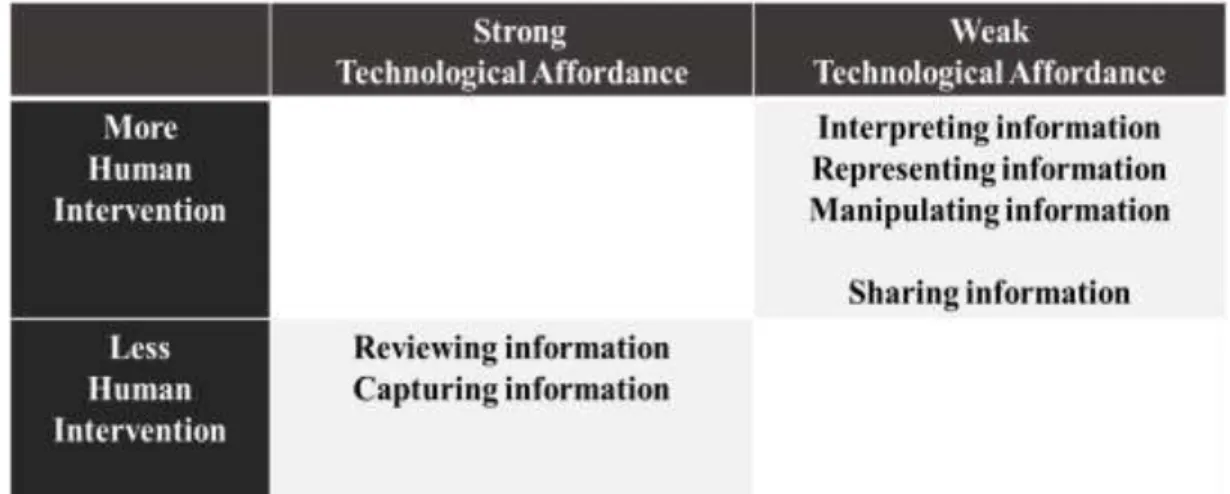
When technological affordance assumed the greatest role in achieving an information practice, there’s not much room for human intervention. Technology
affordances wield control over practice by providing convenience. For example, automatic logging and keeping large amounts of data were applied to this case. With human intervention, those practices might be difficult, or rather human intervention would take more time and effort than when the technology does the same practices. In certain practices, human intervention was considered more important than technology. Such practices were often based on own health-related goals or contextual factors. For examples, when it came to practices concerned with managing, representing, and interpreting information, human intervention was perceived as a better way to work. Study participants also favored taking an active part in such information practices without using technological affordances.
In the practice of manipulating information, little technological affordance was noticed among participants. Even though all participants were heavy users of smart devices, technologies seemed not to be capable of customizing or organizing information in ways they wanted. Participant 4 clearly referred to this.
My to do’s is all by hand, you know, and I could do all that through Google calendar and stuff, there’s so many electronic things that I can do but I like to not be on this as much as possible because I like to visually see how it is, I like to format things the way that I want to do it. I like it to be organized a certain way and electronics you only can usually do it a couple ways, you know you have to do it a different way and I just didn’t want to, I like to visually see it all here, I don’t want pages to scroll through, different data to put in, I don’t want to be in the gym like this, I just want to write a number down and keep going you know. (P4)
well for manipulating information.
So it [using technologies] slows you down, it’s confusing, it could get deleted, I can’t flip through it. I don’t know just I’m a by hand kind of guy, so both how I plan my day and how I plan my workouts. (P4)
Figure 3 represents where each information practice is based in relationships between technological affordance and human intervention.
Figure 3 Position of information practices in relationship between technological affordance and Influence of Life contexts
Technological affordance and human intervention could be seemed to exert their influences almost equally. In terms cases when human intervention worked better, human intervention was favored no matter what kinds of technology, be it mobile application or physical activity tracking device, was used, and no matter what level of technical
affordances were provided. This suggest how human finally and ultimately mediate tensions over technologies (Leonardi, 2011). This was clearly represented by Cooren, who said that “To say that nonhumans do things does not mean that human contributions are passed over…humans can appropriate what nonhumans do” (2004, p. 377).