Conflict Related Violence Directed Toward Children in an IDP Setting
By
Jennifer Espiritu MD
A Master’s Paper submitted to the faculty of the University of North Carolina at Chapel Hill
In partial fulfillment of the requirements for the degree of Master of Public Health in
the Public Health Leadership Program, Health Care and Prevention Concentration.
Chapel Hill 2008
___________________________ ___________________________
INTRODUCTION
Due to a variety of factors, Africa has been afflicted by conflict more than any other continent, undergoing more than 20 civil wars since the 1960s.1 A recent study of displaced Sierra Leonean children in internally displaced person (IDP) camps found that almost 80% of them had experienced a death in their immediate family, and more than half of them had witnessed the killing of a parent, sibling, or other close relative.2 No information was given for children who were the direct victims of violence. The burden of armed conflict upon children is so significant that UNICEF uses it as one of the five factors considered in measuring a child’s risk of threatened well-being up to the age of 18. The other four are under-five mortality, moderate or severe underweight, lack of primary schooling, and the likelihood of risk from HIV/AIDS.
Numbers for both child abuse and gender based violence (GBV) increase in the face of disaster, conflict or other events that force populations to uproot and move to other locations.7, 9, 10 However, the circumstances of a complex humanitarian disaster can sometimes inhibit researchers and clinicians from determining the prevalence of, or patients’ experience of human rights violations in child IDPs. Underreporting of GBV when directly questioned has been documented as high as 70%.11 For child abuse, underreporting has been
attributed to fear, perceived low efficacy, ambivalence, and self-blame.12, 13 Similar to GBV, because of cultural norms or safety concerns, inquiring about the presence of child abuse can often be difficult if not impossible. The World Health Organization’s 2007 report on ethical and safety recommendations regarding the study of violence in emergencies notes that participation in violence inquiries can be dangerous and sometimes life threatening to both participants and those screening individuals for exposure to violence.14
METHODS
Study Design
Our study used data from a cross-sectional study of internally displaced Sierra Leonean women conducted by Physicians for Human Rights/United Nations Mission in Sierra Leone (PHR/UNAMSIL) team. This was a population-based assessment of the prevalence and impact of human rights abuses amongst Sierra Leonean IDPs.8 The data were collected in 2001 over 4 weeks. The University of North Carolina’s Institutional Review Board Committee approved secondary data use and the study was exempted from review.
Sampling
When this study was conducted, registered IDPs were dispersed among 21 locales and camps in Sierra Leone in 7 districts and the western area. The sample was obtained by selecting locales and/or camps based on IDP arrival date and place of residence prior to displacement. Locales and/or camps were selected to reflect the known proportion of two-third of recent arrivals in all IDP locales or camps. Four sample locations from 3 districts and the western area of Sierra Leone were selected for the study, to represent 91% of the IDP population in Sierra Leone. The 4 other districts or locales were excluded due to small population size inadequate for sampling (less than 5000) or inaccessibility due to security concerns.8
determined. The starting household was designated via a random number generator, and each nth household interviewed until the camp, cluster or town had been surveyed in entirety. Cluster sampling was conducted in one camp due to size and difficulty with mapping. This was done by first dividing the camp into 8 administrative units or clusters. Two clusters were then randomly chosen from 7 of these units. The remaining one was excluded because it consisted solely of recent arrivals, which made it different in composition from the other seven units.18
From the 1048 households sampled, 1207 women agreed to participate in the survey.18 There were more participants than households as some men had more than one wife, so there were instances of multiple wives in a household.
Survey
The survey was composed of 49 questions regarding demographic information, household members’ experiences of war related sexual assault or human rights abuses by combatants, attitudes regarding justice and punishment for perpetrators as well as women’s rights and societal roles, and perceptions of physical and mental health. The questions on human rights violations queried whether the respondents or members of their household experienced beatings, shootings, killings, tortures, serious injuries, sexual assaults, rapes, abductions, violent amputations, or forced labor by combatants in the last ten years. For each abuse incident report, respondents were asked a series of questions about the abuse including the victim’s relationship to the respondent, gender, age, what type of abuses occurred, when they occurred, the group membership of the perpetrator and consequences of the abuse such as death, injury, depression, pregnancy, disease, and rejection from the victim’s community.
into Temne and Mende. The back-translated questions were reviewed by PHR/UNAMSIL team for accuracy, and then reviewed by human rights experts and sexual violence experts for content and accuracy. Finally, a pilot survey was given to 12 IDP women in Freetown with suggestions to ensure cultural appropriateness and clarity.8
Interviews
The PHR/UNAMSIL team trained and supervised 21 Sierra Leonean women. This team has extensive experience in research, human rights, counseling for survivors of sexual assault and torture, and Sierra Leonean programs in sexual aid assault for IDPs and refugees. Training for the Sierra Leonean women consisted of classroom teaching, role-play, and field observation. To minimize the risk of possible repeat traumatization, a psychologist and social worker specializing in sexual violence provided training regarding sensitization to that issue.18
The face-to-face interviews were administered over 4 weeks in 2001. Concerns regarding privacy were addressed by conducting the interviews at NGO offices, UNICEF’s Freetown headquarters, health clinics, IDP camps, and in the offices of programs for women who were pregnant as a result of rape. Each interview was conducted over a period of 25 to 60 minutes.18
Human Subjects Protections
violence received referrals to appropriate services.8
Definitions
A household was defined as "people sleeping and eating under the same roof" prior to displacement. Abuse experiences were isolated when respondents indicated that they or a household member had been beaten, shot, killed, abducted, sexually assaulted (including rape), or suffered amputations, burned dwellings, and looting at the hands of combatants. These abuses were further categorized into type of abuse – physical, sexual, and other. Beatings, gunshot wounds, amputations, torture, killings, abduction, and capture for less than a day were categorized as physical abuse. Sexual abuse consisted of forced removal of clothing, sexual assault without rape, and rape. Other types of abuse included threats of death or injury, forced labor, and loss of property including food, water, or shelter. General health was defined as wellbeing over the past 2 years using a Likert scale of very good, good, fair and poor. Suicidal ideation was considered present if the
respondent indicated thoughts of suicide or of taking action to end her own life since the war. It included all thoughts of suicide (but not action), whether the thoughts did or did not include a plan to commit suicide. A suicide attempt by the respondent was defined as a deliberate action with potentially life-threatening
consequences since the war.18 Information was also recorded regarding the respondent’s age, her ethnic affiliation, religious affiliation, and marital status (single, married, separated due to war, separated not due to war, and widowed). Years of completed education by the respondent were also recorded. The women were queried about their occupation prior to displacement, and these were categorized as housewife/student, farmer, trader, and professional. The number of times the household was displaced was recorded. The respondent’s history of any abuse was recorded as well as the presence of depression, both since
displacement. Finally the age and gender of children in the household and their experience with conflict related violence was collected.
Identification of cases
beatings, shootings, killings, abductions, and sexual assault including rape, amputations, burned dwellings, or looting at the hands of combatants-- was included as a case.
Statistical Analysis
STATA 9 statistical software was used to manage and analyze the data.19 Univariate statistics were used to describe the means, standard deviations, and shapes of distributions for continuous variables, and frequencies for categorical variables with particular attention to missing data, sparse numbers, or outliers.
To assess the probability of CRVDC, bivariate analysis was conducted for each of the potential predictors with the dichotomous outcome of CRVDC, using Pearson’s chi-square test for categorical predictors, and t-tests. Continuous and ordinal predictors were assessed for linearity with the outcome and based on the results were either kept as is, dichotomized, or converted to categorical/dummy variables.
Multivariate analysis was conducted using logistic regression to find the set of survey items that might best predict the probability of CRVDC. All potential indicators, whether significant or not in the bivariate tests, were in the full model. Likelihood ratio tests were used to eliminate any non-significant variables. The final model consisted of those predictor variables that remained statistically significant at p <= 0.05, after
adjustment for other variables in the model. The Wald test was used to test for paired comparisons within dummy variables and the outcome. For the final parsimonious model, the standard error was adjusted for interclass correlation within the households for the cluster sampling design.
Reliability of our model was assessed using the Hosmer-Lemeshow goodness-of-fit test, sensitivity, specificity, and the area under a receiver operator characteristic (ROC) curve.
Respondent’s Characteristics
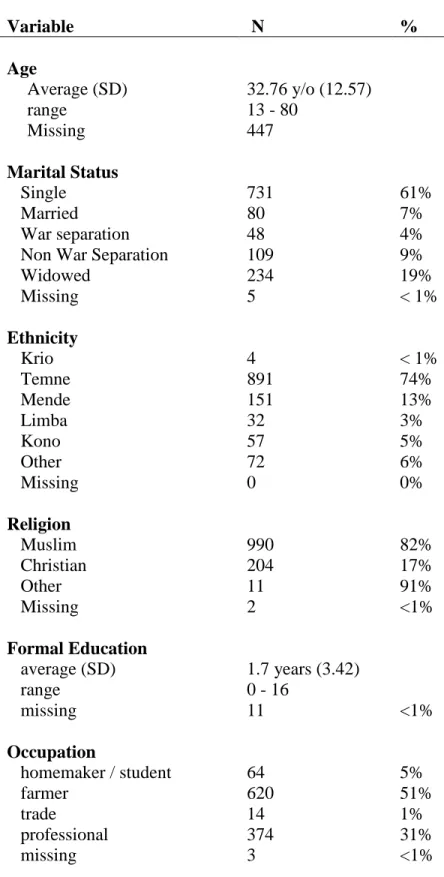
Demographic characteristics of survey respondents are listed in Table 1. There were 1207 women surveyed but not all survey questions were answered. Rather than deleting subjects with missing answers, the entries were coded as missing. Entries with missing information were omitted from analysis. The mean women’s age was younger than the life expectancy for a Sierra Leonean (32.69 years versus 38 years). More than half of the sample (57%) had never been married. The sample was mostly Temme (74%) and Mende (13%) which is similar to the population, but in different proportions. (Thirty percent of Sierra Leoneans are Temme and 30% are Mende.) Also, the proportions of religious affiliations were different. In the sample, 82% were Muslim versus 60% for the population, 17% were Christian versus 30%, and the remainder were of other faiths. The mean education of the sample population, 1.7 years, approximated that of the populace, as did the reported occupations. Thirty-six percent of the respondents had suffered some type of CRV. Most women reported their general health to be fair (68%). Approximately one-third had considered suicide since the beginning of hostilities, but only 18% reported feeling depressed during the current period.
Children’s Characteristics
Information on 2094 children was included in the survey. Characteristics that had more than 30% missing data were again omitted from the analysis. CRVDC was reported in 41% (852 children). With respect to subject characteristics, we examined both the association between CRVDC and maternal as well as children’s characteristics. These details are reported in Table 2. The children were 52% female, and their average age was 10.55 years old. The demographic distribution of the child population resembled that of their mothers. The percentage of married mothers for the child sample was higher than that seen among maternal
mothers who were less often depressed (29%), and more often had mothers with poor or fair general health (571 (39%) and 254 (49%), p < 0.001 ). Finally, these children were more likely to have mothers who also had experienced CRV (76%, p < 0.001, data not shown). There was no statistically significant association between mother’s education (p = 0.788) or suicidal ideation (p = 0.729) and CRVDC.
Modeling
CRVDC, the difference between good health and fair health, and the difference between fair health and poor health are borderline, as demonstrated by their Wald Test p values ( p = 0.10 and p = 0.24, respectively). Similarly, although there was a statistically significant relationship between occupation and a child’s
probability for CRVDC, difference between the children of traders and the children of professionals was also borderline as demonstrated by Wald Testing (p = 0.30). These results are not shown.
The Hosmer-Lemeshow goodness-of-fit test was significant, again indicating that the model did not fit entirely well. The specificity of this tool (0.78) was better than the sensitivity (0.47) and the negative
predictive value better than the positive predictive value (Table 5). Reliability of the model was again further tested using the area under the ROC curve. This area was moderate at 0.70 (Figure 2).
DISCUSSION
This retrospective cross sectional-study examined demographic and psychosocial predictors (including maternal mental health) of conflict related violence directed toward children (CRVDC) in an IDP population. Using secondary data analysis we attempted to develop a tool from a questionnaire that was developed for another study Evidence of no maternal depression, poor general health, and mother’s occupation seemed to differentiate children who had experienced CRVDC from those who did not.
The prevalence rates of CRV toward women and CRVDC toward children were 36.04% and 41%
mothers did), and the mother’s experience of CRV (a larger percentage of children whose mothers had been subject to violence had also experienced CRV), as well as the number of times that the family was displaced (children whose families had fled 6 to 10 times had a larger proportion with experiences of CRV) had statistically significant associations with CRVDC.
However, in a multiple logistic regression analysis adjusted for clustering by household, fewer variables were found to be statistically significant. It demonstrated that a set of variables composed of maternal depression general health, and mother’s occupation performed moderately well as significant predictors of CRVDC in this population. The area under the ROC curve was 0.68, so this is a fair, but not good predictive model. The sensitivity was 47%, specificity 78%, positive predictive value 60% and negative predictive value 68% (Table 5). Since the specificity was greater than the sensitivity, this model could be better used to “rule in” possible cases of CRVDC rather than screening for CRVDC.
Maternal depression was negatively associated with CRVDC, with an odds ratio of 0.42 (Table 4 ). This is inconsistent with a study by Lewin on non-offending mothers of girls who were sexually abused, which found increased levels of both depression and anxiety, and a study on IDPs living in trailers after Hurricane Katrina where symptoms of depression reliably predicted exposure to post-disaster gender based violence.9, 20 This finding in our study may be an artifact of using secondary data from a study designed with different objectives.
Maternal general health was associated with CRVDC overall. Although as maternal health declined, the probability of a child’s exposure to CRVDC increased. However, there were borderline differences between very good and good health, fair and poor health, and good and poor health. Further examination reveals that the confidence interval for the odds ratio of very good to good health contains the null value, and the
very good health spanned an interval from 2.1 to 104.4. This may be due to the distribution of health in this population, where more than 90% of respondents reported fair or poor health. Given the experience of this population, that would seem to be an accurate assessment.
Maternal occupation was predictive of CRVDC, with the children of homemakers and students being more predictive than the children of farmers. In contrast the children of traders and professionals were less predictive. This is consistent with other studies that found that children of less educated or less skilled workers were more likely to be abused.21, 22
LIMITATIONS
The findings of this study represent 2094 children in an internally displaced population in Sierra Leone. This cross-sectional study examined the predictors of CRVDC based on a set of variables including mother’s mental health and makes no claims about causality – i.e., it is impossible to say that CRVDC affects maternal mental health or that the mental health of mothers affects their children’s vulnerability to abuse by others, or that something else that affects both. Since there are limited data on the mental health effects of CRVDC on mothers, it is not possible to ascertain at this time whether the best possible predictors were included in this model. Inferences were drawn from intra-familial child abuse research, which is somewhat similar to children abused by non-family members.
The effects of familial rank (e.g., being the children of the first wife and thus being given more resources than the children of lesser wives) were not delineated in this study. This may result in misclassification measurement bias, and bias our results toward the null, since both exposed and unexposed subjects would be equally likely to be affected.
questionnaires regarding social functioning are not accurate outside of the culture in which they were designed and no questionnaire has been designed for Sierra Leonean culture. Women suffering from depression, as well as those not suffering from depression, may not be accurately classified leading to non-differential bias.
Some studies indicate that the sponsor of a survey may affect non-response rates, i.e. that a foreign government sponsored health survey may garner more missing responses than a relief organization’s survey.23 Moreover, in the case of conflict setting, IDPs in the host country may be reluctant to reveal the specifics regarding GBV or CRVDC, particularly to survey administrators who are foreign military members. Past research in secondary prevention of intra-familial child abuse has shown that screening programs are ineffective without high acceptance of the population.24 So despite the efforts put forth to produce a sensitive and culturally appropriate survey, the repeated abuses by aggressors and so-called allies may have resulted in a disenfranchised IDP population, reluctant to trust few organizations. One indication of
the steps taken by PHR.
The ethnic distribution of the sample was not representative of the population in Sierra Leone. Although Temme and Mende ethnicities made up a bulk of the mothers’ tribal affiliations as in the general population, Temmes constituted 73% of the sample and Mendes constitute 13% of the sample. However, Temmes and Mendes each make up 30% of the country’s population.25
The original study design attempted to make the sample representative of the IDP population in Sierra Leone. In light of the disproportionate representation of Temmes in the sample, and other seemingly incongruent data, it is a reasonable assumption that the self-reported data was inaccurate, affecting the internal validity of this study.
Another incongruous finding is the mothers’ age distribution. The mean age for the study sample was 32.69 years, and the median was 46.5 years old. However, life expectancy for a Sierra Leonean is 38 years old.26 It was tempting to discard the outliers at the extreme right of the range, but mothers older than 50 years old composed more than 10 percent of the sample. Rather than implying a coding error, this proportion
The accuracy of the child IDP data was also questionable. In a population with an under 5 year old mortality rate similar to that in Sierra Leone, we would expect to see a wider distribution at the population base of children under 5 years of age which narrowed as time went on. This would not be the case if mortality due to a complex humanitarian emergency (CHE) or abuse were differentially affecting younger children. In light of the 40.1 % prevalence of moderate and severe stunting and 20.2 % prevalence of severe stunting before 5 years old, 28 the possibility that the stress of a CHE on a Sierra Leonean child’s already brittle physiology which has higher nutritional requirements and lower reserves than that of an adult, could result in higher mortality in younger children. This is especially striking in light of the UN High Commission on Refugees, Doctors without Borders and American Refugee Committee’s joint report’s finding that 23% of the mortality in children 5 years old and younger living in IDP camps was due to malnutrition.29 Since the percentage of 5 to 9 year olds and 10 to 14 year olds stayed fairly stable, it is possible that the counting of children was accurate. The decrease in 15 to 17 years is acceptable as the age span is smaller, and many of those children may be counted as the youngest mothers in that sample.
POLICY IMPLICATIONS AND FUTURE STUDIES
If a valid and reliable tool were developed for accurately determining which children have a higher probability for CRVDC based on maternal mental health indicators, resources could be better directed in conflict affected zones such as Sierra Leone or Iraq. Given that screening for CRVDC can be inaccurate with direct screening due to mistrust of researchers or sponsor organization, or danger to both participants and interviewers, we attempted to develop such a tool to identify CRVDC to minimize those potential pitfalls.
Table 1: Characteristics of Maternal Respondents (N=1207)
Variable N %
Age
Average (SD) 32.76 y/o (12.57)
range 13 - 80
Missing 447
Marital Status
Single 731 61%
Married 80 7%
War separation 48 4%
Non War Separation 109 9%
Widowed 234 19%
Missing 5 < 1%
Ethnicity
Krio 4 < 1%
Temne 891 74%
Mende 151 13%
Limba 32 3%
Kono 57 5%
Other 72 6%
Missing 0 0%
Religion
Muslim 990 82%
Christian 204 17%
Other 11 91%
Missing 2 <1%
Formal Education
average (SD) 1.7 years (3.42)
range 0 - 16
missing 11 <1%
Occupation
homemaker / student 64 5%
farmer 620 51%
trade 14 1%
professional 374 31%
Table 1, cont’d
N %
Number of times displaced
average (SD) 4.45 (2.12)
range 1 to 15
missing 85 7%
General Health
Very Good 18 1%
Good 99 8%
Fair 763 63%
Poor 327 27%
Missing 0 0%
Suicidal Ideation
No 868 72%
Yes 339 28%
Missing 0 0%
Depression
No 992 82%
Yes 215 18%
Experienced CRV
No 772 64%
Table 2: Characteristics of the Children (N=2094)
Variable N %
Childs Gender
male 1009 48%
female 1082 52%
missing 3 <1%
Childs Age
1 to 5 years old 123 6%
6 to 10 years old 270 13%
11 to 17 years old 395 19%
average (sd) 10.55 years (4.19)
range .75 - 17
missing 1306 62%
Marital Status of Mother
Single 1049 50%
Married 251 12%
War separation 76 3%
Non War Separation 221 11%
Widowed 492 24%
missing 5 < 1%
Ethnicity of Mother
Krio 52 2%
Temne 1535 73%
Mende 246 12%
Limba 51 2%
Kono 89 4%
Other 116 6%
missing 5 <1%
Religion
Muslim 1670 80%
Christian 382 18%
Other 37 2%
missing 5 <1%
Mother's Formal Education
average (sd)
1.45 (3.11)
range 0 - 16
missing 30 1%
Variable N %
Mother's Occupation
Homemaker / student 51 2%
Farmer 1005 48%
Retail 226 11%
Professional 807 39%
Missing 5 <1%
Number of times displaced
average (SD) 4.60 (2.30)
Range 1 to 15
Missing 252 12%
Mother's General Health
Very Good 36 2%
Good 76 4%
Fair 1462 70%
Poor 515 25%
Missing 5 <1%
Suicidal Ideation
No 1459 70%
Yes 630 30%
Missing 5 <1%
Depressed Mothers
No 1298 62%
Yes 796 38%
Missing 0 0%
CRV against Mother
none reported 1164 56%
Yes 930 44%
Missing 0 %
CRVDC
none reported 1242 59%
Yes 852 41%
Missing 0 0%
CRVDC types
Physical Violence 420 49%
Sexual Violence 340 40%
Table 3 : Bivariate Analysis (N = 1842 Children) Outcome: CRVDC
Variable CRVDC n (%) P Value
Child’s Gender P = 0.018
Male 384 (38 %)
Female 467 (43 %)
Mother’s Marital Status P < 0.001
Single 426 (41%)
Married 158 (63%)
War separation 21 (28%) Non War Separation 118 (54%)
Widowed 124 (25%)
Ethnicity P < 0.001
Krio 38 (73%)
Temne 593 (39%)
Mende 73 (30%)
Limba 29 (57 %)
Kono 61 (69 %)
Other 53 (46%)
Religion P < 0.001
Muslim 642 (39%)
Christian 176(46%)
Other 30 (81%)
Mother Education P = 0.788
Less than 1 Year 770 (41%)
2 to 7 years 61 (40%)
More than 7 years 3 (30 %)
Mother Occupation P<0.001
homemaker / student 37 (73%)
farmer 504(50%)
retail 58 (26%)
professional 248 (31%)
Number of times displaced P = 0.005
1 to 5 492 (36%)
6 to 10 200 (45%)
Table 3 cont’d : Bivariate Analysis Outcome : CRVDC
Variable CRVDC n (%) P Value
General Health p < 0.001
Very Good 3 (8%)
Good 19 (25%)
Fair 571 (39%)
Poor 254 (49%)
Suicidal Ideation p = 0.729
no 588 (40%)
yes 259 (41%)
Depressed p < 0.001
no 620 (47%)
yes 232 (29%)
Acts against Mother p < 0.001
none 143 (12%)
any act 709 (76.%)
Table 4 : Logistic Regression with Clustering (N= 1842) Outcome: CRVDC
Independent Variables:
Maternal Depression, Maternal General Health, Mother’s Occupation
Variable OR lower upper P
Maternal Depression 0.42 0.24 0.74 0.003
Maternal General Health
Very Good 1
Good 6.41 0.77 53.16 0.085
Fair Health 10.58 1.56 71.9 0.016
Poor Health 17.8 2.1 104.43 0.007
Mother's Occupation
Housewife/Student 3.02 0.94 9.75 0.064
Farmer 1
Trader 0.32 0.15 0.66 0.002
Table 5 : Accuracy of the Final Model Outcome: CRVDC
Independent Variables:
Maternal Depression, Maternal General Health, Mother’s Occupation)
Sensitivity 47% Specificity 78%
PPV 60%
Figure 1 : Receiver Operator Characteristic Curve for CRVDC Modeling
0.00 0.25 0.50 0.75 1.00
Sensit ivit y
0.00 0.25 0.50 0.75 1.00
1 - Specif icity
REFERENCES
1. Global Security.org. “The World at War.” Available at: http://www.globalsecurity.org/military/world/war/. Accessed Mar 1, 2008.
2. Gupta L, Zimmer C. Psychosocial intervention for war-affected children in Sierra Leone. Br J Psychiatry. 2008;192:212-216.
3. UNICEF. The Progress of Nations. 1999. Available from:
http://www.unicef.org.libproxy.lib.unc.edu/pon99/. Accessed 10 April 2008.
4. The war amputees of Sierra Leone. The Canadian Medical Association Journal. 2000;162:1797, 1799.
5. Lawson M. Recent medical evidence for torture and human rights abuse in Sierra Leone: A report for the medical foundation for the care of victims of torture. Med Confl Surviv. 1999;15:255-270.
6. Fox SH, Tang SS. The Sierra Leonean refugee experience: Traumatic events and psychiatric sequelae. J Nerv Ment Dis. 2000;188:490-495.
7. Physicians for Human Rights, United Nations Assistance Mission in Sierra Leone. War-Related Sexual Violence in Sierra Leone :A Population-Based Assessment : A Report. Boston, MA: Physicians for Human
Rights; 2002.
8. Amowitz LL, Reis C, Lyons K. H., Mansaray, B., Kinsulure-Smith AM, Taylor L, Iacopino V. Prevalence of war-related sexual violence and other human rights abuses among internally displaced persons in Sierra Leone. Journal of the American Medical Association. 2002;287:513-521.
10. Keenan HT, Marshall SW, Nocera MA, Runyan DK. Increased incidence of inflicted traumatic brain injury in children after a natural disaster. Am J Prev Med. 2004; 26: 189-193.
11. Kothari CL, Rhodes KV. Missed opportunities: Emergency department visits by police-identified victims of intimate partner violence. Ann Emerg Med. 2006; 47: 190-199.
12. Lau JT, Liu JL, Yu A, Wong CK. Conceptualization, reporting and underreporting of child abuse in Hong Kong. Child Abuse Negl. 1999; 23: 1159-1174.
13. Kellogg ND, Hoffman TJ. Unwanted and illegal sexual experiences in childhood and adolescence. Child Abuse Negl. 1995; 19: 1457-1468.
14. WHO. Ethical and safety recommendations for researching, documenting and monitoring sexual violence in emergencies. Geneva: WHO Press; 2007.
15. Rinehart DJ, Becker MA, Buckley PR, et al. The relationship between mothers' child abuse potential and current mental health symptoms: Implications for screening and referral. J Behav Health Serv Res. 2005; 32: 155-166.
16. Kim K, Noll JG, Putnam FW, Trickett PK. Psychosocial characteristics of nonoffending mothers of sexually abused girls: Findings from a prospective, multigenerational study. Child Maltreat. 2007; 12: 338-351.
18. Physicians for Human Rights. War-related sexual violence in Sierra Leone: A population-based assessment, Boston: 2002.
19. STATA Corporation. STATA 9.0 (intercooled). College Station, TX: 2003.
20. Lewin L, Bergin C. Attachment behaviors, depression, and anxiety in nonoffending mothers of child sexual abuse victims. Child Maltreat. 2001;6:365-375.
21. Hadi A. Child abuse among working children in rural Bangladesh: Prevalence and determinants. Public Health. 2000; 114: 380-384.
21. Burnett MW, Spinella PC, Azarow KS, Callahan CW. Pediatric care as part of the US Army medical mission in the global war on terrorism in Afghanistan and Iraq, December 2001 to December 2004. Pediatrics. 2008; 121: 261-265.
22. Porter M, Haslam N. Predisplacement and postdisplacement factors associated with mental health of refugees and internally displaced persons: A meta-analysis. JAMA. 2005;294:602-612.
23. Groves R. Missing data, missing persons, and the psychological and behavioral foundations of sample survey participation. 2008.
24. Thyen U, Thiessen R, Heinsohn-Krug M. Secondary prevention--serving families at risk. Child Abuse Negl. 1995;19:1337-1347.
25. US Department of State. Sierra Leone: Country specific information, 2007. Available from: http://www.travel.state.gov/travel/cis_pa_tw/cis/cis_1016.html#country. Accessed January 10, 2008.
26. Government of Sierra Leone. Situation analysis of women and children in Sierra Leone. Freetown, Sierra Leone:1999.
environment (WorldSAFE): A model of a multi-national study of family violence. Inj Control Saf Promot. 2004;11:81-90.
28. UNICEF. Global Database On Child Malnutrition. Available at:
http://www.childinfo.org/areas/malnutrition/stunting.php. Accessed February 10, 2008.
Appendix 1 Sierra Leone
Officially known as the Republic of Sierra Leone, the country is made of one area and three provinces in West Africa. Sierra Leone is a constitutional republic nation. It is bordered by Guinea on the north and Liberia on the south, with the Atlantic Ocean on the west. Sierra Leone is a country, which blends western cultural values, inherited from Britain, and traditional indigenous African norms
Similar to the histories of other African nations, Sierra Leone is rich in natural resources (diamonds, gold, iron, and bauxite) and has been exploited by foreign powers since colonial times. Sierra Leone was also an important center of transatlantic trade in enslaved Africans. The capital Freetown was founded in 1787 by the Sierra Leone Company as a home for formerly enslaved African Americans and West Indians who had fought for the British in the American Revolutionary War. In 1808, Freetown became a British Crown Colony, and in 1896, the interior of the country became a British Protectorate. The Crown Colony and Protectorate joined and gained independence in 1961. Many felt that this new government was corrupt, and facilitated widespread chaos, poverty and little opportunity for education or economic advancement. Democratic attempts to revamp the system failed, and the Revolutionary United Front (RUF) was formed, and soon after an alliance formed with the Sierra Leone Army (SLA). Led by Foday Sankoh, the RUF took up arms to make changes and redistribute the country’s wealth. The Sierra Leone Civil War began in March 1991 and lasted about a decade. Nigeria sent troops, the ECOMOG, in 1993 to aid the civilian militias in defending the villages. Unfortunately, these soldiers behaved just as brutally in their search for rebels amongst the populace. South African mercenaries were also brought in by the Sierra Leone government to quell the unrest. 1-3 Tens of thousands have died and millions have become refugees.
returned from Great Britain, North America, and capture slave ships. The balance is spread over 15 other tribal groups, and a small Lebanese community. Approximately 60% of the population is Muslim, 30% Christian, and 10% Animist. 3
Approximately thirty-six percent of the populace is literate. 3 However, in 2003 Sierra Leone was rated as having one of the world’s highest illiteracy rates. Primary school is for ages 5 to 12, secondary schools offering a 7 year program, various technical schools, teacher training programs, and two universities.2
About two-thirds of the population engages in subsistence agriculture, which accounts for more than half of the national income. Manufacturing accounts for 30.6% and the service industry comprises the remaining 16.9%.3 According to the WHO, life expectancy is estimated at 38 years.4 Sierra Leone is among the countries with the lowest life expectancies at birth in the world. The infant mortality rate--158.27 deaths/1,000 live births, is one of the world’s worst.5
REFERENCES
1. Amowitz LL, Reis C, Lyons K. H., Mansaray, B., kinsulure-Smith AM, Taylor L, Iacopino V. Prevalence of war-related sexual violence and other human rights abuses among internally displaced persons in Sierra Leone. Journal of the American Medical Association. 2002;287:513-521.
2. Encyclopedia Britannica. Sierra Leone. Available at:
http://www.britannica.com/EBchecked/topic/543356/Sierra-Leone. Accessed January 2, 2008.
3. US Department of State. Sierra Leone: Country specific information, 2007. Available from: http://www.travel.state.gov/travel/cis_pa_tw/cis/cis_1016.html#country. Accessed January 10, 2008.
4. World Health Organization. World Health Report. . 2002.
Appendix 2
GBV and Child Abuse
Domestic abuse is a global public health and human rights issue. Some estimate that at least one-third of the world’s female population has at least one life time exposure, physically or sexually.1
Closely related to the risks factors for gender-based violence are the risk factors for child abuse. 2 Co-occurrence has been
estimated between 30 and 60% 3 . Moreover, studies examining this co-occurrence found significant
associations for lower occupational or socioeconomic status, past incidents or reports of child maltreatment, larger household size, higher numbers of family stressors, more maternal psychopathology or symptoms of distress, and more substance abuse problems.4, 5
Most studies defined violence toward the children as more severe than a slap or a spanking. Both random and nonrandom surveys consistently show that about half of the men who batter their wives also batter their children.6 Social learning theory suggests that people learn from observing and modeling others' behavior. Unpunished, or without negative consequences related to the behavior (if victim submits to the violence), the behavior will likely continue. Alternatively, it suggests that children subject to or who witness violence are more likely to be maltreated because they see and model the same behaviors in their mothers and
REFERENCES
1. Bachman R, Saltzman L. Violence against women: Estimates from the redesigned survey. Bureau of Justice Statistics. 1995.
2. Lee LC, Kotch JB, Cox CE. Child maltreatment in families experiencing domestic violence. Violence Vict. 2004;19:573-591.
3. Edleson JW. The overlap between child maltreatment and woman battering. Violence Against Women. 1999;5:134--154.
4. Bowker LH, Arbitell M, Mcferron JR. “On the relationship between wife beating and child abuse.” In: Yllo K, Bograd M, eds. Feminist Perspectives on Wife Abuse. Sage; 1988.
5. Appel AE, Holden GW. The co-occurence of spouse and physical child abuse: A review and appraisal. Journal of Family Psychology. 1998;12:578-599.
6. Saunders DG. Child custody decisions in families experiencing woman abuse. Soc Work. 1994;39:51-59.
7. Renner LM, Slack KS. Intimate partner violence and child maltreatment: Understanding intra- and intergenerational connections. Child Abuse Negl. 2006;30:599-617.
Appendix 3 Children and War
“Major wars” are defined by the United Nations as military conflicts resulting in 1,000 combat related deaths per year.1 In the middle of 2005, there were eight major wars and up to two dozen low intensity conflicts (political-military confrontation between opposing states or groups, involving the deployment and use of troops and military assets in situations below war but more than routine peaceful negotiation between states).1 Behind the numbers of combat related deaths that define a war, lay the larger effects of armed conflict on non-combatant women and children. Civilian women and children made up less than 5% of all casualties in World War I. In contrast, current estimates lie upwards of 75% due to technologies that are more destructive but do not discriminate between combatants and civilians such as aerial bombardment, unconventional warfare with shifting borders of combat in villages and urban settings, as well as acts of terrorism. 1, 2 Both internationally and domestically, quality of health has been associated with (in)stability and (in)security. 3 Due to their lower social status and lack of resources, non-combatant women and children generally suffer more than non-combatant men.4 Although studies are underway to identify women victims of violence after disasters and conflict, little work has been done to identify child victims of conflict related violence. As more missions related to humanitarian aide and disaster relief by bodies such as
non-governmental organizations (NGOs), sponsored military operations, and United Nations (UN) agencies, better tools should be developed to identify these victims.
Numbers for child violence and mortality increase in the face of disaster, conflict or other events that force populations to uproot and move to other locations. 5-8 In the 1991 Kurdish refugee crisis, children comprised 64% of all deaths.9 The Mozambique National Resistance, or Renamo, which waged war against the
Mozambican and Zimbabwean governments during the 1970s and 80s, has been widely accused of wide spread human rights violations, including violence against children. Out of the estimated 600,000
execution of their parents, and in accounts of young children gunned down when they refused to leave their parents.4 During the Iraq and Afghanistan conflicts from December 2001 to 2004, pediatric patients with injuries threatening life, limb, or eyesight made up 4.3% of patients seen at US Army Military Treatment Facilities.10 From January 2002 to June 2006, the injury rate for Iraqi children under the age of 15 increased almost seven fold from pre-invasion to post invasion.11 This burden is borne by the local medical system, aide organizations, and combatant organizations. For those who do survive conflicts, their day-to-day realities have little or no relation to their pre-conflict existence, as the economic infrastructures and social fabric of communities have been disrupted.8
War and its immediate aftermath places families under extreme stress and women and children, who have lower status in most societies, are especially vulnerable to harm due to household disruption loss of assets and entitlements, and loss of social networks.12-14 Moreover, children are physically and emotionally dependent on their guardians, as well as physically and mentally immature. According to a UNICEF report, in the decade leading up to 1996, child victims of war included 2 million killed, 4-5 million disabled, 12 million left homeless, over 1 million orphaned or separated from their parents, and approximately 10 million psychologically traumatized.15 A study on Ugandan children showed that persistent exposure to war has entrenched violence as a preferred method of conflict resolution – girls choosing emotional abuse and boys choosing physical violence.16 They were able to sympathize with violence victims, but did not have peaceful alternatives to resolving conflicts. Sexual violence was common in Croatia, Bosnia and Herzegovina,
Of note is that this study did not include unaccompanied children or child soldiers, both of whom have suffered greatly. Child soldiers, both boys and girls have joined rebel groups, willingly or unwillingly, in Sierra Leone as young as seven years of age. Rough estimates have placed this number between 1700 and 3000.18, 19 However, UNICEF estimated that there were 12000 children under the age of 18 who were demobilized from Liberian Children Associated with Fighting Forces (CAFF) in 2004.15 Their roles varied from slave to bush wife to fighters who committed atrocities. No attempt was made in this study to discern the roles, if any, of children or women in these capacities.
Another consideration regarding child soldiers is the numbers of children in this study population, especially in light of reporting inaccuracies. Although the age for military service in Sierra Leone is 17 years old, according to the UN, up to 10000 children as young as 8 years old have been recruited to fight in the nation’s civil war.15, 19 Child soldiers were typically children abducted from village raids, where the adults were maimed or killed. Drugs were often forced upon the boys, who were then forced to commit atrocities against their family or community. These orphans were they taken in by their surrogate family, often the RUF.20 Girls faced torture, sexual abuse, and deprivation, and were sometimes the perpetrators of violence.18 Not uncommonly, they bore the children of their captors, and are treated as outcasts if they can return to their communities. In this case, the estimates of our study could grossly under estimate the risk of child abuse in IDP populations.
It is recognized that armed conflicts fought in and around communities normalize violence and plant seeds for potential armed conflict.4, 21 Aide organizations such as Physicians for Human Rights and the
International Medical Corps, as well as the United States Army’s highly specialized Civil Affairs units, spend much time and effort is expended to educate workers about their mission specific regions and cultures,
REFERENCES
1. Global Security.org. The World At War. Available at: http://www.globalsecurity.org/military/world/war/. Accessed Mar 1, 2008.
2. Bellamy C. The State Of The World's Children, 1996. Available at: http://www.unicef.org/sowc96. Accessed Mar 28, 2008.
3. Tarantino D. The role of U.S. Department of Defense health sector in natural disaster and conflict settings. In: Civil-Military Medicine: On Dangerous Ground. Monterey, CA: Center for Stablization and
Reconstruction Studies; 2006:38-52.
4. Garbarino J, Kostelny K, Dubrow N. No Place to be a Child : Growing Up in a War Zone. Lexington, Mass.: Lexington Books; 1991.
5. Amowitz LL, Reis C, Lyons K. H., Mansaray, B., kinsulure-Smith AM, Taylor L, Iacopino V. Prevalence of war-related sexual violence and other human rights abuses among internally displaced persons in Sierra Leone. Journal of the American Medical Association. 2002;287:513-521.
7. Curtis T, Miller BC, Berry EH. Changes in reports and incidence of child abuse following natural disasters. Child Abuse Negl. 2000;24:1151-1162.
8. Mullany LC, Richards AK, Lee CI, et al. Population-based survey methods to quantify associations
between human rights violations and health outcomes among internally displaced persons in eastern Burma. J Epidemiol Community Health. 2007;61:9098-914.
9. Mandalask AM. The greatest impact of war and conflict. Ambulatory Child Health. 2001;7:97-103.
10. Burnett MW, Spinella PC, Azarow KS, Callahan CW. Pediatric care as part of the US army medical mission in the global war on terrorism in Afghanistan and Iraq, December 2001 to December 2004. Pediatrics. 2008;121:261-265.
11. Iraq Family Health Survey Study Group, Alkhuzai AH, Ahmad IJ, et al. Violence-related mortality in Iraq from 2002 to 2006. N Engl J Med. 2008;358:484-493.
12. Larrance R, Anastario M, Lawry L. Health status among internally displaced persons in Louisiana and Mississippi travel trailer parks. Ann Emerg Med. 2007;49:590-601, 601.e1-12.
13. Leus X, Wallace J, Loretti A. Internally displaced persons. Prehosp Disaster Med. 2001;16:116-123.
14. Porter M, Haslam N. Predisplacement and postdisplacement factors associated with mental health of refugees and internally displaced persons: A meta-analysis. JAMA. 2005;294:602-612.
15. UNICEF. Evaluation of the disarmament, demobilisation programmed for children associated with the fighting forces in Liberia. Inter Agency evaluation of the DD programe for children in Liberia. 2006.
16. Magambo C, Lett R. Post-traumatic stress in former Ugandan child soldiers. Lancet. 2004;363:1647-1648.
Violence in Sierra Leone :A Population-Based Assessment : A Report. Boston, MA: Physicians for Human
Rights; 2002.
18. Roberts K. The plight of girl soldiers. Am J Nurs. 2005;105:102-103.
19. United Nations. What's going on - child soldiers in Sierra Leone. Available at:
http://www.un.org/works/goingon/soldiers/goingon_soldiers.html. Accessed March 10, 2008.
20. Ashby P. Child combatants: A soldier's perspective. Lancet. 2002;360 Suppl:s11-2.