The Collaborative Place-making Approach:
Increasing Public Support for Density
by
Nathan James Lindquist
A Masters Project submitted to the faculty of the University of North Carolina at Chapel Hill
in partial fulfillment of the requirements for the degree of Master of Regional Planning in the Department of City and Regional Planning.
Chapel Hill
2007
Approved by:
_________________________ ______________________
TABLE OF CONTENTS
I. Abstract……….…...1
II. Introduction……….………....2
A. Density’s Comeback B. Opposition to Density C. Outline of Paper III. Collaborative Planning………...…...5
A. The Emerging Collaborative Paradigm B. Collaborating on Density IV. Framing the Density Debate………..………...…....8
A. Guiding Collaboration Through Framing B. Overview of Frames and Framing C. Framing and Planning Inset: The Seattle Urban Village Strategy D. Framing Density through Place-making E. The Collaborative Place-making Approach V. Case Study: Durham’s Ninth Street Plan……….…..…14
A. Methodology of the Case Study B. Introduction to Ninth Street C. Participant Views of Ninth Street D. The Place-making Frame E. The Charrette F. Form-Based Codes VI. Conclusion………....…28
A. Evaluation of Collaborative Placemaking Approach B. Shortcomings of the Approach C. Advantages of the Approach D. Implications for Further Research Bibliography……….…34
Appendix A: Ninth Street Plan Images………....36
Appendix B: Interview Participants……….…38
Appendix C: Interview Questions……….39
I. ABSTRACT
As urban neighborhoods in many cities revitalize, planners pushing for increased density often come into conflict with local stakeholders who are wary of increased density in their neighborhoods. In order to obtain public support for increased density, planners must first ensure that plans protect neighborhood quality. This paper
hypothesizes that one way to reach the twin goals of increased density and preserved neighborhood quality is through a collaborative place-making approach to planning.
The collaborative place-making approach utilizes collaborative planning tools like charrettes that allow the public to tailor density to the context of their neighborhood. This approach also frames the planning process around the idea of place-making. Place-making improves public perceptions of density by focusing on creating a great place. This paper hypothesizes that collaborative planning and a place-making frame may make the public more comfortable with density.
II. INTRODUCTION A. Density’s Comeback
In recent years, many American urban neighborhoods have experienced a comeback. Across the country, once stagnant downtowns, inner-ring suburbs, and commercial corridors are seeing new development in the form of higher-density apartments, townhouses, and mixed-use projects. After a long hiatus, people are rediscovering the benefits of urban living.
This renewed demand for urban living has dovetailed with another trend: the promotion of compact, high-density cities by urban planners and policy-makers. Cities see many advantages in high-density environments, from creating 24-hour neighborhoods and attracting the creative class to curbing sprawl and promoting mass transit.
Cities also a renewed interest in cultivating their sense of place. Cities are finding that there is great value, both real and perceived, in being known as a fun place to be, an interesting place to be. Much urban revitalization has followed the principles of New Urbanism, with its emphasis on attractive public spaces, mixed uses, and walkable neighborhoods—all of which requires a critical mass of density.
B. Opposition to Density
At the same time, collaborative planning processes have gained currency, giving the public more influence over planning in their communities—and over density in their own neighborhoods (Innes 1996). Thus if the public perceives density as denigrating to the quality of their neighborhoods, they have more influence to derail densification efforts, canceling the benefits of density to the city as a whole. The question is, then, how can planners guide the planning processes so that both city goals of increased density and neighborhood goals of a preserved quality of life are met?
C. Outline of Paper
This paper hypothesizes that one way to reach both neighborhood and city goals around density is through a collaborative place-making approach to planning. This approach involves the following two elements:
1. Collaborative planning. Collaborative planning empowers the public to play a significant role in deciding the appropriate density for their neighborhood, potentially resulting in more public support for density than traditional top-down planning methods.
2. Framing through place-making. Planners may be able to improve the
public’s perception of density by framing the planning process in a compelling way. This paper will look specifically at a place-making frame that highlights the positive effects of density by focusing on how density can create a great place.
In order to implement a collaborative place-making approach, planners must utilize planning tools that are supportive of both collaborative planning and framing. This paper will look specifically at four tools:
• Small-area planning • Charrettes
• Form-based codes • Place-making
The structure of this paper will be as follows. First, an overview of collaborative planning, and then an overview of framing, will be given. Each section will include a description of how specific planning tools—small-area planning, charrettes, form-based codes, and place-making—can implement collaborative planning and framing within the planning process. The purpose of this section is to describe how the collaborative place-making approach works theoretically.
Then, the paper will evaluate a case study of the Durham Ninth Street plan, which utilized the collaborative place-making approach in an attempt to meet both city goals of increased density and neighborhood goals of a preserved quality of life. The case study will evaluate the success of the collaborative place-making approach in increasing public support for density while preserving neighborhood quality in the minds of stakeholders.
1. Small-area planning 2. Charrettes
3. Form-based codes
4. Place-making
PLANNING TOOLS KEY ELEMENTS OF
PLANNING PROCESS
1.Collaborative planning
2. A “place- making” frame
1. Increase public support for density 2. Preserve neighborhood quality
III. COLLABORATIVE PLANNING
A. The Emerging Collaborative Paradigm
The dynamics of democratic governance have changed since the Urban Renewal era, when governments often developed and implemented plans with minimal input from the affected stakeholders. Today, citizen groups are better able to leverage the resources, information, and networks to influence public decision-making As a result, collaborative relationships between the government and the public are becoming more common (Innes 1999).. As one resident told the mayor of Lakewood, CO, “what we’ve got here is a parent-child relationship between the government and the people. What we need is an adult-adult relationship.” (Leighninger, 2007)
In response to the call for more directly democratic planning, many governments have incorporated collaborative planning processes. These processes strive to partner with the public in every aspect of the decision, look to the public for direct advice and innovation in formulating solutions, and incorporate the public’s recommendations into the decisions to the maximum extent possible (IAP2, 2007).
Research has demonstrated the benefits of collaborative public participation processes in planning. For instance, more inclusive public decision-making processes create plans that are more legitimate, equitable, effective, and affordable due to fewer legal challenges and greater public support (Innes 2004; Godschalk, 1994). In
environmental planning processes, more intensive public processes have been demonstrated to lead to substantively better outcomes (Beierle and Cayford, 2002). Similarly, greater stakeholder involvement in the creation of comprehensive plans increases the chance that the plan is implemented (Burby, 2003).
B. Collaborating on Density
How can the benefits of collaborative planning be transferred to gaining public support for increased density? When used as collaborative planning tools, small-area planning, charrettes, and form-based codes have characteristics that can make the public more comfortable with density.
Manageable scale. Small-area planning on a neighborhood, corridor, or district scale allows for a high level of engagement with local stakeholders. Planners and the public can design on a block-by-block level, tailoring the plan to the unique conditions of the neighborhood. Conversely, city-wide plans cannot easily reach this level of detail. By fine-tuning the location and intensity of density, small-area planning may help make the public more comfortable with density.
designers to ensure that information is shared by all, small-group sessions that allow individuals to actively participate, and a final plan that incorporates everyone’s input— are designed to facilitate collaboration and consensus (Lennertz, 2003). Charrettes make the public’s impact on the plan visible, helping to avoid the perception that the
government is forcing a neighborhood to increase density.
Simple planning tools. If the public is to participate in planning they must comprehend the instruments at hand. However, traditional zoning is considered difficult for the average person to grasp. Form-based codes, on the other hand, use images to communicate intent, and have been promoted as easier for the public to understand. Form-based codes regulate the form of buildings rather than the use (Local Government Commission, 2007). Thus, when used as a collaborative planning tool, they give the public greater control over the look and feel of development, potentially making them more comfortable with higher levels of density.
IV. FRAMING THE DENSITY DEBATE A. Guiding Collaboration through Framing
The collaborative planning processes described above place more power in the hands of the public than have traditional planning processes. While this can advance the goals of the local community, it also has the potential of blocking larger city or region-wide goals of increased density. As some theorists have noted, pure public decision-making may result in a “tyranny of the majority” that results in undesirable
consequences. To prevent this, these theorists hold that experts, such as planners, should retain a significant role in the decision-making process (Pelletier et al. 1999).
In the debate over increased density, the role of planners is to perform a balancing act. Planners must empower the local community while still seeking to accomplish city goals of increased density. Planners can accomplish this balancing act through an effective framing of the plan. This section of the paper will describe how a place-making frame can be used to increase public support for density while still empowering the public through a collaborative planning process.1
B. Overview of Frames and Framing
Originating in the field of communication theory, frames are cognitive structures that people use to simplify complex situations. In the same way that a picture frame crops out some objects in order to focus on others, people use mental frames to focus on certain concepts while giving less attention to others (Kaufman 1999). Frames are often
1 Of course, before a government inserts itself into the future of a neighborhood by
determined by past experiences that are recalled in new situations. Frames can determine whether new information is embraced or dismissed.
The act of framing, then, is crafting a frame for the purpose of influencing how others perceive a situation. Framing often takes the form of a narrative—a story that compels people to view a situation through a certain frame (Kaufman 2001).
Framing is a feature of our everyday conversations and arguments, often
occurring unconsciously. A greater awareness of frames can help planners understand its effects on planning. Planners should realize the importance of framing plans through the creation of a compelling narrative. If planners fail to actively frame plans, the public may see the frame through a more negative frame created through the media, word-of-mouth, or the previous frames of stakeholders.
C. Frames and Planning
Sanda Kaufman has done pioneering work on the role of frames in planning. In one study, Kaufman focused on the frames of stakeholders involved in a dispute over the siting of a landfill (Kaufman 1999). In this situation, stakeholders adopted strong frames (No waste in our backyards!) because the dispute revolved around a single, clear-cut issue. Stakeholder groups were set against one another, and the strength of their frames diminished their willingness to accept information that contradicted their positions. Here, planners had to play a mediating role between monolithic opposing sides, making it difficult for planners to take a leadership role in actively framing the planning process.
strong positions, and their positions may be in less opposition to one another. The complexity and uncertainty of small-area planning gives planners the opportunity to take a strong leadership role in framing the plan.
If done carefully, framing can act as a vehicle for stakeholders to coalesce around a shared goal. A compelling frame supported by the right planning tools can provide a conceptual framework for the planning process—a guiding principle that sets the parameters of the debate. Framing can prevent the complexity and uncertainty of planning from derailing the process.
The Seattle Urban Village Strategy (see next page) offers one instance where collaborative planning and framing were used to increase public support for density. Seattle framed the planning process around the idea of creating better neighborhoods. In the next section, this paper will describe a similar way to frame the density debate to increase public support for density: place-making.
D. Framing Density through Place-making
The concept of place-making recognizes that high-quality public places contribute great value to the community. Place-making is similar to the principles of New
Urbanism in its emphasis on the public realm, the streetscape, a mixture of uses, and walkable destinations. In practice, place-making puts the focus on the details that create the place: wide sidewalks, a mix of uses and activities, and buildings that create well-defined spaces.
Example of Collaborative Planning and Framing: The Seattle Urban Village Strategy
The city of Seattle’s urban village strategy provides one example of how collaborative neighborhood planning and framing can be used to make the public more comfortable with higher density.
In 1994, Seattle’s comprehensive plan outlined a plan to accommodate 60,000 new residents within Seattle by 2014. The plan identified thirty-four urban villages where density should be increased. At first, Seattle’s powerful neighborhood organizations opposed the idea of increasing density. They felt that the plan was a top-down mandate that would undermine their community fabric (Diers, 2002).
Instead of forcing density onto neighborhoods, the city gave neighborhoods the responsibility to collaborate with planners on a neighborhood plan. The plans used the Comprehensive Plan’s target population growth numbers as a reference, while retaining the option to advocate for a lower-density target population. In 1999, thirty-seven neighborhood plans were approved. Each had either met or exceeded their targeted population growth numbers. Many neighborhoods approved multi-family housing, mixed-use development, or a reduction in parking requirements.
Collaboration. The successful buy-in of Seattle’s neighborhood organization was
attributed to the way in which the community was empowered to develop their own strategies tailored to the unique character of each neighborhood. They collaborated on the appropriate location and intensity of density. Although the collaborative approach involved a heavy workload at the beginning of the process, the payoffs will hopefully come in the form of reduced opposition to high-density development proposals.
Small-area planning. Place-making must be undertaken at the neighborhood level in order to apply the necessary attention to detail and address the concerns and desires of local stakeholders.
Charrettes. The local public is best able to decide what makes a great place for their neighborhood. The wisdom of local experience is essential to creating a great place, and can be captured by bringing stakeholders together to collaborate at a charrette.
Form-based codes. Form-based codes offer a means by which communities can create and regulate a place. Form-based codes control the relationship of buildings to one another and to the street, creating a well-defined public realm and an attractive pedestrian environment. Since form-based codes use pictures more than words, the public can better visualize how building form will affect an area’s sense of place.
A place-making frame can increase public support for density by focusing on the positive aspects of higher density that are often overlooked. Without place-making, the idea of four-story buildings in a neighborhood could induce fears of traffic congestion and over-shadowed houses. Conversely, a place-making frame revisions four-story buildings as a traditional Main Street row of shops and dwellings. Ideally, it becomes a place of
entertainment and life, a place of which the community can be proud.
A place-making frame can also help the plan avoid getting bogged down in the multitude of issues that concern different stakeholders. While these issues (economics, gentrification, traffic) must be addressed and taken into account, they can also derail the planning process by blocking consensus and sparking conflict over potential
consequences that are difficult to discern. However, if people can agree on what type of buildings and density will define a great public place, the other issues are more likely to fall into place.
E. The Collaborative Place-making Approach
V. CASE STUDY OF THE COLLABORATIVE PLACE-MAKING APPROACH: THE DURHAM 9TH STREET PLAN
A. Methodology of Case Study
In order to evaluate the hypothetical benefits of the collaborative place-making approach, this paper completed a case-study of the Ninth Street Plan in Durham, NC. The Ninth Street Plan included each of the tools mentioned above: small-area planning, a charrette, form-based codes and a place-making frame by planners. It also shared the twin goals of increasing density while preserving the quality of the neighborhood. This makes the Ninth Street plan a good opportunity to test the ability of the collaborative place-making approach in achieving these goals.
Eleven interviews were conducted with stakeholders who attended the charrette for the Ninth Street plan (see Appendix C). The interviews collected participant opinions on the charrette, form-based codes, the place-making frame, and the overall plan (see Appendix D). Interviewees included two planners, one designer (who led the charrette), six residents, one merchant, and one commercial property owner (see Appendix B). Residents were the most willing to be interviewed, while merchants and property owners were more difficult to contact. Residents were also more involved in the charrette; about forty residents participated compared to only eleven merchants and property owners. Some observations included in this paper were also taken from public comments made at the charrette or public meetings.
presented on March 22, 2007 but the plan would be refined further. Thus, interviews with participants had to be conducted in January and February of 2007, before
participants had seen the draft plan.
Still, this paper can evaluate whether the tools of the collaborative place-making approach—small-area planning, charrettes, form-based codes, and a place-making
frame—were able to increase public support for density. It will also evaluate whether the public felt that, in its incomplete stages, the Ninth Street plan was successful in
preserving the quality of the neighborhood. Finally, this paper will discuss the successes and shortcomings of the collaborative place-making approach as used with the Ninth Street plan, and what this reveals about the advantages and shortcomings of the collaborative place-making approach.
B. Introduction to 9th Street
Adjacent to Duke University, Ninth Street is today one of Durham’s most popular commercial areas. The area was largely vacant until the 1980s, when a few local
businesses began a revitalization of the area. Today, the historic buildings and local businesses of Ninth Street give the area a unique flavor, described one resident as “quintessentially Duham.”
Today, two elements define the character of Ninth Street. The first is the row of historic one and two-story commercial buildings on the street’s eastern side that house independent restaurants and shops. The second is the historic Erwin Mill that sits on a rise on the street’s western side, converted into fashionable apartments.
buildings. Most of these buildings are between one and two stories tall. Exceptions to this include one large three-story apartment complex, and the ten-story Erwin Tower.
Within walking distance of Ninth Street are several well-established
neighborhoods, including Old West Durham, Trinity Heights, and Watts-Hillandale. These neighborhoods have active neighborhood associations. Residents described the population as politically liberal and middle to upper-middle class. 37% of the adult population has a bachelor’s degree or higher (U.S. Census 2000).
Within the Ninth Street area, there is both opportunity and market demand for new residential and commercial development. The area also includes the site of a potential future commuter train station. With these factors in mind, the Durham
comprehensive plan identified Ninth Street as an area where density should be increased.
C. Participant Views of Ninth Street
This section summarizes the views of eight public participants (residents, a merchant, and a property owner) towards Ninth Street—both as it is now and what they want it to be in the future. These views provide background on how participants approached the Ninth Street planning process. They also provide evidence on how the collaborative place-making approach may have influenced the public’s support for density.
praised the area’s eclectic personality, variety of locally-owned shops, and walkable streets.
Needed improvements. Responses on needed improvements to Ninth Street varied. They included missing sidewalk connections, sidewalks too narrow for outdoor café-seating, crime, and outdated infrastructure. Several participants were also concerned over the lack of support from Durham and Duke University for the area’s eclecticness and independence. Most participants felt that the parking lots on Ninth Street should be developed to improve the streetscape, while merchants on 9th Street expressed concern over a lack of parking.
Fears for Ninth Street’s future. The most common fear voiced by participants was a loss of Ninth Street’s local and “funky” character to “suburbanization.” They worried that historic buildings and local businesses would be replaced with new, more expensive buildings and chain stores. The top priority for many was to protect the historic commercial buildings and the mill from redevelopment.
Some also fear that the Ninth Street plan will catalyze new development. According to one planner, “the prosperity on Ninth Street is relatively new, and people are worried that new development will change things.” A secondary fear was that a lack of public investment would lead to the area’s decay and eventual vacancy.
Pedestrian vs. automotive access to Ninth Street. While most particpants recognized that both forms of transportation should be accommodated, more than half (5/8) felt that pedestrian access should be emphasized. Most felt that surface parking should be limited.
Two participants remembered a moment at the charrette when a planner asked, “does anyone have trouble parking around 9th Street?” Nobody raised their hand, proving to some that parking is not a problem. Three respondents felt that cars and pedestrians should be equally
accommodated, with the merchant concerned that a lack of parking could become a problem for local businesses.
Initial reaction to the plan. Participants were
asked to rank their initial reaction to the Ninth Street plan before the charrette on a scale of 1 to 5, with 5 being the most positive reaction. The average response was a 4.4. This positive reaction was largely due a feeling that Ninth Street needed both financial and planning attention from the city. People wanted to ensure that future development would not disrupt the existing character of Ninth Street.
The initial reaction of some participants to the plan was more cautious. They were concerned that the plan might try to “fix what’s not broke” about Ninth Street; that
Survey Query Compiled Responses
Building Heights
Five responses for 3 to 4 stories;
One responses for 8 stories.
Ped vs. Auto Access
5/8 prefer emphasis on pedestrian access;
3/8 prefer equal emphasis on both
Initial reaction to plan
(scale of 1 to 5) 4.4
Support for plan in
January 2007
the plan’s motive was to make the area more upscale; or that form-based codes were an inappropriate tool.
Support for plan as of January 2007. Although they had not yet seen the final draft of the plan, participants were asked to score their current support for the plan on the same scale. The average response was a 4.2. The reason that this score was lower than the initial reaction score (4.4) can mostly be attributed to the fact that “the jury was still out” on the plan.
D. The Place-making Approach
This section examines the place-making frame utilized by planners in the Ninth Street plan. First, I asked planners to describe the message they conveyed to the public about the Ninth Street plan. This section then examines how participants responded to the place-making frame in order to evaluate its effects on improving perceptions of density, and on public support for the plan.
Planners. Planners presented the Ninth Street Plan as an idea that had been brewing for a long time. During the 1990s, the Durham Board of Commissioners promised to do a plan for Ninth Street. Furthermore, the Triangle Transit Authority encouraged local governments to prepare for mass transit by establishing guidelines to increased density around future transit stops. Ninth Street was one of the targeted densification areas.
However, planners believed that density guidelines could not be implemented without first going ‘to the local community to see what they wanted.” A planner
development around Ninth Street, it was important for the community to have a collaborative role in planning.
In approaching the Ninth Street plan, planners knew that “the idea of increasing density would be politically unpalatable to a lot of people.” So, planners decided to avoid talking about density and instead “focus on the form and the street,” “creating a good pedestrian environment,” and on “keeping the existing character of 9th Street as whole as possible.” As one planner said,
The way we try to frame it is that “development is coming anyways, multi-family living in an urban area is a very popular thing to do now, the market is there for it, and most of that land is privately owned. If they want to develop it, they are going to develop it. So lets try to put in something that will fit in as best as possible.”
In trying to preserve the sense of place on Ninth Street, planners returned to an idea of place-making largely abandoned by the profession since the early 20th century. Looked
at this way, public opposition to development is rarely caused by density. Rather, “the problem is design.” Planners hoped that people would accept density if “it will make the streets come alive and turn it into a very nice destination.” By focusing on design instead of density, planners hoped that conflict over density could be avoided.
Planners also concentrated on the fact that existing zoning on Ninth Street allowed for ten story buildings in many areas, and did not regulate the appearance or pedestrian-friendliness of the buildings. Their place-making approach would actually ensure that development was more compatible with its surroundings by limiting density to more acceptable levels and ensuring that the design contributed to creating a great place.
“the planners communicated that Ninth Street was a special part of the city that requires a unique approach.” In general, participants got the message that new development was inevitable and needed to be guided with a plan.
However, in response to an open-ended question about how planners framed the plan, no participants specifically mentioned place-making. The DAD designer was not surprised; he felt that the two-day charrette was too brief for the place-making message to be clearly communicated to the public. One planner agreed that place-making was not the key to public support for the plan. More important was “the public having a hand in developing the rules” to guide development in their community.
On the other hand, when participants were asked directly about the place-making focus of the plan, the response was very positive. Everyone agreed that creating great places was important to people around Ninth Street. According to one participant, “the whole idea of viewscapes and focal points at the end of the street was excellent.” Several mentioned that place-making was a good organizing principle for the plan because it “herded” everyone in the same direction. People also felt that the community was comfortable with a certain level of density as long as it did not disrupt the existing character of Ninth Street, as evidenced by the general acceptance of three to four story buildings.
with residents but could not totally assuage fears that the plan might negatively affect the area.
E. The Charrette Process
Charrette Overview. The Ninth Street planning charrette was held in September of 2006 on a Friday evening and all day Saturday. At the beginning of the charrette the planning director told participants that they would try a new planning approach: form-based codes. He emphasized that if people did not like form-form-based codes, they could scrap it and go back to more traditional zoning tools. Several participants said that they appreciated this expression of flexibility.
An architect with the pro-bono group Durham Area Designers led the charrette. He began by giving a presentation to familiarize participants with form-based codes. He also gave global examples of design and building form to illustrate the art of place-making.
Then, participants broke up into small groups to discuss their opinions on appropriate building types, building heights, lot configuration (locating the building and parking in regards to the streetscape), special locations, and uses. Each small group drew up a plan and presented it to the entire group.
Planners. After looking at the plans produced at the charrette, planners were struck by the public consensus on the level of density appropriate for Ninth Street, and how similar it was to what planners thought appropriate. Participants had generally decided on three to four story building heights in most areas, with variations in some areas according to the context.
Planners emphasized the importance of the public arriving at these conclusions for themselves. They believed that if planners had proposed the same plan without public buy-in and input, it would not have been positively received. As one planner remarked, “people like to be asked, and they like to see that their suggestions are incorporated in the final plan.”
Planners also said the charrette helped to build consensus through the sharing of information. For example, many participants wanted to preserve an undeveloped parcel near Ninth Street as a park. However, Durham Parks and Recreation would not buy the parcel, and planners could not legally zone it as open space. Once charrette participants understood these facts, six out of eight small-group plans placed development on the site. The charrette was “a way to get people to say, ‘ok, we can’t get exactly what we want, but here is something that we can live with.’”
The charrette also resulted in what planners felt was a substantively better plan. For example, based on participant feedback the boundaries of the planning area were adjusted to better respond to those areas that needed planning and exclude those that did not.
Participants. Overall, participants gave the charrette positive reviews. Examples of praise included that form-based codes were clearly presented, the small-group format was effective, planners did a good job of moving the process along, and the charrette was well organized. Both participants and planners recognized that those who attended the charrette were a generally pro-planning crowd.
However, even participants who voiced concerns over the plan’s potential outcome felt that the charrette was an overall positive experience. They appreciated the chance to hear the viewpoints of other stakeholders in the community. One neighborhood leader felt that the charrette let developers “see the support for keeping Ninth Street local, while also realizing that we will support dense infill projects.” One property owner, while concerned that residents would influence the Ninth Street plan to limit his building heights, still felt that the charrette was a positive experience. Overwhelmingly,
participants felt that public participation was genuine; that the charrette “was not a staged event.”
Participants also expressed concerns with the charrette. One felt that the charrette should have given more weight to neighborhood organizations, rather than focusing on individuals. Due to their large constituencies, these groups have considerable political pull and their support for the plan is crucial. Therefore, the participant felt that the charrette should have engaged neighborhood organizations to ensure that their concerns were addressed.
Another concern mentioned by several participants was that planners did not adequately explain what happens to the plan after the charrette. How would the ideas generated at the charrette be turned into a final plan? In the past, many participants had poor experiences with planning. They were concerned that the Ninth Street plan would be similarly corrupted during the post-charrette political process. Participants wanted the planners to provide greater transparency so that they could monitor the plan’s progress.
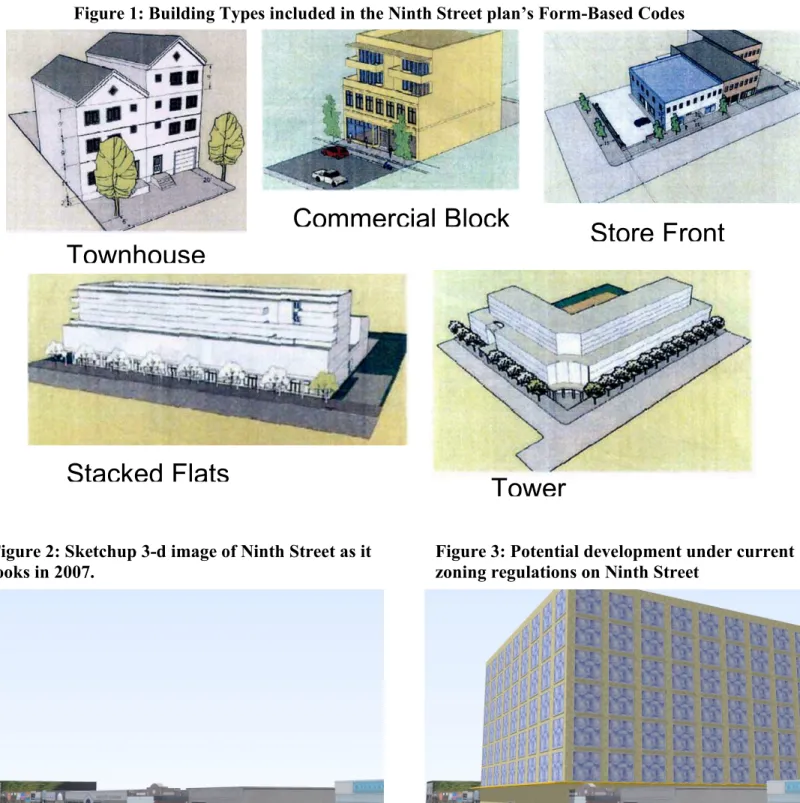
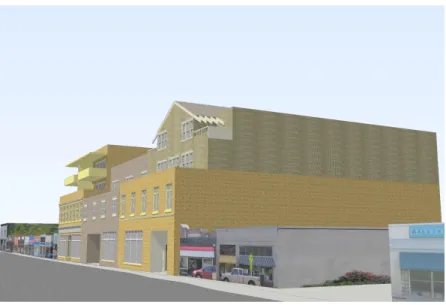
Another concern involved the use of images at the charrette. Two participants said that planners made a mistake in showing Sketchup images of potential new
development on Ninth Street in the place of historic buildings (see Appendix A, Figures 2, 3, and 4). This change was threatening to many people, and contributed to the
suspicion that planners sought to make the area more upscale rather than preserve its existing “funky” character.
Also, two participants expressed concern that the Durham Area Designers
“communicated a certain level of ownership over the plan and the feeling that there were right or wrong answers in regards to building heights.” These participants worried that DAD’s focus might be more on design than on translating the public’s desires into a plan.
F. Form-Based Codes
codes offered a “basic framework” to gather public input and guide the public towards realistic decisions. As one planner said:
“We didn’t want to go in with a blank slate because if you do that, people will have unrealistic wishes. They’ll say they want a community center or a park, but this is privately owned land that somebody wants to make a profit on, so form-based codes offered a basic framework that we could go in with and start from there.”
At the charrette, participants were asked to decide on the types of buildings that should be developed around Ninth Street. The final plan, derived from the small group plans, included “storefronts”, “commercial block buildings”, “townhouses”, and “towers.” (see Appendix A, Figure 1) They also decided on the specific locations for each building type (see Appendix A, Figure 5).
Planners felt that the response to form-based codes at the charrette was very positive, since it allowed people to directly craft regulations for the area. However, they worried that the opponents of form-based codes who did not attend the charrette would sway public opinion. Planners felt that more people were questioning form-based codes at the November public meeting. However, at the March 2007 meeting, although some people disagreed with how form-based codes were used, it appeared that the majority accepted the concept of form-based codes for Ninth Street.
However, several participants felt that the public lacked an understanding of form-based codes. Even though form-based codes are supposedly easier to understand, some members of the public were well-versed in traditional zoning. One participant felt that this new form of zoning impeded public oversight of the plan; that form-based codes could be used to “put one over” on the community.
Another concern from this participant was that form-based codes would not regulate use. Apparently, this is a concern that is shared by several residents who do not want businesses dispersed throughout residential areas. Also, some participants worried that form-based codes will spur redevelopment that tears down historic buildings, whereas traditional zoning has not so far.
V. CONCLUSION
A. Evaluation of the Collaborative Place-making Approach
The Ninth Street plan used a collaborative place-making approach in order to reach the twin goals of increased public support for density and preservation of neighborhood quality. This section will evaluate the extent to which it reached those goals, and why it was or was not an effective approach.
Increased public support for density. The Ninth Street plan, if finalized in its present form, would significantly increase the capacity for density in the Ninth Street area. In most of the Ninth Street area, the plan sets maximum building heights at two to four stories, with six or eight stories in some areas. This is a significantly higher level of density than currently exists around Ninth Street. The public expressed support for this level of density in interviews and through their input at the charrette.
The most important factor in obtaining public support for increased density was the collaborative planning process. As one planner said, “more than anything people want a hand in developing the rules” that guide development so that they can tailor density to the context of their neighborhood and place higher density at the proper locations and intensities.
Alone, a place-making frame would not have done much to increase public support for density. Most participants had specific concerns that could not be
ameliorated by the idea that Ninth Street would be a great place. However, place-making in combination with collaborative planning was a very effective approach. It offered a conceptual framework that allowed for public collaboration but guided it towards a realistic end.
Preservation of neighborhood quality. Because of its nebulous nature, it is more difficult to judge the success of the collaborative place-making approach in
protecting the quality of the Ninth Street neighborhood. Clearly, some public participants were concerned that the plan would harm Ninth Street’s character by displacing historic buildings and local businesses. Some worried that form-based codes would allow commercial uses in residential areas. Some worried that the plan would result in the neighborhood becoming more “upscale” and less “funky.”
The uncertain and complex nature of planning made it impossible for the Ninth Street plan to completely dispel these concerns. As a land use plan, it could not control the economics of the area. However, collaborative planning tools allowed participants to address the most important concerns, like the preservation of the block of historic
commercial buildings, to the maximum extent possible.
The place-making frame also helped overcome neighborhood quality concerns by emphasizing that the plan would preserve the pedestrian-friendly, mixed-use, eclectic character of the area. Even though some members of the public held some reservations, the focus on creating a great place at Ninth Street helped the public trust that planners were concerned with preserving the quality of the neighborhood. . The place-making frame kept the process moving forward and avoided crippling conflict over these concerns.
A. Shortcomings of the Approach.
The most significant shortcoming of the collaborative place-making approach is the sensitivity of collaborating with the public and communicating effectively. Due to the long history of top-down governmental decision-making, the public often distrusts the motives of planners. Using new planning tools, like form-based codes, increases the potential for misunderstandings and distrust. This distrust may lead the public to use the power gained in collaborative planning to make the planning process difficult. To avoid conflict, planners must devote much time to thoughtful communication with the public: anticipating and responding to their concerns, explaining complex planning concepts, combating misinformation and avoiding misperceptions.
Despite overall effective communication between planners and the public, the Ninth Street plan exhibited instances where poor communication led to conflict. For example, the power of images sometimes led the public to distrust planners. Planners had created 3-d models of potential future development in the place of the historic
some members of the public, these images communicated a threatening change to their neighborhood. When these images were published in the Durham newspaper, some members of the public felt that planners were trying to “scare” the public into supporting the Ninth Street plan. This example illustrates how careful planners must be when collaborating with the public. Something as simple as an image can increase public distrust of planners.
Once planners have given the public a certain measure of control through collaborative planning, the public will demand that they follow through with a transparent planning process. This is no easy task for planners, but essential to establishing the trust necessary to make collaborative planning work.
B. Advantages of the Approach
In the Ninth Street plan, the major advantage of using the collaborative place-making approach was that it fit the local context. The neighborhoods surrounding Ninth Street contain many well-educated and involved citizens. They have strong
neighborhood organizations accustomed to advocating for their interests. Collaborative planning allowed this involved and knowledgeable public to be an asset to the planning process, rather than a formidable political encumbrance to the plan’s implementation. Thus, collaborative planning was the most effective way to secure public support for the Ninth Street plan.
The place-making frame of the Ninth Street plan was also a good fit because the public already viewed Ninth Street as a great place. They appreciated the historic
participants emphasized the importance of pedestrian access, so they were willing to try form-based codes and its focus on wider sidewalks and building types that promote a good pedestrian environment.
Another key advantage of the collaborative place-making approach is that it builds a constituency in support of higher density, mixed-use, pedestrian-oriented places. In the Ninth Street plan, the charrette gave supporters of these ideas an opportunity to contribute to the planning process. Planners, architects, and students who live in the neighborhood were able to contribute. Conversely, traditional planning processes often lack a venue where the pro-density public can contribute to the plan, and opponents to density become the only public voices heard by politicians. Thus, collaboratively-developed plans may create a base of public support that makes them more politically resilient to the inevitable attacks from opponents.
The collaborative place-making approach offers a conceptual framework that can help planners increase public support for density while preserving neighborhood quality. It provides a balance between empowering the local public and guiding the plan towards larger goals.
D. Implications for Further Research
This study was also imperfect in that it could not measure whether dense
BIBLIOGRAPHY
Beierle, Thomas C., and Cayford, Jerry (2002) Democracy in Practice: Public
Participation in Environmental Decisions (Washington D.C., Resources for the Future)
Burby, Raymond C. (2003) “Making Plans that Matter: Citizen Involvement and Government Action” Journal of the American Planning Association, 69:33-49.
Diers, Jim (2004) Neighbor Power: Building Community the Seattle Way. University of Washington Press: Seattle and London.
Fulton, M. (1986) “Evolution of Public-Private Bargaining in Urban Development” Carolina Planning, 12 (1): 10-17.
Godschalk, D. et al. (1994) Pulling Together: A Planning and Development Consensus Building Manual (Washington D.C., Urban Land Institute)
Innes, J. B. (1996) “Planning Through Consensus Building: A New View of the Comprehensive Planning Ideal” Journal of the American Planning Association, 62 4): 460-472.
Innes, J. B. (1999) “Consensus Building in Complex and Adaptive Systems: A
Framework for Evaluating Collaborative Planning” Journal of the American Planning Association, vol. 65
Innes, J.B. and Booher, D. E.(2004) “Reframing Public Participation: Strategies for the 21st Century” Planning Theory and Practice, 5 (4): 419-436.
International Association of Public Participation. “IAP2 Public Participation Spectrum” accessed at http://www.iap2.org/displaycommon.cfm?an=5 on January 26, 2007. Kaufman, S. and Smith, J. (1999) “Framing and Reframing in Land Use Conflicts” Journal of Architecture and Planning Research, 16(2): 164.
Kaufman, S. (2001) “Framing Feedback for Joint Decision Processes” (powerpoint presentation given at the ACSP) available at http://urban.csuohio.edu/~sanda/pres/#art Kaufman, S., Burgess, G., and Gardner, R. (2003) “Just the Facts, Please: Framing and Technical Information” Environmental Practice, 5: 223-231
Leighninger, M. “The Next Wave of People Power” February 14, 2007. Available at www.tompaine.com:
Accessed February 24, 2007, available at www. lgc.org:
www.lgc.org/freepub/PDF/Land_Use/fact_sheets/form_based_codes.pdf -
Pelletier, D.L., V. Kraak, C. McCullum, U. Uusitalo and R. Rich (1999) “The Shaping of Collective Values through Deliberative Democracy: An Empirical Study from New York's North Country.” Policy Sciences 32:103-131.
APPENDIX A: IMAGES FROM THE NINTH STREET PLAN
Figure 1: Building Types included in the Ninth Street plan’s Form-Based Codes
Tower
Commercial Block
Townhouse
Store Front
Stacked Flats
Figure 2: Sketchup 3-d image of Ninth Street as it
Figure 4: Potential development with form-based codes on Ninth Street
Commercial Block Store Front Special Sites Stacked Flats Tower Townhouses
Corner Sites (cross-hatched) Proposed compact neighborhood Current Compact neighborhood
APPENDIX B: INTERVIEW PARTICIPANTS
Planners:
xxxxx (Durham Planning Director) xxxxx (Durham Planning Department) xxxxxx (Durham Area Designers) Public Participants:
APPENDIX C: INTERVIEW QUESTIONS
A. Survey questions for public participants
These first questions will ask what you think about 9th Street as it is today, and then how
you think 9th street should develop in the future.
1. When you think about 9th street as it is today, what do you like about it? 2. In your opinion, does 9th street have any problems or issues that need to be
addressed? What are they?
3. When you think about the future of 9th street, what is your worst fear for what it could become?
4. These next questions will ask your opinion on how the 9th Street area should be developed in the future. In answering these questions, think more about the area surrounding the 9th street commercial block, because everyone seems to agree that
the historic block should be preserved.
• In general, what building heights do you think are appropriate for the 9th Street area?
Comparables are Station 9, the tall building, present 9th street commercial?
• For these next four questions, answer on a scale of 1 to 5. On the issue of
transportation, in your opinion, how important is automobile access to 9th street, through easy, plentiful parking and auto-oriented roads? 1 is not important at all, 5 is very important.
• How important is it to make the 9th street area pedestrian friendly, with wide
sidewalks, crosswalks, and on-street parking? 1 is not important at all, 5 is very important.
The rest of the questions will be about the 9th street planning process, including the charrette that was held in September and the meeting in November that presented the results of the charrette.
1. Thinking back to this summer and fall, how did you first hear about the 9th street plan?
2. What was your initial reaction to the 9th Street plan when you first heard about it, did you initially have a positive or negative reaction? Rate this on a scale of 1-10. 1 is Absolutely Not A Good Idea, and 10 is Its about time!
3. These next few questions are open-ended, so just answer with whatever comes to mind. Thinking back to the charrette, and the planner’s presentations, or any conversations you have had with the planners, what impression did you get of the basic message that the planners wanted to convey about the 9th street plan? 4. Going back to your experience at the charrette, what comes to mind that you liked
about the charrette, in terms of the focus, the presentations, the agenda, the atmosphere, the participants or anything else?
5. What do you think could have been better about the charrette?
or during the charrette, were you skeptical that the public would have a large role in creating the actual plan?
7. The 9th Street plan is likely going to use form-based codes, which allow the regulation of building form. After your experience with form-based codes at the charrette, do you agree with the use of form-based codes for 9th Street?
8. Why do you feel that way about form-based codes?
9. At the charrette or in conversations with planners, do you think that the planners and designers did a good job of presenting form-based codes in a clear and understandable way? Yes, somewhat, or no.
10. One major focus of the charrette and form-based codes was to design good public spaces and create a great place on 9th Street. What do you think of this focus on public spaces?
11.Do you think that people are willing to accept higher levels of density if they know that it will result in attractive, well-designed public spaces? Why do you think that?
12. These two questions are about your impressions of other participants opinions on the plan. In talking with other people about the plan and hearing their opinions, what is your sense on the level of support out there for the plan?
13. Have you observed anyone whose involvement with the 9th street plan has changed their opinions, either positively or negatively, on the plan, form-based codes, higher density, or planning in general?
14.Have you gotten anything interesting or useful out of the 9th street planning process, such as information about the neighborhood, planning, the viewpoints of other people, or better lines of communication?
15.Thinking back to your initial reaction to the 9th Street plan before the charrette, how do you feel about the plan now? Do you feel differently at all? Rate on a scale of 1-10.
B. Survey questions for planners:
1. What story did the planning department want to tell with the Ninth Street planning process?
2. How did form-based codes and the charrette frame the planning process? 3. How have people received the idea of form-based codes? How has that changed
over time?
4. How has the focus on the public realm and creation of a great space affected the plan? Has this approach helped the planning process?
5. Do you think that focusing on the positive aspects of density has improved people’s opinion of density?
6. Is there an advantage to hiring out the designer role, as an advocate for the public realm to keep the planning department more neutral?
8. Do you think that the use of form-based codes and a charrette makes people more comfortable with higher density by allowing them to see what development will look like, rather than imagining worst-case development?
9. Who are the major stakeholders, who was most involved or vocal about the project? Is there any consistency among groups?
10.Is there differences in the groups views on density, the public realm, form-based codes and the charrette process?
11.How well-informed were various stakeholders of various aspects of the plan? I.e., the economics, the regulatory environment, and the design possibilities of the plan? What effect has any misinformation among stakeholders had?
12.Did you observe changes in viewpoint or positions among any participants during the process?
13.Did you adjust any part of the process in response to feedback, and if so why? 14.How successful was the charrette process in addressing participant concerns?
Compared to other planning approaches that might have been used?
15.Did the high level of involvement of participants in creating form-based codes at the charrette increase support of the plan and its chances of implementation? 16.What has most contributed to the successes of this process? Conversely, what has
APPENDIX D: COMPILED INTERVIEW RESPONSES
*Note: Since many of these interviews were transcribed over the phone, any spelling and grammar mistakes are the fault of the transcriber. The “R”, “D”, or “M” in front of some responses denote either “resident”, “developer”, or “merchant”.
1. What do you like about 9th Street?
R--One of the last locally owned shopping districts in the triangle and it has eclectic environment because of local ownership
R--Diversity, ecleticness, independence, and possibly also the reputation, at a meeting in western north carolina people talked about how great 9th street was.
R--I live two blocks from 9th Street, I am a homeowner there because its about the only place in Durham where you can walk to places, there is a mix of businesses with a local flavor, good sidewalk conditions and there are specific businesses that we have come to know and we frequent.
R--9th street alows you to make connections to people in a way that’s not possible in other places because you are walking around and running into people. There are many different people doing different things, its not like running into people in the grocery store where everyone is there for the same reason. The guy who sleeps behind the store, I had a conversation with him, and that would never happen in most other places.
M--9th Stret is fairly unique and has its own personality, its not too trendy, and there are a lot of individually owned, unique retail establishments
R--There are a variety of stores and a variety of services and they are all right there within walking distance from where I live.
Locally owned businesses not shiny corporate chains, and the fact that I can walk to it and it’s a downtown feel and a diversity of different stores, and separates it from 9th street.
Ninth street taught us that if you can get a few businesses together you can successfully change a business street that was originally developed for millworkers by getting together a few businesses that can support each other and help the places in between. 9th street in 1983 was a remarkable mixture of old businesses and new businesses.
2. Problems, issues, changes that need to be made?
R--There needs to be streetfront development on the west side of 9th street, more contiguous sidewalks, and some buildings may need to become taller on 9th street, I don’t feel that attached to the buildings as they are.
M--Parking is an issue for merchants, safety, having lighting and enough accessibility and walking zones. The utility poles are above ground and ugly, the infrastructure is old.
eight cobra street lights with acorn lights that would make for a better atmosphere. The other is to establish the green space that would be a buffer on Green Street.
R--Wish it had more universal support from the city and the university, supporting its eclecticness and independence
More sidewalk seating for a café style around the sidewalks, the other side of the street be developed instead of a parking lot. More investment in giving it character with old timey street lights, having durham really invest like they did downtown pumping in resources to make it attractive
3. What is your fear for the future of ninth street?
R--Worry that it would become part of the establishment and lose its individuality
I think that it would be bad if it became like streets of southpoint with big money and big chains.
R--Bigger picture is with the plan affecting the shops and the mill. How can you have a small area plan that encourages economic development that we want to see while protecting our historic buildings. DAD showed a slide with all of the 9th street buildings gone. That would tear apart the living room of our neighborhood. Replacing this would tear out the soul of the street. I’m tired of making suggestions because the planning director doesn’t take it so I’m putting the ball in his court. We are not a typical neighborhood
association because we let a lot of density come in.
R--The fear is that it will be developed in a crappy way so that the personal flavor is lost and it gets suburbanized. The vacant land is particularly concerning because it could be developed in typical strip mall fashion. Another fear is that the businesses could all get homogenized or every store becomes a restaurant. Some people have the fear that someone could buy up a lot of the property, demolish it all and then build some monstrosity, but I don’t think that is especially likely.
M--Fear is that the older buildings would not be maintained and that it would be deserted
R--Fear is that we will not see greater investment in Durham and that it would decay and the storefronts would be vacant. Also worried that the train station won’t happen and that will hurt 9th Street. Not worried about it becoming dense and more upscale.
4. Comments on building heights…….
Nothing higher than 3 stories, from the charrette I learned that to secure its future uniqueness, how do you do that? You want to protect that, but I think that the system they are encouraging secures a foundation of ordinances or codes that allow for creativity within a framework
At first we thought 5,6,7,8, but then someone said we don’t want the focal point to shift to the west from 9th street, but at the same time we don’t want to lose the shops on 9th street. That’s the dilemma, there has to be a careful balance.
enough street because the streets are narrow and buildings are so tall. Maybe three stories
Building heights should match what is there right now. You don’t want 4 to 6 stories without big dead places where the message is uncertain. We can have higher density in other areas near Erwin square but it has to respect the context of 9th street.
Another thing is the question of transection. It is appropriate for the neighborhoods, the way that the residential moves into the commercial used to be very good and now that has been somewhat changed by development with 9th street north and doesn’t make a successful transection. With this form based codes we have to preserve this
successful transection. We were told when we last met that they will work on these things and come back and have more variations that will be more site specific and more sensitive. Right now.
D--Building heights is a loaded question. I’d like to have eight or nine story residential apartments over retail. You are talking 175 or 200 units. That has little or no impact on ninth street except to stabilize the current merchants on 9th street.This is allowed by zoning. Density brings up the bar for everyone, it makes old west durham neighborhood more valuable because it brings more amenities.
5. Comments on pedestrian access versus auto access…..
pedestrian access is more important, Steve Gaddis, raise your hand and tell me if you couldn’t find a parking space, no one could raise their hand. Parking might be tight but I’ve never been able to find a spot. That won’t prevent people from going. There are streets without sidewalks. Duke has a responsibility there too.
Transportation—its not a contest, I would put pedestrian first though, a slightly parking starved area is a good thing, we need to make a good pedestrian environment. And make it an unattractive area for big box development regulatory wise. This where the use based component in necessary so that we can concentrate parking where parking is needed. And how can you provide for parking if there is a mixture of uses everywhere? You have to carefully select where there is a mixture of uses. But I would be against a notion of rigid formulas that every building has to have its own parking. One of the great things about 9th street is its principal market is people who live close by, so streetscapes are extremely important, and they do not want to walk by huge parking lots and poor streetscapes. You will walk long distances if the things you walk past are human in scale.
Both because one reason we bought a house is the location, and we can walk wherever we need to go. I am a proponent of alternative transportation, but if you do add a lot of development than you have to make sure there is enough. We should maximize pedestrian access to the point of not supporting a public
6. Initial reaction to the plan?
It was concern about the plan, because 9th street was so unique 3
5 but I was concerned about the notion of form based codes, I don’t want to experiment too much with ninth street
Why is this happening now, and who is behind it. Then we learned that Duke was paying for it. Making 9th street upscale seems to be the goal, they paid
$225,000. The fact that they showed at the end the drawing where 9th street was replaced by new buildings gave evidence to that. 3
M--4—I thought it was a good idea, having the charrette on a Saturday is like saying to merchants, we don’t want you to come.
Initial reaction was a 5. Because if the city doesn’t put there money where there mouth is, then revitalization won’t happen. They have to believe in supporting the local developer, otherwise the bigger developers will come in and put in the strip malls and they can afford to buy huge lots. But infill like 9th street the developer is going to do what is best for himself, and the city has to support the developer so the city should be sure to do underground lines for the 9th street area, pay for the sidewalks, do the landscaping, rather than say. If you give incentives to the developer, than I can do a nicer building and charge cheaper rents. And the city would get more property taxes every year. What they’ve done in downtown durham is to put in parking garages to help the developers. But where is my money its not equal
7. What was the planner’s message?
They did explain that there is a formal method of a plan, the form-based codes was a key part, they did not propose that it had to happen.
really got the impression that it was not a staged event, I really felt that the planning department in durham were really interested in people’s feedback, a genuine desire to get people’s input and that would be incorporated. What was unclear was how the plan would be carried out and the time frame because the city can’t mandate how property owners change their property. But I had a hard time of connecting the great exercises with reality, because of the multiple property owners involved.
I approve with what the city planners state their goals are. What duke said that about keeping a look and successful transactions, and keeping what we like and shaping future development. He is an intelligent person with an artistic flair. His eye’s are on that prize but his approaches may be to abstract. But I am concerned that the designers aren’t necessarily committed to the goals and more interested in designing and less interested in a regulatory environment that achieves goals. They tend to design for a two dimensional world instead of a three d world.
The planners communicated that 9th Street was a special part of the city that requires a unique approach, which is the where form-based codes can step in. They also made it clear that they were very open to the idea of heavy
community involvement in the plan. And they said that form-based codes are a good path to creating certainty around future development on 9th street. The planners said that the plan will not actually result in development, it will
only guide what development occurs.
M--The planners explained that the plan was overdue, and that we needed to create a cohesive plan for 9th street, and we needed to get input from the people. Development and infill are going to happen regardless, so we need to control it. There was also an emphasis on form-based codes.
8. Thoughts about the charrette………..
There was a high level of support for planning among the people who showed up at the charrette, and in the neighborhoods surrounding 9th street there are many people who support planning in general.
Well-presented with form-based codes, it was good for us who aren’t planners to understand what we should think about. A very participatory process that was inclusive. It can be difficult in citizen input I don’t think it was
representative of the area that would be impacted, but it takes the resources and time to lay the groundwork for trust. It wasn’t very diverse in who came to the charrette. I thought that one exercise on Friday night was done a little to early in the process, we didn’t know enough to make those decisions at that point.
At the charrette the groups were isolated from each other and might not have the same idea of what happened as another table. So you have to trust that the designers will bring it together. It was bad to have only individuals at the charrette, you should have had organizations represented. There aree five organized groups in the area, very politically active area. We should have invited the representatives of these organizations to participate in the process, because that is going to happen anyway, when the larger organizations dissaprove of what happened. That was a misstep but the people who were proposing this were hoping that they could avoid this process, but you can’t. To me a charrette works best when it is ten people instead of 100 people so that everyone can work together.
D--They did an excellent job of moving it forwanrd and keeping people on task and making people think. They gave us the feedback but what is happening with it right now? So there is a meeting, is the next step going to be. I was afraid that the planners would listen too much and make it slow so they couldn’t move fast, and they have moved faster than I anticipated
The community has to watch this and for the community to deal with the form based codes. Its much more complicated than regular zoning which has happened for four generations. That’s patronizing to say that its easier for people to understand than regular zoning.