Sharif University of Technology
Scientia IranicaTransactions C: Chemistry and Chemical Engineering http://scientiairanica.sharif.edu
SBA-15-supported copper (II) complex: An ecient
heterogeneous catalyst for azide-alkyne cycloaddition in
water
M. Bagherzadeh
a;, H. Mahmoudi
a, M. Amini
b, S. Gautam
c, and K.H. Chae
d a. Department of Chemistry, Sharif University of Technology, Tehran, P.O. Box 11155-3615, Iran.b. Department of Chemistry, Faculty of Science, University of Maragheh, Maragheh, Iran.
c. University Institute of Chemical Engineering & Technology (SSB UICET), Panjab University Chandigarh, 160-014, India. d. Advanced Analysis Center, Korea Institute of Science and Technology, Seoul 136-791, South Korea.
Received 18 January 2017; received in revised form 28 June 2017; accepted 12 February 2018
KEYWORDS Mesoporous SBA-15; Copper complex; Azide-alkyne cycloaddition; Triazole; Heterogeneous catalyst.
Abstract. The reaction of the functionalized mesoporous SBA-15 in absolute ethanol with copper (II) acetate aorded a novel CuII-Schi base/SBA-15 catalyst. The
com-pound CuII-Schi base/SBA-15 was characterized by IR spectroscopy, small-angle X-ray
diraction (SAX), Energy Dispersive X-ray Spectroscopy (EDXS), X-ray Absorption Near Edge Structure (XANES), Scanning Electron Microscope (SEM), Transmission Electron Microscope (TEM), and N2 adsorption/desorption studies. Further, the catalytic activity
of this well-dened material was tested in three-component Copper-catalyzed Azide-Alkyne Cycloaddition (CuAAC) reactions to obtain 1,4-disubstituted-1,2,3-triazoles in good to excellent yields from an organic halide, sodium azide, and alkyne in water as a green solvent. More importantly, the catalyst can be recovered and reused eciently up to ve consecutive cycles with negligible loss of catalytic activity.
© 2018 Sharif University of Technology. All rights reserved.
1. Introduction
The Copper-catalyzed Azide-Alkyne Cycloaddition (CuAAC) for the synthesis of 1,2,3-triazole derivatives is one of the most attractive [1] and fundamental reactions [2] in nature [3-6] and synthetic organic chemistry [7-13]. Both copper (0) and copper (I), con-taining compounds, have recently emerged as eective catalysts in 1,3-dipolar azide-alkyne cycloaddition [14-24]. However, these compounds are prone to redox pro-cesses; hence, it is desirable to protect and stabilize the active copper catalysts during CuAAC-cycloaddition *. Corresponding author. Tel.: +98 21 66165354;
E-mail address: [email protected] (M. Bagherzadeh) doi: 10.24200/sci.2018.20197
reaction [25]. This limitation can be overcome by utilizing a Cu(II) catalyst [26-28].
Mesoporous SBA-15, as an interesting meso-porous silica material, has attracted considerable at-tention [29] due to its ordered pore diameter [30], large specic surface areas [31], uniform-sized pores [32], thicker walls [33], high hydrothermal stability [33], high surface-to-volume ratio [31], variable framework compositions [34], and ease of modication [35] by utilizing available surface silanol groups to immobilize a homogeneous catalyst to minimize the leaching of the active component [31,32,34-36]. Herein, the synthesis of SBA-15 to anchor CuII-Schi base complex through an organic linker (3-aminopropyl)trimethoxysilane was reported. The 1,3-dipolar azide-alkyne cycloaddition reaction proceeds with a CuII-Schi base/SBA-15 cata-lyst, and the recovery of the catalyst can be done easily
Figure 1. Preparation steps of CuII-Schi base/SBA-15 catalyst.
several times without any signicant loss of activity. 2. Results and discussion
Functionalized mesoporous SBA-15 was prepared by reuxing SBA-15/Pr-NH2 with salicylaldehyde. The subsequent reaction of the functionalized mesoporous SBA-15 in absolute ethanol with copper (II) acetate led to the formation of a novel CuII-Schi base/SBA-15 catalyst. The elemental analysis of the prepared CuII-Schi base/SBA-15 catalyst showed 3.13% for the weight percentage of Cu, 13.97% for C, and 1.69% for N. Elemental analysis demonstrated that the molar ratios of N/Cu and C/Cu were 2.47 and 23.76, respectively, arming the coordination of two Schi base ligands on the SBA-15 with copper (II) ions as shown in Figure 1 [37].
2.1. Catalyst's characterization
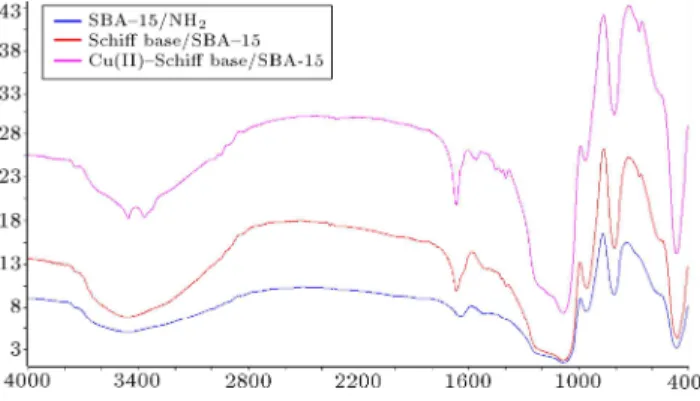
The FTIR spectra of SBA-15/Pr-NH2, Schi base/SBA-15, and CuII-Schi base/SBA-15 are shown in Figure 2. According to the FTIR spectrum, the bands at 3450 (very broad) and 1650 cm 1 are attributed to O-H and O-H modes of silanol groups, respectively [38]. Moreover, the characteristic antisymmetric Si-O-Si vibration bands of [SiO4] units are observed at 1050{1200 cm 1 [39]. The presence
Figure 2. FT-IR spectra of SBA-15/Pr-NH2, Schi
base/SBA-15, and CuII-Schi base/SBA-15.
of a bond at 1650 cm 1 in Schi base/SBA-15 and CuII-Schi base/SBA-15 is attributed to
H-C=N of the azomethine group [37,40].
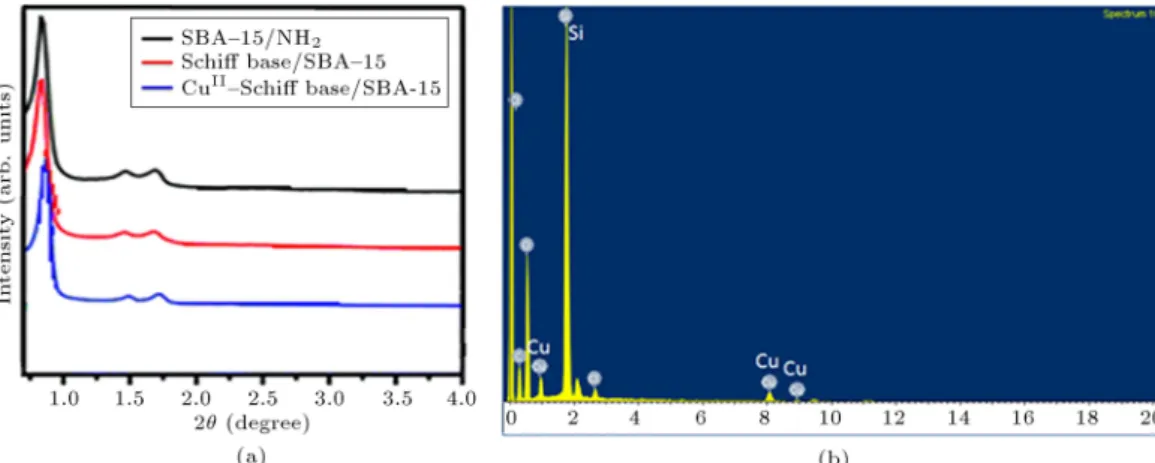
The small angle XRD patterns of SBA-15/Pr-NH2, SBA-15/Schi base, and CuII-Schi base/SBA-15 are shown in Figure 3. XRD patterns display three well-resolved peaks in the low angle range at 0.5-4 2 that can be indexed to (100), (110), and (200) reec-tions in the hexagonal two-dimensional space group p6 mm for the mesoporous silica SBA-15 matrix [31,41]. Some loss in the intensities of the peaks was observed following the attachment of CuII-complex, revealing that silylation indeed occurred inside the channels of SBA-15 [42]. The SAX patterns conrm that the high mesoscopic order of the compounds was not de-stroyed in the multi-step synthesis procedure. Energy Dispersive X-ray Spectroscopy (EDXS) conrms the presence of 4.06% copper in CuII-Schi base/SBA-15 sample Figure 3(b). The X-ray diraction patterns of SBA-15/Pr-NH2, SBA-15/Schi base, and CuII-Schi base/SBA-15 showed a similar pattern, indicating that the structure of SBA-15 was not changed with the addition of the complex into the channels of SBA-15, Figure 4.
N2 adsorption-desorption isotherms of SBA-15/Pr-NH2, Schi base/SBA-15, and CuII-Schi base/SBA-15 show type IV isotherms with hysteresis loops (Figure 5), related to capillary condensation steps, characteristic of the mesoporous materials with uniformly sized mesoporous [43]. The BET sur-face area, pore diameter, and pore volume of CuII -Schi base/SBA-15 are smaller than those of -Schi base/SBA-15 and SBA-15/Pr-NH2 mesoporous silica, suggesting that the complex is present inside the pores of the support material, because it is well known that the introduction of the complex in porous supports shows a decrease in its specic surface area and pore volume (Table 1) [44].
Cu L-edge XANES spectra for CuII-Schi base/SBA-15 are shown in Figure 6. The peaks at
Figure 3. (a) Small-Angle X-ray diraction (SAX) patterns of SBA-15/Pr-NH2, SBA-15/Schi base and CuII-Schi
base/SBA-15. (b) EDXS analysis of the nal compound CuII-Schi base/SBA-15.
936.2 eV and 956.4 eV, respectively, are assigned to the transitions of Cu 2p3=2 4s (L3) and 2p1=2 4s (L2), and the presence of a bump-like feature at 940:5 eV signies the existence of copper with oxidation state 2+ in the sample [45,46].
Figure 7(a) and (b) illustrates SEM and 7(c) and (d) TEM images of CuII-Schi base/SBA-15 to conrm the high mesoscopic order of the compound. This catalyst displays parallel channels with the highly ordered pores arranged in a 2D-hexagonal p6 mm-resembling structure, thus conrming the retention of the physical structure of the siliceous material, although CuII-Schi base complex entered into the channels of functionalized SBA-15 [32].
Figure 4. X-ray diraction patterns of SBA-15/Pr-NH2,
SBA-15/Schi base and CuII-Schi base/SBA-15.
2.2. Catalytic activity
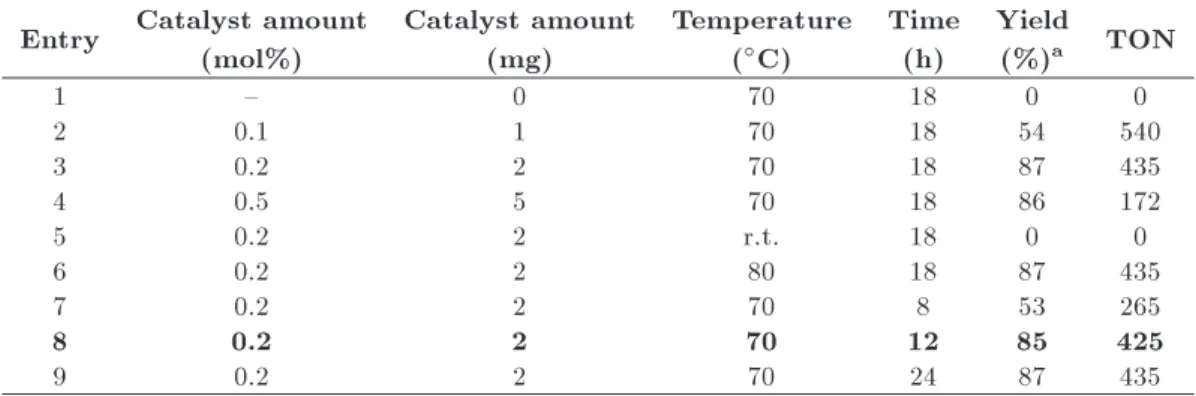
The CuII-Schi base/SBA-15 catalyst was shown to be ecient in the multi-component 1,3-dipolar cy-cloaddition of terminal alkynes and organic azides yielded in situ from sodium azide and dierent organic halides. Phenylacetylene and benzyl chloride were chosen as starting compound models to optimize the reaction conditions (Table 2). Interestingly, water as a \green" solvent was used for all cycloaddition reactions. Initially, optimization of the reaction was performed by varying the catalyst loading. As shown in Table 2,
Figure 5. Nitrogen adsorption-desorption isotherms of SBA-15/Pr-NH2, Schi base/SBA-15-15, and CuII-Schi
base/SBA-15.
Table 1. Surface characteristics of SBA-15/Pr-NH2, Schi base/SBA-15, and CuII-Schi base/SBA-15.
Compound d100a (nm) SBETb(m2g 1) Vc(cm3g 1) DBJHd (nm)
SBA-15/Pr-NH2 5.179 498.27 114.48 1.64
Schi base/SBA-15 5.338 476.76 109.54 1.64
CuII-Schi base/SBA-15 5.435 387.55 89.04 1.21
ad100is the d(100) spacing;bSBETis the BET surface area; cV is the total pore volume;dD is the average pore diameter.
Figure 6. The copper L-edge XANES spectra for CuII-Schi base/SBA-15
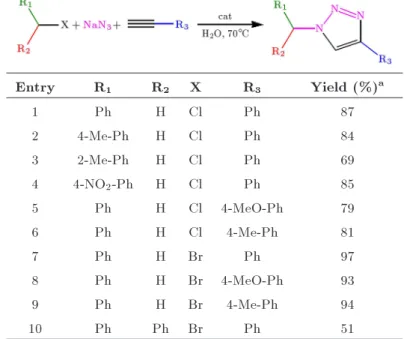
reaction time up to 18 h. After the determination of the best reaction condition, CuAAC reactions were carried out with various azides and alkynes to produce the corresponding 1,4-disubstituted-1,2,3-triazoles. The results are summarized in Table 3. The substitution of electron donating or electron withdrawing groups on the phenyl ring of benzyl halides and phenylacetylenes did not have a meaningful eect on the reaction
Figure 7. (a) and (b) SEM images, (c) and (d) TEM images of CuII-Schi base/SBA-15.
Table 2. The eect of reaction conditions on the azide-alkyne cycloaddition.
Entry Catalyst amount(mol%) Catalyst amount(mg) Temperature(C) Time(h) Yield(%)a TON
1 { 0 70 18 0 0
2 0.1 1 70 18 54 540
3 0.2 2 70 18 87 435
4 0.5 5 70 18 86 172
5 0.2 2 r.t. 18 0 0
6 0.2 2 80 18 87 435
7 0.2 2 70 8 53 265
8 0.2 2 70 12 85 425
9 0.2 2 70 24 87 435
Table 3. Cycloaddition of benzyl halides with terminal alkynes in the presence of Cu -Schi base/SBA-15.
Entry R1 R2 X R3 Yield (%)a
1 Ph H Cl Ph 87
2 4-Me-Ph H Cl Ph 84
3 2-Me-Ph H Cl Ph 69
4 4-NO2-Ph H Cl Ph 85
5 Ph H Cl 4-MeO-Ph 79
6 Ph H Cl 4-Me-Ph 81
7 Ph H Br Ph 97
8 Ph H Br 4-MeO-Ph 93
9 Ph H Br 4-Me-Ph 94
10 Ph Ph Br Ph 51
aIsolated yield.
outcome (entries 2-6). Furthermore, steric hindrance of the ortho substituents on benzyl chlorides aected the progress of the reaction, and benzyl chloride sub-stituted with a methyl group at the ortho position had less product yield than the para derivative (entries 2 and 3). Due to the weak C-Br bond compared to C-Cl bond [47], replacement of benzyl chloride with benzyl bromide appears to have a decisive eect on the catalytic activity, as benzyl bromide reacted to give the corresponding 1,2,3-triazole products in good to excellent yields (entries 7-10).
Repeated use of a catalyst is an important pa-rameter in its evaluation [48]; thus, recoverability and reusability of CuII-Schi base/SBA-15 were investi-gated. The amounts of both the catalyst and reac-tants were increased by ve-fold, and the experiment was performed under the previous reaction conditions. After the reaction, the catalyst was recovered by centrifugation, washed three times with water and ethanol, dried at 60C, and subjected to a new cycle of reaction. The results indicated that the used material was also active as a catalyst for ve times without a dramatic loss of catalytic performance (Figure 8).
After the last run, the catalyst was separated from the reaction mixture, washed several times with ethanol, and dried at 60C. The FTIR spectra of the separated catalyst were recorded at room temperature, and this spectrum was compared to the fresh catalyst spectrum (Figure 9). This comparison showed no major changes, indicating good stability of CuII-Schi base/SBA-15 catalyst.
In order to investigate CuII-Schi base/SBA-15 leaching into the azide-alkyne cycloaddition of pheny-lacetylene and benzyl chloride as a model reaction,
the reaction stopped at half the reaction time (6 h) and the catalyst was completely ltered from the solution. Subsequently, the rest of the reaction mixture
Figure 8. Recycling studies of the CuII-Schi
base/SBA-15 catalyst in the azide-alkyne cycloaddition reaction.
Figure 9. FT-IR spectra of fresh (red line) and reused (blue line) catalyst.
3. Experimental section 3.1. Materials and methods
Chemicals and solvents were purchased from Merck and Sigma-Aldrich and were used without further purica-tion. FT-IR spectrum was obtained using a Bruker tensor 27 FT-IR spectrophotometer using KBr disks at room temperature. TEM measurements were carried out on pristine and irradiated samples at 200 kV using FEI, Tecnai F20 G2 TEM. The morphologies of the products were observed further by scanning electron microscopy (SEM, FEI XL-30 FEG) with Energy-Dispersive X-ray spectroscopy (EDX) for percentage composition. The XANES investigation was done at NSRRC, Hsinchu, Taiwan. Nitrogen adsorption isotherms at 196C were measured using Belsorp mini II Instrument. The mesostructured materials were degassed at 100C for 15 h prior to each adsorption measurement. The copper content of the catalyst was determined by a Perkin-Elmer AA-300 Inductively Coupled Plasma{Atomic Emission Spectroscopy (ICP-AES). Elemental analysis, for Carbon, Hydrogen, and Nitrogen (CHN), was undertaken on a lecotruspec elemental analyzer. The 1H NMR spectra of the catalytic product in CDCl3 were obtained using a Bruker FT-NMR 500 MHZ spectrometer.
3.2. Catalyst preparation
The ordered mesoporous silica was prepared follow-ing the previously published procedure with small changes in reagents [29,31]. In the reactor chamber equipped with a mechanical stirrer, 4.0 g Pluronic copolymer P123 was dissolved in 120 mL of 2.0 M HCl under constant stirring. After 2 h, 30 mL of water and, then, 39.8 mmol of tetraethyl orthosilicate (TEOS) were added dropwise into the solution of P123. Then, 1.23 mmol of (3-aminopropyl) trimethoxysilane (APTMS) was poured into the above mixture. All the steps were kept in water bath at 40C. The mixture continued being stirred for 24 h; then, it was held at 100C in a Teon-lined autoclave. After 24 h, the white resultant solid was recovered by ltration and washed with ethanol. To remove the occluded P123, the product was extracted by Soxhlet extraction with ethanol for 48 h and, then, dried at 60C. This substance was identied as SBA-15/Pr-NH2.
Modication of the mesoporous channels was carried out by reuxing 0.8 g of SBA-15/Pr-NH2 with 5 mmol of salicylaldehyde in 25 mL of ethanol for 24 h
After 24 h, the resulted material was ltered, washed with ethanol, and dried in an oven at 60C.
3.3. General procedure for azide-alkyne cycloaddition
For the suspension of CuII-Schi base/SBA-15 catalyst (0.2 mol%) in H2O (2 mL) alkyne (0.5 mmol), the organic halide (0.55 mmol) and NaN3 (0.55 mmol) were added. The reaction mixture was warmed to 70C and stirred for 12 h. Then, water (5 mL) was added to the resulting mixture, and a product was extracted with EtOAc (2 10 mL). The collected organic phases were dried over anhydrous MgSO4, and the solvent was removed under reduced pressure to give the corresponding triazoles, which did not require any further purication.
4. Conclusion
In summary, the present study illustrated the feasibility and applicability of utilizing the CuII-Schi base/SBA-15 material to catalyze the azide-alkyne cycloaddition for the synthesis of the corresponding 1; 2; 3 triazoles through 1; 3 dipolar cycloaddition of terminal alkynes with organic azides generated in situ from sodium azide and dierent organic halides in the presence of water. The process is environmentally friendly and uses an easily available solvent to produce excellent yields. Fur-thermore, the recyclability and reusability of catalyst for up to ve consecutive cycles in the reaction of phenylacetylene and benzyl chloride substrates without any signicant loss of eciency indicate the potential of the CuII-Schi base/SBA-15 as an ecient catalyst. Acknowledgements
The rst author acknowledges the research council of the Sharif University of Technology for the research funding of this work.
References
1. Evans, R.A. \The rise of azide-alkyne 1,3-dipolar `click' cycloaddition and its application to polymer science and surface modication", Aust. J. Chem., 60, pp. 384-395 (2007).
2. Spruell, J.M. The Power of Click Chemistry for Molecular Machines and Surface Patterning: Power of Click Chemistry for Molecular Machines and Surface Patterning, Springer (2011).
3. Hein, C., Liu, X.-M., and Wang, D. \Click chemistry, a powerful tool for pharmaceutical sciences", Pharm. Res., 25, pp. 2216-2230 (2008).
4. Moses, J.E. and Moorhouse, A.D. \The growing appli-cations of click chemistry", Chem. Soc. Rev., 36, pp. 1249-1262 (2007).
5. Thirumurugan, P., Matosiuk, D., and Jozwiak, K. \Click chemistry for drug development and diverse chemical-biology applications", Chem. Rev., 113, pp. 4905-4979 (2013).
6. Witczak, Z.J. and Bielski, R., Click Chemistry in Gly-coscience: New Developments and Strategies, Wiley (2013).
7. Padwa, A., 1,3-Dipolar Cycloaddition Chemistry, Wi-ley (1984).
8. Amini, M., Naslhajian, H.F., Farnia, S.M., Ky-oung Kang, H., Gautam, S., and Chae, K.H. \Polyoxomolybdate-stabilized Cu2O nanoparticles as
an ecient catalyst for the azide-alkyne cycloaddi-tion", New J. Chem., 40, pp. 5313-5317 (2016).
9. Donnelly, K.F., Petronilho, A., and Albrecht, M. \Application of 1,2,3-triazolylidenes as versatile NHC-type ligands: synthesis, properties, and application in catalysis and beyond", Chem. Commun., 49, pp. 1145-1159 (2013).
10. Haldon, E., Nicasio, M.C., and Perez, P.J. \Copper-catalysed azide-alkyne cycloadditions (CuAAC): an update", Org. Biomol. Chem., 13, pp. 9528-9550 (2015).
11. Becer, C.R., Hoogenboom, R., and Schubert, U.S. \Click chemistry beyond metal-catalyzed cycloaddi-tion", Angew. Chem. Int. Ed., 48, pp. 4900-4908 (2009).
12. Mekhzoum, M.E.M., Benzeid, H., Qaiss, A.E.K., Es-sassi, E.M., and Bouhd, R. \Copper(I) conned in interlayer space of montmorillonite: A highly ecient and recyclable catalyst for click reaction", Catal. Lett., 146, pp. 136-143 (2016).
13. Domini, C., Alvarez, M., Silbestri, G., Cravotto, G., and Cintas, P. \Merging metallic catalysts and sonication: A periodic table overview", Catalysts. 7, p. 121 (2017).
14. Faraji, M., Amini, M., and Anbari, A.P. \Prepara-tion and characteriza\Prepara-tion of TiO2-nanotube/Ti plates
loaded Cu2O nanoparticles as a novel heterogeneous
catalyst for the azide-alkyne cycloaddition", Catal. Commun., 76, pp. 72-75 (2016).
15. Akbari, A., Arsalani, N., Amini, M., and Jabbari, E. \Cube-octameric silsesquioxane-mediated cargo cop-per Schi base for ecient click reaction in aqueous media", J. Mol. Catal. A: Chem., 414, pp. 47-54 (2016).
16. Meldal, M. and Torne, C.W. \Cu-catalyzed azide{ alkyne cycloaddition", Chem. Rev., 108, pp. 2952-3015 (2008).
17. Hein, J.E. and Fokin, V.V. \Copper-catalyzed azide-alkyne cycloaddition (CuAAC) and beyond: new re-activity of copper(i) acetylides", Chem. Soc. Rev., 39, pp. 1302-1315 (2010).
18. Jin, T., Yan, M., and Yamamoto, Y. \Click chemistry of alkyne-Azide cycloaddition using nanostructured copper catalysts", Chem. Cat. Chem., 4, pp. 1217-1229 (2012).
19. Woo, H., Kang, H., Kim, A., Jang, S., Park, J., Park, S., Kim, B.-S., Song, H., and Park, K. \Azide-alkyne huisgen [3+2] cycloaddition using CuO nanoparticles", Molecules, 17, p. 13235 (2012).
20. Rostovtsev, V.V., Green, L.G., Fokin, V.V., and Sharpless, K.B. \A Stepwise huisgen cycloaddition process: Copper(I)-Catalyzed regioselective Ligation of azides and terminal alkynes", Angew. Chem. Int. Ed., 41, pp. 2596-2599 (2002).
21. Torn?e, C.W., Christensen, C., and Meldal, M. \Peptidotriazoles on solid phase: [1,2,3]-triazoles by regiospecic copper(I)-catalyzed 1,3-dipolar cycloaddi-tions of terminal alkynes to azides", J. Org. Chem., 67, pp. 3057-3064 (2002).
22. Shamim, T. and Paul, S. \Silica functionalized Cu(I) as a green and recyclable heterogeneous catalyst for the huisgen 1,3-dipolar cycloaddition in water at room temperature", Catal. Lett., 136, pp. 260-265 (2010).
23. Wan, L. and Cai, C. \Multicomponent synthesis of 1,2,3-triazoles in water catalyzed by silica-immobilized NHC-Cu(I)", Catal. Lett., 142, pp. 1134-1140 (2012).
24. Amini, M., Hassandoost, R., Bagherzadeh, M., Gau-tam, S., and Chae, K.H. \Copper nanoparticles sup-ported on CeO2 as an ecient catalyst for click
reactions of azides with alkynes", Catal. Commun., 85, pp. 13-16 (2016).
25. Presolski, S.I., Hong, V.P., and Finn, M.G., \Copper-catalyzed azide-alkyne click chemistry for bioconjuga-tion", in Current Protocols in Chemical Biology, John Wiley & Sons, Inc (2009).
26. Amini, M., Bayrami, A., Marashi, M.N., Arab, A., Ellern, A., and Woo, L.K. \Synthesis, structure, and catalytic properties of copper, palladium and cobalt complexes containing an N,O-type bidentate thiazoline ligand", Inorg. Chim. Acta., 443, pp. 22-27 (2016).
27. Mohammed, S., Padala, A.K., Dar, B.A., Singh, B., Sreedhar, B., Vishwakarma, R.A., and Bharate, S.B. \Recyclable clay supported Cu (II) catalyzed tandem one-pot synthesis of 1-aryl-1,2,3-triazoles", Tetrahe-dron., 68, pp. 8156-8162 (2012).
and cyclohexene with hydrogen peroxide", J. Mol. Catal. A: Chem., 377, pp. 16-28 (2013).
30. Katiyar, A., Yadav, S., Smirniotis, P.G., and Pinto, N.G. \Synthesis of ordered large pore SBA-15 spherical particles for adsorption of biomolecules", J. Chro-matogr. A., 1122, pp. 13-20 (2006).
31. Bagherzadeh, M., Zare, M., Salemnoush, T., Ozkar, S., and Akbayrak, S. \Immobilization of dioxomolyb-denum (VI) complex bearing salicylidene 2-picoloyl hydrazone on chloropropyl functionalized SBA-15: A highly active, selective and reusable catalyst in olen epoxidation", Appl. Catal., A., 475, pp. 55-62 (2014).
32. Bagherzadeh, M., Zare, M., Amini, M., Salemnoush, T., Akbayrak, S., and Ozkar, S. \Epoxidation of olens catalyzed by a molybdenum-Schi base complex anchored in the pores of SBA-15", J. Mol. Catal. A: Chem., 395, pp. 470-480 (2014).
33. Zhang, F., Yan, Y., Yang, H., Meng, Y., Yu, C., Tu, B., and Zhao, D. \Understanding eect of wall structure on the hydrothermal stability of mesostructured silica SBA-15", J. Phys. Chem. B., 109, pp. 8723-8732 (2005).
34. Stevens, W.J.J., Lebeau, K., Mertens, M., Van Tende-loo, G., Cool, P., and Vansant, E.F. \Investigation of the morphology of the mesoporous 16 and SBA-15 materials", J. Phys. Chem. B., 110, pp. 9183-9187 (2006).
35. Enumula, S.S., Gurram, V.R.B., Kondeboina, M., Burri, D.R., and Kamaraju, S.R.R. \ZrO2/SBA-15 as
an ecient catalyst for the production of [gamma]-valerolactone from biomass-derived levulinic acid in the vapour phase at atmospheric pressure", RSC Adv., 6, pp. 20230-20239 (2016).
36. Mohammadi Ziarani, G., Lashgari, N., and
Badiei, A.R. \Green synthesis of spiro[indoline-3, 9-xanthene]trione derivatives using sulfonic acid functionalized SBA-15 as a new nanoporous acid catalyst", Sci. Iran. 20, pp. 580-586 (2013).
37. Bhunia, S., Saha, D., and Koner, S. \MCM-41-supported oxo-vanadium (IV) complex: A highly se-lective heterogeneous catalyst for the bromination of hydroxy aromatic compounds in water", Langmuir, 27, pp. 15322-15329 (2011).
38. Alba, M.D., Luan, Z., and Klinowski, J. \Titanosili-cate mesoporous molecular sieve MCM-41: synthesis
40. Bagherzadeh, M., Ataie, S., Mahmoudi, H., and Janczak, J. \Synthesis, structure characterization and study of a new molybdenum Schi base complex as an epoxidation catalyst with very high turnover num-bers", Inorg. Chem. Commun., 84, pp. 63-67 (2017).
41. Beck, J.S., Vartuli, J.C., Roth, W.J., Leonowicz, M.E., Kresge, C.T., Schmitt, K.D., Chu, C.T.W., Olson, D.H., Sheppard, E.W., McCullen, S.B., Higgins, J.B. and Schlenker, J.L. \A new family of mesoporous molecular sieves prepared with liquid crystal tem-plates", J. Am. Chem. Soc., 114, pp. 10834-10843 (1992).
42. Joseph, T., Deshpande, S.S., Halligudi, S.B., Vinu, A., Ernst, S. and Hartmann, M. \Hydrogenation of olens over hydrido chlorocarbonyl tris-(triphenylphosphine) ruthenium (II) complex immobilized on functionalized MCM-41 and SBA-15", J. Mol. Catal. A: Chem., 206, pp. 13-21 (2003).
43. Ying, J.Y., Mehnert, C.P., and Wong, M.S. \Synthesis and applications of supramolecular-templated meso-porous materials", Angew. Chem. Int. Ed., 38, pp. 56-77 (1999).
44. Srivastava, R., Srinivas, D., and Ratnasamy, P. \Sites for CO2 activation over amine-functionalized
meso-porous Ti(Al)-SBA-15 catalysts", Micromeso-porous Meso-porous Mater., 90, pp. 314-326 (2006).
45. Gurevich, A.B., Bent, B.E., Teplyakov, A.V., and Chen, J.G. \A NEXAFS investigation of the formation and decomposition of CuO and Cu2O thin lms on
Cu(100)", Surf. Sci., 442, pp. L971-L976 (1999).
46. Sharma, A., Varshney, M., Park, J., Ha, T.-K., Chae, K.-H., and Shin, H.-J. \XANES, EXAFS and photo-catalytic investigations on copper oxide nanoparticles and nanocomposites", RSC Adv., 5, pp. 21762-21771 (2015).
47. Shaik, S.S. and Pross, A. \SN2 reactivity of CH3X
derivatives. A valence bond approach", J. Am. Chem. Soc., 104, pp. 2708-2719 (1982).
48. Massah, A.R., Kalbasi, R.J., Toghiani, M., Na-jafabadi, B.H., and Adibnejad, M. \Hydrotalcite as an ecient and reusable catalyst for acylation of phenols, amines and thiols under solvent-free conditions", E-J. Chem., 9, pp. 2501-2508 (2012).
Biographies
Mojtaba Bagherzadeh is a Professor at the Chem-istry Department of Sharif University of Technology. He obtained his PhD degree in Inorganic Chemistry
from Shiraz University in 1998. His research inter-ests include metal complex catalyzed oxidations of organic compounds, synthesis of inorganic complexes, biomimetic catalytic systems, and experimental and theoretical mechanistic studies of catalytic reactions. Hamed Mahmoudi received his BS degree in Applied Chemistry from Razi University in 2011 and MS degree in Inorganic Chemistry from the Sharif University of Technology in 2013, where he has been working since 2013 on his doctoral degree project. His research inter-est is mainly focused on the synthesis of multifunctional homogeneous and heterogeneous catalysts for catalytic transformation in a green medium.
Mojtaba Amini is an Associate Professor of Inorganic Chemistry at University of Maragheh. He obtained his PhD degree in Inorganic Chemistry from Sharif
Uni-versity of Technology in 2011. His research interest is mainly focused on the synthesis of novel homogeneous and heterogeneous catalysts for oxidation reactions, Heck and Suzuki coupling reactions, cycloaddition reactions, and also preparation of polyoxometalete nanoclusters and nanoparticles.
Sanjeev Gautam is an Assistant Professor at the Chemistry Department of the Panjab University In-stitute of Engineering and Technology. His research interest is mainly focused on preparation and electronic structure investigation of various nanoparticles. Keun Hwa Chae is an Assistant Professor at the Chemistry Department of The Korea, Institute of Science and Technology. His research interest is mainly focused on the characterization and electronic structure studies of various nanoparticles.