TECHNICAL UNIVERSITY OF CLUJ-NAPOCA
ACTA TECHNICA NAPOCENSIS
Series: Applied Mathematics, Mechanics, and Engineering Vol. 61, Issue II, June, 2018
EXPERIMENTAL RESEARCH ON REVERSE EXTRUSION
OF THIN WALL TUBES
Petru Paul DINCU, Gheorghe ACHIMAȘ, Marius BULGARU
Abstract Technological aspects related to the preparation of the blank and the extrusion itself for the reversible extrusion, of a S20A steel tubular piece (GJB 163 - China standard).
Key words: Extrusion, extruded parts, tubular pieces, reversed extrusion
1.INTRODUCTION
The technological process of extrusion of tubular pieces includes mainly the following operations:
• Preparation of the blank; • The extrusion itself
• After extrusion processing of the
obtained pieces
From these operations were analyzed and developed some technological aspects related to the preparation of the blank and the extrusion, for the production by reverse extrusion of a tubular part from S20A steel (GJB 163 – China standard) of the shape and dimensions presented in figure 1.
The development of tube processing technology by reversed extrusion, imposed the modernization of the operations of obtaining the semi-finished products, which determine the economic efficiency of the product.
The cutting operation must provide: - low cut surface roughness;
- high accuracy of the volume or length;
- high accuracy of the deviations from the geometrical shape;
- Keeping the initial characteristics of the material in the separation area.
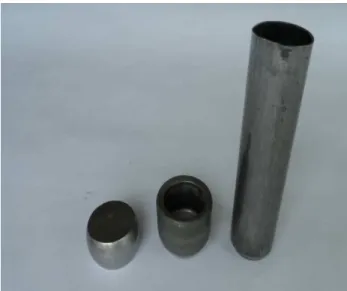
Fig. 1 Tubular piece of steel
Taking into account the drawing of the extruded piece shown in figure 1, the technological elements necessary for the cold extrusion process can be determined, namely:
• The shape of the semi-finished
product;
• The number of extrusion operations.
(Fig. 1). The work drawing specifies the achievement of this part from steel, grade S20A. The shape and the dimensions of the part, as well as the series of production to be obtained (Process production) recommends its achievement by cold reversed extrusion.
2. TECHNOLOGICAL PROCESS
Based on the above analyzed aspects, the following technological process was drawn up for the part “tube” (Fig. 1), extrude from steel grade S20A.
1. Semi-finished product cutting (fig. 2)
Fig. 2 The initial blank, material S20A
Equipment: Vertical press with feeding mechanism J-23-80, Press PA163;
Tool: Precision shearing device
Material: High quality carbon steel Ø24+0,05 0
grade S20A.
2. Plate flattening (fig. 3).
Equipment: Horizontal press D101 (13,25 kW); Tool: Buffer
Utilaj: Presă verticală cu mecanism de alimentare J-23-80, presă PAI63;
Fig. 3 Flattened blank
3. Flattened blanks annealing.
Equipment: Rotary electrical oven EBNER; Verification Parameters: 145 HB or 200 HV0,1,
4. Flattened blanks surfaces treatment (fig. 3)
The method which allowed application of cold extrusion of the steel and the best results were obtained, and today is unanimously used is the procedure of phosphating.
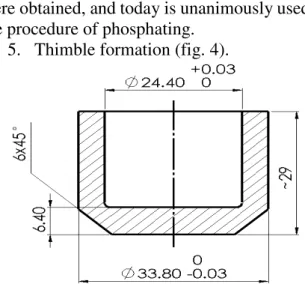
5. Thimble formation (fig. 4).
Fig. 4. Geometrical shape of thimble
Equipment: Horizontal Press: F=200 tf. Blank: Phosphating plate
Automatic feed with semi-finished products on the trough of the machine. On the internal and external surface of the phosphating thimble there are not allowed scratches, impressions or other kind of defects.
6. Flushing and drying Equipment: Flushing – drying unit.
7. Annealing
The conditions of position 3 of the technological route will be observed.
8. Phosphating
The methodology from position 4 of the technological route will be applied.
9. Extension of the thimble through extrusion (fig. 4)
The flow of the material in the sections of the extruded product does not occur uniformly. Less intensive occurs towards the contact surface between the material and the tools, respectively in the area where friction forces are created and thus tangential components, and between the mandrel and the extrusion plate, where the influence of the tangential strains decreases, the flow is produced with greater intensity.
10.Flushing and drying
Equipment: Flushing – drying unit
EXTRUSION
The sequence of operations is the most important phase in the design of an extrusion processing technology (fig. 5).
Fig. 5 The sequence of operations at the extrusion of a tubular piece
Based on the sequence of the extrusion operations, there is the possibility that a calculation of the economic efficiency can be made from the conception phase. So, in this phase it can be ascertained whether the extrusion process is economically efficient, or if it is appropriate to apply another process.
As informative data, can be taken into consideration the recommendations from the specialty literature [2], [4] for the extrusion of the tubular pieces with small diameter, it recommends the mass production and the process production.
Mass production is specific to the technologies which represent a huge volume of production and a much reduced schedule.
The process production is characteristic for the processes which have a very great volume of production and a very small schedule (in many cases, pnly one type of product is manufactured).
4. THE EXPERIMENTAL RESULTS
REGARDING THE REVERSED EXTRUSIONOF TUBE WITH SMALL DIAMETER
The technological process of extrusion mainly comprises three operations:
● the preparing of the semi-finished part;
● the extrusion itself;
● the post-extrusion machining of the parts obtained.
All the extrusion processes have as goal the changing of the shape and dimensions of the half-finished product, in order to approach and superpose these with the shape and dimensions (theoretical) of the piece established before. The more accurate is this superpose the greater is the accuracy of the processing through extrusion.
From practical point of view, achievement of an absolute coincidence between the extruded piece and the designed and materialized pattern through the work drawing is not achievable. Due to some objective factors, deviation from the theoretical shape are registered, called “geometrical and dimensional deviations”.
The three dimension measurement represents today an indispensable technique for insuring the quality for the tubular extruded pieces and so, the competitiveness of the companies on the market. Practically it is impossible to imagine the presence on the market which don’t have a certification of conformity which can be obtained in the present only by measurements with three dimension measurement equipment of the pieces.
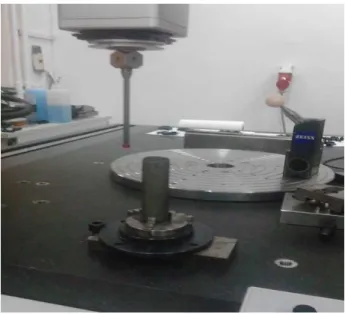
Any coordinate measurement machine (fig. 6) is based on use of four technological elements, which are:
• Mechanical structure (high accuracy); • Data control and processing system; • Feeler system;
Fig. 6. Coordinate measuring machine
The geometry of the piece which is going to be measured (fig. 7) is a decisive factor in configuring the feeler system which will be used.
7. Geometry of the tubular shape pieces which are to be measured on (MMC)
The dimensional accuracy
Measurement of the diameter of a bore (fig. 6) can be reduced from cylinder to a circle (which leads to reduction of the measurement time), when we are interested in the diameter and the position.
After the center of the circle is determined, is possible to program the machine for the measurement of the distance between the 2 points of the circle, 24 points were chosen (fig. 8).
Fig. 8 Local diameters measurement on MMC
Through feeling of the actual profile the coordinate points 1, 2, 3… 24 (fig. 8) are acquired. Through these points the Software of the MMC draws the most adjacent circle (ideal).
The measurement on MMC of the bores of the pieces in figure 7, contain:
a) Method:
- the axes of the cylindrical bore is defined; - more perpendicular planes are built on the axes and the feeling of the points from the intersection contours with the planes of the surface to be measured is realized (theoretically circular) (fig. 9).
At each assembly of points will be associated a circle. The couple of points which belong to the surface and will be aligned with the center of the circle.
- construction of a cylinder inside the base of the felt points assembly
9. The principle of measurement of the internal and external diameter of the pieces in figure 7:
For each assembly of points a circle will be associated. The couples of points belonging to the surface will be defined and they will be aligned with the center of the circle:
- construction of a cylinder inside the base of the felt points assembly.
b) Procedure:
- the bore as well as the cylinder re measured; - the plane PL2 is constructed, the circle is palpated in 24 points;
- proceed exactly as above for PL3 … PL5.
Extruded surfaces roughness
The roughness of the extruded surfaces is defined as the assembly of irregularities which a form the relief of the real surface and whose pace is relatively small in respect to its depth.
Provision of the roughness parameters is an essential problem, with implications in what concerns the correct function of the respective piece, but also upon their manufacturing costs. When providing a roughness for a surface must be taken into account the functional role of the respective surface, the dimensional tolerances, at last but not at least the possibility of execution.
Choose of roughness must be done in close relation with the degree of accuracy of the bore, the influence of the roughness being greater as the degree of accuracy is smaller.
Value of roughness has a direct influence upon the lifecycle, the surface irregularities being primer for squeeze, cracking or corrosion. Maximum value of the roughness can reach up to 20% from the dimensional tolerance [3].
The roughness of the tubular extruded pieces and of the half-finished products was measured with an apparatus of Mitutoyo surftest type SJ-301 from the endowment of UTC-N. The measurement of the extruded pieces (fig. 7) was performed on the external surfaces as well as on the internal surfaces.
At tubular pieces the external surface is generally more rough as the internal surface.
From the figure 7 results that the external surface roughness, Ra = 0,25 µm is greater as the roughness of the internal surface,
Ra = 0,21 µm, i.e. the phosphating and the lubricating were adequate.
When providing the roughness for an internal or an external extruded surface the functional role of the respective surface, the dimensional tolerances will be taken into account, and at last but not at least the possibilities of execution.
The accuracy of the walls of the extruded piece
The modification of the material thickness at the tubular extruded pieces from steel occurs as well as on the longitudinal section of the piece, as on the transverse section (fig. 7). Ion principle, at extrusion, variation of thickness in longitudinal section is given by the deviation of the thickness.
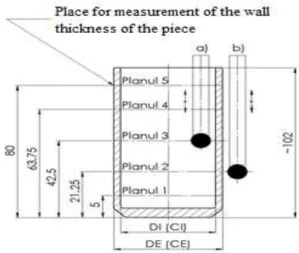
Determination of the wall thickness variation of the extruded piece on the height of the piece was performed on MMC by measurement on the directory of the extruded piece in interior and exterior, by scanning, according to figure 10.
Fig. 10 Measurement principle of the wall thickness of an extruded piece: a) Measurement of the internal radius Ri; b) Measurement of the external radius Re.
With the help of the measured points is determined in equally distant planes the external radius (Re) and the internal radius (Ri).
5. CONCLUSIONS
The creation of a technological process of extrusion is made according to the drawing of the finite part and to the mechanical characteristics of the material.
Metal deformability through extrusion is influenced by: the mechanical characteristics of the extruded metal, the chemical composition, structure, deformation conditions, temperature, material deformation speed and ratio, state of stress and deformation scheme.
In comparison with other technological procedures, the process of reversed extrusion provides a high efficiency, a high grade of material use and reduction of the work volume. Also, due to the hardening of the extruded material of the achieved tubular pieces present better mechanical characteristics and a higher accuracy.
The roughness of the extruded piece depends on the half-finished product surface preparation, the quality of the active elements surfaces, the structure of the material and variations of section.
Determination of the wall thickness variation of the extruded piece on the height of
the piece was performed on (MMC) by measurement on the directory of the extruded piece in interior and exterior.
From the results of the measurements performed on (MMC) the following conclusion can be drawn:
- the quality of the measured object, for example if the piece is conform or not conform and if can be rectified;
- the parameters of the extrusion process; - capacity of the supplier to extrude products with the required characteristics.
6. REFERENCES
[1] http://www.deform.com/products/deform-2d/2d-brochure.pdf.
[2] Bejinariu,C. Extrudarea indirectă la rece a oțelului. Editura Tehnopres, Iași 2008. [3] Tăpălagă,I.,ș.a. Extrudarea metalelor la rece.
Editura Dacia Cluj-Napoca, 1986.
[4] Crișan,L. Metode modern de măsurar. Editura Dacia, Cluj-Napoca, 2004.
[5] Socaciu, T. Cold Reverse Extrusion of Metals. ”Petru Maior” University Publishing House Targu Mures, 1998
Cercetări privind extrudarea inversă a tuburilor metalice cu pereți subțiri
Rezumat: Cercetările experimentale au cuprins: realizarea unor piese tibulare prin extrudare; măsurarea durității; măsurarea dimensiunilor; controlul formei geometrice a pieselor extrudate pe (MMC). Domeniul cel mai larg de piese relizabile prin extrudare inversă îl formează piesele tubulare, dar se pot realiza și alte forme.
Petru Paul DINCU, Ph Student, Eng., Technical University of Cluj-Napoca, Department of Manufacturing Engineering, 103-105 Muncii Blvd, 400641 Cluj-Napoca, Romania, E-mail: [email protected], Phone: 0040 730020411
Gheorghe ACHIMAȘ, Prof. Dr. Eng., Technical University of Cluj-Napoca, Department of Manufacturing Engineering, 103-105 Muncii Blvd, 400641 Cluj-Napoca, Romania, E-mail: [email protected], Phone: 0040 264 401 731
Marius BULGARU,Prof. Dr. Eng., Technical University of Cluj-Napoca, Department of