Socialinės technologijos/Social Technologies
Mykolo Romerio universitetas, 2015
Mykolas Romeris University, 2015
ISSN 2029-7564 (online)
https://www.mruni.eu/lt/mokslo_darbai/st/apie_leidini/ https://www.mruni.eu/en/mokslo_darbai/st/apie_leidini/index.php
SOCIAL TECHNOLOGIES 2015, 5(1), p. 7–21
USE OF INFORMATION AND COMMUNICATION
TECHNOLOGY IN THE STUDY PROCESS:
TEACHERS’ EXPERIENCE
Valdonė Indrašienė
Mykolas Romeris University, Lithuania, [email protected]
Leta Dromantienė
Mykolas Romeris University, Lithuania, [email protected]
Erika Bielskytė-Simanavičienė
Mykolas Romeris University, Lithuania, [email protected]
doi:10.13165/ST-15-5-1-01
Abstract
Aim: To analyse teachers’ experience in applying information communication technologies (from now on referred to as ICT) during the study process.
Methodology:The analysis is based on a qualitative research methodology determi-ned by the novelty of the problem under analysis. Six teachers of the University X (facul-ty Y) participating in the study were selected by applying a random sampling procedure and were interviewed by using the semi-structured interviews.
Results: The research revealed that the use of ICT in the study process is still fra-gmented due to the lack of the teachers` ICT competence and to teaching priority given to direct communication. Because of the lack of higher level competence in ICT necessary for the efficient use of ICT tools in the study process, teachers as a rule resort to limited opportunities to increase the attractiveness of the process.
Practical significance: the research revealed problems faced by the university tea-chers in applying ICT during the study process. Identification of problems will facilitate a more efficient use of ICT in the study process, as well as the development of teachers’ qualification.
Originality and value: the research provided more information on teachers` com-petence in using ICT.
Keywords: ICT competence, higher education institution, innovative activity, effective teaching/ learning, virtual environment.
Type of research: research paper.
Introduction
Rapidly changing public life patterns, continual changes in the structure of social and economic system and ICT developments impose new challenges on education and education related processes, and cause fundamental changes in learning environments. A smart learning environment is effective, efficient and engaging (Merrill, 2013; Spector and Merrill, 2008); it makes use of adaptive technologies; or it is designed to include innovative features and capabilities that improve understanding and performance (Spector, 2014).
In the Digital Agenda for Europe the European Commission is promoting various initiatives aimed at increasing training in digital skills; modernising education across the EU; harnessing digital technologies for learning. The value of ICTs in supporting the learning and teaching process and increasing the capacities of students and teachers is well understood in Member States.
National governments make educational policy decisions related to managerial factors and engage educators in the process of transformation of the educational paradigm. Policy actions are needed for supporting the co-development of open and flexible content and curricula that allow innovative teaching and learning practices made possible by the use of ICT, to flourish and become mainstream (Brečko et al., 2014). Within the context of a new educational paradigm, ICT integration plays a crucial role in ensuring effective and efficient teaching/learning processes. It was established that using MOOC and OLI courses in hybrid formats, faculty was able to achieve the outcomes comparable to traditionally taught sections with, on average, considerably reduced class time (Griffith et al., 2014).
Tuzhilin (2005), new developments must “include, among others, the improved modelling of users and items, and incorporation of the contextual information into the recommendation process”.
Being a part of the education system, higher education institutions go hand in hand with public changes determined by the developing academic, information and technological environment and market economy (Stasiulionienė and Jucevičienė, 2004). Experts predict that this “perfect storm” (Mayberry, 2011) requires a transformation in higher education practices to make a quality postsecondary education affordable (Christensen et al., 2011), relevant, accessible and desirable.
The structure of a current higher education institution is inconceivable without the learners equipped with the effective ICT tools and measures which are the attributes of an effective university (Fabunmi, 2012), as well as without an interactive study system which is a combination of interactive information communication technology, didactic measures and their application technology. More open educational projects are emerging in the educational institutions of many countries (Wiley, 2007).
According to the researchers investigating changes in the study processes, higher education institutions shall get adjusted to the changing needs of society (Mahmood, 2009). Study change processes determine modifications in higher education institutions which will transform teaching/learning practices. Thus, “future development should concentrate on the transformation of teaching and learning practices to better meet the challenges of modern society” (Ilomäki, 2008: 68). Application of ICT tools stipulating changes in the model of the pedagogical system determined by a new paradigm, is analysed by foreign (Anderson, 2005; Sessoms, 2008; Ross et al., 2010; Eid Al Harbi, 2014) and Lithuanian (Jucevičienė, 2005; Gudelienė-Gudelevičienė and Kaušylienė, 2006; Čiužas and Navickaitė, 2011; Dagienė and Žilinskienė, 2011 etc.) researchers. They emphasise numerous possibilities afforded by ICT: attraction of students, their engagement in the interactive teaching/learning, development of self-sufficiency skills; besides, ICT encourages students to seek, discover and celebrate cognition joy and to increase efficiency of the teaching/learning process.
The aim of the research: to analyse teachers’ experience in applying ICT during the study process.
Methods of the research: analysis of scientific literature, data analysis, semi-structured interview, content analysis, processing and consolidation.
1. The role of the teacher in the context of innovative activity
The role of teachers as knowledge society builders is related to their scientific activity whilst understanding that higher education institutions should pursue not only fundamental or applied research but also develop new methodologies, foster innovation and educate society (Rastauskienė et al., 2008). In view of this, teachers`work is defined through major activities and is related to the production, transmission and dissemination of knowledge (Havelock and Hamilton, 2004); teachers’ activity is defined by the three main composite parts: pedagogical, scientific and dissemination activity.
Changing environment of higher education and educational paradigm, as well as ICT developments, determine the emergence of modern education content, new methods and strategies and innovative attitudes. It is agreed that efficient use of these teaching/learning components depends on the teacher`sfunction. Therefore, in order to create a modern and interactive study system in compliance with the needs of a contemporary society, it is necessary to increase the level of the teachers’ ICT competence and prepare teachers for driven growth. Usually innovation-driven and competent teachers give preference to the educational paradigm reflecting a democratic teaching style, the ability to use ICT as interactive learning, the use of various teaching/learning methods and tools contributing to the development of favourable educational environment. Electronic learning environments are rational systems which take a lot of work off teachers’ shoulders. Teachers must know and keep abreast of the programmes that are available and suitable for their students’ individual needs. They need to be the managers or planners of students’ learning processes: they bring together the educational tools and set them up in a particular way. (Zhu, 2010). ICT, the usage of smart educational products help teachers bring more collaboration and interactivity into the classroom. Teachers can quickly incorporate them into their teaching, to transform student learning and increase engagement. It means that in the constantly changing higher education system teachers and their function are exposed to new challenges and new demands.
the initial emergence of an idea to the final result; close interaction between the organisation and its macro-environment, which is usually analysed in the context of technological innovations (Luckin et al., 2012). In view of this, innovative activity is treated as the generation of new ideas, innovation, modification, and the process creating new services and methods. ICT, the use of smart educational products can help teachers bring more collaboration and interactivity into the classroom. Teachers can quickly incorporate them into their teaching, to transform student learning and increase engagement.
In the rare cases, the concept of innovative activity could be found in the context of social innovations. In this respect, the focus is given to the development, search for, adoption, implementation, dissemination, evaluation and communication of innovations. Thus, social innovations highlight the three core dimensions: satisfaction of human needs (content dimension), social relations, social inclusion (process dimension), and better opportunities for socio-political activity and access to resources (empowerment dimension) (Butkevičienė, 2009).
Innovative activity of teachers of the higher education institution is treated as a process specifically directed toward the establishment, adoption, implementation and application of educational innovations at different stakeholders’ levels aimed to improve the educational systems, and is related to various innovation implementation stages,e.g. innovation building and implementation of new technological processes (Bastic and Leskovar-Spacapan, 2006). According to the researchers, teachers’focus on a search for a new information, knowledge, methods and new measures. Thus, innovative activity is related to the innovative aspects contributing to the creation of new ideas. Over time, this activity brings unique, innovative achievements (Shavinina and Seeratan, 2003), and this is a step forward toward innovations and willingness to change.
In conclusion it could be said that the ambition of a contemporary higher education institution to pursue high-level intellectual activity, create knowledge society and help students to work and live in the knowledge society environment depends on the teachers` readiness to implement innovations in the pedagogical, scientific and dissemination activity.
2. Premises for ICT application in the study process
Rapid technological change, increasing amounts of information and transition to a knowledge and information society determine the importance of information literate individuals and management of information abilities and skills.
In order to ensure a successful study process and provide excellent learning conditions for students and for knowledge creation/sharing, it is very important to provide a favourable environment for studies: each education institution shall provide optimal opportunities for students and equip them with the necessary tools, support and information. According to V. Indrašienė and O. Merfeldaitė (2011), development of the current education system is an integral part of ICT integration in the education development process. The ICT-based teaching andlearning environment suggests a new type of the educational environment, i.e. a virtual teaching and learning environment defined as an IT-based educational system where the primary interaction is between the learners and teachers.
Thus, implementing ICT in the study process to provide high-quality studies, the focus is on a study-friendly environment providing for personal development, promoting positive attitude towards learning, increasing confidence and self-trust, enhancing motivation and close communication between teachers and students. A particular emphasis is given to the collaborative online learning presenting new challenges and opportunities for teachers and students (Baker, 2011).
In literature the ICT concept is defined as a set of digital means and tools which, in pursuance of educational objectives, facilitate creation, accumulation, protection, transformation and dissemination of information (Buabeng-Andoh, 2012), and as a computer system including hardware, software, data, procedures and human individuals (Markauskaitė, 2000).While speaking about the ICT concept, Markauskaite indicates that the main element is a computer (hardware, software and digital devices) and computer-based human and organisational aspects. Besides, the author emphasises that ICT should also be perceived as a certain environment. In summarising the above ICT concept, V. Brazdeikis (2009) highlights the following elements of ICT: computer-based environments, and means andprocesses used in these environments. According to the author, people and information are key players in these environments.
However, competent pedagogues are nearly the most important factor determining efficient use of ICT in the study process (Eid Al Harbi, 2014). They are able to create, interpret and use information in their daily activity; they are responsible for quality and outcomes of their work; they can independently identify and solve problems and pursue continuous qualification development.
resources and educational methods increasing students` motivation to participate in the educational activity facilitating educational process and improving performance results (Mullen and Wedwick, 2008). It is important to note that new technologies do facilitate the process of learning, yet the improvement is possible only when they are used properly by qualified teachers, in due time and in the appropriate environment. Thus, for teachers it is not enough to be able to use ICT tools; they should also apply these tools adequately during the study process. In view of this it is necessary to focus on teachers’ educational ICT competence. According to F. A. Fabunmi (2012), it is not enough for teachers to have relevant technological knowledge and skills; educational ICT application skills are also crucial.
Meta-learning competence plays the central role in the structure of teachers’ educational competence (Stasiulionienė and Jucevičienė, 2004); it empowers teachers to become learners in order to ensure effective learning of other individuals, and to share new knowledge with the society.
In view of this, adequate meta-learning competence empowering teachers to become learners and encompassing educational and ICT competence can determine development and achievement of high-level educational ICT competence.
When integrating ICT in the study process, it is especially important to have major subject and ICT integral educational competence. Thus, the method of ICT usage is determined both by teachers’ knowledge of own subject and knowledge of ICT possibilities.
3. Methodology of the research
The research was performed in August - September 2014. The respondents could use different ways of answering: they could provide answers by email or face-to-face during an interview. The account was taken of respondents’ personal experience and their individuality providing a detailed and extensive picture of the situation. The focus was not on the spread of the phenomenon, but to the understanding of particular cases providing for “movement” toward new research areas, better understanding of respondents` attitudes and life priorities (Bitinas, 2010).
Six teachers of University X (Faculty Y) were selected by applying a targeted random sampling. Since there were multiple informative population units, several options have been chosen, and a smaller sample established. The data has been collected until a certain degree of theoretical “satiation” has been achieved.
The research was aimed to evaluate teachers` readiness to integrate IT tools in the teaching/learning process and their experience in applying these tools for different purposes.
attached to the sequence of questions or anticipated words, and to freely change their order (Flick, 2009). Besides, the method of a semi-structured interview induced a more relaxed communication atmosphere, better adjustment to the research environment, and provided information contributing to an in-depth discussion of the problem of analysis. Selection of this method was determined by the possibility to get a detailed picture of the problem, identify causes of the phenomenon under analysis, and reveal subjective respondents’ views and experiences.
The data obtained via a semi-structured interview was analysed by applying the method of a descriptive analysis (interpretation, contact identification) which included the following stages: multiple text readings and specification of categories via keywords: division of category content into sub-categories, interpretation/substantiation of categories/sub-categories from the text evidence (Creswell, 2013). The analysis of teachers` skills and their readiness to apply ICTs in the study process was based on the humanistic personality theory. It served as the basis for the analysis of the teachers’ role in the process of ICT implementation taking the firm view that every human being is a unique, organised and ever-changing personality aimed to create the future and realise own powers. In order to highlight a special nature of the above phenomenon and interpret it as a subject of conscientious individuals’ experience, the reference was made to phenomenology. In the context of this research, phenomenological research design allowed to analyse personal respondents’ experience and get acquainted with the teachers’ evaluation of the situation.
A quantitative expression of answers, i.e. the number of teachers attributed to one or another category or sub-category was not estimated. It was considered that the opinion of each respondent was unique and valuable.
The following ethical principles were applied during the research: voluntary approach, goodwill, privacy and respect. In order to ensure confidentiality of respondents, their names have been replaced with codes.
Research outcomes. Analysis of the data obtained during the research revealed the following main categories: diversity of the applied measures, purpose of application; teaching/learning in the virtual environment, and application problems establishing teachers` experience in applying the ICT during the study process.
Participants of the research identified few ICT measures most often used during the study process (Table 1): computer, overhead projector, mobile phone and internet.
Table 1. Diversity of ICT tools used in the study process
Sub-category Supporting statements
Computer and
overhead projector “without any doubt, slides with pictures (sometimes with examples, some-times with video material) <...> just slides, I use them during lectures” [A] “Internet, demonstration software” [B]
“During the study process I use exceptionally computer rooms, computers and overhead projectors. I don`t use any other tools” [C]
“Review of video, video materials,records; filming and review of team work” [A]
Mobile phone “mobile phones” [B]
“you reminded - taking photographs as slides, by phone <...> I can provide statistics right now, slides have been shot, some of them, by about three persons” [A]
“to find information somewhere, in the phone or iPad” [C]
Internet “in order to accomplish the task it is necessary to search for information on the internet” [B]
“Internet <...> email, social networks – if I understand what you are asking” [B]
It was established that most often the respondents use internet, computer and overhead projector. At the same time, it is necessary to note that when using the above ICT tools teachers take all opportunities provided by these technologies.
Students also use mobile phones during the study process. Usually, these tools are necessary for the search of information or slide-making; yet, according to the respondents, the latter is not very popular among students.
In highlighting the use of ICT tools in the study process, it is necessary to focus on a scarce selection of technical tools and their usage. It could be assumed that teachers are not inclined to promote IT tools in the study process. Besides, according to respondents, students are also reluctant to use these tools for learning purposes:
“During the seminars I encourage students to bring computers <...> but only few students bring them along <...> they don`t use computers <...> they do have a possibility but only
few of them use computers” [A].
Although the selection of ICT resources in the study process is limited, their application is quite diverse (Table 2). ICT tools are used as one of the means for students` activation and inclusion in the study process with the aim to present teaching material and make this material visual.
The scientific literature (Vilkonienė, 2009) highlights that ICT tools can help achieve better teaching/learning results even if they are used as a visual measure, because visual presentation of information is more easily memorised and it has a major impact on learning abilities.
Table 2. ICT application purposes in the study process
Sub-category Supporting statements
Activation and involvement of students
“During lectures this is an activation measure, the main objective <...> used at the very beginning, in the form of questions, a topic suggestion” [A]
“to make students interested... by using active (whatever) symbols”[C] Presentation of
material “for presentation of lecture material” [C]“PowerPoint, PowerPoint presentations” [D] “various slides, presentations” [E]
Visuality of
pre-sented material “coordinate images and sound; quite often; the presentation is coordination of image and sound, isn‘t it?” [D] “highlighting some visual tools” [A]
Search for and analysis of information
“it is meant for the analysis, situation analysis when students themselves are learning to evaluate and recognise” [A]
“When I need to find and specify information” [C]
“Search for information to accomplish the tasks; just for information” [B] The research revealed one more objective of ICT application in the study process – search for information and analysis.
The analysis of the scientific literature revealed that modern ICT tools provide numerous teaching and learning opportunities and flexible teaching and learning forms; one of them is teaching and learning in the virtual environment. When speaking about the possibilities for the use of ICT in the study process, teachers provide their subjective experience of the organisation of teaching/learning in the virtual environment. According to the analysis of the research outcomes, this experience, includes the implementation process and non-applicability of learning in the virtual environment (Table 3).
Table 3. Teaching/learning in the virtual environment
Sub-category Supporting statements
Implementation
process “I try to update material and tasks, inform on changes, provide feedback and evaluate” [B] “Learning in virtual environment seems to be clear in a broad sense – definitely not [not realised, auth.]”[C]
“Students are present in the auditoriums although they have all the material in the Moodle environment” [C]
Teaching/ learning in virtual environment is not applicable
“Virtual environment hinders the process <...> we are deprived of the communication and cooperation moments <...> difficult to realise as is the case when you have direct contact hours with students; the extent of learning when there is communication between teachers and students, or among students during lectures” [A]
“To my mind, learning in the virtual environment is not appropriate for social work students <...>
“It is not the right tool for counselling, communication, concentration or empathy” [F]
According to the research, implementation of the teaching and learning process in the virtual environment is related to the presentation of study materials and tasks in the Moodle system. After implementation of teaching and learning in the virtual environment students get feedback: they are evaluated and informed on the achieved progress. Whereas literature (Dagienė, 2003) highlights that the entire education process takes place in the virtual environment including presentation of study materials, course curriculum, communication, discussions, accomplishment of practical tasks, and organisation of teamwork. Afterwards, the acquired knowledge and abilities are evaluated via computer-based tests.
When organising teaching and learning in the virtual environment teachers realise only some of the composite parts of teaching and learning in the virtual environment: “In a broad sense learning in the virtual environment is not realised; certainly not [not implemented, auth.]” [C].
In indicating the reasons of non-applicability of teaching/learning in the virtual environment, teachers emphasise the importance of direct cooperation and
communication. According to informants, during the teaching/learning process it is
crucial to supervise students and provide timely feedback in order to make appropriate corrections. According to informants, learning in the virtual environment cannot provide this possibility.
Informants provided other reasons of non-applicability of teaching andlearning in the virtual environment: possible technical problems, insufficient quality of
consultations. They also indicated that it is more difficult to concentrate or reveal
emotional state in the virtual environment. This is in line with the research (Januszewski and Molenda, 2008) results showing that pedagogues are still afraid to work in the virtual environment because they are not fully aware of the specific technological issues. They also highlight that it is very difficult to go hand in hand with the rapidly developing technologies.
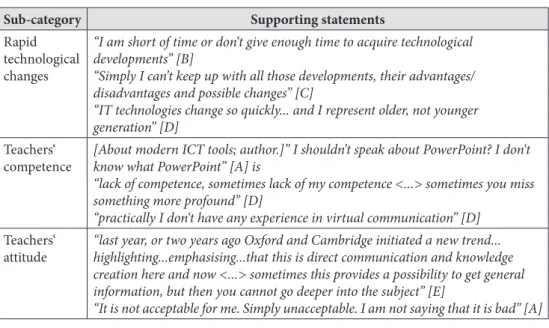
According to the analysis of the use of IT tools in the study process, IT integration in the teaching and learning process is not sufficiently developed and is a not-so-common phenomenon. Regarding the use of the above tools, the informants mentioned the problems preventing from application of technologies and the use of their opportunities (Table 4): rapid technological developments, teachers` competence, and teachers` attitudes.
Table 4. Problems in applying IT tools in the study process
Sub-category Supporting statements
Rapid technological changes
“I am short of time or don‘t give enough time to acquire technological developments” [B]
“Simply I can’t keep up with all those developments, their advantages/ disadvantages and possible changes” [C]
“IT technologies change so quickly... and I represent older, not younger generation” [D]
Teachers‘
competence [About modern ICT tools; author.]” I shouldn’t speak about PowerPoint? I don‘t know what PowerPoint” [A] is “lack of competence, sometimes lack of my competence <...> sometimes you miss something more profound” [D]
“practically I don‘t have any experience in virtual communication” [D] Teachers‘
attitude “last year, or two years ago Oxford and Cambridge initiated a new trend...highlighting...emphasising...that this is direct communication and knowledge creation here and now <...> sometimes this provides a possibility to get general information, but then you cannot go deeper into the subject” [E]
“It is not acceptable for me. Simply unacceptable. I am not saying that it is bad” [A]
Since it is difficult to manage properly and use ICT due rapidly changing/ developing technologies, lack of competence is a major problem in applying ICT in the teaching/learning process.
Analysis of the research revealed that successful application of ICT in the study process is determined by a negative teachers` attitude toward new technologies: “In the virtual learning environment I always have doubts: probably I didn’t try this or that,
maybe I don’t have enough experience...I have a feeling that I can`t do this” [A].
Although respondents don`t firmly deny the benefit of technical tools in the teaching/learning process (“I don`t say that this is bad” [A]), they highlight that this is unacceptable for them: “For me this is unacceptable” [A] and add that “direct
communication and knowledge creation here and now” is more important for them
[E]. According to them, “other (Oxford, Cambridge) universities also give priority to direct communication.”
Conclusions
The changing higher education environment, changes in the educational paradigm and development of information technologies determine the need for innovation-driven teachers with high-level of communication competence. Contemporary teaching and learning trends reflect the transition from conventional to the non-conventional innovative teaching methods promoting interactive learning forms, active engagement of students and integrative thinking methods, the application of which requires ICT and e-learning environment.
virtual environment is occasionally organised due to the priority given to direct communication and due to the lack of ICT competence.
Teachers do not deny benefits of ICT tools, yet, due to the lack of ICT competence necessary for an efficient use of technical tools in the teaching and learning process, they mostly use computers, overhead projectors, mobile phones and the internet. The purpose of ICT usage during the studies is directed toward the organisation of process (attractiveness of study material, student activation) rather than to the curriculum studies.
References
Adomavicus, G, Tuzhilin, A. Toward the next generation of recommender systems: a survey of the state-of-the-art and possible extensions. Knowledge and Data Engineering, IEEE Transactions on. [interactive]. 2005. 17(6) : 734-749. [accessed 2015-02-28] <http://web.stanford. edu/class/ee378b/papers/adomavicius-recsys.pdf>
Anderson, J. IT, e-learning and teacher development. International Education Journal. [interactive]. 2005. 5(5) : 1-14. [accessed 2015-02-22] <http://files.eric. ed.gov/fulltext/EJ903883.pdf>.
Bastic, M., Leskovar-Spacapan, G. 2006. What do transition organizations lack to be innovative. Kybernetes. 35(7/8) : 36-45. Baker, R. Pedagogies and Digital Content in
the Australian School Sector. [interactive]. The Le@rning Federation, Education Services Australia 2011. [accessed 2015-02-28] <http://www.ndlrn.edu.au/verve/_ resources/ESA_Pedagogies_and_Digital_ Content_in_the_Australian_School_Sector. pdf >
Brečko, N. B., Kampylis, P., Punie, Y. Mainstreaming ICT – enabled Innovation in Education and Training in Europe: Policy actions for sustainability, scalability and impact at system leve [interactive]. Luxembourg: Publications Office of the European Union,2014. [accessed 2015-02-28] <http://ftp.jrc.es/EURdoc/JRC83502. pdf >
Bitinas, B. 2010. Gyvenimas ugdymo verpetuose. Klaipėda: Klaipėdos universiteto leidykla. Brazdeikis, V. 2009. Informacinėmis ir
komu-nikacinėmis technologijomis papildytų edu-kacinių aplinkų kaita. Informacijos mokslai. 50 : 57-63.
Buabeng-Andoh, Ch. 2012. Factors influencing teachers’ adoption and integration of information and communication technology into teaching: A review of the literature. International Journal of Education and Development using Information and Communication Technology. 8(1) : 136-155. Butkevičienė, E. 2009. Social Innovations
in Rural Communities: Methodological Framework and Empirical Evidence. Social Sciences. 1(63) : 80-88.
Christensen, C.M., Horn, M.B., Caldera L., & Soares, L. Disrupting college: How disruptive innovation can deliver quality and affordability to postsecondary education. [interactive]. 2011. [accessed 2015-03-02]. http://www.americanprogress. org/issues/2011/02/pdf/disrupting_college. pdf
Creswell J. W. 2013. Qualitative Inquiry and Research Design : Choosing Among
Five Approaches. Los Angeles: SAGE
Publications
Čiužas, R., Navickaitė, J. 2011. Ugdymo turinio planavimas ir įgyvendinimas. Pedagogika.
101 : 37-42.
pagrindimas. Informacijos mokslai. 25 : 127-133.
Dagienė, V., Žilinskienė, I. 2011. Mokymosi veiklos samprata skaitmeninėje plotmėje.
Pedagogika. 102 : 94-103.
Digital Agenda in the Europe 2020 strategy. [accessed 2015-03-01]. < http://ec.europa. eu/digital-agenda/en/digital-agenda-europe-2020-strategy >
Eid Al harbi, H. 2014. Towards successful implementation of ICT in education. The 2014 WEI International Academic Conference Proceedings. Vienna (Austria) : 33-45. Fabunmi, F., A. Undergraduate students’
perception of the effectiveness of ICT use in improving teaching and learning in Ekiti State University. In International Journal of Library and Information Science [interactive]. 2012, 4(7) : 121-130 [accessed 2015-02-22] <http://www.academicjournals.org/article/ article1379692777_Fabunmi.pdf >.
Flick, U. 2009. An introduction to Qualitative Research. Fourth edition. SAGE Publications Ltd
Griffiths, R., Chingos, M., Mulhern, Ch., Spies, R. Interactive Online Learning on Campus: Testing MOOCs and Other Platforms in Hybrid Formats in the University System of Maryland. [interactive]. 2014 [accessed 2015-02-28]. <http://sr.ithaka.org/sites/ default/files/reports/S-R_Interactive_ Online_Learning_Campus_20140710.pdf > Gudelienė-Gudelevičienė, L., Kaušylienė, A.
2006. Ugdymo paradigmos virsmas nuo mokymo prie mokymosi. Pedagogika. 82 : 68-72.
Havelock, R., Hamilton, J. L. 2004. Guiding Change in Special Education. How to Help Schools With New Ideas and Practices.
Corwin Press.
High Level Group on the Modernisation of Higher Education. Report to the European Commission on New modes of learning and teaching in higher education. [interactive]. 2014. [accessed 2015-03-01]. <http://www.suhf.se/MediaBinaryLoader. axd?MediaArchive_FileID=ab79b64b-3873-43bd-a148-456b5ff94db3&FileName
=EU+High+level+group+om+modernisati on+of+higher+education_Oct+2014.pdf > Ilomäki, 2008. The effects of ICT on school:
teachers’ and students’ perspectives. Turun Yliopisto : Turku
Indrašienė, V., Merfeldaitė, O. 2011. Inovacijoms palankios mokyklos aplinkos kūrimo prielaidos Utenos savivaldybėje.
Pedagogika. T. 102 : 74-80.
Youssef, B. A.,Mounir, D. The Impact of ICT on Student Performance in Higher Education: Direct Effects, Indirect Effects and Organizational Change. The Economics of E-learning [interactive]. 2008. Revista de Universidad y Sociedad del Conocimiento (RUSC). 5(1) :45-56 [accessed 2015-03-01]. <http://www.uoc.edu/rusc/5/1/dt/eng/ benyoussef_dahmani.pdf >
Januszewski, A., Molenda, M. (2008)
Educational technology: A definition with commentary. NJ: Erlbaum
Jucevičienė, P. Mokytojų didaktinės kompetencijos atitiktis šiuolaikiniams švietimo reikalavimams: tyrimo ataskaita [interactive]. 2005 [accessed 2015-02-22] <http://www.smm.lt/uploads/ documents/kiti/MOKYTOJU_DIDAKT_ KOMPETENCIJOS_ATITIKTIS_%20 SIUOLAIK_REIKALAV.pdf>
Luckin, R., Blight, B., Manches, A., Ainsworth, Sh., Crook, Ch., Noss R.
Decoding Learning: The Proof, Promise and Potential of Digital Education. [interactive]. 2012. [accessed 2015-03-02]. <http:// www.nesta.org.uk/publications/decoding-learning>
Mahmood, K. 2009. Gender, subject and degree differences in university students’ access, use and attitudes toward information and communication technology (ICT).
International Journal of Education and Development using Information and Communication Technology. 5(3) : 206-216 Markauskaitė L., 2000. Kompiuterinių mokymo
formų bendrojo lavinimo mokykloje analizė: daktaro disertacija. Vilnius: Matematikos ir informatikos institutas.
perfect storm. A Conversation Starter RIT Board of Trustees Mee [interactive]. 2011. [accessed 2015-03-02] <https://www.rit. edu/provost/sites/rit.edu.provost/files/ rit_2020_0.pdf>
Merrill, M.D. 2013. First principles of instruction: Identifying and designing effective, efficient and engaging instruction. San Francisco CA : Wiley, John&Sons Mullen, R., Wedwick, L. 2008. Avoiding the
digital abyss: Getting started in the classroom with YouTube, digital stories, and blogs. The Clearing House. 82 (2) : 66– 69.
Rastauskienė, G. J., Kardelis, K., Šeščilienė, I. M. 2008. Aš koncepcija: kognityviojo komponento raiška tarp Lietuvos aukštųjų mokyklų dėstytojų. Acta Paedagogica Vilnensia. 20(3) : 12-31.
Ross, S. M., Morrison, G. R., Lowther, D. L. Educational Technology Research Past and Present: Balancing Rigor and Relevance to Impact School Learning. Contemporary Educational Technology [interactive]. 2010. 1 (1) : 17-35 [accessed 2015-02-17] <http:// aulavirtual.eaie.cvudes.edu.co/publico/ lems/L.000.002.MG/Documentos/Anexos/ Cap3/1.pdf>
Sessoms, D. 2008. Interactive instruction: Creating interactive learning environments through tomorrow’s teachers. International Journal of Technology in Teaching and Learning, 4 (2) : 86-96.
Shavinina, L. V., Seeratan K. L. 2003. On the nature of individual innovation.
International Handbook on Innovation Oxford, UK: Elsevier Science. 31-43.
Simonaitienė, B., Greenrod, G. 2009. Characteristics of Educational Potential Evaluation of Foreign Language Teaching Educational Software. Socialiniai mokslai.
2(64) : 35-42.
Spector, J.M., Merrill ,M.D. (2008) Special issue: Effective, efficient and engaging (E³) learning in a digital age. Distance Education. 29 (2) : 123 -126.
Spector J.M. Conceptualizing the emerging field of smart learning environments. Smart learning environments. [interactive]. 2014, 1:2 [accessed 2015-02-28] <http://www. slejournal.com/content/1/1/2 >
Stasiulionienė, V., Jucevičienė, P. 2004. Edukacinės paradigmos virsmo įgalinimas Utenos kolegijoje: verslo vadybos programos atvejis. Mokslo taikomieji tyrimai Lietuvos kolegijose, 1 : 46–55.
Wiley, D. On the sustainability of Open Educational Resource Initiatives in Higer Education. Paris: OECD, Centre for Educational Research and Innovation (CERI) [interactive]. 2007 [accessed 2015-02-28] <http://www.oecd.org/edu/ ceri/38645447.pdf >
Wheeler S. 2012. Digital literacies for engagement in emerging online cultures.
eLC Research Paper Series. 5 (1) : 14 – 25. Vilkonienė, M. 2009. Informacinių ir
komunikacinių technologijų diegimo ir taikymo švietime įtaka pedagoginės sistemos kaitai: diskurso analizė. Pedagogika. 95 : 126-133
Zhu, Ch. Teacher roles and adoption of educational technology in the Chinese context. Journal for Educational Research Online. [interactive]. 2010, 2 : 72–86 [accessed 2015-03-01] <http://www.pedocs. de/volltexte/2011/4576/pdf/JERO_2010_2_ Zhu_Teacher_roles_and_adoption_of_ educational_S72_D_A.pdf >