Sleep
disordered
breathing
and
fi
broblast
growth
factor
23
in
the
Hispanic
Community
Health
Study/Study
of
Latinos
Rupal
Mehta
a,b,c,⁎,
Xuan
Cai
b,
Alexander
Hodakowski
b,
Bharat
Thyagarajan
d,
Donglin
Zeng
e,
Phyllis
C.
Zee
f,
William
K.
Wohlgemuth
g,k,
Susan
Redline
h,l,
James
P.
Lash
i,
Myles
Wolf
j,
Tamara
Isakova
a,baDivisionofNephrologyandHypertension,DepartmentofMedicine,NorthwesternUniversityFeinbergSchoolofMedicine,Chicago,IL,USA
bCenterforTranslationalMetabolismandHealth,InstituteforPublicHealthandMedicine,NorthwesternUniversityFeinbergSchoolofMedicine,Chicago,IL,USA cJesseBrownVeteransAdministrationMedicalCenter,Chicago,IL,USA
dDepartmentofLaboratoryMedicineandPathology,DivisionofMolecularPathologyandGenomics,UniversityofMinnesota,Minneapolis,MN,USA eDepartmentofBiostatistics,UniversityofNorthCarolinaGillingsSchoolofGlobalPublicHealth,ChapelHill,NC,USA
fDivisionofSleepMedicine,DepartmentofNeurology,NorthwesternUniversityFeinbergSchoolofMedicine,Chicago,IL,USA gDivisionofNeurology,BruceW.CarterDepartmentofVeteransAffairsMedicalCenter,Miami,FL,USA
hDivisionofSleepandCircadianDisorders,DepartmentofMedicine,BrighamandWomen'sHospital,Boston,USA iDivisionofNephrology,DepartmentofMedicine,UniversityofIllinoisatChicago,Chicago,IL,USA
jDivisionofNephrology,DepartmentofMedicine,DukeUniversity,Durham,NC,USA
kDivisionofPsychology,BruceW.CarterDepartmentofVeteransAffairsMedicalCenter,Miami,FL,USA lDivision of Sleep and Circadian Disorders, Department of Neurology, Brigham and Women's Hospital, Boston, USA
A R T I C L E I N F O
Keywords:
Fibroblast growth factor 23 Hypoxia
Sleep disordered breathing Chronic kidney disease Osteocyte
A B S T R A C T
Preclinical data suggest that hypoxia stimulatesfibroblast growth factor 23 (FGF23) transcription and cleavage in osteocytes, resulting in elevated circulating c-terminal (cFGF23) levels but normal intact FGF23 (iFGF23) levels. We conducted a case-control study within the Hispanic Community Health Study/Study of Latinos to investigate whether sleep disordered breathing, as a model of hypoxemia, is independently associated with elevated cFGF23 levels in the general population and with elevated cFGF23 and iFGF23 levels in patients with chronic kidney disease (CKD), in whom FGF23 cleavage may be impaired. Cases (n = 602) had severe sleep disordered breathing defined as an apnea/hypopnea index (AHI) of≥30. Controls without severe sleep dis-ordered breathing (n = 602) were matched for sex and CKD stage. The median AHI in the cases was 45.8 (IQR 35.5–62.5) compared to 2.6 (IQR 0.6–8.2) in the controls. Cases had higher cFGF23 levels than controls (66.2 RU/mL, IQR 52.8–98.4 vs. 61.2 RU/mL, IQR 49.5–80.1, p value < 0.001). There were no differences in iFGF23 levels between cases and controls. In adjusted linear regression and multinomial regression analyses, body mass index attenuated the relationship between severe sleep disordered breathing and cFGF23 levels. No significant relationships were seen in analyses of severe sleep disordered breathing and iFGF23 levels or in analyses of iFGF23 and cFGF23 stratified by CKD status. Additional studies using other models of intermittent and chronic hypoxia are needed to confirm whether hypoxia stimulates FGF23 transcription in humans and to determine the impact on iFGF23 levels in CKD.
1. Introduction
Fibroblast growth factor 23 (FGF23) is an osteocyte-derived hor-mone that regulates systemic phosphate and vitamin D homeostasis [1]. Chronic kidney disease (CKD) represents the most common setting of
secondary FGF23 excess. FGF23 levels rise early in CKD and FGF23 levels may be thousands-fold higher than in CKD by the time end stage renal disease occurs [2]. Preclinical data demonstrate direct toxic ef-fects of FGF23 on cardiac myocytes through activation offibroblast growth factor receptor 4 [3,4]. Results from observational studies are
Abbreviations:FGF23,fibroblast growth factor 23; cFGF23, c-terminalfibroblast growth factor 23; iFGF23, intactfibroblast growth factor 23; CKD, chronic kidney disease; HCHS/SOL, Hispanic Community Health Study/Study of Latinos; AHI, apnea/hypopnea index; UACR, urinary albumin-to-creatinine ratio; eGFR, estimated glomerularfiltration rate; CRP, C-reactive protein; OR, odds ratio
⁎Correspondingauthorat:633NorthSaintClair,18-081,Chicago,IL60611,USA.
E-mailaddress:[email protected](R.Mehta).
https://doi.org/10.1016/j.bone.2018.06.024
Received7May2018;Receivedinrevisedform12June2018;Accepted29June2018 Available online 03 July 2018
monitor for overnight recording at their baseline clinic visit, when participants also had their blood drawn [29]. This monitor measures airflow via nasal cannula, pulse rate, snoring levels, and hemoglobin oxygen saturation via transcutaneous oximetry [29]. All sleep records were scored at a central sleep reading center by a certified poly-somnologist, who manually edited artifacts, identified periods of sleep, and interpreted the oxyhemoglobin desaturation associated with each respiratory event [29]. Respiratory events were defined as a 50% or greater reduction in airflow that lasted≥10 s [29]. Apnea/hypopnea index (AHI)≥30 was defined as > 30 respiratory events per estimated sleep hour with 3% desaturation. Within and between scorer reliability was high for the AHI (intra-class and inter-class correlation coeffi -cients > 0.95) [29]. Severe sleep disordered breathing was defined as AHI≥30 on overnight sleep testing.
2.3. Outcomes
Our primary outcomes were plasma cFGF23 and iFGF23 levels. We measured FGF23 using Quidel's (formerly known as Immutopics) cFGF23 and iFGF23 assays (San Clemente, California, Quidel) at the HCHS/SOL Central Laboratory at the University of Minnesota after a single thaw of frozen samples. To quantify precision, we measured in a blinded manner a random selection of 10% of samples in duplicate. The mean intra-assay coefficients of variation for cFGF23 and iFGF23 were 4.4% and 6.6%. The inter-assay coefficients of variation ranged from 4.8–8.3% for cFGF23 and 6.1–6.4% for iFGF23.
2.4. Covariates
Information on participant demographics, medication use and clinical data was collected at the baseline visit [27,28]. Resting blood pressure was measured via standardized protocols. Diabetes was
de-fined as one of the following: fasting plasma glucose level≥126 mg/ dL, a 2-hour post-load glucose level≥200 mg/dL, hemoglobin A1C level≥6.5%, or documented use of hypoglycemic agents on their medication inventory [31, 32]. The centralized laboratory measured serum creatinine and calcium, and urinary albumin-to-creatinine ratio (UACR) via standard assays. Phosphate was measured in plasma on a Roche Cobas 6000 Chemistry Analyzer (Roche Diagnostics Corpora-tion) using a colormetric method. For plasma phosphate, the laboratory intra-assay CV was 0.8% at a concentration of 6.1 mg/dL and the inter-assay CV was 1.9% at a concentration of 3.7 mg/dL. CKD was defined as an estimated glomerularfiltration rate (eGFR) < 60 mL/min/1.73 m2
using the creatinine-based Chronic Kidney Disease Epidemiology Col-laboration Cystatin C equation [33]. The amount of missing data for covariates was minimal and less than < 0.5%.
2.5. Statistical analysis
We used standard descriptive statistics to summarize and compare baseline characteristics of our study population according to presence of severe sleep disordered breathing at study enrollment.
To test the association of sleep disordered breathing with FGF23 levels, wefit separate models for cFGF23 and iFGF23. First, we used multinomial logistic regression analyses with cFGF23 and iFGF23 ex-pressed in ascending quartiles, as previously done [7, 34]. We then examined FGF23 as a continuous outcome variable in linear regression models, for which we log transformed cFGF23 and iFGF23 levels be-cause they were not normally distributed. We hierarchically adjusted all models for potential confounding factors, including demographics (age and sex), CKD risk factors (eGFR, albuminuria and plasma phos-phate), comorbidities (blood pressure, smoking, diabetes, and coronary heart disease), and inflammation (C-reactive protein [CRP]). In our
final model, we further adjusted for body mass index.
Given that FGF23 cleavage may be impaired in CKD [15,26], we performed pre-planned exploratory subgroup analyses in those with corroborative: higher FGF23levels are strongly associated with left
ventricular hypertrophy, cardiovascular events and mortality in pa-tients withCKD[5–12]. Collectively,these findingshavespurred in-vestigations to identify modifiable factors that regulate circulating FGF23levels.
Studies in animal modelsdemonstrate that the balance between FGF23transcriptionandpost-translationalcleavageof newly synthe-sized FGF23proteindetermines levelsof circulatingbioactiveFGF23 [13].FGF23transcriptionisupregulatedinresponsetoknownstimuli and in health, this is matched by an increase in post-translational FGF23cleavage[13,14].Thus,circulatinglevelsofbiologically-active hormone,whicharemeasuredbyintactassays(iFGF23),staywithin the normal range, but C-terminal inactive fragments are elevated, whicharemeasuredbyassaysthatdetectboththebiologically-active intacthormoneandC-terminalfragments(cFGF23)[13–15].Iron
de-ficiencyandinflammationaretworecentlydiscoveredstimuliofFGF23 transcription that are accompanied by parallel increases in FGF23 cleavage,resulting inelevationsof cFGF23butnot iFGF23levels.In CKD,FGF23cleavagemaybeimpairedsuchthatstimulithat upregu-late FGF23 transcription in osteocytes produce elevations in both cFGF23andiFGF23[1].Preclinicaldatademonstratethathypoxiamay beanovelstimulusofFGF23transcription[16].However,fewclinical studieshaveinvestigatedtheeffectofhypoxemiaoncirculatingFGF23 levelsinhealthandinCKD.
Sleepdisorderedbreathingisacommoncauseofnocturnal hypox-emiathatisstronglyassociatedwithincreasedrisk ofcardiovascular diseaseinthegeneralpopulationandinpatientswithCKD[17–25].We conductedanestedcase-controlstudywithinalargeprospectivecohort of individuals withandwithout CKD totest thehypothesis that in-dividuals with severe sleepdisordered breathingwould have higher baseline cFGF23levelscomparedtoindividualswithoutseveresleep disorderedbreathing.Giventhatpost-translationalcleavageofFGF23 maybeimpairedinCKD[15,26],inexploratoryanalyses,wetestedthe hypothesisthatindividualswithsleepdisorderedbreathingandCKD, defined as an estimated glomerular filtration rate<60mL/min/ 1.73m2,wouldhaveelevationsinbothcFGF23andiFGF23levels.
2. Methods
2.1. Studypopulationanddesign
TheHispanic CommunityHealth Study/Study of Latinos(HCHS/ SOL)isanongoingmulti-centerprospectivecohortstudyofriskfactors forandtheprevalenceofcardiovascular, pulmonaryandchronic dis-easesintheHispanic/Latinopopulation[27,28].TheHCHS/SOLstudy population included16,415participantsaged 18–74yearswhowere recruited between2008 and2011fromfour field centersacrossthe UnitedStates:Chicago,IL;Bronx,NY,Miami,FL;SanDiego,CA.The samplingdesignandimplementationoftheHCHS/SOLwerepreviously described[27,28].Allparticipantsgavewritteninformedconsent,and the study was approved by the Institutional Review Board at each participatingfieldcenter[27,28].
Ofthetotal HCHS/SOLstudypopulation,14,440 individuals un-derwent a sleepstudy at their baseline visit with sufficient somno-graphy data for analyses [29]. For this case-controlstudy [30], we identified 602 individuals who met the severe sleep disordered breathingcasedefinitionandwhohadplasmaavailableforadditional measurements.Wethenselected602controls,frequency-matchedfor sexandCKDstage,whodidnothaveseveresleepdisorderedbreathing. Ourtotalpopulationincluded1204individualsinwhomwemeasured baselineplasmacFGF23,iFGF23andphosphate(Fig.1).
2.2. Primaryexposure
and without CKD. In analyses restricted to those with or without CKD, we compared those with severe sleep disordered breathing to controls using standard descriptive statistics. We used linear regression to in-vestigate the associations of severe sleep disordered breathing and cFGF23 and iFGF23 expressed as a continuous variable. We used a si-milar hierarchical modeling approach to that used in our total popu-lation.
In sensitivity analyses, we replaced body mass index with waist circumference, which may be a more accurate measure of adiposity, in our multinomial and linear regression models.
Analyses were performed using SAS version 9.4 (Cary, NC, USA). Two-sided p values < 0.05 were considered statistically significant.
3. Results
3.1. Associations of sleep disordered breathing with FGF23 levels
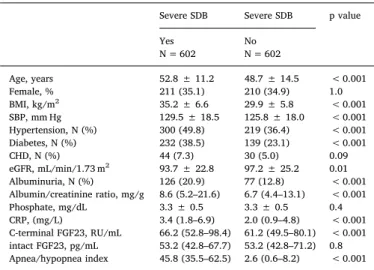
Table 1 presents clinical and demographic characteristics of the 1204 HCHS/SOL participants according to presence of severe sleep disordered breathing. The median AHI in individuals with severe sleep disordered breathing was 45.8 (IQR 35.5–62.5) compared to 2.6 (IQR 0.6–8.2) in the control group. Compared to controls, individuals with severe sleep disordered breathing were older and had higher prevalence of diabetes. Individuals with severe sleep disordered breathing also had higher levels of inflammation and were more obese compared to con-trols (CRP 3.4 mg/L, IQR 1.8–6.9 vs. 2.0 mg/L, IQR 0.9–4.8, p value < 0.001; body mass index 35.2 ± 6.6 kg/m2vs. 29.9 ± 5.8 kg/ m2, p value < 0.001,Table 1). Levels of cFGF23 were slightly higher in individuals with severe sleep disordered breathing compared to con-trols (66.2 RU/mL, IQR 52.8–98.4 vs. 61.2 RU/mL, IQR 49.5–80.1, p value < 0.001, Table 1). iFGF23 levels did not differ between in-dividuals with severe sleep disordered breathing and those without (Table 1).
We investigated the associations of sleep disordered breathing with ascending FGF23 quartiles using multinomial logistic regression ana-lyses. In unadjusted analyses, individuals with severe sleep disordered breathing had higher odds of belonging to cFGF23 Quartile 4 versus
Quartile 1 (cFGF23 Quartile 4 vs. Quartile 1 Odds Ratio [OR] 2.02, CI 1.46–2.80Table 2). After adjustment for demographics, CKD-associated risk factors, comorbidities, and CRP, individuals with severe sleep dis-ordered breathing continued to have higher odds of belonging to cFGF23 Quartile 4 versus Quartile 1 (cFGF23 Quartile 4 vs. Quartile 1 OR 1.93, CI 1.31–2.86Table 2). After adjustment for body mass index, the association was attenuated but remained significant (cFGF23 Quartile 4 vs. Quartile 1 OR 1.70, CI 1.12–2.59,Table 2). We did not appreciate a significant relationship between severe sleep disordered
Fig. 1.Case control study design
Controls are frequency matched for sex and CKD stage.
Abbreviations: HCHS/SOL, Hispanic Community Health Study/Study of Latinos; N, number; SDB, sleep disordered breathing; CKD, chronic kidney disease.
Table 1
Characteristics of total population according to sleep disordered breathing status.
Severe SDB Severe SDB p value
Yes N = 602
No N = 602
Age, years 52.8 ± 11.2 48.7 ± 14.5 < 0.001
Female, % 211 (35.1) 210 (34.9) 1.0
BMI, kg/m2 35.2 ± 6.6 29.9 ± 5.8 < 0.001
SBP, mm Hg 129.5 ± 18.5 125.8 ± 18.0 < 0.001 Hypertension, N (%) 300 (49.8) 219 (36.4) < 0.001 Diabetes, N (%) 232 (38.5) 139 (23.1) < 0.001
CHD, N (%) 44 (7.3) 30 (5.0) 0.09
eGFR, mL/min/1.73 m2 93.7 ± 22.8 97.2 ± 25.2 0.01 Albuminuria, N (%) 126 (20.9) 77 (12.8) < 0.001 Albumin/creatinine ratio, mg/g 8.6 (5.2–21.6) 6.7 (4.4–13.1) < 0.001
Phosphate, mg/dL 3.3 ± 0.5 3.3 ± 0.5 0.4
CRP, (mg/L) 3.4 (1.8–6.9) 2.0 (0.9–4.8) < 0.001 C-terminal FGF23, RU/mL 66.2 (52.8–98.4) 61.2 (49.5–80.1) < 0.001 intact FGF23, pg/mL 53.2 (42.8–67.7) 53.2 (42.8–71.2) 0.8 Apnea/hypopnea index 45.8 (35.5–62.5) 2.6 (0.6–8.2) < 0.001
Results are reported as means ± standard deviation, proportions or medians with interquartile ranges.
breathing and iFGF23 Quartiles (iFGF23 Quartile 4 vs. Quartile 1 OR 0.76, CI 0.52–1.11).
In the unadjusted linear regression analyses, severe sleep disordered breathing was associated with higher cFGF23 levels expressed as a continuous variable (β-estimate 0.12, CI 0.04–0.19, p value 0.002,
Table 3). The relationship remained significant after adjustment for demographics, CKD risk factors, comorbidities, and CRP (β estimate 0.08, CI 0.02–0.15, p value 0.02). However, the association became non-significant after the addition of body mass index (βestimate 0.07, CI −0.005–0.14, p value 0.07,Table 3). We did not identify a sig-nificant relationship between severe sleep disordered breathing and iFGF23 levels (Table 3).
3.2. Subgroup analyses by CKD status
Of the 1204 individuals in the total population, 106 met criteria for CKD. Clinical characteristics of individuals by severe sleep disordered breathing status in individuals with and without CKD are presented in Supplemental Tables 1 and 2. The mean eGFR in those with CKD and
4. Discussion
In a sample drawn from a large cohort of Hispanic/Latino patients with and without CKD, we demonstrated that individuals with severe sleep disordered breathing had slightly higher levels of cFGF23 than those without severe sleep disordered breathing, but no difference in iFGF23 levels. Body mass index or waist circumference were the main confounders that attenuated the sleep disordered breathing-cFGF23 relationship in both linear and multinomial logistic regression analyses. We did not appreciate any relationship with severe sleep disordered breathing presence and iFGF23 in the total population or in the sub-group with CKD. These results are broadly consistent with our hy-potheses and suggest that in addition to iron deficiency and
in-flammation, sleep disordered breathing may be another clinical entity in which we see upregulation of FGF23 transcription in osteocytes and an elevation in cFGF23 but not iFGF23 levels.
In vivo and in vitro studies demonstrate that hypoxia regulates
cFGF23 quartiles (RU/mL)
AHI≥30 vs. AHI < 30
Total N Quartile 1 < 50.5 N = 302
Quartile 2 50.5–63.15 N = 300
Quartile 3 63.16–87.95 N = 301
Quartile 4 > 87.96 N = 301
Unadjusted 1204 REF 1.22 (0.89–1.69)
1.32 (0.95–1.81) 2.02 (1.46–2.80)
Model 1 1204 REF 1.21
(0.87–1.68)
1.29 (0.93–1.79) 1.98 (1.41–2.77)
Model 2 1203 REF 1.27
(0.91–1.77)
1.43 (1.01–2.01) 2.23 (1.53–3.24)
Model 3 1200 REF 1.24
(0.89–1.74)
1.37 (0.96–1.93) 2.10 (1.43–3.08)
Model 4 1200 REF 1.19
(0.84–1.69)
1.41 (0.99–2.02) 1.93 (1.31–2.86)
Model 5 1197 REF 1.08
(0.75–1.57)
1.39 (0.95–2.03) 1.70 (1.12–2.59)
Model 1 adjust for age and gender.
Model 2 adjusts for covariates in Model 1 plus plasma phosphate, eGFR and UACR.
Model 3 adjusts for covariates in Model 2 plus hypertension, diabetes presence, cardiovascular disease, cigarette use.
Model 4 adjusts for covariates in Model 3 plus C-reactive protein. Model 5 adjusts for covariates in Model 4 plus body mass index.
Abbreviations: FGF23,fibroblast growth factor 23; N, number; eGFR, estimated glomerularfiltration rate; UACR, urinary albumin-to-creatinine ratio.
Table 3
Adjusted associations of severe sleep disordered breathing with cFGF23 and iFGF23 levels expressed as continuous variables.
c-terminal FGF23 iFGF23
AHI≥30 vs. AHI < 30 Total N Parameter Estimate 95% CI p-Value Parameter estimate 95% CI p-Value
Unadjusted 1204 0.12 0.04–0.19 0.002 −0.02 −0.08–0.03 0.4
Model 1 1204 0.10 0.03–0.17 0.006 −0.03 −0.09–0.02 0.3
Model 2 1203 0.09 0.03–0.16 0.006 −0.03 −0.09–0.02 0.2
Model 3 1200 0.08 0.02–0.15 0.01 −0.03 −0.08–0.02 0.2
Model 4 1200 0.08 0.02–0.15 0.02 −0.03 −0.08–0.03 0.4
Model 5 1197 0.07 −0.005–0.14 0.07 −0.03 −0.09–0.03 0.3
Model 1 adjust for age and gender.
Model 2 adjusts for covariates in Model 1 plus plasma phosphate, eGFR and UACR.
Model 3 adjusts for covariates in Model 2 plus hypertension, diabetes presence, cardiovascular disease, cigarette use. Model 4 adjusts for covariates in Model 3 plus C-reactive protein.
Model 5 adjusts for covariates in Model 4 plus body mass index.
Abbreviations: FGF23,fibroblast growth factor 23; N, number; CI, confidence interval; eGFR, estimated glomerularfiltration rate; UACR, urinary albumin-to-creatinine ratio.
Table2
Adjusted associations of severe sleep disordered breathing presence with cFGF23expressedasquartiles.
severe sleepdisordered breathing was 46.3±13.3mL/min/1.73m2
andinthosewithCKDwithoutseveresleepdisorderedbreathingwas 45.0±13.5mL/min/1.73m2 (Supplemental Table 1). Individuals
with CKD and severe sleep disordered breathing had significantly higher bodymass index andCRP thanthose withCKD but without severesleepdisorderedbreathing(bodymassindex35.4±6.7kg/m2 vs.30.0 ±6.8kg/m2,pvalue<0.001;CRP6.1mg/LIQR2.7–11.6vs.
3.0mg/LIQR1.4–5.8,pvalue0.001,SupplementalTable1).cFGF23 and iFGF23 levels were also higher in those with severe sleep dis-ordered breathing than in those without severe sleep disordered breathing, however this did not reach significance (Supplemental Table1).Inmultivariableanalysesthatwererestrictedtoindividuals withCKD,severesleepdisorderedbreathingwasnotassociatedwith highercFGF23levelsoriFGF23levels(SupplementalTable3).
3.3. Sensitivityanalyses
hypoxemia associates with different biological responses [53], and the relationship of each of these to FGF23 homeostasis is unknown. We demonstrate small and likely not clinically meaningful elevations in cFGF23 levels in individuals with intermittent hypoxia. Whether chronic hypoxia models would demonstrate larger differences in cFGF23 levels is unknown. Human models of chronic hypoxia however, also have limitations. For example, clinical scenarios of severe lung disease are characterized as high inflammatory states, and a major etiology of lung disease includes smoking, another known risk factor associated with elevated FGF23 levels [54]. Due to the small sample size of the CKD subgroup, we could not elucidate the impact of severe sleep disordered breathing on FGF23 transcription or cleavage in CKD. Although we were able to adjust for important confounders such as body mass index and CRP in our cross-sectional analyses, we were unable to adjust for iron indices and do not have longitudinal FGF23 measurements available. Finally, our study only included Hispanic/ Latino populations. Given that prior studies have demonstrated racial variation in FGF23 levels [55], the generalizability of ourfindings may be limited.
In settings of increased FGF23 transcription but normal FGF23 cleavage, which result in isolated cFGF23 elevation, we do not yet understand what role c-terminal FGF23 fragments have given that the biologic activity and maladaptive cardiovascular effects of FGF23 are believed to be mediated by elevation in iFGF23 levels. However, ele-vated levels of cFGF23 and iFGF23 both demonstrate associations with morbidity and mortality in the general population and in those with CKD [7,9,10]. It is critical to continue investigations that help eluci-date factors that regulate FGF23 production and cleavage. The current
findings demonstrate that, similar to iron deficiency and inflammation, severe sleep disordered breathing may be another clinical state char-acterized by cFGF23 elevation in the absence of iFGF23 elevation. Further human studies in alternative models of hypoxemia and in larger CKD populations are needed to confirm ourfindings and ascertain the impact of CKD on cFGF23 and iFGF23 levels in sleep disordered breathing.
Conflict of interest statement
All authors have read the journal's policy on disclosure of potential conflicts of interest. RM has interest in Abbot Laboratories, AbbVie, Inc. and Teva Pharmaceuticals Industries Ltd. TI has received honoraria from Bayer and grant support from Shire. MW has received research support, honoraria or consultant fees from Amgen, Ardelyx, DiaSorin, Keryx, Lilly, Pfizer, Shire and Ultragenyx.
The authors thank the staffand participants of HCHS/SOL for their important contributions.
Investigators website -http://www.cscc.unc.edu/hchs/. This study was supported by grants R01DK081374 (MW), K24DK093723 (MW), R01DK102438 (TI), National Kidney Foundation of Illinois Young Investigator Grant (RM), and a Strategically Focused Research Network Center Grant from the American Heart Association (MW). The Hispanic Community Health Study/Study of Latinos was carried out as a colla-borative study supported by contracts from the National Heart, Lung, and Blood Institute (NHLBI) to the University of North Carolina (N01-HC65233), University of Miami (N01-HC65234), Albert Einstein College of Medicine HC65235), Northwestern University (N01-HC65236), and San Diego State University (N01-HC65237). The fol-lowing Institutes/Centers/Offices contribute to the HCHS/SOL through a transfer of funds to the NHLBI: National Institute on Minority Health and Health Disparities, National Institute on Deafness and Other Communication Disorders, National Institute of Dental and Craniofacial Research, National Institute of Diabetes and Digestive and Kidney Diseases, National Institute of Neurological Disorders and Stroke, NIH Institution-Office of Dietary Supplements.
FGF23transcription[16].WhenUMR-106cellsaregrowninanoxygen deprived environment, expression of FGF23 mRNA increases. This parallels increasesin HIF-1αprotein expression,making itplausible thattheappreciableincreaseinFGF23mRNAexpressionisinresponse tocellhypoxia[16].Invivomodelssupportthesefindings.When an-imalsareexposedtoahypobaricatmosphere,cFGF23increasesbysix fold,butiFGF23remainsunchanged[16].Thisindicatesthathypoxic
environments may upregulate FGF23 transcription, which is
re-presented byanincreasein cFGF23,alongwithacommensurate in-creaseinFGF23cleavageresultinginnormalbioactiveiFGF23levels [35].Observationalhumanstudiesalsosupport ahypoxia-FGF23 re-lationship.Asinglecenterstudyof32pediatricpatientsdemonstrated that preoperative oxygensaturation levelnegatively correlatedwith cFGF23 levels, suggesting that hypoxemia mayalso regulate FGF23 transcription in humans [36]. Wenowdemonstrate thatindividuals withseveresleepdisorderedbreathingaremorelikelytohaveelevated cFGF23levels,butnotiFGF23levels.
Severe sleep disordered breathing is characterized by multiple overnightrespiratoryeventsassociatedwithoxygendesaturation[37]. Prior reports of experiments conducted in cell cultures and animal modelsdemonstratethatepisodichypoxiacandirectlyimpactthebone byincreasingexpressionofHIF-1αandstimulatingFGF23transcription [38,39].Basedonthesedata,weproposethatintermittentnocturnal hypoxemia insleepdisorderedbreathingmaydirectly triggerFGF23 transcriptionintheboneresultinginelevatedcFGF23levels.We fur-ther speculatethat increasesinFGF23transcriptioninducedby noc-turnalhypoxemiaintheabsenceofCKDiscoupledtoparallelincreases inFGF23cleavage,resultinginnormaliFGF23levels.
There areadditional possible explanations for our findings. The elevationofcFGF23intheseveresleepdisorderedbreathinggroupmay bearesultofcoexistingriskfactors,suchaselevatedbodymassindex, inflammation,andhematologicindicesinindividualswithseveresleep disorderedbreathing.Priorinvestigationsledbyourgroupandothers demonstrated significant associations between elevated body mass indexandelevatedFGF23levels[40–45].Indeed,adjustmentforbody massindexorwaistcircumferenceattenuated ourresultsinbothour multinomial logistic regression and linear regression analyses, and these covariates were the major confounders that rendered the re-lationship in the linear regression models non-significant. The me-chanismsunderlyingtheassociationsofelevatedbodymassindexand FGF23levelsremainunknown,butanoverlapbetweenmetabolicand inflammatory signalsis knowntoexist,whichmaycontributetoan inflammatory milieu in obesity [46]. Both acute and chronic
in-flammation are known stimuli of FGF23 transcription [47]. In all comparisons,includingoursubgroupsofCKDandnon-CKD,thosewith severesleepdisorderedbreathinghadsignificantlyhigherCRPvalues than those without severe sleep disordered breathing. Although we adjusted forCRPinourmodels,inflammationremainsabiologically plausible mechanism that may link sleep disordered breathing and elevatedbodymassindexwithFGF23elevation.
Priorinvestigationsalsodemonstratethaterythropoietinlevelsmay be elevated in individualswith sleepdisordered breathing[48]and datasuggestthaterythropoietinmaydirectlyregulateFGF23 produc-tion[16].Inaddition,irondeficiencyupregulatesFGF23transcription andmayalsobe relatedtosleeprelateddiseases[47,49].Although ironstoresanderythropoietinarenotavailableforouranalyses, dis-turbancesinhematologicparametersrepresentanothermechanismby which cFGF23 levels may be elevated in severe sleep disordered breathing.Finally,priorinvestigationsinhumans demonstrateda re-lationship betweenobstructivesleepapneaandaberrantmineral me-tabolism[50–52].Bytriggeringalterationsinthemineralmetabolism axis, intermittent hypoxia may indirectly lead to FGF23 elevation throughalterationsinvitaminDandparathyroidhormone.
We acknowledge additional limitations in our study. Sleep dis-orderedbreathingexemplifiesagoodmodelofintermittenthypoxemia,
[1] M. Wolf, Update onfibroblast growth factor 23 in chronic kidney disease, Kidney Int. 82 (7) (Oct 2012) 737–747.
[2] T. Isakova, P. Wahl, G.S. Vargas, et al., Fibroblast growth factor 23 is elevated before parathyroid hormone and phosphate in chronic kidney disease, Kidney Int. 79 (12) (Jun 2011) 1370–1378.
[3] C. Faul, A.P. Amaral, B. Oskouei, et al., FGF23 induces left ventricular hypertrophy, J. Clin. Invest. 121 (11) (Nov 2011) 4393–4408.
[4] A. Grabner, A.P. Amaral, K. Schramm, et al., Activation of cardiacfibroblast growth factor receptor 4 causes left ventricular hypertrophy, Cell Metab. 22 (6) (Dec 1 2015) 1020–1032.
[5] A. Alonso, F.L. Lopez, K. Matsushita, et al., Chronic kidney disease is associated with the incidence of atrialfibrillation: the Atherosclerosis Risk in Communities (ARIC) study, Circulation 123 (25) (Jun 28 2011) 2946–2953.
[6] O.M. Gutierrez, J.L. Januzzi, T. Isakova, et al., Fibroblast growth factor 23 and left ventricular hypertrophy in chronic kidney disease, Circulation 119 (19) (May 19 2009) 2545–2552.
[7] O.M. Gutierrez, M. Mannstadt, T. Isakova, et al., Fibroblast growth factor 23 and mortality among patients undergoing hemodialysis, N. Engl. J. Med. 359 (6) (Aug 7 2008) 584–592.
[8] J. Kendrick, A.K. Cheung, J.S. Kaufman, et al., FGF-23 associates with death, car-diovascular events, and initiation of chronic dialysis, J. Am. Soc. Nephrol. 22 (10) (Oct 2011) 1913–1922.
[9] J.J. Scialla, M. Wolf, Roles of phosphate andfibroblast growth factor 23 in cardi-ovascular disease, Nat. Rev. Nephrol. 10 (5) (May 2014) 268–278.
[10] J.J. Scialla, H. Xie, M. Rahman, et al., Fibroblast growth factor-23 and cardiovas-cular events in CKD, J. Am. Soc. Nephrol. 25 (2) (Feb 2014) 349–360. [11] R. Mehta, X. Cai, J. Lee, et al., Association offibroblast growth factor 23 with atrial
fibrillation in chronic kidney disease, from the Chronic Renal Insufficiency Cohort Study, JAMA Cardiol. 1 (5) (Aug 01 2016) 548–556.
[12] P.L. Lutsey, A. Alonso, E. Selvin, et al., Fibroblast growth factor-23 and incident coronary heart disease, heart failure, and cardiovascular mortality: the Atherosclerosis Risk in Communities study, J. Am. Heart Assoc. 3 (3) (Jun 10 2014) e000936.
[13] E.G. Farrow, X. Yu, L.J. Summers, et al., Iron deficiency drives an autosomal dominant hypophosphatemic rickets (ADHR) phenotype infibroblast growth factor-23 (Fgffactor-23) knock-in mice, Proc. Natl. Acad. Sci. U. S. A. 108 (46) (Nov 15 2011) E1146–E1155.
[14] M. Wolf, T.A. Koch, D.B. Bregman, Effects of iron deficiency anemia and its treat-ment onfibroblast growth factor 23 and phosphate homeostasis in women, J. Bone Miner. Res. 28 (8) (Aug 2013) 1793–1803.
[15] E.R. Smith, M.M. Cai, L.P. McMahon, S.G. Holt, Biological variability of plasma intact and C-terminal FGF23 measurements, J. Clin. Endocrinol. Metab. 97 (9) (Sep 2012) 3357–3365.
[16] E.L. Clinkenbeard, E.G. Farrow, L.J. Summers, et al., Neonatal iron deficiency causes abnormal phosphate metabolism by elevating FGF23 in normal and ADHR mice, J. Bone Miner. Res. 29 (2) (Feb 2014) 361–369.
[17] H. Fox, H.C. Purucker, I. Holzhacker, et al., Prevalence of sleep-disordered breathing and patient characteristics in a coronary artery disease cohort undergoing cardiovascular rehabilitation, J. Cardiopulm. Rehabil. Prev. 36 (6) (Nov/Dec 2016) 421–429.
[18] M. Turhan, A. Bostanci, S. Bozkurt, Estimation of cardiovascular disease from polysomnographic parameters in sleep-disordered breathing, Eur. Arch. Otorhinolaryngol. 273 (12) (Dec 2016) 4585–4593.
[19] Z. Ehsan, S.L. Ishman, T.R. Kimball, et al., Longitudinal cardiovascular outcomes of sleep disordered breathing in children: a meta-analysis and systematic review, Sleep 40 (3) (Mar 01 2017).
[20] S. Stadler, T. Zimmermann, F. Franke, et al., Association of sleep-disordered breathing with diabetes-associated kidney disease, Ann Med. (Mar 27 2017) 1–9. [21] C.L. Phillips, I. Laher, B.J. Yee, Is the kidney yet another potential end-organ ca-sualty of obstructive sleep apnea? Am. J. Respir. Crit. Care Med. 192 (7) (Oct 01 2015) 779–781.
[22] S.M. Dharia, M.L. Unruh, L.K. Brown, Central sleep apnea in kidney disease, Semin. Nephrol. 35 (4) (Jul 2015) 335–346.
[23] Y.C. Lee, S.Y. Hung, H.K. Wang, et al., Sleep apnea and the risk of chronic kidney disease: a nationwide population-based cohort study, Sleep 38 (2) (Feb 01 2015) 213–221.
[24] J. Xu, I.Y. Yoon, H.J. Chin, The effect of sleep apnea on all-cause mortality in nondialyzed chronic kidney disease patients, Sleep Med. 27–28 (Nov–Dec 2016) 32–38.
[25] Y.S. Lin, P.H. Liu, S.W. Lin, et al., Simple obstructive sleep apnea patients without hypertension or diabetes accelerate kidney dysfunction: a population follow-up cohort study from Taiwan, Sleep Breath. 21 (1) (Mar 2017) 85–91.
[26] T. Shimada, I. Urakawa, T. Isakova, et al., Circulatingfibroblast growth factor 23 in patients with end-stage renal disease treated by peritoneal dialysis is intact and biologically active, J. Clin. Endocrinol. Metab. 95 (2) (Feb 2010) 578–585. [27] L.M. Lavange, W.D. Kalsbeek, P.D. Sorlie, et al., Sample design and cohort selection
in the Hispanic Community Health Study/Study of Latinos, Ann. Epidemiol. 20 (8) (Aug 2010) 642–649.
[28] P.D. Sorlie, L.M. Aviles-Santa, S. Wassertheil-Smoller, et al., Design and im-plementation of the Hispanic Community Health Study/Study of Latinos, Ann. Epidemiol. 20 (8) (Aug 2010) 629–641.
[29] S. Redline, D. Sotres-Alvarez, J. Loredo, et al., Sleep-disordered breathing in Hispanic/Latino individuals of diverse backgrounds. The Hispanic Community Health Study/Study of Latinos, Am. J. Respir. Crit. Care Med. 189 (3) (Feb 01 2014) 335–344.
[30] V.L. Ernster, Nested case-control studies, Prev. Med. 23 (5) (Sep 1994) 587–590. [31] H.M. Gonzalez, W. Tarraf, C.J. Rodriguez, et al., Cardiovascular health among
di-verse Hispanics/Latinos: Hispanic Community Health Study/Study of Latinos (HCHS/SOL) results, Am. Heart J. 176 (Jun 2016) 134–144.
[32] W.W. Wong, G. Strizich, M. Heo, et al., Relationship between body fat and BMI in a US hispanic population-based cohort study: results from HCHS/SOL, Obesity (Silver Spring) 24 (7) (Jul 2016) 1561–1571.
[33] L.A. Inker, C.H. Schmid, H. Tighiouart, et al., Estimating glomerularfiltration rate from serum creatinine and cystatin C, N. Engl. J. Med. 367 (1) (Jul 5 2012) 20–29. [34] T. Isakova, H. Xie, W. Yang, et al., Fibroblast growth factor 23 and risks of mortality and end-stage renal disease in patients with chronic kidney disease, JAMA 305 (23) (Jun 15 2011) 2432–2439.
[35] M. Wolf, K.E. White, Couplingfibroblast growth factor 23 production and cleavage: iron deficiency, rickets, and kidney disease, Curr. Opin. Nephrol. Hypertens. 23 (4) (Jul 2014) 411–419.
[36] M.R. Hanudel, K. Wesseling-Perry, B. Gales, et al., Effects of acute kidney injury and chronic hypoxemia onfibroblast growth factor 23 levels in pediatric cardiac surgery patients, Pediatr. Nephrol. 31 (4) (Apr 2016) 661–669.
[37] Y. Leng, C.T. McEvoy, I.E. Allen, K. Yaffe, Association of sleep-disordered breathing with cognitive function and risk of cognitive impairment: a systematic review and meta-analysis, JAMA Neurol. 74 (10) (Oct 1 2017) 1237–1245.
[38] C.M. Swanson, S.A. Shea, K.L. Stone, et al., Obstructive sleep apnea and metabolic bone disease: insights into the relationship between bone and sleep, J. Bone Miner. Res. 30 (2) (Feb 2015) 199–211.
[39] Q. Zhang, M. Doucet, R.E. Tomlinson, et al., The hypoxia-inducible factor-1alpha activates ectopic production offibroblast growth factor 23 in tumor-induced os-teomalacia, Bone Res. 4 (2016) 16011.
[40] M.A. Mirza, J. Alsio, A. Hammarstedt, et al., Circulatingfibroblast growth factor-23 is associated with fat mass and dyslipidemia in two independent cohorts of elderly individuals, Arterioscler. Thromb. Vasc. Biol. 31 (1) (Jan 2011) 219–227. [41] S. Zaheer, I.H. de Boer, M. Allison, et al., Fibroblast growth factor 23, mineral
metabolism, and adiposity in normal kidney function, J. Clin. Endocrinol. Metab. 102 (4) (Apr 1 2017) 1387–1395.
[42] X. Hu, X. Ma, Y. Luo, et al., Associations of serumfibroblast growth factor 23 levels with obesity and visceral fat accumulation, Clin. Nutr. 37 (1) (Feb 2018) 223–228. [43]L.J. Hanks, K. Casazza, S.E. Judd, N.S. Jenny, O.M. Gutierrez, Associations offi
-broblast growth factor-23 with markers of inflammation, insulin resistance and obesity in adults, PLoS One 10 (3) (2015) e0122885.
[44]H. Ge, J. Zhang, Y. Gong, et al., Fibroblast growth factor receptor 4 (FGFR4)
de-ficiency improves insulin resistance and glucose metabolism under diet-induced obesity conditions, J. Biol. Chem. 289 (44) (Oct 31 2014) 30470–30480. [45]F.N. Ali, B. Falkner, S.S. Gidding, et al., Fibroblast growth factor-23 in obese,
normotensive adolescents is associated with adverse cardiac structure, J. Pediatr. 165 (4) (Oct 2014) 738–743 (e731).
[46]C.N. Lumeng, A.R. Saltiel, Inflammatory links between obesity and metabolic dis-ease, J. Clin. Invest. 121 (6) (Jun 2011) 2111–2117.
[47]V. David, A. Martin, T. Isakova, et al., Inflammation and functional iron deficiency regulatefibroblast growth factor 23 production, Kidney Int. 89 (1) (Jan 2016) 135–146.
[48]X.B. Zhang, Y.M. Zeng, H.Q. Zeng, H.P. Zhang, H.L. Wang, Erythropoietin levels in patients with sleep apnea: a meta-analysis, Eur. Arch. Otorhinolaryngol. 274 (6) (Jun 2017) 2505–2512.
[49]M. Zilberman, D.S. Silverberg, I. Bits, et al., Improvement of anemia with ery-thropoietin and intravenous iron reduces sleep-related breathing disorders and improves daytime sleepiness in anemic patients with congestive heart failure, Am. Heart J. 154 (5) (Nov 2007) 870–876.
[50]C. Liguori, A. Romigi, F. Izzi, et al., Continuous positive airway pressure treatment increases serum vitamin D levels in male patients with obstructive sleep apnea, J. Clin. Sleep Med. 11 (6) (Jun 15 2015) 603–607.
[51]A. Barcelo, C. Esquinas, J. Pierola, et al., Vitamin D status and parathyroid hormone levels in patients with obstructive sleep apnea, Respiration 86 (4) (2013) 295–301. [52]N.C. Bozkurt, E. Cakal, M. Sahin, et al., The relation of serum 25-hydroxyvitamin-D levels with severity of obstructive sleep apnea and glucose metabolism abnormal-ities, Endocrine 41 (3) (Jun 2012) 518–525.
Acknowledgements
Each author contributed important intellectual content during manuscript drafting or revision and accepts accountability for the overall workbyensuringthatquestionspertainingtotheaccuracyor integrityofanyportionoftheworkareappropriatelyinvestigatedand resolved.Thecorrespondingauthorconfirmsthatheorshehashadfull accesstothedatainthestudyandfinalresponsibilityforthedecisionto submitforpublication.
AppendixA. Supplementarydata
Supplementarydatatothisarticlecanbefoundonlineathttps:// doi.org/10.1016/j.bone.2018.06.024.
[53] N.R. Prabhakar, G.L. Semenza, Adaptive and maladaptive cardiorespiratory re-sponses to continuous and intermittent hypoxia mediated by hypoxia-inducible factors 1 and 2, Physiol. Rev. 92 (3) (Jul 2012) 967–1003.
[54] M.G. Vervloet, A.D. van Zuilen, A.C. Heijboer, et al., Fibroblast growth factor 23 is associated with proteinuria and smoking in chronic kidney disease: an analysis of
the MASTERPLAN cohort, BMC Nephrol. 13 (Apr 24 2012) 20.