Rashmi KP et al JMSCR Volume 06 Issue 10 October 2018 Page 684
A Study of Patients in Malaria and Complicated Malaria
Authors
Rashmi KP
1, Dr Renymol B
2*1
Assistant Professor Department of General medicine, Govt TD Medical College, Alappuzha, Kerala 2
Associate Professor, Department of Medicine, Government TD Medical College, Alappuzha *Corresponding Author
Dr Renymol B
Associate Professor, Department of Medicine, Government TD Medical College, Alappuzha, India Abstract
Background:Malaria is a very common infectious disease and multiple studies have reported thrombocytopenia as one of the common haematological abnormalities associated with it Increasing association between the disease severity, its pathology and platelet indices is being suggested . This study aimed to attempt an association between the myriad manifestations of malaria, their severity and correlation with platelet count.
Methods: This study was carried out as an observational study on patients admitted with the diagnosis of Malaria in the general medicine wards of Pt BRAM Medical College, Raipur between 2005-2008. Diagnosis of malaria was considered if either of the investigations-peripheral smear, antigen based rapid diagnostic card tests or quantitative buffy coat method (QBC) were positive. Coulter LH 756 was used to measure platelet counts. Platelet counts less than 1,50,000/mm3 were taken to be abnormal. Biochemistry and other pertaining investigations were done to ascertain the presence of any other complications. All the parameters at the time of hospitalization were considered for data analysis
Results: Of the 105 patients included in the study, majority were of male gender (82%) with an average mean age of 38 years.
50 % of patients had tested positive for plasmodium Falciparum, 48% had Plasmodium Vivax and 2% had mixed Plasmodium Vivax and Falciparum infections.
As per the WHO criteria on management of severe malaria (2008), only 14% of patients infected with plasmodium falciparum had severe disease while the majority (36%) had non-severe disease. Both Plasmodium Vivax and Falciparum had equal incidence of thrombocytopenia but significantly lower platelet count were seen in patients with mixed Pl Vivax and Pl Falciparum infections and in those cases who met any one or more of the WHO criteria for severe malaria, though not all associations were statistically significant.
Conclusions: In our study group, Thrombocytopenia was a very common haematological abnormality . However a statistically significant association between severity of platelet count and the species of malaria (Vivax vs Falciparum) was not seen. However, lower platelet counts were seen in patients meeting one or more of the WHO criteria of severe malaria. This association was most significant when renal impairment and parasitemia were taken into consideration. However, since a single reading of different parameters at the time of inclusion was taken, this association could not be definitely proved and thus needs further larger and prospective studies before appropriate conclusions can be drawn.
Introduction
As per the WHO Malaria report 2008, around 1.8 million confirmed cases of malaria are reported annually in the Indian subcontinent, 53% of which are Plasmodium Vivax cases, 47% are Plasmodium Falciparum and only 0.2% cases
have mixed infections. The disease is purported to have a case fatality rate of about 0.8%.
Traditionally it was thought that infections with Pl Vivax had a much benign course when compared to Pl. Falciparum. But increasing data and studies are indicating towards infections with Pl Vivax
www.jmscr.igmpublication.org Impact Factor (SJIF): 6.379
Index Copernicus Value: 79.54 ISSN (e)-2347-176x ISSN (p) 2455-0450
Rashmi KP et al JMSCR Volume 06 Issue 10 October 2018 Page 685 having increased mortality and morbidity which is
equal and comparable to that seen with Pl Falciparum. The emerging chloroquine resistance has further confounded the scenario.
Multiple recent studies have documented incidence of thrombocytopenia in Plasmodium infections (Erhabor et al, Lee et al, Pongponratn et al, Jadhav et al) and some have speculated on possible association between platelet counts and Pl Falciparum severity (Gerardin et al, Srichaikul et al) but the data about a probable association in Pl Vivax infections, especially in Indian sub-continent is scarce and conflicting. (Makkar RP et al, Kochar et al, Sina B et al).
With this background, this observational study was attempted to determine the clinical profile of the patients infected with the Plasmodium as well as the predictors of outcome with regards to the complications and manifestations, with special emphasis on platelet counts.
Methods
This study was carried out as an observational study on patients admitted into the general medicine wards of Pt BRAM Medical College, Raipur between 2005 August and November 2008, with a diagnosis of fever, clinical suspicion of malaria and testing positive for Malaria (Peripheral smear-thin and thick blood smear using Giemsa stain, QBC for malarial parasites or the rapid species specific antigen based diagnostic card tests for malaria).
Informed consents were taken either from the patient or from the relative in those with obtundation. The data pertaining to demographics, relevant clinical, microbiological, biochemical and haematological investigations were entered into a pre-structured format.
Patients with known chronic liver disease, chronic kidney disease, coagulation or bleeding disorders, Iron deficiency Anemia , HIV positive status and other coincidental infections that might confound the reports ,like enteric fever and viral hepatitis were excluded from the study.
Biochemistry investigations like Bilirubin, Liver enzymes, Blood urea, creatinine, Plasma glucose, Arterial blood gas analysis, coagulation parameters like APTT and PT-INR, and Xray chest were done in all subjects, as and when relevant .Species of plasmodium was identified by thick smear.
All patients, at the time of hospitalization, had their baseline platelet counts assessed using the Coulter LH 756 Analyser. A simple classification of thrombocytopenia was done, with counts above 150 x 109/l platelet count as normal, between 150-100 x 109/l as mild thrombocytopenia and < 50 x109/l as severe thrombocytopenia.
As per the World Health Organization Definition of Severe Malaria of 2000 (WHO, 2000), patients with Falciparum infections were classified into non-severe and severe falciparum malaria.
Patients were put into the category of Severe Malaria if their profile showed occurrence any one or more of these laboratory or clinical features:
Major Criteria Other Criteria
Unrousable coma
Generalized convulsions > 2 episodes within 24 hours or evidence of continued seizure activity.
Haematocrit <15% or Haemoglobin < 5 g/dl, normochromic, normocytic; Urine output < 400 ml/24 hours not improving with rehydration or serum creatinine> 3 mg/dl
Non-cardiogenic pulmonary oedema or acute respiratory distress syndrome Blood glucose <40 mg/dl or 2.2 mmol/l
7 ) Systolic pressure < 80 mmHg with circulatory failure
9) Spontaneous bleeding and laboratory evidence of disseminated intravascular coagulation
10) pH <7.25 or serum bicarbonate < 15 mmol/l; venous lactate level <5 mmol/l 11) Macroscopic haemoglobinuria.
Impaired consciousness but arousable Extreme weakness
Rashmi KP et al JMSCR Volume 06 Issue 10 October 2018 Page 686
Results
Of the one hundred and five patients initially incorporated into the study, three were excluded after detailed evaluation. Of the rest one hundred and two case subjects, 82% were of male gender and none of the female patients (18%) were pregnant. The mean age group along the study population was 38 years.
Figure 1: Mean age group in Pl Vivax and Pl Falciparum infection
Sr No. Mean Age (yrs) Category 1 36.4±12.7 Pl. Vivax 2 39.9±13.2 Pl. Falciparum
Figure 2: Gender Distribution in Pl. Vivax and Pl. Falciparum infection
Gender Pl.Vivax Pl Falciparum Mixed
Male 43 (88%) 37(73.3) 2
Female 6(12%) 13 (26.7) 0
Forty nine (48%) had Plasmodium Vivax infection , two patient had mixed Pl Vivax and Falciparum infection while the rest fifty one had Plasmodium Falciparum.
Thirty six % (37) had non-severe Pl Falciparum infection while fourteen % (14) met the WHO 2000 criteria for Severe Falciparum infection. None of the patients with Plasmodium Vivax showed any of the signs or laboratory features of Severe Malaria.
Figure 3: Distribution of patients in Pl. Vivax and Pl .Falciparum infection
S No Species Number of
patients(n)
Percentage (%)
1) Pl Vivax 49 48
2) Pl Falciparum- Non severe
37 36
3) Pl Falciparum- Severe 14 14
4) Mixed 2 2
Amongst the study group, the mean duration of illness varied from 6.2 days in Pl Vivax infection to 6.1 days in Pl Falciparum infection to 7.6 days in those with mixed Pl Vivax and Pl Falciparum infections.
Figure 4: Mean duration of illness in days with Pl Vivax and Pl Falciparum infection
S No Pl Vivax Pl
Falciparum
Mixed Infection Mean duration
of illness(days)
6.2±4 6.1±38 7.6±5.2
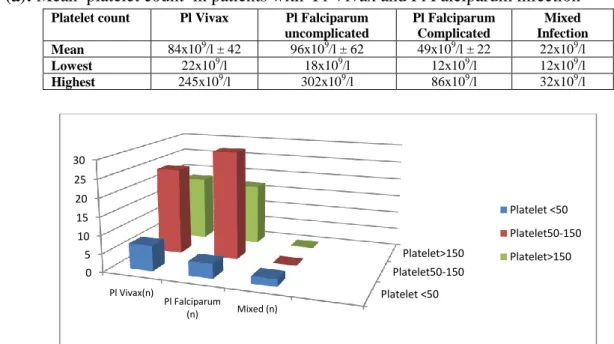
Again in the study group, the mean platelet counts were analysed as per the infecting Plasmodium species. It was 84x109/l ± 42 in patients with Pl Vivax as compared to 96x109/l ± 62 in uncomplicated falciparum and 49x109/l ± 22 in those with mixed infections. The difference was statistically significant (p=0.01) in the group with severe Falciparum infection.
Figure 5 (a): Mean platelet count in patients with Pl Vivax and Pl Falciparum infection Platelet count Pl Vivax Pl Falciparum
uncomplicated
Pl Falciparum Complicated
Mixed Infection Mean 84x109/l ± 42 96x109/l ± 62 49x109/l ± 22 22x109/l
Lowest 22x109/l 18x109/l 12x109/l 12x109/l
Highest 245x109/l 302x109/l 86x109/l 32x109/l
Figure 5(b): Distribution of platelet count in patients with Pl Vivax and Pl Falciparum infection
Platelet <50 Platelet50-150
Platelet>150 0
5 10 15 20 25 30
Pl Vivax(n)
Pl Falciparum
(n) Mixed (n)
Rashmi KP et al JMSCR Volume 06 Issue 10 October 2018 Page 687 An inverse correlation was noted between the platelet counts and erythrocyte infection rate in Pl Falciparum infected cases.
.
Figure 6: Mean platelet count and percentage of infected erythrocytes in patients with Severe Pl Falciparum infection
The study group was further analysed with emphasis on the complications, if any, noted during the time of hospitalization and association with platelet counts.
Severe thrombocytopenia (Platelet count < 20,000/ưl) was seen in 5 patients with Pl Vivax infection and in 9 of those with Pl Falciparum infection. 1 of the cases with mixed species infection also had thrombocytopenia.
Only 1 case with falciparum infection showed abnormal bleeding while jaundice was seen in 27 cases of patients (8 with Vivax and 19 with Falciparum). Renal impairment was seen in 9 cases with Falciparum and 2 with Vivax infections. 1 patient with mixed infection had CNS involvement against 4 with Falciparum and 3 with Vivax infection.
Figure 7: Complications seen in patients with Pl Vivax and Pl .Falciparum Charachteristic
abnormality
Pl Vivax N(%)
Pl Falciparum N(%)
Mixed Infection N Severe
Thrombocytopenia (<20,000/ưl)
5(10.2) 9 (18) 1
Abnormal bleeding None 1(11) None
Jaundice (>3mg/dl) 8(16.3) 19(38) 1
Renal Failure (>3mg/dl)
2(4.08) 9(18) 1
CNS involvement 3(6.1) 4(8) 1
ARDS 2(4.06) 7(14) 1
Acidosis 3(6.1) 9(18) 1
Circulatory collapse 1(2.08) 4(8) 0
Death 1(2.08) 3(6) 0
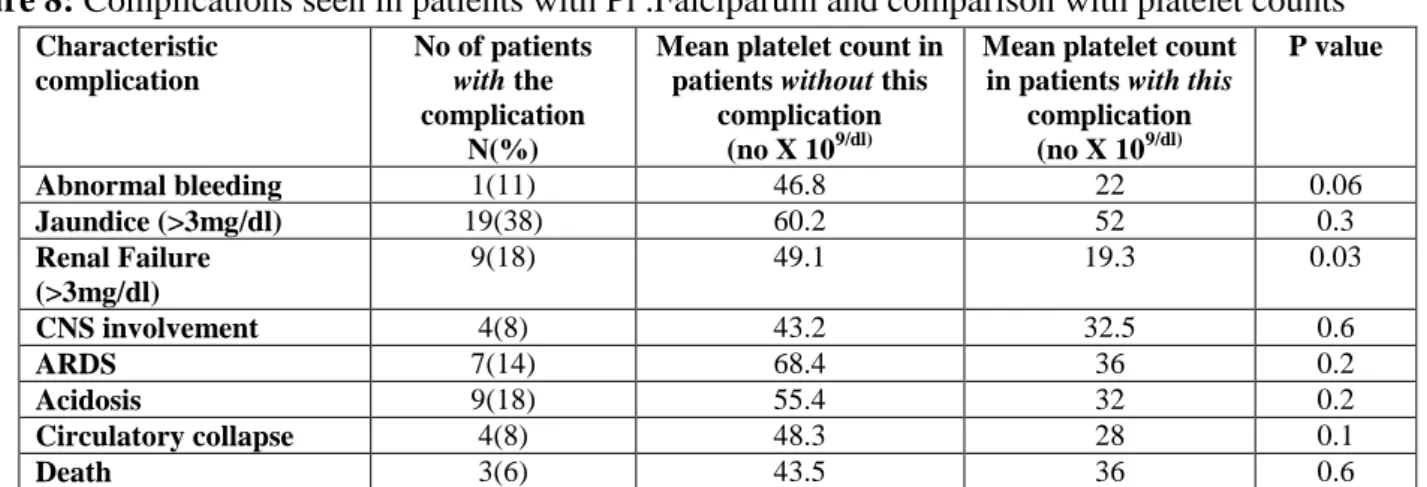
Further analysis was done to attempt a correlation between the incidence and degree of thrombocytopenia in patients with Pl Falciparum infection and meeting the WHO 2000 criteria of complicated malaria.
The mean platelet count was 46.8 x 10⁹/dl in Falciparum cases without features of DIC against 22 x 109/dl in the patient with DIC. Abnormal Bilirubin levels were not found to have any significant statistical association with platelet
0 10 20 30 40 50 60 70 80 90
0-0.5% 0.5-1% 1-5% >5%
Rashmi KP et al JMSCR Volume 06 Issue 10 October 2018 Page 688 counts 60.2 x 10⁹/dl in those without jaundice
against 52 x 109/dl in those with jaundice .Of the three cases of severe Falciparum malaria who
died, platelet count was 36 x 109/dl against 43.5 x 10⁹/dl in those who survived the disease.
Figure 8: Complications seen in patients with Pl .Falciparum and comparison with platelet counts Characteristic
complication
No of patients with the complication
N(%)
Mean platelet count in patients without this
complication (no X 109/dl)
Mean platelet count in patients with this
complication (no X 109/dl)
P value
Abnormal bleeding 1(11) 46.8 22 0.06
Jaundice (>3mg/dl) 19(38) 60.2 52 0.3
Renal Failure (>3mg/dl)
9(18) 49.1 19.3 0.03
CNS involvement 4(8) 43.2 32.5 0.6
ARDS 7(14) 68.4 36 0.2
Acidosis 9(18) 55.4 32 0.2
Circulatory collapse 4(8) 48.3 28 0.1
Death 3(6) 43.5 36 0.6
Discussion
In our study group, male preponderance was seen with 82% being male patients and the mean age was 38 years. Similar findings have been reported in other studies (Jadhav et al, 2004, Kochar et al, 2005 & Makkar et al, 2002). This could be attributed to the demography in the local area, where young males being more outgoing and the dominant bread winner tend to develop exposure to insect bites more and approach hospital care more promptly.
We further found that 66.6% of our Pl Falciparum cases and 63.3% of Pl Vivax cases had thrombocytopenia. The traditional concept of higher association of thrombocytopenia with Pl Falciparum infections have been questioned in several other national and international studies. (Erhabor et al, 2006, Jadhav et al, 2004, Sina B et al, 2002, Srichaikul et al, 1975, Kelton et al, 1979).This was in accordance with the findings in our study, namely that thrombocytopenia has equal prevalence in both Plasmodium species. The mean platelet count in our study was 84,000 ± 42 x 109/l in our Pl Vivax cases , 96,000 ± 62 x 109/l in our simple Pl Falciparum infections, 49,000 ± 20 x 109/l in our severe Pl Falciparum cases while both our mixed Plasmodium infected cases had platelet counts < 50,000 x 109/l. These were comparable to Indian studies by Jadhav et al,
2004 and Sina B et al, 2002. There were 7 cases of Pl Vivax infections in our study, who had platelet counts <50 x 109/l, but none had any bleeding tendencies and all made complete recovery. Similar findings have been reported by Ladhani et al in 2002.
The mean platelet counts in patients with complicated malaria were compared with those having non-severe disease. In patients with cerebral malaria, the mean platelet count was 32.5 x 10⁹/l against 43.2 x 10⁹/l which was statistically insignificant. Similar findings were seen with regards to DIC, Jaundice, Acidosis, ARDS, circulatory collapse and death.
However statistically significant thrombocyto-penia was seen in patients with renal Impairment when compared with those without severe malaria and associated renal impairment. Studies with similar findings have been reported by Reyburn et al and Jadhav et al. Further, higher parasitemia rates in our Falciparum cases had lower platelet counts in a statistically significant manner.
Rashmi KP et al JMSCR Volume 06 Issue 10 October 2018 Page 689 To summarize, incidence of thrombocytopenia
was similar in Plasmodium Vivax and Falciparum infections, but very low platelet counts were seen in patients fulfilling the WHO 2000 criteria of severe Pl Falciparum infection, though statistical significance could be proved only in those with renal impairment
This study was limited by the fact that only one time values of platelet counts and other relevant haematological and biochemical parameters were taken, at the time of hospitalization and sequential follow-up and treatment effects and course during hospital stay were not assessed. More detailed and expansive studies are needed to ascertain the myriad implications and correlations of platelet count with Plasmodium infections.
References
1. Erhabor, O, Babatunde, S. & Uko, K. E. (2006). Some haematological parameters in plasmodial parasitized HIV-infected Nigerians. Nigerian Journal of Medicine, 15 , 52–55.
2. Hoffbrand, A. V., Catovsky, D., & Tuddenham, E. G. D.(eds.) (2005). Postgraduate Haematology. Malden, MA: Blackwell Publishing Inc.
3. Horstmann, R. D. & Dietrich, M. (1985). Haemostatic alterations in malaria correlate to parasitaemia. Blut, 51,329– 335.
4. Jadhav, U. M., Patkar, V.S. & Kadam, N. N. (2004). thrombocytopenia in malaria — correlation with type and severity of malaria. Journal of the Association of Physicians of India,52 , 615–618.
5. Kelton, J. G., Neame, P. B., Gauldie, J. & Hirsh, J. (1979). Elevated platelet-associated IgG in the thrombocytopenia of septicemia. The New England Journal of Medicine , 300 , 760–764.
6. Kochar, D. K., Saxena, V., Singh, N., Kochar, S. K., Kumar, S. V. & Das, A. (2005). Plasmodium vivax malaria.
Emerging Infectious Diseases, 11, 132– 134.
7. Ladhani, S., Lowe, B., Cole, A. O., Kowuondo, K. & Newton, C. R. (2002). Changes in white blood cells and platelets in children with falciparum malaria: relationship to disease outcome. British Journal of Haematology , 119 , 839–847. 8. Makkar, R. P., Mukhopadhyay, S., Monga,
A. & Gupta, A. K. (2002). Plasmodium vivax malaria presenting with severe thrombocytopenia. Brazilian Journal of Infectious Diseases , 6 , 263–265.
9. Ohtaka, M., Ohyashiki, K., Iwabuchi, H., Iwabuchi, A., Lin, K. Y. & Toyama, K. (1993). [A case of vivax malaria with thrombocytopenia suggesting immuno- logical mechanisms]. Rinsho Ketsueki ,34, 490–492.
10.Sina, B. (2002). Focus on Plasmodium vivax .Trends in Parasitology, 18,287–289. 11.Srichaikul, T., Puwasatien, P.,
Karnjana-jetanee, J., Bokisch, V. A. & Pawasatien, P. (1975). Complement changes and disseminated intravascular coagulation in Plasmodium falciparum malaria. Lancet ,1, 770–772.
12.Touze, J. E., Mercier, P., Rogier, C., Hovette, P., Schmoor, P., Dabanian, C., Campiadgi, S. & Laroche, R. (1990). [Platelet antibody activity in malaria thrombocytopenia]. Pathology Biology (Paris) ,38, 678–681.
13.WHO. (2000). Severe falciparum malaria. Transactions of the Royal Society of Tropical Medicine and Hygiene, 94, (Suppl. 1), 1–51.