Transparent Façade Panel Typologies Based on Recyclable Polymer Materials
Abstract
Buildings are large consumers of energy. In the United States of America; they constitute over 33% of the total annual energy consumption, produce 35% of the total carbon dioxide emissions and attribute 40% of landfill wastes. The building industry is also a large consumer of non-renewable materials and this trend has escalated dramatically over the past century. It is essential that we find ways to save on energy consumption through the use of solar energy, improved thermal insulation, and alternative efficient glazed façade systems. In this paper, we demonstrate how alternative typologies of transparent and translucent load-bearing façade systems based on biocomposite and recyclable materials, are structurally and thermally efficient at the same time they contribute towards reduced pollutant emissions and non-renewable material uses.
Composite insulated panel systems are used extensively in the engineering and building industry, owing to their structural and thermal efficiency. However, these systems are generally opaque and offer little flexibility in building applications. As an alternative, we demonstrate how building products comprised of hybrid material typologies can be made to perform efficiently as load-bearing façade systems that substitute for current glazing systems with adequate thermal and structural performance, which also possess good light transmission characteristics and integral shading capability. The materials are configured to work as composite panel systems made from a combination of bio-composite and recyclable polymer materials. These materials are environmentally sustainable, because they either originate from naturally grown renewable resources or are recyclable.
Our research program includes the design and development of prototype panel systems; the evaluation of structural and thermal performance, together with their role in reducing energy consumption and pollution emission through life cycle analysis.
The paper describes relevant applications and related current research activities, being carried out by the authors, under an EPA/NSF funded grant project, titled People, Prosperity and Planet, in relation to prototypical composite panel systems. Our current area of investigation relates to typologies that use thermoplastic polymers (as skin
material) and biocomposites (as a core material). Our evaluations have demonstrated viable applications and improved performance compared to conventional single and double glazing systems in buildings.
The paper also discusses the fundamentals of the research investigations and predicts good energy efficiency, making the product a sustainable alternative when used in building applications. The paper highlights areas of ongoing research and applications for hybrid composite façade systems, which will make the approach a viable option for the building industry, in the future.
Introduction
Buildings (residential and commercial) account for about 40% of the total annual energy consumption in the United States of America; they produce 35% of the total carbon dioxide emissions and attribute 40% of landfill wastes [1, 2]. See Figure 1 for end-use by sector shares of total energy consumption. The building industry is also a large consumer of non-renewable materials and this trend has escalated dramatically over the past century [3].
It is therefore essential that we find ways to save on energy consumption through the use of solar energy, improved thermal insulation, and alternative glazed façade systems. It is imperative that we address energy and materials extraction sustainability issues and broaden the palette of raw materials suitable for the construction industry and the reduction of energy embodied in their production, manufacture and transportation. Contributors to high-energy use relate to ineffective design concepts, inappropriate material type, excessive transportation, unsophisticated construction methods, lack of
environmental controls and wasteful demolition and disposal. In order to deal with these complex interfacing elements, they need to be addressed holistically to understand the drivers for change and to integrate design concepts that are coherent. There are limited resources even for wood and it is not at its most efficient in building applications as a raw material. It also takes a long time to grow, compared to alternative natural sources such as bamboo (60 years to maturity versus 1 year) and nonfood crop products such as kenaf are serious alternatives, which matures within a year. [4] We have seen significant developments in new lightweight polymer and composite materials in the automotive and aerospace industries [4], [5], and this is becoming an emerging technology in modern building construction. Figure 2 shows Flax, hemp, sisal, wool and other natural fibers being used to make 50 Mercedes-Benz E-Class components. This is the area in
which we are focusing our attention, since we believe that this is the future for building materials.
Background
To this end, we propose to address sustainability concerns related to building construction materials through an integrative approach applied to building façade elements, where we can collectively influence design, materials, construction, energy consumption and disposal. We plan to do this through creating a framework and implementing a plan for manufacturing, erection, use and disposal in construction that emerges as an inevitable symbiosis of the process itself. The end result will be to propose a range of building products for façade enclosures that holistically embrace all the manufacturing and end use issues from cradle to grave and life thereafter, using bio-composite and recyclable polymer materials. In a market driven world, we cannot realistically expect consumers to only construct permanent building prototypes and therefore if they are to be considered more as a ‘temporary’ product, then it would serve us well to look at other technologies such as those within the automotive, marine and aerospace industries which design artifacts that are driven by consumer based economic imperatives and limited life span. On the basis of this thesis, we are modeling our research project on technologies and materials that will form a new paradigm that rethinks the design of building enclosures in the future. The range of possible building types is large; therefore we are primarily focusing our attention on buildings that are generally designed within a consumer market for a time span ranging 20 to 40 years, such as commercial, recreational, retail, industrial and housing. [6] There is a
Figure 2. Car components in biocomposites (Photo courtesy of DaimlerChrysler AG)
growing acceptance that there have to be more environmentally friendly processes and products, but consumers are not going to accept products based only on environmental considerations; these products will need to perform and be cost-effective to be competitive and meet the exacting standards for safety and durability in the building industry. Bio-composites are gaining acceptance in everything from automotive manufacturing to bridge building because they can be made to be strong and cost effective, more so than with traditional plastic and glass fiber. These "green" composite materials turn fibers from plants such as cotton, jute, kenaf, flax or hemp and plastics from soybean, wastepaper, corn and sugar into lightweight, strong and stiff materials through innovative research. Bio-composite materials have several advantages. Since they are renewable-based, bio-composites would reduce dependency on petroleum. Potential harmful effects related to materials processing and disposal could be eliminated due to their potential biodegradability. The environmental impact is significant beyond the landfill. The high-fiber plants commonly used for composites are easily grown, require few pesticides and can be rotated with traditional food crops. In this paper, we demonstrate how alternative typologies of transparent and translucent load-bearing façade systems based on biocomposite and recyclable materials, are structurally and thermally efficient and at the same time contribute to reducing energy consumption, pollutant emissions and nonrenewable material uses.
Applications
Composite materials appear to be the way for the future, due to their ability to be precisely manufactured to suit a purpose, the properties of which can be adjusted to suit particular applications, are light-weight and can be molded to provide greater freedom of form. Composites are an important class of engineering materials that are finding increasing use in applications ranging from leisure goods to construction. Our long term project goals are to collaborate with the manufacturing industry, develop and launch a range of bio-composite materials products for façade structures to the building industry. Our short term goal is to identify the potentiality of this approach through schematic designs and prototype testing, towards developing this into a much larger integrative project. This development work is currently being carried out within our own design studios, at the College of Architecture, University of Michigan, working with faculty and students across a range of disciplines. We have also partnered with industry leaders in building
innovation and industrial manufacture. Our initial review of historical applications of bio-composite materials reveals that many of the properties of biocomposite materials have been defined in recent research [4] and it is a well known fact that many natural fibers such as Flax, Hemp, Sisal and Cotton possess properties that are comparable to most traditional building materials such as wood, metal and concrete as well as synthetic fiber based composites such as E-glass, Kevlar and Carbon based polymer matrix composites in existence today. At this point in time, advanced fiber composites are generally expensive and therefore cost will need to be one component that is considered. Clearly, environmental concerns will become more of an issue as our natural fossil based reserves become even more depleted, emphasizing the role of bio-composites in the future. So, rather than avoiding the issue until it becomes a crisis, it is relevant that we address the potential application of bio-composites and in particular their relevance to building construction.
Biocomposite Façade Product
Early studies in composite panels carried out at the Architecture College, University of Michigan, demonstrated the future potential for alternative materials and a variety of
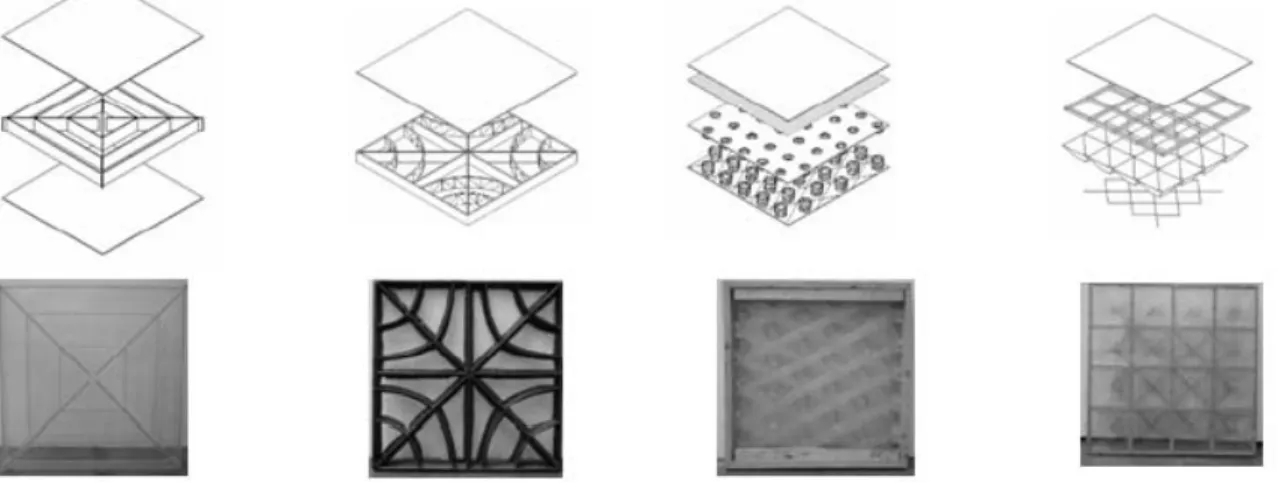
exciting application possibilities. A range of concept products were developed that included materials such as glass, synthetic fiber composites (glass and carbon with epoxy resin), polycarbonate, steel, aluminum and wood. In our quest to develop an environmentally conscious product, we developed further concepts that included a combination of recyclable polymers (thermoplastics) together with biocomposites (based on wood pulp, ryegrass, kenaf and other products based on farming sources). A range of panel typologies, resulting from earlier research is shown in Fig 3.
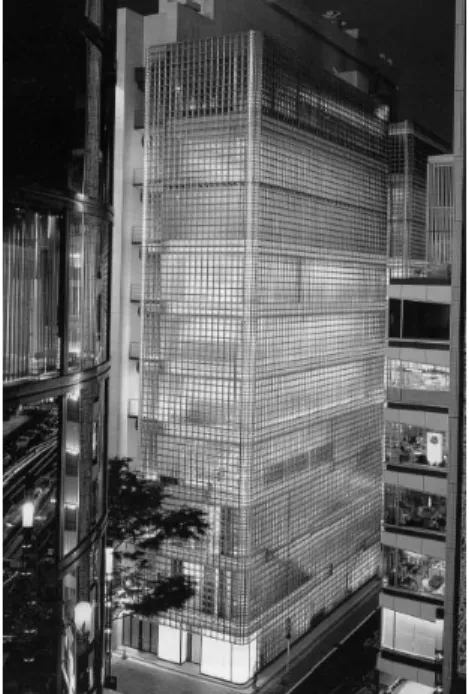
In order to contextualize and give relevance to this new product development, building typologies were studied and a number of recent applications have shown distinct trends towards more transparency in buildings combined with innovative approaches towards adopting translucent glazing that use polymer materials in significant proportions on building facades. One example is the Hermes building located in Tokyo, Japan and designed by Renzo Piano, Architect, as shown in Figure 4.
This building best shows the potential for high performing translucent and transparent facades, although in this instance the façade was most likely very expensive, since it is comprised of glass blocks and designed to cater for significant seismic loads. In addition the quantity of glass block throws into question the thermal efficiency of the entire building, related to both the building as a whole (since the glazing area is significant) and the performance of the façade skin (since glass block is not an efficient thermal insulator, owing to the high thermal conductivity of glass). The architectural intent is clear and dramatic. Since the architectural design is to maximize the glazed area on the building, an equivalent consideration for energy efficiency becomes an imperative. In this instance, the
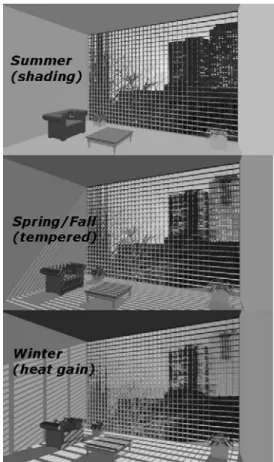
advantage of an alternative that adopts our product concept is clear. The composite panel demonstrates distinct advantages in terms of structural and thermal performance. The panel concept includes a large measure of integral shading elements that allows the façade to perform efficiently during the hot summer months when heat gains need to be prevented from entering the building. Likewise in winter, it is desirable to ensure heat gain through a façade in order to reduce on heating loads. In this instance, the panel concept allows the sun to penetrate through the façade between the integral shading elements, ensuring radiant heat gains into the building. The panel materials are highly insulating (combination of thermoplastic skin with biocomposite core with a thermally performing air gap in between the inner and outer skin). A median performance is expected during the equinox milder seasons. The
Table 1 - Performance assessment comparison for glazing and biocomposite system.
Performance value R SHGC
Double glazing with low
e coating 2.17 0.3
Biocomposite panel clear polymer skins and biocomposite grid core
2.5 varies 0.2 – 0.6 summer –
winter
essential concept for the seasonal transmission characteristics are demonstrated in Figure 5.
Technical Performance
The building envelope is a mediator between various external climates and static indoor conditions. It is also subjected to dynamic factors such as heat, ultraviolet (UV), moisture, sound and wind forces. A key challenge in designing a façade is energy conservation and the occupants’ thermal comfort. While opaque walls focus on safety, privacy and energy conservation, transparent and translucent facade components such as windows, provide day lighting, ventilation and visual transparency. Current glazing systems have been challenged because of low thermal insulation, solar gain, low impact resistance and high initial cost related to high performance glazing. Various building energy codes and ASHRAE (American Society of Heating, Refrigerating and Air-Conditioning Engineers) standards regulate certain R-values (thermal resistivity) of roofs, walls, floors, doors, and glazing. Based on ASHRAE standards, glazing with 50% of the total wall areas in a residential building, for example, requires R-2.17 which is comparable to double glazing, whereas for the remainder of the walls, an R-13 is required. Therefore it is imperative that the glazing elements perform efficiently thermally. Although high performance windows such as multi glazing with low-E coatings and/or argon gas fill can achieve energy savings, their applications can be limited due to the relatively high initial cost. In addition, reflective paints or films on glazing to block sunlight from being transmitted result in lower visual comfort and visual transmittance and consequently, require
extra artificial lighting. Another important factor for energy saving in addition to R-values is the SHGC (solar heat gain coefficient) - a measure of a window’s shading ability. It is not adequate to simply increase the R-value of insulated glazing without a proper shading device. Therefore it is more efficient for transparent glazing to incorporate a shading device either outside or inside of the building to prevent direct radiant heat from the sun from being transmitted, absorbed, and released inside of the building during hot summer months. Decreased cooling loads from shading devices in summer may however increase heating loads in winter if not correctly positioned, and these need to be located in positions that optimize on the sun's angle related to the project latitude. Some double glazed systems incorporate shading devices in the cavity between the skins of glass, but are expensive and reduce vision and natural light. External shading devices are a major visual intrusion on the building façade and require a lot of maintenance. Internal shading devices are less effective, since the sun's radiant energy has already entered the building, causing unwanted heat gains in summer.
Overall safety is also an important consideration, particularly with taller buildings. Glass needs to be strengthened or reinforced by laminating in order to ensure safety, whereas a polymer based skin (such as polycarbonate) has inherent strength and toughness, which enhances safety in glazed applications, potentially driving down costs when compared to its glass equivalent. Glass thicknesses are governed by the application of wind loading and need to remain relatively thin to be economic. This requires a substantial amount of framing to limit structural spans in construction, therefore increasing manufacturing and installation costs as well as compromising the thermal performance of the assembly, needing thermal breaks between inside and outdoor temperatures. Whereas the polymer and biocomposite panels are inherently stiff as a consequence of the through-thickness stiffness that results from the skin/core/skin composite layering, combined with the higher thermally insulating properties compared to glass. It is envisaged that the biocomposite panels can be make in much larger units (approx 12'x 18') compared to glass panels (approx 12'x4.5'), further reducing fabrication costs. The biocomposite system can also take advantage of being much lighter in weight, in the order of 25% of the glass equivalent system. Key to the success of the biocomposite panel façade system is its ability to perform 'passively' between summer and winter conditions within an
integrated skin/shading system. Our initial predictions for the performance of the biocomposite panels are shown in Table 1.
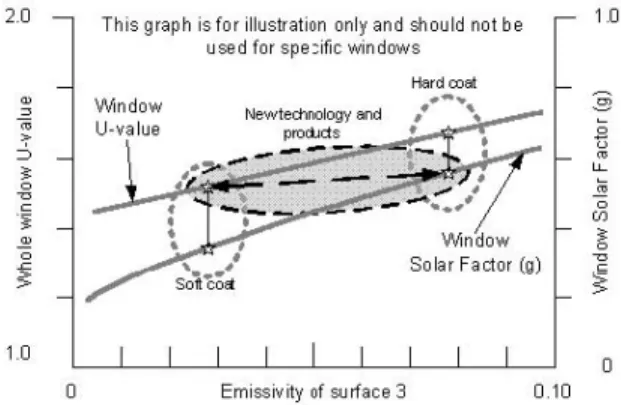
In a recent assessment of the dilemma faced by the fenestration industry [7], in relation to the thermal performance of facades with low e coatings, it was observed that technologies that increase the R-value (by the use of soft coats) is always accompanied by a reduction in the SHGC value. This means that reducing the heat lost from the window is accompanied by a reduction in the heat gained from the sun. An example case study, found that trying to increase the solar rating of refurbished dwellings by using a soft coat made the situation worse, as shown in the graph in Figure 6, where the performance of coatings are shown. They concluded that what is really needed to improve the energy efficiency of domestic windows is a new type of glass that increases the R-value of the glass and, at the same time, retains a high solar factor. Until now this has not been a research priority for the glass companies, but window energy rating now means that the development of coatings with these specific properties opens an important research area. As can be seen from Table 1, we expect the biocomposite panel to perform with a variable SHGC as desired in the above assessment.
The current impasse reached in the fenestration industry could well be overcome by the performance characteristics of our biocomposite façade system.
Research
Our research program includes (a) the design and development of prototype panel systems concepts; (b) the evaluation of structural and thermal performance through laboratory experiments and FEM (Finite Element Method) simulations; (c) the use of LCA (Life Cycle Assessment) with respect to energy consumption and pollution emission in both material production and building operation phases. The current research being carried out by the authors on different prototypical composite panel systems includes a variety of materials, which parametrically compare typology, material, thermal and optical properties. Our current area of investigation relates to typologies that use UV resistant thermoplastic polymers such as PMMA, PET or PC (as skin material) and biocomposites based materials such as woodpulp, ryegrass and kenaf with open cellular configurations (as a core material) shown in the lower half of Figure 3.
Our evaluations have so far demonstrated viable application and improved performance compared to conventional single and double glazing systems in buildings.
Current research activities include:
1. Thermal performance
A single chamber hotbox has been designed and constructed, to carry out quick determinations of effective R and SHGC values. This work follows the guidelines set out by the National Fenestration Council of the United States [8] and allows us to calibrate the concept panel configurations in relation to know materials and applications. Since this is an ongoing process, the results of these tests will be presented at the conference. However we expect to achieve normative values approximating those listed in Table 1. The expected values will vary according to the geometrical configuration of the different biocomposite core typologies shown in Fig 3 and therefore the results will need to be read with reference to the particular application, since the basis for the core configurations is driven by different use applications and therefore is not intended to be rated as a 'standard' product. This will allow future customized designs to be carried out and rapidly tested for thermal performance evaluation according to climate and latitude.
2. Structural performance
This means that the service stresses are low under extreme and short term load conditions, hence avoiding the problem of creep strains that would otherwise have occurred under long term loading. The only real long term loads are the panel self weight and these result in even smaller services stress than those experienced under normal wind loading conditions.
3. Materials Durability
There are a number of challenges being faced in the materials properties under investigation. The primary issues relate to UV and scratch resistance of the polymer skins and moisture and microbial resistance of the core. Emerging coating technologies that provide good UV resistance in polymers are already commercially available. The useful life of a product in practice is currently being researched by a team of materials science faculty and students, as well as the kinds of adhesives that may be adopted for the connections.
4. Energy Efficiency
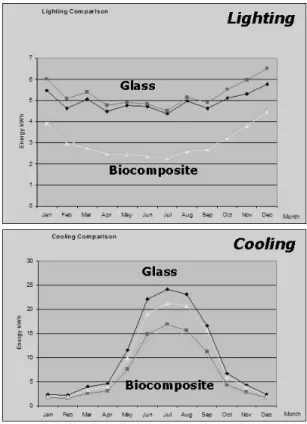
As mentioned earlier in this paper, energy performance is a key issue for this concept design product and is expected to perform very well as a 'passive' moderator that optimizes the range of properties that come into play during an annual cycle between hot and cold seasons. An energy simulation software for buildings based on DOE2, eQUEST [9] was used to carry out an analysis for a full building to study the relative effects of varying SHGC between façade systems related to – a). low E glass b). clear glass with shading. An approx 6% energy saving was determined from a) to b) and a further 6% was obtained by altering the plan form of the building to maximize the south facing aspect. One of the key features of an energy efficient building that adopts passive solar strategies is to maximize the south facing aspect of the building that has a narrow footprint. This plan shape allows the greatest benefits to be gained from winter heat gains and overall improved natural day lighting, both key contributors to overall energy efficiency. The results of this analysis show savings in energy used for cooling, heating and lighting. The effects of this analysis are shown in Fig 7.
The comparisons accounts only for the shading effect and coatings. Further research is being carried out on the actual biocomposite façade panel performance characteristics, to determine accurate R and SHGC values, and make more accurate determinations in the lowering of energy
consumption figures. This initial analysis shows about 40% savings in lighting and cooling energy consumption. More work is needed in assessing the effective heat energy reductions that can be achieved by implementing the design concept.
Interdisciplinary Imperatives
The approaches set out in this paper demonstrates important consequences for building design in relation to material properties, façade panel configuration, building orientation, shape and façade system. These issues were highlighted in a recent discussion on the state of the fenestration industry and how it ought to move forward in innovating new and efficient energy saving technologies for the future [10] Essentially, manufacturers define themselves by the process or material, hence limiting any real innovation in new technology areas. As can be noted here, our concept design involves a fully interdisciplinary
approach to the product design that allows related concepts in materials, energy performance, building form and function to interact in a way that would otherwise not easily happen in industry. Therefore our approach also sets out a new paradigm for progressing new technologies in building façade systems.
Sustainability LCA
A whole building lifecycle can be categorized into five stages such as raw material processing, manufacturing, construction, building use, and end use. Among these phases, building use is one of the major possess approximately six times the embodied energy of glass per unit weight, this value is significantly reduced when comparing the lighter weight, thinner material used in the composite panel system to a value of one and a half times. This is a complex determination and ongoing studies are being carried out to determine the total embodied energies on the basis of LCA for the full polymer skin and biocomposite core compared to a double glazing system following LCA procedures. The results of this analysis are expected to be presented after publication of this paper contributors for creating a larger environmental impact due to heating, cooling, and lighting. Here we demonstrate environmental impacts associated only with the building use phase for a 10-story office building using eQUEST, which simulates total energy consumption for a particular configuration and location as noted in Figure 8.
A simple environmental impact parametric study was carried out on a base model with a double glazing curtain
walling system and compared to a bio-composite panel system. All boundary conditions such as building lifespan, construction materials and methods, fraction of the window, and human comfort are assumed to be constant. The result of this analysis demonstrates that the bio-composite system outperforms the double glazing system in relation to cooling and lighting energy consumption and generates less pollutant emissions. In addition to analyzing the building use phase, an initial estimate shows that the total embodied energies for both systems are quite similar.
Conclusions
The paper shows how hybrid transparent panels possess high performance to weight ratios, are energy efficient and environmentally sustainable when used in building applications.
Issues of durability, UV resistance, microbial attack and moisture resistance are limitations that are being addressed in the research project.
The transparent hybrid panels made from biocomposite and recyclable material systems can effectively provide more sustainable solutions to glazing systems.
Areas for further research are required into the various applications for hybrid composite façade systems, in order to make the approach a viable option for the building industry in the future.
Endnotes:
The Biocomposite Panel © is
protected under design copyright as
well as the subject of patent disclosure protection for the design concept, manufacturing and assembly process. Any further details can be obtained from the
author Harry Giles [email protected] ph 734 647
2360
References:
1. Energy Information Administration, (2004), Annual Energy Review 2003, EPA.
2. Franklin Associates, Prairie Village, KS, (1998), Characterization of Building-Related Construction and Demolition Debris in the United States, EPA, Report No. EPA530-R-98-010 .
3. Center for sustainable systems, (2005), US material use, from http://css.snre.umich.edu/css_doc/CSS05-18.pdf .
4. T. Nishino, Kobe University Japan, (2004) Natural Fiber Sources, Green Composites, Polymer composites and the environment. CRC Press.
5. Sue Elliott-Sink, (2005) Special Report: Cars Made of Plants. From Edumds.com http://www.edmunds.com/ advice/specialreports/articles/105 341/article.html .
6. Linda Brock, School of Architecture, University of British Columbia, Vancouver (2005), Designing the Exterior Wall, Wiley.
7. Robin Kent, British Fenestration Rating Council (2005), Changing an Industry, from http://www.bfrc.org/General_ Publications-Fenestra50.htm .
8. NRFC 102 2004 - Procedure for Measuring the Steady-State Thermal Transmittance of Fenestration Systems.