Original Research Article
Decoding vestibular migraine for easier diagnosis
Anoop C. Vazhipokkil*, Ashwini Shenoy
INTRODUCTION
Migraine is one of the commonest disorders in the world which is primarily associated with headache but also with
autonomic and neurological symptoms.1 Its a complex
neurological disorder that affects multiple cortical, subcortical, and brainstem areas that regulate autonomic,
affective, cognitive, and sensory functions.2 Migraine is
among the top 20 ranked conditions in the world which causes Disability and a huge disease burden for
adolescent and middle aged women.3
The association of dizziness and migraine has been
identified from the 19th century.4 Despite headache being
the primary symptom of a migraine patient, Vertigo is also seen in a number of patients among them. Vestibular
and cranial nociceptive pathways get activated
simultaneously and this parallel activation plays the
linking factor.5 The coexistence of both the symptoms in
the patient can lead to varying perceptions from different clinicians and thereby leads to contrasting diagnoses. This can drastically change the treatment plan for the patient causing no relief of symptoms.
Recent epidemiological finding have revealed that the concurrence of vertigo with migraine is much higher than expected outcomes resulting in a higher prevalence
among adult population.6
ABSTRACT
Background: Due to the absence of a unified set of diagnostic criteria, vestibular migraine is always an underdiagnosed entity. This study was undertaken to find specific pointers in the diagnostic protocol which can help in diagnosing vestibular migraine and also to assess our treatment module for vestibular migraine.
Methods: An elaborate proforma was prepared for evaluating each patient at our vertigo clinic for a time period of two years. A detailed history is followed by general examination, ENT examination, specific tests for eyes, tests for vestibulospinal tract, and also a few more tests such as Doppler, pure tone audiogram, ECHO etc. when the diagnosis was in doubt. A total of 206 patients were evaluated. Vestibular migraine cases were started on our drug regimen of Tab flunarizine once daily and subjected two follow ups (at 4 weeks and 12 weeks).
Results: Total of 20 patients (9.7%) diagnosed as vestibular migraine. There was a slight preponderance to female population. A positive history of recurrent headache and neck pain were definitive clinchers in diagnosing vestibular migraine. All 20 patients had alleviation of symptoms with regards to severity and frequency of episodes.
Conclusions: Detailed history and elaborate vestibular examination alone is necessary for diagnosing vestibular migraine. Flunarizine regimen for a period of 3 months is found to be effective in relieving the symptoms. Adjuvant vestibular rehabilitation exercises mandatory for total alleviation of symptoms.
Keywords: Vestibular migraine, Migrainous vertigo
Department of ENT, Head and Neck Surgery, Sri Ramachandra Medical College and Research Institute, Chennai, Tamil Nadu, India
Received: 02 January 2019
Revised: 22 February 2019
Accepted: 25 February 2019
*Correspondence:
Dr. Anoop C. Vazhipokkil, E-mail: [email protected]
Copyright: © the author(s), publisher and licensee Medip Academy. This is an open-access article distributed under the terms of the Creative Commons Attribution Non-Commercial License, which permits unrestricted non-commercial use, distribution, and reproduction in any medium, provided the original work is properly cited.
The association of vestibular symptoms and migraine was first described in the early eighties and various studies have been done in the last 2 decades of the past century, the term vestibular migraine was coined and used only
from 1999 by Dieterich.7,8
Very recently the ICHC– beta 3 diagnostic criteria described Vestibular migraine as a separate condition and
included it in its appendix.9
Unfortunately, there are no internationally accepted criterias for diagnosing vestibular migraine. Therefore Vestibular migraine remains underdiagnosed compared to other types of vertigo mainly due to the absence of a
unified set of diagnostic criteria.10 It is claimed that
around 7% of the vertiginous population visiting the
vertigo clinic are cases of vestibular migraine.11 Yet the
numbers diagnosed are very low which can be accounted for the fact that these patients are referred to the clinic by the referring physicians who diagnose less than 2 percent
of their patients as vestibular migraine.12
This underdiagnosis and subsequent faulty treatment can lead to gross mismanagement of the vertigo patients as the underlying etiology never gets addressed. In order to overcome this handicap, we decided to review the details of our vertigo clinic for a time span of 25 months and analyse the vestibular migraine cases we had.
The committee for classification of vestibular disorders of the Barany society and the migraine classification subcommittee of the International headache society (IHS) formulated a diagnostic criteria which formulate steps to exclude other vestibular disorders and facilitating
accurate diagnosis of vestibular migraine.9
In most cases of vertigo, bedside clinical examination alone is required for diagnosis whereas in some cases auxiliary vestibular tests, blood investigations or imaging
may be helpful.12 The diagnosis of vestibular migraine is
still purely by clinical examination and confirmed only
when all other causes of vertigo are excluded. 13
Therefore detailed history is a must in order to relate the vertiginous symptoms to the migraine symptoms to diagnose vestibular migraine. But there was still a need to know more about certain symptoms and findings which were more consistent with vestibular migraine and which acted as a definite pointers to the diagnosis ultimately. This identification of such definitive indicators to the
diagnosis was what we aimed to fulfil in this study.14
Aim
The primary aim was to decode specific set patterns
in the clinical history to help identify pointers to the diagnosis of vestibular migraine.
To evaluate our own treatment module devised for
Vestibular migraine.
Objectives of the study
To find the incidence of vestibular migraine among
the vertiginous population
To assess the age and gender distribution among the
cases of Vestibular migraine
To find pointers in the clinical history which is
consistent among the vestibular migraine cases and assessing their significance of association
Identifying the co morbidities of the migraineurs and
their significance
To assess the results of few clinical examinations and
manoeuvres in vestibular migraine and evaluating their significance
To assess the treatment protocol followed by us for
Vestibular migraine.
METHODS
Our speciality vertigo clinic was set up at Sri Ramachandra Medical College and Research Institute, Chennai in April 2015 and functioned once a week for a duration of 2 hours. We prepared an indigenous Proforma which included various detailing of each patient.
We conducted a prospective study from April 2015 to June 2017 which included all the patients who were referred to our clinic.
The proforma included patient Details i.e. name, Hospital ID, age, sex, occupation, contact no and address
The vertiginous history of the patient was detailed in the proforma and specific information about the onset, severity, type, duration, provoking factors and relieving factors
Associated history was also delineated such as vomiting, Headache, visual disturbances, neck pain, fever and other autonomic symptoms.
Past history of the co morbidities (diabetes and hypertension) of the patient was also noted as well as the duration of the treatment they underwent.
Examination
The examination of the patient is done systematically and noted into the proforma by the clinician at the vertigo clinic. The series of examinations include general examination and Vital signs followed by the ENT examination. Tuning fork tests are also done to identify any hearing deficit.
After the above mentioned tests were done, the patient is examined for the Rhomberg’s test, Unterberger’s test, Gait, Tandem walking and the coordinated movements to assess the cerebellar function.
All these findings are noted on the proforma of the particular patient. The clinicians review the referral diagnosis and the final diagnosis is made.
As there are no proven protocols of treatment for vestibular migraine. The treatment of vestibular migraine
is still based on the guidelines for migraine.15 In our study
the patients diagnosed as vestibular migraine were put on oral flunarizine regimen of 10 mg once daily for a month. Flunarizine was favoured because it reduced the frequency of the episodes as well as the severity with a
better efficacy than propranolol and betahistine.16,17 It
was preferred over propranalol as the chances of Extrapyramidal symptoms as well as depression was
much lower in comparison.18 The patient is then asked to
maintain a vertigo diary and asked to review a month later with it. Patients with no marked improvement are then further given flunarizine regimen for another 8 weeks. Additional vestibular rehabilitation exercises are also advised as they have been found to markedly reduce
the symptoms in vestibular migraine patients. 19 Patients
missing the first follow up are contacted telephonically to enquire the progress of the symptoms. A second follow up is planned 12 weeks after the first visit.
The details of our study was analysed by using descriptive and inferential statistical analysis. Results on continuous measurements are presented on Mean±SD (min-max) and results on categorical measurements are presented in number (%). Significance was assessed at 5% level of significance. Chi-square/Fisher Exact test was used to find the significance of study parameters on categorical scale between two or more groups.
The statistical software namely SPSS 18.0, and R environment ver.3.2.2 were used for the analysis of the data and Microsoft word and Excel have been used to generate graphs, tables etc.
RESULTS
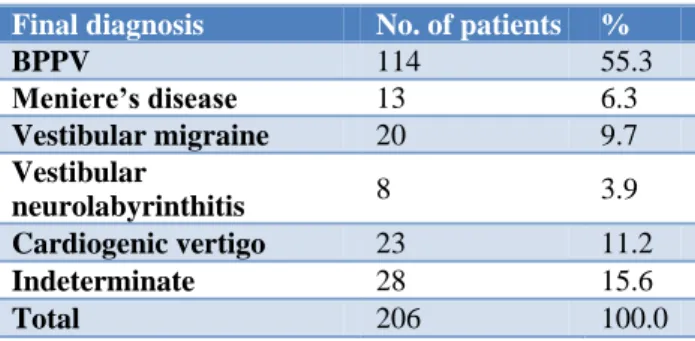
Out of a total of 206 patients, 20 of them were diagnosed as vestibular migraine. This accounted for 9.7% of the total vertiginous population registered at our clinic.
Table 1: Percentage share of various diagnoses.
Final diagnosis No. of patients %
BPPV 114 55.3
Meniere’s disease 13 6.3
Vestibular migraine 20 9.7
Vestibular
neurolabyrinthitis 8 3.9
Cardiogenic vertigo 23 11.2
Indeterminate 28 15.6
Total 206 100.0
Table 2: Age distribution of vestibular migraine patients studied.
Age in years No. of patients %
<18 1 5.0
18-40 11 55.0
40-60 7 35.0
>60 1 5.0
Total 20 100.0
There was one patient each in the paediatric and old age group; the rest were middle aged. Young adults (20-40 years) formed the majority. Using Chi square test, the association of age to the final diagnosis was found to have a P value of 0.104 which was largely insignificant.
Table 3: Gender distribution of vestibular migraine patients studied.
Gender No. of patients %
Female 11 55.0
Male 9 45.0
Total 20 100.0
There was a slight preponderance for female patients who formed a slightly larger majority of 55%. Using Chi square test, the association of the gender to the final diagnosis was found to have a p-value of.224 which was again largely insignificant.
Both the severity of vertigo, vertigo onset and the vertigo description (continuous/intermittent) were assessed using the chi square test and revealed a high P value revealing no significance of association to the final diagnosis.
80% had sudden onset vertigo episodes. Rotatory type of vertigo was seen in 75% cases. The Fischer exact test revealed a high significance of association (p=0.012) of rotatory type to vestibular migraine.
Absence of tinnitus was seen in 75% of the patients which revealed a p value of 0.005 signifying high degree of association, therefore found to be a pointer to the diagnosis of vestibular migraine.
Similarly, hearing loss was not a common feature seen among the cases of vestibular migraine accounting only 10%. We were able to derive a significant association between Absence of hearing loss and vestibular migraine which gave a very low (p<0.001*).
Absence of fever accompanying the vertigo in the history was also found to be a pointer towards diagnosing vestibular migraine as we were able to identify an association of significance i.e. P value of <0.001* in the Fischer exact test.
headache. As described in previous studies, The pain described was typically pricking type and in most cases restricted to the periorbital area and eye. This was found to be a definite pointer towards the diagnosis with an astonishing p value way below 0.001* indicating a strong significance of association.
Figure 1: Percentage of patients with recurrent headache within each diagnosis.
In addition neck pain was seen in 55% of the patients and also had a p value of 0.027 indicating its strong association with the final diagnosis of vestibular migraine.
Figure 2: Percentage of patients with history of neck pain within each diagnosis.
Among the comorbidities assessed, both hypertension and diabetes mellitus was found to have a p value of 0.053 and 0.734 respectively which indicated that both did not have a significant level of association with the diagnosis of vestibular migraine.
Out of the 20 patients diagnosed as migrainous vertigo cases, 10 patients had revealed in the history that they were diagnosed with Migraine previously and had taken treatment for it.
75% of the patients tested negative for Head impulse test and therefore a negative head impulse test revealed a significant association (p<0.001*).
Figure 3: Results of head impulse test within each diagnosis.
Similarly a negative Dix Hallpike also was associated with a highly significant association using the Fischer Exact test (p<0.001*).
Figure 4: Results of Dix- Hallpike’s manouvre within each diagnosis.
Rhomberg’s test, tandem walking and unterberger was seen as negative in majority of the patients but on applying the Fischer exact test to assess the significance of association, they revealed insignificant p values of 0.334, 0.609 and 0.130 respectively.
45% of the patients returned for the first follow up out of which 66% had complete relief and the rest 33% were again continued on oral flunarizine regimen for 2 more months along with vestibular rehabilitation therapy. The exercises were taught by our personnel at the clinic. The 55% patients who didn’t attend the follow up were contacted telephonically and found to have improved symptomatically.
On second follow up at 12 weeks the remaining 33% patients reported to have improved symptomatically with regard to both frequency and severity of the episodes.
0 50 100
Perc
entag
e
·Yes ·No
0 50 100
Perc
entag
e
·Yes ·No
0 20 40 60 80 100
Perc
entag
e
·Negative ·Positive Right
·Positive Left ·Positive Bilateral
0 50 100
Perc
entag
e
·Negative ·Positive Right
DISCUSSION
We had a total of 206 patients who had to undergo the stepwise history and a battery of clinical tests which revealed a staggering 9.1% of our vertigo patients diagnosed as vestibular migraine. This was comparable to the results derived in various other studies.
All these patients were reviewed with their diagnosis at the two follow up meetings, the diagnosis was reviewed, checked and reconfirmed by analysing the patients responses to our anti migraine protocol.
Classically migraine manifests during adolescence and progresses during the middle age and our results also supported this as majority of our patients were middle aged with a slight preponderance of females similar to the
study by Johnsson et al.20
Due to lack of internationally accepted criteria for diagnosis, the clinicians are forced to look for specific clinchers in the history. Previous studies have pointed that diagnosis of migrainous vertigo should be done only in cases where all the other causes of vertigo are excluded. But we searched for features in the clinical history which are consistently seen among the migraine cases which could be declared as definite pointers to diagnosing vestibular migraine.
Two thirds of the patients having vestibular migraine are
said to have a spontaneous rotatory type of vertigo.6
Similarly majority of our migraine patients gave history of spontaneous vertigo and also rotatory type was found to be a definite pointer to the diagnosis (p<0.012).
Hearing loss and tinnitus was seen in in less than 5 patients, but Chi square test (p=0.005) revealed a close association of vestibular migraine with both normal hearing and absence of tinnitus
In most studies headache has been addressed as an associate feature of vestibular migraine, for e.g. Vukovic in 2007 described that headache was associated with vertigo in 24-45% cases, but in our study astonishingly it was a feature in every diagnosed case of vestibular
migraine.14 It also gave a strong significance of
association in the Fischer exact test thereby emphasising on the point that associated history of headache is a tell tale sign of vestibular migraine.
Similar reports was derived with associated neck pain also which also gave a significant p<0.001* undermining its relevance in diagnosing vestibular migraine.
We also found that co morbidities such as diabetes mellitus and hypertension have no role to play in a case of vestibular migraine and has no relevance in the lead up to its diagnosis.
The tests involving eye movements such as Dix-Hallpike and head impulse tests were found to be negative in most of the cases i.e. 95% and 75% respectively. In addition to this we were also able to derive the association that, a negative Dix-Hallpike or a head impulse test has a strong association to diagnosing vestibular migraine (proved by a p<0.001* as per Fischer exact test for both)
Similarly the other tests such as tandem walking, Rhomberg’s test and Unterberger’s were also found negative in majority of the patients but the Fischer exact tests applied on them did not associate them strongly to the final diagnosis of vestibular migraine.
CONCLUSION
Though most studies proclaim headache is an important feature seen in vestibular migraine cases; our study emphasises that recurrent headache episodes is a constant feature seen in every case of vertiginous migraine. We also confirm the definitive association of neck pain in the history to be a clear cut pointer to vestibular migraine. Therefore a patient with spontaneous rotatory vertiginous episodes associated with recurrent headache and neck pain have to be considered as a case of vestibular migraine. And if Head impulse and Dix-Hallpike tests are found negative in the patient then the diagnosis becomes more evident and have to be started on Anti migraine therapy. Oral flunarizine regimen for a period of three months is an effective regimen for proven cases of vestibular migraine with a minimum of 2 follow up visits during the period. Finally, our study also concludes that Vestibular rehabilitation exercises is an absolute necessity and have to be advised with the daily dosing regimen.
ACKNOWLEDGEMENTS
Suresh KP Scientist (Biostatistics) National institute of Veterinary Epidemiology and disease Informatics (NIVEDI), Bangalore, India.
Funding: No funding sources Conflict of interest: None declared Ethical approval: Not required
REFERENCES
1. Pressman A, Jacobson A, Eguilos R, Gelfand A,
Huynh C, Hamilton L, et al. Prevalence of migraine in a diverse community-electronic methods for migraine ascertainment in a large integrated health plan. Cephalalgia. 2016;36:325–34.
2. Burstein R, Noseda, R, Borsook D. Migraine:
Multiple Processes, Complex Pathophysiology. J Neurosci. 2015;35(17):6619–29.
3. Stovner L, Hagen K, Jensen R, Katsarava Z, Lipton
R, Scher A, et al. The global burden of headache: A
disability worldwide. Cephalalgia. 2007;27:193– 210.
4. Cutrer FM, Baloh RW. Migraine-associated
dizziness. Headache. 1992;32(6):300-4.
5. Furman JM, Marcus DA, Balaban CD. Vestibular
migraine: clinical aspects and pathophysiology. Lancet Neurol. 2013;12:706–15.
6. Neuhauser HK, von Brevern M, Radtke A, Lezius F,
Feldmann M, Ziese T, et al. Epidemiology of vestibular vertigo: a neurotologic survey of the general population. Neurology. 2005;65(6):898– 904.
7. Kayan A, Hood JD. Neuro-otological manifestations
of migraine. Brain. 1984;107(4):1123–42.
8. Dieterich M, Brandt T. Episodic vertigo related to
migraine (90 cases): vestibular migraine? J Neurol. 1999;246(10):883-92.
9. Headache Classification Committee of the
International Headache Society (IHS) The
International Classification of Headache Disorders,
3rd edition (beta version) Cephalalgia.
2013;33(9):629–808.
10. Sohn JH. Recent Advances in the Understanding of
Vestibular Migraine. Behav Neurol.
2016;2016:1801845.
11. Dieterich M, Obermann M, Celebisoy N. Vestibular
migraine: the most frequent entity of episodic vertigo. J Neurol. 2016;263(1):82-9.
12. Geser R, Straumann D. Referral and Final
Diagnoses of Patients Assessed in an Academic Vertigo Center. Frontiers Neurol. 2012;3:169.
13. Neuhauser H, Leopold M, von Brevern M, Arnold
G, Lempert T. The interrelations of migraine,
vertigo and migrainous vertigo. Neurology.
2001;56:436–41.
14. Vukovic V, Plavec D, Galinovic I,
Lovrencić-Huzjan A, Budisić M, Demarin V. Prevalence of vertigo, dizziness, and migrainous vertigo in patients with migraine. Headache. 2007;47:1427– 35.
15. Stolte B, Holle D, Naegel S, Diener HC, Obermann
M. Vestibular migraine. Cephalalgia.
2015;35(3):262-70.
16. Van Ombergen A, Van Rompaey V, Van de
Heyning P, Wuyts F. Vestibular migraine in an
otolaryngology clinic: prevalence, associated
symptoms, and prophylactic medication
effectiveness. Otol Neurotol. 2015;36(1):133-8.
17. Verspeelt J, De Locht P, Amery WK. Postmarketing
study of the use of flunarizine in vestibular vertigo and in migraine. Eur J Clin Pharmacol. 1996;51:15– 22.
18. de Bock GH, Eelhart J, van Marwijk HW, Tromp
TP, Springer MP. A postmarketing study of flunarizine in migraine and vertigo. Pharm World Sci. 1997;19(6):269-74.
19. Vitkovic J, Winoto A, Rance G, Dowell R, Paine M.
Vestibular rehabilitation outcomes in patients with and without vestibular migraine. J Neurol. 2013;260(12):3039-48.
20. Jönsson R, Sixt E, Landahl S, Rosenhall U.
Prevalence of dizziness and vertigo in an urban elderly population. J Vestib Res. 2004;14(1):47-52.