ISSN: 2147-611X
www.ijemst.com
The Use of History of Mathematics in the
Mathematics Classroom: An Action
Study
Suphi Önder Bütüner1, Adnan Baki2
1
Yozgat Bozok University
2
Trabzon University
To cite this article:
Butuner, S.O. & Baki, A. (2020). The use of history of mathematics in the mathematics
classroom: An action study.
International Journal of Education in Mathematics, Science and
Technology (IJEMST), 8
(2), 92-117.
This article may be used for research, teaching, and private study purposes.
Any substantial or systematic reproduction, redistribution, reselling, loan, sub-licensing,
systematic supply, or distribution in any form to anyone is expressly forbidden.
Authors alone are responsible for the contents of their articles. The journal owns the
copyright of the articles.
Volume 8, Number 2, 2020
The Use of History of Mathematics in the Mathematics Classroom: An
Action Study
Suphi Önder Bütüner, Adnan Baki
Article Info
Abstract
Article HistoryReceived:
29 September 2019
In this action study, instructional environments were enriched with activities related to the history of mathematics in order to deepen students‟ beliefs about mathematics and reveal for them fun, interesting, and useful activities. The study enrolled twenty-four 8th-grade students. Data were collected by using multiple data collection tools. The data regarding the students‟ beliefs about mathematics were collected via written opinion forms and semi-structured interviews. Prior to the study, the students perceived mathematics as a branch of science that is closed to development and did not know why or how it flourished. After the study, they stated that mathematics is open to development and is used to solve everyday problems. The study revealed a decrease in students‟ absolutist beliefs about mathematics, and students found math fun and interesting as a result of engaging in activities that promote active problem-solving. In the future, other action studies involving the history of mathematics may be used to teach different topics at different grade levels.
Accepted: 07 February 2020
Keywords
Activity
Belief about mathematics History of mathematics 8th grade
Introduction
Educational psychologists continue to report that students‟ epistemological beliefs are closely related to their academic level, a link that has been clearly observed both in students‟ ideas about what constitutes knowledge and how they think it is acquired (Kardash & Howell, 2000; Bendixen & Hartley, 2003; Whitemire, 2004; Schommer-Aikins, Duell, & Hutter, 2005). A study of middle school students by Schommer-Aikins et al. (2005) suggested that students‟ academic performance and grade point average could be predicted by their general epistemological understanding and approaches to solving mathematical problems. Ernest (2014) proposed that epistemological beliefs should be clustered into three categories, which correspond to three different perspectives. The first perspective, the Platonic, considers mathematics as an a priori static unified body of knowledge that exists out there and waits to be discovered. The second perspective, the instrumentalist, regards mathematics as an organized set of instruments (e.g., rules, operations, and algorithms), and hence can be linked to a formalist view of mathematics. Finally, the experimental view regards mathematics as a dynamic and continually evolving field of human creation, the results of which are open to revision. The proponents of this final view believe that mathematics serves human needs, and mathematics appears to find solutions to the needs of everyday life (Charalambous, Panaoura, & Philippou, 2009). Horton and Panasuk (2011) linked the Platonist and instrumentalist belief categories with the absolutist view and the experimentalist category with the fallibilist view. The international mathematics education community largely adopts the experimental approach (fallibilist view) in the learning and teaching of mathematics (Handal, 2003). Handal (2003), Lerman (1983), and Threlfall (1996) described the absolutist view as a concept under behavioral theory and the fallibilist view as a concept under constructivist theory.
difficult to follow transmission type lessons with their emphasis on content may benefit from pedagogies that more readily accommodate a fallibilist perspective that invites them to participate in open-ended inquiry. To aid our understanding of how students construct their beliefs, Di Martino and Zan (2011) conducted a qualitative examination of the relationship between these beliefs and their various other beliefs, attitudes, and emotions. They found that the nature of instruction and early experiences in maths classrooms can generate non-availing beliefs in children who develop a negative view of the subject because they are led to believe that they can only learn the subject by remembering rules and formulas. They call on teachers to be aware of this problem and to endeavor to change non-availing beliefs through instruction, taking care not to conflate the needs of such students with those of others whose negative responses arise from the fact that they have not yet developed deeper thinking skills. A method for profiling domain-specific epistemological beliefs was trialed by Buehl and Alexander (2005) that uses cluster analysis and analysis of variance procedures to categorize students‟ beliefs. It also examines variations in beliefs, motivation, and task performance. The findings of this study endorsed previous research that linked the level of academic attainment to the sophistication of beliefs. Accordingly, students who demonstrated higher levels of motivation and better performance of learning tasks believed less in the isolation and certainty of knowledge, and less in the supremacy of authority as a source. A structural model of mathematics achievement was also tested by Nasser and Birenbaum (2005) that examined five learner variables: gender, epistemological beliefs, self-efficacy, attitudes, and anxiety about mathematics. They found that epistemological beliefs have a direct effect on children‟s self-efficacy beliefs. Moreover, an indirect effect on student achievement, attitudes, and anxiety concerning mathematics was seen in both groups. Accordingly, this cross-cultural study of Arab and Jewish children observed how epistemological beliefs about mathematics strongly influenced learning outcomes in both groups, which are, in turn, sustained by motivational factors, such as self-efficacy beliefs. Further evidence of this relationship comes from a qualitative investigation by Liu (2010) of four Taiwanese college students‟ math-related epistemological beliefs. The participants had obtained significantly different results from a set of three distinct performance contexts. Two of them expressed a dynamic view of mathematics, thinking of it as a process that requires personal creativity, and solved standardized calculus problems more easily than the other two students who had a static, instrumentalist view of mathematics as a set of rules to be followed. The current literature holds that epistemological beliefs can be used to predict students‟ learning outcomes. However, while more dynamic, fallibilist beliefs are usually associated with better outcomes, this association is not necessary for all types of mathematical tasks. Moreover, a student who possesses a robust set of sophisticated beliefs is not always going to outperform a student whose beliefs draw on both static and dynamic views.
The National Council of Teachers of Mathematics (2000) stated that beliefs affect students‟ participation in mathematics activities, their effort and willingness, and attitudes towards learning mathematics. It is a widely accepted fact that students‟ learning outcomes are closely related to their beliefs and attitudes about mathematics (Furinghetti & Pehkonen, 2000; Op‟t Eynde, Corte, & Verschaffel, 2002). There is a cyclical and mutual interaction between belief, attitude, and mathematics achievement (DeBellis & Goldin, 2006; House, 2006; van Eck, 2006). One of the ways to deepen students‟ beliefs about mathematical knowledge and to reveal the fun and interesting side of mathematics is to use HoM (history of mathematics) in classes (Fried, 2001; Gulikers & Blom, 2001). The use of HoM can show students that mathematics is open to development and that it is not only the product of Europe (Ernest, 1998). Thanks to the HoM, students may have an idea about the origin of mathematics by answering questions, such as “why do we use the equal sign” or “why do we use the concept of mean” (Liu, 2003). Students may have true beliefs about mathematics when they encounter the forms of solution and proof by mathematical scholars and different civilizations, and when they use these forms of solutions and proofs themselves. In this way, they learn that mathematics has a multicultural, dynamic, and evolving structure (Bidwell, 1993; Barbin, Bagni, Grugnetli, & Kronfellner 2000, Marshall, 2000; Haverhals & Roscoe, 2010). Horng (2000) finds that students may learn to appreciate the evolution of mathematical knowledge through different solutions to the same problem in different times and locations. This study involves the addition of HoM activities to a mathematics course to enable students to recognize the dynamic and developing nature of mathematics, to deepen their perceptions of successful mathematicians, to show them how and why mathematics emerged, and help them to enjoy the mathematics course by experiencing the fun and interesting side of it. Below is the rationale of the study.
Statement of the Problem
with. The ideal mathematics teacher, according to the students, was one who explained topics well and solved all problems quickly by using rules and formula. They believed that someone who could solve problems accurately and quickly was good at mathematics. They also believed that mathematics was „a closed science,‟ and it emerged 100 years ago. They had only heard about one or two mathematicians. They did not know about the role of mathematics in society or how it emerged. This was a result of their previous mathematics teachers‟ philosophical tendencies towards the nature of mathematics and their instructional styles. Many students used to say to me, “Sir, mathematics is a really boring course based on rules and formula.” All of these led me to use the HoM in my classes. In order to avoid the problems mentioned above, mathematics classes were enriched with HoM activities. There are studies in the literature documenting the effects of HoM on students‟ mathematics attitudes (Ransom, 1991; Lawrence, 2006; Ho, 2008; Haverhals & Roscoe, 2010) and beliefs (Liu & Niess, 2006; Ho, 2008; Liu, 2009). These studies have found that the HoM shows them the fun and interesting side of mathematics and changes their beliefs about mathematics. Therefore, in the present study, we enriched the instructional environment with HoM activities in order to deepen students‟ beliefs about mathematics and show them the fun and interesting side of it. The problem statements in this study were:
1. How do learning environments enriched with HoM activities affect students‟ beliefs about mathematics? 1a. Do learning environments enriched with HoM activities contribute to students‟ learning of the
dynamic and developing nature of mathematics and to the deepening of their perceptions of people good at mathematics?
1b. Do learning environments enriched with HoM activities contribute to students‟ learning of how and why mathematics emerged?
2. Have the activities been effective in pointing out the interesting and entertaining side of mathematics?
Previous Studies
There are many studies in the literature that report the positive effects of using the HoM in the classroom (Percival, 1999; Krussel, 2000; Marshall, 2000; Lawrence, 2006; Liu & Niess, 2006; Ho, 2008; Kaye, 2008; Charalambous, Panoura, & Philippou, 2009; Liu, 2009; Nataraj & Thomas, 2009; Haverhals & Roscoe, 2010; Lim and Chapman, 2015). Percival (1999) studied the reflections of using ancient number systems in an interdisciplinary instructional environment. At the end of the study, the students were able to appreciate the intelligence of ancient civilizations and their contributions to mathematics and saw that mathematics as a science is a product of human effort. Krussel (2000) asked his students to study the historical development of the topics they find hard to learn and to report their findings. The students were surprised that many mathematical concepts had been discovered centuries before. They stated that they were able to better understand the nature of mathematics, and that mathematics was a dynamic and ever-developing science. Marshall (2000) reported the positive results of the use of HoM in his study. His students stated that errors are possible in mathematics; there may still be undiscovered theories; today‟s mathematics was developed by people who lived centuries ago in order to find solutions to their daily problems, and mathematics is a living and developing science that allows civilizations to grow.
Dickey (2001) studied the effects of the HoM on 8th graders‟ learning and attitudes in an action study. In interviews, students expressed their concerns that the activities might lead to a decrease in their mathematics grades, that they may fall behind the mathematics curriculum, and that the information they gain from the activities may not be of use. Liu and Niess (2006) studied the effects of an analysis course based on the historical approach on the development of students‟ mathematical thinking. By the end of this study, no student perceived mathematical thought as consisting only of calculating and operations. On the other hand, there was a significant increase in the number of students who referred to mathematics as logic, judgment, and rational thought. While the number of students who believed that mathematicians should be more creative increased, the number of those who thought mathematicians should find answers quickly decreased. For this reason, teachers need to intervene in ways that can engender enhanced ideas about mathematics amongst students with different beliefs. A relevant example was reported by Ho (2008), who employed action research to see the effects of introducing a social aspect to a mathematics course given to 102 polytechnic students in Singapore. The intervention measured pre- and post-test attitudes toward mathematics in terms of beliefs, interests, confidence, and perseverance. During the intervention, students were asked to take a historical approach to find out how algebra originated. Ho reported that higher scores in terms of belief and perseverance were obtained from the post-test.
can come up with their own mathematics. This was followed by another intervention study that sought to test the efficacy of integrating historical aspects of mathematics with the curriculum and found that it was indeed useful for demonstrating its dynamic, potentially fallible, and sociocultural nature (Charalambous, Panoura, & Philippou, 2009). Liu (2009), who also employed a historical approach, examined how student beliefs evolved over an experimental course in calculus. This year-long intervention with college students in Taiwan utilized an open-ended questionnaire, mathematics biographies, in-class reports, and follow-up semi-structured interviews. Lui reported that it was easier to change the mathematics-related epistemological beliefs of the students in the intervention group than those of the controls. However, given the small scale and the high level of within-group variation, such findings should be treated with caution.
Nataraj and Thomas (2009) studied the effects of teaching the digit number system and great numbers through concrete models based on historical development. All but two students found representing numbers with rods easy and fun. Haverhals and Roscoe (2010) designed a lesson using the historical approach in the teaching of the integral of secant. Students stated that the use of historical approach was fun, interesting, and beneficial. They thought it incredible that such a map was drawn before the systematic use of integrals, that the people who did so were highly intelligent, and that it is amazing and meaningful that they used integrals in daily life. Lim and Chapman (2015) used formal assessments to measure the impact of the history of mathematics (HoM) on 11th graders. They found both immediate short-term and long-term effects on achievement, but only short-term positive effects in the affective domains. In Tozluyurt‟s (2008) study, several students did not show any interest in an HoM activity related to the writing of Egyptian numbers in hieroglyph form. Some said it was because they felt anxious about their university entrance exam, while most simply found hieroglyph drawings difficult. The most popular HoM activity was lattice multiplication. Idikut (2007) enriched his classes with the life stories of mathematicians and found no significant difference between experimental and control group students‟ attitude mean scores. Similar HoM activities were used by Dickey (2001), who introduced students to Egyptian numbers, multiplication and division in Egypt, Babylonian numbers, and the lattice multiplication method. Such historical content is not included in the typical 8th-grade mathematics syllabus, and there is little to connect these topics with modern mathematics. Not surprisingly, students found the activities other than the lattice multiplication method rather boring.
Previous studies have shown that the use of HoM has positive effects on students‟ beliefs about mathematics (Percival, 1999; Krussel, 2000; Marshall, 2000; Liu & Niess, 2006; Ho, 2008; Kaye, 2008; Charalambous, Panoura, & Philippou, 2009; Liu, 2009) and their attitudes towards mathematics (Lawrence, 2006; Nataraj & Thomas, 2009; Haverhals & Roscoe, 2010; Basibuyuk, 2012; Bayam, 2012; Lim and Chapman, 2015). Studies conducted in Turkey about the use of HoM (Idikut, 2007; Tozluyurt, 2008; Albayrak, 2011; Basibuyuk, 2012; Bayam, 2012) have mostly been quantitative and used the experimental method. This is also true for the studies conducted elsewhere. Outside of Turkey, two studies were found to have used the action research method to investigate students‟ views and attitudes (Dickey, 2001; Ho, 2008). Unlike previous studies in the literature, this study considered the barriers to the use of HoM while designing activities, used the HoM as a goal and tool, and used a longer period to implement the activities (one academic year each for the pilot trial and the real study). The close relationship between the researching teacher and the students, as well as the long-term observations and interviews throughout the process, may be the factors that allowed the determination of the change in students. Owing to the nature of the action study, the first author (the researching teacher) gained experience in the use of HoM in the instructional environment and was able to share these experiences with the readers. It is hoped that the study will serve as a guide for future researchers and mathematics teachers in how to use the HoM more effectively. In the following sections, the use of HoM as a goal and a tool will be explained through sample activities used in the study.
Theoretical Framework: The Use of HoM as a Tool and a Goal
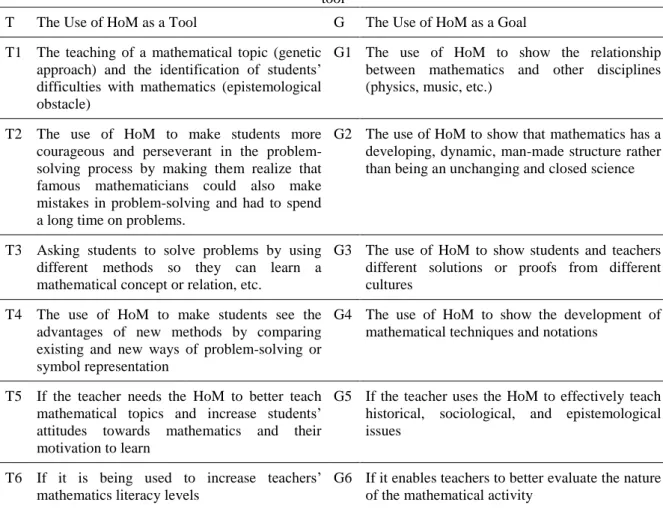
Table 1. The classification of Tzanakis and Arcavi‟s (2000) reasons for using HoM into its use as a goal and a tool
T The Use of HoM as a Tool G The Use of HoM as a Goal
T1 The teaching of a mathematical topic (genetic approach) and the identification of students‟ difficulties with mathematics (epistemological obstacle)
G1 The use of HoM to show the relationship between mathematics and other disciplines (physics, music, etc.)
T2 The use of HoM to make students more courageous and perseverant in the problem-solving process by making them realize that famous mathematicians could also make mistakes in problem-solving and had to spend a long time on problems.
G2 The use of HoM to show that mathematics has a developing, dynamic, man-made structure rather than being an unchanging and closed science
T3 Asking students to solve problems by using different methods so they can learn a mathematical concept or relation, etc.
G3 The use of HoM to show students and teachers different solutions or proofs from different cultures
T4 The use of HoM to make students see the advantages of new methods by comparing existing and new ways of problem-solving or symbol representation
G4 The use of HoM to show the development of mathematical techniques and notations
T5 If the teacher needs the HoM to better teach mathematical topics and increase students‟ attitudes towards mathematics and their motivation to learn
G5 If the teacher uses the HoM to effectively teach historical, sociological, and epistemological issues
T6 If it is being used to increase teachers‟ mathematics literacy levels
G6 If it enables teachers to better evaluate the nature of the mathematical activity
This study used the HoM as a tool in order to make students see the fun and interesting side of mathematics and help them enjoy it. During recent years, there has been a conscious effort that focuses on making mathematics accessible and enjoyable for all children. So, it has become important that mathematics should be facilitated through increased emphasis on more problem solving, using manipulative (or hands-on material), and interactive learning experiences to construct mathematical knowledge (Wang, 2009). Activities (3, 4, 5, 6, 7, 8, 10, 11, 15) used in this study include manipulatives (or hands-on materials), and the HoM provides a context for student work. Math manipulatives are physical objects that are designed to represent abstract mathematical ideas explicitly and concretely (Moyer, 2001). Manipulatives not only allow students to construct their own cognitive models for abstract mathematical concepts and processes, but they also provide a common language to communicate these models to the teacher and other students. In addition to aiding directly in students‟ cognitive processes, manipulatives have the additional advantage of increasing their interest in and enjoyment of mathematics (DeGeorge & Santoro, 2004). Students who are presented with the opportunity to use manipulatives report that they are more interested in mathematics. A long-term interest in mathematics translates to increased mathematical ability (Sutton & Krueger, 2002).
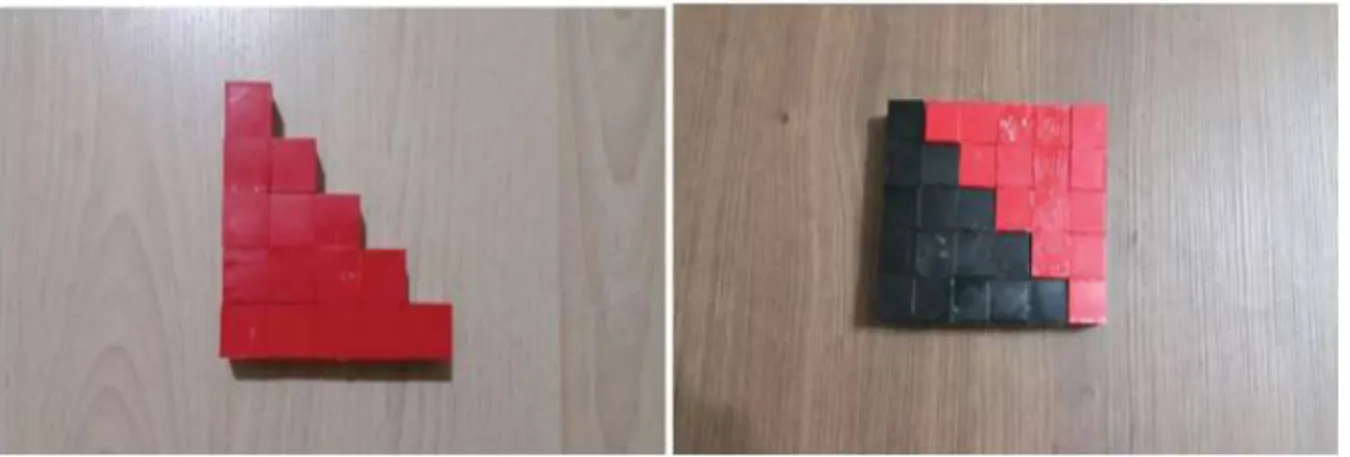
symbolic stage, written and verbal symbols are used. Students use the rule or formula they reach mathematically, by using symbols (Kara ve Koca, 2004). For example, in activities 7-8, the students attempted to obtain rectangular models by taking apart and bringing together consecutive positive whole numbers models (Enactive Stage). Then, the students were given a dotted and isometric paper with their models drawn on them and asked to express the edges of geometric shapes in n (Iconic Stage). In the final symbolic stage, they were asked whether there was a relationship between the sum of the consecutive positive whole numbers, triangular and square number models, and the geometric shapes they obtained. Here, the students were expected to activate their schema and mathematically write the rule they have reached (see Figures 1 and 2).
Figure 1. The consecutive positive integers models used in the study
The aim of Activity 15 (Appendix 2, worksheet 15) in the study was to get the students to discover the volume rule of the frustum square pyramid. The students used the manipulative shown in Figure 2 for Activity 15. In the 2500s BC, ancient Egyptians used the dissection method when calculating the volume of the truncated square pyramid. To calculate the volume of frustum square pyramids by this method, the students should properly separate into pieces the frustum square pyramid model given in Figure 1 and make geometric shapes by bringing the pieces together. They are then expected to add the volumes of the geometric shapes they have created (enactive stage) and state the volume rule for the frustum square pyramid (symbolic stage). When the cut and disintegrate method is applied to the volume calculation of a truncated square pyramid with the bottom length unit a, upper length unit b, and height h, the yields will be a square prism, two identical rectangular prisms, and a square pyramid. The sum of the volumes of these geometric shapes gives the volume of the truncated square pyramid ( ). As can be seen, this activity expects students to discover the rule for calculating the volume of the truncated square pyramid by using the cut and disintegrate method thought to have been used in carrying out this calculation in ancient Egypt (Swetz, 1994). By using manipulative, students may see a new, interesting, fun, and educative method of calculating the volume of the frustum square pyramid and may become more interested in mathematics (Sutton & Krueger, 2002; DeGeorge & Santoro, 2004; Van de Walle et al., 2013). Thus, the HoM is used as a tool.
Figure 2. Model of the frustum square pyramid
2000 and 1800 BC), proportional thinking lay at the center of mathematics. As the amount of water in the River Nile increased, larger agricultural land could be irrigated. Taxes were being collected in proportion to the amount of produce. Buildings were constructed proportionally. Egyptians also solved equations with proportional thinking. These examples are important as they show how mathematics could be used in daily life. For example, having the students learn through Activity 12 (see Appendix 1) that a constant ratio existed between the amount of tax paid by ancient Egyptians and the produce they yielded (Lumpkin, 1997) may help them see the reasons for the emergence of mathematics and evaluate its role and importance in society. The problem below taken from an ancient Egyptian source reveals this:
Imagine that you have 450 hectares of barley, and you must pay as tax 1 out of each 10 hectares. How many hectares of tax would you pay for this produce? (3000 BC)
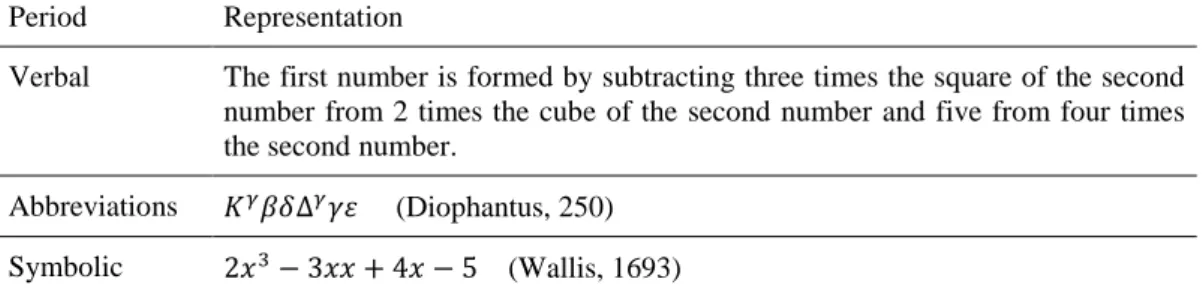
By using the HoM, students can also learn that mathematics is a non-static and developing science. Algebraic expressions have been written in different ways over time (see Table 2). They were written differently in mainly three eras (verbal era, abbreviations era, symbolic era) (Activity 9, see Appendix 1). Examining the representations below may help students see that algebraic statements have evolved over time and that mathematics is not a static science. Information on other activities used in the study is given in Appendix 1.
Table 2. The representation of in three different time periods Period Representation
Verbal The first number is formed by subtracting three times the square of the second number from 2 times the cube of the second number and five from four times the second number.
Abbreviations (Diophantus, 250) Symbolic (Wallis, 1693)
Method
Research Design
The starting point of action research is the investigation of the effectiveness of a new teaching method, strategy or practice, a problem in the classroom, or an engrossing topic about education that intrigues the researching teacher (Johnson, 2005). The starting point of the present study was a problem that the researcher determined in the classroom. “As a result of my observations as a teacher and after informal meetings with my students, I realized that my students‟ beliefs about mathematics had to be developed. Even students who received top grades in mathematics perceived this course as one that comprises only of rules, formula, operations, and symbols. What was noteworthy about the students who were good at mathematics was that they were able to quickly solve the problems I presented them with. The ideal mathematics teacher for the students was one who explained topics well and solved all problems quickly by using rules and formula. To them, someone who could accurately and quickly solve problems was good at mathematics. They also believed that mathematics was „a closed science,‟ and it emerged 100 years ago. They had only heard about one or two mathematicians. They did not know about the role of mathematics in society or how it emerged. Many students have said to me, “Sir, mathematics is a really boring course based on rules and formula.” All of these led me to use the HoM in my classes. In the present study, I enriched my instructional environment with HoM activities to deepen my students‟ beliefs about mathematics and show them the fun and interesting side of it.
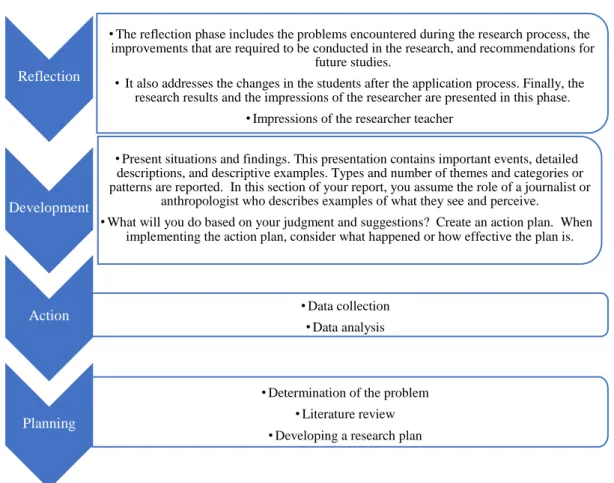
It is expected that the study will enable the first author to gain experience in the use of HoM in the classroom environment, and to better plan and implement future HoM activities in line with these experiences. Also, the researching teacher‟s experiences with the use of HoM will also act as a guide for mathematics teachers and researchers in the more effective use of the HoM. The present study is also expected to guide future action studies (action research is cyclical and is never complete). Mertler (2006) stated that the action research consists of four phases: Planning, Action, Development, and Reflection. The phases of action research are given in Figure 3.
Figure 3. Phases of action research (Mertler, 2006)
The present action research was conducted through two cyclic processes. The first cyclic process took one academic year. During this period, the activities were evaluated by the researchers in terms of fitness for purpose, and necessary revisions were made on the activities.
Participants
The study group comprised twenty-four 8th graders, also from the same school. The first author of the study was the teacher of the participants. The age bracket of the students was 13-14. The school was located in a low socio-economic neighborhood. None of the parents were university graduates. For ethical reasons, students in the study were coded anonymously as S1, S2, … , S23, S24.
The Phases of Action Research
Planning Stage
The planning phase of the action research includes the steps of identifying the problem, reviewing the relevant literature, and developing the research plan. After the problem was identified, the researcher decided to enrich the learning-teaching environments with HoM activities to solve the problem. The researcher studied theoretical articles and books on how and for what purpose the HoM can be used in instructional environments. More than 50 studies, published after the 2000s, were used to show the changes seen in students and teachers following the use of HoM in instructional environments. When designing HoM activities, the first step was for the researchers to simultaneously examine the goals of the elementary mathematics curriculum, the topics included in the 8th-grade mathematics program, and its learning outcomes. The second stage involved the reading of books about the HoM. Following this, in the final stage, the general goals of the elementary mathematics curriculum, textbook topics and outcomes, and the contents of various books on the HoM were simultaneously examined. HoM activities were then prepared, focusing on the topics and concepts agreed upon by the researchers. As the activities were prepared, students-related obstacles to the use of HoM (Clark et al., 2018; Siu, 2007; Tzanakis & Arcavi, 2000) were considered. This study used instructional materials that were in line with the objectives of
Reflection
•The reflection phase includes the problems encountered during the research process, the improvements that are required to be conducted in the research, and recommendations for
future studies.
• It also addresses the changes in the students after the application process. Finally, the research results and the impressions of the researcher are presented in this phase.
•Impressions of the researcher teacher
Development
•Present situations and findings. This presentation contains important events, detailed descriptions, and descriptive examples. Types and number of themes and categories or patterns are reported. In this section of your report, you assume the role of a journalist or
anthropologist who describes examples of what they see and perceive.
•What will you do based on your judgment and suggestions? Create an action plan. When implementing the action plan, consider what happened or how effective the plan is.
Action •Data collection
•Data analysis
Planning
•Determination of the problem
•Literature review
the 8th-grade mathematics curriculum and developed by the authors of the study. For example, in Activity 8, the students were asked to make models by using unit cubes and discover the rule about the sum of positive numbers from 1 to n. In order to do so, students used Yang Hui‟s proof method, but the worksheets did not include detailed information about the historical content. In this way, we tried to prevent the problems associated with using the HoM. The “illumination” and “modules” approaches were adopted in the preparation
of 17 activities. At the same time, the activities used the HoM both as a goal and a tool. The activities were piloted for an entire school year in order to determine the unclear and difficult parts of activities and to see whether they served their purpose. As the pilot study pinpointed activities 9 and 15 to be too long, time-consuming, and hard-to-understand, these activities were excluded while several others were simply revised. The main implementation included 15 activities (Appendix 1) designed to last 26 class hours. The activities on mathematics history are used in the subjects of integer multiplication, Pythagorean theorem, Fibonacci series, the sum of sequential positive integers, representations of algebraic expressions, identities, quadratic equations, ratio and proportion, simple equations, and the volume of three-dimensional geometric bodies. Activity 9 in which the algebraic expressions are presented from past to present lasted 1 lesson hour (40min) while two lesson hours were given to the other activities. The names, aims, and duration of the activities are given in Appendix 1 along with the units and topics into which they were incorporated. Also, the worksheets are given in Appendix 2. These worksheets include “anecdotes,” “historical problems,” “models used by ancient mathematicians,” “ways of proof,” “life stories of famous mathematicians from history,” and “pictures.” Other tools used include posters showing the numbers and number systems in different cultures and the HoM timeline. In the activities, students were asked to perform mathematical processes (Activity 1, 2, 10, 11, 13) or to explore mathematical rules, formulas or relations (3, 4, 5, 6, 7, and 15) by using the solution and proof methods of older times. During the practice of the activities, students were encouraged to use concrete learning objects (sequential positive integer models, truncated square pyramid model), paper cutting, gluing, and painting activities. Apart from this kind of activities, Activity 9 showed the algebraic expressions from past to present in order for students to see clearly the developing dynamic structure of mathematics. In activities 6, 12, and 14, the students were expected to see that mathematics is used in order to meet daily life needs.
Action Stage
In the second cycle of action, each activity was used in the relevant topic (for example, the modeling of identities and Abu-Kamil were used under the subject of identity). Data were collected with multiple data collection tools. Data about students‟ mathematics beliefs were collected via written opinion forms, semi-structured interviews, and field notes. The written opinion forms were implemented twice: at the beginning and end of the study. Horton and Panasuk (2011) linked platonist and formalist belief categories with the absolutist view and the experimentalist category with the fallibilist view. In this study, the participants were asked; “What are the qualities that a person who is good at mathematics should have?”, “Is mathematics open to development? Or is mathematical knowledge static? Explain through examples” and “What led to the emergence of mathematics? Explain through examples,” and the answers of the students were assessed under these two categories. Interviews were held in order to obtain in-depth information from the students and confirm the data obtained from their written opinion forms. A total of 6 students whose mathematics grades were 5 (S24 and S22), 3 (S4 and S10), and 1 (S6 and S23) were selected for the interviews. Interviews with the six students were carried out by the first author. Therefore, the data collected in the study to understand the change in students were described clearly with descriptive analysis. In this process, the data were summarized and interpreted according to previously identified themes, followed by the processing of data. Then, the codes under the themes were defined (Bogdan and Biklen, 1998).
Development and Reflection Stages
The Role of the Researcher
The role of the researchers corresponds to “facilitator” in Ernest‟s beliefs model. Ernest (1989, 1991) offers an explanation of teacher roles based on their philosophical tendencies towards mathematics. He divides the roles of teachers into three categories: explainer, instructor, and facilitator. In the present study, the researching teacher assumed a facilitating quasi-experimental role. The facilitator teacher views mathematics as a dynamic, continually developing field that is a product of human effort and carries a cultural quality. Mathematics is not absolute or unchanging; it is open to change and development.The ultimate instructional aim of the facilitator teacher is to solve problems. In this study, the students were allowed to participate actively in the learning process, both physically and mentally. In the natural environment, the researching teacher observed student reactions as a participant-observer and tried to guide the students in their work.
Validity and Reliability
Two academics working on the HoM, as well as a teacher, analyzed the content of the activities to determine whether the worksheets served their purpose. Minor revisions were made in line with their views. Following this, the worksheets were piloted to see whether there were unclear parts, where the students had difficulty, and how much time was needed for the study. In line with the results of the pilot study, worksheets were revised, and two were excluded from the study. Questions in the written opinion forms were based on similar studies in the literature, and the content validity of the questions was based on the views of two academics specializing in this field. Questions asked in the interviews were not biased. Interview analyses were completed by the researcher (first author) and simultaneously by an academic, and full agreement was found between the two. The findings were confirmed by using different data sources and data collection methods. They were written down independently and objectively by the researcher. The data were also shown to the participants, asking them about their accuracy. The study process, data collection, analysis, and interpretation were explained in detail in the study.
Findings
Findings regarding Students’ Beliefs about Mathematics
Students’ Perceptions of Whether Mathematics is Static or Dynamic
The first question aimed to reveal students‟ views about whether mathematics is open to development. Table 3 shows the codes under the theme “developing or static” before and after the study, together with the frequencies and percentages of each code.
Table 3.The codes under the theme “developing or static” before and after the study
Before After
Sub-themes about coding before and after practice
Students’ perceptions of whether mathematics is static or dynamic.
f % Students’ perceptions of
whether mathematics is static or dynamic.
f %
Fallibilist view It is open to development; it can change (no explanation)
3 12 It is open to development; it can change.
20 83
Some information is open to development (no explanation)
2 8 Some information is open to development.
0 0
Absolutist view It is static; it is not open to development.
14 58 It is static; it is not open to
development (no
explanation)
3 13
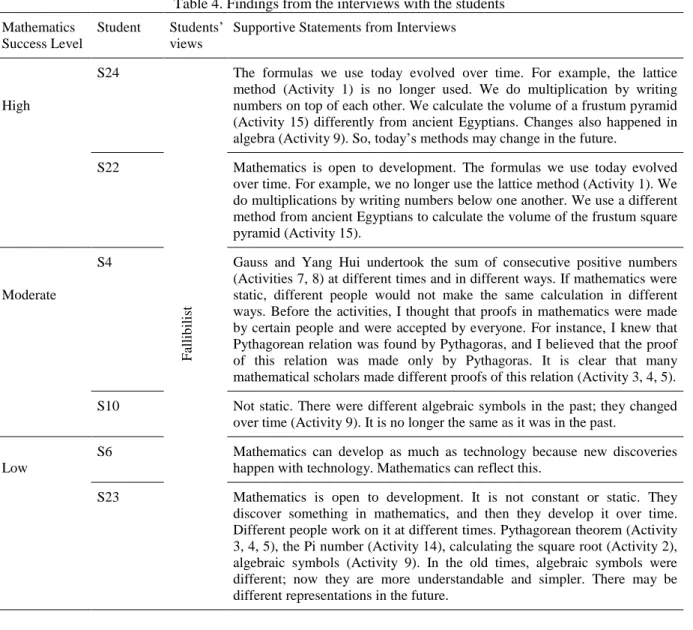
Before the activities, fourteen students stated that mathematics is static and not open to development, while five students opted for the “I do not know” option. Three students stated that mathematics is open to development, while two students stated some information could change in mathematics. The students who stated that mathematics is open to development were unable to explain their answers with concrete examples. After the activities, eleven of the fourteen students who stated that mathematics is static and not open to development, four of the five students who opted for the “I do not know” option, and five students who thought that mathematics is a science open to development but could not explain their answers with examples, stated that mathematics is a science open to development and gave concrete examples regarding their answers. One of the five students who opted for the “I do not know” option and three of the fourteen students who thought mathematics is not open to development before the activities did not change their answers after the activities. Student S21, after the activities, answered the question, « is mathematics open to development? » as “I do not know.” It was observed that the student came from a single-parent family with certain problems and could not focus on the activities. For these reasons, no valid and reliable information was obtained from the student. S8 answered as “it develops” but failed to offer any explanation. S12, S13, and S14 were the students who stated that mathematics is not open to development. These students were unenthusiastic about the course, were constantly talking among themselves, and were not interested in the activities. In general, after the activities, the majority of the students started to think that mathematics is a science open to development and supported this idea with examples. Interviews also confirmed this finding from written opinion forms. Examples from the interviews with S24, S22, S4, S10, S23, and S6, i.e., students with high, moderate, and low mathematics success levels, respectively, are given below. All of these students stated before the activities that mathematics is a static science. After the activities, the students‟ views changed: they stated that mathematics is a science open to development. Table 4 displays the interview data.
Table 4. Findings from the interviews with the students Mathematics
Success Level
Student Students‟ views
Supportive Statements from Interviews
High
S24
Fallib
ilis
t
The formulas we use today evolved over time. For example, the lattice method (Activity 1) is no longer used. We do multiplication by writing numbers on top of each other. We calculate the volume of a frustum pyramid (Activity 15) differently from ancient Egyptians. Changes also happened in algebra (Activity 9). So, today‟s methods may change in the future.
S22 Mathematics is open to development. The formulas we use today evolved over time. For example, we no longer use the lattice method (Activity 1). We do multiplications by writing numbers below one another. We use a different method from ancient Egyptians to calculate the volume of the frustum square pyramid (Activity 15).
Moderate
S4 Gauss and Yang Hui undertook the sum of consecutive positive numbers (Activities 7, 8) at different times and in different ways. If mathematics were static, different people would not make the same calculation in different ways. Before the activities, I thought that proofs in mathematics were made by certain people and were accepted by everyone. For instance, I knew that Pythagorean relation was found by Pythagoras, and I believed that the proof of this relation was made only by Pythagoras. It is clear that many mathematical scholars made different proofs of this relation (Activity 3, 4, 5). S10 Not static. There were different algebraic symbols in the past; they changed
over time (Activity 9). It is no longer the same as it was in the past.
Low
S6 Mathematics can develop as much as technology because new discoveries happen with technology. Mathematics can reflect this.
S24 pointed out activities 1, 9, and 15, and stated at the end of the study that ancient methods and expressions changed over time. S24 added that new methods might be developed in the future. S22 stated that today‟s solution methods and representations are different from those in the past and that mathematics has a developing nature. S4 and S10 emphasized that mathematicians may study similar subjects at different times and have different solutions, therefore suggesting that mathematical knowledge is not static. Having discovered that the Pythagorean Theorem had been proved by different mathematicians at different times and that algebraic symbols had evolved over time, S23 learned that mathematics is a developing science.
Perceptions about Students Successful in Mathematics
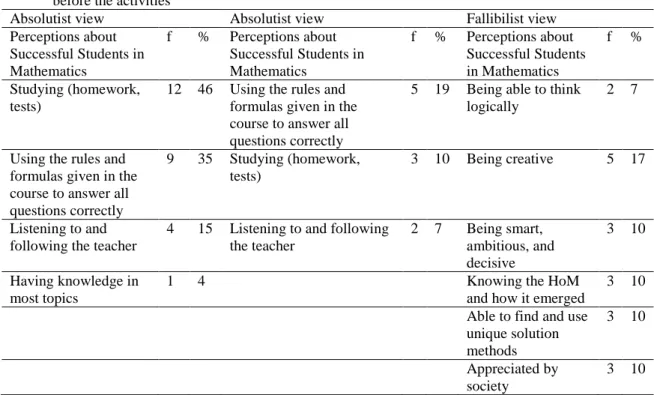
The second question in the written opinion form aimed to reveal the students‟ attitudes towards students good at mathematics. Table 5 includes the codes under the theme “students successful in mathematics” before and after the study, together with the frequencies and percentages of each code.
Table 5. Perceptions about students good at mathematics before and after the study Sub-themes about the codes
before the activities
Sub-themes about the codes after the activities
Absolutist view Absolutist view Fallibilist view
Perceptions about Successful Students in Mathematics
f % Perceptions about Successful Students in Mathematics
f % Perceptions about Successful Students in Mathematics
f %
Studying (homework, tests)
12 46 Using the rules and formulas given in the course to answer all questions correctly
5 19 Being able to think logically
2 7
Using the rules and formulas given in the course to answer all questions correctly
9 35 Studying (homework, tests)
3 10 Being creative 5 17
Listening to and following the teacher
4 15 Listening to and following the teacher
2 7 Being smart, ambitious, and decisive
3 10
Having knowledge in most topics
1 4 Knowing the HoM
and how it emerged
3 10 Able to find and use
unique solution methods
3 10
Appreciated by society
3 10
It was found that all of the students had a dominant absolutist opinion before the activities. All of the students saw successful students in mathematics as someone who performs the tasks correctly in the fastest time, performs the task given by the teacher in the classroom, and knows mathematical subjects. These codes are included in the sub-theme “absolutist” because, as can be seen in the interview findings below, the students gathered under this code describe a successful student in mathematics as one who applies the rules and formulas directly as given in the lessons and as one who quickly and correctly solves the questions asked in the tests or exams. Those listening to the teacher and doing what s/he says, studying, and knowing most of the mathematics subjects are coded under the absolutist sub-theme. For students, knowing mathematics means solving tests or problems as exactly taught in the lesson and memorizing the concepts without questioning or conceptual learning. After the activities, a decrease was found in the dominant absolutist beliefs of the students. While all of the 26 responses before the activities were in the category of absolutist opinion, only ten of the twenty-nine responses that were given after the activities fell in that category. Below are some parts of the interviews with students S24, S22, S4, S10, S23, and S6, and some written comments from other students.
mathematics sets a good example for society and is appreciated. Therefore, there was a decrease in the initial dominant formalist beliefs of both students. S6 emphasized after the study that a person who is good at mathematics must be creative. Before the activities, S6 referred to a student successful in mathematics as one who listened to the teacher in class and did everything s/he said. S23 stated that a student good at mathematics should be creative, intelligent, and able to find unique solutions. According to S23‟s views before the activities, a successful student was one who quickly completes operations by using the rules taught in class. Before the study, S4 and S10 expressed that a successful student in mathematics was one who answered all the questions correctly using rules and formulas, listened to his/her teacher, and did what he said. After the activity, students‟ perceptions of a successful student in mathematics changed into one who is creative, knows the history of mathematics, and uses his/her own logic.
Table 6. Findings from interviews with students Mathematics
Success Level
Student Students‟ Views
Supportive Statements from Interviews
High S24
Fallib
ilis
t
A successful person needs intelligence first of all. My example for this is Gauss (Activity 7). For example, he found the sum of numbers from 1 to 100 in a very short time in his own way. He used his logic. This shows that he solved a difficult problem in his own way without depending on the rule and formula.
S22 They should be able to see what is happening around us from different perspectives. For example, Fibonacci observed daily life events and discovered the series that he named after himself. (Activity 6)
Moderate S4 He needs to think about the question, answer mentally, and not use memorization. The teacher asked the students to add the numbers from 1 to 100 (Activity 7). One did so mentally, didn‟t look in the book, or solve the question. She replied right away.
S10 A person who is good at mathematics uses her mental faculties. There was an ancient scientist. He added the numbers up to 100 (Activity 7). There were no rules or formulas. He used his own creativity. This is a success.
Low S6 “For instance, it was difficult to calculate the volume of a frustum pyramid in ancient times (Activity 15). But they did it. They used their logic and creativity. And then there is Gauss (Activity 7). He wrote down the numbers from 1 to 100, and then reversed and added them.”
S23 After the Greek mathematician proved the Pythagorean relations, many mathematical scholars proved this relation in different ways and in their own way (Activity 3, 4, 5). They did not hold on to his proof and use only that evidence. They always tried to find original proofs and solutions. I think a successful person in mathematics should be able to provide his own specific solutions.
Students’ Perceptions of How and Why Mathematics Emerged
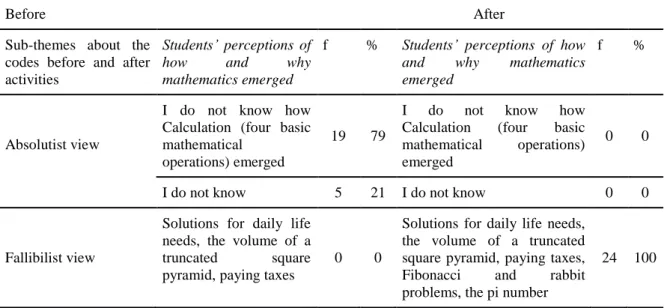
The final question in the written opinion form asked students to “Explain how and why mathematics emerged with examples.” Before the study, all the students stated that they did not know how mathematics emerged and
Table 7. Students‟ perceptions of how and why mathematics emerged
Before After
Sub-themes about the codes before and after activities
Students’ perceptions of how and why mathematics emerged
f % Students’ perceptions of how
and why mathematics emerged
f %
Absolutist view
I do not know how Calculation (four basic mathematical
operations) emerged
19 79
I do not know how Calculation (four basic mathematical operations) emerged
0 0
I do not know 5 21 I do not know 0 0
Fallibilist view
Solutions for daily life needs, the volume of a truncated square pyramid, paying taxes
0 0
Solutions for daily life needs, the volume of a truncated square pyramid, paying taxes, Fibonacci and rabbit problems, the pi number
24 100
After the study, however, students stated that mathematics emerged to meet daily needs and solve real-life problems, and they offered concrete examples. Below are some examples from the interviews with S24, S22, S4, S10, S23, and S6. Table 8 presents the interview data. The students emphasized that the Fibonacci and rabbit problems (Activity 6), proportional reasoning (Activity 12), the story of the number Pi (Activity 14), the volume of the frustum square pyramid (Activity 15), and the problems used in the Pythagorean theorem module (the broken tree problem and the Babylonian problem of the object leaning against the wall) taught them the importance and role of mathematics in real life. In the interviews, S6 and S23 mentioned daily problems and the need to solve these as the reason why mathematics emerged:
Table 8. Findings from the interviews with the students Mathematics
Success Level
Student Students‟ Views
Supportive Statements from Interviews
High S24
Fallib
ilis
t
There was a problem with rabbits (Activity 6). It was related to daily life. While solving that problem, the mathematician found a number sequence.
S22 Babylonians had a problem with the length of an object leaning against a wall, and they solved it with a theorem which was later known as the Pythagorean theorem (Activity 3, 4, 5).
Moderate S4 There was a problem with rabbits (Activity 6). It was related to daily life. While solving that problem, the mathematician found a number sequence.
S10 They needed volume to make truncated pyramids in ancient Egypt because they kept their produce in pyramid-shaped storage (Activity 15).
There was a problem with a broken tree in ancient China. That problem was also derived from real life, and its solution is actually related to the Pythagorean theorem (Activity 3, 4, 5)
Low S6 Ancient Egyptians calculated the volume of the truncated square
pyramid with a method different from the one we use today. They had to calculate this because they kept their wheat and barley in storage shaped like a frustum square pyramid (Activity 15). Therefore, they had to use mathematics.
Evaluation of the Activities according to Students’ Opinions
Students found math fun and interesting as a result of engaging in lessons/activities that promote active problem-solving. The HoM provided a context for student work. Prior to the applications, the students were asked whether they found mathematics interesting and entertaining, and they were asked to explain their answers. All of the students stated that they found mathematics boring. Students stated that mathematics was based on rules and formulas which they should memorize. After the study, the majority of the students stated that mathematics was an interesting and fun subject as a result of engaging in active lessons contextualized in the HoM. This study used worksheets aligned with the curriculum, enabled students to work in groups and discover rules and formulas by using manipulative (or hands-on material), all of which may have contributed to results. The reasons stated by the students as to why they found the activities interesting, fun, and beneficial are illustrated in Table 9.
Table 9. Reasons why the students found the activities fun, interesting, and beneficial Reasons why the activity is
interesting, fun, and beneficial
f Supportive statements
Manipulative (or hands-on material etc.) making classes more enjoyable and interesting
23 Previously, our teachers gave us the rules in class, and we solved problems by using them. We never used concrete models. Now, thanks to the HoM activities, we have started to use concrete models, and the mathematics class has become more enjoyable (S8).
Previously, our teacher used to lecture in mathematics class. We used to copy the board into our notebooks. Classes were, therefore, rather monotonous. Now we use paper cutting, painting, and pasting activities. Such activities are both enjoyable and interesting (S15).
Engaging in active lessons contextualized in the HoM
24 With the activities, we discovered rules and solved problems by using ancient proof and solution methods. For example, by combining the pieces of wood, I discovered the volume of the truncated square pyramid, and it was like a puzzle to reach a conclusion with the pieces of wood. Such informative and fun activities make us participate actively in class (S24).
We found the elements of the Fibonacci sequence and discovered its rule by studying the rabbit problem in Fibonacci‟s book. It was fun to discover rules on our own (S10).
Links with geometry 15 As someone who likes geometry more, I found it interesting and fun to discover the addition rule for consecutive positive whole numbers by using geometry (S12).
Solving equations by making use of the areas of squares and rectangles, cutting paper, painting, and pasting was very interesting and enjoyable. However, I thought mathematics was only possible by solving questions on the board and in the notebook (S15).
Ancient history with good solutions and proof methods
22 Mathematics is an old discipline. I didn‟t know that ancient people used such good methods to solve problems. Learning these interesting methods made me become more interested in mathematics (S14).
Figure 4. S4‟ products in Activities 3 and 7
Figure 5. S6‟s product in Activity 11 and S24‟s product in Activity 15
Figure 6. S23‟s product in Activity 6 and S8‟s product in Activity 1
Discussion and Conclusion
Similar to the present study, Percival (1999), Krussel (2000), Marshall (2000), and Kaye (2008) found that participants learned that mathematics has a developing, dynamic, and multicultural nature. Jardine (1997) emphasized in the conclusion and recommendations section of his study that, even though the HoM may not bring superior success to students in exams, it may help them understand the nature of mathematics.
Before the study, all of the students saw a successful student in mathematics as one who performs the tasks correctly in the fastest time, completes the task given by the teacher in the classroom, and knows mathematical topics. These codes are included in the sub-theme “absolutist.” After the implementation, significant changes occurred in students‟ perceptions of success in mathematics. When participants learned about the solutions that ancient mathematicians developed despite the limited technological possibilities of those days, they discovered the importance of logic and creativity in mathematics. For example, the students came to believe that a successful person in mathematics should be creative when they learned that people in ancient Egypt calculated the volume of truncated square pyramids without using any rules or formula, but by using a unique method (dissection method). Similarly, when they found the sum of numbers from 1 to 100 without using any rules or formulas, they noticed the importance of logic-based thinking to succeed in mathematics. When they learned that the Pythagorean theory was proved by different mathematicians after Pythagoras, and they used these methods of proof, they began to think that a successful person in mathematics should develop their own unique methods of solution and proof. The story of the Fibonacci series showed them that a mathematician should have a different perspective than everybody else. The students stated that Fibonacci became a respected and popular person in society thanks to this series. In short, it was determined by the end of the study that there was a significant decrease in the absolutist opinions of the students. Liu and Niess (2006) found similar findings in their study with high school students. At the end of the study, there was a significant increase in the number of students who stated that mathematics equaled logic, judgment, and mental thinking, and who believed that mathematicians needed creativity.
The findings revealed a decrease in students‟ absolutist beliefs about mathematics. As mentioned above, the students developed more dynamic and fallibilist beliefs by the end of the practices. This finding is expected to bring a positive effect on the students‟ mathematics learning outcomes. Indeed, the available research shows that epistemological beliefs are generally related to students‟ learning outcomes: more dynamic, fallibilist beliefs are typically associated with better learning outcomes. This is because the choice of instructional methods and resources and their appropriate use in classroom teaching and learning of mathematics largely depends on images of mathematics as perceived by the teacher and students (Belbase, 2013, p. 235). For example, a student who holds a Platonist view of mathematics is likely to see learning mathematics as a process of acquiring known and established mathematical truths, and so may be more inclined towards more „traditional‟ ways of studying. On the other hand, a student whose beliefs are more akin to a fallibilist perspective will more readily participate in more open-ended mathematical pedagogies and be more disengaged from content-focused transmission-type lessons (Kloosterman, 2002). Experimental studies have shown that students who see mathematics as a rigid, inanimate, and static process may be reluctant to deal with mathematical activities requiring creativity, and students who perceive mathematics as a dynamic, developmental process may be more willing to engage in these activities (Carlson, 1999; Franke & Carey, 1997; Kloosterman & Stage, 1991). Further evidence of this relationship comes from a qualitative investigation by Liu (2010) of four Taiwanese college students‟ math-related epistemological beliefs. The participants had obtained significantly different results from a set of three distinct performance contexts. Two of them expressed a dynamic view of mathematics, thinking of it as a process that requires personal creativity, and solved standardized calculus problems more easily than the other two students who had a static, instrumentalist view of mathematics as a set of rules to be followed. Di Martino and Zan (2011) set up a qualitative study to clarify the constructs of students‟ beliefs (including epistemological beliefs), attitudes, and emotions, and the relationships among them. According to Di Martino and Zan, teachers should consider these deeply interwoven relations. For instance, a student with a negative disposition towards mathematics, because he/she associates it with lots of rules and formulas to be remembered, should be treated differently than a student who thinks and feels negatively about mathematics.
Similarly, Marshall‟s (2000) study taught them that mathematics emerged as a result of people‟s search for an answer to their everyday problems and needs. Haverhals and Roscoe (2009) emphasized the role of the integral of secant in the development of the Mercator world map and pointed out the importance of mathematics in daily life. Their participants were impressed that early people used integrals in daily life situations. Erdem, Gurbuz, and Duran (2011) studied how the science of mathematics has been used in daily life from the past to our day. To do so, they reviewed various sources about the HoM and examined mathematics in written and oral cultures. They also studied certain reflections of mathematics used in our day in daily life. They attempted in their study to reveal the relationship between mathematics and daily life by mentioning Thales‟ (624–545 BC) method for calculating the height of a pyramid and the ancient Chinese methods of finding a mountain‟s height and a lake‟s depth. Ozdemir, Goktepe, and Kepceoglu (2012) used the HoM to support 11th graders‟ geometric proof skills. The study aimed to enable high school students to use methods used in ancient Egypt, ancient China, and Babylon to calculate the volume of pyramids. The students stated at the end of the study that they could see the daily life uses of mathematics.
Man-Keung Siu (2007) listed sixteen barriers to the use of HoM in a study entitled “No, I do not use HoM in my class, why?” Tzanakis and Arcavi (2002) described these barriers to the use of HoM as philosophical and practical. Haverhals and Roscoe (2010) classified Keung Siu‟s (2007) barriers as “philosophical obstacles,” “student-related obstacles,” “structural obstacles,” and “preparation for instruction.” Student-related obstacles were seen to include their dislike of the HoM content, boring lessons, and not being able to evaluate the exercises. The findings showed that the activities used in the study could be used in mathematics classes, and this type of activity may stop the emergence of student-related obstacles. In the present study, the activities used were fun and enjoyable for the students. Therefore, the students found math fun and interesting as a result of engaging in activities that promote active problem-solving.
During the study, the first author observed that the students were effortful and enthusiastic in completing the activities. Participants highly enjoyed discovering the volume rule for the frustum square pyramid (Activity 15) and the rule for adding consecutive positive numbers (Activities 7-8). Through paper cutting, painting, and pasting activities, participants constructed the Hsuan Thu diagram in ancient Chinese sources and the geometric model that Indian mathematician Bhaskara used when proving the Pythagorean Theorem and made inferences about the relationship between geometric shapes and their areas. In this way, they discovered the rule for the Pythagorean Theorem. When solving second-degree equations, they similarly built Al-Khwarizmi‟s geometric model via paper cutting, painting, and pasting activities, and they thought about the relationships between the areas of geometric shapes (Activity 11). They decided whether equivalence was identity by examining the geometric modeling in Abu-Kamil‟s book (Activity 10).
All these activities were new to the participants. At the end of the study, participants who formerly thought that mathematics was flooded with rules and formulas started to say, “I wish the mathematics course could be like this all the time.” When they discovered that the solution methods or proofs used in the activities were used by ancient civilizations and mathematicians, they could not hide their surprise. The enthusiasm of participants during the activities, and their description of the activities as interesting, fun, and educative can be attributed to the fact that they constructed their own knowledge by using concrete learning objects, and to the fact that they used proofs and solutions with which they were previously unfamiliar. Siu‟s claim that “students do not like the HoM” is not supported by our findings. Instead, we have found supporting evidence for Haverhals and Roscoe‟s (2010) observations that classes based on the historical approach were interesting, and students were willing participants. Albayrak (2011), Butuner (2016), Lawrence (2006), Lim (2011), Lim and Chapman (2015), Lit, Siu, and Wong (2001), and Nataraj and Thomas (2009) also obtained similar results. Another reason why the participants engaged in the activities in an effortful and enthusiastic way may have been the alignment of the activities with the objectives of the textbooks. Indeed, researchers are well aware of the barriers before the use of HoM (Clark et al., 2018; Gonulates, 2004; Ho, 2008; Tzanakis & Arcavi, 2000; Siu, 2007; Panasuk & Horton, 2012). Considering the barriers to the use of HoM when preparing these activities helped us to get the students to willfully engage in the activities.