http://www.cmbl.org.pl DOI: 10.2478/s11658-006-0047-x
Received: 14 March 2006
Revised form accepted:25 June 2006
© 2006 by the University of Wrocław, Poland
* Author for correspondence: e-mail: [email protected]
Abbreviations used: AFLP – amplified fragment length polymorphism; BLAST – basic local alignement search tool; EDTA – ethylene diamine tetraacetic acid; HTGS – high throughput genomic sequences; ICARDA – International Center for Agricultural Research in the Dry Areas; ITS – internal transcribed spacers; Mb – mega base; Nr – ‘non redundant’; QTL – quantitative trait loci; RAPD – randomly amplified polymorphic DNA; RFLP – restriction fragment length polymorphism; UPGMA – unweighted pairs group method using mathematical avarages
PHYLOGENETIC ANALYSES WITHIN THREE SECTIONS
OF THE GENUS Vicia
TOMASZ SAKOWICZ1 and TOMASZ CIEŚLIKOWSKI2
1University of Łódź, Department of Cytogenetics and Plant Molecular Biology, 90-237 Łodź, Banacha 12/16, Poland, 2Centre for Medical Biology Polish
Academy of Sciences, 93-232 Łódź, Lodowa 106, Poland
Key words: Vicia, Average similarity, Multilocus diversity, RAPD
INTRODUCTION
The genus Vicia belongs to the Legumes, one of the largest families of flowering plants, representing tremendous morphological, ecological and genetic diversity. It includes approximately 170 species [1]. About 40 species, mostly of Mediterranean origin, are cultivated worldwide [2], while about 10 cultured species (e.g. V. sativa, V. villosa, V. faba, V. cracca) are a significant source of fodders, green manures and forages. The extensive research into legume genomes carried out over the past decade not only yielded considerable sequence data, rich enough to perform whole genome comparative analyses, but it enabled the establishment of the methods suitable for this type of investigation [3-7]. These include detection of sequence linkage equilibria, RFLP, RAPD or microsatellite-based mapping, and identification of associations with morphological traits or isozyme patterns. To assess the general taxon internal diversity, one has to include overall sequence homologies and the conservation of their order (synteny). Colinear RFLP maps and a close phylogenetic relationship are good indicators of local colinearity, but detailed analysis of the targeted local region is necessary to reveal microcolinearity, which in plants is regarded as an especially useful tool for plant gene identification and study, and for the comparison of many plant genomes [6]. Microcolinearity is observed even between distantly related species; therefore, loci marker probes can be obtained allowing for comparative research on different individuals [8]. Elsewhere, instead of one-to-one colinearity, the distributed network of synteny was discovered [9-11]. Besides the number of comparative experimental data types, statistical methods of sequence analysis were proposed for searches of regions of homology [12, 13].
Several Vicia species characteristics (biochemical, molecular, karyotype, genetic etc.) have been described, leading to a general picture of the diversity within this genus [14-20]. Comparative analysis of the above-mentioned data sets revealed some discrepancies in the resulting species arrangements within the Vicia genus, and thus a need for a common strategy for data ordering stimulated the search for genomic markers related to the general taxon specificity.
The equivalence between taxonomic interspecies order and species-specific trait relationships and the identification and location of important genes and sequences has been investigated in particular detail in V. faba [21, 22]. Its large genome, one of the largest amongst the legumes at 13,000-26,000 Mb [23], seriously complicates the development of saturated linkage maps [24].
The conservation of numerous chromosomal regions in Vicia based on isozyme
genomic rearrangements [3, 26]. There is particular interest in the RAPD markers tightly linked to genes or quantitative trait loci (QTLs) of agronomic significance (rust resistance, broomrape resistance, Ascochyta fabae resistance) [22, 27, 28]. However, ribotyping [29], RFLP analysis [17, 30] amplified fragment length polymorphism (AFLP) [31], microsatellites [21, 32], dispersed [33] and tandem repeats [34], and transposon distribution [34-37] are still of particular importance. Such a variety of genetic typing results encourages investigation of the extent of equivalence between the diversity related to the whole Vicia genome and the diversity related to non-genetic features, in particular the extent of equivalence between the whole genome-related similarity of the species and their similarity based on a limited genomic representation referring to a randomly selected set of loci.
In this study, we investigated Viciafaba and a group of its close relatives (eight species: V. bithynica, V. faba, V. galilaea, V. hyaeniscyamus, V. johannis,
V. kalakhensis, V. narbonensis and V. serratifolia, representing the narbonensis, bithynica and faba sections) [38] with the aim of estimating the genetic diversity among the selected Vicia species, based on the averaged genomic relationships. We also examined the effectiveness of averaged simple genetic characteristics in the description of groups of species.
MATERIALS AND METHODS
Plant material and genomic DNA isolation
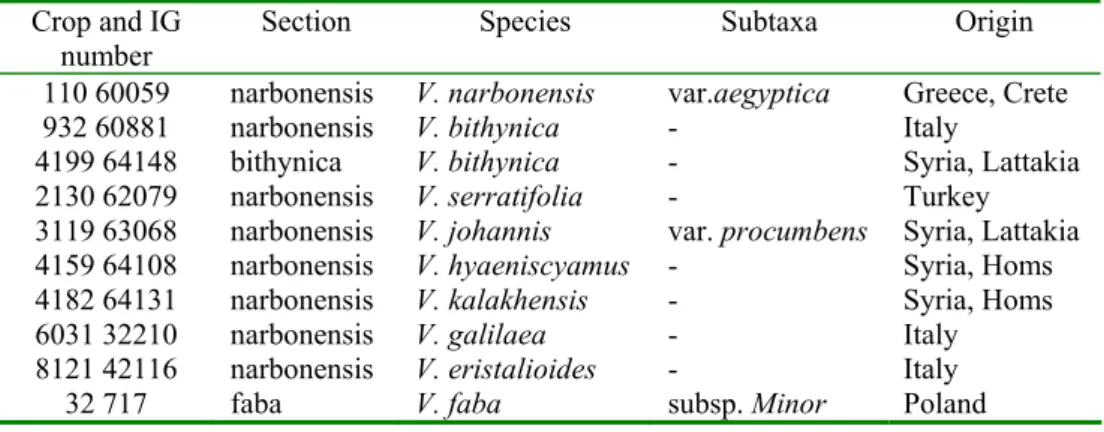
Plant material was obtained from the collections of the International Center for Agricultural Research in the Dry Areas (ICARDA) in Aleppo, Syria (seven species) and the Plant Breeding Station in Olsztyn, Poland (V. faba). All the accessions are listed in Tab. 1.
Tab. 1. Vicia cultivars and accessions used in this study. Crop and IG
number
Section Species Subtaxa Origin
110 60059 narbonensis V.narbonensis var.aegyptica Greece, Crete
932 60881 narbonensis V.bithynica - Italy
4199 64148 bithynica V.bithynica - Syria, Lattakia 2130 62079 narbonensis V.serratifolia - Turkey
3119 63068 narbonensis V.johannis var. procumbens Syria, Lattakia 4159 64108 narbonensis V.hyaeniscyamus - Syria, Homs 4182 64131 narbonensis V.kalakhensis - Syria, Homs
6031 32210 narbonensis V.galilaea - Italy
8121 42116 narbonensis V.eristalioides - Italy
32 717 faba V.faba subsp. Minor Poland
RNase-A in a lysis buffer at 65ºC. DNA extraction (DNeasy Plant Mini Kit, Qiagen) was followed by spectrophotometrical quantification of the DNA amount at 260 nm (Hitachi 2000). Subsequently, the DNA solutions originating from separate accessions were collected together to form the final mixtures, each consisting of 7-10 individual genomic DNAs.
Ribotyping
Ribotyping was performed according to the procedure described above (with
BamHI digestion of the total DNA sample series). The same hybridization conditions were applied. The plasmid pTA71, including the barley 5.8S, 18S and 25S rDNA genes (without spacers), was used as a hybridization probe [39]. The barley genes are evolutionarily far from the equivalent sequences of particular
Vicia species. Therefore, in numerical calculation, they might safely be assumed as approximately equidistant from each of them.
Southern hybridization analysis
Two endonucleases, BamHI and BglII, were applied for the two separate DNA sample series digestions. Digested genomic DNA samples (8 μg per lane) were fractionated by electrophoresis in 1% (w/v) TAE-agarose gels (40 mM Tris, 1 mM EDTA, pH 8.0, 1.14 ml acetic acid/L), before alkaline transfer to nylon membranes (Hybond N+, Amersham). Then they were denaturated, hybridized and detected under standard conditions [40]. The filters were immobilized to 32P-labelled total DNA from Vicia species as probes (labelled by nick
translation). Stringent washes were carried out at 65ºC in 0.5 M sodium phosphate buffer, pH 7.5.
RAPD amplification
bromide was visualized under ultra-violet light and documented using a computer image system (Vilber Lourmat, France).
BLAST searches
A homology search for 25 decamer oligonucleotides that were applied as primers for RAPD was carried out to estimate the frequency of their appearance in the
Vicia genome. The search was performed with the aid of the Basic Local Alignement Search Tool (BLAST) program, version 2.2.8 (NCBI: http://www.ncbi.nlm.nih.gov/BLAST). The search concerned the following databases: Nr (‘Non redundant’, i.e. all GenBank+EMBL+DDBJ+PDB sequences), ‘Chromosome’ and HTGS (Unfinished High Throughput Genomic Sequences; Sequences: phases 1 and 2, but not those of phase 0). The search limits were the same for all the search series (E = 5000). The common search was performed across the database, with a common wide taxonomy limit (e.g. Viridiplanteae, Magnoliophyta, Fabaceae, etc.) to ensure the same chance of selection for each species [42], and then the resulting hit numbers were split between species of interest. The species selected for comparison were Vicia faba
(Viciae), Pisum sativum (Viciae), Phaesolus vulgaris (Phaseoleae) and Glycine max (Phaseoleae). An additional search concerning Arabidopsis thaliana
(Brassiceae) was performed across two databases, ‘Non redundant’ (Nr) and ‘Chromosome’.
The averaged hit numbers (i.e. the frequency of the appearance of particular primer sequences in the genome) were designed for the two species (G. max and
P. sativum) represented in the database by a relatively large number of sequences. Then, the interspecies differences in the hit numbers related to particular decamers were applied as the first approximation of the error related to average values. The averaged hit numbers accompanied by the appropriate errors were subsequently used to extrapolate the hit number value related tothe Vicia genus. The correlation between hit numbers found for individual species was calculated using Statistica 5.1 software.
Computer-assisted electrophoretogram analyses
RESULTS
Genomic DNA mixtures of eight Vicia species were analyzed in a series of RAPD tests. Each mixture consisted of DNA isolates originating from several separate accessions. The amplification products were separated electrophoretically, then the electrophoretic pictures were subjected to computer assisted analysis as described in the Materials and Methods section. Finally, the resulting similarity matrices were applied for the common clustering analysis and for the calculation of the averaged interspecies diversity.
Accuracy of the RAPD test
The accuracy and repetitiveness of typing were verified for each species of interest. For each species, a set of three different DNA mixtures was used in tripled accuracy testing procedures including the isolation of meristemic DNA and amplification. R03, R07 and R08 were the three different RAPD markers applied for each mixture. The general accuracy was higher than 89%. The exceptions were V. faba for R03 and V. narbonensis for R08, for which the differences were much greater. These differences in the amplicon pools generated for particular species were limited to one or two bands. The greatest diversity, observed for V. faba, was additionally tested on the next six distinct genomic mixtures. As no further differences were found (data not shown), the observed discrepancies were interpreted as resulting from genome structure differences, and the experimental error was approximated as not exceeding the value related to molecular weight marker electrophoretic resolution.
The equivalence of primer-based representation of related genomes
The set of decamer primers selected at random was tested to check if it represents particular plant genomes with similar significance, prior to detailed interspecies diversity measurement. The frequency of their appearance in the plant genome of species closely related to Vicia faba (Pisum sativum, Glycine max and Phaesolus vulgaris) was compared [9, 11, 44-46].
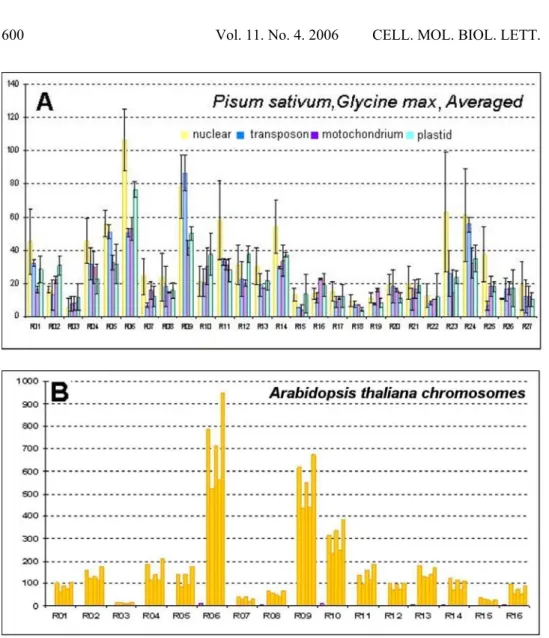
The decamer distributions are shown in Fig. 1, which presents the comparison of the hit numbers found in the organellar, nuclear and transposon sequences. The latter class of sequences was distinguished because of the significance of the transposable element amplification for plant genome size variation [8, 33, 47] and because of the copy number of transposable elements in the Vicia genome, which reaches up to 106 [35]. The histogram of similarities found for most of the applied decamer sequences for the three species (P. sativum, G. max,
P. vulgaris) and the genus Vicia illustrated the general correspondence existing between their genomes.
The correlation between Vicia and P. vulgaris was high (r2 = 0.680, p < 0.0001), similar to that for P. sativum (r2 = 0.833, p < 0.0001) and for G. max (r2 = 0.755, p < 0.0001). A high correlation was also found between Vicia and A. thaliana
Fig. 1. The averaged frequency of appearance of decamer sequences applied as primers for RAPD, calculated for: A - two close relatives of V. faba (P. sativum, G. max); B - A. thaliana. The search was performed across the ‘Chromosome’database, related to primers from R01 up to R16 and ‘split’ to separate chromosomes. The search was carried out using BLASTN 2.2.8 across the NCBI sequence database Nr (the number of descriptions = 1000; number of alignments = 1000; E = 5000). The calculation error was designed as the difference between individual hit numbers.
from the databank searches are mostly genic, the RAPD results might represent the relationships referring to the coding regions of the genome. That is also suggested by the high correlation with A. thaliana sequences [5, 48].
relatively close species G. max and P. sativum, sequences of which are substantially present in the databases. The correlation between the hit numbers for these specieswas very high (r2 = 0.919, p < 0.0001), between the averaged (over G. max and P. sativum) hit frequencies and frequencies for Vicia, 0.807 (p < 0.000001). The error of the predicted hit number distribution in Vicia was estimated by the differences in the corresponding hit frequencies in G. max and
P. sativum (Fig. 1).
The described correspondence in hit frequencies observed for different species suggests that despite the relatively limited data for particular Vicia species (Fig. 1), similar rules of genomic sequence distribution should be valid for the analysed genus, and that in the genomes more closely related to Vicia, there exists a similarly significant degree of correlation. That corresponds with the known simultaneous multi-gene inter-genome homology [25] and suggests that a random set of decamer sequences should possess similar significance for the comparisons of such genomes.
RAPD-based genetic diversity
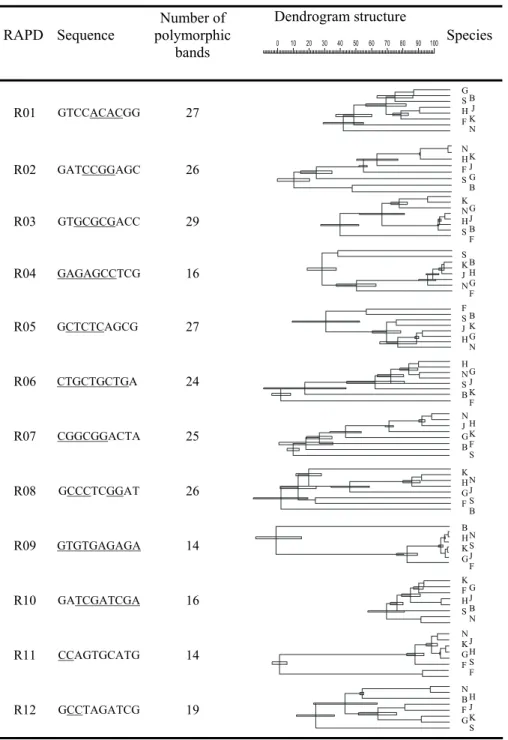
For six oligonucleotides (R01, R03, R08, R15, R18 and R19), the averaged amplicon numbers were higher than six per track, while for four (R20, R21, R23 and R27), they were lower than three (Tab. 2). The amplicon length generally did not exceed 2 kb, and mostly ranged from 200 bp to 700 bp. The widest range of band length (up to 450 bp) was observed for R01, R03, R07, R18 and R15, while the narrowest (up to 300 bp) was for R06, R11, R16, R20, R22 and R27. For only a few decamers was an amplicon common to all the species observed. For 84.5% (21/25 tests) of the decamers, products common to the entire narbonensis section were generated, while for 16.5% (4/25 tests) of the decamers, no common band was observed in any group bigger than two species. The dendrograms formed as a result of these analyses were strongly diverse in their shape and global homology level. About 20% (5 tests) of them were stair-shaped, while about 80% (20 tests) formed more or less distinct clusters. In about 20% of the results, the greatest distance in the interspecies homology level exceeded 80%.
For most of the RAPD tests (Tab. 2), all six species of the narbonensis section were rather similar and their electrophoretic patterns formed common clusters, while the species representing the faba and bithynica sectionsremained separated. The internal homology level of narbonensis ranged between 95% and 30% (in stair-shaped dendrograms). V. bithynica and V. faba were gathered out of the narbonensis section, or the difference related to them was lower than the interspecies differences inside this section. These two species were occasionally included into the narbonensis section. They were sometimes clustered together. Three types of gathering patterns distinguishing separate sections were observed (Tab. 2):
Tab. 2. A comparison of dendrogram topologies. The dendrogram errors are indicated as narrow rectangles. Some repeated motifs in the primer sequences are underlined. The species names are abbreviated as follows: V. bithynica – B, V. faba – F, V. narbonensis – N, V. hyaenicyamus – H, V. galilaea – G, V. kalakhensis – K, V. johannis – J, V. serratifolia – S.
RAPD Sequence polymorphic Number of bands
Dendrogram structure
Species
R01 GTCCACACGG 27
R02 GATCCGGAGC 26
R03 GTGCGCGACC 29
R04 GAGAGCCTCG 16
R05 GCTCTCAGCG 27
R06 CTGCTGCTGA 24
R07 CGGCGGACTA 25
R08 GCCCTCGGAT 26
R09 GTGTGAGAGA 14
R10 GATCGATCGA 16
R11 CCAGTGCATG 14
R12 GCCTAGATCG 19
RAPD Sequence polymorphic Number of bands
Dendrogram structure
Species
R13 CTCTCGGACA 9
R14 GCCAGCTGAC 15
R15 CGACTGCGCC 21
R16 GTCCGATCGC 10
R18 TGGACGCGCT 26
R19 ACGCGCTAGC 10
R20 CCCTAGCGCG 12
R21 TGACCGCCGG 10
R22 ACCGTCGGCA 12
R23 CTGCAGGCAG 21
R24 GCTTGCACCG 26
R25 CTACCGTGGC 18
R27 CAGCGCTGGT 13
ii. In 6 experiments, only one of these two species was separated from the narbonensis section; the separation of V. faba and V. bithynica was distinct in three tests each for R01, R03 and R14 and R02, R09 and R24, respectively. iii. In 9 experiments, V. serratifolia was also separated from the narbonensis
section, usually either with V. bithynica or V. faba (R02, R07, R08, R10, R12, R20-R23).
Interestingly, in 3 RAPD tests (R01, R10 and R16), V. narbonensis was found outside its own section. In one test (R16), V. bithynica and V. faba were also more similar to V. narbonensis and clustered altogether out of the narbonensis section. In one test (R12), V. serratifolia was significantly excluded from the narbonensis section, while in eight subsequent tests, it was clustered together with V. bithynica and V. faba. A high homology level (>60%) between the species(V. narbonensis, V. johannis, V. hyaeniscyamus, V. kalakhensis, V. galilaea and V. serratifolia) was observed for 14 out of the 25 RAPD tests, while it was low (<50%) for 9.
Ribotyping
Hybridization with a plasmid pTA71 including barley rDNA as a probe showed interspecies relationships very similar to those obtained from RAPD analysis. The experiments revealed the strong internal consistency of the narbonensis section (more than 95% homology), the separate nature of the faba section (25% homology) and the completely separate features of the V. bithynica pattern (less than 10% homology with the rest of the species). Also, an uncertain position for
V. serratifolia was observed (Fig. 2A).
RFLP-based interspecies diversity
Out of the pool of eight cross-hybridization experiments among all the Vicia
genomic DNAs, two were arbitrarily selected for numerical validation of the RAPD-based results. The total genomic DNA of V. johannis was used as a probe for the total genomic Vicia DNAs digested with BamH. In the second experiment, the total genomic DNA from V. narbonensis was used as a probe for a Southern hybridization experiment with the total genomic DNA digested with
BglII endonuclease. Both experiments yielded a similar series of bands common to all the species included in the narbonensis section. For V. johannis
hybridization, there were two common bands, while for V. narbonensis
hybridization, there were four (Fig. 2B and C). The dendrograms generated for each experiment were similarly stair-shaped; however, in both, the most distant species was V. bithynica, then V. faba, while the minor differences appeared inside the narbonensis section. While, according to V. johannis-based hybridization, the closest relationship linked V. galilaea and V. kalakhensis, in
Fig. 2. The results of ribotyping and two whole-genome Southern hybridization analyses. The species names are shown at the top of each gel, with the symbols as follows: B – V. bithynica, E – V. eristaloides, F – V. faba, N – V. narbonensis, H – V. hyanicyamus, G – V. galilaea, K – V. kalakhensis, J – V. johannis, S – V. serratifolia, B(i) – V. bithynica (Italy), B(s) – V. bithynica (Syria). A - Ribotyping. Hybridization with a plasmid pTA71 including barley rDNA as a probe. B - RFLP analysis. Southern hybridization of the total genomic DNA from V. johannis with the total genomic Vicia DNA digested with BamHI. C - RFLP analysis. Southern hybridization of the total genomic DNA from V. narbonensis with the total genomic DNA digested with BglII. The scale on the two edges of each picture was used for the normalization procedure. D - The dendrogram correlations (UPGMA) among the species. The scales shown above the dendrogram represent the level of homology between the investigated probes. The values of the clustering errors are shown as narrow rectangles positioned at appropriate dendrogram nodes. V. eristaloides is not included in the cluster analysis, as it was not included in the other experiments.
Primer-specific interspecies characteristics
Two numerical values were calculated for each similarity matrix to characterize and compare the interspecies relationships based on particular RAPD typing: the average of the Pearson’s correlation coefficient values (Ck
sim) and the variance related to this average. All the RAPD tests were divided into five groups according to the repeated motif present in the primer. Then, the Ck
sim values were placed on the diagram as a function of the approximated genomic primer frequency, νk (Tab. 3). The mean of these Cksim values was similar in subsequent
rates, with the genes more highly conserved then repetitive sequences [8, 48]. When tandem GC, AG, GT, CA or CT repeats characterized the primer, a higher value of the similarity coefficient (0.7-0.8) and a rather wide range of variance (0.1-0.6) were observed.
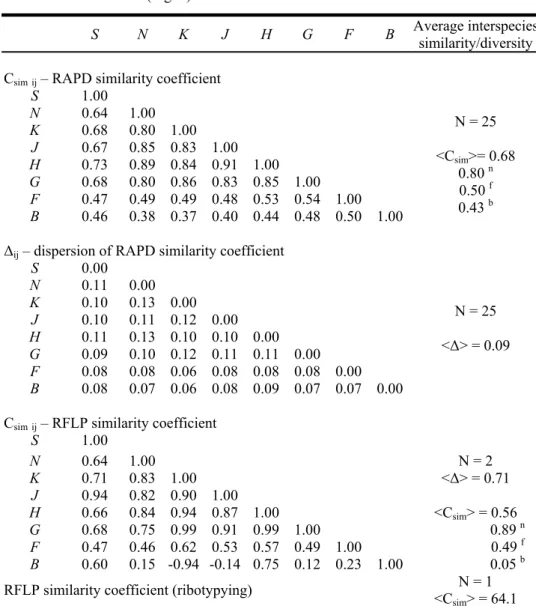
Tab. 3. Global diversity for the analyzed group of Vicia species representing the faba, bithynica and narbonensis sections. The species are described with the same abbreviations as before (Fig. 2).
S N K J H G F B Average interspecies similarity/diversity
Csim ij – RAPD similarity coefficient
S 1.00
N 0.64 1.00
K 0.68 0.80 1.00
J 0.67 0.85 0.83 1.00 H 0.73 0.89 0.84 0.91 1.00 G 0.68 0.80 0.86 0.83 0.85 1.00 F 0.47 0.49 0.49 0.48 0.53 0.54 1.00 B 0.46 0.38 0.37 0.40 0.44 0.48 0.50 1.00
N = 25
<Csim>= 0.68 0.80 n 0.50 f 0.43 b
Δij – dispersion of RAPD similarity coefficient
S 0.00
N 0.11 0.00
K 0.10 0.13 0.00
J 0.10 0.11 0.12 0.00
H 0.11 0.13 0.10 0.10 0.00
G 0.09 0.10 0.12 0.11 0.11 0.00 F 0.08 0.08 0.06 0.08 0.08 0.08 0.00 B 0.08 0.07 0.06 0.08 0.09 0.07 0.07 0.00
N = 25
<Δ> = 0.09
Csim ij – RFLP similarity coefficient
S 1.00
N 0.64 1.00
K 0.71 0.83 1.00
J 0.94 0.82 0.90 1.00
H 0.66 0.84 0.94 0.87 1.00
G 0.68 0.75 0.99 0.91 0.99 1.00 F 0.47 0.46 0.62 0.53 0.57 0.49 1.00 B 0.60 0.15 -0.94 -0.14 0.75 0.12 0.23 1.00
N = 2 <Δ> = 0.71
<Csim> = 0.56 0.89 n 0.49 f 0.05 b RFLP similarity coefficient (ribotypying) <Csim> =N = 1 64.1
aC
simij is an averaged value of Pearson’s correlation coefficients calculated over 25 RAPDs. bΔij is
a standard error related to Csimij. c<Csim> and <Δ> are the averaged values over the independent
values of the presented matrices of Csimij and Δij, respectively. dthe superscripts n, f, and b refer to
Fig 3. Interspecific genetic similarity/diversity for Vicia species. A - Summarized interspecies genetic similarity calculated in particular RAPD analyses for 8 Vicia species. The ranges of similarity/diversity common to particular Cksim types are indicated with the dotted ellipsoid curves. B - Summarized interspecies genetic diversity in particular RAPD analyses for 8 Vicia species. Cksim is an averaged value of all coefficients for the similarity matrix found in one test. The νk describes the frequency of appearance of a decamer sequence in the Vicia genome. Five separate types were distinguished, depending on the presence of a specific motif: (○) decamers, which include the tandemly repeated tetramers or trimers GCAG, GATC or CTG (R06, R10, R23); (U) decamers, with CC or GG repeats (R02, R07, R08, R21, R22, R25); (S) decamers, with GC repeats (R03, R15, R18, R19, R20, R27); (■) decamers, including other types of tandemly repeated dimmer, i.e. CA, CT, GT or AG (R01, R04, R05, R09, R13); and (●) decamers without any tandem repeat (R11, R12, R14, R16, R24).
When a primer included CC or GG repeated motifs, a lower Ck
sim value (0.5-0.6) was accompanied by a rather moderate value (0.1-0.4) of the variance. The primer sequences containing trimer or tetramer tandem repeats had rather high (0.9) or moderate (0.6) Ck
sim values and a lower variance (0.1-0.4), while primers with no repeats gave a higher (0.6-0.9) Ck
sim and wider (0.1-0.6) range of variance (Tab. 3). Generally, the observed interspecies similarity was highest for the loci related to a marker containing tandemly repeated heterodimers.
Averaged genomic similarity between Vicia species
The averaged similarity related to a random set of decamers (possessing diversified genomic frequency) also noticeably separated the sections bithynica (0.43) and faba (0.50) from narbonensis (0.73), and the corresponding averaged diversity was also section-specific (bithynica: 0.07, faba: 0.08, and narbonensis: 0.1). For the individual species of the narbonensis section, the similarity coefficients were as follows: V. serratifolia 0.63, V. kalakhensis 0.73,
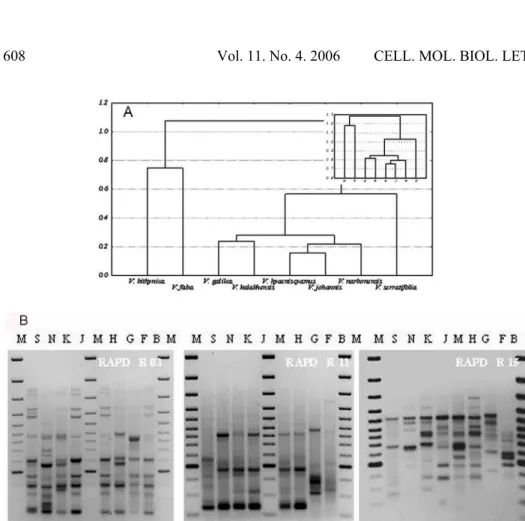
Fig. 4. Taxonomic relationships among the Vicia species – the final dendrogram. A - The averaged relationship between eight Vicia species found on the basis of 25 RAPD analyses. For calculations, the UPGMA (unweighted pair group method using arithmetic averages) and euclidean distances were applied. In the top right corner, the dendrogram is ‘weighted’ by primer genomic frequencies. B -Three RAPDs illustrating three points in A. R11 represents low Ck and high interspecies diversity, R16 represents low Ck and
low diversity, while R03, located close to the center of the diagram, represents moderate values. The species names are abbreviated as in (Fig. 2), M – molecular weight marker.
DISCUSSION
RFLP experiments [17], to assess a clear relationship between different Vicia
accessions, the simultaneous analysis of several patterns was necessary. The set of decamers described here was arranged to cover a possibly wide range of different types of genomic loci, but simultaneously to possess different GC percentages and different genomic frequencies. It was found that for 25 decamer sequences applied as RAPD primers, despite the observed particular differences, the average value of the interspecies relationships resembled that based on the taxonomically important phenotypic, biochemical or molecular data.
Averaged genomic similarity between Vicia species
The search was focused on the generalized interspecies similarity to overcome the differences generated by clustering results related to the particular RAPD, and effective relationships found among the species strongly resembled the established taxonomic relationships (Fig. 3A). The averaged cluster analysis revealed separated clusters of V. faba and V. bithynica, while all the species forming the narbonensis section were gathered together. This appeared to be in general accordance with our ribotyping-based UPGMA cluster analysis, but also with the RFLP results (Fig. 2A). The average RAPD analysis seemed to confirm the association of V. serratifolia with the narbonensis section. However, in all three hybridization tests (RFLP and ribotyping), V. serratifolia was found to be much less related to the section. The relationships between the remaining species of the section were different according to each analysis, while the ribotyping resulted in their nearly 100% identity. The RFLPs showed a much weaker association between the species, and in each RFLP, different species were out of the complex (Fig. 2B, 2C). The RAPD-based observation corresponds with the fingerprinting results of other authors, e.g. with those presented by Van de Ven [17]. However, according to him, two other species (V. galilaea and
V. hyaeniscyamus) were found to be especially similar. Some RAPD tests resulted in different relative positions of V. faba, V.bithynica or V.serratifolia
to the narbonensis section. These results are consistent with the results of some other authors, indicating that V. narbonensis might be found quite apart from the species of its own section. The resultant correspondence of averaged similarity coefficients found among eight Vicia species for the two tests (RAPD- and RFLP-based Southern blot hybridization) suggests quite a wide-range genome similarity, and a kind of equivalence between these two kinds of typing, i.e. hexamer- and decamer-based (Tab. 3 and Fig. 3).
Relationships with a karyotype differences
The presented analysis referred to the species whose 1C ranged from 4.58 pg (V. bithynica) to 13.35 pg (V. faba) [50, 51] with a mean of 7.96 pg. Cluster analysis (Fig. 3A) gathered together four species with similar genome sizes:
V.kalakhensis and V.galilaea (9.18 pg and 6.52 pg). The observed discrepancy between the RAPD clustering of Vicia species and their appropriate 1C values might be related to different evolutionary paths of particular species [47, 52] . In Vicia, apart from variations in chromosome number, there is a large-scale variation in chromosome size, nuclear DNA content, repetitive and non-repetitive DNA sequences and chromosomal repatterning in non-nuclear and nuclear chromosomes. The results of Raina and Ogihara [29], and literature therein, concerning rDNA repeat variability and length heterogeneity place V.faba and V. bithynica outside the narbonensis complex. In the presented ribosomal hybridization study, V. bithynica turned out to be the most distant from the narbonensis section (less than 10% similarity), while the second, V. faba, was about 30% similar, and the third, V. serratifolia, about 75%. The internal homology of the remaining five species of the narbonensis section was 95%. According to the results reported by other authors, the analysis of rrn-related internal transcribed spacers (ITS) does not allow clarification of the phylogenetic relationships within the narbonensis complex, suggesting the possible relative conservativeness of the section [18]. This ITS alignement located V.kalakhensis further from the other members of the group and slightly distinguished the V. serratifolia species. Inside the section, the karyotype analysis gathered together V. galilaea and V. johannis, separately from both
V. narbonensis and V. kalakhensis. It also widened the individual distance of
V. hyaniscyamus [18].
Relationships with phenotype diversity
The question to what extent the similarity between the investigated species might correspond to relationships visible at the proteome level is partially answered by several papers analysing the polymorphism of albumins, isoenzymes (dehydrogenases, superoxide dismutase) or aspartate aminotransferase [15, 16]. The analysis involved allele frequencies at eight polymorphic loci. According to the cited authors, the variation within species revealed by UPGMA cluster analysis performed on a set of the narbonensis section species along with V. faba and V. bithynica allowed the recognition of
CONCLUSIONS
The averaged RAPD-based interspecies relationships are in agreement with RFLP-based and with rDNA-based typing results, confirming that averaged values found on the basis of 25 markers are quite a good approximation of interspecies relationships in Vicia. This suggests that interspecies relationships visible in analyses of rDNA emulate those resulting from a series of short random sequences. When included into analysis, the primer genomic frequencies did not change the observed interspecies relationships.
The results validate the micro- and colinearity known for Fabaceae and are congruent with data known from molecular and morphological taxonomy records. The averaged similarity coefficient and its variance, both referring to the particular RAPD test, produce an informative visualization of interspecies relationships. The primer motif influences the result of interspecies relationships, but in most cases keeps/maintains the relationships between the sections.
Genome description averaged over random loci proved to be an effective and informative tool for interspecies analysis in Vicia.
Acknowledgements. We would like to thank Professor Maria Olszewska from the University of Łódź for her help, encouragement and care. This study was supported by the University of Łódź, grant No 505/040424, and partially by the Centre for Medical Biology PAS.
REFERENCES
1. Allkin, R., Goyder, D.J., Bisby, F.A. and White, R.J. Names and synonymus of species and subspecies in the Viciae. Issue 3 Vicieae Database Project Publication No 7 Southampton, 1986.
2. Harlan, J.R. Theory and dynamics of grassland agriculture. (Van Nostrand, D. Ed), Princeton, New Jersey, USA, 1956.
3. Buntier, J.B., Sørensen, A.P. and Peleman, J.D. Haplotype diversity: the link between statistical and biological association. Trends Plant Sci. 10 (2005) 1360-1385.
4. Gepts, P., Beavis, W.D., Brummer, E.Ch., Shoemaker, R.C., Stalker, H.T., Weeden, N.F. and Young, N.D. Legumes as a model plant family. Genomics for food and feed report of the cross-legume advances through genomics conference. Plant Physiol. 137 (2005) 1228-1235.
5. Lee, J.M., Grant, D., Vallejos, C.E. and Shoemaker, R.C. Genome organization in dicots. II. Arabidopsis as a ‘bridging species’ to resolve genome evolution events among legumes. Theor. Appl. Genet. 103 (2001) 765-773.
7. Zhu, H., Choi, H.-K., Cook, D.R. and Shoemaker, R.C. Bridging model and crop legumes through comparative genomics. Plant Physiol. 137 (2005) 1189-1196.
8. Bennetzen, J.L. Comparative sequence analysis of plant nuclear genomes: microcolinearity and its many exceptions. Plant Cell 12 (2000) 1021-1029. 9. Choi, H.K., Mun, J.H., Kim, D.J., Zhu, H., Baek, J.M., Mudge, J., Roe, B.,
Ellis, N., Doyle, J., Kiss, G.B., Young, N.D. and Cook, D.R. Estimating genome conservation between crop and model legume species. Proc. Natl. Acad. Sci. USA 101 (2004) 15289-15294.
10. McCouch, S.R. Genomics and synteny. Plant Physiol. 125 (2001) 152-155. 11. Yan, H.H., Mudge, J., Kim, D.-J., Shoemaker, R.C. and Young, N.D.
Comparative physical mapping reveals features of microsynteny between Glycine max, Medicago truncatula, and Arabidopsis thaliana. Genome 47 (2004) 141-155.
12. Grant, D., Cregan, P. and Shoemaker, R.C. Genome organization in dicots: genome duplication in Arabidopsis and synteny between soybean and Arabidopsis. Proc. Natl. Acad. Sci. USA 97 (2000) 4168-4173.
13. Frediani, M., Caputo, P., Venora, G., Ravelli, C., Ambrosio, M. and Cremonini, R. Nuclear DNA contents, rDNAs, and karyotype evolution in
Vicia subgenus Vicia: II. Section Peregrinae. Protoplasma 226 (2005) 181-190.
14. Fuchs, J., Strehl. S., Brandes, A., Schweizer, D. and Schubert, I. Molecular-cytogenetic characterization of the Vicia faba genome, heterochromatin differentiation, replication patterns and sequence localization. Chromosome Res. 6 (1998) 219-230.
15. Leht, M. and Jaaska, V. Cladistic and phenetic analysis of relationships in
Vicia subgenus Vicia (Fabaceae) by morphology and isozymes. Plant Syst. Evol. 232 (2001) 237-260.
16. Przybylska, J. and Zimniak-Przybylska, Z. Electrophoretic seed albumin patterns and species relationships in Vicia sect Faba (Fabaceae). Plant. Syst. Evol. 198 (1995) 179-194.
17. Van de Ven, W.T.G., Duncan. N., Ramsay, G., Philips, M., Powell, M. and Waugh, R. Taxonomic relationships between V. faba and relatives based on nuclear and mitochondrial RFLPs and PCR analysis. Theor. Appl. Genet.
86 (1993) 71-80.
18. Venora, G., Blangifirti, S., Frediani, M., Maggini, F., Castiglione, M.R. and Cremonini, R. Nuclear DNA contents, rDNAs, chromatin organization, and karyotype evolution in Vicia sect Faba. Protoplasma 213 (2000) 118-125. 19. Wojciechowski, M.F. In Advances in legume systematics. Part 10. Higher
level systematics. Edited by Klitgaard, B.B. and Bruneau, A. Royal Botanic Gardens, Kew, U.K. (2003) 5-35.
21. Pozarkova, D., Kublizkova, A., Roman, B., Torres, A.M., Lucretti, S., Lysak, M., Dolezel, J. and Macas, J. Development and characterization of microsatellite markers from chromosome 1-specific DNA libraries of Vicia faba. Biol. Plant. 45 (2002) 337-345.
22. Román, B., Torres, A.M., Rubiales, D., Cubero, J.I. and Satovic, Z. Mapping of quantitative trait loci controlling broomrape (Orobanche crenata Forsk) resistance in faba bean (Viciafaba L). Genome 45 (2002) 1057-1063.
23. Bennett, M.D. and Leitch, I.J. Angiosprm DNA C-values database (release5.0 dec.2004) http://www.rbgkew.org.uk/cval/homepage.html (2004).
24. Román, B., Satovic, Z., Pozarkova, D., Macas, J., Dolezel, J. and Torres, A.M. Development of a composite map in Viciafaba, breeding applications and future prospects. Theor. Appl. Genet. 108 (2004) 1079-1088.
25. Torres, A.M., Weeden, N.F. and Martín, A. Linkage among isozyme, RFLP and RAPD markers in Viciafaba. Theor. Appl. Genet. 85 (1993) 937-945. 26. Heslop-Harrison, J.S. Comparative genome organization in plants: from
sequence and markers to chromatin and chromosomes. Plant Cell 12 (2000) 617-635.
27. Avila, C.M., Sillero, J.C., Rubiales, D., Moreno, M.T. and Torres, A.M. Identification of RAPD markers linked to the Uvf-1 gene conferring hypersensitive resistance against rust (Uromyces Viciae-fabae) in Viciafaba
L. Theor. Appl. Genet. 107 (2003) 353-358.
28. Weder, J.K.P. Identifcation of Food and Feed Legumes by RAPD-PCR.
Lebensm-Wiss u-Technol. 35 (2002) 504-511.
29. Raina, S.N. and Ogihara, A. Ribosomal DNA repeat unit polymorphism in 49 Vicia species. Theor. Appl. Genet. 90 (1995) 477-486.
30. Potokina, E., Tomooka, N., Vaughan, D.A., Alexandrowa, T. and Xu, R.Q. Phylogeny of Vicia subgenus Vicia (Fabaceae) based on analysis of RAPDs and RFLP of PCR-amplified chloroplast genes. Genet. Res. Crop. Evol. 46 (1999) 149-161.
31. Potokina, E., Blattner, F.R., Alexandrova, T. and Bachmann, K. AFLP diversity in the common vetch (Vicia sativa L) on the world scale. Theor. Appl. Genet. 105 (2002) 58-67.
32. Peakall, R., Gilmore, S., Keys, W., Morgante, M. and Rafalski, A. Cross-Species amplification of soybean (Glycine max) simple sequence repeats (SSRs) within the genus and other legume genera: implications for the transferability of SSRs in plants. Mol.Biol.Evol. 15 (1998) 1275-1287. 33. Frediani, M., Galati, M.T., Maggini, F., Galasso, I., Minelli, S., Ceccarelli,
M. and Cionini, P.G. A family of dispersed repeats in the genome of V. faba: structure, chromosomal organization, redundancy modulation, and evolution. Chromosoma 108 (1999) 317-324.
35. Pearce, S.R., Harrison, G., Li, D., Heslop-Harrison, J.S., Flavell, A. and Kumar, A. The Ty-1-copia group retrotransposons in Vicia species: copy number, sequence heterogeneity and chromosomal localization. Mol. Gen. Genet. 250 (1996) 305-315.
36. Naumann, P., Koblizkova, A., Navratilova, A. and Macas, J. Significant expansion of Vicia pannonica genome size mediated by amplification of a single type of giant retroelement. Genetics 173 (2006) 1047-1056.
37. Macas, J., Neumann, P. and Pozarkova, D. Zaba: a novel miniature transposable element present in genomes of legume plants. Mol. Gen. Genomics 269 (2003) 624-631.
38. Maxted, N., Khettab, M.A. and Bisby, F.A. The newly discovered relatives of Vicia faba do little to resolve the enigma of its origin. Bot. Chron. 10 (1991) 435-465.
39. Gerlach, W.L. and Bedbrook, J.R. Cloning and characterization of ribosomal RNA genes from wheat and barley. Nucleic Acids Res. 8 (1979) 1869-1885. 40. Sambrook, J., Fritsch, E.F. and Maniatis, T. Molecular Cloning
A Laboratory Manual, 2nd Ed. Edited by Cold Spring Harbor Laboratory Press, New York, 1989.
41. Williams, J.G.K., Kubelik, A.R., Livak, A.J., Rafalski, J.A. and Tingey, S.V. DNA polymorphism amplified by arbitrary primers are useful as genetic markers. Nucleic Acids Res. 18 (1990) 6531-6535.
42. Altschul, S.F., Madden, T.L., Schäffer, A.A., Zhang, J., Zhang, Z., Miller, W. and Lipman D.J. Gapped BLAST and PSI-BLAST: a new generation of protein database search programs. Nucleic Acids Res. 25 (1997) 3389-3402. 43. Sokal, R.R. and Sneath, P.H.A., Principles of Numerical Taxonomy. WH
Freeman & Co, San Francisco, CA USA, 1963.
44. Francki, M.G. and Mullan, D.J. Application of comparative genomics to narrowleafed lupin (Lupinus angustifolius L.) using sequence information from soybean and Arabidopsis. Genome 47 (2004) 623-632.
45. Hecht, V., Foucher, F., Ferrandiz, C., Macknight, R., Vardy, M.E., Ellis, N., Beltran, J.P., Rameau, C. and Weller, J.L. Conservation of Arabidopsis flowering genes in model legumes. PlantPhysiol. 137 (2005) 142-1434. 46. Kalo, P., Seres, A., Taylor, S.A., Jakab, J., Kevei, Z., Kereszt, A., Endre, G.,
Ellis, T.H.N. and Kiss, G.B. Comparative mapping between Medicago sativa and Pisum sativum. Mol.Genet.Genomics 272 (2004) 235-246. 47. Hill, P., Burford, D., Martin, D.M. and Flavell, A.J. Retrotranspozon
populations of Vicia species with varying genome size. Mol. Genet. Genomics 273 (2005) 371-381.
49. Menacio-Hautea, D., Fatokum, C.A., Kumar, L., Danesh, D. and Young, N.D. Comparative genome analysis of mungbean (Vigna radiata L. Wilczek) and cowpea (V. unguiculata) using RFLP analysis. Theor. Appl. Genet. 86 (1993) 797-810.
50. Bennett, M.D. and Smith, J.B. Nuclear DNA amounts in angiosperms. Phil. Trans. of the Royal Society of London B 334 (1991) 309-345.
51. Olszewska, M.J. and Osiecka, R. The relationship between 2C DNA content, life- cycle type, systematic position and the dynamics of DNA endoreplication in parenchyma nuclei during growth and differentiation of roots in some dicotyledonous-herbaceous species. Biochemie und Physiologie der Pflanzen 178 (1983) 581-599.
52. Naranjo, C.A., Ferrari, M.R., Palermo, A.M. and Poggio, L. Karyotype, DNA content and meiotic behaviour in five south american species of Vicia