AUSTRALIAN JOURNAL OF BASIC AND
APPLIED SCIENCES
ISSN:1991-8178 EISSN: 2309-8414 Journal home page: www.ajbasweb.com
Open Access Journal
Published BY AENSI Publication
© 2016 AENSI Publisher All rights reserved
This work is licensed under the Creative Commons Attribution International License (CC BY).
http://creativecommons.org/licenses/by/4.0/
To Cite This Article: Gengashree P, Hima Bindhu S, S, Sivarathinabala M, Person Identification using Gait Signatures in a Smart Classroom. Aust. J. Basic & Appl. Sci., 10(2): 176-180, 2016
Person Identification using Gait Signatures in a Smart Classroom
1Gengashree P, 2Hima Bindhu S, 3Abirami S, 4Sivarathinabala M
1,2,3,4 Department of Information Science and Technology,College of Engineering, Guindy, Chennai-600 025.
Address For Correspondence:
Abirami S, Department of Information Science and Technology, Anna University, College of Engineering, Guindy, Chennai – 600 025. abirami_mr @yahoo.com
A R T I C L E I N F O A B S T R A C T
Article history:
Received 04 December 2015 Accepted 22 January 2016 Available online 14 February 2016
Keywords:
Gait Signature Extraction Person Identification Gait Recognition
Person Authentication in many scenarios at present makes use of human gait – which is believed to be unique for each individual. In this paper, we proposed an approach to effectively identify persons using Human Gait in a Smart Classroom. In the scenario of human identification, past attempts need human co-operation for person identification. An outstanding advantage of gait is its potential for being noticeable over long distances which does not involve any notification or contact with the subject. These reasons make Gait as an excellent option for person identification. Hence we identified persons in smart classrooms using gait signatures. This implementation provides us promising results in the accuracy of the person identification process.
INTRODUCTION
This research aims at incorporating intelligence into a classroom in order to detect intruders and identify authorized students/staff members without any human intervention. The following is the inspirational scenario of our research. We have seen in our classrooms where staffs find it difficult to maintain the perfect attendance list. There is another scenario where smart classrooms have introduced smart cards and biometrics, etc. to ensure physical security, but every single security system needs human cooperation. One successful way to identify and authenticate students in these smart classrooms is by using video feeds from surveillance cameras and using Gait – walking style of a person, to uniquely identify individual people. Normally biometric authentication both physical and behavioral means need human interaction. In contrast, gait can be used to authenticate a person properly, without any human interaction.
There are two kinds of approaches in gait analysis: Model Free and Model Base (M. Sivarathinabala and S. Abirami, 2014). A Model free approach generally captures the whole body dynamics and static features by a concise representation such as silhouettes shape measurement. Model Free has a low computational cost and faster computation compared to Model Free. There are so many gait features that can be extracted and used for gait analysis. Here in this work, we have been considered model free approach. Gait Energy Image (GEI) is one of the prominent features used for gait analysis.
In this paper, our contribution lies in introducing gait to identify and authenticate the students in a smart classroom and automatically mark their attendance when they simply walk in the door. We have been considered Gait Energy Image (GEI) as the feature to identify the person accurately.
Related Works:
Various works in the field of video analytics have been devoted for gait recognition and they are addressed in this section in detail with respect to the human identification. Existing gait recognition techniques, mainly fall into two broad categories, namely model based and model free approaches. Model free approaches use motion information directly extracted from silhouettes, whilst model based approaches fit a model for the human body and represent gait using the parameters of the model which are updated over time.
The recent works in the category of model based approaches include: analysis of the discriminatory power of joint angle (S.X. Yang et al.,2014), the usage of Microsoft Kinect for skeleton measurement (J. Preis et al., 2012) and 3D approach using marionette and mass-spring model (G. Ariyanto et al., 2012). Recent trends in gait recognition research seem to favor model free approaches since they are computationally less intensive, more robust to noise, and have a comparable or better performance compared with the model based ones on benchmarking datasets (Han, J and Bhanu, B, 2006).
Ben Abdelkader et al., (2004) proposes to represent gait using image, self-similarity which measures the similarity between pairs of silhouettes in a gait sequence. It is claimed that the self-similarity representation of gait encodes a projection of gait dynamics and is resistant to noise. In the model free approaches, the main focus is on motion pattern, irrespective of the underlying structure. Some of these approaches are: gait energy image (GEI), gait entropy image (GEnI) and gait flow image (GFI). An average of all the images over a gait period is termed as gait energy image (GEI) (Han, J and Bhanu, B, 2006) that represents the silhouette shape and motion information in a single frame by maintaining its temporal information. Gait entropy image (GEnI) (J.Preis et al., 2012) represents the randomness of pixel intensities in the GEI using Shannon entropy. So it invariably captures the dynamic information of the gait without the cooperation of a subject (K.Bashir et al.,2010). A comprehensive survey of various current gait recognition techniques is given in (T.K.Lee et al.,2014), highlighting the challenges and issues related to gait processing.
Proposed System:
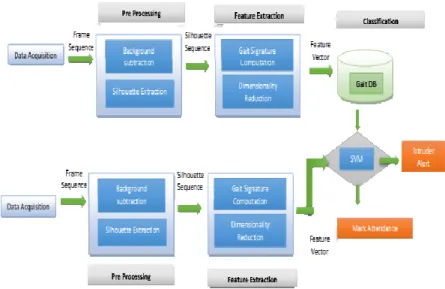
In this research paper, we have tried to bring in the authentication of a student in a smart classroom without human intervention as well as to mark attendance automatically. Initially, our person identification system extracts gait signatures of every student after preprocessing. GEI and GII are the features extracted in the feature extraction phase and template images are created for them. The classification phase differentiates the person based on their features. During the training phase, template images are created from their features and they are trained using a multi class SVM classifier. Here testing phase is efficient because even if the person walks slightly different or walks with different clothes, it could be identified. Once a person who walks in is authenticated, then his/her attendance will be marked for the day. All the phases of person authentication process are explained here.
1. Pre-Processing:
In model free gait analysis, frames from the video sequences are extracted from each human walking over a small period of time called one gait cycle. Next to it, pre-processing phase (VidhuBala R. Vidya Sagar and Abirami.S (2012)) includes background subtraction and silhouette extraction. Once a background subtraction is done, silhouettes are extracted and silhouettes are normalized and centralized to the same size for further processing.
2. Feature Extraction:
Here feature extraction, includes the extraction of gait signatures, like GEI (Gait Energy Image) (Han, J and Bhanu, B, 2006) and GII (Gait Information Image). Gait Signatures like GEI is computed by taking the average of all the images in one gait cycle of a person walking. GII is calculated by taking the average of the pixel intensities of all silhouette images in one gait cycle. The resultant image will be of high dimension (ie.,155*65 )which will take more time to train and classify. Hence this leads to reduce the dimension by performing dimensionality reduction. We chose Principal Component Analysis (PCA) to dimensionally reduce the extracted image. After performing PCA the dimension of the feature vector gets reduced by 155*2.
3. Classification:
Classification process is used to identify whether the person under test belongs to the class or not. Here, multi class SVM is used in the classification process (Blessy Selvam and Abirami.S (2013)). Since, these are of higher dimensions, PCA reduced feature vectors has been given as input to the classifier. Here the classifier has been trained with the gait signatures of every person in the classroom.
silhouettes, Gait signatures are extracted and after dimensionality reduction gait feature vectors are generated and tested using a classifier to identify the correct unique id of the students in the class. Subsequently, attendance is marked against that individual.
Fig. 1: Framework for Person Identification using Gait
RESULTS AND DISCUSSION
The implementation of this gait recognition system has been done using MATLAB (Version2014a). The input videos have taken real time when the students enter into the classroom. Those real time videos are used in the creation of the training data set and testing is also done using those real time videos taken in the smart classroom with a set of 15 students.
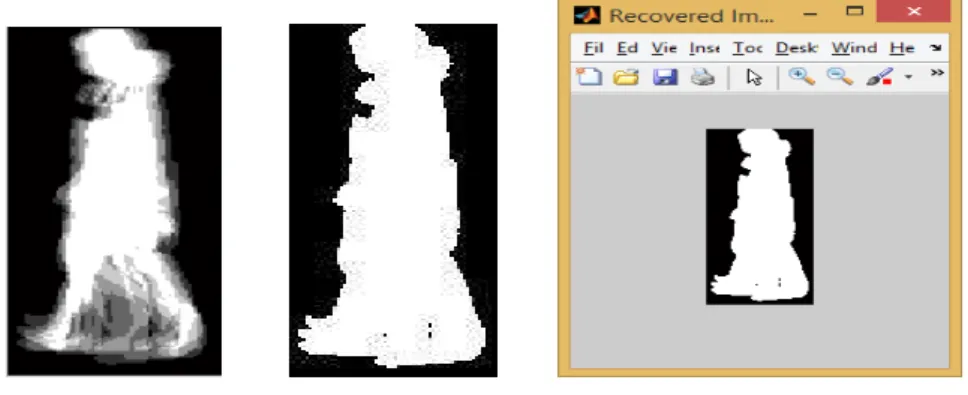
Figure 1(a) and (b) shows the results of pre-processing step involving background subtraction and silhouette extraction. Figure 2 shows the results of feature extraction (GEI) after taking the average of all the images over the gait cycle. Figure 3 shows the mean image of GEI and the recovered image after classification.
Fig. 1: (a) Original human silhouette with background subtraction.
(b) ROI of the original image after normalization and centralization.
Fig. 3: Mean Image and Classified Image Performance Analysis:
In this work, we have considered two datasets MIT database (Han, J and Bhanu, B, 2006)13 subjects, 194 samples in the indoor environment and self generated database which consists of 15 subjects, 300 samples in the indoor environment. The Classification results of the proposed method using generated dataset in the smart classroom have been tabulated in the table. Correct classification rate (CCR) in Self generated database has been recognized. CCR rate has been shown in table.1.
Table 1: Performance evaluation
No of Subjects Self-Generated Database
Correct Classification Rate (CCR %)
Person1 88.4
Person2 98.5
Person3 92.3
Person4 93.4
Person5 94.5
Conclusion:
In this research, an automated gait based authentication system in a smart classroom is proposed to automatically mark attendance for students to classify from intruders. This system has been proposed and implemented with a significant feature vector generation. These features are then trained for every individual and used during the testing phase. Here, the classifier used is simple multiclass Support Vector Machines (SVM) classifier which is trained for 15 subjects in a smart classroom. The proposed algorithm has been tested using real time videos captured in the classrooms. This system has the ability to recognize students in the classroom against teachers and intruders and to automatically mark attendance for them successfully.
ACKNOWLEDGEMENT
This research is supported by the Centre for Technology Development and Transfer (CTDT), Anna University, Chennai under the student innovative projects – proceedings no. 1988/CTDT-1/RSS SIP/ CEG/ 2015.The authors would like to thank the faculties and students in the Department of Information Science and Technology, Anna university, Chennai for providing us valuable support and guidance to complete this project.
REFERENCES
Han, J., B. Bhanu, 2006. Individual recognition using gait energy image. IEEE Trans. PAMI 28 (2), 316– 322.
BenAbdelkader, C., R. Cutler, L. Davis, 2004. Gait recognition using image selfsimilarity. EURASIP J. Appl. Signal Process, (1): 572-585.
Yang, S.X., P.K. Larsen, T. Alkjær, E.B. Simonsen, N. Lynnerup, 2014. Variability and similarity of gait as evaluated by joint angles: implications for forensic gait analysis, J. For. Sci., 59(2): 494–504.
Ariyanto, G., M.S. Nixon, 2012. Marionette mass-spring model for 3d gait biometrics, in: 5th IAPR International Conference on Biometrics (ICB), IEEE, pp: 354-359.
Preis, J., M. Kessel, M. Werner, C. Linnhoff-Popien, 2012. Gait recognition with kinect, 1st International Workshop on Kinect in Pervasive Computing, New Castle, UK, pp: 1-4.
Bashir K., T. Xiang, S. Gong, 2010. Gait recognition without subject cooperation, Pattern Recognit. Lett., 31(13): 2052-2060.
Lee, T.K., M. Belkhatir, S. Sanei, 2014. A comprehensive review of past and present vision-based techniques for gait recognition,Multimedia Tools Appl., 72(3): 1-37.
Sivarathinabala, M. and S. Abirami, 2014. “ Automatic Identification of Person using fusion of features”, in proceedings of International Conference on Science, Engineering and Management Research (ICSEMR) pp: 1-5, IEEE, DOI: 10.1109/ICSEMR.2014.7043628
Vidhu Bala, R., Vidya Sagar and S. Abirami, 2012. ”Trends in Word Sense Disambiguation”, Artificial Intelligence Review, Springer Publishers, Impact Factor: 1.565, DOI 10.1007/s10462-012-9331-5.