METHODOLOGY
Nonpher: computational method
for design of hard-to-synthesize structures
Milan Voršilák
1and Daniel Svozil
1,2*Abstract
In cheminformatics, machine learning methods are typically used to classify chemical compounds into distinctive classes such as active/nonactive or toxic/nontoxic. To train a classifier, a training data set must consist of examples from both positive and negative classes. While a biological activity or toxicity can be experimentally measured, another important molecular property, a synthetic feasibility, is a more abstract feature that can’t be easily assessed. In the present paper, we introduce Nonpher, a computational method for the construction of a hard-to-synthesize virtual library. Nonpher is based on a molecular morphing algorithm in which new structures are iteratively generated by simple structural changes, such as the addition or removal of an atom or a bond. In Nonpher, molecular morphing was optimized so that it yields structures not overly complex, but just right hard-to-synthesize. Nonpher results were compared with SAscore and dense region (DR), other two methods for the generation of hard-to-synthesize compounds. Random forest classifier trained on Nonpher data achieves better results than models obtained using SAscore and DR data.
Keywords: Synthetic feasibility, Molecular complexity, Molecular morphing
© The Author(s) 2017. This article is distributed under the terms of the Creative Commons Attribution 4.0 International License (http://creativecommons.org/licenses/by/4.0/), which permits unrestricted use, distribution, and reproduction in any medium, provided you give appropriate credit to the original author(s) and the source, provide a link to the Creative Commons license, and indicate if changes were made. The Creative Commons Public Domain Dedication waiver (http://creativecommons.org/ publicdomain/zero/1.0/) applies to the data made available in this article, unless otherwise stated.
Background
Virtual screening is a well-established approach in which possible biologically active molecules are searched in the large collections of available screening compounds [1, 2]. However, virtual screening generates structures mostly similar to known ones. If new chemotypes are to be identified, virtual compounds can be assembled from scratch using de novo design [3] that, typically, gener-ates thousands of potentially novel compounds. Because it is unrealistic to synthesize and test so many com-pounds [4], their synthetic accessibility is assessed and compounds difficult to synthesize are removed from the virtual library. The assessment of compound synthetic feasibility can be done either manually, or computation-ally. But, due to a large number of structures, a manual examination is usually impractical. In addition, it has been demonstrated that medicinal chemists are not very
consistent in identifying synthetically unfeasible com-pounds [5–7]. Thus, computational methods were devel-oped as an alternative means for compound synthetic feasibility assessment [8]. These can be roughly divided into two groups [9]. In a retrosynthetic approach [10– 13], a target molecule is decomposed to starting materi-als by breaking bonds that can be easily created by known chemical reactions. The retrosynthetic approach requires the databases of both starting materials and reactions annotated with yields and reaction conditions. Not only that keeping these databases up-to-date is a difficult task, but retrosynthetic methods are also, due to their high computational demands, not suitable for large-scale predictions. Another approach of synthetic accessibil-ity assessment is based on the complexaccessibil-ity of a structure itself. An assumption behind this approach is that more complex structures are harder to synthesize. However, due to the ambiguous and context dependent definition of molecular complexity [14], its evaluation is not an easy task. Simple and commonly used complexity metrics is a molecular weight. More sophisticated complexity meas-ures (e.g., Bertz [15], Whitlock [16], BC [17], or SMCM [18] indices) are calculated from a number of atoms,
Open Access
*Correspondence: [email protected]
bonds, rings, and/or hard-to-synthesize motifs, such as chiral centers or uncommon ring fusions. While a com-plexity approach is fast enough for primary screening, it has also its limitation: it removes complex molecules that can be actually synthesized from already existing complex precursors. To overcome this problem, Ertl sug-gested [9] an SAscore prediction model based on the occurrence of molecular circular fragments [19] in the database of synthetically accessible compounds.
Another way how to assess synthetic accessibility is to use supervised machine learning approaches [20], such as support vector machines, artificial neural networks or random forests (RF). To train a binary classifier requires a training data set consisting of both positive (i.e., easy-to-synthesize) and negative (i.e., hard-easy-to-synthesize) examples. While positive examples can be selected from the database of existing compounds, such as PubChem [21] or ZINC [22], no equivalent database is available for negative examples. Nevertheless, as negative examples can be used compounds with SAscore higher than 6 [9]. Alternatively, in a dense region (DR) approach [20], easy-to-synthesize compounds are identified as these coming from the dense and hard-to-synthesize compounds from the sparse regions of chemical space. For a given com-pound, chemical space density is evaluated by calculat-ing the number of its nearest neighbors. However, both SAscore and DR methods assess already existing struc-tures a majority of which is, in principle, amenable to synthesis. Thus we developed Nonpher, a method for the construction of hard-to-synthesize virtual compounds which is based on a previously published molecular mor-phing approach [23]. Using Nonpher, a virtual library of 1,706,950 hard-to-synthesize compounds was con-structed (Additional file 1). This library was then used to build a random forest classification model. The quality of this model was verified by predicting the synthetic acces-sibility of 40 hard-to-synthesize compounds collected carefully from literature. In addition, this model outper-formed similar models trained on data constructed by SAscore [9] and DR [20] approaches.
Methods
Nonpher description
Nonpher is a methodology for the generation of hard-to-synthesize structures. The input to Nonpher is an existing structure, further referred to as a starting structure that gradually undergoes simple structural variations, such as the addition/removal/change of an atom or a bond. This process is called molecular morphing [23] and structures that form a morphing path are called morphs. In Non-pher, any structure can be used as a starting structure. A new morph is generated from the starting structure by a random choice of a structural variation (e.g., atom
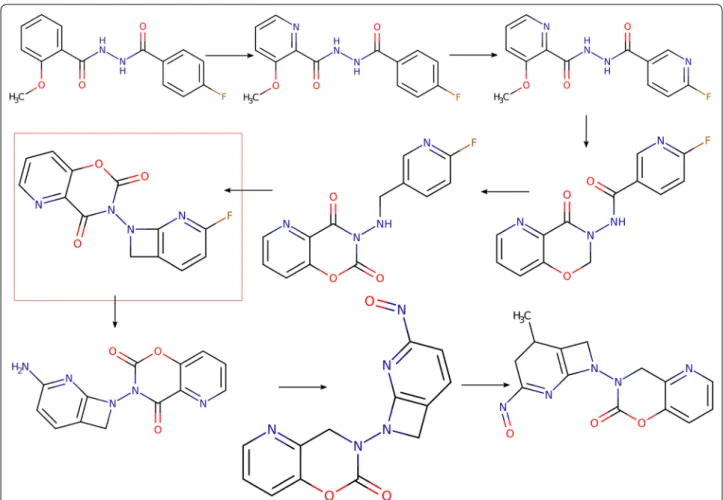
deletion) and by a random choice of a place in the start-ing structure where this variation is applied. The process is stochastic and generates, in a stepwise manner, linear paths from a starting structure. With the lengthening of a morphing path, morphs get more complex and after a certain number of steps they can be considered as syn-thetically unfeasible. However, if morphing is terminated too late, morphs get excessively complex (Fig. 1; Addi-tional file 2: Figure S1). Thus, the number of morphing steps must be optimized so that structural variations that lead to a change in a synthetic accessibility are captured just after they appear. In Nonpher, the optimum number of morphing steps is obtained for each morphing path by monitoring morph complexity using the Bertz [15], Whitlock [16], BC [17], and SMCM [18] complexity indi-ces as implemented in the RDKit cheminformatics toolkit [24], version Q1 2014.
Construction of training set
To train a binary classifier, the training data set Strain
must consist of both positive (i.e., compounds that are relatively easy to synthesize) and negative (i.e., com-pounds that are hard to synthesize) examples. These subsets will be further denoted as S+
train and S
−
train,
respec-tively. In the Nonpher approach, the S−
train data set was
generated by molecular morphing [23] as described in the previous section. The S+
train data set was formed by
compounds randomly chosen from the ZINC12 data-base [22]. ZINC12 contains over 30 million commercially available compounds and represents, after the exclusion of natural products, a reliable source of structures that can be prepared by current organic synthesis methods.
Construction of test set
The performance of a binary classifier is assessed using a test set Stest that consists of both positive (S+test) and nega-tive (S−
test) samples not used for model building [25]. To evaluate Nonpher performance, S−
test compounds were obtained by the analysis of 296 published structures which ease of synthesis was assessed by experienced medicinal chemists. 12 compounds came from the SYL-VIA paper [12], 100 structures from the RASA paper [11], 40 structures from the SAscore paper [9], and 144 molecules were randomly selected [26] from the KEGG DRUG database [27, 28]. Based both on original chem-ists’ scores, as well as on scores given by the SAscore [9], FA4 [26], SYLVIA [12] and RASA [11] methods, the final S−
test data set of 40 hard-to-synthesize was assembled. A complementary S+
test data set consists of 20 structures
Construction of SAscore and DR sets The quality of the Nonpher S−
train library was compared with the S−
train data sets constructed using the SAscore [9] and dense region (DR) [20] approaches. SAscore was calculated for the whole ZINC12 database (22,723,223 compounds) and 54,750 structures that exceeded the recommended threshold of 6 [9] formed the S−
train data set. The same number of S+
train structures were ran-domly selected from ZINC12 compounds with the SAs-core lower than 4 (Additional file 4). This threshold was chosen to ensure that S+
train and S −
train sets contain com-pounds with markedly different complexities.
DR approach [20] is based on the assumption that syn-thetically feasible compound lies in rather dense part of chemical space (i.e., it has many structurally similar neigh-bors), while unfeasible compound occupies a sparse chem-ical space region. The S+
train and S −
train DR data sets were constructed from the Molecular Libraries Small Molecule Repository (MLSMR) downloaded from PubChem [21] on 15. 7. 2015. As recommended by the authors, S+
train data set
consists of MLSMR compounds with 20 or more nearest neighbors and Strain− data set of MLSMR compounds with up to one neighbor [20]. To identify structurally similar neighbors, compounds were represented by 512-bit Mor-gan fingerprints with the radius of 2 (RDKit equivalent to widely adopted ECFP4 fingerprint [19]) and their similar-ity was assessed by the Tanimoto coefficient, threshold of which was set to 0.6. The Strain+ DR data set contains 113,176 structures and the S−train DR data set contains 50,345 structures (Additional file 5).
Random forest classifier
parameters. For classification purposes, all structures were encoded as 512-bit Morgan fingerprints with radius 2 and random forest classifier consisting of 100 trees implemented in Scikit-learn [32] was used.
The quality of proposed libraries of hard-to-synthe-size structures was assessed by evaluating the perfor-mance of RF models that were built using individual S−
train data sets augmented with corresponding S
+
train data sets. To assess RF model performance, overall classification accuracy Acc, a sensitivity SN, specific-ity SP and an area under a ROC curve AUC was calcu-lated for a test set. A classification accuracy Acc gives the percentage of correctly classified samples regard-less their class. Though Acc is a commonly used perfor-mance measure, it is less suitable for imbalanced data. A trivial classifier that assigns every data point into a majority class can still achieve a high accuracy. For imbalanced data, a classification accuracy can be cal-culated both for positive and negative classes indepen-dently. The percentage of a correctly predicted positive class is known as sensitivity (SN) and the percentage of a correctly predicted negative class is known as speci-ficity (SP).
These entities are defined using the following quanti-ties: true positives (TP) are easy-to-synthesize structures predicted to be easy-to-synthesize, true negatives (TN) are to-synthesize structures predicted to be hard-to-synthesize, false positives (FP) are hard-to-synthesize structures predicted to be easy-to-synthesize and false negatives (FN) are easy-to-synthesize structures pre-dicted to be hard-to-synthesize.
SN and SP can be combined to create a two-dimen-sional receiver operating characteristic (ROC) curve that is the graphical representation of the trade-off between true positive rate (given as SN) and false posi-tive rate (given as 1 − SP) over all possible thresholds. The area under the ROC curve (AUC) is the quantita-tive measure of the performance of a classifier and is equal to the probability that a classifier will rank a ran-domly chosen positive instance higher than a ranran-domly chosen negative example. A random classifier has the AUC of 0.5, while the AUC for a perfect classifier is equal to 1.
Accuracy(Acc)=
TP+TN
TP+FN+FP+TN
Sensitivity(SN)= TP TP+FN
Specificity(SP)= TN
TN+FP.
Results and discussion
To generate the Nonpher library of synthetically unfea-sible structures, 500,000 compounds were randomly selected from the ZINC12 database [22]. These com-pounds served as starting structures for molecular mor-phing. For performance reasons, molecular morphing was terminated after 30 steps. S−
train data set was formed by morphs complexity indices of which exceeded their thresholds within these 30 steps. In the present study, the following complexity indices were used: Bertz [15], Whitlock [16], BC [17], and SMCM [18] index. Their thresholds, used to distinguish between easy- and hard-to-synthesize structures, were determined by the analysis of the complexity distribution of 22,723,223 commer-cially available compounds from the ZINC12 database [22]. Because complexities are correlated with molecu-lar weight (MW) [18], ZINC12 structures were binned by their MW into eleven intervals, each 50 Da wide. As expected, the medians of individual complexity indi-ces increase with increasing MW (Additional file 2: Fig-ure S2). For each bin and for each complexity index, its maximum number (i.e., all ZINC12 structures have lower complexity than a maximum), 999th permille (i.e., 99.9% ZINC12 structures have lower complexity then 999th permille) and 99th percentile (i.e., 99% ZINC12 structures have lower complexity than 99th percentile) were identified (Additional file 2: Table S1). The struc-tures exceeding these limits are considered to be hard-to-synthesize. In addition to three possible complexity thresholds, also the number (1, 2, 3 or 4) of complexity indices that exceed these thresholds must be established. To select an optimal stop condition, twelve S−
train data sets covering all possible combinations of up to four com-plexity indices (Bertz, Whitlock, BC, SMCM) exceed-ing each of three possible complexity thresholds (max, 999th permille and 99th percentile) were constructed. Each of the S−
train data sets was augmented with the S
+
train data set consisting of corresponding starting structures. Thus, each Strain data set contains the same number of positive and negative examples, but they differ in size. For each Strain data set, a random forest was trained and its accuracy was assessed on the test set Stest . The
high-est classification accuracy (89.4%) and reasonably low and well balanced numbers of false negatives (9) and false positives (8) were obtained for structures that vio-late the 999th permille criterion for at least one com-plexity index (Additional file 2: Table S2). To make sure that the classification accuracy was not achieved by the fortunate selection of random structures, additional four S−
train sets were generated from different randomly
cho-sen ZINC12 structures (i.e., from different S+
(Additional file 2: Table S3) demonstrating the validity of suggested stopping criteria.
Similarly to the Nonpher database, ZINC and MLSMR S+
train data sets were also sampled five times. In the case of the ZINC database, S−
train data set is formed by 54,750 structures that exceed the SAscore threshold of 6. Five different S+
train data sets were formed by random sampling of 54,750 structures from the ZINC12 database with the SAscore lower than 4. In DR method, 113,176 structures were identified as easy-to-synthesize and 50,345 struc-tures as hard-to-synthesize. 50,345 hard-to-synthesize structures formed the S−
train data set and five different S+
train data sets of the same size were randomly sampled
from 113,176 easy-to-synthesize DR structures. The aver-age classifier performance for Nonpher, SAscore and DR methods is summarized in Table 1, performance meas-ures of individual samples and their corresponding con-fusion matrices are available in Additional file 2: Tables S3–S5.
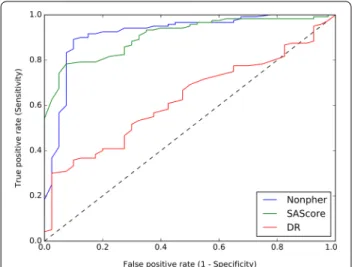
Of all three approaches, Nonpher produces hard-to-synthesize library with the highest classification accuracy of 89.6% and the best balance between a sen-sitivity and specificity (Table 1). The RF model trained on molecules selected according to their SAscore achieved the accuracy of 82.5% (AUC 0.89) and train-ing data created by the DR method lead only to the accuracy of 46.0% (AUC 0.60). While SN and SP are reasonably balanced for the Nonpher data set, SAscore data yields a model with low SP and DR data with low SN. Thus, both SAscore and DR methods are deficient in obtaining too many false predictions. While SAscore model tends to predict more compounds as easy-to-synthesize, DR model labels a majority of compounds as hard-to-synthesize. Worse performance of DR model is also apparent from its lower AUC (Table 1) as well as from its ROC curve (Fig. 2). The inspection of ROC curves of Nonpher and SAscore models reveals that although SAscore model produces better ROC values for higher thresholds, Nonpher model is better at distinguishing hard-to-synthesize from easy-to-syn-thesize structures.
Conclusions
Nonpher, our approach for the in silico generation of hard-to-synthesize structures, provides an important addition to existing tools for a computer-aided molecu-lar design. In Nonpher, molecumolecu-lar morphing [23], that systematically alters a given structure by small structural changes (e.g., add or remove atom or bond), is used to construct hard-to-synthesize structures. The length of molecular morphing was optimized so that generated structures are hard-to-synthesize, although not overly complex. The quality of the Nonpher library was assessed by building a random forest (RF) classifier using a train-ing set consisttrain-ing of the Nonpher library augmented with synthetically accessible compounds randomly selected from the ZINC12 database [22]. The quality of RF model was verified by predicting the synthetic accessibility of 40 compounds that were carefully collected from the lit-erature and were considered to be hard-to-synthesize by experienced medicinal and organic chemists [9, 11, 12, 26]. Nonpher was compared with SAscore [9] and DR [20] approaches, two alternative methods for the con-struction of hard-to-synthesize compounds. Nonpher yielded data of higher quality than both SAscore and DR methods, as demonstrated by a lower amount of false predictions and by better balance between sensitivity and specificity of Nonpher model. The Nonpher library of hard-to-synthesize compounds contains 1,706,950 struc-tures and is available for download (Additional file 1). Similarly, test set consisting of 40 manually curated hard-to-synthesize compounds augmented with 120 easy-to-synthesize structures is also available (Additional file 3). By providing both training and test data sets we believe that our method will further boost research in the auto-matic prediction of molecular synthetic feasibility. Table 1 Test set performances of random forest models
trained on data generated by Nonpher, SAscore and DR approaches
An accuracy (Acc), sensitivity (SN), specificity (SP) and an area under a ROC curve (AUC) are calculated as average values from five different random samples of the
Strain data set
Model Acc (%) SN (%) SP (%) AUC
Nonpher 89.6 93.8 77.0 0.94 SAscore 82.5 94.7 46.0 0.89
DR 46.0 30.8 91.5 0.60
Abbreviations
RF: random forest; TP: true positives; TN: true negatives; FP: false positives; FN: false negatives; Acc: accuracy; SN: sensitivity; SP: specificity; ROC: receiver operating characteristic; AUC: area under receiver operating characteristic; DR: dense region; BC: Barone and Chanon complexity index; SMCM: synthetic and molecular complexity metric; MLSMR: Molecular Libraries Small Molecule Repository; MW: molecular weight.
Authors’ contributions
DS and MV conceptualized the problem. MV was responsible for method development, implementation and validation. DS supervised the study and prepared the manuscript with the active participation of MV. Both authors read and approved the final manuscript.
Author details
1 CZ-OPENSCREEN: National Infrastructure for Chemical Biology, Laboratory of Informatics and Chemistry, Faculty of Chemical Technology, University of Chemistry and Technology Prague, Prague, Czech Republic. 2 CZ-OPEN-SCREEN: National Infrastructure for Chemical Biology, Institute of Molecular Genetics, AS CR v.v.i., Prague, Czech Republic.
Acknowledgements
The authors acknowledge Ivan Čmelo for a technical help and David Hoksza for the modifications of molecular morphing algorithm. Computational resources were provided by the CESNET LM2015042 and the CERIT Scientific Cloud LM2015085, provided under the programme “Projects of Large Research, Development, and Innovations Infrastructures”.
Competing interests
The authors declare that they have no competing interests.
Funding
This work was supported from the Ministry of Education of the Czech Repub-lic (NPU I- LO1220 and LM2015063). MV research was further supported by a specific university research (MSMT No. 20/2015).
Received: 13 December 2016 Accepted: 11 March 2017
References
1. Klebe G (2006) Virtual ligand screening: strategies, perspectives and limitations. Drug Discov Today 11(13–14):580–594
2. Shoichet BK (2004) Virtual screening of chemical libraries. Nature 432(7019):862–865
Additional files
Additional file 1. Nonpher training set. It contains SMILES of 1,706,950 hard-to-synthesize structures and the same amount of easy-to-synthesize structures.
Additional file 2. The supporting information contains details on molec-ular complexities and on molecmolec-ular morphing threshold optimization. Additional file 3. Test set. It contains SMILES of 40 structures considered as hard-to-synthesize by medicinal chemists and 120 easy-to-synthesize structures.
Additional file 4. SAscore training set. It contains SMILES of 54,750 struc-tures considered to be hard-to-synthesize by the SAscore criterion (i.e., with SAscore higher than 6) and the same amount of easy-to-synthesize structures.
Additional file 5. DR training set. It contains SMILES of 50,345 hard-to-synthesize structures (i.e., they are from a sparse region) and of 113,176 easy-to-synthesize structures (i.e., they are from a dense region).
3. Hartenfeller M, Schneider G (2011) De Novo Drug Design. In: Bajorath J (ed) Chemoinformatics and computational chemical biology. Humana Press, Totowa, pp 299–323
4. Bonnet P (2012) Is chemical synthetic accessibility computationally predictable for drug and lead-like molecules? A comparative assess-ment between medicinal and computational chemists. Eur J Med Chem 54:679–689
5. Lajiness MS, Maggiora GM, Shanmugasundaram V (2004) Assessment of the consistency of medicinal chemists in reviewing sets of compounds. J Med Chem 47(20):4891–4896
6. Takaoka Y, Endo Y, Yamanobe S, Kakinuma H, Okubo T, Shimazaki Y, Ota T, Sumiya S, Yoshikawa K (2003) Development of a method for evaluating drug-likeness and ease of synthesis using a data set in which compounds are assigned scores based on chemists’ intuition. J Chem Inf Comput Sci 43(4):1269–1275
7. Kutchukian PS, Vasilyeva NY, Xu J, Lindvall MK, Dillon MP, Glick M, Coley JD, Brooijmans N (2012) Inside the mind of a medicinal chemist: the role of human bias in compound prioritization during drug discovery. PLoS ONE 7(11):e48476
8. Baber JC, Feher M (2004) Predicting synthetic accessibility: application in drug discovery and development. Mini Rev Med Chem 4(6):681–692 9. Ertl P, Schuffenhauer A (2009) Estimation of synthetic accessibility score
of drug-like molecules based on molecular complexity and fragment contributions. J Cheminform 1:11
10. Ihlenfeldt W-D, Gasteiger J (1996) Computer-assisted planning of organic syntheses: the second generation of programs. Angew Chem Int Ed Engl 34(23–24):2613–2633
11. Huang Q, Li L-L, Yang S-Y (2011) RASA: a rapid retrosynthesis-based scoring method for the assessment of synthetic accessibility of drug-like molecules. J Chem Inf Model 51(10):2768–2777
12. Boda K, Seidel T, Gasteiger J (2007) Structure and reaction based evalua-tion of synthetic accessibility. J Comput Aided Mol Des 21(6):311–325 13. Gillet VJ, Myatt G, Zsoldos Z, Johnson AP (1995) SPROUT, HIPPO and
CAESA: Tools for de novo structure generation and estimation of syn-thetic accessibility. Perspect Drug Discov Des 3(1):34–50
14. Selzer P, Roth H-J, Ertl P, Schuffenhauer A (2005) Complex molecules: do they add value? Curr Opin Chem Biol 9(3):310–316
15. Bertz SH (1981) The first general index of molecular complexity. J Am Chem Soc 103(12):3599–3601
16. Whitlock HW (1998) On the structure of total synthesis of complex natu-ral products. J Org Chem 63(22):7982–7989
17. Barone R, Chanon M (2001) A new and simple approach to chemical complexity. Application to the synthesis of natural products. J Chem Inf Comput Sci 41(2):269–272
18. Allu TK, Oprea TI (2005) Rapid evaluation of synthetic and molecular complexity for in silico chemistry. J Chem Inf Model 45(5):1237–1243 19. Rogers D, Hahn M (2010) Extended-connectivity fingerprints. J Chem Inf
Model 50(5):742–754
20. Podolyan Y, Walters MA, Karypis G (2010) Assessing synthetic accessibility of chemical compounds using machine learning methods. J Chem Inf Model 50(6):979–991
21. Kim S, Thiessen PA, Bolton EE, Chen J, Fu G, Gindulyte A, Han L, He J, He S, Shoemaker BA et al (2016) PubChem substance and compound databases. Nucleic Acids Res 44(D1):D1202–D1213
22. Irwin JJ, Sterling T, Mysinger MM, Bolstad ES, Coleman RG (2012) ZINC: a free tool to discover chemistry for biology. J Chem Inf Model 52(7):1757–1768
23. Hoksza D, Skoda P, Vorsilak M, Svozil D (2014) Molpher: a software frame-work for systematic chemical space exploration. J Cheminform 6:13 24. RDKit: Open-source cheminformatics. http://www.rdkit.org 25. Bishop C (2007) Pattern recognition and machine learning. Springer,
Berlin
26. Fukunishi Y, Kurosawa T, Mikami Y, Nakamura H (2014) Prediction of synthetic accessibility based on commercially available compound databases. J Chem Inf Model 54(12):3259–3267
27. Kanehisa M, Goto S, Sato Y, Furumichi M, Tanabe M (2012) KEGG for integration and interpretation of large-scale molecular data sets. Nucleic Acids Res 40(Database issue):D109–D114
29. Svetnik V, Liaw A, Tong C, Culberson JC, Sheridan RP, Feuston BP (2003) Random Forest: a Classification and Regression Tool for Compound Clas-sification and QSAR Modeling. J Chem Inf Comput Sci 43(6):1947–1958 30. Palmer DS, O’Boyle NM, Glen RC, Mitchell JBO (2007) Random Forest
Models To Predict Aqueous Solubility. J Chem Inf Model 47(1):150–158 31. Bruce CL, Melville JL, Pickett SD, Hirst JD (2007) Contemporary QSAR
Clas-sifiers Compared. J Chem Inf Model 47(1):219–227