www.ijemst.com
Examining Personalisation of Instruction,
Attitudes toward and Achievement in
Mathematics Word Problems among
Nigerian
Senior
Secondary
School
Students
Adeneye O. A. Awofala
University of Lagos
To cite this article:
Awofala, Adeneye, O.A. (2014). Examining personalisation of instruction, attitudes toward
and achievement in mathematics word problems among Nigerian senior secondary school
students.
International Journal of Education in Mathematics, Science and Technology, 2
(4),
273-288.
This article may be used for research, teaching, and private study purposes.
Any substantial or systematic reproduction, redistribution, reselling, loan, sub-licensing,
systematic supply, or distribution in any form to anyone is expressly forbidden.
Authors alone are responsible for the contents of their articles. The journal owns the
copyright of the articles.
Volume 2, Number 4, October 2014, Page 273-288
ISSN: 2147-611X
Examining Personalisation of Instruction, Attitudes toward and
Achievement in Mathematics Word Problems among Nigerian Senior
Secondary School Students
Adeneye O.A. Awofala*
University of Lagos
Abstract
This study investigated the effect of a personalised print-based instruction versus a non-personalised print-based instruction on the attitudes toward mathematics word problems of 350 senior secondary school year one Nigerian students within the blueprint of a quantitative research of pre-treatment-intervention-post-treatment non-equivalent control group quasi-experimental design with a survey design of an ex-post facto type. The Attitudes toward Mathematics Word Problem Inventory (ATMWPI) and Achievement in Mathematics Word Problem Test (AMWPT) were used to collect data relating to the dependent measures. The results of the data analyses showed that the personalised instruction students had higher levels of self-confidence, liking, usefulness, and motivation but recorded low level of anxiety regarding mathematics word problems compared with the non-personalised group students. While the personalised instruction students were more influenced by the context of the word problem than their non-personalised instruction counterparts, the experimental and control groups’ students did differ on their attitudes toward mathematics word problem as a male domain. In addition, self-confidence, liking, usefulness, motivation, context, and treatment had statistically significant predictive effect on achievement in mathematics word problem whereas anxiety and male domain dimensions of attitudes toward mathematics word problem had no statistically significant predictive effect on achievement in mathematics word problem.
Key words: Personalisation instruction, Word problems, Attitudes, Mathematics, Achievement.
Introduction
Attitudes are learned predispositions to respond positively or negatively to certain objects, situations, concepts or persons (Aiken, 1980). It is evident that the attitude of students to the subjects in the school curriculum has a profound bearing on their achievement (Awofala, Arigbabu & Awofala, 2013); hence, the development of positive attitudes toward school subjects had long been a major goal of educators. In particular, the concern for students’ attitudes toward traditional subjects in the school curriculum including mathematics (Awofala & Awolola, 2011a, 2011b; Awofala, 2012) has risen with regard to the possibility of enhancing cognitive performance. Attitude is an important variable in mathematics learning. This is because students with positive attitudes toward mathematics tend to show high ability in mathematics than those with negative attitudes who may be less inclined to make the effort to improve their mathematical abilities. In Nigeria, students’ performance in both internal and external examinations in mathematics at the secondary school level had been decreasing in the recent past, and educators had been calling for the improvement of students’ attitude to the subject (Ifamuyiwa & Akinsola, 2008) as there is a positive relationship between attitude and achievement (Memnum & Akkaya, 2012; Kadijevich, 2006; Maye, & Kishor, 1997; Ma, 1997). There are many variables affecting students’ attitudes towards mathematics. Among these variables are low interest on the part of the students, perception that mathematics is difficult and abstract, psychological fear of the subject, poor methods of teaching and poor performance in mathematics (Memnum & Akkaya, 2012; Akay & Boz, 2010).
In the recently published Examiner’s Report of the West African Examination Council (WAEC) in Nigeria, May/June 2005–2009, the Chief Examiner, indicated that majority of the candidates appeared to have major problem in algebraic aspect of mathematics and in particular most candidates demonstrated weakness in word problems. Among the factors identified to account for poor performance in word problems, poor teaching approach featured prominently. The traditional method of teaching has been criticized for not investing in
*
students the needed critical thinking skills for translating the verbal statements in a word problem into an algebraic language. This ugly trend of poor performance in mathematics word problem needs redressing and concerted efforts should be made by teachers to improve on their teaching methods in order to enhance better performance and improve students’ attitudes toward word problems. Thus, there is a need to explore alternative strategies that can be manipulated to promote students’ attitudes toward mathematics word problems as current results (WAEC, 2010) reveal that the traditional teaching approach is deficient in meeting the needs of teeming learners. Therefore, effort is made in this study to investigate the efficacy of personalisation of instruction on students’ attitudes toward mathematics word problems.
Personalisation of instruction, as a form of individualised instruction has continued to receive a growing attention in the recent past (Awofala, 2011b; Awofala, Balogun & Olagunju, 2011; Bates & Wiest, 2004; Şimşek, & Çakır, 2009) and many studies have shown its effectiveness in facilitating students’ learning outcomes in mathematics (Hart, 1996; Lopez & Sullivan, 1992; Davis-Dorsey, Ross & Morrison, 1991; Akinsola & Awofala, 2008, 2009). A remarkable body of literature has provided a number of conceptualisations of personalisation of instruction. Miller and Kulhavy (1991) defined personalisation as the act of using verbal modifiers and exemplars which have been lifted directly from an individual’s own repertoire of life experience. Personalisation is an instructional-design in which the instructional context is made more meaningful by allowing learners to transform textual information to contain familiar referents (Akinsola & Awofala, 2009). It is incorporating selected information with students’ personal preferences and interests into the word problem content (Anand & Ross, 1987; Bates & Wiest, 2004; Ku & Sullivan, 2000).
Personalisation of instruction may, in fact, serve several important functions in the mathematics classroom: (1) It creates strong encoding that aids retrieval of knowledge (Davis-Dorsey, Ross & Morrison, 1991) and supports development of meaningful mental representations of problems and their connections to existing schemata (Davis-Dorsey et al, 1991), (2) It is a meaningful way of making problem contexts more concrete and more familiar (Lopez & Sullivan, 1992; Bates & Wiest, 2004) thereby aiding students’ understanding of word problems Dorsey et al, 1991), (3) It fosters and maintains students’ attentiveness to problems (Davis-Dorsey et al, 1991) thus, instilling greater interest in students (Awofala, Fatade, & Olaoluwa, 2013; Awofala, 2010), (4) It motivates students to work on problems (Hart, 1996) thereby increasing students fascination with problems (Giordano, 1990), (5) Personalisation is a means of breaking monotony of word problems with unfamiliar contexts (Bates & Wiest, 2004) or mathematically complex cognitive tasks (Lopez & Sullivan, 1992) and thus, helps in reducing students’ cognitive load in solving problems (Akinsola & Awofala, 2009), (6) It stimulates intrinsic interest and enhances personal meaning of new content (Cordova, 1993) thereby giving the learner greater capability to relate to, and discern meaning from new information(Akinsola & Awofala, 2009), and (7) it increases students’ confidence, enjoyment and learning (Cordova, 1993).
As important as personalisation of instruction is, it is not without criticisms. The strategy has been strongly criticized for enhancing sex-stereotyped contexts that favour males and harm females’ achievement by drawing them into problems in distracting ways (Akinsola & Awofala, 2009). Sex-stereotyped problem contexts may advantage one sex over another in terms of familiarity of content and in type of affective response elicited (Wiest, 2002). In addition, Ross and Anand (1987) maintained that the effectiveness of the personalised treatment may wear off over time as they noted that the higher scores on personalised tests could be due, in part, to the novelty or newness of the personalisation and that the newness might fizzle out if the treatments were used often. Bates and Wiest (2004) noted that the time constraints in preparing individualised materials could reduce it use in the mathematics classroom.
liking, motivation, male domain, usefulness, and context). The methodology section offered more explanation regarding the dimensions of the attitudes toward mathematics word problems.
Theoretical framework
Three theoretical frameworks (constructivism, situated cognition, and social cognitive learning) are more amenable to the personalisation of instruction. First, Constructivism is based on the premise that we all construct our own perspective of the world, through individual experiences and schema – an internal knowledge structure (Schuman, 1996; Brenda, 1998). Second, the Situated cognition states that knowledge is embedded in context being specific to the real life situation in which knowledge is applied (Nesher, 2000). Constructivism and situated cognition, emphasize that learning is optimized when students are engaged in realistic instructional contexts (Bednar, Cuningham, Duffy, & Perry, 1991; Collins, Brown, & Newman, 1989). Within these perspectives, the emphasis is on constructive processes among students in which knowledge as whole is problematised and the link among the triad of teaching, learning, and performing contexts. Cognition is situated in, rather than isolated from context (Awofala, 2010). Contexts are not only integral to knowing and understanding (Brown, Collins & Diguid, 1989; Brown & Palinscar, 1989) they appear to influence the utility of knowledge and skills, thus making their transfer easy. In the formal school setting, contents are often isolated from the contexts from which they derive meaning and this tends to hamper student’s understanding. Highly decontextualised understanding tends to be rigid, incomplete and naïve (Spiro, Feltovich, Jacobson, and Coulson, 1991) and may incapacitate student’s transfer of knowledge and skills to everyday problems. Situated learning may promote transfer by closing the gap between real life and formal educational settings. It is suggested that students should be immersed in authentic contexts which are complex, ill-defined and unorganised rather than selective cuts of reality that aim at directly transmitting certain predefined abstract concepts (Hoppe, 1993; Choi & Hannafin, 1997). Real life contexts are supported to increase motivation to learn while making deployment of knowledge and skill easier since they show inherent relationships between concepts and personal experience (Choi & Hannafin, 1997). In constructivism
…purposeful knowledge construction may be facilitated by learning environments which: (i) Provide multiple representations of reality – avoid oversimplification of instruction by representing the natural complexity of the world; (ii) Present authentic tasks – contextualize; (iii) Provide real-world, case-based learning environments, rather than pre-determined instructional sequences; (iv) Enable
context- and content-dependent knowledge construction. (Jonasson, 2006).
Research Questions
The present study provided answer to three research questions:
(1) Does personalisation of instruction affect students’ attitudes toward mathematics word problem? (2) What is the relative contribution of each factor (self-confidence, anxiety, liking, motivation, male
domain, usefulness, context, and treatment) to the explanation of the variance in the students’ achievement in mathematics word problems?
(3) What is the composite contribution of these factors (self-confidence, anxiety, liking, motivation, male domain, usefulness, context, and treatment) to the explanation of the variance in the students’ achievement in mathematics word problems?
Method
Research Design
This study adopted an eclectic research paradigm. This is because, the researchers combined a pre-treatment, post-treatment non-equivalent control group quasi-experimental design with a survey design of an ex-post facto type, where 01, 03 and 02, 04 represent pre-treatment questionnaire and post-treatment questionnaire respectively, X1 represents experimental treatment with personalisation of instruction and C represents control treatment with non-personalisation of instruction.
Experimental group: 01 X1 02
Control group: 03 C 04
Intact classes were used to avoid disrupting school programmes for experimental purpose. An ex-post facto design was adopted in order to account for the predictive effect of attitudes toward mathematics problems on achievement in mathematics word problems.
Participants
A sample of 350 out of 900 senior secondary school year one (SSI) students from six out of 18 co-educational senior secondary schools in Odogbolu Local Government Area of Ogun State, Nigeria participated in the study. Stratified proportional sampling technique was used to select six schools and one intact class from a stream of three classes each was randomly selected from each school. The allocation of the six intact classes into experimental and control group was done by a flip of coin and the class that chose head or tail became experimental and control groups respectively for the convenience of the author. The mean ages of the students in the experimental group (n = 183) and the control group (n =167) were 15.6 years and 15.8 years, respectively.
Instrumentation
For the purpose of data collection, three evaluative instruments namely Attitudes toward Mathematics Word Problem Inventory (ATMWPI), Students’ İnterest İnventory (SII), and Mathematics Word Problem Achievement Test (MAWPAT) and one stimulus instrument tagged Instructional Programme on Mathematics Word Problem (IPMW) (with two parallel versions) were developed and utilized in the study.
The ATMWPI consists of a group of seven instruments: (1) Self-confidence in learning mathematics word problem scale, (2) Liking mathematics word problem scale, (3) Usefulness of mathematics word problem scale, (4) Mathematics word problem anxiety scale (5) Context in mathematics word problem scale, (6) Motivation toward mathematics word problem scale, and (7) Mathematics word problem as a male domain scale and altogether contain 35 items and take 20 minutes to complete. In this study, attitude towards mathematics word problem is composed of seven dimensions as explained below:
(1) Self-confidence denotes perceived ease, or difficulty, of learning mathematics word problems (e.g., “I usually do well in mathematics word problem”);
(3) Usefulness indicates student’s beliefs concerning the contribution of mathematics word problems to his/her educational and career performance (e.g., “I need mathematics word problem to learn other areas of mathematics”);
(4) Anxiety denotes student’s deeper attitude feeling of tension and discomfort that interfere with the manipulation of mathematics word problems (e.g., “mathematics word problems make me feel uneasy, restless, irritable and nervous”);
(5) Context refers to the surrounding text or talk of an expression in word problem (e.g., “I am happy dealing with mathematics word problems that contain familiar contexts”);
(6) Motivation denotes an internal state or condition (sometimes seen as a need, desire, or want) that serves to stimulate, invigorate and direct goal-oriented behaviour in mathematics word problems (e.g., “The challenge of mathematics word problem appeals to me”); and
(7) Male domain refers to the stereotypical perception of mathematics word problems as masculine (e.g., “Males are naturally good at solving mathematics word problems than females”)
Each item of the ATMI is rated on a five-point modified Likert scale ranging, from Undecided – 0, Strongly agree - 1, Agree - 2, Disagree – 3 to Strongly disagree – 4 for each negatively worded statement and the score is reversed for every positive statement with the weighting ascribed to Undecided used as the starting point in both cases. Psychometric properties of the ATMWPI were initially investigated by the author on a sample of 685 senior secondary school mathematics students. Factor analysis conducted using the Principal Component Analysis with varimax factor resolution revealed seven interpretable structures with eigen values greater than unity, which accounted for a total of 84.72% of variance. The seven factors showed non-overlapping items with items loadings of 0.60 or above. The items identified that loaded significantly on Factors 1, 2, 3, 4, 5, 6 and 7 were tested for internal consistency reliability. Cronbach’s alpha coefficients of 0.96, 0.97, 0.98, 0.98, 0.94, 0.87 and 0.90 were found for Factors 1, 2, 3, 4, 5, 6 and 7 respectively (p<0.05) in all cases). Details regarding the development of the ATMWPI have been kept for another study. Two weeks test-retest reliability of the ATMWPI using the Pearson Product Moment Correlation gave a coefficient of stability, 0.83.
The MAWPAT adopted from Akinsola and Awofala (2009) is a 21 multiple-choice objective test items with one key and three distractors. Each test item is followed by four answer options (A–D) from which the student is expected to select the correct alternative. An example of the test item is given below. Three students have to write a makeup test. Tope scored 24/60 on her first test and 32/40 on her makeup test. Jaye scored 35/70 on his first test and 54/60 on his makeup test. Bolanle scored 27/90 on her first test and 45/50 on her second test. Which of the student improved the most and calculate his/her percentage? A: Tope and 60% B: Bolanle and 60% C: Jaye and 65% D: Tope and 65%
The test content covered the concepts of arithmetic and algebra word problems differentiated into simple translation, multi-step and process problems in the three levels of cognitive domain of remembering, understanding and thinking. The MAWPAT had items of discrimination power of more than 0.40, difficulty index of 0.40–0.60 and internal consistency reliability of 0.84 using Kuder–Richardson’s formula 20 (Akinsola & Awofala, 2009). In the present study, a distracter analysis was performed for each of the 21 items and results showed that distracters in each of the items had negative discrimination indices (ranging from -0.3 to -0.15) while each correct answer discriminated positively (ranging from 0.45 to 0.9). The internal consistency reliability of 0.87 using Kuder–Richardson’s formula 20 was computed for the current study. Each correct answer attracted four marks for the convenience of the researcher.
along the senior secondary school year one mathematics textbook used by the participants. Each self-paced instructional programme required the same computational skills and used identical numbers, but the problem context differed. The non-personalised version provided only minimal, non-meaningful contextual information and was written first and used standard problems tailored along the students’ mathematics textbook. The personalised version provided familiar, relevant problem contexts and was written by incorporating the most popular referents (places, foods, sports, etc.) from the SII. The instructional programme covered procedures for solving word problems and a Polya’s (1945/73) four-part strategy of understanding the problem; devising a plan; carrying out the plan; and looking back was incorporated into the instruction for both treatments. One example each of word problem in their personalised context and non-personalised context forms follow:
Example 1
Personalised Context: At Tantalizer, one piece of meat pie and two pieces of chicken pie cost N360. Two pieces of meat pie and two pieces of chicken pie cost N450. What is the cost of a meat pie?
Example 2
Non-personalized context: At Oland centre gym, one brass kg disk and two copper kg disks cost N360. Two brass kg disks and two copper kg disks cost N450. What is the cost of a brass kg disk?
A major distinction between examples 1 and 2 is that in example 1, the context of the word problem is derived from the students’ repertoire of familiar experiences and preferences while in the example 2, the context of the word problem is non-familiar because none of the students chose the preferences used in the formulation of the word problem. It is noted that problem context is relative and as used here refers to the familiarity/non-familiarity of the word problem to students’ experience and interest.
Instruction on the strategy for solving the word problems also contained the rule and its application with appropriate examples and practice problems were provided. Answers to all problems were also provided in each version after the completion of the practice problems by the participants to enable self-checking. A review containing the summary of the procedures for solving the problems was also provided.
Procedure
The study took place in six intact classrooms over two 45-minutes class periods on consecutive days, three weeks after the administration of SII. The option of a longer treatment was not considered because the author was of the opinion that the content areas for the study can be covered within the small treatment period. Prior to the study, participants received instruction on the computational aspects of algebraic word problems involving linear equations, simultaneous equation and quadratic equations for two weeks; a week after being pretested with the SII, MAWPAT and the ATMWPI in order to reduce the confounding effects of computational efficiency (Akinsola & Awofala, 2008, 2009). Subsequently, the most dominant choices from the inventory were used to convert the non-personalised version of the instructional programme into the personalised version. With the assistance of the mathematics teacher, each of the two versions of the instructional programme was administered in regularly scheduled mathematics classes. The personalised group (n=183) received self-paced personalised instructional programme while the personalised group (n=167) was placed on the self-paced non-personalised instructional programme. Instructions on the study’s purpose, procedures and instructional programme were given to the students with the conviction that they were helping with a new programme, which would eventually count as part of their final grade. Students completed the initial portion of the instructional programme on the first day of instruction and the review portion on the second day. Thereafter, the ATMWPI and MAWPAT were administered to the students.
Data analysis
mathematics word problem, as indicated by the seven subscales scores on the ATMWPI. Follow-up analyses were conducted to evaluate the mean differences between the experimental and control groups with respect to each dimension of the dependent variable. Prior to investigating the multivariate effect, the multivariate normality and homogeneity of variance and covariance matrices assumptions of MANOVA were checked. Shapiro Wilks test and BOX’s M test were used to check normality and homogeneity of variance and covariance matrices assumptions of MANOVA. According to Stevens (2002), one can detect multivariate normality assumption by examining univariate normality of observations on each variable using the Shapiro-Wilk test. Multiple regression analysis using the enter model and stepwise was used to answer research questions two and three.
Results and Discussion
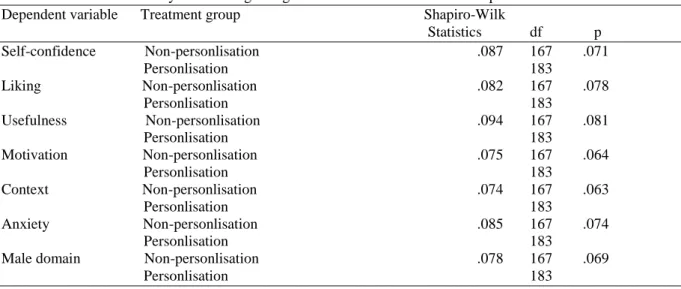
The results of the Shapiro-Wilk test (Table 1) conducted showed that the dependent variable was normally distributed across treatment conditions (p>0.05). The non-significant F test from BOX’s M statistic was the sign of homogeneity of variance and covariance matrices (p>0.05).
Table 1. Analysis result regarding normal distribution test of the dependent variables
Dependent variable Treatment group Shapiro-Wilk
Statistics df p
Self-confidence Non-personlisation .087 167 .071
Personlisation 183
Liking Non-personlisation .082 167 .078
Personlisation 183
Usefulness Non-personlisation .094 167 .081
Personlisation 183
Motivation Non-personlisation .075 167 .064
Personlisation 183
Context Non-personlisation .074 167 .063
Personlisation 183
Anxiety Non-personlisation .085 167 .074
Personlisation 183
Male domain Non-personlisation .078 167 .069
Personlisation 183
Table 2 shows the descriptive statistics of students’ pre-treatment and post-treatment scores on the attitudes toward mathematics word problem. MANOVA result, based on pre-treatment scores, showed no pre existing differences between the experimental and control groups with respect to students’ attitudes toward mathematics word problem, as indicated by the seven sub-scale scores, F(7, 342)=1.83, p = .42. Also, the univariate ANOVA results based on pre-treatment scores showed no pre existing differences between the two groups regarding each subscale of attitudes toward mathematics word problem: self-confidence, F(1,348) =0.13, p=.72; liking, F(1,348)=0.24, p=.88; usefulness, F(1,348) = 0.72, p=.40; motivation, F(1,348)=0.50, p= .48; anxiety, F(1,348) = 0.07, p = .79; context, F(1,348) = 2.37, p=.13; and male domain F(1,348) = 0.35, p=.85. In essence, the two groups were similar to each other with respect to the aggregate dependent variable for attitudes toward mathematics word problem.
Table 2. Descriptive statistics for students’ attitudes toward mathematics word problem by treatment
Pretest Posttest Experimental Control Experimental Control
(n=183) (n=167) (n=183) (n=167) Variable Mean SD Mean SD Mean SD Mean SD
Impact of Personalization of Instruction on Students’ Attitudes toward Mathematics Word Problem
The F ratio for MANOVA showed that the post-treatment mean scores were statistically significant at the 0.05 level, F(7, 342) = 12.46, p = .000, η2
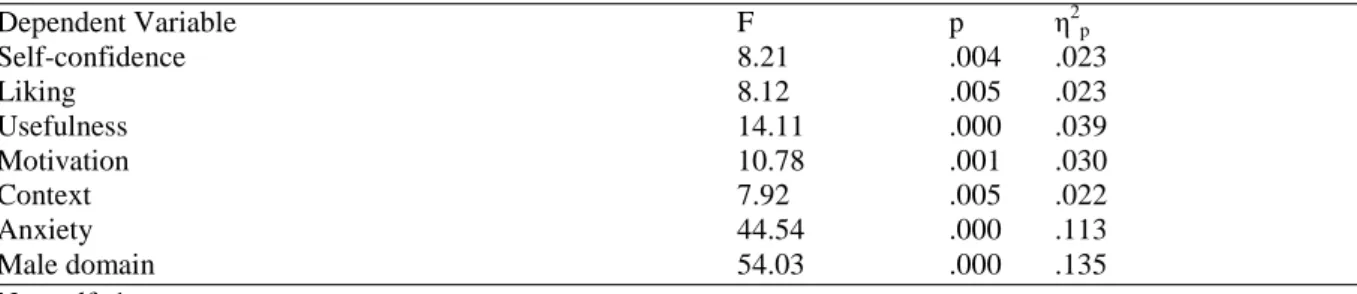
p=.20. In essence, the experimental and control groups had statistically significant mean scores on the aggregate dependent variables of self-confidence, liking, anxiety, usefulness, motivation, context, and male domain. The multivariate partial eta squared of 0.20 based on Wilk’s lambda value of 0.80 revealed that the magnitude of the difference between the two groups was small. Hence, the value implied that the treatment accounted for 20% of multivariate variance of the dependent variables. This showed that there may be other independent variables not considered in this study which could account for the unexpalined multivariate variance of 80%. In furtherance to the obtained statistically significant MANOVA F for the aggregate dependent variables, the author conducted univariate ANOVAs to further comprehend how the experimental and control groups would be impacted by the interventions with respect to each of the dependent variables on post-treatment scores. Table 3 shows the results of the univariate ANOVA analyses on students’ attitudes toward mathematics subscale scores. As displayed in Table 3 below, there was a statistically significant mean difference between the groups regarding self-confidence in learning mathematics word problem (p<.05), liking mathematics word problem (p<.05), usefulness of mathematics word problem (p<.05), anxiety towards mathematics word problem (p<.05), motivation toward the learning of mathematics word problem (p<.05), context of mathematics word problem (p<.05) and mathematics word problem as a male domain (p<.05).
Table 3. Univariate ANOVA results for students’ attitudes toward mathematics word problem
Dependent Variable F p η2p
Self-confidence 8.21 .004 .023
Liking 8.12 .005 .023
Usefulness 14.11 .000 .039
Motivation 10.78 .001 .030
Context 7.92 .005 .022
Anxiety 44.54 .000 .113
Male domain 54.03 .000 .135
Note: df=1
A look at the post-treatment mean scores in Table 2 showed that the students in the experimental group had consistently higher mean scores on each subscale of the dependent variable except for anxiety subscale but still in favour of the experimental group. In essence, students in the experimental group tended to display less anxiety towards mathematics word problem, were more inclined to be self-confident in learning mathematics word problem, and were more influenced by the context of mathematics word problem than did the students in the control group. For instance, while 72.6% of the students in the experimental group disagreed with the statement that “mathematics word problems make me feel uneasy, restless, irritable and nervous”, only 28.7% of the control group students disagreed with this statement. Similarly, 70.8% of the experimental group students indicated their disagreement with the statement that “mathematics word problem is not one of my strength areas in mathematics”, only 26.4% of control group students disagreed with this statement. More so, while 75.6% of the experimental group students agreed with the statement that “I am happy dealing with mathematics word problems that contain familiar contexts”, only 33.4% of the control group students agreed with this statement. In addition, the experimental group students appeared to like mathematics word problem, displayed more favourable attitudes toward its usefulness, were more motivated to learn mathematics word problem and perceived mathematics word problem as male dominated domain than the students in the control group. For example, 62.4% of the students in the experimental group indicated their agreement with the statement that “I enjoy learning mathematics word problems”, whereas 37.6% of the control group students agreed with this statement. The author noted similar results with respect to agreement with the statement that “I need mathematics word problem to learn other areas of mathematics”: 68.3% of the experimental group students agreed, and only 42.7% of the control group students agreed. Also, whereas 78.2% of the students in the experimental group agreed with the statement that “The challenge of mathematics word problem appeals to me”, only 42.3% of the students in the control group agreed with this statement.
Composite contributions of factors (self-confidence, anxiety, liking, motivation, male domain, usefulness, context, and treatment) to the explanation of the variance in achievement in mathematics word problems
Word Problem Inventory were 3.52 (n=350; SD=0.49) for self-confidence, 3.41 (n=350; SD=0.43) for liking, 3.42 (n=350; SD=0.46) for usefulness, 3.46 (n=350; SD=0.42) for motivation, 3.39 (n=350; SD=0.50) for context, 2.90 (n=350; SD=0.80) for anxiety, and 3.38 (n=350; SD=0.45) for male domain. Mean for the treatment was found to be 1.52 (n=350; SD=0.52). The participants of the current study recorded higher means for the seven dimensions (self-confidence, anxiety, liking, motivation, male domain, usefulness, and context) of attitudes toward mathematics word problems.
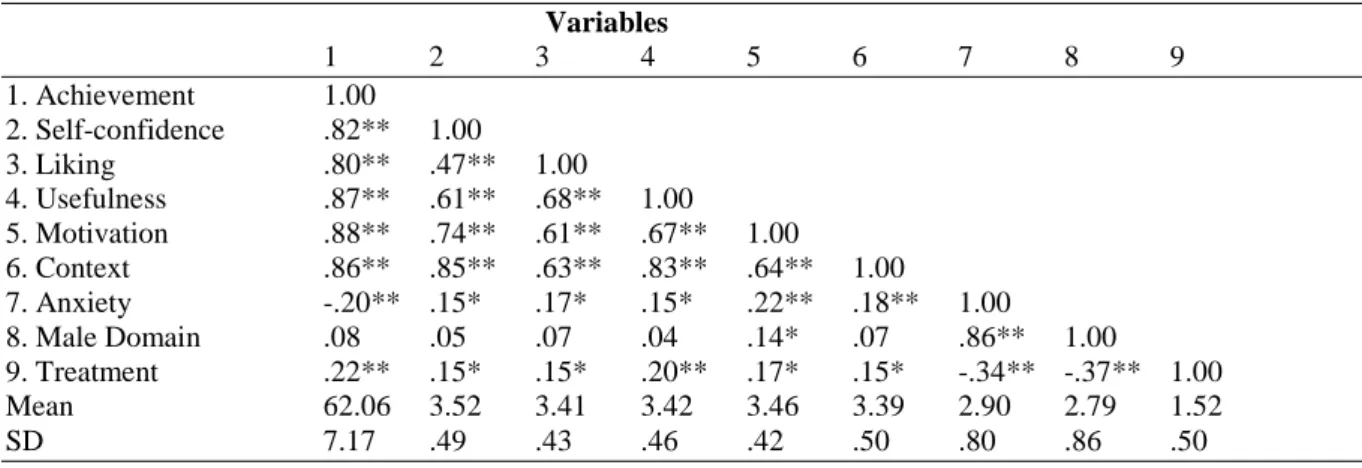
Table 4: Mean, standard deviation, and intercorrelations among the predictors and achievement in mathematics word problems for total sample (n=350)
Variables
1 2 3 4 5 6 7 8 9
1. Achievement 1.00
2. Self-confidence .82** 1.00
3. Liking .80** .47** 1.00
4. Usefulness .87** .61** .68** 1.00
5. Motivation .88** .74** .61** .67** 1.00
6. Context .86** .85** .63** .83** .64** 1.00
7. Anxiety -.20** .15* .17* .15* .22** .18** 1.00
8. Male Domain .08 .05 .07 .04 .14* .07 .86** 1.00
9. Treatment .22** .15* .15* .20** .17* .15* -.34** -.37** 1.00
Mean 62.06 3.52 3.41 3.42 3.46 3.39 2.90 2.79 1.52
SD 7.17 .49 .43 .46 .42 .50 .80 .86 .50
*p<.05, **p<.001
As part of precursor to conducting multiple regression analysis, relationships between variables were computed using the Pearson Product Moment Correlation and results showing these relationships can be gleaned from Table 4 above. In terms of relationship between Achievement in Mathematics Word Problem and Attitudes toward Mathematics Word Problem, results showed the existence of a positive correlation between achievement in mathematics word problem and self-confidence (r=.82, p<.001), liking (r=.80, p<.001), usefulness (r=.87, p<.001), motivation (r=.88, p<.001), context (r=.86, p<.001) and male domain (r=.57, p<.001). Anxiety toward mathematics word problem had a negative correlation with achievement in mathematics word problem (r=-.20, p<.001). Treatment was significantly and positively related to achievement in mathematics word problem (r=.22, p<.001). It should be noted that treatment was significantly and negatively related to attitudes toward mathematics word problem as a male domain (r=-.37, p<.001), and anxiety (r=-.34, p<.001).
A multiple regression analysis was performed with Achievement in Mathematics Word Problem as the dependent variable and dimensions of Attitudes toward Mathematics Word Problem and treatment as the independent variables. This initial regression analysis provided an examination of all variables entered in the regression equation, regardless of their statistical significance. Assumptions were met regarding linearity, homoscedasticity, normality of residuals, and the collinearity diagnostics from the regression output showed no collinearity problem. Using enter method, a significant model appeared (F(8, 341)=2121.89, p<.001, R
2
=.98) Table 5. Summary of Regression Results with Dimensions of Attitudes toward Mathematics Word Problem and
Treatment Entered for Full Model Explaining Achievement in Mathematics Word Problem Independent Variables B SEb β Partial t p
Constant -1.606 .550 - - -2.917 .004 Self-confidence 3.001 .300 .206 .476 9.989 .000 Liking 4.207 .188 .253 .771 22.333 .000 Usefulness 4.050 .276 .260 .622 14.654 .000 Motivation 5.733 .253 .336 .775 22.626 .000 Context 1.297 .354 .091 .194 3.658 .000 Anxiety .357 .139 .040 -.138 2.565 .011 Male domain -.318 .129 -.038 -.132 -2.460 .014 Treatment .354 .122 .025 .155 2.903 .004
All eight variables (self-confidence, liking, usefulness, motivation, context, anxiety, male domain, and treatment) had statistically significant predictive effect on achievement in mathematics word problem, and all together, independent variables explained 98% of the achievement in mathematics word problem. This high value might be due to autocorrelation among the dimensions of attitude toward mathematics word problems which this study did not evaluate. Thus, this result should be taken with caution. According to the standardized coefficients the regression model is as follows: Achievement in Mathematics Word Problempredicted = -1.606 +
0.206self-confidence + 0.253liking + 0.260usefulness + 0.336motivation + 0.091context + 0.040anxiety - 0.038male domain + 0.025treatment.
Relative contributions of factors (self-confidence, anxiety, liking, motivation, male domain, usefulness, context, and treatment) to the explanation of the variance in achievement in mathematics word problems
Afterwards, a stepwise regression analysis was used to determine the contribution of each of these variables in predicting achievement in mathematics word problem. A reduced model explaining the predictive capacity of the eight variables (self-confidence, liking, usefulness, motivation, context, anxiety, male domain, and treatment) on achievement in mathematics word problem is outlined in Table 6 below. Model 1, which includes only motivation scores, is accounted for 77.7% of the variance in students’ achievement in mathematics word problem. The inclusion of context into Model 2 resulted in additional 92.9% of the variance being explained. The insertion of liking into Model 3 produced additional 96.5% of the variance.
The inclusion of usefulness into Model 4 resulted in additional 97.3% of the variance. The incorporation of self-confidence into Model 5 resulted in additional 97.9% of the variance. The integration of treatment into Model 6 resulted in additional 98% of the variance in students’ achievement in mathematics word problem. Collectively, self-confidence, liking, usefulness, motivation, context, and treatment explained 98% of the variance in students’ achievement scores in mathematics word problem (F(1, 343)=2788.121, p<.001). In each of the six models, anxiety and male domain had no relative contribution to the prediction of achievement in mathematics word problem.
Table 6. Summary of stepwise regression results with self-confidence, liking, usefulness, motivation, context, and treatment entered for final model explaining achievement in mathematics word problem
Model Independent variables B SEB β t p R R2 F p 1 Constant 9.965 1.506 - 6.616 .000 .882 .777 1213.794 .000 Motivation 15.048 .432 .882 34.840 .000 2 Constant 4.731 .884 - 5.350 .000 .963 .929 2207.970 .000 Motivation 9.488 .323 .556 29.359 .000
Context 7.222 .270 .506 26.729 .000
3 Constant .349 .658 - .531 .596 .982 .965 3147.849 .000 Motivation 7.884 .240 .462 32.786 .000
Context 5.714 .204 .400 27.980 .000 Liking 4.416 .230 .265 19.163 .000
4 Constant -.204 .581 - .350 .726 .986 .973 3077.051 .000 Motivation 7.431 .216 .435 34.372 .000
Context 4.208 .233 .295 18.029 .000 Liking 3.768 .213 .226 17.721 .000 Usefulness 2.761 .273 .177 10.110 .000
5 Constant -1.577 .523 - -3.015 .003 .990 .979 3263.70 .000 Motivation 5.675 .252 .332 22.525 .000
Context 1.135 .356 .080 3.185 .002 Liking 4.266 .191 .256 22.305 .000 Usefulness 4.238 .276 .272 15.331 .000 Self-confidence 3.162 .301 .217 10.503 .000
6 Constant -1.772 .521 - -3.404 .001 .990 .980 2788.121 .000 Motivation 5.681 .249 .333 22.822 .000
The study investigated the effect of personalisation of instruction on senior secondary school students’ attitudes toward mathematics word problem (self-confidence, anxiety, liking, motivation, male domain, usefulness, and context) and four important findings emerged from this study. First, MANOVA results showed no pre-existing differences between the experimental group and the control group with respect to the attitudes toward mathematics word problem (p>.05). Second, univariate ANOVA results based on pre-treatment scores revealed no pre-existing differences between the experimental and control groups regarding each subscale of attitudes toward mathematics word problem (self-confidence, anxiety, liking, motivation, male domain, usefulness, and context) (p>.05). These two findings indicated that the students in the two groups (experimental and control) used in the study exhibited comparable characteristics. Hence, they both entered the instruction/experiment on equal strength. Similar studies (Awofala, Fatade & Ola-Oluwa, 2012; Awofala, 2011a; Sungur & Tekkaya, 2006) have claimed that determining the similarity between students in the experimental and control groups regarding dependent variables as done in the present study was a good starting point for the treatment. In this study, the students in the experimental group were exposed to the personalisation of instruction and students in the control group were treated with the non-personalisation of instruction.
However, the third and fourth findings recorded in this study were antithesis of the first and second findings respectively. In essence, the third finding based on MANOVA results indicated that there were statistically significant differences between the students exposed to the personalisation of instruction and those exposed to the non-personalisation of instruction on the aggregate attitudes toward mathematics word problem (p<.05). Fourth, the univariate ANOVA results based on post-treatment scores showed that statistically significant differences existed between the students exposed to the personalisation of instruction and those exposed to the non-personalisation of instruction on each subscale of attitudes toward mathematics word problem (self-confidence, anxiety, liking, motivation, usefulness, male domain, and context). In particular, personalised students more than non-personalised students, tended to be self-confident in learning mathematics word problem, found learning of mathematics word problem useful to their educational and career performance, were more influenced by the context of mathematics word problem, and perceived mathematics word problem to be male domain. More so, the personalised students displayed less anxiety towards mathematics word problem in comparison to their non-personalised counterparts. Thus, personalisation of instruction might be a good strategy for reducing students’ anxiety in the learning of mathematics word problem. It is noted that the terms story problems and word problems can invoke uncomfortable memories for many people (Fairbairn, 1993) due to the fact that word problems can be boring and tedious to solve (Bates & Wiest, 2004) thereby creating anxiety for students.
Apart from the fact that students in the personalised group appeared to like mathematics word problem more than their counterparts in the non-personalised group, they showed more motivation towards the learning of mathematics word problem than their counterparts in the non-personalised group. In short, this study has provided evidence in support of the efficacy of personalisation of instruction in fostering students ‘attitudes toward mathematics word problem. Thus, personalisation could be used to reduce students’ level of anxiety in mathematics word problem, foster self-confidence, likeness and motivation in word problem and promote students’ positive perception of the usefulness of mathematics word problem to educational and career performance. The high perception of mathematics word problem as a male domain by the personalised group further gave credence to the finding that personalisation enhanced sex-stereotyped contexts that favour males and harm females’ achievement by drawing them into problems in distracting ways (Akinsola & Awofala, 2009) and sex-stereotyped problem contexts may advantage one sex over another in terms of familiarity of content and in type of affective response elicited (Wiest, 2002).
However, the third and fourth findings recorded in this study agreed with the findings of Lopez and Sullivan (1992) who found that individual personalisation (i.e., tailoring problems to individual interests) fostered positive attitudes toward mathematics word problem. More so, Ku and Sullivan (2002) found that participants using the personalised problems showed better attitudes toward the programme than those using the non-personalised word problems. They found that group personalisation (as used in the present study) enhanced students’ positive attitudes toward mathematics word problems. Moreover, similar findings were recorded by Awofala (2010) regarding the effectiveness of personalisation of instruction on students’ attitudes toward mathematics word problems.
toward mathematics word problems and by implication improve students’ academic performance in the subject. Personalisation of instruction is distinct from other instructional strategies because it places students in the centre of an interest riding problem context (Awofala, 2010). This meaningful problem context may serve as a catalyst for students’ motivation and interest when learning how to solve word problems in mathematics and this may result in increased students’ comprehension of the material.
One other major investigation carried out in this study was to determine the joint contributions of attitudes toward mathematics word problems (self-confidence, anxiety, liking, motivation, male domain, usefulness, and context) and treatment and relative contribution of each factor (self-confidence, anxiety, liking, motivation, male domain, usefulness, context, and treatment) to the explanation of the variance in the students’ achievement in mathematics word problems. Examination of attitudes toward mathematics word problem scores indicated that the participants in this study had high scores on self-confidence, anxiety, liking, motivation, male domain, usefulness, and context dimensions. They also recorded high scores in the achievement in mathematics word problem. The results of the present study showed that as achievement in mathematics word problem increases, attitudes toward mathematics word problem also increase. In specific terms, as achievement in mathematics word problem increases, self-confidence, liking, context, usefulness, male domain, and motivation also increase whereas anxiety toward mathematics word problem decreases. The result of a negative relationship between achievement in mathematics word problem and anxiety regarding mathematics word problem recorded in this study is consistent with the previous researches which examined the relationship between general mathematics achievement and mathematics anxiety (Khatoon & Mahmood, 2010; Yüksel-Sahin, 2008; Satake & Amato, 1995; Hembree, 1990; Ashcraft & Kirk, 2001). Zakaria and Nordin (2008) found an inverse relationship between mathematics anxiety and achievement in mathematics. Specifically, they found that students with higher mathematics anxiety scored significantly lower in mathematics achievement. Karimi and Venkatesan (2009) found that mathematics anxiety has significant negative correlation with mathematics performance. According to Arem (2009), students with high mathematics anxiety levels engage in negative thinking about their self-ability. These students will exhibit less confidence in working with numbers and mathematical concepts through a problem-solving process. The negative relationship between achievement in mathematics word problem and anxiety regarding mathematics word problem could be explained by the fact that low performance in mathematics word problem may result in high anxiety regarding mathematics word problem while high performance in mathematics word problem has the capacity to lower anxiety in mathematics word problem. The present study has shown that increased personalised context in mathematics word problem resulted in low anxiety regarding mathematics word problem whereas reduced personalised context (non-personalised) resulted in higher anxiety regarding mathematics word problem.
Regression analyses had revealed that self-confidence, liking, usefulness, motivation, context, anxiety, male domain and treatment were significant joint predictors of achievement in mathematics word problem. While motivation in mathematics word problem had the greatest impact; these eight independent variables explained 98% of the variance in posttest achievement score in mathematics word problem of the participants. In this study, the stepwise regression analysis showed that motivation in mathematics word problem was the most potent predictor of senior secondary school year one students’ achievement in mathematics word problem, and this was followed by context in mathematics word problem, liking mathematics word problem, usefulness of mathematics word problem, and self-confidence in mathematics word problem. Treatment was the least significant contributor to the prediction of achievement in mathematics word problem. This was expected because treatment was not part of the dimensions of attitudes toward mathematics word problem considered.
Conclusion
no one best instructional method for improving cognitive and affective skills in mathematics word problem, some authors have emphasised the importance of appropriate interventions (Hart, 1996; Awofala, Fatade & Olaoluwa, 2013). Constructivist teaching through some instructional practices that encourage familiar instructional context in mathematics word problem is considered an important approach for improving students’ attitudes toward and achievement in mathematics word problem (Akinsola & Awofala, 2009, 2008; Ku & Sullivan, 2002, 2000).
Recommendations
Based on the findings of this study mathematics teachers should endeavour to implement personalisation of instruction supplemented with problem solving in improving students’ cognitive and affective skills in mathematics word problem. The present study has two issues that future studies need to contend with: First, the impact of personalisation of instruction on students’ achievement in mathematics word problem segregated along the Trends in International Mathematics and Science Study (TIMSS) taxonomy should be investigated. Second, future research should explore alternative technologies to reduce the time-intensive nature of developing personalised word problems. In particular, future study should focus on tapping the advantages inherent in the use of computer and internet in developing personalised materials. More so, the autocorrelations among the dimensions of attitudes towards mathematics word problems should be investigated.
References
Aiken, L. R. (1980). Attitude measurement and research. In D. A. Payne (Ed.), Recent developments in affective measurement (pp. 1-24). San Francisco: Jossey-Bass.
Akay, H. & Boz, N. (2010). The Effect of Problem Posing Oriented Analyses-II Course on the Attitudes toward Mathematics and Mathematics Self-Efficacy of Elementary Prospective Mathematics Teachers. Australian Journal of Teacher Education, 35, 60-75.
Akinsola, M. K. & Awofala, A. O. A. (2008). Effects of Problem Context and Reasoning Complexity on Mathematics Problem Solving Achievement and Transfer of Secondary School Students. European Journal of Scientific Research, 20(3), 641-651.
Akinsola, M. K. & Awofala, A. O. A. (2009). Effect of Personalization of Instruction on Students’ Achievement and Self-efficacy in Mathematics Word Problems. International Journal of Mathematical Education in Science and Technology, 40(3), 389-404.
Anand, P. G. & Ross, S. M. (1987). Using Computer-Assisted Instruction to Personalize Arithmetic Materials for Elementary School Children. Journal of Educational Psychology, 79(1), 72-78.
Arem, C. A. (2009). Conquering Math Anxiety. 3rd Ed., Cengage Learning, Belmont, pp: 215.
Ashcraft, M. H., & Kirk, E. P. (2001). The relationships among working memory, math anxiety, and performance. Journal of Experimental Psychology, 120(2), 224-237.
Awofala, A.O.A. (2012) An Analysis of the new 9-year basic Education mathematics Curriculum in Nigeria. Acta Didactica Naponcensia, 5(1), 17-27.
Awofala, A. O. A. (2011a). Effect of Concept Mapping Strategy on Students’ Achievement in Junior Secondary School Mathematics. International Journal of Mathematics Trends and Technology, 2(2), 11-16. Awofala, A. O. A. (2011b). Effect of Personalized, Computer-Based Instruction on Students' Achievement in
Solving Two-step Word Problems. International Journal of Mathematics Trends and Technology, 2(2), 5-10.
Awofala, A. O. A. (2010). Impact of Personalised instruction on Senior Secondary School Learning Outcomes in Mathematics word problems. Unpublished Ph.D Thesis. University of Ibadan.
Awofala, A. O. A. & Awolola, S. A. (2011a) Curriculum value orientation and reform in the 9-year basic education mathematics curriculum. In O.S. Abonyi (Ed.) Proceedings of 52nd Annual Conference of the Science Teachers Association of Nigeria on Reforms in Science, Technology, Engineering and
Mathematics( pp.297-303) HEBN Publishers Plc.
Awofala, A. O. A. & Awolola, S. A. (2011b) Coping with New Mathematics Teacher’s Beliefs in a Conflicting Milieu of Curriculum Transform. In O.S. Abonyi (Ed.) Proceedings of 52nd Annual Conference of the Science Teachers Association of Nigeria on Reforms in Science, Technology, Engineering and
Awofala, A. O. A., Arigbabu, A. A. & Awofala, A. A. (2013). Effects of framing and team individualised instructional strategies on senior secondary school students’ attitudes toward mathematics. Acta Didactica Naponcensia, 6(1), 1-22.
Awofala, A. O. A., Balogun, T. A. & Olagunju, M. A. (2011). Effects of three modes of personalization on students' achievement in mathematics word problems in Nigeria. International Journal for Mathematics Teaching and Learning (Online) Available, http://www.cimt.plymouth.ac.uk/journal/awofala.pdf. Awofala, A. O. A. & Nneji, L. M. (2012). Effect of framing and Team Assisted Individualised Instructional
Strategies on Students’ Achievement in Mathematics. Journal of the Science Teachers Association of Nigeria, 43(3), 20-28.
Awofala, A. O. A. Fatade, A. O., & Ola-Oluwa, S. A. (2012). Achievement in Cooperative versus Individualistic Goal-Structured Junior Secondary School Mathematics Classrooms in Nigeria, International Journal of Mathematics Trends and Technology, 3(1), 7-12.
Awofala, A. O. A., Fatade, A. O. & Olaoluwa, S. A. (2013). Improving Students' Interest in Solving Mathematics Word Problems through Personalization of Instruction, Indian Streams Research Journal, 3(1), 1-11.
Bandura, A. (1977). Social Learning Theory. Englewood Cliffs, N. J.:Prentice-Hall.
Bandura, A. (1986). Social Foundations of Thought and Action: A Social Cognitive Theory. Engle Wood Cliffs, NJ: Prentice-Hall.
Bates, E. T. & Wiest, L. R. (2004). Impact of Personalization of Mathematical Word Problems on Student Performance. The Mathematics Educator, 14(2), 17-26.
Bednar, A. K., Cunningham, D., Duffy, T. M., & Perry, J. D. (1991). Theory into Practice: How Do We Think? Instructional Technology: Past, Present, and Future. G. J. Anglin. Ed. Englewood, Co.: Libraries Unlimited. 88-101.
Brenda, M. (1998). Instructional Design and Learning Theory. Retrieved Jan. 20, 2007 from
http://Www.Usask.Ca/Education/Coursework/802papers/Mergel/Brenda.Htm
Brown, A. S & Palincsar, A. S. (1989). Guided, Cooperative Learning and Individual Knowledge Acquisition. Knowing, Learning, and Instruction. Essays in Honour of Robert Glaser. L.B. Resnick. Ed. Hillsdale, NJ: Erlbaum. 393-444.
Brown, J. S.; Collins, A. S. & Diguid, P. (1989). Situated Cognition and the Culture of Learning. Educational Researcher 18(1), 32-42.
Choi, J–I. & Hannafin, M. (1997). The Effects of Instructional Context and Reasoning Complexity on Mathematics Problem-Solving. Educational Technology Research and Development 45(3), 43-55. Collins, A. S.; Brown, J. S. & Newman, S. E. (1989). Cognitive Apprenticeship; Teaching the Crafts of Reading,
Writing and Mathematics. Knowing, Learning, and Instruction: Essays in Honour of Robert Glaser. L. B. Resnick .Ed. Hillsdale, N. J: Erlbaum. 453-494.
Cordova, D. I. (1993). The Effects of Personalisation and Choice on Students' Intrinsic Motivation and Learning. Doctoral Dissertation, Stanford University (0212).
d'Ailly, H. H. & Simpson, J. (1997). Where Should 'You' Go in a Math Compare Problem? Journal of Educational Psychology, 89(3), 567.
Davis-Dorsey, J. K. (1989). The Role of Context Personalisation and Problem Rewording in the Solving of Math Word Problems. Unpublished Doctoral Dissertation, Memphis State University.
Davis-Dorsey, J., Ross, S. M. & Morrison, G. R. (1991). The Role of Rewording and Context Personalization in the Solving of Mathematical Word Problems. Journal of Educational Psychology, 81(1), 61-68. Dhlamini, J., & Mogari, D. (2013). The effect of a group approach on the performance of high school
mathematics learners. Pythagoras, 34(2), Art. #198, 9 pages. http://dx.doi. org/10.4102/pythagoras. v34i2.198.
Duckworth, K., Akerman, R., MacGregor, A., Salter, E., & Vorhaus, J. (2009). Self-Regulated Learning: A Literature Review. Research Report, Institute of Education, Center for Research on Wider Benefits of
Learning, University of London. Downloaded from
http://www.learningbenefits.net/Publications/ResReps/ResRep33.pdf
Elenchothy, D., (2007). Kebimbangan matematik dan hubungannya dengan pencapaian pelajar tingkatan empat di daerah Klang. [Mathematics anxiety and their relationship with achievement among Form Four students]. Master Thesis, Universiti Putra Malaysia.
Fairbairn, D. M. (1993). Creating Story Problems. Arithmetic Teacher, 41(3), 140-142.
Fatade, A. O., Arigbabu, A. A., Mogari, D., & Awofala, A.O.A. (2014). Investigating Senior Secondary School Students’ Beliefs about Further Mathematics in a Problem-Based Learning Context. Bulgarian Journal of Science and Education Policy (BJSEP), 8(1), 5-46
Hart, J. M. (1996). The Effect of Personalized Word Problems. Teaching Children Mathematics, 2(8), 504-505. Hembree, R., (1990). The nature, effects and relief of mathematics anxiety. Journal for Research in Mathematics
Education, 21, 33-46.
Hoppe, H. U. (1993). Cognitive Apprenticeship: The Emperor’s New Method? A Polemical Reaction to the Debate on Situated Cognition and Cognitive Apprenticeship. Journal of Artificial Intelligence in Education, 4, 49-54.
Ifamuyiwa, S. A. & Akinsola, M. K. (2008). Improving Senior Secondary School Students’ Attitude towards Mathematics. International Journal of Mathematical Education in Science and Technology, 39(5), 569-585.
Jonassen, D. H. (2006). Thinking Technology: Toward a Constructivist Design Model. Retrieved May 2, 2007, from http://ovray.cudenver.edu/slsanfor/cnstdm.txt.
Kadijevich, D. (2006). Developing trustworthy TIMSS background measures: A case study on mathematics attitude. The Teaching of Mathematics, 9, 41-51.
Karimi, A. & Venkatesen, S. (2009). Mathematics anxiety, mathematics performance and academic hardiness in high school students. International Journal of Educational Sciences, 1, 33-37.
Khatoon, T. & Mahmood, S. (2010). Mathematics anxiety among secondary school students in India and its relationship to achievement in mathematics. Eurasia Journal of Social Sciences, 16, 75-86.
Ku, H-Y & Sullivan, H. J. (2002). Student Performance and Attitudes Using Personalised Mathematics Instruction. Educational Technology Research and Development, 50(1), 21-33.
Ku, H-Y. & Sullivan, H. J. (2000). Personalization of Mathematics Word Problems in Taiwan, Educational Technology Research and Development, 48(3), 49-59.
Lopez, C. L. & Sullivan, H. J. (1992). Effect of Personalization of Instruction Context on the Achievement and Attitudes of Hispanic Students, Education Technology Research and Development, 40(4), 5-13.
Ma, X. (1997). Reciprocal relationships between attitude toward mathematics and achievement in mathematics. The Journal of Educational Research, 90(4), 221-229.
Maye, X. & Kishor, N. (1997). Assessing the Relationship Between Attitude Toward Mathematics and Achievement in Mathematics: A Meta-Analysis. Journal for Research in Mathematics Education, 28(1), 26-47.
Memnum, D. S. & Akkaya, R. (2012). Preservice teachers’ attitudes towards mathematics in Turkey. International Journal of Humanities and Social Sciences, 2(9), 90-99.
Miller, D. C. & Kulhavy, R. W. (1991). Personalizing sentences and text, Contemporary Educational Psychology, 16, 287–292.
Nesher, P. (2000). Mathematics at the core of Educational Process. Routledge International Companion to Education. B.Moon, M. Ben-Peretz and S. Brown. Eds. 809.
Polya, G. (1945/1973). How to solve it: A new aspect of mathematics, 2nd Ed, New Jersey: Princeton University Press.
Ross, S. M. & Anand, P. G. (1987). A Computer-Based Strategy for Personalizing Verbal Problems in Teaching Mathematics, Educational Communications and Technology Journal, 35(3), 151-162.
Ross, S. M. (1983). Increasing the Meaningfulness of Quantitative Material by Adapting Context to Student Background. Journal of Educational Psychology 75(4), 519-529.
Ross, S. M., Mccormick, D., Krisak, N. & Anand, P. G. (1985). Personalizing Context in Teaching Mathematical Concept: Teacher-Managed and Computer-Assisted Models. Educational Communication and Technology Journal 33.3: 169-178.
Satake, E & Amato, P. P. (1995). Mathematics anxiety and achievement among Japanese Elementary School Students. Educational and Psychological Measurement, 55(6), 1000-1007.
Schuman, L. (1996). Perspectives on Instruction. Retrieved Jun. 8, 2006, from:
http://edweb.sdsu.edu/courses/edtec540/perspectives/pespectives.htl.
Spiro, R.; Feltorich, P.; Jacobson, M. & Coulson, R. (1991). Cognitive Flexibility Constructionism, and Hypertext: Random Access Instruction for Advanced Knowledge Acquisition in Ill-Structured Domains. Educational Technology 31(5), 24-33.
Stevens, J. (2002). Applied multivariate statistics for the social sciences. Mawah, NJ: Erlbaum.
Sungur, S. & Tekkaya, C. (2006). Effects of problem-based learning and traditional instruction on self-regulated learning, The Journal Educational Research, 99(5), 307-317.
Şimşek, N. & Çakır, Ö (2009). Effect of Personalization on Students' Achievement and Gender Factor in Mathematics Education, International Journal of Social Sciences, 4(4), 278-282.
WAEC (2010). Chief Examiners’ Reports on the Performance of Candidates in Mathematics.
Wiest, L. R. (2002). Aspects of Word-Problem Context that Influence Children's Problem-Solving Performance. Retrieved Janu. 8, 2006, from: http://www.findarticles.com/p/articles/mi_m0nvc/is_2_24/Ai_93211025. Wright, J. P. & Wright, C. D. (1986). Personalized Verbal Problems: An Application of the Language
Yüksel-Sahin, F., (2008). Mathematics anxiety among 4th and 5th grade turkish elementary school students. International Electronic Journal of Mathematics Education, 3, 179-192.
Zakaria, E. & Nordin, N. M. (2008). The effects of mathematics anxiety on matriculation students as related to motivation and achievement. Eurasia Journal of Mathematics, Science and Technology Education, 4, 27-30.