Address for correspondence
Dr. Smitha S Prabhu, Associate Professor, Department of Dermatology
Kasturba Medical College, Manipal, Karnataka, India
Email: [email protected]
Original Article
Quality of life in acne patients: A clinical and
Dermatology Life Quality Index (DLQI) based
cross-sectional study
Introduction
Acne is a chronic inflammatory condition of pilosebaceous duct affecting more than 85% adolescents and young adults. As it commonly affects the face which is the most visible and scrutinized body part, and often occurs at a
psychologically labile period when the person is utmost body conscious, moderate to severe acne can lead to psychosocial embarrassment.1 Increased awareness and early intervention may benefit patients. Psychological comorbidity can be measured only using tangible tools like various life quality indices. Measurement of quality of life (QoL) changes gives insight into the impact of acne from a patient’s perspective and can also be a measure of treatment success.1
WHO defines QoL as the “individual’s Neethu Kanagala Chowdary, Smitha S Prabhu, Shrutakirthi Damodar Shenoi, Sudhir UK Nayak
Department of Dermatology & Venereology, Kasturba Medical College, Manipal,Karnataka, India
Abstract
Objective To detect the impact of acne vulgaris on quality of life and assess correlation between disease severity, complications and decreased life quality.Methods This cross-sectional study of one-year duration involving acne patients of 18-30 years was carried out after institutional Ethics Committee clearance. After written informed consent, patients filled a proforma including demographic data, treatment and previous psychiatric history. Clinical grade of acne and severity of pigmentation and scarring were noted. Acne severity was classified as mild, moderate or severe and DLQI was noted. Statistical analysis was performed with the Statistical Package for the Social Sciences (SPSS version 15.0), Chi-square test and Pearson’s correlation coefficient.
Results Overall mean DLQI was 7.84 (females 8.02, males 7.82) showing no significant difference between the genders. There was no association seen between DLQI scores severity and complications like pigmentation (p=0.198) and scarring (p=0.095). There was significant association between severity of acne grades and DLQI scores (p=0.014).
Limitation The study population was restricted to patients visiting our outpatient department. Only DLQI questionnaire was used for evaluation, which could detect psychosocial problems, but not depression or anxiety without clinical assessment.
Conclusion Our study confirms a negative impact of acne on quality of life substantiating a holistic approach treating physique and psyche for well-being of the person.
Key words
perception of their position in the context of culture and value systems in which they live and in relation to their goals, expectations, standards, and concerns”.2 It provides a valuable insight into the debilitating effects of acne, that patients do not address themselves. Finlay and Khan developed the widely used Dermatology Life Quality Index (DLQI)3 for use in research studies and routine clinical practice to assess changes in health-related quality of life (HRQoL), as it is a sensitive measure.
The majority of studies on the psychosocial impact of acne have been conducted among patient groups in the US and Europe4 and there is paucity of data in India, except for a few studies involving few patients.5-7This study was undertaken to detect the impact of acne vulgaris on quality of life (QOL) and to look for correlation between severity and decreased life quality.
Methods
This was an open labeled prospective study of one-year duration (August 2014-July 2015) including 100 patients within age group of 18-30 years, diagnosed as acne. After institutional ethics committee approval and written informed consent, patients filled a proforma including demographic data, family history, treatment history, psychiatric and systemic comorbidities and precipitating factors, if any. Clinical grade of acne and severity of pigmentation and scarring were noted. Acne severity was classified as mild, moderate or severe according to the classification of the American Academy of Dermatology. Patients were then asked to fill DLQI questionnaire
The DLQI questionnaire is designed for use in adults, i.e. patients over the age of 16. It consists of 10 questions and each question has 4 possible answers with a maximum of 3 points and a total
maximum score of 30 and minimum of 0. The higher the score, the more quality of life is impaired. The DLQI can also be expressed as a percentage of the maximum possible score of 30. DLQI is a descriptive questionnaire for adults, analyzing 6 subscales: symptoms and feelings; daily activities; leisure; work and school; personal relationships; treatment. It can be scored from 0 to a maximum of 30. There is a very high success rate of accurate completion of the DLQI. If one question is left unanswered this is scored 0 and the scores are summed and expressed as usual out of a maximum of 30. If two or more questions are left unanswered the questionnaire is not scored. If two or more response options are ticked, the response option with the highest score should be recorded. If there is a response between two tick boxes, the lower of the two score options should be recorded. The DLQI can be analyzed by calculating the score for each of its six sub-scales (see above). When using sub-sub-scales, if the answer to one question in a sub-scale is missing, that sub-scale should not be scored. The clinical interpretation of the DLQI scores uses a banding system (consisting of 5 bands). According to this system, a DLQI score 0-1 = no effect at all on patient's life, DLQI score of 2-5 = small effect on patient's life, DLQI score of 6-10 = moderate effect on patient's life, DLQI score of 11-20 = very large effect on patient's life, DLQI score of
21-30 = extremely large effect on patient's life.6
The Minimal Clinically Important Difference (MCID) of the DLQI in inflammatory skin
diseases (range=2.2-6.9) has been estimated.3
Statistical analysis was performed with the Statistical Package for the Social Sciences (SPSS version 15.0). Comparison of categorical variables between the independent groups was performed using Chi-square test and for determining the relationship between constant variables, Pearson’s correlation coefficient was used. P values of 0.05 or less were considered statistically significant.
Results
A total of 100 patients were included into the study, with equal number of males and females. The largest number of participants were between 18-21(55%) years old and the rest 45% were between 21-30years. Students constituted 85%. Stress (31%), oily foods (31%), premenstrual
phase were the main precipitating factors (Table
1). Mild acne was seen in 15%, moderate in
33% and severe in 52% as shown in Table 2.
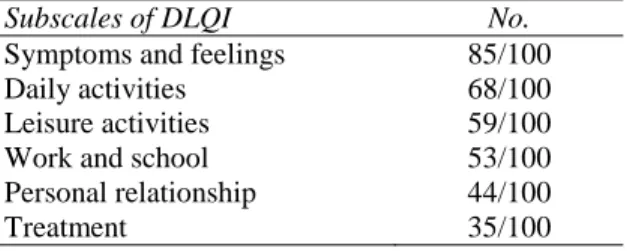
Overall mean DLQI was 7.84, (females 8.02, males 7.82), range 3-27. Patients within age group of 18-21years had a mean DLQI of 8.73 (range 6-27) and those between 22-30 years, 6.84 (range 3-24). DLQI grades seen in our population are tabulated in Table 3. There was no association of DLQI with complications like pigmentation (p=0.198) and scarring (p=0.095). This descriptive questionnaire was assessed in 6 subscales as given in Table 4.
Twenty-two patients were severely embarrassed, depressed, self-conscious, upset or sad due to their skin. Out of these 22 patients, 16 (approximately 64%) patients had DLQI score of more than 10 and 36% showed less than 10. Severe acne was recorded in 18 patients (82%) and milder forms seen in 4 (18%). On statistical analysis, there was significant association between depression and acne severity, whereas no association with depression and DLQI scores (p=0.246).
Table 1 Precipitating factors for acne Precipitating factors N & %
Stress 31
Oily foods 31
Premenstrual flare 50 (females) Table 2 Grading of severity of acne (n=100).
Grade Clinical characteristics N & % Mild
acne
Presence of a few papules and pustules mixed with comedones, but no nodules
15
Moderate acne
Presence of many papules and pustules, together with a few nodules
33
Severe acne
Presence of numerous or extensive papules and pustules, as well as many nodules
52
Table 3 Dermatology life quality index (DLQI) scoring in patients (n=100).
DLQI N & %
No impairment (0-1) 10
Mild impairment (2-5) 28
Moderate impairment (6-10) 35 Very large impairment (11-20) 26 Extremely large impairment (21-30) 01 Table 4 Subscales of dermatology life quality index (DLQI) in study population. (n=100)
Subscales of DLQI No.
Symptoms and feelings 85/100
Daily activities 68/100
Leisure activities 59/100
Work and school 53/100
Personal relationship 44/100
Treatment 35/100
Among the total 100 patients, 26 had DLQI>10, 13 of whom had severe acne and rest 50% had mild to moderate acne. On the other hand 54/100 patients had severe form of acne and amongst them, more than 10 scores were noted in only 13 (24%) patients and less than 10 was seen in 76%. On further statistical analysis, we found significant association between severity of acne
Discussion
The impact of acne on QoL has been studied by many nationalities; but Indian studies are few. Comparison of prevalence between different studies is difficult because of differences in the questionnaire design, study setting and population characteristics. Most of the studies have included a younger age group (13-18 years), whereas our study included patients (mostly students) aged 18-30. Females and males were in equal proportion.
Physical and psychological impact of acne in adult females was assessed in 11 females by Pruthi et el.5 using a semi-structured clinical interview of the Skindex, a quality of life measure for patients with skin disease, and high emotional and social impairment, in terms of the feelings of physical discomfort, anger or both was seen. A cross-sectional questionnaire-based study by Gupta et al.6 in India using global acne scoring and Cardiff acne disability index found no correlation between severity of acne and an impaired quality of life, rather those who consumed alcohol and smoked had impaired quality of life. Increasing age was associated with progressively lesser severity of lesions and increased impact on quality of life.6 Durai and Nair7 conducted a prestructured, questionnaire-based study on 140 acne patients attending their dermatology OPD, utilizing DLQI, as well as, Cardiff Acne Disability Index (CADI) questionnaire. Their mean DLQI score was 6.91 and the mean CADI score was 5.2 with statistically significant association between the scores, and impact of acne on quality of life was found to be less compared to other studies, with age, occupation, marital status, family, and treatment history played a role in affecting the QoL. Diet, smoking, and alcohol did not influence the QoL.7
The mean DLQI score was found to be higher in our patients (7.84) when compared to studies by Durai and Nair7 (6.91) and Jancovick et al.1 (4.35). Females showed higher DLQI scores when compared to males which may be because females are more conscious of their appearance. DLQI scores were significantly higher in 18-21 years when compared to 22-30 years. Half the females had premenstrual flare, a significant precipitating factor when compared to stress and food.
Martin et al.8 and Durai and Nair7 observed that the QoL correlated with acne severity and the scores worsened with increasing severity. This was duplicated in our study. We conclude that acne has a significant negative impact on QOL. Patients with history of depression, anxiety, embarrassment and social phobia suffering from acne surprisingly did not have higher DLQI scores.
While assessing the 6 subscales of DLQI questionnaire, we found self-consciousness and daily activities to be most affected; leisure and work activities moderately affected; personal relationships and treatment least affected.
To the best of our knowledge, there are no studies which have evaluated the effect of acne on these individual aspects of life.
Limitations of our study are that the population was restricted to patients visiting our outpatient department. Only DLQI questionnaire was used for evaluation. The questionnaire used is suitable for the detection of psychosocial problems, but not sufficient to diagnose depression or anxiety without clinical assessment.
Conclusion
effective treatment, improvement of the psyche of the patient should be targeted along with medical treatment. Psychological/psychiatric consultation should be sought in select conditions; this can be facilitated by setting up a separate psychodermatology clinics in all tertiary care hospitals, which will help to clear physical and emotional scars of the patients. Such clinics will also decrease the patients’ apprehension/aversion towards visiting a psychiatry clinic.
Acknowledgement
We are thankful to Drs. AY Finlay and GK Khan for providing license for use of DLQI in the study (License ID CUQoL1581).
References
1. Jankovic S, Vukicevic J, Djordjevic S, Jankovic J, Marinkovic J. Quality of life among schoolchildren with acne: Results of a cross-sectional study. Indian J Dermatol Venereol Leprol. 2012;78:454-8.
2. Kuyken W. The World Health Organization Quality Of Life assessment (WHOQOL): Position paper from the World Health Organization. Soc Sci Med. 1995;41:1403-9. 3. Finlay AY, Khan GK. Dermatology Life Quality Index (DLQI): a simple practical measure for routine clinical use. Clin Exp Dermatol. 1994;19:210-6.
4. Barnes LE, Levender MM, Fleischer AB, Feldman SR. Quality of life measures for acne patients. Dermatol Clin. 2012;30 :293-300.
5. Pruthi GK, Babu N. Physical and psychosocial impact of acne in adult females. Indian J Dermatol. 2012;57:26-9. 6. Gupta A, Sharma YK, Dash KN, Chaudhari
ND, Jethani S. Quality of life in acne vulgaris: Relationship to clinical severity and demographic data. Indian J Dermatol Venereol Leprol. 2016;82:292-7.
7. Durai PT, Nair DG. Acne vulgaris and quality of life among young adults in South India. Indian J Dermatol. 2015;60:33-40. 8. Martin AR, Lookingbill DP, Botek A, Light