Mounting Specimens
Labi
EQUIPMENT AND MATERIALS
YouH rsed
the
tollowing items to oompl(te this Ltbsessicn. (The standool kit
tot
this ho
ivailable from
wwwthehoit
scientistcon
iincludes the ferns
listed in the first group.)
MATERIALS FROM KIT
• Ovei oS
• Forco
• Fhpi to
• Scalpel
• Shd viil(
* Shdes fiat)
• Stain ethylene Oi re
* Stirriilp rod (optional)
MATERIALS YOU PROVIDE
• i3utiiie liphter (or oilier Paine source)
• Carrot (raw)
• 55j5 Jii(I iiiiIiW1tr
Ms oteiiie(priiciiased1)1 hoiiiernidii)
Petroleum icily
• rpU(iiIiCfl carrot
Specimen: human hair
Specii en: per id water
• Toothpicks
• Vegetahie oil(oliveor similar)
• Watcr, distilled
BACKGROUND
I ii ist nornt a ‘;poimen hetore t3Li
cart
i;bei
VOit
withyour
inicioscopeMountit p oonst
of p
paring the
specimen(it
tecess ary), placing
it on
microscope slide,
adding
adrop of w
or another mounting medium,
and covering the specimen and medium with a coverslip. lfl thi
ah session, we’H prepare
and observe
several types ol slide mounts.
PROCEDURE I2-1: MAKING WET MOUNTS
A wet
mount
is
the simplest and quickest way to prepare a specimen for observation. Fo mak
wet mount,
sitnply
position th specimen in the center of a sli Jo, place a
drop of water
or otho
miii
intant on the specir nen, and lower a
coverslip into place. r
naking
sure to
avoid bubbles.
lti’iit.ipiil.t n”t nilititisti it it is about loin
toi kr’itn ihetin, tdv.uii ntis that It inonni i’. i
loinporary hecaine the moniitingtinOwillovaporate infact,
tonghotquartz-liainpon lininination, watermayovanocite
.ilter only a mini feor two
MOUNTING A HAIR SPECIMEN
I. Obtain a hat ticimerl. (in calmnini’lysnip abtof jOUI
hair, hut rt’ more nierr’stirmgto o.irHHme aopecinenthat
includes theroot,(it’s ilso interesting to compare and
;ontrast the appearanceofspecimens from different
people of diftorent ages and hair cnlnrs, from tile head, lard or mustache, trunk, limbs, pubic. axillary[armpit]
‘pinno. from pets, and no 0111
fomom’ tom tin the 0l)€’cminri ritim mc for ii
nl,rOs,5it‘tile All.tdrop ofw itor, cai’tillly p0511
a coverskp it a45’ angie to the shde, andthen lower ‘‘ovenslipintoplace. Ittheme,ire any hnhhles nnder thr
ovomolip, mine thetip o[ the torcips to torcothem outI
ii icrfit ‘nit shp
‘I Ptmico tho ‘.lidtm urmrttrthe stageclips orii th nechani
‘Page and montgr tile npccmcnuniter the IX ‘iblectivi
A inst the illumination level and diaphragm to obtain Irmaxinnrm contrast, Readiust thero,ifnecessary to oh
maximum Imagedetail Note the amount of detail visit liii main tndy of the bitt versustileboundaries
4 RepeatstepP o view thehair mt 1LiOX ann 400X, notir
lIlyadditional detail tlmat’sv sibie ithigher magnifc..it
Rocordyournbservations ri your lab notebook. Shoot in image ormakea sketch,asshowninFigure P20, to
illustrate the major structUral elements visible in the h
ynu have aneyepiecemebcie, use itto estimate the wid hi hair awl the owe at any structures visible.
Rat,iin this slidei,ir literconnparisorr
* , t’l’: :‘i’’i it ,‘‘ic’i 1 Ii i’ci,’
11;,’ ii’t’.tl.
iIi)l.l’;t.tmti(fi !il ‘i ‘iS its UI offci lmt1p0m’1ii5 inom..tnth
“(on can utoiloot t.t,’UnLiott.t
Son count 15 Iii opuI.•..tr ira‘1:1 Sonis(;iOifco 0 5npf
cbs,01 ,‘iii.titOH 1l’..’...1,’ir Ii
‘iii:. .ii ,‘,‘‘ ‘.‘ i_t.’,ii’/t’•i’
.,.t 1
:
5 r:i’ :rOi .‘‘.,it’/‘‘i1i
1_il t’.’’i’ f ii’,, i.’’l’’.im’’i’t
[igurcl-2-1:,-ii
—
COMPARING TEMPORARY MOUNTING FLUIDS
[fin rc[r,jctier .ndi fIr’ rrocrrtiiifllid ‘‘DiiLiDeI iiiS
1 major effect errtIrejrric’iiiitaridtypeof ifefiil ‘JisihlO In
a specimen. b’ RIif‘rifnrn. a rrol’nmm th;mf thenimni
cOmponent of h,inr ii, ,rfnniit 1 52. elose totfi,if of [lieglris risen in the rnicroscopcr elide ,iretcuver SID.Lot finn from the 133 RI of
water
If a colorless solid oblectiLimmersed inacolorlessliqLnnd
with the canoe refractive index as the object,it disappears.
You can verify this withiiglass stirring rod and some water and vegetable oil. Fill a beaker or other container with water and immerse the stirring rod, The rod remains clearly visible because its RI (about is quite different from the 1 33 RI of water If you replace the water with vegetable oil (RI about 1.5÷) the rod hecorries invisible in thelnqLnnd (or nearly so)
because the refractive indices of the liquid arid solid object are
so similar. It they’re ndentical, the nblect disappears completely
That’s whyit canbe near 1y impossible to see bacteria or other
rnicroorgamnrsms in water unless they are stiiinenf
ii.
errin ‘j’f,ihI’rIi.i’t
ii I’ miii fl’’ ,l.iu rrv.
[IIi’’,f)’ ‘In’Ini’mni’l’i II
‘.“rten Ilu.i’ inn’ liii, tl’c’Iin’Ict’’i \‘‘c’cs,mnnr[ tIe 15 ehprn.fivt mnt’r l’i.ne’’ I neon e,irr’firiy iini
nitthen ,idInm’t tin’ nllnnninn.ntiuin level arncf ifi.ipt
uht,inn the fni,mxiinii a n n;ontr ant Fe’,f(llnnst [[rem, to olifiii nnaxanrmin inimpe detnil Note fbi anne vi’,iblein the memo liridyof the heir versn’ifheb
i ‘livitch to the ,lirl,’ yen nninnbe previoii’ly, mu
noire miii . ru I VteiI veshle ‘mire‘‘nit’ ‘i em., mm;uni’er’c:i’nimn
Cmii ‘mii,’rvnfiu,mmr,,inicirunni Inmennimne icy
Figure I—22: Wet ii’/vnr’nn/) nnonritat brmiirr,rir [renal Ira
Consider the implications of the mounting fluid you the first instance, you used water, by far the most cc
mounting fluid used for wet mounts. In the second ir you used glycerol or vegetable oil, whose RI is close Permountarid ether permanent mounting fluids. Th
arid type of detail differed noticeably between the tv
[fiats why experienced rnicroscoprsts generally kee selection of different nrouritnng fluids readily availab
;‘.,f.’rtiifi.’O’,’r/ urn u’r•rrt erir.ar,:nriei/ .ruu’et.’nrftn’rrrrr1 (rrd.
iouieitrrilroeLnu’, iiirnionjot (I.s).and a f.:iniriiiIiaIcectirr rnon.irrt (t.r.;). Bcetn•.•.rrei rn rbothn.ir inrlivic.boai cull’, are n..msr.naliy rnoi noted uP. eerrearroeurd (err. 2
1_ab —2 Morinnf mm I,[
PROCEDURE I22: MAKING SMEAR
MOUNTS
Othit frhiilfit
ut What
itoiiiijd,
iikio run
pie
1ulitl ur
Itqiitd
piu;irtien
[hit Luntain
hacturia or other ct.II on a hde
nd
then
aner it to
produt;e
a thin layer If
the
ipucimen
toe
it
as-is II to
asohd opecimen mix a hit of
it
with a drop of
water oranother mor
[Ii d hefore oin the smear
fOlio ki rtii Di
11..
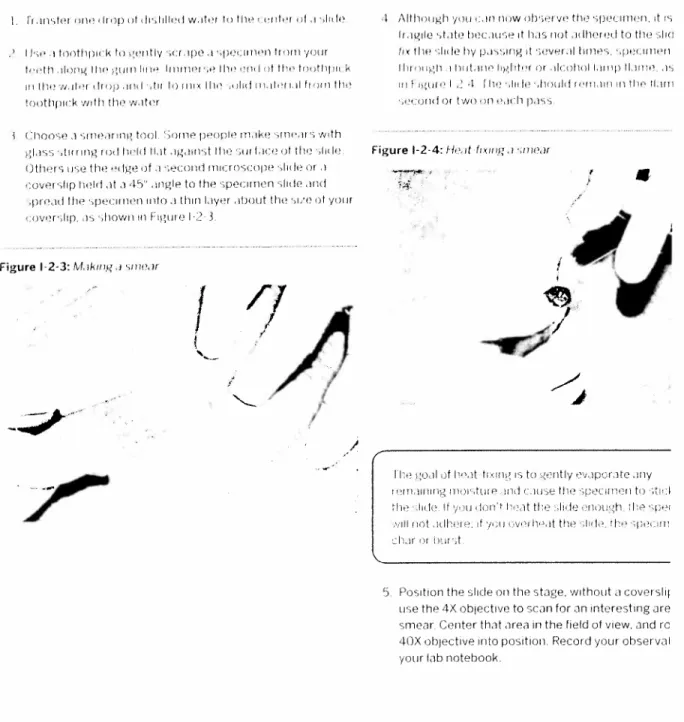
.isirearirii .orne pee[i!i inoke Si000rO of
glis turing niH hit lit 10110/I fir tico UI thu
0th rt use theeuIrt4,l it secuiiiI1010111 cope huh? or
covislip held it i 1k ungle to the sp:umen stole irud
pr Sill I 1w SiJiicui ii tiitO 0thin 101 .ii iiiut the ce t ;u 1
O/l ll1. .11/shownIii 5th 0Ii 3.
Figure 1-2—3:biilrlii 1 iii,
All h uuI1 you cue t si ‘I roe [h ii lu it
ii tih tilhe .iu it ii; i/I 1Ii i 11ti Ptsluc lifeliv 11051 50111 ii 1. 110111
iii lU 0 iilUioop 0. H
Figure 1—24: Flit tioug i irueor
If Ii
the . Ft. k/eu don [ . -.it ii • sOle0100
ittit ion/re: /00 ouihtrtit theSF010.
ci or or ou rot.
5 Positionthe slidenitthestorge,without tcoverslij
iso theHXobjective to icon for oti ntorestingore omeor. Centerlimit irei in the heldof view.ond no -lOXobjectiveinto position.Recordyourobservuit yourtubnotebook
4
/7
/
PROCEDURE I’2-3: MAKING HANGING DROP MOUNTS
ie
/
hit tpn;p
dt
op
roe/hod is
used to observe
living microorg
Otsi irs,typicolly
protozoi,
illtht
iritutil
env ourirent ihe idvuritree to mine the hrngingdrop method is thit you
(OUtobser
the
or. rimslive otid iindorriged ioIne ibor.it thrir
nuhimo, runVtriiroririd, tiedirici. jrrd
on,
Hi’ disidvoritoge is
thot
some ot the little buggers ire
tiP.
(You
conslow them
doWnby
o iding o drop ot n rethyl cellulose or glycerol to the water.) E3ecius e they con move ;iround in
three
ihn’o I ‘Vms.t
colthi cirollirigino
toke’
1
r
thorn
ri
the timId of viow
utd
ittlor:us
eon (fit pee. orion inbee ion new heri n h n.
elo.lyir’i( o’ii’5 V.it 05. her ire the
t•n.ir.(idotle ‘ [)i5)J( ii’! ne”Oyeii ‘ire
ijflh
fir It, i’1’f1
iiet-edges of the envmrelip 1 fee oemeneoph to termj
hot\ieen iii CoViOip ii1(1tb’elide
I. ‘i h i tti’’”i i]’’liiiI iiL ilti el ti
‘ielp. .tre’iiiin I‘‘nil /
Figtire b25: te(;’,t(rfin ‘‘of‘.;‘“t’ ‘0
.5. Iiv it ii V II 515.1 (well leWiS.O,enter theV .11 iiii tt•
Ce’ WrSSlip .iini lOwer the stile into the Covei’Op. (Ice
5, thin’the lideCiitheStipe. (‘(nitenlic( the dee of 10 oh1
P Aiiiiist fun dieiptimoin to itsiii.iiiet ettllif’ IOUff0,
hilnininilton tothe middle ofitsrange
I f, ii’-. Onlf’io of.notlii itrom,, pfinn.fiehonki beviii
crneoni.e iiin,.mud nepo.nhoin 110 ilide ii i”on’ni,ury t’
tfinettgeftfneitriipin the i’eiileiot the field ofviny,
‘(‘(inn f)I’tOII,it,’ tt’n’IniriiV1,i 011 iOn’ non,, in
or oilier profoi’ninr iifir tot ‘fVIEW ifso icenfen it
het you(urn) inn the tieidofviewand switch to the11
oblectiVe to observe tot ther details. Note thatit
is n
(moves on itsOwn)and Tiny he difficult to keep fociit ‘nOrrns ‘hound inn the wmter drop.
9. if there alenopr otists visiblein the fieldof view, rec
tile field on the edge of the drop arid rotate the 4X c ole posifiinn.Scanthewater illopto iocate one or deforms, center thearea of interestinthe field of v
androtatethe
lOX
obtective into position to obser V more closely. Continue scanning at tow powerto1wadditional hfetorms, and identity as many different
youcan find
rI ii_Itr:
1 Ii r ii hi pi itO nlE i hp
them
)
To liii (end irde odd one urop 01 rnothviine blue stain, allowit to work for 30 ser orids or so, and tiwn usothe corner of a tissue or paper towel to draw off the excess stain Add on drop ofwaterto the specimen ar put a coverstip in pIice
REVIEW QUESTIONS
1:
‘\‘ti, I iro iii :id.iriticoo iiiilIrjWhcksut Vv’’dIii
rd your ‘l’-’’r v,itriiris i
lb Rep at steps liii Ough 0, using piece of car
to prodi ice a or ipitudinal sectior Compare ar
the stained cr ossection arid longrtndinabsm
and record yniir nhservatron, sonr lab nob?
Q
2:
Why night yn use a monntinp ibid other than water for mskin,e a wet mount”Q
3:
lAltatare tim advantages and di awbacks at, r hanging-dr op mountQ
4:
HoWwouldyin slowdown last rrroving livemicroorganismsIn make iteasier to viewthem?Q
5:
Why might you make both cross-sectional and longitudinal-sectional mounts of a specimen?Q
6:
If a forestry corrrpan’/ cutsdowna tree, which type of section are they performing? if they cut that tree trunk intwhattype of sectioning are they doing?